


Abstract
The armless snake eel, Dalophis imberbis, is a fossorial rare species. It is considered to be a non-target fishery resource with elusive behavior, and there is a paucity of knowledge regarding its distribution and biology. This study reports three new documented occurrence records of D. imberbis along the northern and southeastern coastal areas of Sicily (central Mediterranean Sea) during 2025. Specimens were collected at depths ranging from 43 m to an unusually shallow depth of 5.4 m, extending the known upper vertical limit of the species, which was previously considered a 20 m depth. Environmental parameters were collected through a multiparametric probe and integrated with products from the Copernicus Marine Service (CMS), providing new insights which highlight the presence of the species in relatively warm (17.6–20.8 °C) and moderately oxygen-undersaturated (6.9–8.5 mg/L) waters. A global distributional analysis was performed by aggregating the field data with literature records and datasets published in the Global Biodiversity Information Facility (GBIF), refining the distribution of the species in the Mediterranean and Atlantic Ocean. Thus, the three new records expand the known distribution of the species in the center of the Mediterranean Sea, providing an updated bathymetric range and the first preliminary insights into the environmental preferences of this data-deficient ophichthid. This work underscores the importance of combining traditional surveys with big-data repositories and remote sensing to monitor rare marine biodiversity.
1. Introduction
Dalophis imberbis, commonly known as armless snake eel, is a fossorial fish with serpentiform body belonging to the Ophichthidae family, a worldwide taxon which comprises 377 species [1,2]. The species was originally described as Sphagebranchus imberbis Delaroche, 1809 [3] based on a live specimen from Ibiza (reported as Iviça), Spain, found in a fish trap for eels. The body is extremely slender, elongated, almost-cylindric, and, excluding its pointed extremes, has a uniform thickness of a finger. It is characterized by slow and snake-like movements, hence the name. The coloration is purplish gray on the dorsal side, characterized by a multitude of small brownish-purple spots densely clustered on a grayish background. The ventral side is yellowish white with silvery reflections.
Dalophis imberbis is the only species of the Dalophis genus inhabiting both the Mediterranean Sea and the central eastern Atlantic Ocean [1]. Although the other four congeneric species are distributed along the Atlantic coast of Africa, knowledge about the genus is limited due to uncertainties in the taxonomical identification, especially during the leptocephali larval phase [4,5].
The Mediterranean occurrence of D. imberbis has been documented in recent records, which confirmed its presence from the western to the eastern basin, although it is still considered rare in the easternmost Levantine basin, in the Adriatic, and the north Tyrrhenian Sea. It seems common in other areas, especially in the central and southern Tyrrhenian Sea [6,7,8,9,10]. The species is evaluated as being of Least Concern on the IUCN Red List [11]; however, it is considered globally uncommon and a non-target fishery resource, occasionally caught as bycatch in trawl hauls [7,12]. Therefore, studies of D. imberbis result in partial knowledge.
Little is known about D. imberbis ecology and biology; it inhabits soft bottoms, burrowing in sand or mud, at depths between 20 and 100 m [1,12,13]. No information is known about its tolerance limits for environmental parameters. The species seems to have nocturnal behavior [13], but nothing is known about its functional traits.
Dalophis imberbis has been genetically identified during the leptocephali larval phase in different areas of the Mediterranean Sea and Atlantic Ocean [14]; nonetheless, nothing is known about its reproduction cycle or many other traits, such as its feeding or behavior, or whether it is a solitary or gregarious species.
In contexts where traditional scientific literature lacks detailed data on a species, big-data repositories can offer an indirect, powerful alternative for knowledge extrapolation. The Global Biodiversity Information Facility (GBIF; https://www.gbif.org/ accessed on 18 November 2025) is the principal gatherer of biodiversity occurrence records worldwide [15,16]. The potential of the GBIF platform is its capacity to cross-reference data from different sources with the accuracy and reliability given by the standardization of records. In fact, the data stored in this repository are not only from research datasets, including molecular databases (e.g., BOLD, https://www.boldsystems.org/), but also from museums or Citizen Science projects (e.g., iNaturalist, https://www.inaturalist.org/).
The present paper aimed to report the first documented observations of D. imberbis on the island of Sicily (Southern Italy), focusing on the physical environmental parameters to refine its ecological profile with the first insights into habitat preferences and define the bathymetric and geographical range of distribution of the species, with the integration of literature data and datasets retrieved from GBIF.
2. Materials and Methods
A survey of the macro-zoobenthos bioindicator in soft bottoms was conducted along the coastal areas of the island of Sicily (central Mediterranean) during 2025. A Van-Veen grab of 18 L was used.
Some individuals were unintentionally captured alive during the sampling operations, and to ensure the survival of the specimens, they were immediately released.
Identification was performed onboard based on diagnostic morphological features (e.g., cylindric body, color pattern, head shape, absence of caudal and ventral fins), following Delaroche, (1809) and Fischer et al., (1987) [3,17].
The survey protocols included the collection of water column parameters using the multiparametric probe Idronaut Ocean Seven 316Plus (IDRONAUT S.r.l., Brugherio, Italy) and data on temperature, conductivity, salinity, pH, oxygen in mg/L, and fluorescence from June and October, which have been associated with the presence of the records. In a further sampling in November, the data collection of parameters was not scheduled, and the values of surface and bottom temperature and salinity were therefore extracted using E.U. Copernicus Marine Service Information from the Mediterranean Sea Physics Analysis and Forecast product [18,19], while dissolved oxygen was extracted from the Mediterranean Sea Biogeochemistry Analysis and Forecast product [20]. Calculations were managed and handled in QGIS Development Team, QGIS 3.34.11 [Software] (Version 3.34.11, 2024).
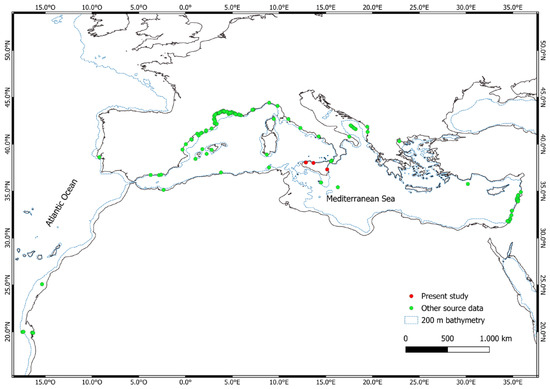
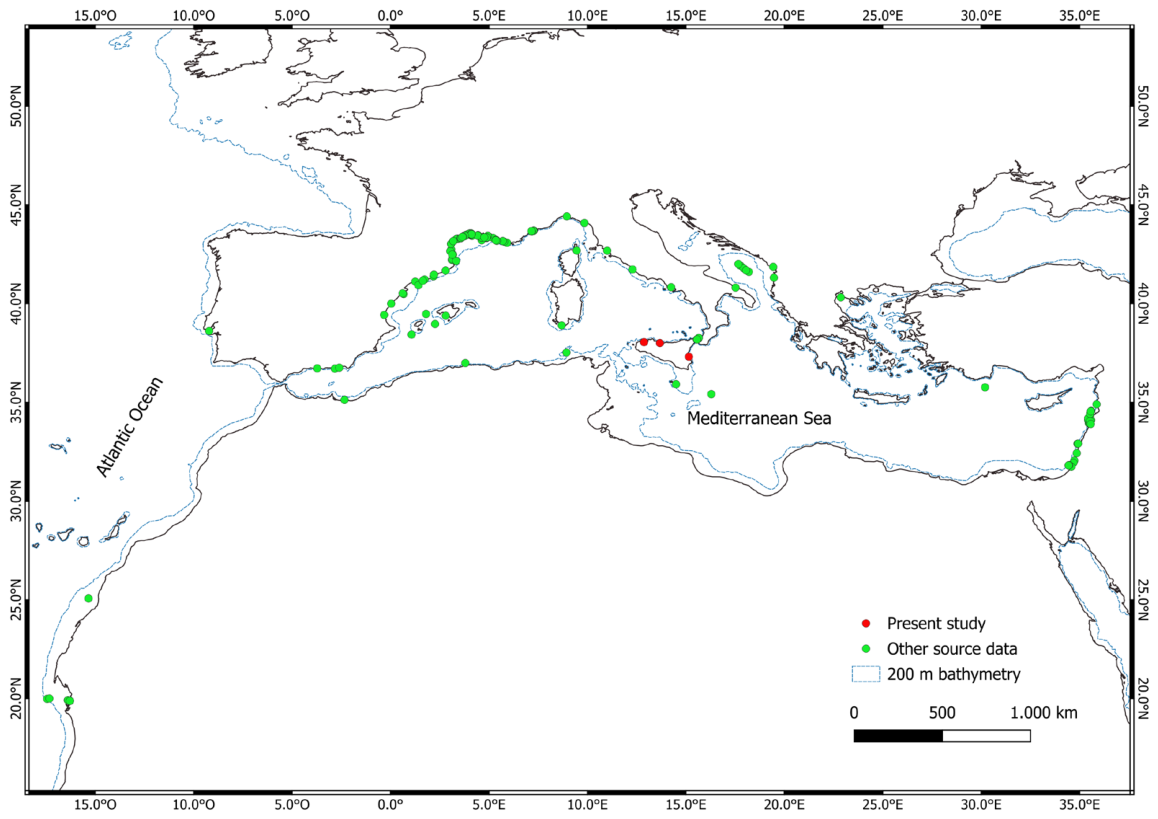
The global distributional map (Figure 1) was generated by aggregating the new Sicilian records, with data from both the literature [4,6,7,8,9,10,12,13,21,22,23,24,25,26,27] and the GBIF database [28], filtering for the species Dalophis imberbis. Occurrence records from the GBIF dataset and from the literature whose coordinates were absent or generically calculated based on the centroid of the area (e.g., Mediterranean Sea, Adriatic Sea) were not taken into consideration.
Figure 1.
Geographical distribution of Dalophis imberbis: red dots represent individuals from the present study; green dots represent records reported in the literature and the biodiversity online databases [4,6,7,8,9,10,13,21,22,23,24,25,27,28]; blue dashed line represents 200 m depth bathymetry.
3. Results
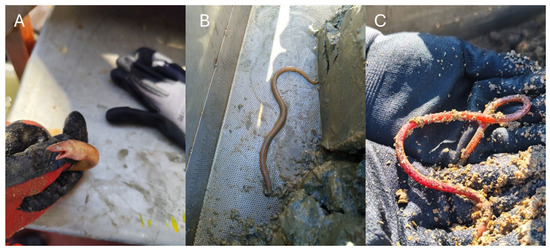
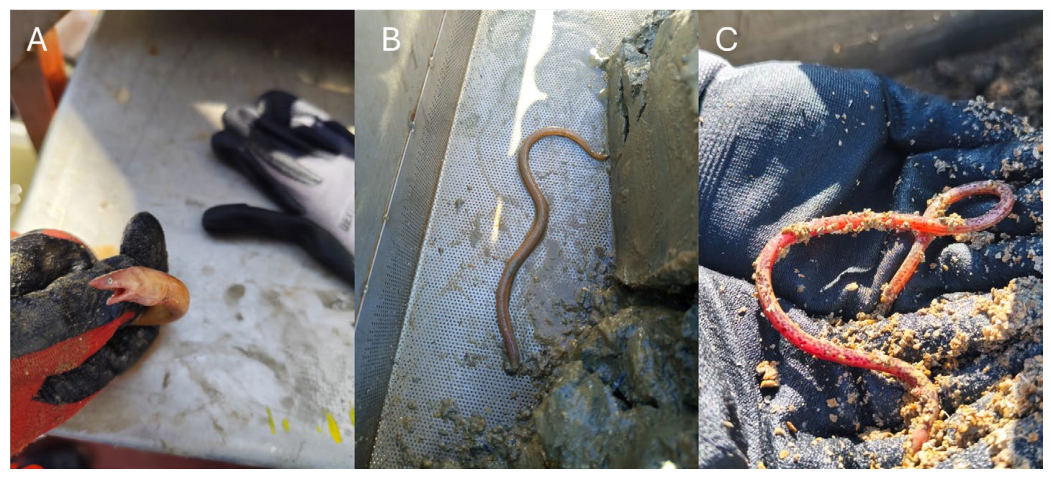
A total of three live individuals of D. imberbis (Figure 2) were accidentally caught. Two specimens were recorded in two different stations in northern Sicily (MZB_18B; MZB_7B) and the third one in southeastern Sicily (MZB_42A) (Figure 2; Table 1). The first individual (Figure 2A) was collected on the 26th June 2025 in front of the Termini Imerese Port (MZB_18B) in Termini Imerese Gulf, the second (Figure 2B) was collected the 18th October 2025 at Guidaloca Beach (MZB_7B), in the Castellammare del Golfo Gulf, and the third specimen (Figure 2C) was caught the 11th November 2025 at Agnone Beach (MZB_42A), in the southern extreme of the Catania Gulf.
Figure 2.
Specimens of Dalophis imberbis captured along the Sicilian coast, and soon after released; (A) sample from the site MZB_18B in Termini Imerese (Palermo); (B) sample from the site MZB_7B in Guidaloca Beach, Castellammare del Golfo (Trapani); (C) sample from the site MZB_42A, in Agnone Beach (Siracusa).
Table 1.
Occurrence records of D. imberbis are reported; columns show capture information, specifically the event date, the coordinates, and the body length.
In the first and second sites, the bottom was muddy, while at the third station, the bottom was composed of coarse biogenic sand; the depths were, respectively, 19 m, 43 m and 5.4 m (Table 2). Onboard, body length was estimated to be approximal 500 mm for the first individual, 300 mm for the second one and 250 mm for the third (Table 1). Registered parameters at bottom for the first two individuals showed a temperature of 19.7 °C and 17.6 °C, oxygenation of 8.4 mg/L and 8.6 mg/L, density of a-chlorophyll ranging 0.16–0.29 mg/m3, pH ranging 8.10–8.20 and mean salinity of 38.1 ppt (Table 2). Parameters calculated by the models showed a temperature of 20.8 °C, salinity of 38.5 ppt and oxygenation of 6.9 mg/L in the station of the third individual (Table 2).
Table 2.
Environmental information for each site; specifically, bottom composition, depth of the catch, and water parameters. These last refer to the surface (S) and bottom depth (B). Temperature (Temp.), conductivity (Cond.), salinity, pH, dissolved oxygen (Oxygen), Fluorometer. Water parameters of MZB_42A-Siracusa were extrapolated from the E.U. Copernicus Marine Service Information [18,19,20]; NA: not available data.
The GBIF dataset resulted in 351 occurrence records ranging from the year 1845 to 2025 [28]. The dataset was composed of 42 sources [25,29,30,31,32,33,34,35,36,37,38,39,40,41,42,43,44,45,46,47,48,49,50,51,52,53,54,55,56,57,58,59,60,61,62,63,64,65,66,67,68,69], of which the primary one was iNaturalist (168 records). The other records in the dataset came from different typologies, such as single occurrence records, genetic records, or museum specimens. The distributional map (Figure 1) was made using 286 georeferenced records, including the new records of the present study and data from GBIF and the literature.
4. Discussion
The three Mediterranean occurrence records of D. imberbis represent the first documented observations into northern and southeastern Sicilian coastal marine habitats. The presence of the species in Sicilian coastal waters was not extensively reported; it was generically reported as bycatch only in bottom trawl surveys in waters (55–115 m) in the southern Tyrrhenian Sea [12]. Additionally, data from GBIF documented four old (1845–1960) preserved museum specimens from the Strait of Messina [33,36,48,69].
These three recent occurrence records confirm the presence of D. imberbis in Sicilian coastal waters. The species may be more abundant and distributed along the island than was thought.
As similarly seen for other rare species [69], the integration of this new data with information from different types of historical record sources depicts a more accurate distribution of D. imberbis. The presence of the species in the eastern Atlantic Ocean is confirmed by a few documented records; in Mauritania by an old (1988) museum specimen and by environmental DNA analyses [51,66], and Portuguese waters through the images of animals published on online biodiversity platforms [40]. The Mediterranean distribution of D. imberbis appears more uniform, especially in northern and northwestern coasts, in Spanish and French localities (Figure 1), confirmed by a high amount of citizen data [40]. Its presence has also been confirmed in different localities in the central Mediterranean waters, but, due to few records, the presence results are small along the African coast and there is an absence of records between Tunisian and Egyptian waters [28]. On the other hand, in the Levantine basin, the species appears to be more abundant than was previously reported in the literature [8,28]. The Aegean Sea and Adriatic Sea remain poorly studied. Their relative information was extrapolated from fishery data sources, and this did not allow specific areas to be searched well for the presence of D. imberbis, although information indicates the presence of leptocephali larvae in the Adriatic Sea [10,23,27,28].
The present captures are in accordance with actual knowledge on the morphology of the species; the total length is comparable with previous data (e.g., 429.7 ± 62.3 mm in [6]), and the type of bottom substrate is in line with other records [7,8,12].
Only one individual has been caught on each site; consequently, it is not possible to surmise whether they live in aggregate groups or not. Indirect information comes from an unusual massive stranding event (201 dead animals) and from the estimate of low density (20 ind./km2) in trawl surveys [6,12]. On the other hand, information from GBIF suggests a more precise scenario: many images showed the animals engaging in gregarious behaviors, with two or more individuals burrowing close to each other [40].
Analyzing the depths of the three individuals, the two from northern Sicily were in line with the literature, whereas the third was found in very shallow waters (5.4 m). This record might indicate the extension of the known upper vertical limit of the species, suggesting its potential presence in shallow infralittoral habitats. Since scientific knowledge of the species is linked to sporadic bycatch records, the upper limits may have been underestimated for a long time due to the under-sampling of shallow waters by traditional fishing gear. In fact, a similar observation comes from scuba divers, who claim to have observed individuals at 4–5 m in S. le Bris, France [13]. Moreover, despite the depth of sightings not being registered, two other indirect pieces of information may suggest that our observation is not sporadic and could be a real indication of the need to extend the upper limit of the species. First, through GBIF records, D. imberbis individuals have been photographed by recreational scuba divers in coastal areas (usually less than 20 m) [40]. Second, a high number of beached animals [6] may indicate that D. imberbis is a shallow-water-dwelling species. The nearshore sighting may indicate an ecological plasticity of D. imberbis habitat preference, while its presence may be explained by the rich environment of the area; in fact, the site was characterized by the proximity of two significant river mouths (i.e., the San Leonardo River and Simeto River) which might cause an elevated productivity assessment of the area, confirmed by the coarse biogenic sand bottom (Figure 2C; Table 1).
Little is known about the deepest limit; some information comes from trawl surveys, which have reported the species in hauls in layers 51–115 m [12,23].
The water parameters also showed interesting patterns. Individuals were reported in warm waters (Table 2). This may suggest a high tolerance of the species to high temperatures, exhibiting a thermophilic behavior which allows the species to live in the tropical Atlantic area [8,24,25,26,28].
The oxygenation parameters showed interesting results; D. imberbis was caught in well-saturated water and in moderately sub-saturated water (Table 2). This may indicate a wide tolerance to different oxygenation parameters with a possible adaptation to hypoxic boundary conditions.
Although these records provide novel insights, the small sample size and the opportunistic nature of the sightings must be acknowledged as study limitations to address as future challenges.
5. Conclusions
The present study provides a contribution to the biological and ecological knowledge of Dalophis imberbis, a species long characterized as data-deficient. This new data expands the known geographical range of the species in the central Mediterranean, reporting the presence of the species in three different coastal sites of Sicily.
The record at 5.4 m depth suggests a potentially wider presence in shallow coastal habitats than previously assumed. Furthermore, this work reports indications about characteristics of the environment for the first time and may constitute a baseline to describe the hypothetical range of habitat preferences for D. imberbis when more data is available.
While the species is currently well-established in Mediterranean waters, the north-eastern Atlantic distribution is not well-studied. The northernmost Atlantic records are presently limited to the Portuguese coast.
Our results demonstrate that integrating traditional field surveys with high-resolution environmental modeling and big-data repositories is a powerful strategy for monitoring elusive and rare marine biodiversity. In conclusion, this work not only reports new records from the coast of Sicily but also refines the distribution and the hypothetical range of habitat preferences of D. imberbis.
Author Contributions
Conceptualization, M.B. and S.L.B.; methodology, M.B. and B.S.; investigation, M.B.; resources, B.S. and S.L.B.; writing—original draft preparation, M.B.; writing—review and editing, S.L.B.; supervision, S.L.B.; funding acquisition, B.S. and S.L.B. All authors have read and agreed to the published version of the manuscript.
Funding
This research was partially funded by the National Recovery and Resilience Plan (NRRP), Mission 4 Component 2 Investment 1.4—Italian Ministry of University and Research, funded by the European Union—NextGenerationEU; code CN_00000033, Concession Decree No. 1034 of 17 June 2022 adopted by the Italian Ministry of University and Research, CUP B73C22000790001, Project title “National Biodiversity Future Center—NBFC”. Collaboration agreement between the Sicilian Region, Department of the Basin Authority of the Hydrographic District of Sicily, and ARPA Sicily for the implementation of the FSC 2014 POA financing line—Action Line 2.3.1 “Interventions to improve the quality of water bodies, and related Technical Annex and Supplementary Act—EQB Monitoring Coastal Marine Waters: Surveys of Posidonia oceanica meadows; Benthos determination of hard bottoms using the Carlit method; Determination of soft bottoms; Phytoplankton determination—L5” intervention line (CUP F62G16000000001).
Institutional Review Board Statement
Not applicable.
Data Availability Statement
The original contributions presented in this study are included in the article. Further inquiries can be directed to the corresponding author.
Acknowledgments
The authors are grateful to Li Vorsi Andrea and Ponzé Nicolò for providing the photograph of the third individual (Figure 1). The authors are also grateful to the three Reviewers for their valuable suggestions.
Conflicts of Interest
The authors declare no conflicts of interest.
References
- Froese, R.; Pauly, D. FishBase. World Wide Web Electronic Publication. Version (04/2025). Available online: https://www.fishbase.org (accessed on 7 November 2025).
- Van Der Laan, R.; Eschmeyer, W.N.; Fricke, R. Family-Group Names of Recent Fishes. Zootaxa 2014, 3882, 1–230. [Google Scholar] [CrossRef] [Scilit]
- Delaroche, F.-E. Suite Du Mémoire Sur Les Espèces de Poissons Observées à Iviça. Tableau Des Espèces de Poissons Que j’ai Observées à Iviça Pendant Les Mois de Décembre, Janvier et Février. Tableau Des Poissons Que j’ai Observés à Maïorque et à Barcelonne, Mais Que Je n’ai Point Vus à Iviça. Observations Sur Quelques-Uns Des Poissons Indiqués Dans Le Précédent Tableau, et Descriptions Des Espèces Nouvelles Ou Peu Connues. Ann. Muséum D’histoire Nat. 1809, 13, 313–361. [Google Scholar]
- Palomera, I.; Fortuño Alós, J.M. Larvas Leptocéfalas de Peces Anguiliforrnes En La Costa Noroccidental de África. Res. Exp. Cient. Buque Oceanogr. 1981, 9, 3–15. [Google Scholar]
- Blache, J.; Bauchot, M.L. Contribution à La Connaissance Des Poissons Anguilliformes de La Côte Occidentale d’Afrique. Bull. Inst. Fond. Afr. Noire 1972, 34, 692–773. [Google Scholar]
- Bonifazi, A.; Fratini, F.; Ventura, D. Unusual Massive Beaching of Dalophis Imberbis (Delaroche, 1809) (Anguilliformes, Ophichtidae) from the Central Tyrrhenian Sea. Thalass. Int. J. Mar. Sci. 2019, 35, 573–576. [Google Scholar] [CrossRef] [Scilit]
- Biagi, F.; Sartor, P.; Ardizzone, G.D.; Belcari, P.; Belluscio, A.; Serena, F. Analysis of Demersal Fish Assemblages of the Tuscany and Latium Coasts (North-Western Mediterranean). Sci. Mar. 2002, 66, 233–242. [Google Scholar] [CrossRef] [Scilit]
- Capapé, C. First Substantiated Record of Armless Snake Eel Dalophis imberbis (Osteichthyes: Ophichthidae) from the Syrian Coast (Eastern Mediterranean SEA). Ann. Ser. Hist. Nat. 2021, 31, 101. [Google Scholar] [CrossRef] [Scilit]
- Salvadori, S.; Coluccia, E.; Cannas, R.; Cau, A.; Deiana, A.M. A ZZ–ZW Sex Chromosome System in the Finless Eel Dalophis Imberbis (Anguilliformes, Ophichtidae). Genetica 2009, 135, 283–288. [Google Scholar] [CrossRef] [Scilit] [PubMed]
- Papaconstantinou, C. Some Rare Mesopelagic and Bathyal Fish Caught in the Greek Seas. Thalassographica 1990, 13, 35–39. [Google Scholar]
- McCosker, J.; Smith, D.G.; Tighe, K. IUCN Dalophis Imberbis. In The IUCN Red List of Threatened Species; International Union for Conservation of Nature (IUCN): Gland, Switzerland, 2022; p. E.T194982A2371472. [Google Scholar] [CrossRef] [Scilit]
- Busalacchi, B.; Rinelli, P.; De Domenico, F.; Profeta, A.; Perdichizzi, F.; Bottari, T. Analysis of Demersal Fish Assemblages off the Southern Tyrrhenian Sea (Central Mediterranean). Hydrobiologia 2010, 654, 111–124. [Google Scholar] [CrossRef] [Scilit]
- Iglésias, S.P.; Bergot, P.; Breton, P.; Brunelle, S.; Camusat, M.; Causse, R.; Charbonnel, É.; Chevaldonné, P.; Cordier, Y.; Cosquer, P.; et al. French Ichthyological Records for 2018. Cybium 2020, 44, 285–307. [Google Scholar] [CrossRef]
- The International Barcode of Life Consortium International Barcode of Life Project (iBOL). Occurrence Dataset. 2025. Available online: https://doi.org/10.15468/inygc6 (accessed on 18 November 2025).
- Steinke, D.; Gemeinholzer, B.; Martínez-Meyer, E.; Noesgaard, D.; Young, A.; Schigel, D. Globally Aggregated Biodiversity Data Impact Predictive and Descriptive Research. Proc. Natl. Acad. Sci. USA 2025, 122, e2519119122. [Google Scholar] [CrossRef] [Scilit]
- Heberling, J.M.; Miller, J.T.; Noesgaard, D.; Weingart, S.B.; Schigel, D. Data Integration Enables Global Biodiversity Synthesis. Proc. Natl. Acad. Sci. USA 2021, 118, e2018093118. [Google Scholar] [CrossRef] [Scilit] [PubMed]
- Fischer, W.; Schneider, M.; Bauchot, M.L. Fiches FAO d’identification Des Especes Pour Les Besoins de La Pêche. In Méditerranée et Mer Noire (Zone De Pêche 37); FAO: Rome, Italy, 1987; pp. 1201–1210. [Google Scholar]
- Salon, S.; Cossarini, G.; Bolzon, G.; Feudale, L.; Lazzari, P.; Teruzzi, A.; Solidoro, C.; Crise, A. Novel Metrics Based on Biogeochemical Argo Data to Improve the Model Uncertainty Evaluation of the CMEMS Mediterranean Marine Ecosystem Forecasts. Ocean Sci. 2019, 15, 997–1022. [Google Scholar] [CrossRef] [Scilit]
- European Union-Copernicus Marine Service. Mediterranean Sea Physics Analysis and Forecast; Copernicus Marine Service (CMEMS): Toulouse, France, 2025. [Google Scholar] [CrossRef]
- Feudale, L.; Bolzon, G.; Lazzari, P.; Salon, S.; Teruzzi, A.; Di Biagio, V.; Coidessa, G.; Alvarez, E.; Amadio, C.; Cossarini, G. Mediterranean Sea Biogeochemical Analysis and Forecast (Copernicus Marine Service MED-Biogeochemistry, MedBFM4 System): MEDSEA_ANALYSIS_FORECAST_BGC_006_014_MedBFM4 2023. Available online: https://doi.org/10.25423/cmcc/medsea_analysisforecast_bgc_006_014_medbfm4 (accessed on 18 November 2025).
- Béarez, P.; Pruvost, P.; Feunteun, E.; Iglésias, S.P.; Francour, P.; Causse, R.; De Mazieres, J.; Tercerie, S.; Bailly, N. Checklist of the Marine Fishes from Metropolitan France. Cybium 2017, 41, 351–371. [Google Scholar] [CrossRef]
- Lipej, L.; Dulčić, J. Checklist of the Adriatic Sea Fishes. Zootaxa 2010, 2589, 1–92. [Google Scholar] [CrossRef] [Scilit]
- Ungaro, N. Analysis of Demersal Species Assemblages from Trawl Surveys in the South Adriatic seaAnalyse Des Assemblages d’espèces Démersales à Partir Des Campagnes de Chalutage Effectuées En Mer Adriatrique. Aquat. Living Resour. 1999, 12, 177–185. [Google Scholar] [CrossRef] [Scilit]
- Golani, D. Checklist of the Mediterranean Fishes of Israel. Zootaxa 2005, 947, 1–90. [Google Scholar] [CrossRef] [Scilit]
- Bariche, M.; Fricke, R. The Marine Ichthyofauna of Lebanon: An Annotated Checklist, History, Biogeography, and Conservation Status. Zootaxa 2020, 4775, 1–157. [Google Scholar] [CrossRef] [Scilit]
- Bïlecenoğlu, M.; Kaya, M.; Cïhangïr, B.; ÇİÇEK, E. An Updated Checklist of the Marine Fishes of Turkey. Turk. J. Zool. 2014, 38, 901–929. [Google Scholar] [CrossRef] [Scilit]
- Papaconstantinou, C.; Kapiris, K.; Karachle, P.K.; Zenetos, A. Fauna Graeciae. An Updated Checklist of the Fishes in the Hellenic Seas; Monographs on Marine Sciences; National Centre for Marine Research: Athens, Greece, 2014; Volume 7, ISBN 978-960-9798-05-1. [Google Scholar]
- GBIF.org User Occurrence Download. 2025. Available online: https://doi.org/10.15468/DL.A59GGJ (accessed on 18 November 2025).
- Conselleria de Medio Ambiente, Agua, Infraestructuras y Territorio, Generalitat Valenciana. Banco de Datos de La Biodiversidad de La Comunitat Valenciana. Biodiversity Data Bank of Generalitat Valenciana. Occurrence Dataset. 2024. Available online: https://doi.org/10.15468/b4yqdy (accessed on 18 November 2025).
- Fong, J. CAS Ichthyology (ICH); Version 150.500; California Academy of Sciences: San Francisco, CA, USA, 2025; Occurrence Dataset; Available online: http://ipt.calacademy.org:8080/resource?r=ich&v=150.500 (accessed on 18 November 2025).
- Sibylle, R.; Vaz, S.; Cheret, I.; Tessier, E. CHALIST Survey Catch Data: Bentho-Demersal Assemblages of the Gulf of Lion (North-Western Mediterranean) from 1983 to 1992; IFREMER: Plouzané, France, 2025; Sampling Event Dataset; Available online: https://doi.org/10.17882/99956 (accessed on 18 November 2025).
- Nieto Rubio, P. Colección de Vertebrados (Naturalizados y En Fluido) Del Departamento de Zoología de La Facultad de Biología de La Universidad de Sevilla; Version 1.2; Universidad de Sevilla: Sevilla, Spain, 2018; Occurrence Dataset; Available online: https://doi.org/10.15470/iwd4nz (accessed on 18 November 2025).
- Senckenberg Collection Pisces SMF. Occurrence Dataset. 2025. Available online: https://doi.org/10.15468/xaofbe (accessed on 18 November 2025).
- Tom, M. Epifauna of Haifa Bay, Mediterranean Israeli Shelf-Moshe Tom’s Collection; Version 1.39; Ocean Biodiversity Information System (OBIS): Ostend, Belgium, 2025; Israel Oceanographic and Limnological Research. Samplingevent Dataset; Available online: https://ipt.vliz.be/iolr/resource?r=aaa&v=1.39 (accessed on 18 November 2025).
- Edelist, D.; Belmaker, J. Fish and Marine Invertebrates from the Israeli Eastern Mediterranean Sea; Ocean Biodiversity Information System (OBIS): Ostend, Belgium, 2021; Hellenic Center for Marine Research. Sampling Event Dataset; Available online: https://doi.org/10.15468/p3ub2f (accessed on 18 November 2025).
- Swedish Museum of Natural History Fish Collection NRM 2025. Available online: https://doi.org/10.15468/d7eitf (accessed on 18 November 2025).
- Inventaire National du Patrimoine Naturel Fish Watch Forum: Observatoire Participatif Des Poissons Marins—Observations de Poissons Marins Du Fish Watch Forum. Occurrence Dataset. 2021. Available online: https://doi.org/10.15468/jgfto3 (accessed on 18 November 2025).
- FishBase FishBase Database 2025. Available online: https://doi.org/10.15468/wk3zk7 (accessed on 18 November 2025).
- Carita, D.; Meister, M.; Ludes-Fraulob, E.; Wandhammer, M. Fishes MZS; Version 1.2; Global Biodiversity Information Facility (GBIF) Secretariat: Copenhagen, Denmark, 2020; Musée Zoologique de la Ville de Strasbourg. Occurrence Dataset; Available online: https://doi.org/10.15468/z0dq5e (accessed on 18 November 2025).
- iNaturalist Contributors. iNaturalist iNaturalist Research-Grade Observations; Global Biodiversity Information Facility (GBIF) Secretariat: Copenhagen, Denmark, 2025; Occurrence Dataset; Available online: https://doi.org/10.15468/ab3s5x (accessed on 18 November 2025).
- European Bioinformatics Institute (EMBL-EBI). GBIF Helpdesk INSDC Sequences; Version 1.163; European Bioinformatics Institute (EMBL-EBI): Cambridgeshire, UK, 2025; European Nucleotide Archive (EMBL-EBI); Occurrence Dataset; Available online: https://doi.org/10.15468/sbmztx (accessed on 18 November 2025).
- Lubinevsky, H.; Tom, M. Macrofauna of the Eastern Mediterranean Lsraeli Shelf; Version 1.57; Global Biodiversity Information Facility (GBIF) Secretariat: Copenhagen, Denmark, 2025; Samplingevent Dataset; Available online: https://ipt.vliz.be/iolr/resource?r=macrofauna_of_the_eastern_mediterranean_lsraeli_shelf&v=1.57 (accessed on 18 November 2025).
- Deudero Company, S. Marine Biodiversity Atlas of the Balearic Sea; Version 1.0; Ocean Biodiversity Information System (OBIS): Ostend, Belgium, 2025; Occurrence Dataset; Available online: https://doi.org/10.15468/3g2c3d (accessed on 18 November 2025).
- Guerrero, E.; Abelló, P.; Lombarte, A.; Villanueva, R.; Ramón, M.; Sabatés, A.; Santos, R. Marine Biological Reference Collections: CBMR-General (ICM-CSIC); Version 1.32; Institut de Ciències del Mar (CSIC): Barcelona, Spain, 2025; Occurrence Dataset; Available online: https://doi.org/10.15470/qlqqdx (accessed on 18 November 2025).
- Solís Fraile, G. Museo Nacional de Ciencias Naturales, Madrid: MNCN_ICTIO; Institut de Ciències del Mar (CSIC): Barcelona, Spain, 2020; Occurrence Dataset; Available online: https://doi.org/10.15468/emdpoi (accessed on 18 November 2025).
- Quesada Lara, J.; Agulló Villaronga, J. Museu de Ciències Naturals de Barcelona: MCNB-Cord; Global Biodiversity Information Facility (GBIF) Secretariat: Copenhagen, Denmark, 2025; Occurrence Dataset; Available online: https://doi.org/10.15468/yta7zj (accessed on 18 November 2025).
- Harvard University (MCZ); Morris, P.J. Museum of Comparative Zoology, Harvard University; Version 162.484; Harvard University: Cambridge, MA, USA, 2025; Occurrence Dataset; Available online: https://doi.org/10.15468/p5rupv (accessed on 18 November 2025).
- Naturgucker.de NABU|Naturgucker. Occurrence Dataset. 2025. Available online: https://doi.org/10.15468/uc1apo (accessed on 18 November 2025).
- Natural History Museum Natural History Museum (London) Collection Specimens. Occurrence Dataset. 2025. Available online: https://doi.org/10.5519/qd.cv5d8yso (accessed on 18 November 2025).
- Slieker, F.J.A.; van der Es, H.; Andeweg, R.; Langeveld, B.W.; Schnörr, S. Natural History Museum Rotterdam—Specimens. Version 1.45. Occurrence Dataset. 2024. Available online: https://doi.org/10.15468/kwqaay (accessed on 18 November 2025).
- Dondorp, E.; Creuwels, J. Naturalis Biodiversity Center (NL)—Pisces; Naturalis Biodiversity Center: Leiden, The Netherlands, 2025; Occurrence Dataset; Available online: https://doi.org/10.15468/evijly (accessed on 18 November 2025).
- Møller, P.R.; Carl, H. NHMD Ichthyology Collection; Global Biodiversity Information Facility (GBIF) Secretariat: Copenhagen, Denmark, 2025; Occurrence Dataset; Available online: https://doi.org/10.15468/cs1ywg (accessed on 18 November 2025).
- Orrell, T.; Informatics and Data Science Center—Digital Stewardship. NMNH Extant Specimen Records (USNM, US). Version 1.102. Occurrence Dataset. 2025. Available online: https://doi.org/10.15468/hnhrg3 (accessed on 18 November 2025).
- Chic, Ò.; Manjabacas, A.; Guerrero, E.; Lombarte, A. Otoliths Reference Collection. CBMR-AFORO (ICM-CSIC); Global Biodiversity Information Facility (GBIF) Secretariat: Copenhagen, Denmark, 2023; Occurrence Dataset; Available online: https://doi.org/10.15468/wdwxid (accessed on 18 November 2025).
- Inventaire National du Patrimoine Naturel Programme BioObs: Observations Naturalistes En Milieux Aquatiques-Observations de BioObs. Occurrence Dataset. 2023. Available online: https://doi.org/10.15468/ldch7a (accessed on 18 November 2025).
- Inventaire National du Patrimoine Naturel Programme CROMIS: Carnet de Plongée En Ligne de La FFESSM-Observations d’espèces Subaquatiques Collectées Par Les Utilisateurs de CROMIS. Occurrence Dataset. 2022. Available online: https://doi.org/10.15468/63ju7z (accessed on 18 November 2025).
- Pauwels, O.; Samyn, Y.; Vandenberghe, T. RBINS DaRWIN. Occurrence Dataset. 2021. Available online: https://doi.org/10.15468/qxy4mc (accessed on 18 November 2025).
- Royal Belgian Institute of Natural Sciences RBINS Fish Collection. 2025. Available online: https://doi.org/10.15468/ga5ady (accessed on 18 November 2025).
- Burridge, M.; Lujan, N.K. Royal Ontario Museum—Ichthyology; Version 2.1; Ocean Biodiversity Information System (OBIS): Ostend, Belgium, 2025; Occurrence Dataset; Available online: https://doi.org/10.5886/gbendr (accessed on 18 November 2025).
- Inventaire National du Patrimoine Naturel SILENE-FAUNE-PACA—Tour_du_Valat_2017_12_18. Occurrence Dataset. 2018. Available online: https://doi.org/10.15468/nnw2xy (accessed on 18 November 2025).
- Gur, Y. Steinhardt Museum of Natural History (SMNHTAU) Vertebrates; Version 1.7; The Steinhardt Museum of Natural History: Tel Aviv-Yafo, Israel, 2022; Occurrence Dataset; Available online: https://doi.org/10.15468/nmhemt (accessed on 18 November 2025).
- MNHN; Chagnoux, S. The Fishes Collection (IC) of the Muséum National d’Histoire Naturelle (MNHN—Paris); Version 57.423; National Museum of Natural History: Paris, France, 2025; Occurrence Dataset; Available online: https://doi.org/10.15468/tm7whu (accessed on 18 November 2025).
- Staatliches Museum für Naturkunde Stuttgart The Ichthyology Collection at the Naturkundemuseum Stuttgart. Occurrence Dataset. 2025. Available online: https://doi.org/10.15468/96bruq (accessed on 18 November 2025).
- Staatliche Naturwissenschaftliche Sammlungen Bayerns The Pisces Collection at the Zoologische Staatssammlung München. Occurrence Dataset. 2025. Available online: https://doi.org/10.15468/fzn9sv (accessed on 18 November 2025).
- Mohamed El-Hacen, H.; Schilling, C.; Serrão, E.; Sidina, E.; Suominen, S.; Provoost, P.; Gillard, E.; Douvere, F.; Appeltans, W. UNESCO eDNA Expedition in Banc d’Arguin National Park (Mauritania): May 2023; Ocean Biodiversity Information System (OBIS): Ostend, Belgium, 2024; Occurrence Dataset; Available online: https://doi.org/10.25607/ow4wgq (accessed on 18 November 2025).
- UMMZ Fish Division Data Group. LSA IT A University of Michigan Museum of Zoology, Division of Fishes; Version 1.91; Research Museums Center (RMC): Ann Arbor, MI, USA, 2025; Occurrence Dataset; Available online: https://doi.org/10.15468/8cxijb (accessed on 18 November 2025).
- Leibniz Institute for the Analysis of Biodiversity Change (LIB) ZMH Ichthyology Collection. Occurrence Dataset. 2025. Available online: https://doi.org/10.15468/q2sy3f (accessed on 18 November 2025).
- Lakkis, S. Zooplankton of Lebanon. Version 1.0. Occurrence Dataset. 2025. Available online: https://doi.org/10.15468/gt2zfs (accessed on 18 November 2025).
- Battiata, M.; Serena, F.; Lo Brutto, S. Genetic and Distribution Data of the Bramble Shark Echinorhinus brucus (Bonnaterre, 1788) and the Prickly Shark Echinorhinus cookei Pietschmann, 1928 to Better Reconstruct Their Conservation Status. Animals 2024, 14, 993. [Google Scholar] [CrossRef] [Scilit] [PubMed]

Disclaimer/Publisher’s Note: The statements, opinions and data contained in all publications are solely those of the individual author(s) and contributor(s) and not of MDPI and/or the editor(s). MDPI and/or the editor(s) disclaim responsibility for any injury to people or property resulting from any ideas, methods, instructions or products referred to in the content. |
© 2026 by the authors. Licensee MDPI, Basel, Switzerland. This article is an open access article distributed under the terms and conditions of the Creative Commons Attribution (CC BY) license.