


Abstract
The Black Sea harbour porpoise (Phocoena phocoena relicta Abel, 1905) is an endemic cetacean with poorly understood spatial ecology in Bulgarian waters. This study aimed to update knowledge on its distribution, abundance, and habitat use throughout the Bulgarian Exclusive Economic Zone (EEZ). We conducted systematic aerial line-transect surveys in all four seasons between October 2022 and October 2023, combined with distance sampling and MaxEnt habitat modelling. Porpoises were present year-round across the EEZ, with marked seasonal shifts in distribution and habitat preferences. Highest densities were observed in spring, while winter distributions were concentrated offshore. Habitat suitability was dynamic, with key high-use areas identified near Cape Emine and in southern offshore waters near the Turkish border. Overall, about 40% of the EEZ represented high-suitability habitat. These findings provide the first comprehensive, year-round baseline for P. p. relicta in Bulgarian waters, highlighting the species’ flexible habitat use and seasonality. The study was conducted under extraordinary conditions due to regional military activity, which may have influenced porpoise behaviour and spatial patterns. The provided results are critical for designing effective conservation and management measures in the face of both natural and anthropogenic pressures and threats.
1. Introduction
The Black Sea and its northern extension, the Sea of Azov, together form the world’s largest inland brackish basin, connected to the Mediterranean only via the Turkish Straits System (TSS) [1,2,3]. This restricted exchange—together with pronounced gradients in salinity, temperature and oxygen between the Black Sea and the Sea of Marmara—has shaped a comparatively species-poor marine fauna [1,3]. Consequently, the modern Black Sea ecosystem differs markedly from the Mediterranean and supports only a limited cetacean community [3,4].
Only three cetacean taxa occur regularly in the Black Sea: the harbour porpoise (Phocoena phocoena relicta), the common dolphin (Delphinus delphis ponticus), and the bottlenose dolphin (Tursiops truncatus ponticus) [4,5]. The TSS represents a major phylogeographic boundary that promotes genetic isolation of Pontic vertebrates from Mediterranean populations [6]. Dolphins (Delphinidae) are capable of occasional movements through the Bosphorus and Dardanelles; for example, population genetic evidence indicates connectivity patterns for D. delphis across the Black Sea and the Turkish Straits System [7]. In contrast, the Black Sea harbour porpoise (family Phocoenidae) is actually restricted to the Black Sea basin, with the straits acting as a barrier to regular exchange with adjacent seas [8,9]. Morphological and genetic analyses support the subspecific status of P. p. relicta and indicate long-term isolation, low genetic diversity, and anatomical differentiation relative to Atlantic populations [8,9].
Despite its conservation relevance, the evidence base for the ecology and distribution of P. p. relicta has long remained fragmented, with limited published work over several decades [10]. More recently, Bulgarian studies have addressed age structure [11], interactions with fisheries and mitigation measures [12,13], spatio-temporal patterns of mortality and stranding [14,15,16,17,18] and exposure to contaminants including microplastics and heavy metals [19,20]. However, key uncertainties persist regarding the contemporary spatial distribution, seasonal habitat use and population status of the subspecies within Bulgarian waters.
Systematic, EEZ-scale information on the distribution and abundance of P. p. relicta in Bulgaria has been particularly limited. Several surveys in the 2000s documented occurrences along the Bulgarian coast, but were largely constrained to nearshore areas and warm-season periods [21,22,23]. A major national effort initiated in 2014 provided the first broad, year-round assessment of cetacean distribution in the Bulgarian EEZ, including aerial observations and habitat-related analyses [24,25]. Nevertheless, the project concluded that additional and repeated survey effort was necessary to strengthen national reference values and to support the designation and evaluation of offshore conservation areas [26]. At the basin scale, the ACCOBAMS Survey Initiative/CeNoBS aerial surveys in 2019 delivered the first comprehensive estimates for Black Sea cetaceans, but for national-scale applications they provide only a single-season (summer) snapshot and therefore limited insight into seasonal dynamics in Bulgarian waters [4,27].
In this context, the present study was designed to provide a year-round, EEZ-wide update on the distribution and habitat use of the Black Sea harbour porpoise in Bulgarian waters. Specifically, we aimed to: (1) estimate mean seasonal and annual abundance and density of P. p. relicta in the Bulgarian EEZ using aerial line-transect distance sampling; (2) characterise seasonal spatial distribution patterns and depth-related habitat use; (3) model habitat suitability using MaxEnt to identify key environmental predictors and delineate high-use areas relevant for conservation planning; and (4) discuss the influence of anthropogenic factors (e.g., military activities) on the distribution of the species. Surveys were conducted in all four seasons between October 2022 and October 2023 along eight predefined transects spanning the Bulgarian EEZ. Having in mind the extraordinary anthropogenic context during the study period (including heightened naval activity in parts of the Black Sea), our interpretation explicitly considers the possibility that disturbance-driven behavioural responses may have influenced detection and distribution patterns.
2. Materials and Methods
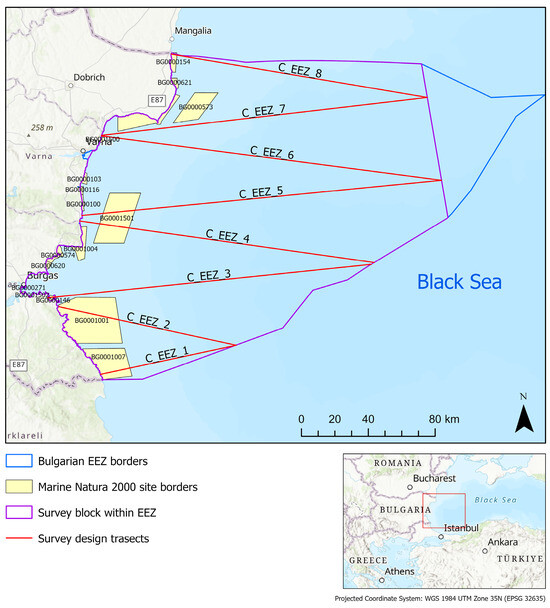
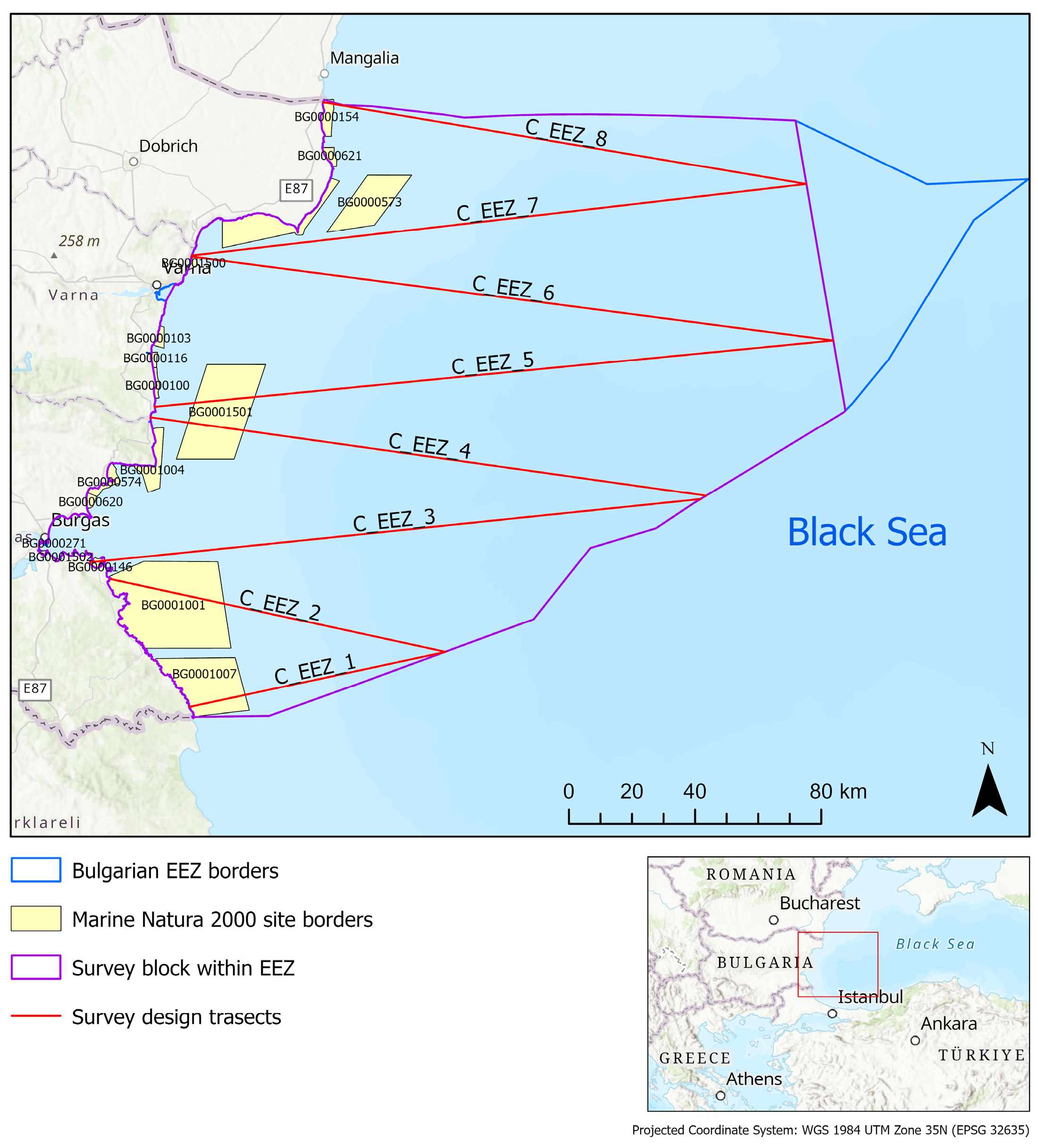
Our data were collected across all four seasons from October 2022 to October 2023 using plane-based aerial surveys. The study area was the Bulgarian Exclusive Economic Zone (EEZ), covering approximately 36,000 km2 and including several Natura 2000 sites (Figure 1). Since shipboard surveys and coastal observations cover only parts of the EEZ (and yield data that are not directly comparable to aerial surveys), here we present results only from the aerial surveys, comparing them with similar data from two previous major projects.
Figure 1.
Map of the eight aerial transects covering the Bulgarian EEZ.
2.1. Aerial Survey
We conducted aerial surveys using a Cessna 182 Skylane aircraft (Cessna Aircraft Company, Wichita, KS, USA) with bubble windows. Each season, observers flew along 8 predefined line transects (total planned transect length ≈1334.4 km per season), yielding a cumulative survey effort of 5375.5 km over the year (Figure 1, Table 1). The transect layout was designed with the program Distance 7.5 (Research Unit for Wildlife Population Assessment, Centre for Research into Ecological and Environmental Modelling, University of St Andrews, St Andrews, UK). The data collection protocol followed the one implemented in the SAMMOA software v2.1.3 (2022) (Code Lutin, Plouzané, France) [28], which allows real-time georeferenced data logging during flight missions. All surveys were flown at 130–180 m altitude, with Beaufort Sea state ≤ 3 and good sighting conditions. The observation team on board consisted of one pilot, two observers (each viewing through a bubble window on either side of the plane), and a data recorder who was also a second qualified pilot. This arrangement was chosen due to the heightened risk from active military operations in the Black Sea during the study period (e.g., potential GPS signal jamming), to ensure safety and continuity of observations. In case of pilot incapacitation, the second pilot/recorder could assume control of the aircraft. During surveys, observers continuously scanned 90° downward through the bubble windows; each sighting was recorded with its bearing (angle from trackline) via handheld voice recorders. All intercom communications were also recorded. The recorder marked each sighting’s GPS location when alerted by the observers. After each flight, sightings and effort data were compiled into an electronic georeferenced database. Standard distance-sampling field methods were employed: observers used Suunto PM-5/360 PC clinometers (Suunto Oy, Vantaa, Finland) to measure declination angles to each sighting, and positions were logged on Garmin GPSMAP 79s units (Garmin Ltd., Olathe, KS, USA). Voice records (observer sighting calls and intercom logs) were archived (using Olympus VN-541PC voice recorders—Olympus Corporation, Tokyo, Japan) to ensure data accuracy via later cross-checks.
Table 1.
Lengths (in km) of each of the eight transects surveyed by air in each season, and total effort for all seasons.
2.2. Habitat Modelling
We modelled harbour porpoise habitat suitability using a maximum entropy approach. All georeferenced porpoise sightings from the aerial surveys were pooled by season (winter, spring, summer, autumn), yielding four datasets (shapefiles) with associated attributes for each observation (e.g., group size, behaviour). We assembled a suite of 41 ecogeographic predictor variables (from sources such as Aqua MODIS) expected to influence porpoise distribution. Environmental data were obtained or generated as raster layers (ASCII format) with matching resolution and extent. Habitat models were then developed in MaxEnt 3.3.3k software (Phillips et al.; American Museum of Natural History, New York, NY, USA) [29], using each season’s occurrence data against the corresponding set of environmental layers. The MaxEnt models produced per-season habitat suitability maps, which we post-processed in ArcGIS Pro v3.6 (Esri Inc., Redlands, CA, USA). We determined a threshold suitability value (distinguishing “more suitable” vs. “less suitable” habitat) based on MaxEnt’s output diagnostics (plots and tables of model gain and omission rates). Using GIS overlay and raster calculations, we combined the seasonal maps into an overall annual habitat suitability map. This cumulative map highlights areas of consistently high predicted suitability across seasons. For ease of interpretation, high-suitability areas in the cumulative raster were vectorized into polygons delineating the core habitat zones for the species.
2.3. Abundance and Density Estimation
Prior to the surveys, we designed the transect plan using Distance 7.5 software so as to closely match the survey design of the international ACCOBAMS Survey Initiative (CeNoBS) conducted in summer 2019 [27]. The EEZ was partitioned into zigzagging systematic transects with equal spacing (covering ~5% of the area per ACCOBAMS design) to ensure representative coverage of both coastal and offshore waters. We adhered to these predefined tracklines during all survey flights. Only on-effort sightings (detections made while flying along transects under standard protocol) were used for population analyses, and only when a perpendicular distance from the trackline could be measured or reliably estimated for the sighting. We tallied the number of on-transect detections in each season as the basis for abundance estimation.
We analyzed the data to estimate porpoise abundance and density using line-transect distance sampling methods [30,31,32]. All analyses were conducted using the Distance 7.5 software [33,34]. Distance sampling extrapolates from observations within a surveyed strip to the entire study area by modelling a detection function—i.e., the decline in detection probability with increasing distance from the transect line [27]. This method assumes that all animals directly on the line (distance = 0) are detected with certainty. From standard formulae, we estimated the effective strip half-width (μ) of the survey and the average detection probability within the full strip width w. These were obtained by fitting a detection function g(x) to the observed perpendicular distance data. We tested various candidate detection function models, combining key functions (uniform, half-normal, hazard-rate, or negative exponential) with potential series expansion terms (cosine, Hermite, or simple polynomials) for flexibility. In multiple-covariate distance sampling (MCDS), the scale parameter of the detection function can be modelled as an explicit function of covariates (such as group size, observer, sea state, etc.). We included relevant sighting conditions (e.g., Beaufort Sea state, turbidity, visibility, glare, cloud cover) and platform factors (observer side, subjective detection conditions) as potential covariates influencing detectability (Table 2). In the MCDS framework, a half-normal or hazard-rate detection function is typically used, with the scale parameter σ expressed as an exponential function of the covariates. This ensures σ remains positive and allows each covariate to shift the detection curve width multiplicatively.
Table 2.
Covariates tested in the distance sampling detection function models, with their data type and levels/range. Environmental conditions are coded following standard protocols for aerial surveys (e.g., Beaufort scale definitions, turbidity categories, etc.).
After modelling the detection function for our survey data, we estimated the density (D) and abundance (N) of harbour porpoises using standard line-transect distance sampling formulas. Animal density was estimated as:
where (n) is the number of detected clusters, is the mean cluster size, (w) is the truncation distance, (L) is the total transect length surveyed, is the estimated probability of detection within distance (w), and is the effective strip half-width (ESW). The probability of detection within the truncation distance is defined as:
where (g(x)) is the detection function describing the probability of detecting an object at perpendicular distance (x) from the transect line.
The effective strip half-width is defined as:
and is estimated as:
The ESW represents the half-width of an ideal survey strip in which all animals are detected with certainty and that would produce the same expected number of detections as the fitted detection function.
Total abundance within the study area was estimated as:
where (A) is the total area of the surveyed region.
Detection functions were modelled using standard key-function models with optional adjustment terms. Candidate models included the half-normal (HN) and hazard-rate (HR) key functions. For the hazard-rate model the detection function is defined as:
where represents the scale parameter that may depend on covariates (zi), and (b) is a shape parameter controlling the rate of decline in detectability with distance.
Environmental and observational covariates potentially affecting detectability were incorporated using the multiple-covariate distance sampling (MCDS) framework. Candidate covariates included sea state, cloud cover, glare intensity, turbidity, and observer experience. Covariates were incorporated through the scale parameter of the detection function.
Model selection followed an information-theoretic approach, with competing models ranked using Akaike’s Information Criterion (AIC). The model with the lowest AIC value was selected as the most parsimonious description of the detection process, provided that it also showed an adequate goodness-of-fit. Model fit was evaluated using standard diagnostics implemented in Distance, including quantile–quantile plots and formal goodness-of-fit tests (e.g., Cramér–von Mises test).
Cluster size bias was evaluated by comparing observed mean group size with the expected cluster size estimated by the detection model. When necessary, expected cluster size was used in density estimation to correct for size-biased detection.
Density and abundance were estimated separately for each survey season. Variance estimates incorporated both encounter rate variance and detection function variance, and coefficients of variation (CV) and 95% confidence intervals were calculated for all density and abundance estimates.
All analyses followed the conventional distance sampling assumption that animals located directly on the transect line are detected with certainty (g(0) = 1). No explicit corrections for perception or availability bias were applied; therefore, abundance estimates should be interpreted as conventional distance sampling estimates. Table 2 summarizes the sighting and effort-related covariates that were recorded and considered in our models. These included sea state, water turbidity, atmospheric visibility, glare severity, cloud cover, and the observers’ subjective assessment of sighting conditions. By modelling detection probability as a function of such covariates, we aimed to account for heterogeneity in detectability and thus obtain more reliable abundance estimates.
Information criteria were used for selecting between competing models, or quantifying the degree of support for each model. In conventional distance sampling, we can use information criteria to select between say a half-normal and a hazard-rate detection function. The most widely used information criterion is Akaike’s information criterion (AIC).
For a given model with maximized likelihood , information criteria are:
where q was the number of parameters in the model. Thus q was the number of parameters in the key function plus the number of adjustment terms. AIC was evaluated for each model, and the model with the smallest AIC value was deemed best.
AIC is the default model selection method in software Distance.
Goodness-of-fit testing involved measuring discrepancies between the data and the model fit. Three different statistical tests are commonly used to assess goodness-of-fit: chi-squared, Kolmogorov–Smirnov and Cramer-von Mises. Chi-squared tests were relevant for binned data. The latter two used the quantile–quantile plot as a basis for measuring goodness-of-fit. Specifically, the Kolmogorov–Smirnov test tests the null hypothesis that samples were from the same distribution using the largest vertical distance between any point and the 1:1 regression. The Cramer-von Mises test was very similar to the Kolmogorov–Smirnov test except that it sums up the absolute deviations from each point to the 1:1 line. For both tests, if the p-value was greater than the significance level (e.g., typically set at 0.05), then the conclusion is that the 1:1 line does not deviate too far from the data, implying that the detection function fits the data reasonably well. To estimate the density or abundance of a population, we need to fit a suitable detection function to the observed data guided by the following four steps:
Distance data can be truncated (i.e., discarded) either in the field (i.e., before surveying) or at the analysis stage. Truncation is usually necessary to remove observations recorded at extreme distances, which may be viewed as less reliable and can contribute to a poorer model fit.
In the results that follow, we present the estimated detection function and parameter values, followed by seasonal density and abundance estimates with associated uncertainty (coefficients of variation and confidence intervals). All estimates are compared with those from earlier surveys in the region to contextualize the status of the Black Sea harbour porpoise in Bulgarian waters.
We used the Kernel Density Estimation (KDE) to differentiate species concentrations. It should be noted that for this type of analysis it is of particular importance that there are no repeated counts of the same individuals in the models. The design of data collection through distance sampling, combined with established methodologies for field observations of cetaceans, ensured the highest reliability of the data.
3. Results
3.1. Detection Probability and Abundance Estimates
Each season’s line-transect detection function was modelled with the inclusion of relevant covariates, yielding season-specific detection probabilities and effective strip widths (Table 3). The best-fit detection function in winter included only visibility as a covariate, indicating that detection probability was significantly lower in poor visibility conditions (p < 0.01). In spring, multiple factors influenced detectability—the selected model included Beaufort Sea state, turbidity, visibility, glare, cloud cover, and observer side, reflecting a significant effect of these environmental conditions on sighting probability. By contrast, the summer model retained a subset of factors (Beaufort Sea state, turbidity, cloud cover), and the autumn model included only sea state as a covariate. Notably, certain variables (e.g., group size and observer identity) did not significantly affect detection probability in any season (p > 0.05), suggesting that all group sizes were detected at similar rates and that the two observers performed equivalently. The mean probability of detection (for an animal within the truncation distance) ranged from approximately 0.51 in spring to 0.74 in autumn, with corresponding effective strip half-widths (ESW) of ~210 m in spring and ~60 m in autumn (Table 3). These results indicate that detectability was moderate to relatively high and seasonally variable under the survey conditions (2022–2023), although it varied by season and sighting conditions.
Table 3.
Parameters and results for the detection function for P. p. relicta in the Bulgarian EEZ.
Using the above detection functions, we estimated harbour porpoise density and abundance for each season and overall (annual) across the Bulgarian EEZ (Table 4). The mean seasonal density across the four surveys was approximately 0.21 individuals·km−2 (mean ± SD: 0.21 ± 0.08), corresponding to mean seasonal abundance estimate of about 6750 porpoises (±~2300). Seasonal density estimates differed significantly (one-way, F3,28 = 10.58, p < 0.001). Spring had the highest predicted density (mean ~0.33 individuals·km−2) and abundance (~10,600 animals), whereas winter had the lowest (mean ~0.09 individuals·km−2; ~2950 animals). Summer and autumn were intermediate, with densities of ~0.29 and 0.13 individuals·km−2, yielding abundance estimates of ~9300 and ~4100 animals, respectively (Table 4). These point estimates are associated with broad uncertainty bounds (95% confidence intervals in Table 4), but they clearly indicate a pronounced seasonal fluctuation in porpoise numbers. In particular, spring supported roughly 3.5 times the density of winter. The mean group size of porpoises also varied seasonally: for example, spring sightings averaged ~2.8 individuals per group (SD ± 0.4), compared to ~1.4 (±0.1) in summer, suggesting the occurrence of larger aggregations in the spring months. Despite these seasonal changes, porpoises were recorded in all surveyed seasons, confirming year-round presence in the Bulgarian EEZ.
Table 4.
Parameters and results of an analysis for P. p. relicta in the Bulgarian EEZ.
3.2. Seasonal Distribution and Depth Preferences
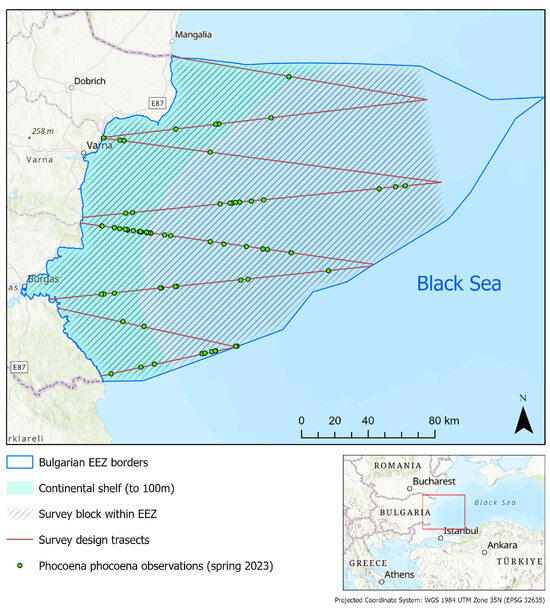
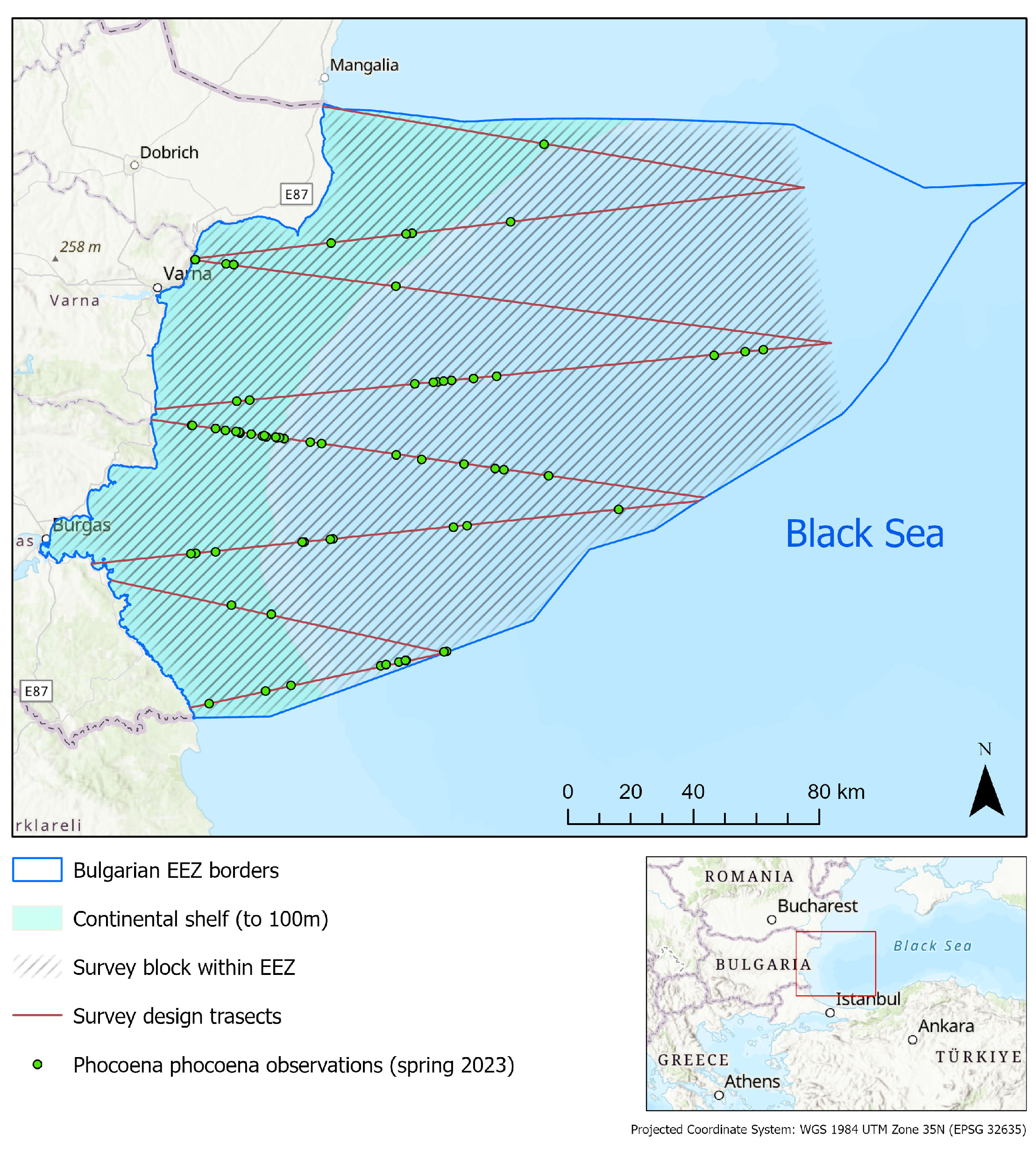
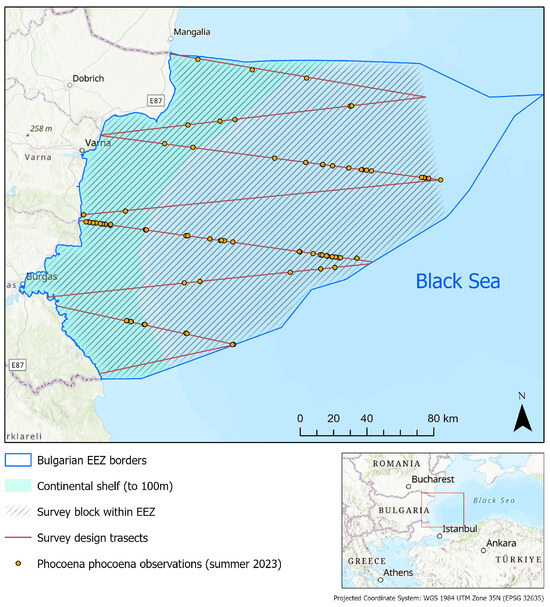
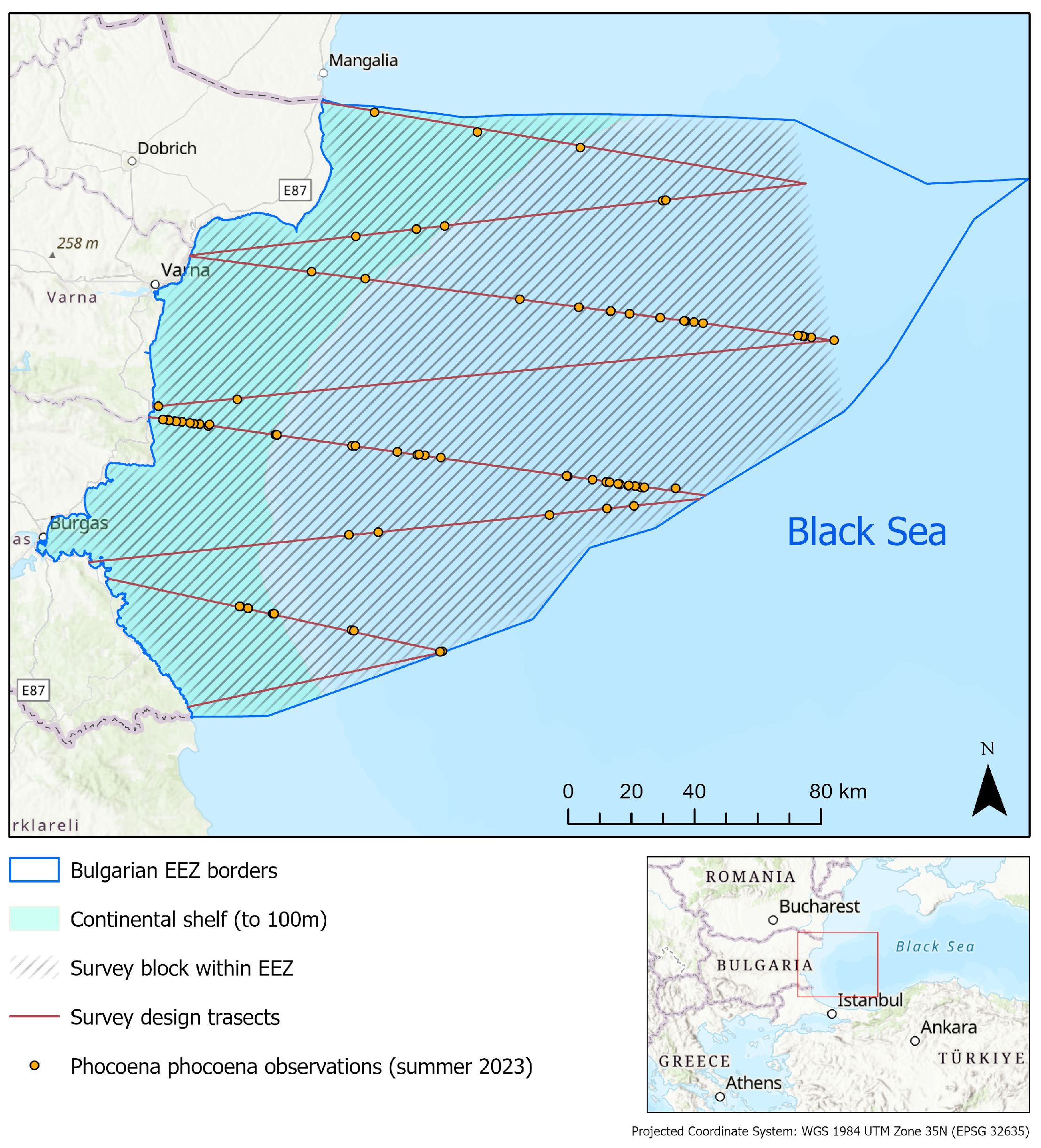
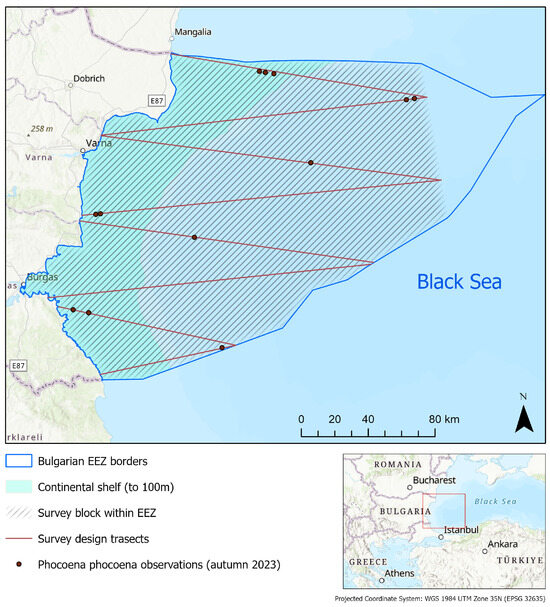
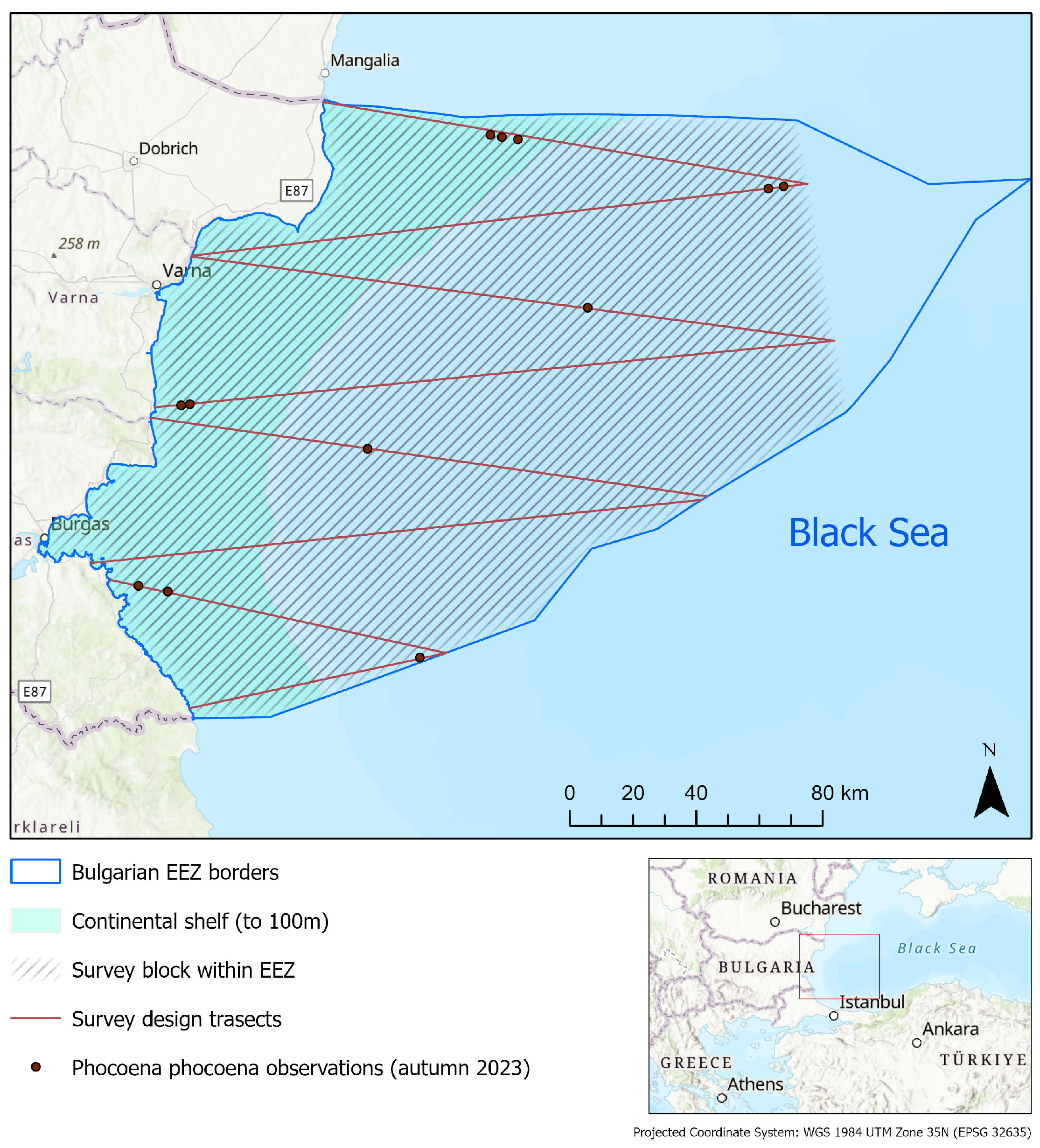
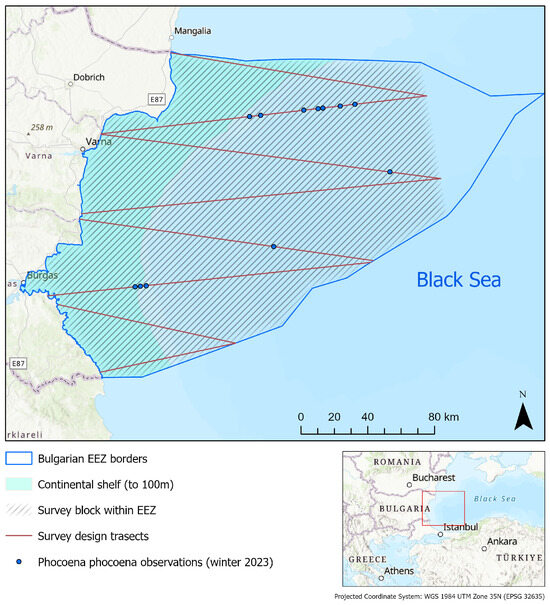
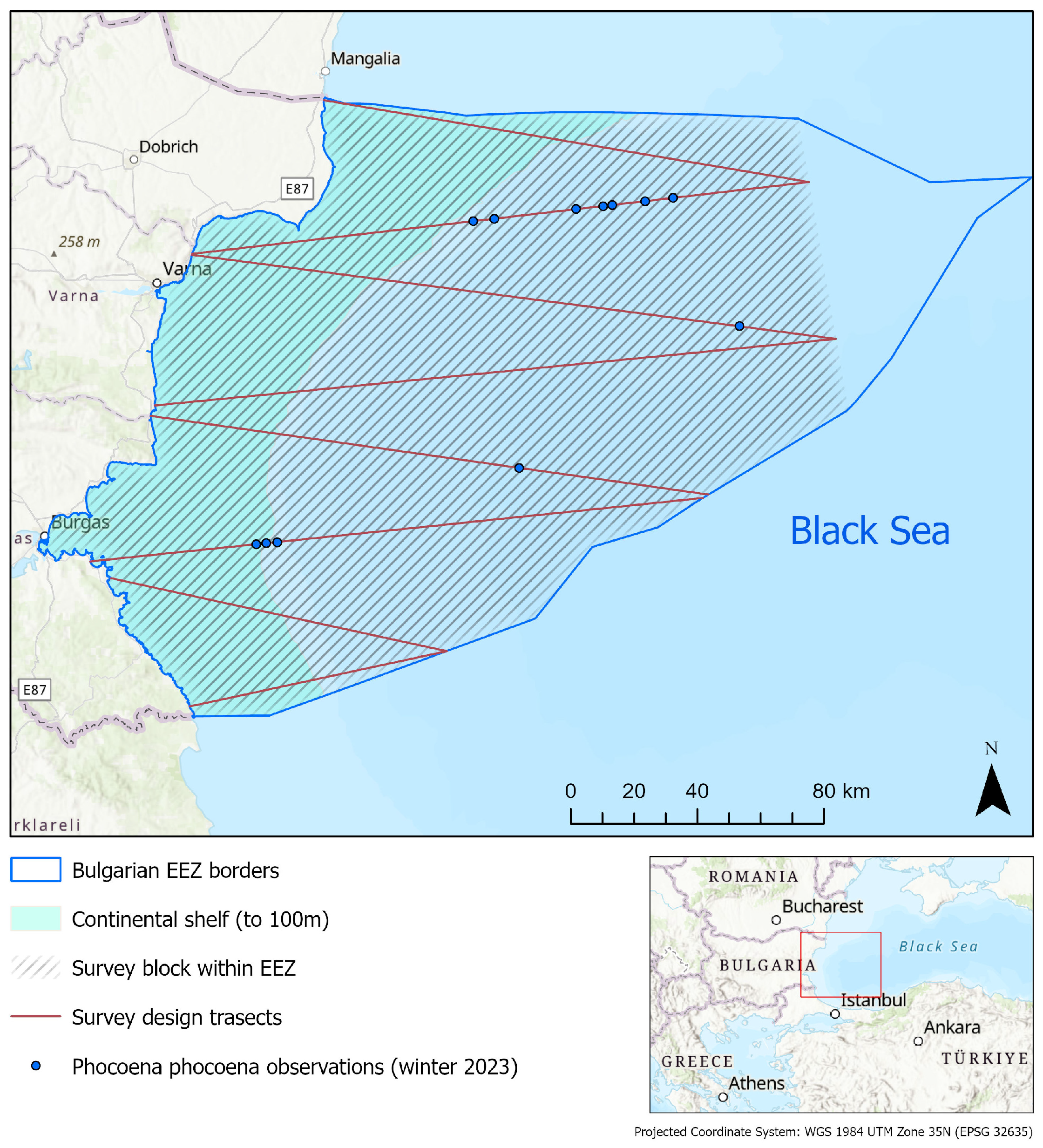
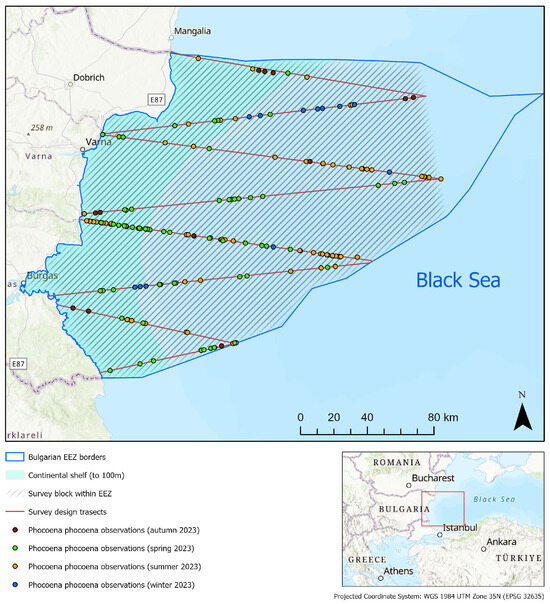
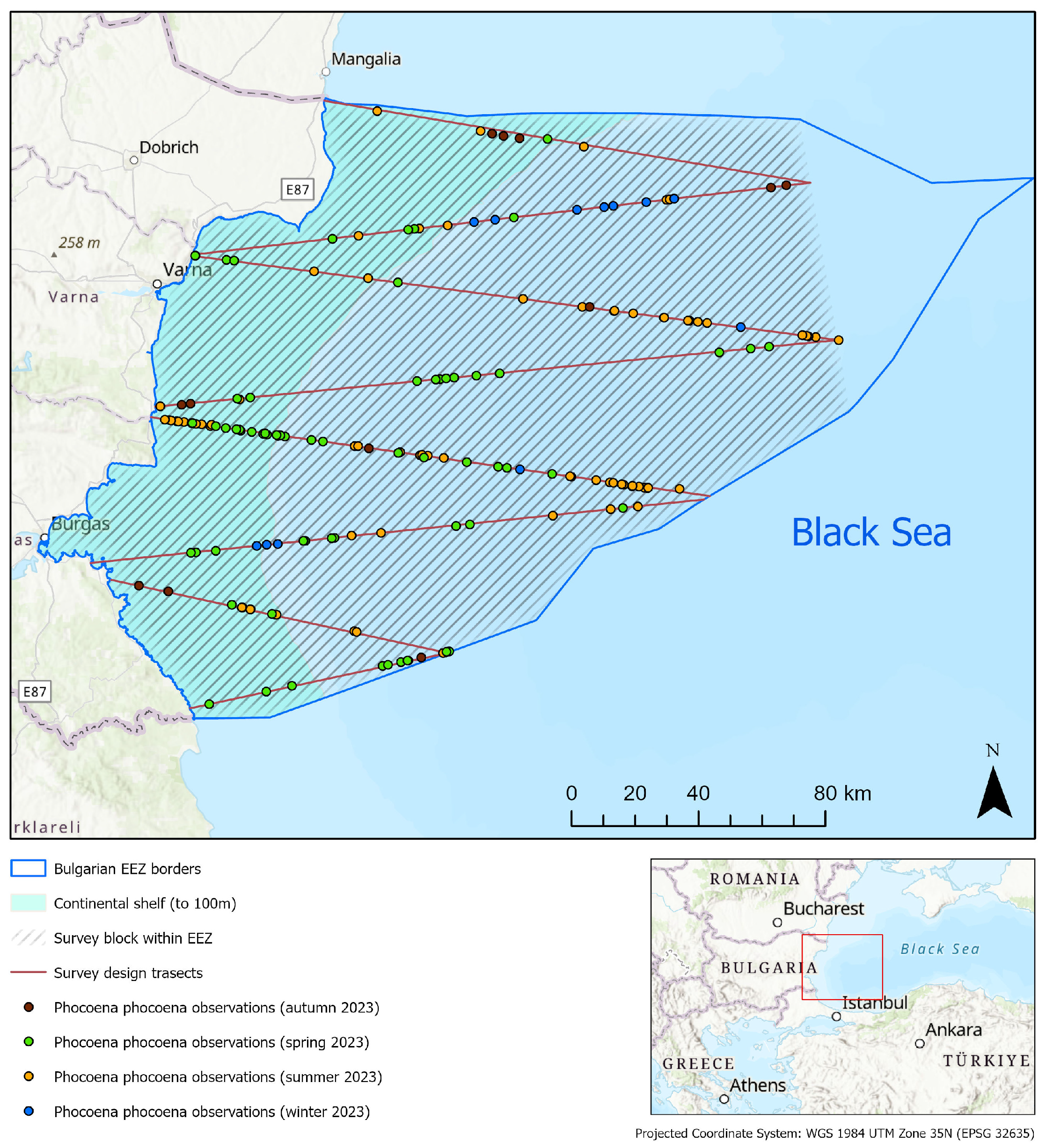
All seasonal surveys documented a broad spatial distribution of harbour porpoises across both coastal and offshore waters of the Bulgarian EEZ, with clear seasonal shifts in distribution patterns. Figure 2 (spring), Figure 3 (summer), Figure 4 (autumn), and Figure 5 (winter) show the geospatial sighting locations by season.
Figure 2.
Results of the aerial survey conducted in spring.
Figure 3.
Results of the aerial survey conducted at summer.
Figure 4.
Results of the aerial survey conducted in autumn.
Figure 5.
Results of the aerial survey conducted in winter.
Importantly, overall spatial distribution remained extensive in every season—porpoises were recorded along most transects either on the shelf, slope, or open sea. The notable high-density areas also varied seasonally. In spring and summer, the largest aggregations and most frequent sightings were concentrated around Cape Emine (a central coastal headland) and in the southern offshore waters near the border with Turkey. By autumn, when overall detections declined, those porpoises that were observed tended to appear further north and offshore, including some concentrations in the northern EEZ toward the Romanian border. During winter, the remaining detections were almost entirely in deep offshore zones; a cluster of winter sightings was noted in the northern offshore area of the Bulgarian EEZ (around transect 1), with few to no animals encountered in nearshore waters. Figure 6 presents an integrated map of all sightings across the four seasons, illustrating this seasonal range shift: porpoise distribution contracted away from the coast and toward offshore (especially northern offshore) waters as the year progressed into winter. The results demonstrate a seasonally dynamic distribution, with harbour porpoises utilizing coastal shelf habitats more in the warm months and shifting to an offshore, deeper-water habitat use in the late autumn and winter.
Figure 6.
The overall distribution of the species during the four seasons.
Significance of difference between seasons based on depth data (Table 5) is based on hypothesis testing method. The following hypotheses are formulated:
H0.
There is no difference between the depth distributions across seasons.
H1.
There is a significant difference between the depth distributions across seasons.
Table 5.
Difference between seasons based on depth data.
The Chi-square value is 26.9277421, the degrees of freedom are 3, and the p-value is 2.94256 × 10⁻⁶ at a significance level of α = 0.05. Since p < α, the null hypothesis is rejected. Therefore, there is a significant difference between the depth distributions across seasons.
The confidence interval for the population proportion (p) of observations occurring at depths not exceeding 200 m relative to the total number of recorded depths was estimated using the Wilson score interval for a binomial proportion:
where () is the sample proportion, (x) is the number of observations at depths not greater than 200 m, (n) is the total number of observations, and (z) is the critical value of the standard normal distribution corresponding to the desired confidence level.
In the present study (x = 80) and (n = 183), therefore
For a 95% confidence level (z = 1.96), the Wilson confidence interval for the true proportion (p) is 0.368 < p < 0.509
Thus, approximately 36.8–50.9% of the observations occurred in waters shallower than 200 m.
We found a trend that significant concentrations of the species are in the center of the Black Sea, where the deepest parts of the Bulgarian EEZ are located. The division of the EEZ into a shelf up to 100 m and the open sea was not a sufficiently precise approach, since the real ecological barrier is the hydrogen sulfide layer, which prevents the development of benthic organisms and allows only pelagic life in the Black Sea. According to established concepts, this layer covers depths above 200 m. In order to analyze in detail this spatial distribution strategy of P. p. relicta and its seasonal variations, we present data on the preferences of the species to different depths.
Porpoises were encountered from the immediate coastal zone (in spring, the shallowest sighting was at ~8 m depth) to the deepest offshore waters (>2000 m). However, the relative use of shallow vs. deep habitats changed with season. In summer, the species was most frequently observed on the continental shelf: approximately 64% of summer sightings occurred in waters ≤ 200 m deep. By contrast, during spring and winter the population was largely concentrated farther offshore—76% of spring and over 90% of winter sightings were in waters > 200 m deep. The autumn distribution was intermediate, with about half of the sightings on the shelf and half beyond 200 m. These patterns are reflected in the mean sighting depths per season (Table 6). In summer, harbour porpoises were found at a mean depth of only ~501 m (with many animals in the 50–100 m depth range), whereas in spring the mean occurrence depth was ~1377 m and many detections were in waters 1500–2100 m deep. Autumn sightings had a mean depth of ~571 m, indicating use of both shelf and slope habitats. During winter, very few animals were detected inshore (only one sighting in <200 m), and the mean depth of sightings was ~1765 m, highlighting the pronounced offshore distribution in the winter season.
Table 6.
Seasonal depth distribution of harbour porpoise sightings in Bulgarian waters. Summary of sighting depths by season, including the number of sightings analyzed (n), mean depth ± standard deviation, observed depth range, and the percentage of sightings in shallow (≤200 m) vs. deep (>200 m) water. The 200 m isobath is approximately the depth of the Black Sea’s anoxic layer, used here to delineate shelf vs. open-sea habitats.
Seasonal depth preferences: As shown above, porpoises in spring and winter were predominantly in waters beyond the 200 m isobath, whereas in summer a majority of sightings were on the continental shelf (shallower than 200 m). Autumn sightings were split between shallow and deep habitats. These data underscore a flexible habitat-use strategy: the Black Sea harbour porpoise regularly exploits both shallow coastal habitats and deep offshore habitats, with a tendency to expand into deeper, offshore waters in the colder seasons. All depth ranges given are within the species’ known ecological limits in the Black Sea (the maximum sighting depth ~2145 m approaches the deepest available habitat in the Bulgarian EEZ).
3.3. Habitat Suitability and Density Patterns (MaxEnt Model)
Using the pooled sighting data and environmental predictors, we developed MaxEnt habitat suitability models for each season, and a combined annual model, to identify key habitat areas for the harbour porpoise.
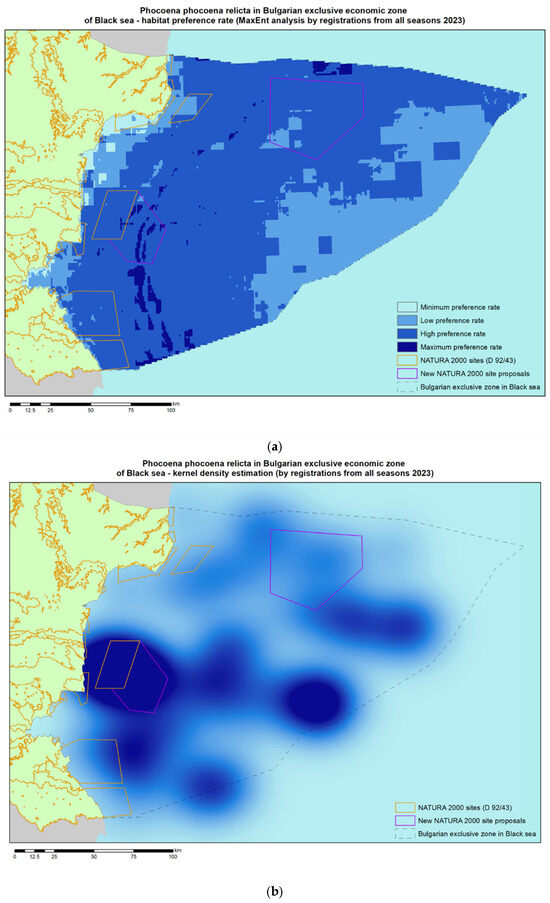
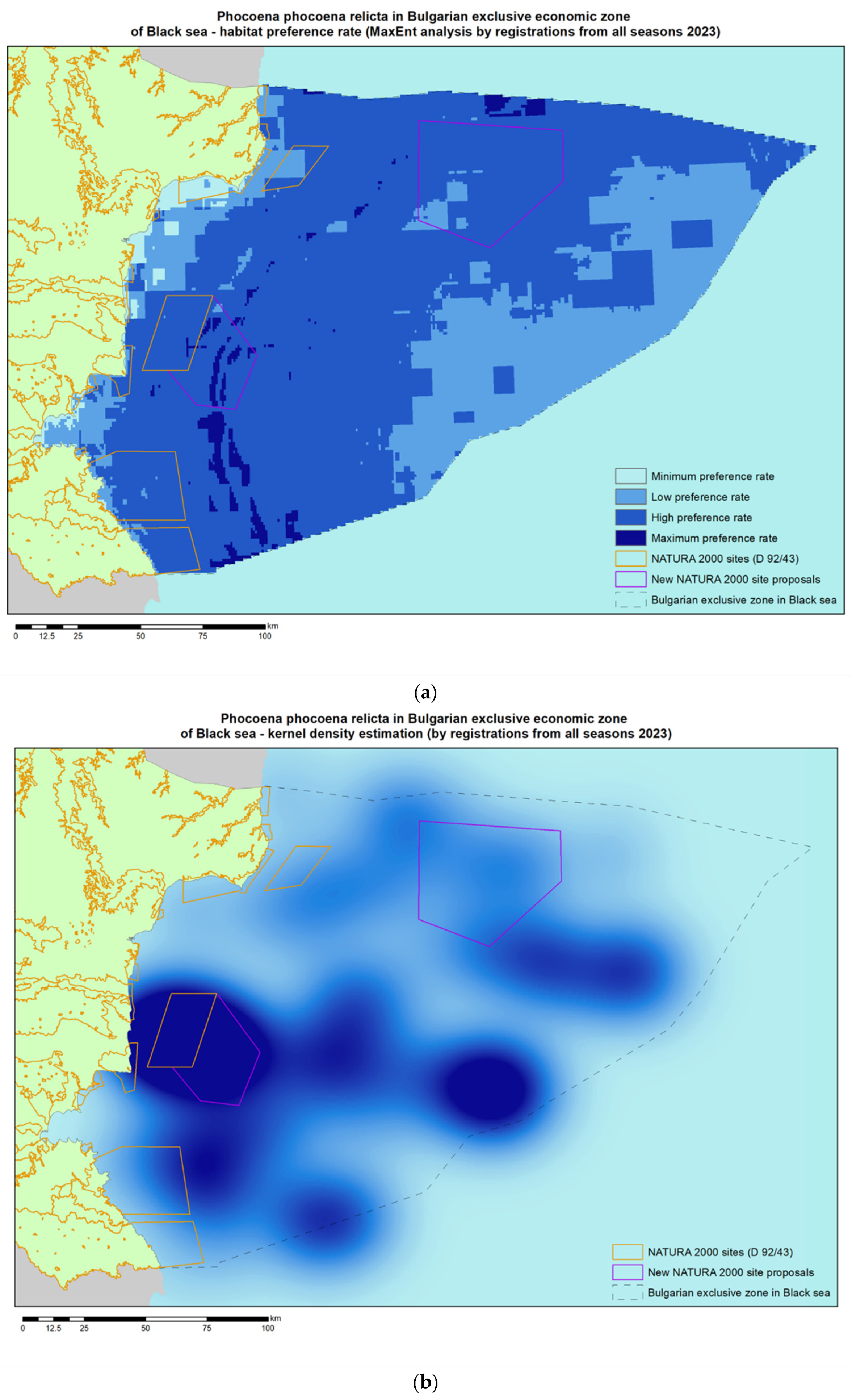
The MaxEnt outputs and accompanying KDE of sighting locations revealed congruent spatial patterns of habitat use, which are summarized in Figure 7a,b (composite panels for all seasons). Overall, the models indicated that harbour porpoises have the potential to occupy a large portion of the Bulgarian EEZ year-round, but within this broad range there are distinct seasonal hotspots and shifts in habitat suitability. The total area predicted as occupied habitat was high—the combined annual model suggests that porpoises use approximately 80+% of the EEZ at least occasionally. However, only a subset of this range constitutes core high-suitability habitat. Using a high probability threshold, roughly 40% of the EEZ was classified as highly suitable habitat for P. p. relicta (i.e., areas consistently predicted to have high habitat preference). These core areas align closely with the observed high-density regions from the survey.
Figure 7.
(a). Habitat preference rate by registration—all seasons of 2023. (b). Kernel density estimation by registration—all seasons of 2023.
Spatially, the seasonal habitat models showed a shifting distribution of suitable areas from spring through winter. In spring, the model predicted the most suitable habitats mainly along the shelf break and upper slope, especially in the southern half of the EEZ. Areas of highest predicted suitability were concentrated around the Cape Emine vicinity and extending offshore to the southeast, as well as in some coastal segments in the north (where a few high-use zones near the coast were evident). The kernel density map for spring likewise identified Cape Emine and the southern offshore area (near the Turkish border) as centers of high sighting density. By summer, the MaxEnt model still highlighted the southern EEZ as a prime habitat region, but the spatial pattern of suitability became more fragmented (mosaic). The maximum-suitability areas in summer were smaller and more scattered, mostly situated in the open sea off the southern coast. High-suitability values were also found near prominent capes (e.g., Cape Kaliakra in the north and Cape Emine in the central coast), primarily just seaward of the shelf edge. Consistently, the summer kernel density analysis showed the highest porpoise concentrations in the offshore waters of the south, with only one notable coastal high-density spot at Cape Emine. These results indicate that the porpoises’ open-sea concentration was more pronounced in summer compared to spring, as animals spread out into pelagic waters and only a few coastal areas (like Emine) retained high densities.
In autumn, the habitat suitability pattern differed markedly from the earlier seasons. The MaxEnt model for autumn predicted highly suitable habitat in the northern part of the EEZ, as well as broadly across much of the offshore zone. In fact, during autumn virtually the entire Bulgarian EEZ was estimated to be at least moderately suitable for porpoises, suggesting a more even or wide-ranging distribution. The highest suitability scores in autumn occurred in two main areas: (1) the northern offshore zone (approaching the Romania border), and (2) parts of the shelf waters along the southern coast (including around Cape Emine and the Strandzha coast marine Natura 2000 sites). Notably, despite the offshore shift, the model indicated that some shelf habitat remained important: the maximally preferred sites in autumn were actually on the shelf (e.g., around Cape Kaliakra in the north and within the Strandzha coastal Natura 2000 sites in the south), even though most porpoises were spread out offshore. The autumn kernel density map confirms that Cape Emine and certain Natura 2000 coastal sites (e.g., BG0001501 “Emona” and BG0001001 “Ropotamo”) still supported local clusters of higher density in autumn. However, the highest densities in autumn were found offshore in the north, outside of territorial waters, indicating a strong overall preference for open-sea habitat even late in the year.
By winter, the models and density analyses showed an extreme retreat from coastal waters. The winter MaxEnt model predicted very low suitability in nearshore areas, with porpoises largely confined to offshore habitats. Only small, isolated patches of maximum suitability were identified, occurring both in the far south and far north of the EEZ. The model’s high-suitability area in winter was much reduced in size compared to other seasons (Figure 7a,b), reflecting the more limited and offshore-biased distribution of sightings. Broad areas of the northern offshore EEZ were still classified as “strong preference” habitat, indicating that the northern deep waters remained a key refuge in winter. The kernel density results for winter mirror this pattern: the highest sighting densities occurred in the northern offshore region (this was the most significant concentration for the winter period), with additional dense sightings in the southern offshore waters (particularly the open sea between the BG0001501 “Emona” and BG0001001 “Ropotamo”). Essentially, during winter the species vacated the coastal shelf almost entirely and was observed predominantly in the open sea at the outer EEZ.
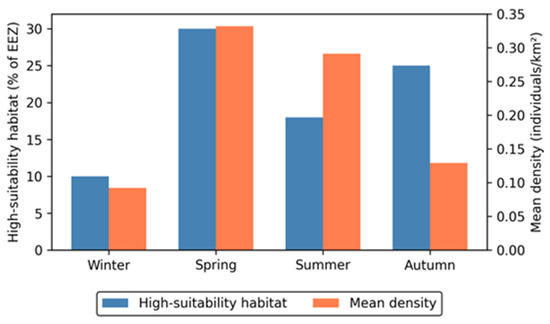
Table 7 summarizes two key indicators for the Black Sea harbour porpoise in the Bulgarian waters, by season: (1) the proportion of the area of the Bulgarian Exclusive Economic Zone (EEZ) with high habitat suitability during the respective season, and (2) the average density of harbour porpoises (number of individuals per km2) during the season. These quantitative indicators show how much of the habitat is highly preferred in each season, as well as how the average abundance of the species changes.
Table 7.
Comparative seasonal indicators for the proportion of the highly suitable area of the Bulgarian EEZ and average density of harbour porpoises (P. p. relicta). (Note: The proportions are approximate, derived from model maps of suitability by season; densities are estimated by remote sensing).
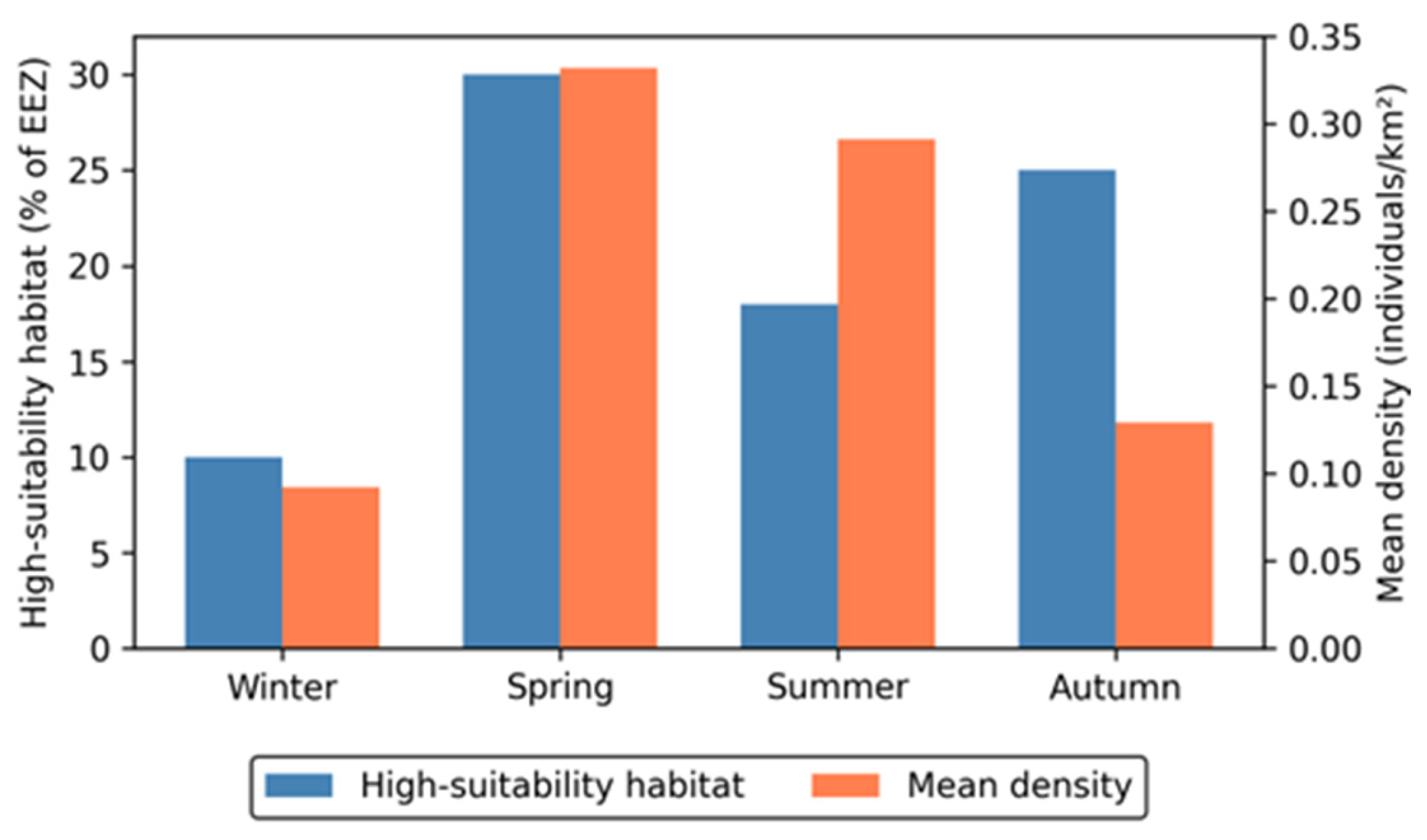
Seasonal comparison of harbour porpoise high-suitability habitat and mean density in the Bulgarian EEZ is presented in Figure 8. Each season (Winter, Spring, Summer, Autumn) is represented by a pair of bars: blue bars show the percentage of the EEZ classified as highly suitable habitat for porpoises (based on MaxEnt habitat modelling), and orange bars show the mean porpoise density (individuals per km2) from distance sampling.
Figure 8.
Seasonal comparison of the harbour porpoise habitat suitability (blue bars; % of Bulgarian EEZ classified as highly suitable by MaxEnt) and mean density (orange bars; individuals per km2 from distance sampling) for each season.
Numerical values in the table and Figure 8 highlights the seasonal variability in porpoise habitat use: for example, spring had the highest porpoise density (~0.33 ind./km2) while winter has the lowest (~0.09 ind./km2). Summer maintains a relatively high density (~0.29 ind./km2), second only to spring, while autumn marks a decrease to ~0.13 ind./km2. In contrast, autumn features the largest extent of suitable habitat (nearly half of the EEZ classified as high-suitability), whereas winter’s high-suitability area is minimal (only on the order of ~10% of the EEZ). Therefore, the extent of core high-suitability habitat (as a percentage of the EEZ) remains limited to a subset of the area in all seasons (on the order of only tens of percent, consistent with ~40% of the EEZ being identified as high-suitability habitat on an annual basis).
These patterns reflect pronounced seasonal shifts in porpoise distribution: a concentrated spring population (high densities in relatively limited areas) versus a more dispersed autumn distribution across a broader area despite lower densities. This spring peak vs. autumn spread likely corresponds to ecological drivers already noted i for example, spring aggregations may coincide with breeding or intense feeding on spring-spawning prey, whereas the autumn expansion offshore aligns with porpoises tracking prey migrations (anchovy and other pelagic fish moving off the shelf in late year). Overall, the results highlight that spring is the season of greatest porpoise density in Bulgarian waters, whereas autumn provides the widest swath of suitable habitat, with winter witnessing both the lowest densities and most restricted core habitats. This underscores a seasonal transition from concentrated use of key areas in spring to a broad, offshore-oriented habitat use by autumn and winter, consistent with the flexible, season-dependent habitat utilization of P. p. relicta in the Black Sea.
Almost the entire EEZ is used to some degree by harbour porpoises over the year; but the core areas of persistent high habitat suitability are mainly in the open waters along the EEZ boundaries (especially the southern offshore border and the northeastern offshore sector). Coastal waters immediately adjacent to the shoreline were of low importance year-round. Among Bulgaria’s marine Natura 2000 sites, those that cover expansive offshore regions or border the open sea (such as the southern Natura 2000 sites along the Strandzha coast and the Cape Emine area) encompass the most important habitats for P. p. relicta. Areas with a high or maximum habitat suitability were consistently located in the open sea; often just outside or at the edge of territorial waters.
The habitat modelling and density analyses illustrate clear seasonal and spatial patterns: harbour porpoise habitat use shifts from a more coastal/shelf-focused distribution in spring and summer to a more offshore-oriented distribution by autumn and winter, with persistent hotspots in the southern offshore waters and around Cape Emine, and a seasonal emergence of northern offshore hotspots in the latter part of the year.
These results identify the key habitat areas of the species and seasonal density shifts for Black Sea harbour porpoises in Bulgarian waters, providing a science-based foundation for targeting conservation measures in space and time.
4. Discussion
4.1. Spatial and Seasonal Distribution
In line with our first objective of characterizing the spatial and seasonal distribution of the Black Sea harbour porpoise, our results revealed distinct patterns in habitat use across regions and seasons. Porpoises were encountered in both shallow coastal waters [35] and deeper offshore parts of the continental shelf, but their distribution shifted markedly between late spring and autumn. This indicates that P. p. relicta does not remain uniformly coastal year-round; instead, it exhibits a seasonal offshore expansion. Notably, our finding that porpoises make significant use of offshore shelf habitat in autumn provides new insight that refines the traditional view of this subspecies as primarily coastal. This seasonal plasticity in habitat use highlights the importance of considering both shallow and deeper shelf zones in conservation planning, especially during the late-year period.
4.2. Potential Migratory Movements
Our second objective concerned the potential migratory movements of P. p. relicta, and the observed seasonal shifts strongly suggest that the porpoises undertake annual movements comparable to those documented in earlier studies. The pronounced southward and offshore shift between spring and autumn aligns with the well-known basin-wide migration of Black Sea harbour porpoises from the northwestern waters toward the southern/southeastern Black Sea as winter approaches [36]. In the warm season, porpoises are present in the northwestern Black Sea (and even the Sea of Azov), but as temperatures drop they leave these areas by late autumn and congregate in the south [37]. Our data support this pattern: the scarcity of porpoises in Bulgarian coastal waters in autumn, contrasted by their persistence in the deeper southern shelf, is consistent with a migratory movement towards wintering grounds. A likely driver of this migration is prey availability. Anchovy (Engraulis encrasicolus ponticus), one of the harbour porpoise’s principal prey in the Black Sea, undertakes a similar seasonal migration—moving to the southeastern Black Sea to overwinter [37]. The increased offshore sightings and larger group sizes we observed in autumn could thus be explained by porpoises aggregating in areas where anchovies and other pelagic fish concentrate in colder months. Such winter aggregations have been described previously [38] and were indicated in our study by a rise in mean group size from spring to autumn. The recent behavioural research likewise emphasizes the species’ flexibility in movement and habitat use [39,40]. In summary, the seasonal distribution changes of P. p. relicta in Bulgarian waters can be interpreted as part of a broader migratory cycle driven by ecological factors—chiefly the annual movement to and from prey-rich wintering areas. This finding reinforces prior knowledge of Black Sea harbour porpoise migration while providing specific new evidence from the western Black Sea that helps fill geographic gaps in understanding their movement ecology.
4.3. Comparison with Other Black Sea Cetaceans
Finally, we compared P. p. relicta with other Black Sea cetaceans to provide context for the observed patterns, addressing our fourth objective. The Black Sea is home to two other endemic cetacean subspecies—the common dolphin (Delphinus delphis ponticus) and the bottlenose dolphin (Tursiops truncatus ponticus)—which differ in ecology and behaviour. These differences shed light on the unique aspects of harbour porpoise habitat use. Notably, P. p. relicta in our study utilized both shallow and deeper shelf waters, adjusting its range seasonally, whereas common dolphins are typically associated with the open pelagic zone and greater depths. Historically, common dolphins were the most abundant cetaceans offshore and were less common in coastal waters, their distribution being mainly driven by depth and pelagic prey availability [41,42]. Our findings reflect this contrast: for example, we observed that common dolphins were relatively scarce on the shelf, especially in autumn, consistent with their tendency to move further offshore or leave the area when prey on the shelf diminishes. In spring, common dolphins were present on the Bulgarian shelf (albeit at lower densities than porpoises), but by late autumn their numbers dropped more steeply than those of harbour porpoises, suggesting that many common dolphins had shifted to deeper, off-shelf waters by that time [43]. This behaviour contrasts with harbour porpoises, which, while moving offshore in autumn, still remained within the shelf region and continental slope of the Black Sea rather than venturing into the central basin.
Bottlenose dolphins, on the other hand, exhibit a more residential coastal ecology. They tend to remain inshore year-round, often forming local groups that frequent shallow bays and areas near river mouths [44]. In the Black Sea, bottlenose dolphins have become prevalent in nearshore waters, especially in the northern sector, since the decline of porpoises in the 1990s [45]. Our results concur with their known habitat preference: the Black Sea bottlenose dolphin was the least frequently sighted species overall, and when observed, it was mostly in coastal habitats. We found little seasonal change in bottlenose dolphin distribution—their spring and autumn densities in coastal waters were similar, and very few were detected offshore [46].
This consistency underscores a key difference between bottlenose dolphins and harbour porpoises: P. p. relicta shows much more pronounced seasonal mobility, whereas T. t. ponticus stays in its preferred shallow-water ranges and does not undertake long-range seasonal migrations. Ecologically, bottlenose dolphins in the Black Sea feed on a variety of coastal fish and even interact with fisheries (e.g., depredating fish from nets), which may allow them to remain inshore even as environmental conditions change [44]. Harbour porpoises, by contrast, are obliged to track highly mobile, seasonally migrating prey like anchovy, which leads them to range more widely. For comparison, seasonal surveys in the Sinop region (southern Black Sea) reported that all three Black Sea cetacean species reach their highest local abundance in spring [47]. That study further noted that harbour porpoises and bottlenose dolphins were present year-round off Sinop, whereas common dolphins vacated this area during winter months.
These interspecies comparisons highlight that the patterns we observed for P. p. relicta—such as equal use of shallow and deeper shelf habitats in autumn and significant seasonal range shifts—are not universal among Black Sea cetaceans. Rather, they are specific responses of this species to its ecological niche (small schooling fish prey, colder tolerance, etc.), distinguishing it from the more pelagic common dolphin and the more coastal bottlenose dolphin. By maintaining this comparative perspective, we reinforce how our study’s findings fit into the broader context of regional cetacean ecology. Each species occupies a slightly different niche and responds differently to seasonal and human-driven changes, and P. p. relicta’s particular pattern of seasonal offshore movement and habitat flexibility emerges as an adaptive strategy that sets it apart from its Black Sea counterparts. In particular, our finding that harbour porpoises concentrate in offshore southern waters during autumn/winter provides a concrete advancement in understanding, as it modifies earlier assumptions of strictly coastal distribution and underscores the influence of seasonal prey migrations on porpoise habitat use. This study offers important, refined knowledge about P. p. relicta ecology in Bulgarian waters—knowledge that both reinforces and updates the existing data while highlighting implications for conservation in the face of ongoing human impacts.
4.4. Anthropogenic Impacts
Our third objective was to evaluate how anthropogenic pressures might influence the habitat use and population status of P. p. relicta. Studies from multiple countries have consistently reported that harbour porpoises make up 90–98% of small cetaceans caught in bottom-set gillnet fisheries [48,49,50]. In Bulgarian waters, the turbot gillnet fishery is known to be a major source of porpoise mortality [51], which likely contributes to lower porpoise numbers in heavily fished coastal areas. Indeed, a dramatic decline of harbour porpoises in the northwestern Black Sea during the 1990s was attributed to mass mortality in gillnets [52,53]. Apart from bycatch, other human factors may also influence habitat use. Coastal degradation and disturbance are growing concerns: the Black Sea has experienced severe ecological degradation over the last century due to pollution, eutrophication, and overfishing [43]. These pressures can indirectly affect porpoises by reducing their prey base (e.g., overfishing of pelagic fish) and by degrading important habitats [41]. Additionally, intense vessel traffic and underwater noise near ports and busy coastal zones might displace porpoises from otherwise suitable habitats, as has been observed in other regions [54]. In our study, we noted that porpoise hotspots in spring overlapped with several Natura 2000 sites along the coast, underlining the importance of these relatively undisturbed habitats [43,46].
One autumn (early winter) aggregation was detected outside the current marine Natura 2000 sites, suggesting that seasonal shifts could expose porpoises to unprotected and potentially high-impact areas. Overall, the interaction of anthropogenic factors with porpoise ecology emphasizes the need for targeted management. Effective conservation of P. p. relicta will require active measures to mitigate bycatch and reduce habitat degradation in both coastal and offshore areas used by the species [43,46].
4.5. The Impacts of Active Military Operations near the Research Area During the Field Surveys
During our field surveys, active military operations near the research area appeared to influence the behaviour and distribution of the target species [55]. Critically, however, acoustic disturbance from naval sonar emerged as a major threat, given its extensive reach and impact. This means that during intense naval operations, very few refuges remain where sensitive species can escape the signals [56]. These behavioural changes under military stress are comparable to well-documented cases globally. Many marine mammal species respond to naval sonar and explosions with marked avoidance and altered behaviour [57]. In fact, a wide range of whale, dolphin and porpoise species are now known to be impacted by military noise at levels much lower than earlier predicted, with significant behavioural effects occurring well below traditional safety thresholds [58]. Together, these studies underline a clear pattern: intense anthropogenic noise from military activities can trigger avoidance, disrupt feeding and communication, and displace marine mammals from their preferred habitats on a global scale.
Finally, we must emphasize the scientific uncertainty introduced by these atypical conditions during data collection. War-related disturbances present a confounding factor that makes it challenging to disentangle normal ecological patterns from stress-induced aberrations. The complexities of monitoring animals in a conflict zone mean that some effects may go undetected or underestimated. In our case, behaviours observed (or not observed) in the surveyed area might not reflect the species’ typical habits at all—they could be temporary reactions to the chaos of military activity. Similar caution has been voiced by other researchers who faced these issues [58]. Due to this high level of uncertainty, any conclusions drawn from wartime data should be treated with caution. It is crucial to continue monitoring the population after the cessation of hostilities to see if and how their distribution and behaviour return to baseline patterns. By comparing our situation with these analogous cases from both the Black Sea and global studies, we underscore that the anomalous behaviour and distribution changes we recorded were not isolated incidents, but part of a broader, well-documented pattern of wildlife responding to intense human disturbances. This context allows us to better interpret our findings and calls for careful consideration of anthropogenic noise and conflict when managing and conserving the affected species.
5. Conclusions
Our study provides the first comprehensive, year-round assessment of the Black Sea harbour porpoise in Bulgarian waters, revealing how this endemic subspecies uses the marine environment across seasons. We found that P. p. relicta occurs throughout the EEZ year-round, with peak abundance in spring and a marked shift in distribution as winter approaches. Porpoises are not confined to nearshore habitats; instead, they display a flexible habitat use, spreading into deeper offshore shelf waters in autumn and winter. Two key high-density areas were identified: one around Cape Emine (central coast) and another in the southern offshore zone near the border with Turkey. Notably, the latter represents a winter aggregation area outside existing Natura 2000 sites. These spatial–temporal patterns refine our understanding of Black Sea harbour porpoise ecology—confirming a seasonal migratory movement to prey-rich southern waters—and fill critical knowledge gaps about their distribution and habitat preferences. We emphasize that these results were obtained under extraordinary conditions of regional military conflict, which likely influenced porpoise behaviour. This context warrants caution in interpretation, and continued post-conflict monitoring will be essential to discern lasting trends versus short-term disturbance effects.
From a conservation and management perspective, our findings have direct implications for policy and the Natura 2000 network in Bulgaria. The evidence base now clearly supports targeted actions to safeguard the harbour porpoise:
First, we recommend designation of marine Natura 2000 site to encompass the newly identified offshore hotspot in Bulgaria’s waters. This area, used heavily by porpoises in autumn–winter, currently lies unprotected and merits attention for Natura 2000 site designation. Likewise, existing coastal Natura 2000 sites that overlap with spring porpoise concentrations should be maintained or enhanced in management, as these sites already provide refuge in critical seasons. Formal protection of both coastal and offshore core habitats of the species in the Natura 2000 network and the development of appropriate site-specific conservation objectives (SSCOs) will ensure the species’ year-round range is adequately covered.
Second, it is important to mitigate gillnet bycatch, which is the dominant human-caused threat to Black Sea harbour porpoises. We specifically recommend implementing the use of acoustic deterrent devices (pingers) in the turbot gillnet fishery, as trials in Bulgarian waters have shown pingers can significantly reduce porpoise bycatch without deterring target catch. Strengthening bycatch mitigation measures—through updated fishery regulations and stricter enforcement is critical to reduce preventable mortality. This action aligns with regional conservation priorities and would directly improve the species’ conservation status.
Third, we highlight the need for ongoing monitoring and research to track the harbour porpoise population in the face of environmental change and human pressures. In particular, dedicated surveys after the cessation of the Black Sea conflict are needed to determine whether porpoises return to their typical distribution patterns or if war-related disturbances have caused lasting shifts. Recent analyses of the conflict’s impact indicate that few undisturbed refuges remained for cetaceans during intense military activity, so continued monitoring will be crucial for detecting any rebound or long-term displacement. This information should be fed back into national conservation strategies—including updating the favourable reference values for the population and adjusting Natura 2000 sites boundaries or regulations as necessary. By combining adaptive management with sustained scientific observation, Bulgarian authorities can ensure that the spatial priorities identified by this study translate into effective protection of the Black Sea harbour porpoise, securing its future in a rapidly changing region.
Author Contributions
Conceptualization, V.D., G.T., P.D., N.N. (Nikolay Nedyalkov) and N.N. (Nikolay Natchev); Methodology, V.D., K.D., K.M., G.T., P.D., Y.S., G.N. and N.N. (Nikolay Nedyalkov); Validation, V.D., K.D., K.M., G.T., Y.S., P.D., N.N. (Nikolay Nedyalkov) and N.N. (Nikolay Natchev); Formal Analysis, V.D., K.D., K.M., G.T., Y.S., P.D., G.N. and N.N. (Nikolay Nedyalkov); Investigation, V.D., K.D., K.M., G.T., Y.S., G.N. and N.N. (Nikolay Nedyalkov); Resources, V.D., K.D., K.M., G.T., Y.S., G.N., N.N. (Nikolay Nedyalkov) and B.K.; Data Curation, V.D., K.D., K.M., G.T., Y.S., G.N. and N.N. (Nikolay Nedyalkov); Writing—Original Draft Preparation, V.D., N.N. (Nikolay Nedyalkov), G.T., Y.S., P.D. and N.N. (Nikolay Natchev); Writing—Review & Editing, V.D., N.N. (Nikolay Nedyalkov), G.T., Y.S., P.D. and N.N. (Nikolay Natchev); Visualization, G.T., P.D. and N.N. (Nikolay Nedyalkov); Supervision, V.D., N.N. (Nikolay Nedyalkov) and N.N. (Nikolay Natchev); Project Administration, V.D., N.N. (Nikolay Nedyalkov) and B.K.; Funding Acquisition, V.D., N.N. (Nikolay Nedyalkov) and B.K. All authors have read and agreed to the published version of the manuscript.
Funding
The research was funded by a Project No. BG16M1OP002-3.005-0001 “Natura 2000 in the Black Sea”. The Project was financed under direct grant procedure BG16M1OP002-3.005 of the Operational Programme “Environment 2014–2020”. The project’s beneficiary was the National Nature Protection Service Directorate at the Ministry of Environmental and Water.
Institutional Review Board Statement
Not applicable.
Informed Consent Statement
Not applicable.
Data Availability Statement
The data presented in this study are available on request from the corresponding author. All data are also available at the Ministry of Environment and Water, Bulgaria.
Acknowledgments
We would like to acknowledge the support given by the Ministry of Environment and Water, Bulgaria as well as all the field experts involved: Svetoslav Ivanov, Kiril Valchev, Paulina Sergieva, Violeta Evtimova, Stoyan Yordanov, Daniela Dimitrova, Daniela Nikolova, Venislava Spasova, Yanko Yankov, Alexander Kirov, Daria Angelova. Two anonymous reviewers are acknowledged for their helpful comments and contribution to the manuscript.
Conflicts of Interest
The authors declare no conflicts of interest.
References
- Stanev, E.; Grashorn, S.; Zhang, Y. Cascading ocean basins: Numerical simulations of the circulation and interbasin exchange in the Azov–Black–Marmara–Mediterranean Seas system. Ocean Dyn. 2017, 67, 1003–1025. [Google Scholar] [CrossRef] [Scilit]
- Ferrarin, C.; Bellafiore, D.; Sannino, G.; Bajo, M.; Umgiesser, G. Tidal dynamics in the inter-connected Mediterranean, Marmara, Black and Azov seas. Prog. Oceanogr. 2018, 161, 102–115. [Google Scholar] [CrossRef] [Scilit]
- Oğuz, T.; Öztürk, B. Mechanisms impeding natural Mediterranization process of Black Sea fauna. J. Black Sea/Mediterr. Environ. 2011, 17, 234–253. [Google Scholar]
- Accobams. Estimates of Abundance and Distribution of Cetaceans in the Black Sea from 2019 Surveys; Paiu, R.-M., Panigada, S., Cañadas, A., Gol’din, P., Popov, D., David, L., Roul, M., Amaha Öztürk, A., Glazov, D., Eds.; ACCOBAMS Survey Initiative/CeNoBS Projects: Monaco, 2021; 54p. [Google Scholar]
- Spasov, N. Red Data Book of the Republic of Bulgaria: Harbour Porpoise Phocoena phocoena (Linnaeus, 1758); Joint Edition of the Bulgarian Academy of Sciences & Ministry of Environment and Water; BAS & MoEW: Sofia, Bulgaria, 2011; Volume 2. [Google Scholar]
- Kalkan, E.; Karhan, S.U.; Bilgin, R.; Hemond, E.M. The Turkish Straits System as a phylogeographic boundary: A literature review. In The Sea of Marmara: Marine Biodiversity, Fisheries, Conservation and Governance; Ozsoy, E., Çağatay, M.N., Balkıs, N.E., Balkıs, N.U., Öztürk, B., Eds.; Turkish Marine Research Foundation Publication: Istanbul, Turkey, 2016; pp. 550–559. [Google Scholar]
- Tonay, A.M.; Uzun, B.; Dede, A.; Amaha Öztürk, A.; Danyer, E.; Aytemiz Danyer, I.; Bilgin, R. Population genetic structure of the short-beaked common dolphin from the Black Sea and the Turkish Straits System. Mitochondrial DNA Part A 2020, 31, 257–264. [Google Scholar] [CrossRef] [Scilit]
- Viaud-Martínez, K.A.; Vergara, M.M.; Golodin, P.E.; Ridoux, V.; Öztürk, A.A.; Öztürk, B.; Rosel, P.E.; Frantzis, A.; Komnenou, A.; Bohonak, A.J. Morphological and genetic differentiation of the Black Sea harbour porpoise Phocoena phocoena. Mar. Ecol. Prog. Ser. 2007, 338, 281–294. [Google Scholar] [CrossRef] [Scilit]
- Chehida, Y.B.; Thumloup, J.; Vishnyakova, K.; Goldin, P.; Fontaine, M.C. Genetic homogeneity in the face of morphological heterogeneity in the harbour porpoise from the Black Sea and adjacent waters (Phocoena phocoena relicta). Heredity 2020, 124, 469–484. [Google Scholar] [CrossRef] [Scilit]
- Goldin, P.E. Growth and body size of the harbour porpoise, Phocoena phocoena (Cetacea, Phocoenidae), in the Sea of Azov and the Black Sea. Vest. Zool. 2004, 38, 59–73. [Google Scholar]
- Evtimova, V.; Parvanov, D.; Peshev, H.; Grozdanov, A. Age Determination of Harbour Porpoise (Phocoena phocoena relicta) from the Bulgarian Black Sea Coast. Ecol. Balk. 2022, 14, 161–164. [Google Scholar]
- Zaharieva, Z.; Yordanov, N.; Racheva, V.; Delov, V. The effect of pingers on cetaceans bycatch and target catch in the turbot gillnets in Bulgarian Black Sea. ZooNotes 2019, 150, 1–4. [Google Scholar]
- Zaharieva, Z.; Racheva, V.; Parvanov, D.; Delov, V. The conflict between fisheries and cetaceans in Bulgaria’s Black Sea territorial waters. Aquat. Mamm. 2020, 46, 99–110. [Google Scholar] [CrossRef] [Scilit]
- Evtimova, V.; Delov, V.; Parvanov, D.; Grozdanov, A.; Velina, Y. A contribution to the study on the three cetacean species stranded along the Bulgarian Black Sea coast. Annu. l’Univ. Sofia “St. Kliment Ohridski” 2015, 101, 33–43. [Google Scholar]
- Evtimova, V.; Dimitrov, K.; Delov, V.; Velina, Y.; Iordanov, S. Data on cetacean mortality along Bulgarian Black Sea coast during spring–autumn. Annu. l’Univ. Sofia “St. Kliment Ohridski” 2016, 102, 62–69. [Google Scholar]
- Evtimova, V.; Parvanov, D.; Grozdanov, A.; Dimitrov, K.; Tserkova, F.; Yordanov, S.; Delov, V. Cetacean mortality along the Bulgarian Black Sea coast during 2017. ZooNotes 2018, 134, 1–4. [Google Scholar]
- Popov, D.; Meshkova, G. Cetacean strandings along the Bulgarian coast of the Black Sea in 2010-2022. Oceans 2024, 5, 429–441. [Google Scholar] [CrossRef] [Scilit]
- Popov, D.; Meshkova, G.D.; Klisurova, H.I.; Dimitrov, H.A. Where do cetaceans spend their summers in the Bulgarian Black Sea? Acta Zool. Bulg. 2024, 20, 173–184. [Google Scholar]
- Evtimova, V.; Parvanov, D.; Grozdanov, A.; Tserkova, F.; Zlatkov, B.; Vergilov, V.; Delov, V. Heavy metals in bones from harbour porpoises Phocoena phocoena from the Western Black Sea Coast. ZooNotes 2019, 136, 1–4. [Google Scholar]
- Mihova, S.; Doncheva, V.; Stefanova, K.; Stefanova, E.; Popov, D.; Panayotova, M. Plastic Ingestion by Phocoena phocoena and Tursiops truncatus from the Black Sea. In Environmental Protection and Disaster Risks, EnviroRISKs 2022; Dobrinkova, N., Nikolov, O., Eds.; Lecture Notes in Networks and Systems; Springer: Cham, Switzerland, 2023; Volume 638. [Google Scholar] [CrossRef] [Scilit]
- Raykov, V.S.; Panayotova, M. Cetacean sightings of the Bulgarian Black Sea coast over the period 2006–2010. J. Environ. Prot. Ecol. 2012, 13, 1824–1835. [Google Scholar]
- Panayotova, M.; Todorova, V. Distribution of three cetacean species along the Bulgarian Black Sea coast in 2006–2013. J. Black Sea/Mediterr. Environ. 2015, 21, 45–53. [Google Scholar]
- Panayotova, M.; Todorova, V. Using opportunistic sightings to assess the distribution of small cetaceans in Bulgarian waters of the Black Sea in 2012. Acta Zool. Bulg. 2015, 6, 421–427. [Google Scholar]
- Mihailov, K.; Terziiski, G.; Klisarova, D.; Delov, V.; Goffmann, O. Model of Distribution, Number and Migration of the Three Cetacean Species Tursiops truncatus, Delphinus delphis and Phocoena phocoena in the Bulgarian Black Sea EEZ; Executive Environmental Agency: Sofia, Bulgaria, 2015; 80p. [Google Scholar]
- Mihailov, K.; Delov, V.; Goffman, O.; Terziiski, G.; Dimitrov, S. Methodology for Observation/Mapping of Cetaceans in the Exclusive Economic Zone of Bulgaria; Executive Environmental Agency: Sofia, Bulgaria, 2015; 65p. [Google Scholar]
- Klisarova, D.; Terziiski, G.; Mihailov, K.; Delov, V. Need for Further Studies to Designate Natura 2000 Protected Areas for Tursiops truncatus and Phocoena phocoena in the Bulgarian Black Sea EEZ; Executive Environmental Agency: Sofia, Bulgaria, 2015; 32p. [Google Scholar]
- Paiu, R.-M.; Cañadas, A.; Dede, A.; Meshkova, G.; Murariu, D.; Amaha Özturk, A.; Popov, D.; Tonay, A.M.; Timofte, C.; Kopaliani, N.; et al. Density and abundance estimates of cetaceans in the Black Sea through aerial surveys (ASI/CeNoBS). Front. Mar. Sci. 2024, 11, 1248950. [Google Scholar] [CrossRef] [Scilit]
- Code Lutin. SAMMOA. 2019. Available online: https://www.observatoire-pelagis.cnrs.fr/tools/sammoa/?lang=en (accessed on 5 February 2026).
- Phillips, S.J.; Anderson, R.P.; Schapire, R.E. Maximum entropy modeling of species geographic distributions. Ecol. Mod. 2006, 190, 231–259. [Google Scholar] [CrossRef] [Scilit]
- Buckland, S.T.; Rexstad, E.A.; Marques, T.A.; Oedekoven, C.S. Distance Sampling: Methods and Applications; Springer International Publishing: Cham, Switzerland, 2015; ISBN 978-3-319-19218-5. [Google Scholar] [CrossRef] [Scilit]
- Miller, D.L.; Burt, M.L.; Rexstad, E.A.; Thomas, L. Spatial models for distance sampling data: Recent developments and future directions. Methods Ecol. Evol. 2013, 4, 1001–1010. [Google Scholar] [CrossRef] [Scilit]
- Paiu, R.M.; Panigada, S.; Cañadas, A.; Goldin, P.; Popov, D.; David, L.; Glazov, D. Estimates of Abundance and Distribution of Cetaceans in the Black Sea from 2019 Surveys; ACCOBAMS Project–ACCOBAMS Survey Initiative CeNoBS Projects: Monaco, 2021; Available online: https://accobams.org/wp-content/uploads/2021/04/ASI_CeNoBS-Black-Sea-report.pdf (accessed on 12 October 2025).
- Len, T.; Buckland, S.T.; Rexstad, E.A.; Laake, J.L.; Strindberg, S.; Hedley, S.L.; Burnham, K.P. Distance software: Design and analysis of distance sampling surveys for estimating population size. J. Appl. Ecol. 2010, 47, 5–14. [Google Scholar] [CrossRef] [Scilit] [PubMed]
- CREE. Centre for Research Into Ecological and Environmental Modelling at the University of St Andrews—Free Software for the Design and Analysis of Distance Sampling Surveys of Wildlife Populations. 2025. Available online: https://distancesampling.org/ (accessed on 11 October 2025).
- Valchev, K.; Yordanova, Y.; Delov, V. Vantage point surveys of cetaceans (Mammalia, Cetacea) and their interactions with marine birds. ZooNotes 2023, 220, 1–4. [Google Scholar]
- Birkun, A., Jr. Cetaceans (Cetacea). In The North-Western Black Sea: Biology and Ecology; Zaitsev, Y.P., Aleksandrov, B.G., Zyryanov, N.N., Eds.; Naukova Dumka: Kiev, Ukraine, 2006; pp. 381–414. [Google Scholar]
- Birkun, A., Jr.; Krivokhizhin, S.; Komakhidze, A.; Mukhametov, L.; Shpak, O.; Goradze, I.; Kryukova, A. Wintering concentration of Black Sea cetaceans off the Crimean and Caucasian coasts. In Abstracts of the 20th Annual Conference of the European Cetacean Society; European Cetacean Society: Gdynia, Poland, 2006; p. 203. [Google Scholar]
- Birkun, A., Jr.; Frantzis, A. Phocoena phocoena ssp. relicta. In The IUCN Red List of Threatened Species 2008; International Union for Conservation of Nature (IUCN): Gland, Switzerland, 2008; p. e.T17030A6737111. [Google Scholar] [CrossRef] [Scilit]
- Delov, V.; Dimitrov, K.; Vulchev, K.; Dimitrova, D.; Nikolova, G.; Traikov, I. The behaviour and adaptive strategies of Black Sea Harbour porpoises (Phocoena phocoena relicta). In International Conference “Kliment’s Days 2023—60 Years Faculty of Biology”, Sofia, Bulgaria, 9–11 November 2023; Abstract Book; Sofia University: Sofia, Bulgaria, 2023; p. 61. [Google Scholar]
- Ivanchikova, J.; Tregenza, N.; Popov, D.; Meshkova, G.; Paiu, R.M.; Timofte, C.; Öztürk, A.A.; Tonay, A.M.; Dede, A.; Özsandıkçı, U.; et al. Seasonal and diel patterns in Black Sea harbour porpoise acoustic activity in 2020–2022. Ecol. Evol. 2024, 14, e70182. [Google Scholar] [CrossRef] [Scilit] [PubMed]
- Mikhalev, Y.A. Characteristics of the distribution of the common dolphins (Delphinus delphis) in the Black Sea. Vest. Zool. 2008, 42, 325–337. [Google Scholar]
- Delov, V.; Dimitrov, K.; Vulchev, K.; Nikolova, G. Adaptive strategies and behaviour of Black Sea common dolphin (Delphinus delphis ponticus) in Bulgarian waters of Black Sea. In 36th Annual Conference, Ponta Delgada, Azores, Portugal, 14–16 May 2025; Abstract Book; European Cetacean Society: Kiel, Germany, 2025; p. 265. [Google Scholar]
- Popov, D.; Panayotova, M.; Bekova, R.; Dimitrov, H.; Meshkova, G. Seasonal Abundance, Density and Distribution of Cetaceans in the Bulgarian Black Sea Shelf in 2017. Diversity 2023, 15, 229. [Google Scholar] [CrossRef] [Scilit]
- Delov, V.; Dimitrov, K.; Simeonovska-Nikolova, D.; Traykov, I.; Racheva, V.; Zaharieva, Z.; Evtimova, V.; Velina, Y.; Vulchev, K.; Nikolova, G. Behaviour and adaptive strategies of Bottlenose dolphin (Tursiops truncatus ponticus) to anthropogenic factors in the Black Sea. In 35th European Cetacean Society Conference, Catania, Italy, 10–12 April 2025; Abstract Book; European Cetacean Society: Kiel, Germany, 2024; p. 176. [Google Scholar]
- Birkun, A., Jr.; Krivokhizhin, S.; Kosova, K. Bottlenose dolphin (Tursiops truncatus) became the prevalent cetacean species in Black Sea coastal waters off Crimea. In European Research on Cetaceans—15: Proceedings of the 15th Annual Conference of the European Cetacean Society, Rome, Italy, 6–10 May 2001; Evans, P.G.H., O’Boyle, E., Eds.; European Cetacean Society: Kiel, Germany, 2004; p. 409. [Google Scholar]
- Popov, D.; Meshkova, G.; Vishnyakova, K.; Ivanchikova, J.; Paiu, R.M.; Timofte, C.; Öztürk, A.A.; Tonay, A.M.; Dede, A.; Panayotova, M.; et al. Assessment of the bycatch level for the Black Sea harbour porpoise in the light of new data on population abundance. Front. Mar. Sci. 2023, 10, 1119983. [Google Scholar] [CrossRef] [Scilit]
- Özsandıkçı, U.; Özdemir, S. Seasonal abundance estimates of cetaceans in the southern Black Sea (Sinop), Türkiye. Mar. Mammal Sci. 2024, 40, e13092. [Google Scholar] [CrossRef] [Scilit]
- Gönener, S.; Bilgin, S. The effect of pingers on harbour porpoise (Phocoena phocoena) bycatch and fishing effort in the turbot gill net fishery on the Turkish Black Sea coast. Turk. J. Fish. Aquat. Sci. 2009, 9, 151–157. [Google Scholar] [CrossRef]
- Birkun, A.; Krivokhizhin, S.; Masberg, I.; Radygin, G. Cetacean bycatches in the course of turbot and spiny dogfish fisheries in the northwestern Black Sea. In Proceedings of the 23rd Annual Conference of the European Cetacean Society, Istanbul, Turkey, 2–4 March 2009; p. 15. [Google Scholar]
- Mihaylov, K. Cetacean bycatches in turbot fisheries on the central coast of the Bulgarian Black Sea. In Report of the Second Transversal Working Group on Bycatch (Scientific Advisory Committee of GFCM, Antalya, Turkey, 7–9 December 2011); Scientific Advisory Committee of GFCM: Rome, Italy, 2011; p. 39. [Google Scholar]
- Birkun, A., Jr. Interaction between cetaceans and fisheries: Black Sea. In Cetaceans of the Mediterranean and Black Seas: State of Knowledge and Conservation Strategies; Notarbartolo di Sciara, G., Ed.; ACCOBAMS Secretariat: Monaco, 2002; pp. 98–107. [Google Scholar]
- Birkun, A., Jr. Strandings of neonate Black Sea harbour porpoises (Phocoena phocoena) as a probable consequence of the nursing females’ death in fishing gear. In Marine Mammals of the Holarctic: Collection of Scientific Papers (3rd International Conference, Koktebel, Ukraine, 11–17 October 2004); Marine Mammal Council, MMC: Moscow, Russia, 2004; pp. 59–64. [Google Scholar]
- Birkun, A., Jr. Bottom-set gillnet fisheries and harbour porpoises in the Black Sea: High-tech against cetaceans. FINS (Newsl. ACCOBAMS) 2005, 2, 10. [Google Scholar]
- Dyndo, M.; Wiśniewska, D.M.; Rojano-Doñate, L.; Madsen, P.T. Harbour porpoises react to low levels of high-frequency vessel noise. Sci. Rep. 2015, 5, 11083. [Google Scholar] [CrossRef] [Scilit]
- Hoyt, E. The Dolphin and Porpoise Casualties of the War in Ukraine. Whale and Dolphin Conservation (WDC). 2022. Available online: https://erichhoyt.com/counting-the-dolphin-and-porpoise-casualties-of-the-war-in-ukraine/ (accessed on 12 January 2026).
- Węgrzyn, E.; Rusev, I.; Tańska, N.; Miedviedieva, I.; Kagalo, A.A.; Leniowski, K. The use of social media in assessing the impact of war on cetaceans. Biol. Lett. 2023, 19, 20220562. [Google Scholar] [CrossRef] [Scilit]
- Stanistreet, J.E.; Beslin, W.A.; Kowarski, K.; Martin, S.B.; Westell, A.; Moors-Murphy, H.B. Changes in the acoustic activity of beaked whales and sperm whales recorded during a naval training exercise off eastern Canada. Sci. Rep. 2022, 12, 1973. [Google Scholar] [CrossRef] [Scilit]
- Parsons, E. Impacts of Navy sonar on whales and dolphins: Now beyond a smoking gun? Front. Mar. Sci. 2017, 4, 295. [Google Scholar] [CrossRef] [Scilit]

Disclaimer/Publisher’s Note: The statements, opinions and data contained in all publications are solely those of the individual author(s) and contributor(s) and not of MDPI and/or the editor(s). MDPI and/or the editor(s) disclaim responsibility for any injury to people or property resulting from any ideas, methods, instructions or products referred to in the content. |
© 2026 by the authors. Licensee MDPI, Basel, Switzerland. This article is an open access article distributed under the terms and conditions of the Creative Commons Attribution (CC BY) license.