


Abstract
Background: Total joint arthroplasty (TJA) is one of the most successful surgical procedures for patients to improve the quality of life. In recent years, the use of machine learning (ML) in the setting of arthroplasty decision-making has grown. Methods: This article reviewed studies published between 2020 and 2025 that applied ML to TJA, with a focus on the limitations reported by these studies. A search in ScienceDirect identified 220 articles. After screening and full-text assessment, 17 studies met the inclusion criteria, excluding imaging-based research, to focus on predictive models trained on non-image clinical data. Results: The reviewed studies revealed several common limitations, categorised into four groups, including observations and follow-up (30.3% of the studies), dataset quality and design (27.3%), model transferability and generalisation (27.3%), and outcome measurement and interpretation (15.2%). These limitations impact the reliability and real-world relevance of ML models in the context of arthroplasty. This article also provides suggestions to help researchers address these limitations in future studies. Conclusions: This review provides an overview of the potential limitations associated with the development of ML models within the TJA community in order to identify the gaps and challenges to improve the quality of research and possibly decision-making support systems using joint arthroplasty clinical datasets.
1. Introduction
Total joint arthroplasty (TJA), including total hip arthroplasty (THA), total knee arthroplasty (TKA) and total shoulder arthroplasty (TSA), remains the most effective treatment for reducing pain and improving quality of life in patients with advanced lower-extremity joint diseases [1]. Despite the use of standardised surgical techniques, clinical outcomes following TJA remain highly variable. A subset of patients continues to experience unsatisfactory results, including persistent pain, limited range of motion, swelling, infection, or combinations of these complications. Such poor functional outcomes not only reduce the expected benefits of surgery but also contribute to significant morbidity and extended treatment requirements [2].
The growth in computing power, data storage, and sensing technologies has enabled the data collection and analysis of a huge number of surgical procedure data. The evolution of machine learning (ML) has further improved the ability of computers to explore insights from datasets [3]. Artificial intelligence (AI), as a broader field, has emerged as a transformative technology across various settings including healthcare. The potential applications vary, such as diagnostics, therapeutics, population health management, administration, and regulation. Although there has been a rapid increase in medical machine learning (a subset of AI) research in recent years, including studies in fields such as ophthalmology, the translation of these promising results into routine clinical practice has been limited [4]. Within the scope of artificial intelligence, ML focuses on training models that learn patterns from data to predict outcomes or categorise observations. These models are able to continuously be improved by incorporating new data, resulting in better performance over time [4].
The field of medicine has experienced remarkable advancements in technology, which have driven comprehensive research into ML-based models for outcomes following joint arthroplasty. These models are designed to aid in preoperative management, shared decision-making, and risk assessment and adjustment [5]. The number of performed arthroplasties continues to increase annually, with an important amount of patient and surgery data available due to electronic medical record systems and joint registry collections [6]. In medical research, ML is commonly applied, with supervised learning being the most widely used technique. The supervised approach of machine learning estimates functions from input data to predict categorical outcomes, continuous values or time-to-event outputs [7]. While the potential of ML in medical settings is undeniable, healthcare applications involve significant challenges. The need for model interpretability, performance and accountability could potentially be more crucial than other aspects. Increasingly, machine learning models utilise electronic medical records to address clinical and epidemiological questions, providing opportunities to enhance non-biased accuracy and precision in clinical decision-making [8].
This paper aims to review studies published between 2020 and 2025 that applied ML techniques in the context of total joint arthroplasty. It aims to critically review the methods used along with limitations and provide insights into future directions.
2. Methodology of Review
A search was conducted in ScienceDirect using keywords to cover arthroplasty-related machine learning approaches. The search query included the following key terms:
- (“total hip replacement” OR “total knee replacement” OR “total shoulder replacement” OR “total joint replacement” OR “hip replacement” OR “knee replacement” OR “shoulder replacement”).
- AND (“machine learning” OR “artificial intelligence” OR “deep learning”) in the fields of title, abstract, or keywords.
- To exclude imaging-based studies, we applied the filter NOT (“image” OR “radiograph” OR “x-ray” OR “CT” OR “MRI” OR “radiology”).
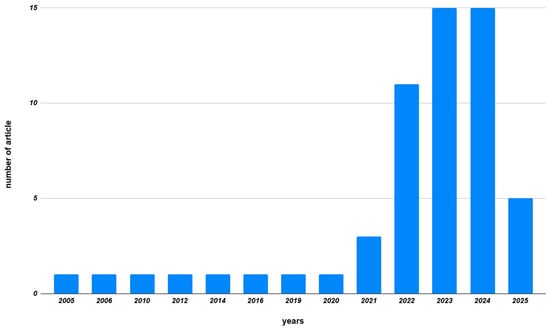
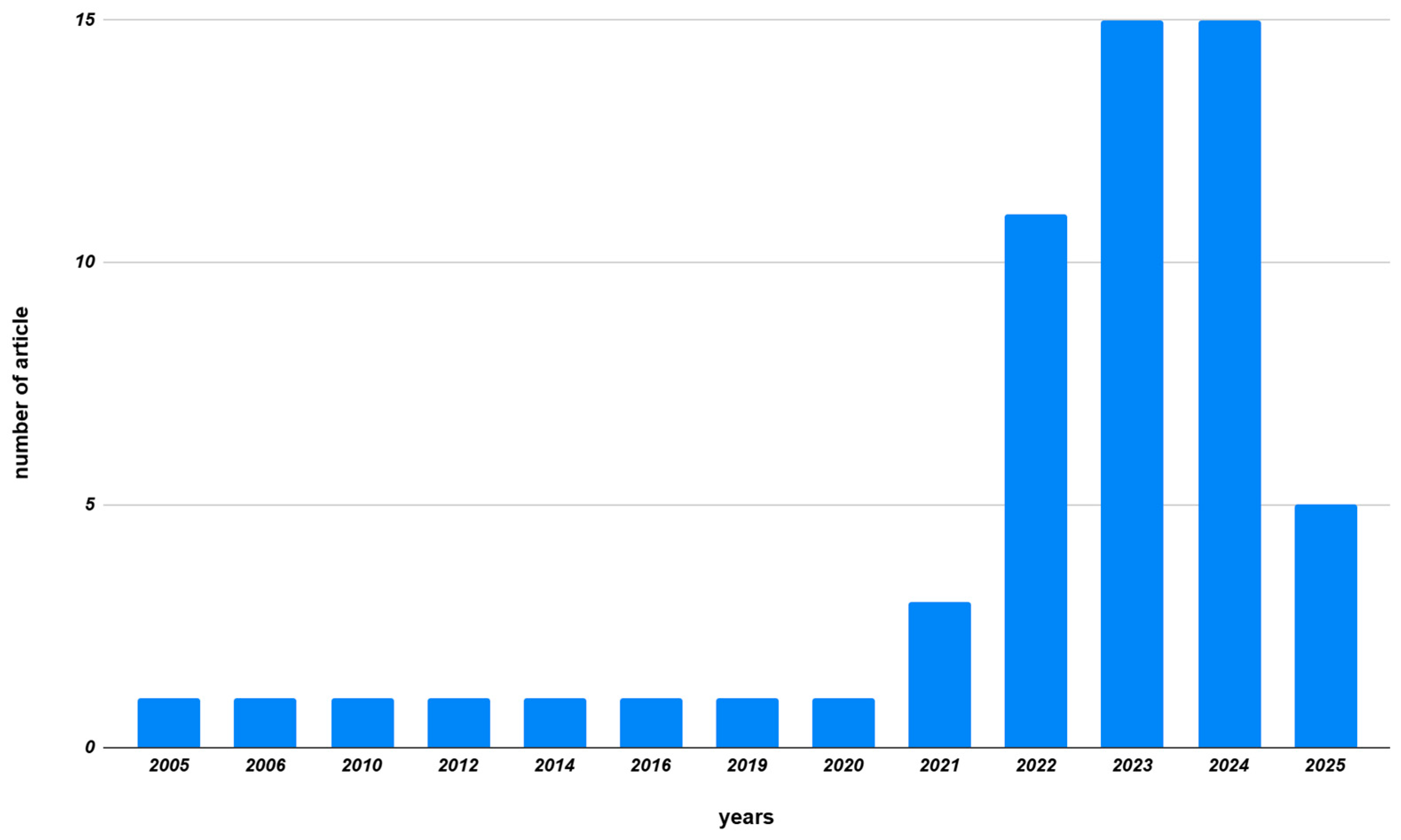
The scope of this review was limited to studies published between 2020 and 2025, during which the number of relevant publications increased significantly (Figure 1). To improve transparency of the study identification process, the screening and selection process was further clarified. Titles and abstracts of all articles were initially screened to assess their relevance to machine learning applications in total joint arthroplasty. Potentially eligible studies then underwent a full-text eligibility assessment. Duplicate records were manually identified and removed prior to the full screening process. Clear inclusion and exclusion criteria were applied, focusing on studies that utilised machine learning methods with structured clinical data while excluding imaging-based research. This structured approach helped ensure that only relevant studies were included in the final analysis.
Figure 1.
Number of published articles per year.
The initial search yielded 220 articles. After screening titles and abstracts, 39 were found relevant out of the initial 220 research studies. Following a detailed full-text assessment, 17 studies met the inclusion criteria and were included in this review (Table 1). Although a structured search strategy was implemented, this study was conducted as a focused narrative review rather than a formal PRISMA-guided systematic review. Moreover, ScienceDirect was selected due to its broad indexing of peer-reviewed orthopaedic and medical informatics journals. However, we acknowledge that restricting the search to a single database may impact the comprehensiveness of study identification and may introduce selection bias. A formal risk-of-bias assessment tool was not applied, as the objective of this review was to analyse reported methodological limitations rather than evaluate and compare the outcomes.
Table 1.
Summary of included studies and reported methodological limitations.
3. Review Results
Table 1 provides an overview of the 17 studies included. For each study, key details were summarised, including the type of surgery, study aims, data source, collection period, sample size and reported limitations. This structured presentation allows for easier comparison across studies and highlights common methodological challenges in applying machine learning approaches to TJA research.
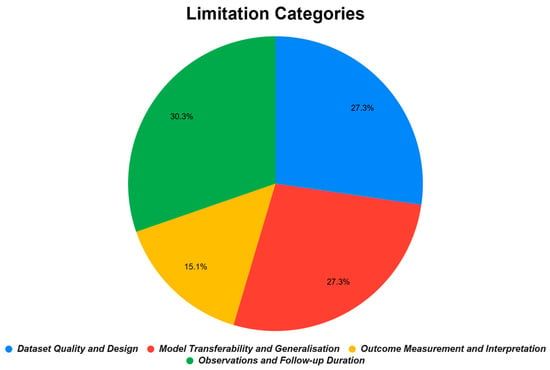
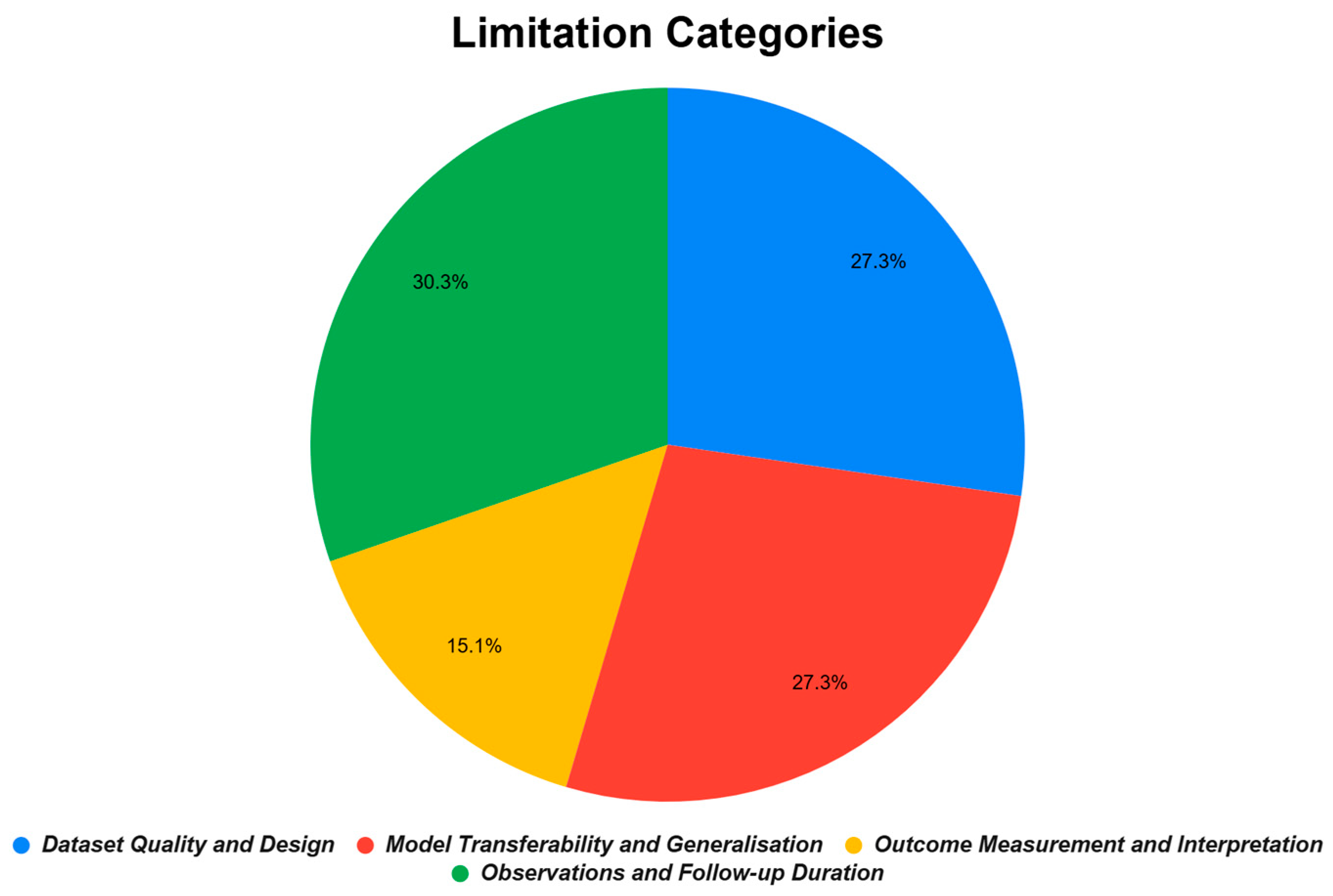
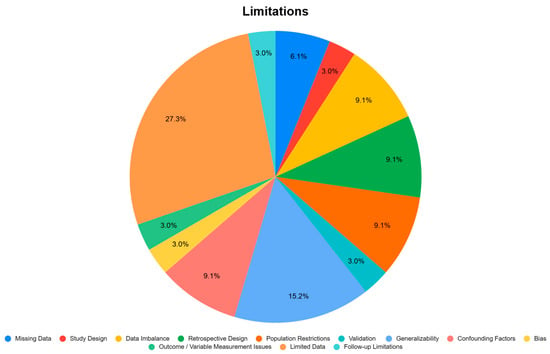
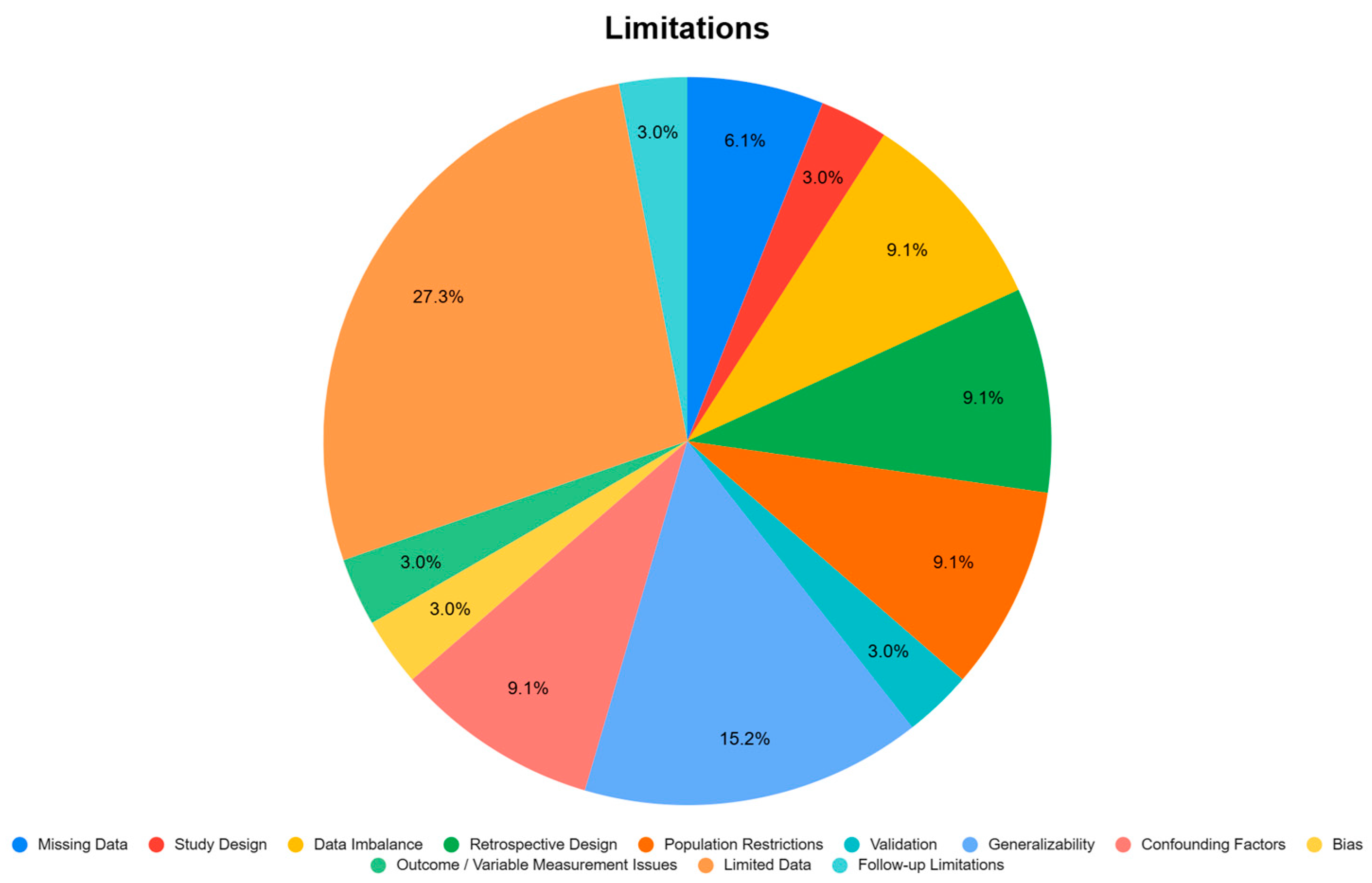
As presented in Table 1, study limitations were reviewed from each paper, most commonly discussed in the discussion sections. The frequency of these limitations across the reviewed studies is shown in Figure 2 and Figure 3. These figures illustrate the frequency of reported limitations across the selected studies. The duration of observations and follow-ups was the most frequently reported category (30.3%), highlighting challenges in accountability and validation of ML models. Dataset quality and design (27.3%), model transferability and generalisation (27.3%), and outcome measurement and interpretation (15.2%) were commonly reported limitations, representing the need for improved data collection and validation strategies. The percentages were calculated based on the proportion of included studies reporting each limitation category (n = 17), allowing structured descriptive synthesis despite methodological heterogeneity.
Figure 2.
Categorised limitations of ML in total joint arthroplasty.
Figure 3.
Frequency of reported limitations across selected studies.
A thorough review of these studies revealed recurring methodological limitations across the literature. Many of the studies listed in Table 1 were constrained by issues related to dataset quality and design such as missing information or imbalanced datasets. In addition, several studies reported limitations with model transferability and generalisation of patient populations, validation and/or limited applicability to broader clinical settings. The studies also raised concerns regarding outcome measurement and interpretation, including the influence of confounding factors, potential sources of bias, and inconsistencies in how outcomes or variables were defined and measured. While almost all studies had limitations in the number of available observations and the follow-up period, only a few explicitly acknowledged this.
4. Limitations of ML in TJA
This section addresses issues related to dataset quality and design, model transferability and generalisation, outcome measurement and interpretation, and observations and follow-up duration. Each of these subcategories was reviewed in detail to explore the impact of limitations on the robustness, reliability, and generalisability of machine learning models in TJA.
4.1. Dataset Quality and Design
This section addresses issues related to missing data, study design, data imbalance, and retrospective design. Each of these subcategories will be reviewed in detail.
First, missing data can occur not only when parts of the dataset are incomplete, but also when important factors are not considered. For example, in a study, three patients with four missing characteristics were excluded from the analysis [24]. Also, in another study, important factors such as clinical, demographic, and lifestyle characteristics, and race were omitted [13]. Second, study design issues may arise when researchers include interacting variables that are difficult to validate. For instance, in a research by Harris et al., although drug use disorder diagnosis and full-time employment may be related to outcomes, it is more likely that these variables act as proxies for a broader set of causally related medical and social conditions [18]. Third, data imbalance often occurs in studies with small populations. For example, the proportion of patients with K+ disorders was significantly lower than that of those without. To address this, while the authors applied the SMOTE method to rebalance the dataset, it also introduced potential statistical bias [12]. Similarly, Devana et al. noted that predictive models trained on artificially balanced datasets may not be directly applicable in clinical settings, as they are often poorly calibrated. To better address the imbalance, they evaluated five prognostic models using the area under the precision–recall curve [20].
Finally, reliance on retrospective design and routinely collected data can introduce biases related to data quality and completeness [11]. For instance, a retrospective design led to selection bias by limiting the population to those seeking surgical evaluation [20]. To mitigate such challenges, future research may benefit from integrating machine learning approaches with dynamic datasets derived from existing healthcare information systems [11].
4.2. Model Transferability and Generalisation
This section discusses limitations related to population restrictions, validation, and generalisability. Initially, population restrictions occur when data are collected from a very specific group or a single centre, which limits the applicability of the findings. For example, in Lee’s study, only female patients undergoing posterior-stabilised TKAs were included. As a result, the findings cannot be generalised to male patients or those undergoing cruciate-retaining TKAs. The authors suggested that future research should incorporate both male patients and cruciate-retaining procedures to improve applicability [14]. Similarly, in Faure’s study, the dataset consisted only of a European population. The authors noted that confirming the model with larger, multicentre datasets would strengthen its external validity [10]. Furthermore, validation issues were based solely on internal validation, while external validation is necessary to better assess the true performance of predictive models [16]. Finally, yet importantly, a lack of generalisability often stems from restricted data collection or narrow population samples. For instance, in Sniderman’s paper, the developed model was specific to total hip arthroplasty (THA) and therefore could not be applied to other orthopaedic populations [21]. Likewise, in Fu et al.’s work, the model was based on data from a single institution; to address this, the authors highlighted the importance of incorporating data from external agencies to improve verification [9]. Importantly, generalisability is not solely dependent on large datasets. However, Gowd et al.’s study included a database that covered 60% of the population, and regional biases remained; the dataset could not be considered fully representative of the entire population [17].
4.3. Outcome Measurement and Interpretation
This category of limitations includes confounding factors, bias, and issues related to outcome or variable measurement. In the first place, confounding factors may affect results when important variables are overlooked. For instance, in one study, several factors influencing patient admission may have also affected the selection process [9]. Similarly, in another study, implant materials and insert types were not standardised, which could have influenced the findings [14]. In the second place, bias can arise when parts of the patient population are excluded from analysis. In a study, non-response bias occurred in cases where patients who did not complete all follow-up steps were not included in the model. The authors suggested that this limitation could be addressed by increasing the dataset’s scale [23]. In the third place, outcome/variable measurement plays a critical role in model accuracy. In a paper, it was reasonable to assume that patients with higher drain outputs would have an increased likelihood of postoperative anaemia or the need for a blood transfusion, illustrating how outcome definitions directly influence predictive performance [16].
4.4. Observations and Follow-Up Duration
Initially, in some cases, limitations arise from the scope of the dataset and the factors it includes. Expanding the range of effective variables could improve prediction accuracy and enhance clinical decision-making [19]. One study relied only on well-known clinically relevant attributes, while additional factors such as surgeon-related variables and catalogue ranges could also have been examined. Expanding datasets by incorporating information from multiple international registries that track the same prostheses could help address this issue [25]. Short follow-up periods also represented a common limitation. As mentioned in a study, while a three-month follow-up was considered sufficient for the study’s aim, and many postoperative THA patients show good recovery at this stage, others continue to improve, with further improvement expected [21].
5. Discussion
In this review of ML-related articles in TJA published between 2020 and 2025, 17 studies met the inclusion criteria. These studies mention several common challenges that currently undermine ML performance in arthroplasty settings. As shown in Figure 1, limited data and generalisability are the most common issues. In detail, some models were trained using limited populations and tested only through internal validation, raising concerns of generalisation in broader patient groups. The challenges with outcome and variable measurement, such as confounding factors and inconsistent definitions, further complicate the model’s interpretation by researchers. Finally, small datasets, limited variables, and short follow-up periods restricted the accuracy of outcomes.
Although a structured search strategy was implemented, this study was conducted as a focused narrative review rather than a formal PRISMA-guided systematic review. Previous reviews primarily emphasised model performance metrics and predictive accuracy [7]. However, this paper presented a review with a unique concentration on methodological limitations that affect clinical translation, particularly dataset heterogeneity, external validation deficits, and outcome definition inconsistencies. Despite earlier reviews mainly emphasising imaging processing or the frequency of different ML techniques, this one excluded imaging-based models to narrow the scope and focus on structured clinical data. We combined their reported limitations into four main categories: (1) dataset quality and design, (2) model transferability and generalisation, (3) outcome measurement and interpretation, and (4) observations and follow-up. Thus, this review highlights these four categories of challenges for using ML models for clinical purposes for TJA patients.
The reviewed articles have several recommendations for future research, such as collecting larger samples from multiple centres, including patients of different ages, genders, and various types of prostheses, as well as integrating data from several international registries. Such datasets would not only improve robustness and reliability but also enhance external validity [10,25,26,27,28]. For instance, since African American and Asian populations represented only a small proportion in Li et al.’s research dataset, further investigation is needed for generalisability across other ethnic groups, such as the Chinese population [13]. Moreover, rebalancing issues would be alleviated in large datasets, thereby decreasing the likelihood of statistical bias [10]. Similar to the larger cohort, ongoing follow-up could address issues in the prospective cohort [21]. Nevertheless, although incorporating additional variables may enhance model performance, the number of variables should remain relatively small for clinical utility [16].
In addition, a few points can guide future research in this field. First, improving dataset quality is essential through better data collection protocols, minimising missing information, and including clinically relevant variables. Second, strategies for external validation and transferability should be prioritised, considering testing models across diverse populations and healthcare systems. Third, outcome measures should be standardised to reduce variability and simplify comparisons between studies. Finally, enhancing follow-up will provide more robust insights into long-term functional outcomes and complications, provided predictive models capture the full patient trajectory.
From a regulatory perspective, limited external validation and opaque model architectures may hinder approval processes. Furthermore, medico-legal accountability remains complex when predictive tools influence surgical decision-making, particularly if algorithmic biases are not fully disclosed. This review has some limitations. It is limited to ScienceDirect and to studies published between 2020 and 2025. Accordingly, relevant research articles published in other databases or beyond this timeframe were not considered. In addition, a formal risk-of-bias assessment tool was not applied, as the objective of this review was to analyse reported methodological limitations rather than to evaluate comparative effectiveness outcomes.
6. Conclusions and Recommendations for Future ML Research in TJA
This review highlights limitations of utilising ML in TJA across the recent literature. Issues with missing data, retrospective design, and small and imbalanced datasets reduce the stability of predictions. Equally important, many studies relied on narrow patient populations, and internal validation could restrict their generalisability. Limitations in outcome/variable measurement, such as confounding factors and inconsistent definitions, further weaken interpretability. Taken together, these challenges explain why ML models have yet to move from research to everyday practice in arthroplasty.
The main findings of this review suggest that while ML has shown potential for predicting outcomes, identifying complications, and supporting clinical decision-making, its recent application in TJA has methodological weaknesses. For researchers, this highlights the need to prioritise the design of larger, multicentre datasets, adopt rigorous validation strategies, and ensure transparency of models.
Partnerships between data scientists, orthopaedic surgeons, registries, and healthcare systems can generate more vast datasets and promote model interpretability, transparency, and reproducibility. Developing ML models that not only achieve high predictive accuracy but also address real-world clinical needs will be crucial to bridge the gap between research and practice in arthroplasty.
To date, multivariable predictive models for TJR have been developed primarily using imaging-derived variables. However, the application of ML in predicting postoperative outcomes remains in its early stages, with only a limited number of studies demonstrating models that are applicable in clinical practice. This suggests the need for further research, particularly in the development of models capable of predicting a wider range of outcomes, such as the early identification of prosthesis outliers, by training large-scale data from national joint registries worldwide.
Such advances may signal the beginning of a new era in joint arthroplasty, where ML-driven decision support systems provide surgeons with robust, data-informed tools to guide patient-specific treatment strategies. The Australian Orthopaedic Association Registry, recognised as a global leader in arthroplasty data collection, captures high-quality information on nearly all joint replacement procedures performed in Australia. This comprehensive dataset represents a crucial resource for developing more robust and reliable predictive models in the future.
Despite promising predictive performance in some specific contexts, few models have been prospectively implemented in clinical workflows. Regulatory standards, data governance requirements, and medico-legal accountability concerns may partly explain the gap between development and adoption.
Author Contributions
Methodology, K.G.; formal analysis, S.G.R.A.; investigation, S.G.R.A.; writing—original draft preparation, S.G.R.A.; writing—review and editing, R.H., C.A. and K.G.; supervision, R.H. and K.G. All authors have read and agreed to the published version of the manuscript.
Funding
The authors received no financial support for the research, authorship and/or publication of this article.
Institutional Review Board Statement
Not applicable.
Informed Consent Statement
Not applicable.
Data Availability Statement
The data presented in this study are available on request from the corresponding author.
Conflicts of Interest
The authors declare no conflict of interest.
References
- Baratta, J.L.; Deiling, B.; Hassan, Y.R.; Schwenk, E.S. Total Joint Replacement in Ambulatory Surgery. Best Pract. Res. Clin. Anaesthesiol. 2023, 37, 269–284. [Google Scholar] [CrossRef] [Scilit] [PubMed]
- Littman, J.L.; Molino, J.; Olansen, J.B.; Antoci, V.; Aaron, R.K. Predicting Outcome of Total Knee Arthroplasty by Cluster Analysis of Patient-Reported Outcome Measures. J. Arthroplast. 2025, 40, 873–879.e2. [Google Scholar] [CrossRef] [Scilit]
- Wall, J.; Krummel, T. The digital surgeon: How Big Data, Automation, and Artificial Intelligence will Change Surgical Practice. J. Pediatr. Surg. 2020, 55, 47–50. [Google Scholar] [CrossRef] [Scilit]
- Ruamviboonsuk, P.; Chantra, S.; Seresirikachorn, K.; Ruamviboonsuk, V.; Sangroongruangsri, S. Economic Evaluations of Artificial Intelligence in Ophthalmology. Asia-Pac. J. Ophthalmol. 2021, 10, 307–316. [Google Scholar] [CrossRef] [Scilit]
- Dalil, D.; Esmaeili, S.; Safaee, E.; Asgari, S.; Kejani, N. The Prediction of Venous Thromboembolism Using Artificial Intelligence and Machine Learning in Lower Ex-tremity Arthroplasty: A Systematic Review. Arthroplast. Today 2025, 33, 101672. [Google Scholar] [CrossRef] [Scilit]
- Dragosloveanu, S.; Vulpe, D.E.; Andrei, C.A.; Nedelea, D.G.; Garofil, N.D.; Anghel, C.; Dragosloveanu, C.D.M.; Cergan, R.; Scheau, C. Predicting Periprosthetic Joint Infection: Evaluating supervised machine learning models for clinical application. J. Orthop. Transl. 2025, 54, 51–64. [Google Scholar] [CrossRef] [Scilit]
- Ghadirinejad, K.; Milimonfared, R.; Taylor, M.; Solomon, L.B.; Graves, S.; Pratt, N.; de Steiger, R.; Hashemi, R. Supervised Machine Learning for the Prediction of Post-operative Clinical Outcomes of Hip and Knee Replacements: A Review. ANZ J. Surg. 2024, 94, 1228–1233. [Google Scholar] [CrossRef] [Scilit]
- Rubinger, L.; Gazendam, A.; Ekhtiari, S.; Bhandari, M. Machine Learning and Artificial Intelligence in Research and Healthcare. Injury 2023, 54, S69–S73. [Google Scholar] [CrossRef] [Scilit]
- Fu, M.; Liu, Y.; Hou, Z.; Wang, Z. Interpretable prediction of acute ischemic stroke after hip fracture in patients 65 years and older based on machine learning and SHAP. Arch. Gerontol. Geriatr. 2025, 129, 105641. [Google Scholar] [CrossRef] [Scilit] [PubMed]
- Faure, N.; Knecht, S.; Tran, P.; Tamine, L.; Orban, J.C.; Bronsard, N.; Gonzalez, J.F.; Micicoi, G. Prediction of transfusion risk after total knee arthroplasty: Use of a machine learning algorithm. Orthop. Traumatol. Surg. Res. 2025, 111, 103985. [Google Scholar] [CrossRef] [Scilit] [PubMed]
- Golinelli, D.; Rosa, S.; Rucci, P.; Sanmarchi, F.; Tedesco, D.; Biagetti, C.; Gili, A.; Bucci, A.; Romeo, L.; Grilli, R. ML-predicted Surgical Site Infections: An Epidemiological Study Utilizing Machine Learning on Routinely Collected Healthcare Data to Predict Infection Risk. Smart Health 2025, 37, 100596. [Google Scholar] [CrossRef] [Scilit]
- Tran, P.; Knecht, S.; Tamine, L.; Faure, N.; Orban, J.C.; Bronsard, N.; Gonzalez, J.F.; Micicoi, G. Risk Prediction of Kalaemia Disturbance and Acute Kidney Injury After Total Knee Arthroplasty: Use of a Machine Learning Algorithm. Orthop. Traumatol. Surg. Res. 2025, 111, 103958. [Google Scholar] [CrossRef] [Scilit]
- Li, H.H.T.; Chan, L.C.; Chan, P.K.; Wen, C. An Interpretable Knee Replacement Risk Assessment System for Osteoarthritis Patients. Osteoarthr. Cartil. Open 2024, 6, 100440. [Google Scholar] [CrossRef] [Scilit]
- Lee, D.W.; Han, H.S.; Lee, M.C.; Ro, D.H. Prediction of postoperative gait speed change after bilateral primary total knee arthroplasty in female patients using a machine learning algorithm. Orthop. Traumatol. Surg. Res. 2024, 110, 103842. [Google Scholar] [CrossRef] [Scilit]
- Ghadirinejad, K.; Graves, S.; de Steiger, R.; Pratt, N.; Solomon, L.B.; Taylor, M.; Hashemi, R. Can Machine Learning Algorithms Contribute to the Initial Screening of Hip Prostheses and Early Identification of Outliers? Prosthesis 2024, 6, 744–752. [Google Scholar] [CrossRef] [Scilit]
- Kolin, D.A.; Lyman, S.; Della Valle, A.G.; Ast, M.P.; Landy, D.C.; Chalmers, B.P. Predicting Postoperative Anemia and Blood Transfusion Following Total Knee Arthroplasty. J. Arthroplast. 2023, 38, 1262–1266.e2. [Google Scholar] [CrossRef] [Scilit] [PubMed]
- Gowd, A.K.; Agarwalla, A.; Beck, E.C.; Rosas, S.; Waterman, B.R.; Romeo, A.A.; Liu, J.N. Prediction of Total Healthcare Cost Following Total Shoulder Arthroplasty Utilizing Machine Learning. J. Shoulder Elb. Surg. 2022, 31, 2449–2456. [Google Scholar] [CrossRef] [Scilit] [PubMed]
- Harris, A.H.S.; Kuo, A.C.; Bowe, T.R.; Manfredi, L.; Lalani, N.F.; Giori, N.J. Can Machine Learning Methods Produce Accurate and Easy-to-Use Preoperative Prediction Models of One-Year Improvements in Pain and Functioning After Knee Arthroplasty? J. Arthroplast. 2021, 36, 112–117.e6. [Google Scholar] [CrossRef] [Scilit]
- Slezak, J.; Butler, L.; Akbilgic, O. The Role of Frailty Index in Predicting Readmission Risk Following Total Joint Replacement Using Light Gradient Boosting Machines. Inform. Med. Unlocked 2021, 25, 100657. [Google Scholar] [CrossRef] [Scilit]
- Devana, S.K.; Shah, A.A.; Lee, C.; Roney, A.R.; van der Schaar, M.; SooHoo, N.F. A Novel, Potentially Universal Machine Learning Algorithm to Predict Complications in Total Knee Arthroplasty. Arthroplast. Today 2021, 10, 135–143. [Google Scholar] [CrossRef] [Scilit]
- Sniderman, J.; Stark, R.B.; Schwartz, C.E.; Imam, H.; Finkelstein, J.A.; Nousiainen, M.T. Patient Factors That Matter in Predicting Hip Arthroplasty Outcomes: A Machine-Learning Approach. J. Arthroplast. 2021, 36, 2024–2032. [Google Scholar] [CrossRef] [Scilit] [PubMed]
- Hyer, J.M.; Paredes, A.Z.; White, S.; Ejaz, A.; Pawlik, T.M. Assessment of Utilization Efficiency Using Machine Learning Techniques: A Study of Heterogeneity in Preoperative Healthcare Utilization Among Super-utilizers. Am. J. Surg. 2020, 220, 714–720. [Google Scholar] [CrossRef] [Scilit]
- Ulivi, M.; Meroni, V.; Orlandini, L.; Prandoni, L.; Rossi, N.; Peretti, G.M.; Dui, L.G.; Mangiavini, L.; Ferrante, S. Opportunities to Improve Feasibility, Effectiveness and Costs Associated with a Total Joint Replacements High-volume Hospital Registry. Comput. Biol. Med. 2020, 121, 103775. [Google Scholar] [CrossRef] [Scilit] [PubMed]
- Lei, M.; Han, Z.; Wang, S.; Han, T.; Fang, S.; Lin, F.; Huang, T. A Machine Learning-based Prediction Model for In-hospital Mortality Among Critically Ill patients with Hip Fracture: An Internal and External Validated Study. Injury 2023, 54, 636–644. [Google Scholar] [CrossRef] [Scilit]
- Ghadirinejad, K.; Graves, S.; de Steiger, R.; Pratt, N.; Solomon, L.B.; Taylor, M.; Hashemi, R. What Is the Most Appropriate Comparator to Use in Assessing the Comparative Performance of Primary Total Knee Prostheses? A Registry-Based Study. Arthroplast. Today 2024, 27. [Google Scholar] [CrossRef] [Scilit]
- Chaiyasit, K.; Phombut, C.; Wiangkham, A.; Rooppakhun, S. Kinetics prediction of normal knee and undergone total knee arthroplasty during squatting based on extreme gradient boosting. Results Eng. 2024, 23, 102663. [Google Scholar] [CrossRef] [Scilit]
- Twumasi, C.; Aktas, M.; Santoni, N. Kinetic Pattern Recognition in Home-Based Knee Rehabilitation Using Machine Learning Clustering Methods on the Slider Digital Physiotherapy Device: Prospective Observational Study. JMIR Form. Res. 2025, 9, e69150. [Google Scholar] [CrossRef] [Scilit]
- Wang, X.; Liu, T.; Sheng, Y.; Zhang, Y.; Qiu, C.; Li, M.; Cheng, Y.; Li, S.; Wang, Y.; Wu, C. Identification and Verification of Four Candidate Biomarkers for Early Diagnosis of Osteoarthritis by Machine Learning. Heliyon 2024, 10, e35121. [Google Scholar] [CrossRef] [Scilit] [PubMed]

Disclaimer/Publisher’s Note: The statements, opinions and data contained in all publications are solely those of the individual author(s) and contributor(s) and not of MDPI and/or the editor(s). MDPI and/or the editor(s) disclaim responsibility for any injury to people or property resulting from any ideas, methods, instructions or products referred to in the content. |
© 2026 by the authors. Licensee MDPI, Basel, Switzerland. This article is an open access article distributed under the terms and conditions of the Creative Commons Attribution (CC BY) license.