


Abstract
We review recent calculations and numerical simulations showing the formation of coherent states of protons in hydrogen-loaded metals with a cubic crystal lattice. The characteristic frequencies discussed here are the local proton frequency, the plasma frequency, and the resonant confined electromagnetic frequency; depending on the adopted parameters, they are of order –. They are far from the much higher frequency corresponding to the full electron-capture energy transfer. In these states protons oscillate coherently and in a fixed phase relation with a strong high-frequency electric field which is trapped in the material, especially if the material is made of micro-powders. The energy gap of the coherent ground state is estimated to be well above thermal energies, of the order of a fraction of an eV per particle, and therefore large enough to make the state robust against thermal fluctuations. The analytical calculations address the realistic case of a large number of protons, in the rotating-wave approximation. The numerical calculations are presently limited to a small number of protons but go beyond the rotating-wave approximation and allow one to take into account a dissipation term associated with the strong oscillating electric field. The next task of this theoretical model is to compute the excited states of the coherent system. A simplified interacting-qubit model gives evidence of collective transition energies larger than the single-oscillator spacing. It does not yet establish whether a realistic external pump can populate such collective excited states with appreciable probability, nor the overall pump-to-capture conversion efficiency in a realistic proton lattice. If suitable states can be populated, their de-excitation could make some electron-capture processes energetically possible, with generation of slow neutrons. This dynamical mechanism offers an alternative to the Widom–Larsen hypothesis of “heavy electrons”, and is closer to current models in mainstream physics. The consequences, in terms of nuclear transmutations, of neutron generation via electron capture would be similar to those already known in the literature.
1. Introduction
A long-standing open problem in the physics of hydrogen-loaded metals is whether collective quantum states of the absorbed hydrogen can play a direct role in low-energy nuclear processes. From a theoretical point of view, this question is interesting independently of any specific phenomenological interpretation, because hydrogen in a metallic lattice provides a dense system of light charged particles bound to interstitial sites and coupled, in principle, to collective electromagnetic modes of the host material [1,2,3,4]. If a sufficiently large number of such particles can enter a coherent state, the relevant energy scales need not be limited to those of single, incoherent particles.
This possibility is also motivated by a large body of experimental work. Hundreds of independent experiments have reported evidence for anomalous reactions occurring in some hydride metals when subjected to thermal, electrical, or optical stimulation. Nuclear transmutations of the metal atoms have been observed, and in some cases also neutron emission and reactions of hydrogen isotopes leading, for example, to the formation of tritium or other light elements [5,6,7,8,9,10,11,12]. See also the tables of references in Refs. [5,7]. Some of these reactions generate excess heat of apparently non-chemical origin. A satisfactory microscopic theory of such phenomena is still lacking. The aim of the present paper is not to provide a complete reaction model, but to discuss one possible theoretical ingredient: the formation and excitation of coherent proton states in hydrogen-loaded metals.
We shall focus on hydrogen-loaded systems, rather than deuterium-loaded systems. This choice is deliberate. From the point of view of many-body theory, deuterons would be simpler, because they are bosons. Protons, instead, are fermions, and one must in principle worry about the exclusion principle. However, the one-particle wavefunctions of protons bound to tetrahedral or octahedral sites in a metallic lattice are strongly localized, as shown in Ref. [3]. The overlap between wavefunctions centered at different sites is therefore very small, so that an approximate boson-like treatment can be used for the collective oscillatory degrees of freedom considered here. This approximation would of course be exact, as far as exchange symmetry is concerned, for deuterons.
There is also a physical reason for keeping the discussion centered on protons. If a deuterium-loaded material contains collective states with sufficiently large available energy, fusion channels are in principle also possible, although their probabilities in a condensed-matter environment may be strongly suppressed. In the present work we want to isolate a different mechanism, namely electron capture (EC) by coherent protons followed by neutron-induced nuclear processes. In this mechanism the elementary weak process is
and the missing energy, approximately for particles initially at rest, is supplied by a collective excitation of the proton system. The subsequent neutron can then be captured by a light or heavy nucleus, producing deuterium, tritium, or a transmuted isotope, depending on the material and on the nuclear channel involved. Thus the role of the coherent proton state is not to enhance ordinary fusion, but to provide, at least in principle, a collective energy reservoir for electron capture.
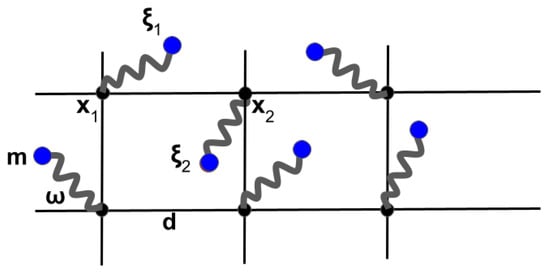
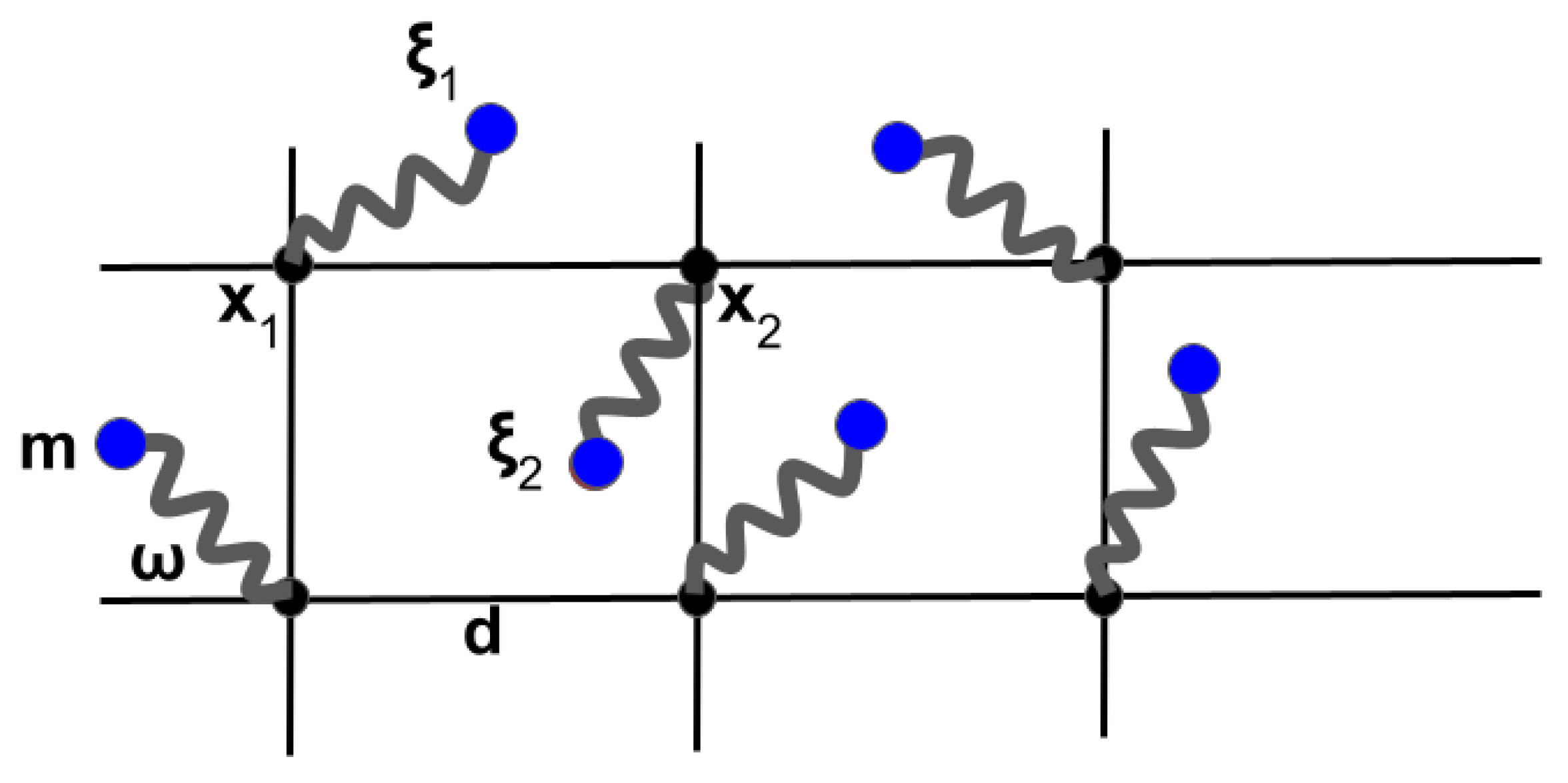
The formation of the coherent ground state has been studied in Refs. [1,2]. In that model, a large number N of protons are bound to interstitial sites of a cubic lattice and oscillate with a local frequency determined by the electrostatic potential of the site (see Figure 1). The protons are also coupled to electromagnetic modes confined inside a finite region of the material. Above a density-dependent threshold, the system can lower its energy by forming a collective state in which the proton oscillations are phase-correlated with a self-generated electromagnetic field. The coherent ground state is therefore separated from the incoherent perturbative ground state by an energy gap, which makes it robust against thermal fluctuations.
Figure 1.
Two-dimensional projection of the simple-cubic effective lattice used in the model. The points are equilibrium positions of interstitial particles and are distinct from the atomic sites of the host crystal. denotes the displacement from equilibrium. Each particle has mass m and is bound by a local elastic potential with frequency . The spacing between effective sites is d.
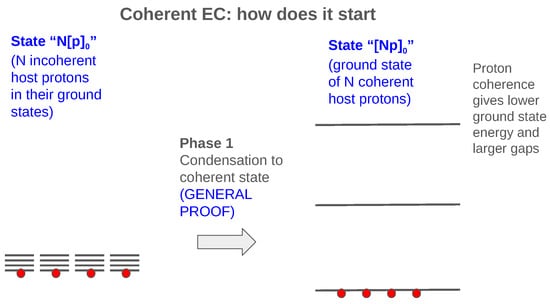
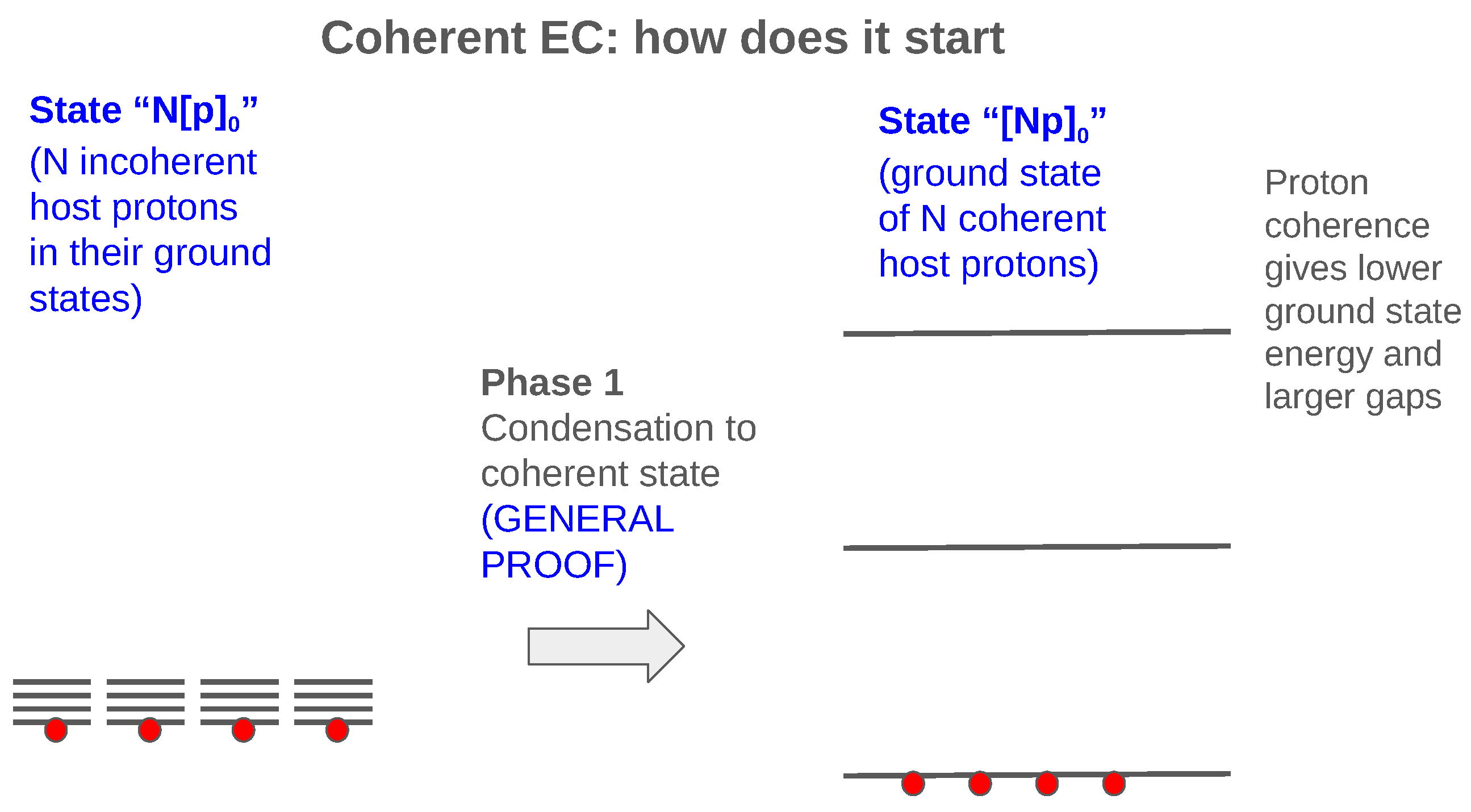
For electron capture, however, the ground-state gap alone is not sufficient. One needs excited coherent states capable of storing and transferring an energy of order to a single electron-capture event. The basic idea is that some transition energies of an interacting collective system may increase with the number of participating degrees of freedom and can therefore be much larger than the level spacings of individual oscillators. This is not a consequence of phase coherence alone. For N identical, uncoupled harmonic oscillators moving in phase, both the collective restoring-force constant and inertia scale as N, so that the normal-mode frequency remains the single-oscillator frequency and the first symmetric excitation lies only above the ground state. The proposed high-energy transition must instead arise from the spectrum and matrix elements of the interacting matter–field Hamiltonian. This is qualitatively illustrated in Figure 2, Figure 3 and Figure 4. A related phenomenon, in which a large quantum is redistributed among many smaller degrees of freedom, is often referred to as down-conversion or fractionation of a large quantum, and has been studied theoretically in other condensed-matter contexts, for example by Hagelstein and Chaudhary [13]. More recently, Ref. [14] has provided numerical evidence, in a simplified model of coherent harmonic qubits, that high-frequency energy transfer between external oscillators can occur only when the intermediate low-frequency oscillators are in a coherent state. Although this simplified model does not yet constitute a full calculation for hydrogen-loaded metals, it shows that interaction-induced collective transitions above the base frequency can occur in that model. Whether the required state can be populated with appreciable probability in a realistic hydrogen-loaded metal remains open.
Figure 2.
Graphical representation of the coherent electron-capture process investigated in Refs. [1,2,3]. A process of this kind might be responsible for generation of slow neutrons in a metal hydride, for example TiHx, with subsequent production of deuterium and isotopes of Ti. Phase 1: following the absorption of hydrogen in Ti, protons are bound to tetrahedral or octahedral sites in the Ti crystal structure, with an approximately harmonic potential. The wavefunctions of the single protons become synchronized, through a complex mechanism analyzed in Refs. [1,2,3], and protons condense into a collective coherent state with an energy gap well above thermal energies, robust with respect to thermal fluctuations. The number N of protons in a single coherence domain can be quite large, up to . The coherent ground state of N protons is denoted here by . The upper levels schematically denote interaction-induced collective excitations; their realistic spectrum and preparation probabilities have not yet been derived. Note that in the picture only a few protons and a few energy levels have been represented.
Figure 3.
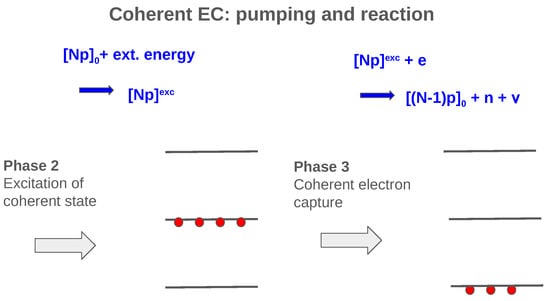
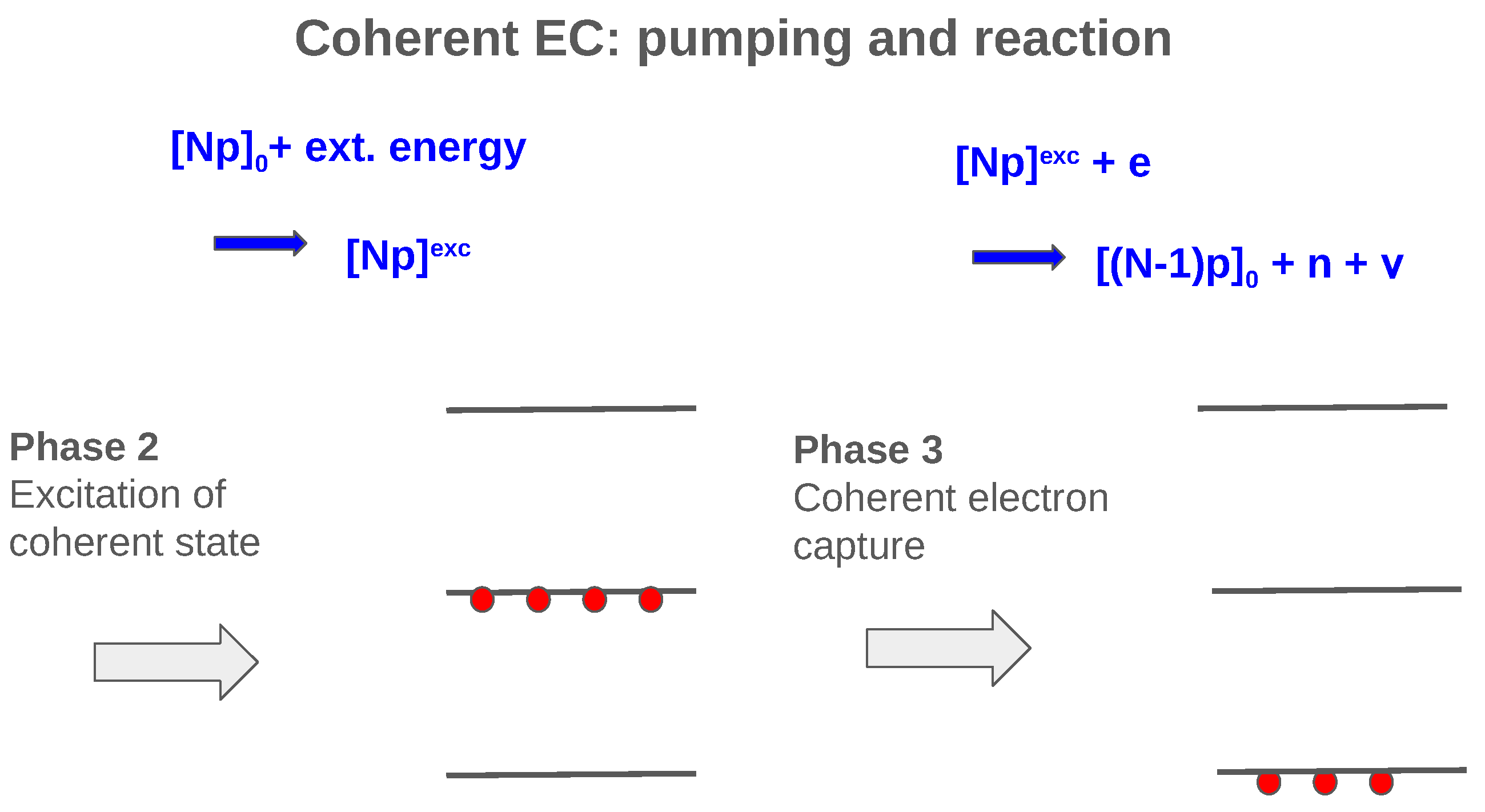
Conditional scheme for Phases 2 and 3. If a suitable drive populates a collective excited state with sufficient energy and weak-transition spectral weight, electron capture can become energetically allowed. In Phase 3 the number of protons decreases by one, a neutrino is generated, and the collective proton state is de-excited. The microscopic pumping probability and overall conversion efficiency have not yet been computed for a realistic metal hydride.
Figure 4.
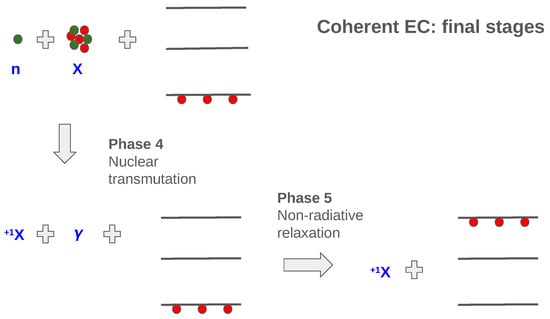
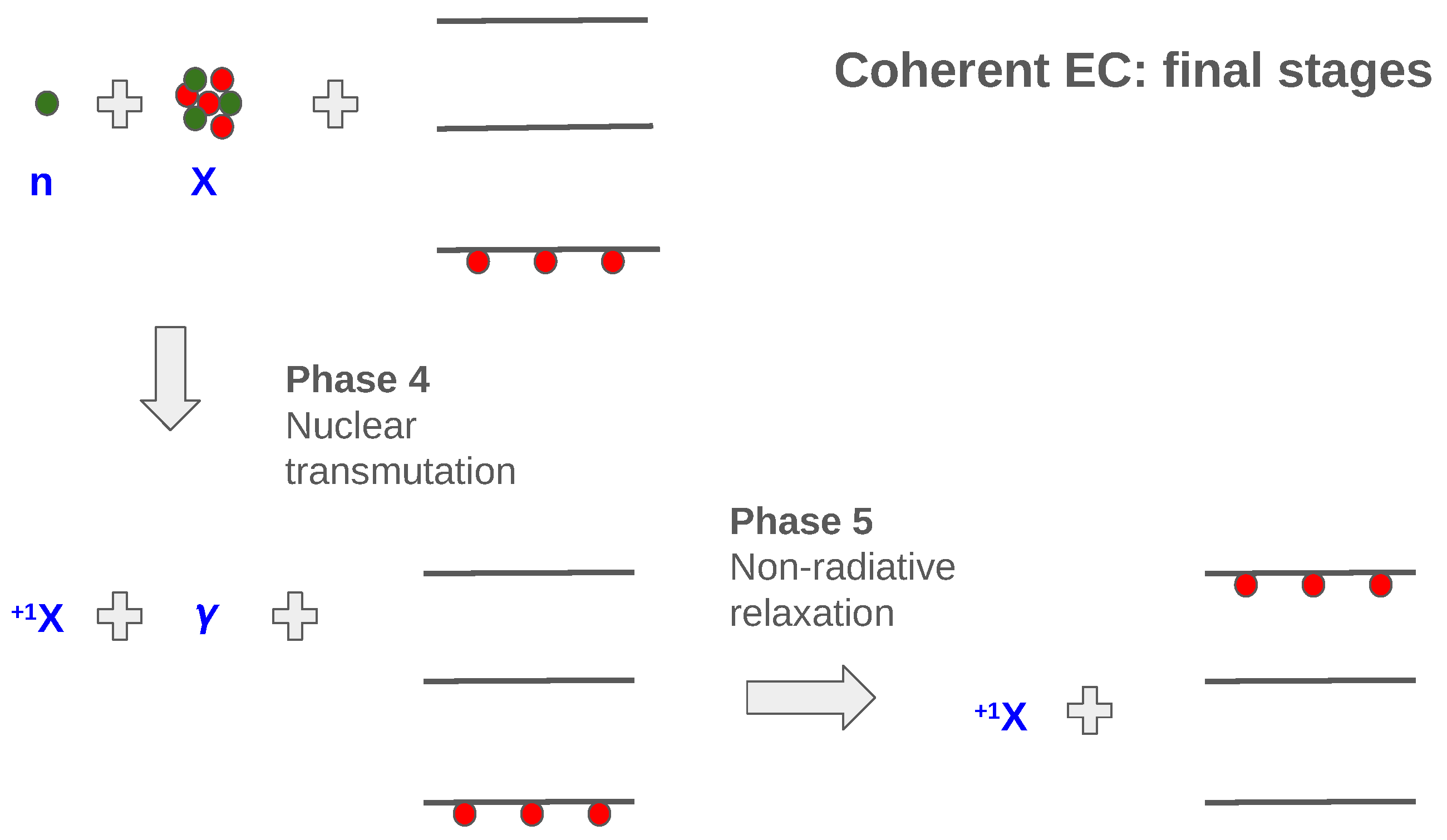
Phase 4: the neutron causes a transmutation in which the mass of an absorbing nucleus X, in our case Ti or H, increases by one and energy is released in a gamma ray. Phase 5: the gamma ray may be partially absorbed or reprocessed by collective degrees of freedom. In favorable conditions, the excited coherent state could support further electron captures, even if the external power supply is not available anymore.
The large energy gaps of the collective proton system could also play a role after electron capture has occurred. The slow neutrons produced by EC can be absorbed by heavy nuclei of the host metal, causing transmutations, or by light nuclei. For hydrogen loading, an important channel is
with emission of a gamma ray. For deuterium loading, neutron capture can lead to tritium formation. In both cases, the gamma energy may be partially reabsorbed by collective degrees of freedom of the proton or deuteron system, although the efficiency and kinetics of such processes are presently unknown. Evaluating the efficiency and kinetics of these transmutations therefore requires the spectrum of the excited coherent states and the corresponding transition probabilities. Determining these quantities remains one of the main open problems of the model.
The occurrence of EC in condensed matter has been previously suggested by Widom and Larsen [4]. In the weak interaction process (1) the missing energy in case of initial particles at rest was hypothesized to come from the increase in the effective electron mass due to the electromagnetic electron interaction in matter. Proton oscillations were supposed to play only an indirect role, because they generated strong oscillating fields on the metal surface and these in turn increased the effective electron mass. This hypothesis of the “heavy electron” is hard to prove, for several reasons, and has been strongly criticized [15,16,17,18]. Widom and Larsen defended their proposal also in other articles [19,20,21] and described a possible suppression mechanism of the gamma rays which originate from transmutations of heavy elements and reactions such as and . This suppression mechanism is also based on the heavy-electron hypothesis. Note that the generation of tritium has been observed in several experiments, mainly starting from deuterium but also from hydrogen [22,23,24,25,26,27,28,29].
The electron capture by coherent protons as proposed in this paper has been previously analyzed by Gamberale [30]. The purpose of that work was complementary to the one pursued in Refs. [1,2]. Instead of deriving the coherent state from the microscopic matter–field Hamiltonian, Gamberale assumed the existence of coherent proton and electron plasmas and used them as initial and final states in a quantum-field-theoretical calculation of the weak process (1). This made it possible to address a question which is not treated in the present review of the coherence mechanism itself, namely the order of magnitude of the neutron production rate once a coherent excitation above the electron-capture threshold is available. The work also includes rate equations relating the pumping process to the final energy output, which are clearly relevant to applications.
A central point of Ref. [30] is that the missing energy for electron capture need not be supplied by a single particle. If a coherence domain contains a very large number N of charged particles, a collective variation of the energy per particle of order can correspond to a macroscopic energy available for one weak transition. In this sense the threshold is not crossed by accelerating one proton or one electron to MeV energies, but by a small de-excitation of a many-body coherent state. This is conceptually close to the “fractionation” or down-conversion idea discussed above, but it is implemented there at the level of the weak-interaction matrix element.
The treatment of the excited coherent state in Ref. [30] is based on an Ansatz inspired by Preparata’s coherent-electrodynamics approach [31]. The coherent ground state is parametrized by a collective mixing angle, fixed by minimization of the energy. A coherent excited state is then represented by a nearby state in the same class, with slightly different values of the collective parameters, for example a modified mixing angle and a modified collective momentum. Thus the excitation is not described as the promotion of one proton to a high single-particle level, but as a small collective displacement of the entire coherent configuration. The electron-capture final state is obtained by applying the appropriate destruction operators to this many-body coherent state, so that one proton and one electron are removed from the coherent domain while the large-N coherent structure is otherwise preserved.
This Ansatz should be regarded as physically motivated but not yet as a derived spectrum of the microscopic proton–photon Hamiltonian. This is where the later numerical work on coherent harmonic qubits [14] may become relevant. In Ref. [14] the excited states are not postulated through a Preparata-type variational form. Instead, a simplified system of N two-state oscillators coupled to a dissipative photon mode is probed dynamically by weakly coupled external oscillators of variable frequency. Resonant absorption and resonant transfer between two external oscillators then provide operational information on the transition energies and transition probabilities of the coherent system. The important qualitative result is that high-frequency transfer mediated by low-frequency oscillators appears only in the coherent phase. This supports the basic physical assumption used in Ref. [30], namely that coherent excited states can exchange energy collectively at frequencies much higher than those of the individual oscillators, but it also shows that a quantitative theory of such states should ultimately be based on their actual spectrum and transition matrix elements rather than on an Ansatz alone.
It is useful to state the scale separation explicitly. The threshold energy corresponds to , or . These values are many orders of magnitude above the local proton, plasma, and confined-field frequencies. For example, corresponds to . The proposed process therefore cannot be described as ordinary resonant excitation of one harmonic quantum. In response-function language, an observable EC rate requires non-negligible spectral weight of the local weak operator at the required energy and momentum transfer. The existing weak-interaction calculation is conditional on the assumed initial coherent excited state; it does not yet include the microscopic probability of generating and populating that state.
The comparison also clarifies the present status of the theory. The calculation of Ref. [30] is the most direct attempt to connect coherent proton states with the weak electron-capture rate, but it relies on an assumed structure of the excited coherent states. The numerical results of Ref. [14] point in the same physical direction, showing collective high-frequency transitions in a simplified model, but they do not yet provide the full excited-state spectrum of a realistic hydrogen-loaded metal. A complete theory of coherent electron capture should therefore combine the microscopic derivation of the coherent ground state, the localized proton spectrum of Ref. [3], and a many-body calculation of the excited coherent states and of their weak-interaction matrix elements.
2. Elements from the Calculation “Coherent Plasma in a Lattice”
In Refs. [1,2], we considered a system with a large number N of protons bound in potential wells centered at tetrahedral sites in a cubic metal lattice. More precisely, the analytical model uses a simple-cubic effective lattice of oscillator equilibrium positions. This is an idealization of the interstitial sublattice and should not be identified with the Bravais lattice of the host metal. A real host may be FCC, BCC, or HCP; its structure enters the effective theory through the geometry and density of the occupied interstitial sites, the spacing d, and the local confining potential. These quantities determine the elastic frequency, the maximum displacement, and the plasma coupling. The estimate in Ref. [1], for example, was made for protons occupying voids of an FCC matrix. All protons oscillate with the same elastic frequency defined by the local electrostatic potential; in addition, they are subject to collective plasma oscillations with a frequency which depends on the proton density and is of the same magnitude as . The protons also interact with cavity photons, i.e., electromagnetic modes confined in a finite volume of size , where is the resonant photon wavelength, related to and .
The one-particle energy spectrum of protons bound by the local electrostatic potential has been computed numerically in Ref. [3] for a typical lattice with unit spacing and a frequency . This corresponds to . Note that a cube of side contains cells. It turns out to have 12 bound states with equal gaps in the energy interval , and a continuum of unbound states above zero. The bound eigenfunctions are strongly localized in the tetrahedral site wells, due to the large mass of protons. This justifies an approximated boson-like treatment without Pauli exclusion. The calculation can of course be repeated for deuterons instead of protons, in which case the boson-like treatment is exact.
Low-energy nuclear reactions via coherent EC can be schematically thought to occur in five stages, depicted in Figure 2, Figure 3 and Figure 4: Phase 1, condensation to coherent state; Phase 2, excitation of the coherent state; Phase 3, coherent EC; Phase 4, nuclear transmutation; Phase 5, non-radiative relaxation. The analytical and numerical calculations of Refs. [1,2,3] establish Phase 1 within the assumptions of the model. Phases 2 and 3 remain conditional on the existence, preparation, and weak-transition strength of suitable excited coherent states; Phases 4 and 5 describe possible subsequent processes. Here, the state-preparation probability denotes the probability that, starting from the coherent ground state, a specified external driving protocol populates the target collective excited state, or the relevant excited-state subspace. It depends on the drive coupling, frequency, intensity and duration, as well as on detuning, dissipation and decoherence.
Introducing some more formal details, we use natural units in Equations (3)–(11). The corresponding factors can be restored when frequencies are converted into SI units. Let be the number of oscillating protons and let denote the vector of annihilation operators for the three Cartesian oscillator modes at site n; the dagger denotes the corresponding creation operators. The Hamiltonian of the bound protons is
where
is the frequency renormalized by plasma oscillations, and all operators have an implicit time dependence in the interaction representation. Here is the frequency fixed by the local elastic cage, while is the plasma frequency for proton charge e, proton mass m, and coherence volume V in the units used here.
The Hamiltonian of the photons in a finite volume V requires a careful treatment of photon modes and their frequencies, according to general quantum-optics rules. Here we can just sketch a few essential points. A priori, photon modes with frequencies , , or are involved in resonant interactions. One starts by writing the pure photon part of the modes of frequency :
Here the summation is taken over two photon polarizations p and all possible directions of , i.e., over solid angles. The operators and annihilate and create a photon with polarization p and wave vector ; the condition follows from .
The matter–field interaction is written as a dipole interaction plus diamagnetic terms by replacing the momentum by in the Hamiltonian. Here is the equilibrium position of proton n, its displacement, its canonical momentum, and the quantized vector potential. One obtains
Next, two crucial mathematical transformations of the photon field are performed, preserving the commutation rules. The first is a linear combination known to eliminate the diamagnetic term,
The transformed operators obey the same bosonic commutation relations as the b operators; this Bogoliubov transformation incorporates the diamagnetic contribution into the dressed photon frequency . This clearly makes sense only if is not zero. In our case, is defined by the electrostatic lattice forces, while often in quantum optics it is defined by the size of the external artificial cavity. The second step is the summation of modes in all space directions,
Here is the photon polarization vector and is the unit vector along the Cartesian direction i; is therefore the normalized collective photon operator polarized along i. This introduces a three-dimensional improvement factor which is crucial for condensation.
The formation of resonant electromagnetic modes in all three space directions is possible because the finite volume acts as a natural cavity. Inside one micro-grain of the metal, the bare photon frequency changes to by combination with the plasma frequency, while the photon momentum is not affected. An external photon mode has a different ratio of energy and momentum. This mismatch prevents internal modes from propagating outside the material and thus provides a justification of the three-dimensional cavity effect. Possible losses at the interface can be taken into account numerically for small N, in addition to ohmic losses in the bulk. One finds that the occurrence of condensation is not affected by the losses.
The total effective Hamiltonian can be rewritten as
In the interaction term, is the ith Cartesian component of . The four operator products respectively describe rotating and counter-rotating matter–field processes; the latter are retained in the displayed effective Hamiltonian even though the analytical ground-state estimate is subsequently evaluated in the rotating-wave approximation. After minimization, the energy gap per particle of the coherent state is found to be
where is the dimensionless matter–field coupling and is the dimensionless coherent-state amplitude. The associated physical displacement is bounded by the size and shape of the interstitial cage and hence by the number of bound levels supported by the electrostatic well. Equation (11) gives the first-order result; the gap becomes negative for , signaling instability of the perturbative vacuum toward the coherent trial state.
Parameter Dependence and Possible Experimental Observables
The model parameters separate into material parameters and preparation parameters. Increasing the hydrogen loading increases the oscillator density and therefore , raising toward its saturation value and favoring the coherent instability. The host crystal and the choice of tetrahedral or octahedral occupation modify the local cage stiffness, and hence , as well as the allowed displacement encoded by . Changing from H to D primarily changes the mass and consequently both local and plasma frequencies. Grain size and morphology control the effective mode volume and boundary losses, whereas temperature and disorder affect dephasing and the lifetime of a coherence domain. Finally, pump frequency and intensity do not alter the equilibrium Hamiltonian written above unless an explicit drive term is added, but they control which excited states can be populated and with what probability.
These dependencies suggest several classes of observables. Vibrational or infrared spectroscopy can constrain and its isotope shift; optical or dielectric measurements can probe resonant confined modes and their linewidths; loading-dependent changes can test the predicted role of ; and pump–probe measurements can search for collective resonances, nonlinear absorption, or delayed energy transfer. Such measurements would test the coherent matter–field sector independently of nuclear signals. Observation of EC would require the additional dynamical condition discussed above: sufficient spectral weight of the local weak operator near the full threshold energy, together with an appreciable population of the relevant excited state.
The work in Ref. [14] concerns the numerical computation of the excited states of coherent oscillators in the simple case of quantum oscillators with two states only, called “harmonic qubits”. Information on the spectrum of these states and on their transition probabilities is obtained by simulating their coupling to one or two external oscillators with higher frequency. The model comprises N qubits coupled to a self-generated photon field that is able to synchronize them into a coherent ground state, even in the presence of dissipation. The qubits are additionally coupled to a variable external high-frequency oscillator Q. In correspondence with the frequency of a collective excited state of the qubits, energy is absorbed from the external oscillator. If two variable external oscillators and are coupled to each other via the coherent qubits, energy transfer between them is possible when their frequency matches the frequency of an excited coherent state. The published calculations show that high-frequency energy transfer between two external oscillators mediated by a system of low-frequency oscillators is only possible when this system is in a coherent state.
3. Conclusions and Outlook
The formation of coherent proton states in highly hydrogenated metals is a plausible theoretical mechanism for creating collective energy reservoirs in condensed matter. If suitable excited coherent states exist, they could provide the energy required for electron capture, with generation of slow neutrons. These neutrons could then be captured by light or heavy nuclei, leading to deuterium or tritium formation, isotope shifts, or nuclear transmutations. Gamma rays emitted in such secondary reactions might be partially reabsorbed or reprocessed by collective degrees of freedom of the coherent proton system, but the corresponding efficiencies and reaction kinetics are presently unknown.
The central open problem is the structure of the excited coherent states. The existence of the coherent ground state has been derived analytically, and the localization of the single-proton bound states has been studied numerically. However, electron capture requires not only a stable coherent ground state, but also excited coherent states with suitable transition energies and transition strengths. In the calculation of Ref. [30], the excited states were described by a Preparata-type Ansatz. This provides a useful first estimate of the electron-capture rate, but a more complete theory should derive the excited spectrum from the microscopic proton–photon Hamiltonian.
The size of a coherence domain is expected to be at most of the order of the wavelength of the resonant electromagnetic mode trapped in it, namely . This corresponds to – lattice sites. In principle, such domains may form spontaneously, as proposed in coherent electrodynamics models of water [32,33], although an analogous proof for hydrogen-loaded metals is still missing. In practice, a granular or microstructured material could help define effective cavities, possibly even on scales smaller than the wavelength, since the minimum number of coherent protons needed to supply the energy for one electron-capture event is much smaller, of order .
It is not clear whether coherence domains could be observed directly through their interaction with external gamma rays. In principle, a coherent domain with a suitable spectrum of collective excited states could have an enhanced probability of absorbing or reprocessing gamma radiation, especially if the gamma energy can be redistributed among many low-energy degrees of freedom. However, the experimentally measured attenuation or re-emission signal would be an average over the whole sample. If, at a given time, only a small fraction of the material volume is occupied by active coherence domains, the corresponding signal would be strongly diluted and could be hidden by ordinary photoelectric, Compton, and nuclear absorption processes in the metal. Moreover, the domains may be transient and spatially inhomogeneous, so that a null result in a bulk gamma-absorption experiment would not necessarily rule out their existence. Conversely, a positive result would require careful separation from standard gamma-interaction mechanisms.
Preliminary simulations with a small number of particles suggest the existence of a discrete spectrum in which some transition energies grow with the number of particles participating in the coherent state. In order to allow electron capture, the coherent system must first be driven into an excited state. The external pump, however, is expected to act at frequencies of the order of the base oscillation frequency , rather than directly at the much larger collective transition frequency. The relevant physical problem is therefore a form of coherent energy conversion between strongly mismatched energy scales.
This statement does not apply to N uncoupled harmonic oscillators, whose in-phase normal-mode frequency remains . It refers specifically to the interaction-induced spectrum observed in the simplified matter–photon model. At present, neither the extrapolation of this scaling to macroscopic N in a realistic proton lattice nor a mechanism that prepares the required high-energy state with a quantified probability has been established. Coherence is a necessary ingredient of the numerical effect found in that model, but it is not by itself a frequency-conversion mechanism.
Related issues appear in the spin–boson models studied by Hagelstein and Chaudhary [13,34], where a large two-level transition can become resonant with many quanta of a low-frequency oscillator through multiphoton Bloch–Siegert anticrossings. Those models show that an energy match alone is not sufficient: one must also compute the level splitting, or equivalently the transition matrix element, because this determines whether energy exchange can occur on a physically relevant time scale. The analogy with the present problem is limited, since the spin–boson models involve few degrees of freedom and a prescribed oscillator mode, while the coherent-proton model involves many localized proton oscillators, a self-generated electromagnetic field, and dissipation. Still, they provide useful guidance for future work: coherent down-conversion requires a precise resonance condition, a non-negligible anticrossing gap, and sufficient stability of the resonance during the exchange of many low-energy quanta.
Experiments on ensembles of 57Fe nuclei excited by X-ray free-electron-laser pulses [35] provide a different but relevant benchmark. They demonstrate collective nuclear response and photon-by-photon superradiant decay in an extended solid-state system. They do not demonstrate the down-conversion mechanism required here, but they show that coherent nuclear ensembles in crystals can display measurable collective radiative dynamics.
The comparison between Ref. [30] and the later work on coherent harmonic qubits [14] clarifies the present status of the theory. Ref. [30] gives the first explicit weak-interaction calculation of neutron production from coherent proton states, but it relies on an assumed form of the excited coherent configurations. The numerical results of Ref. [14], although obtained in a simplified two-level model, point in the same physical direction by showing that high-frequency energy transfer can be mediated by a coherent system of low-frequency oscillators. A complete theory should combine these two ingredients: the weak-interaction matrix element of Ref. [30] with a microscopic calculation of the excited coherent spectrum and of the corresponding transition strengths.
In modern many-body language, the ultimate quantity to be computed is not only the total energy stored in a coherence domain, but the spectral weight with which the local weak operator couples the initial coherent state to final states containing a neutron and a neutrino. This requires a dynamical response function or structure factor of the coherent medium. Establishing whether such a response contains a coherent contribution scaling super-extensively with the number of participating protons remains an open problem.
Consequently, the present status is conditional: the ground-state coherent phase has been derived within the stated Hamiltonian and approximations; collective high-frequency transitions have been observed only in a simplified few-qubit model; and the published EC rate assumes an already prepared coherent excited state. An absolute neutron-production rate or overall pump-to-EC conversion efficiency combining all three steps is not yet available.
Finally, weak-interaction mechanisms for low-energy nuclear processes have also been considered in a different framework in Ref. [36], where proton-to-neutron conversion is treated as the first step of a second-order perturbative process. In that approach the neutron is a virtual intermediate state subsequently captured by a nucleus, and no coherent proton domain is assumed. The rate is found to be negligible in general, but it may be enhanced in the presence of a suitable nuclear resonance. This is conceptually different from the coherent-proton mechanism discussed here, where the missing energy is supplied by a real collective excitation of the medium. Nevertheless, the comparison is instructive: in both cases an observable rate requires a non-trivial spectral enhancement, either a nuclear resonance or a coherent many-body transition with sufficient spectral weight.
Funding
This work was partially supported by the Free University of Bozen-Bolzano with the research project NMCSYS-TN2815. G.M. is a member of INdAM (Istituto Nazionale di Alta Matematica).
Data Availability Statement
The original contributions presented in this study are included in the article. Further inquiries can be directed to the corresponding author.
Conflicts of Interest
The author declares no conflicts of interest.
References
- Gamberale, L.; Modanese, G. Coherent Plasma in a Lattice. Symmetry 2023, 15, 454. [Google Scholar] [CrossRef] [Scilit]
- Gamberale, L.; Modanese, G. Numerical simulations unveil superradiant coherence in a lattice of charged quantum oscillators. Phys. B Condens. Matter 2023, 671, 415406. [Google Scholar] [CrossRef] [Scilit]
- Gamberale, L.; Modanese, G. Spectral Analysis of Proton Eigenfunctions in Crystalline Environments. Quantum Rep. 2024, 6, 172–183. [Google Scholar] [CrossRef] [Scilit]
- Widom, A.; Larsen, L. Ultra-low momentum neutron catalyzed nuclear reactions on metallic hydride surfaces. Eur. Phys. J. C 2006, 46, 107–111. [Google Scholar] [CrossRef] [Scilit]
- Metzler, F.; Hunt, C.; Messinger, J.; Galvanetto, N.; Hagelstein, P. Probing Neutrons and Purported Fission Daughter Products from Gas-Loaded, Laser-Irradiated Metal-Hydrogen Targets. SSRN Preprint. 2023. Available online: https://papers.ssrn.com/sol3/papers.cfm?abstract_id=4411160 (accessed on 5 September 2026).
- Fomitchev-Zamilov, M. Observation of neutron emission during acoustic cavitation of deuterated titanium powder. Sci. Rep. 2024, 14, 11517. [Google Scholar] [CrossRef] [Scilit]
- Iwamura, Y.; Itoh, T.; Yamauchi, S.; Takahashi, T. Anomalous heat generation that cannot be explained by known chemical reactions produced by nano-structures multilayer metal composites and hydrogen gas. Jpn. J. Appl. Phys. 2024, 63, 037001. [Google Scholar] [CrossRef] [Scilit]
- Hioki, T.; Iwamura, Y.; Itoh, T.; Saito, M.; Yamauchi, S.; Takahashi, T.; Kasagi, J. Changes in the structure and composition of nano-sized Ni-Cu multilayer films with increasing temperature in an atmosphere with and without hydrogen. Front. Mater. 2024, 11, 1407810. [Google Scholar] [CrossRef] [Scilit]
- Yamauchi, T.; Mori, Y.; Higashi, S.; Seiichi, H.; Hasegawa, M.; Takahashi, A.; Taniike, A.; Kanasaki, M. Detections of He-3 in Ni-based binary metal nanocomposites with Cu in zirconia exposed to hydrogen gas at elevated temperatures. Jpn. J. Appl. Phys. 2024, 64, 017004. [Google Scholar] [CrossRef] [Scilit]
- Gamberale, L.; Modanese, G. An Experimental Study on Deuterium Production from Titanium Hydride Powders Subjected to Thermal Cycles. Symmetry 2024, 16, 1542. [Google Scholar] [CrossRef] [Scilit]
- De Ninno, A.; Frattolillo, A.; Lollobattista, G.; Martinis, L.; Martone, M.; Mori, L.; Podda, S.; Scaramuzzi, F. Evidence of emission of neutrons from a titanium-deuterium system. Europhys. Lett. 1989, 9, 221. [Google Scholar] [CrossRef] [Scilit]
- Celani, F.; Spallone, A.; Righi, E.; Trenta, G.; Catena, C.; D’agostaro, G.; Quercia, P.; Andreassi, V.; Marini, P.; di Stefano, V.; et al. Thermal and isotopic anomalies when Pd cathodes are electrolyzed in electrolytes containing Th–Hg salts dissolved at micromolar concentration in C2H5OD/D2O mixtures. Condens. Matter Nucl. Sci. 2006, 379–397. [Google Scholar] [CrossRef] [Scilit]
- Hagelstein, P.L.; Chaudhary, I.U. Level splitting in association with the multiphoton Bloch-Siegert shift. J. Phys. B At. Mol. Opt. Phys. 2008, 41, 035601. [Google Scholar] [CrossRef] [Scilit][Green Version]
- Gamberale, L.; Modanese, G. Excited States of Coherent Harmonic Qubits with Long-Range Photon Coupling and Dissipation. Ann. Der Phys. 2025, 537, e00074. [Google Scholar] [CrossRef] [Scilit]
- Hagelstein, P.L.; Chaudhary, I.U. Electron mass shift in nonthermal systems. J. Phys. B At. Mol. Opt. Phys. 2008, 41, 125001. [Google Scholar] [CrossRef] [Scilit]
- Hagelstein, P.L. Electron Mass Enhancement and the Widom-Larsen Model. J. Condens. Matter Nucl. Sci. 2013, 12, 18–40. [Google Scholar] [CrossRef] [Scilit]
- Ciuchi, S.; Maiani, L.; Polosa, A.D.; Riquer, V.; Ruocco, G.; Vignati, M. Low Energy Neutron Production by Inverse beta decay in Metallic Hydride Surfaces. Eur. Phys. J. C 2012, 72, 2193. [Google Scholar] [CrossRef] [Scilit][Green Version]
- Pourjafarabadi, E.; Mojavezi, A. Electron mass renormalization and absorption of hard photons. Eur. Phys. J. C 2022, 82, 752. [Google Scholar] [CrossRef] [Scilit]
- Widom, A.; Larsen, L. Nuclear Abundances in Metallic Hydride Electrodes of Electrolytic Chemical Cells. 2006. Available online: http://arxiv.org/abs/cond-mat/0602472 (accessed on 5 September 2026).
- Widom, A.; Srivastava, Y.N.; Larsen, L. Errors in the quantum electrodynamic mass analysis of Hagelstein and Chaudhary. arXiv 2008, arXiv:0802.0466. [Google Scholar]
- Srivastava, Y.N.; Widom, A.; Larsen, L. Erroneous Wave Functions of Ciuchi et al. for Collective Modes in Neutron Production on Metallic Hydride Cathodes. arXiv 2012, arXiv:1210.5212. [Google Scholar]
- Storms, E.; Talcott, C. Electrolytic tritium production. Fusion Technol. 1990, 17, 680–695. [Google Scholar] [CrossRef] [Scilit]
- Will, F.G.; Cedzynska, K.; Linton, D.C. Reproducible tritium generation in electrochemical cells employing palladium cathodes with high deuterium loading. J. Electroanal. Chem. 1993, 360, 161. [Google Scholar] [CrossRef] [Scilit]
- Claytor, T.N.; Schwab, M.J.; Thoma, D.J.; Teter, D.F.; Tuggle, D.G. Tritium Production from Palladium Alloys; Technical Report LA-UR-98-2697; Los Alamos National Laboratory: Los Alamos, NM, USA, 1998. [Google Scholar]
- Szpak, S.; Mosier-Boss, P.A.; Boss, R.D.; Smith, J.J. On the behavior of the Pd/D system: Evidence for tritium production. Fusion Technol. 1998, 33, 38–51. [Google Scholar] [CrossRef] [Scilit]
- Packham, N.J.C.; Wolf, K.L.; Wass, J.C.; Kainthla, R.C.; Bockris, J.O.M. Production of tritium from D2O electrolysis at a palladium cathode. J. Electroanal. Chem. 1989, 270, 451–458. [Google Scholar] [CrossRef] [Scilit]
- Chien, C.C.; Hodko, D.; Minevski, Z.; Bockris, J.O.M. On an electrode producing massive quantities of tritium and helium. J. Electroanal. Chem. 1992, 338, 189. [Google Scholar] [CrossRef] [Scilit]
- Chien, C.C.; Huang, T.C. Tritium production by electrolysis of heavy water. Fusion Technol. 1992, 22, 391. [Google Scholar] [CrossRef] [Scilit]
- Srinivasan, M. Revisiting the Early BARC Tritium Results. J. Condens. Matter Nucl. Sci. 2015, 15, 137–148. [Google Scholar] [CrossRef] [Scilit]
- Gamberale, L. Neutron Production via Electron Capture by Coherent Protons. arXiv 2022, arXiv:2209.06139. [Google Scholar]
- Preparata, G. QED Coherence in Matter; World Scientific: Singapore, 1995. [Google Scholar]
- De Ninno, A.; Gamberale, L. A Coherent Electrodynamics Theory of Liquid Water. Liquids 2025, 5, 30. [Google Scholar] [CrossRef] [Scilit]
- Bono, I.; Del Giudice, E.; Gamberale, L.; Henry, M. Emergence of the coherent structure of liquid water. Water 2012, 4, 510–532. [Google Scholar] [CrossRef] [Scilit]
- Hagelstein, P.L.; Chaudhary, I.U. Multiphoton Bloch-Siegert shifts and level-splittings in spin-one systems. J. Phys. B At. Mol. Opt. Phys. 2008, 41, 035602. [Google Scholar] [CrossRef] [Scilit][Green Version]
- Chumakov, A.I.; Baron, A.Q.R.; Sergueev, I.; Strohm, C.; Leupold, O.; Shvyd’ko, Y.; Smirnov, G.V.; Rüffer, R.; Inubushi, Y.; Yabashi, M.; et al. Superradiance of an ensemble of nuclei excited by a free electron laser. Nat. Phys. 2018, 14, 261–264. [Google Scholar] [CrossRef] [Scilit]
- Ramkumar, K.; Kumar, H.; Jain, P. Low energy nuclear reactions through weak interactions. Phys. Rev. C 2024, 110, 044605. [Google Scholar] [CrossRef] [Scilit]
Disclaimer/Publisher’s Note: The statements, opinions and data contained in all publications are solely those of the individual author(s) and contributor(s) and not of MDPI and/or the editor(s). MDPI and/or the editor(s) disclaim responsibility for any injury to people or property resulting from any ideas, methods, instructions or products referred to in the content. |
© 2026 by the author. Licensee MDPI, Basel, Switzerland. This article is an open access article distributed under the terms and conditions of the Creative Commons Attribution (CC BY) license.