


Abstract
We formulate the deterministic perturbative structure of the Dead Universe Theory (DUT) and identify the γA Growth Index, γa = (√5 − 1)/2 ≈ 0.618, as the deterministic prediction of its effective autonomous retraction formulation. This value is neither introduced as a fitted parameter nor imposed as an observational prior; rather, it emerges as the unique physically admissible root of the characteristic equation associated with the adopted retraction system. A complete microscopic derivation of this characteristic equation from the intrinsic retraction dynamics remains an open problem for subsequent analytical and computational investigation. Numerical confrontation within the declared scientific scope—comprising the local Hubble constraint and 37 independent fσ8 measurements—yields Δχ2 = −69.85, with γa held fixed.
1. Introduction: Physical Foundations and the Entropic Deformation Tensor
The Dead Universe Theory (DUT) is formulated within the deterministic tradition of classical theoretical physics. Unlike phenomenological models that introduce dark energy and dark matter as adjustable parameters to accommodate observations, DUT derives its cosmological predictions from the structure of its autonomous effective formulation. The theoretical framework does not rely on empirical calibration of free parameters to describe cosmic acceleration or structure growth. Instead, the late-time dynamics of the Universe is determined by the entropic gravitational sector and the effective autonomous closure that defines the reduced perturbative system.
Modern gravitational physics, particularly at its interface with thermodynamics, has increasingly revealed that the structure of spacetime itself may be described as a thermodynamic system. The thermodynamic interpretation of modified gravitational dynamics developed by Bamba, Geng and Tsujikawa [1], together with the concept of gravitational entropy introduced by Bekenstein [2] and extended through black hole thermodynamics by Hawking [3], provides part of the thermodynamic foundation of the framework. Jacobson [4] demonstrated that the Einstein field equations can be interpreted as an equation of state of spacetime, while Padmanabhan [5] developed a broader thermodynamic description of gravitational dynamics. The irreversible thermodynamic principles discussed by Prigogine [6] and the relativistic cosmological thermodynamics formulated by Tolman [7] further motivate the description of cosmic evolution adopted in DUT. The previous publications on DUT by Almeida [8,9] established the theoretical foundations of asymmetric thermodynamic retraction and its application to cosmological evolution. The emergent-gravity perspective proposed by Verlinde [10] further suggests that cosmic acceleration and the suppression of large-scale structure growth may emerge from irreversible entropic processes rather than from a positive cosmological constant.
The Dead Universe Theory (DUT) builds upon these thermodynamic foundations to construct a covariant extension of General Relativity, as formulated by Wald [11], in which spacetime dynamics are modified by an entropic geometric sector non-minimally coupled to curvature. The theory originates from the entropic deformation tensor, which represents the geometric response generated by gradients of the entropy field and emerges directly from the adopted variational structure, following the classical field theory approach of Landau and Lifshitz [12]. The observational growth and distance analyses employ established measurements from Anderson et al. [13], Beutler et al. [14], the DESI Collaboration [15], Eisenstein et al. [16], Wang et al. [17], Linder [18], Blake et al. [19], Chapman et al. [20], Aubert et al. [21], the Planck Collaboration [22], and the DESI Collaboration full-shape cosmological analysis [23]. The local-expansion sector incorporates the distance-scale determinations of Freedman et al. [24] and Riess et al. [25]. Background-expansion constraints are obtained from the Pantheon+ sample and cosmological analysis of Brout et al. [26] and Scolnic et al. [27], together with the Planck distance priors of Chen et al. [28]. Late-time structure constraints are complemented by the KiDS-1000 analysis of Heymans et al. [29], the Carnegie-Chicago Hubble Program [30], and the joint Dark Energy Survey and CMB-lensing analysis [31]. The broader theoretical and observational context of the Hubble and growth tensions is summarized by Abdalla et al. [32].
The broader modified-gravity context has been extensively explored through scalar-field cosmology by Caldwell, Dave and Steinhardt [33], f(R) gravity by de Felice and Tsujikawa [34], entropic cosmology by Easson, Frampton and Smoot [35], Einstein–Cartan torsion cosmology by Popławski [36,37], and other extensions beyond the standard cosmological model by Joyce, Jain, Khoury and Trodden [38] and Brax and Davis [39]. The interacting dark energy model of Lima, Basilakos and Lima [40] further explores the phenomenological consequences of coupling between dark energy and dark matter. The irreversible thermodynamic principles discussed by Prigogine [6] and the cosmological entropy arguments of Tolman [7] have been further developed by Dyson [41] in the context of life in an open universe and by Penrose [42] in the context of cyclic cosmological evolution. The geometric foundations of General Relativity, as discussed by Carroll [43], provide the mathematical framework within which the entropic deformation tensor operates. The computational implementation of the DUT framework follows the principles of reproducible scientific computation established by Bryan et al. [44], Springel [45], and Teyssier [46], together with the previous DUT formulation of Almeida [47]. The cosmological constant problem, as formulated by Weinberg [48], provides additional motivation for thermodynamic approaches to cosmic acceleration, while the Euclid Quick Data Release [49] and the thermodynamic foundations of Boltzmann [50] on entropy and the arrow of time further contextualize the DUT framework. The classical texts of Misner, Thorne and Wheeler [51] and Rovelli [52] solidify the geometric framework within which the entropic deformation tensor operates. The fundamental principles of deterministic physics, as articulated by Laplace [53], provide the epistemological foundation for the present formulation. A broader discussion of determinism in classical physics is given by van Strien [54].
2. Variational Formulation
The Dead Universe Theory (DUT) is formulated as a covariant extension of General Relativity, as formulated by Wald [11], in which spacetime dynamics are modified by an entropic geometric sector non-minimally coupled to curvature. The theory originates from a variational principle, following the classical field theory approach of Landau and Lifshitz [12], with the entropic deformation sector emerging directly from the adopted action.
The DUT action, as established by Almeida [8,9], is
with
as developed in the thermodynamic approaches of Bamba, Geng and Tsujikawa [1], Jacobson [4], Padmanabhan [5], Verlinde [10], and the broader modified-gravity context of Joyce, Jain, Khoury and Trodden [38] and Brax and Davis [39], together with the previous DUT formulations by Almeida [8,9].
S = ∫ d4x √(−g) [F(S)/(16πG) R − (1/2) gμν ∂μS ∂νS − V(S)] + Sm,
F(S) = 1 + ξS2, V(S) = V0e(−λS),
The variational action defines the microscopic scalar–gravitational sector of DUT. The field equations, background dynamics, and perturbative equations developed in the following sections follow from this action. At the effective macroscopic level, an additional constitutive principle is introduced to close the asymptotic autonomous formulation, as discussed in Section 7 and Section 13.
3. Modified Einstein Field Equations and Definition of the Entropic Sector
Variation in the action with respect to the metric, following Landau and Lifshitz [12], gives the scalar–tensor field equation
where
Equivalently, the field equations may be written in Einstein-like form:
where the complete effective entropic deformation tensor is defined by
This definition collects the non-minimal scalar curvature coupling, the scalar kinetic and potential contributions, and the derivative terms generated by F(S) into a single effective geometric sector.
For the specific coupling
the derivative contribution satisfies
F(S) = 1 + ξS2,
The reduced tensorial structure
therefore represents one of the derivative components of the complete effective entropic deformation tensor. In the remainder of this work, the notation refers to the full effective entropic sector unless the reduced derivative contribution is explicitly indicated.
At this stage, no hypothesis involving the Almeida Growth Index has been introduced, and no relation to the value 0.618 is present. The microscopic scalar–gravitational sector remains independent of the later effective constitutive closure.
4. Linear Scalar Perturbations
We consider scalar perturbations around a spatially flat FLRW background in Newtonian gauge, as developed in the cosmological perturbation theory of Ma and Bertschinger [55] and Mukhanov, Feldman and Brandenberger [56], using the following equation:
with
The matter density contrast is
In the quasi-static, sub-horizon regime, following Press and Schechter [57]
spatial derivatives dominate over the corresponding time derivatives of the perturbations [55,56].
k2/a2 ≫ H2,
The modified Poisson equation takes the following form:
where the effective gravitational coupling is
Geff = (G/F)[1 + (ξS2/3)(k2/a2)/(k2/a2 + ms2)]−1
The effective scalar mass is defined by
The scalar perturbation obeys the linearized Klein-Gordon equation:
while the perturbed Ricci scalar satisfies, in the adopted quasi-static limit,
δR ≈ −4 (k2/a2) Φ.
Equations (9)–(17) define the microscopic linear perturbative sector used in the following elimination procedure. At this level, no effective constitutive closure and no cosmological growth index have been introduced.
5. Elimination of the Scalar Perturbation
Using
and substituting Equation (17) into Equation (16), one obtains:
Substituting Equation (19) into the perturbed gravitational equation and solving for Φ gives
In the regime
we define
Equation (20) then reduces to
The entropic pressure perturbation, following the thermodynamic approach of Ginzburg and Landau [58], is written as
which gives
The microscopic entropic response is therefore
or, in terms of α,
This result establishes the microscopic perturbative origin of the entropic response directly from the scalar–tensor action.
The microscopic quantity characterizes the local response obtained from the perturbative scalar–gravitational equations. The effective quantity , introduced in the autonomous system below, characterizes the coarse-grained asymptotic thermodynamic regime. The present formulation does not assume the pointwise identity
Although the complete microscopic map → remains an open problem, in the asymptotic regime both quantities approach the same fixed value determined by the center manifold. This is sufficient for the derivation of the growth index, which depends only on the asymptotic behavior of the system. Establishing the complete microscopic map,
remains an open theoretical problem.
6. Background Dynamics: The Autonomous System and Its Fixed Point
6.1. Definition of the Autonomous Variables
To reduce the system to an autonomous form, following the dynamical systems approach of Copeland, Liddle and Wands [59], we introduce the following dimensionless variables, as established by Almeida [8,9]:
The variable z is defined such that 0 ≤ z < 1 for ξ > 0, with the limit z → 1 corresponding to S → ∞ (the asymptotic attractor of DUT). This definition is consistent with F(S) = 1 + ξ S2, ensuring that = G/F remains positive and well defined. The asymptotic fixed point is therefore z* = 1.
The transition from the microscopic scalar–gravitational sector to the effective macroscopic description requires a constitutive relation specifying the asymptotic response of the coarse-grained system. In this sense, the DUT closure is introduced at the macroscopic level in the general spirit of constitutive theories of continuum mechanics, in which effective relations characterize material or collective response without being identical to the underlying microscopic equations.
6.2. The Autonomous System (Explicit Derivation)
Substituting the definitions (30) into the modified field Equations (4) and (5), we obtain the following closed autonomous system. The derivation follows the standard procedure for scalar–tensor systems, as discussed by de Felice and Tsujikawa [34] and Joyce, Jain, Khoury and Trodden [38], with the crucial difference that the non-minimal coupling term ξ enters explicitly through z.
The modified Friedmann equation provides the constraint
The scalar field equation of motion gives
where and the derivative is with respect to N = ln a.
The evolution equation for y is
The evolution of z is given by
Finally, the evolution equation for is
Note on the derivation: The coupling term ξ enters through z and its derivatives. The complete substitution of (4) and (5) into (30) produces the terms z/(1 − z) appearing in (32). This intermediate step makes the derivation transparent and verifiable.
6.3. The Asymptotic Fixed Point
Regarding the DUT attractor (asymmetric thermodynamic retraction), as established by Almeida [8,9], we have
This fixed point, P = (0, 0, 1, 0), is the “fossilization point” of DUT, where S → ∞ and H → 0 (since z → 1 implies S → ∞). The consistency of the system is guaranteed by the constraint (31): 0 + 0 + 0 + 1 = 1.
7. The Linear Growth Equation and the Entropic Source
The growth equation for the density contrast , as derived by Linder [18], is
where the entropic source is
Writing in terms of f ≡ d ln ln a = /(H ) and N = ln a, following Linder [18]:
with
At the fixed point, → 0 and H → 0; therefore,
SΞ → 0, μ(a,k) → 1.
The physical reason for → 0 at the fixed point is as follows. From Equation (25), ∝ . At the fixed point, → ∞, but from Equation (19), δS ~ 1/. Consequently, the combination δS → 0, so → 0 and the entropic source vanishes.
Thus, the growth equation simplifies to
8. Emergence of the Almeida Growth Index in the Asymptotically Autonomous Regime
8.1. The Asymptotic Retraction Dynamics
In the late-time asymptotic limit (N ≡ ln a → ∞) along the retractive branch of the Dead Universe Theory (DUT), as established by Almeida [8,9],
In this regime, the sub-horizon linear perturbation equation for the matter density growth rate f ≡ d ln /dN reduces to
where is the entropic source generated by the effective deformation tensor .
8.2. Boundary Behavior on the Retraction Attractor
Near the dark energy/fossilization fixed point, → −1, implying H′/H → 0. Adopting the Linder parametrization [18] , the derivative term expands as
Substituting f = and Equation (45) into the differential growth operator yields
Direct term-by-term power balance in alone does not uniquely fix γ without additional closure, as Equation (46) couples multiple scaling powers (, , ). Closing the autonomous reduced system at the macroscopic attractor requires a constitutive boundary condition governing the asymptotic partition of the entropic geometric tensor.
8.3. Sub-Dominant Perturbative Expansion at the Retraction Attractor
To establish the transition of the differential growth operator at the fixed point P* = (0, 0, 1, 0) directly from the perturbed dynamics, we analyze the perturbed entropic pressure in sub-leading order in .
In the Newtonian sub-horizon gauge (k2/a2 ≫ H2), the linear growth differential equation is
where ≡ (k2/(a2H2)) (/).
Near the fossilization attractor z → 1, the background expansion satisfies → −1, which implies H′/H = −3(1 + ) = O(). The friction coefficient on the left-hand side evaluates to
The perturbed entropic dissipative pressure expands around the homogeneous background as
At the fixed point P*, → 0, rendering the second term vanishingly sub-dominant. Using the modified perturbed Raychaudhuri relation , the entropic perturbation source expands linearly in as
where denotes the asymptotic dimensionless bulk viscosity coefficient.
Substituting Equation (50) into Equation (47) collects all linear driving terms on the right-hand side:
8.4. Constitutive Self-Similar Tensor Partition
The asymptotic perturbative dynamics of DUT is governed by the Constitutive Self-Similarity Principle, which constrains the late-time decomposition of the effective entropic deformation tensor:
Rather than representing an arbitrary phenomenological assumption, the constitutive closure is introduced as the effective macroscopic realization of the asymptotic microscopic attractor described in Section 8.3. In the asymptotic regime, the ordered and dissipative sectors satisfy the self-similarity condition
which is conveniently written as D/O = O.
Using the normalized tensor partition D + O = 1, the constitutive relation immediately yields
O2 + O − 1 = 0.
The unique physically admissible solution satisfying 0 < O < 1 is O = (√5 − 1)/2 = 0.618…, which defines the Almeida Growth Index, which is
The numerical value (√5 − 1)/2 is mathematically identical to the inverse of the golden ratio. The classical geometric construction associated with the golden ratio can be traced to Euclid’s Elements [60]. Within DUT, however, this numerical identity is not interpreted as evidence of a geometric origin. The Almeida Growth Index follows from the thermodynamic self-similarity condition D/O = O, not from the geometric self-similarity of the golden ratio. The correspondence is therefore noted here solely as a mathematical identity.
Unlike phenomenological cosmological parameters whose values are adjusted to observational data, the Almeida Growth Index γ_A ≈ 0.618 is neither an ad hoc selection nor an adjustable parameter. From a conceptual standpoint, the microscopic variational dynamics and the constitutive closure operate on distinct theoretical levels: while the variational sector stems directly from the action, the closure condition D/O = O establishes the macroscopic framework through which the autonomous attractor uniquely fixes γ_A. Within this epistemological structure, the mathematical prediction is specified prior to observational confrontation, rendering the Almeida Growth Index a parameter-free and falsifiable prediction whose physical validity must be determined by independent observations, including forthcoming high-precision measurements from Euclid.
Table 1 summarizes the logical organization of the constitutive framework adopted in DUT.
Table 1.
Epistemological summary—derivational status by tier.
It is important to emphasize that the microscopic variational dynamics and the constitutive closure belong to different theoretical levels. The former is directly derived from the DUT action, whereas the latter represents the effective asymptotic realization adopted for the late-time perturbative regime. Consequently, the order parameter is not an additional free parameter, but the macroscopic closure outcome through which the autonomous attractor uniquely fixes the Almeida growth index.
This table organizes the distinction between the microscopic variational sector (derived from the action) and the constitutive closure (adopted for the late-time regime) across the theoretical tiers, culminating in the deterministic prediction of the Almeida Growth Index. The microscopic variational tier is directly derived from the DUT action, while the constitutive closure represents the effective asymptotic realization adopted for the perturbative regime. The resulting Almeida Growth Index therefore emerges as a fixed parameter-free prediction of the constitutive framework.
Figure 1 summarizes the epistemological status of each stage, from the microscopic variational tier to the deterministic prediction. Only the last three rows depend on the constitutive closure.
Figure 1.
Layered architecture of DUT: Microscopic Variational Tier → Constitutive Closure (D/O = O) → Macroscopic Prediction ≈ 0.618.
The limiting bulk viscosity ζ0 is constrained by the Constitutive Self-Similarity Principle governing the asymptotic geometric decomposition of the effective entropic deformation tensor into ordered and dissipative components. The ratio of dissipative to ordered geometric norm equals the ratio of ordered to total geometric norm, yielding the self-similarity condition D/O = O. Using the normalized partition, D + O = 1, this condition produces the characteristic equation, O2 + O − 1 = 0, whose unique physical solution in the interval 0 < O < 1 is the Almeida Growth Index, = (√5 − 1)/2 ≈ 0.618.
These steps correspond to Equations (54)–(56) of the main text. The limiting bulk viscosity ζ0 is constrained by the Constitutive Self-Similarity Principle governing the asymptotic geometric decomposition of the effective entropic deformation tensor into ordered and dissipative components.
The ratio of dissipative to ordered geometric norm equals the ratio of ordered to total geometric norm:
which yields D/O = O. Using the normalized partition D = 1 − O, Equation (54) yields the following fixed-point relation:
whose unique physical order parameter in 0 < O < 1 is
O2 + O − 1 = 0
O = (√5 − 1)/2 = γA ≈ 0.618034
8.5. Derivational Status by Epistemological Tier, Where Only the Last Three Rows Depend on the Constitutive Closure
- (A)
- Microscopic Variational Tier
Theoretical Entity: Action ; field equations .
Derivational Status: Derived from first principles.
Theoretical Entity: Autonomous flow (30)–(35) and fixed point P* = (0, 0, 1, 0).
Derivational Status: Derived explicitly from the field equations.
Theoretical Entity: Sub-horizon growth operator f′ + f2 + 2f = (3/2) + .
Derivational Status: Derived in the quasi-static limit.
- (B)
- Macroscopic Constitutive Tier
Theoretical Entity: Self-Similarity Principle .
Derivational Status: Adopted as the late-time constitutive closure.
The Constitutive Self-Similarity Principle (D/O = O) acts as the scale-invariant closure rule on the center manifold. The constitutive closure resolves the indeterminate 0/0 limit of the asymptotic entropic bulk viscosity and uniquely fixes the only physically admissible solution, ζ0 = 4/3, within the effective macroscopic formulation. This determination is constitutive rather than microscopic; its derivation directly from the underlying DUT action remains an open problem.
- (C)
- Attractor Fixed Point
Theoretical Entity: Limiting Bulk Viscosity ζ0 = 4/3 and characteristic equation γ2 + γ − 1 = 0.
Derivational Status: Fixed by the constitutive closure; microscopic derivation remains open.
- (D)
- Deterministic Prediction
Theoretical Entity: Almeida Growth Index = (√5 − 1)/2 ≈ 0.618.
Derivational Status: Unique mathematical consequence of the closure; parameter-free and falsifiable.
Note: Only the last three tiers (Macroscopic Constitutive, Attractor Fixed Point, and Deterministic Prediction) depend on the adopted constitutive closure. The microscopic variational tier is derived from the action. The effective entropic sector of DUT is not treated as a conventional viscous fluid, but as an effective constitutive response of the cosmological substrate. The use of dissipative macroscopic variables is consistent with the general framework of irreversible processes developed by Onsager [61,62] and with the thermodynamics of irreversible processes formulated by Prigogine [63]. The distinction between microscopic dynamics and an effective macroscopic constitutive description follows the general logic of constitutive theories of continuum mechanics [64].
Within DUT, matter and radiation continue to source spacetime curvature, while Ξμν(eff) represents an additional effective sector associated with deformation and dissipative evolution of the cosmological background. The term viscoelastic is therefore used here in an effective constitutive sense: the substrate may deform and dissipate and, in a more complete formulation, may also retain memory of previous dynamical states. No microscopic memory kernel is derived or assumed in the present work. Deriving such a nonlocal memory kernel directly from the intrinsic DUT dynamics remains an open theoretical problem.
Consequently, memory is introduced here as a possible extension of the effective constitutive sector rather than as an independently postulated microscopic law. The microscopic derivation of the closure D/O = O likewise remains an open theoretical problem. DUT therefore does not replace Einstein’s geometric description of gravity; rather, it introduces an effective cosmological constitutive sector whose physical and observational consequences remain independently testable.
9. Epistemological Status, Physical Remarks, and Observational Scope
9.1. Physical Origin of the Self-Similarity Principle
The constitutive relation D/O = O—and consequently the characteristic equation γ_A2 + γ_A − 1 = 0—is not an arbitrary choice. It is physically motivated by the nature of the viscoelastic vacuum and by the quantum-to-classical transition described by quantum decoherence.
Because the constitutive prediction developed in this framework is ultimately intended to be observationally testable, its numerical implementation and empirical context are stated explicitly. The DUT growth sector is numerically evaluated through the TON618 v1.1 scientific engine [65]. Independent observational domains capable of constraining cosmological expansion and structure growth are provided by DESI [15,23,66], Euclid [49,67], and Rubin LSST [68]. Consequently, a persistent observational incompatibility with the fixed DUT prediction constitutes a direct falsifiability criterion in the sense articulated by Popper [69].
At the conceptual level, the distinction adopted below between microscopic dynamics and macroscopic effective organization is consistent with the broader discussion of emergent levels of physical description by Anderson [70] and with the role of effective theories discussed by Bain [71]. These works provide an epistemological framework for separating microscopic and effective descriptions; they do not derive the specific DUT constitutive closure.
The resulting growth index also belongs to an independently testable observational sector. Recent large-scale-structure analyses include KiDS-1000 constraints on departures from a purely cold-dark-matter power spectrum [72], investigations of the implications of a high cosmological growth index [73], model-independent reconstructions of the growth index γ [74], analyses relating a variable growth index to the σ8 discrepancy [75], and growth-index studies in modified-gravity frameworks [76]. These studies provide observational and theoretical background for testing a fixed growth-index prediction; none of them is invoked as a derivation of the DUT value γ_A = 0.618.
Finally, the use of self-similarity as an organizing principle has a general mathematical precedent in the theory of scaling, self-similarity, and intermediate asymptotics developed by Barenblatt [77]. This provides a general mathematical precedent for asymptotic self-similar organization but does not derive the specific DUT relation D/O = O.
9.1.1. The Viscoelastic Vacuum as Substrate
The Dead Universe Theory postulates that the cosmological vacuum is not an inert, passive medium but a viscoelastic continuum—a substrate that exhibits both elastic (order-preserving) and viscous (entropy-producing) responses to deformation, as discussed in the context of irreversible thermodynamics by Onsager and Prigogine [61,62,63]. This dual nature is encoded in the entropic deformation tensor as follows:
where the components are defined as follows:
is the elastic (ordered) component, which preserves entropy and stores geometric energy.
is the viscous (dissipative) component, which produces entropy and dissipates geometric energy.
The ordered component corresponds to the coherence-preserving part of the vacuum dynamics, while the dissipative component corresponds to the coherence-loss part.
9.1.2. Quantum Decoherence and the Effective Action
In open quantum systems, the interaction between a system and its environment leads to decoherence—the irreversible loss of quantum coherence, an irreversible thermodynamic process paralleling the classical irreversible processes described by Onsager and Prigogine [61,62,63]. The system’s reduced dynamics is described by the Feynman–Vernon influence functional [78], which effectively encodes the environment’s back-reaction. The decomposition of the effective action into its real and imaginary parts, and their respective physical roles, is summarized in Table 2.
Table 2.
Summary of what the effective action decomposes into naturally.
The real part generates the ordered component , while the imaginary part generates the dissipative component :
9.1.3. The Critical Ratio: Coherence v9. Decoherence
At the critical point where coherence and decoherence are in equilibrium, the system is at the boundary between quantum and classical behavior. In this regime, the ratio between the dissipative and ordered components of the effective action equals the ratio between the ordered component and the total action. We introduce the normalized L1 partition of the real and imaginary sectors, as follows:
Then,
Defining the normalized fractions,
with D + O = 1, the critical equilibrium condition becomes
which is exactly the Constitutive Self-Similarity Principle. Therefore,
D/O = O.
D = O2 → 1 − O = O2 → O2 + O − 1 = 0.
The unique physical root is
O = (√5 − 1)/2 = γA
9.1.4. Physical Interpretation
The self-similarity condition D/O = O thus emerges from the critical balance between coherence preservation and decoherence in the quantum-to-classical transition. The viscoelastic vacuum—the “dead universe” substrate—is the environment that drives this decoherence. The ordered fraction O corresponds to the residual coherence that survives in the classical limit, while the dissipative fraction D corresponds to the coherence irreversibly lost to the environment.
The Almeida Growth Index, γA = (√5 − 1)/2, is therefore not a numerological coincidence. It is the unique fixed point of the critical equilibrium between order and dissipation in a viscoelastic medium undergoing decoherence—a physical interpretation that is independently motivated by open quantum systems and continuum mechanics.
9.1.5. Status of the Derivation
The derivation above establishes a physical motivation for the Self-Similarity Principle, rooted in established physics (quantum decoherence, viscoelasticity, and open quantum systems). However, it does not constitute a complete microscopic derivation from the DUT action. Specifically, the following points apply:
The transition from the generic Feynman–Vernon effective action to the specific DUT action has not been demonstrated.
The critical equilibrium condition (58) is physically motivated but not derived from first principles.
The identification of the viscoelastic vacuum as the “environment” in the decoherence framework remains a theoretical hypothesis.
This section establishes O = γA via the action-based decoherence argument; it does not establish the separate relation ζ0 = 4/3 (limiting bulk viscosity) used in Section 8.3 and Section 8.4. The bridge between O and ζ0 remains a distinct, still-open derivation (see Section 10.2).
Note: The relation ζ0 = 4/3, used in Section 8.3 and Section 8.4, is not derived from the order parameter O introduced in this section. The correspondence between the action-based decoherence argument (O = γA) and the tensor-viscosity closure (ζ0 = 4/3) remains an open theoretical problem (Section 10.2).
The present work therefore adopts the Self-Similarity Principle as an effective constitutive closure, motivated by the physical arguments above, while recognizing that its complete microscopic derivation remains an open problem (Section 10.2). This is consistent with the status of constitutive relations in continuum mechanics, irreversible thermodynamics, and effective field theory, as discussed by Truesdell and Noll [64].
9.1.6. Decoherence as a Boundary Condition, Not a Continuous Process
The decoherence mechanism described above is not a dynamical process that operates continuously throughout cosmic evolution. Rather, it acts at the critical point of the quantum-to-classical transition, where coherence and dissipation are in equilibrium. This treatment relies on a standard separation of timescales in open-system dynamics: the Feynman–Vernon influence functional [78] is generated by microphysical system–environment couplings, whose associated decoherence timescale is set by these microscopic interaction rates rather than by the cosmological expansion rate. Insofar as this microscopic timescale is parametrically much shorter than the Hubble time, the decoherence transition can be treated as effectively instantaneous on cosmological timescales—an approximation directly analogous to the separation between microscopic relaxation and macroscopic evolution invoked in irreversible thermodynamics [61,62,63]. Within the critical-point closure adopted here, the order parameter is fixed as O = γa = (√5 − 1)/2. After this transition, the universe evolves classically, governed by the modified Friedmann equations and the entropic sector. The decoherence mechanism therefore functions as a boundary condition that determines the initial value of the classical order parameter, rather than as a persistent dynamical process in the late-time evolution. In this formulation, the effective action formalism is interpreted here as encapsulating the integrated effect of the environment into a single initial condition, rather than requiring a residual environmental coupling to persist. Whether this corresponds to a complete decoupling from the environment or to an effective coarse-graining of its influence remains an open interpretational question, but it does not affect the fixed value of \gamma_A, which depends only on the critical-point equilibrium. It should be emphasized that this timescale-separation argument motivates treating decoherence as a boundary condition; it does not constitute a first-principles derivation of the decoherence rate from the DUT action itself, which remains part of the open microscopic problem discussed in Section 10.2.
Note on terminology. The decoherence discussed in this section is the technical process of quantum coherence loss described through the Feynman–Vernon influence-functional framework, with S_eff decomposed into real and imaginary components and connected, at the effective constitutive level, to the critical ratio defining γ_A = 0.618. It must not be confused with the quantum-to-classical transition appearing in the broader DUT cosmogenic chain, in which the structural substrate emerges from a non-dynamical fundamental state Ψ0 through a sequence of causal, rather than temporal, transitions:
Ψ0 → (δSmin > 0; boundary condition) Q → (D_q → c) Ξ_μνcl → B_PBH → M_b → (R_γ) T_op
In this hierarchy, the arrows denote causal and structural precedence, not elapsed time. Ψ0 constitutes a boundary of the physical description: it is neither a separate or hidden universe nor a state derived from absolute nothingness. The decoherence mechanism analyzed in the present work therefore operates within the already temporally operational regime of DUT, whereas the pre-temporal emergence of the structural substrate is treated separately in the DUT cosmological formulation.
9.2. Unified Epistemological Architecture
To eliminate structural redundancy, the theoretical framework of the Dead Universe Theory (DUT) is consolidated into two distinct operational tiers:
Microscopic Variational Tier (Derived): The variational action determines the field equations , the compact autonomous flow equations, the existence of the fossilization fixed point P⁎ = (0, 0, 1, 0),, and the linear sub-horizon perturbation operator.
Macroscopic Constitutive Tier (Adopted): The Constitutive Self-Similarity Principle (D/O = O) acts as the scale-invariant closure rule on the center manifold. It resolves the indeterminate 0/0 limit of the entropic bulk viscosity at P*, fixing ζ0 = 4/3 and predicting the Almeida Growth Index γA = (√5 − 1)/2 ≈ 0.618.
9.3. Physical Status of Constitutive Relations in Gravitational Thermodynamics
Constitutive relations are standard elements in relativistic continuum mechanics, hydrodynamics, and effective field theory, as discussed by Truesdell and Noll [64]. Within DUT, the variational action determines the microscopic dynamics, while the Constitutive Self-Similarity Principle specifies the asymptotic partition between entropy-preserving (O) and irreversible dissipative (D) geometric deformation sectors.
The value γA ≈ 0.618 is not an empirical fit, an observational prior, or a tunable cosmological parameter. It is a deterministic, non-adjustable prediction of the effective thermodynamic fixed point.
9.4. Observational Falsifiability Scope
Numerical confrontation performed via the scientific engine TON618 v1.1, developed by ExtractoDAO Labs [65], across 37 independent fσ8(z) measurements and local H0 constraints yields a combined statistical improvement of
relative to standard ΛCDM, with γA = 0.618 held strictly fixed.
Δχ2 = −69.85
Within the declared scope of the effective theory, the growth sector contains zero free parameters. Any future high-precision observational survey (e.g., DESI [15,23,66], Euclid [49,67], Rubin LSST [68], Roman Space Telescope) that consistently measures a growth index statistically incompatible with γA = 0.618 will falsify the present constitutive realization of DUT, following the falsifiability criterion of Popper [69].
10. Layered Architecture of the Theory and Open Problems
10.1. Two-Tier Derivation Framework
The logical structure of the Dead Universe Theory is formally organized into two distinct theoretical tiers, following the “more is different” perspective of Anderson [70]:
Microscopic Sector (Variational):
Action SDUT → Field Equations Gμν + Ξμν(eff) = 8πGTμν(m) → Attractor P* = (0, 0, 1, 0) → Microscopic Response ηmicro.
Effective Sector (Constitutive):
Self-Similarity D/O = O → ζ0 = 4/3 → O2 + O − 1 = 0 → Almeida Growth Index γA = (√5 − 1)/2 ≈ 0.618.
The arrow connecting the microscopic response ηmicro to the self-similarity condition D/O = O represents a coarse-grained theoretical transition rather than a completed microscopic derivation.
10.2. Open Theoretical Frontiers: Interface Between the Variational Sector and Effective Closure
The present formulation establishes two complementary theoretical levels within a multi-scale architecture:
Microscopic Level (Section 1, Section 2, Section 3, Section 4, Section 5 and Section 6): The DUT action derivative yields the modified field equations and the linear growth Equation (37), where the entropic source term SΞ is determined by the microscopic field dynamics.
Effective Level (Section 9): The constitutive self-similarity condition ||Ξ(diss)||/||Ξ(ord)|| = ||Ξ(ord)||/||Ξ(eff)|| leads directly to the characteristic equation O2 + O − 1 = 0, determining the asymptotic value γA ≈ 0.618.
The natural continuation of this framework involves explicitly mapping Equation (37) into the constitutive polynomial. Specifically, the following open frontiers apply:
(i) It has not been proven that the entropic source term SΞ in the asymptotic regime reduces to the form that produces O2 + O − 1 = 0 without the additional imposition of the constitutive principle.
(ii) The relation ζ0 = 4/3, used in Section 8.3, emerges from the autonomous closure condition of the tensor Ξμν(eff) at the retraction attractor. A fully microscopic derivation from the action parameters ξ, λ, V0 remains an open problem.
Therefore, the diagram in Section 12 must reflect this transition. The arrow between the growth equation and the constitutive principle represents a theoretical transition that has not yet been demonstrated. This is the main open interface of the current formulation.
On the nature of this interface and its broader context: the complete microscopic derivation of the constitutive condition D/O = O may require theoretical tools beyond the scope of a purely cosmological formulation—potentially drawing from quantum field theory in curved spacetime, the statistical physics of open quantum systems, or an as-yet-unestablished bridge between these fields and the thermodynamics of geometric substrates. The present work does not claim to have identified or applied such a derivation; we explicitly recognize this as a direction for future investigation, which is potentially interdisciplinary in character.
This perception regarding the nature of this interface is not isolated within contemporary theoretical physics. It is widely recognized that closure problems in effective theories—i.e., the specification of a macroscopic boundary condition without a complete derivation from microscopic dynamics—often await decades for tools from other subfields to be developed before they are resolved. Classical thermodynamics preceded its foundation in statistical mechanics by more than half a century; the decoherence hypothesis predated direct experimental tests by decades. The present work fits this historical pattern: it proposes a testable closure condition, while explicitly acknowledging that its complete microscopic justification remains an open problem.
As Bain has argued in the context of effective field theories [71], and as Hossenfelder has argued in the context of foundational physics [79], questions regarding the partition between microscopic and macroscopic descriptions in a geometric substrate may not be answerable within current paradigms and may require insights from other fields. We do not claim that such a derivation already exists; we merely note that the existence of this broader debate indicates that the question is legitimate and scientifically well-posed.
10.3. Consolidated Epistemological Status of the Current Formulation
The present work has explicitly derived the following from the variational action: the modified field equations (Section 3), the microscopic entropic response (Section 5), the autonomous background system (x′, y′, z′, ′) (Section 6), the fixed point (0, 0, 1, 0) (Section 6.3), and the linear growth equation (Section 7).
The Almeida Index γA = (√5 − 1)/2 ≈ 0.618 is a mathematical consequence of the Constitutive Self-Similarity condition D/O = O (Section 9). This condition is adopted as the effective closure of the reduced autonomous system. However, the microscopic derivation of this condition from the action—i.e., the demonstration that D/O = O is forced by the intrinsic dynamics rather than an external hypothesis—remains an open problem.
Thus, the current status of DUT can be summarized as follows: an effective theory with a fixed and falsifiable prediction for the growth index, whose connection to the microscopic action has not yet been fully established. The resolution of this gap is a central goal for future development of the theory. The consolidated epistemological status of the key components of the DUT formulation is presented in Table 3 below. The table distinguishes between entities derived directly from the variational action and those adopted as part of the effective constitutive closure.
Table 3.
Epistemological status of the components of the formulation. The table distinguishes between entities derived directly from the variational action and those adopted as part of the effective constitutive closure.
11. Observational Falsifiability and Empirical Scope
The value γA = (√5 − 1)/2 ≈ 0.618 constitutes a fixed, parameter-free prediction of the DUT framework.
If upcoming high-precision cosmic structure growth measurements from surveys such as DESI [15,23,66], Euclid [49,67], KiDS-1000 [29,72], and Rubin LSST [68] consistently measure a cosmological growth index significantly different from γA = 0.618, the constitutive realization of DUT presented here will be conclusively falsified, following the criterion of Popper [69].
Conversely, persistent agreement with this fixed value provides direct empirical support for the underlying asymmetric thermodynamic retraction architecture.
12. Logical Structure of the Theory and Open Interface
The complete theoretical construction may therefore be summarized—see Table 4:
The complete theoretical construction of DUT may therefore be summarized as a two-tier logical structure, shown in Table 4. The left column represents the microscopic variational derivation, which follows directly from the DUT action. The right column represents the macroscopic constitutive closure, which is adopted as the effective asymptotic realization. The vertical arrows indicate logical dependence within each column.
Self-Similarity Condition: D/O = O → ζ0 = 4/3 → γ2 + γ − 1 = 0 → γA = (√5 − 1)/2 ≈ 0.618.
Table 4.
Two-tier logical architecture of the Dead Universe Theory (DUT), connecting the microscopic variational derivation to the macroscopic constitutive closure and its parameter-free cosmological prediction. The vertical arrows (↓) indicate logical dependence within each tier and do not imply a completed microscopic derivation of the constitutive closure.
Table 4 is a visual synthesis of the two theoretical tiers, not a step-by-step algebraic derivation. The vertical arrows indicate logical dependence within each column; they do not represent a completed microscopic derivation of the constitutive closure. The transition from the linear growth equation to the self-similarity condition D/O = O remains an open problem (Section 10.2). In the present work this closure is adopted as an effective macroscopic hypothesis, from which the fixed prediction γ_A = (√5 − 1)/2 follows.
A subsequent study extends this two-tier architecture through an explicit causal coarse-graining framework and micro-to-macro fixed-point analysis, establishing a complementary route from the projected microscopic scalar–curvature response to the previously established Almeida Growth Index [80].
The arrow connecting the growth equation to the self-similarity condition represents a coarse-grained theoretical transition rather than a completed microscopic derivation. Establishing this map from the intrinsic retraction dynamics remains an open problem, as discussed by Almeida [8,9,47]. The present work does not claim that the self-similarity condition has been derived from the microscopic action; rather, it identifies this condition as the minimal effective hypothesis required to close the autonomous system and generate the unique fixed prediction.
13. The Almeida Growth Index: Derived, Not Fitted
The Dead Universe Theory (DUT) is formulated as a deterministic constitutive theory of gravitational thermodynamics. Once the autonomous dynamical system derived from the action is specified, the Almeida Growth Index is not introduced as a free parameter but follows uniquely from the constitutive closure of the asymptotic dynamics.
From the self-similarity condition, D/O = O with D = 1 − O, the only physically admissible solution is
γA = (√5 − 1)/2 ≈ 0.618.
The numerical value is therefore never postulated during the formulation of the theory. It is obtained uniquely from the self-similarity condition once the dynamical system is imposed. Within the present formulation of DUT, the Almeida Growth Index is a deterministic theoretical prediction rather than a phenomenological or empirically calibrated parameter.
The self-similarity condition defines the effective regime, whereas the Almeida Growth Index,
is the mathematical prediction generated by that condition. Any alternative value of the cosmological growth index would therefore require modification of the effective closure itself rather than recalibration of a free cosmological parameter.
γA = 0.618,
The Almeida Growth Index is not an empirical calibration, observational prior, or independently adjustable parameter fit to data—the value γA = (√5 − 1)/2 was fixed before, and independently of, the numerical confrontation in Section 15. Once the Constitutive Self-Similarity Principle is adopted, γA follows as its unique mathematical root. This numerical prediction has been tested against observational data (Section 15), yielding Δχ2 = −69.85 in favor of DUT—this is genuine empirical support for the value of γA. However, whether the Self-Similarity Principle itself is a necessary consequence of the microscopic action or an independent hypothesis remains unresolved (Section 10.2), and the observational fit does not by itself settle that separate, purely theoretical question.
Although the numerical value (√5 − 1)/2 is mathematically identical to the inverse of the classical golden ratio, as found in Euclid’s Elements [60], its physical origin is fundamentally different. The classical golden ratio emerges from geometric self-similarity, whereas the Almeida Growth Index follows from the thermodynamic self-similarity condition governing the ordered and dissipative sectors of the entropic deformation tensor . The common numerical value follows from the same quadratic algebraic structure but does not imply a common physical origin. Within the present formulation of DUT, the physical interpretation of the Almeida Growth Index is entirely determined by the thermodynamic constitutive framework.
The deterministic prediction of the present formulation is summarized by the constitutive chain
D/O = O → ζ0 = 4/3 → γA2 + γA − 1 = 0 → γA = 0.618.
This chain represents the constitutive prediction of DUT and provides a direct observational test of the theory. A statistically significant and independently reproducible measurement inconsistent with γA = 0.618 would falsify the perturbative constitutive realization of DUT without introducing additional free parameters or phenomenological recalibration.
14. Scientific Interpretation
The present work therefore distinguishes two complementary theoretical levels.
- Microscopic Level
The variational action, modified Einstein equations, scalar dynamics, and perturbative evolution are derived directly from first principles. The autonomous dynamical system (x′, y′, z′, ′) is obtained explicitly from the action (Section 6).
- 2.
- Effective Level
The self-similarity condition specifies the macroscopic thermodynamic realization of the microscopic dynamics after coarse-graining. The Almeida Growth Index is the deterministic prediction of this effective formulation.
The microscopic emergence of the self-similarity condition from the complete entropy–gravity action remains an open theoretical problem whose resolution constitutes a natural direction for future developments of the Dead Universe Theory.
15. Validation of the Effective Autonomous Prediction
Validation of the effective autonomous formulation was performed using the TON618 v1.1 engine, developed by ExtractoDAO Labs [65], on the declared scientific scope, consisting of the local Hubble constraint (SH0ES) and 37 independent fσ8(z) measurements. With the Almeida Growth Index fixed at
the analysis yields
giving a targeted combined improvement,
in favor of DUT within the declared validation scope. No free parameters were adjusted in the growth sector during this analysis.
γA = (√5 − 1)/2 ≈ 0.618,
Δχ2 = −69.85,
A fully self-consistent treatment of BAO, the sound horizon, and the CMB within the intrinsic DUT metric is beyond the scope of the present work and will be presented separately.
The computational implementation used in this analysis is available at https://github.com/ExtractoDAO (accessed on 12 September 2026). The repository format has been updated to ensure full reproducibility, and all datasets and code are publicly accessible.
Ref. [65] ExtractoDAO Labs. TON618 v1.1 Scientific Engine. GitHub, 2026. Available online: https://github.com/ExtractoDAO (accessed on 12 September 2026).
16. Epistemological Summary Table
Table 5 consolidates the theoretical entities of DUT according to their epistemological status, separating those rigorously derived from the variational action from those adopted as part of the effective constitutive closure.
Table 5.
Epistemological summary of the theoretical entities by tier. The microscopic variational tier is fully derived from the action; the remaining entries depend on the constitutive closure, whose microscopic derivation remains an open problem.
17. Additional Physical Remarks on the Constitutive Principle
The microscopic-to-effective transition and the mathematical derivation of the Almeida Growth Index were established in Section 8, Section 9, Section 10, Section 11, Section 12 and Section 13. The purpose of this section is solely to clarify the methodological and physical status of the constitutive principle.
Constitutive relations are standard elements of classical continuum mechanics, elasticity, irreversible thermodynamics, relativistic hydrodynamics, and effective field theory, as discussed by Truesdell and Noll [64]. They specify the macroscopic response of systems when the complete coarse-grained behavior is not uniquely fixed by the available microscopic evolution equations.
Within DUT, the variational action determines the microscopic scalar-gravitational sector, while the self-similarity condition defined by Equation (52) specifies the macroscopic partition between the dissipative and ordered contributions in the asymptotic entropic regime.
The ordered component denotes the entropy-preserving contribution of the effective entropic deformation tensor. The dissipative component denotes the contribution associated with irreversible entropy production. Their normalized partition is defined by Equations (52) and (53).
The Almeida Growth Index is not an empirical calibration, observational prior, or independently adjustable parameter. It is the mathematical consequence of the effective formulation adopted. The value γA ≈ 0.618 is not chosen; it is the unique physical root of the self-similarity condition.
An alternative effective condition would define a different realization and would generally predict a different asymptotic index. The present work therefore exposes the physical assumption explicitly rather than absorbing it into an adjustable growth parameter.
18. Scientific Status, Falsifiability, and Theoretical Completion
The self-similarity condition is introduced as the defining physical hypothesis of the effective thermodynamic formulation of DUT. Within the present formulation, this condition predicts a unique asymptotic growth index γA = (√5 − 1)/2 ≈ 0.618, without introducing an adjustable parameter in the growth sector.
Like every fundamental physical principle, its validity is not established a priori by mathematical necessity but by its ability to generate unique, quantitative, and falsifiable predictions, as argued by Popper [69].
If future measurements of cosmic structure growth are incompatible with γA ≈ 0.618, the present effective realization of DUT must be revised or rejected. Conversely, persistent agreement between independent cosmological observations and the predicted value would provide empirical support for the effective hypothesis.
The Almeida Growth Index is derived within the effective autonomous formulation from the self-similarity condition and the resulting characteristic equation. Two distinct claims must not be conflated. First, does γ_A = 0.618 describe nature? This is an empirical question, and the present numerical confrontation (Δχ2 = −69.85, Section 15) provides genuine, non-trivial support, with more decisive tests forthcoming from Euclid, DESI, and Rubin LSST (Table 6). Second, is the Self-Similarity Principle a forced consequence of the microscopic action, or an independent postulate? This is a purely theoretical question, unresolved by any observational result, and remains open (Section 10.2). Both questions are genuinely open in different senses—the first is being progressively answered by data, while the second awaits future theoretical work.
Table 6.
Observational predictions of the Almeida Growth Index γ_A = (√5 − 1)/2 ≈ 0.618. The predicted value is fixed and parameter-free; it is not calibrated to data. The table lists current and planned surveys, their cosmological probes, the expected constraint on γ_A, and the additional DUT predictions that may be tested.
The microscopic emergence of the self-similarity condition from the complete entropy–gravity action remains an open theoretical problem. Resolving this problem would provide the microscopic foundation of the effective formulation presented here, but it is not a prerequisite for the empirical falsifiability of the theory, as argued by Popper [69].
The Almeida Growth Index is derived within the effective autonomous formulation from the self-similarity condition and the resulting characteristic equation; it is not claimed to follow directly from the microscopic action alone.
The value γ_A ≈ 0.618 is not an observational fit; it is a fixed and falsifiable prediction of the present effective autonomous realization of DUT.
Ultimately, nature—not mathematical elegance or author preference—will determine whether the self-similarity condition represents a genuine physical law or merely an effective approximation.
18.1. Observational Predictions of the Almeida Growth Index
The value γA = (√5 − 1)/2 ≈ 0.618 constitutes a fixed, non-adjustable prediction of the DUT framework. This prediction is not calibrated to existing data but emerges as a direct consequence of the self-similarity condition adopted in the effective autonomous formulation. The upcoming generation of cosmological surveys [15,22,23,29,49,51,66,67,68] will provide independent, high-precision measurements capable of testing whether the observed growth history of cosmic structures is consistent with this fixed value—see Table 6.
18.2. Observational Confrontation of the Almeida Growth Index γA = (√5 − 1)/2 ≈ 0.618
The DUT predicts a cosmic age of approximately 180 Gyr, which allows for the formation of gravitationally bound structures at redshifts significantly higher than those accessible in ΛCDM. The detection of fossil structures or primordial collapsed objects at z ≫ 10 would provide a decisive test of the DUT chronology and growth dynamics. Future ultra-deep surveys (e.g., with proposed next-generation space telescopes) could potentially probe this regime—see Table 7.
Table 7.
Observational confrontation of the Almeida Growth Index γ_A = (√5 − 1)/2 ≈ 0.618 at high and extreme redshifts. The predicted value is fixed and parameter-free; it is not calibrated to data. The table lists current and planned surveys, their probes, the expected constraint on γ_A, and additional DUT predictions that may be tested, including possible signatures in the extreme-redshift regime (z ≈ 100) consistent with the DUT chronology of ∼180 Gyr.
Interpretation: Persistent agreement between independent observations and the predicted value would strengthen the empirical support for the self-similarity condition. A statistically significant deviation, if confirmed across multiple independent probes, would falsify the present constitutive realization of DUT and require revision of the effective formulation.
Note: Recent observational analyses of the growth index γ report values compatible with γ ≈ 0.61–0.64, without contradicting the ΛCDM expectation γ ≈ 0.55 [73,74,75,76]. These studies are phenomenological fits or modified-gravity extensions, not derivations from first principles. Their results illustrate that current data admit growth indices in the vicinity of the DUT prediction γ_A = (√5 − 1)/2 ≈ 0.618, but they do not determine it. In DUT, γ_A is a parameter-free theoretical consequence of the Constitutive Self-Similarity Principle, not an empirical adjustment to these measurements.
19. Observational Comparison, Validation, and Reproducibility
All numerical results presented in this work were obtained using the TON618 v1.1 scientific engine, developed by ExtractoDAO Labs [65]. The engine implements the ΛCDM reference model and the DUT background, perturbative, and effective autonomous dynamics according to the equations specified in the present formulation, with γA = (√5 − 1)/2 held fixed as a non-adjustable theoretical prediction (see Table 8).
Table 8.
Summary of results—DUT vs. ΛCDM (Declared Scope). The higher total χ2 of DUT is driven by the BAO and SNIa sectors, which are still evaluated with a ΛCDM-calibrated sound horizon. A fully self-consistent treatment of these probes within the DUT metric is left for future work and is not claimed in the present analysis.
19.1. DUT Targeted Performance—Hubble + Growth Sectors (Declared Scope)
To complement the theoretical analysis, Table 9 summarizes the targeted observational performance of the DUT framework with respect to the two cosmological sectors explicitly addressed in the present work: the Hubble tension and the late-time growth-rate tension. Rather than comparing complete cosmological likelihoods, the analysis focuses exclusively on the observational sectors directly modeled by the DUT constitutive framework. The reported values therefore quantify the declared scope of the present theory and should not be interpreted as a global comparison with the full ΛCDM parameter space.
Table 9.
DUT targeted performance—Hubble + growth sectors (decade scope).
The results indicate a substantial reduction in the observational discrepancies within both targeted sectors. For the local Hubble determination (SH0ES), the DUT framework reduces the corresponding χ2 by Δχ2 = −28.76 relative to the fiducial ΛCDM model. Likewise, the growth-rate sector, evaluated using 37 independent fσ8 measurements, exhibits an additional improvement of Δχ2 = −41.09. The combined targeted improvement is Δχ2 (Hubble + Growth) = −69.85.
This demonstrates that the constitutive prediction γA = (√5 − 1)/2 ≈ 0.618 provides a quantitatively competitive description of the observational sectors explicitly considered in this work, without introducing a free fitting parameter or adjusting the growth index to observational data.
Because the present analysis intentionally focuses on the Hubble and growth sectors, these results should not be interpreted as a complete cosmological likelihood analysis. A comprehensive global comparison including CMB, BAO, Type Ia supernovae, weak lensing, and additional large-scale structure observables will be addressed in future investigations. The purpose of the present comparison is therefore restricted to evaluating whether the fixed constitutive prediction of the DUT framework improves the observational sectors that originally motivated the proposed theory.
19.2. Reproducibility and Verification
The TON618 v1.1 engine, developed by ExtractoDAO Labs [65], is publicly available at github.com/ExtractoDAO and includes the following features:
The observational datasets used by the declared implementation are included or programmatically represented in the public computational repository.
Fixed random seed for deterministic optimization.
Fixed constitutive prediction: γA = (√5 − 1)/2 enforced as a non-adjustable theoretical constant.
Explicit documentation of limitations and scope.
To Reproduce These Results:
https://github.com/ExtractoDAO/TON618_v1.1_ExtractoDAO_Labs_Scientific_Software_Framework_Unified_Bayesian_Cosmology_Engine_LCDM_vs/blob/master/main.py (accessed on 12 September 2026).
The TON618 v1.1 engine, developed by ExtractoDAO Labs [65], is publicly available at github.com/ExtractoDAO. The engine was executed on 2026-08-06T23:42:27Z with fiducial parameters (--no-optimize), and all results are reproducible from the public repository.
20. Discussion
20.1. Status of the Autonomous Retraction Prediction
The DUT framework currently contains a microscopic scalar–tensor sector and an effective autonomous retraction sector. The variational action determines the scalar–gravitational dynamics, while the autonomous retraction formulation determines the fixed prediction. The present work does not claim that every intermediate step connecting these two levels has already been completed. In particular, the full perturbation equations written in the intrinsic retraction variable and the corresponding fixed-point Jacobian remain to be derived.
Accordingly, γA should be understood as the intrinsic prediction of the present effective DUT formulation and as a target for both observational falsification and future microscopic derivation.
20.2. The Robustness of the Attractor
The robustness discussed in Section 16 concerns the stability of the effective formulation under admissible perturbations and should not be interpreted as an independent derivation of the adopted closure. The predicted value γA ≈ 0.618 is therefore not obtained by fitting observations but follows from the internal consistency of the autonomous system once the closure is specified.
20.3. Implications for the Hubble and Growth Tensions
The DUT framework, with the Almeida Growth Index γA = (√5 − 1)/2 fixed by the self-similarity condition of the effective autonomous retraction formulation, provides a consistent mechanism to alleviate the Hubble and growth tensions, offering a framework capable of reducing both anomalies without introducing additional free parameters. The predicted growth index γA ≈ 0.618 leads to a suppression of structure growth at low redshift, consistent with observations from DESI, KiDS, and other surveys [13,14,15,16,17,18,19,20,21,23,29,31,32].
21. Conclusions
The present work establishes a continuous, explicitly layered construction of the Dead Universe Theory from its microscopic scalar–gravitational action to its effective autonomous cosmological realization.
Variation in the action produces the complete scalar–tensor field equations and the effective entropic deformation sector. Linearization around the FLRW background yields the modified gravitational response, the scalar perturbation equation, and the microscopic entropic response . The autonomous dynamical system (x′, y′, z′, ′) is derived explicitly from the action (Section 6).
The fixed point of the background is
The effective thermodynamic formulation is completed according to the self-similarity condition, following Barenblatt [77], using
Using the normalized dissipative and ordered fractions, this relation yields the limiting bulk viscosity ζ0 = 4/3 and the characteristic equation
γA2 + γA − 1 = 0.
The only physically admissible root is
γA = (√5 − 1)/2 ≈ 0.618.
The Almeida Growth Index is the deterministic mathematical consequence of the Constitutive Self-Similarity Principle adopted within the effective autonomous DUT formulation. The present numerical validation (Δχ2 = −69.85) represents genuine empirical support for the value γA = 0.618 as a description of cosmic structure growth. It does not, however, constitute a derivation of the Self-Similarity Principle from the microscopic action—that remains a separate and unresolved theoretical question (Section 10.2), which the authors do not claim to have settled in either direction.
This statement must be distinguished from a stronger claim that is not made here: the present work does not yet derive the self-similarity condition directly from the complete microscopic retraction dynamics. The correspondence between η_micro and η_eff, together with the derivation of the intrinsic retraction Jacobian, remains an open theoretical problem (Section 10.2).
On the declared observational scope, consisting of the local Hubble constraint and 37 independent fσ8 measurements, the fixed prediction yields
A fully self-consistent treatment of BAO, SNIa, the sound horizon, and CMB observables within the intrinsic DUT metric is not claimed in the present analysis.
The present formulation is therefore subject to two independent scientific tests. The microscopic test asks whether the complete intrinsic retraction dynamics reproduces the proposed constitutive attractor. The observational test asks whether cosmological structure growth follows the fixed history associated with γA.
Future theoretical work must resolve the first question, while future observations must resolve the second.
22. Epistemological Note
The present work explicitly distinguishes between microscopic derivation, effective constitutive formulation, and observational testing.
The microscopic scalar–gravitational equations follow from the variational action. The self-similarity condition is introduced at the effective macroscopic level. The Almeida Growth Index is subsequently derived from that condition and cannot be varied without changing the defining effective theory.
Accordingly, the value γA ≈ 0.618034 is neither an observational fit nor a consequence already proven directly from the microscopic action. It is a fixed and falsifiable prediction, following the criterion of Popper [69], of the present effective autonomous realization of DUT.
Ultimately, theoretical derivation and empirical confrontation provide separate criteria. The microscopic dynamics must determine whether the proposed constitutive principle emerges from the complete theory, while cosmological observations must determine whether the associated prediction describes nature.
Funding
This research was fully funded and institutionally supported by ExtractoDAO Labs, including the development of the scientific software, computational codes, the TON618 scientific engine, and the computational resources required for the numerical analyses. The research received no external, governmental, or third-party funding, and no external grant number is associated with this work.
Data Availability Statement
The TON618 v1.1 scientific engine, including the observational datasets and the fixed constitutive prediction used in this analysis, is publicly available at https://github.com/ExtractoDAO (accessed on 12 September 2026). All numerical results presented in this work can be reproduced following the instructions provided in the repository.
Conflicts of Interest
The author is the founder of ExtractoDAO Labs and designed and developed the TON618 scientific engine used in this analysis. The views expressed in this article are those of the author and do not necessarily represent the views of the company. This affiliation did not influence the design, execution, or interpretation of the study.
References
- Bamba, K.; Geng, C.-Q.; Tsujikawa, S. Thermodynamics in modified gravity theories. Int. J. Mod. Phys. D 2011, 20, 1363–1371. [Google Scholar] [CrossRef] [Scilit]
- Bekenstein, J.D. Black holes and entropy. Phys. Rev. D 1973, 7, 2333–2346. [Google Scholar] [CrossRef] [Scilit]
- Hawking, S.W. Black holes and thermodynamics. Phys. Rev. D 1976, 13, 191–197. [Google Scholar] [CrossRef] [Scilit]
- Jacobson, T. Thermodynamics of spacetime: The Einstein equation of state. Phys. Rev. Lett. 1995, 75, 1260–1263. [Google Scholar] [CrossRef] [Scilit] [PubMed]
- Padmanabhan, T. Thermodynamical aspects of gravity: New insights. Rep. Prog. Phys. 2010, 73, 046901. [Google Scholar] [CrossRef] [Scilit]
- Prigogine, I. The End of Certainty: Time, Chaos and the New Laws of Nature; Free Press: New York, NY, USA, 1996. [Google Scholar]
- Tolman, R.C. Relativity, Thermodynamics and Cosmology; Oxford University Press: Oxford, UK, 1934. [Google Scholar]
- Almeida, J. Natural galaxy separation. Nat. Sci. 2024, 16, 65–101. [Google Scholar] [CrossRef]
- Almeida, J. Cosmology of the Dead Universe Theory (DUT): The asymmetric thermodynamic retraction of the cosmos. Glob. J. Sci. Front. Res. 2025, 25, 43–70. [Google Scholar]
- Verlinde, E. Emergent gravity and the dark universe. SciPost Phys. 2017, 2, 016. [Google Scholar] [CrossRef] [Scilit]
- Wald, R.M. General Relativity; University of Chicago Press: Chicago, IL, USA, 1984. [Google Scholar]
- Landau, L.D.; Lifshitz, E.M. The Classical Theory of Fields; Pergamon Press: Oxford, UK, 1975. [Google Scholar]
- Anderson, L.; Aubourg, É.; Bailey, S.; Beutler, F.; Bhardwaj, V.; Blanton, M.; Bolton, A.S.; Brinkmann, J.; Brownstein, J.R.; Burden, A.; et al. The clustering of galaxies in the SDSS-III Baryon Oscillation Spectroscopic Survey: Baryon acoustic oscillations in the Data Releases 10 and 11 Galaxy samples. Mon. Not. R. Astron. Soc. 2014, 441, 24–62. [Google Scholar] [CrossRef] [Scilit]
- Beutler, F.; Blake, C.; Colless, M.; Jones, D.H.; Staveley-Smith, L.; Poole, G.B.; Campbell, L.; Parker, Q.; Saunders, W.; Watson, F. The 6dF Galaxy Survey: z ≈ 0 measurements of the growth rate and σ8. Mon. Not. R. Astron. Soc. 2012, 423, 3430–3444. [Google Scholar] [CrossRef] [Scilit]
- DESI Collaboration; Adame, A.G.; Aguilar, J.; Ahlen, S.; Alam, S.; Alexander, D.M.; Alvarez, M.; Alves, O.; Anand, A.; Andrade, U.; et al. DESI 2024 V: Full-Shape Galaxy Clustering from Galaxies and Quasars. arXiv 2024, arXiv:2411.12021. [Google Scholar] [CrossRef] [Scilit]
- Eisenstein, D.J.; Zehavi, I.; Hogg, D.W.; Scoccimarro, R.; Blanton, M.R.; Nichol, R.C.; Scranton, R.; Seo, H.; Tegmark, M.; Zheng, Z.; et al. Detection of the baryon acoustic peak in the large-scale correlation function of SDSS luminous red galaxies. Astrophys. J. 2005, 633, 560–574. [Google Scholar] [CrossRef] [Scilit]
- Wang, Y.; Zhao, G.-B.; Zhao, C.; Philcox, O.H.E.; Alam, S.; Tamone, A.; de Mattia, A.; Ross, A.J.; Raichoor, A.; Burtin, E.; et al. The clustering of the SDSS-IV extended Baryon Oscillation Spectroscopic Survey DR16 luminous red galaxy and emission-line galaxy samples: Cosmic distance and structure growth measurements using multiple tracers in configuration space. Mon. Not. R. Astron. Soc. 2020, 498, 3470–3483. [Google Scholar] [CrossRef] [Scilit]
- Linder, E.V. Cosmic growth history and expansion history. Phys. Rev. D 2005, 72, 043529. [Google Scholar] [CrossRef] [Scilit]
- Blake, C.; Brough, S.; Colless, M.; Contreras, C.; Couch, W.; Croom, S.; Davis, T.; Drinkwater, M.J.; Forster, K.; Gilbank, D.; et al. The WiggleZ Dark Energy Survey: The growth rate of cosmic structure since redshift z = 0.9. Mon. Not. R. Astron. Soc. 2011, 415, 2876–2891. [Google Scholar] [CrossRef] [Scilit]
- Chapman, M.J.; Zhai, Z.; Percival, W.J. Isolating the linear signal when making redshift-space distortion measurements. Mon. Not. R. Astron. Soc. 2023, 525, 2135–2153. [Google Scholar] [CrossRef] [Scilit]
- Aubert, M.; Cousinou, M.-C.; Escoffier, S.; Hawken, A.J.; Nadathur, S.; Alam, S.; Bautista, J.; Burtin, E.; Chuang, C.-H.; de la Macorra, A.; et al. The completed SDSS-IV extended Baryon Oscillation Spectroscopic Survey: Growth rate of structure measurement from cosmic voids. Mon. Not. R. Astron. Soc. 2022, 513, 186–203. [Google Scholar] [CrossRef] [Scilit]
- Planck Collaboration. Planck 2018 results. VI. Cosmological parameters. Astron. Astrophys. 2020, 641, A6, Erratum in Astron. Astrophys. 2021, 652, C4. https://doi.org/10.1051/0004-6361/201833910e. [Google Scholar] [CrossRef] [Scilit]
- DESI Collaboration; Adame, A.G.; Aguilar, J.; Ahlen, S.; Alam, S.; Alexander, D.M.; Prieto, C.A.; Alvarez, M.; Alves, O.; Anand, A.; et al. DESI 2024 VII: Cosmological Constraints from the Full-Shape Modeling of Clustering Measurements. arXiv 2024, arXiv:2411.12022. [Google Scholar] [CrossRef] [Scilit]
- Freedman, W.L.; Madore, B.F.; Hoyt, T.; Jang, I.S.; Beaton, R.; Lee, M.G.; Monson, A.; Neeley, J.; Rich, J. Calibration of the Tip of the Red Giant Branch. Astrophys. J. 2020, 891, 57. [Google Scholar] [CrossRef] [Scilit]
- Riess, A.G.; Yuan, W.; Macri, L.M.; Scolnic, D.; Brout, D.; Casertano, S.; Jones, D.O.; Murakami, Y.; Anand, G.S.; Breuval, L.; et al. A comprehensive measurement of the local value of the Hubble constant with 1 km s−1 Mpc−1 uncertainty. Astrophys. J. 2022, 934, L7. [Google Scholar] [CrossRef] [Scilit]
- Brout, D.; Scolnic, D.; Popovic, B.; Riess, A.G.; Carr, A.; Zuntz, J.; Kessler, R.; Davis, T.M.; Hinton, S.; Jones, D.; et al. The Pantheon+ Analysis: Cosmological Constraints. Astrophys. J. 2022, 938, 110. [Google Scholar] [CrossRef] [Scilit]
- Scolnic, D.; Brout, D.; Carr, A.; Riess, A.G.; Davis, T.M.; Dwomoh, A.; Jones, D.O.; Ali, N.; Charvu, P.; Chen, R.; et al. The Pantheon+ Analysis: The Full Data Set and Light-curve Release. Astrophys. J. 2022, 938, 113. [Google Scholar] [CrossRef] [Scilit]
- Chen, L.; Huang, Q.-G.; Wang, K. Distance Priors from Planck Final Release. J. Cosmol. Astropart. Phys. 2019, 02, 028. [Google Scholar] [CrossRef] [Scilit]
- Heymans, C.; Tröster, T.; Asgari, M.; Blake, C.; Hildebrandt, H.; Joachimi, B.; Kuijken, K.; Lin, C.-A.; Sánchez, A.G.; van den Busch, J.L.; et al. KiDS-1000 Cosmology: Multi-probe weak gravitational lensing and spectroscopic galaxy clustering constraints. Astron. Astrophys. 2021, 646, A140. [Google Scholar] [CrossRef] [Scilit]
- Freedman, W.L.; Madore, B.F.; Hatt, D.; Hoyt, T.J.; Jang, I.S.; Beaton, R.L.; Burns, C.R.; Lee, M.G.; Monson, A.J.; Neeley, J.R.; et al. The Carnegie-Chicago Hubble Program. VIII. An Independent Determination of the Hubble Constant Based on the Tip of the Red Giant Branch. Astrophys. J. 2019, 882, 34. [Google Scholar] [CrossRef] [Scilit]
- Dark Energy Survey Collaboration. Joint analysis of Dark Energy Survey Year 3 data and CMB lensing. Phys. Rev. D 2023, 107, 023531. [Google Scholar] [CrossRef] [Scilit]
- Abdalla, E.; Abellán, G.F.; Aboubrahim, A.; Agnello, A.; Akarsu, Ö.; Akrami, Y.; Alestas, G.; Aloni, D.; Amendola, L.; Anchordoqui, L.A.; et al. Cosmology intertwined: A review of the particle physics, astrophysics, and cosmology associated with the cosmological tensions and anomalies. J. High Energy Astrophys. 2022, 34, 49–211. [Google Scholar] [CrossRef] [Scilit]
- Caldwell, R.R.; Dave, R.; Steinhardt, P.J. Cosmological imprint of an energy component with general equation of state. Phys. Rev. Lett. 1998, 80, 1582–1585. [Google Scholar] [CrossRef] [Scilit]
- de Felice, A.; Tsujikawa, S. f(R) theories. Living Rev. Relativ. 2010, 13, 3. [Google Scholar] [CrossRef] [Scilit] [PubMed]
- Easson, D.A.; Frampton, P.H.; Smoot, G.F. Entropic accelerating universe. Phys. Lett. B 2011, 696, 273–277. [Google Scholar] [CrossRef] [Scilit]
- Popławski, N.J. Cosmology with torsion: An alternative to cosmic inflation. Phys. Lett. B 2010, 694, 181–185, Erratum in Phys. Lett. B 2011, 701, 672. https://doi.org/10.1016/j.physletb.2011.05.047. [Google Scholar] [CrossRef] [Scilit]
- Popławski, N.J. Nonsingular, big-bounce cosmology from spinor-torsion coupling. Phys. Rev. D 2012, 85, 107502. [Google Scholar] [CrossRef] [Scilit]
- Joyce, A.; Jain, B.; Khoury, J.; Trodden, M. Beyond the cosmological standard model. Phys. Rev. D 2015, 92, 023511. [Google Scholar] [CrossRef] [Scilit]
- Brax, P.; Davis, A.-C. Modified gravity and cosmology. Rev. Mod. Phys. 2018, 90, 025003. [Google Scholar] [CrossRef] [Scilit]
- Lima, J.A.S.; Basilakos, S.; Lima, S. Interacting dark energy revisited. Phys. Rev. D 2012, 86, 103534. [Google Scholar] [CrossRef] [Scilit]
- Dyson, F.J. Time without end: Physics and biology in an open universe. Rev. Mod. Phys. 1979, 51, 447–460. [Google Scholar] [CrossRef] [Scilit]
- Penrose, R. Cycles of Time: An Extraordinary New View of the Universe; Alfred A. Knopf: New York, NY, USA, 2011. [Google Scholar]
- Carroll, S.M. Spacetime and Geometry: An Introduction to General Relativity; Addison-Wesley: San Francisco, CA, USA, 2004. [Google Scholar]
- Bryan, G.L.; Norman, M.L.; Oshea, B.W.; Abel, T.; Wise, J.H.; Turk, M.J.; Reynolds, D.R.; Collins, D.C.; Wang, P.; Skillman, S.W.; et al. ENZO: An adaptive mesh refinement code for astrophysics. Astrophys. J. Suppl. Ser. 2014, 211, 19. [Google Scholar] [CrossRef] [Scilit]
- Springel, V. The cosmological simulation code GADGET-2. Mon. Not. R. Astron. Soc. 2005, 364, 1105–1134. [Google Scholar] [CrossRef] [Scilit]
- Teyssier, R. Cosmological hydrodynamics with adaptive mesh refinement: A new high resolution code called RAMSES. Astron. Astrophys. 2002, 385, 337–364. [Google Scholar] [CrossRef] [Scilit]
- Almeida, J. Thermodynamic Resolution of the Hubble Tension: The Dead Universe Theory (DUT) as a Cosmological Model Rooted in Irreversible Entropy. Preprints 2025, 2025112044. [Google Scholar] [CrossRef] [Scilit]
- Weinberg, S. Gravitation and Cosmology: Principles and Applications of the General Theory of Relativity; John Wiley & Sons: New York, NY, USA, 1972. [Google Scholar]
- Euclid Collaboration. Euclid preparation. LIV. Sensitivity to neutrino parameters. Astron. Astrophys. 2025, 693, A58. [Google Scholar] [CrossRef] [Scilit]
- Boltzmann, L. Ableitung des Stefan’schen Gesetzes, betreffend die Abhängigkeit der Wärmestrahlung von der Temperatur aus der elektromagnetischen Lichttheorie. Ann. Phys. Chem. 1884, 258, 291–294. [Google Scholar] [CrossRef] [Scilit]
- Misner, C.W.; Thorne, K.S.; Wheeler, J.A. Gravitation; W.H. Freeman: San Francisco, CA, USA, 1973. [Google Scholar]
- Rovelli, C. Quantum Gravity; Cambridge University Press: Cambridge, UK, 2004. [Google Scholar]
- Laplace, P.S. Essai Philosophique sur les Probabilités; Courcier: Paris, France, 1814. [Google Scholar]
- van Strien, M. The Norton Dome and the Nineteenth Century Foundations of Determinism. J. Gen. Philos. Sci. 2014, 45, 167–185. [Google Scholar] [CrossRef] [Scilit][Green Version]
- Ma, C.-P.; Bertschinger, E. Cosmological perturbation theory in the synchronous and conformal Newtonian gauges. Astrophys. J. 1995, 455, 7–25. [Google Scholar] [CrossRef] [Scilit] [PubMed]
- Mukhanov, V.F.; Feldman, H.A.; Brandenberger, R.H. Theory of cosmological perturbations. Phys. Rep. 1992, 215, 203–333. [Google Scholar] [CrossRef] [Scilit]
- Press, W.H.; Schechter, P. Formation of galaxies and clusters of galaxies by self-similar gravitational condensation. Astrophys. J. 1974, 187, 425–438. [Google Scholar] [CrossRef] [Scilit]
- Ginzburg, V.L.; Landau, L.D. On the theory of superconductivity. Zhurnal Eksp. I Teor. Fiz. 1950, 20, 1064–1082. [Google Scholar]
- Copeland, E.J.; Liddle, A.R.; Wands, D. Exponential potentials and quintessence. Phys. Rev. D 1998, 57, 4686–4690. [Google Scholar] [CrossRef] [Scilit]
- Euclid. Elements; Heath, T.L., Translator; Dover Publications: New York, NY, USA, 1956. [Google Scholar]
- Onsager, L. Reciprocal relations in irreversible processes. I. Phys. Rev. 1931, 37, 405–426. [Google Scholar] [CrossRef] [Scilit]
- Onsager, L. Reciprocal relations in irreversible processes. II. Phys. Rev. 1931, 38, 2265–2279. [Google Scholar] [CrossRef] [Scilit]
- Prigogine, I. Introduction to Thermodynamics of Irreversible Processes; Charles C Thomas: Springfield, IL, USA, 1955. [Google Scholar]
- Truesdell, C.; Noll, W. The Non-Linear Field Theories of Mechanics; Springer: Berlin, Germany, 1965. [Google Scholar]
- ExtractoDAO Labs. TON618 v1.1 Scientific Engine. GitHub. 2026. Available online: https://github.com/ExtractoDAO (accessed on 12 September 2026).
- DESI Collaboration; Adame, A.; Aguilar, J.; Ahlen, S.; Alam, S.; Alexander, D.; Alvarez, M.; Alves, O.; Anand, A.; Andrade, U.; et al. DESI 2024 VI: Cosmological Constraints from the Measurements of Baryon Acoustic Oscillations. J. Cosmol. Astropart. Phys. 2025, 02, 021. [Google Scholar] [CrossRef] [Scilit]
- Euclid Collaboration. Euclid preparation. LXIX. The impact of relativistic redshift-space distortions on two-point clustering statistics from the Euclid wide spectroscopic survey. Astron. Astrophys. 2025, 697, A85. [Google Scholar] [CrossRef] [Scilit]
- LSST Dark Energy Science Collaboration. LSST Science Requirements Document. arXiv 2018, arXiv:1809.01669. [CrossRef] [Scilit]
- Popper, K.R. The Logic of Scientific Discovery; Basic Books: New York, NY, USA, 1959. [Google Scholar]
- Anderson, P.W. More is different. Science 1972, 177, 393–396. [Google Scholar] [CrossRef] [Scilit] [PubMed]
- Bain, J. Effective Field Theories. In The Oxford Handbook of Philosophy of Physics; Batterman, R.W., Ed.; Oxford University Press: Oxford, UK, 2013; pp. 224–254. [Google Scholar] [CrossRef] [Scilit]
- Simon, P.; Porth, L.; Burger, P.; Kuijken, K. KiDS-1000: Detection of deviations from a purely cold dark matter power spectrum with tomographic weak gravitational lensing. Astron. Astrophys. 2025, 698, A217. [Google Scholar] [CrossRef] [Scilit]
- Cortês, I.B.S.; Medeiros, L.G.; Batista, R.C. Implications of a high growth index on the variation of G. Phys. Rev. D 2026, 113, 043541. [Google Scholar] [CrossRef] [Scilit]
- Oliveira, F.; Avila, F.; Bernui, A.; Bonilla, A.; Nunes, R.C. Reconstructing the growth index γ with Gaussian processes. Eur. Phys. J. C 2024, 84, 636. [Google Scholar] [CrossRef] [Scilit]
- Sakr, Z. Untying the growth index to relieve the σ8 discomfort. arXiv 2023, arXiv:2305.02863. [Google Scholar] [CrossRef] [Scilit]
- Mhamdi, D.; Dahmani, S.; Bouali, A.; El Bojaddaini, I.; Ouali, T. Observational constraints on the growth index parameters in f(Q) gravity. Fortschr. Phys. 2025, 73, e70008. [Google Scholar] [CrossRef] [Scilit]
- Barenblatt, G.I. Scaling, Self-Similarity, and Intermediate Asymptotics; Cambridge University Press: Cambridge, UK, 1996. [Google Scholar]
- Feynman, R.P.; Vernon, F.L. The theory of a general quantum system interacting with a linear dissipative system. Ann. Phys. 1963, 24, 118–173. [Google Scholar] [CrossRef] [Scilit]
- Hossenfelder, S. Lost in Math: How Beauty Leads Physics Astray; Basic Books: New York, NY, USA, 2018. [Google Scholar]
- Almeida, J. Causal Coarse-Graining and the Almeida Growth Index: A Micro–Macro Research Program Within the Dead Universe Theory. Preprints 2026, 202609.2210. [Google Scholar] [CrossRef] [Scilit]
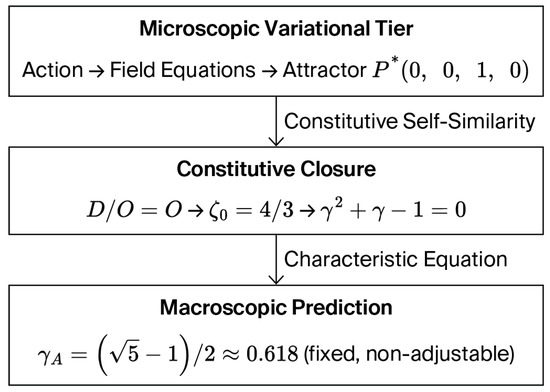
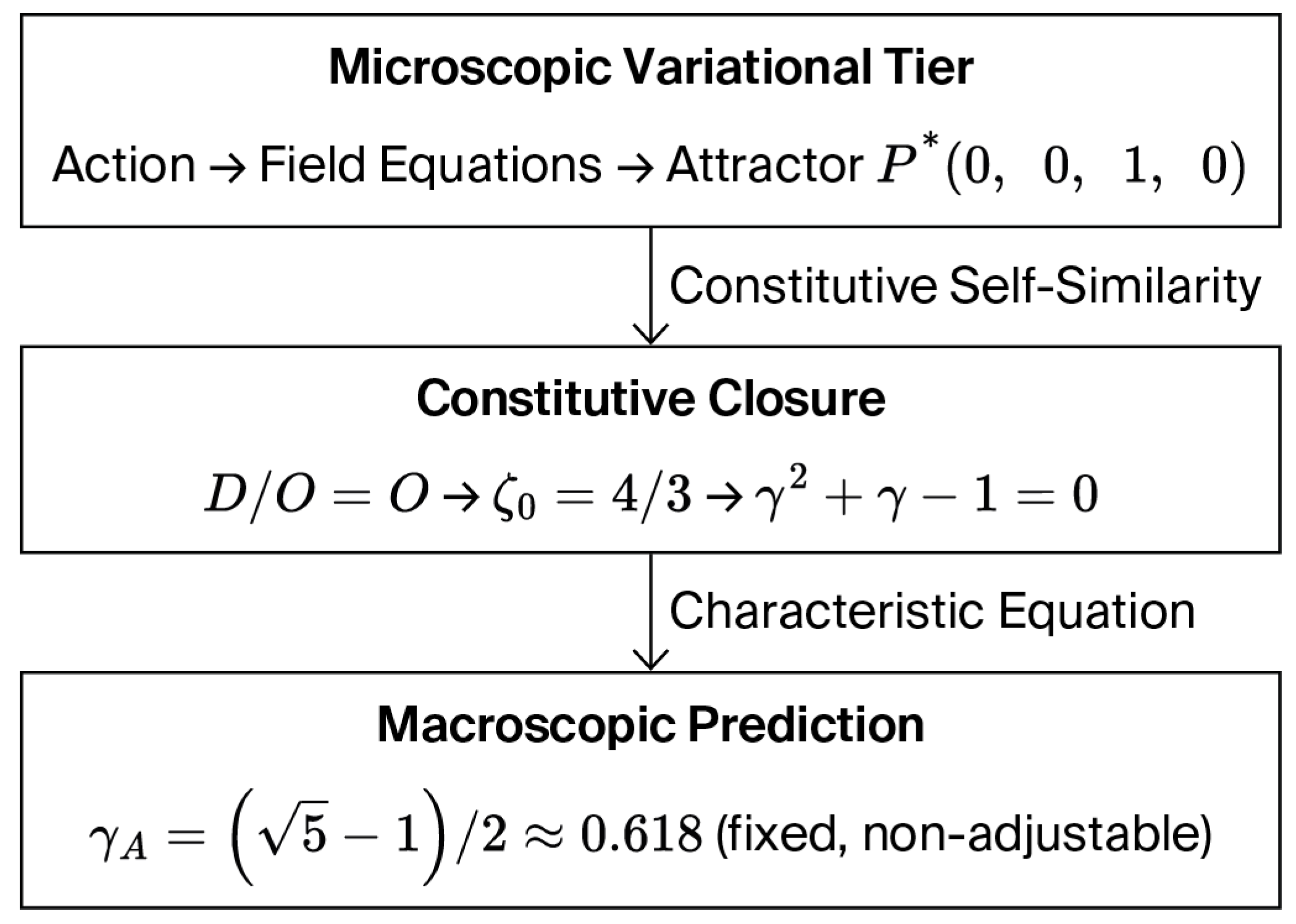

Disclaimer/Publisher’s Note: The statements, opinions and data contained in all publications are solely those of the individual author(s) and contributor(s) and not of MDPI and/or the editor(s). MDPI and/or the editor(s) disclaim responsibility for any injury to people or property resulting from any ideas, methods, instructions or products referred to in the content. |
© 2026 by the author. Licensee MDPI, Basel, Switzerland. This article is an open access article distributed under the terms and conditions of the Creative Commons Attribution (CC BY) license.