You are currently viewing a new version of our website. To view the old version click .

Vehicles, Volume 2, Issue 4

December 2020 - 6 articles

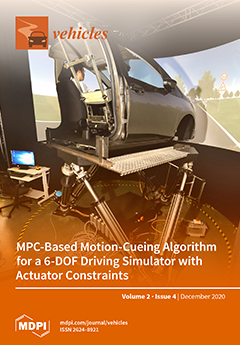
Cover Story: The effectiveness of driving simulators depends largely on their ability to generate realistic motion cues. Though conventional filter-based motion-cueing strategies have provided reasonable results, these methods suffer from poor workspace management. In this paper, a new MPC-based algorithm has been designed that incorporates the nonlinear kinematics of the Stewart platform. Moreover, the human vestibular system model is included within the formulation to increase the fidelity of the produced motion cues. To manage the workspace efficiently, constraints are imposed on the actuator displacements, and state-dependent adaptive weights are used to tune the algorithm. The results indicate a better reference tracking and workspace utilization performance for the proposed algorithm when compared to conventional algorithms. View this paper.
  • Issues are regarded as officially published after their release is announced to the table of contents alert mailing list .
  • You may sign up for email alerts to receive table of contents of newly released issues.
  • PDF is the official format for papers published in both, html and pdf forms. To view the papers in pdf format, click on the "PDF Full-text" link, and use the free Adobe Reader to open them.

Articles (6)

  • Article
  • Open Access
3 Citations
5,383 Views
27 Pages

Motorcycle Structural Fatigue Monitoring Using Smart Wheels

  • Federico Ballo,
  • Francesco Comolli,
  • Massimiliano Gobbi and
  • Giampiero Mastinu

17 December 2020

The paper is devoted to the measurement and to the processing of load spectra of forces and moments acting at the wheel hub of a motorcycle. Smart wheels (SWs) have been specifically developed for the scope. Throughout the paper, the extreme case of...

  • Article
  • Open Access
35 Citations
11,368 Views
23 Pages

MPC-Based Motion-Cueing Algorithm for a 6-DOF Driving Simulator with Actuator Constraints

  • Yash Raj Khusro,
  • Yanggu Zheng,
  • Marco Grottoli and
  • Barys Shyrokau

2 December 2020

Driving simulators are widely used for understanding human–machine interaction, driver behavior and in driver training. The effectiveness of simulators in this process depends largely on their ability to generate realistic motion cues. Though t...

  • Article
  • Open Access
3 Citations
4,479 Views
22 Pages

Automated Multi-Level Dynamic System Topology Design Synthesis

  • Aart-Jan Kort,
  • Jan Wijkniet,
  • Alexander Serebrenik and
  • Theo Hofman

28 November 2020

Designing new mechatronic systems for vehicle applications is a complex and time-consuming process. The increasing computational power allows us to generate automatically novel and new mechatronic discrete-topology concepts in an efficient manner. Us...

  • Article
  • Open Access
3 Citations
5,448 Views
14 Pages

Importance of Vehicle Body Elements and Rear Axle Elements for Describing Road Booming Noise

  • Michael Herrmann,
  • Rainer Jöst,
  • Florian Kehl,
  • Ali Özkan,
  • Simon Pless and
  • Frank Gauterin

25 November 2020

For investigating influences of vehicle components on the acoustic comfort at low frequencies, e.g., the booming noise behavior of a vehicle, building a whole car simulation model is useful. To reduce the model’s complexity and to save resource...

  • Article
  • Open Access
5 Citations
3,233 Views
13 Pages

22 October 2020

Magnetorheological (MR) regenerative suspension system can not only achieve excellent comprehensive suspension performance but also effectively recover and utilize vibration potential energy, which has been a research hotspot in the field of vehicle...

Get Alerted

Add your email address to receive forthcoming issues of this journal.

XFacebookLinkedIn
Vehicles - ISSN 2624-8921