


Abstract
The chemical evolution of simple molecules into higher-order structures, such as amino acids, is a fundamental process occurring throughout the cosmos. Methane (CH4) serves as a key precursor in this evolutionary sequence and is prevalent on planetary bodies like Mars and Saturn. In these environments, CH4 is frequently ionized by cosmic radiation, forming the methane radical cation (CH4+). In this study, the ion-molecule reactions between CH4+ and neutral CH4 (CH4+ + CH4 → products) were investigated using direct ab initio molecular dynamics (AIMD) simulations to elucidate the underlying reaction mechanisms. Our calculations demonstrate that proton transfer (PT) occurs efficiently, yielding the methanium ion (CH5+) and the highly reactive methyl radical (CH3): CH4+ + CH4 → CH5+ + CH3. Furthermore, the reaction outcomes exhibit a strong dependence on the impact parameter (b). Collisions at very low impact parameters (b = 0–0.2 Å) resulted in non-reactive, billiard-ball-like scattering. Within the range of b = 0.2–3.0 Å, the formation of a long-lived complex, [CH5-CH3]+, was observed. In the intermediate range of b = 3.0–5.0 Å, a proton-stripping mechanism predominated in PT channel, while collisions at b > 5.0 Å were exclusively non-reactive. The reaction mechanism was qualitatively discussed. These findings provide a detailed atomistic picture of the collision dynamics governing methane-derived molecular evolution in celestial environments.
1. Introduction
The molecular chemical evolution from atoms to molecules and then to higher-order molecules, such as amino acids and DNA, is a process that takes place throughout the cosmos. Elucidating this evolutionary pathway remains a significant and challenging theme in contemporary science [1,2,3]. Methane (CH4) is one of the simplest and most fundamental molecules in the universe, serving as a key building block for this chemical evolution [4,5,6,7,8]. Furthermore, methane plays a critical role as a potential biosignature, indicating the possibility of life’s existence in space. Methane is a major component in the atmospheres of planets and icy bodies, including Mars [4,5], Jupiter [6,7], and Saturn [8].
In 2014, NASA’s Curiosity rover first detected the presence of CH4 in the Martian atmosphere [9]. Separately, the Cassini probe discovered lakes and seas of CH4 on Titan, Saturn’s largest moon. Thus, CH4 is recognized as a substance of profound importance in the field of cosmic chemistry.
In cosmic space, the molecules are usually irradiated by cosmic rays [10]. These effects generate ionized states of molecules. CH4+ is generated by the irradiation of CH4. CH4+ can react with neutral CH4 molecules: CH4+ + CH4 → products.
The experiments of the reaction were carried out by several groups. In 1990, Herman et al. investigated the reaction of CH4+ with CH4 using scattering experiments and showed that the main reaction channel was a proton transfer (PT) from CH4+ to CH4 [11] namely, the reaction was expressed as
CH4+ + CH4 → CH5+ + CH3 (reaction 1).
They also indicated that reaction (1) is composed of three distinct channels: PT, hydrogen atom transfer (HT), and complex formation channels. The reaction for the PT channel takes place on the ground state potential energy surface. In the HT channel, the excited state is involved in the reaction. In the complex channel, the reaction proceeds mainly via the intermediate complex expressed as
CH4+ + CH4 → [CH4-CH4+] (complex) → CH5+ + CH3.
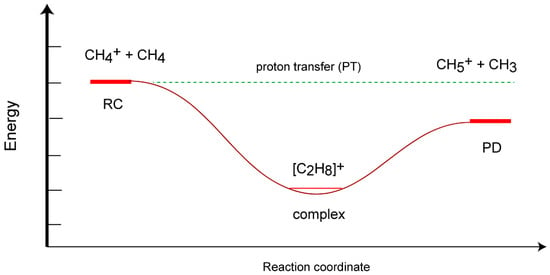
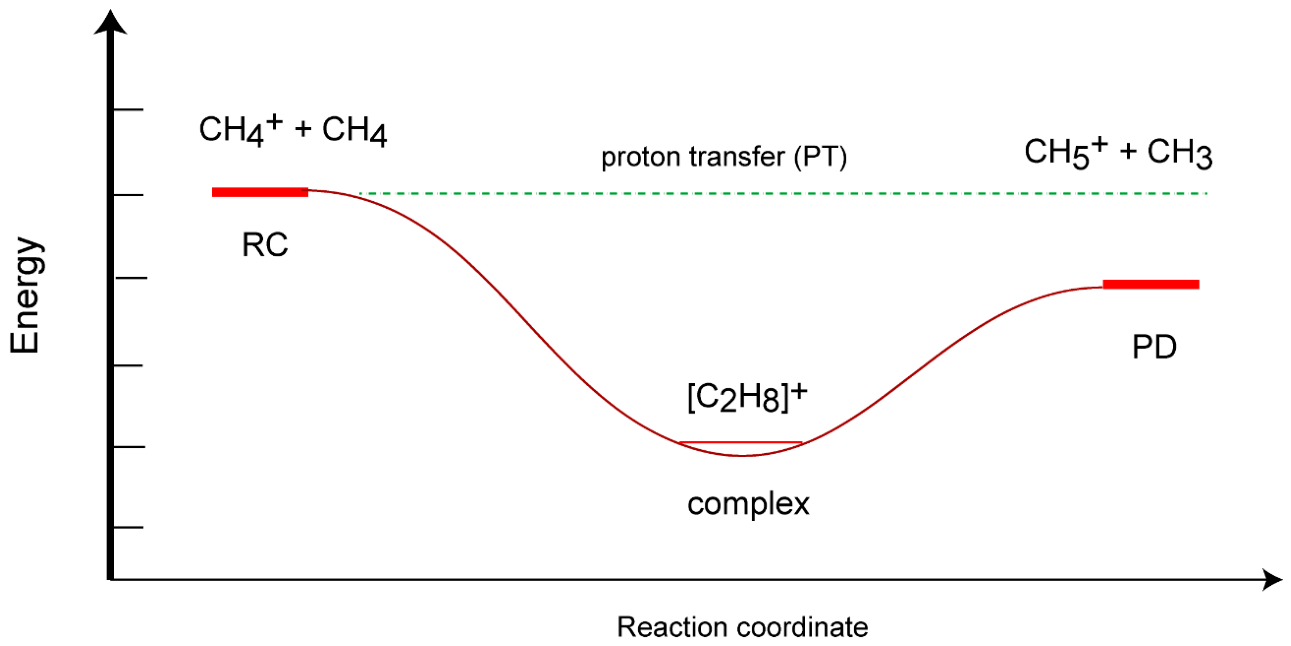
From theoretical points of view, Kamiya and Morokuma carried out ab initio calculations for reaction (1) [12]. They showed that PT occurs on the ground state potential energy surface. In addition, the electron transfer (excited state) was correlated in the HT channel. A schematic illustration of the potential energy curve (PEC) for the PT reaction in CH4+ + CH4 is shown in Figure 1. The reactant state (RC) is composed of CH4+ + CH4, and the product state (PD) is composed of CH5+ + CH4. The reaction proceeds via the intermediate complex [CH4-CH4]+ region. The energy level of PD is slightly lower in energy than RC. The exothermic energy is obtained to be ΔH = ca.2.0 kcal/mol.
Figure 1.
Schematic illustration of the potential energy curves for the bimolecular collision reaction, CH4+ + CH4. RC and PD mean reactant and product states, respectively.
In the present study, the direct ab initio molecular dynamics (AIMD) method [13,14,15] was applied to the PT process in reaction (1) in order to obtain information on the detailed reaction mechanism. Thus, the energetics were understood from the experiments and static ab initio calculations. However, the dynamics features were scarcely known. In order to elucidate the chemical evolution of CH4 and CH4+, information on the reaction dynamics is absolutely required. In particular, the dependence of impact parameter (b) in the collision on the reaction mechanism was investigated.
2. Computational Details
2.1. Ab Initio Calculations
The geometries of the neutral dimer (CH4)2, the dimer radical cation (CH4)2+, and the reaction intermediates were fully optimized using the second-order perturbation Møller–Plesset (MP2) method with a 6-311++G(d,p) basis set [16,17]. The single and double excitation coupled cluster (CCSD) method with 6-311++G(d,p) basis set, CCSD/6-311++G(d,p), was also used for the geometry optimization [18]. Atomic and molecular charges were calculated using the natural population analysis (NPA) approach [19]. Standard Gaussian 09 and 16 program packages were used for all static ab initio calculations [20,21].
2.2. Direct Ab Initio MD Calculations
2.2.1. Bimolecular Reactions for CH4+ + CH4
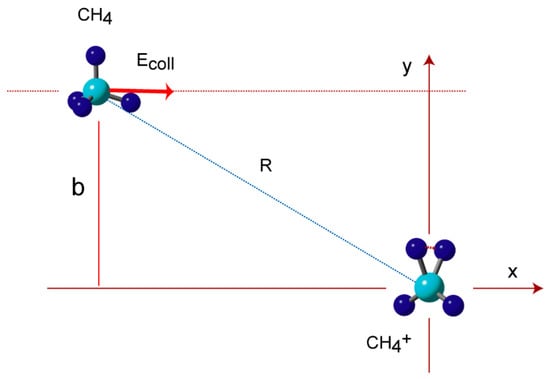
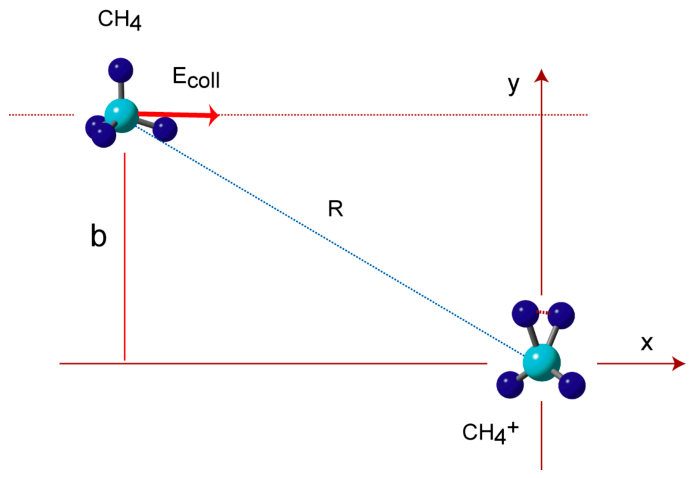
The reaction dynamics for the bimolecular collision reaction of CH4+ + CH4 were computed according to the following procedure. Figure 2 shows the initial geometrical configuration of the reactant state (CH4+ + CH4) at time zero. First, the structures of CH4+ and CH4 were separately optimized at the MP2/6-311++G level of theory. Second, CH4+ was put in the origin of the x-y-z coordinate (x = y = z = 0.0 Å). Next, CH4 was put on the X-Y plane, as shown in figure. The C-H directions of CH4+ and CH4 were randomly selected at time zero. The impact parameter (b) was randomly chosen in the range of b = 0.0–8.8 Å. The distances of CH4 from CH4+ were randomly selected for R = 6.0–7.0 Å. The collision energies were set to Ecoll = 11.0 and 17.8 kcal/mol.
Figure 2.
Initial structural configuration in the collision reaction system, CH4+ + CH4. R and b mean intermolecular distance and impact parameter, respectively. Ecoll means relative collision energy between CH4+ and CH4.
The rotational temperature was set to zero (time = 0 fs). The maximum simulation time was 2.0 ps, and the time step was 0.01 fs. The velocity Verlet algorithm was used to solve the motion equations of the system. The deviation in the total energy was less than 0.01 kcal/mol. Direct AIMD calculations were performed using our code [22,23,24].
2.2.2. Reaction of (CH4)2+ Following the Ionization of Neutral Methane Dimer (CH4)
Two methods were used in the direct AIMD calculations of (CH4)2+: in method A, the optimized neutral dimer (CH4)2 was used as a starting structure of (CH4)2+ at the vertical ionization point. The thermally sampled structure of the neutral dimer was used in method B. In the direct AIMD calculations using the optimized structure (method A), the structure of (CH4)2 was first optimized at the MP2/6-311++G(d,p) level. From the optimized structure, the trajectory of [(CH4)2+]ver began at the vertical ionization point, where [(CH4)2+]ver indicates (CH4)2+ at the vertical ionization point of (CH4)2. The rotational temperature, momentum vector, and excess energy of [(CH4)2+]ver were set to zero (time = 0 fs). The maximum simulation time was 2.0 ps, and the time step was 0.01 fs. The velocity Verlet algorithm was used to solve the motion equations of the system. The deviation in the total energy was less than 0.01 kcal/mol.
In method B, direct AIMD calculations of the neutral (CH4)2 cluster were performed at a constant temperature (10 K) [25] to generate the initial geometries of the structure in the vertical ionization state, [(CH4)2+]ver. The Nosé–Hoover algorithm was used to maintain a constant temperature for each trajectory [26,27]. Direct AIMD calculations of [(CH4)2+]ver were performed on selected geometries at the MP2/6-311++G(d,p) level.
3. Results
3.1. Energies of the Reaction System
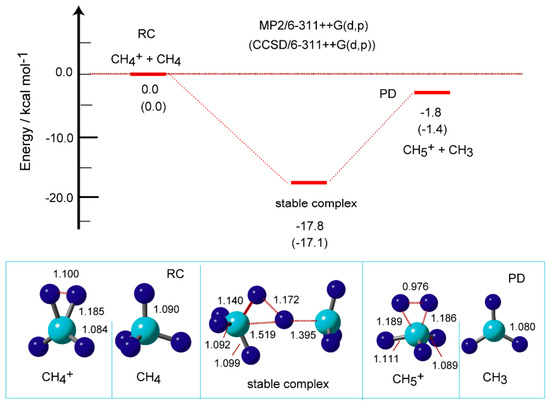
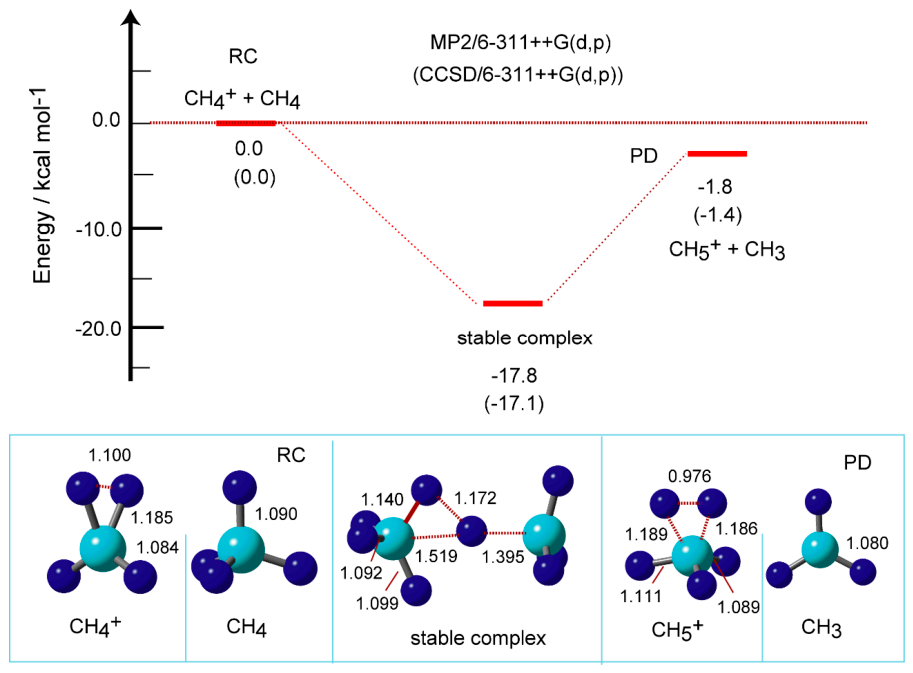
First, the energies of the reaction system were calculated and then the energy diagram was constructed. The geometry optimizations were carried out at the MP2 and CCSD/6-311++G(d,p) levels of theory. The optimized structures and energy diagram are given in Figure 3. The RC state was composed of CH4+ and CH4. CH4 has a Td symmetry and the C-H bond length was 1.090 Å. In contrast, the structure of CH4+ was largely deformed from Td to a Cs symmetry. The C-H bond lengths were 1.084 and 1.185 Å, and the interatomic distance of H-H was 1.100 Å, which was significantly shorter than the normal H-H distance of CH4 (1.779 Å). The structure of the stable intermediate complex [CH4-CH4]+ was also significantly deformed from the neutral methane dimer as shown in Figure S1 (the structure of neutral methane dimer) in the Supplementary Materials. The structure of [CH4-CH4]+ was composed of a methyl radical (CH3) and CH4+, and the proton (H+) was located in a central position between CH4 and CH3. The distances of H+ were 1.519 and 1.395 Å from the carbon atoms of CH4 and CH3, respectively. PD was composed of CH5+ and CH3. CH5+ consisted of CH3 and H2+, where H2+ interacted with CH3. The C-H bond lengths were 1.111 and 1.189 Å. The H-H bond length of H2+ was 0.976 Å.
Figure 3.
(Upper) Energy diagram for the bimolecular collision reaction system, CH4+ + CH4. The values indicate relative energies in kcal/mol. The calculations were performed at the MP2 and CCSD levels with the 6-311++G(d,p) basis set. The values calculated at the CCSD level are given in parenthesis. (Lower) Optimized structures of the reaction system. The calculations were performed at the MP2/6-311++G(d,p) level. Bond lengths are in Å. Optimized structures calculated at the CCSD/6-311++G(d,p) level are given in the Supplementary Materials.
The energy diagram was constructed in Figure 3 (upper figure). Zero level of energy in the energy diagram corresponds to the total energy of RC (CH4+ + CH4). The stable complex state was 17.8 kcal/mol lower in energy than RC. PD was 1.82 kcal/mol lower and 16.0 kcal/mol higher in energies than RC and the complex state, respectively, indicating that the reaction is slightly exothermic.
The geometry optimization was also carried out at the CCSD/6-311++G(d,p) level. The structures are given in Figure S2 (Supplementary Materials). The similar geometries and energetics were obtained: the binding energy of the stable complex was calculated to be 17.1 kcal/mol (CCSD/6-311++G(d,p) level), which agreed well with the value at the MP2 level (17.8 kcal/mol at MP2/6-311++G(d,p) level).
In order to check the effects of basis set and calculation level on the potential energy surface of the CH4+/CH4 system, CCSD(T) and QCISD methods and aug-cc-pVDZ and aug-cc-pVTZ basis sets were examined for the calculations. The results are given in Table S1. A comparison of results of the MP2-level with those of the other methods clearly shows that the MP2 level yields reasonable results.
3.2. Direct AIMD Calculations for Bimolecular Reaction: Complex Formation Channel
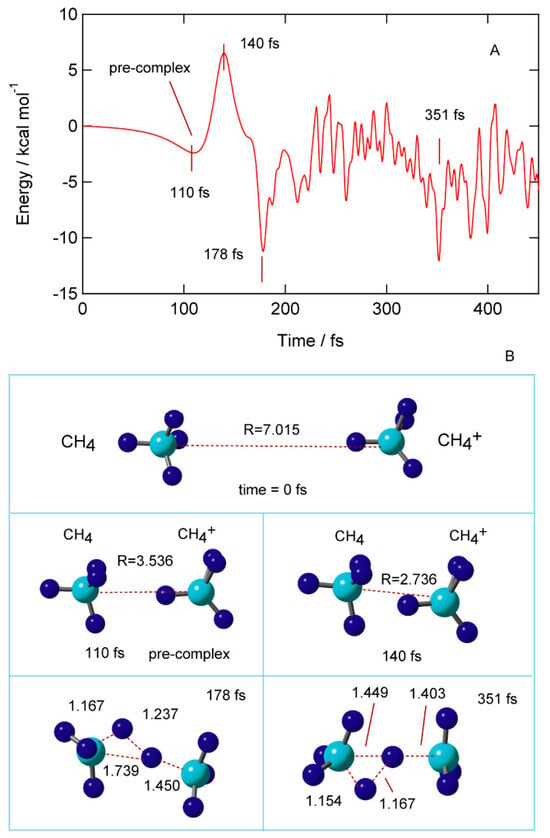
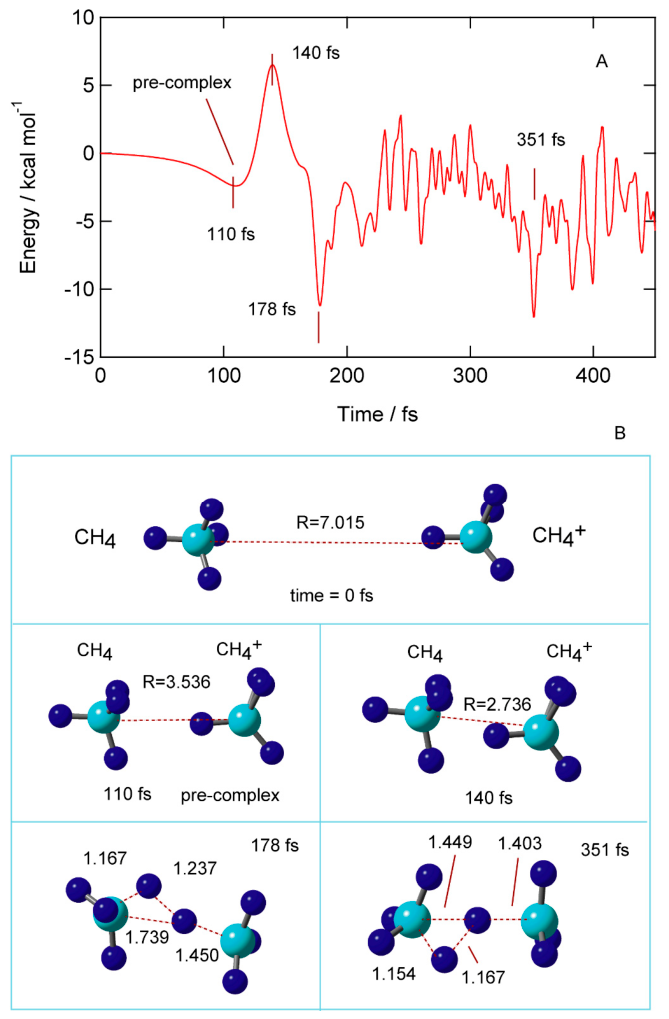
Three reaction channels were obtained from the direct AIMD calculations for the bimolecular collision reaction: namely, (1) complex formation, (2) PT, and (3) no-reaction channels. First, the result of the complex formation channel is presented in this section. Figure 4 shows a sample trajectory for the complex formation channel. In this trajectory, the intermolecular distance and the impact parameter were set to R = 7.015 and b = 0.35 Å at time zero, respectively, and the collision energy was Ecoll = 17.8 kcal/mol.
Figure 4.
(A) Time evolution of potential energy and (B) snapshots of the reaction system for CH4+ + CH4. Direct AIMD calculations were performed at the MP2/6-311++G(d,p) level. The MP2/6-311++G(d,p)-optimized geometries were used as the initial geometries. The distances are in Å.
Time evolution of potential energy (PE) and snapshots of the reaction system are illustrated in Figure 4A and Figure 4B, respectively. Zero level of PE corresponds to the total energy of RC (CH4+ + CH4). At time zero, the intermolecular distance was R = 7.015 Å. After the start of the reaction, PE decreased gradually as a function of time. At 110 fs, the energy minimized slightly (−2.0 kcal/mol), indicating that the pre-complex was formed. The binding energy of the pre-complex was 2.0 kcal/mol relative to RC (CH4+ + CH4). This pre-complex is different from the stable complex in Figure 3. The intermolecular distance was R = 3.536 Å at 110 fs. PE reached the energy peak at 140 fs, where the collision of CH4 with CH4+ occurred (R = 2.736 Å). After the collision, PT occurred from CH4+ to CH4 at 178 fs and PE decreased rapidly to −11.0 kcal/mol. The proton was located at 1.739 Å from CH4 and 1.450 Å from CH3, indicating that the stable complex was formed at 178 fs. The stable complex still remained at 351 fs, and the dissociation did not occur in this trajectory. This trajectory gave a complex formation channel.
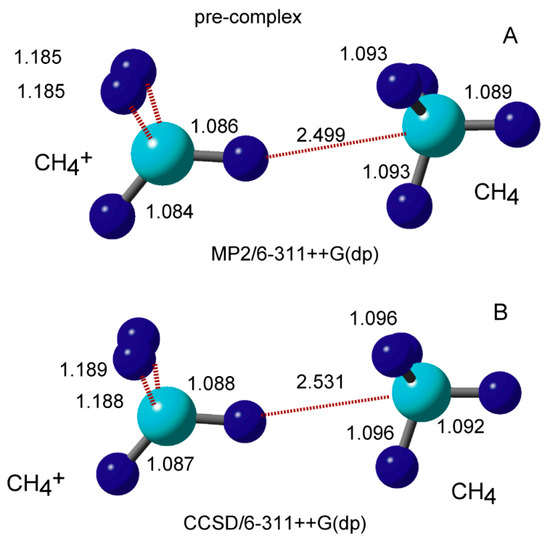
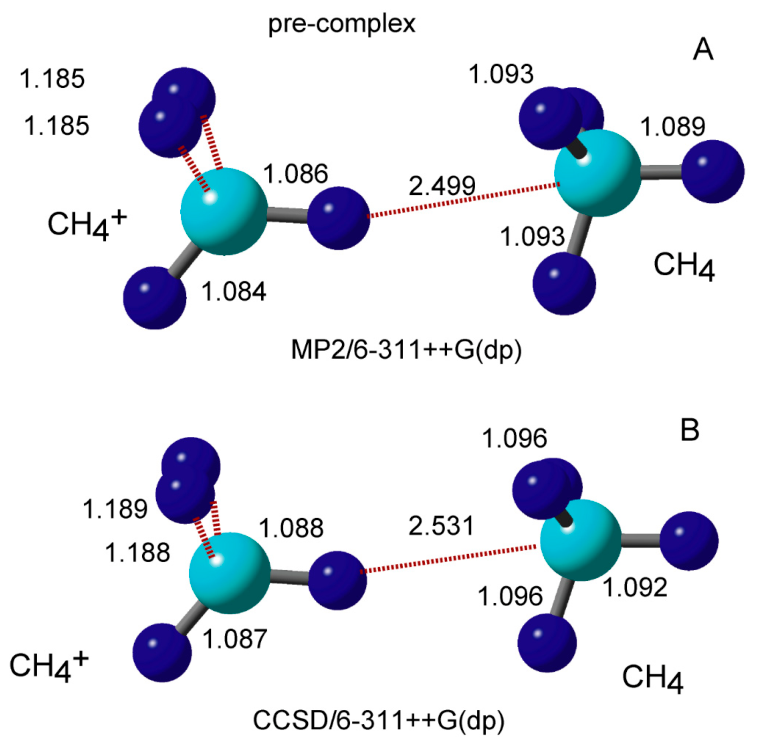
In order to determine the accurate structure of the pre-complex, the geometry optimizations of the pre-complex were carried out at the MP2 and CCSD/6-311++G(d,p) levels of theory. The structure at 110 fs (Figure 4) was chosen as the initial structure in the geometry optimization. The optimized structures are given in Figure 5. Both levels of theory gave similar structures of the pre-complex. The proton of CH4+ orients toward the carbon atom of CH4. The intermolecular distances were 2.499 Å (MP2) and 2.531 Å (CCSD). The binding energies were calculated to be 2.68 (MP2) and 2.53 kcal/mol (CCSD). Thus, the structure and electronic states of the pre-complex are notably different from those of the stable complex. The reaction was expressed as
CH4+ + CH4 → [CH4+-CH4] (pre-complex) → [CH3-CH5+] (stable complex)
Figure 5.
Optimized structures of the pre-complex of [CH4+-CH4]. The calculations for geometry optimization were performed at the (A) MP2 and (B) CCSD/6-311++G(d,p) levels. Bond lengths are in Å.
Namely, PT occurs within the complex.
3.3. Direct AIMD Calculations for Bimolecular Reaction: PT Channel
In this section, the results of the PT channel are shown. In this sample trajectory, the intermolecular distance and the impact parameter were set to R = 7.047 and b = 4.26 Å respectively, at time zero, while the collision energy was Ecoll = 17.8 kcal/mol.
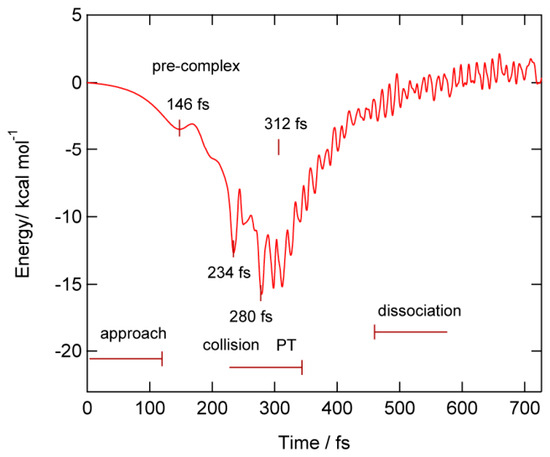
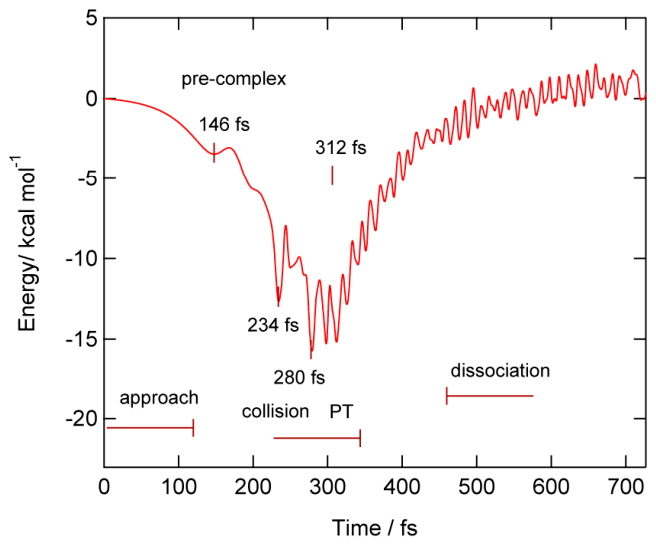
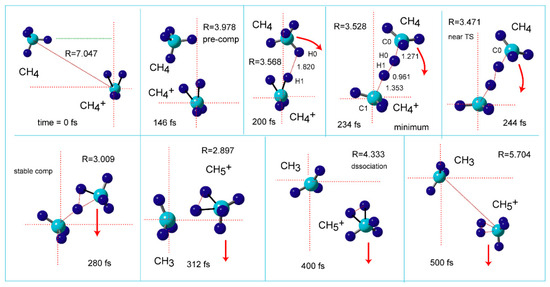
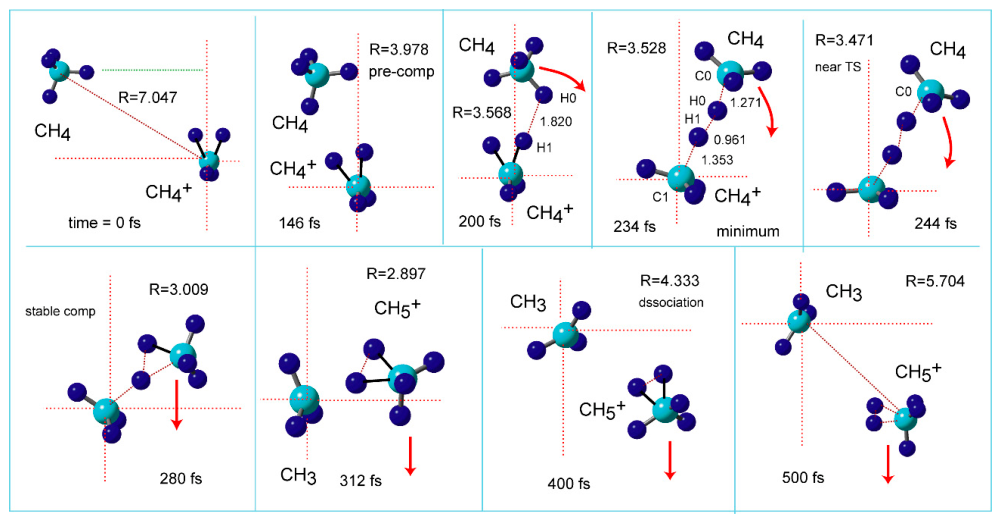
The time evolution of PE of the reaction system is given in Figure 6. The reaction started at time zero. PE can be classified into five regions: (1) approaching, (2) collision, (3) PT process, (4) complex formation, and (5) dissociation. In the first region (approaching), CH4 gradually approached CH4+, and then the pre-complex was formed at 146 fs. The energy was stabilized to −3.4 kcal/mol. Next, the collision between CH4 and CH4+ occurred at 234 fs (collision region). At same time, PT occurred from the collision between CH4+ and CH4 (244 fs) and the stable complex [CH5+-CH4] was formed at 280 fs (the energy was −12.7 kcal/mol). After the PT process and complex formation, dissociation of CH5+ from CH3 occurred. At 400–700 fs, PD was (CH5+ + CH3). The reactive radical (CH3) was generated by PT.
Figure 6.
Time evolution of potential energy of the reaction system for the proton transfer channel in CH4+ + CH4. Direct AIMD calculations were performed at the MP2/6-311++G(d,p) level.
The snapshots of [CH4-CH4] + are illustrated in Figure 7. The reaction started at time zero. CH4 gradually approached to CH4+. At 146 fs, the structure of CH4-CH4+ resembled that of the pre-complex (R = 3.978 Å). The energy was slightly stabilized (-3.4 kcal/mol). At 200 fs, R = 3.568 Å and the distance between the proton (H0) of CH4+ and hydrogen (H1) of CH4 was 1.820 Å, where the energy was minimized at 234 fs (−12.7 kcal/mol). Here, the proton (H1) was abstracted by CH4. The structure of CH4-(H+)-CH3 was close to that of TS for PT at 244 fs (R = 3.471 Å). After TS, the stable complex was formed at 280 fs. The intermolecular distance was R = 3.009 Å at 280 fs. The stable complex was composed of CH5+ and the methyl radical (CH3). After the formation of the stable complex, CH5+ gradually dissociated from CH3. The intermolecular distances were R = 4.333 (400 fs) and 5.704 Å (500 fs). Finally, the product was CH5+ + CH3 in this trajectory.
Figure 7.
Time evolution of snapshots of the reaction system for proton transfer channel in CH4+ + CH4. Direct AIMD calculations were performed at the MP2/6-311++G(d,p) level. The MP2/6-311++G(d,p)-optimized geometries were used as the initial geometries.
3.4. Summary of Trajectory Calculations for the Bimolecular Collision Reaction
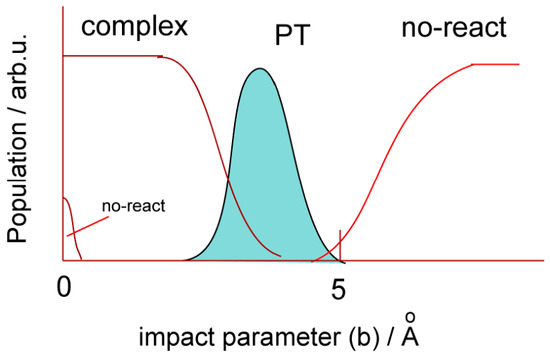
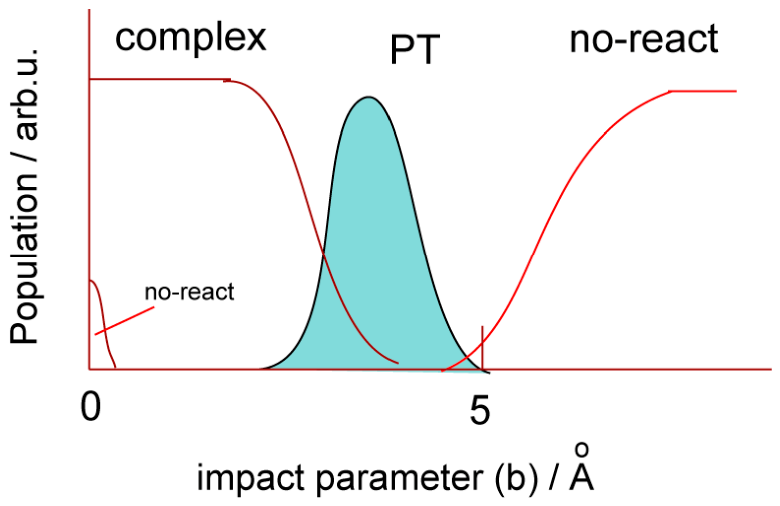
A total of 50 trajectories were run for each collision energy. In the case of lower collision energy (Ecoll = 11.0 kcal/mol), all trajectories gave the complex formation channel. In high collision energy (Ecoll = 17.8 kcal/mol), 16 and 22 trajectories led to the PT and complex formation channels, respectively, and 12 trajectories gave the non-reactive channel. The branching rations were 0.32 (PT), 0.44 (complex), and 0.24 (non-reactive). Figure 8 shows a schematic illustration of the change in product states plotted as a function of b at larger collision energy (Ecoll = 17.8 kcal/mol). At small impact parameters (b = 0–3.0 Å), the main channel was the formation of the long-lived complex [CH5+-CH3] (the stable complex). Also, some non-reactive trajectories were calculated to be near b = 0.0 Å (Ecoll = 17.76 kcal/mol), as if they had been flicked away like a billiard ball. The region of the PT channel was b = 3.0–5.0 Å. PT occurred with the proton stripping mechanism. It was emphasized that PT occurs in the middle region of the impact parameter. At larger b values (>5.0 Å), the non-reaction channel was dominant (no-collision trajectories) due to no-interaction. Thus, the product channel was strongly dependent on values of b in the collision.
Figure 8.
Schematic illustration of the change in product channels depending on impact parameter (b) in bimolecular collision reaction, CH4+ + CH4, derived from the present calculations. Complex and PT mean complex formation and proton transfer channels, respectively.
3.5. Reactions of (CH4)2+ Following the Ionization of (CH4)2
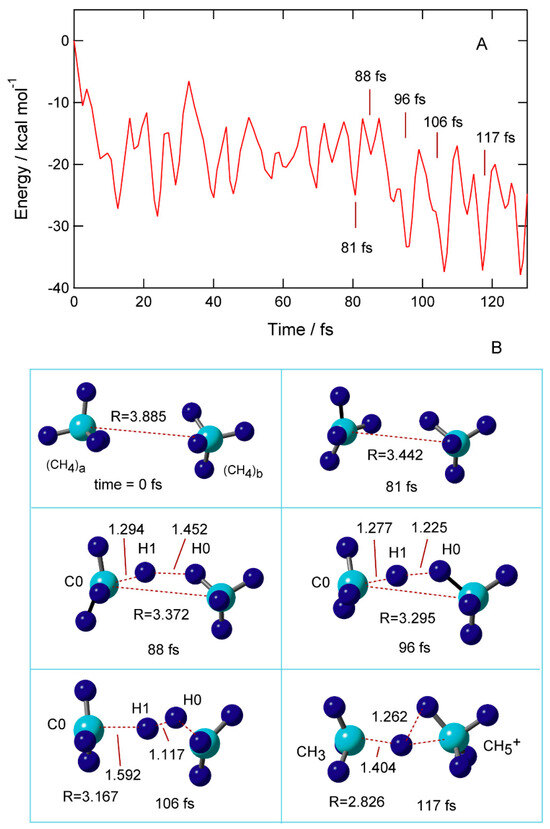
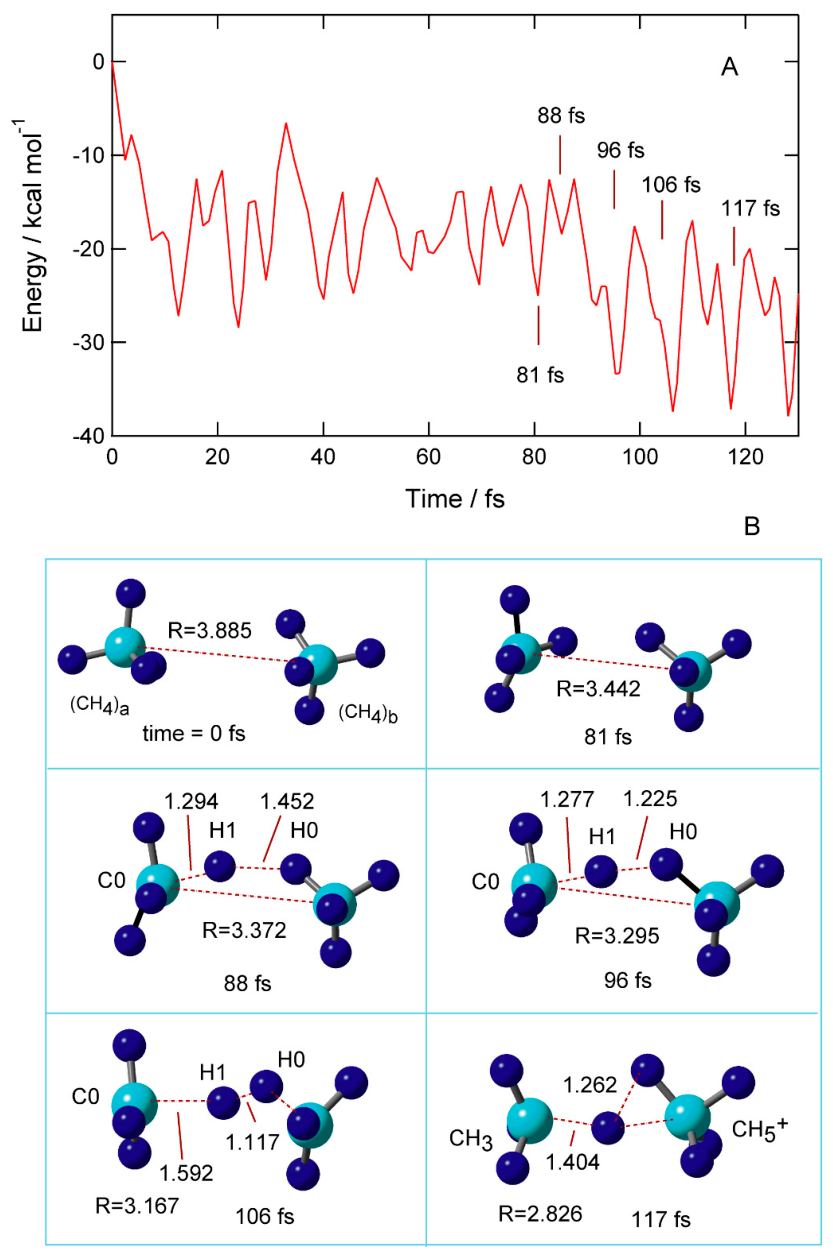
While the preceding section addressed the bimolecular reactions of CH4+ + CH4, the present section focuses on the ionization dynamics of (CH4)2 and the subsequent relaxation of the dimer cation, (CH4)2+. Figure 9A,B illustrate the time evolution of the potential energy (PE) and representative snapshots of the (CH4)2+ system, calculated at the MP2/6-311++G(d,p) level (method A). The zero-energy reference was defined as the total energy of (CH4)2+ at the vertical ionization point from the optimized neutral dimer. At this point, the NPA charges of (CH4)a and (CH4)b were +0.52 and +0.48, respectively, indicating that the positive charge is larger on (CH4)a. This distribution stems from the distinct structural environments of the two methane units within the dimer. Following ionization, the PE decreases sharply to −28 kcal/mol, driven by the structural relaxation of the (CH4)a+ moiety. Subsequently, the PE exhibits periodic oscillations until approximately 80 fs. During this interval, (CH4)a+ gradually approaches (CH4)b, with the intermolecular distance (R) decreasing from 3.885 Å at 0.0 fs to 3.442 Å at 81 fs (specifically, R = 3.716 Å at 50 fs and 3.525 Å at 70 fs). At 88 fs (R = 3.372 Å), the two moieties reach a proximity that triggers PT from (CH4)a+ to (CH4)b. At the transition state, the transferring proton (H1+) is positioned 1.294 Å from C0 and 1.452 Å from H0. The further reduction of the H1–H0 distance to 1.225 Å (96 fs) and 1.117 Å (106 fs) confirms the completion of the proton transfer within this time regime, with the process being fully finalized by 117 fs.
Figure 9.
Time evolution of (A) potential energy and (B) snapshots of the reaction system of (CH4)2+, following the ionization of the neutral methane dimer, (CH4)2. Direct AIMD calculations were performed at the MP2/6-311++G(d,p) level. The MP2/6-311++G(d,p)-optimized geometries were used as the initial geometries of (CH4)2 at time zero. Bond lengths are in Å.
The reaction of (CH4)2+ from the optimized structure of (CH4)2 is expressed as follows.
(CH4)2 + IE(ionization energy) → [(CH4)2+]ver + e− → (CH3-CH5+)
The methane dimer was ionized by ionization energy (IE). After the ionization, PT occurred within the dimer cation and the stable complex was formed.
Next, the initial structures of (CH4)2 were generated around the equilibrium point of (CH4)2 by thermal activation at 10 K. The details were described in the section on computational details as method B. The results are shown in Figure S3. After vertical ionization of (CH4)2, the intra-cluster PT occurred rapidly within the dimer cation, and the stable complex was formed. These results are the similar to that from the optimized structure.
4. Discussion and Conclusions
This study demonstrates that methyl radicals (CH3) are efficiently produced via the reaction between methane cations and neutral methane, acting as versatile intermediates that react with various species to form species like ethane (C2H6), methylamine (CH3-NH2), and methanol (CH3OH). Our findings establish that this high-efficiency, non-barrier reaction serves as a pivotal pathway in cosmic molecular evolution, leading toward the synthesis of complex organic molecules like amino acids.
The dynamics simulations in this study were performed at the MP2/6-311++G(d,p) level of theory. The optimized structures and energies obtained at this level show excellent agreement with those calculated at the CCSD/6-311++G(d,p) level, validating our choice of the MP2 method for the dynamics calculations.
Due to the high computational cost associated with the MP2/6-311++G(d,p) level, the number of trajectories was limited, necessitating a qualitative analysis. To achieve a more rigorous understanding of the dynamics—such as determining precise branching ratios—a significantly larger number of trajectories would be required. Nevertheless, the current results remain robust for qualitative discussion. Despite these approximations, this study provides fundamental insights into the CH4+/CH4 ion-molecule reaction mechanism.
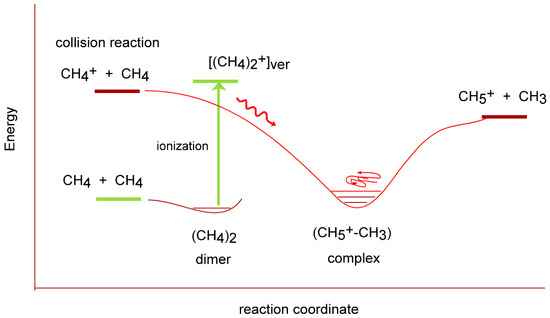
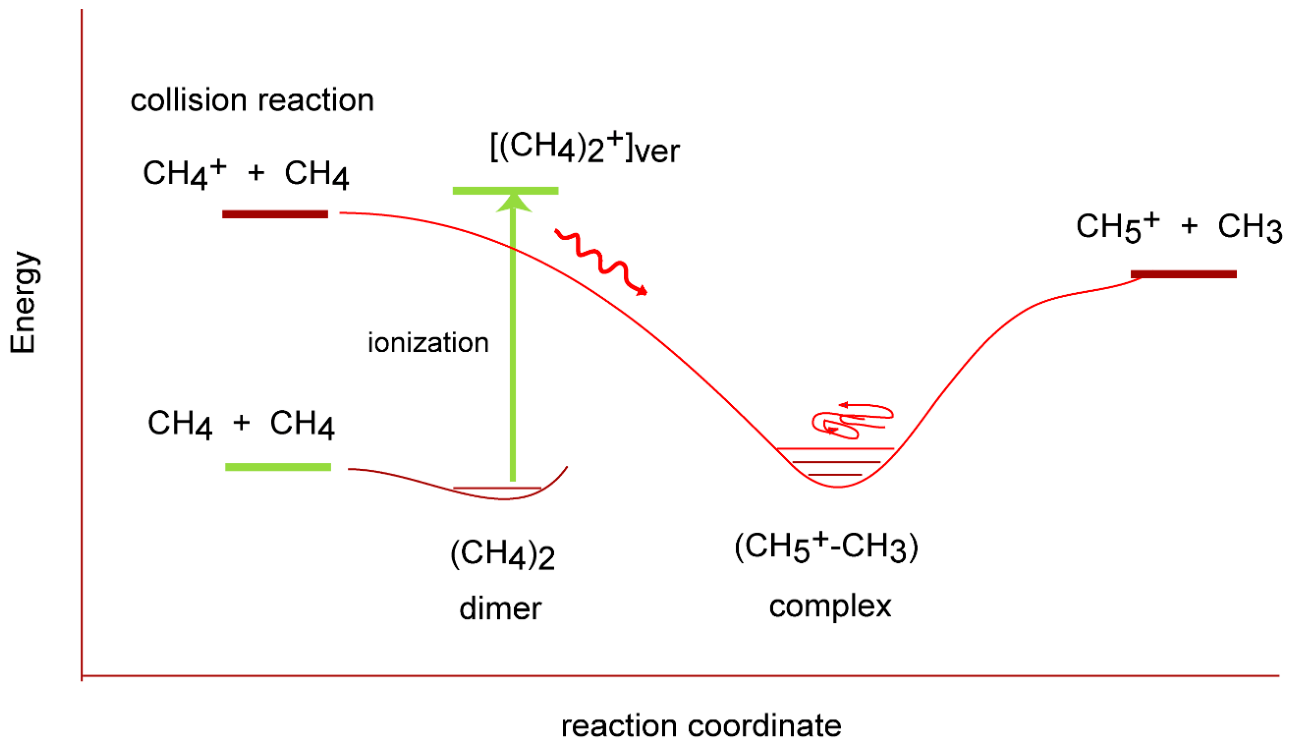
In summary, Figure 10 schematically illustrates the potential energy curves for the CH4+/CH4 reaction system. The process involves two pathways: a bimolecular collision (CH4+ + CH4) and an intra-dimer reaction of (CH4)2+ post-ionization. The bimolecular route yields CH5+/CH3 at larger impact parameters (b = 3–5 Å), while shifting to complex formation at smaller impact parameters. In contrast, photoionization of the neutral methane dimer leads exclusively to the complex formation channel. Furthermore, the active methyl radical is formed barrierlessly via the bimolecular collision.
Figure 10.
Schematic illustration of the potential energy curves for the bimolecular collision reaction, CH4+ + CH4, and the intra-cluster reaction of (CH4)2+ after ionization of methane dimer, (CH4)2.
Supplementary Materials
The following supporting information can be downloaded at: https://www.mdpi.com/article/10.3390/chemistry8060084/s1, Figure S1: Optimized structures of methane dimer. The calculations were performed at the MP2/6-311++G(d,p) level. Bond lengths are in Å; Figure S2: Optimized structures of the reaction system. The geometry optimizations were performed at the CCSD/6-311++G(d,p) level. Bond lengths are in Å; Figure S3:Time evolution of potential energies of methane dimer cation (CH4)2+ following the ionization of (CH4)2. Initial geometries of (CH4)2 were generated around the equilibrium structure of (CH4)2 by thermal activation at 10 K. Four trajectories are given in figure. The calculations were carried out at the MP2/6-311++G(d,p) level; Table S1: Relative energies (in kcal/mol) calculated by several methods.
Funding
The author acknowledges the partial support from JSPS KAKENHI (Grant Numbers 21K04973, 21H05415 and 24K12960).
Data Availability Statement
The original contributions presented in this study are included in the article/Supplementary Material. Further inquiries can be directed to the corresponding author.
Conflicts of Interest
The author declare no conflicts of interest.
References
- Berné, O.; Martin-Drumel, M.-A.; Schroetter, I.; Goicoechea, J.R.; Jacovella, U.; Gans, B.; Dartois, E.; Coudert, L.H.; Bergin, E.; Alarcon, F.; et al. Formation of the methyl cation by photochemistry in a protoplanetary disk. Nature 2023, 621, 56–59. [Google Scholar] [CrossRef] [Scilit] [PubMed]
- Rocha, W.R.M.; van Dishoeck, E.F.; Ressler, M.E.; van Gelder, M.L.; Slavicinska, K.; Brunken, N.G.C.; Linnartz, H.; Ray, T.P.; Beuther, H.; o Garatti, A.C.; et al. JWST Observations of Young protoStars (JOYS+): Detecting icy complex organic molecules and ions—I. CH4, SO2, HCOO−, OCN−, H2CO, HCOOH, CH3CH2OH, CH3CHO, CH3OCHO, and CH3COOH. Astron. Astrophys. 2024, 683, A124. [Google Scholar] [CrossRef] [Scilit]
- van Gelder, M.L.; Tabone, B.; Tychoniec, Ł.; van Dishoeck, E.F.; Beuther, H.; Boogert, A.C.A.; o Garatti, A.C.; Klaassen, P.D.; Linnartz, H.; Müller, H.S.P.; et al. Complex organic molecules in low-mass protostars on Solar System scales. Astron. Astrophys. 2020, 639, A87. [Google Scholar] [CrossRef] [Scilit]
- Webster, C.R.; Mahaffy, P.R.; Atreya, S.K.; Flesch, G.J.; Mischna, M.A.; Meslin, P.-Y.; Farley, K.A.; Conrad, P.G.; Christensen, L.E.; Pavlov, A.A.; et al. Mars methane detection and variability at Gale crater. Science 2015, 347, 415–417. [Google Scholar] [CrossRef] [Scilit] [PubMed]
- The ACS and NOMAD Science Teams; Korablev, O.; Vandaele, A.C.; Montmessin, F.; Fedorova, A.A.; Trokhimovskiy, A.; Forget, F.; Lefèvre, F.; Daerden, F.; Thomas, I.R.; et al. No detection of methane on Mars from early ExoMars Trace Gas Orbiter observations. Nature 2019, 568, 517–520. [Google Scholar] [CrossRef] [Scilit] [PubMed]
- Susorney, H.C.M.; Barnouin, O.S.; Ernst, C.M.; Byrne, P.K. The surface roughness of Mercury from the Mercury Laser Altimeter: Investigating the effects of volcanism, tectonism, and impact cratering. J. Geophys. Res. Plan. 2017, 122, 1372–1390. [Google Scholar] [CrossRef] [Scilit]
- Gladstonea, G.R.; Allenb, M.; Yung, Y. Hydrocarbon photochemistry in the upper atmosphere of Jupiter. Icarus 1996, 119, 1–52. [Google Scholar] [CrossRef] [Scilit] [PubMed]
- Aberle, J.; Koll, K.; Dittrich, A. Form induced stresses over rough gravel-beds. Acta Geophys. 2008, 56, 584–600. [Google Scholar] [CrossRef] [Scilit]
- Witze, A. Curiosity rover sniffs Martian methane. Nature 2014. Epub ahead of printing. [Google Scholar] [CrossRef] [Scilit]
- Dalgarno, A. The galactic cosmic ray ionization rate. Proc. Natl. Acad. Sci. USA 2006, 103, 12269–12273. [Google Scholar] [CrossRef] [Scilit] [PubMed]
- Herman, Z.; Henchman, M.; Friedrich, B. A beam scattering study of the dynamics of CH4+(CH4,CH3)CH5+ reaction in the eV collision energy range: Three competing mechanisms of CH+5 formation. J. Chem. Phys. 1990, 93, 4916–4921. [Google Scholar] [CrossRef] [Scilit]
- Kamiya, K.; Morokuma, K. Potential energy surface and reaction mechanism for the ion-molecule reaction: CH4 + CH4+ → CH3 + CH5. Chem. Phys. Lett. 1996, 123, 331–336. [Google Scholar] [CrossRef] [Scilit]
- Tachikawa, H. Molecular Design of H2 Storage/Release Devices: A Direct Ab Initio MD Study. Nanomaterials 2025, 15, 1498. [Google Scholar] [CrossRef] [Scilit] [PubMed]
- Tachikawa, H. C-C Bond Formation Reaction Catalyzed by a Lithium Atom: Benzene-to-Biphenyl Coupling. ACS Omega 2023, 8, 10600–10606. [Google Scholar] [CrossRef] [Scilit] [PubMed]
- Tachikawa, H. Effects of Residual Water on Proton Transfer-Switching Molecular Device. Photochem 2024, 4, 462–473. [Google Scholar] [CrossRef] [Scilit]
- McLean, A.D.; Chandler, G.S. Contracted Gaussian basis sets for molecular calculations. I. Second row atoms, Z = 11–18. J. Chem. Phys. 1980, 72, 5639–5648. [Google Scholar] [CrossRef] [Scilit]
- Head-Gordon, M.; Head-Gordon, T. Analytic MP2 frequencies without fifth-order storage. Theory and application to bifurcated hydrogen bonds in the water hexamer. Chem. Phys. Lett. 1994, 220, 122–128. [Google Scholar] [CrossRef] [Scilit]
- Yanai, T.; Tew, D.P.; Handy, N.C. A new hybrid exchange-correlation functional using the Coulomb-Attenuating Method (CAM-B3LYP). Chem. Phys. Lett. 2004, 393, 51–57. [Google Scholar] [CrossRef] [Scilit]
- Reed, A.E.; Weinstock, R.B.; Weinhold, F. Natural population analysis. J. Chem. Phys. 1985, 83, 735–746. [Google Scholar] [CrossRef] [Scilit]
- Frisch, M.J.; Trucks, G.W.; Schlegel, H.B.; Scuseria, G.E.; Robb, M.A.; Cheeseman, J.R.; Scalmani, G.; Barone, V.; Mennucci, B.; Petersson, G.A.; et al. Gaussian 09, Revision D.01; Gaussian, Inc.: Wallingford, CT, USA, 2013. [Google Scholar]
- Frisch, M.J.; Trucks, G.W.; Schlegel, H.B.; Scuseria, G.E.; Robb, M.A.; Cheeseman, J.R.; Scalmani, G.; Barone, V.; Petersson, G.A. Gaussian 16, Revision A.03; Gaussian, Inc.: Wallingford, CT, USA, 2016. [Google Scholar]
- Tachikawa, H. Mechanism of nitrous oxide (HONO) formation in D-layer of ionosphere. J. Chem. Phys. 2025, 162, 194307. [Google Scholar] [CrossRef] [Scilit] [PubMed]
- Tachikawa, H. Mechanism of ionic dissociation of HCl in the smallest water clusters. Phys. Chem. Chem. Phys. 2024, 26, 3623–3631. [Google Scholar] [CrossRef] [Scilit] [PubMed]
- Tachikawa, H. Intracluster reaction dynamics of NO+ (H2O)n. J. Chem. Phys. 2024, 161, 094306. [Google Scholar] [CrossRef] [Scilit] [PubMed]
- Tachikawa, H. Proton Transfer vs Complex Formation Channels in Ionized Formic Acid Dimer: A Direct Ab Initio Molecular Dynamics Study. J. Phys. Chem. A 2020, 124, 3048–3054. [Google Scholar] [CrossRef] [Scilit] [PubMed]
- Nose, S. A unified formulation of the constant temperature molecular dynamics methods. J. Chem. Phys. 1984, 81, 511–519. [Google Scholar] [CrossRef] [Scilit]
- Hoover, W.G. Canonical dynamics: Equilibrium phase-space distributions. Phys. Rev. A 1985, 31, 1695–1697. [Google Scholar] [CrossRef] [Scilit] [PubMed]
Disclaimer/Publisher’s Note: The statements, opinions and data contained in all publications are solely those of the individual author(s) and contributor(s) and not of MDPI and/or the editor(s). MDPI and/or the editor(s) disclaim responsibility for any injury to people or property resulting from any ideas, methods, instructions or products referred to in the content. |
© 2026 by the author. Licensee MDPI, Basel, Switzerland. This article is an open access article distributed under the terms and conditions of the Creative Commons Attribution (CC BY) license.