


Abstract
The Boltzmann–Loschmidt dispute in 1876–1877 concerned the problem of the time reversal of thermalization in time-reversible classical equations of motion. Here, 150 years later, we revisit this problem in the context of quantum computing. We propose a quantum protocol that allows us to perform a time reversal of complex evolution in the regime of many-body quantum chaos with many qubits. The system consists of qubits evolving on a square lattice with inter-qubit next-nearest-neighbor static couplings and a driven pulsed magnetic field. The system entropy grows quite rapidly to maximal values but returns to its initial comparably small values after time reversal. This time reversal is shown to be stable with respect to quantum gate imperfections. However, similar to the Lorenz butterfly effect, there is a butterfly effect of a qubit in which the inversion of only one qubit breaks the time reversibility of the whole system. We argue that this protocol is accessible to current quantum computers and annealers with hundreds of qubits.
1. Introduction
The statistical theory of entropy growth and thermalization was formulated by Ludwig Boltzmann in 1872 based on the dynamical equations of motion of an atomic gas [1]. Johann Josef Loschmidt objected to this theory in 1876 [2] and pointed out that the reversible dynamical equations allow one to invert the velocities of atoms, returning them to the initial state. Boltzmann’s reply was published in 1877 [3], and legend has it that, when asked what happens to the entropy and thermalization if all atomic velocities are inverted, he replied “then go and invert them” [4].
In the context of classical mechanics, the resolution of the Boltzmann–Loschmidt dispute is related to the emergence of dynamical chaos with its exponential instability of nonlinear motion, which leads to exponential error growth and thus breaks time reversal on logarithmically short time scales [5,6,7,8]. An example of such a breakdown of time reversal is given in Ref. [9].
To illustrate such an exponential instability of chaotic motion, Edward Lorenz, in 1972, illustrated it with the flap of a butterfly’s wings in Brazil setting off a tornado in Texas [10]. This became known as the butterfly effect [11].
In quantum mechanics, time evolution is described by the linear Schrödinger equation, and Lyapunov exponential instability of motion (with exponent ) exists only on the logarithmically short Ehrenfest time scale , after which mixing stops at small enough phase-space scales determined by the reduced Planck constant ℏ (taken here in dimensionless units) [12,13,14,15]. Hence, for quantum-chaotic evolution, time reversal is preserved under moderate computer errors, whereas the corresponding classical evolution is nonreversible on the same computer even for tiny round-off errors [9]. The effects of errors and perturbations on time reversal in the regime of quantum chaos, known as the Loschmidt echo, have been studied by different groups, with a detailed description given in Refs. [16,17,18,19,20,21,22].
Nowadays, there is significant interest in out-of-time-order correlators (OTOCs) and quantum chaos, for which certain correlators demonstrate exponential growth on short Ehrenfest times corresponding to the scrambling of quantum information (see for example, [12,13,23,24,25,26]). At long enough times, this growth saturates because there is no mixing on phase-space scales smaller than the Planck constant. Certainly, such a growth on time scale does not prevent the time reversal of unitary quantum evolution. During time reversal, the entropy decreases, returning to its initial value and corresponding to the unscrambling of quantum information.
Indeed, the experimental realization of time reversal was first performed in spin systems as spin echo [27,28,29]. For acoustic and electromagnetic waves, time reversal was realized in [30,31], leading to significant applications. Time-reversal techniques are also commonly used for seismic analysis in geophysics [32]. For an atomic Bose–Einstein condensate, time reversal of part of a wave packet was achieved in experiments with atoms in a kicked optical lattice [33,34] following the theoretical proposal [35]. An experiment involving time reversal of almost the entire wave packet of cold atoms or ions in a harmonic trap was recently proposed in Ref. [36].
The classical and quantum equations of motion are time-reversible in both cases. However, in the classical case, chaos leads to the exponential growth of errors with time and breaks time reversal, whereas in the quantum case, quantum errors grow only polynomially with time.
In recent decades, there has been significant progress in the development of quantum computation and information (see, for example, [37,38,39]). Quantum computing now operates with several tens of qubits and, in some platforms, with more than one hundred qubits (see, for example, [40,41,42,43,44]). Despite the increase in qubit count, the realization of several thousand two-qubit gates remains a challenge due to decoherence effects. For certain systems, it is more transparent to realize quantum simulators for specific physical effects such as the time evolution of Ising Hamiltonians or kicked Ising chains (see, for example, [42,43,44]).
It is worth noting that many interesting mathematical and numerical results for kicked Ising chains have been obtained in the regime of quantum chaos (see [45,46,47,48] and the references therein). The quantum simulations of such kicked Ising chains are in some respects more accessible for current quantum computers or simulators (see, for example, [42,43]).
While References [45,46,47,48] mainly concern studies of kicked Ising chains, here we consider a quantum computer with qubits forming a two-dimensional (2D) square lattice. Such quantum computer hardware models with static imperfections in 2D have been studied, for example, in Ref. [49]. Here, we show that a specific 2D kicked Ising model enables the efficient realization of complex evolution in a regime of quantum chaos when a rapid enough entropy growth is inverted in time with full recovery of the initial quantum register state. We argue that this type of quantum computation provides a novel quantum setting in which to revisit the Boltzmann–Loschmidt dispute.
We also point out that the proposed time reversal kicked Ising (TIRKI) model can be implemented on quantum annealers, which can operate with thousands of qubits solving complucated physical problems (see, for example, [50,51,52] and the references therein). Time reversal in a system with several hundred qubits allows the inversion of the time arrow for a macroscopically huge number of Hilbert states.
The paper is organized as follows. The TIRKI model is presented in Section 2. The properties of many-body quantum chaos in this model are described in Section 3. Theresults for time reversal in the model are described in Section 4. The effects of static imperfections on time reversal are discussed in Section 5. The butterfly effect of the qubit for time reversal is analyzed in Section 6. The discussion of the results is given in Section 7.
2. Description of TIRKI Model
The TIRKI model of a driven quantum computer is described by the Hamiltonian
where is the unperturbed Hamiltonian and V describes a time-dependent kick perturbation with a periodic Dirac -function of period T, and are Pauli matrices of qubits, and the sum over () runs over next-nearest-neighbor qubits located on a square lattice with firm boundary conditions, and J and h describe the qubit coupling strength and the kick amplitude, respectively. The number of qubits is with lattice sizes and in x and y directions, respectively. The size of the Hilbert space is and the quantum register states are with 0 or 1 for spin down or up, repspectively.
The one-period evolution propagator for the wavefunction of the Hamiltonian (1) on one period T has the form
where is the wavefunction after one perturbation period and . The unitary propagator can be viewed as a pulsed magnetic field acting simultaneously on all qubits while the operator just describes a free evolution of coupled qubits. Then, the quasienergy- eigenfunctions of the evolution operator U are determined by the equation with .
The time-reversal protocol is as follows. The forward evolution is performed for periods (kicks) with the propagator (2), after which the time-reversal operator takes the form
where is the kick operator with h replaced by (the magnetic field changes its sign), and the period between kicks is , so that one has . The asteriks * denotes the complex conjugate and the dagger † denotes the Hermitian conjugate. At , however, the operator , where I is the unit operator. As a result, one obtains the complex-conjugate evolution operator, and after evolving backward for periods under , the whole system returns to the initial state at the time moment . The same time-reversal protocol also applies to any unperturbed Hamiltonian that is an integer function of multiplied by J (so that eigenvalues of H are integers multiplied by J). For example, this can be the unperturbed Hamiltonian , where A is any integer.
Thus, time reversal of the quantum evolution (2) is straightforward to realize: one just needs to replace by increasing the time interval between kicks (this gives additional phase shifts) and by changing the sign of the pulsed magnetic field . The physical reason for the possibility of time inversion is the properties of quantum rotation phases, which become shifted by integer multiples of so that the phases become identical to those without rotation. Formally, changing the time interval does not exactly conjugate the evolution operator. However, because of the spectral properties of the unperturbed system between kicks, this change in time interval provides effective time conjugation and yields exact time reversal of the system to its initial state. A similar procedure was experimentally realized for the time reversal of cold atoms in Refs. [33,34].
To assess the robustness of time reversal, let us examine the effect of static imperfections following the approach used in Ref. [18]. In the presence of imperfections, the Hamiltonian (1) becomes
with and , where random static perturbations are distributed in narrow intervals (they act only for nearest-neighbor qubits as in the Hamiltonian (1)) and , with the imperfection amplitude in the x-direction. Thus, for , the evolution operator with imperfections is
where the amplitudes of relatively weak random imperfections are distributed in narrow intervals and .
For the time-reversal interval, , one has and , hence the backward evolution propagator with imperfections reads
Thus, for , the effective strength of the imperfections is increased for , with . We consider that does not change sign. These introduced imperfections correspond to a mathematical model of static imperfection effects for quantum evolution. The static imperfections act on the whole time interval . This corresponds to a realistic experimental situation since experimentally it is complicate to switch off such imperfections on the way forward and switch them on for backward propagation.
We characterize the precision of time reversal by the fidelity, defined as . In the absence of imperfections, one has exact time reversal and . The fidelity decreases with increasing imperfection strength.
Let us also consider the level spacing statistics of quasienergies . Following Ref. [49], we also characterize the eigenstates by their von Neumann entropy, defined as , where is the quantum probability to find the noninteracting multiqubit quantum register state of Hamiltonian in the eigenstate of the evolution operator U at . The same definition of can be used for the evolution of wavefunction at some time moment t (instead of ).
Without imperfections, note that the kick operator at is just a global spin-flip operator , and since the term in the is invariant under a global spin flip, commutes with H. Consequently, the characteristics of the time evolution have a periodic dependence on h with a period (see Section 3 below). For a square lattice without imperfections, the lattice has the symmetry of the dihedral group with five irreducible symmetry sectors , , , , and E. In addition, the time-evolution operator U is invariant under the global spin flip operator . Thus, in total, there are ten symmetry sectors . Finally, U is diagonalized exactly in each sector separately to calculate the quasienergy spacings in Figure 1.
Figure 1.
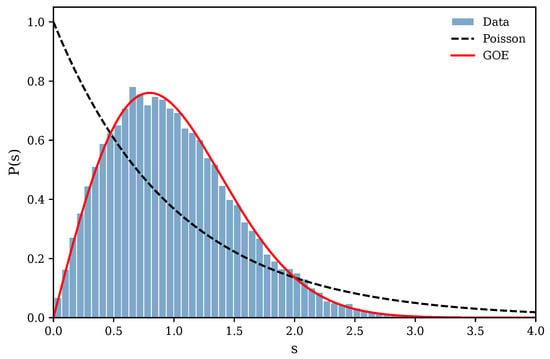
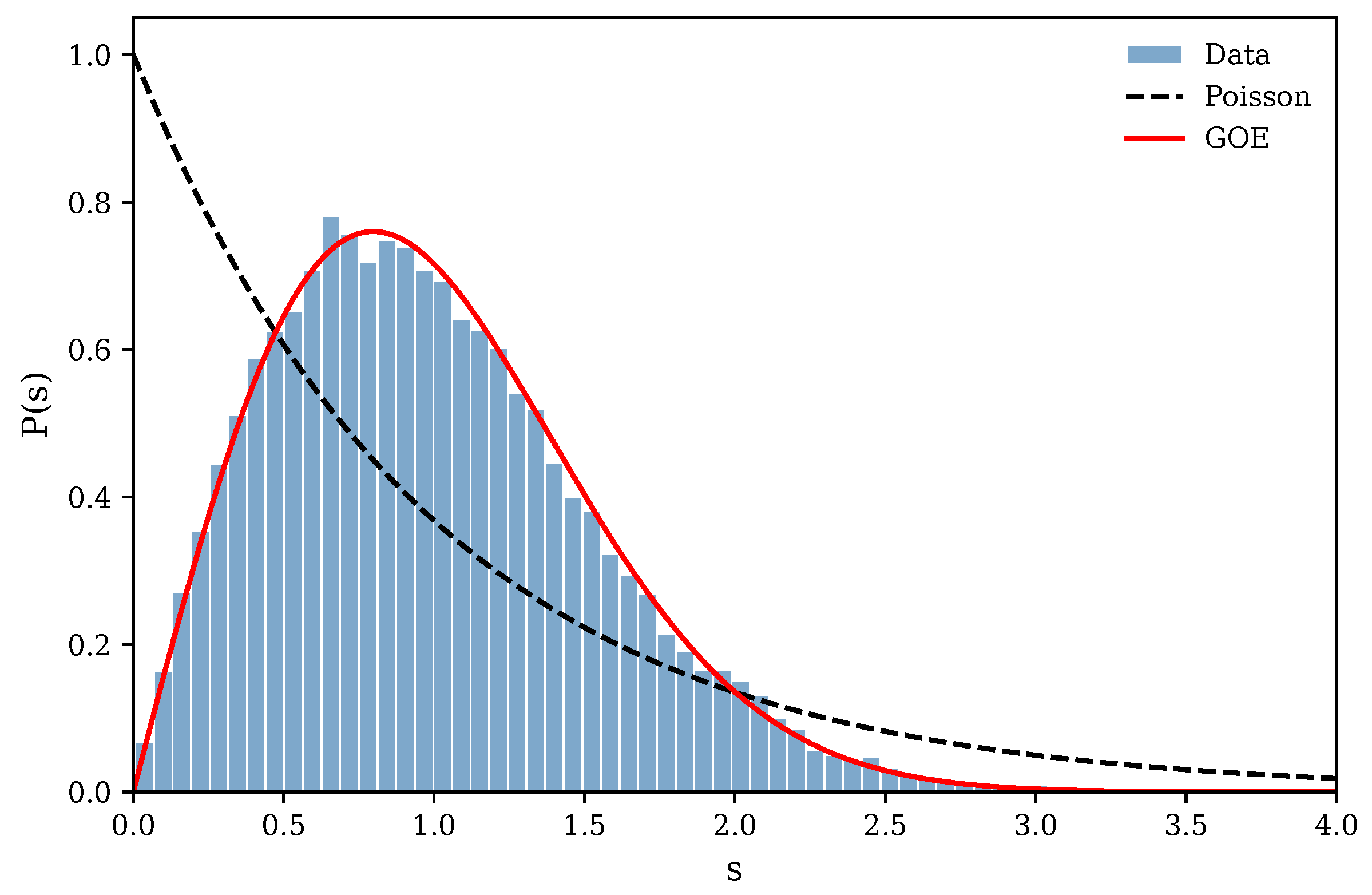
Level spacing s statistics of quasienergies of unitary operator U at parameters and for qubits. The distribution is obtained by diagonalizing all ten symmetry sectors separately, and there are approximately spacings. The Poisson (dashed curve) and Wigner surmise for Guassian orthogonal ensemble (GOE) of random matrix theory (red solid curve) distributions are also shown.
A quantum time-reversal protocol for quantum computing of the classical chaotic Arnold cat map was discussed in Ref. [53]. However, this protocol requires a significant number of two-qubit and one-qubit gates and is still not accessible to current quantum computers (about gates for one map iteration at twenty-seven qubits). In contrast, the protocol proposed here is straightforward to implement on both quantum computers and quantum annealers: for one evolution period, static inter-qubit couplings are kept fixed, and a relatively short global magnetic-field pulse performs a fixed phase rotation on all qubits.
In this paper, we consider only static imperfections that accumulate coherently with time (linearly with the number of gates ), whereas unitary random decoherence errors accumulate only diffusively (as ) [18]. In this sense, static imperfections are more detrimental. Thus, here we consider decoherence produced by unitary gate errors (see, for example, [54]) that lead to fidelity decay. We do not consider here the effects of dissipative decoherence that have been studied in other studies for a kicked rotator (see, for example, [55]). Other types of environmental influence are discussed, for example, in Refs. [56,57].
3. Many-Body Quantum Chaos in TIRKI Model
In the absence of imperfections, we find that, for typical parameter values and , the quantum register states of Hamiltonian (1) are mixed by the kick potential V and the system is in the regime of quantum chaos (see, for example, [15,49]). For typical parameters and h, the level-spacing statistics of nearest quasienergies are described by random matrix theory (RMT) [15] (see Figure 1, where s is rescaled level spacing). Indeed, the data show that well enough follows the Wigner surmise . These results show that the TIRKI model at such parameters is in the regime of developed quantum chaos.
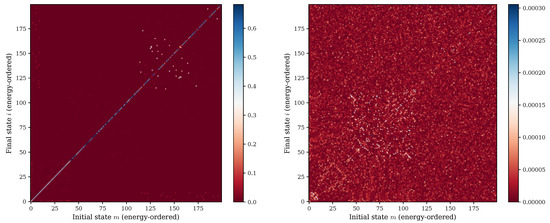
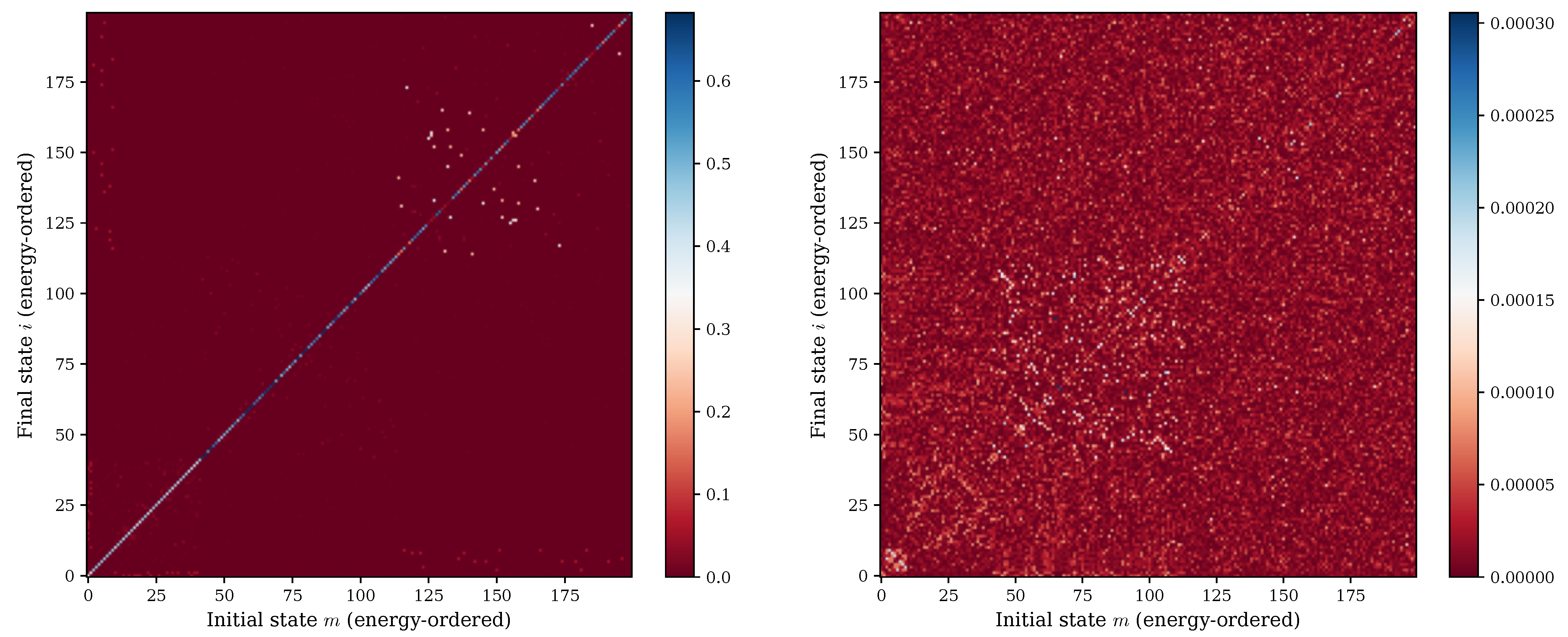
Figure 2 shows that, after evolution to , the initial register states (the 200 states at the lowest energy are shown), the kick perturbation V does not excite a significant number of other register states at , whereas for , a number of register states are excited. Thus, at , the system with the Haniltonian (1) is close to an integrable case, while at the system is in the regime of developed quantum chaos in agreement with the RMT level spacing statistics shown in Figure 1.
Figure 2.
Matrix of excited state after perturbation periods for qubits for , and (left) and 1 (right). Only 200 initial register states with minimal energy are shown. See text for details.
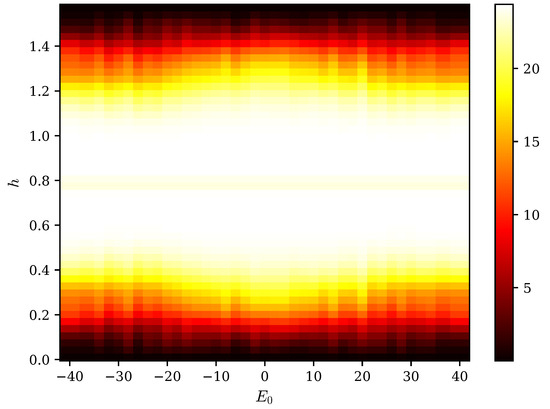
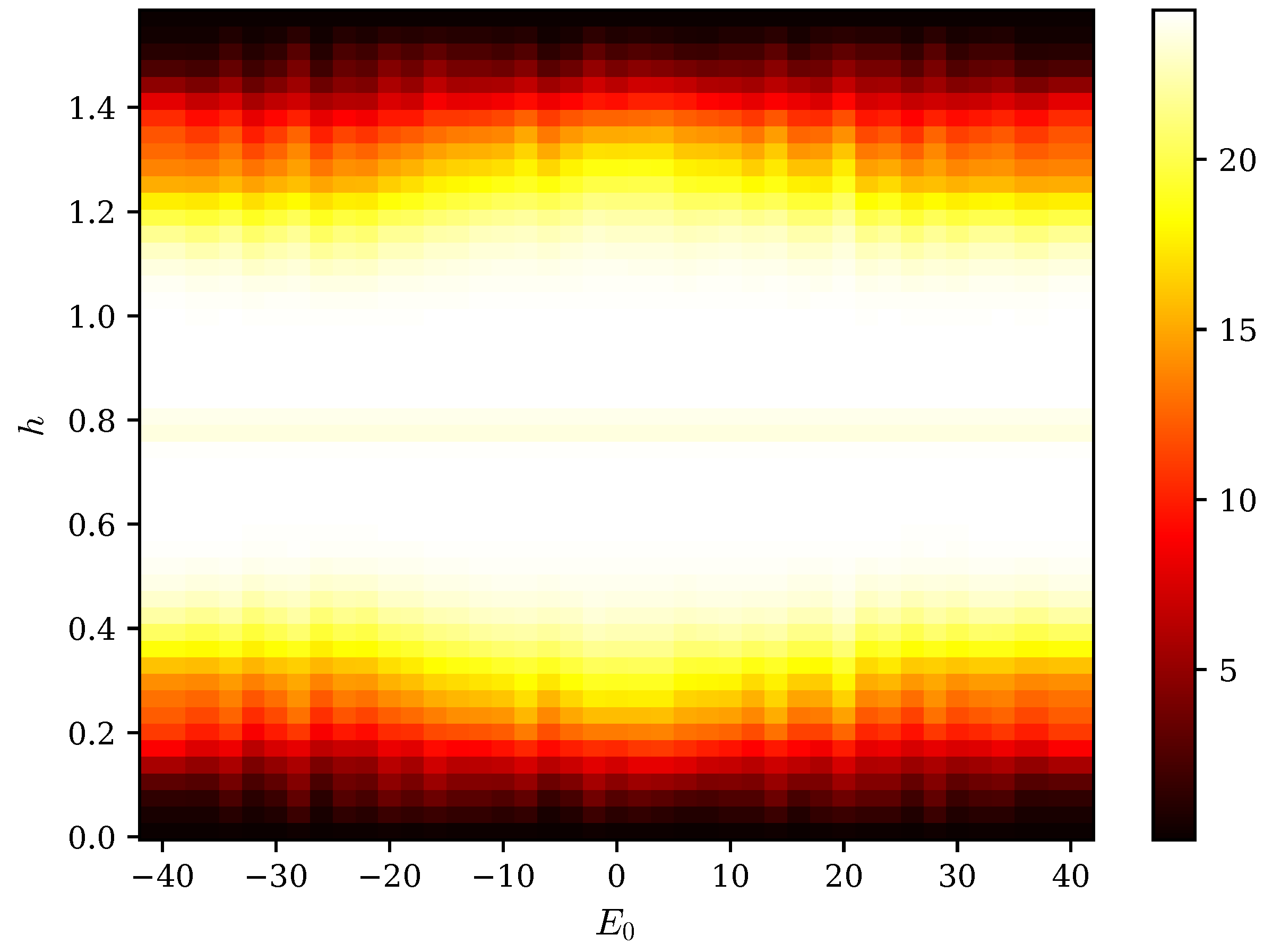
Another indication of the emergence of quantum chaos is given in Figure 3, where we show the dependence of entropy after kicks as a function of kick strength and initial register energy for and . For weak values of , the entropy remains relatively small, with , whereas for it reaches its maximal value, . Thus, the system is in the regime of quite strong chaos for . Because of the periodicity of the kick strength with , the values of are periodic and symmetric with respect to .
Figure 3.
Quantum register melting: color bar shows entropy values after evolution periods in dependence on h and initial energy for qubits, , , and initial state , where the arrows signify spins up. Melting sets in above a threshold of h and is the strongest in the high-density central band , invading the low-density band edges later. The horizontal dark stripes are the fidelity register-preserving areas.
4. Time Reversal for TIRKI Model
Here we discuss the properties of the time-reversal protocol described in Section 2 (mainly in the absence of imperfections). The effects of imperfections are discussed in Section 5.
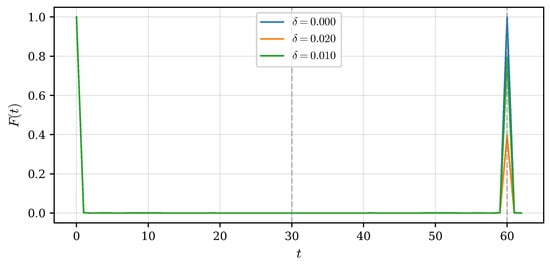
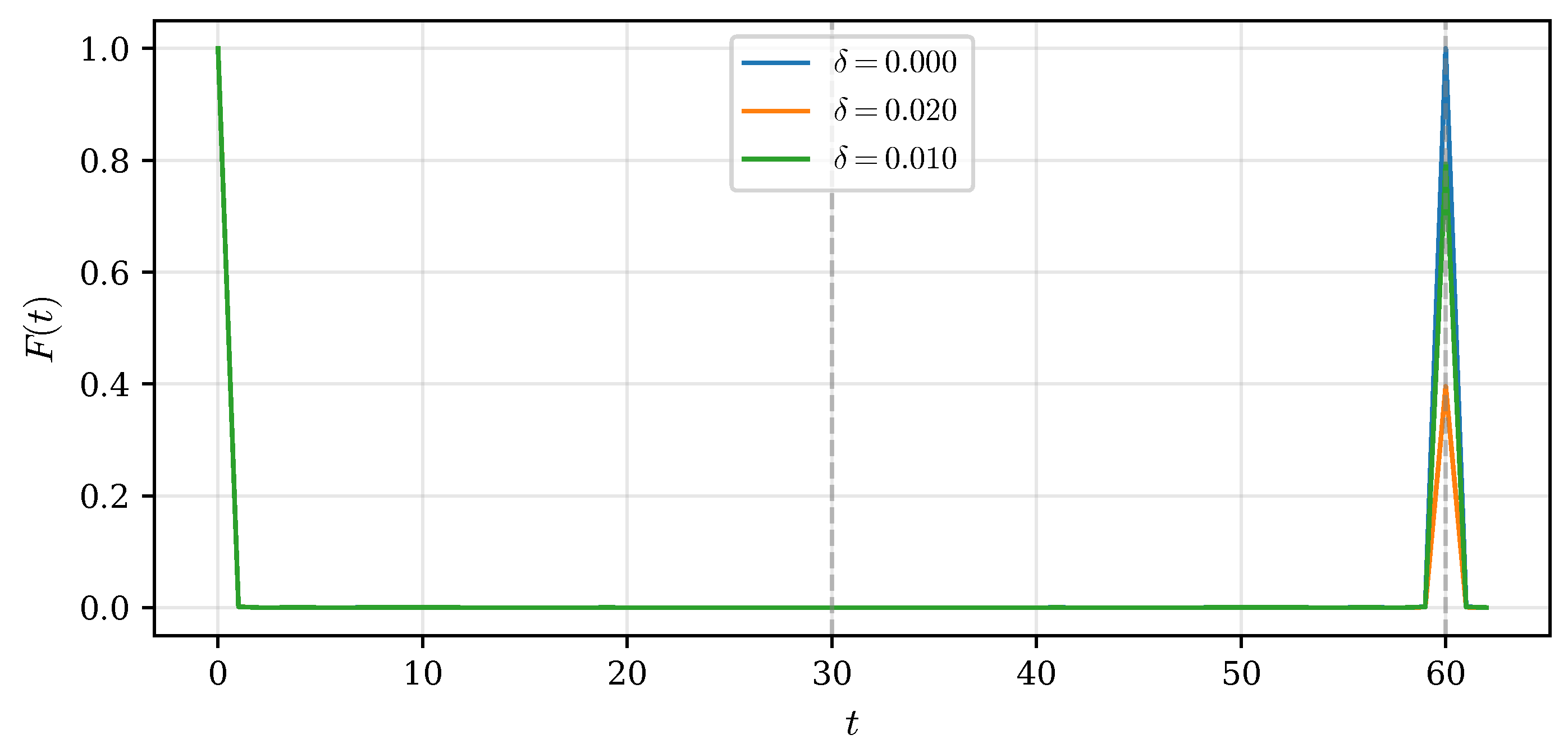
Figure 4 shows the time dependence of the fidelity , with time reversal performed at at system parameters , and qubits. After one period, the fidelity drops to quite a small value but at the return moment it is exceptionally well recovered at . The effect of static imperfections is shown by the dashed curves for . These imperfections reduce the fidelity revival at but the fidelity remains relatively high at (the effects of imperfections are discussed in detail in Section 5).
Figure 4.
Fidelity as a function of time t for model parameters , , at and (vertical dashed lines), where initial state is . Amplitude of static imperfections is with (orange curve), (green curve), and 0 (blue curve, no imperfections).
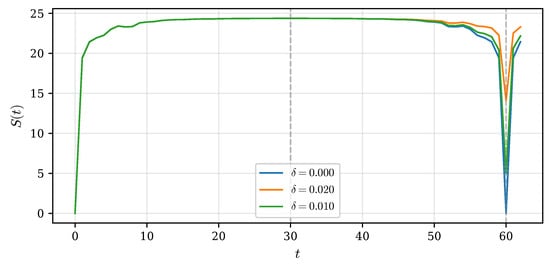
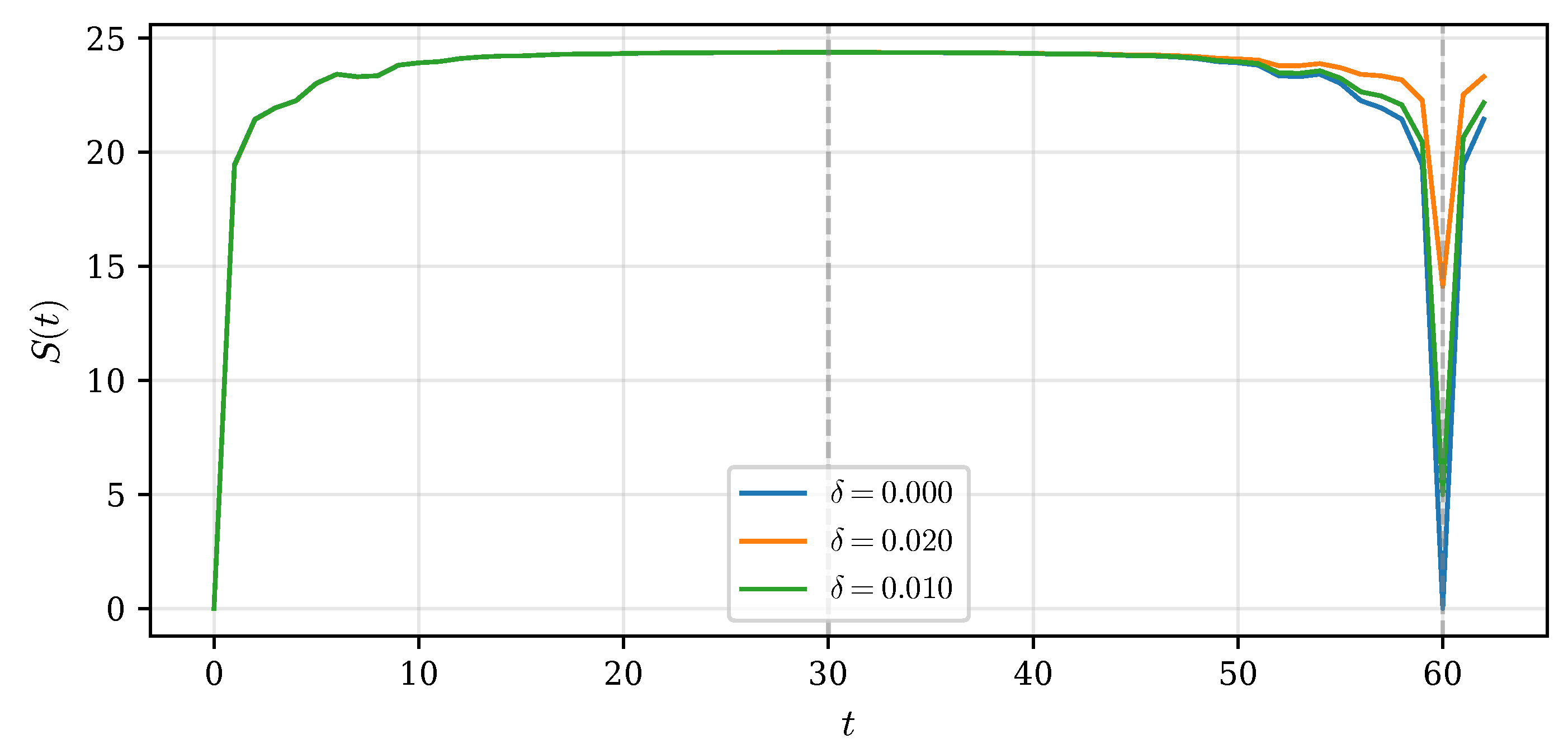
The time-reversal effect on the entropy is shown in Figure 5 for the same system parameters. After the first five periods, the entropy grows from its initial value almost up to its maximal value , remaining close to this value at longer times. At the return time , the entropy returns to its initial value . The backward return of entropy is only relatively weakly affected by static imperfections (see Section 5 for more details).
Figure 5.
Entropy as a function of time t for the same system parameters as in Figure 4.
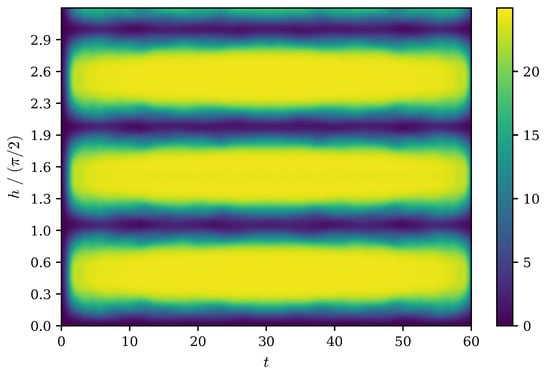
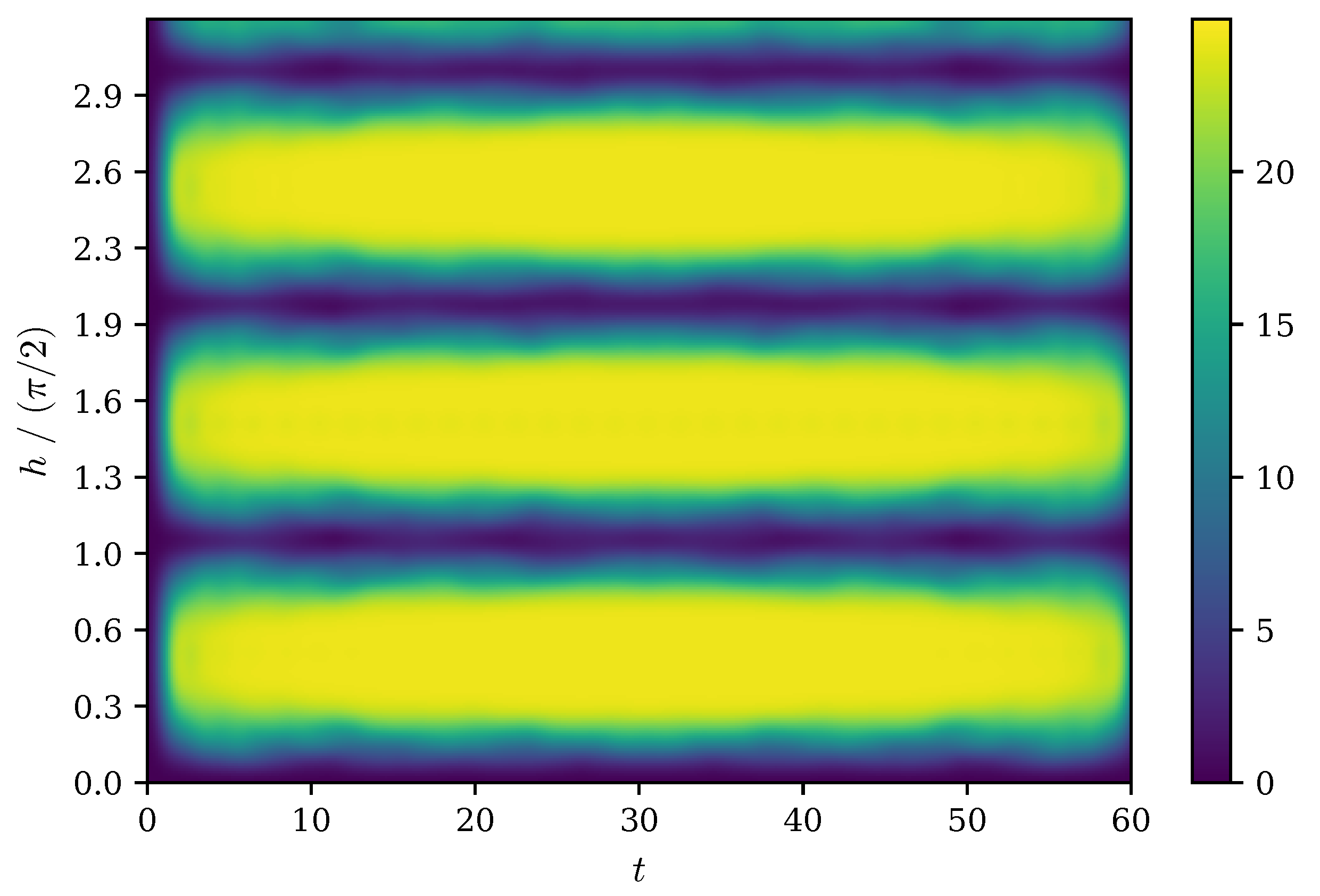
Figure 6 shows the dependence of on time and the parameter h at for the time interval . The results well demonstrate time reversal of the entropy . As in Figure 3, the entropy remains small at for , corresponding to a quasi-integrable phase, while the regime of developed quantum chaos appears at (as discussed in Section 3 above, there are periodicity and symmetry for the variation in h).
Figure 6.
Entropy as a function of h and time t (color bar with values) for , , , and with no imperfections. The kick strength is expressed as . Bright (yellow) bands mark fast saturation to a considerably large entropy; the dark horizontal stripes at and 3, are the register-preserving resonances where the kick is trivial up to a phase.
5. Effects of Imperfections for Time Reversal
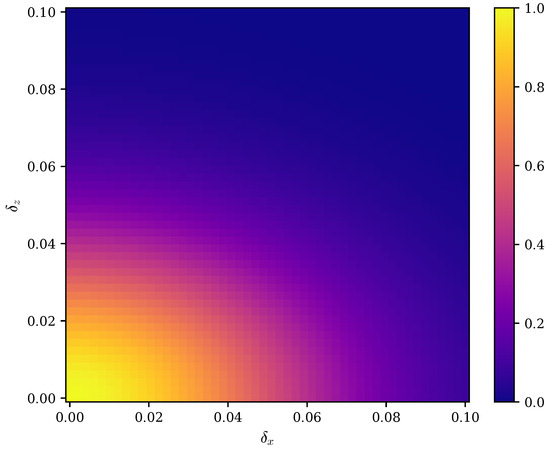
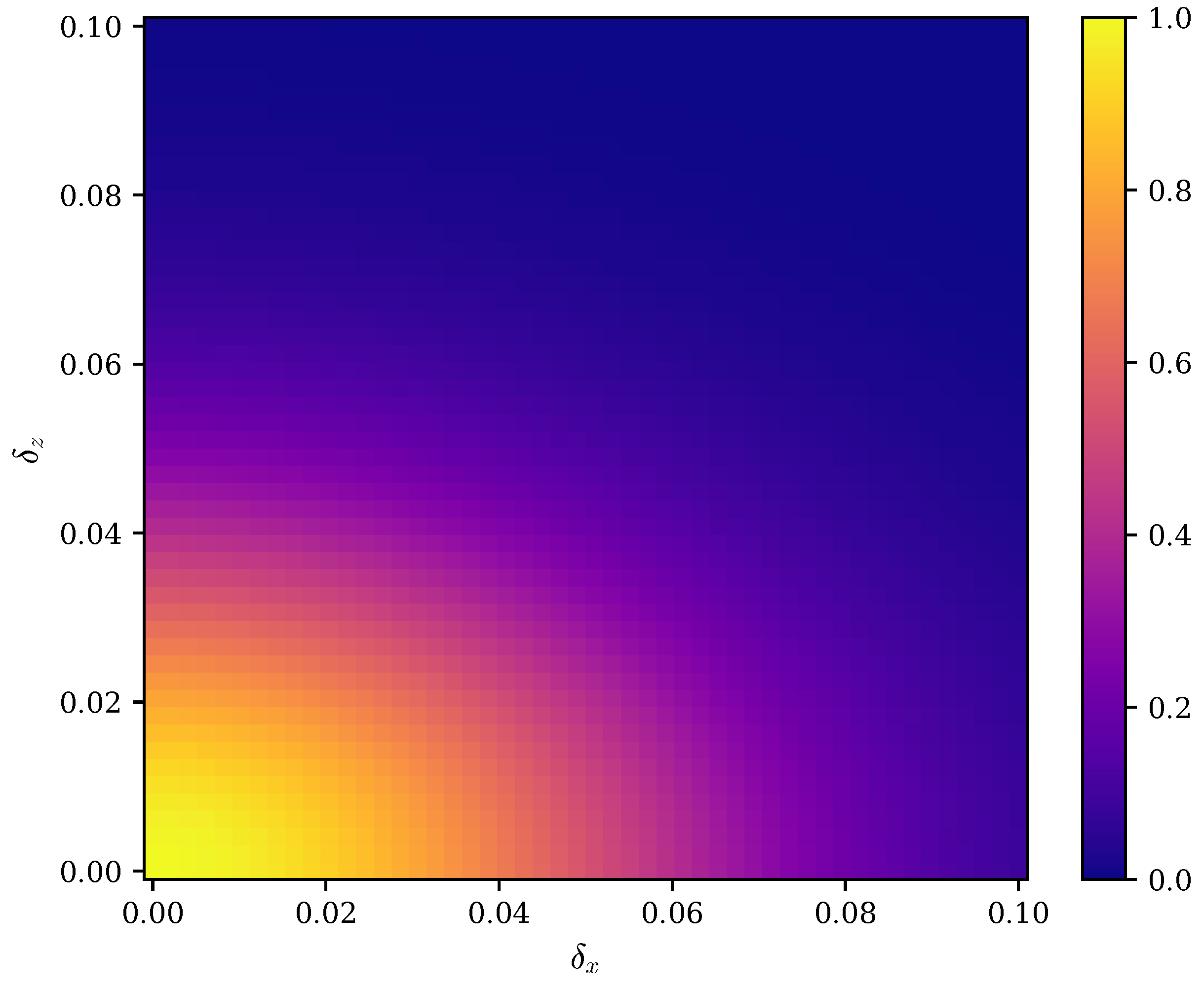
The effects of static imperfections on the fidelity are shown in Figure 7 with its dependence on imperfection amplitudes and . The results show that the fidelity of time reversal decays only polynomially as the strength of the static imperfections increases. We note that the effects of static imperfections have been analyzed analytically and numerically in Ref. [18] over ten orders of magnitude for generic quantum algorithms. We present Figure 7 only as an illustration for the system studied with no intention to reproduce the established dependencies in Ref. [18].
Figure 7.
Fidelity shown by the color bar as a function of imperfection amplitudes and for , , , , and initial state of . Here, is the spread of the kick angle per site, and is the spread of the Ising coupling per bond. Data considered are for a single fixed realization. The reversal is exact only at .
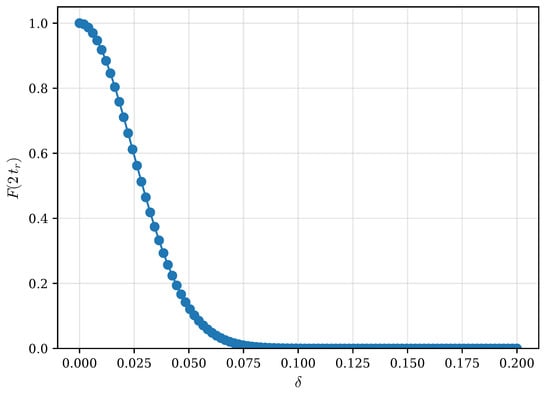
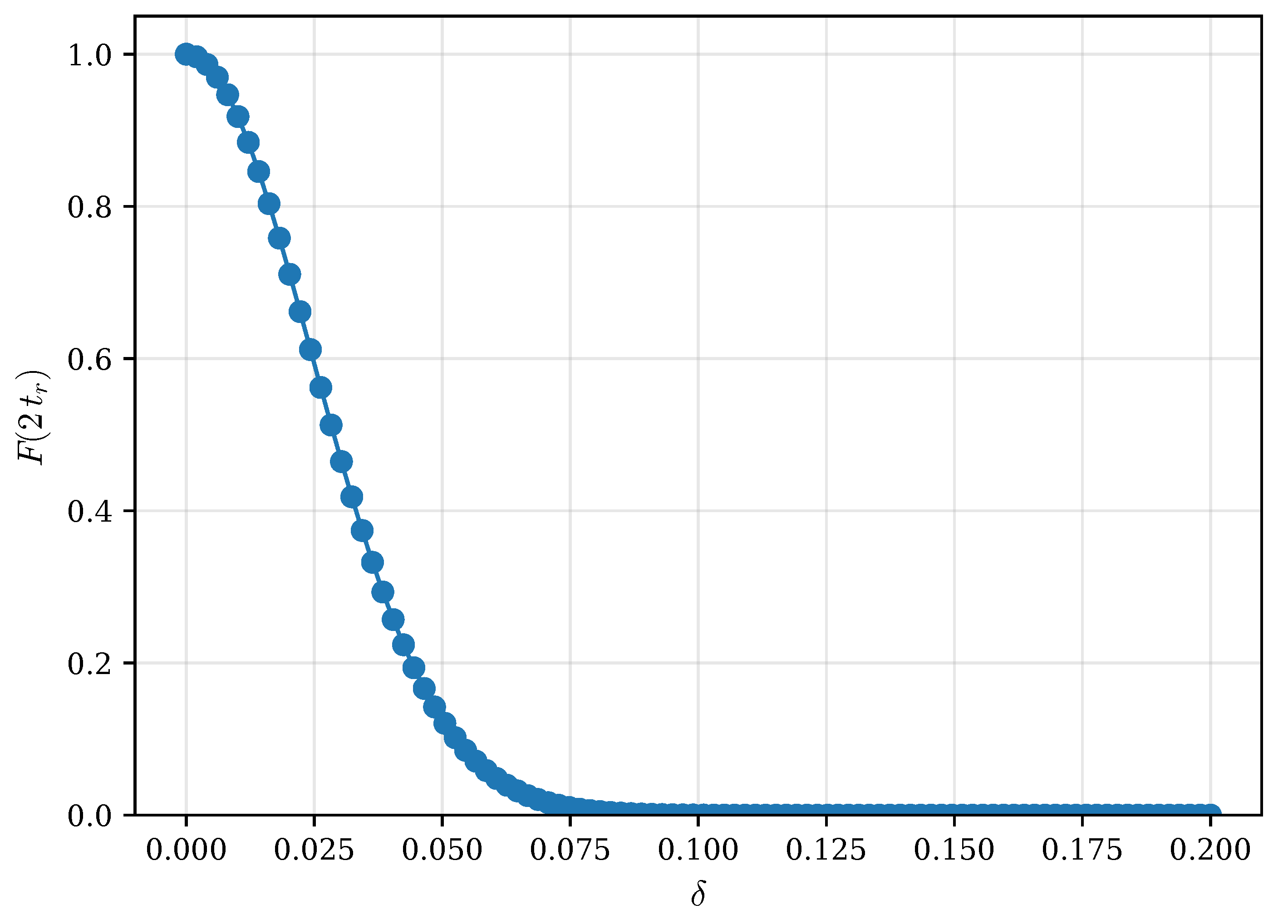
The dependence of the fidelity at the return time on the amplitudes of the imperfections is shown in Figure 8. The dependence is approximately described by the expression , where G depends on the system parameters , and , in agreement with the general properties of Loschmidt echo decay. The Loschmidt echo decay is studied and described in detail in Refs. [17,18,19,20,21,49] and therefore we do not discuss this behavior in detail here.
Figure 8.
Fidelity versus for , , , , and representing a cut along the diagonal of Figure 7.
6. Butterfly Effect of Qubit
The results obtained show that the quantum computing of complex evolution (2) remains stable with respect to quantum gate imperfections. This stability is also preserved against phase-noise gate errors, as shown, for example, in Ref. [18]. However, it is practical to ask whether the time-reversal operation remains stable if, at a time-reversal moment , there is an inversion of only one qubit (apart from this change, the time-reversal protocol remains unchanged). This time-reversal operation can be viewed as a butterfly effect of a qubit. The butterfly effect in classical dynamics and its relation to chaotic motion was discussed by Lorenz [10] (see also the novel written by Ray Bradbury [58]).
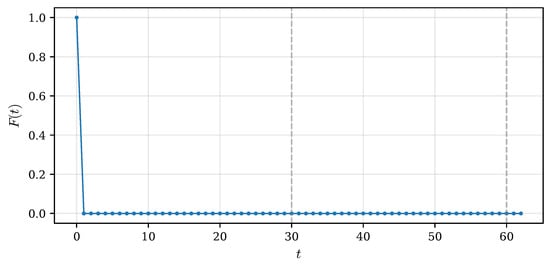
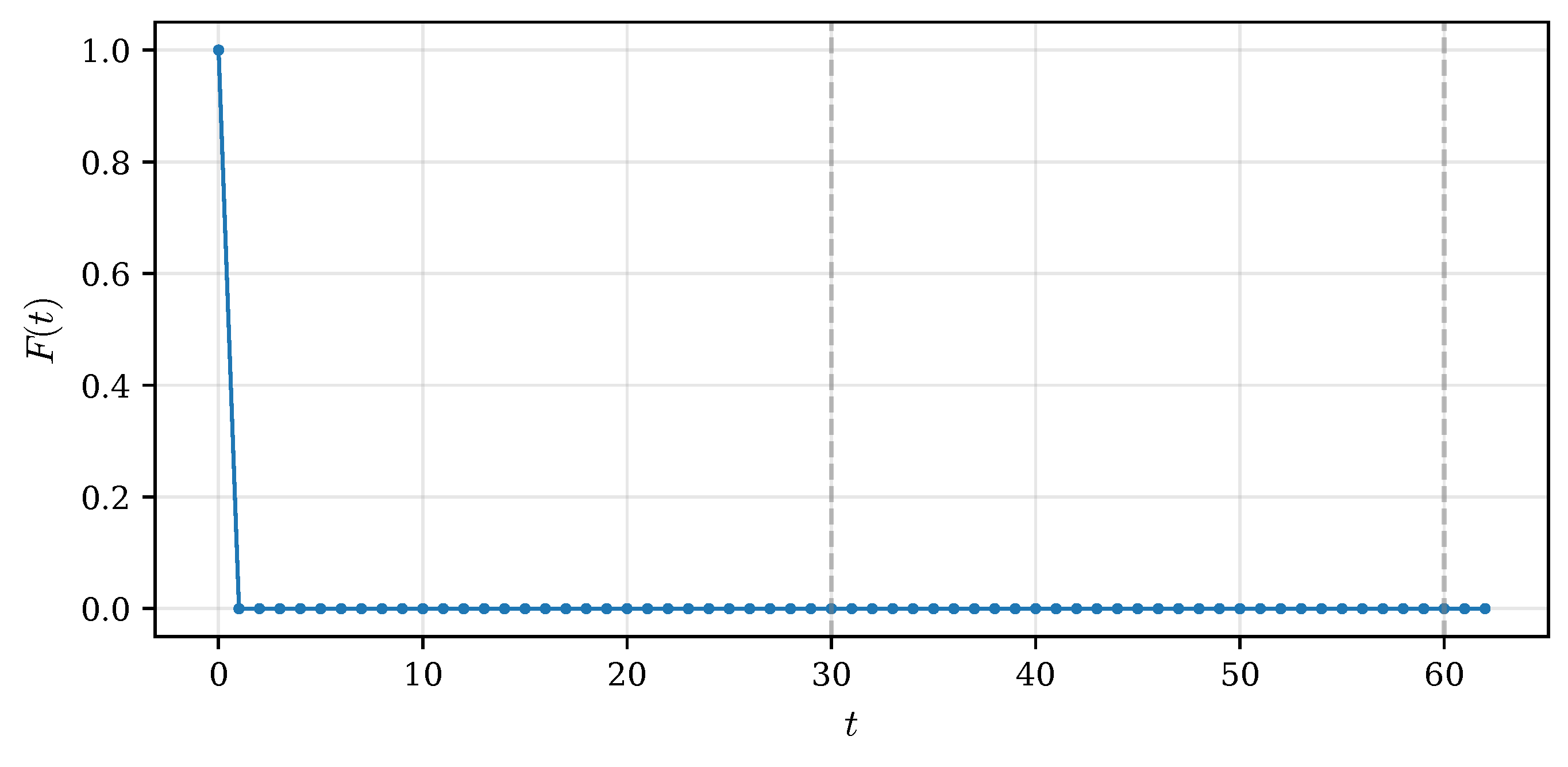
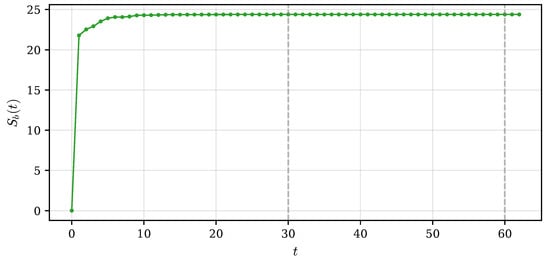
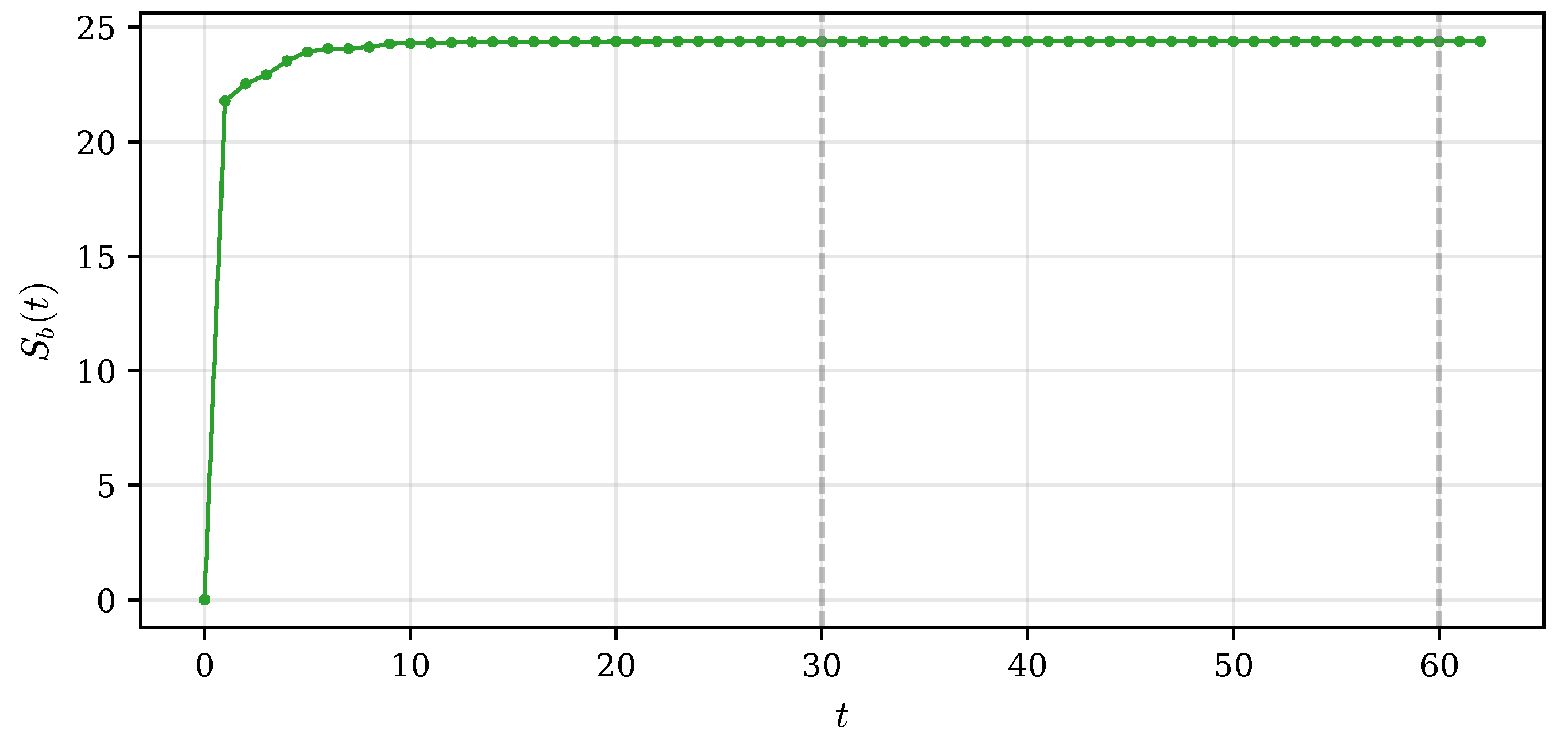
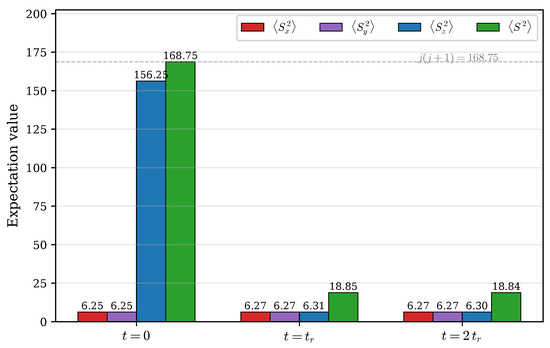
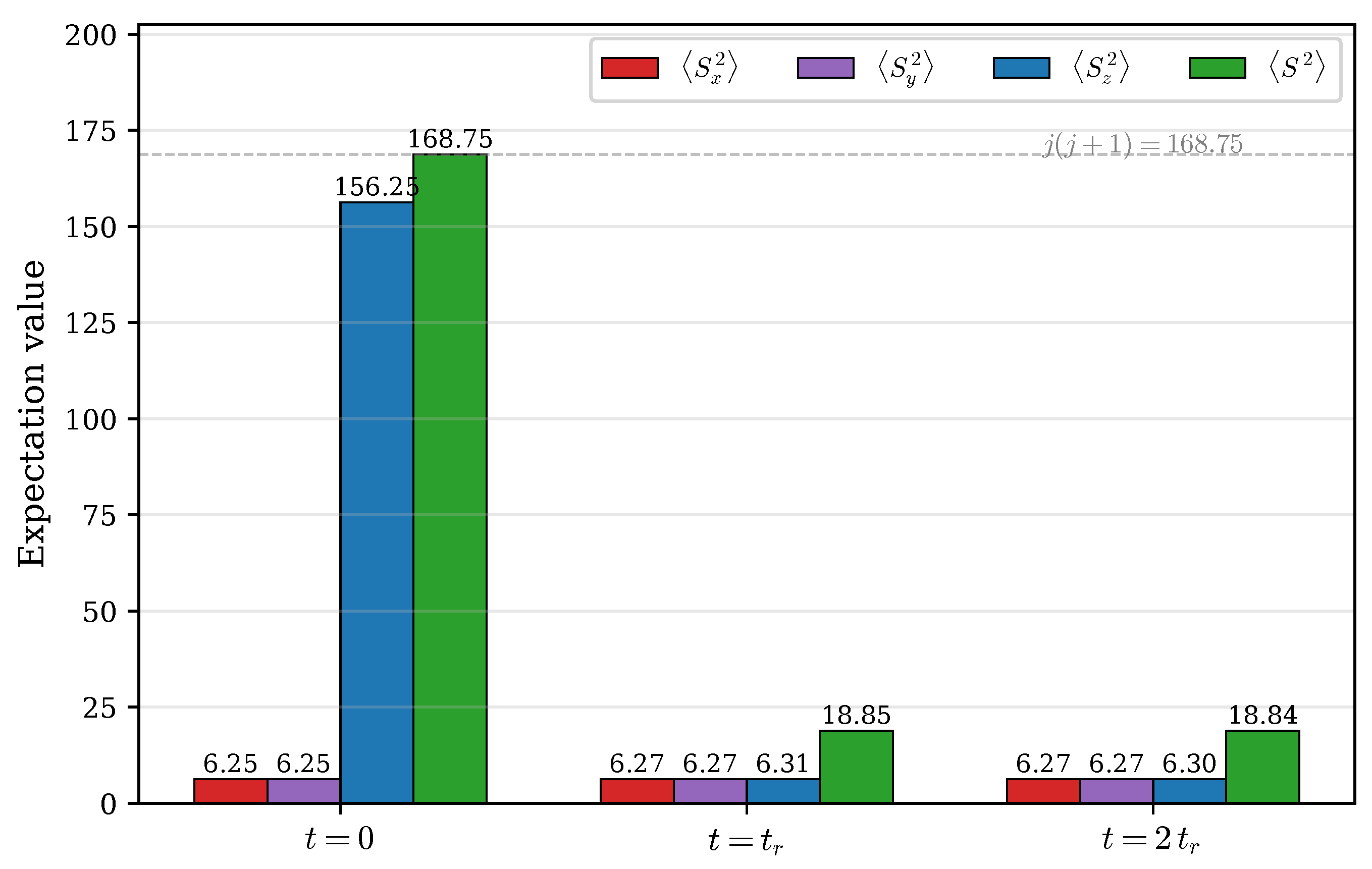
The butterfly effect of a qubit is shown in Figure 9 and Figure 10 for fidelity and entropy , respectively. Here, the time-reversal protocol for the system with twenty-five qubits, without imperfections, is applied at the time moment with the inversion of the central qubit (located at the lattice position ). This single-qubit inversion completely breaks time reversal: there are no signs of a return at for F and . Time reversal is also broken for the total spin squared of the system, as shown in Figure 11, whereas, in the absence of qubit inversion, returned exactly to its initial value.
Figure 9.
Fidelity as a function of time t for the butterfly effect of a qubit: one central qubit is inverted at (vertical dashed line). Here, , , , and with no imperfections.
Figure 10.
Same as in Figure 9, but for the system entropy .
Figure 11.
Spin squared of the whole system shown at time moments for the butterfly effect of the qubit for the same system parameters as usd in Figure 9. j denotes the total spin of all qubits.
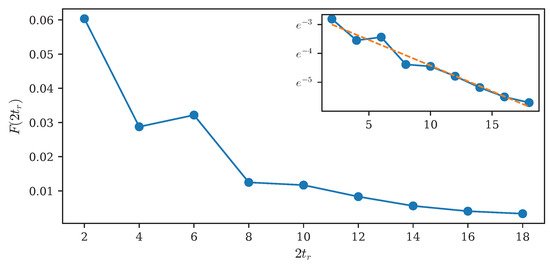
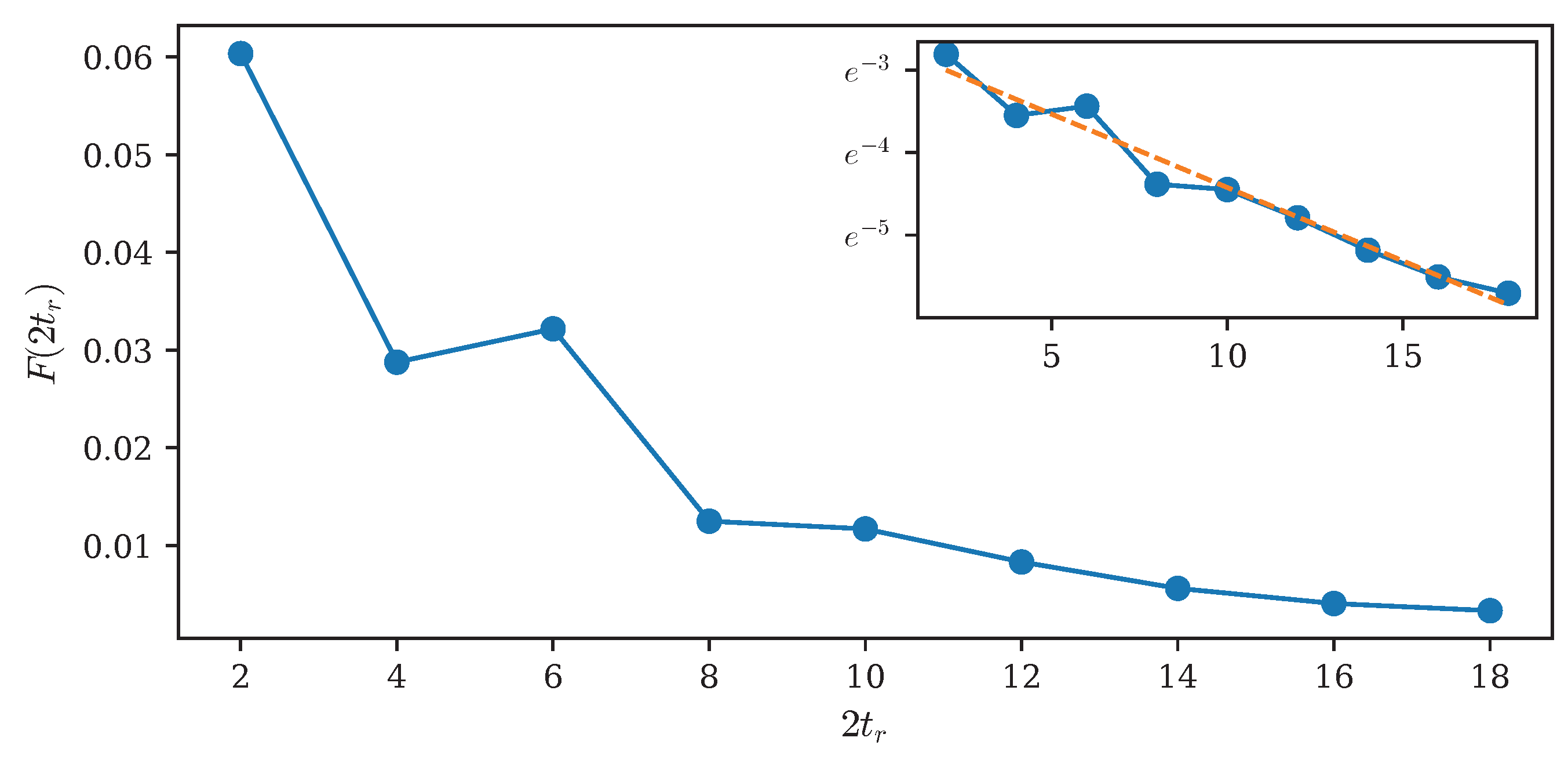
To illustrate the butterfly effect of the qubit in more depth, Figure 12 shows the dependence of fidelity F on the return time when only one qubit is inverted at a time-reversal moment . The results show that drops significantly after only one evolution period, with . For , the decay of fidelity continues approximately exponentially ( for parameters of Figure 12 insert). We note a similarity between this decay and the results reported in Ref. [53] (see Figure 3 in Ref. [53]). Certainly, the inversion of one qubit represents quite a large quantum error, with a relatively large drop in fidelity, as shown in Figure 12. However, in a system of many qubits (e.g., 100 or 1000), it is not apparent whether a flip of one spin affects the spin of the whole system. If a system is not in a regime of many-body quantum chaos (for example, if it is integrable), then a flip of one qubit does not affect the total spin or system entropy. In contrast, in the quantum chaos regime, even a flip of one qubit sufficiently rapidly affects the spin and entropy of the whole system, presumably on the effective Ehrenfest time scale. In Figure 5 and Figure 6, one sees that quantum chaos sets in on a considerably short time scale and we believe that this is at the origin of the butterfly effect of a one-qubit flip. The one-qubit flip effect was shown to be related to the classical Lyapunov exponent in Ref. [53] for the quantum computing of the Arnold cat map.
Figure 12.
Fidelity versus return time for the butterfly effect of the qubit when only one central qubit is inverted at time for , , , and with no imperfections. The inset shows versus and a fit (dashed line).
Thus, we conclude that, due to many-body quantum chaos and the associated relatively rapid entropy growth (see, for example, Figure 5), there is quite a strong butterfly effect of a qubit for the complex quantum evolution of the system with Hamiltonian (1) considered that completely breaks time reversibility. We consider this butterfly effect of a qubit as an analogue of the classical butterfly effect discussed in Refs. [10,11].
We have checked that the above results remain essentially unchanged for different realizations of random static imperfections and various initial states.
7. Discussion
In this study, we proposed a simple enough quantum protocol that enables the time reversal of complex evolution on a quantum computer in a regime of quantum chaos. The protocol considers qubits on a square lattice with next-nearest-neighbor static interactions between them. The time evolution is generated by a comparably short, periodically pulsed global magnetic field acting simultaneously on all qubits. This corresponds to a one-qubit phase rotation applied to all qubits. The periodic time evolution is shown to be in the regime of quantum chaos with level-spacing statistics of quasienergies described by the RMT. Time reversal is achieved by changing the period between pulses and by inverting the magnetic field at a specified time. As a result, the system returns exactly to its initial quantum register state. The time reversal is shown to be robust against quantum imperfections, as checked for nine, sixteen, and twenty five qubits. Earlier studies show that the quantum gate errors grow only polynomially with the number of qubits (see, for example, [18,21,38,59]). The current capabilities of quantum computers [40,41,42,43,44] with up to 144 qubits and quantum annealers [50,51,52] allow this time-reversal protocol to be performed with about hundred or more qubits using relatively simple quantum operations. We believe that, for a quantum simulator with 100 qubits, a macroscopic number of quantum trajectories in the Hilbert space of size is reversed in time, returning to their initial state, and the whole quantum system returns to its initial state. This number is significantly larger than the Avogadro number .
Although time reversal is robust against gate imperfections, we show that the many-body quantum chaos leads to a butterfly effect of a qubit when the inversion of only one qubit breaks the time reversal of the whole system.
We argue that experiments on quantum computers or quantum annealers will revisit the Boltzmann–Loschmidt dispute in a quantum setting, 150 years after its original formulation.
Author Contributions
All authors contributed equally to all stages of this work. All authors have read and agreed to the published version of the manuscript.
Funding
The authors acknowledge support from the grant ANR (Agence Nationale de la Recherche), France, project NanoX N° ANR-17-EURE-0009 in the framework of the Programme Investissements d’Avenir (project MTDINA, Mesoscopic Transport for DIrected Network Analysis).
Data Availability Statement
The data presented in this study are available on request from the corresponding author due to the large amount of data.
Conflicts of Interest
Author Mahdi Kourehpaz was employed by the company Mindbreeze GmbH. The remaining authors declare that the research was conducted in the absence of any commercial or financial relationships that could be construed as a potential conflict of interest.
References
- Boltzmann, L. Weitere Studien über das Wärmegleichgewicht unter Gasmolekülen. Sitzungsber. Kaiser. Acad. Wissensch. Math.-Naturwiss. Cl. 1872, 66(2), 275–370, Reprinted in Brush S.G. (Ed.) Kinetische Theorie II. Irreversible Prozesse Einfrung und Originaltexte. Academie-Verlag: Berlin, Germany; Pergamon Press: Oxford, UK; Vieweg + Sohn: Braunschweig, Germany, 1970; pp. 115–225. [Google Scholar] [CrossRef] [Scilit]
- Loschmidt, J. Über den Zustand des Wärmegleichgewichts eines Systems von Körpern mit Rücksicht auf die Schwerkraft. Sitzungsber. Kaiser. Acad. Wissensch. Math.-Naturwiss. Cl. 1876, 73(2), 128–142. Available online: https://viewer.acdh.oeaw.ac.at/viewer/mirador/?pi=MN_2Abt_73_1876&page=136 (accessed on 1 October 2026).
- Boltzmann, L. Über die Beziehung eines allgemeine mechanischen Satzes zum zweiten Haupsatze der Wärmetheorie. Sitzungsber. Kaiser. Acad. Wissensch. Math.-Naturwiss. Cl. 1877, 75(2), 67–73, Reprinted in Brush S.G. (Ed.). Kinetische Theorie II. Irreversible Prozesse Einfrung und Originaltexte. Academie-Verlag: Berlin, Germany; Pergamon Press: Oxford, UK; Vieweg + Sohn: Braunschweig, Germany, 1970; pp. 240–247. [Google Scholar] [CrossRef] [Scilit]
- Mayer, J.E.; Goeppert-Mayer, M. Statistical Mechanics; John Wiley & Sons, Inc.: New York, NY, USA, 1977; Available online: https://archive.org/details/statisticalmecha029112mbp/ (accessed on 1 October 2026).
- Arnold, V.; Avez, A. Ergodic Problems of Classical Mechanics; W.A. Benjamin, Inc.: New York, NY, USA, 1968; Available online: https://archive.org/details/ergodicproblemso0000arno (accessed on 1 October 2026).
- Cornfeld, I.P.; Fomin, S.V.; Sinai, Y.G. Ergodic Theory; Springer-Verlag New York, Inc.: New York, NY, USA, 1982. [Google Scholar] [CrossRef] [Scilit]
- Chirikov, B.V. A universal instability of many-dimensional oscillator systems. Phys. Rep. 1979, 52, 263–379. [Google Scholar] [CrossRef] [Scilit]
- Lichtenberg, A.; Lieberman, M. Regular and Chaotic Dynamics; Springer Science+Business Media, LLC: New York, NY, USA, 1992. [Google Scholar] [CrossRef] [Scilit]
- Shepelyansky, D.L. Some statistical properties of simple classically stochastic quantum systems. Phys. D Nonlin. Phenom. 1983, 8, 208–222. [Google Scholar] [CrossRef] [Scilit]
- Lorenz, E.N. Predictability: Does the Flap of a Butterfly’s Wings in Brazil Set Off a Tornado in Texas. Presented Before the American Association for the Advancement of Science, December 29, 1972. Available online: https://mathsciencehistory.com/wp-content/uploads/2020/03/132_kap6_lorenz_artikel_the_butterfly_effect.pdf (accessed on 1 October 2026).
- Rouvas-Nicolis, C.; Nicolis, G. Butterfly effect. Scholarpedia 2009, 4, 1720. [Google Scholar] [CrossRef] [Scilit]
- Chirikov, B.V.; Izrailev, F.M.; Shepelyansky, D.L. Dynamical stochasticity in classical and quantum mechanics. In Soviet Scientific Reviews, Section C: Mathematical Physics Reviews. Volume 2; Novikov, S.P., Ed.; OPA B.V.: Amsterdam, The Netherlands, 1981; pp. 209–267. Available online: https://www.researchgate.net/publication/268666973_Dynamical_stochasticity_in_classical_and_quantum_mechanics (accessed on 1 October 2026).
- Shepelyanskii, D.L. Dynamical stochasticity in nonlinear quantum systems. Theor. Math. Phys. 1981, 49, 925–928. [Google Scholar] [CrossRef] [Scilit]
- Chirikov, B.V.; Izrailev, F.M.; Shepelyansky, D.L. Quantum chaos: Localization vs. ergodicity. Phys. D Nonlin. Phenom. 1988, 33, 77–88. [Google Scholar] [CrossRef] [Scilit]
- Haake, F. Quantum Signatures of Chaos; Springer Nature Switzerland AG: Cham, Switzerland, 2018. [Google Scholar] [CrossRef] [Scilit]
- Peres, A. Stability of quantum motion in chaotic and regular systems. Phys. Rev. A 1984, 30, 1610–1615. [Google Scholar] [CrossRef] [Scilit]
- Jalabert, R.A.; Pastawski, H.M. The semiclassical tool in complex physical systems: Mesoscopics and decoherence. In Advances in Solid State Physics; Kramer, B., Ed.; Springer: Bernin/Heidelberg, Germany, 2001; pp. 483–496. [Google Scholar] [CrossRef] [Scilit]
- Frahm, K.M.; Fleckinger, R.; Shepelyansky, D.L. Quantum chaos and random matrix theory for fidelity decay in quantum computations with static imperfections. Eur. Phys. J. D 2004, 29, 139–155. [Google Scholar] [CrossRef] [Scilit]
- Gorin, T.; Prosen, T.; Seligman, T.H.; Znidaric, M. Dynamics of Loschmidt echoes and fidelity decay. Phys. Rep. 2006, 435, 33–156. [Google Scholar] [CrossRef] [Scilit]
- Jacquod, P.; Petitjean, C. Decoherence, entanglement and irreversibility in quantum dynamical systems with few degrees of freedom. Adv. Phys. 2009, 58, 67–196. [Google Scholar] [CrossRef] [Scilit]
- Goussev, A.; Jalabert, R.A.; Pastawski, H.M.; Wisniacki, D.A. Loschmidt echo. Scholarpedia 2012, 7, 11687. [Google Scholar] [CrossRef] [Scilit]
- Sanchez, C.M.; Chattah, A.K.; Pastawski, H.M. Emergent decoherence induced by quantum chaos in a many-body system: A Loschmidt echo observation through NMR. Phys. Rev. A 2022, 105, 052232. [Google Scholar] [CrossRef] [Scilit]
- Garcia-Mata, I.; Jalabert, R.A.; Wisniacki, D.A. Out-of-time-order correlations and quantum chaos. Scholarpedia 2023, 18, 55237. [Google Scholar] [CrossRef] [Scilit]
- Michel, T.R.; Urbina, J.D.; Schlagheck, P. Quasiclassical theory of out-of-time-ordered correlators. J. Phys. A Math. Theor. 2025, 58, 275303. [Google Scholar] [CrossRef] [Scilit]
- Yoshimura, T.; Sa, L. Theory of irreversibility in quantum many-body systems. Phys. Rev. E 2025, 111, 064135. [Google Scholar] [CrossRef] [Scilit]
- Duarte, J.; Garcia-Mata, I.; Wisniacki, D.A. Ruelle–Pollicott decay of out-of-time-order correlators in many-body systems. Phys. Rev. E 2026, 113, 024209. [Google Scholar] [CrossRef] [Scilit]
- Hahn, E.L. Spin echos. Phys. Rev. 1950, 80, 580–594. [Google Scholar] [CrossRef] [Scilit]
- Bagguley, D.M.S. (Ed.) Pulsed Magnetic Resonance: NMR, ESR, and Optics. A Recognition of E. L. Hahn; Oxford University Press: New York, NY, USA, 1992. [Google Scholar] [CrossRef] [Scilit]
- Pastawski, H.M.; Levstein, P.R.; Usaj, G.; Raya, J.; Hirschinger, J. A nuclear magnetic resonance answer to the Boltzmann–Loschmidt controversy. Physica A 2000, 283, 166–170. [Google Scholar] [CrossRef] [Scilit]
- Fink, M. Chaos and time-reversed acoustics. Phys. Scr. 2001, 2001, 268–277. [Google Scholar] [CrossRef] [Scilit]
- Lerosey, G.; de Rosny, J.; Tourin, A.; Derode, A.; Montaldo, G.; Fink, M. Time reversal of electromagnetic waves. Phys. Rev. Lett. 2004, 92, 193904. [Google Scholar] [CrossRef] [Scilit]
- Larmat, C.S.; Guyer, R.A.; Johnson, P.A. Time-reversal methods in geophysics. Phys. Today 2010, 63, 31–35. [Google Scholar] [CrossRef] [Scilit]
- Ullah, A.; Hoogerland, A.D. Experimental observation of Loschmidt time reversal of a quantum chaotic system. Phys. Rev. E 2012, 83, 046218. [Google Scholar] [CrossRef] [Scilit]
- Cao, A.; Sajjad, R.; Mas, H.; Simmons, E.Q.; Tanlimco, J.L.; Nolasco-Martinez, E.; Shimasaki, T.; Kondakci, H.E.; Galitski, V.; Weld, D. Interaction-driven breakdown of dynamical localization in a kicked quantum gas. Nat. Phys. 2022, 18, 1302–1306. [Google Scholar] [CrossRef] [Scilit]
- Martin, J.; Georgeot, B.; Shepelyansky, D.L. Cooling by time reversal of atomic matter waves. Phys. Rev. Lett. 2008, 100, 044106. [Google Scholar] [CrossRef] [Scilit]
- Ermann, L.; Chepelianskii, A.D.; Shepelyansky, D.L. Boltzmann–Loschmidt dispute reloaded: Quantum 150 years later. Entropy 2026, 28, 594. [Google Scholar] [CrossRef] [Scilit]
- Steane, A. Quantum computing. Rep. Prog. Phys. 1998, 61, 117–173. [Google Scholar] [CrossRef] [Scilit]
- Nielsen, M.A.; Chuang, I.L. Quantum Computation and Quantum Information; Cambridge University Press: Cambridge, UK, 2010. [Google Scholar] [CrossRef] [Scilit]
- Deutsch, I.H. Harnessing the power of the second quantum revolution. PRX Quantum 2020, 1, 020101. [Google Scholar] [CrossRef] [Scilit]
- Google Quantum AI and Collaborators. Observation of constructive interference at the edge of quantum ergodicity. Nature 2025, 646, 825–830. [Google Scholar] [CrossRef] [Scilit]
- Zang, C.; Cortiñas, R.G.; Karamlou, A.H.; Noll, N.; Provazza, J.; Bausch, J.; Shirobokov, S.; White, A.; Claassen, M.; Kang, S.H.; et al. Quantum computation of molecular geometry via many-body nuclear spin echoes. arXiv 2025, arXiv:2510.19550. [Google Scholar] [CrossRef] [Scilit]
- Fischer, L.E.; Leahy, M.; Eddins, A.; Keenan, N.; Ferracin, D.; Rossi, M.A.C.; Kim, Y.; He, A.; Pietracaprina, F.; Sokolov, B.; et al. Dynamical simulations of many-body quantum chaos on a quantum computer. Nat. Phys. 2026, 22, 302–307. [Google Scholar] [CrossRef] [Scilit]
- Nagao, K.; Shirakawa, T.; Sun, R.; Prelošek, P.; Yunoki, S. Probing many-body localization crossover in quasiperiodic Floquet circuits on a quantum processor. arXiv 2026, arXiv:2603.12675. [Google Scholar] [CrossRef] [Scilit]
- Levitan, E.; Watad, T.; Perry, R.; Broers, L.; Mullath, M.Z.; Alberton, O.; Arad, I.; Atia, Y.; Bairey, E.; Barkan, S.; et al. Resolving structure in prethermal Floquet dynamics with precision quantum computation. arXiv 2026, arXiv:2607.24937. [Google Scholar] [CrossRef] [Scilit]
- Prosen, T. Exact time-correlation functions of quantum Ising chain in a kicking transversal magnetic field: Spectral analysis of the adjoint propagator in Heisenberg picture. Prog. Theor. Phys. Suppl. 2000, 139, 191–203. [Google Scholar] [CrossRef] [Scilit]
- Bertini, B.; Kos, P.; Prosen, T. Entanglement spreading in a minimal model of Maximal many-body quantum chaos. Phys. Rev. X 2019, 9, 021033. [Google Scholar] [CrossRef] [Scilit]
- Bertini, B.; Clayes, P.W.; Prosen, T. Exactly solvable many-body dynamics from space-time duality. Rev. Mod. Phys. 2026, 98, 025001. [Google Scholar] [CrossRef] [Scilit]
- Pathak, T.; Ebisu, H.; Prosen, T. Spread of entanglement in generalized kicked Ising chain. arXiv 2026, arXiv:2608.09695. [Google Scholar] [CrossRef] [Scilit]
- Georgeot, B.; Shepelyansky, D.L. Quantum chaos border for quantum computing. Phys. Rev. E 2000, 62, 3504–3507. [Google Scholar] [CrossRef] [Scilit]
- King, A.D.; Nocera, A.; Rams, M.M.; Dziarmaga, J.; Wiersema, R.; Bernoudy, W.; Raymond, J.; Kaushal, N.; Heinsdorf, N.; Harris, R.; et al. Beyond-classical computation in quantum simulation. Science 2025, 388, 199. [Google Scholar] [CrossRef] [Scilit]
- Zhang, H.; Kamenev, A. Computational complexity of three-dimensional Ising spin glass: Lessons from D-wave annealer. Phys. Rev. Res. 2025, 7, 033098. [Google Scholar] [CrossRef] [Scilit]
- Abel, S.; Constantin, A.; Nutricati, L.A. Quantum annealing: Optimisation, sampling, and many-body dynamics. Contemp. Phys. 2026. in print. [Google Scholar] [CrossRef] [Scilit]
- Georgeot, B.; Shepelyansky, D.L. Stable quantum computation of unstable classical chaos. Phys. Rev. Lett. 2001, 86, 5393–5396. [Google Scholar] [CrossRef] [Scilit]
- Kern, O.; Alber, G.; Shepelyansky, D.L. Quantum error correction of coherent errors by randomization. Eur. Phys. J. D 2005, 32, 153–156. [Google Scholar] [CrossRef] [Scilit]
- Weon Lee, J.; Shepelyansky, D.L. Quantum chaos algorithms and dissipative decoherence with quantum trajectories. Phys. Rev. E 2005, 71, 056202. [Google Scholar] [CrossRef] [Scilit]
- Goletz, C.-M.; Koch, W.; Grossmann, F. Semiclassical dynamics of open quantum systems: Comparing the finite with the infinite perspective. Chem. Phys. 2010, 375, 227–233. [Google Scholar] [CrossRef] [Scilit]
- Galiceanu, M.; Beims, M.W.; Strinz, W.T. Quantum energy and coherence exchange with discrete baths. Phys. A 2014, 415, 294–306. [Google Scholar] [CrossRef] [Scilit]
- Bradbury, R. A Sound of Thunder. Collier’s 1952, 129(26), 20–21. Available online: https://www.unz.com/print/Colliers-1952jun28/ (accessed on 1 October 2026).
- Georgeot, B.; Shepelyansky, D.L. Emergence of quantum chaos in the quantum computer core and how to manage it. Phys. Rev. E 2000, 62, 6366–6375. [Google Scholar] [CrossRef] [Scilit]
Disclaimer/Publisher’s Note: The statements, opinions and data contained in all publications are solely those of the individual author(s) and contributor(s) and not of MDPI and/or the editor(s). MDPI and/or the editor(s) disclaim responsibility for any injury to people or property resulting from any ideas, methods, instructions or products referred to in the content. |
© 2026 by the authors. Licensee MDPI, Basel, Switzerland. This article is an open access article distributed under the terms and conditions of the Creative Commons Attribution (CC BY) license.