


Abstract
How feasible is traceable Arabic video production for a crowdsourced telephony denial-of-service (TDoS) scenario, and which failures limit its evaluation? AdFactory uses commercial services to produce presenter videos (Influencer mode) and four-scene product advertisements (Luxury mode) from fixed presenter and product sources. Influencer mode returned 47 completed outputs from 54 planned comparisons; outputs labeled MultiTalk matched their Hunyuan counterparts by recorded SHA-256, so that route’s backend model remains unconfirmed. Luxury mode returned four complete clips in 27 of 28 first attempts, but only 13 supported a complete composite score. Pilot-exclusion, weight-sensitivity and paired-effect analyses expose measurement limitations. Influencer cost is the recorded or reserved amount (the greater of recorded cost and preflight estimate), not verified cash expenditure or full-pipeline costs. The platform draws the telephone number at assembly, so a sampled optical character recognition (OCR) audit depends mainly on the rendering template and the OCR tool and does not compare generation engines. A separate two-class queueing analysis examines capacity trade-offs; queue inputs remain synthetic. Public posting was disabled, but unlisted inspection URLs remained publicly retrievable. We measured neither audience conversion nor live telephone disruption. In a blinded rating of 32 new clips by 62 adult Arabic-speaking volunteers, 84% of all ratings were the top category and inter-rater agreement was near zero. Route differences were at most 0.16 scale points, and clips with documented visible defects were rated like the others, so we do not present these scores as evidence of realism. These findings show bounded production feasibility and measurement failures, but establish neither an overall engine ranking nor end-to-end attack feasibility. The work therefore characterizes an integrated, production-side path for a crowdsourced TDoS scenario, not a new telephony-level attack mechanism.
1. Introduction
In a crowdsourced telephony denial-of-service (TDoS) scenario, an adversary could distribute a video that encourages viewers to call a common telephone number. Service disruption would additionally depend on distribution, audience response, call timing and duration, and the receiving system’s capacity. We study the preceding media-production stage. We do not treat successful video generation as evidence that viewers will call or that a telephone service will be disrupted. The offline telephone-capacity analysis remains separate from the generated videos.
Prior work surveys deepfake generation and detection [1,2,3]. Connecting commercial generation APIs does not establish that the resulting videos preserve the intended Arabic speech, presenter identity, product geometry, or contact information. We study these production and measurement problems using an integrated, traceable workflow. Our evaluation concerns the assembled media and their recorded inputs, including failed requests and incomplete measurements. The research questions below distinguish this production evidence from the unmeasured audience response and the separately modeled telephone-capacity effects.
We implemented AdFactory in Laravel to connect a structured campaign request to creative direction, reference-conditioned images, speech, video generation and final composition. The request includes mode, presenter and product settings, with separate wardrobe, voice, text and contact policies. Creative direction produces the narration and scene plan; enabled quality checks can request bounded corrections. Actor reference audio can select a cloning route, while other campaigns use the configured speech route. The actual stages, overrides, retries and provider identifiers must be read from each run record. A completed status alone does not establish that every available check ran or that an independent reviewer accepted the media.
Influencer mode is intended to animate a presenter using a separately prepared Arabic recording. For the controlled avatar benchmark, eligibility requires an adapter to declare that external audio is used without regeneration. This declaration is checked before dispatch, but it does not verify what the provider returned. We therefore distinguish the declared capability, the measured preservation result and audiovisual alignment. An output can be delivered while its audio provenance remains unresolved; successful lip synchronization alone does not establish that the selected source recording was retained.
Luxury mode produces a product advertisement from four scenes. AdFactory creates the storyboard images, animates each image, and joins the clips with narration and music. The narration plays over the scenes; it does not have to follow a mouth, so lip synchronization is not the test here. The checks follow what happens to the product across the shots: whether it keeps its appearance, whether the label remains readable, and whether the actions make sense from one scene to the next. Figure 1 shows both production paths and their place in the wider threat scenario.
Figure 1.
AdFactory’s two video-production paths and the wider telephony denial-of-service (TDoS) scenario. The implemented workflow generates Arabic test videos. The gray path shows how distribution and viewer calls could lead to telephone-resource pressure; it was not executed in the evaluation. The offline queueing model examines that pressure separately using assumed inputs.
The development records include provider changes, partial runs, failures, and recoveries; we do not treat them as independent evaluations. The historical evidence has three distinct production layers: four end-to-end demonstrations, a fixed-input presenter benchmark, and a fixed-input product benchmark. Their planned engine–case cells are comparisons of fixed sources, not independently sampled cases. First attempts remain primary, and later recoveries remain separately labeled. The revision experiments are reported as a separate extension with their own inputs, versions, and outcomes (Section 4.6, Section 4.7 and Section 4.8).
We entered telephone numbers as research test inputs and disabled public posting in the evaluated workflow. We did not measure viewer calls, comments, or disruption of a live telephone service. We do not infer from a test number’s appearance or intended use that it is unassigned. Number recognition in retained rendered frames is assessed separately from number ownership and spoken-number fidelity. The offline capacity model uses assumed arrival and service conditions, not traffic inferred from the generated videos.
We organize the study around three research questions. RQ1: Under fixed source inputs and documented service settings, can the workflow produce complete Arabic presenter and product videos, and what production cost, latency, and failures are observed? RQ2: Which content-preservation and measurement failures arise, and how do pilot inclusion, missing measurements, and scoring weights affect the interpretation of the retained results? RQ3: How faithfully is the intended telephone number recognized in sampled rendered frames, and what separate capacity trade-offs arise in an offline model with assumed legitimate and adversarial traffic? For this revision, we state an explicit feasibility proposition: at least one tested workflow can produce a structurally complete Arabic call-to-action video with traceable inputs and production costs. A completed file does not, by itself, establish realistic motion, legible digits, persuasive impact, or attack success. We report production cost descriptively per completed file under the retained settings, without a prespecified affordability cutoff or a tested claim of cost superiority; we do not test the stronger hypothesis that production is not the principal bottleneck in an end-to-end attack, because distribution and audience-to-call conversion were not measured. These questions clarify the scope of the retained evaluation and are not presented as preregistered hypotheses. Our contribution is a traceable, production-side characterization of the two elements of this scenario that we implemented and measured: AI-generated Arabic media and the embedding of a contact number in the assembled video. The later steps of the scenario, namely social distribution, human-initiated calling and any resulting pressure on telephone capacity, were not executed; they motivate the call to action that the videos carry. The characterization covers feasibility and failure modes from source inputs to returned or assembled video files and keeps media measurements separate from the offline capacity analysis.
2. Related Work and Study Positioning
2.1. Synthetic Media, Detection, and Provenance
Synthetic-media research includes generated faces and speech, talking heads, and diffusion-based video [4,5,6,7]. Detection is still weak when the recording conditions or the attack type change; the ASVspoof studies showed speech detectors losing accuracy under those shifts [8,9]. Viewers may also take a generated face for a real one [10]. Recording a file’s origin and controlling where it goes are further safeguards, but they are not part of the generator itself.
We distinguish the constructs measured in video evaluation. VBench [11] separates 16 dimensions and compares dimension-specific measures with human preferences. Fréchet Video Distance (FVD) [12] compares distributions of video features and requires attention to sample size. We cite these approaches as methodological context; we do not report a VBench or FVD evaluation of AdFactory, infer a reliable per-clip FVD score, or use those references to validate this study’s Arabic-specific quality thresholds.
Media provenance is a record of where a file came from and what happened to it. The Coalition for Content Provenance and Authenticity (C2PA) publishes a standard for such records [13], and AudioSeal places watermarks in generated speech [14]. Not every provider supports these safeguards, and a visible mark or a metadata field can be stripped later. For each AdFactory output, the system records the included origin information and how it was checked.
2.2. Evaluation of Arabic and Saudi Content
Arabic speech resources cover different tasks and different varieties of Arabic. SADA consists mainly of Saudi audio for speech recognition [15]. SawtArabi is used to evaluate Arabic text-to-speech (TTS), including dialects and speech that switches between languages [16]. Those collections give context for the speech that AdFactory uses; they are not themselves the evaluation in this study.
We use Arabic speech as a fixed production setting rather than a language-comparison factor. In the original benchmark, we evaluated source-audio preservation and audiovisual alignment; these measurements do not establish intelligibility, pronunciation, dialect fidelity, or speech naturalness, and we did not conduct a separate listening study of those constructs. The contribution is the documented integration and bounded evaluation of an Arabic-configured workflow, without claiming an Arabic-specific performance advantage, validated Saudi-speech acceptance thresholds, or language-wide generality. We distinguish the subsequent human evaluation of newly generated clips by its own stimuli, raters, applicable questions, and agreement analysis. Such ratings do not retrospectively validate the original benchmark outputs.
2.3. Workflow Automation and Security
We implement AdFactory in Laravel, where a configured campaign request initiates the production workflow. We evaluate this implementation; we do not compare it with low-code platforms or claim superiority over them.
Generative AI can supply content for social engineering. Research on phishing examines why people may fall for an attack [17] and how large language models can help create or detect phishing messages [18]. Deepfakes add risks involving identity, authority, and trust [19,20]. This literature is used to describe the threat scenario. The quality of a generated video and the response of its viewers are treated as different questions.
2.4. Telephony Denial of Service and Resilience
Traditional denial-of-service classifications focus on computer and network resources [21]. TDoS is narrower: it targets the limited resources used to handle telephone calls and can disrupt emergency or organizational communications [22,23]. Existing defenses include work in the data plane [24], defenses against Session Initiation Protocol (SIP) flooding [25], and detection of unusual patterns in call-detail records [26].
People were coordinating TDoS campaigns before generative AI. SecureLogix described posts on Facebook and Twitter that named telephone numbers and a time to call them [27]. The FBI later described the same pattern as using social networks to encourage people to flood a number with calls [23]. In the threat model, the calls still come from people, not from the platform.
Research on telephony abuse shows several ways in which unwanted calls are produced. Studies of robocalls describe the telephone-spam ecosystem, its defenses [28], and large-scale campaign activity observed through honeypot lines [29]. A taxonomy of telephony fraud lists organizing people on social media to call a specific number, alongside autodialers, as one way to initiate TDoS [30]. Voice-phishing studies show that recipients act on scam calls, with caller-ID spoofing an important factor [31]. A controlled study showed that a pipeline combining a large language model with speech recognition and synthesis can conduct vishing conversations [32]. Swatting research shows how fabricated emergency calls exploit dispatch prioritization [33]. Work on activist distributed denial of service (DDoS) describes how tool design and media coverage drew volunteers into LOIC-based actions [34], and how such attacks combine voluntary and involuntary participation [35]. Together, these studies show that voice channels can carry unwanted or disruptive calls and that recruited participants can be mobilized for disruptive online actions. AdFactory addresses a narrower, earlier step: whether connected AI services can produce Arabic call-to-action videos under test conditions, with telephone numbers entered as research test inputs and public posting disabled. We do not measure whether such videos recruit callers, how many calls follow, or how often viewing converts to calling.
Digital resilience means handling disruption and adapting with digital resources [36,37]. For the social TDoS risk considered here, the practical work is narrower: document the video-production process, test its controls, and examine telephone capacity offline.
Previous studies examine generative AI in social engineering and multimedia disinformation [20,38], including attacks supported by AI agents [39]. The agentic-phishing study reviews earlier research; it does not report new experiments. Our contribution is not a new telephony-level attack; it is narrower and empirical: a characterization, restricted to Arabic-language outputs and running from source inputs to returned or assembled video files, of whether connected commercial AI services can produce the call-to-action videos assumed by the social TDoS scenario, which production and measurement steps fail, and how those failures limit evaluation. The workflow takes a research test number through media production while connecting providers, checking outputs, and recording costs and file origins; the evaluator settings, benchmark exports and simulation results are provided in Supplementary File S1. Unlike prior work that studies AI media generation or TDoS separately, this study examines media production and contact embedding for that scenario in one traceable, ethically bounded workflow; distribution and calling were not executed.
The literature search covered publications available through 23 August 2026, including scholarly sources and material from the FBI, CISA, and SecureLogix. The terms combined TDoS with social networks, crowdsourcing, generative AI, synthetic media, automation, and dissemination. The relevant sources were compared with the main features of AdFactory. This was a targeted search, not a systematic review. During revision, we extended this targeted search to vishing, robocalls, telephony fraud, swatting, and hacktivist or volunteer DDoS (searched 31 October 2026).
2.5. Threat Model and the Scope of the Study
The threat model comprises three parties: the attacker, the viewers of the video, and the owner of the telephone number. The attacker seeks to occupy the call-handling capacity of that number. The attacker is assumed to rely on commercial text, image, speech, and video services, to operate with a limited budget, and to be able to publish videos on social platforms. The attacker is not assumed to control the telephone network or to originate automated calls. Calls are placed by people who watched the video and elected to dial.
The core attack path has five components: fully automated Arabic-language media production using commercial AI services; embedding a victim’s telephone number in the video; distribution through social-media accounts; response by real human viewers who choose to call; and potential saturation of the victim’s call-handling capacity. This path is distinct from automated TDoS because its attack vector is human-initiated rather than bot-initiated.
The video must supply viewers with a reason to call. Candidate reasons include a giveaway, a prize draw, a time-limited product offer, or a request to call for further information. The campaign form already encodes some of these reasons. It provides a giveaway category for prizes and draws, as well as a free-text field for a special offer, and the on-screen overlay presents the number with wording such as “call now” or “for orders or inquiries”. The two production modes would support this scenario by different means. In Influencer mode, a presenter addresses the viewer directly in Arabic and requests a call, in the register of a social-media creator. By default, the number is not spoken. It is shown on screen, and the presenter points to it. In Luxury mode, the video is styled as a brand advertisement, and the number appears on screen as the line for orders or inquiries. In both modes, the telephone number constitutes the call to action.
These reasons specify the scenario; they were not tested. The study measured video production. It did not measure which reason persuades viewers, how many viewers would call, or whether a live telephone line would fail. Distribution and subsequent viewer calls fall outside the evaluated system (Figure 1).
3. AdFactory System
3.1. System Overview
We implement both production modes in Laravel, using queued campaign jobs and campaign-linked media and provider-request records. The ordinary campaign pipeline prepares the brief, images and speech before video generation and final assembly. We distinguish this generation worker from the evaluator of retained media and the separate offline queue simulator. The historical frozen presenter benchmark bypassed the ordinary production stages by submitting fixed image, audio and prompt inputs directly through avatar adapters. We attribute software versions and effective settings only to the dated worker, evaluator or analysis record that supports them (Table 1). A dependency constraint or current checkout does not establish an earlier deployed environment; when the matching runtime or code revision is unavailable, we report it as unknown.
Table 1.
Consolidated version and date evidence by execution scope. Dates identify the record type stated; unknown access dates and backend versions are not inferred.
3.2. Architecture and Production Modes
A generation task first enters a database queue. A worker then picks it up, and a provider adapter converts the request to the format accepted by the selected service. Before image, speech, and animation generation, the creative brief supplies the narration and scene plan used at assembly.
A video request can incur a charge even when its outcome is unclear. The provider may not send a notification, or a status check may time out; sending the request again could cause a second charge. The implemented sequence is therefore reservation, dispatch, update, then a block on automatic resubmission. Before sending a raw-video request, AdFactory stores a reservation with the provider, scene, version, request state, and initial cost entry. Provider notifications and a limited number of status checks update that record. If the outcome is still unknown, automatic resubmission of the scene is blocked.
The reservation was tested in two ways, and both tests passed. A reservation was stored before a raw-video request went out, and an uncertain outcome stopped automatic resubmission. Database row locks keep workers from overwriting one another when they run at the same time. Those tests cover AdFactory’s behavior. They do not cover the provider’s billing or recovery process.
3.3. Controls in the System
AdFactory validates campaign fields and applies mode-dependent generation and quality-control (QC) rules. The controlled frozen-avatar preflight additionally rejects adapters that declare they cannot use external audio without regeneration and skips sources beyond a declared duration cap. These checks express a contract, not proof of the returned output. Enabled upstream checks can reject briefs, images or speech, but configuration switches and reuse paths affect which checks run. For ordinary presenter campaigns, the inspected final audit is diagnostic and can be stored after completion; we therefore report a final-QC verdict separately from file delivery and database status.
We bound correction loops and retain their rejection reasons so that a later request can address earlier defects. The counters have different meanings: some limits count retries after an initial attempt, while provider-level limits count total HTTP attempts. Voice correction can also call creative direction again. These local bounds do not constitute one global bound on billable requests, and an uncertain timeout does not establish that no charge occurred. We distinguish correction rounds, provider submissions, retained outputs, and recorded or reserved costs; feedback changes request instructions rather than model weights.
AdFactory includes an optional interface for an external publishing service. A research lock blocks external dispatch. The interface also checks the publishing setting and whether a destination is configured. The publication service, including these controls, is exercised by 13 automated tests that substitute a simulated destination for every network call; all 13 passed on 31 October 2026. The live connection to social platforms was not completed in the study, and automatic publication stayed off. Table 2 separates the controls implemented in AdFactory from safeguards proposed for social platforms and telephone systems. Publication records and file-access conditions are reported in Section 5.1.
Table 2.
Implemented workflow controls and proposed downstream safeguards.
4. Materials and Methods
4.1. Research Design and Evidence Sources
We use a retrospective design-to-evidence mapping to describe the implemented workflow, drawing on design-science reporting concepts [40,41]. Table 3 links stated requirements to implementation and retained evidence. We do not present this later reporting map as proof that the requirements or tests were preregistered, or as an independently validated design theory. We distinguish internal control checks, four end-to-end demonstrations and the fixed-input media benchmarks; the offline capacity analyses concern separate assumed systems. This framing supports a bounded account of the artifact and its observed failures [42,43].
Table 3.
Design requirements and their evaluation.
Table 3 links the five design requirements to their purpose, implementation, and evaluation.
The dataset saved on 22 July 2026 is the earlier development record. The inventory checked on 8 September includes campaigns added after that date. The fixed-input benchmarks sit inside that longer history (Table 4).
Table 4.
Evidence used in the evaluation.
The supplementary evidence package holds the saved configuration, evaluator settings, numerical results, and source-file hashes. Raw media and operational payloads are not in that package.
We use the source case as the unit of benchmark comparison: six presenter cases and four product cases. Frames, tracks and scenes are nested measurements, and engine-case cells reuse the same sources. A repeated generation would estimate variability within a source case rather than add a new source case. First attempts are the primary observations; recoveries remain separate. The skincare case informed the Luxury instrument, so the four-case record is retained as historical evidence, while the pilot-excluded analysis is explicitly a retrospective sensitivity check, not a new independently calibrated benchmark.
4.2. End-to-End Test and Development Dataset
For the four end-to-end campaigns, the first question was simpler: would the full path return a usable video for a female case and a male case in each mode? A completed database status was not enough. Each final file was downloaded from its serving URL, checked for HTTP access, and inspected with FFmpeg’s ffprobe for resolution and duration.
The four cases used the configuration recorded on 11 June 2026 (source commit 9f4f219). gemini-3.1-pro-preview provided creative direction, gemini-2.5-flash performed quality checks, gemini-3.1-flash-tts-preview generated speech, and gpt-image-2 generated images. Luxury animation used Kling v2.6 Pro through fal.ai (adapter fal_kling). Influencer animation used Wan 2.2-S2V through WaveSpeed (adapter wavespeed_wan22_s2v). lyria-3-pro-preview generated music, ElevenLabs produced the sound effects, and FFmpeg assembled the final videos.
The development snapshot saved on 22 July 2026 holds 506 campaign records and 1869 media-asset records. Provider changes, calibration, retries, and partial runs are included in that snapshot.
On 8 September 2026, the production database was checked against the media-storage bucket in Cloudflare R2. Both the web and worker services reported 593 stored campaigns and 2578 media-asset records. The largest campaign ID was #622, but an ID is not a count of stored rows and was therefore not used as the campaign total.
The later inventory includes work added after the snapshot. It does not rewrite the benchmark cases or their recorded measurements.
4.3. Influencer Benchmark with Identical Inputs
The frozen Influencer experiment contains 54 planned first-attempt cells from six source cases and nine candidate routes. We distinguish the common source image, recording and case prompt from the adapter-specific request submitted to a provider. Adapters can add prompt instructions and expose different resolution, duration and optional seed fields; common sources therefore do not imply identical wire payloads or returned dimensions. We identify the retained run-6 bundle by its protocol and fixture hashes and its recorded completion timestamp of 26 July 2026. We report provider access dates, API versions, model revisions and non-default settings only where the corresponding record supports them, leaving missing fields explicitly unknown. A model-name date suffix is not an access date, and optional seed support does not establish that an effective seed was retained for every request.
Completed attempts, failures, and skipped cases were kept as separate outcomes. One case was skipped because it exceeded the provider’s duration limit. Four other cases were not attempted after their route had already timed out twice. For the completed videos, the checks covered lip synchronization, face identity, label text, source-audio preservation, borders, and movement. Generation time and the recorded or reserved cost were stored in the same record.
We measured audiovisual alignment with SyncNet [44] on the longest detected face track, using the original Python code at commit 907c0b5 and syncnet_v2.model. Lower lip-sync error distance (LSE-D) and higher lip-sync error confidence (LSE-C) describe the instrument response in this pipeline. Retained checks with shifted audio characterize timing sensitivity on generated clips; they do not supply a genuine human Arabic reference baseline or validate absolute Arabic-quality cutoffs. Face identity was measured using ArcFace [45] through InsightFace 0.7.3 and buffalo_l, taking the median cosine similarity to the source face over twelve frames sampled between 5% and 95% of the video.
We distinguish the synchronization method from the attribution of its evaluation quantities. SyncNet [44] provides the audiovisual synchronization method; Wav2Lip [46] reports SyncNet-based LSE-D/C evaluation and separates human judgments of synchronization from visual quality. We cite Wav2Lip for evaluation context and terminology, not as a generator tested in this study. These references do not establish intelligibility, validated Saudi-speech acceptance thresholds or human validation of the original benchmark.
We measured Influencer product-label text with PaddleOCR 3.7.0 [47], using the PP-OCRv5 mobile detector and Arabic recognizer in the fixed label regions. We call the historical quantity the character-weighted partial-label error. After NFKC normalization, case folding, removal of Arabic marks and tatweel, and retention of alphanumeric characters, the evaluator selects the best candidate or sliding-window match for each expected token, weights token errors by normalized character count, clips each partial error at one, and takes the median across the fixed sampled frames. Recognized strings are de-duplicated; the retained collector does not preserve box geometry. Source-image values, signed video-minus-source differences and Arabic/Latin breakdowns remain separate diagnostics; subtraction does not remove OCR bias. Luxury uses a different best-candidate clipped label-error reduction: it selects the lowest normalized full-reference error among individual candidates, joins, reversed joins and, for two to six candidates, permutations; each candidate error is clipped at one. Its temporal summary requires an evaluable source and at least 70% evaluable-frame coverage, and reports the 95th percentile and nonnegative source-adjusted degradation. We do not describe either historical reduction as conventional ordered, unclipped full-string character error rate (CER). The pinned Arabic-label exclusions for the watch and handbag are explicit applicability decisions; the normalizer retains Latin alphanumeric characters.
The initial preservation check compared aligned Chromaprint fingerprints using a 0.95 similarity threshold. It compares the fingerprints over their shared length and does not establish byte identity or complete speech retention. The later retained check decoded both recordings to 16 kHz mono, removed their means and measured the peak normalized waveform cross-correlation over time lags, also using a 0.95 threshold. We report these as different measurements rather than describing the latter as only an offset correction to the former. Passing either check is evidence of similarity under its stated procedure, not a test of Arabic intelligibility, pronunciation, dialect or naturalness. Supplementary File S1 retains the separate methods and outcomes.
We retain the original paired sign-test analysis [48] and its declared Holm family [49] for transparency, but use it as exploratory evidence. Cases available for both engines supply paired differences; ties are excluded from the sign test. The original family contained 268 tests with nonmissing p-values. With six non-tied cases, the minimum two-sided exact p-value is 0.03125, above the first 0.05/268 Holm threshold. This design cannot initiate rejection in that family. The retained 10,000-resample percentile-bootstrap intervals for engine medians are descriptive small-case summaries, not well-established measures of population precision. Wilson completion intervals [50] and the separate unpaired Fisher sensitivity analysis do not increase the number of independent source cases.
Supplement S1 reports retrospective case-paired raw effects for historical stage-1 first attempts. For each alphabetically labeled route pair and metric, B − A is calculated within each retained source case and summarized by its median and observed minimum-to-maximum range. All 252 non-MultiTalk pair–metric summaries and 1512 case slots are retained with missing values made explicit. A separate legacy reconstruction reproduces all 203 earlier medians within six-decimal rounding. In the corrected cost view, five ungenerated slots with recorded zero costs are unavailable for per-video comparison; raw zeros and statuses remain preserved, changing 13 cost-pair counts and 11 medians. Positive recorded or reserved request costs are neither verified cash expenditure nor necessarily completed-file costs. Observed ranges describe spread, not confidence intervals; a single paired difference supplies no uncertainty information. Six fixed source cases do not establish reliable population coverage or exchangeable sampling. Existing historical per-engine percentile-bootstrap intervals remain exploratory and are not paired-effect confidence intervals; subtracting their endpoints does not construct such intervals. Frames and pairwise comparisons do not increase the independent case count. No new p-values or rankings are inferred.
The route labeled MultiTalk returned six saved files whose recorded SHA-256 values equal those of the Hunyuan outputs for the same six cases. Different result records, paths and adapter model names do not establish independent generation or identify the model that ran. We retain these files as delivered-route observations in the original accounting, but exclude them as independent engine-quality observations. We leave the actual provider/model revision unresolved where no original provider receipt corroborates it; the current adapter implementation does not repair that historical gap. New submissions and their provenance records are separate evidence and cannot replace these original observations.
The revision extraction retains 203 paired-test rows after removing MultiTalk comparisons, with unavailable raw p-values excluded. Their Holm values were inherited from the original export, not recomputed for a newly declared 203-test family. We label them accordingly. The minimum attainable paired sign-test p-value with six non-tied cases remains 0.03125, above either first Holm threshold. The filtered paired differences and matched-case denominators are descriptive. They neither establish equivalence nor repair the absence of a completed repeated-generation selection stage; the original exports remain available separately.
The supplement retains the original statistical exports and bootstrap intervals.
4.4. Luxury Benchmark with Identical Inputs
The Luxury benchmark compared seven image-to-video engines on four product cases. The female cases were skincare and perfume; the male cases were wristwatch and handbag. That design contained 28 planned first attempts. Within each case, the four source images, narration, storyboard, motion prompts, and scene order stayed the same. The raw clips returned by the providers were compared. Narration, music, and clip assembly were separate production steps.
For each raw scene, the evaluator sampled 10 frames per second during the first five seconds. Measurements from the four scenes were combined within each product case, so the scenes did not count as independent trials. The checks covered label changes, product movement relative to the background, motion smoothness, and black borders. Additional checks covered face identity, unexpected faces in product-only shots, and movement of a separate part, such as a lid beside its jar. For error measures, the worst applicable scene value was used; for face identity and black-border measures, the median across scenes was used.
We retain Table 5 as the historical engineering scoring contract. It assigns a 0–100 composite only when all eight required case-level measurements are available; a measurement need not apply to every scene. Under the frozen annotations, the watch and handbag have no applicable Arabic-label or detached-component measurement, but both components remain required. Their unavailable composites therefore reflect a rubric–task mismatch, not zero quality. We distinguish structural inapplicability from failed extraction and incomplete generation, and preserve the original scores and abstentions without imputing values or dropping required dimensions.
Table 5.
Luxury scoring bounds, weights, and hard-defect thresholds.
We document the historical qualification gates separately from the numerical score: a cell required a complete score and clearance of every hard-defect rule, and the original cross-case gate required qualification in all four cases. We do not treat these gates as validated engine-ranking rules. For retrospective weight sensitivity, we preserve the original normalization bounds, directions, clipping and required-component policy, and first reproduce the 13 available primary scores and their stored normalized components exactly. We then evaluate 18 schemes fixed before this recomputation: historical weights, equal weights, and each of the eight weights individually multiplied by 0.8 or 1.2 while all other weights remain fixed. These are relative changes, not percentage-point changes. Every scheme uses the same complete scored subset within each analysis; we neither retune thresholds nor reclassify qualification.
We used the skincare pilot to inform the scoring bounds and hard-defect thresholds, and retain it in the frozen four-case record. We therefore report pilot inclusion and exclusion separately. Including the pilot, the 28 primary attempts contain 27 complete four-clip outputs and 13 complete composites: six skincare and seven perfume attempts. Excluding skincare leaves 21 attempts across three planned cases, 20 complete four-clip outputs and seven complete composites, all from perfume. Thus, the scored subset covers two cases with the pilot and only one without it, and cannot support a scored three-case comparison. We label both exclusion and weight sensitivity as retrospective. Exclusion does not remove the pilot’s influence on the fixed normalization, create an independently held-out validation set, or validate the instrument against perceived quality.
A separate-part track required 70% usable frames, and OCR required 70% evaluable frames. The evaluator tracked product positions using a correlation filter with channel and spatial reliability (CSRT). Camera motion was estimated with an affine transformation to distinguish it from product movement. Parallax can affect this estimate because objects at different depths appear to move by different amounts.
In Table 5, p95 means the 95th percentile. Each measurement is scaled linearly between its good and bad bounds and then clipped to 0–1. Higher face-identity similarity is better; lower values are better for the other seven measures. The weighted mean is multiplied by 100 to produce the total score. The border-pixel ratio counts perimeter pixels whose grayscale intensity is eight or less. It does not represent the percentage of the whole image covered by borders.
We retain visual notes on actions not fully captured by the scalar measures, including perfume spray, watch-crown rotation and zipper closure. We also retain the later AI-assisted review, whose model, prompt, rubric and run conditions were not fully recorded. We keep both forms of commentary separate from the measured scores and the documented engineering qualification gates, and use neither to rank engines, establish comparative quality, or independently validate the scoring instrument.
4.5. Offline Model of Telephone Capacity
We distinguish the retained thesis-associated four-load scenario analysis, the historical single-class factorial sensitivity analysis, and the separate two-class extension executed during revision. They describe stipulated queue models, not measured audience response, telephone access or consequences of the generated videos. The four-load scenario analysis and the historical factorial analysis were developed during the first author’s master’s thesis work, which has not been published; the two-class extension was executed for this revision.
We use M/M/c/K as the homogeneous analytical reference: Poisson arrivals at rate λ, exponential service at rate μ per occupied resource, c parallel resources and K total service-plus-waiting positions. N is the total occupancy, and A = λ/μ = λE[S] is the dimensionless offered load. For the no-defense Poisson/exponential two-class reference, λ = λL + λA and both classes share the service law. We do not apply this description automatically to alternative distributions or priority policies. Resources and time are abstract, not measured carrier capacity.
For state n ∈ {0, …, K}, the birth and death rates without mitigation are
We interpret λn as the rate at which occupancy increases from n to n + 1: λ for n < K and zero at capacity. The death rate μn = min(n,c)μ is the aggregate completion rate of occupied resources. These homogeneous no-defense rates do not represent policy rejection or general-service dynamics. The stationary probabilities are
We interpret πn as the stationary probability of n occupied system positions; normalization makes them sum to one. For Poisson arrivals without admission screening, Pblock = πK [51]. This is a stationary capacity-blocking reference, not a finite-horizon completion fraction. We compare it only with compatible homogeneous no-defense Poisson/exponential simulations, not priority, screening/gap or non-Markovian profiles.
We retain the historical single-class distinction: conditional resource blocking divides capacity rejections by arrivals passing screening; total rejection divides policy plus capacity rejections by all offered arrivals. Those outputs cannot identify legitimate or emergency-caller access. In the separate two-class extension, we retain these distinctions for each synthetic true class and also count actual completions and pending requests within a defined arrival cohort. We do not describe the extension as single-class or equate nonblocking with completion.
We identify the historical factorial inputs as E = 100, r ∈ {0.01, 0.02, 0.04}, q ∈ {0.5, 1.0}, λ = Erq, c ∈ {8,10,12}, K = c + 2 and mean holding time h ∈ {2,3,5}, with μ = 1/h. E is a dimensionless scenario scale; r and q are stipulated demand multipliers, not observed audience size or conversion probabilities. These settings are separate from the revision extension’s λL/λA profiles and were not fitted from media quality or viewer behavior.
We retain the historical protocol’s 162 scenario/policy cells and 30 replications per cell, totaling 4860 runs of 6000 abstract time units with 600 units of warm-up. Its analytical comparison concerns no-mitigation cells. These are not the revision extension’s 2160 policy runs, and neither set is an empirical media benchmark.
We retain seed namespace 20260721 for the historical protocol; its cell identifier, including policy, enters the SHA-256 replicate seed. We do not assume matched offered traces across its policies. The revision extension instead records version offline_two_class_v1 and base seed 20261027, with common offered traces and marks for matched policies within each profile/replicate. We bind each analysis to its own manifest and source hashes.
We identify this as the historical window-triggered controller: after warm-up, it checks the preceding 270-unit interval, activates if blocking exceeds 0.15 or utilization exceeds 0.85, and remains active thereafter. Admission probabilities are 1.0, 0.7 and 0.4 for no, moderate and strong control. We do not present the extension’s fixed policies or new workflow figure as a replay of that controller.
We report a separate revision extension with two synthetic classes, legitimate L and adversarial A, sharing the service distribution within a profile. We evaluated 18 one-factor-at-a-time profiles, six fixed policies and 20 seeded replications: 2160 policy runs and 4320 class-result rows. The central case stipulates λL = 1, λA = 3, E[S] = 3, c = 10, K = 12 and [W, T) = [300, 3300). These are abstract settings, not measured traffic or audience conversion. Arrival sensitivity covers independent Poisson streams, an equal mixture of exponential interarrival times with means 0.2/λ and 1.8/λ, and periodic Poisson intensity 0.25λ/1.75λ in 20-unit half-periods. Service sensitivity covers exponential, deterministic and lognormal(σ = 1) laws with matched mean 3. Other profiles vary demand, capacity, mean service, synthetic identities, detector errors, warm-up and observation length separately; this is not a full factorial design.
We compare no control, static random admission with probability 0.4, global spacing 0.5, per-identity spacing 1.0, screening with assumed false-positive rate (FPR) 0.02/false-negative rate (FNR) 0.20, and trusted nonpreemptive priority with two reserved total-system positions (Figure 2). Central trust probabilities are 0.80 for L and 0.05 for A; artificial identity counts are 64 and 8. Policies use sampled flags/trust marks, not the latent true class directly; the class controls simulated mark generation and accounting. An untrusted request is policy-rejected when N ≥ K − 2; a trusted request still faces capacity K and gains priority only among waiting requests. No running service is preempted. Global/identity timers advance on policy pass even if capacity subsequently rejects the arrival; policy rejection does not advance them. These abstractions omit identity manipulation, detection overhead, abandonment and retrials, and are not deployed caller defenses.
Figure 2.
We show admission decisions and occupancy transitions in the separate two-class extension. Policy or capacity rejection leaves N unchanged. Admission increases N by one; completion before T decreases N by one. Starting a queued request does not change total occupancy again. The six fixed policies and their gates precede capacity testing; global and identity timers advance on policy pass, including subsequent capacity rejection. Trusted priority is nonpreemptive and does not expose the true class. Reported completions and pending requests refer to arrivals in [W, T), whereas occupancy also includes surviving pre-warmup arrivals. Events at T are not processed. We keep this extension distinct from the historical window-triggered controller and do not transfer homogeneous birth/death rates to every extension policy or distribution.
We count each class’s arrivals during [W, T): Og = Dg + Bg + Ag and Ag = Cg + Qg + Sg. O is offered demand, D policy rejection, B capacity rejection, A admission, C completion before T, Q queued at T and S in service at T. Total rejection = (Dg + Bg)/Og; completion = Cg/Og; pending = (Qg + Sg)/Og; conditional capacity blocking = Bg/(Og − Dg). We report ratios with zero denominators as undefined, not zero, and do not equate nonblocking with completion. N includes pre-warm-up survivors, whereas class counters concern the observation-arrival cohort. Events exactly at T are not processed. Mean waiting among service starters is conditional; observed waiting including queued survivors is a censored lower bound, not their completed waiting time.
We identify the executed extension as offline_two_class_v1, base seed 20261027, with Python 3.14.3, win32/Windows build 26300 and standard-library dependencies recorded in run_manifest.json. Independent streams for each class’s arrivals, service draws, marks and identities generate offered events before policy decisions; matched policies reuse the full trace within each profile/replicate. We retain replicates.csv, summary.csv and paired_differences.csv and bind source/output hashes in the supplement. Means and approximate t19 Monte Carlo intervals describe variation across 20 seeds; paired contrasts compare policy minus no-control on matched traces. Recorded validation reports 11 unit checks and five no-defense Poisson/exponential reference cells with eight replications each, separate from the 2160 policy runs. We do not extend those checks to real-world traffic validity or infer earlier production-worker environments from this simulator runtime.
Table 6 compares the inputs and outputs of the video evaluation and the offline model.
Table 6.
Inputs and outcomes of the media evaluation and offline queue.
4.6. Matched Route Comparison on New Outputs
To obtain new outputs that can be compared within cases, we generated a separate set of advertisements under a protocol fixed before the first video request (Supplementary File S1). It comprises 16 source cases, eight Luxury and eight Influencer, across several product categories. Each case was produced in two route arms: in Luxury, arm A used minimax-h3 and arm B heygen-video-1; in Influencer, arm A used omnihuman-2 and arm B kling-avatar-2.0-pro. Each arm was generated twice (rep1 and rep2), giving 64 planned advertisements. Within a case, both arms and both repetitions used the same frozen source images, storyboard, script, synthesized voice, music and end card with a fictional telephone number. A repetition was a fresh request with identical inputs; the provider requests recorded no seed. Luxury videos were requested in two parts and joined by the platform into 20 s finals, and all finals were 1080 × 1920. We report this set as a revision extension and do not pool it with the historical benchmark.
We declared 21 deviations from the protocol in a dated amendment before the first human rating (Supplementary File S1). Both arm-B engines were replaced during the batch (vidu-q4-reference by heygen-video-1, and ltx-2-5-fast by kling-avatar-2.0-pro), after an earlier random draw of cases for human rating. The first author chose the replacement engines after seeing arm-A outputs of seven cases and two arm-B outputs from the replaced engines, with the aim of higher realism for the human rating. The difference B − A therefore compares the final configured routes, not the pair fixed in the protocol, and the choice of arm B is a researcher degree of freedom. A choice made for realism could favor arm B; on the primary item, arm B was not rated higher than arm A (Section 5.6). Five rep1 slots were delivered from a regeneration rather than the first attempt: three after the first author rejected a generation for visible defects (L01_A, I03_A and L05_B, whose rejected first video also came from a replaced arm-B engine), and two after a case redo or the engine change (I03_B and I02_B). One perfume case (L05) was paused and produced last, after its script was rewritten. After these three rejections, engine defects were kept as study outcomes and not regenerated. Platform fixes made during the batch changed gates, scheduling and finishing, not the video requests.
The instrument fixed before the batch has three parts. Completion, requests, recorded video cost and failures come from the platform ledger. An engineering QC model (gemini-4-argon) checked each Luxury final against its storyboard and plan. Perceived quality is measured by the human rating of rep1 (Section 4.7). Lip-sync, face-identity and OCR scoring were not part of this instrument. We report no lip-sync or face-identity values for these outputs; the telephone-number audit of Section 4.8 was added afterward as a declared post hoc check. We compare rep2 with rep1 only on fields recorded in the same unit.
4.7. Blinded Human Rating of the Matched Route Comparison
The human rating covered the 32 rep1 outputs of Section 4.6: both route arms of all 16 cases. Before upload, every clip was normalized to the same loudness and encoded with the same settings for streaming. The clips were uploaded to YouTube as unlisted videos titled only with neutral codes (V01–V32) and embedded in a Google Form. Each rater saw one of four fixed paths of eight clips, made of two Luxury and two Influencer cases with both arms. A seeded assignment placed the cases so that each path covered at least three product categories, and fixed a clip order in which the two arms of a case were four positions apart. The form opened a path automatically: after each submission, and once a minute, a script directed the next rater to the least-filled path, with ties broken by a seeded sequence. Raters who opened the form at the same time could be sent to the same path, so the paths filled unevenly by up to two raters. Raters were not told which service, route or case produced a clip, and the code key was kept in a private file.
Raters were adult volunteers who confirmed that they were 18 or older, proficient in Arabic and not involved in building the platform. They were recruited as a convenience sample by sharing the form link through WhatsApp and social media. They were not experts in video generation, so their ratings are those of a general audience, the audience such advertisements address; they are not an expert judgment of generation artifacts. A Google sign-in limited responses to one per account, and names and email addresses were not collected.
After each clip, raters answered the primary item: how realistic the advertisement is as a complete audiovisual presentation, on five labeled categories from 1 (very unrealistic) to 5 (very realistic). They then rated visual quality and naturalness of motion. Luxury clips had one further item on the naturalness of interaction with the product, and Influencer clips had three further items on the intelligibility and naturalness of the Arabic speech and on lip–speech synchrony. All items were required. A final item asked whether every clip had been watched in full with sound. After the first 13 responses, raters reported that an optional per-clip problem checkbox confused them; we removed it, together with an attention item, and added a contact line instead. The answers already given were kept: all 13 raters had passed the attention item, and one rater had reported one clip without sound. The rating items, scales, clips and paths did not change.
The analysis followed a protocol fixed before data collection, with its amendments recorded before the affected responses (Supplementary File S1). For each mode, we took each rater’s within-case difference between arms B and A on the primary item, averaged these differences within each case and then over the mode’s eight cases with equal weights (D). An approximate 95% interval conditional on these clips came from resampling whole raters (10,000 draws, fixed seed); it is not a significance test. A mixed model with random intercepts for rater and case and a fixed path effect supports the estimate. Sensitivity analyses repeat the analysis on the eight cases of an earlier random draw, without two prespecified cases, with resampling stratified by path and with attention failures included. Ratings of a clip that its rater reported as unplayable or silent were treated as missing. Inter-rater agreement is reported as ordinal and interval Krippendorff’s α per item and mode. At a reviewer’s request, we added two post hoc analyses that were not in the protocol: the primary estimate restricted to the six cases per mode in which both rated clips were first attempts, and the scores of the five clips with visible defects named in Section 5.5.
4.8. Sampled Audit of the On-Screen Telephone Number
No video-generation engine produces the telephone number. The platform draws it as text with FFmpeg when it assembles the final video, after the engine has returned its clips. In the historical finals, the number was drawn over the whole video. In the 64 advertisements of Section 4.6, it appears only on the end card: from 17.0 s to the end of the file in Luxury, and from a start time between 17.7 and 18.5 s to the end in Influencer. These start times are those recorded at assembly. The audit therefore checks whether the platform’s rendering can be read back by one OCR tool. It is not a comparison of generation engines, although generated footage behind the number can affect recognition.
For each final, we listed the timestamps of all decoded frames and took the frame nearest to 0.25 s, 1.25 s, 2.25 s and so on, stopping 0.25 s before the last frame. A file of 20 s gives 20 samples, and a file whose last frame is near 19 s gives 19; short files were not padded. From each sampled frame, we cut the lower 40% of the image, converted it to grayscale and enlarged it twofold. The primary branch read this crop with the Windows OCR engine for Arabic (ar-SA). A sensitivity branch read a fixed horizontal band of the frame (rows 1640 to 1830 of 1920) with the English engine (en-US); the band had been fixed for the position of the number in the earliest files. A sample is an exact match when the full intended number is among the strings of 8 to 15 digits returned by the engine, after Arabic-Indic digits are converted to Western digits. The denominator is every sampled frame of a file, whether or not recognition succeeded. A sample without a match is not evidence that the number is absent.
The audit covers three sets of files. The first is the four end-to-end demonstration campaigns, two Luxury and two Influencer. The second is the 27 available primary Luxury finals of the historical benchmark, with recovery #622 kept separate. The third is the 64 advertisements of Section 4.6. We added it in this revision at a reviewer’s request, and it is post hoc, because OCR was not part of the instrument fixed before that batch. The outputs of the historical Influencer benchmark are raw engine outputs without a contact overlay, so they contain no number to audit.
5. Results
5.1. End-to-End Results and Retained Failures
All four initial tests produced 1080 × 1920 videos lasting 19.833–19.969 s, and they passed the system’s quality checks. Failure reasons recorded along the way informed later corrections and provider comparisons. Section 4.3 describes the correction to the source-audio check.
Database rows and stored objects are different counts, so they are reported separately. On 8 September 2026, the inventory held 593 campaign records and 2578 media-asset records in the database. Those figures are not counts of final videos: a campaign may produce several files, and an asset record may refer to partial work. R2 contained 2436 objects across 370 campaign folders. Its latest campaign-media upload was for #622 on 14 August 2026.
A final-video path was present in 131 campaigns, and every referenced file was found in the R2 listing. Eleven of those campaigns still had a failed status. File existence was checked separately; workflow status alone did not show whether a final video was stored.
Development was funded by buying prepaid credits for the text, image, speech, and video APIs. Before the formal benchmarks, these payments were approximately USD 1000–1300 and may have been higher. The application’s earlier media ledger recorded USD 165.47 for part of the same work. This ledger covers part of that expenditure; it is not an additional payment to add to the prepaid total.
Changes in provider balances indicate approximately USD 164.10 for benchmark-related video generation. This includes source-development attempts for Luxury mode and the later recovery, as well as the primary comparisons. The supplementary cost record explains how the amount was reconstructed and which assumptions were used.
At the inventory check, none of the 593 campaigns had a publication timestamp. We exercised the publication gate only in automated tests that substitute a simulated destination for every network call (13 tests, all passed on 31 October 2026) and kept public posting disabled. Inspection media nevertheless remained retrievable by anyone holding an unlisted URL on the public R2 domain. An unlisted link is not an access control, so we describe the setup as publication-disabled but inspection-accessible, rather than contained. We kept audit records private. These observations establish the recorded publication state and the scope of those tests; they do not demonstrate access isolation.
5.2. Influencer Benchmark
Of the 54 planned Influencer comparisons, 47 produced technically complete files. Two failed, and five were skipped, so the technical completion rate is 87.04%. Supplementary File S1 keeps the records for all first attempts.
Creatify Aurora, Kling Avatar v2 Pro, Kling Avatar v2 Standard, OmniHuman 1.5, Hunyuan Avatar, Wan 2.2-S2V, and the route labeled MultiTalk each returned six files. MultiTalk remains in this completion count, with its duplicate outputs excluded from quality analysis as described in Section 4.3.
LTX-2.3 completed five cases. Its remaining input was 20.08 s long, above the provider’s 20-s limit, and the protocol did not allow the audio timing to be changed.
SkyReels completed no cases: the first two attempts timed out, and the other four were not submitted. Those unsubmitted cases are recorded as skipped_capability, but they were skipped after the timeouts, not rejected by the provider as unsupported inputs.
Setting the six duplicates aside left 41 distinct outputs for quality analysis: 36 files from six engines that completed every case, and five files from LTX.
Table 7 compares the six distinct engines with complete case coverage. Figure 3 shows completion for every candidate and the available median quality measures.
Table 7.
Influencer benchmark medians for the six distinct engines with 6/6 coverage. Costs are recorded or reserved amounts (the greater of the recorded cost and the preflight estimate); motion energy is descriptive.
Figure 3.
Completion and median results are shown without a combined score. All nine routes appear in the completion summary. Quality panels show the six distinct engines with full case coverage, excluding MultiTalk because its files exactly match those of Hunyuan, and LTX and SkyReels because their coverage was incomplete. Engines are listed alphabetically in every panel; the order implies no ranking.
All 47 returned files met the retained 0.95 peak waveform-correlation threshold when time lag was allowed. We describe this as a result of that preservation check, including the duplicate files, rather than byte identity or independent validation of speech quality. Median measured black-bar area was zero. Lower LSE-D and partial-label error, and higher LSE-C and identity similarity, are the declared directions of those measurements. Motion energy measures the amount of movement; it does not validate naturalness or establish a perceptual ordering.
We supplemented the frozen label measures with a separate Windows OCR remeasurement of retained Influencer material. We retained 984 video frame–language observations from 492 crops, applying ar-SA and en-US separately to identical inputs. We then calculated normalized full-sequence CER from the saved word boxes using a separately frozen, reference-independent spatial rule: lines top-to-bottom, Arabic word runs right-to-left, and Latin/numeric runs left-to-right. We retained token characters and repetitions without selecting a best match, permutation or recognizer language. The same historical label normalizer was applied to the full reference and hypothesis; CERnorm = (S + D + I)/N, where S, D and I count character substitutions, deletions and insertions and N is normalized reference length. The ratio is not clipped. Plain references were checked against the six source images with AI assistance; this inspection was not blinded or independent human transcription. Under this rule, source-image normalized exact matches were 3/6 for ar-SA and 0/6 for en-US. All 984 video observations were computable, including 171 demonstrably completed empty recognitions scored as deletion-only CER = 1; actual recognition errors or unusable geometry would remain missing. The unchanged cup crop truncates part of its label, so its score includes crop visibility and recognition error. Earlier vendor-order candidate results and their different empty-row treatment remain separate supplementary records. These joint changes to reference order and accounting are not an improvement in the recognizer or a validated perceptual-quality gain; the historical PaddleOCR results remain unchanged.
Across the six engines with complete case coverage, median LSE-D ranged from 7.7390 to 9.4145, median LSE-C from 5.7130 to 7.3835, median face-identity similarity from 0.759115 to 0.948621, median partial-label error from 0.000000 to 0.195238, median body-motion energy from 0.005640 to 0.013332, median recorded or reserved cost from USD 1.0959 to 3.1200, and median generation time from 171.5 to 583.5 s. We report these spreads descriptively for six shared source cases rather than naming a leading engine for any measure.
The original paired export reports Holm-adjusted p-values of 1.0 for its 268 non-missing tests. With six non-tied cases, the smallest attainable two-sided sign-test p-value is 0.03125, so no rejection could begin under the original family. Removing MultiTalk leaves a descriptive filtered table, not additional independent cases or a recomputed correction. We therefore do not use these tests to select an overall engine, claim equivalence or infer that the observed median differences would persist in a broader population.
The separate unpaired Fisher sensitivity analysis of completion gave a smallest Holm-adjusted value of 0.07794 (raw p-values rounded to six decimal places in the frozen calculation; approximately 0.077922 at full precision); removing MultiTalk did not change the corrected conclusion.
These columns describe the tested sources and conditions. They do not constitute a validated engine-selection rule, and incomplete coverage, unresolved provenance and unmeasured perceptual outcomes must remain visible when the figures are interpreted.
Our post hoc visual inspection was not blinded and was conducted after we had viewed the metrics. We use these observations to describe potential failure modes, including hand jitter and excessive movement, rather than to rank engines. Motion energy measures the amount of movement; it does not establish its naturalness. We therefore report it descriptively and reserve claims about perceived realism for an appropriately designed human evaluation. Section 5.6 reports a human rating of the new outputs only; its scores were at the ceiling of the scale, and it does not rate these historical outputs.
The Influencer video-generation ledger contained USD 83.05 in recorded or reserved costs, which should not be read as cash spent. Provider balances fell by about USD 77, while recorded generation times added up to approximately 17,771 s. Supplementary File S1 reports the ledger and balance totals separately; missing charges were not estimated.
5.3. Luxury Benchmark
Twenty-seven of the 28 primary attempts returned all four raw clips, so technical completion was 96.43%. Six engines completed all four product cases; Vidu completed three. The incomplete attempt was Vidu Q3’s handbag case, campaign #617, which returned three scenes.
A later recovery, campaign #622, produced all four clips even though its database status still showed failure. This recovery was kept separate from the first-attempt comparison.
We divide the 28 primary attempts into 13 complete scored outputs, 14 complete four-clip outputs without a complete score, and one incomplete output (#617; Figure 4). The 14 complete unscored attempts comprise one skincare attempt (#565), all seven watch attempts, and six handbag attempts. For #565, the required product–component track in scene 1 had coverage 0.10, below the historical 0.70 extraction requirement, so component drift was unavailable. For watch and handbag, the frozen Arabic-label and detached-component measures were structurally inapplicable but remained required for a composite. Handbag attempts #619 and #621 additionally lacked the required product/reference tracking coverage in scene 0 (0.68 and 0.48), making translation, scale and jerk aggregates unavailable. Attempt #617 returned only three of four clips and has no retained complete primary evaluation; recovery #622 remains supplementary. We do not equate these distinct causes, convert unavailable scores or structural inapplicability to zero, or substitute the recovery for a first attempt.
Figure 4.
Score availability for the 28 primary attempts. Missing primary evidence refers to the incomplete four-scene result from campaign #617, which returned three clips. Campaign #622 is shown separately as a later recovery.
Pooled across the seven engines and four scenes, the ten retained frame-level component measures (the eight Table 5 components, with partial-label error retained as change, median and p95 variants) give 280 planned measurement slots per product case (1120 in total), of which 574 were structurally not applicable. Applicable slots with a retained historical measurement numbered 160 of 161 for skincare, 168 of 168 for perfume, 77 of 77 for watch and 114 of 140 for handbag. Of the 26 remaining handbag slots, 23 were unavailable and three, from the clips returned by incomplete attempt #617, have only a later technical dark-perimeter measurement. These counts describe measurement availability per case; they do not score or order engines.
We retain the historical observation that one scored primary cell in the skincare pilot cleared all recorded hard-defect rules; none of the seven perfume scores cleared all these rules after pilot exclusion. These are instrument-defined qualification outcomes, not evidence of engine superiority. In the retrospective 18-scheme analysis, all 13 available historical scores and their normalized components were reproduced exactly, and every scheme retained the same scored attempts. Across the individual relative ±20% weight perturbations, the largest absolute per-attempt score change was 2.4205 points in both the pilot-included subset (13/28 attempts) and the pilot-excluded subset (7/21 attempts). Equal weights produced maximum absolute changes of 15.6403 and 13.3766 points, respectively. The subsets contain six skincare scores plus seven perfume scores, and seven perfume scores only. We report descriptive sensitivity conditional on the historical normalization and complete-score selection, without ranking engines, imputing missing dimensions, asserting equivalence, or generalizing beyond these observations. The analysis does not repair measurement validity, calibration overlap or structural inapplicability.
Our unblinded inspection identified perfume spray originating away from the nozzle, unexpected caps or hands, drifting labels, and unexplained product movement. These observations concern physical interaction and storyboard adherence that the retained frame measures did not fully capture; they were not added to the objective score. We do not infer an engine preference from these observations. The complete Vidu handbag output belongs to recovery attempt #622 and remains separate from incomplete first attempt #617.
5.4. Offline Sensitivity Analysis of Telephone Capacity
We retain the historical report separately: its manifest records 162 cells, 30 replications per cell and 4860 runs, with conservation/bounds/completeness checks recorded as passed. The maximum reported no-mitigation mean-blocking discrepancy from M/M/c/K is 0.00153727 against a tolerance of 0.02. These are historical model-verification results, not live telephone performance. The original Figure 5 remains a historical single-class sensitivity figure; the revision extension has separate results and an admission-workflow figure.
Figure 5.
Historical single-class sensitivity analysis of the offline queue with fictional inputs (162 cells and 4860 runs). Resource blocking uses arrivals that pass screening, including those blocked by capacity, as its denominator. Total access rejection uses all arrivals. The maximum analytic error is reported for cases without mitigation. The two-class extension is reported separately in Figure 2 and Table 8.
Blocking and utilization increased when the fictional response coefficient, contact coefficient, or holding time was raised. More capacity reduced both. At offered load A = 20, c = 8, K = 10, and without mitigation, mean blocking was 0.605 and mean utilization was 0.990. Moderate admission control in the same setting reduced resource blocking to 0.457, but total access rejection rose to 0.612. The rule protected capacity by turning away arrivals, not by serving them. This example shows why lower blocking alone does not mean better access. Supplementary File S1 gives the results for every input setting and replicate.
We report Table 8 separately for the extension’s stipulated central case. Mean legitimate total rejection is 24.362% without control and 60.299% with static random admission; completion before T is 75.559% and 39.671%, with pending fractions retained separately. Screening under assumed FPR 0.02/FNR 0.20 gives legitimate rejection of 2.389% and completion of 97.527%; these values are not measured detector performance. Even without adversarial demand, screening rejects 2.090% of legitimate arrivals. In the periodic-arrival profile, no-control legitimate rejection is 42.863% compared with 24.362% in the central case, despite matched long-run mean arrival intensity. Per-identity rejection depends on the assumed adversarial identity count: 1.885% for one identity, 13.821% for eight and 23.585% for 64. These examples describe conditional synthetic sensitivity, not actual caller identification or defense superiority.
Table 8.
We report legitimate-arrival total rejection, completion before T and pending fractions in the stipulated central two-class scenario. Values are means of 20 replicate ratios; rejection intervals in the retained CSV are approximate 95% t19 Monte Carlo intervals across seeds, not population intervals or measured defense accuracy. Full class counts and paired contrasts remain in the supplement.
We retain exact replicate counts, pending states, approximate Monte Carlo intervals and paired contrasts in the hashed CSVs. Table entries are means of 20 replicate ratios, not ratios pooled across replications. Lower waiting among service starters does not establish better access if many offered requests were rejected; nonstarters and pending requests are not assigned zero waiting. These results are separate from the original media benchmarks and do not supply audience-to-call conversion estimates.
5.5. Matched Route Comparison
All 64 advertisements were delivered, 16 per arm; each was decoded at 1080 × 1920 and was eligible for rating. Fifty-nine finals came from the first video request of their slot and five, all in rep1, from a regeneration (Section 4.6). The batch sent 106 video requests against 96 planned; the additional requests were the regenerations, two Kling jobs rejected and refunded by the provider, and the superseded arm-B attempts, all of which remain in the ledger. The ledger recorded 77 stop events in 20 slots, 36 of which were failed source, script, voice or storyboard checks before any video request; every affected slot was later completed.
The engineering QC approved one of the 32 Luxury finals (L03, arm A, rep2) and rejected 31; for 18 slots the verdict was carried over unchanged after a re-finish of the end card that did not alter the video. No final QC verdict was recorded for the 32 Influencer finals. The QC checks each final against its storyboard and plan and does not measure perceived realism. Human raters scored the Luxury rep1 clips at 4.65–4.72 out of 5 (Section 5.6). Two explanations are possible, and our data cannot separate them: the QC may be stricter than a general audience, or the rating instrument may be insensitive to defects that the QC detects. We therefore report the QC verdicts as engineering checks only and do not conclude that either measure is the correct one.
Recorded video cost per delivered video was USD 1.20 for minimax-h3, 1.36 for heygen-video-1, 2.10 for omnihuman-2 and 2.24 for kling-avatar-2.0-pro. A provider price change on 5 November 2026, which affected only the last case produced, changed the first two figures to USD 1.60 and 1.08, respectively. Three heygen-video-1 finals were recorded at USD 0 because they used free generation tickets, and one at USD 0.68 because one of its two parts did. Recorded video cost was USD 105.88 for the 64 delivered finals and USD 112.62 for all video requests; one superseded request has no recorded cost. These amounts cover video generation only, not images, voice, music, QC or development.
Fields recorded in the same unit agreed across repetitions. Durations were identical within every pair; Luxury QC verdicts matched except for L03_A, which failed in rep1 and passed in rep2; and recorded cost differed only where rep1 used a free ticket. No rep2 output shared a provider job or output hash with rep1. With two draws per cell, we make no claim about stochastic stability.
Frame-by-frame review, which was not blinded, found visible engine defects that were kept as outcomes, for example, a duplicated watch (L01_B_rep1), a third hand (L08_B_rep1), a lock that changed shape (L03_B_rep1), an invented zipper (L04_B) and an extra gold piece in the hand (I07_B). Perfume was the hardest category for both arms (L05 and L06): spray appeared without a visible press of the nozzle or passed near the face, and caps appeared and disappeared. Perfume is the only category that requires a precise mechanical sequence of press, directed spray and recapping, and neither engine linked the spray to the press.
5.6. Human Ratings
The form received 63 responses between 5 and 9 November 2026. One respondent did not confirm eligibility; the remaining 62 raters completed their path (17, 15, 15 and 15 per path), meeting the prespecified minimum of 15. No rater failed the attention item, and no response was incomplete. One rater reported not watching every clip with sound and was retained and flagged, and one clip rating was excluded because its rater reported no sound.
Scores were close to the top of the scale for both arms of both modes (Table 9). Mean primary scores were 4.72 (arm A) and 4.65 (arm B) for Luxury, and 4.69 and 4.64 for Influencer. In Luxury, the equal-case difference B − A was −0.08 (95% interval −0.17 to −0.01); the mixed-model estimate was −0.08 (−0.20 to 0.04), and on the four cases of the earlier random draw the difference was −0.02 (−0.12 to 0.07). In Influencer, the difference was −0.05 (−0.13 to 0.02), and the mixed-model estimate was −0.05 (−0.14 to 0.04). Case differences ranged from −0.29 to 0.12 in Luxury and from −0.27 to 0.29 in Influencer. On the secondary items, every difference was 0.16 points or less; the largest was natural motion in Influencer, −0.16 (−0.29 to −0.06), favoring arm A. In the post hoc analysis restricted to the six cases per mode in which both rated clips were first attempts, the difference was −0.09 (−0.18 to −0.01) in Luxury and −0.04 (−0.15 to 0.07) in Influencer, close to the full estimates. The three clips delivered after the first author had rejected an earlier generation had mean primary scores of 4.73 (L01_A), 4.41 (I03_A) and 4.67 (L05_B), against 4.72, 4.73 and 4.64 for the other clips of the same mode and arm. Two of them scored within 0.03 points of the others, and one scored lower. The rejected first attempts were not rated, so their effect on the ratings cannot be estimated directly.
Table 9.
Human ratings of the 32 rep1 clips (62 raters; 1–5 scale). D is the equal-case mean of within-rater differences B − A; intervals are approximate 95% rater-bootstrap intervals conditional on these clips, not significance tests. Luxury A = minimax-h3, B = heygen-video-1; Influencer A = omnihuman-2, B = kling-avatar-2.0-pro.
Ordinal Krippendorff’s α was close to zero for every item, between −0.017 and 0.039. Of the 2480 ratings, 84% were 5 and a further 7% were 4. With scores at this ceiling, raters did not agree on an order of the clips. The ratings also did not register documented defects. The five clips with gross visible defects named in Section 5.5 received a score of 4 or 5 in 69 of 77 primary ratings (90%), and their mean was 4.66. The 27 clips not in that list, which include the perfume clips described there, received a score of 4 or 5 in 371 of 418 ratings (89%), with a mean of 4.67. All 62 raters rated at least one of the five clips, and Supplementary File S1 gives the counts per clip. We therefore treat the ceiling as a validity limit of the instrument. A ceiling effect of the scale, viewing on small screens, low attention or a general audience that does not notice such defects could each explain why the ratings did not register the defects, and the data cannot separate these explanations. The scores do not establish that the outputs are realistic, and they neither rank engines nor validate the historical benchmark outputs or their thresholds.
5.7. Telephone-Number Audit
In the four demonstration campaigns, the primary branch matched the full number in 4, 0, 3 and 0 of 20 samples and the sensitivity branch in 7, 0, 8 and 0. Both zeros belong to the two Influencer demonstrations. In a retained frame of one of them, the number is visible at low contrast, so a zero is a recognition failure and not an absent number. In the 27 primary Luxury finals, the primary branch matched 436 of 526 samples, with at least one match in every file. The sensitivity branch matched none, because the number lies above its fixed band in these files. Across the 31 files, the primary branch matched 443 of 606 samples and the sensitivity branch 15 of 606. Recovery #622 gave 18 of 20 and 0 of 20; it is not substituted for the incomplete first attempt #617, which has no assembled final.
In the 64 new advertisements, the same time grid placed 128 of 1270 samples on the end card: three in each Luxury final and one in each Influencer final. The primary branch matched the full number in 120 of these 128 samples: 93 of 96 in Luxury (46 of 48 in arm A and 47 of 48 in arm B) and 27 of 32 in Influencer (14 of 16 and 13 of 16). In the other eight samples, the engine returned a digit string that differed from the number, for example, in one digit. Five Influencer finals had no match, because their single end-card sample was among these eight. None of the 1142 samples taken before the end card returned the number. The sensitivity branch returned no match because its fixed band does not cover the end card.
Because the platform draws the number at assembly, these rates depend mainly on the rendering template and the OCR tool. Where the number is drawn over generated footage, the background can also affect recognition, as the low-contrast number in the Influencer demonstrations suggests. The rates are not a comparison of engines. The sensitivity branch shows how much the result depends on where the tool looks. Its fixed band missed the number in the 27 Luxury finals and on the end cards. In the two Luxury demonstrations, where the band covers the number, it matched 15 of 40 samples, against 7 of 40 for the primary branch. The audit shows that a machine can read back the composited number in most sampled frames where it is drawn. It does not measure legibility to viewers, continuous presence on screen, spoken-number fidelity or the accuracy of a recurring-number detector.
6. Discussion
For the presenter workflow, the service must accept the supplied Arabic recording alongside the source image and text instructions. Generating a different voice is not equivalent to preserving that input. We therefore distinguish delivery and audio provenance from lip synchronization, identity preservation, and motion. The retained measurements and costs describe separate properties under fixed source conditions; they do not establish an overall engine preference or a trade-off that generalizes to other cases. Motion energy alone cannot distinguish natural gestures from excessive or physically implausible movement. Any new service version must be evaluated under its documented input contract rather than assumed equivalent to the historical route.
In Luxury, completion and scoring differed mainly because of the scoring instrument. Twenty-seven of 28 attempts returned four clips, but only 13 had every measurement required for a complete score. Thirteen of the 14 complete attempts without a score are watch and handbag attempts, for which the rubric required measurements that do not apply (Section 4.4); the other, #565, lacked a required product track (Section 5.3). Outputs with incomplete measurements were left without an overall score rather than scored using only the available values. A returned clip count cannot show whether the product action followed the brief.
Checks before assembly were meant to cut manual correction without accepting defective material: they caught broken images or voice tracks before paid video generation. Failure records showed where a run had stopped, so approved images and audio could be reused during recovery. The partial handbag attempt #617 and its separate recovery #622 are why the first outcome stayed in the record. Retry limits and feedback kept correction inside the workflow. A raw-video reservation also blocked automatic resubmission when a paid request had an uncertain outcome.
We distinguish the single-class historical conclusion from the two-class extension. Historically, screening reduced conditional capacity blocking while increasing total rejection, without identifying legitimate callers. The extension separately counts legitimate/adversarial offered demand, policy and capacity rejection, completion and pending states. Outcomes depend on assumed identity, error/trust rates, distributions and policy strength; we do not identify a universally superior defense or infer real emergency-caller access. Neither analysis calibrates demand from video quality, reach or persuasion.
We interpret the benchmark costs as evidence about one preparatory stage: producing Arabic media for a call solicitation. The returned files demonstrate media-production feasibility under the tested conditions, not the cost or success of the whole TDoS scenario. Human callers remain the capacity-consuming mechanism. We have not measured how reach, persuasion, or moderation would determine their arrival rate, nor whether AI video changes that response relative to a text post. We therefore keep the queueing analysis independent, using explicit synthetic arrival and service assumptions rather than deriving them from video quality. Repeated-number detection is a candidate defense; the queue-policy comparisons concern only the simulated model.
We treat recurring-number screening as a proposed platform defense, not an evaluated detector. Validation would require independently transcribed numbers, a defined cross-video matching rule, positive and negative examples, and false-positive and false-negative accounting. Neither the sampled-frame OCR audit nor the synthetic queue policies provide that validation.
7. Limitations and Ethics
The historical comparisons use six presenter sources and four product sources, with one primary generation per engine–case cell. Frames and scenes do not enlarge these source sets, and the skincare calibration case is not independent of the Luxury instrument. Repeated generation and new source cases address different variability questions. The retained visual observations were unblinded and do not supply independent perceptual validation. The human rating in Section 4.7 covers newly generated outputs only, and ratings of new outputs cannot retrospectively validate the historical outputs.
The human ratings have further limits. Raters were a convenience sample of volunteers, not experts in video generation, and their eligibility and non-involvement were self-attested. Viewing was self-reported rather than logged, playback quality varied with streaming, and raters with more than one Google account could have responded twice. Clips were embedded YouTube players whose channel name was visible; the name differed between two upload batches, but both arms of a case always came from the same channel. Within a path, every rater saw the same clip order, the scale had no “cannot judge” option, and the near-ceiling scores did not separate clips, including clips with documented defects (Section 5.6). The arm-B engines were chosen after some outputs had been seen (Section 4.6), so the route comparison is exploratory. With eight cases per mode, the results describe these configured routes on these cases only.
Some visible defects remain outside the measures or are only partly covered, including label drift and implausible object interactions; some provider cost and latency records are also incomplete. The telephone-number audit (Section 4.8 and Section 5.7) samples about one frame per second and uses one OCR tool in two fixed configurations. Frame-level recognition-empty, recognition-error and preprocessing-unavailable states are retained separately in the redacted supplement. We do not select a favorable branch per file. A spoken-number fidelity check had no target: the stored narration and speech-synthesis texts of the four demonstrations, the 27 audited primary Luxury finals, recovery #622 and the six Influencer source cases contain no numeric digits and no sequence of two or more consecutive single-digit Arabic number words. Each demonstration has a stored narration that directs viewers to the number shown on screen; prices and discounts in these texts are written as Arabic number words. We did not transcribe the synthesized audio, and we did not repeat this text check for the 64 new advertisements. The retained October bytes are hash-bound; exact identity with the originally reported historical files is not independently established. The frozen Influencer raw outputs did not undergo contact-CTA assembly and are outside this rendered-contact contract. No inference about audience conversion or telephone disruption follows.
The queue model used fictional parameters and was not connected to SIP, the public switched telephone network or a carrier. The historical media evaluations measured generated files rather than responses from people watching them; the human ratings in Section 5.6 cover only the new outputs of Section 4.6.
This study describes the production side of an attack scenario and is therefore open to misuse. For that reason, we report the workflow and its measurements rather than material that could be used directly. We distinguish disabled publication from access containment. Public posting and external dispatch were disabled in the research workflow, but inspection media remained retrievable through unlisted public R2 URLs. Unlisted URLs do not provide authentication or access control, and we therefore do not describe those assets as privately contained. Changing storage access now would not establish historical containment. Our visual notes were post hoc and unblinded; the researcher’s preferences for particular outputs are subjective limitations, not comparative findings or evidence of engine superiority. We retain failed attempts and recoveries separately and do not replace an original result with a preferred later output.
8. Conclusions
We demonstrated the feasibility of producing Arabic presenter and product videos with traceable production records under the tested service settings, while documenting failures in generation, content preservation, and measurement coverage. Among the six non-aliased Influencer routes with complete case coverage, median raw-video cost measures ranged from USD 1.10 to 3.12 per video. Each measure is the recorded or reserved cost, that is, the greater of the recorded cost and the preflight estimate; it does not establish cash expenditure or full pipeline cost, or estimate the cost, persuasion, or success of a crowdsourced TDoS attack. Luxury’s 27 complete first attempts included 14 without a complete composite score, 13 of them because the rubric required measurements that do not apply to the watch and handbag cases; this limits comparative interpretation. Sampled telephone recognition and the separate offline capacity model address different parts of the threat scenario and do not validate the unmeasured transition from viewing to calling. We therefore interpret AdFactory as a feasibility and failure-mode study rather than an overall engine ranking or a demonstrated attack. These findings support the feasibility of the production stage of the integrated path, but not the end-to-end success of the attack. The revision extension adds repeated generation and a blinded human rating of new outputs. The ratings were at the ceiling of the scale: route differences were at most 0.16 scale points, and clips with documented defects were rated like the others. The engineering QC rejected 31 of 32 Luxury finals. These data cannot show whether the QC is stricter than a general audience or the rating instrument is insensitive.
We use the historical calculations and the separately documented two-class revision extension to examine the consequences of explicit synthetic assumptions. We distinguish offered demand from actual completion and horizon-pending requests and retain policy-induced collateral rejection. Recorded validation concerns simulator accounting and compatible mathematical reference cases, not an attack, measured conversion or a deployed caller-aware defense. We keep these findings separate from the media benchmarks; the earlier thesis analyses are unpublished.
Supplementary Materials
The following supporting information can be downloaded at: https://www.mdpi.com/article/10.3390/jcp6060208/s1. Supplementary File S1 contains evaluator settings, benchmark exports, simulation results, data dictionaries, source-file hashes, and the development inventory verified on 8 September 2026. It also contains the ledger and protocol amendments of the 64-video revision extension and the anonymized human ratings with their analysis outputs. Raw media and operational payloads are excluded.
Author Contributions
Conceptualization, methodology, software, validation, formal analysis, investigation, resources, data curation, writing—original draft preparation, and visualization, H.A.G.A.; supervision, M.S.S. and O.B.; writing—review and editing, H.A.G.A., M.S.S. and O.B. All authors have read and agreed to the published version of the manuscript.
Funding
This research received no external funding.
Institutional Review Board Statement
The human rating study (Section 4.7) was approved by the first author’s thesis supervisor at the Faculty of Computer and Information Systems, Islamic University of Madinah; no separate institutional ethics committee review was sought. Adult volunteers rated synthetic advertisements anonymously, and the researchers collected no names, email addresses or other direct identifiers. The historical benchmark evaluation involved no human participants.
Informed Consent Statement
Informed consent was obtained from all participants. Before viewing any clip, participants read an Arabic information text and confirmed consent through a required item; those who did not consent were taken directly to submission. Participation was voluntary and could be stopped at any time before submission. The historical benchmark evaluation involved no human participants.
Data Availability Statement
The numerical results and supporting evaluation records are included in Supplementary File S1. The anonymized human ratings are included as well. Raw media and operational payloads are excluded from that package; its inventory describes the included files.
Acknowledgments
We thank Allah for the strength and perseverance to complete this work. We also thank the faculty members of the Faculty of Computer and Information Systems at the Islamic University of Madinah, and the first author’s family for their support and prayers. During the preparation of this manuscript and the reported experiments, the first author used Claude (Opus 5, Anthropic) and ChatGPT and Codex (GPT-6, OpenAI) as supervised research-support tools. These tools assisted with software engineering, analytical checks, language editing, operational execution of the generation pipeline, and logging of study decisions. The authors reviewed and edited the output, approved the experimental design, interpretation and final decisions, and take full responsibility for the content of this publication.
Conflicts of Interest
The authors declare no conflicts of interest.
Abbreviations
The following abbreviations are used in this manuscript: TDoS, telephony denial of service; TTS, text-to-speech; DSR, design science research; OCR, optical character recognition; CER, character error rate; SIP, Session Initiation Protocol; C2PA, Coalition for Content Provenance and Authenticity; LSE-D, lip-sync error distance; LSE-C, lip-sync error confidence; CSRT, correlation filter with channel and spatial reliability.
References
- Masood, M.; Nawaz, M.; Malik, K.M.; Javed, A.; Irtaza, A.; Malik, H. Deepfakes generation and detection: State-of-the-art, open challenges, countermeasures, and way forward. Appl. Intell. 2023, 53, 3974–4026. [Google Scholar] [CrossRef] [Scilit]
- Mirsky, Y.; Lee, W. The creation and detection of deepfakes: A survey. ACM Comput. Surv. 2022, 54, 7. [Google Scholar] [CrossRef] [Scilit]
- Pei, G.; Zhang, J.; Hu, M.; Zhang, Z.; Wang, C.; Wu, Y.; Zhai, G.; Yang, J.; Tao, D. Deepfake generation and detection: A benchmark and survey. ACM Comput. Surv. 2026, 58, 273. [Google Scholar] [CrossRef] [Scilit] [PubMed]
- Jabbar, A.; Li, X.; Omar, B. A survey on generative adversarial networks: Variants, applications, and training. ACM Comput. Surv. 2022, 54, 157. [Google Scholar] [CrossRef] [Scilit]
- Tan, X.; Qin, T.; Soong, F.; Liu, T.-Y. A survey on neural speech synthesis. arXiv 2021, arXiv:2106.15561. [Google Scholar] [CrossRef] [Scilit]
- Xing, Z.; Feng, Q.; Chen, H.; Dai, Q.; Hu, H.; Xu, H.; Wu, Z.; Jiang, Y.-G. A survey on video diffusion models. ACM Comput. Surv. 2025, 57, 41. [Google Scholar] [CrossRef] [Scilit]
- Yang, L.; Zhang, Z.; Song, Y.; Hong, S.; Xu, R.; Zhao, Y.; Zhang, W.; Cui, B.; Yang, M.-H. Diffusion models: A comprehensive survey of methods and applications. ACM Comput. Surv. 2024, 56, 105. [Google Scholar] [CrossRef] [Scilit]
- Liu, X.; Wang, X.; Sahidullah, M.; Patino, J.; Delgado, H.; Kinnunen, T.; Todisco, M.; Yamagishi, J.; Evans, N.; Nautsch, A.; et al. ASVspoof 2021: Towards spoofed and deepfake speech detection in the wild. IEEE/ACM Trans. Audio Speech Lang. Process. 2023, 31, 2507–2522. [Google Scholar] [CrossRef] [Scilit]
- Wang, X.; Delgado, H.; Tak, H.; Jung, J.-W.; Shim, H.-J.; Todisco, M.; Kukanov, I.; Liu, X.; Sahidullah, M.; Kinnunen, T.; et al. ASVspoof 5: Design, collection and validation of resources for spoofing, deepfake, and adversarial attack detection using crowdsourced speech. Comput. Speech Lang. 2026, 95, 101825. [Google Scholar] [CrossRef] [Scilit]
- Nightingale, S.J.; Farid, H. AI-synthesized faces are indistinguishable from real faces and more trustworthy. Proc. Natl. Acad. Sci. USA 2022, 119, e2120481119. [Google Scholar] [CrossRef] [Scilit] [PubMed]
- Huang, Z.; He, Y.; Yu, J.; Zhang, F.; Si, C.; Jiang, Y.; Zhang, Y.; Wu, T.; Jin, Q.; Chanpaisit, N.; et al. VBench: Comprehensive Benchmark Suite for Video Generative Models. In Proceedings of the IEEE/CVF Conference on Computer Vision and Pattern Recognition (CVPR), Seattle, WA, USA, 16–22 June 2024; pp. 21807–21818. Available online: https://openaccess.thecvf.com/content/CVPR2024/html/Huang_VBench_Comprehensive_Benchmark_Suite_for_Video_Generative_Models_CVPR_2024_paper.html (accessed on 10 September 2026).
- Unterthiner, T.; van Steenkiste, S.; Kurach, K.; Marinier, R.; Michalski, M.; Gelly, S. Towards Accurate Generative Models of Video: A New Metric & Challenges. arXiv 2019, arXiv:1812.01717v2. [Google Scholar] [CrossRef] [Scilit]
- Coalition for Content Provenance and Authenticity. Content Credentials: C2PA Technical Specification (Version 2.4). 2026. Available online: https://spec.c2pa.org/specifications/specifications/2.4/specs/C2PA_Specification.html (accessed on 10 September 2026).
- San Roman, R.; Fernandez, P.; Elsahar, H.; Défossez, A.; Furon, T.; Tran, T. Proactive detection of voice cloning with localized watermarking. In Proceedings of the 41st International Conference on Machine Learning, Vienna, Austria, 21–27 July 2024; PMLR. Volume 235, pp. 43180–43196. Available online: https://proceedings.mlr.press/v235/san-roman24a.html (accessed on 10 September 2026).
- Alharbi, S.; Alowisheq, A.; Tüske, Z.; Darwish, K.; Alrajeh, A.; Alrowithi, A.; Tamran, A.B.; Ibrahim, A.; Aloraini, R.; Alnajim, R.; et al. SADA: Saudi audio dataset for Arabic. In Proceedings of the ICASSP 2024—2024 IEEE International Conference on Acoustics, Speech and Signal Processing (ICASSP), Seoul, Republic of Korea, 14–19 April 2024; pp. 10286–10290. [Google Scholar] [CrossRef] [Scilit]
- Lodagala, V.S.; Alkanhal, L.; Izham, D.; Mehta, S.; Chowdhury, S.A.; Makki, A.; Hussein, H.S.; Henter, G.E.; Ali, A. SawtArabi: A benchmark corpus for Arabic TTS—Standard, dialectal and code-switching. In Proceedings of the Interspeech 2025, Rotterdam, The Netherlands, 17–21 August 2025; pp. 4793–4797. [Google Scholar] [CrossRef] [Scilit]
- Desolda, G.; Ferro, L.S.; Marrella, A.; Catarci, T.; Costabile, M.F. Human factors in phishing attacks: A systematic literature review. ACM Comput. Surv. 2022, 54, 173. [Google Scholar] [CrossRef] [Scilit]
- Heiding, F.; Schneier, B.; Vishwanath, A.; Bernstein, J.; Park, P.S. Devising and detecting phishing emails using large language models. IEEE Access 2024, 12, 42131–42146. [Google Scholar] [CrossRef] [Scilit]
- Pedersen, K.T.; Pepke, L.; Stærmose, T.; Papaioannou, M.; Choudhary, G.; Dragoni, N. Deepfake-driven social engineering: Threats, detection techniques, and defensive strategies in corporate environments. J. Cybersecur. Priv. 2025, 5, 18. [Google Scholar] [CrossRef] [Scilit]
- Schmitt, M.; Flechais, I. Digital deception: Generative artificial intelligence in social engineering and phishing. Artif. Intell. Rev. 2024, 57, 324. [Google Scholar] [CrossRef] [Scilit]
- Mirkovic, J.; Reiher, P. A taxonomy of DDoS attack and DDoS defense mechanisms. ACM SIGCOMM Comput. Commun. Rev. 2004, 34, 39–53. [Google Scholar] [CrossRef] [Scilit]
- Cybersecurity and Infrastructure Security Agency. Telephony Denial of Service Attacks: Lessons Learned from a Public Safety Answering Point. 2022. Available online: https://www.cisa.gov/sites/default/files/2024-09/24_0828_s-n_tdos_attacks_lessons_learned_from_PSAP_2022_final_508C.pdf (accessed on 10 September 2026).
- Federal Bureau of Investigation. Telephony Denial of Service Attacks can Disrupt Emergency Call Center Operations; Alert No. I-021721-PSA; Internet Crime Complaint Center: Washington, DC, USA, 2021. Available online: https://www.ic3.gov/PSA/2021/PSA210217 (accessed on 10 September 2026).
- Febro, A.; Xiao, H.; Spring, J. Telephony denial of service defense at data plane (TDoSD@DP). In Proceedings of the NOMS 2018—2018 IEEE/IFIP Network Operations and Management Symposium, Taipei, Taiwan, 23–27 April 2018; pp. 1–6. [Google Scholar] [CrossRef] [Scilit]
- Akbar, M.A.; Farooq, M. Securing SIP-based VoIP infrastructure against flooding attacks and Spam Over IP Telephony. Knowl. Inf. Syst. 2014, 38, 491–510. [Google Scholar] [CrossRef] [Scilit]
- Sultan, K.; Ali, H.; Zhang, Z. Call detail records driven anomaly detection and traffic prediction in mobile cellular networks. IEEE Access 2018, 6, 41728–41737. [Google Scholar] [CrossRef] [Scilit]
- SecureLogix Corporation. Voice & Unified Communications State of Security Report 2014. 2014. Available online: https://www.cisco.com/c/dam/en/us/products/collateral/unified-communications/unified-border-element/sl-securityreport2014-041814.pdf (accessed on 10 September 2026).
- Tu, H.; Doupé, A.; Zhao, Z.; Ahn, G.-J. SoK: Everyone hates robocalls: A survey of techniques against telephone spam. In Proceedings of the 2016 IEEE Symposium on Security and Privacy (SP), San Jose, CA, USA, 22–26 May 2016; pp. 320–338. [Google Scholar] [CrossRef] [Scilit]
- Prasad, S.; Bouma-Sims, E.; Mylappan, A.K.; Reaves, B. Who’s calling? Characterizing robocalls through audio and metadata analysis. In Proceedings of the 29th USENIX Security Symposium (USENIX Security 20); USENIX Association: Berkeley, CA, USA, 2020; pp. 397–414. Available online: https://www.usenix.org/conference/usenixsecurity20/presentation/prasad (accessed on 31 October 2026).
- Sahin, M.; Francillon, A.; Gupta, P.; Ahamad, M. SoK: Fraud in telephony networks. In Proceedings of the 2017 IEEE European Symposium on Security and Privacy (EuroS&P), Paris, France, 26–28 April 2017; pp. 235–250. [Google Scholar] [CrossRef] [Scilit]
- Tu, H.; Doupé, A.; Zhao, Z.; Ahn, G.-J. Users really do answer telephone scams. In Proceedings of the 28th USENIX Security Symposium (USENIX Security 19), Santa Clara, CA, USA, 14–16 August 2019; pp. 1327–1340. Available online: https://www.usenix.org/conference/usenixsecurity19/presentation/tu (accessed on 31 October 2026).
- Figueiredo, J.; Carvalho, A.; Castro, D.; Gonçalves, D.; Santos, N. Sounds vishy: Automating vishing attacks with AI-powered systems. In Proceedings of the 20th ACM Asia Conference on Computer and Communications Security (ASIA CCS ’25), Hanoi, Vietnam, 25–29 August 2025; pp. 407–424. [Google Scholar] [CrossRef] [Scilit]
- Plumb, J.J.; Visonà, M.W. “I just shot my mom”: A genre analysis of swatting calls. Discourse Stud. 2025, 27, 805–825. [Google Scholar] [CrossRef] [Scilit]
- Sauter, M. “LOIC will tear us apart”: The impact of tool design and media portrayals in the success of activist DDOS attacks. Am. Behav. Sci. 2013, 57, 983–1007. [Google Scholar] [CrossRef] [Scilit]
- Deseriis, M. Hacktivism: On the use of botnets in cyberattacks. Theory Cult. Soc. 2017, 34, 131–152. [Google Scholar] [CrossRef] [Scilit]
- Boh, W.; Constantinides, P.; Padmanabhan, B.; Viswanathan, S. Special issue introduction: Building digital resilience against major shocks. MIS Q. 2023, 47, 343–360. [Google Scholar]
- Tim, Y.; Leidner, D.E. Digital resilience: A conceptual framework for information systems research. J. Assoc. Inf. Syst. 2023, 24, 1184–1198. [Google Scholar] [CrossRef] [Scilit]
- Barman, D.; Guo, Z.; Conlan, O. The dark side of language models: Exploring the potential of LLMs in multimedia disinformation generation and dissemination. Mach. Learn. Appl. 2024, 16, 100545. [Google Scholar] [CrossRef] [Scilit]
- Chandre, P.; Bhujbal, P.; Kerketta, R.; Nandimath, J.; Shendkar, B.; Bhosale, R. Phishing 2.0: Exploring the capabilities and risks of agentic AI-enabled attacks. Front. Comput. Sci. 2026, 8, 1795045. [Google Scholar] [CrossRef] [Scilit]
- Hevner, A.R.; March, S.T.; Park, J.; Ram, S. Design science in information systems research. MIS Q. 2004, 28, 75–105. [Google Scholar] [CrossRef] [Scilit]
- Peffers, K.; Tuunanen, T.; Rothenberger, M.A.; Chatterjee, S. A design science research methodology for information systems research. J. Manag. Inf. Syst. 2007, 24, 45–77. [Google Scholar] [CrossRef] [Scilit]
- Gregor, S.; Hevner, A.R. Positioning and presenting design science research for maximum impact. MIS Q. 2013, 37, 337–355. [Google Scholar] [CrossRef] [Scilit]
- Gregor, S.; Jones, D. The anatomy of a design theory. J. Assoc. Inf. Syst. 2007, 8, 312–335. [Google Scholar] [CrossRef] [Scilit]
- Chung, J.S.; Zisserman, A. Out of time: Automated lip sync in the wild. In Computer Vision—ACCV 2016 Workshops; Springer: Cham, Switzerland, 2017; Volume 10117, pp. 251–263. [Google Scholar] [CrossRef] [Scilit]
- Deng, J.; Guo, J.; Xue, N.; Zafeiriou, S. ArcFace: Additive angular margin loss for deep face recognition. In Proceedings of the IEEE/CVF Conference on Computer Vision and Pattern Recognition, Long Beach, CA, USA, 16–20 June 2019; pp. 4690–4699. Available online: https://openaccess.thecvf.com/content_CVPR_2019/html/Deng_ArcFace_Additive_Angular_Margin_Loss_for_Deep_Face_Recognition_CVPR_2019_paper.html (accessed on 10 September 2026).
- Prajwal, K.R.; Mukhopadhyay, R.; Namboodiri, V.P.; Jawahar, C.V. A Lip Sync Expert Is All You Need for Speech to Lip Generation In the Wild. In Proceedings of the ACM International Conference on Multimedia (ACM MM), Seattle, WA, USA, 12–16 October 2020; pp. 484–492. [Google Scholar] [CrossRef] [Scilit]
- PaddlePaddle. PaddleOCR, Version 3.7.0; [Computer Software]. 2026. Available online: https://github.com/PaddlePaddle/PaddleOCR/releases/tag/v3.7.0 (accessed on 10 September 2026).
- Dixon, W.J.; Mood, A.M. The statistical sign test. J. Am. Stat. Assoc. 1946, 41, 557–566. [Google Scholar] [CrossRef] [PubMed]
- Holm, S. A simple sequentially rejective multiple test procedure. Scand. J. Stat. 1979, 6, 65–70. [Google Scholar]
- Wilson, E.B. Probable inference, the law of succession, and statistical inference. J. Am. Stat. Assoc. 1927, 22, 209–212. [Google Scholar] [CrossRef]
- Shortle, J.F.; Thompson, J.M.; Gross, D.; Harris, C.M. Fundamentals of Queueing Theory, 5th ed.; Wiley: Hoboken, NJ, USA, 2018. [Google Scholar] [CrossRef] [Scilit]
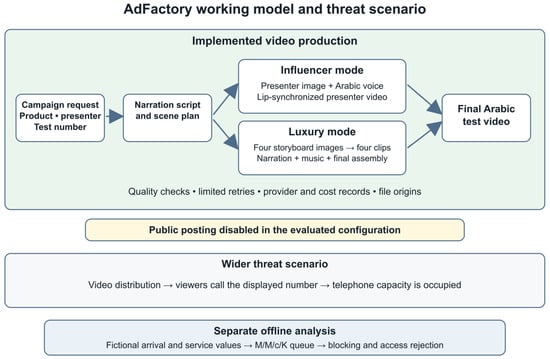
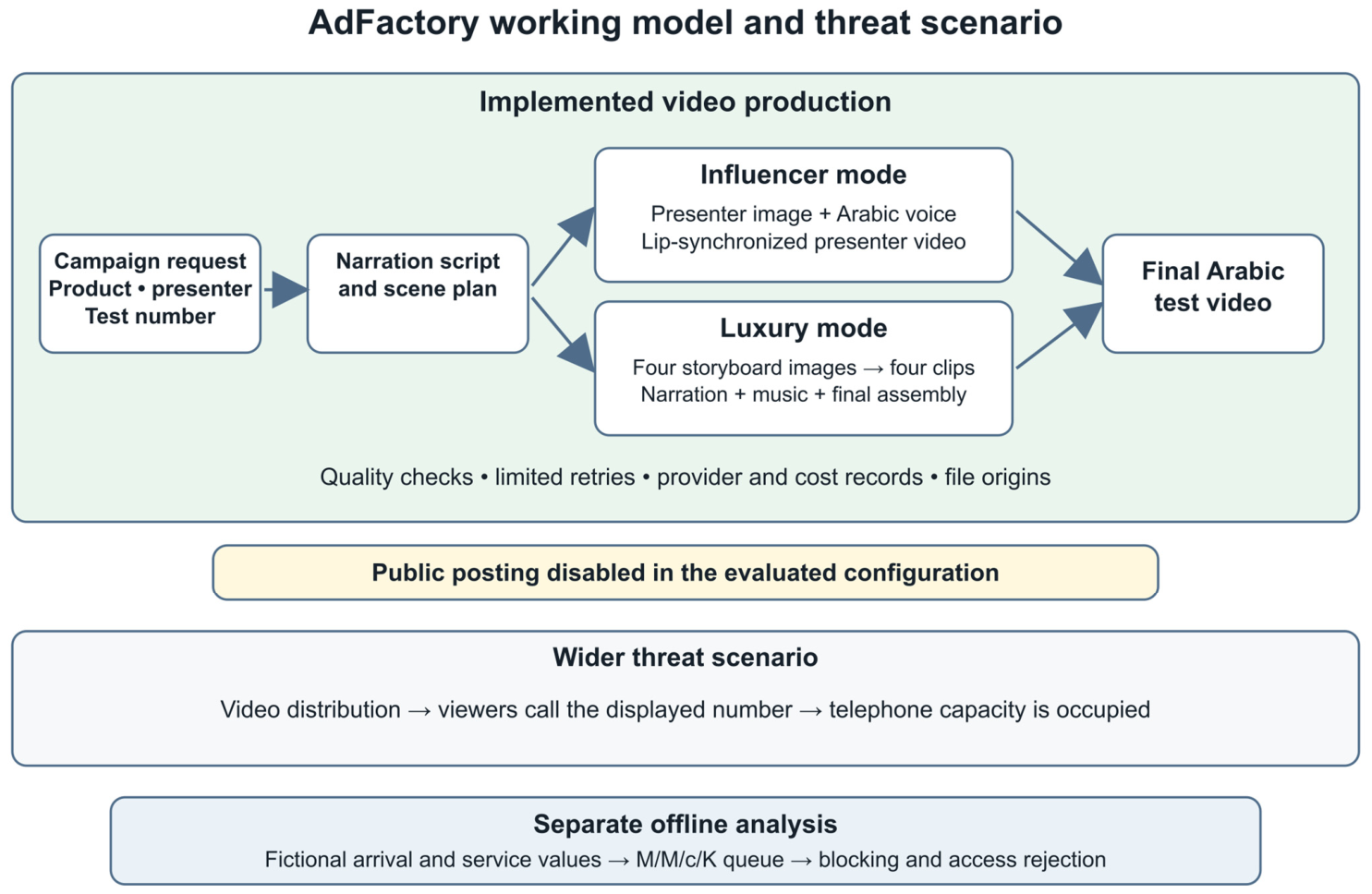
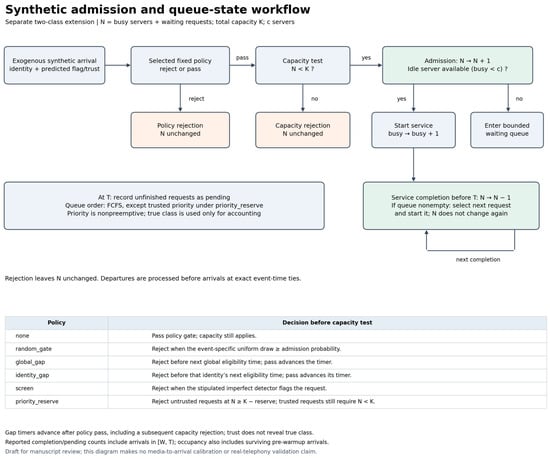
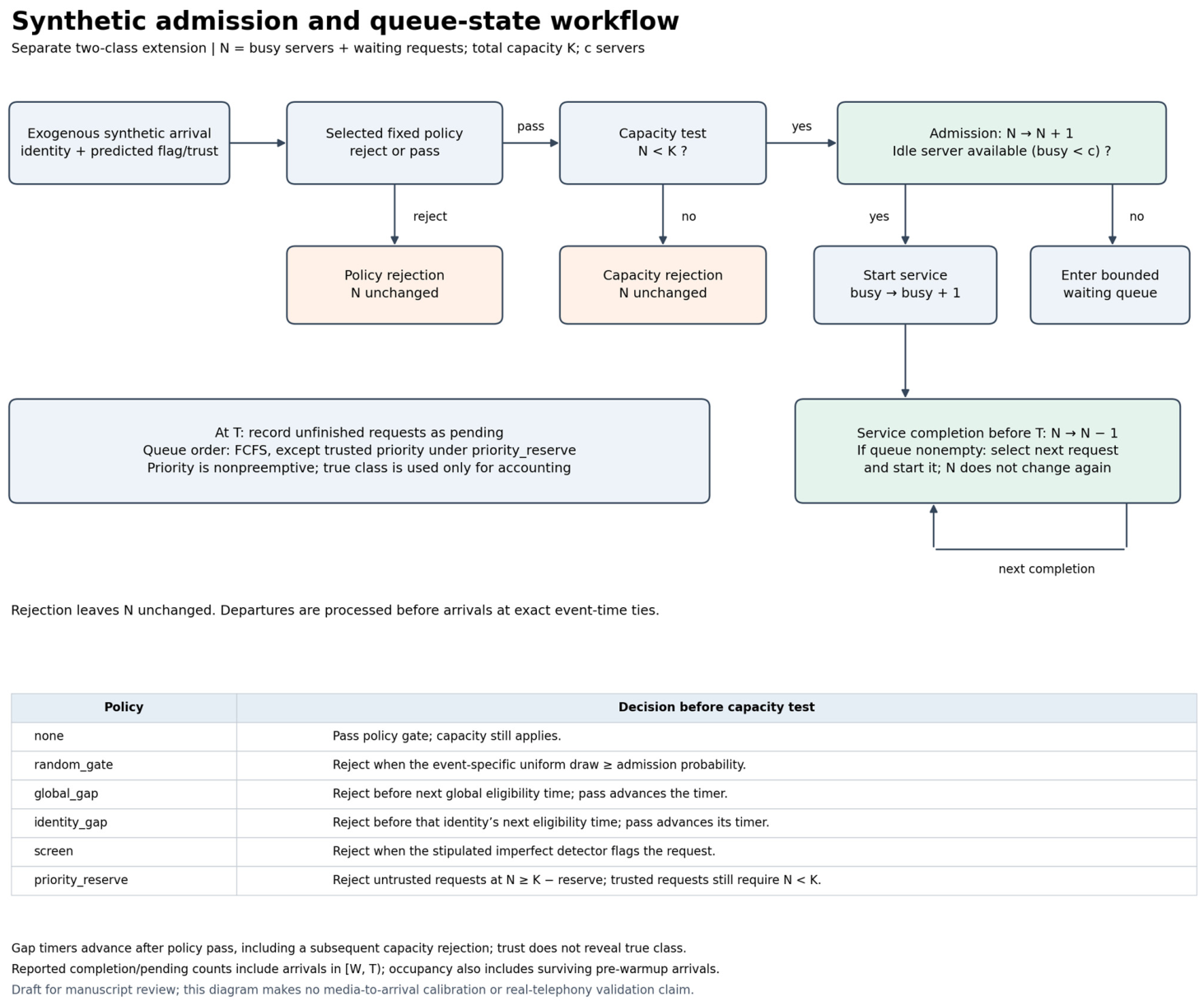
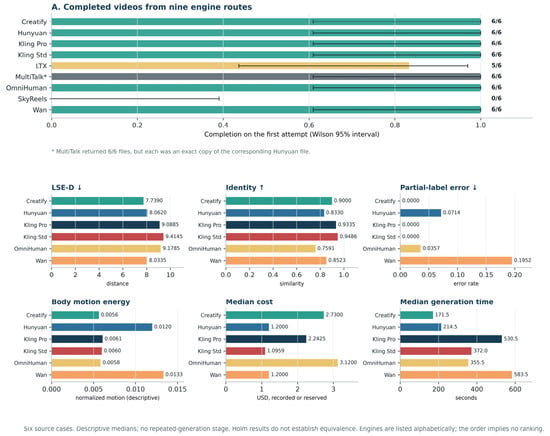
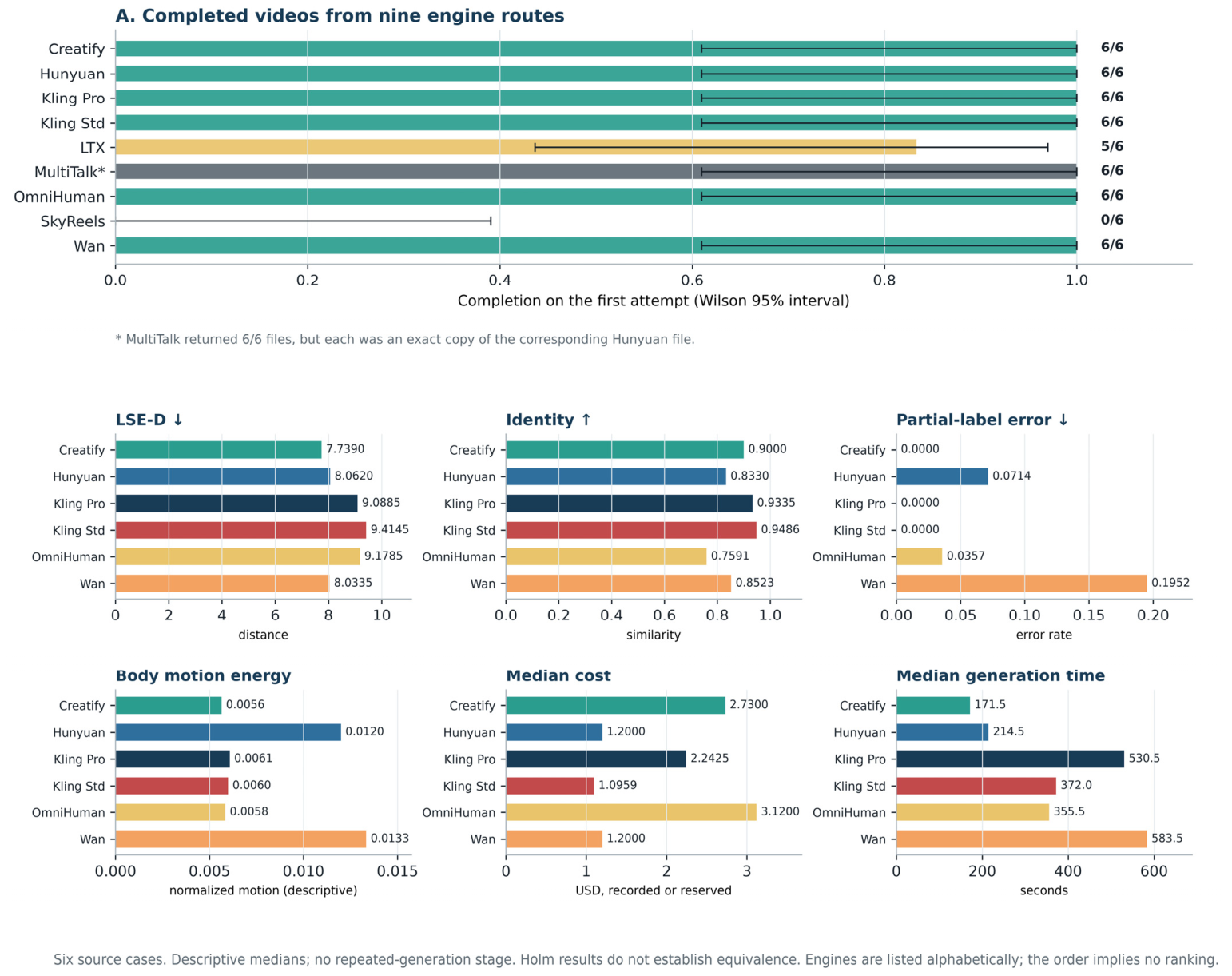
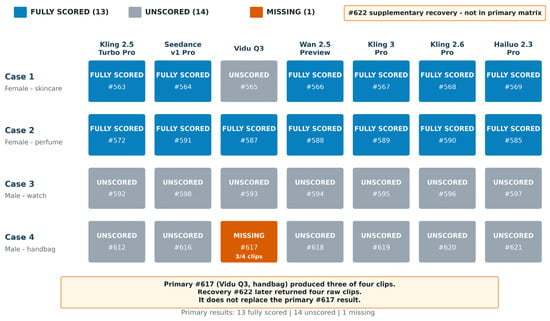
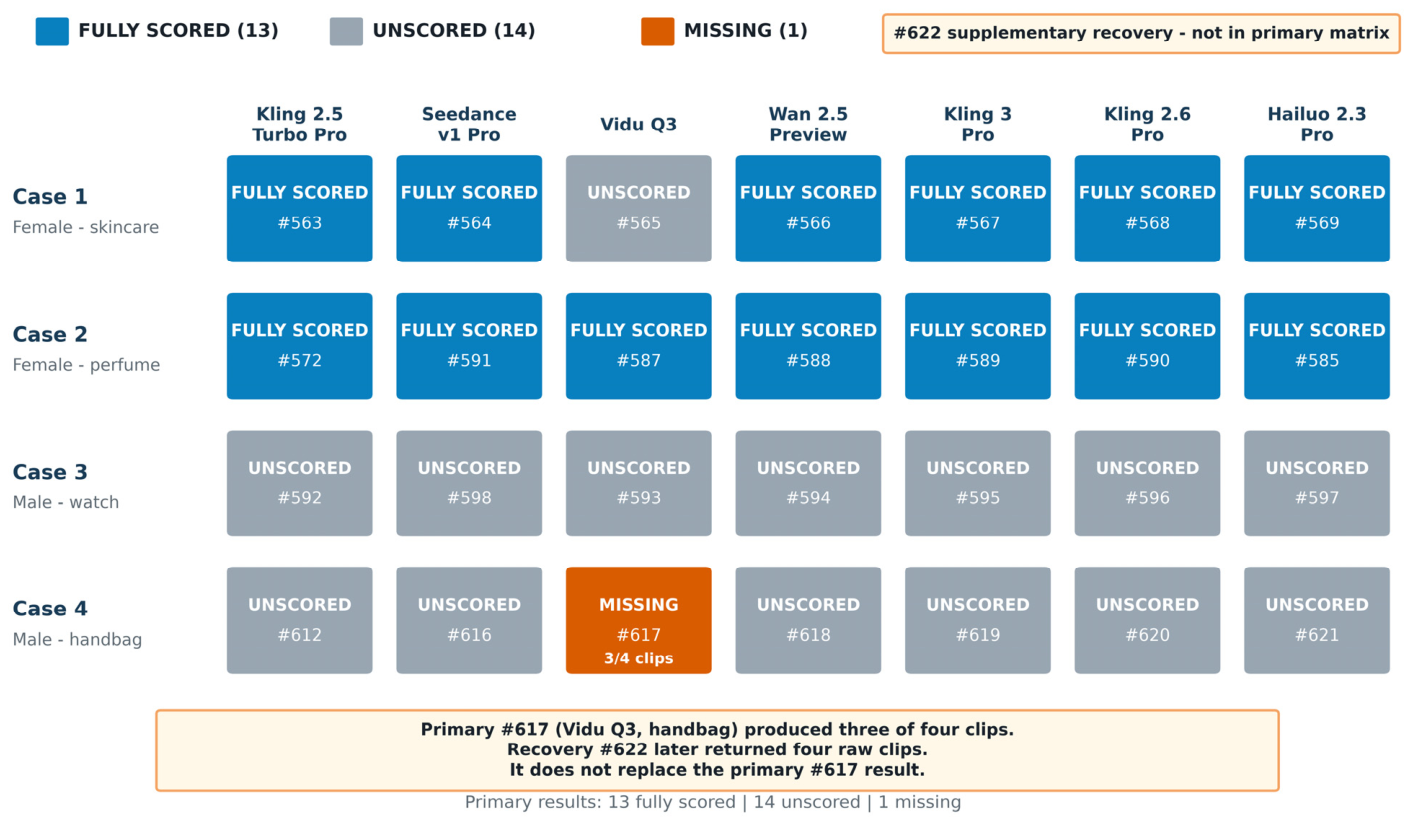
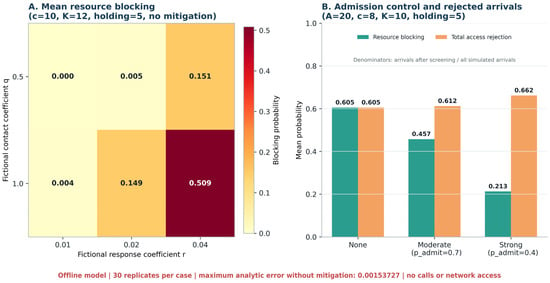
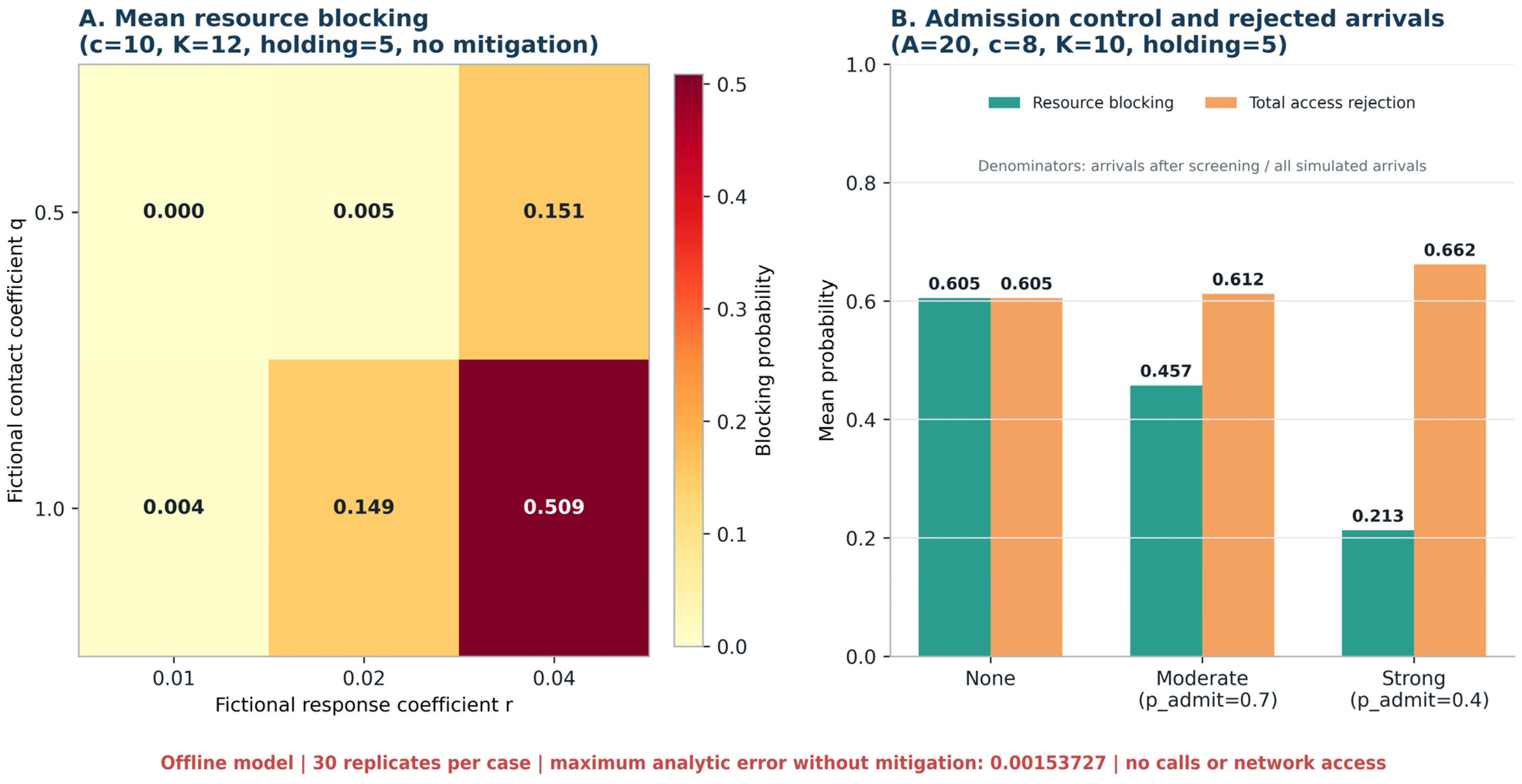

Disclaimer/Publisher’s Note: The statements, opinions and data contained in all publications are solely those of the individual author(s) and contributor(s) and not of MDPI and/or the editor(s). MDPI and/or the editor(s) disclaim responsibility for any injury to people or property resulting from any ideas, methods, instructions or products referred to in the content. |
© 2026 by the authors. Licensee MDPI, Basel, Switzerland. This article is an open access article distributed under the terms and conditions of the Creative Commons Attribution (CC BY) license.