


Abstract
This work presents a Fourier-domain encryption scheme for multiplexed image databases that integrates virtual-optical multiplexing with chaotic diffusion. By combining chaotic encryption with spectral-domain symmetry reduction, the proposed approach secures large multiplexed image datasets while reducing memory requirements and preserving reconstruction fidelity. A dataset of 2025 grayscale images ( pixels) is multiplexed and encrypted using linear chaotic transformations applied separately to the amplitude (A) and phase () components. To improve storage efficiency, the symmetry conditions of both spectral components are exploited, allowing a reduced portion of the Fourier plane to be stored while preserving accurate reconstruction. A performance landscape relating the correlation coefficient (CC), memory consumption, and the retained Fourier-plane percentage (FPP) is constructed to identify stable operating regions that balance reconstruction fidelity and compression under increasing multiplexing load. The encryption key consists of a 22-symbol ASCII string from which 84 seed parameters for a deterministic pseudorandom chaotic map are derived. Security and sensitivity analyses demonstrate strong key dependence and resistance to statistical attacks, while maintaining high reconstruction fidelity. The proposed scheme provides an efficient and scalable solution for secure large-scale image repositories.
1. Introduction
In an increasingly digital world, the secure transmission and storage of sensitive image data present significant technical challenges, including confidentiality, scalable repository management, computational efficiency, and controlled storage requirements, among others. These challenges are particularly critical in applications such as facial recognition systems [1,2,3], deepfake detection [4], cross-spectral face analysis [5,6], and clinical facial assessment [7]. Furthermore, such image repositories provide the training data necessary for artificial intelligence applications in face generation and recognition [8,9,10,11]. These databases also enable advancements in biomedical imaging [10,12,13], address legal security concerns [14,15], and support large-scale deep learning datasets [16], where massive image repositories must be securely processed and exchanged.
Due to their strong spatial redundancy, high dimensionality, and significant inter-pixel correlation, images require encryption and storage strategies that preserve structural fidelity while remaining memory efficient, particularly when multiple images are jointly handled. In this context, the joint requirement of secure multiplexing and memory-efficient storage becomes a critical yet still insufficiently addressed challenge. Image encryption therefore evolves from a standalone security task into a multi-constraint design problem involving cryptographic robustness, storage scalability, spectral bandwidth management, and stable reconstruction in multiplexed environments. The simultaneous demand for secure image protection, scalable multiplexing, and memory-efficient storage calls for approaches that go beyond encryption alone, particularly when reconstruction stability and storage reduction must be jointly ensured.
Different spatial-domain and transform-domain formulations have been proposed to address secure image multiplexing and encryption. Among them, spectral-domain approaches are particularly suitable when explicit control over frequency content and multiplexed structure is required, and include Fourier [17,18], Fresnel [19], Gyrator [12,20], discrete wavelet [21,22], discrete cosine transform [23,24], and Fibonacci Q-transforms [25].
Recently, methodologies have been proposed that combine double random phase encoding (DRPE) with compressive sensing to achieve simultaneous data authentication and compression, as well as techniques based on the discrete trinion Fourier transform for holistic processing of color channels [18]. The robustness of these cryptosystems has been enhanced through the use of nonlinear algorithms, such as the Quasinormal-Zernike algorithm in the Fresnel domain [26], QR decomposition applied to the gyrator wavelet transform [27], and the use of discrete cosine transform (DCT) coefficients in conjunction with random vortex networks [28]. In addition, several recent schemes rely on the dynamic complexity of nonlinear systems, including fast color encryption algorithms [29] and new three-dimensional chaotic maps with controllable Lyapunov exponents [30], robust sine–cosine chaotic maps combined with advanced bit-plane decomposition frameworks [31], and newly validated hardware structures combining memristive Tabu learning neural networks with chaotic mechanisms have been explored to secure high-throughput data pipelines in multi-node scenarios [32]. These nonlinear configurations are essential to provide large nominal key spaces and resistance against brute-force and statistical attacks [17,33].
However, two practical aspects remain insufficiently standardized in the recent literature. First, several works report large nominal key spaces without clearly specifying the length and structure of the external user-defined key, while others require comparatively long user-defined keys, which may limit practical usability in real deployment scenarios [34]. In contrast, the present scheme explicitly defines a 22-symbol ASCII external key, from which the internal chaotic parameters are deterministically derived. Second, although some recent approaches operate in Fourier-related domains or perform spectral filtering, they do not always report the exact retained Fourier-plane percentage, the associated memory savings, or objective reconstruction-quality indicators after filtering [30,35]. This makes it difficult to assess the trade-off between encryption, compression, and reconstruction fidelity in multiplexed image repositories.
Despite these advances, approaches that jointly integrate memory reduction through multiplexing and stable reconstruction remain an open and relevant research direction. Within this framework, spectral allocation plays a central role in determining reconstruction performance and scalability, motivating its analysis within a structured characterization of multiplexed encryption systems. Accordingly, identifying an admissible spectral support becomes a system-level design problem that determines how scalability, storage efficiency, and reconstruction accuracy are jointly balanced through reconstruction conditioning. This motivates a systematic characterization of coupled spectral regimes to clarify the interplay between reconstruction fidelity and spectral allocation and to enable controlled trade-offs in multiplexed and encrypted image systems.
In application areas such as surveying, satellite remote sensing, geophysics, and certain biomedical imaging tasks, the volume of data generated by images such as orthomosaics, tomographic records, and other biomedical images is considerably large. This information is commonly stored and shared in high-resolution formats. However, in many professional scenarios, the full level of detail provided by high spatial resolution is not always required for the intended task. Instead, the relevant information is often associated with macroscopic structures, topographic boundaries, or general density patterns. Maintaining full high-definition standards in these contexts may therefore produce unnecessary storage costs, saturate transmission channels, and increase processing times. The proposed approach, based on encrypting and processing images using only a controlled percentage of the Fourier plane, directly addresses this need for optimization by reducing the stored data volume, enabling more efficient transmission, and preserving the useful structural information. Thus, the main objective is not only to protect image data cryptographically, but also to define a compact spectral representation that balances security, memory reduction, transmission efficiency, and reconstruction fidelity.
The present work analyzes reconstruction behavior as spectral bandwidth varies under different memory-saving and multiplexing conditions, providing a stability-aware perspective for spectral design in multiplexed encryption systems. The results reveal admissible stability regions in which structural fidelity is preserved, thereby recasting spectral support selection as a regime-identification problem rather than as a heuristic bandwidth-tuning procedure. Within this formulation, substantial memory reduction can be achieved while maintaining controlled reconstruction behavior, demonstrating that scalability and structural robustness can be jointly preserved under increasing multiplexing load.
The proposed framework integrates virtual-optical multiplexing with dual chaotic diffusion applied independently to amplitude and phase components in the Fourier domain. Chaotic masks are generated from a 22-symbol ASCII key and incorporated through linear chaotic transformations constructed under a non-singular determinant constraint, ensuring invertibility and numerical stability. The parameters of the chaotic system are selected according to dynamical-security considerations, including sensitivity to initial conditions and sustained chaotic behavior, as supported by phase-space and Lyapunov analyses. Statistical evaluation shows favorable performance across standard image-encryption metrics suggested in the literature [36,37], and applicable to our case, confirming strong diffusion capability and cryptographic robustness, while structural analysis demonstrates stable reconstruction behavior as dataset size increases. Under this formulation, Fourier-plane support is characterized through its induced reconstruction stability landscape, which enables stability-constrained spectral design under application-dependent fidelity requirements.
2. Fourier-Domain Multiplexing
2.1. Proposed Fourier-Domain Framework
This section presents the general architecture of the proposed framework for large-scale image multiplexing and chaotic encryption in the Fourier domain. The model integrates controlled spectral packing, phase–amplitude symmetry constraints, and chaotic modulation into a unified processing pipeline. Given a set of N input images , each image is transformed into the frequency domain. The spectral representations are spatially arranged within a constrained Fourier plane according to the controlled spectral packing factor , which regulates bandwidth occupation.
To ensure physically consistent reconstruction and avoid spectral artifacts, symmetry criteria are explicitly enforced for both amplitude and phase components. Conjugate symmetry is preserved in the packed spectrum, guaranteeing real-valued spatial-domain recovery after inverse transformation while maintaining structural coherence under high-density multiplexing. The multiplexed spectrum is subsequently modulated using a deterministic chaotic mask generated from secret-key parameters. This encryption stage operates directly in the frequency domain without increasing the spectral support, preserving invertibility while enhancing key sensitivity.
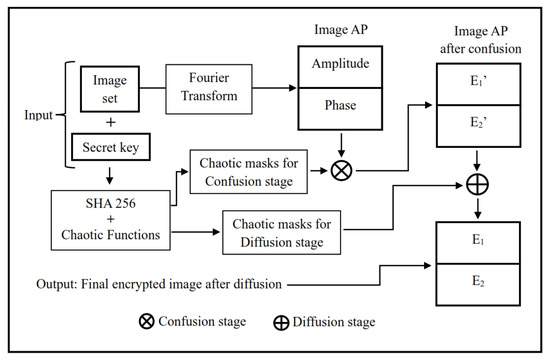
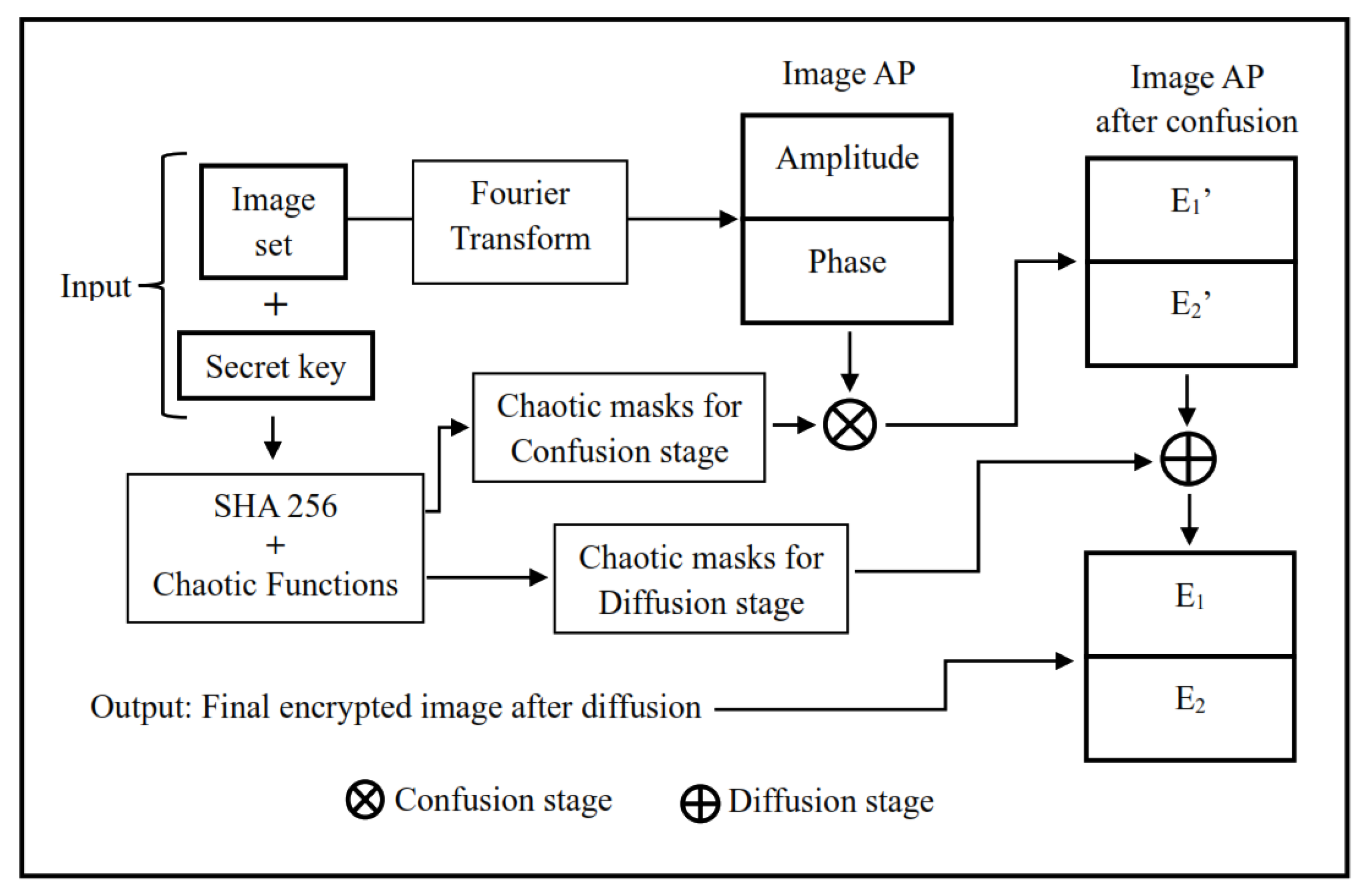
Authorized recovery consists of chaotic demodulation, symmetric spectral extraction, and inverse Fourier transformation. The framework is designed to minimize spectral occupancy while preserving structural fidelity and enabling high compression efficiency under strict reconstruction constraints. Figure 1 summarizes the complete processing pipeline of the proposed framework. The diagram highlights the transition from the plaintext image set to the final ciphertext package, including the Fourier-domain multiplexing stage, symmetry enforcement and spectral filtering, the SHA-256-based key derivation process, chaotic mask generation, and the two encryption layers of confusion and diffusion.
Figure 1.
Flowchart of the image encryption process.
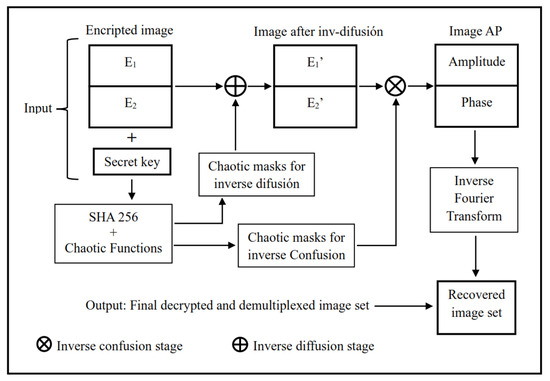
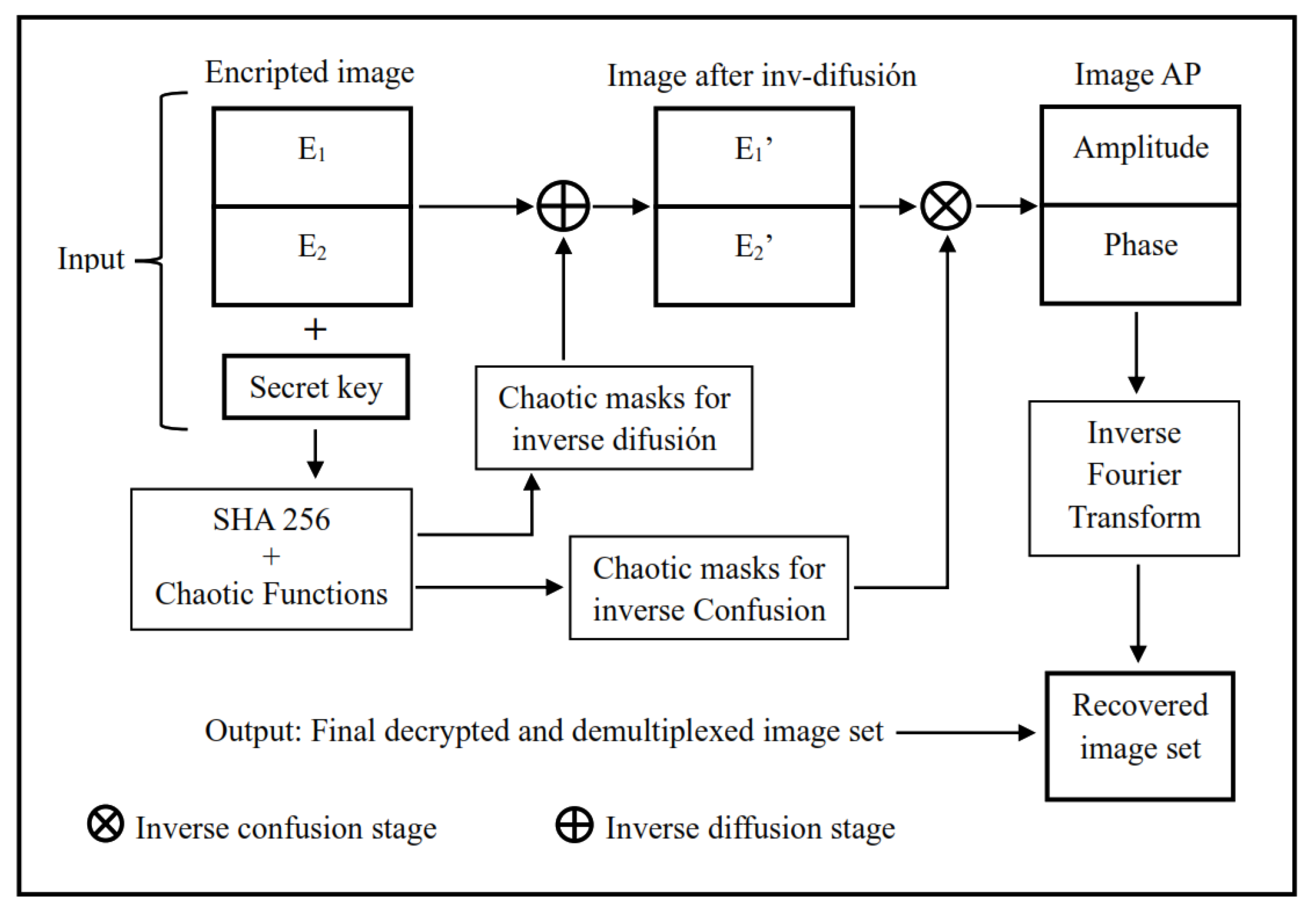
The inverse route for authorized recovery is also indicated, showing how the original images are reconstructed from the encrypted package through key derivation, chaotic mask generation, inverse confusion, inverse diffusion, and inverse Fourier-domain processing. Figure 2 summarizes the recovery procedure.
Figure 2.
Flowchart of the image decryption process.
2.2. Information Multiplexing Using the Virtual-Optical Method
The virtual-optical multiplexing process is implemented in the Fourier plane (FP) as a refined formulation of previously reported schemes [6,17]. The method consolidates multiple input images into a single complex spectral package, enabling structured frequency-domain manipulation prior to encryption.
Unlike earlier implementations requiring N independent Fourier transforms, the proposed scheme applies a single FT to a composite input plane containing all images. This choice is primarily motivated by computational efficiency and by the preservation of the spatial indexing needed for selective demultiplexing. Since the encrypted payload is generated from a global composite Fourier representation, the method processes a spectrally coupled packet rather than N mutually independent transforms.
The framework packages N grayscale images of side length l arranged in a regular grid within the composite input plane , where . The resulting input plane has dimensions , with . A single Fourier transform is then applied:
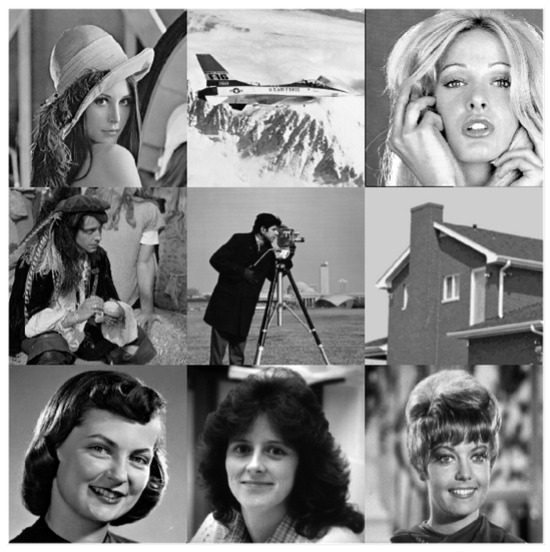
where A and denote the amplitude and phase components of the complex spectral package J. Figure 3 illustrates an example of an input plane containing nine images arranged in a grid prior to Fourier transformation.
Figure 3.
Input plane containing images, each of size pixels, arranged in a grid. Images were sourced from the USC-SIPI database [38].
2.3. Processing of Amplitude and Phase Components
The amplitude A and phase of the complex package J are processed separately in the Fourier plane (FP) due to their fundamentally different statistical and structural characteristics. The phase component exhibits intrinsic periodicity within the interval , allowing a direct 8-bit representation with negligible quantization impact. In contrast, the amplitude component presents a broad dynamic range and a non-uniform value distribution, requiring dedicated preprocessing prior to storage.
Owing to the conjugate symmetry property of the Fourier transform for real-valued inputs, the spectral components satisfy and , which enables the representation of only half of the Fourier plane during storage while retaining full reconstruction. Previous investigations [6] have characterized the saturation behavior of both components, providing the basis for the preprocessing strategies adopted here.
To address the dynamic range of the amplitude, a two-stage normalization process is implemented. First, the continuous amplitude values are discretized into q uniform quantization levels (UQL), where is selected for computational efficiency. This step maps the amplitude values onto the integer interval .
Subsequently, a logarithmic transformation is applied to compress the dynamic range:
The transformed amplitude is then linearly scaled to the standard 8-bit range for compatibility with conventional image storage formats.
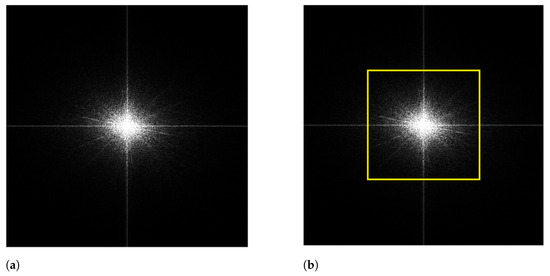
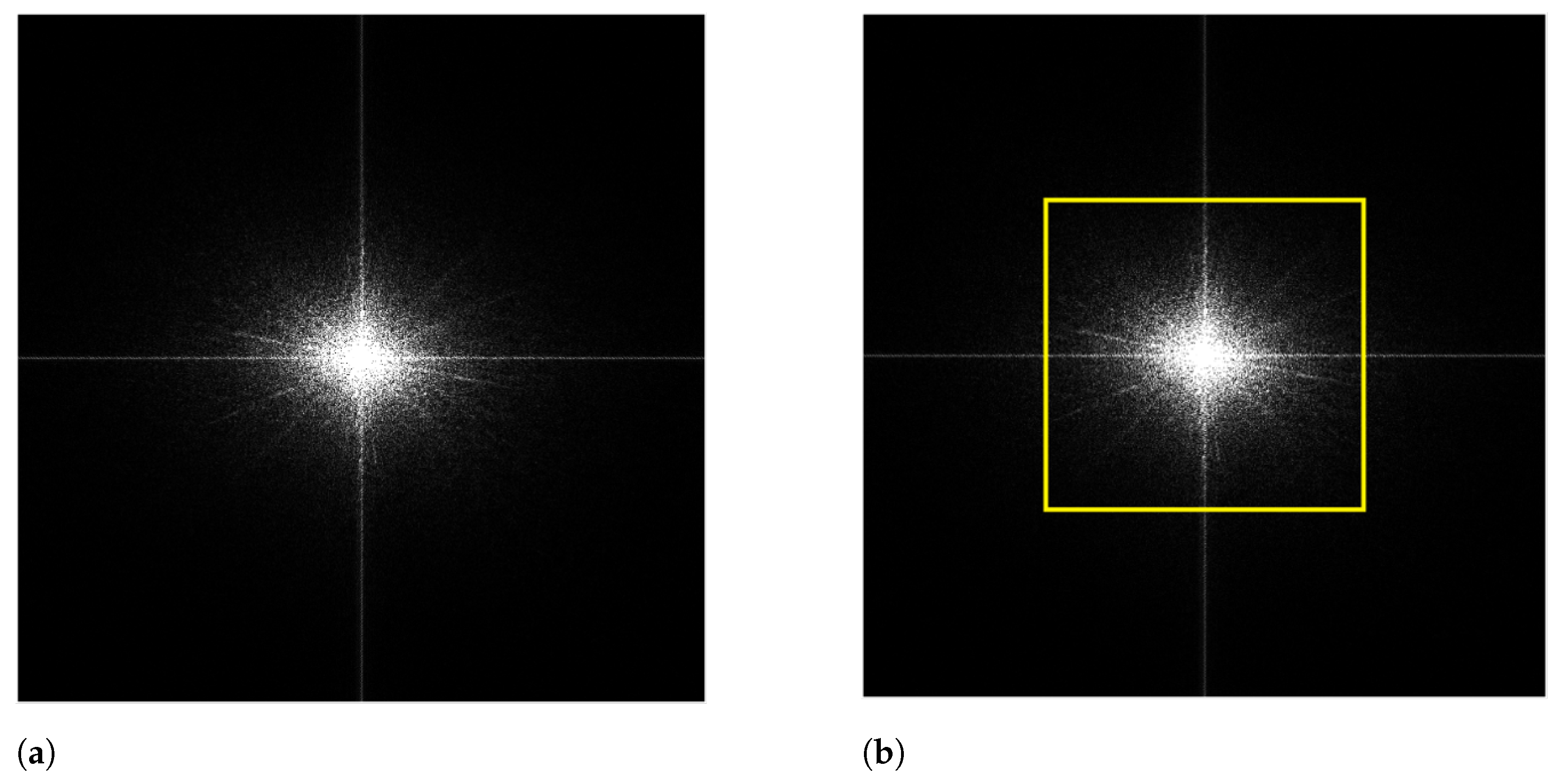
To further reduce storage requirements, the amplitude and phase components undergo frequency-domain filtering centered on the Fourier-plane origin. This process selectively retains central frequency components while discarding peripheral regions, decreasing the memory footprint with minimal impact on reconstruction quality. The filtered package is denoted as , with the retained spectral percentage determined through an iterative evaluation guided by a structural fidelity criterion, which defines the central region used in the subsequent analysis. Figure 4 illustrates (a) the full-width multiplexed amplitude and (b) the selected central region corresponding to 17.64% of the Fourier plane.
Figure 4.
(a) Full-width multiplexed amplitude. (b) Central 17.64% region selected for frequency-domain filtering.
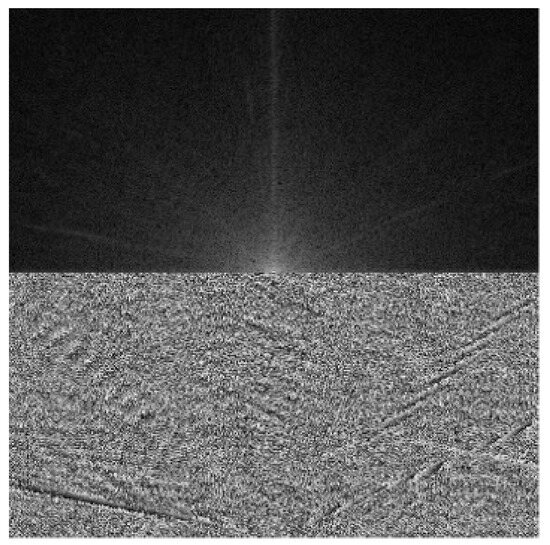
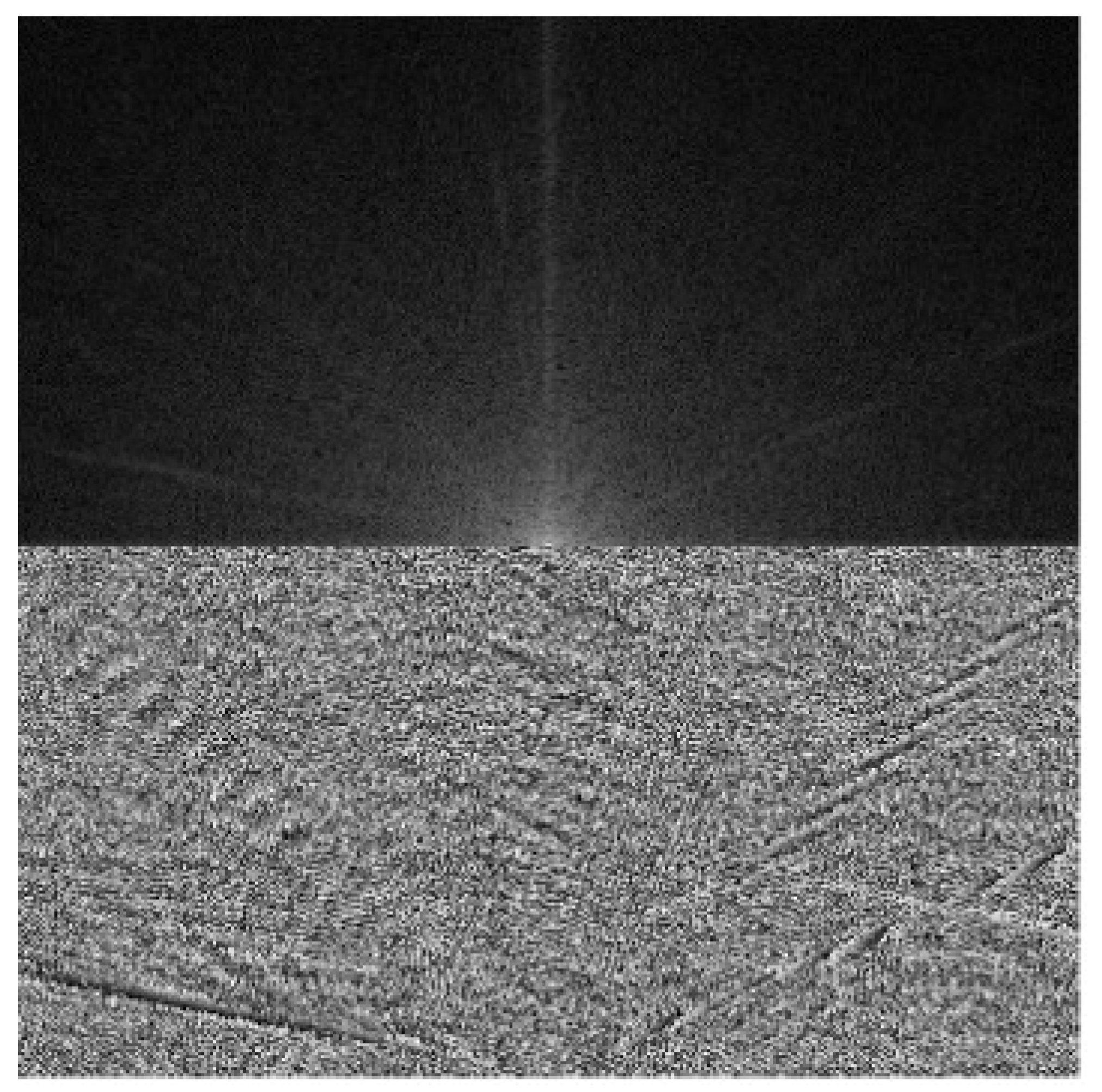
To further reduce the representation, the inherent conjugate symmetry of the Fourier transform is exploited to store only the upper half of the processed and filtered amplitude and phase components in a standard image format, consistent with the retained spectral region. For the illustrative case , each filtered component, namely the amplitude A and phase , has dimensions pixels. The final package M, shown in Figure 5, is formed by vertically concatenating the reduced amplitude and phase components, resulting in an image of dimensions pixels, called AP image.
Figure 5.
Multiplexed packet M stored as a standard image using 17.64% of the Fourier plane (AP image). The resulting -pixel package contains nine grayscale images, each of size pixels.
2.4. Image Demultiplexing
The demultiplexing process extracts the original images from the multiplexed package M by reversing the multiplexing operations. The first step consists of restoring the complete Fourier plane by embedding the filtered package M within a zero-valued frame of dimensions (for the illustrative case , pixels), thereby reconstructing the original working plane.
Once the complete Fourier plane is recovered, the previously applied preprocessing transformations are inverted in reverse order. First, the linear scaling is inverted using the stored normalization parameters. Then, the logarithmic transformation is inverted through the exponential operation:
The restored spectral package then undergoes an inverse Fourier transform:
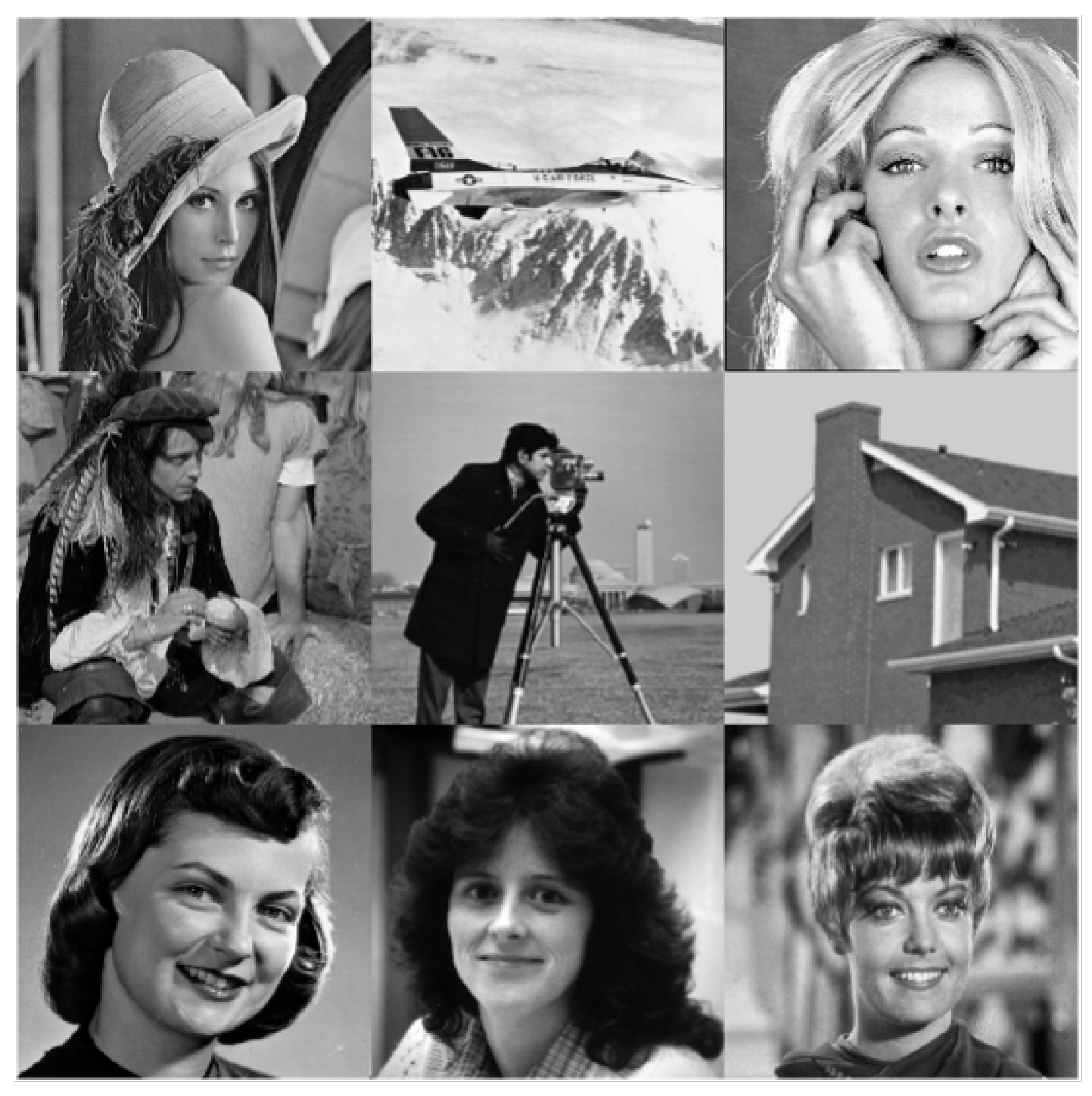
where the resulting spatial-domain plane contains the multiplexed images, which are subsequently extracted according to the original grid configuration, as illustrated in Figure 6. A detailed algorithmic description is provided in Appendix A.
Figure 6.
Images recovered from the multiplexed package after demultiplexing.
3. Encryption of Image Packets in the Fourier Plane
To encrypt the images contained in the package M—the composite image comprising N original grayscale images—we implement two complementary cryptographic procedures: confusion and diffusion. Both stages utilize chaotic sequences derived from a cryptographic key, with parameters defined to maintain the invertibility of the overall transformation. First, the confusion stage is implemented through algebraic operations involving chaotic parameters, modifying the relationship between the original images and their encrypted representation, and operating on the separated amplitude and phase components in the Fourier domain. Second, the diffusion stage is applied via two modular sums in orthogonal scanning paths, namely rightward/downward and leftward/upward, propagating pixel alterations across the complete image matrix and processing the complete encrypted package in the spatial domain.
3.1. Chaotic Encryption Scheme
3.1.1. Chaotic Functions for Encryption
Chaotic systems are deterministic nonlinear dynamical systems characterized by extreme sensitivity to initial conditions and parameters. These properties make them suitable for cryptographic applications, as they generate pseudorandom sequences that appear stochastic while remaining fully reproducible given the correct parameters. Both the confusion and diffusion stages utilize chaotic masks of pseudorandom numbers derived from a two-dimensional chaotic system given by the iterative equations:
where are the state variables at iteration n, is a nonlinear coupling parameter, and is a rotation angle. This map is structurally related to coupled nonlinear oscillator systems studied in chaotic dynamics. A detailed dynamical analysis of (5) is reported in [39]. In particular, within the working parameter region used for encryption in this study, for example and , the map exhibits sustained chaotic behavior characterized by a positive and stable largest Lyapunov exponent, for example , which supports strong key sensitivity through the exponential separation of nearby trajectories. Moreover, the sum of the Lyapunov exponents is reported to be close to zero, consistent with approximately area-preserving dynamics and the absence of dissipative attractors in the explored regimes.
Furthermore, the parameter-space analysis presented in [39], aimed at guaranteeing a vast and sensitive key space, reveals extensive regions of robust chaos, meaning that small variations in the parameters k and —which are themselves derived from the cryptographic key—produce statistically independent and highly uncorrelated chaotic sequences.
3.1.2. Key Generation and Chaotic Mask Construction
The proposed encryption scheme employs a key introduction and derivation procedure, denoted as IntroKeyV03, whose purpose is to transform the user-provided secret into reproducible and well-dispersed key material suitable for parameterizing the chaotic systems involved in the encryption process. The external key consists of 22 ASCII symbols, composed of a 10-symbol password and two independent 6-symbol salts. These elements are jointly processed through a SHA-256-based derivation procedure to reduce structural biases in human-chosen secrets and to mitigate precomputation and key-reuse attacks.
The IntroKeyV03 procedure is based on the cryptographic hash function SHA-256, standardized by the National Institute of Standards and Technology (NIST) within the Secure Hash Standard. SHA-256 maps an input of arbitrary length to a fixed-length digest of 256 bits (32 bytes) and exhibits a strong avalanche effect, whereby small changes in the input result in outputs that are effectively uncorrelated.
In practice, the 22 input symbols are first encoded and concatenated into a single byte sequence, which is then processed through iterative chained applications of SHA-256. The procedure yields a deterministic pseudorandom byte stream (84 bytes in the configuration reported in this work), from which the numerical parameters required by the chaotic maps and the discrete control variables of the encryption algorithm are extracted. The procedure expands and decorrelates the derived key material, and distributes the available entropy of the user-provided secret into a stable and reproducible internal representation suitable for cryptographic use.
3.1.3. Cryptographic Hash Function
Rather than relying on a single evaluation of SHA-256, the proposed scheme applies the hash function iteratively in a chained manner. Starting from an initial digest , subsequent values are generated as . Each iteration produces 32 new bytes, and concatenating successive digests yields a pseudorandom byte stream of arbitrary length. Acting as a cryptographic expander, the iterative construction propagates and disperses the original input entropy in a cryptographically strong manner while eliminating simple patterns and correlations in the derived data.
The iteration continues until a total of 84 bytes is accumulated. These bytes are subsequently transformed into decimal digits by applying a byte-wise modulo operation. Specifically, each byte b is mapped to a digit as follows: , resulting in values in the set . The final output is therefore a deterministic decimal string of length 84, which facilitates reproducible partitioning into numerical parameters for initializing the chaotic systems and for generating the chaotic masks employed in both the algebraic confusion stage and the modular-sum diffusion stage of the encryption algorithm.
3.1.4. Key Space and Key Derivation Security
The security of the proposed encryption scheme relies on both the nominal size of the external key space and the robustness of the key derivation mechanism that maps the 22-symbol user-provided key into the internal parameters governing the chaotic processes. As described above, the external key combines a password with two independent salts, allowing the scheme to preserve practical usability while reducing vulnerability to precomputation and key-reuse attacks.
Assuming a conservative model in which each symbol is represented as an 8-bit value, the theoretical key space size is , which corresponds to a key complexity of
that is, approximately possible combinations. The resulting upper bound exceeds the security level commonly associated with AES-128 and lies between the 128-bit and 192-bit security levels adopted as reference points in modern symmetric cryptography. It should be emphasized that this figure represents a theoretical bound; the effective security ultimately depends on the entropy with which users select the input symbols.
A critical aspect of the proposed scheme is that the human-generated key material is never used directly in the encryption process. Instead, the concatenation of the password and salts is processed through an iterative and chained SHA-256-based expansion mechanism. The expansion procedure removes any direct correspondence between the structural properties of the original password and the resulting chaotic parameters, ensuring that even minimal changes in a single symbol lead to completely uncorrelated internal keys. Partial key guesses or incremental attacks provide no advantage, as each hypothesis requires the full key derivation and encryption process.
The computational cost of each key attempt can be explicitly quantified. Each trial requires multiple evaluations of SHA-256 to generate the expanded key material, followed by the generation of chaotic masks and the execution of the confusion and diffusion stages. Even under optimistic assumptions involving highly optimized implementations and massive parallelism, exhaustive search over such a space remains computationally infeasible. Furthermore, the inclusion of independent salts invalidates rainbow-table attacks and prevents attackers from leveraging password reuse across different encryption instances.
The combination of a large theoretical key space, a standardized cryptographic hash function for key expansion, and a non-negligible computational cost per key attempt aligns with current cryptographic practices. Resistance to brute-force and offline attacks is further evaluated in the following cryptanalysis section through empirical tests on encrypted data.
3.1.5. Parameter Mapping from Derived Digits and Chaotic Mask Generation
Once the 84 digits are obtained from the SHA-256 expansion, they are used to parameterize the chaotic functions twice: first to obtain the confusion matrices and then to obtain the diffusion matrices. In each invocation, the digits are mapped to the parameters of the chaotic functions according to the following assignment:
Using the same mapping with digits 43–84, two additional chaotic masks are generated. Each mask contains values computed according to the expression
where denotes the total number of entries. When generating the first set of values corresponding to the confusion masks and , the algorithm is constrained to produce chaotic values in the interval .
The dimensionality is fixed: the sizes of and are chosen to exactly match the dimensions of the amplitude A and the phase of the wave packet. In the particular example reported in this work, the amplitude and phase matrices have dimensions , and therefore the same dimensions are imposed on and . When the chaotic functions are invoked for the second time, chaotic arrays and are generated in the interval . The dimensions of these arrays are chosen to exactly match those of the multiplexed package M, which is scaled to this interval prior to the diffusion stage.
In the example considered in this work, the multiplexed package has dimensions , and therefore the same size is imposed on and .
The complete process of chaotic mask generation is summarized in Algorithm A2.
3.2. Confusion Stage
The encryption step corresponds to the confusion stage, which operates directly on the spectral components. The two sets of chaotic numbers are reshaped into arrays and , which act as confusion chaotic masks (CMs) having the same dimensions as the amplitude A and phase images, namely pixels. These masks modulate a pixelwise chaotic linear transformation (CLT) that couples the amplitude and phase components as
where , , , and are constant coefficients selected to guarantee the reversibility of the transformation. At each pixel location, the local mixing matrix must be invertible, which requires its determinant
to be non-zero. This condition is satisfied when and . In this work, the parameters , , , and are adopted. Under this selection, the determinant remains strictly non-zero for all pixel locations (see Appendix A), ensuring exact invertibility while inducing strong amplitude–phase mixing.
Because the transformation modifies the dynamic ranges of and , the resulting matrices cannot be stored directly in standard image formats. To address this, an affine normalization is applied independently to each component,
where denotes a global linear transformation that rescales values to the standard interval . The corresponding extrema are stored to allow exact inversion during decryption (see Appendix B).
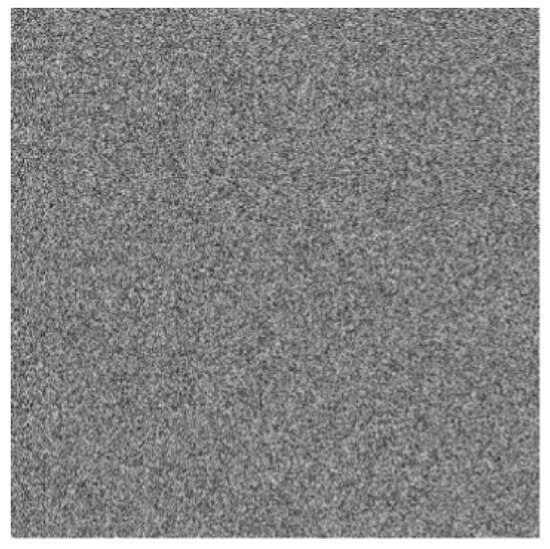
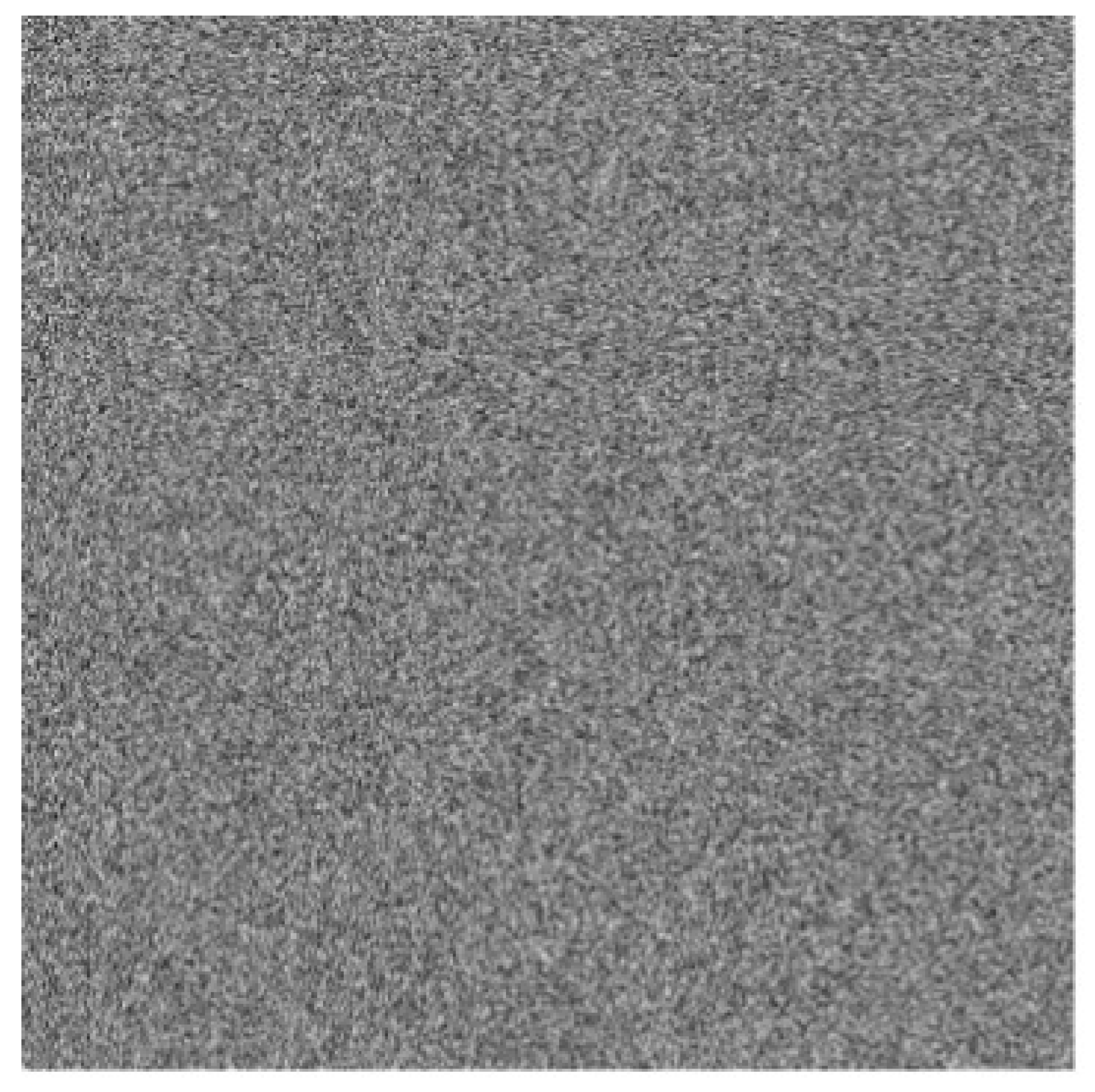
Finally, the normalized matrices and are concatenated vertically to form the confused image E, with overall dimensions pixels. An example of the resulting encrypted package is shown in Figure 7. The package is stored in PNG format at 8 bpp, occupies approximately 402 KB, and contains the encrypted representation of nine original images ( pixels each).
Figure 7.
Final encrypted package H after both the confusion and diffusion stages. The image results from applying strong forward and backward diffusion to the package E.
3.3. Diffusion Stage
When the chaotic function is invoked for the second time, two chaotic arrays, denoted and , are generated. These arrays serve as diffusion chaotic masks (DMs) and have the same dimensions as the confused package E, with values confined to the range . All pixel values of E are scaled to this interval to enable the diffusion operations. The normalized values in E are quantized to 8-bit integers using linear scaling to the interval prior to applying the modular diffusion operations.
Let denote the linearized version of the confused package E, and let and denote the corresponding linearized diffusion masks. For each position i, represents the input byte, and represent the chaotic mask values, and and denote the diffused outputs after the first and second passes, respectively.
The forward diffusion is defined by modular addition with chaining as
where . The chaining term ensures that each output element depends on all preceding elements, promoting strong forward diffusion.
A second diffusion pass is then applied in the reverse direction using the mask :
This backward chaining propagates perturbations in the reverse direction, reinforcing global diffusion. All operations are performed bytewise in the additive group , ensuring exact reversibility.
After completing both diffusion passes, the final encrypted image H is obtained by reshaping back to the original package dimensions . In our example, Figure 7 illustrates the encrypted package resulting from applying the diffusion stage to the confused package E.
3.4. Image Decryption Process
The decryption process reverses each encryption stage in the opposite order. The cryptographic key is used to reconstruct the chaotic masks, beginning with the diffusion masks and , which enable the reversal of the modular diffusion operations described in Section 3.3.
The encrypted amplitude and phase are recovered by inverting the chaotic linear transformation defined in Equation (8). The determinant of the system,
must satisfy for all pixels to guarantee invertibility. In this work, the parameters , , , and are selected to ensure a strictly non-zero determinant across the domain, thereby preserving invertibility while maintaining strong mixing between the amplitude and phase components. The closed-form expressions for the recovered components are given in Equations (A2) and (A3), and their derivation is provided in Appendix D.
Once the amplitude and phase are recovered, the Fourier plane is reconstructed using the symmetry property described in Section 2.3. The recovered components are embedded into a zero-valued background plane of size . Before reconstructing the complex package J, the logarithmic transformation in Equation (2) is inverted:
The complete complex package is then obtained as
Finally, the inverse Fourier transform (IFT) is applied to the reconstructed package J:
The N original images are extracted by partitioning the plane according to the original multiplexing grid. This completes the inversion of the proposed Fourier-domain encryption framework. A complete procedural summary of the decryption algorithm is provided in Appendix C.
3.5. Experimental Setup
Security-related experiments were conducted using grayscale images (8-bit) from the USC-SIPI database [38]. The images used in the efficiency experiments consist of synthetic human faces generated by GAN-based models. In particular, the images were obtained from the public website This Person Does Not Exist, which generates artificial human-face images using StyleGAN-based models [40,41,42]. The original RGB images, with a resolution of pixels, were converted to grayscale, resized to pixels, and stored as 8-bit PNG files. The final dataset contains more than 4000 images. Since the images are synthetic and do not correspond to real individuals, no direct biometric-identification or personal-privacy concerns associated with real subjects are involved.
The spectral packing factor was varied to evaluate its influence on reconstruction performance and memory efficiency. Reconstruction quality was assessed using CC, NMSE, PSNR, and SSIM, computed per image and averaged over each multiplexed set. Compression efficiency was quantified through the compression ratio (CR), defined as the ratio between the memory required to store N original images and the memory required by the multiplexed encrypted package. Decryption and demultiplexing times were recorded separately. All simulations were implemented in MATLAB R2023b on an Intel Core i7 workstation with 32 GB of RAM.
4. Results
The results presented below illustrate the trade-off between reconstruction quality and encrypted payload size achieved through Fourier-plane filtering. Increasing the filtering level reduces the data size while progressively degrading reconstruction fidelity. Different operating regimes can thus be identified, each corresponding to a particular balance between image quality, memory efficiency, and security, depending on the application requirements.
4.1. Optimization of the Virtual-Optical Multiplexing and Encryption Method
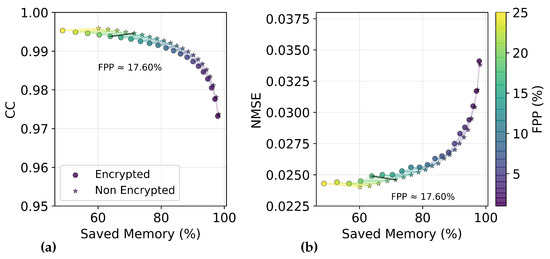
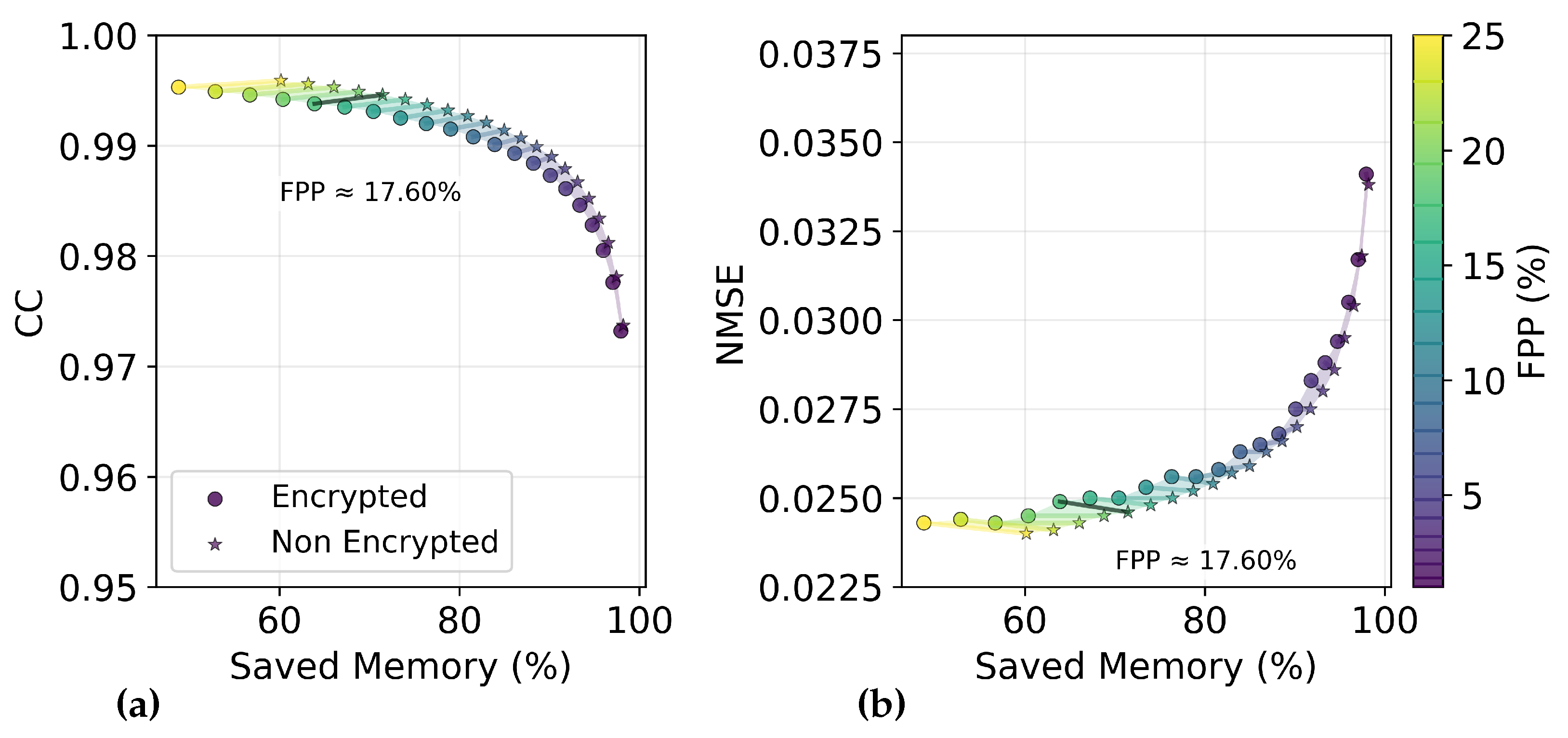
Figure 8 illustrates the behavior of both the correlation coefficient and the normalized mean square error (NMSE) as functions of memory savings for different retained fractions of the Fourier plane (FPP).
Figure 8.
(a) Correlation coefficient versus memory savings for different Fourier plane fractions (FPP), for encrypted and non-encrypted cases. (b) Corresponding NMSE behavior. The highlighted point marks the minimum bandwidth satisfying .
The encrypted and non-encrypted cases exhibit nearly identical trends in both metrics, indicating that the reconstruction behavior is primarily governed by the retained spectral information rather than by the encryption process. As the FPP decreases, memory savings increase monotonically. In the high-bandwidth region, remains close to unity while NMSE stays nearly constant, because the retained spectrum still contains the dominant low and intermediate frequency components, which encode the global structure and most of the image energy, indicating that both structural similarity and reconstruction energy are preserved. As the retained spectral bandwidth is further reduced, the slope of the curve increases and NMSE begins to rise more rapidly, revealing a transition toward a higher-sensitivity regime. This transition is associated with the progressive loss of intermediate-frequency components, which play a critical role in preserving structural information. Once these components are significantly affected, the reconstruction becomes increasingly sensitive to variations in FPP, so that small reductions in the retained spectral bandwidth lead to disproportionately large degradations in reconstruction quality.
The optimal operating point is defined as the minimum spectral bandwidth satisfying the fidelity constraint This value lies within an empirically observed structural stability regime, in which controlled truncation of the Fourier support results in only bounded and gradually varying changes in spatial-domain similarity metrics. From an energy perspective, this truncation reduces the total spectral energy available for reconstruction, which directly impacts the spatial-domain fidelity. As a result, the reconstructed image progressively departs from the original as fewer spectral components are retained. The choice of the fidelity threshold () is not unique, but rather defines an operational point within a broader trade-off between reconstruction quality and memory savings. Different application requirements may justify alternative thresholds, leading to different optimal values of along the same efficiency–fidelity curve.
At this point, the relative structural deviation remains below 0.5%, while NMSE is still confined to the low-error regime. The consistent behavior of and NMSE around indicates the onset of increased sensitivity to spectral truncation, confirming an efficient trade-off between memory reduction and reconstruction fidelity. Moreover, the close overlap between encrypted and non-encrypted curves demonstrates that chaotic encryption does not modify the underlying efficiency–fidelity landscape.
Structural Stability as a Function of Package Size
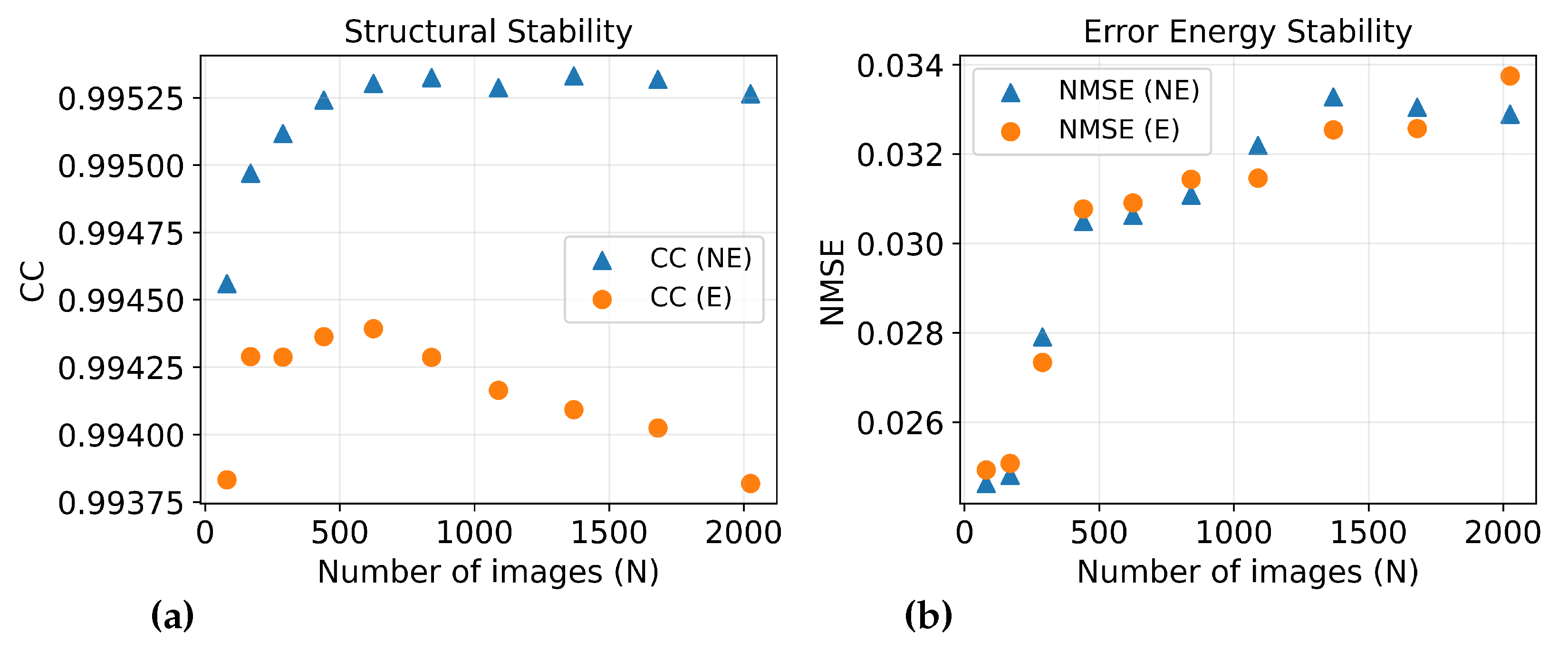
To evaluate the algorithm under increasing computational load, a systematic sweep of the package size was performed by progressively increasing the number of multiplexed images up to . For each configuration, a square mosaic of side was defined such that . The algorithm was executed ten times per configuration, and memory usage, processing time, and quality metrics were recorded for both non-encrypted and encrypted routes.
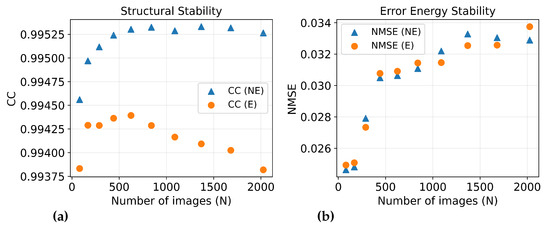
Figure 9 summarizes the structural and energy stability behavior. As N increases up to 2025, the correlation coefficient consistently remains above 0.994, very close to unity, while NMSE shows a smooth and bounded variation. Together, these metrics indicate that reconstruction fidelity is preserved across the explored multiplexing range, suggesting that the multiplexing process does not introduce additional structural degradation beyond that imposed by the underlying spectral representation and that scalability is primarily constrained by computational resources.
Figure 9.
Structural scalability with respect to the number of multiplexed images N. (a) Correlation coefficient . (b) Normalized mean square error (NMSE). Both metrics remain stable for encrypted (E) and non-encrypted (NE) configurations across the explored range up to .
4.2. Cryptanalysis and Security Evaluation
Cryptanalysis involves performing diverse security tests on encrypted information to assess its resistance against potential attacks. In this work, we employ multiple analysis techniques to evaluate the robustness of the proposed encryption scheme. These include sensitivity testing through key parameter variations, simulated brute-force attacks, statistical analysis, and the evaluation of resistance against standard cryptographic attacks, such as known-plaintext and differential attacks [36,37].
4.2.1. Sensitivity Analysis
A fundamental cryptographic requirement is sensitivity to key variations, where minimal alterations should produce dramatically different encrypted outputs. We conducted sensitivity tests by introducing perturbations to individual key parameters while keeping the remaining parameters constant. Table 1 summarizes the correlation coefficients between correctly and incorrectly decrypted images.
Table 1.
Key sensitivity analysis: correlation coefficients with perturbed parameters
The near-zero correlation coefficients and NPCR values approaching 99.61% confirm the extreme sensitivity to initial conditions, which is characteristic of chaos-based encryption schemes.
4.2.2. Brute-Force Attack Resistance
The theoretical key space of the proposed scheme, derived from 22 symbols with 8-bit encoding, is . To quantify practical resistance, we simulated brute-force attacks by generating random keys and attempting decryption. The success rate was precisely zero, with no keys producing recognizable images (). The computational time required for a single decryption attempt averaged 1.23 s, making exhaustive search computationally infeasible. Even under an optimistic hypothetical rate of keys per second, exhausting the key space would require approximately years.
4.2.3. Statistical Analysis of Encrypted Images
A properly encrypted image should exhibit statistical properties indistinguishable from random noise. We evaluate this through three quantitative measures: information entropy, histogram uniformity, and adjacent-pixel correlation.
- Information Entropy: The Shannon entropy H for an 8-bit image is calculated as where is the probability of intensity level i. Since the logarithm is taken in base 2, the entropy is expressed in bits. In the context of 8-bit grayscale images, this corresponds to bits per pixel, with a theoretical maximum of 8 bits/pixel. For the encrypted package containing 9 images (Figure 7), we obtained bits/pixel, approaching the theoretical maximum of 8 bits/pixel. For larger packages, for example images, H approaches the theoretical maximum of 8 bits/pixel, indicating near-optimal randomness.
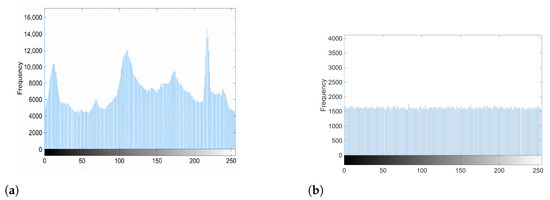
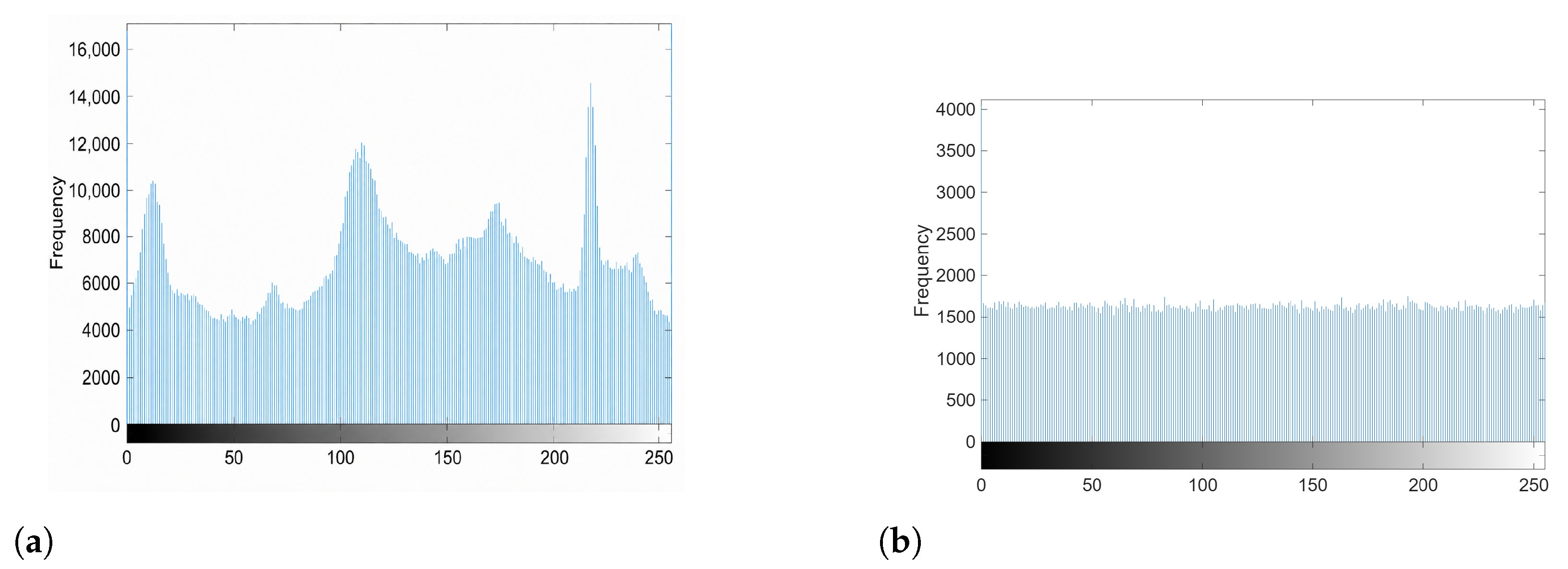
- Histogram Analysis: Figure 10 compares the histograms of the original and encrypted packages. The original multiplexed package (Figure 10a) exhibits a non-uniform distribution characteristic of natural images, while the encrypted package (Figure 10b) shows a near-uniform distribution across all intensity levels. Quantitative analysis yields (critical value = 293.2 at with 255 degrees of freedom), confirming statistical uniformity.Figure 10. Histogram comparison: (a) Original multiplexed package showing natural image statistics; (b) encrypted package exhibiting a near-uniform distribution across intensity levels.
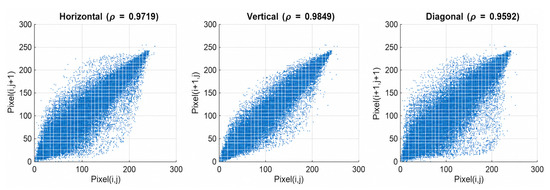
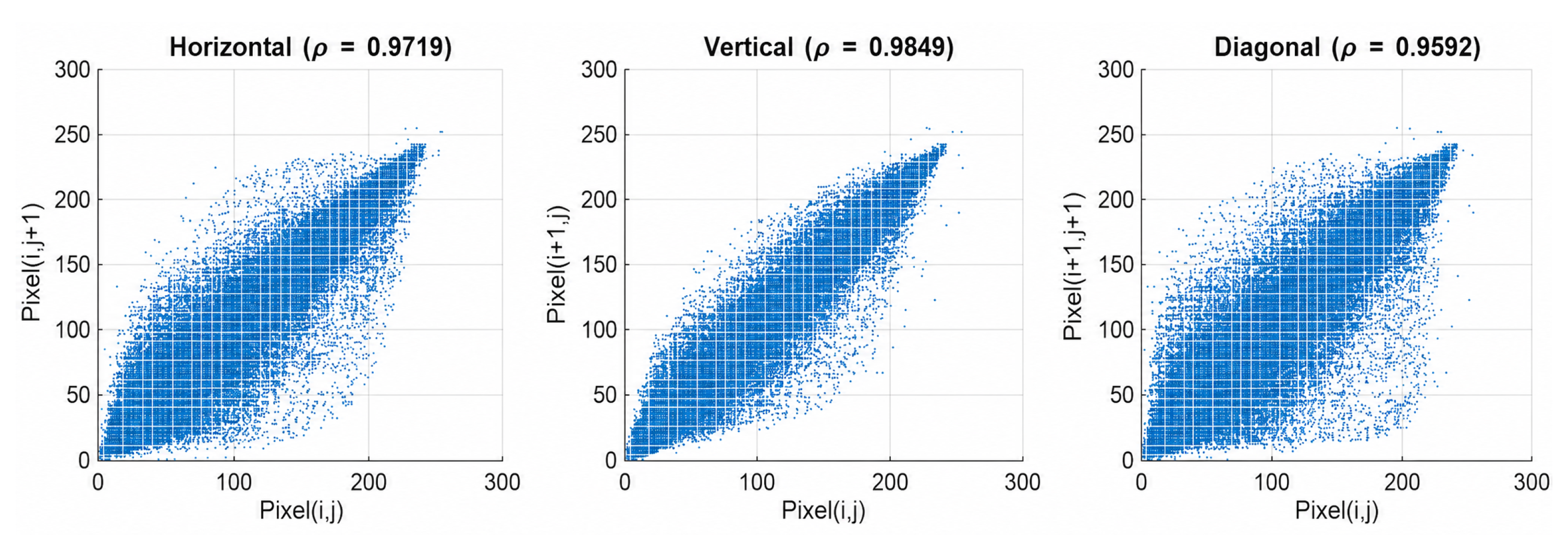
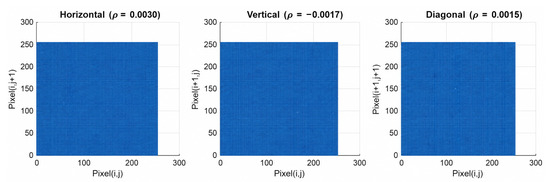
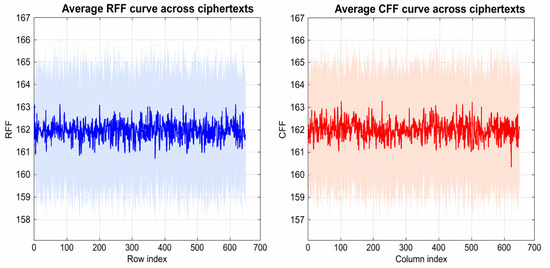
- Adjacent-Pixel Correlation: Natural images exhibit strong correlations between adjacent pixels, which encryption should eliminate. We compute correlation coefficients in the horizontal, vertical, and diagonal directions:Figure 11 shows the adjacent-pixel correlation of the original images in the horizontal, vertical, and diagonal directions. The high correlation coefficients indicate the strong linear dependence between neighboring pixels, as expected in natural images. Figure 12 shows the adjacent-pixel correlation of the encrypted package in the horizontal, vertical, and diagonal directions. In contrast with the original images, the correlation coefficients are close to zero, indicating that the encryption process effectively removes the statistical dependence between adjacent pixels.Figure 11. Adjacent-pixel correlation analysis for original images in the horizontal, vertical, and diagonal directions, with correlation coefficients , , and , respectively. The strong linear relationships are characteristic of natural images.Figure 12. Adjacent-pixel correlation analysis for the encrypted package in the horizontal, vertical, and diagonal directions, with correlation coefficients , , and , respectively. Near-random distributions confirm effective encryption.
4.2.4. Resistance to Known-Plaintext and Chosen-Plaintext Attacks
To assess the cryptographic robustness of the proposed scheme, a dedicated experimental framework was designed to evaluate its resistance to Known-Plaintext Attacks (KPAs) and Chosen-Plaintext Attacks (CPAs). The analysis focuses exclusively on the critical strong diffusion stage, namely the transformation , where E denotes the previously confused and quantized data package with values in , and represents the final encrypted output obtained after the forward and backward strong diffusion processes.
These experiments do not aim to recover the secret key; instead, they evaluate the statistical behavior of the cipher under KPA and CPA scenarios. This approach follows standard practice in the image encryption literature, where resistance is assessed through sensitivity, randomness, and decorrelation metrics rather than through explicit key extraction attempts.
CPA Results: Table 2 summarizes the results obtained for the selected chosen-plaintext scenarios. For the CPA experiments, a set of carefully selected plaintext images with highly predictable structures was employed, including a constant image (All_255), horizontal and vertical gradients, a checkerboard pattern, a single-active-pixel image, and a random plaintext image. Each plaintext was encrypted using the same secret key, generated through the IntroKeyV03 module (10-symbol password and two independent 6-symbol salts). Security performance was evaluated using the Number of Pixel Change Rate (NPCR), the Unified Average Changing Intensity (UACI), the Shannon entropy of the ciphertext, and the correlation between plaintext and ciphertext.
Table 2.
CPA results for selected plaintext patterns.
The NPCR values are consistently close to or above 99%, indicating the high sensitivity of the encryption process to minimal changes in the plaintext. The UACI values remain around 33%, which corresponds to the theoretical ideal value for 8-bit grayscale images. Even in extreme cases, such as single-pixel activation, the cipher exhibits a pronounced avalanche effect. Furthermore, the Shannon entropy of the ciphertext remains systematically close to 8 bits, reflecting an almost uniform gray-level distribution. The correlation between plaintext and ciphertext is effectively zero in all cases, demonstrating the absence of any direct statistical relationship between input and output.
KPA Results: For the KPA analysis, 25 independent plaintext–ciphertext pairs were generated using random images. For each pair, the ciphertext entropy and several correlation measures were computed, including correlations between plaintext and ciphertext as well as correlations between adjacent pixels in the encrypted images. For the KPA experiments involving 25 independent known plaintext–ciphertext pairs, the ciphertext entropy remains close to its theoretical maximum, while all correlation measures are concentrated around zero. Table 3 presents a global statistical summary of the evaluated metrics.
Table 3.
Statistical summary of KPA results including mean, standard deviation, minimum, and maximum values.
The average entropy remains practically equal to the maximum theoretical value, while the mean correlation between plaintext and ciphertext is negligible. Similarly, correlations between adjacent pixels in the encrypted images are close to zero in all directions, so that no statistically exploitable patterns are observed, even when multiple plaintext–ciphertext pairs are available.
Discussion: The experimental results characterize the behavior of the proposed strong diffusion stage under CPA and KPA scenarios. The consistently elevated NPCR values indicate a pronounced avalanche effect, meaning that minimal variations in the plaintext propagate extensively across the encrypted output. This behavior is further supported by UACI values that closely approach those expected from an ideal 8-bit encryption process, reflecting the balanced intensity diffusion introduced by the bidirectional diffusion operations.
Ciphertext entropy values near the theoretical maximum of 8 bits indicate a high degree of statistical randomness, while the near-zero correlation coefficients between plaintext and ciphertext reveal the effective suppression of linear dependencies. The joint behavior of these differential and statistical indicators situates the transformation within the class of diffusion mechanisms designed to minimize structural persistence and reduce exploitable statistical leakage under adversarial observation.
4.2.5. Floating Frequency Analysis of the Ciphertext Set
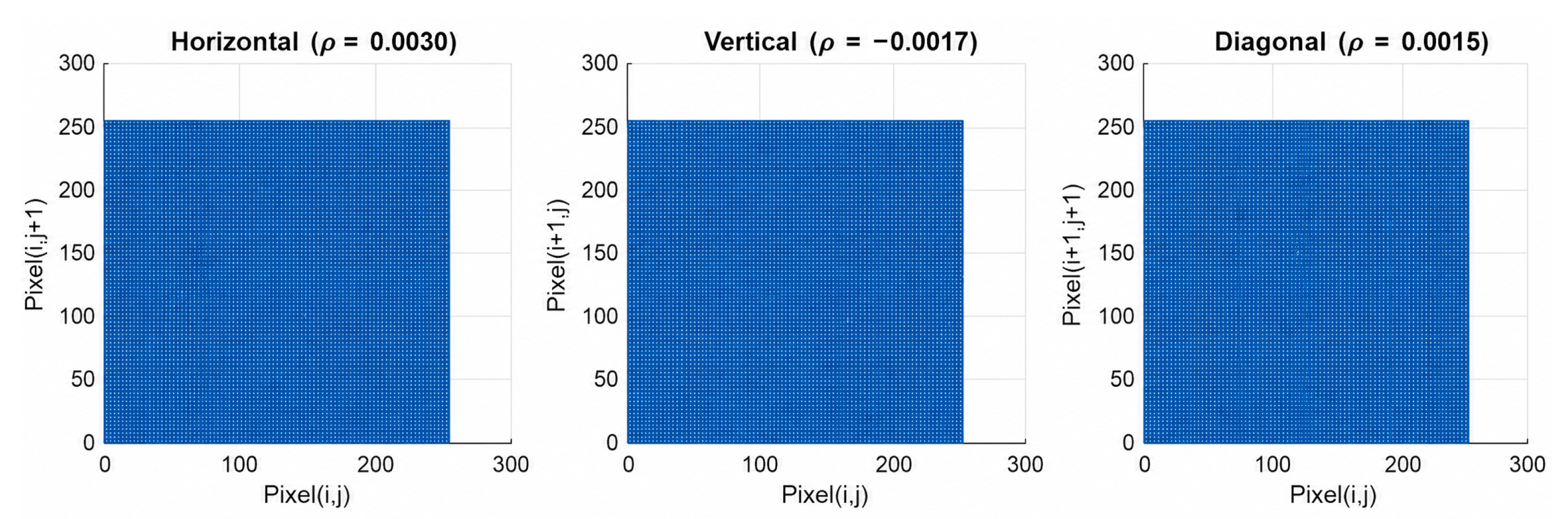
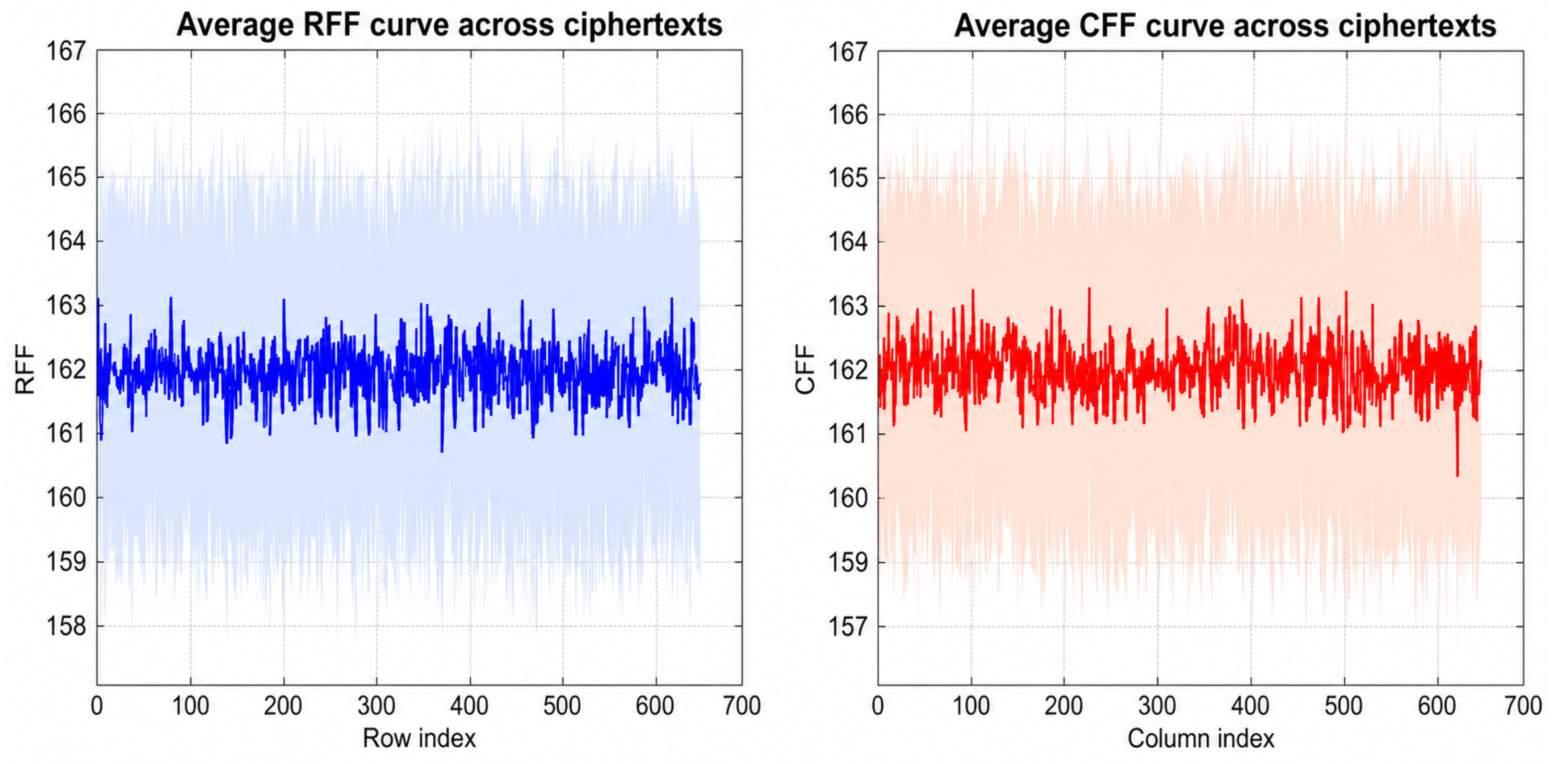
The floating frequency test was performed on a set of 50 encrypted images generated with the same cryptographic key, using a window length of 256 and a sliding step of 1. The objective was to evaluate the local statistical uniformity of the ciphertext using the row floating frequency (RFF) and column floating frequency (CFF), defined as the number of distinct gray levels within each analysis window, as shown in Table 4.
Table 4.
Results of the floating frequency analysis.
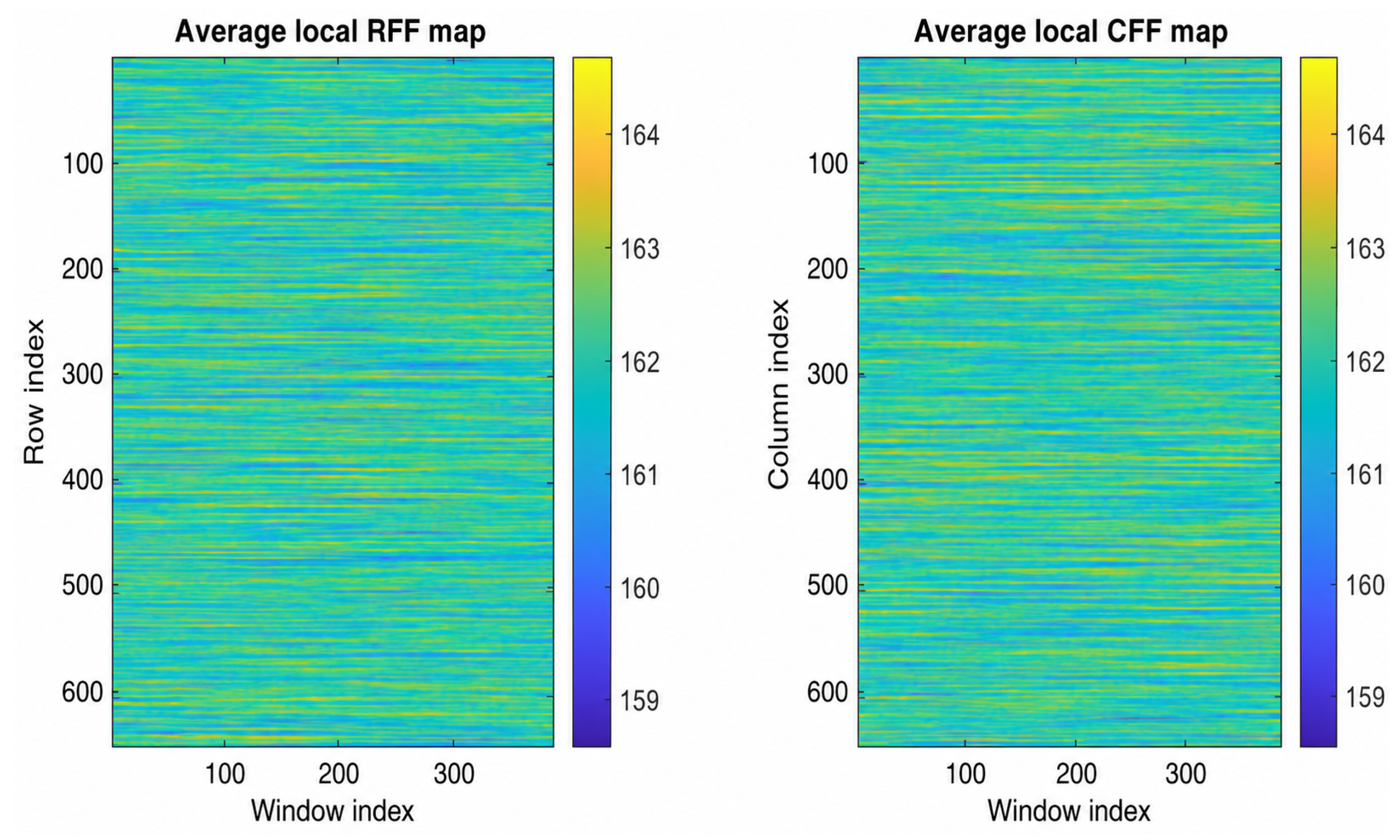
The results show a highly stable behavior of the ciphertext across the analyzed set. The global averages of RFF and CFF are nearly identical, while their coefficients of variation remain low and tightly grouped (see Figure 13). This agreement between row-wise and column-wise statistics indicates the absence of directional bias in the encrypted images. Likewise, the average curves, the distribution summaries, and the local maps do not reveal persistent valleys, anomalous peaks, or structured weak regions (see Figure 14). Taken together, these findings indicate that the proposed encryption procedure produces ciphertexts with a homogeneous local distribution of gray levels, which is consistent with the statistical behavior expected from a secure image-encryption scheme.
Figure 13.
Average RFF (left) and CFF (right) curves with standard-deviation bands computed over 50 cryptograms.
Figure 14.
Mean local maps for RFF (left) and CFF (right), showing a spatially uniform response across the analyzed windows.
4.2.6. Ciphertext Sensitivity to Minimal Local Perturbations
To evaluate how local ciphertext alterations affect the recovered image and to analyze the dependence of the proposed method on the integrity of the encrypted Fourier-domain package, a controlled perturbation experiment was performed while keeping the standard decryption procedure unchanged. In this analysis, local noise-like and occlusion-like modifications were introduced into the ciphertext. A total of 50 cryptograms were considered, including an unperturbed reference case and random localized modifications with patch sizes of , , , , and pixels.
For the unperturbed case at , the scheme achieved high reconstruction quality, with average values of , , dB, and . After introducing a minimal perturbation into the encrypted payload, the recovered image changed noticeably, with the metrics decreasing to , , and dB, while increased to . For a perturbation, the reconstruction metrics decreased to , , and dB, and for a perturbation they reached , , and dB. With larger perturbations of and pixels, the reconstruction became severely degraded, with correlation values close to zero and very low SSIM values. This behavior reflects the strong dependence of the reconstruction process on the preservation of the encrypted Fourier-domain package, so local alterations of the ciphertext are expressed directly as measurable degradation in the recovered data.
4.2.7. Differential Attack Results (NPCR–UACI)
To quantify the avalanche effect, a one-pixel-change differential attack was performed. In each trial, a base plaintext package was generated and then perturbed by modifying a single pixel; both inputs were encrypted with the same key, and the resulting ciphertexts were compared using NPCR (Number of Pixel Change Rate, i.e., the percentage of pixels that differ between ciphertexts) and UACI (Unified Average Changing Intensity, i.e., the normalized average intensity difference). For 8-bit data, near-ideal behavior is characterized by and , reflecting almost complete diffusion and average changes close to one third of the dynamic range.
To isolate the contribution of each stage, two configurations were evaluated over 50 trials. The experimental results reveal two clearly differentiated regimes, summarized in Table 5.
Table 5.
Differential attack: FULL pipeline vs. isolated diffusion (50 trials).
- (i)
- Full encryption pipeline (FULL).
The differential response is highly stable and concentrated, with and (mean ± standard deviation). The corresponding histograms exhibit a narrow distribution around the central values, while the NPCR–UACI scatter plot forms a compact cloud without pronounced tails. This combination, namely means close to ideal values plus low dispersion, indicates that a minimal perturbation in the plaintext produces global and consistent changes in the ciphertext, i.e., a strong and reproducible avalanche effect.
- (ii)
- Isolated diffusion on the quantized intermediate package ().
In this variant, only the forward and backward strong diffusion stage is applied, using as input , i.e., the intermediate package quantized to 8 bits immediately before diffusion, corresponding to the stacked phase/amplitude matrix after confusion and normalization. Although the mean values remain high (, ), the variability increases markedly, with and . This is clearly reflected in the histograms through longer tails and, more notably, in the NPCR–UACI scatter plot, where some trials exhibit atypically low/high UACI values even when NPCR remains high. In practical terms, diffusion alone enforces global changes, but its differential response is more sensitive to the statistical structure of the intermediate plaintext.
Table 5 quantitatively highlights the contrast: the FULL pipeline not only achieves near-ideal mean values, but also dramatically reduces dispersion, with approximately smaller and approximately smaller compared to diffusion alone. Overall, these results indicate that the preceding confusion stage acts as a pre-mixing mechanism that redistributes and decorrelates information before diffusion, making the avalanche effect less dependent on specific plaintext patterns and therefore more robust against differential attacks.
4.3. Comparison with Recent Related Methods
To further contextualize the proposed scheme, Table 6 summarizes a comparison with representative recent multi-image encryption and optical encryption methods. The comparison includes commonly reported security metrics, such as entropy, NPCR, UACI, adjacent-pixel correlation, and key space, together with system-level aspects that are particularly relevant for multiplexed image repositories, including the number of packed images, memory savings, reconstruction quality, and encryption time per image. Since not all existing schemes report the same indicators, unavailable values are marked as not reported. This comparison highlights that many recent methods focus primarily on cryptographic indicators, whereas the proposed approach additionally reports storage reduction and reconstruction quality under large-scale multiplexing.
Table 6.
Comparison with recent related multi-image encryption and optical encryption methods.
5. Conclusions
We have presented a novel chaotic encryption scheme designed for the protected storage of sensitive images through Fourier-plane multiplexing, followed by a confusion–diffusion architecture with chaotic masks that can be regenerated from a key. The proposed framework uniquely combines spectral multiplexing and chaotic encryption, enabling the secure aggregation of multiple images into a single encrypted container. The proposed method integrates (i) a spectral aggregation mechanism that compacts multiple images into a single container, and (ii) a cryptographic mixing stage that yields outputs statistically close to noise, while preserving the invertibility required for demultiplexing and faithful recovery.
From the cryptographic standpoint, the results demonstrate that the encrypted container loses the statistical features associated with natural images and adopts a behavior consistent with pseudorandomness: histograms evolve toward nearly uniform distributions, spatial correlations in the three principal directions are attenuated to values close to zero, and the dependence between plaintext and ciphertext becomes negligible. Complementarily, sensitivity to minimal perturbations in the plaintext propagates globally throughout the ciphertext, confirming strong diffusion properties and a pronounced avalanche effect.
Taken together, these results indicate that the proposed scheme provides effective resistance to statistical and differential cryptanalysis under the standard evaluation scenarios for image encryption.
From a design and scope perspective, the main contribution of this work lies in the integration of secure chaotic encryption with a Fourier-domain multiplexing strategy, enabling simultaneous multi-image protection without compromising invertibility or reconstruction quality. While a significant portion of the recent literature focuses on encrypting a single image per execution using high-dimensional chaotic maps, cellular automata, or combinations with DNA and nonlinear permutations [46,54,55,56,57,58,59,60,61], this work demonstrates the encryption of a multiplexed container while preserving invertibility and faithful recovery after demultiplexing.
Additionally, the method exhibits stable differential behavior and favorable scalability in both memory and computational cost as the number of multiplexed images increases, supporting its applicability in secure image-repository scenarios.
For future work, we plan to extend the evaluation to heterogeneous datasets and to complementary randomness and robustness protocols, as well as to explore variants of spectral multiplexing and chaotic parameterization that maintain the invertibility of the system and improve computational efficiency.
Author Contributions
J.A.V.V. was responsible for the conceptualization, methodology, software development, formal analysis, investigation, resources, data curation, visualization, supervision, and project administration. M.A.L.-A., H.D.S.J., C.A.M.A. and L.F.D.G. contributed to the validation and review of the manuscript. Specifically, M.A.L.-A. and C.A.M.A. contributed to the analysis and interpretation of the chaotic-system components; H.D.S.J. contributed to the development and discussion of the manuscript; and L.F.D.G. contributed to the discussion of the results and the implementation of the computational programs. Writing—original draft preparation, J.A.V.V.; writing—review and editing, M.A.L.-A., H.D.S.J., C.A.M.A. and L.F.D.G. All authors have read and agreed to the published version of the manuscript.
Funding
This research received no external funding.
Institutional Review Board Statement
Not applicable.
Informed Consent Statement
Not applicable.
Data Availability Statement
The datasets used in this study are publicly available from the USC-SIPI image database [38] and the website This Person Does Not Exist [40,41,42].
Conflicts of Interest
The authors declare no conflicts of interest.
Abbreviations
The following abbreviations are used in this manuscript:
| GL | Gray Level |
| CC | Correlation Coefficient |
| SSIM | Structural Similarity Index Measure |
| PSNR | Peak Signal-to-Noise Ratio |
| RMSE | Root Mean Square Error |
| NPCR | Number of Pixel Change Rate |
| UACI | Unified Average Changing Intensity |
| MSE | Mean Square Error |
| AES-128 | Advanced Encryption Standard (128-bit key) |
| NIST | National Institute of Standards and Technology |
| SHA-256 | Secure Hash Algorithm (256-bit) |
| ASCII | American Standard Code for Information Interchange |
| AI | Artificial Intelligence |
Appendix A. Demultiplexing Algorithm Summary
The complete demultiplexing procedure is summarized as follows. The recovery stage consists of reconstructing the Fourier plane, inverting the preprocessing transformations, and applying the inverse Fourier transform.
| Algorithm A1 Demultiplexing Procedure |
|
Appendix B. Chaotic Mask Generation from Cryptographic Key
| Algorithm A2 Chaotic Mask Generation from Cryptographic Key |
|
Appendix C. Decryption Algorithm Summary
The complete decryption algorithm can be summarized as follows.
| Algorithm A3 Decryption Algorithm |
|
Appendix D. Inversion of Chaotic Linear Transformations
The encrypted amplitude and phase are recovered by solving the system defined in Equation (8). The determinant of the transformation at each pixel is:
Parameter values must be chosen such that at all pixel locations. In this work, we use which guarantee that the determinant is strictly non-zero for all pixels, ensuring invertibility while providing strong mixing between components.
The original amplitude A and phase are then recovered as:
For the selected parameter values the determinant in Equation (9) becomes
Since , the expression is strictly positive. Therefore, the determinant is strictly negative and non-zero for all pixel locations, guaranteeing invertibility of the confusion transformation.
Appendix E. Affine Normalization Operator
The normalization operator applied to is defined as
This transformation maps the dynamic range of to the interval while preserving an affine relationship between input and output values.
During decryption, the inverse transformation is given by
using the stored extrema .
Appendix F. Computational Scaling Analysis
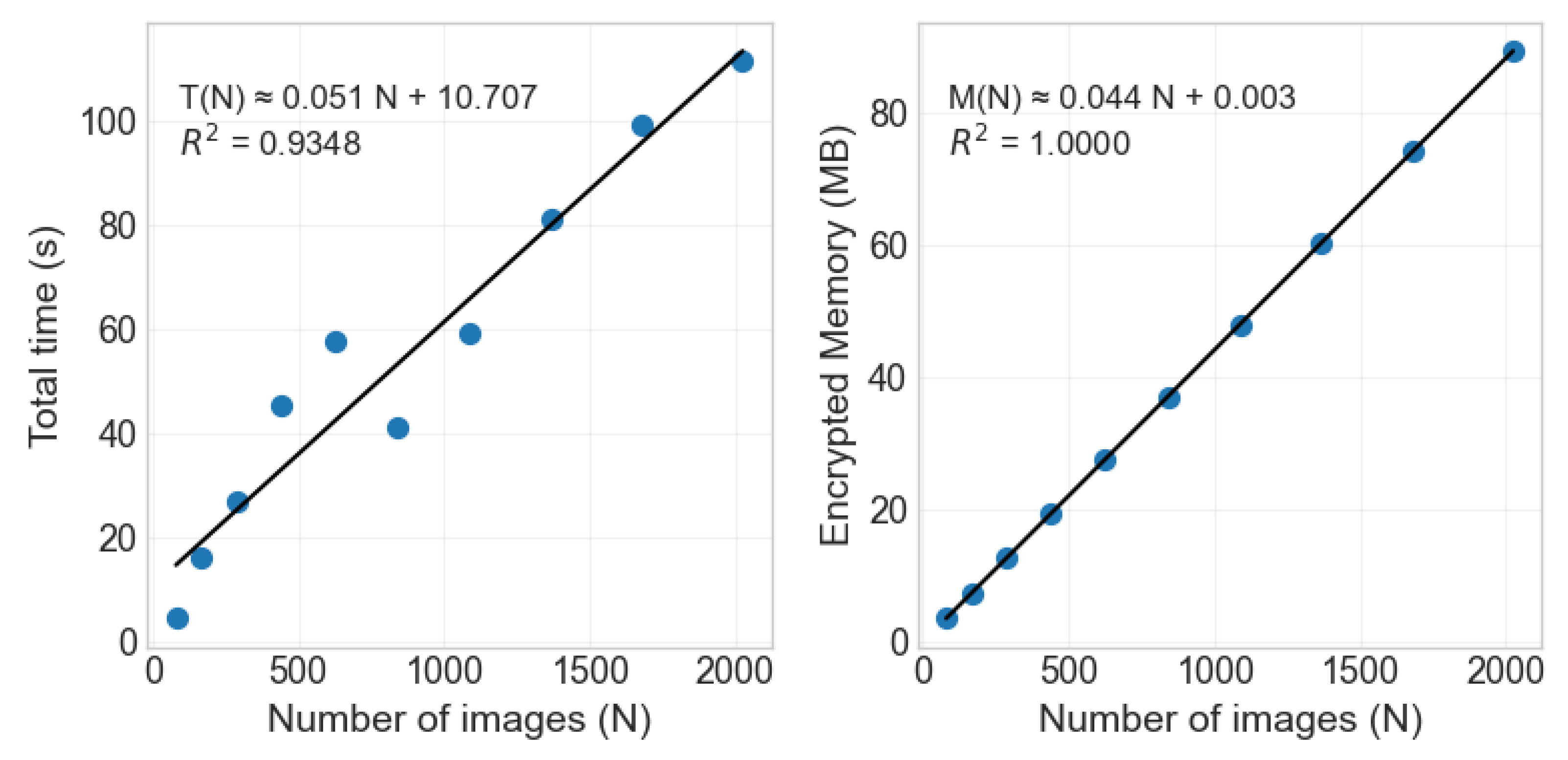
Figure A1 presents the computational scaling behavior of the proposed framework. The total processing time exhibits an approximately linear dependence on the number of multiplexed images, following: , with . The linear trend indicates that the dominant computational cost grows proportionally with the package size, while the constant term reflects fixed overhead associated with initialization and preprocessing stages. Similarly, the encrypted memory consumption follows a strictly linear relationship, , with , indicating a proportional increase in encrypted storage with N in the explored range. The fitted relations provide simple scaling laws to estimate memory usage and runtime as the package size grows.
Figure A1.
Time and memory complexity analysis. Left: total execution time versus the number of multiplexed images N, with linear regression fit. Right: encrypted memory consumption as a function of N. The high values indicate linear scaling behavior.
References
- Prunty, J.E.; Jenkins, R.; Qarooni, R.; Bindemann, M. A cognitive template for human face detection. Cognition 2024, 249, 105792. [Google Scholar] [CrossRef] [Scilit]
- Quan, H.; Hu, Y.; Bonarini, A. POLIMI-ITW-S: A large-scale dataset for human activity recognition in the wild. Data Brief 2022, 43, 108420. [Google Scholar] [CrossRef] [Scilit]
- Mensah, J.A.; Ocran, E.; Asiedu, L. On multiple imputation-based reconstruction of degraded faces and recognition in multiple constrained environments. Sci. Afr. 2023, 22, e01964. [Google Scholar] [CrossRef] [Scilit]
- Bray, S.D.; Johnson, S.D.; Kleinberg, B. Testing human ability to detect ‘deepfake’ images of human faces. J. Cybersecur. 2023, 9, tyad011. [Google Scholar] [CrossRef] [Scilit]
- Anghelone, D.; Chen, C.; Ross, A.; Dantcheva, A. Beyond the visible: A survey on cross-spectral face recognition. Neurocomputing 2025, 611, 128626. [Google Scholar] [CrossRef] [Scilit]
- Vargas, J.; Amaya, D.; Rueda, E. Digital image compression for a 2f multiplexing optical setup. J. Opt. 2016, 18, 075701. [Google Scholar] [CrossRef] [Scilit]
- Matthews, H.S.; Palmer, R.L.; Baynam, G.S.; Quarrell, O.W.; Klein, O.D.; Spritz, R.A.; Hennekam, R.C.; Walsh, S.; Weinberg, S.M.; Hallgrimsson, B.; et al. Large-scale open-source three-dimensional growth curves for clinical facial assessment and objective description of facial dysmorphism. Sci. Rep. 2021, 11, 12175. [Google Scholar] [CrossRef] [Scilit]
- Dey, P.; Mahmud, T.; Chowdhury, M.S.; Hossain, M.S.; Andersson, K. Human age and gender prediction from facial images using deep learning methods. Procedia Comput. Sci. 2024, 238, 314–321. [Google Scholar] [CrossRef] [Scilit]
- Kumari, P.; Choudhary, P.; Kujur, V.; Atrey, P.K.; Saini, M. Concept drift challenge in multimedia anomaly detection: A case study with facial datasets. Signal Process. Image Commun. 2024, 123, 117100. [Google Scholar] [CrossRef] [Scilit]
- Singh, M.; Baranwal, N.; Singh, K.N.; Singh, A.K.; Zhou, H. Deep learning-based biometric image feature extraction for securing medical images through data hiding and joint encryption–compression. J. Inf. Secur. Appl. 2023, 79, 103628. [Google Scholar] [CrossRef] [Scilit]
- Toshpulatov, M.; Lee, W.; Lee, S. Talking human face generation: A survey. Expert Syst. Appl. 2023, 219, 119678. [Google Scholar] [CrossRef] [Scilit]
- Shen, Y.; Tang, C.; Xu, M.; Lei, Z. Optical selective encryption based on the FRFCM algorithm and face biometric for the medical image. Opt. Laser Technol. 2021, 138, 106911. [Google Scholar] [CrossRef] [Scilit]
- Zhang, Z.; Zhou, N.; Sun, B.; Banerjee, S.; Mou, J. Multimedia healthcare cloud personal archives security system based on compressed sensing and multi-image encryption. J. Frankl. Inst. 2024, 361, 106844. [Google Scholar] [CrossRef] [Scilit]
- Demir, E. The protection of human biodata: Is there any role for data ownership? Comput. Law Secur. Rev. 2023, 51, 105905. [Google Scholar] [CrossRef] [Scilit]
- da Silva, A.G.A.; Gomes, H.M.; Batista, L.V. A collaborative deep multitask learning network for face image compliance to ISO/IEC 19794-5 standard. Expert Syst. Appl. 2022, 198, 116756. [Google Scholar] [CrossRef] [Scilit]
- Alsafyani, M.; Alhomayani, F.; Alsuwat, H.; Alsuwat, E. Face image encryption based on feature with optimization using secure crypto general adversarial neural network and optical chaotic map. Sensors 2023, 23, 1415. [Google Scholar] [CrossRef] [Scilit] [PubMed]
- Valencia, J.A.V.; Rodriguez, B.A.P. Phase chaotic encryption and efficiency evaluation for an image multiplexing method. Opt. Lasers Eng. 2019, 121, 464–472. [Google Scholar] [CrossRef] [Scilit]
- Wang, M.; Fu, X.; Yan, X.; Teng, L. A new chaos-based image encryption algorithm based on discrete Fourier transform and improved Joseph traversal. Mathematics 2024, 12, 638. [Google Scholar] [CrossRef] [Scilit]
- Abuturab, M.R. A superposition based multiple-image encryption using Fresnel-domain high dimension chaotic phase encoding. Opt. Lasers Eng. 2020, 129, 106038. [Google Scholar] [CrossRef] [Scilit]
- Shao, Z.; Liu, X.; Yao, Q.; Qi, N.; Shang, Y.; Zhang, J. Multiple-image encryption based on chaotic phase mask and equal modulus decomposition in quaternion gyrator domain. Signal Process. Image Commun. 2020, 80, 115662. [Google Scholar] [CrossRef] [Scilit]
- Mehmood, A.; Shafique, A.; Chaudhry, S.A.; Alawida, M.; Khan, A.N.; Kumar, N. A time-efficient and noise-resistant cryptosystem based on discrete wavelet transform and chaos theory: An application in image encryption. J. Inf. Secur. Appl. 2023, 78, 103590. [Google Scholar] [CrossRef] [Scilit]
- Huang, Y.; Wang, L.; Li, Z.; Zhang, Q. A new 3D robust chaotic mapping and its application to speech encryption. Chaos Solitons Fractals 2024, 184, 115038. [Google Scholar] [CrossRef] [Scilit]
- Wang, X.; Liu, C.; Jiang, D. A novel triple-image encryption and hiding algorithm based on chaos, compressive sensing and 3D DCT. Inf. Sci. 2021, 574, 505–527. [Google Scholar] [CrossRef] [Scilit]
- Sisaudia, V.; Vishwakarma, V.P. A secure gray-scale image watermarking technique in fractional DCT domain using zig-zag scrambling. J. Inf. Secur. Appl. 2022, 69, 103296. [Google Scholar] [CrossRef] [Scilit]
- Kumar, S. Image data security using quasigroup combined with Fibonacci Q-transformation. J. Inf. Secur. Appl. 2021, 61, 102941. [Google Scholar] [CrossRef] [Scilit]
- Shalu; Yadav, A.K.; Singh, P. Nonlinear multiple color image encryption using Quasinormal-Zernike Algorithm in Fresnel transform domain. J. Opt. 2025, 1–18. [Google Scholar] [CrossRef] [Scilit]
- Mehra, I.; Nishchal, N.K. Fingerprint image encryption using phase retrieval algorithm in gyrator wavelet transform domain using QR decomposition. Opt. Commun. 2023, 533, 129265. [Google Scholar] [CrossRef] [Scilit]
- Kumar, R.; Rao, S.K.; Nishchal, N.K.; Alfalou, A. Multi-image encryption based on DCT coefficients and random vortex lattice. Optik 2026, 347, 172666. [Google Scholar] [CrossRef] [Scilit]
- Alexan, W.; Hosny, K.M.; Gabr, M. A new fast multiple color image encryption algorithm. Clust. Comput. 2025, 28, 325. [Google Scholar] [CrossRef] [Scilit]
- Cheng, H.; Li, Y.; Yu, B.; Wang, X.; Zhang, F.; Yuan, P.; Ding, D. A novel 3D chaotic map with controllable Lyapunov exponents and extensive regimes: Application to multiple images holographic encryption. Nonlinear Dyn. 2026, 114, 438. [Google Scholar] [CrossRef] [Scilit]
- Njitacke, Z.T.; Maghrabi, L.A.; Ahmad, M.; Althaqafi, T. Efficient Bit-Plane Based Medical Image Cryptosystem Using Novel and Robust Sine-Cosine Chaotic Map. Comput. Mater. Contin. 2025, 83, 917. [Google Scholar] [CrossRef] [Scilit]
- Lin, H.; Duan, C.; Deng, X.; Zhang, S. A robust industrial image encryption algorithm for IIoT fusing a Tabu learning neural network and chaos mechanism. Expert Syst. Appl. 2026, 325, 132604. [Google Scholar] [CrossRef] [Scilit]
- Meng, K.; Wo, Y. An image compression and encryption scheme for similarity retrieval. Signal Process. Image Commun. 2023, 119, 117044. [Google Scholar] [CrossRef] [Scilit]
- Liu, H.; Teng, L.; Zhang, Y.; Si, R.; Liu, P. Multi-medical image encryption by a new spatiotemporal chaos model and DNA new computing for information security. Expert Syst. Appl. 2024, 235, 121090. [Google Scholar] [CrossRef] [Scilit]
- Vanitha, P.; Shikder, A.; Nishchal, N.K.; Ko, D.-K. Multiplexed optical encryption using Bessel–Gaussian speckle patterns in the Fresnel domain for secure and high-capacity data storage. J. Opt. 2026, 28, 035705. [Google Scholar] [CrossRef] [Scilit]
- Murillo-Escobar, M.A.; Meranza-Castillón, M.O.; López-Gutiérrez, R.M.; Cruz-Hernández, C. Suggested Integral Analysis for Chaos-Based Image Cryptosystems. Entropy 2019, 21, 815. [Google Scholar] [CrossRef] [Scilit]
- Zhang, H.; Feng, X.; Sun, J.; Yan, P. Chaotic Image Security Techniques and Developments: A Review. Mathematics 2025, 13, 1976. [Google Scholar] [CrossRef] [Scilit]
- USC-SIPI Image Database. Miscellaneous Volume. Available online: https://sipi.usc.edu/database/database.php?volume=misc (accessed on 9 January 2026).
- Vargas Valencia, J.A.; Londoño-Arboleda, M.A.; Salinas Jiménez, H.D.; Marín Arango, C.A.; Duque Gómez, L.F. Image Encryption Using Chaotic Box Partition–Permutation and Modular Diffusion with PBKDF2 Key Derivation. J. Cybersecur. Priv. 2026, 6, 21. [Google Scholar] [CrossRef] [Scilit]
- Wang, P. This Person Does Not Exist. Available online: https://thispersondoesnotexist.com/ (accessed on 2 May 2026).
- Karras, T.; Laine, S.; Aila, T. A style-based generator architecture for generative adversarial networks. In Proceedings of the IEEE/CVF Conference on Computer Vision and Pattern Recognition (CVPR), Long Beach, CA, USA, 15–20 June 2019; pp. 4401–4410. [Google Scholar]
- Karras, T.; Laine, S.; Aittala, M.; Hellsten, J.; Lehtinen, J.; Aila, T. Analyzing and improving the image quality of StyleGAN. In Proceedings of the IEEE/CVF Conference on Computer Vision and Pattern Recognition (CVPR), Seattle, WA, USA, 13–19 June 2020; pp. 8110–8119. [Google Scholar]
- Du, L.; Teng, L.; Liu, H.; Lu, H. Multiple face images encryption based on a new non-adjacent dynamic coupled mapping lattice. Expert Syst. Appl. 2024, 238, 121728. [Google Scholar] [CrossRef] [Scilit]
- Kumar, A.; Dua, M. A novel exponent–sine–cosine chaos map-based multiple-image encryption technique. Multimed. Syst. 2024, 30, 141. [Google Scholar] [CrossRef] [Scilit]
- Zhang, X.; Liu, M. Multiple-image encryption algorithm based on the stereo Zigzag transformation. Multimed. Tools Appl. 2024, 83, 22701–22726. [Google Scholar] [CrossRef] [Scilit]
- Song, W.; Fu, C.; Zheng, Y.; Zhang, Y.; Chen, J.; Wang, P. Batch image encryption using cross image permutation and diffusion. J. Inf. Secur. Appl. 2024, 80, 103686. [Google Scholar] [CrossRef] [Scilit]
- Zhang, Z.; Zhang, J. Parallel multi-image encryption based on cross-plane DNA manipulation and a novel 2D chaotic system. Vis. Comput. 2024, 40, 8615–8637. [Google Scholar] [CrossRef] [Scilit]
- Hosny, K.M.; Kamal, S.T. A new four-tier technique for efficient multiple images encryption. Multimed. Tools Appl. 2025, 84, 26797–26815. [Google Scholar] [CrossRef] [Scilit]
- Gaur, K.S.; Singh, H.; Thakran, S.; Singh, K. Double-image encryption by utilizing the Fourier domain, singular value decomposition, chaotic phase mask and wavelet transform. J. Mod. Opt. 2026, 73, 144–160. [Google Scholar] [CrossRef] [Scilit]
- Deng, Y.; Peng, Y.; Han, X.; Jin, W.; Zhou, T.; Zhao, Z.; Li, Y.; Ma, L. Asymmetric multi-image encryption technology based on position multiplexing and computer-generated holography. Opt. Commun. 2025, 587, 131960. [Google Scholar] [CrossRef] [Scilit]
- Cheng, M.; Jiang, M.; Yang, J.; Zhan, C.; Wang, X.; Lin, F.; Liang, W. Chaotic multi-image encryption scheme based on new spatial permutation and BP neural network compression. Nonlinear Dyn. 2026, 114, 137. [Google Scholar] [CrossRef] [Scilit]
- Li, Y.; Tao, Y. Improved LSTNet-driven hyperchaotic sequence optimization and its application in multi-image encryption. Knowl.-Based Syst. 2026, 338, 115529. [Google Scholar] [CrossRef] [Scilit]
- Shabasy, N.H.E.; Mansy, A.; Alexan, W. An improved Bülban map and its application in multiple image encryption. J. King Saud. Univ. Comput. Inf. Sci. 2026, in press. [Google Scholar] [CrossRef] [Scilit]
- Darani, A.Y.; Yengejeh, Y.K.; Pakmanesh, H.; Navarro, G. Image encryption algorithm based on a new 3D chaotic system using cellular automata. Chaos Solitons Fractals 2024, 179, 114396. [Google Scholar] [CrossRef] [Scilit]
- Wu, X.; Shi, H.; Ji’e, M.; Duan, S.; Wang, L. A novel image compression and encryption scheme based on conservative chaotic system and DNA method. Chaos Solitons Fractals 2023, 172, 113492. [Google Scholar] [CrossRef] [Scilit]
- Guo, P.; Shi, Q.; Jian, Z.; Zhang, J.; Ding, Q.; Yan, W. An intelligent controller of homo-structured chaotic systems under noisy conditions and applications in image encryption. Chaos Solitons Fractals 2024, 180, 114524. [Google Scholar] [CrossRef] [Scilit]
- Tang, S.; Xu, X.; Jiang, Z.; Meng, D.; Sun, K. An image encryption scheme without additional key transmission based on an N-dimensional closed-loop coupled triangular wave model. Chaos Solitons Fractals 2024, 185, 115039. [Google Scholar] [CrossRef] [Scilit]
- Zhao, H.; Wang, S.; Fu, Z. A new image encryption algorithm based on cubic fractal matrix and L-LCCML system. Chaos Solitons Fractals 2024, 185, 115076. [Google Scholar] [CrossRef] [Scilit]
- Bhowmik, S.; Acharyya, S. Image encryption approach using improved chaotic system incorporated with differential evolution and genetic algorithm. J. Inf. Secur. Appl. 2023, 72, 103391. [Google Scholar] [CrossRef] [Scilit]
- He, J.; Zhu, H.; Zhou, X. Quantum image encryption algorithm via optimized quantum circuit and parity bit-plane permutation. J. Inf. Secur. Appl. 2024, 81, 103698. [Google Scholar] [CrossRef] [Scilit]
- Zhou, S.; Qiu, Y.; Qi, G.; Zhang, Y. A new conservative chaotic system and its application in image encryption. Chaos Solitons Fractals 2023, 175, 113909. [Google Scholar] [CrossRef] [Scilit]



Disclaimer/Publisher’s Note: The statements, opinions and data contained in all publications are solely those of the individual author(s) and contributor(s) and not of MDPI and/or the editor(s). MDPI and/or the editor(s) disclaim responsibility for any injury to people or property resulting from any ideas, methods, instructions or products referred to in the content. |
© 2026 by the authors. Licensee MDPI, Basel, Switzerland. This article is an open access article distributed under the terms and conditions of the Creative Commons Attribution (CC BY) license.