


Abstract
In this study, lamellar MFI (Mobile Five-membered ring Intergrowth) zeolites pillared with TiO2 were synthesized using tetraethyl orthotitanate (TEOTi) as titanium precursor and evaluated as photocatalysts for Rhodamine B (RhB) degradation under UV irradiation. The materials were characterized by X-ray diffraction (XRD), UV–Vis spectroscopy, N2 adsorption–desorption, photoluminescence spectroscopy (PL), and transmission electron microscopy (TEM). XRD confirmed the preservation of the lamellar MFI structure and the formation of anatase TiO2 pillars within the interlayer space. The composites exhibited hierarchical micro/mesoporosity, high surface areas (>320 m2 g−1), and mesopore sizes of approximately 4.1–4.2 nm. Photocatalytic experiments revealed that the incorporation of TiO2 into the lamellar MFI framework significantly enhanced the degradation kinetics of RhB compared with bare TiO2. The apparent pseudo-first-order rate constants followed the order MFIPTi-6 > MFIPTi-3 > MFIPTi-12 > TiO2 > MFIPTi-24, with MFIPTi-6 exhibiting the highest activity (kapp = 0.049 min−1), approximately 1.6 times higher than that of pure TiO2. Scavenger experiments identified hydroxyl radicals as the predominant reactive species involved in the degradation process. TOC (Total Organic Carbon) measurements showed approximately 80% organic carbon removal, while recyclability tests demonstrated stable photocatalytic performance over six consecutive cycles. These results highlight the potential of lamellar TiO2/MFI composites as efficient and reusable photocatalysts for water treatment applications.
1. Introduction
Dyes and pigments are structurally complex organic compounds that constitute an essential component of numerous industrial and consumer applications. They are particularly relevant in sectors such as textiles, paper, and plastics, where large volumes of water are required for dyeing processes [1,2]. It is estimated that approximately 15% of global dye production is lost during processing and subsequently discharged into industrial effluents. Many of these compounds are classified as carcinogenic and pose significant risks to both human health and aquatic ecosystems [1,3]. Among environmental contaminants, organic pollutants are especially hazardous due to their high solubility in water and persistence in natural systems [4]. Consequently, effective treatment prior to environmental discharge is imperative to mitigate their impact and to ensure compliance with regulatory standards. Rhodamine B (RhB) is one of the most widely used xanthene dyes, with applications in textile dyeing, acrylic materials, paints, and as a fluorescent tracer in biological systems characterized by intense coloration and recalcitrance to conventional degradation processes [5,6]. Therefore, the development of efficient strategies for the removal of RhB from wastewater is critical to reduce its environmental burden. A variety of treatment technologies have been explored for dye removal from aqueous systems. Among them, heterogeneous photocatalysis (classified as an advanced oxidation process, AOP) has emerged as a promising and extensively investigated approach. This process is based on the generation of highly reactive hydroxyl radicals (•OH), which are capable of mineralizing a wide range of organic contaminants. Photocatalysis is initiated by the absorption of photons with energy equal to or greater than the band gap of a semiconductor, leading to the formation of electron–hole pairs that drive redox reactions at the catalyst surface [7]. The efficiency of this process strongly depends on the physicochemical properties of the semiconductor, including its light absorption capacity and charge carrier separation dynamics. Titanium dioxide (TiO2) is recognized as a benchmark photocatalyst due to its abundance, chemical stability, photostability, biocompatibility, and high photocatalytic efficiency, as well as its ability to minimize the formation of undesirable by-products [8]. Among the TiO2 polymorphs, anatase is generally considered the most active phase for photocatalytic applications because of its favorable electronic structure, high surface activity, and suitable band-gap energy [9]. At the nanoscale, the physicochemical properties of TiO2 differ significantly from those of its bulk counterpart, with reduced particle size generally leading to enhanced photocatalytic performance. Therefore, precise control over particle size and dispersion is a key factor in optimizing photocatalytic activity. One effective strategy to achieve this is the immobilization or dispersion of TiO2 nanoparticles onto suitable supports such as silica, alumina, clays, and zeolites, enabling the formation of well-defined nanostructured materials [10]. Zeolites, in particular, are highly attractive supports due to their large specific surface area, strong adsorption capacity, intrinsic acidity, and well-defined microporous frameworks. However, the small pore size of conventional zeolites (typically <2 nm) imposes diffusion limitations for bulky organic molecules, which can hinder catalytic performance. To overcome these limitations, the introduction of secondary mesoporosity into zeolitic frameworks has been widely investigated. The generation of hierarchical micro-/mesoporous structures enhances mass transport and improves accessibility to active sites, particularly in reactions involving large molecular species [10,11]. Among the various synthetic strategies, the preparation of two-dimensional (2D) layered zeolites followed by pillaring represents a robust approach for constructing such hierarchical architectures [11,12,13]. However, only a few theoretical studies have been conducted to understand the specific properties of these materials [14,15]. In these systems, guest species can be intercalated within the interlayer galleries, generating mesoporous domains while preserving the intrinsic microporosity of the zeolitic framework. This hierarchical organization results in improved structural, textural, and physicochemical properties [16,17,18]. Despite these advantages, relatively few studies have addressed the photocatalytic application of pillared zeolites for dye degradation [11,19,20] whereas pillared clays have been more extensively investigated [21,22,23,24]. Previous studies have reported the synthesis of lamellar zeolite structures based on MOR (Mordenite) and MFI frameworks, as well as their pillaring with amorphous SiO2 [13]. Furthermore, the incorporation of anatase TiO2 into lamellar MOR structures has demonstrated significant improvements in textural properties compared to conventional bulk zeolites [25]. For instance, Emdadi et al. [11] reported efficient methyl orange degradation using a titanosilicate pillared MFI zeolite, attributing the enhanced performance to the presence of Ti species within the pillars, Brønsted acid sites associated with Al–O(H)–Si groups, and the hierarchical porosity of the material. Although photocatalysts based on TiO2 and MFI-type zeolites have been widely studied, the effect of TiO2 pillaring on the structural, textural, and photocatalytic properties of lamellar MFI zeolites has not been sufficiently investigated. In particular, the relationship between TiO2 pillars and photocatalytic performance remains unclear. In this context, the objective of the present study is to synthesize a lamellar mesoporous TiO2/MFI composite zeolite (denoted as MFIPTi) and to evaluate its photocatalytic performance toward the degradation of Rhodamine B.
2. Materials and Methods
2.1. Chemicals
All the precursors were reagent grade and were used with no further modifications. Tetraethyl orthotitanate (TEOTi), used as TiO2 precursor, was purchased from Sigma-Aldrich (St. Louis, MO, USA). Lamellar mesoporous MFI was synthesized as described in our previously reported work [13].
2.2. Synthesis of Lamellar Zeolite with TiO2 Pillars
The pillaring of the mesoporous lamellar MFI zeolite was carried out following the methodology reported by Na et al. [26]. Briefly, 0.8 g of the lamellar MFI precursor was dispersed in 4.384 g of titanium tetraethoxide (TEOTi) under continuous stirring. The suspension was maintained at 25 °C under a nitrogen atmosphere in order to prevent premature hydrolysis of the titanium alkoxide precursor. A series of samples was prepared using identical reactant compositions while varying the stirring time to control the interaction between the alkoxide species and the lamellar zeolite structure. The mixtures were stirred for 3, 6, 12, and 24 h (at 100 rpm), respectively. After the corresponding treatment time, the resulting solids were recovered by filtration using acetone as washing solvent and subsequently dried at 80 °C for 6 h. Hydrolysis of the intercalated alkoxide species was carried out by dispersing each dried sample in 10 mL of distilled water contained in a 20 mL glass vial equipped with a magnetic stirring bar. The sealed vial was directly immersed in a water bath maintained at 90 °C on the stirring plate and stirred at 100 rpm for 12 h. The obtained materials were filtered, thoroughly washed with distilled water, and dried prior to calcination. Finally, the samples were calcined in air at 450 °C for 4 h in order to remove the organic species and promote the crystallization of TiO2 in the anatase phase within the pillared structure. The resulting materials were denoted as MFIPTi-3, MFIPTi-6, MFIPTi-12, and MFIPTi-24, corresponding to stirring times of 3, 6, 12, and 24 h during the pillaring stage, respectively. For comparison purposes, a reference TiO2 sample was synthesized following the same procedure employed for the pillared materials, but in the absence of the zeolitic support. In this case, the titanium alkoxide precursor was stirred for 6 h, hydrolyzed in distilled water at 90 °C for 12 h, and subsequently calcined at 450 °C for 4 h. This material was used as the control photocatalyst.
2.3. Characterization
X-ray powder diffraction (XRD) analysis was performed to investigate the crystalline structure and phase composition of the zeolitic materials using a PANalytical Aeris diffractometer (Malvern Panalytical, Almelo, The Netherlands) equipped with monochromatic CuKα radiation (λ = 0.154056 nm). Diffraction patterns were recorded within the 2θ range of 1–35°, covering the characteristic reflections associated with both the anatase TiO2 phase and the MFI zeolitic framework. The textural properties of the synthesized materials were determined by N2 adsorption–desorption measurements using a Micromeritics TriStar II surface area and porosity analyzer (Micromeritics Instrument Corporation, Norcross, GA, USA). Prior to analysis, all samples were degassed under vacuum at 300 °C for 4 h in order to remove adsorbed moisture and volatile species. The specific surface area was calculated using the Brunauer–Emmett–Teller (BET) method within the relative pressure range of 0.05 < P/P0 < 0.26. The pore size distribution and average pore diameter were determined by the Barrett–Joyner–Halenda (BJH) method using the desorption branch of the N2 isotherm. The total pore volume (Vp) was estimated from the amount of nitrogen adsorbed at a relative pressure of P/P0 = 0.99. In addition, the microporous surface area (Smicro) and microporous volume (Vmicro) were determined using the t-plot method. Diffuse reflectance UV–Vis spectroscopy was carried out using an Agilent Technologies Cary 5000 UV–Vis–NIR spectrophotometer (Agilent Technologies, Santa Clara, CA, USA) in the wavelength range of 200–800 nm. The optical band gap energy (Eg) of the materials was estimated using the Kubelka–Munk function: F(R) = (1 − R)2/R, where F(R) is proportional to the absorption coefficient. The band gap values were obtained from Tauc plots by extrapolating the linear region of the following relationship: (F(R)·hv)1/2 vs. hv. Transmission electron microscopy (TEM) analysis was conducted using a JEOL JEM-2010 microscope (JEOL Ltd., Tokyo, Japan) to evaluate the morphology and microstructural characteristics of the synthesized materials. For TEM observations, the samples were ultrasonically dispersed in isopropyl alcohol and deposited onto lacey carbon-coated copper grids (440 mesh). Photoluminescence (PL) spectra were recorded at room temperature using a PerkinElmer LS50B photoluminescence spectrophotometer (PerkinElmer Inc., Waltham, MA, USA) in order to evaluate charge carrier recombination behavior in the photocatalytic materials.
2.4. Photodegradation of Rhodamine B (RhB)
Irradiation was provided by a UV-A Tecnolite F8T5BLB lamp (Tecnolite, Zapopan, Mexico) with a nominal power of 8 W positioned at the center of the reactor. The incident light intensity measured at the reactor center was 9.7 mW cm−2. The initial RhB concentration was fixed at 20 mg L−1, while the photocatalyst loading was maintained at 1000 mg L−1. The reaction temperature was controlled using a PolyScience recirculating cooling/heating system, model 1B13A0794 (PolyScience, Niles, IL, USA). For reaction, the initial pH of the RhB solution was measured and maintained at approximately 5.8 without further adjustment.
Prior to UV irradiation, the suspension was maintained under dark conditions for 30 min to establish adsorption–desorption equilibrium between the dye molecules and the catalyst surface. Subsequently, the UV lamp was switched on to initiate the photocatalytic reaction. The degradation of RhB was monitored using a Varian Cary 100 UV–Vis spectrophotometer (Varian, Palo Alto, CA, USA) by following the decrease in absorbance of the characteristic RhB absorption band centered at approximately 550 nm. The temporal evolution of absorbance was used to determine the photocatalytic degradation kinetics. It should be noted that the decrease in absorbance at 550 nm primarily reflects RhB discoloration and may be influenced by intermediate deethylation reactions occurring during photocatalysis. Therefore, total organic carbon (TOC) measurements were additionally performed to provide complementary information regarding the extent of organic pollutant removal.
Control experiments were performed to distinguish photocatalytic degradation from adsorption and direct photolysis. Adsorption-only experiments were conducted during the dark-equilibrium stage prior to irradiation, showing limited RhB adsorption on the materials. In addition, a photolysis experiment performed under UV irradiation in the absence of a photocatalyst showed negligible RhB discoloration, confirming that the observed degradation mainly arises from the photocatalytic activity of the TiO2/MFI composites.
Removal efficiency (%) = (C0 − Ct)/C0
A photocatalytic study was carried out on each pillared zeolite.
3. Results and Discussion
The pillaring of the two-dimensional (2D) lamellar MFI zeolite was carried out using the lamellar MFI precursor and titanium tetraethoxide (TEOTi) as the pillaring agent, following the methodology reported by Na et al. [26]. During the synthesis of the lamellar mesoporous TiO2/MFI composites, the stirring time employed in the pillaring stage was systematically varied at 3, 6, 12, and 24 h in order to evaluate its influence on the structural properties of the final materials.
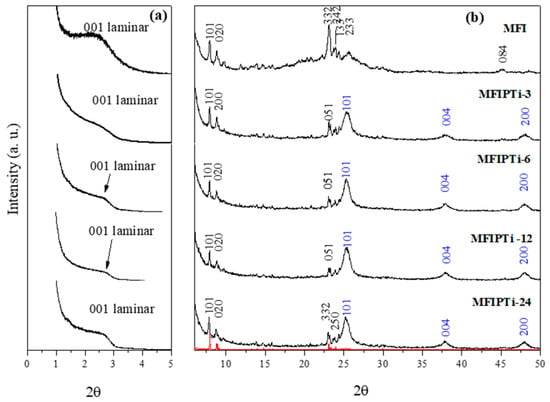
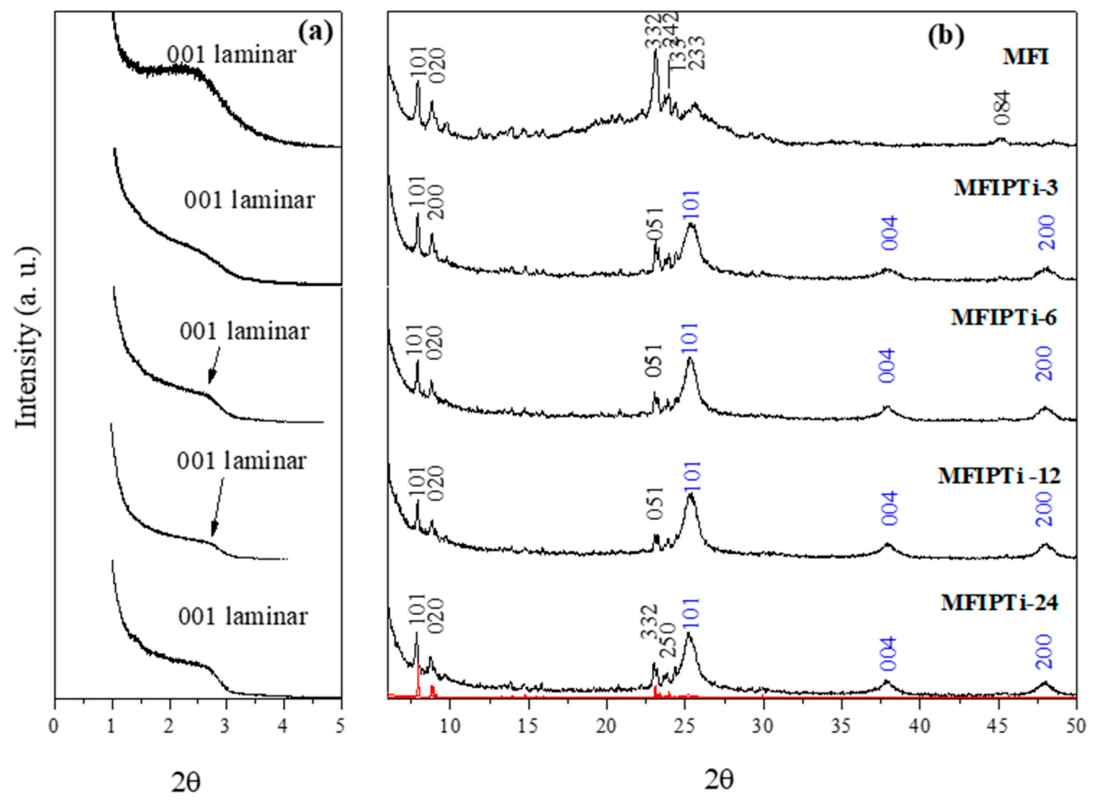
Figure 1 presents the X-ray diffraction (XRD) patterns of the as-synthesized, calcined, and TiO2-pillared MFI materials. For comparison purposes, the diffractograms corresponding to the parent lamellar MFI zeolite before calcination and the calcined bulk MFI zeolite are also included. The diffraction pattern of the MFI zeolite exhibits the characteristic reflections at 2θ = 7.95°, 8.85°, and 23.14°, which are assigned to the (101), (200), and (332) crystallographic planes, respectively. These reflections are consistent with the crystalline structure of the MFI framework according to the ICDD (International Centre for Diffraction Data) reference pattern 00-044-0003. The diffraction profiles of the pillared samples, MFIPTi-3, MFIPTi-6, MFIPTi-12, and MFIPTi-24, retain the characteristic reflections associated with the MFI structure, indicating that the zeolitic framework remains preserved after the pillaring and calcination processes. In addition to the zeolitic reflections, the TiO2 pillared materials exhibit diffraction peaks corresponding to the anatase crystalline phase, particularly those indexed to the (101), (004), and (200) planes, in agreement with JCPDS (Joint Committee on Powder Diffraction Standards) card No. 84-1286. The presence of these reflections confirms the successful incorporation of TiO2 within the pillared structure. Furthermore, the relatively broad and low-intensity diffraction peaks associated with TiO2 suggest the formation of nanocrystalline domains with reduced particle size. The predominance of the anatase phase is particularly relevant, since anatase is generally considered the thermodynamically favored polymorph at the nanoscale, whereas rutile becomes more stable at larger crystallite dimensions [9,27]. This observation is also consistent with the synthesis pathway employed in the present work, as wet chemical hydrolysis routes involving titanium alkoxide precursors are well known to preferentially produce nanocrystalline anatase TiO2 [28]. In particular, the hydrolysis and condensation of titanium alkoxides in solution commonly promote the direct formation of the anatase phase, further supporting the thermodynamic stability of anatase under the synthesis conditions employed in this study [27].
Figure 1.
(a) Low angle and (b) wide-angle powder X-ray patterns of MFI lamellar zeolite (black planes) with TiO2 pillars (blue planes). The diffractogram of lamellar MFI before calcination was added for comparison. Red pattern represents the typical signs of calcined bulk MFI zeolite obtained from the IZA database [29].
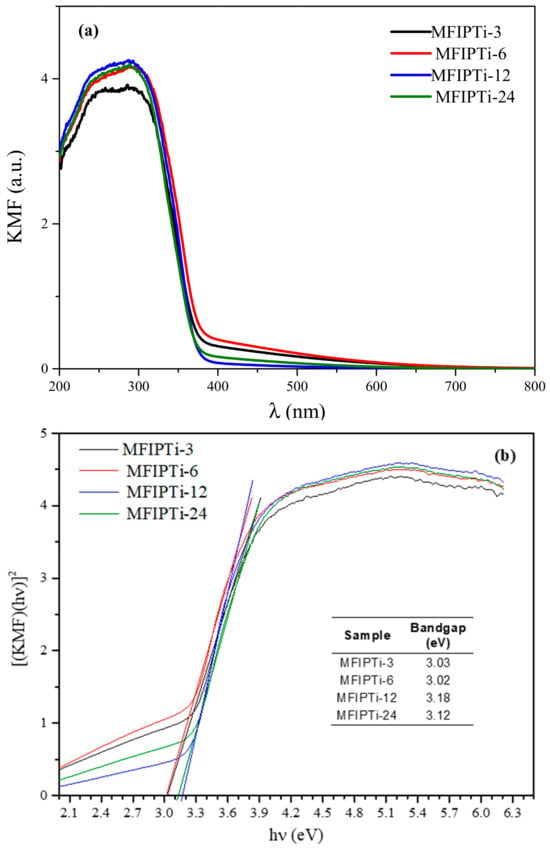
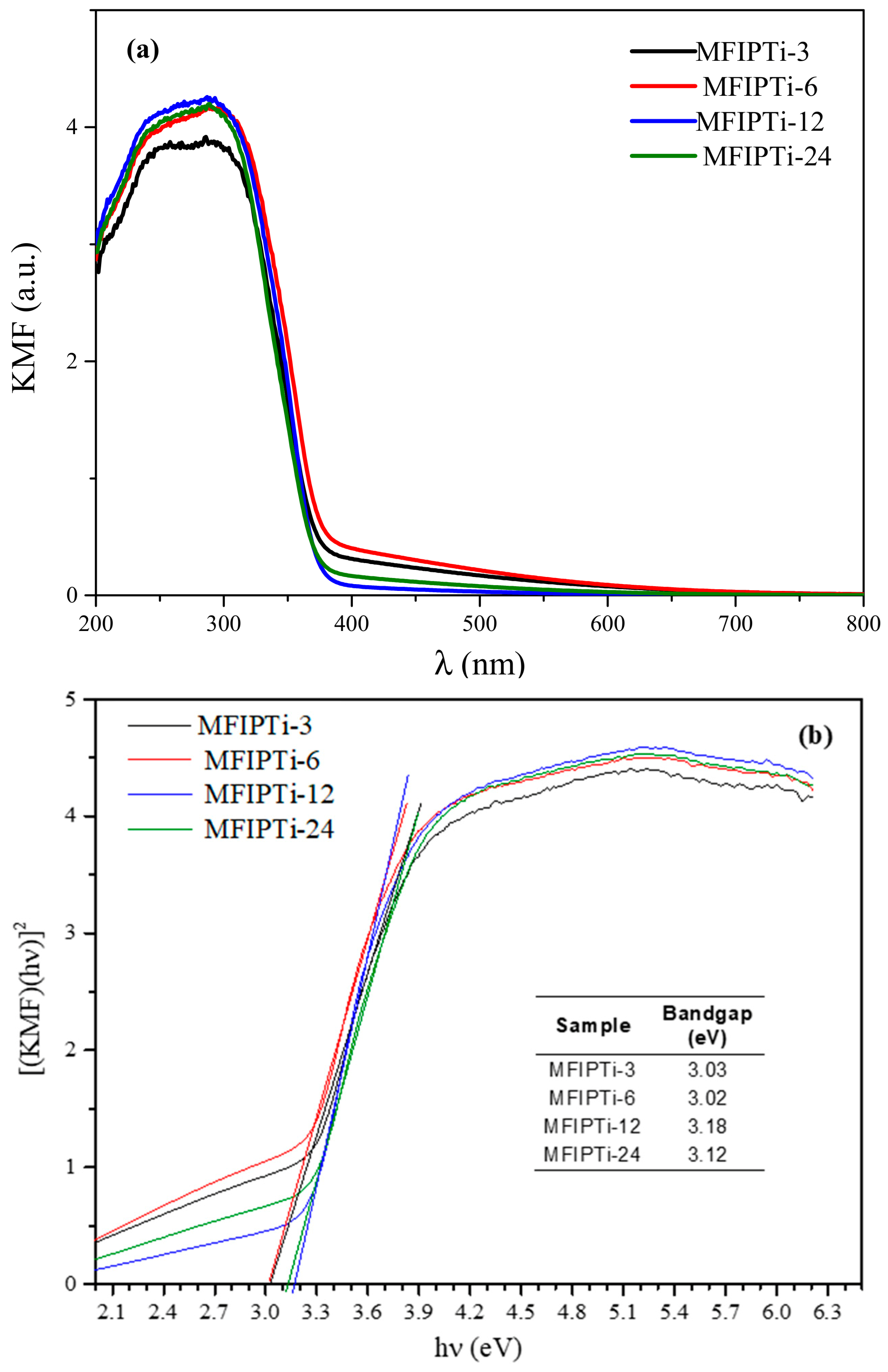
Figure 1a presents the low-angle X-ray diffraction patterns of the pillared zeolitic materials. According to the criteria established by Na et al. [26], the presence of diffraction signals in the low-angle region is indicative of the formation and preservation of a lamellar mesophase within the zeolitic structure. The parent lamellar MFI zeolite exhibits a characteristic low-angle reflection at 2θ = 2.32°, corresponding to a first-order interlayer reflection with an interplanar spacing of approximately 3.9 nm. This reflection confirms the multilamellar organization of the synthesized MFI precursor. After the pillaring process, the MFIPTi-3, MFIPTi-6, MFIPTi-12, and MFIPTi-24 samples also exhibited low-angle reflections located at approximately 2θ = 2.6°, 2.7°, 2.65°, and 2.6°, respectively. These reflections correspond to interplanar distances in the range of 3.3–3.4 nm. Specifically, an interlayer spacing of approximately 3.3 nm was observed for MFIPTi-6 and MFIPTi-12, whereas MFIPTi-3 and MFIPTi-24 exhibited slightly larger values close to 3.4 nm. The decrease in basal spacing relative to the parent lamellar MFI may be associated with structural rearrangements occurring during hydrolysis and calcination, including partial contraction of the interlamellar galleries. Among the synthesized materials, MFIPTi-24 displayed the most well-defined and intense low angle reflection, suggesting a higher degree of preservation of the lamellar ordering after pillaring and thermal treatment. This observation indicates that the stirring time during the pillaring stage plays a significant role in maintaining the structural integrity of the layered arrangement. In this regard, prolonged stirring appears to promote a more homogeneous interaction between the titanium precursor and the interlayer region, favoring better stabilization of the lamellar architecture. The parent MFI sample prior to calcination exhibited a more intense low angle reflection, indicating the high structural organization and stability of the original mesostructure. In contrast, the TiO2 containing samples were analyzed after calcination, and therefore the decrease in low-angle peak intensity can reasonably be attributed to several factors, including the removal of the organic structure-directing species, the formation of the inorganic TiO2 phase, and partial topotactic collapse between adjacent lamellae during thermal treatment [28]. Such behavior is commonly reported in pillared layered materials subjected to calcination processes. Moreover, the reduction in low-angle diffraction intensity after TiO2 incorporation may also indicate a lower degree of intercalation of the titanium precursor (TEOTi) within the interlayer space, particularly when compared with systems pillared using silicon alkoxide precursors such as tetraethyl orthosilicate (TEOS) [13,25]. This behavior can be related to the intrinsic chemical reactivity of TEOTi. Unlike TEOS, titanium tetraethoxide exhibits high sensitivity toward hydrolysis, even under ambient moisture conditions, making strict control of the reaction atmosphere essential during synthesis. Premature hydrolysis of TEOTi may limit its diffusion and homogeneous incorporation within the interlamellar galleries, thereby affecting the final mesostructural organization of the material. In this context, the preservation of the lamellar mesostructure during pillaring could potentially be improved through the use of less hydrolytically sensitive precursors or by employing mixed alkoxide systems containing TEOS, which may help moderate the hydrolysis kinetics of TEOTi under ambient conditions [11]. The diffuse reflectance UV–Vis spectra expressed in Kubelka–Munk units are shown in Figure 2a. All pillared materials exhibited a strong absorption band centered at approximately 288 nm followed by a gradual decrease in absorbance toward higher wavelengths. The MFIPTi-3 and MFIPTi-6 samples showed slight absorption tails extending into the visible region, whereas MFIPTi-12 and MFIPTi-24 exhibited negligible absorption in this range. The absorption band located near 280–288 nm is commonly attributed to ligand-to-metal charge transfer transitions from O2− to Ti4+ species in octahedral coordination environments [30]. Therefore, the observed spectra suggest the successful incorporation of octahedrally coordinated Ti species within the pillared zeolitic framework. The optical band gap energies of the materials were estimated using the Kubelka–Munk approach by constructing Tauc plots from the relationship: [F(R)·hv]1/2 vs. hv. The band gap values were determined by extrapolating the linear region of the plots to the photon energy axis [31], as illustrated in Figure 2b. Among the synthesized materials, MFIPTi-6 exhibited the lowest band gap energy (3.02 eV), whereas MFIPTi-12 showed the highest value (3.18 eV). Although the differences among the samples are relatively small, slight variations in band gap energy can nevertheless be observed as a function of the stirring time employed during synthesis. These results suggest that subtle modifications in the local TiO2 environment, particle dispersion, or semiconductor zeolite interactions may influence the electronic structure of the composites. In general, a slight tendency toward increased band gap energy with longer stirring times was observed. The reported band gap energy for anatase TiO2 is approximately 3.23 eV [32], which is close to the values obtained in the present work. Nevertheless, the slightly lower band gap energies observed for the pillared materials may be advantageous for photocatalytic applications, as they could facilitate photoactivation under near-UV irradiation conditions. Similar behavior has been previously reported for TiO2-based photocatalysts synthesized under controlled hydrolysis conditions, where variations in crystallite size, morphology, and surface hydroxylation were found to influence the optical band gap and photocatalytic degradation efficiency of organic dyes [33].
Figure 2.
(a) Diffuse reflectance absorption spectra and (b) Tauc plots of materials MFIPTi-3, MFIPTi-6, MFIPTi-12, and MFIPTi-24.
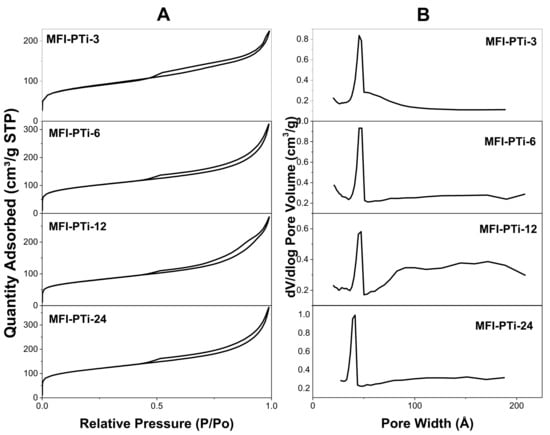
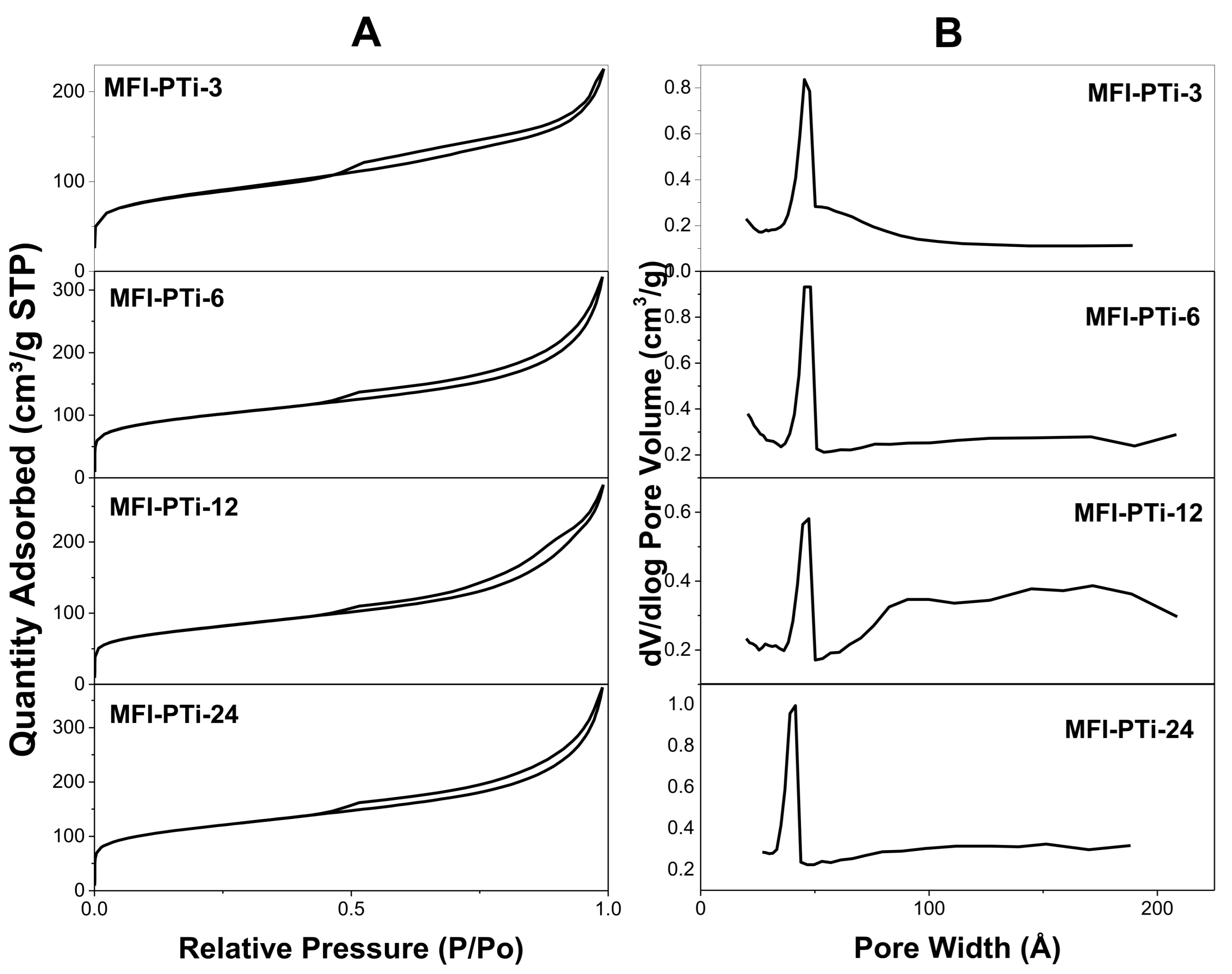
The specific surface area (SBET), microporous surface area (Smicro), total pore volume (Vp), and microporous volume (Vmicro) of the synthesized materials were determined from N2 adsorption–desorption measurements, and the corresponding values are summarized in Table 1. Among the analyzed samples, MFIPTi-24 and MFIPTi-6 exhibited the highest BET surface areas, which can be associated with the successful formation of TiO2 pillars and the consequent increase in interlayer separation within the lamellar zeolitic structure. In general, the incorporation of TiO2 pillars contributed to the development of hierarchical porosity and improved accessibility to the porous network. In particular, the MFIPTi-24 sample showed increases in microporous surface area, total pore volume, and microporous volume, suggesting that prolonged stirring during the pillaring stage favors a more effective intercalation of the titanium precursor into the interlamellar galleries and promotes better preservation of the porous architecture after calcination. Interestingly, the MFIPTi-6 sample also displayed relatively high textural properties despite the shorter stirring time employed during synthesis, indicating that significant pillar formation and pore development can already occur at intermediate reaction times. In contrast, the MFIPTi-3 material exhibited a lower pore volume, although it retained several structural characteristics associated with the zeolitic framework. This behavior may be related to insufficient diffusion and intercalation of the TiO2 precursor within the interlayer domains due to the limited stirring time, leading to less effective pillar formation and reduced mesostructural development. Figure 3A presents the N2 adsorption–desorption isotherms together with the pore size distribution curves for the MFIPTi-3, MFIPTi-6, MFIPTi-12, and MFIPTi-24 samples. All pillared materials exhibited adsorption isotherms characteristic of type IV behavior according to the IUPAC classification [34], confirming the presence of mesoporosity in the synthesized composites. Additionally, all samples displayed H3-type hysteresis loops within the relative pressure range of P/P0 = 0.4–1.0, which are typically associated with slit-shaped pores generated by layered or lamellar structures. This behavior is consistent with previously reported results for pillared lamellar zeolitic materials [13]. The occurrence of this hysteresis loop further supports the successful generation of interlamellar mesoporous domains after TiO2 pillaring. At low relative pressures (P/P0 < 0.3), all samples exhibited significant nitrogen uptake, indicating monolayer–multilayer adsorption processes associated with the intrinsic microporosity of the zeolitic framework [35]. However, the MFIPTi-12 sample showed a noticeably lower adsorption intensity in this region compared with MFIPTi-3, MFIPTi-6, and MFIPTi-24, suggesting a lower contribution of microporous domains in this material. This reduction may indicate partial pore blockage or a less efficient preservation of the microporous structure during the pillaring and calcination processes.
Table 1.
Textural properties of lamellar mesoporous TiO2/MFI materials.
Figure 3.
N2 adsorption–desorption isotherms (A) and pore size distribution (B) curves of lamellar mesoporous TiO2/MFI materials.
Figure 3B presents the pore size distribution curves of the synthesized lamellar mesoporous TiO2/MFI materials. All samples exhibited a well-defined and relatively sharp distribution centered within the range of approximately 4.1–4.2 nm, which is characteristic of the mesoporous architecture generated through the pillaring of the lamellar MFI structure. The presence of this narrow distribution indicates the successful preservation of the ordered mesostructure after TiO2 incorporation and calcination. Among the analyzed materials, MFIPTi-12 displayed a less intense peak, together with a broader distribution extending toward larger pore diameters. This behavior suggests the presence of a less homogeneous interlayer arrangement within the material. More specifically, the spacing between lamellar domains appears to be less uniform compared to the other pillared samples. This observation may indicate that the organization of the zeolitic particles, particularly the stacking and coupling of lamellar aggregates rather than the individual lamellae themselves, is less ordered in MFIPTi-12. Consequently, the broad pore size distribution observed in the range of approximately 8–20 nm is more likely associated with intercrystalline voids formed between aggregated particles rather than with well-defined intracrystalline mesopores generated by controlled pillaring. In contrast, MFIPTi-3, MFIPTi-6, and MFIPTi-24 exhibited comparatively narrower pore size distributions dominated by a single mesopore population centered near 4 nm. This behavior suggests a more uniform interlamellar spacing and a more homogeneous mesostructural organization within these materials. In particular, the well-defined pore distribution observed for MFIPTi-6 and MFIPTi-24 supports the notion that the pillaring process in these samples promoted a more regular separation between zeolitic layers, resulting in a more ordered hierarchical pore system.
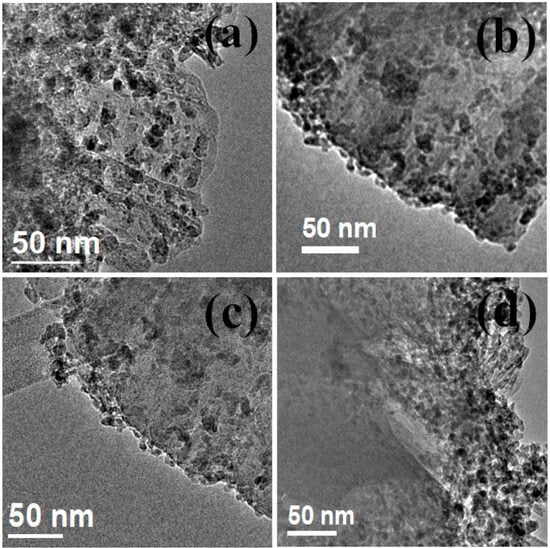
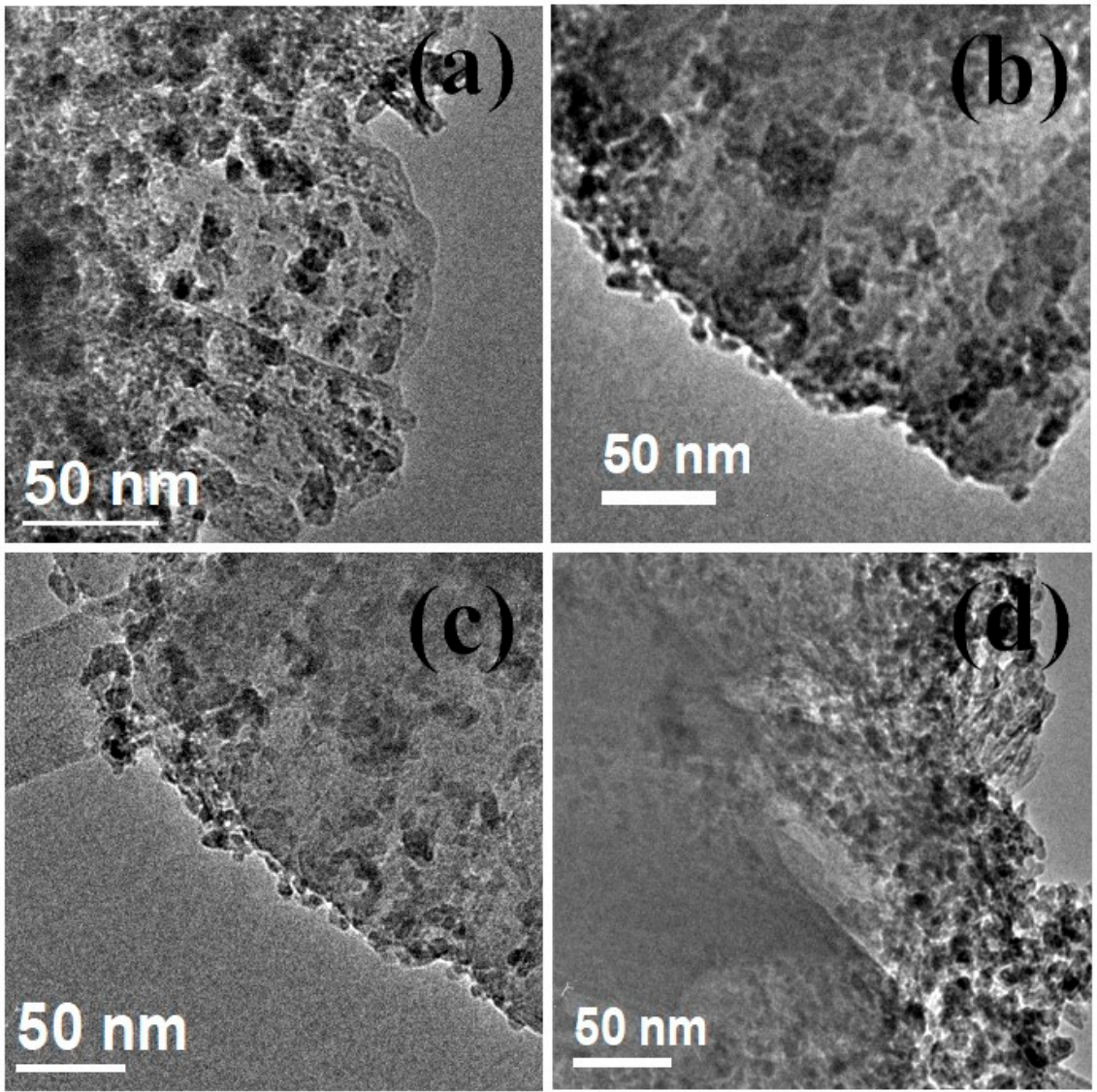
Transmission electron microscopy (TEM) analysis was carried out to investigate the morphology of the lamellar MFI structure as well as the distribution and localization of the TiO2 phase within the composite materials. Figure 4 presents representative TEM micrographs of the samples synthesized using different stirring times during the pillaring process. The micrographs reveal that the lamellar MFI zeolitic framework is uniformly decorated with TiO2 nanoparticles exhibiting average particle sizes in the range of approximately 5–8 nm. These nanoparticles appear to be homogeneously dispersed over the zeolitic surface, indicating effective incorporation and distribution of the semiconductor phase within the layered structure. The nanometric dimensions of the TiO2 particles are consistent with the broad diffraction peaks observed in the XRD analysis and support the formation of nanocrystalline anatase domains.
Figure 4.
TEM images of the samples MFIPTi-3 (a), MFIPTi-6 (b), MFIPTi-12 (c) and MFIPTi-24 (d).
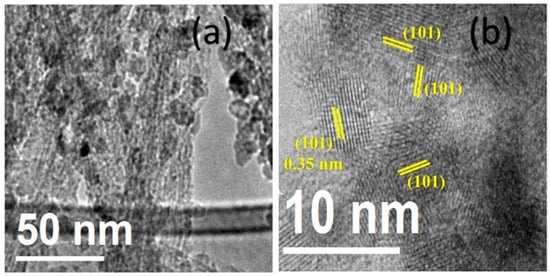
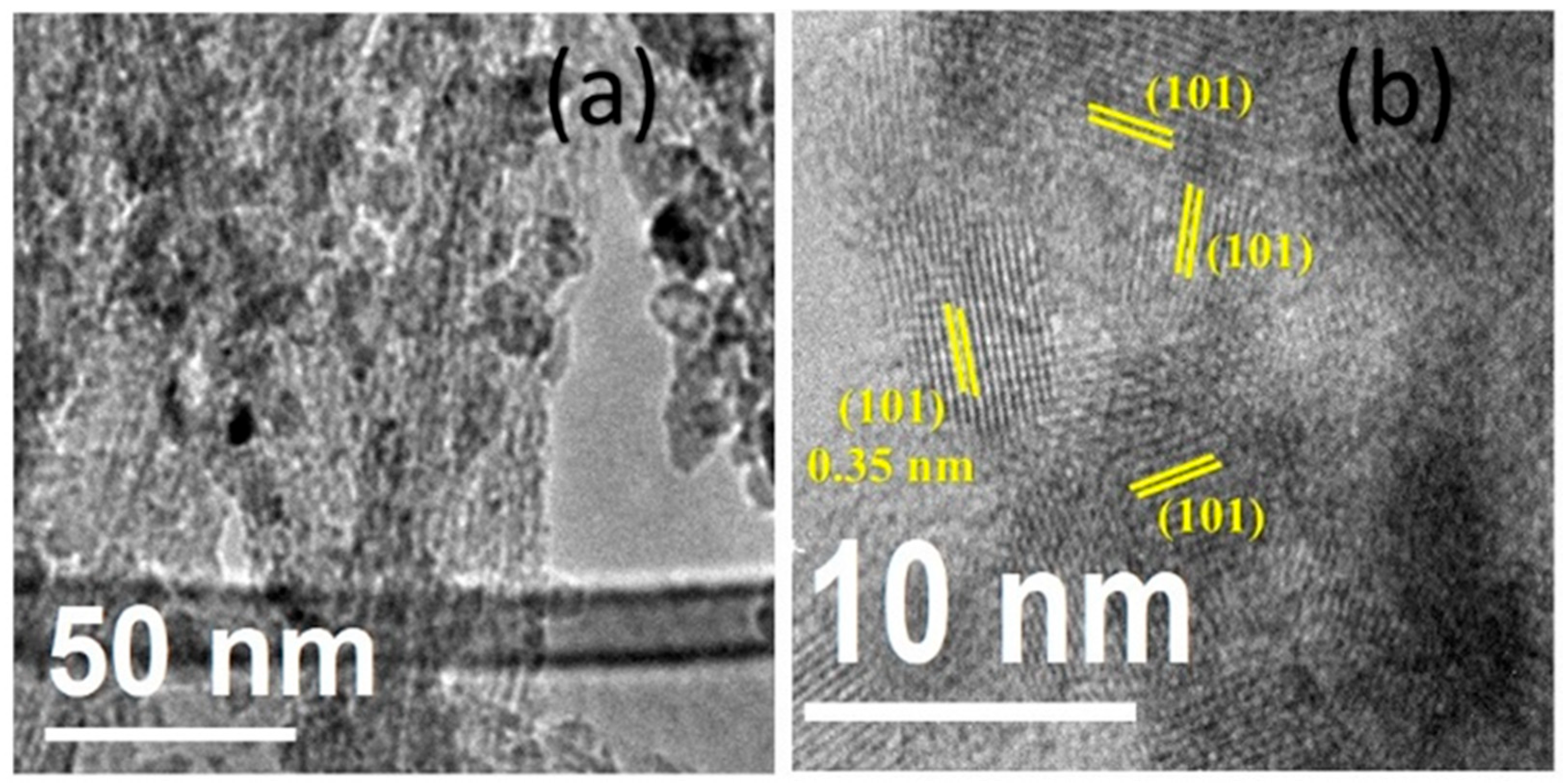
In Figure 5a, the persistence of the lamellar morphology after TiO2 incorporation and calcination can be clearly observed. The final materials retain characteristic fringe-like features typically associated with layered or lamellar zeolitic structures. The preservation of these fringes suggests that the layered organization of the MFI precursor is at least partially maintained after the pillaring process. The observed lamellar contrast may arise from the presence of small TiO2 nanoparticles located within the interlamellar galleries, contributing to the stabilization of the layered arrangement. Additionally, the maintenance of the lamellar morphology may also be related to partial topotactic condensation or non-congruent lamellar collapse during calcination, a phenomenon previously reported for layered zeolitic systems [36]. Such structural rearrangements can promote partial consolidation of the framework while still preserving the characteristic layered architecture of the material. Figure 5b shows high-resolution TEM images in which lattice fringes corresponding to TiO2 nanoparticles can be distinguished. The measured interplanar spacing was approximately d = 0.35 nm, which corresponds to the (101) crystallographic plane of anatase TiO2, the most intense reflection of this crystalline phase. This result further confirms the successful formation of nanocrystalline anatase TiO2 within the pillared zeolitic composites.
Figure 5.
TEM images of samples MFIPTi-3 (a) and MFIPTi-6 (b).
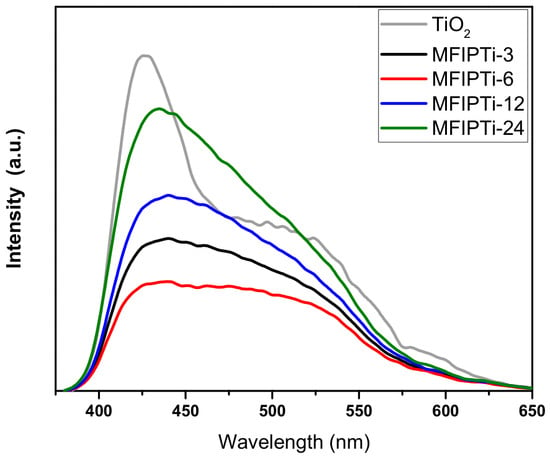
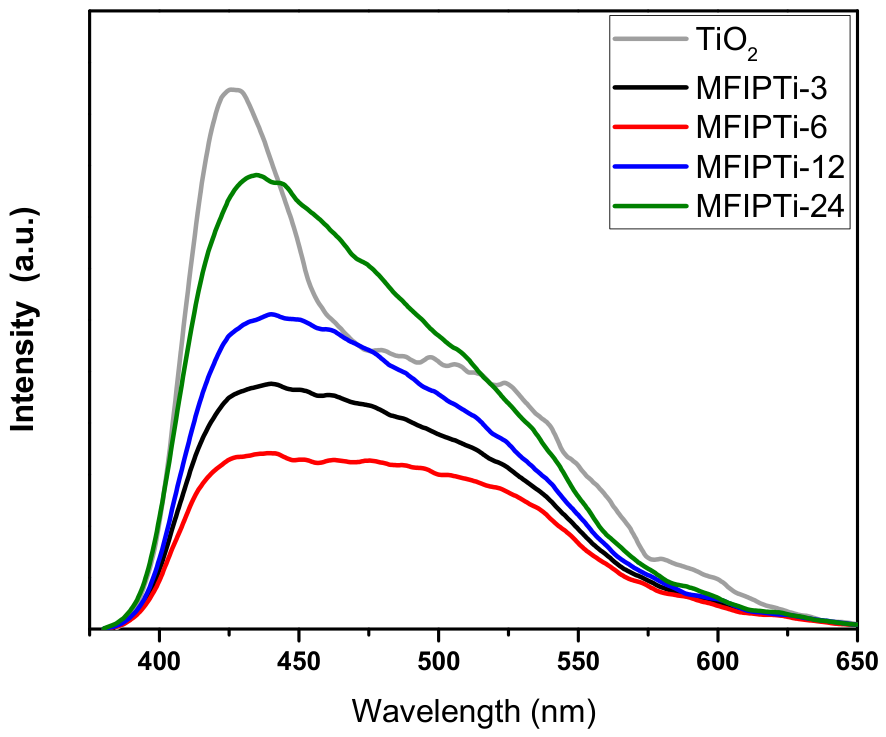
Photoluminescence (PL) spectroscopy is widely employed to investigate the behavior of photogenerated electron–hole pairs and to gain insight into charge separation and recombination processes in photoactive materials [37,38]. In the present study, PL analysis was performed to evaluate the photoelectronic properties of the synthesized TiO2 and TiO2/MFI composite materials. The corresponding spectra are presented in Figure 6.
Figure 6.
PL spectra (365 nm excitation) of TiO2 material and TiO2 incorporated into the zeolite MFI lamellar at different times.
All analyzed samples, including pure TiO2 and the pillared TiO2/MFI composites, exhibited a broad emission band within the wavelength range of approximately 425–445 nm. This emission is characteristic of anatase TiO2 and is generally associated with radiative recombination processes involving photogenerated charge carriers. More specifically, these emissions are attributed to electronic transitions between delocalized band states and localized defect states, including transitions involving the valence band, conduction band, and occupied or unoccupied localized energy levels [39,40]. The PL intensity is directly related to the recombination rate of photogenerated electron–hole pairs. In general, a higher PL intensity indicates a greater probability of charge carrier recombination, whereas lower PL intensity suggests more efficient charge separation and reduced recombination losses. From a photocatalytic standpoint, lower recombination rates are desirable because they increase the availability of charge carriers to participate in surface redox reactions. The relative PL intensities of the materials followed the trend TiO2 > MFIPTi-24 > MFIPTi-12 > MFIPTi-3 > MFIPTi-6. This behavior indicates that the incorporation of the TiO2 phase within the lamellar MFI structure contributes to suppressing electron–hole recombination compared to pure TiO2. Among the synthesized composites, the MFIPTi-6 sample exhibited the lowest PL intensity, suggesting the most efficient charge separation and the lowest recombination rate of photogenerated electron–hole pairs. The improved charge carrier dynamics observed for MFIPTi-6 may be associated with a more favorable dispersion of TiO2 nanoparticles, enhanced semiconductor–zeolite interfacial interactions, and the hierarchical pore structure of the material, all of which can facilitate charge migration and reduce recombination phenomena. Such characteristics are expected to positively influence the photocatalytic performance of the composite material.
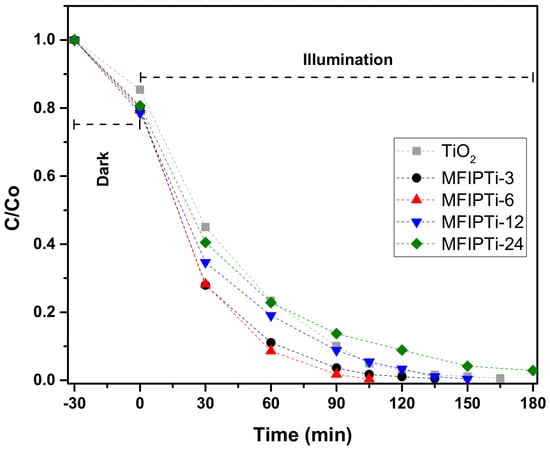
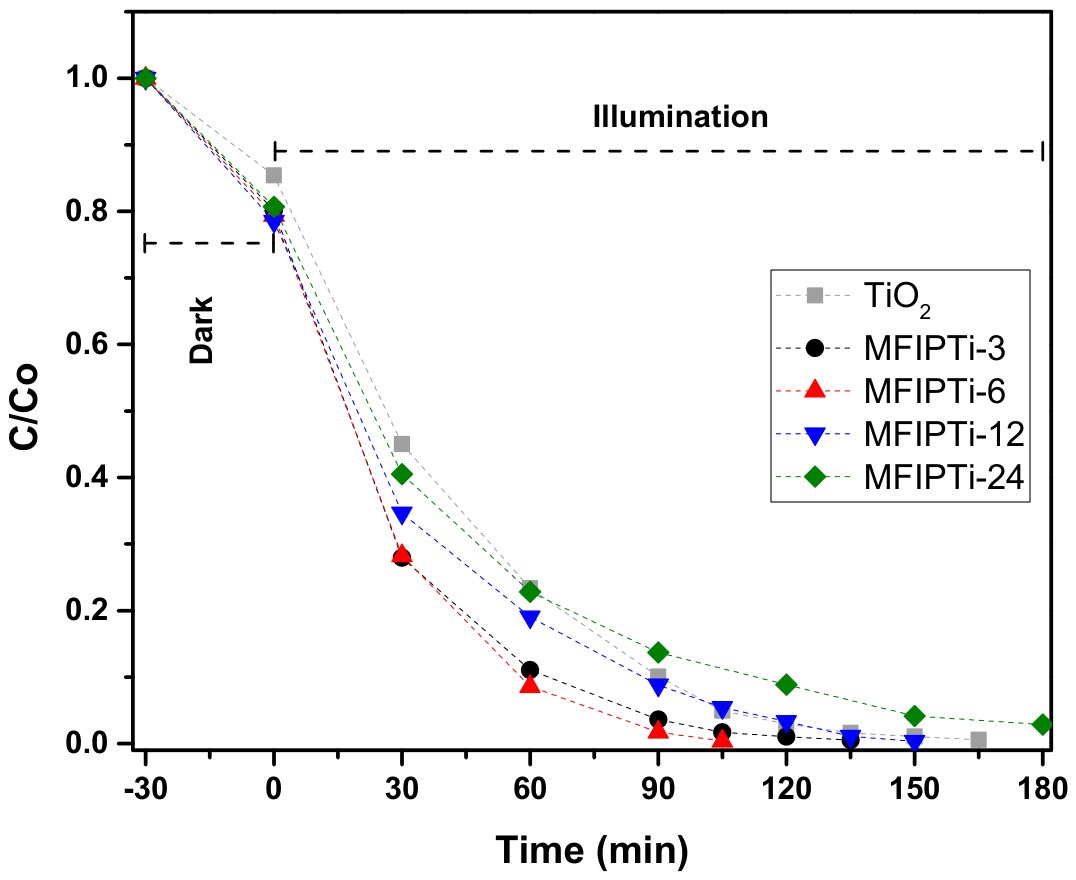
The photocatalytic activity under UV irradiation, together with the adsorption behavior under dark conditions, of the lamellar mesoporous TiO2/MFI materials during Rhodamine B (RhB) degradation is presented in Figure 7. Prior to irradiation, the adsorption capacity of the materials was evaluated during the dark-equilibrium stage. The reference TiO2 sample adsorbed approximately 14% of the initial RhB concentration, whereas the TiO2/MFI composites exhibited slightly enhanced adsorption capacities, with an average increase of approximately 5% relative to pure TiO2 synthesized under similar conditions.
Figure 7.
Photocatalytic degradation of rhodamine B. Plot of C/Co vs. irradiation time.
The photocatalytic degradation kinetics were analyzed using the pseudo-first-order Langmuir–Hinshelwood model, expressed as ln(C0/C) = (kapp)t, where C0 and C are the RhB concentrations at the beginning of irradiation and at reaction time t, respectively, and kapp is the apparent rate constant. Table 2 summarizes the apparent pseudo-first-order kapp for RhB degradation. The kapp values were determined to be 0.031, 0.037, 0.049, 0.033, and 0.019 min−1 for TiO2, MFIPTi-3, MFIPTi-6, MFIPTi-12, and MFIPTi-24, respectively. Among all the synthesized materials, MFIPTi-6 exhibited the highest photocatalytic activity, achieving a rate constant approximately 1.6 times higher than that of bare TiO2, whereas MFIPTi-24 displayed the lowest photocatalytic activity among the TiO2/MFI composites. These results indicate that the incorporation of TiO2 into the lamellar MFI structure significantly influences the degradation kinetics of RhB.
Table 2.
Kinetic parameters (kapp and R2), band gap energies, and time to complete dye degradation for the studied photocatalysts.
Regarding photocatalytic performance, the MFIPTi-3, MFIPTi-6, and MFIPTi-12 samples exhibited higher photocatalytic activities than the reference TiO2 material, confirming that the incorporation of TiO2 into the lamellar MFI structure positively influences the degradation kinetics of Rhodamine B. The apparent pseudo-first-order rate constants (kapp) followed the order MFIPTi-6 (0.049 min−1) > MFIPTi-3 (0.037 min−1) > MFIPTi-12 (0.033 min−1) > TiO2 (0.031 min−1) > MFIPTi-24 (0.019 min−1). Among all synthesized composites, MFIPTi-6 exhibited the highest photocatalytic activity, with a (kapp) value approximately 1.6 times greater than that of bare TiO2 and 2.6 times greater than that of MFIPTi-24. In contrast, MFIPTi-24 displayed the lowest apparent reaction rate despite possessing the highest BET surface area. The enhanced photocatalytic performance of the lamellar mesoporous TiO2/MFI composites can be associated with three main factors: (i) improved textural properties, (ii) enhanced accessibility and diffusion of RhB molecules through the hierarchical lamellar structure, and (iii) the availability and dispersion of catalytically active Ti species within the material. In this regard, although TiO2 has been extensively investigated for dye degradation applications, only a limited number of studies have explored the use of lamellar or hierarchical zeolites as support for TiO2-based photocatalysts. Therefore, the photocatalytic performance achieved in the present study, with a maximum apparent rate constant (Kapp) of 0.049 min−1, is comparable to, and in some cases exceeds, that reported for similar systems in which TiO2 constitutes the sole active phase [41,42,43]. These findings highlight the potential and robustness of the catalytic system investigated herein, which is currently undergoing further optimization to enhance its photocatalytic efficiency.
The textural characterization results (Table 1) indicate that the pillared materials possess relatively high specific surface areas, providing a large interfacial contact area between the photocatalyst and RhB molecules. This enhanced surface accessibility favors adsorption and may contribute to the photocatalytic degradation process. However, the photocatalytic activity does not correlate directly with the textural parameters. For instance, MFIPTi-24 exhibited the highest BET surface area (382 m2 g−1), microporous surface area (92 m2 g−1), and micropore volume (0.053 cm3 g−1), yet its photocatalytic activity was significantly lower than that of MFIPTi-6. The TEM images suggest that increasing the TiO2 content affects the distribution of the Ti-containing phase within the lamellar structure. In particular, MFIPTi-24 exhibits regions with higher contrast and a less homogeneous distribution of TiO2 species compared to MFIPTi-6, indicating the possible formation of larger TiO2 domains at higher loadings. These observations suggest that surface area alone is not the determining factor governing the degradation performance. Instead, photocatalytic efficiency appears to be more strongly influenced by the dispersion of TiO2 species and the dynamics of charge carriers. Such structural changes may reduce the effectiveness of charge separation and increase the probability of electron–hole recombination, despite the favorable textural properties of the material. This interpretation is further supported by the PL results, which indicate more efficient charge separation for MFIPTi-6 than for MFIPTi-24. Therefore, the superior activity of MFIPTi-6 is attributed to a more favorable balance between surface accessibility, TiO2 dispersion, and charge separation efficiency.
Additionally, the molecular dimensions of RhB (17.9 × 9.8 × 4.3 Å) [44] suggest that the interlayer spacing and mesoporosity generated within the pillared zeolite play a crucial role in facilitating molecular diffusion and mass transport. In the present study, the interplanar spacing (~3.9 nm) together with the mesopore size distribution centered near 4.1 nm provided suitable channels for the transport and adsorption of RhB molecules within the photocatalytic structure, thereby enhancing degradation efficiency. Likewise, the low-angle XRD results confirmed the formation and preservation of the lamellar zeolitic arrangement, while the wide-angle diffraction patterns evidenced the formation of anatase TiO2 pillars within the interlamellar regions. This hierarchical architecture is particularly advantageous because it increases the exposure and accessibility of Ti active sites distributed throughout the pillared structure. Furthermore, the confinement of TiO2 within the layered framework contributes to maintaining a high dispersion of the photoactive phase while preserving accessible porous pathways for RhB diffusion toward the active photocatalytic sites located inside the material.
The photocatalytic degradation results exhibited a strong correlation with the photoluminescence (PL) analysis. Although a decrease in PL intensity is commonly associated with suppressed radiative electron–hole recombination, other contributions should also be considered. In the present composites, partial light absorption or scattering by the zeolitic phase, as well as the formation of Ti–O–Si interfacial linkages, may influence the PL response. Therefore, the observed PL quenching cannot be attributed exclusively to reduced recombination. Nevertheless, the inverse correlation between PL intensity and photocatalytic activity indicates that charge separation plays a significant role in determining the photocatalytic performance. The incorporation of TiO2 into the lamellar MFI framework appears to promote a synergistic interaction between the semiconductor phase and the hierarchical MFI structure, favoring the utilization of photogenerated charge carriers in surface redox reactions. In particular, MFIPTi-6 exhibited the lowest PL intensity and the highest RhB degradation rate, suggesting that this sample provides the most favorable balance between TiO2 dispersion, charge-carrier separation, and accessibility of active sites. These results are consistent with the superior photocatalytic activity observed for MFIPTi-6 and further support the beneficial role of the hierarchical TiO2/MFI architecture in enhancing photocatalytic performance.
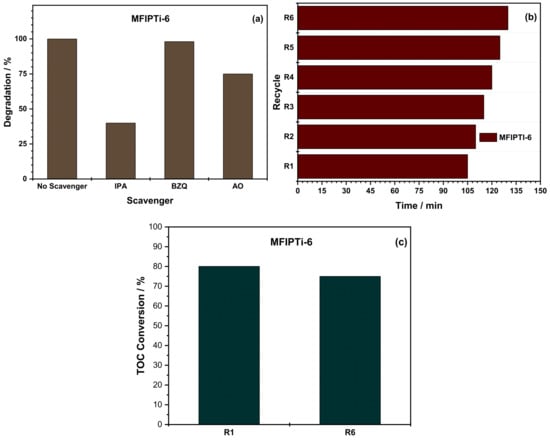
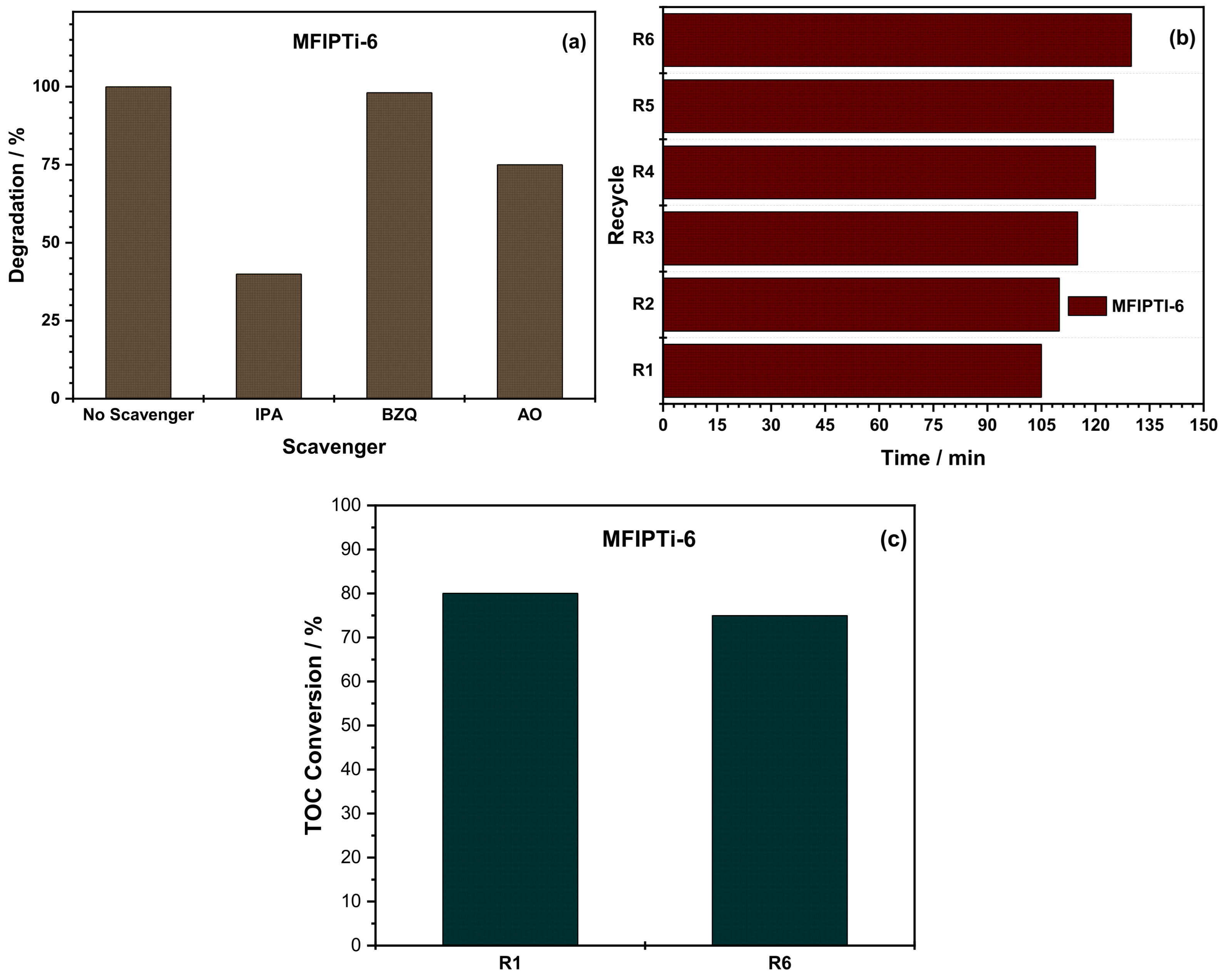
Figure 8 provides additional insight into the photocatalytic mechanism, stability, and long-term performance of the MFIPTi-6 material. The scavenger experiments (Figure 8a) revealed that the photocatalytic degradation of RhB is strongly influenced by the presence of hydroxyl radicals (•OH). The addition of isopropanol (IPA), used as a hydroxyl radical scavenger, resulted in the most pronounced decrease in degradation efficiency, indicating that •OH species play a dominant role in the oxidation process. In contrast, the presence of benzoquinone (BZQ), a superoxide radical scavenger, produced only a slight decrease in activity, suggesting a limited contribution of O2•− species. The addition of ammonium oxalate (AO), employed as a hole scavenger, caused a moderate reduction in degradation efficiency, indicating that photogenerated holes also participate in the reaction mechanism. These results suggest that hydroxyl radicals are the primary reactive species responsible for RhB degradation, while photogenerated holes contribute as secondary oxidizing agents.
Figure 8.
(a) Photocatalytic generation of ROS, (b) Reusability tests, and (c) TOC (%) measured after the end of the first and sixth runs (R1 and R6 cycle) for the MFIPTi-6 material.
The reusability experiments (Figure 8b) demonstrated that MFIPTi-6 retains a high photocatalytic activity after six consecutive reaction cycles. Although a slight increase in the degradation time was observed with successive cycles, the catalyst maintained an excellent performance throughout the recycling tests, indicating good structural stability and resistance to deactivation under the reaction conditions. This behavior highlights the robustness of the hierarchical TiO2/MFI architecture and its potential for repeated use in photocatalytic applications.
To evaluate the extent of organic pollutant removal beyond dye decolorization, total organic carbon (TOC) measurements were performed during the recycling experiments. The TOC analysis (Figure 8c) revealed total organic carbon removals of approximately 80% and 75% for the first (R1) and sixth (R6) cycles, respectively. The small decrease observed after six consecutive cycles demonstrates the excellent stability of the MFIPTi-6 photocatalyst and indicates that its ability to oxidize organic species is largely preserved during repeated operation. This result is consistent with the recyclability tests and confirms that the catalyst maintains both high photocatalytic activity and substantial organic carbon removal after multiple reuse cycles, confirming its suitability as a stable and reusable photocatalyst for wastewater treatment applications.
4. Conclusions
Lamellar mesoporous TiO2/MFI composites were successfully synthesized through the pillaring of layered MFI zeolites using titanium tetraethoxide as precursor, followed by hydrolysis and calcination treatments. XRD analysis confirmed the preservation of the lamellar MFI structure together with the formation of nanocrystalline anatase TiO2 within the pillared materials. The synthesized composites exhibited hierarchical micro-/mesoporosity, high surface areas, and suitable pore dimensions that favored the diffusion and adsorption of Rhodamine B molecules. Photocatalytic degradation experiments demonstrated that the incorporation of TiO2 into the lamellar MFI framework significantly enhanced the degradation kinetics of Rhodamine B compared with pure TiO2. The apparent pseudo-first-order rate constants followed the order MFIPTi-6 > MFIPTi-3 > MFIPTi-12 > TiO2 > MFIPTi-24, with MFIPTi-6 exhibiting the highest activity (kapp = 0.049 min−1), approximately 1.6 times greater than that of bare TiO2. The superior performance of MFIPTi-6 was attributed to a favorable balance between textural properties, accessibility of Ti-active sites, dispersion of the TiO2 phase, and efficient utilization of photogenerated charge carriers. Photoluminescence measurements indicated improved charge separation in the composites, although the observed PL quenching may also be influenced by light absorption/scattering effects and Ti-O-Si interfacial interactions. In addition, scavenger experiments revealed that hydroxyl radicals (•OH) are the predominant reactive species involved in Rhodamine B degradation, while photogenerated holes also contribute to the photocatalytic process. These findings suggest that the enhanced photocatalytic activity results from the synergistic interplay between hierarchical porosity, favorable TiO2 dispersion, and effective utilization of photogenerated charge carriers. The MFIPTi-6 material also exhibited good stability during six consecutive reuse cycles, maintaining high photocatalytic activity and organic carbon removal efficiency. These results demonstrate that the hierarchical TiO2/MFI architecture remains effective during repeated operation and possesses promising stability under the investigated conditions. Overall, the results demonstrate that lamellar mesoporous TiO2/MFI materials are effective hierarchical photocatalysts for the degradation of organic pollutants. The combination of enhanced photocatalytic activity, significant organic carbon removal, and good recyclability highlights their potential for photocatalytic water treatment applications. Nevertheless, further studies under long-term operating conditions and with real wastewater matrices are required to fully assess their practical applicability.
Author Contributions
Conceptualization, R.I.Y.-G. and U.C.-F.; Data curation, R.I.Y.-G., U.C.-F., J.A.-G., F.N.M.-R., H.A.B.-N., S.F.-M., M.G.S. and V.P.; Formal analysis, R.I.Y.-G. and U.C.-F.; Funding acquisition, U.C.-F. and S.F.-M.; Investigation, R.I.Y.-G., U.C.-F., J.A.-G., F.N.M.-R., S.F.-M., M.G.S. and V.P.; Methodology, R.I.Y.-G., U.C.-F. and A.U.R.d.E.; Supervision, R.I.Y.-G. and U.C.-F.; Validation, R.I.Y.-G. and U.C.-F.; Writing—original draft, R.I.Y.-G., U.C.-F. and A.U.R.d.E.; Writing—review and editing, R.I.Y.-G., U.C.-F., J.A.-G., F.N.M.-R., H.A.B.-N., S.F.-M., M.G.S. and V.P. All authors have read and agreed to the published version of the manuscript.
Funding
This research was funded by PAPIIT through Projects IV100124, IN116424, IN115920, IN111622 and SENER-CONACyT through Project 117373. MGS acknowledges Saint-Petersburg State University for research project 150805481.
Data Availability Statement
The original contributions presented in this study are included in the article. Further inquiries can be directed to the corresponding authors.
Acknowledgments
The authors would like to thank P. Casillas, D. Dominguez, and C. Gonzalez for technical assistance.
Conflicts of Interest
The authors declare no conflicts of interest.
References
- Wu, Q.; Liang, H.; Li, M.; Liu, B.; Xu, Z. Hierarchically Porous Carbon Membranes Derived from PAN and Their Selective Adsorption of Organic Dyes. Chin. J. Polym. Sci. 2016, 34, 23–33. [Google Scholar]
- Crini, G. Non-Conventional Low-Cost Adsorbents for Dye Removal: A Review. Bioresour. Technol. 2006, 97, 1061–1085. [Google Scholar] [PubMed]
- Houas, A.; Lachheb, H.; Ksibi, M.; Elaloui, E.; Guillard, C.; Herrmann, J.M. Photocatalytic Degradation Pathway of Methylene Blue in Water. Appl. Catal. B Environ. 2001, 31, 145–157. [Google Scholar] [CrossRef] [Scilit]
- Chormare, R.; Kumar, M.A. Environmental Health and Risk Assessment Metrics with Special Mention to Biotransfer, Bioaccumulation and Biomagnification of Environmental Pollutants. Chemosphere 2022, 302, 134836. [Google Scholar] [CrossRef] [Scilit] [PubMed]
- Xu, D.; Ma, H. Degradation of Rhodamine B in Water by Ultrasound-Assisted TiO2 Photocatalysis. J. Clean. Prod. 2021, 313, 127758. [Google Scholar] [CrossRef] [Scilit]
- Skjolding, L.M.; Dyhr, K.S.; Köppl, C.J.; McKnight, U.S.; Bauer-Gottwein, P.; Mayer, P.; Bjerg, P.L.; Baun, A. Assessing the Aquatic Toxicity and Environmental Safety of Tracer Compounds Rhodamine B and Rhodamine WT. Water Res. 2021, 197, 117109. [Google Scholar] [CrossRef] [Scilit] [PubMed]
- Thiruvenkatachari, R.; Vigneswaran, S.; Moon, I.S. A Review on UV/TiO2 Photocatalytic Oxidation Process. Korean J. Chem. Eng. 2008, 25, 64–72. [Google Scholar] [CrossRef] [Scilit]
- Zangeneh, H.; Zinatizadeh, A.A.L.; Habibi, M.; Akia, M.; Hasnain Isa, M. Photocatalytic Oxidation of Organic Dyes and Pollutants in Wastewater Using Different Modified Titanium Dioxides: A Comparative Review. J. Ind. Eng. Chem. 2015, 26, 1–36. [Google Scholar] [CrossRef] [Scilit]
- Gatou, M.-A.; Syrrakou, A.; Lagopati, N.; Pavlatou, E.A. Photocatalytic TiO2-Based Nanostructures as a Promising Material for Diverse Environmental Applications: A Review. Reactions 2024, 5, 135–194. [Google Scholar]
- Khatamian, M.; Hashemian, S.; Sabaee, S. Preparation and Photo-Catalytic Activity of Nano-TiO2ZSM-5 Composite. Mater. Sci. Semicond. Process. 2010, 13, 156–161. [Google Scholar] [CrossRef] [Scilit]
- Emdadi, L.; Tran, D.T.; Zhang, J.; Wu, W.; Song, H.; Gan, Q.; Liu, D. Synthesis of Titanosilicate Pillared MFI Zeolite as an Efficient Photocatalyst. RSC Adv. 2017, 7, 3249–3256. [Google Scholar]
- Antúnez-García, J.; Galván, D.H.; Petranovskii, V.; Murrieta-Rico, F.N.; Yocupicio-Gaxiola, R.I.; Fuentes-Moyado, S. Theoretical Study of the Effect of Isomorphous Substitution by Al3+ and/or Fe3+ cations to Tetrahedral Positions in the Frame-work of a Zeolite with Erionite Topology. J. Mater. Sci. 2019, 54, 13190–13199. [Google Scholar] [CrossRef] [Scilit]
- Yocupicio-Gaxiola, R.I.; Petranovskii, V.; Antúnez-García, J.; Fuentes Moyado, S. One-Pot Synthesis of Lamellar Mordenite and ZSM-5 Zeolites and Subsequent Pillaring by Amorphous SiO2. Appl. Nanosci. 2019, 9, 557–565. [Google Scholar] [CrossRef] [Scilit]
- Antúnez-García, J.; Yocupicio-Gaxiola, R.I.; Serrato, A.R.; Petranovskii, V.; Murrieta-Rico, F.N.; Shelyapina, M.G.; Fuentes-Moyado, S. A Theoretical Study of the Effect of Exchange Cations in Surface of ZSM-5 Lamellar Zeolites. J. Solid State Chem. 2023, 317, 123725. [Google Scholar]
- Thang, H.V.; Rubes, M.; Bludsky, O.; Nachtigall, P. Computational Investigation of the Lewis Acidity in Three-Dimensional and Corresponding Two-Dimensional Zeolites: UTL vs IPC-1P. J. Phys. Chem. A 2014, 118, 7526–7534. [Google Scholar] [PubMed]
- Opanasenko, M.V.; Roth, W.J.; Čejka, J. Two-Dimensional Zeolites in Catalysis: Current Status and Perspectives. Catal. Sci. Technol. 2016, 6, 2467–2484. [Google Scholar]
- Roth, W.J.; Gil, B.; Makowski, W.; Marszalek, B.; Eliášová, P. Layer like Porous Materials with Hierarchical Structure. Chem. Soc. Rev. 2016, 45, 3400–3438. [Google Scholar] [PubMed]
- Roth, W.J.; Nachtigall, P.; Morris, R.E.; Čejka, J. Two-Dimensional Zeolites: Current Status and Perspectives. Chem. Rev. 2014, 114, 4807–4837. [Google Scholar] [CrossRef] [Scilit] [PubMed]
- Zhang, J.; Lu, Z.; Wu, W.; Tran, D.T.; Shang, W.; Chen, H.; Lei, Y.; Li, Z.; Wang, M.; Woehl, T.J. Mesopore Differences between Pillared Lamellar MFI and MWW Zeolites Probed by Atomic Layer Deposition of Titania and Consequences on Photocatalysis. Micropor. Mesopor. Mat. 2019, 276, 260–269. [Google Scholar] [CrossRef] [Scilit]
- Li, B.; Zhang, X.; Yang, X.; Xu, Y.; Chun, W.; Hao, Q.; Zhang, J.; Li, Z.; Chen, H.; Ma, X. Ti3+ Self-Doped TiO2 Nanoparticles Immobilized on Self-Pillared Pentasil Zeolite Nanosheets: An Efficient Visible-Light-Driven Degradation Photocatalyst. Appl. Surf. Sci. 2024, 677, 161000. [Google Scholar]
- Yang, J.-H.; Piao, H.; Vinu, A.; Elzatahry, A.A.; Paek, S.-M.; Choy, J.-H. TiO2-Pillared Clays with Well-Ordered Porous Structure and Excellent Photocatalytic Activity. RSC Adv. 2015, 5, 8210–8215. [Google Scholar]
- Fatimah, I.; Nurillahi, R.; Sahroni, I.; Muraza, O. TiO2-Pillared Saponite and Photosensitization Using a Ruthenium Complex for Photocatalytic Enhancement of the Photodegradation of Bromophenol Blue. Appl. Clay Sci. 2019, 183, 105302. [Google Scholar]
- Chen, D.; Zhu, Q.; Zhou, F.; Deng, X.; Li, F. Synthesis and Photocatalytic Performances of the TiO2 Pillared Montmorillonite. J. Hazard. Mat. 2012, 235, 186–193. [Google Scholar] [CrossRef] [Scilit]
- Fatimah, I.; Wijaya, K. Microwave Assisted Preparation of TiO2/Al-Pillared Saponite for Photocatalytic Phenol Photo-Oxidation in Aqueous Solution. Arab. J. Chem. 2015, 8, 228–232. [Google Scholar]
- Shelyapina, M.G.; Yocupicio-Gaxiola, R.I.; Zhelezniak, I.V.; Chislov, M.V.; Antúnez-García, J.; Murrieta-Rico, F.N.; Galván, D.H.; Petranovskii, V.; Fuentes-Moyado, S. Local Structures of Two-Dimensional Zeolites—Mordenite and ZSM-5—Probed by Multinuclear NMR. Molecules 2020, 25, 4678. [Google Scholar] [PubMed]
- Na, K.; Chol, M.; Park, W.; Sakamoto, Y.; Terasakl, O.; Ryoo, R. Pillared MFI Zeolite Nanosheets of a Single-Unit-Cell Thickness. J. Am. Chem. Soc. 2010, 132, 4169–4177. [Google Scholar] [PubMed]
- Zhang, H.; Banfield, J.F. Structural Characteristics and Mechanical and Thermodynamic Properties of Nanocrystalline TiO2. Chem. Rev. 2014, 114, 9613–9644. [Google Scholar] [CrossRef] [Scilit] [PubMed]
- Naught, M.; Wilkinson, A.; Nic, M.; Jirat, J.; Kosata, B.; Jenkins, A. IUPAC, Compendium of Chemical Terminology. XML on-Line Corrected Version 2006. Available online: http://goldbook.iupac.org (accessed on 4 May 2026).
- Baerlocher, C.; McCusker, L.B. Database of Zeolite Structures. Available online: http://www.iza-structure.org/databases/ (accessed on 4 May 2026).
- Přech, J.; Eliášová, P.; Aldhayan, D.; Kubů, M. Epoxidation of Bulky Organic Molecules over Pillared Titanosilicates. Catal. Today 2015, 243, 134–140. [Google Scholar] [CrossRef] [Scilit]
- Abdullahi, S.S.; Güner, S.; Koseoglu, Y.; Murtala, I.; Adamu, B.I.; Abdulhamid, M.I. Simple Method For The Determination of Band Gap of a Nanopowdered Sample Using Kubelka Munk Theory. J. Niger. Assoc. Math. Phys. (NAMP) 2016, 35, 241–246. [Google Scholar]
- Hellwege, K.-H.; Madelung, O.; Schulz, M.; Weiss, H. Landolt-Börnstein Neue Serie; Springer: New York, NY, USA, 1984. [Google Scholar]
- Estrada-Flores, S.; Flores-Guia, T.E.; Pérez-Berumen, C.M.; García-Cerda, L.A.; Robledo-Cabrera, A.; Aguilera-González, E.N.; Martínez-Luévanos, A. Effect of Acetic Acid on Morphology, Structure, Optical Properties, and Photocatalytic Activity of TiO2 Obtained by Sol–Gel. Reactions 2026, 7, 5. [Google Scholar] [CrossRef] [Scilit]
- Thommes, M.; Kaneko, K.; Neimark, A.V.; Olivier, J.P.; Rodriguez-Reinoso, F.; Rouquerol, J.; Sing, K.S.W. Physisorption of Gases, with Special Reference to the Evaluation of Surface Area and Pore Size Distribution (IUPAC Technical Report). Pure Appl. Chem. 2015, 87, 1051–1069. [Google Scholar] [CrossRef] [Scilit]
- Liou, T.H.; Lin, M.H. Surface and Pore Characteristics of MCM-48 Synthesized Using Cationic/Nonionic Surfactants by a Green Way. J. Nanosci. Nanotechnol. 2016, 16, 9115–9124. [Google Scholar] [CrossRef] [Scilit]
- McNaught, A.D.; Wilkinson, A. Compendium of Chemical Terminology; Blackwell Science: Oxford, UK, 1997; Volume 1669. [Google Scholar]
- Dong, Y.; Zhang, W.; Tao, Y. CTAB Modified TiO2 Supported on HZSM-5 Zeolite for Enhanced Photocatalytic Degradation of Azophloxine. J. Mater. Res. Technol. 2020, 9, 9403–9411. [Google Scholar] [CrossRef] [Scilit]
- Wang, C.; Li, Y. Preparation and Characterisation of S Doped TiO2/Natural Zeolite with Photocatalytic and Adsorption Activities. Mater. Technol. 2014, 29, 204–209. [Google Scholar]
- Caudillo-Flores, U.; Lara-Romero, J.; Zárate-Medina, J.; Muñoz-Batista, M.J.; Huirache-Acuña, R.; Rivera-Muñoz, E.M.; Cortés, J.A. Enhanced Photocatalytic Activity of MWCNT/TiO2 Heterojunction Photocatalysts Obtained by Microwave Assisted Synthesis. Catal. Today 2016, 266, 102–109. [Google Scholar] [CrossRef] [Scilit]
- Muñoz-Batista, M.J.; Nasalevich, M.A.; Savenije, T.J.; Kapteijn, F.; Gascon, J.; Kubacka, A.; Fernández-García, M. Enhancing Promoting Effects in G-C3N4-Mn+/CeO2-TiO2 Ternary Composites: Photo-Handling of Charge Carriers. Appl. Catal. B Environ. 2015, 176–177, 687–698. [Google Scholar] [CrossRef] [Scilit]
- Yang, X.; Gan, C.; Xiong, H.; Huang, L.; Luo, X. Fabrication and Characterization of SiO2@TiO2@ Silicalite-1 Catalyst and Its Application for Degradation of Rhodamine B. RSC Adv. 2016, 6, 105737–105743. [Google Scholar]
- Azeez, S.O.; Saheed, I.O.; Adekola, F.A.; Salau, S.S. Preparation of TiO2-Activated Kaolinite Composite for Photocatalytic Degradation of Rhodamine B Dye. Bull. Chem. Soc. Ethiop. 2022, 36, 13–24. [Google Scholar] [CrossRef] [Scilit]
- Karimi, M.; Grayeli, A. Synthesis and Characterization of Nonmetal-Doped TiO2 Nanoparticles for Photocatalytic Degradation of Rhodamine B Dye. Prog. Color Color. Coat. 2024, 17, 263–273. [Google Scholar]
- Canning, J.; Huyang, G.; Ma, M.; Beavis, A.; Bishop, D.; Cook, K.; McDonagh, A.; Shi, D.; Peng, G.-D.; Crossley, M.J. Percolation Diffusion into Self-Assembled Mesoporous Silica Microfibres. Nanomaterials 2014, 4, 157–174. [Google Scholar] [CrossRef] [Scilit] [PubMed]

Disclaimer/Publisher’s Note: The statements, opinions and data contained in all publications are solely those of the individual author(s) and contributor(s) and not of MDPI and/or the editor(s). MDPI and/or the editor(s) disclaim responsibility for any injury to people or property resulting from any ideas, methods, instructions or products referred to in the content. |
© 2026 by the authors. Licensee MDPI, Basel, Switzerland. This article is an open access article distributed under the terms and conditions of the Creative Commons Attribution (CC BY) license.