


Abstract
Copper-catalyzed oxidative coupling links coordination chemistry to the manufacture of poly(2,6-dimethyl-1,4-phenylene oxide), also termed poly(phenylene ether) (PPO/PPE). This critical narrative review examines how ligand architecture, halide coordination, solvent, base, and oxygen availability influence copper speciation and phenolic coupling. A historical account connects early copper–amine formulations with diamine catalysts, mechanistic and spectroscopic studies, aqueous polymerization, and supported catalyst designs. Particular attention is given to Cu–diamine–halide systems investigated through the oxidation of 2,6-di-tert-butylphenol (DTBP) to diphenoquinone. These experiments establish condition-specific correlations between solution composition and activity, but do not by themselves identify the species controlling C–O-selective polymerization of 2,6-dimethylphenol. Radical, phenoxonium, and copper–oxygen pathways are evaluated according to the evidence supporting each proposed step. The industrial discussion connects polymer structure and purification to engineering blends, electrical components, water-management applications, reactive oligomers, emerging functional membranes, and experimental pollutant-to-polymer recovery. Across these applications, catalyst assessment requires more than substrate conversion: C–O selectivity, molar-mass distribution, end-group chemistry, residual copper, and process requirements also warrant consideration. Recent coupled spectroscopic methods provide precedents for tracking transient copper species; extending such measurements to PPO turnover, together with product-resolved kinetics and polymer characterization, offers a practical route toward predictive catalyst design.
1. Introduction
The oxidative polymerization of 2,6-dimethylphenol (DMP) to poly(2,6-dimethyl-1,4-phenylene oxide) is an established application of copper-mediated aerobic coupling [1]. PPO and PPE refer here to the same substituted aromatic polyether, and they should not be confused with poly(propylene oxide) [1]. Blending extends its processability and application range, with NORYL representing a commercial family rather than a unique polymer composition [1]. Copper–amine formulations have evolved over decades. One important patented example is the CuBr2/N,N′-di-tert-butylethylenediamine (dbed) complex, but a precursor formula does not establish the identity of the active species under turnover [2,3].
The commercial success of this chemistry has long coexisted with an incomplete molecular understanding: assignments of the species controlling PPO turnover remain strongly condition-dependent. Time-resolved, coupled spectroscopic methods are now improving access to transient species in related copper oxidations [4]; their application to polymerization is a distinct experimental challenge. The mechanistic stakes extend beyond polymer science. Oxidative couplings of phenols and naphthols provide access to biaryl and diaryl ether frameworks abundant in natural products and materials chemistry, and copper-catalyzed aerobic variants tolerate functional groups that classical cross-coupling methods require prefunctionalized substrates to accommodate [5]. Understanding which Cu species activate phenolic O–H and C–H bonds is therefore relevant to homogeneous catalysis broadly and to bioinspired oxidation chemistry in which copper–dioxygen cores perform comparable transformations [6].
In our previous work, we examined the oxidative coupling of 2,6-di-tert-butylphenol (DTBP) to 3,3′,5,5′-tetra-tert-butyl-4,4′-dibenzoquinone (DTBQ) in methanol as a model of phenolic oxidation and C–C coupling [7]. The copper formulations contained ethylenediamine [7], 1,3-propanediamine, 1,4-butanediamine (bn), N,N′-di-tert-butylethylenediamine (dbed), or 1,5-pentanediamine [8,9]. Within the reported comparisons, formulations associated with [Cu(dbed)Cl]+ and [Cu(dbed)Br]+, together with the Cu/bn/Br− mixture prepared at a 2:1:1 molar ratio, showed higher apparent quinone-formation activity; formulations associated with [Cu(dbed)]2+ and [Cu(bn)]2+ showed lower but comparable activity [8,9]. These labels identify solution formulations and equilibrium assignments, rather than independently measured activities of isolated species. The optical response integrates the reactivity of the coexisting copper ensemble, whose major and minor components may contribute differently during reaction.
The review first connects catalyst development to PPO applications, then examines solution equilibria, kinetic evidence, competing mechanisms, and copper–oxygen model chemistry. It concludes with alternative media and catalyst architectures, unresolved experimental questions, and criteria for industrially meaningful comparison.
Scope and Evidence Appraisal
This is a critical narrative review rather than a systematic review or meta-analysis. Foundational studies were selected for their relevance to copper speciation, phenolic coupling, and PPO formation; recent studies were included when they supplied mechanistic evidence or a distinct materials application. During revision, targeted DOI, title, and keyword searches were checked against publisher records (ACS, RSC, Wiley, Elsevier, and MDPI) and PubMed Central. Queries used exact titles or DOIs, supplemented by terms such as copper, polymerization, temperature, solvent, yield, and catecholase; the final targeted check was performed on 2 November 2026. This procedure does not establish exhaustive coverage. Each study is compared within its substrate, oxidant, medium, analytical endpoint, and evidence type; catalytic, stoichiometric, and enzymatic results are distinguished.
Allen et al. survey the broad scope of aerobic copper chemistry [5], Kobayashi and Higashimura review oxidative phenol polymerization [10], and Gámez et al. examine the radical-versus-ionic controversy in DMP coupling [11]. The present review focuses on the connection between solution-speciation assignments, the actual reaction observable, and the quality requirements of the resulting material. Its critical contribution is to identify where these connections are experimentally supported and where they remain hypotheses, especially when DTBP model oxidation is used to inform DMP polymerization.
Operational definition: Throughout this review, a “catalytically relevant Cu species” is a complex whose population, electronic structure, or metal-center accessibility influences substrate activation, either as a resting form or as a precursor to a less abundant reactive intermediate. Relevance does not equate the isolated or equilibrium species with the species that performs bond activation; establishing this relationship requires kinetic and spectroscopic evidence under turnover conditions (Section 8) [7,8,9].
2. Historical Development and Applications of PPO
2.1. From Copper–Amine Discovery to Catalyst Diversification
The foundational research by Hay and co-workers appeared in 1959, followed by a fuller investigation of 2,6-disubstituted phenols in 1962 [12,13]. These studies established that copper–amine/O2 chemistry could lead either to aromatic polyethers or to diphenoquinones, making product selectivity an early design problem. The subsequent commercial history involved both catalytic synthesis and polymer formulation [1]. It is therefore misleading to describe every later molecular copper complex as a replacement for the industrial catalyst.
For an ideal linear chain with one phenolic end and one terminal aryl hydrogen, the net aerobic C–O coupling balance is Equation (1). It describes overall stoichiometry, not an elementary propagation step; end-group defects and branching require separate balances.
n C8H10O + (n − 1)/2 O2 → H–[O–C6H2(CH3)2]n–H + (n − 1) H2O
The 1975 patent on a copper–dbed complex marks an identifiable formulation milestone: bulky secondary diamine coordination became an explicit catalyst-design variable [2]. Later kinetic work examined how copper, amine, base, and substrate concentrations affect reaction behavior [3,14]. Studies of oligomer redistribution then placed additional constraints on the chain-growth mechanism [15]. This progression shifted attention from the nominal catalyst recipe toward the species and transformations present in the reacting solution.
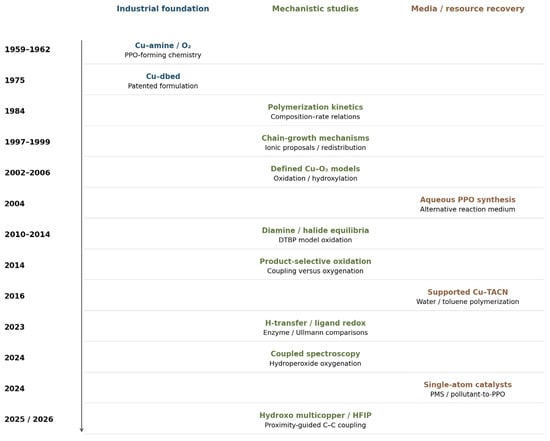
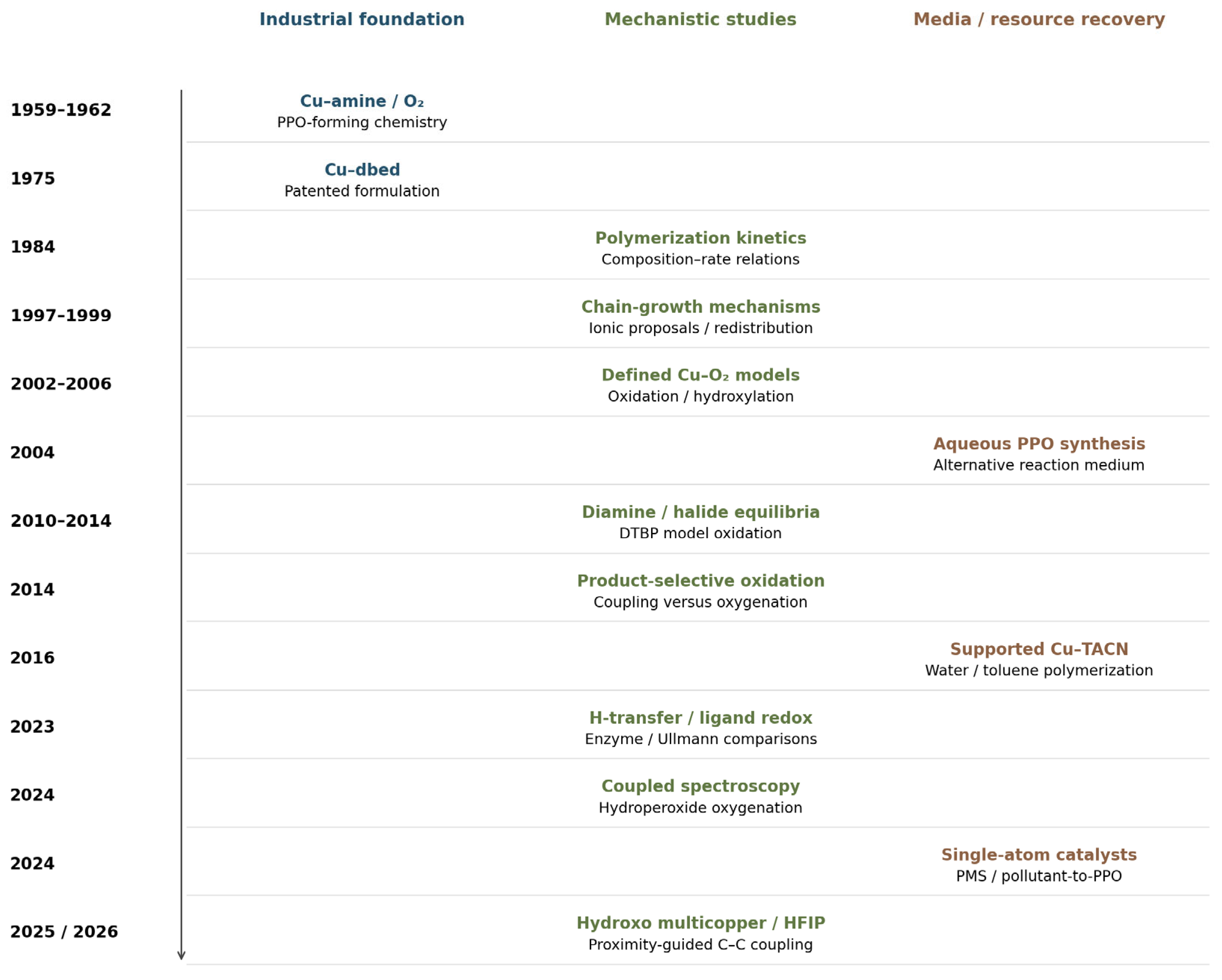
From the 2000s onward, several research directions developed in parallel. Defined copper–oxygen complexes clarified possible oxidation chemistry; aqueous polymerization addressed reaction media; Cu–diamine–halide studies connected solution equilibria with DTBP oxidation; and supported copper complexes explored alternative catalyst handling [7,16,17,18]. Figure 1 summarizes selected milestones. It is a map of documented research directions, not a claim of successive industrial replacement or a comprehensive patent chronology.
Figure 1.
Selected publication and patent milestones. Research strands develop in parallel; the diagram does not imply successive industrial replacement. The 2023 ligand-radical study concerns Ullmann coupling, the 2024 monitoring study concerns hydroperoxide oxygenation, and the 2024 recovery route uses peroxymonosulfate. The final milestone appeared online in 2025 and in the 2026 journal volume. Sources: [2,3,4,7,8,9,12,13,15,16,17,18,19,20,21,22,23,24,25].
Recent developments extend these parallel directions: ligand redox participation in a distinct copper cross-coupling reaction (2023), simultaneous monitoring of copper and radical intermediates (2024), pollutant-to-polymer transfer using supported single atoms (2024), and multicopper-mediated site selectivity (online 2025; issue 2026) [4,19,20,21]. These milestones broaden the mechanistic and application landscape without establishing replacement of commercial Hay-type formulations.
2.2. Applications and the Distinction Between Polymer and Formulation
PPO applications are best discussed at the level of the material actually used. A high-molar-mass aromatic polyether, a PPE/polystyrene (PS) blend, a functionalized oligomer, and an ion-containing membrane are chemically related but are not interchangeable products. Commercial blend performance depends on composition, fillers, additives, and processing, in addition to the PPO made by oxidative coupling [1]. Manufacturer documentation establishes application relevance; it does not reveal the copper species used in a proprietary manufacturing process.
For engineering components, technical documentation for a commercial PPE/PS grade identifies low moisture uptake, dimensional stability, and hydrolytic stability, with application categories including electrical housings, appliances, pumps, water meters, and automotive electrical parts [26]. These are grade-dependent uses or candidate uses, not universal approvals for every PPO formulation. Table 1 relates representative application families to the polymer attributes that merit attention during catalyst evaluation.
Table 1.
Representative PPO-derived materials and application-driven assessment criteria. The final column gives proposed evaluation priorities, not demonstrated causal effects for a particular copper catalyst.
Electronic thermosets provide a distinct example. Functionalized low-molar-mass PPE products such as SA9000 are intended for insulating formulations requiring low dielectric response and reduced moisture uptake [27]. Here, end-group functionality and compatibility with the curing formulation matter alongside molar mass. It would be incorrect to infer that the maximum achievable polymer molar mass is always the desired catalytic outcome. Catalyst evaluation should therefore include the identity and concentration of chain ends and their suitability for subsequent functionalization or curing. Matching a target molar mass without the required end-group population is insufficient.
Functional membranes broaden the research scope. Quaternized PPO has been investigated for natural-gas processing, illustrating how chemical modification can convert the parent polymer into a separation material [28]. PPO-based anion-exchange membranes incorporating ionic triptycene additives have also been studied for water electrolyzers [29]. These examples support emerging application potential; they do not demonstrate that unmodified PPO conducts hydroxide or that the cited membrane formulations have achieved broad industrial deployment. Membrane performance should be assessed after functionalization, under the relevant operating conditions.
2.3. Linking Catalyst Selection to Product Quality
A useful assessment should connect reaction performance to the specification of the final material. For DMP polymerization, monomer conversion alone cannot distinguish desired ether formation from quinone production, low-molar-mass material, or other side reactions. A catalyst comparison should therefore report isolated polymer yield, C–O/C–C product information, number- and weight-average molar masses, dispersity, and end-group analysis. Copper content after a defined isolation procedure and the solvent and wash requirements should be measured separately. These are proposed comparison criteria; the available DTBP speciation studies do not establish their quantitative dependence on individual Cu species.
Table 1 translates application requirements into catalyst-assessment targets: chain-growth selectivity should be related to molar-mass consistency and end-group populations, while purification should be related to final material composition. Residual Cu and ligand-derived extractables should be measured alongside color, dielectric behavior, aging, and membrane performance; their effects require grade-specific testing rather than assumed universal thresholds. Connecting these endpoints to time-resolved speciation would permit meaningful comparisons between catalysts.
3. Solution Speciation of Cu–Diamine–Halide Systems
3.1. Cu–Halide Speciation and Solvent Dependence
The quantitative study of Cu speciation began with aqueous systems: the stability and electronic spectra of copper(II) chlorido complexes in aqueous solution established that Cu–halide equilibria are governed by successive complex formation and are strongly condition-dependent [30]. Extension to anhydrous methanol provided the solvent relevant to the catalytic coupling chemistry and showed that the Cu–halide speciation and associated electronic spectra depend sensitively on solvent and halide identity [31].
The alcohol comparison in Table 2 shows increasing overall formation constants for every listed Cu–halide stoichiometry in the sequence methanol < ethanol < propan-2-ol [32]. This is consistent with the decreasing polarity of this solvent series, although dielectric response alone does not determine complex stability. Halide identity, competitive solvation, ion pairing, and concentration convention also matter. Bromide complexes are not uniformly more stable than their chloride analogs: for example, the listed log β2 values in propan-2-ol are 8.4 and 8.6, respectively. Similar distribution-curve shapes therefore do not establish identical speciation or reactivity across media.
Table 2.
Overall stability constants (log β) of copper(II)–halido complexes in three anhydrous alcohols [32].
The HFIP/multicopper example in Section 6.2 illustrates a different solvent question: selectivity through substrate organization. It cannot be predicted by extrapolating the polarity trend of unligated Cu–halide equilibria in Table 2.
Ultrafast transient absorption measurements on copper(II) chlorido complexes in methanol reveal rapid ligand-exchange and photochemical relaxation processes [33]. These results illustrate solvent coordination and copper lability; however, photoperturbation timescales should not be equated with the equilibration rate of a diamine-containing catalyst under thermal turnover. The methanol ligands should also remain explicit when interpreting coordination formulas: solvent coordination numbers are not copper nuclearities.
3.2. Five-Coordinate Cations and the Thermodynamics of Halide Binding
The step that converts a resting dication into a monohalide cation,
was studied for L = ethylenediamine (en), N-methylethylenediamine (meen), N,N′-dimethylethylenediamine (dmen), and N,N-dimethylethylenediamine (amen), with X− = Cl−, Br−, I−, or SCN−, in methanol at 25 °C [34]. Spectrophotometric equilibrium measurements and calorimetric titrations showed regular trends within most anion series. The exceptional values for [Cu(amen)2I]+ were attributed to distortion toward trigonal-bipyramidal geometry. Complex formation was entropy-favored, consistent with a substantial desolvation contribution. The different correlations between reaction enthalpy and anion-desolvation enthalpy were interpreted in terms of methyl-group crowding around the incoming donor. These findings establish solvent- and ligand-dependent binding behavior; their extension to catalytic rates is a hypothesis. Hydration, hydrolysis, and acid–base equilibria can change the balance in water.
[CuL2]2+ + X− ⇌ [CuL2X]+,
3.3. Cu–Diamine–Halide Speciation in the Catalytic Systems
Spectrophotometric studies connected copper–diamine speciation with phenol oxidation [35,36]. Cu–ethylenediamine–halide equilibria and DTBP oxidation were examined in methanol [7], followed by 1,3-propanediamine/1,4-butanediamine systems [8] and comparative studies including bulky dbed and related diamines [9]. These measurements provide the experimental basis for the comparisons in Table 3.
Table 3.
Qualitative comparison of apparent DTBP-to-DTBQ activity of copper-containing solutions in methanol. Species labels indicate equilibrium assignments associated with the formulations, not isolated-species rates. This is not a universal ranking for PPO synthesis [8,9].
Within the reported DTBP experiments, apparent quinone-formation activity varied with diamine structure and formulation [7,8,9,35,36]. Table 3 summarizes these condition-specific comparisons at the solution level. The observed response can include contributions from both more abundant and less abundant reactive complexes; their individual contributions cannot be separated from the progress curves alone. An abundant equilibrium species may be a resting state or precursor, and a minor species may contribute substantially to turnover. Neither abundance nor a preparation ratio establishes the identity or nuclearity of the active species.
Reported conditions: The studies used DTBP in methanol at 303 K, nominal catalyst concentrations of 3.0 × 10⁻⁵ M, and substrate concentrations of approximately 0.0077 M, with model 8453 UV–Vis instruments (reported as HP or Agilent) [7,8,9]. The common substrate, comparable reagent systems and concentrations, and the same instrument model support comparison of the measured solution responses, with ligand and halide formulation as experimental variables. The nominal concentrations are retained as reported; catalyst formulation and copper nuclearity should be specified before converting them to a common total-copper basis. Such internal comparability does not establish the contribution of an individual copper species or a universal ranking across other reaction systems.
The net DTBP-to-DTBQ balance is Equation (3). This C–C-coupled quinone endpoint differs from the C–O-selective chain growth represented in Equation (1).
2 C14H22O + O2 → C28H40O2 + 2 H2O
DTBP and DMP differ in steric demand and product network. Formation of a C–C-coupled diphenoquinone is not a surrogate measurement for selective PPO production. Direct transfer of an activity ranking requires DMP experiments with polymer-specific characterization.
Direct PPO studies provide complementary evidence. Firlik et al. compared CuBr/dbed, Cu2O/Br2/dbed, CuBr2/dbed, and CuCO3/Br2/dbed formulations [37]. Cu(I)-derived systems were most active within their study. Changing DMP/Cu from 1000 to 1800 affected molar mass differently for Cu(I)- and Cu(II)-derived formulations; excess bromine also altered the response. Their proposed mechanism includes bromination and radical generation, so it should not be generalized to bromide-only mixtures. Gao et al. characterized a methoxido-bridged dicopper(II) precursor and reported 70% PPE yield with approximately 99% selectivity in DMP polymerization involving sodium methoxide and imidazole [38]. This establishes that a structurally defined dinuclear precursor can be catalytically competent, while leaving its persistence throughout turnover as a separate question.
An instructive methodological advance is the online EPR/UV–visible/near-IR study of Wang and co-workers [4]. In copper-catalyzed phenol oxygenation with cumene hydroperoxide, the coupled measurements supported assignment of a transient Cu(II)–alkoxyl radical complex alongside radical and copper-speciation changes. This demonstrates the value of synchronized probes during reaction. It is not an O2-only DMP polymerization experiment and does not resolve the active nuclearity of the Cu/bn/Br− system in Table 3. Adapting the approach to PPO requires concurrent measurement of polymer formation and verification that the spectroscopic sampling represents the reacting mixture.
Counterion-sensitive solution equilibria and defined copper–oxygen models provide complementary information [16,23,31,32]. The former describe populations under specified solution conditions; the latter establish accessible structures and reactions. Connecting them requires measurements in the actual substrate/oxidant mixture. The protonation state of the substrate should also be specified: the enzyme evidence discussed in Section 6.3 cannot be reduced to a universal requirement for initial phenolate coordination. Table 4 compares the substrates, reaction conditions, products, and mechanistic evidence across the systems discussed.
Table 4.
Comparison of model oxidation, PPO synthesis, and copper–oxygen chemistry. Conditions and evidence are specific to each cited system; these rows do not constitute a numerical activity ranking.
4. Kinetic Evidence and Ensemble Reactivity
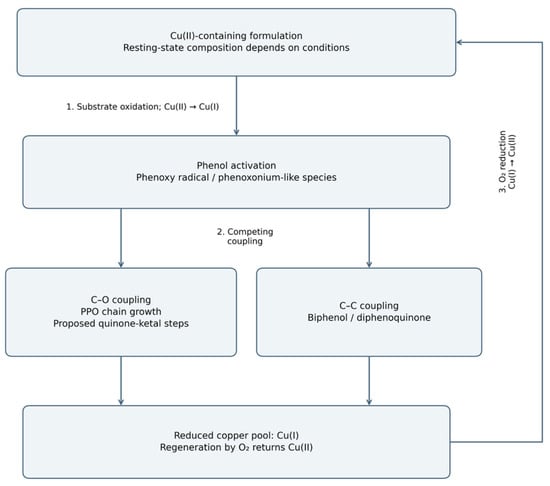
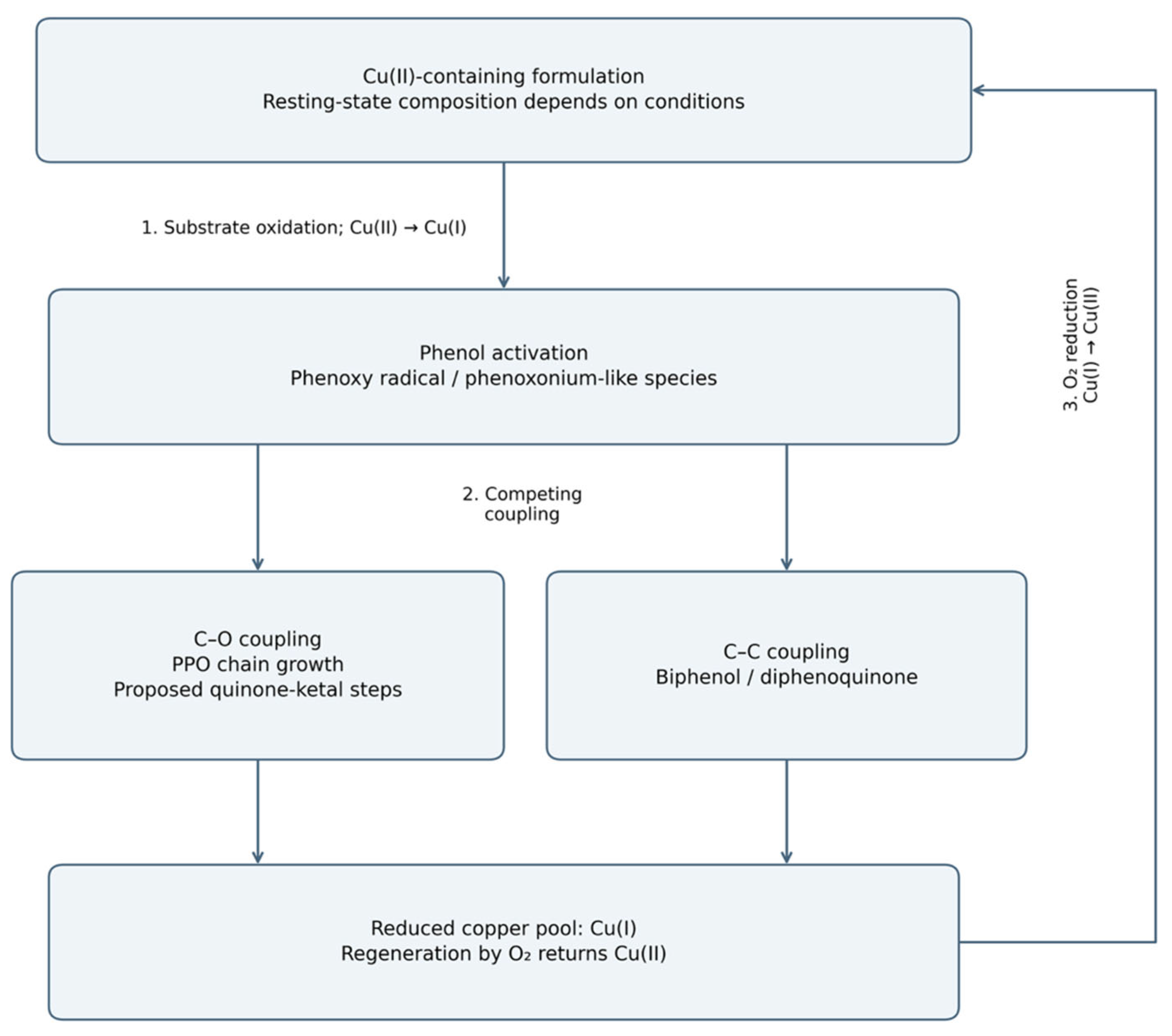
Figure 2 organizes the proposed aerobic coupling chemistry into substrate activation, competing coupling pathways, and copper regeneration by O2 [5,11,15,22]. This is a conceptual cycle for aerobic phenolic coupling, rather than an established sequence for every Cu–diamine–halide formulation. The peroxide-driven study discussed in Section 3.3 has a different oxidant boundary. Kinetic interpretation requires identifying which Cu species participates in each stage and separating chemical turnover from oxygen delivery.
Figure 2.
Proposed aerobic copper-mediated phenolic coupling network. Stage 1 shows formal substrate oxidation coupled to Cu(II) → Cu(I); stage 2 distinguishes C–O chain growth from C–C coupling; stage 3 shows Cu(I) → Cu(II) during regeneration by O2 [5,11,15,22]. These are formal oxidation-state labels, not assignments of a unique mono- or dinuclear active structure. Equations (4) and (5) provide redox bookkeeping. The scheme combines proposals from different systems; it does not establish that all branches operate under identical conditions or represent verified elementary steps.
Equations (4) and (5) show formal redox balances for a Cu(II)/Cu(I) description of substrate oxidation and aerobic regeneration. Ligands are omitted; the equations do not assign nuclearity, oxygen-binding geometry, or a concerted four-copper step. Actual oxygen activation can involve additional intermediates.
ArOH + Cu(II) → ArO• + H+ + Cu(I)
4 Cu(I) + O2 + 4 H+ → 4 Cu(II) + 2 H2O
For the DTBP studies, a slope measured over a stated interval describes an apparent quinone-formation rate. The available records do not verify that the compared intervals are sufficiently early and compositionally unchanged to justify an initial-rate assignment. Incompleteness of the full progress curve, by itself, does not preclude initial-rate analysis. Within the linear photometric range, the Beer–Lambert relation converts a baseline-corrected slope to a concentration rate if the optical path, quinone absorptivity, and absence of significant interference are established. A fitted finite-interval slope represents an interval-averaged apparent rate. No new numerical slopes or rate constants are derived here.
The reported quinone absorptivity at 418 nm is 3.95 × 10⁴ L mol−1 cm−1 [7,8,9]. The 2013 and 2014 studies stopped the kinetic records at an absorbance of approximately 2.3, beyond which the photometric response was no longer treated as linear [8,9]. This is an upper measurement-range limitation, rather than a detection limit or evidence of a chemical plateau. Quinone accumulation may continue after this cutoff without being reliably recorded under the same measurement conditions. Consequently, the truncated traces do not establish reaction completion, final conversion, final yield, or total turnover number.
At the solution level, the apparent rate represents the aggregate net contribution of the reacting copper ensemble, potentially including both major and minor complexes. Describing this response as a sum of contributions is a bookkeeping interpretation, not a demonstrated kinetic law for independent catalysts: interconversion, resting states, and inhibitory species can couple those contributions. The available measurements therefore support comparisons of apparent conversion to the monitored quinone within comparable measurement intervals, while leaving species-specific rate constants and contributions unresolved [7,8,9].
Early kinetic work established the parametric dependence of the reaction. Mobley examined the oxidative coupling of 2,6-dimethylphenol with the copper–diamine catalyst system and framed activity in terms of the copper–amine–halide equilibria operative under reaction conditions [3]. Baesjou and co-workers subsequently dissected the roles of copper, base, and phenol concentrations in the same reaction, demonstrating that the rate law reflects the distribution of copper species rather than a single invariant active complex [14]. Studies have identified the catalytic activity and reaction mechanism of copper–ethylenediamine complexes in phenol autoxidation [35,36].
HPLC measurements provide an experimental constraint on polymerization mechanisms [15]. Starting from the isolated C–O dimer produces monomer and other oligomers, demonstrating redistribution. Quinone-ketal formation followed by bond cleavage and rearrangement was proposed to explain this behavior. The contrasting response of methylated phenols also constrains the role of the phenolic proton. These observations support evaluation of quinone-ketal pathways but do not independently identify every proposed copper-bound intermediate. An adequate mechanism should explain the observed redistribution and substrate dependence without treating the proposed intermediate sequence as a direct HPLC observation.
5. Mechanistic Alternatives: Radical, Phenoxonium, and C–C vs. C–O Selectivity
5.1. The Phenoxy-Radical Pathway
In radical pathways, one-electron oxidation of the phenol generates a resonance-stabilized phenoxy radical that undergoes C–O or C–C coupling [5]. The ortho- and para-radicals have similar stability, leading to several possible coupling outcomes [5]. Because the substrates are not prefunctionalized, oxidative phenol couplings are typically substrate-controlled, although catalyst choice can impose some degree of control [5]. Recent mechanistic reviews of oxidative phenolic coupling emphasize that at least one radical intermediate is involved in most systems and that chemoselectivity (homo- vs. cross-coupling), regioselectivity (ortho/meta/para), and enantioselectivity are governed by the oxidation site of the phenol and the potential coupling sites [40].
Catalyst control of the branching between coupling and oxygenation has been demonstrated explicitly: with the appropriate choice of Cu(I) salt, amine ligand, desiccant, and temperature, the aerobic copper-catalyzed oxidation of phenols can be directed selectively to ortho-quinones, biphenols, or benzoxepines, and substituent effects on the phenol influence the selectivity between ortho-oxygenation and oxidative coupling [24]. In the context of the Hay-type systems, the C–C coupling product can be further oxidized to benzoxepine by a putative Cu2O2 species in the presence of dbed [41]—a reminder that the same Cu/diamine platform can support divergent downstream chemistry depending on conditions.
5.2. The Phenoxonium Pathway
The radical interpretation has been challenged by a heterolytic alternative [5]. An account summarizing five decades of mechanistic studies on the 2,6-dimethylphenol polymerization concludes that the weight of experimental evidence supports an ionic pathway for polymer chain growth, with phenoxyl radicals alone unable to explain the observed regiochemistry [11].
Calculations on DMP and its C–O dimer provided support for a phenoxonium interpretation of para-selective coupling [22]. The proposed sequence involves phenolate-bridged copper species, oxidation to an electrophilic phenoxonium-like intermediate, and quinone-ketal formation [22]. Charge distributions rationalize this proposal but do not constitute direct observation of the intermediate. The independent observation of oligomer redistribution imposes experimental constraints on chain-growth mechanisms [15]. Resolving the pathway requires comparison of kinetically viable alternatives under the same solvent, ligand, and oxygen conditions.
The oxidation-state distinction between radical and phenoxonium proposals can be expressed by the formal half-reactions in Equation (6). These balances do not establish that a freely diffusing radical or cation accumulates; coordination and coupled proton transfer may modify the elementary sequence.
ArOH → ArO• + H+ + e−; ArO• → ArO+ + e−
5.3. Radical vs. Ionic: A Condition-Dependent Landscape
Different elementary steps and product branches need not share a single mechanism. Copper–oxygen models support phenol oxidation and radical coupling pathways, whereas ionic proposals address selectivity and redistribution during polymer growth [11,22,41]. These proposals remain condition-dependent interpretations: neither formation of a radical nor a computed phenoxonium charge distribution identifies the complete catalytic cycle. The polymerization literature should therefore be assessed separately from stoichiometric oxidation and enzymatic hydroxylation [10]. Radical and ionic labels can also describe different stages of a multistep sequence; ligand redox participation requires testing independently rather than being inferred from either label.
A related but chemically distinct precedent is the Cu–oxalamide Ullmann etherification reported by Delaney and co-workers [19]. Their experimental and computational analysis supports aryl-halide addition to Cu(II), with ligand-centered radical character stabilizing the ensuing high-valent chemistry. This is not a diamine-catalyzed oxidative coupling of unfunctionalized phenols. Its relevance here is conceptual: a ligand may participate electronically as well as control geometry. A corresponding role in PPO synthesis remains a hypothesis requiring evidence for ligand-centered spin density, ligand transformation, and kinetically competent intermediates.
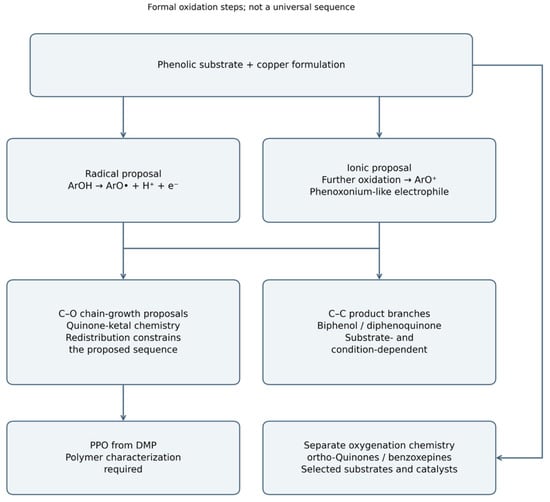
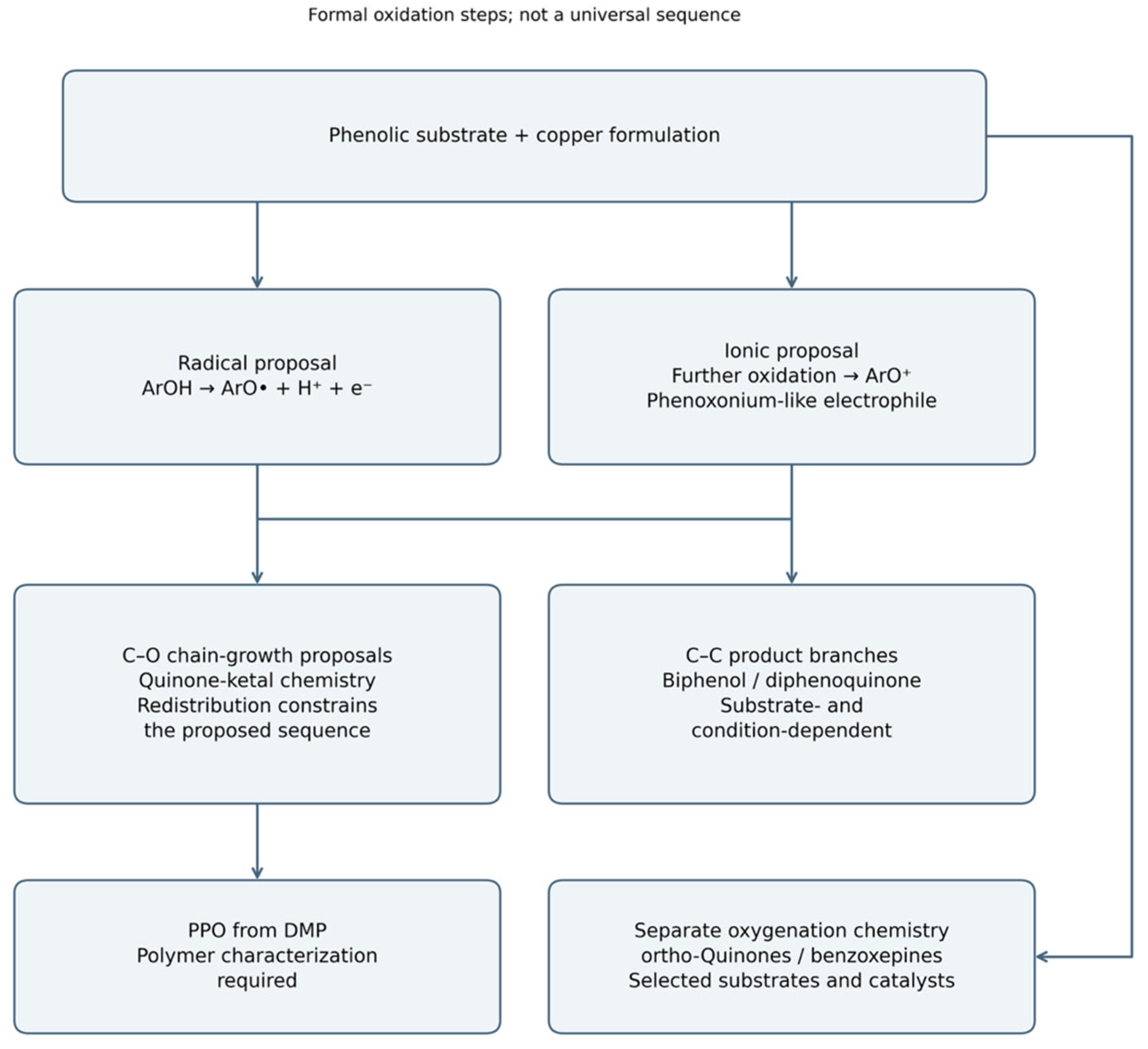
Figure 3 compares the radical and ionic proposals with competing product branches. The diagram combines evidence from different substrates and catalyst systems; it should not be read as proof that all branches operate for DMP under one set of conditions.
Figure 3.
Mechanistic branches in the copper-mediated oxidative coupling of phenols. One-electron oxidation can generate a resonance-stabilized phenoxy radical; proton-coupled electron transfer by selected Cu2O2 models provides related evidence (Section 6). The ionic proposal involves two sequential one-electron transfers leading to a phenoxonium-like electrophile with para-selective reactivity (Section 5.2). Both proposals can accommodate C–O coupling through quinone-ketal chemistry; HPLC-observed oligomer redistribution constrains these mechanisms without uniquely proving either. Competing C–C pathways yield biphenol and/or diphenoquinone products. Catalyst-controlled oxygenation to ortho-quinones or benzoxepines has been demonstrated for suitable phenolic substrates by varying Cu(I) salt, amine, desiccant, and temperature [11,15,22,24,41]. The starting DMP node represents PPO synthesis; the broader oxygenation branches are comparative and are not all established for DMP. Arrow labels summarize proposals rather than verified elementary steps.
6. Copper–Dioxygen Intermediates and Bioinspired Model Chemistry
6.1. The Cu2O2 Cores
The structures and spectroscopy of copper–dioxygen complexes have been extensively characterized: μ-η2:η2-peroxodicopper, bis(μ-oxo)dicopper, and related cores interconvert depending on ligand, solvent, and temperature [6]. The stabilized μ-η2:η2-peroxodicopper complex with a secondary diamine ligand demonstrated tyrosinase-like reactivity, establishing that simple diamine ligation—the same family as the dbed ligand of the Hay catalyst—can support dioxygen activation and phenol oxidation [16,23]. The relevance to the catalytic systems is mechanistic rather than a direct identification of an industrial intermediate. The diamine ligand defines the resting Cu species characterized by speciation studies [7,8,9]. It may also constrain the copper–dioxygen chemistry accessible during turnover.
For the same supporting-ligand framework, the formal core descriptions in Equation (7) conserve atoms and core charge (+2). They distinguish peroxide reduction from O–O cleavage and are not a universal equilibrium for every diamine formulation [6,42].
2 Cu(I) + O2 → {Cu(II)2(O22−)} ⇌ {Cu(III)2(O2−)2}
A further distinction concerns operation mode. Isolated Cu2O2 complexes can perform a stoichiometric substrate-oxidation event, and yields based on a preformed dicopper–dioxygen reagent should be distinguished from yields based on phenol in a catalytic experiment [39]. In aerobic Hay-type chemistry, copper regeneration by O2 permits turnover [5]. Model-complex stoichiometry therefore defines accessible reactivity but does not establish the active-species distribution, productivity, or lifetime of a working polymerization catalyst.
6.2. Substrate Accessibility and Ligand Congestion
The guanidine/amine series illustrates the effect of access to a bis(μ-oxo)dicopper core [43]. The most congested, bis-guanidine complex reacted with neither phenols nor phenolates. The bis-amine analog yielded C–C-coupled bis-phenol, whereas the mixed-ligand complex hydroxylated phenolates to catecholates. This comparison supports a role for ligand architecture in controlling reaction outcome within that series. Extension to dbed polymerization catalysts also requires attention to the solvent, proton transfer, and substrate orientation.
Bera and co-workers reported aerobic ortho–ortho phenol coupling with hydroxo multicopper(II) clusters in HFIP [21]. The proposed selectivity model brings two coordinated phenolate partners into proximity at the accessible ortho positions, supported by computation, high-resolution mass spectrometry, and infrared photodissociation studies. This example complements steric-access models by emphasizing assembly and substrate orientation in a particular medium; it does not establish that HFIP universally overrides ligand sterics. It also concerns C–C biphenol formation rather than the C–O-selective growth of DMP-derived PPO.
In the bidentate 2-(2-pyridyl)ethylamine series, ligand substitution changes the predominant Cu2O2 species: a pyridyl 6-methyl substituent favors the side-on peroxo form, whereas the unsubstituted ligand favors a bis(μ-oxo) form [44]. Taki and co-workers nevertheless identified bis(μ-oxo)dicopper(III) as a common reactive intermediate in both systems. The observed or trapped product therefore need not be the species that controls reaction kinetics. The same study also examined oxidation of 2,4-di-tert-butylphenol by a mixed-valence trinuclear copper–oxo complex, producing a C–C-coupled biphenol. These observations should be distinguished from catalytic DMP chain growth.
6.3. Tyrosinase-like Hydroxylation vs. Radical Coupling
Catechol oxidation, phenol hydroxylation, and phenolic coupling are distinct transformations. Reim and Krebs reported significant catecholase activity for complexes 1, 5, 6, and 7 in their series and applied a Michaelis–Menten treatment to aerial oxidation of 3,5-di-tert-butylcatechol [45]. This supports a structure-dependent activity comparison, but does not alone establish a causal geometric descriptor or a PPO polymerization mechanism. In the synthetic model studied by Mirica and co-workers, phenolate hydroxylation and cryogenic observation of a bis(μ-oxo)dicopper–phenolate intermediate supported an electrophilic aromatic substitution interpretation [46]. Substituent-dependent kinetics were also examined in a related model by Palavicini and co-workers [47]. These historical interpretations concern specified synthetic systems; numerical Hammett slopes or isotope effects should only be compared together with the substrate, labeling position, solvent, temperature, and rate-limiting step.
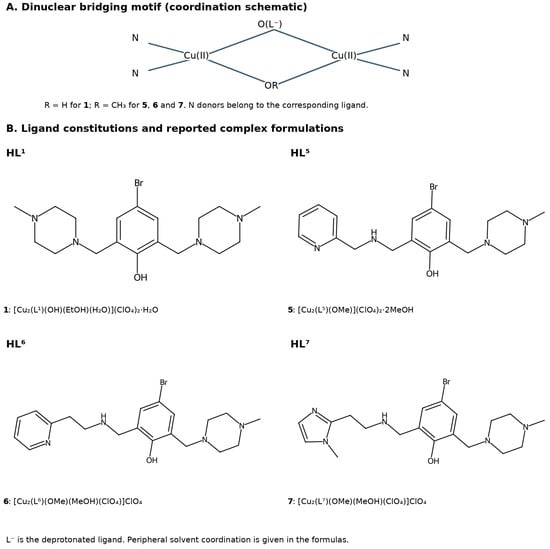
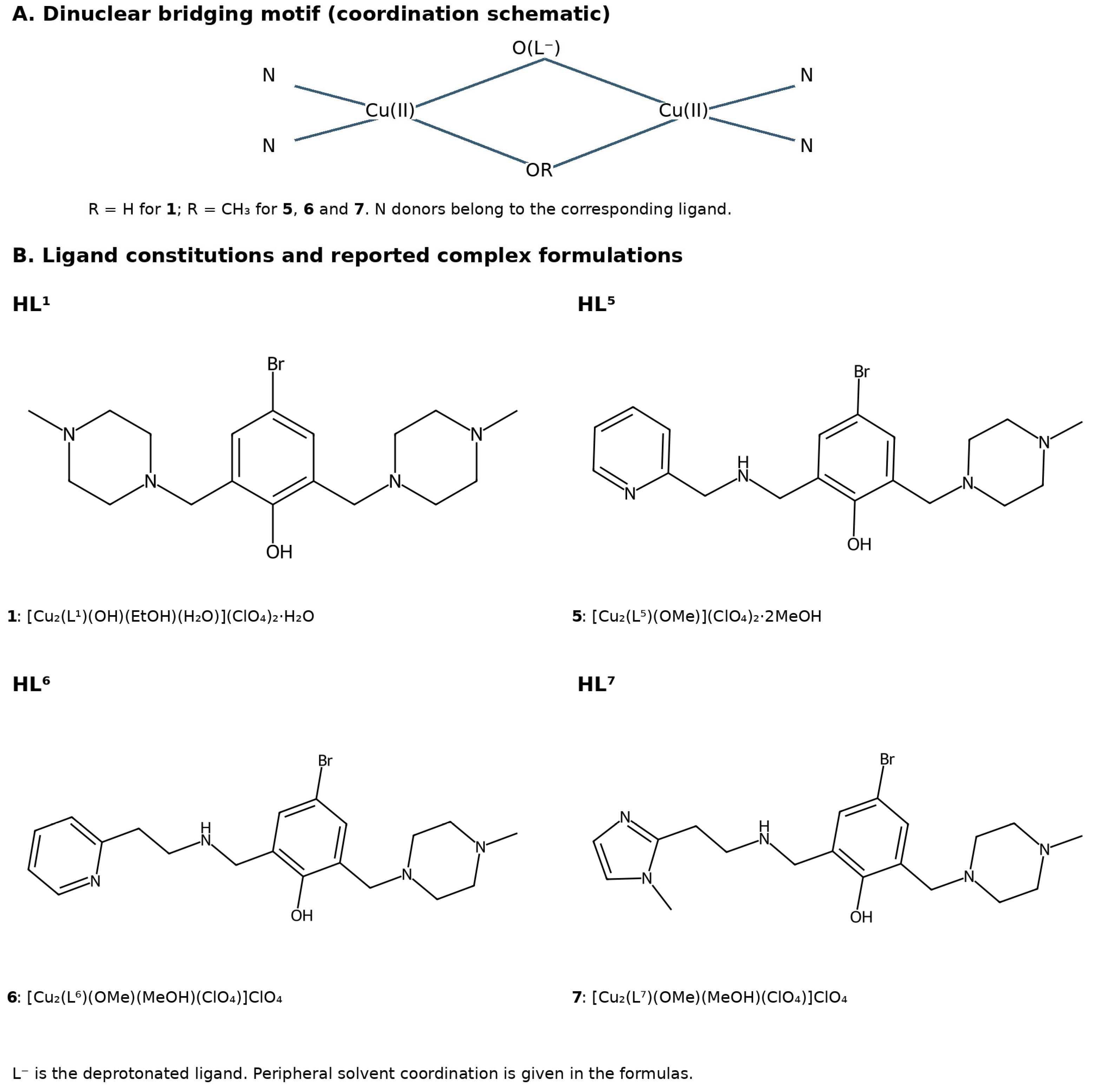
Figure 4 identifies the ligand constitutions and reported formulations of complexes 1, 5, 6, and 7 in the numbering of Reim and Krebs [45]. Their shared phenoxido and hydroxido/methoxido bridges define dinuclear precursors; the drawing does not imply unchanged structures throughout catalysis. The net catecholase reaction is Equation (8), where R denotes the retained ring substituents.
2 R–C6H3(OH)2 + O2 → 2 R–C6H3O2 + 2 H2O
Figure 4.
Structural overview of the catecholase models 1, 5, 6, and 7 reported by Reim and Krebs [45]. (A) Shared Cu2 bridging motif, with peripheral coordination simplified. (B) Constitutional structures of the protonated ligand precursors and the corresponding reported complex formulas; L denotes the deprotonated ligand. Newly drawn from the reported chemical identities, these are not crystallographic projections. Solvent molecules and perchlorate coordination are specified in the formulas rather than assigned geometrical positions. Original compound numbering is retained.
Stoichiometric dicopper–dioxygen reactions with phenols can yield C–C-coupled products through proton–electron transfer pathways [39]. For oxy-tyrosinase, Kipouros and co-workers combined pre-steady-state kinetics and mechanistic calculations to support initial hydrogen transfer from a protonated phenolic substrate to the Cu2O2 active site [25]. This adds a proton-transfer coordinate that is absent from a simple phenolate-binding picture. It does not establish that every synthetic diamine complex follows the enzyme pathway: ligand basicity, substrate binding, hydrogen bonding, and proton acceptors differ. For PPO catalysis, substrate O–H isotope effects, acid/base dependence, and time-resolved Cu speciation would be needed to test analogous requirements. Copper–oxygen core identity and steric access thus define a structure–reactivity hypothesis, together with proton transfer and substrate orientation, rather than a sufficient assignment of the working polymerization catalyst [42,48].
7. Substrate Scope and Emerging Green Routes
The coupling chemistry is not limited to 2,6-dimethylphenol. The oxidative coupling of phenols and naphthols in natural product synthesis benefits from high functional-group tolerance and the elimination of prefunctionalized starting materials [5], and recent mechanistic work provides structured understanding of the factors governing chemoselectivity, regioselectivity, and enantioselectivity in radical-mediated phenolic coupling [40]. Catalyst-controlled product divergence—ortho-quinones, biphenols, or benzoxepines from the same phenol—has been demonstrated by varying the Cu(I) salt, amine ligand, desiccant, and temperature [24].
Regioselectivity within the PPO family has been probed by copolymerization: the oxidative coupling copolymerization of 2,6-dimethylphenol with alkoxyphenols (methoxy, ethoxy, benzyloxy, butoxy, 2-hydroxyethoxy) proceeds effectively with unit ratios matching the feed; for the 50:50 2,6-dimethylphenol/p-methoxyphenol feed, a copolymer with DMP:p-MOP = 50:50 and oxyphenylene (C–O):phenylene (C–C) = 67:33 was obtained in 71% yield in CH2Cl2/methanol (7:1) over 24 h, with solubility and thermal properties significantly affected by the alkoxyphenol structure [49]. These data quantify product branching but do not independently distinguish phenoxonium and radical mechanisms [11,22].
Aqueous oxidative polymerization provides a route for changing the solvent and isolation strategy of PPO synthesis [17]. The reported water-based chemistry is an experimental advance, but solvent substitution alone does not establish a lower environmental burden [50]. Oxidant use, base consumption, washing, drying, catalyst loss, and product quality belong within the process boundary. Formation constants measured in anhydrous alcohols cannot be transferred quantitatively to aqueous polymerization without renewed speciation measurements.
Wastewater valorization adds a distinct application boundary. Liu and co-workers investigated single-atom Cu, Ni, Co, and Fe catalysts for peroxymonosulfate-activated pollutant polymerization and identified PPO products from 2,6-dimethylphenol, including in the Cu system [20]. The detailed chain-product characterization highlighted the Co catalyst; its reported molar mass should not be reassigned to Cu. This is evidence for experimental resource recovery, not demonstrated industrial production of specification-grade PPO. A practical comparison with aerobic synthesis should account for oxidant and salt consumption, catalyst/product separation, polymer purity, residual metals, and usable material yield.
7.1. Supported Catalysts and the Limits of Recovery Claims
Saito et al. used a Cu–triazacyclononane polymer grafted onto polystyrene particles for DMP polymerization under O2 in water/toluene at 50 °C [18]. The isolated PPO yield was 16%, with Mw = 5100 and dispersity Mw/Mn = 1.6. Product identity was examined by NMR and IR, and molar mass by GPC. Recovery by centrifugation allowed three cycles with approximately constant yield, although polymer molar mass decreased after the second cycle. Thus, reuse was demonstrated, but retained yield alone does not establish unchanged active sites or absence of catalytically relevant copper leaching. The modest yield and use of an organic phase remain important process limitations.
For the single-atom route described above, catalyst characterization before reaction and recovery of organic material are distinct from proof of an unchanged active site throughout reuse [20]. Catalyst mass balance, leachate tests, repeated-cycle performance, and product recovery remain appropriate evaluation criteria.
For industrial comparison, stability is best assessed by productivity and product quality across cycles, and copper loss by a Cu mass balance including a polymer, liquor, and recovered catalyst. Purification should be evaluated through residual Cu and ligand content together with wash-solvent consumption per mass of acceptable polymer. Solvent recovery, drying energy, and material losses are also needed to compare an aqueous or supported route with a homogeneous process. The cited examples do not provide a harmonized dataset for all of these indicators, so a numerical sustainability ranking is not assigned.
7.2. Lignin Depolymerization as a Phenolic-Feedstock Opportunity
Copper-containing catalysts also participate in producing phenolic feedstocks from lignin. Panyadee et al. combined alkaline fractionation of palm empty fruit bunches with microwave-assisted oxidative depolymerization using Cu(OH)2/Fe2O3, 2.5 wt% H2O2, and 300 W irradiation for 15 min [51]. The reported 91.78% phenolic fraction refers to chromatographic peak area, not an isolated mass yield. A subsequent study used supported Cu–Fe oxides and H2O2 under microwave heating for 30 min [52]. These are mixed-metal, peroxide-driven depolymerization systems, distinct from Cu–diamine/O2 oxidative polymerization.
These studies establish access to mixtures containing phenolic products such as syringol and acetosyringone [51,52]. Their possible use in new materials is a research opportunity rather than evidence of a demonstrated lignin-to-PPO process. Substitution patterns, impurities, isolation requirements, and competing oxidation or condensation determine whether a recovered fraction is suitable for controlled coupling. No unique balanced equation represents lignin depolymerization because the feedstock and products are heterogeneous. For a defined bond-cleavage model, both fragment identities and oxidant consumption would be required to construct that balance.
8. Open Experimental Questions and Outlook
The highest-priority uncertainty is the identity of species responsible for turnover, rather than simply the species abundant before substrate addition. In the Cu/bn/Br− 2:1:1 formulation, a reagent ratio is insufficient to assign nuclearity; likewise, the activity associated with monohalide dbed formulations does not establish that the corresponding equilibrium cation is the oxygen-activating species [8,9]. The interface between these solution equilibria and copper–oxygen intermediates remains a mechanistic question. Model studies provide plausible structures, but their occurrence in halide-rich polymerization mixtures requires direct evidence [6,42]. Emerging coupled spectroscopy makes this question experimentally approachable; the outstanding task is validation in PPO-forming mixtures, including their evolving water content and viscosity [4].
8.1. Experimental Route Toward Predictive Comparisons
A staged experimental program can test these interpretations. First, determine speciation at matched solvent composition, temperature, ligand/Cu ratio, halide/Cu ratio, and water content. Second, measure initial rates and product distributions while independently varying copper concentration and oxygen delivery. Stirring and gas-flow controls are necessary before assigning a molecular rate law. Third, follow the mixture during turnover using complementary UV–visible, EPR, and, where feasible, X-ray absorption measurements. A change in an optical band alone should not be assigned to a unique active structure without independent constraints. The online multimodal strategy discussed in Section 3.3 provides a methodological precedent [4]. For polymerization, synchronized polymer sampling and oxygen-uptake measurements should accompany Cu spectroscopy; nuclearity assignments may additionally require structural constraints from X-ray absorption or independently characterized intermediates.
The decisive transferability test is a paired substrate study: compare DTBP oxidation and DMP polymerization under deliberately documented conditions, then quantify both oxidation products and isolated polymer properties. Competing speciation–kinetic models should be fitted against the same data and tested on held-out conditions. Apparent activity improvements should be reported alongside Cu loading, reaction time, polymer yield, molar-mass distribution, and residual metal. This design separates evidence for rapid phenol oxidation from evidence for a useful polymerization catalyst.
8.2. Limits of the Present Synthesis
The internally comparable DTBP experiments support qualitative comparisons of apparent quinone formation under the reported concentrations, medium, temperature, and instrumental conditions [7,8,9]. The records summarized here do not verify an initial-rate interval, complete reaction progress, or separate contributions from individual copper species. Across the wider literature, different solvents, bases, substrates, temperatures, and analytical endpoints prevent a universal numerical ranking. Conditional formation constants from alcohol solutions may not describe an oxygenated, water-producing polymerization mixture. Low-temperature copper–oxygen models and enzyme results provide mechanistic possibilities, but their transfer to industrial conditions remains uncertain [42]. Proprietary process information and grade-specific material formulations further limit inference from commercial applications back to catalyst identity.
9. Conclusions
The development of copper-mediated phenolic coupling connects an effective industrial polymerization with a still incomplete molecular description of its working catalyst. Ligand, halide, solvent, substrate, base, and oxygen conditions should be considered together when interpreting activity. The DTBP-to-diphenoquinone literature supports condition-specific relationships between formulation, equilibrium speciation, and the aggregate apparent quinone-formation response [7,8,9], while PPO synthesis additionally requires evidence for C–O-selective chain growth, suitable molar mass, and controllable end groups. Copper–oxygen models and phenoxonium proposals provide testable mechanistic alternatives, not universal assignments. Applications in engineering blends, electrical materials, functional membranes, and emerging resource recovery strengthen the need to relate catalyst performance to measurable product quality. Progress should therefore be evaluated by the combination of catalytic productivity, polymer specification, copper removal, and process burden, with operando measurements used to connect these outcomes to solution speciation. Recent spectroscopy and proximity-controlled coupling expand the experimental toolkit, while emphasizing the need to match mechanistic evidence to the substrate and oxidant actually used [4,20,21].
Funding
This research received no external funding.
Institutional Review Board Statement
Not applicable.
Informed Consent Statement
Not applicable.
Data Availability Statement
The original contributions presented in this review are included in the article. No new experimental datasets were generated. Further inquiries can be directed to the corresponding author.
Conflicts of Interest
The author declares no conflicts of interest.
References
- Hay, A.S. Polymerization by oxidative coupling: Discovery and commercialization of PPO and Noryl resins. J. Polym. Sci. Part A Polym. Chem. 1998, 36, 505–517. [Google Scholar] [CrossRef]
- Hay, A.S. Copper Complex. US Patent 3,914,266, 21 October 1975. Available online: https://patents.google.com/patent/US3914266A/en (accessed on 17 September 2026).
- Mobley, D.P. The kinetics of oxidative coupling of 2,6-dimethylphenol with a copper-diamine catalyst system. J. Polym. Sci. Polym. Chem. Ed. 1984, 22, 3203–3215. [Google Scholar] [CrossRef] [Scilit]
- Wang, Y.; Zhou, Y.; Sun, W.; Wang, X.; Yao, J.; Li, H. Identifying Radical Pathways for Cu(I)/Cu(II) Relay Catalyzed Oxygenation via Online Coupled EPR/UV–Vis/Near-IR Monitoring. Adv. Sci. 2024, 11, 2402890. [Google Scholar] [CrossRef] [Scilit] [PubMed]
- Allen, S.E.; Walvoord, R.R.; Padilla-Salinas, R.; Kozlowski, M.C. Aerobic Copper-Catalyzed Organic Reactions. Chem. Rev. 2013, 113, 6234–6458. [Google Scholar] [CrossRef] [Scilit] [PubMed]
- Mirica, L.M.; Ottenwaelder, X.; Stack, T.D.P. Structure and Spectroscopy of Copper−Dioxygen Complexes. Chem. Rev. 2004, 104, 1013–1046. [Google Scholar] [CrossRef] [Scilit] [PubMed]
- Segoviano-Garfias, J.J.N.; Moreno-Esparza, R.; Mendoza-Díaz, G. Spectrophotometric determination of formation constants for the Cu–ethylenediamine–halogen (chloride and bromide) system and their catalytic effect on the oxidative coupling of 2,6-di-tert-butyl-phenol. Inorganica Chim. Acta 2010, 363, 3461–3468. [Google Scholar] [CrossRef] [Scilit]
- Segoviano-Garfias, J.J.N.; Mendoza-Díaz, G.; Moreno-Esparza, R. Spectrophotometric determination of the formation constants of the cupric halogen complexes with 1,3-propanediamine and 1,4-butanediamine in methanol solution and their activity on the oxidative coupling of the 2,6-di-tert-butylphenol. Inorganica Chim. Acta 2013, 400, 184–190. [Google Scholar] [CrossRef] [Scilit]
- Segoviano-Garfias, J.J.N.; Mendoza-Díaz, G.; Moreno-Esparza, R. A comparative study of the speciation in methanol solution and activity in the oxidative coupling of 2,6-di-tert-butylphenol presented by the complexes: Copper(II)-N,N′-di-tert-butylethylenediamine-halogen and some copper(II)-diamine-halogen complexes. Inorganica Chim. Acta 2014, 411, 148–157. [Google Scholar] [CrossRef] [Scilit]
- Kobayashi, S.; Higashimura, H. Oxidative polymerization of phenols revisited. Prog. Polym. Sci. 2003, 28, 1015–1048. [Google Scholar] [CrossRef] [Scilit]
- Gámez, P.; Gupta, S.; Reedijk, J. Copper-catalyzed oxidative coupling of 2,6-dimethylphenol: A radicalar or an ionic polymerization? Comptes Rendus Chim. 2007, 10, 295–304. [Google Scholar] [CrossRef] [Scilit]
- Hay, A.S.; Blanchard, H.S.; Endres, G.F.; Eustance, J.W. Polymerization by Oxidative Coupling. J. Am. Chem. Soc. 1959, 81, 6335–6336. [Google Scholar] [CrossRef] [Scilit]
- Hay, A.S. Polymerization by oxidative coupling. II. Oxidation of 2,6-disubstituted phenols. J. Polym. Sci. 1962, 58, 581–591. [Google Scholar] [CrossRef] [Scilit]
- Baesjou, P.J.; Driessen, W.L.; Challa, G.; Reedijk, J. A kinetic study of the copper-catalysed oxidative coupling of 2,6-dimethylphenol. The role of copper, base and phenol concentrations. J. Mol. Catal. A Chem. 1998, 135, 273–283. [Google Scholar] [CrossRef] [Scilit]
- Baesjou, P.J.; Driessen, W.L.; Challa, G.; Reedijk, J. The Course of the Copper-Catalyzed Oxidative Polymerization of 2,6-Dimethylphenol. Analysis of Oligomeric Phenols during the Coupling Reaction. Macromolecules 1999, 32, 270–276. [Google Scholar] [CrossRef] [Scilit]
- Mirica, L.M.; Vance, M.A.; Rudd, D.J.; Hedman, B.; Hodgson, K.O.; Solomon, E.I.; Stack, T.D.P. A Stabilized μ-η2:η2 Peroxodicopper(II) Complex with a Secondary Diamine Ligand and Its Tyrosinase-like Reactivity. J. Am. Chem. Soc. 2002, 124, 9332–9333. [Google Scholar] [CrossRef] [Scilit] [PubMed]
- Saito, K.; Tago, T.; Masuyama, T.; Nishide, H. Oxidative Polymerization of 2,6-Dimethylphenol to Form Poly(2,6-dimethyl-1,4-phenyleneoxide) in Water. Angew. Chem. Int. Ed. 2004, 43, 730–733. [Google Scholar] [CrossRef] [Scilit] [PubMed]
- Saito, K.; Miyamoto, K.; Nanayakkara, S.; Ihara, H.; Hearn, M.T.W. Poly(N-4-vinylbenzyl-1,4,7-triazacyclononane) Copper Complex Grafted Solid Catalyst for Oxidative Polymerization of 2,6-Dimethylphenol. Molecules 2016, 21, 146. [Google Scholar] [CrossRef] [Scilit] [PubMed]
- Delaney, C.P.; Lin, E.; Huang, Q.; Yu, I.F.; Rao, G.; Tao, L.; Jed, A.; Fantasia, S.M.; Püntener, K.A.; Britt, R.D.; et al. Cross-coupling by a noncanonical mechanism involving the addition of aryl halide to Cu(II). Science 2023, 381, 1079–1085. [Google Scholar] [CrossRef] [Scilit] [PubMed]
- Liu, H.-Z.; Shu, X.-X.; Huang, M.; Wu, B.-B.; Chen, J.-J.; Wang, X.-S.; Li, H.-L.; Yu, H.-Q. Tailoring d-band center of high-valent metal-oxo species for pollutant removal via complete polymerization. Nat. Commun. 2024, 15, 2327. [Google Scholar] [CrossRef] [Scilit] [PubMed]
- Bera, R.; Shaashua, O.; Libman, A.; Derks, M.T.G.M.; Yuan, B.; Pereverzev, A.Y.; Kapanaiah, R.; Ben Lulu, M.; Kertzman, L.; Vainer, Y.; et al. Ortho–Ortho Selective Oxidative Coupling of Phenols by Hydroxo Multicopper(II) Clusters. J. Am. Chem. Soc. 2026, 148, 228–239. [Google Scholar] [CrossRef] [Scilit] [PubMed]
- Baesjou, P.J.; Driessen, W.L.; Challa, G.; Reedijk, J. Ab Initio Calculations on 2,6-Dimethylphenol and 4-(2,6-Dimethylphenoxy)-2,6-dimethylphenol. Evidence of an Important Role for the Phenoxonium Cation in the Copper-Catalyzed Oxidative Phenol Coupling Reaction. J. Am. Chem. Soc. 1997, 119, 12590–12594. [Google Scholar] [CrossRef] [Scilit]
- Mirica, L.M.; Rudd, D.J.; Vance, M.A.; Solomon, E.I.; Hodgson, K.O.; Hedman, B.; Stack, T.D.P. μ-η2:η2-Peroxodicopper(II) Complex with a Secondary Diamine Ligand: A Functional Model of Tyrosinase. J. Am. Chem. Soc. 2006, 128, 2654–2665. [Google Scholar] [CrossRef] [Scilit] [PubMed]
- Esguerra, K.V.N.; Fall, Y.; Petitjean, L.; Lumb, J. Controlling the Catalytic Aerobic Oxidation of Phenols. J. Am. Chem. Soc. 2014, 136, 7662–7668. [Google Scholar] [CrossRef] [Scilit] [PubMed]
- Kipouros, I.; Stańczak, A.; Dunietz, E.M.; Ginsbach, J.W.; Srnec, M.; Rulíšek, L.; Solomon, E.I. Experimental Evidence and Mechanistic Description of the Phenolic H-Transfer to the Cu2O2 Active Site of oxy-Tyrosinase. J. Am. Chem. Soc. 2023, 145, 22866–22870. [Google Scholar] [CrossRef] [Scilit] [PubMed]
- SABIC. NORYL Resin 731. Manufacturer Technical Data and Application Information. Available online: https://materialfinder.sabic-specialties.com/material/noryl-resin-731 (accessed on 17 September 2026).
- SABIC. SA9000. Material Finder, Manufacturer Product Information on Functionalized PPE Oligomers. Available online: https://materialfinder.sabic-specialties.com/document-download/2f703f8f-2786-ea11-8103-c81318e981df (accessed on 17 September 2026).
- Qasem, E.; Upadhyaya, L.; Li, X.; Nunes, S.P. Quaternized poly(phenylene oxide) membranes for natural gas processing. J. Membr. Sci. 2024, 709, 123099. [Google Scholar] [CrossRef] [Scilit]
- An, S.J.; Kim, J.E.; Yu, S.; Kim, K.J.; Kim, M.J.; Kim, J.H.; Lee, J.H.; Chi, W.S. Ionic Triptycene Additive-Blended Poly(2,6-dimethyl-1,4-phenylene oxide)-Based Anion Exchange Membranes for Water Electrolyzers. ACS Appl. Energy Mater. 2023, 6, 8929–8940. [Google Scholar] [CrossRef] [Scilit]
- Khan, M.A.; Schwing-Weill, M. Stability and electronic spectra of the copper(II) chloro complexes in aqueous solutions. Inorg. Chem. 1976, 15, 2202–2205. [Google Scholar] [CrossRef] [Scilit]
- Khan, M.A.; Meullemeestre, J.; Schwing, M.J.; Vierling, F. Detailed spectrophotometric study of the copper(II) halides in anhydrous methanol. Inorg. Chem. 1989, 28, 3306–3309. [Google Scholar] [CrossRef] [Scilit]
- Dali, S.; Benghanem, F.; Khan, M.A.; Meullemeestre, J.; Vierling, F. Halogenocomplexes of copper(II) in anhydrous propan-2-ol. Polyhedron 1991, 10, 2529–2533. [Google Scholar] [CrossRef] [Scilit]
- Mereshchenko, A.S.; Pal, S.K.; Karabaeva, K.E.; El-Khoury, P.Z.; Tarnovsky, A.N. Photochemistry of Monochloro Complexes of Copper(II) in Methanol Probed by Ultrafast Transient Absorption Spectroscopy. J. Phys. Chem. A 2012, 116, 2791–2799. [Google Scholar] [CrossRef] [Scilit] [PubMed][Green Version]
- Barbucci, R.; Paoletti, P.; Fabbrizzi, L. The thermodynamic and electronic properties of some copper(II) five-co-ordinate cations in non-aqueous solution. J. Chem. Soc. Dalton Trans. 1972, 2593–2596. [Google Scholar] [CrossRef] [Scilit]
- Kushioka, K. Catalytic activity of copper(II)-ethylenediamine complexes in autoxidation of phenols. J. Org. Chem. 1983, 48, 4948–4950. [Google Scholar] [CrossRef] [Scilit]
- Kushioka, K. Autoxidation of phenols catalyzed by copper(II)-ethylenediamine complexes: The reaction mechanism. J. Org. Chem. 1984, 49, 4456–4459. [Google Scholar] [CrossRef] [Scilit]
- Firlik, S.; Alichniewicz-Kalinowska, D.; Skupiński, W. Study of the Cu[I]/Cu[II] catalytic system in 2,6-dimethylphenol polymerization to poly(phenylene oxide). Mol. Catal. 2021, 510, 111628. [Google Scholar] [CrossRef] [Scilit]
- Gao, J.; Zhong, S.H.; Zingaro, R.A. The oxidative coupling polymerization of 2,6-dimethylphenol catalyzed by a μ-OCH3-bridged dicopper(II) complex catalyst. J. Mol. Catal. A Chem. 2004, 207, 15–20. [Google Scholar] [CrossRef] [Scilit]
- Osako, T.; Ohkubo, K.; Taki, M.; Tachi, Y.; Fukuzumi, S.; Itoh, S. Oxidation Mechanism of Phenols by Dicopper−Dioxygen (Cu2/O2) Complexes. J. Am. Chem. Soc. 2003, 125, 11027–11033. [Google Scholar] [CrossRef] [Scilit] [PubMed]
- Choi, H.; Suh, S.; Kang, H. Advances in Exploring Mechanisms of Oxidative Phenolic Coupling Reactions. Adv. Synth. Catal. 2024, 366, 4347–4384. [Google Scholar] [CrossRef] [Scilit]
- Trammell, R.; Rajabimoghadam, K.; Garcia-Bosch, I. Copper-Promoted Functionalization of Organic Molecules: From Biologically Relevant Cu/O2 Model Systems to Organometallic Transformations. Chem. Rev. 2019, 119, 2954–3031. [Google Scholar] [CrossRef] [Scilit] [PubMed]
- Elwell, C.E.; Gagnon, N.; Neisen, B.D.; Dhar, D.; Spaeth, A.D.; Yee, G.M.; Tolman, W.B. Copper–Oxygen Complexes Revisited: Structures, Spectroscopy, and Reactivity. Chem. Rev. 2017, 117, 2059–2107. [Google Scholar] [CrossRef] [Scilit] [PubMed]
- Herres-Pawlis, S.; Verma, P.; Haase, R.; Kang, P.; Lyons, C.T.; Wasinger, E.C.; Flörke, Ü.; Henkel, G.; Stack, T.D.P. Phenolate Hydroxylation in a Bis(μ-oxo)dicopper(III) Complex: Lessons from the Guanidine/Amine Series. J. Am. Chem. Soc. 2009, 131, 1154–1169. [Google Scholar] [CrossRef] [Scilit] [PubMed]
- Taki, M.; Teramae, S.; Nagatomo, S.; Tachi, Y.; Kitagawa, T.; Itoh, S.; Fukuzumi, S. Fine-Tuning of Copper(I)-Dioxygen Reactivity by 2-(2-Pyridyl)ethylamine Bidentate Ligands. J. Am. Chem. Soc. 2002, 124, 6367–6377. [Google Scholar] [CrossRef] [Scilit] [PubMed]
- Reim, J.; Krebs, B. Synthesis, structure and catecholase activity study of dinuclear copper(II) complexes. J. Chem. Soc. Dalton Trans. 1997, 26, 3793–3804. [Google Scholar] [CrossRef] [Scilit]
- Mirica, L.M.; Vance, M.A.; Rudd, D.J.; Hedman, B.; Hodgson, K.O.; Solomon, E.I.; Stack, T.D.P. Tyrosinase Reactivity in a Model Complex: An Alternative Hydroxylation Mechanism. Science 2005, 308, 1890–1892. [Google Scholar] [CrossRef] [Scilit] [PubMed]
- Palavicini, S.; Granata, A.; Monzani, E.; Casella, L. Hydroxylation of Phenolic Compounds by a Peroxodicopper(II) Complex: Further Insight into the Mechanism of Tyrosinase. J. Am. Chem. Soc. 2005, 127, 18031–18036. [Google Scholar] [CrossRef] [Scilit] [PubMed]
- Rolff, M.; Schottenheim, J.; Decker, H.; Tuczek, F. Copper–O2 reactivity of tyrosinase models towards external monophenolic substrates: Molecular mechanism and comparison with the enzyme. Chem. Soc. Rev. 2011, 40, 4077–4098. [Google Scholar] [CrossRef] [Scilit] [PubMed]
- Habaue, S. Effective Synthesis of Poly(2,6-Dimethyl-1,4-Phenylene Oxide) Derivatives by Oxidative Coupling Copolymerization of Alkoxyphenols with Copper(II) Catalyst. J. Adv. Catal. Sci. Technol. 2017, 4, 1–7. [Google Scholar] [CrossRef] [Scilit][Green Version]
- Clarke, C.J.; Tu, W.-C.; Levers, O.; Bröhl, A.; Hallett, J.P. Green and Sustainable Solvents in Chemical Processes. Chem. Rev. 2018, 118, 747–800. [Google Scholar] [CrossRef] [Scilit] [PubMed]
- Panyadee, R.; Posoknistakul, P.; Jonglertjunya, W.; Kim-Lohsoontorn, P.; Laosiripojana, N.; Matsagar, B.M.; Wu, K.C.-W.; Sakdaronnarong, C. Sequential Fractionation of Palm Empty Fruit Bunch and Microwave-Assisted Depolymerization of Lignin for Producing Monophenolic Compounds. ACS Sustain. Chem. Eng. 2018, 6, 16896–16906. [Google Scholar] [CrossRef] [Scilit]
- Panyadee, R.; Saengsrichan, A.; Posoknistakul, P.; Laosiripojana, N.; Ratchahat, S.; Matsagar, B.M.; Wu, K.C.-W.; Sakdaronnarong, C. Lignin-Derived Syringol and Acetosyringone from Palm Bunch Using Heterogeneous Oxidative Depolymerization over Mixed Metal Oxide Catalysts under Microwave Heating. Molecules 2021, 26, 7444. [Google Scholar] [CrossRef] [Scilit] [PubMed]

Disclaimer/Publisher’s Note: The statements, opinions and data contained in all publications are solely those of the individual author(s) and contributor(s) and not of MDPI and/or the editor(s). MDPI and/or the editor(s) disclaim responsibility for any injury to people or property resulting from any ideas, methods, instructions or products referred to in the content. |
© 2026 by the author. Licensee MDPI, Basel, Switzerland. This article is an open access article distributed under the terms and conditions of the Creative Commons Attribution (CC BY) license.