


Abstract
This study investigates the mechanochemical synthesis of silver molybdate (Ag2MoO4). Three silver precursors (AgCl, AgNO3, Ag2SO4) in combination with sodium molybdate dihydrate as the molybdenum precursor were used. Three corresponding sodium salts, which are also formed as byproducts, were employed as process control agents (PCAs) to investigate the possibility of obtaining fine-grained silver molybdate. Milling was performed in a planetary mill at 600 and 100 rpm, and for 2 h, 15 min, and 5 min. X-ray diffraction analysis (XRD) revealed that AgCl is completely unreactive in this type of reaction, whereas AgNO3 and Ag2SO4 form crystalline Ag2MoO4. Additional sample characterization included Fourier transform infrared spectroscopy (FTIR), UV-Vis diffuse reflectance spectroscopy (UV-Vis DRS), scanning electron microscopy (SEM), energy-dispersive X-ray spectroscopy (EDS), and simultaneous differential thermal and thermogravimetric analysis (DTA-TGA). The results indicate that the silver molybdate formation reaction is favorable and rapid. Even under the mildest conditions, including the presence of PCA, micron-sized silver molybdate particles were obtained. A greater rotation rate and longer milling time resulted in a decrease in particle size, but also an increase in sodium content. However, unlike the few existing reports on the mechanochemical synthesis of Ag2MoO4, which, despite harsh milling conditions, did not yield a phase-pure product, our approach produced well-crystallized and pure silver molybdate even under the mildest synthesis conditions.
1. Introduction
The current development of materials and their syntheses should follow the global goals of sustainable development. One of these goals is affordable and clean energy, the aspects of which can be achieved through the ecologically appropriate synthesis of novel and advanced materials. Research into eco-friendly and novel energy storage devices is one of the pathways to fulfilling the goals of sustainable development, especially the search for affordable and clean energy. Historically, inorganic materials, ranging from metals to semiconductors, have played a central role and continue to be essential in the search for sustainable, efficient, and accessible energy solutions [1,2].
Silver molybdate Ag2MoO4, which could be a part of this search for energy materials, is an inorganic material with two distinct polymorphic phases. Cubic β-Ag2MoO4 is the stable phase with a spinel-type structure, A2BX4, characterized by a rare combination of monovalent and hexavalent cations, and crystallizes in the Fd-3m space group [3]. The spinel structure is made of [MoO4] tetrahedrons and [AgO6] octahedrons. The other polymorph is the tetragonal metastable α-Ag2MoO4 with distorted [MoO6] and [AgO6] octahedrons and uneven Ag–O bonds, which turns into β-Ag2MoO4 when heated above 280 °C [4]. While the stable phase forms readily under mild synthesis conditions, the formation of the metastable phase requires high hydrostatic pressure or the addition of organic surfactants [5,6]. Additionally, other stoichiometries of silver molybdate (Ag2Mo2O7, Ag2Mo3O10, Ag2Mo4O13) can be synthesized through different routes and varying conditions [4,7,8].
Over the past three decades, sustained interest in silver molybdate has revealed a wide range of potential applications. Ag2MoO4, being a semiconductor with a band gap of 3.30 eV, enables its use in photonic and optoelectronic devices, as a photocatalyst and electrocatalyst, and in Fenton-like reactions [4]. It also exhibits catalytic activity in various organic transformations, possesses low toxicity, and demonstrates strong antimicrobial performance. Its photoluminescence and relatively high electrical conductivity further suggest promising applications in sensors and supercapacitors. Among these possibilities, one of the most compelling is its role in fast-ion-conducting (FIC) glasses [9,10].
FIC glasses belong to superionic conductors or solid electrolytes, which have exceptionally high ionic conductivity that is comparable to molten salts and strong aqueous electrolytes (10−3–10 S cm−1) [11]. In these glasses, the charge transfer is achieved through the rapid migration of mobile ionic species within the disordered or amorphous network, which allows for fast ion motion via open channels, flexible bonding environments, and variable local coordination. The usual conducting ions in these structures, which are characterized by low activation energies, are lithium, sodium, copper, or silver cations [10,12]. The prevailing networks in these kinds of FICs are chalcogenide, borate, and phosphate glasses, with AgI being the most extensively studied silver-based superionic phase. In borate or phosphate glasses, Ag2O-B2O3 and Ag2O-P2O5 form continuous random networks, while in the systems with added MoO3, depolymerization occurs due to the non-network forming property of the [MoO4] tetrahedra [10]. Consequently, using silver molybdate directly rather than separate silver and molybdenum oxides can be more favorable for forming high-quality FIC glass networks. In Ag2MoO4, silver ions are weakly bonded and separated by relatively large Ag–Ag distances, which allows for better conductivity, whereas [MoO4] tetrahedra remain structurally isolated, reducing network depolymerization. Additionally, Ag2MoO4 melts more uniformly than mixtures of Ag2O and MoO3, promoting network homogeneity and the formation of an open medium-range structure [13,14,15].
Ag2MoO4 has been successfully prepared using a number of different methods. Precipitation is one of the simplest and most researched methods alongside hydrothermal/solvothermal synthesis. In these syntheses, conditions influence the type of the forming phase, as well as the crystallinity, size, and morphology of the end product [4]. Other reported approaches include solid-state reactions and sonochemical and microwave-assisted methods [3,16]. One of the least explored yet promising methods is mechanochemical synthesis, which aligns with the principles of environmentally responsible and solvent-free material preparation. It is based on the application of mechanical high-energy grinding in different kinds of mills and vessels. It typically requires no solvent, whereas the fine tuning of employed reactants and synthesis conditions can yield highly selective reactions, often producing nanoscale and phase-pure materials [17,18]. However, the current body of research on the mechanochemical synthesis of silver molybdate is scarce and in previous studies, phase-pure Ag2MoO4 was either not the primary objective or was not fully achieved despite the harsh milling conditions employed [10,19,20,21].
The goal of this work was the investigation of mechanochemical synthesis of phase-pure silver molybdate. Three silver precursors (AgCl, AgNO3, Ag2SO4) in combination with sodium molybdate dihydrate as the molybdenum precursor were used. Sodium nitrate was employed as a process control agent, while also being formed as a byproduct, to investigate the possibility of obtaining fine-grained silver molybdate. Additionally, milling conditions, time, and rotational rate varied. Finally, the obtained powders were characterized to elucidate these influences on the final product.
2. Materials and Methods
Mechanochemical synthesis of silver molybdate was performed in a Pulverisette 6 planetary rotational mill (Fristch, Idar-Oberstein, Germany) using an 80 mL zirconia (ZrO2) vessel and 10 mm diameter zirconia balls. The mass ratio of zirconia balls to reaction mass was kept at 6:1 for all syntheses, which is a ratio commonly used in planetary milling for inorganic synthesis as it provides sufficient impact energy without over-diluting the reaction mass [17,18]. The influence of the precursor was investigated using silver chloride (Kemika, Zagreb, Croatia, 99%), silver nitrate (Merck, Rahway, NJ, USA, 99%), and silver sulphate (Kemika, Zagreb, Croatia, 99%), while the molybdenum precursor was sodium molybdate dihydrate (Kemika, Zagreb, Croatia, 99%). Process control agents (PCAs) were used to investigate the possibility of preparing nanosized Ag2MoO4 particles. The PCA NaNO3 (Kemika, Zagreb, Croatia, 99%) was chosen in accordance with the applied silver salt precursor (AgNO3), since it was also the byproduct of the reaction. When the PCA was used, the reaction mass was diluted with PCA in a mass ratio of PCA to precursors of 6:1. This ratio is established in mechanochemistry as a dilution factor aimed at limiting particle growth by physically separating product particles [17,18]. The applied milling time was 2 h, 15 min, and 5 min, while the tested milling rates were 600 and 100 rpm. The rotational rate of 600 rpm was chosen as a high-energy starting point for milling. Additionally, a rotational speed of 100 rpm was introduced as a milder condition after the high-energy runs showed particle coarsening with a time of milling of 15 min to ensure complete conversion. Before the characterization, the obtained powders were washed 5 times. Washing consisted of adding deionized water, sonication of suspension for 5 min in an ultrasonic bath, centrifugation of the sonicated samples at 3500 rpm for 5 min, and decantation. Finally, washed samples were dried for 24 h at 105 °C. Inevitably, due to some of the milled material sticking to the vessel and the balls, as well as losses over the course of the washing procedure, the yield of this method was reduced. However, the undiluted syntheses had a yield of ~90%, while the diluted ones had a lower yield of up to ~70%.
Powder X-ray diffraction analysis was performed on the Rigaku Miniflex 600 diffractometer (Rigaku, Tokyo, Japan) with CuKα radiation. Data were collected in the 2θ range of 10° to 70°, with a step size of 0.01° and a scan rate of 10° min−1. FTIR analysis was conducted on a Bruker Vertex 70 spectrometer (Bruker Optics, Karlsruhe, Germany) in attenuated total reflectance (ATR) mode, using samples pressed onto a diamond crystal. Spectra were recorded in the range of 400–4000 cm−1 with a resolution of 2 cm−1, and the final spectrum represents the average of 32 scans. The morphology of the samples was examined using the Tescan Vega III Easyprobe scanning electron microscope (Tescan, Brno, Czech Republic) equipped with a tungsten filament, operating at an accelerating voltage of 10 kV. Samples were mounted on holders using self-adhesive carbon tape and sputter-coated with a gold–palladium alloy using Quorum SC 7620 sputter coater (Quorum Technologies, Laughton, UK). The chemical composition and elemental distribution of the synthesized compounds were analyzed by energy-dispersive X-ray spectroscopy (EDS) using the Bruker Quantax system (Bruker, Billerica, MA, USA). Simultaneous differential thermal and thermogravimetric analysis (DTA/TGA) was carried out using a NETZSCH STA 409 thermal analyzer (NETZSCH, Selb, Germany). Approximately 30 mg of the sample was placed in an α-Al2O3 crucible, which was also used as the reference material. The sample was heated from room temperature to 650 °C at a rate of 10 °C min−1 under an air flow of 30 cm3 min−1. Diffuse reflectance spectroscopy (DRS) was performed using an Ocean Insight QE Pro High-Performance spectrometer (Ocean Optics, Orlando, USA) equipped with an integrating sphere. Reflectance spectra were measured in the range of 200–900 nm using BaSO4 as a white standard. Particle size distribution analysis was performed based on SEM micrographs using the ImageJ v1.54t software [22] on a sample of 100 particles. A lognormal model was chosen to describe the distribution, as it provided the best fit to the obtained data.
Table 1 lists the abbreviations used for the differently prepared samples. These designations will be used consistently throughout the remainder of the text.
Table 1.
Abbreviations for differently prepared silver molybdate samples.
3. Results and Discussion
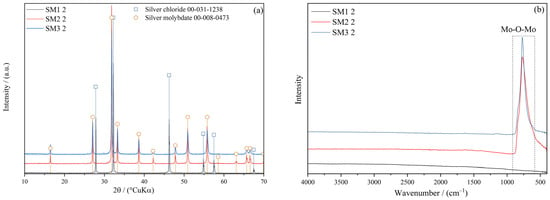
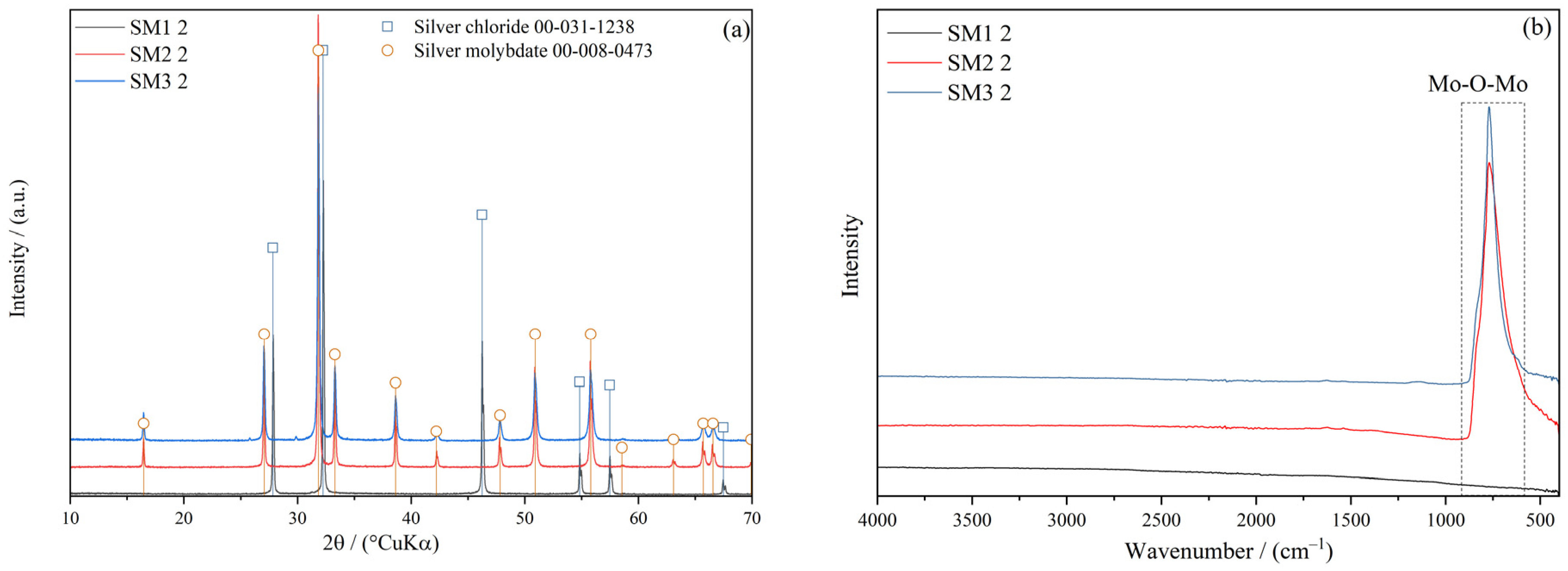
In Figure 1, the XRD and FTIR analyses of silver molybdate prepared from three different silver precursors are presented. The X-ray diffraction patterns (Figure 1a) show that silver chloride does not react with sodium molybdate under the applied mechanochemical conditions, even after 2 h of milling. The diffraction peaks correspond exclusively to unreacted AgCl, ICDD PDF No. 31-1238. In contrast, the other two precursors readily form silver molybdate, β-Ag2MoO4 ICDD PDF No. 8-0473. AgCl has an extremely low-solubility product and is a true ionic solid where during grinding it provides little thermodynamic driving force for exchange with molybdate. Furthermore, the bond in AgCl is relatively strong and the chloride anion is not easily displaced by molybdate under these conditions [23]. The synthesis using silver nitrate yields a phase-pure product, whereas the sample prepared from silver sulphate (SM3 2) contains minor impurities. Sodium sulphate is significantly less soluble than sodium nitrate, but its impurity peaks do not match with this. The impurity is most likely α-Ag2MoO4, ICDD PDF No. 21-1340, which has an 004 peak of the strongest intensity at an angle of 29.78° 2θ. The second most intense peak, 311, should appear at 32.93° 2θ. However, it overlaps with the 311 peak of β-Ag2MoO4, while all other α-Ag2MoO4 peaks have low intensity. Additionally, another peak present at 25.80° 2θ does not belong to the α-Ag2MoO4 phase and cannot be confidently associated with a new phase. Therefore, the present impurity cannot be attributed to α-Ag2MoO4 or any other phase with absolute certainty. It was believed that the metastable α-phase could be prepared only under high hydraulic pressure, but recently, its synthesis in heterojunction materials or as a sole phase has been reported [24,25]. Consequently, this sample was deemed unsuitable for further investigation.
Figure 1.
XRD patterns (a) and FTIR spectra (b) of silver molybdate samples prepared from three different precursors.
The FTIR spectra, in Figure 1b, support these findings. Sample SM1 2 exhibits no absorption bands in the standard, mid-infrared spectrum, which is specific to true ionic compounds such as AgCl, and corroborates the non-reactivity of silver chloride in this type of synthesis. Consequently, the AgCl-based synthesis was excluded from further investigation. The other two samples, SM2 2 and SM3 2, show specific molybdate bands centered around 750 cm−1, which correspond to the vibrations of Mo–O in the [MoO4] tetrahedra. Although different metal cations can influence the position and shape of this band, the silver cation’s only influence is through a slight red shift [26,27].
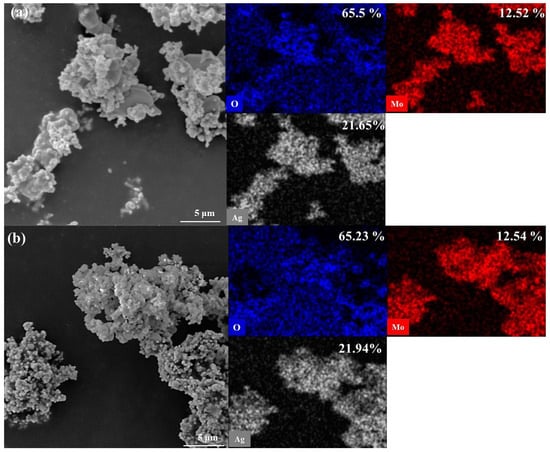
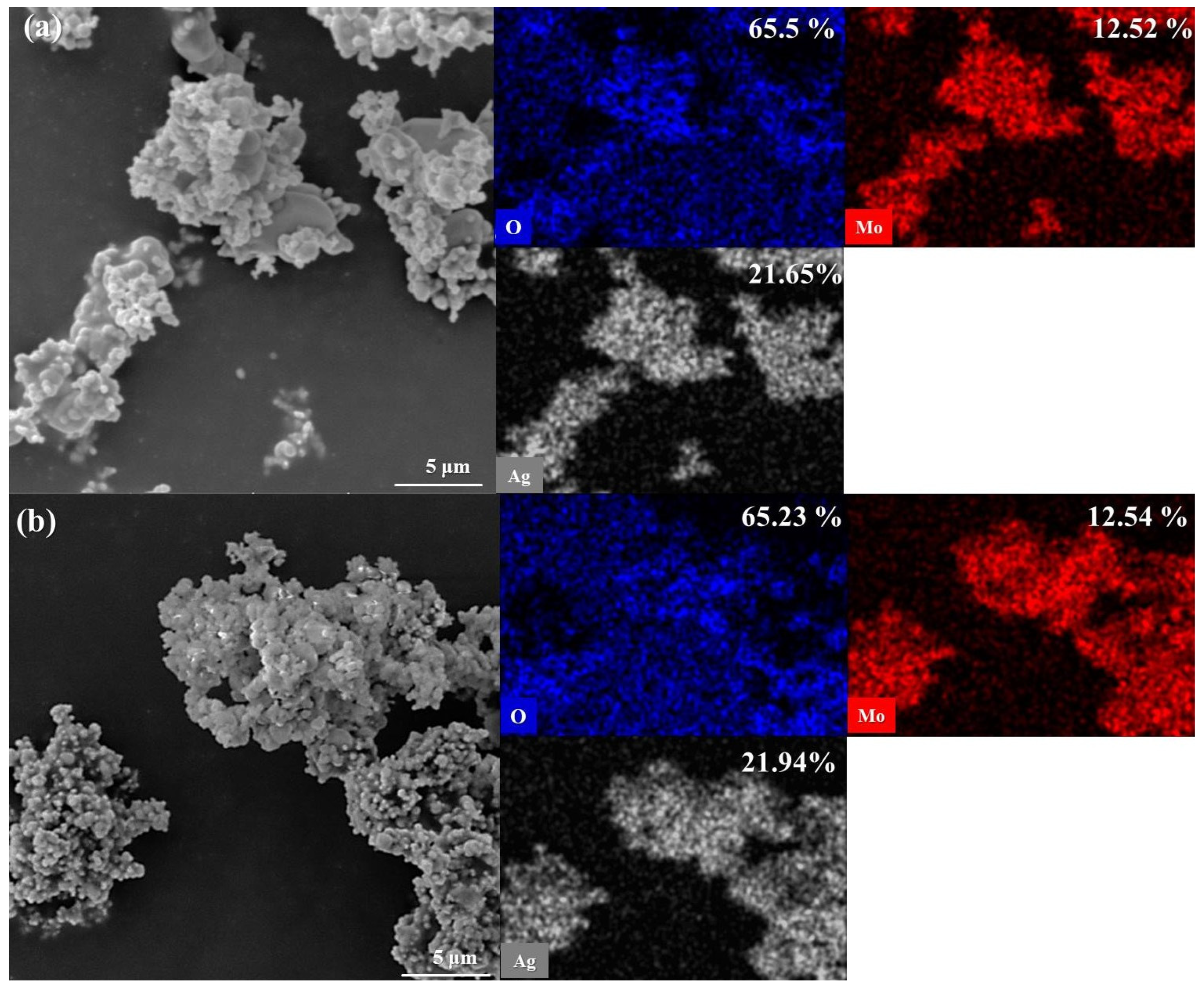
Figure 2 shows the EDS elemental mapping of samples SM2 2 and SM3 2. In both samples, the stoichiometric ratios, as expected, roughly correspond to Ag2MoO4.
Figure 2.
SEM micrograph and EDS mapping of the SM2 2 (a) and SM3 2 (b) sample with the atomic percentages of the present elements.
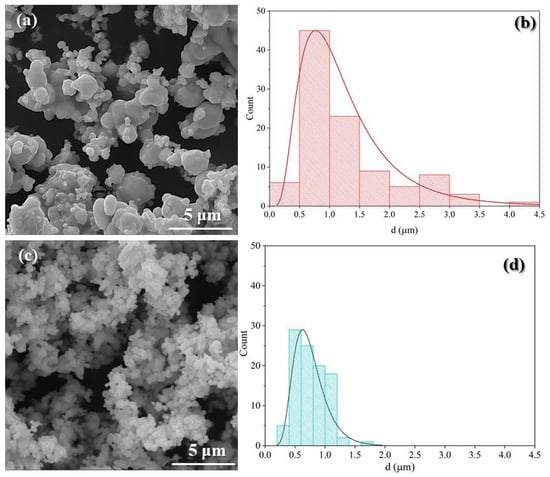
In Figure 3, the SEM micrographs and particle size distributions of SM2 2 and SM3 2 samples are given. As can be seen from Figure 3, the SM2 2 sample (Figure 3a,b) has noticeably larger particles with a broader particle size distribution. The larger particles display a fused or coalesced morphology rather than simple agglomeration or aggregation. In contrast, the SM3 2 particles (Figure 3c,d) show a narrower distribution and smaller average size.
Figure 3.
SEM micrographs of SM2 2 sample (a) and its particle size distribution (b), SM3 2 sample (c) and its particle size distribution (d).
In the next stage of the research, the possibility of preparing nanosized silver molybdate was examined. Although the SM3 2 sample shows a more favorable particle size distribution, only the silver nitrate precursor yielded phase-pure silver molybdate. Thus, efforts to prepare nanosized β-Ag2MoO4 were focused exclusively on the SM2 series.
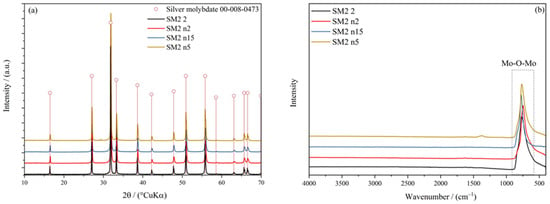
Figure 4a shows the XRD patterns of SM2 samples prepared with an added process control agent and different milling times. It is evident that the reduction in the milling time does not influence the crystal phase obtained. Also, judging by the XRD peaks, no significant reduction in the crystallite size of the obtained β-Ag2MoO4 occurs. The diffractogram of sample SM2 n5 shows a small peak at 29.38° 2θ. This peak matches well with the 104 peak of NaNO3, ICDD PDF No. 36-1477. Unfortunately, all other major peaks of this phase overlap with peaks belonging to the β-Ag2MoO4 phase. Additionally, the FTIR spectrum (Figure 4b) shows a weak bimodal band centered around 1390 cm−1, characteristic of nitrates. Therefore, when the XRD and FTIR results are considered together, the impurity can, with sufficient certainty, be attributed to sodium nitrate.
Figure 4.
XRD (a) and FTIR analysis (b) results of SM2 samples prepared with and without process control agent.
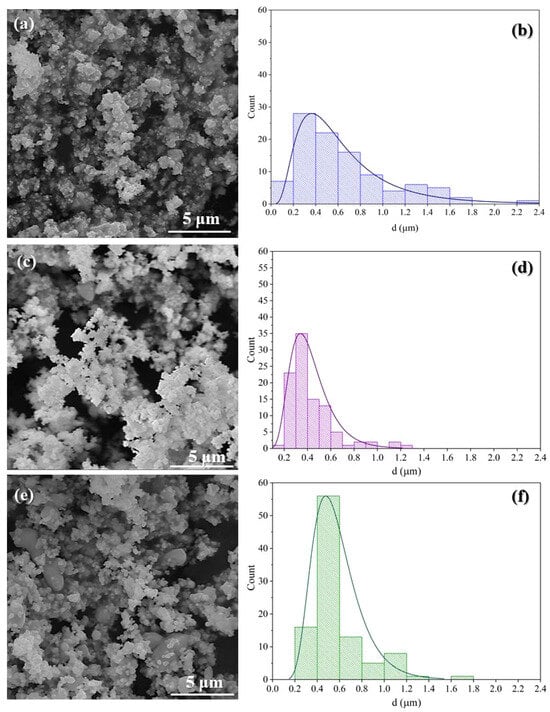
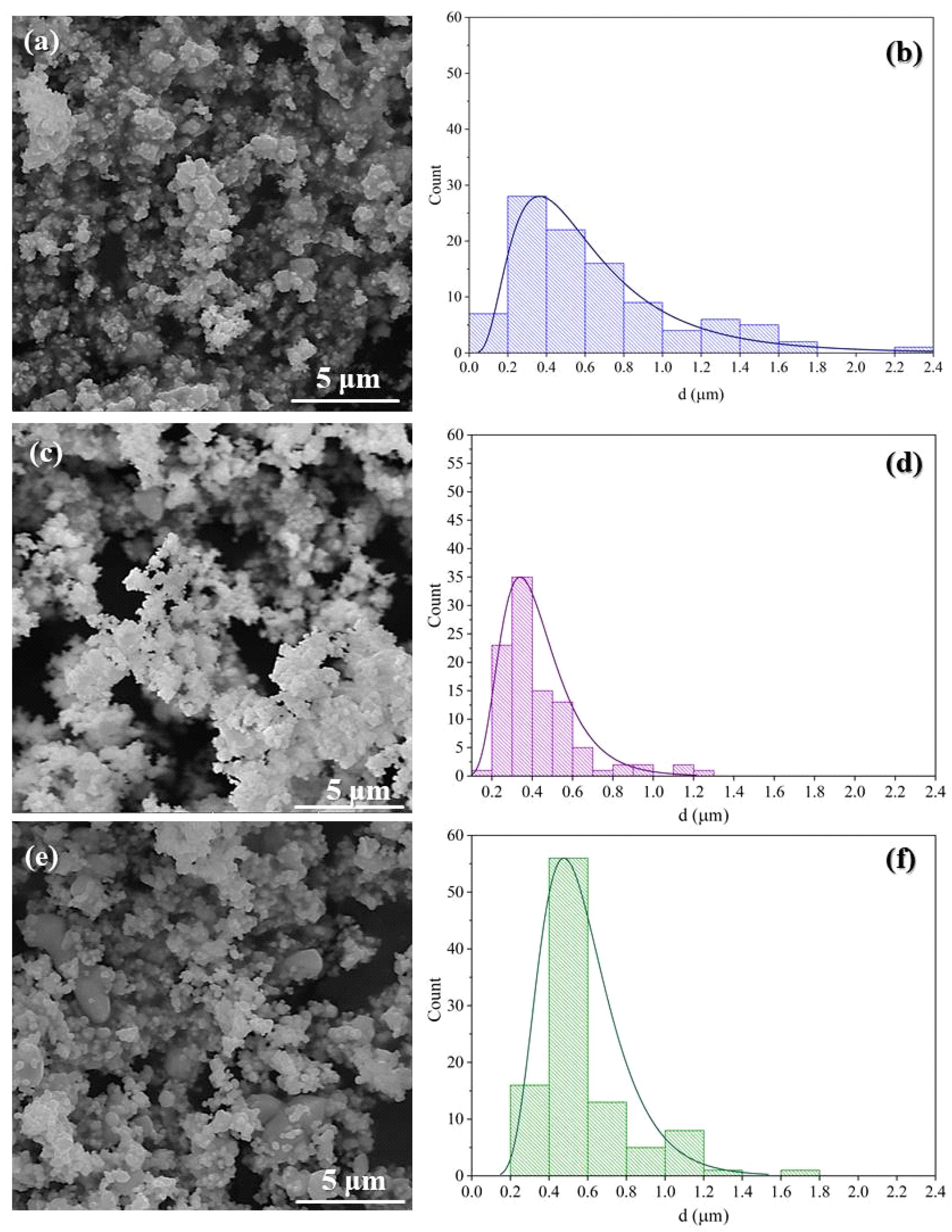
The SEM micrographs and particle size distributions shown in Figure 5 indicate that the increase in milling time leads to a broader particle size distribution. Additionally, the number of particles larger than the median size increases, while the frequency of particles near the median value decreases. These results are consistent with the known effect of the lower limit of size reduction in brittle materials, below which continuous grinding is ineffective [28]. The apparent agglomeration evident in these samples may result from heat released during prolonged milling, which allows for the growth of larger particles at the expense of smaller ones. Therefore, even the shortest milling time at 600 rpm can be considered as a relatively harsh preparation condition. To further clarify the influence of milling intensity, a rotational rate of 100 rpm was employed. A milling time of 15 min at the lower rotational rate was chosen to ensure complete conversion and avoid the presence of impurities.
Figure 5.
SEM micrographs of the SM2 n2 sample (a) and its particle size distribution (b), the SM2 n15 sample (c) and its particle size distribution (d), and the SM2 n5 sample (e) and its particle size distribution (f).
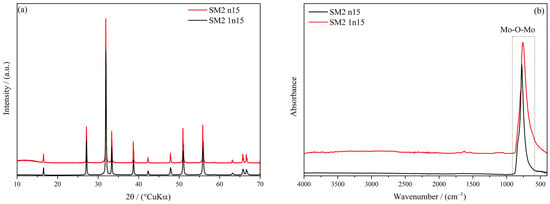
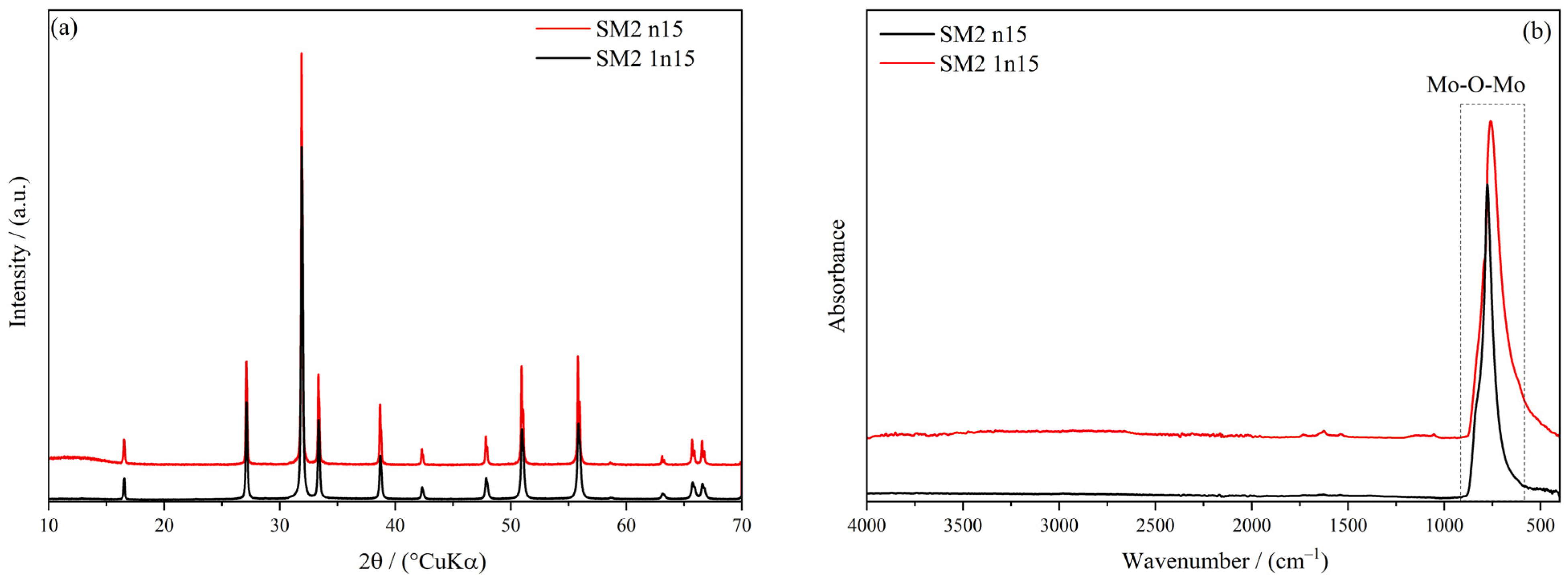
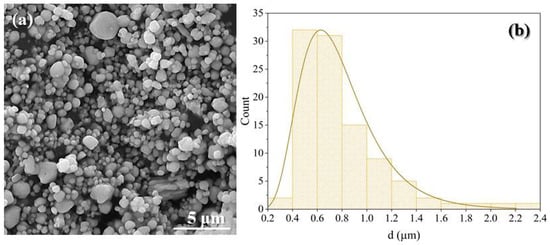
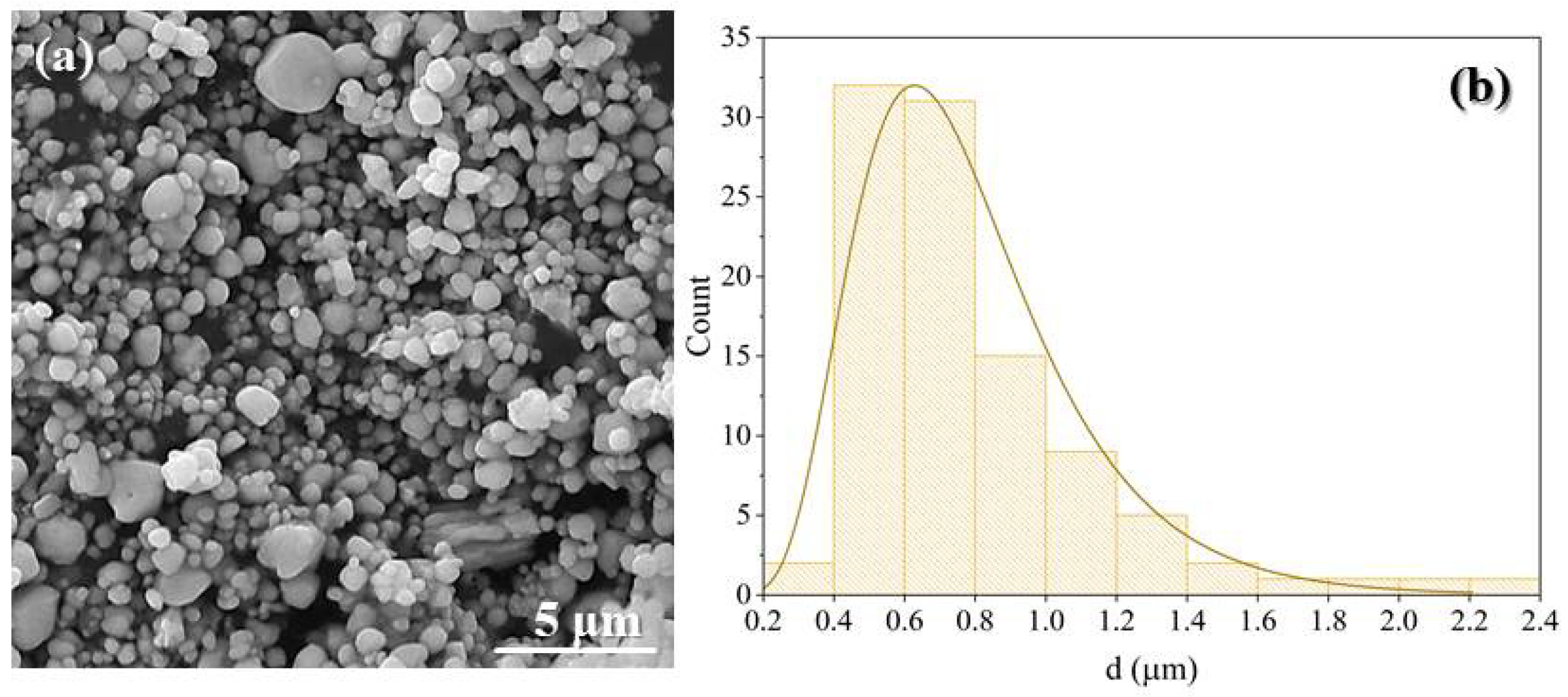
The XRD and FTIR results (Figure 6) confirm that even at 100 rpm, the formation of phase-pure silver molybdate occurs. Also, the SEM micrograph and particle size analysis show a noticeably narrower particle size distribution (Figure 7). The particles display conspicuous sphericity but the particle size distribution median is shifted to a larger particle size. The larger particle size is a consequence of less energy provided to the process due to a lower rotational rate. Importantly, no evident agglomeration or coalescence is observed in these samples.
Figure 6.
XRD (a) and FTIR analysis (b) results of SM2 samples prepared with two different milling rates.
Figure 7.
SEM micrograph of SM2 1n15 sample (a) and its particle size distribution (b).
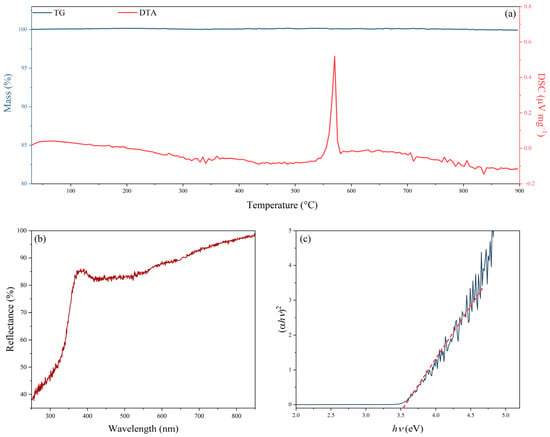
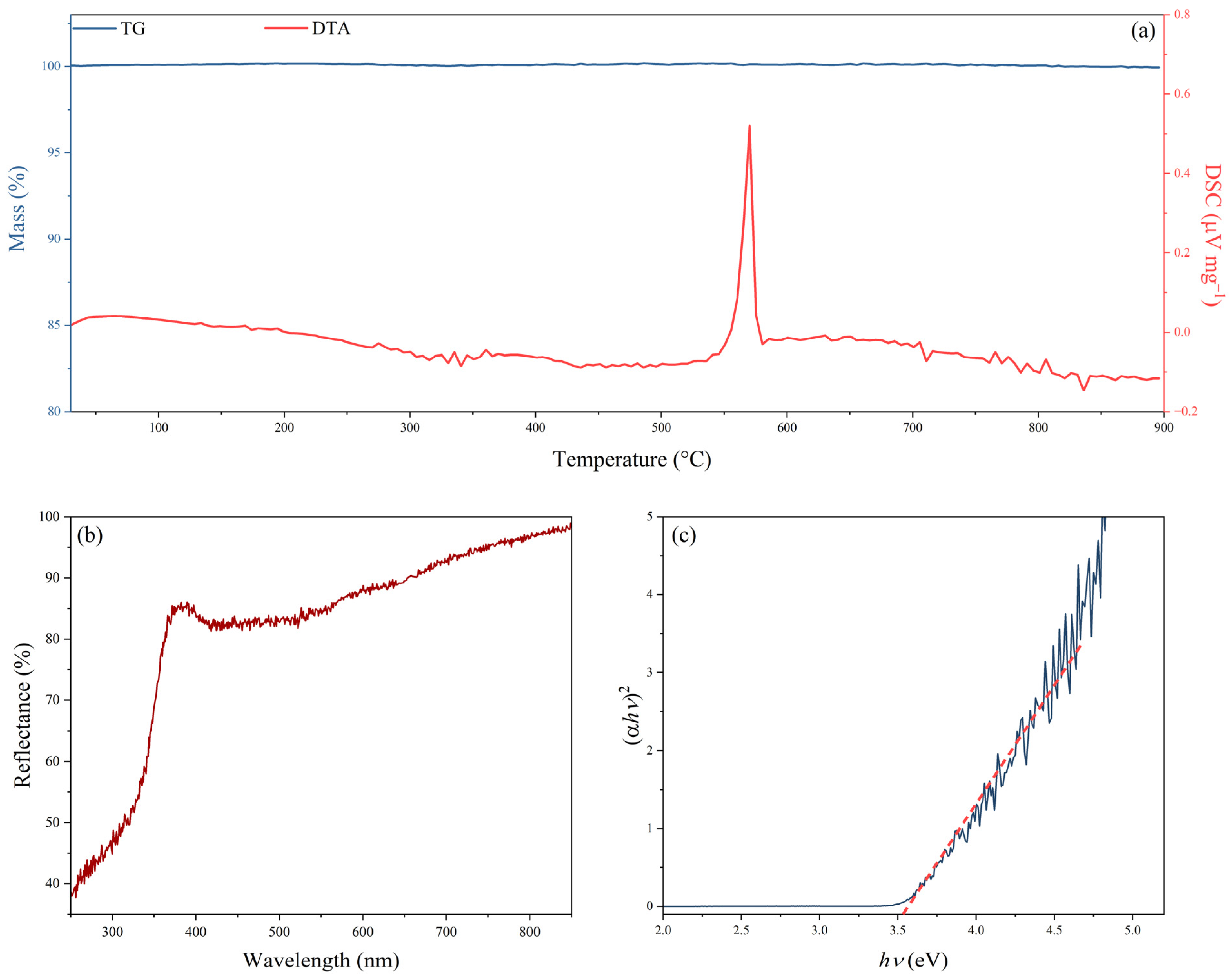
A simultaneous DTA/TG analysis was performed on the most promising SM2 1n15 sample, with the results presented in Figure 8a. It can be observed that the sample SM2 1n15 has an endothermic peak at 570 °C. According to reference [29], this effect can be attributed to the melting of β-Ag2MoO4. No other notable thermal effects or mass changes were observed, confirming the phase purity of the prepared sample.
Figure 8.
DTA/TG results (a), diffuse reflectance spectrum (b), and Tauc plot (c) of the SM2 1n15 sample.
To obtain the photoelectronic properties of this sample, its band gap was determined via its diffuse reflectance spectrum (Figure 8b,c). For silver molybdate, the band gap and its electron transitions are treated as direct transitions [30,31]. The optical band gap was estimated to be ~3.5 eV from the Tauc plot, which is slightly higher than commonly reported values (≈3.1–3.4 eV) [32,33]. The almost negligible difference comes from the subjective nature of determining the band gap from the Tauc plot and due to differences in particle size. Finally, as reported in the work by Gamsjäger and Morshita [34], the formation of silver molybdate is thermodynamically favorable, as confirmed by the highly negative standard molar enthalpy of formation and Gibbs energy of formation. The enthalpy of formation of β−Ag2MoO4 was determined to be −(838.16 ± 2.00) kJ·mol−1, while the standard Gibbs energy of formation was found to be −(748.232 ± 1.743) kJ·mol−1, both large negative values, confirming the strong thermodynamic spontaneity. The standard molar entropy of β−Ag2MoO4 was established as (220.80 ± 2.21) J·K−1·mol−1, reflecting the ordered crystalline nature of the product. The large negative values of both ΔfH° and ΔfG° confirm that the formation of silver molybdate is strongly thermodynamically spontaneous and highly exothermic, meaning that once the precursors are brought into intimate contact during milling, the reaction proceeds rapidly and completely even with minimal mechanical energy input. Conversely, the observed changes in particle morphology and size distribution at higher milling times are a consequence of the mechanical energy applied to the already-formed product. Prolonged milling introduces mechanical stress, promotes particle coalescence through localized heat generation, and can induce structural disorder or amorphization. This accounts for the broader particle size distributions and evidence of particle fusion observed in samples milled for longer durations at 600 rpm. Despite the favorable characteristics of the described mechanochemical approach, planetary mills are typically confined to gram-scale batches, and scaling up to larger quantities would require different mill types. Additionally, the washing procedure, consisting of repeated cycles of sonication and centrifugation, is time-consuming and contributes to yield losses, particularly in PCA-diluted runs where yields dropped to approximately 70%. Nevertheless, the approach compares favorably to conventional wet-chemical routes in terms of solvent consumption and overall energy input as well as good reproducibility with high yields.
4. Conclusions
This study demonstrated that mechanochemical synthesis is a viable and environmentally friendly route of producing phase-pure β-Ag2MoO4, provided that precursor choice and milling intensity are carefully controlled. Among the tested precursors, only silver nitrate yielded pure β-Ag2MoO4; silver chloride remained unreactive and synthesis with silver sulphate yielded impurities. The addition of process control agents did not allow for the formation of nanosized particles due to the rapid reaction of certain silver salts and sodium molybdate dihydrate. While smaller particles were obtained under harsher milling conditions, the appearance of contaminants was also promoted. Lower milling rates (100 rpm) were sufficient to achieve a complete reaction without impurity incorporation. The thermal analysis confirmed the stability and purity of the synthesized β-Ag2MoO4 and the optical band gap values aligned well with those reported in the literature, further validating the quality of the nitrate-derived samples. Overall, the results highlight mechanochemistry as a promising solvent-free method for producing high-purity silver molybdate and emphasize the importance of controlled milling parameters in tailoring product purity and morphology. The phase-pure β-Ag2MoO4 obtained under mild mechanochemical conditions represents a promising starting material for fabricating fast-ion-conducting (FIC) glasses, and future work will focus on evaluating its performance in glass-forming systems.
Author Contributions
Conceptualization, S.K. and F.B.; methodology, S.K. and F.B.; validation, F.B., N.M. and K.M.; formal analysis, F.B. and S.K.; investigation, F.B., N.M. and K.M.; data curation, F.B.; writing—original draft preparation, F.B.; writing—review and editing, S.K. and K.M.; visualization, F.B.; supervision, S.K. All authors have read and agreed to the published version of the manuscript.
Funding
This research was conducted within the framework of the project HEMKAT, financed by the European Union’s NextGenerationEU fund from source 581—The recovery and resilience mechanism in the framework of programme financing of public higher education institutions and public scientific institutes.
Data Availability Statement
The data that support the finding of this study are available from the corresponding author upon reasonable request.
Acknowledgments
The support of the University of Zagreb, Faculty of Chemical Engineering and Technology, is gratefully acknowledged.
Conflicts of Interest
The authors declare no conflicts of interest.
References
- Nasser, B.; Tawalbeh, M.; Al-Othman, A.; Yusuf, M. Contributions of Green Energy Materials to Sustainable Development Goals. J. Renew. Sustain. Energy 2025, 1, 4. [Google Scholar] [CrossRef] [Scilit]
- Chen, Z.; Zhang, L.; Yu, T.; Yang, H.; Lu, Y.; Wang, X.; Li, R.; Ye, Z.; Li, P.; Zheng, B.; et al. Zinc-ion batteries: Pioneering the future of sustainable energy storage through advanced materials and mechanisms. RSC Appl. Interfaces 2025, 2, 1143–1170. [Google Scholar] [CrossRef] [Scilit]
- Gouveia, A.F.; Sczancoski, J.C.; Ferrer, M.M.; Lima, A.S.; Santos, M.R.M.C.; Li, M.S.; Santos, R.S.; Longo, E.; Cavalcante, L.S. Experimental and Theoretical Investigations of Electronic Structure and Photoluminescence Properties of β-Ag2MoO4 microcrystals. Inorg. Chem. 2014, 53, 5589–5599. [Google Scholar] [CrossRef] [Scilit]
- Della Rocca, D.G.; Peralta, R.M.; Peralta, R.A.; Peralta Muniz Moreira, R.d.F. Recent development on Ag2MoO4-based advanced oxidation processes: A review. React. Kinet. Mech. Catal. 2021, 132, 1–35. [Google Scholar] [CrossRef] [Scilit]
- Beltrán, A.; Gracia, L.; Longo, E.; Andrés, J. First-principles study of pressure-induced phase transitions and electronic properties of Ag2MoO4. J. Phys. Chem. C 2014, 118, 3724–3732. [Google Scholar] [CrossRef] [Scilit]
- Ng, C.H.B.; Fan, W.Y. Uncovering metastable α-Ag2MoO4 phase under ambient conditions. Overcoming high pressures by 2,3-Bis(2-pyridyl)pyrazine doping. Cryst. Growth. Des. 2015, 15, 3032–3037. [Google Scholar] [CrossRef] [Scilit]
- Singh, D.P.; Sirota, B.; Talpatra, S.; Kohli, P.; Rebholz, C.; Aouadi, S.M. Broom-like and flower-like heterostructures of silver molybdate through pH controlled self assembly. J. Nanoparticle Res. 2012, 14, 781. [Google Scholar] [CrossRef] [Scilit]
- Ferreira, E.A.C.; Andrade Neto, N.F.; Bomio, M.R.D.; Motta, F.V. Influence of solution pH on forming silver molybdates obtained by sonochemical method and its application for methylene blue degradation. Ceram. Int. 2019, 45, 11448–11456. [Google Scholar] [CrossRef] [Scilit]
- Calistiri, S.; Gessi, A.; Marghella, G.; Bruni, S.; Ubaldini, A. Characterization and Formation Mechanism of Ag2MoO4 Crystals via Precipitation Method: Influence of Experimental Parameters and Crystal Morphology. Crystals 2024, 14, 254. [Google Scholar] [CrossRef] [Scilit]
- Sanson, A.; Rocca, F.; Armellini, C.; Ahmed, S.; Grisenti, R. Local study on the MoO4 units in AgI-doped silver molybdate glasses. J. Non-Cryst. Solids 2009, 354, 94–97. [Google Scholar] [CrossRef] [Scilit]
- Mehrer, H. Fast Ion Conductors. In Diffusion in Solids, 1st ed.; Springer: Berlin/Heidelberg, Germany, 2007; pp. 475–490. [Google Scholar]
- Tuller, H.L.; Button, D.P.; Uhlmann, D.R. Fast Ion Transport in Oxide Glasses. J. Non-Cryst. Solids 1980, 40, 91–118. [Google Scholar] [CrossRef] [Scilit]
- Bhattacharya, S.; Ghosh, A. Transport properties of AgI doped silver molybdate superionic glass-nanocomposites. J. Phys. Condens. Matter 2005, 17, 5655–5662. [Google Scholar] [CrossRef] [Scilit]
- Swenson, J.; McGreevy, R.L.; Börjesson, L.; Wicks, J.D.; Howells, W.S. Intermediate-range structure of fast-ion-conducting AgI-doped molybdate and tungstate glasses. J. Phys. Condens. Matter 1996, 8, 3545–3552. [Google Scholar] [CrossRef] [Scilit]
- Narayana Reddy, C.; Veeranna Gowda, V.C.; Sujatha, B. Ion conductivity and dielectric relaxation behavior in FIC silver based phospho-molybdate glasses. Ionics 2006, 12, 159–165. [Google Scholar] [CrossRef] [Scilit]
- Lopes, F.H.P.; Noleto, L.F.G.; Vieira, V.E.M.; de Sousa, P.B.; Jucá, A.C.S.; Oliveira, Y.L.; Costa, K.R.B.S.; Almeida, M.A.P.; Gouveia, A.F. Experimental and Theoretical Correlation of Modulated Architectures of β-Ag2MoO4 Microcrystals: Effect of Different Synthesis Routes on the Morphology, Optical, Colorimetric, and Photocatalytic Properties. J. Inorg. Organomet. Polym. Mater. 2023, 33, 424–450. [Google Scholar] [CrossRef] [Scilit]
- Chetry, A.B. Mechanochemistry: A new frontier in chemical synthesis. J. Chem. Res. 2025, 49, 17475198251339299. [Google Scholar] [CrossRef] [Scilit]
- Kurajica, S.; Brleković, F.; Keser, S.; Dražić, G.; Mužina, K.; Mihajlović, V. Evaluation of Mechanochemically Prepared CePO4·H2O Nanoparticles as UV Filter for Photoprotective Formulations. Molecules 2025, 30, 405. [Google Scholar] [CrossRef] [Scilit] [PubMed]
- Juarez, J.C.; Morales, R. Reduction Kinetics of Ag2MoO4 by Hydrogen. Metal. Mater. Trans. B 2008, 39, 738–745. [Google Scholar] [CrossRef] [Scilit]
- Karthikeyan, A.; Rao, K.J. Structure and Silver Ion Transport in AgI-Ag2MoO4 Glasses: A Molecular Dynamics Study. J. Phys. Chem. B 1997, 101, 3105–3114. [Google Scholar] [CrossRef] [Scilit]
- Dalvi, A.; Shahi, K. Characterization and electrochemical cell characteristics of mechanochemically synthesized AgI–Ag2O–MoO3 amorphous superionic system. J. Phys. Chem. Solids 2003, 64, 813–819. [Google Scholar] [CrossRef] [Scilit]
- Schneider, C.A.; Rasband, W.S.; Eliceiri, K.W. NIH Image to ImageJ: 25 years of image analysis. Nat. Methods 2012, 9, 671–676. [Google Scholar] [CrossRef] [Scilit]
- Gosh, S.; Basu, A.N. Unified study of the lattice mechanical properties of the AgCl crystal. Phy. Rev. B 1981, 23, 1818–1826. [Google Scholar] [CrossRef] [Scilit]
- Della Rocca, D.G.; Schneider, M.; Fraga, F.C.; de Noni, A.N., Jr.; Peralta, R.A.; Rodriguez-Agualdo, E.; Rodriguez-Castellon, E.; Moreira, R.F.P.M. A comprehensive insight into the parameters that influence the synthesis of Ag2MoO4 semiconductors via experimental design. J. Mater. Sci. Mater. Electron. 2023, 34, 1500. [Google Scholar] [CrossRef] [Scilit]
- Oliveira, C.A.; Volanti, D.P.; Nogueira, A.E.; Zamperini, C.A.; Vergani, C.E.; Longo, E. Well-designed β-Ag2MoO4 crystals with photocatalytic and antibacterial activity. Mater. Des. 2016, 115, 73–81. [Google Scholar] [CrossRef] [Scilit]
- Mondal, A.; Roy, A.; Raveendran, D.; Reddy Inta, H.; Ghosh, S.; Bhandry, N.; Mahalingam, V. Interface Engineering of Cobalt−Silver Molybdate Nanostructures for Bifunctional Water Splitting. ACS. Appl. Nano Mater. 2026, 9, 1354–1366. [Google Scholar] [CrossRef] [Scilit]
- Silva, J.C.; Oliveira da Silva, L.R.; de Sousa, D.L., Jr.; da Silva Pereira, R.L.; Sampaio de Freitas, T.; Roque Paulo, C.P.; Gonçalves, S.A.; Rocha, J.E.; de Oliveira Borges, J.A.; Melo Coutinho, H.D.; et al. FTIR characterization and microbiological application of polyoxometalates molybdic acid and potassium molybdate against MDR bacteria. Res. Chem. 2024, 7, 101466. [Google Scholar] [CrossRef] [Scilit]
- Martelli, S.; Di Nunzio, P.E. Powder ball milling: An energy balance approach to particle size reduction. J. Mater. Res. 2024, 40, 292–308. [Google Scholar] [CrossRef] [Scilit]
- Tsyrenova, G.D.; Solodovnikov, S.F.; Khaikina, E.G.; Khobrakova, E.T.; Bazarova, Z.G.; Solodovnikova, Z.A. Phase formation in the systems Ag2MoO4–MO–MoO3 (M=Ca, Sr, Ba, Pb, Cd, Ni, Co, Mn) and crystal structures of Ag2M2(MoO4)3 (M=Co, Mn). J. Solid. State Chem. 2004, 177, 2158–2167. [Google Scholar] [CrossRef]
- Binish, B.; Lokesh, B.; Veer, Y.; Peters, S.; Abith, M.; Sabari Girisun, T.C.; Mani Rahulan, K. Silver molybdate: An excellent optical limiting material under nanoregime for photonic device application. Sci. Rep. 2024, 14, 5642. [Google Scholar] [CrossRef] [Scilit]
- Da Silva, P.H.; de Souza, D.A.; Filho, R.L.F.; Teixeira, A.P.C.; Lago, R.M.; Britao, W.R.; Araujo, E.A., Jr.; Takeno, L.L.; Sousa Morais, F.; de Lima Nascimento, J.F.; et al. GO@β-Ag2MoO4 Composite: One-Step Synthesis, Characterization and Photocatalytic Performance against RhB Dye. ACS Phys. Chem. 2024, 4, 632–646. [Google Scholar] [CrossRef] [Scilit]
- Warmuth, L.; Ritschel, C.; Feldmann, C. Facet-, composition- and wavelength-dependent photocatalysis of Ag2MoO4. RSC Adv. 2020, 10, 18377–18383. [Google Scholar] [CrossRef] [Scilit]
- Vinoth Kumar, J.; Karthik, R.; Chen, S.M.; Muthuraj, V.; Karuppiah, C. Fabrication of potato-like silver molybdate microstructures for photocatalytic degradation of chronic toxicity ciprofloxacin and highly selective electrochemical detection of H2O2. Sci. Rep. 2016, 6, 34149. [Google Scholar] [CrossRef] [Scilit]
- Gemsjager, H.; Morishita, M. Thermodynamic properties of molybdate ion: Reaction cycles and experiments. Pure Appl. Chem. 2015, 87, 461–476. [Google Scholar] [CrossRef] [Scilit]

Disclaimer/Publisher’s Note: The statements, opinions and data contained in all publications are solely those of the individual author(s) and contributor(s) and not of MDPI and/or the editor(s). MDPI and/or the editor(s) disclaim responsibility for any injury to people or property resulting from any ideas, methods, instructions or products referred to in the content. |
© 2026 by the authors. Licensee MDPI, Basel, Switzerland. This article is an open access article distributed under the terms and conditions of the Creative Commons Attribution (CC BY) license.