


Abstract
Particle pollution has been recognized as a significant form of environmental pollution. More specifically, the inhalation of very small (ultrafine) airborne particulate matter that is emitted from the burning of fossil fuels poses one of the most serious threats to human health. High-efficiency retention of these particles is one of the most challenging environmental problems, since conventional techniques such as electrostatic precipitators, bag filters, or cyclones have low collection efficiency in the respirable range (0.1 μm–1.0 μm). Acoustically induced agglomeration of ultrafine particles is a promising technique to increase the size of small particles before they enter a conventional filter. During this process, high-intensity acoustic fields are applied to the flue gas stream, inducing interactions among suspended particles that give rise to collisions and agglomeration. The preconditioned aerosol can then be filtered within conventional filters with higher collection efficiency. The present work reports the results of a numerical investigation of the effect of ultrasound preconditioning on the particle size distribution as a function of parameters related to the ultrasound system design, such as the sound frequency and intensity, and the initial distribution characteristics. Particle agglomeration is modeled via the solution of the population balance equation with the Multi-Monte Carlo method. Results show that acoustic agglomeration can shift the particle size distribution toward larger diameters and reduce the number concentration of particles, thus leading to increased capture efficiency of conventional filters.
1. Introduction
The presence of ambient particulate matter (PM) in the atmosphere has been identified as a serious problem having adverse effects on both human health and the environment [1]. Increased PM concentration in the atmosphere not only reduces visibility, but also affects ecosystem components such as plants or soil via its deposition [2].
Based on its size, inhalable PM can be categorized into coarse PM10 (having an aerodynamic diameter, d, from about 2.5 μm up to 10 μm), fine PM2.5 (d equal to or less than 2.5 μm), and its ultrafine subset (d less than 0.1 μm). All of these fractions have been found to be toxic by recent epidemiological studies [3]; however, the fine and ultrafine components, which are mainly produced by combustion activities, are even more dangerous [4,5], for two main reasons. First, they consist of carbonaceous combustion particles with chemical components such as polycyclic aromatic hydrocarbons (PAHs) that have increased carcinogenic potential [6]; second, because of their size, they can penetrate deeper into the human lungs and cause respiratory (chronic bronchitis, asthma, or lung cancer) and cardiovascular diseases (cardiac arrhythmias or heart attacks) [7]. Regarding the particulates emitted from the power sector, coal power plants have historically been a major source of pollutants [8].
Filtering devices such as electrostatic precipitators, baghouses, wet scrubbers, cyclone dust collectors, and granular bed filters have been employed in power plants for years to capture particles emitted from the combustion of fossil fuels [9]. While these devices exhibit an efficiency exceeding 99.9% for particles with a diameter larger than 2.5 μm [10], their retention capacity diminishes for fine and submicron particles [11]. To improve the efficiency of these devices, one approach is the preconditioning of the exhaust gas stream to increase the size of the particles with the aid of various agglomeration technologies, including heterogeneous condensation [12] or the application of an external force field [13], such as acoustic [14] or magnetic [15] fields. Among these, using acoustic fields to promote particle agglomeration is the focus of the present work.
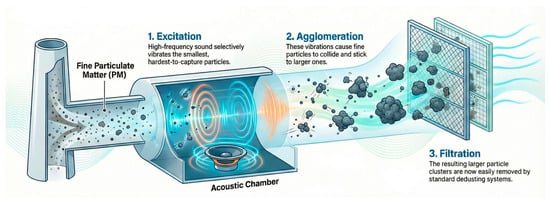
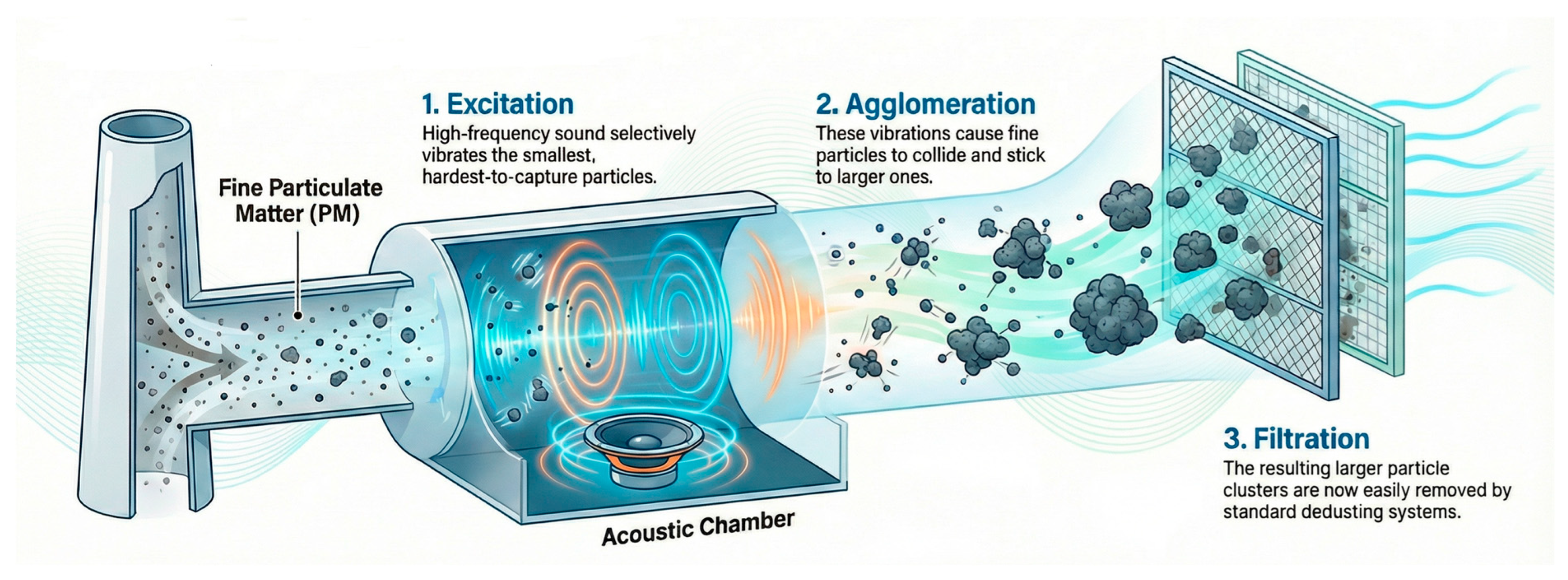
During acoustic agglomeration preconditioning, as schematically shown in Figure 1, high-intensity acoustic fields are applied to the flue gas stream, inducing interactions among suspended particles, leading to collisions and agglomeration [16]. Testing of this methodology within industrial-scale chambers has demonstrated a potential reduction of up to 70% in the number concentration of micron-sized fly ash particles [17].
Figure 1.
Schematic concept of the acoustic agglomeration preconditioning of solid particles found in industrial gas emissions.
Many physical mechanisms are believed to contribute to the acoustic agglomeration process: the first one to be accounted for is the orthokinetic mechanism, where collisions between particles of different sizes are attributed to the different ways they respond to the acoustic oscillations of the fluid [18]. The variation in particle motion within the acoustic field, described by each particle’s entrainment factor, creates a relative velocity that facilitates inter-particle collisions [19]. The orthokinetic mechanism, while considered the primary driver of acoustic agglomeration, fails to account for collisions between particles of uniform size, a phenomenon substantiated by experimental observations [20,21]. Consequently, the hydrodynamic mechanism has been proposed, positing that inter-particle interactions, even among identically sized particles, are induced by hydrodynamic forces that arise when particles are in close proximity.
Numerical modeling and simulation are valuable tools for investigating the influence of various mechanisms on the overall efficiency of acoustic agglomeration in enhancing particle size. The standard approach to numerically analyzing acoustic agglomeration dynamics involves solving the population balance equation (PBE) [22] or its discrete form, the Smoluchowski equation [23]. The solution of this equation depicts the temporal evolution of a particle size distribution, contingent upon the accurate definition of the collision rate. It can be solved through deterministic methodologies, such as the method of moments [24], the sectional method [25], the discrete method [26], the discrete-sectional method [27], or stochastic techniques commonly referred to as Monte Carlo (MC) methods [28]. In contrast to deterministic integration, stochastic methodologies employ MC simulations to model the dynamic behavior of a finite ensemble of particles and track their history over time [22].
The objective of the present work is to numerically investigate the acoustic agglomeration of liquid particles. Experimental data on glycol fog droplets agglomerated in an acoustic chamber are used to validate our results. A key contribution of this approach is the incorporation of the acoustic wake effect (AWE) into the agglomeration model.
2. Methods and Models
The PBE, accounting solely for agglomeration phenomena, is expressed by the following nonlinear integro-differential equation, originally formulated by Friedlander [29]:
where np(υ,t) is the particle size distribution function at time t and β(υ,u) is the agglomeration frequency function of two particles of volumes υ and u. The term β(υ,u), also referred to as the collision frequency function or kernel, encapsulates the physical mechanisms that drive inter-particle collisions and agglomeration and quantifies the rate at which these particles collide. The third term accounts for particle loss through deposition, as dictated by the deposition kernel, R(υ). The left-hand side of Equation (1) denotes the temporal variation in the number concentration of particles with volume υ.
The Multi-Monte Carlo (MMC) methodology, utilized in the present work for the numerical solution of the PBE, was initially developed to reduce computational cost and improve the accuracy of the Direct Simulation Monte Carlo (DSMC) method [30]. A key distinction from the DSMC methodology lies in the representation of simulation entities. Rather than representing individual particles, these entities represent groups of particles with similar properties, referred to as “fictitious” particles. While the concept of fictitious particles has been previously employed in constant-number MC methods, the MMC methodology uniquely features a dynamic weight assignment. This weight, denoting the number of real particles represented by a simulation particle, varies in response to prevailing dynamic processes. Specifically, agglomeration reduces the weight and increases the size of simulation particles, whereas deposition only decreases the weight. A more detailed description of the MMC method and illustrative examples can be found in [31].
3. Agglomeration Kernels
The agglomeration kernel contains all the information required for modeling a process initiated by a specific physical phenomenon. Particularly for particle agglomeration, the kernel represents the probability of an agglomeration event occurring between two particles. Each kernel is a function of the sizes of the two particles involved in the collision process. In this study, the effects of turbulent and gravitational agglomeration will not be considered as they are negligible for the particle sizes examined [32]. The kernel employed for solving the PBE is the overall agglomeration kernel, which is considered the sum of the following kernels representing the effect of each individual mechanism.
3.1. Brownian Agglomeration Kernel
The behavior of small particles within a quiescent fluid depends on the ratio of their size to the mean free path of the surrounding medium’s molecules, as quantified by the Knudsen number, Kn [33]. Due to their small size, collisions between these particles and medium molecules result in their random motion (Brownian motion), leading to collisions (thus agglomeration) among the particles themselves. Depending on the value of the Knudsen number, various particle size regimes are defined: the continuum and near-continuum regimes (Kn < 0.01 and 0.01 < Kn < 1), the transition regime (1 < Kn < 10), and the free-molecule regime (Kn > 10); for each regime, a different expression for the collision kernel can be formulated. For the particle sizes examined here, the continuum regime expression is used [34]:
where kB is the Boltzmann constant, T is the absolute temperature, μ is the dynamic viscosity of the medium, and Cc(υ1) and Cc(υ2) are the Cunningham slip correction factors.
3.2. Acoustic Agglomeration Kernel
The orthokinetic and hydrodynamic mechanisms have been identified as the primary contributors to the acoustic agglomeration process. To accurately simulate the impact of each mechanism on the solution of the PBE, a distinct collision kernel must be derived for each one, and the total agglomeration kernel can be expressed as the linear superposition of these kernels:
where bOI and bHI are the weighting factors of each mechanism’s contribution to the overall kernel. These factors cannot be theoretically determined; therefore, a combination satisfying the condition bOI + bHI = 1 can be chosen [35] or, alternatively, values of unity (bOI = bHI = 1) can be adopted, which represents the convention utilized in this work and aligns with previous numerical investigations of acoustic agglomeration [36,37,38,39,40,41,42,43,44]. Currently, there is no standardized analytical methodology for determining these factors; consequently, an empirical trial-and-error approach could be used to align simulation results with experimental data. For instance Ezekoye and Wibowo [36] applied this technique to match the available experimental data of Capéran [45] and Brandt and Hiedemann [18], and they determined that incorporating only a 5% to 30% contribution from the orthokinetic mechanism is sufficient to reproduce the observed trend in particle number reduction.
βtotal = bOIβOR + bHIβHY
3.2.1. Orthokinetic Agglomeration Kernel
Regarding the orthokinetic mechanism, it is crucial to analyze the oscillatory motion of particles induced by the acoustic wave. Specifically, larger particles tend to remain nearly stationary, whereas smaller particles are almost entirely entrained by the medium, oscillating back and forth with the medium [46]. The concept of the acoustic agglomeration volume was introduced by Mednikov [47] to describe the volume swept by a given particle due to its oscillatory motion (relative to other particles) during a complete acoustic cycle. Mednikov’s main assumption was that all particles within the agglomeration volume were captured and that this volume was entirely replenished by other particles within a single acoustic cycle. Considering only two types of particles (particle 1 is the oscillating collector and particle 2 represents the particles that are inside the agglomeration volume), the agglomeration kernel for this mechanism can be expressed as follows (Mednikov formulation):
where d1 and d2 represent the particle diameters, U0 denotes the velocity amplitude of the sound wave, and n12 is the relative entrainment factor between the two particles:
n12 = H12 = |H1 − H2|
The magnitude and phase of the H-function are respectively the entrainment factor and phase delay of the particle [48]:
where λp is the ratio of the fluid density, ρf, to the particle density, ρp, ω is the angular frequency of the acoustic wave, and δv is the penetration depth of the viscous wave [49].
The expression for the relative entrainment factor n12 can now be written as:
A major limitation of the Mednikov model is that the oscillatory motion of particles and the mutual scattering interactions between them are not considered in the derivation of the agglomeration volume [50]. Later, Song included them in his study and modified the Mednikov expression by introducing a new formulation for the relative entrainment factor of two particles [51]:
where G12 is the so-called scattering interaction function and a detailed description can be found in Song’s dissertation [51].
ns12 = |H1 − H2 + G12|
3.2.2. Hydrodynamic Agglomeration Kernel
Apart from the linear particle–gas interactions inherent in the orthokinetic mechanism, nonlinear inter-particle interactions also occur within an oscillating gas [52]. These interactions can be attributed either to nonlinear interactions between particle scattering waves and the incident field, termed the mutual radiation pressure effect (MRPE) [53], or to viscous asymmetries in the flow field surrounding the particles, leading to the AWE [54]. To investigate the influence of these interactions on particle motion, it is necessary to calculate the forces exerted on particles in the Stokes flow regime (giving rise to Bjerknes or König forces) and, for the study of the AWE, in the Oseen flow regime. Both force types act concurrently on particles exposed to an acoustic field; however, distinct agglomeration kernels have been formulated for each to facilitate further investigation into their impact on the acoustic agglomeration process.
Mutual Radiation Pressure Effect Kernel
The proximity of two moving particles within an acoustic field induces additional scattered waves that interfere with their trajectories. The nonlinear interaction between the incident wave and the waves scattered by each particle generates a resultant wave, disturbing nearby particles and influencing their motion. The non-uniform spatial distribution of scattering velocity leads to a net pressure force between the particles [36,55]. These forces, stemming from interactions between particles and the surrounding fluid, are commonly referred to as secondary acoustic forces [56].
For this hydrodynamic mechanism, the agglomeration frequency function can be described by the classic expression of König, who calculated the forces between two particles in an ideal fluid using the Bernoulli effect. König’s expression for the collision kernel takes the form:
Danilov and Mironov [57] were the first to incorporate the viscous effects on such Bernoulli interactions and formulated an overall approach for the Bjerknes forces. Later, Song extended their work by also incorporating the effect of particle entrainment and the separation distance between particles, and formulated the following expression for the hydrodynamic mechanism [51]:
The parameter g12, a complex algebraic expression known as the hydrodynamic interaction function, accounts for the effects of entrainment and scattering waves; a detailed derivation can be found in Song’s dissertation [51].
Acoustic Wake Effect Kernel
An asymmetry in the flow field surrounding a particle undergoing oscillatory motion in an acoustic field generates a wake characterized by an area of reduced pressure downstream of the particle. The presence of an adjacent oscillating particle within the wake of a leading particle results in a reduction in drag, causing the trailing particle to move toward the leading particle. These interacting particles exhibit mutual perturbation of their trajectories due to their periodically varying wakes [58].
Though the AWE is a purely hydrodynamic mechanism, its associated collision kernel can be expressed by considering it as a refill mechanism for the acoustic agglomeration volume, which was previously used to formulate the orthokinetic agglomeration kernel. In Mednikov’s classical theory, after one acoustic cycle, all particles are swept by the core oscillating particle, and the emptied agglomeration volume is assumed to be automatically refilled by smaller particles with an arbitrarily set unity refill factor [59]. However, if physical mechanisms such as gravity, acoustic wave scattering, MRPE, acoustic streaming, or the AWE are considered as refill mechanisms, the volume will only be partially refilled. If the acoustic wake is considered the only refill mechanism, the agglomeration kernel can be calculated as follows [60]:
The refill factor R12 has been calculated as an extension to the length of the acoustic agglomeration volume formulated by Mednikov, L21:
where l1 and l2 are the particle slip coefficients in the Oseen regime [61] and Tac is the acoustic period. The length L21 can be calculated from the relative displacement between the particles [59]:
In this equation, x1 and x2 are the particle displacement amplitudes and LAWE is the acoustic wake volume length that can be calculated as follows [60]:
3.3. Deposition Kernel and Treatment of Particle Deposition Event
For the account of particle loss though their deposition on the acoustic chamber walls, the relevant kernel can be given as a combination of the effect of the diffusion deposition or gravitational settling [62]:
where AD and AS represent the chamber surface areas associated with diffusion and gravitational settling, respectively, and V denotes the volume of the acoustic chamber. Here, δD is the diffusive boundary layer thickness, D is the particle diffusion coefficient, and Us is the settling velocity, defined as [63]:
δD = 0.005D0.274
Upon the determination of a deposition event, the tracked fictitious particle must be removed from the distribution’s particle population. However, this action would inevitably lead to a continuous reduction in particle number, thereby compromising the statistical treatment of the problem, a predicament identical to that encountered during the agglomeration process. To mitigate this issue, a recalibration of the weighting factor is necessary. In the present work, the weight of the tracked particle is set to zero, and the simulation proceeds with this particle included as a “ghost” entity.
4. Results and Discussion
To investigate the influence of acoustic agglomeration on particle size distribution, a representative cell containing up to N0 = 5.5 × 10¹² real particles/m3 is isolated from an aerosol system and used in the simulation. Unless specified otherwise, the simulation is conducted with 9000 fictitious particles, and the size distribution is discretized into 500 logarithmically spaced bins within the range of 0.1 μm to 500 μm. For validation, the MMC model will first be compared against experimental data (accounting for both Brownian motion and acoustic agglomeration) and subsequently against numerical results from other researchers who used the same experimental dataset.
The experimental data employed pertain to the temporal evolution of an initial aerosol mixture subjected to an acoustic field. These data were originally documented in the work of Magill [64] and further elaborated on by Capéran and Somers [45,65]. These experiments investigated the time-dependent evolution of a distribution of liquid glycol particles under the influence of an acoustic field with varying intensity and frequency. All studies mentioned above utilized a standard experimental configuration. This setup comprised an agglomeration chamber for introducing the aerosol mixture, a sound source connected to a piezoelectric transducer for generating the acoustic field, and the requisite instrumentation for monitoring the particle distribution over time. The sound source is capable of operating at different frequencies and is supplied with electrical power, which can be correlated with various acoustic velocity amplitudes (as detailed in Table 1). These amplitudes were calculated using charts, provided by Capéran, that convert electrical power to acoustic pressure. Magill, in his experimental study of agglomeration, employed an acoustic chamber in the form of a 0.6 m3 acrylic glass/PMMA container and the acoustic field had a frequency of 9.4 kHz at a SPL of 155 dB (corresponding to U0 = 3.89 m/s). In contrast, Capéran provides a more detailed description of a slightly larger cylindrical container, measuring 2 m in length and 0.7 m in diameter.
Table 1.
Correlation of electrical power to sound velocity amplitude.
Both initial mixtures were assumed to follow a log-normal distribution, with their characteristics also presented in Table 2.
Table 2.
Parameters of the two experimental setups utilized as reference in the numerical simulation of acoustic agglomeration.
In addition to the experimental data, results from the work of Ezekoye and Wibowo [36] and Sheng and Shen [37] are employed. Both studies numerically investigated the same instances of acoustic agglomeration. The former utilized a modified numerical model of Gelbard and Seinfeld’s sectional code MAEROS [66], whereas the latter solved the problem stochastically using the DSMC methodology. The liquid nature of the aerosol particles (droplets) means that their agglomeration results in the formation of larger spherical particles of uniform density. This characteristic substantially simplifies the simulation, as all kernel expressions for spherical particles remain applicable.
Furthermore, a simplifying assumption in the numerical calculations is that every collision event results in agglomeration, thereby setting the collision efficiency to unity [67]. Any transient phenomena during collision like droplet deformation, oscillation or breakage have not been taken into consideration in the present work.
Additionally, the computational code inherently assumes spatially homogeneous conditions for both particle number concentration and the acoustic field. This necessitates a traveling-wave acoustic field, a condition adopted in other simulation studies [36], and a uniform particle distribution throughout the entire field (a homogeneous mixture, achieved via a fan within the acoustic agglomeration chamber). Lastly, as noted by Capéran, other phenomena stemming from the sound’s influence on the fluid, such as acoustic streaming or acoustic turbulence, as well as the effect of the primary acoustic force, are of negligible intensity and are therefore excluded from the calculations [45].
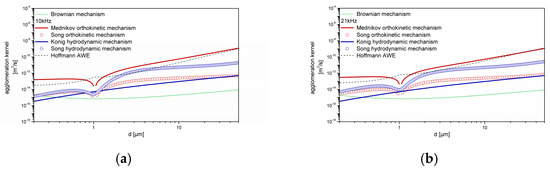
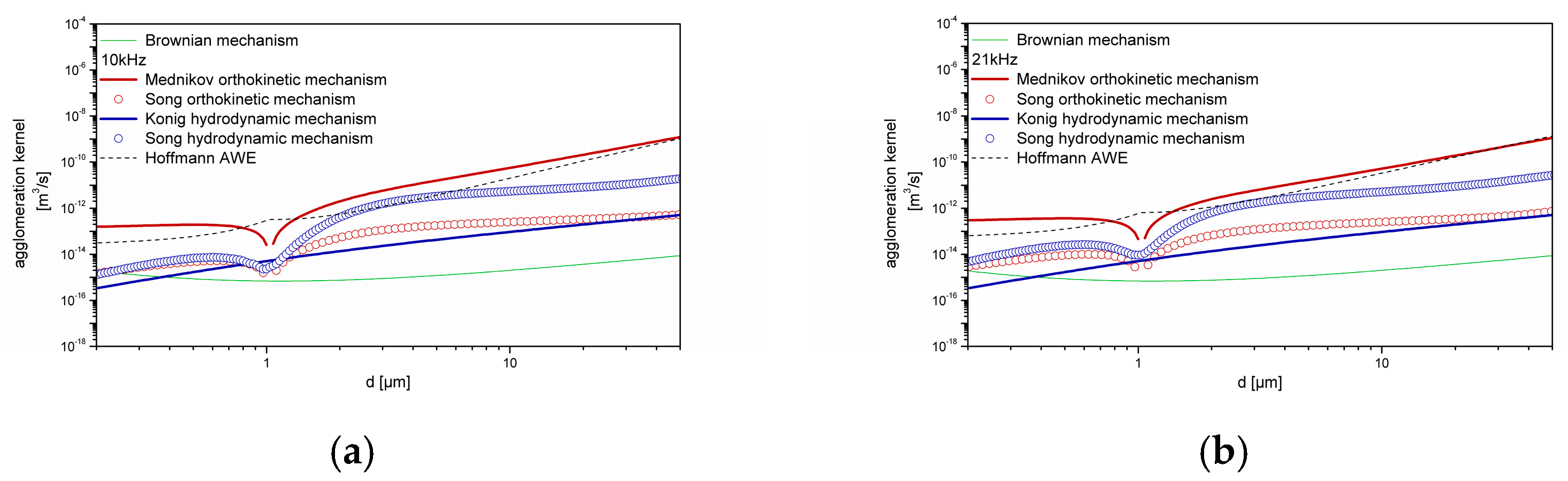
Figure 2 compares the strengths of various agglomeration mechanisms examined in the present work. The graph pertains to a scenario where one particle has a diameter of 1 μm, the sound intensity is 100 W, and the acoustic frequencies are 10 kHz and 21 kHz. The size of the second particle ranges from 0.1 μm to 50 μm. The kernel’s intensity directly correlates with its contribution to the overall agglomeration process. This figure clearly shows that acoustic mechanisms (both orthokinetic and hydrodynamic) contribute significantly more than the Brownian mechanism, with their intensity nearly two orders of magnitude higher. As anticipated, the Mednikov approach exhibits the highest intensity, which is attributable to its assumptions of an ideal fluid and complete volume refilling after a single acoustic cycle. This overestimation of the agglomeration rate will subsequently be demonstrated through comparison with experimental data. Conversely, Song’s mechanism, which incorporates the effect of scattering waves that reduce the number of particles within the agglomeration volume, is considerably weaker. Further observation of these curves reveals that the orthokinetic mechanism, in both its formulations, asymptotically approaches zero when the two particles are of identical size. This outcome aligns with its algebraic expression, as identically sized particles oscillate in the same manner within the acoustic field, precluding the development of relative velocity. On the other hand, the hydrodynamic mechanism exhibits nearly steady growth with increasing particle size, and for particles of identical size, the kernel does not reach zero. This accounts for the experimentally observed agglomeration of similarly sized particles. Nevertheless, employing Song’s expression for this mechanism reveals a behavior similar to the orthokinetic mechanism, albeit less pronounced. This resemblance is anticipated, given Song’s inclusion of particle entrainment in his formulation. Furthermore, with the incorporation of viscosity and the influence of scattering waves, the hydrodynamic mechanism can become comparable to the orthokinetic mechanism, potentially exerting a more significant impact on the agglomeration process.
Figure 2.
Intensity of the collision kernel of each acoustic agglomeration mechanism for various particle diameters (the diameter d1 is fixed and equal to 1 μm) and two distinct sound frequencies: (a) 10 kHz; (b) 21 kHz. The intensity of the acoustic field is fixed at 100 W (U0 = 0.98 m/s).
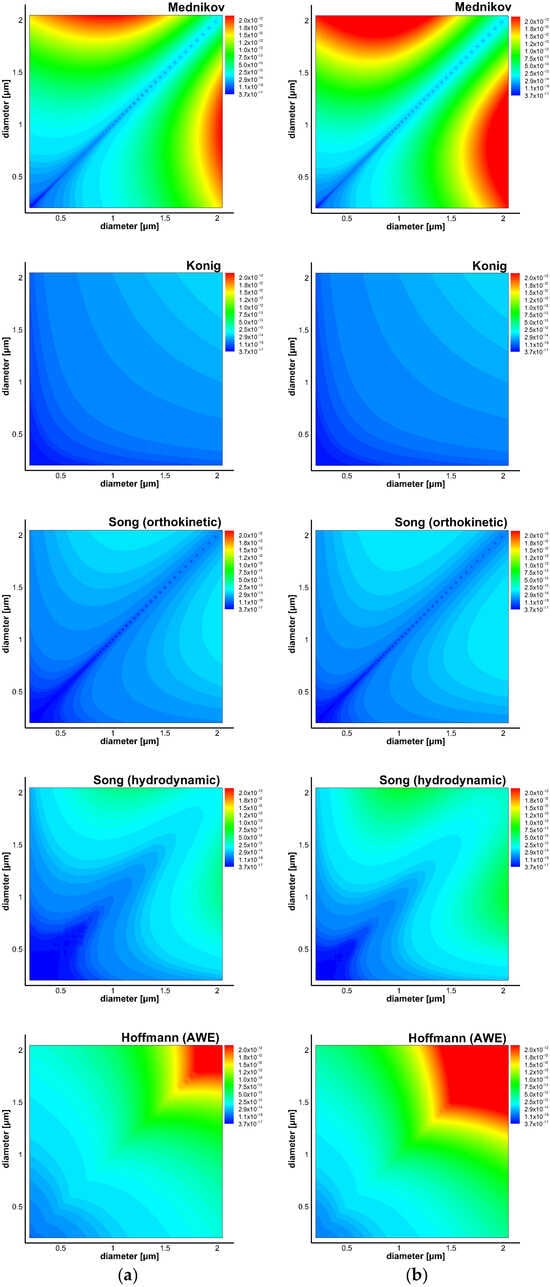
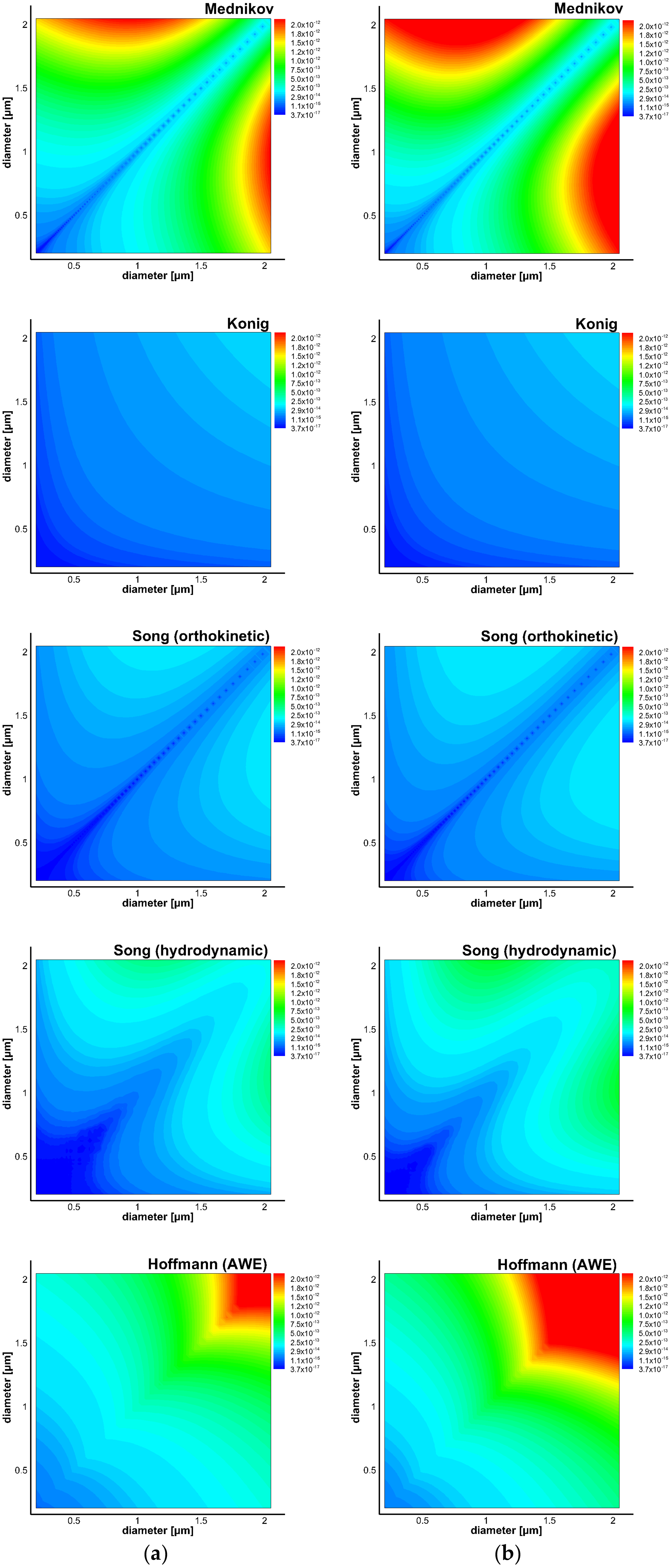
Additionally, the expression for the kernel used to describe the AWE is plotted in Figure 2. Since this kernel was derived as a correction to the Mednikov expression, a similar order of magnitude is anticipated. However, for equally sized particles, a reversed trend relative to the orthokinetic mechanism is observed, as the number of collisions is not diminished. This is attributed to the fact that the convergent velocity between the two particles, when calculated using the AWE theory, is not zero for particles of the same size. From this figure, it is also evident that this mechanism is stronger than the MRPE, which is consistent with experimental observations of the trajectories of similarly sized particles, under acoustic conditions in the Oseen flow regime [68,69]. In Figure 3, the strength of each kernel for any given pair of particles with diameters ranging from 0 μm to 2 μm is plotted for two different acoustic frequencies.
Figure 3.
Contour plots illustrating the intensity of the various acoustic agglomeration mechanisms for different pairs of particle diameters. The collision frequency is expressed in units of m3/s, and the acoustic velocity amplitude is U0 = 0.98 m/s with a sound frequency of (a) 10 kHz; (b) 21 kHz.
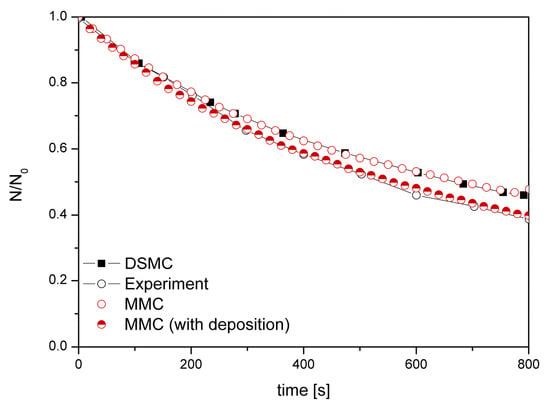
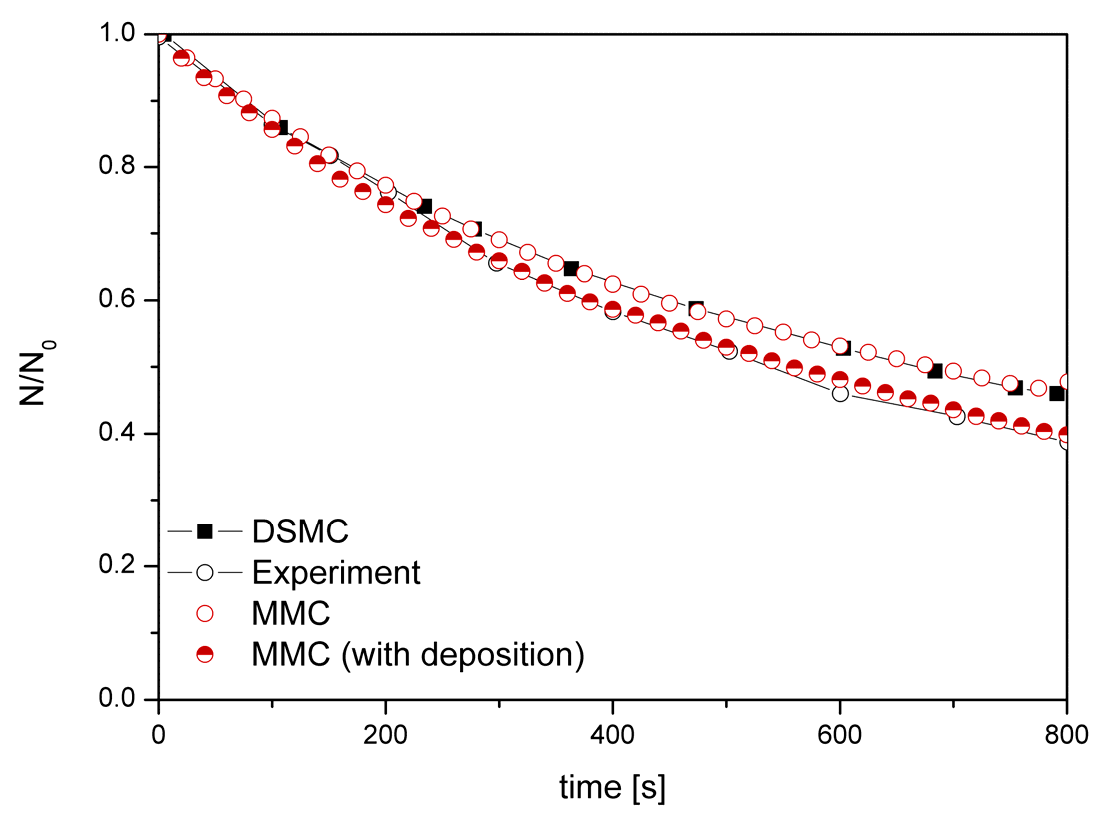
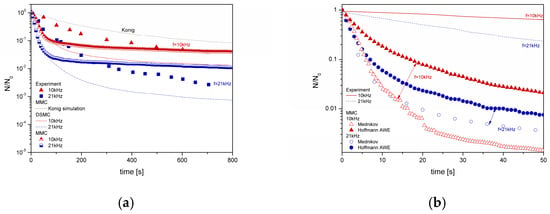
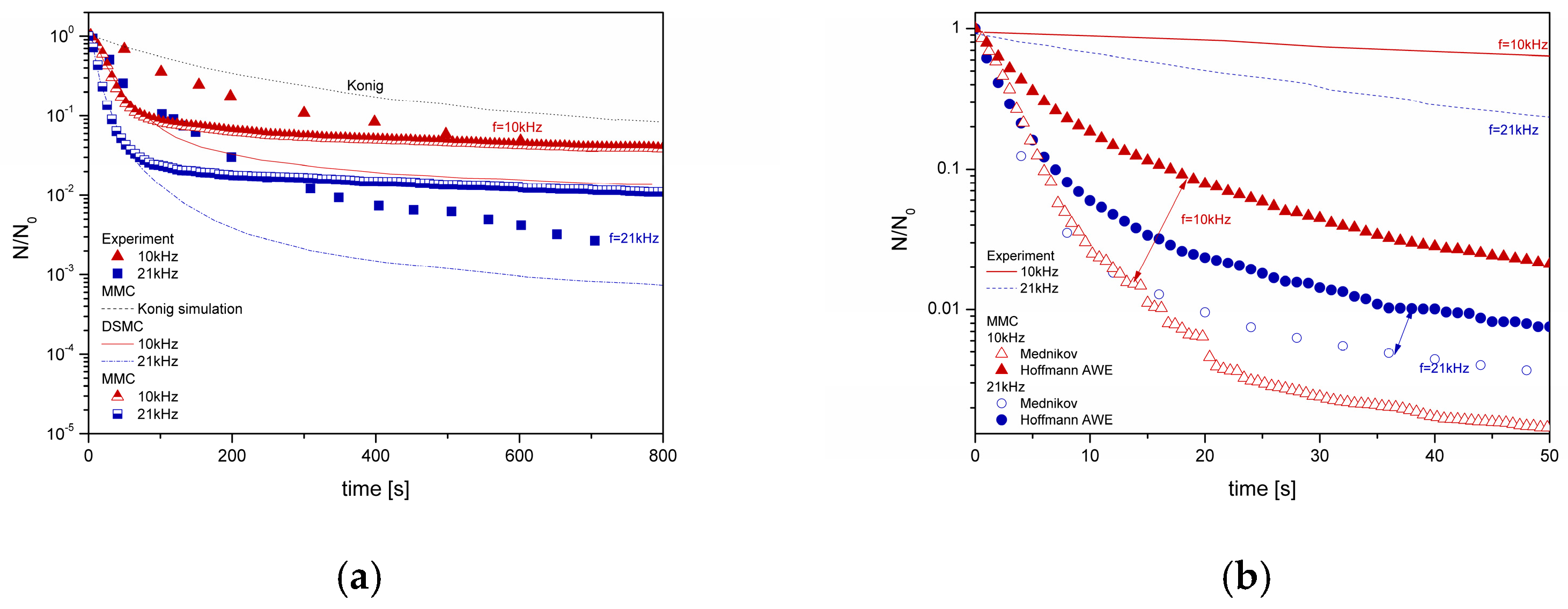
Initially, the outcomes of the MMC model, considering only Brownian motion as the agglomeration mechanism, will be presented. To monitor the temporal evolution of the agglomeration process, the non-dimensional particle number concentration, expressed as N/N0 (where N0 represents the initial total particle number concentration), will be depicted as a function of time, as shown in Figure 4. Experimental data from Capéran [45] and numerical simulation results from Sheng’s DSMC method will be utilized [37]. Inclusion of deposition effects in the simulation demonstrates an increased particle removal rate, aligning more closely with experimental observations.
Figure 4.
Temporal evolution of the non-dimensional particle number concentration.
4.1. Influence of Agglomeration Kernel Expression and Residence Time
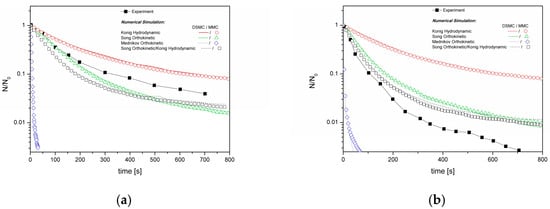
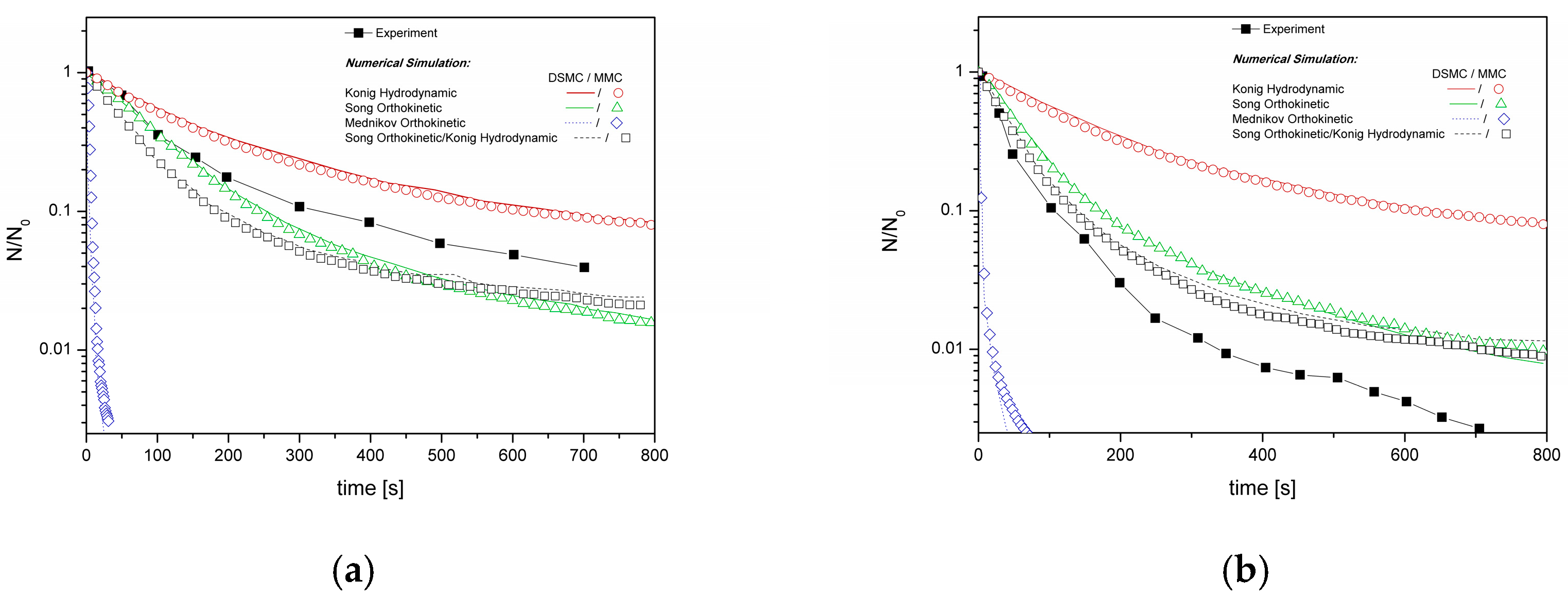
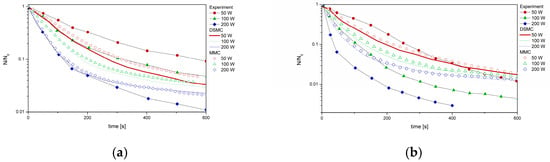
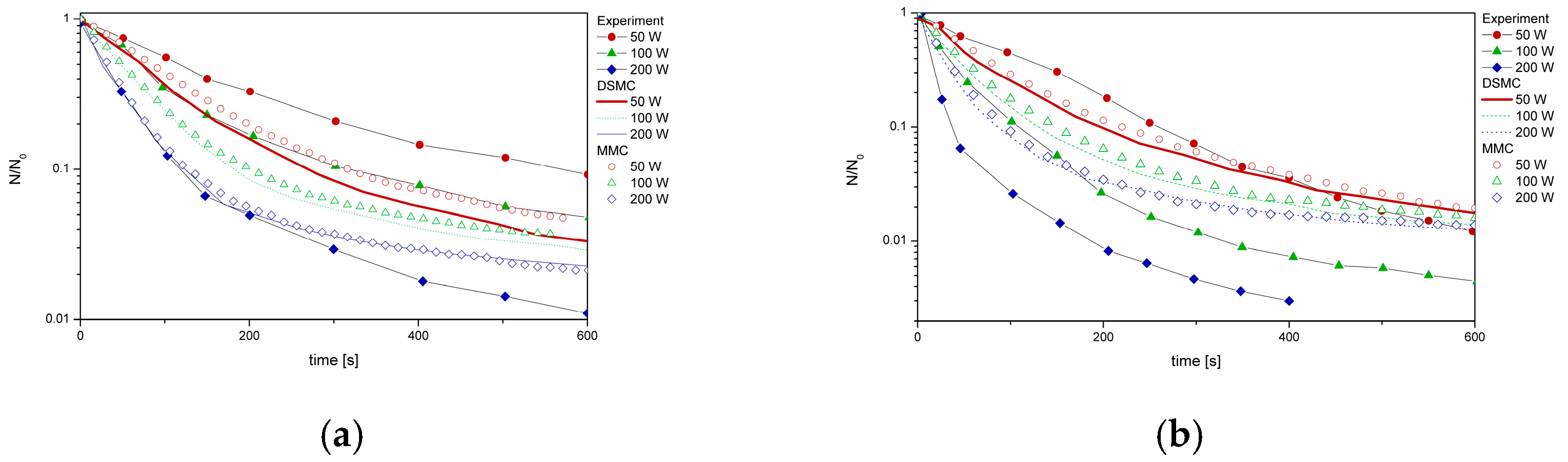
Figure 5 and Figure 6 display the temporal evolution of the non-dimensional particle number concentration, incorporating the effect of acoustic agglomeration in the simulation. A variety of individual kernels were examined, considering two distinct acoustic field frequencies at one fixed sound intensity (100 W). In all numerical simulations, the influence of the Brownian kernel was included, but the deposition mechanism was neglected. The results from both the DSMC and MMC simulations are presented alongside the experimental data from Capéran [45]. Regarding the validity of the MMC simulation, both numerical simulations predict nearly identical effects of the acoustic agglomeration process for each combination of mechanisms employed, a result that was anticipated given that both methodologies are statistical in nature. These figures illustrate that the total particle number concentration decreases monotonically over time; this decrease is predominantly influenced by the acoustic field rather than by Brownian motion alone. A comparative analysis with the baseline results depicted in Figure 4, illustrates the pronounced impact of the applied acoustic field relative to purely Brownian mechanisms: specifically, a 60% reduction in initial aerosol particle concentration, which requires approximately 800 s under purely Brownian treatment, is attained in roughly 100 s upon application of the acoustic field. Nevertheless, the effect of agglomeration is more pronounced during the initial stages of the acoustic treatment compared to later periods.
Figure 5.
Temporal evolution of the non-dimensional particle number concentration and comparison with the DSMC and experimental results, for various acoustic kernel combinations and for two acoustic frequencies (a) 10 kHz; (b) 21 kHz.
Figure 6.
Temporal evolution of the non-dimensional particle number concentration and comparison with the DSMC and experimental results, for the hydrodynamic mechanism as modified by Song (a) and for the AWE kernel (b).
The choice of kernel expressions significantly influences the simulation outcomes. For the orthokinetic mechanism, the Mednikov formulation consistently overestimates the agglomeration rate. This overestimation arises because it assumes the agglomeration volume is completely refilled with particles after one acoustic cycle. In contrast, Song’s approach refines Mednikov’s formulation by incorporating both scattering effects and the oscillatory motion of the particle. These factors reduce the number of particles that refill the agglomeration volume, leading to fewer inter-particle collisions and, consequently, a smaller decrease in the particle number concentration. Regarding the hydrodynamic mechanism, the König formulation underestimates the experimentally observed reduction in particle number concentration, because the ideal fluid assumption neglects viscous effects, which, according to Song, could lead to an increase in the strength of the agglomeration kernel by up to eight orders of magnitude, for specific particle size combinations [51]. When these effects are incorporated (via Song’s expression), the reduction in particle number concentration is overestimated, particularly during the initial stages of the simulation for both methodologies. However, within the context of the MMC simulation, a better agreement with the experimental results is observed during the later stages of the agglomeration process, especially for the low-frequency case.
Should the kernel expression based on the AWE be employed for the simulation, the reduction in particle number concentration is comparable to, though smaller than, the one predicted using the Mednikov approach. This is expected, as this formulation is derived from the Mednikov approach but incorporates a refill mechanism for the agglomeration volume that does not take unity values. For both cases investigated (10 kHz and 21 kHz), the results exhibit closer agreement with the experimental data. Furthermore, for the high-frequency case, the deviation from the Mednikov-simulated results is less pronounced than for the low-frequency case.
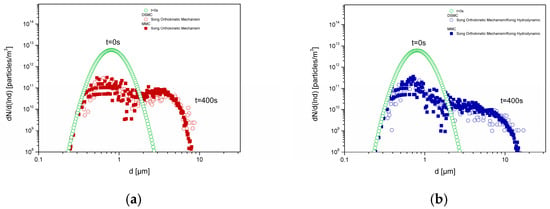
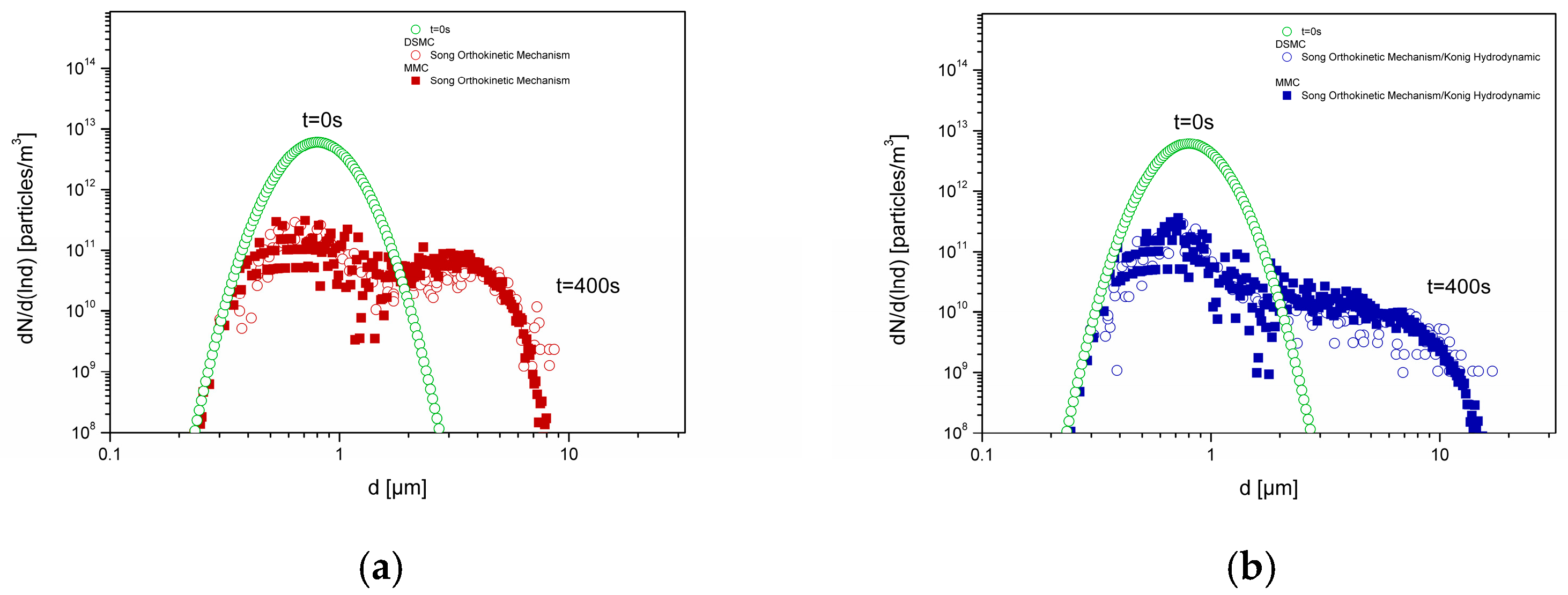
Figure 7 compares the particle size distribution after acoustic agglomeration as predicted by the present model and the numerical simulation utilizing the DSMC. For this comparison, an acoustic treatment of 400 s was selected, and two distinct scenarios were analyzed: first, employing only Song’s orthokinetic mechanism, and subsequently, incorporating the hydrodynamic mechanism via the König expression. The results confirm the formation of larger particles while depleting smaller ones. Furthermore, the acoustic treatment shifts the particle distribution from a log-normal to a bimodal form, an observation consistent with acoustic agglomeration experiments conducted by other researchers [19]. When the hydrodynamic mechanism is included in the simulation, the distribution curve exhibits a flatter profile toward the higher end, leading to the creation of larger particles within the same acoustic treatment duration compared to the exclusive action of the orthokinetic mechanism. This outcome is attributed to the hydrodynamic mechanism promoting collisions between larger, similarly sized particles, which subsequently act as efficient collectors for smaller ones.
Figure 7.
Snapshots of the particle size distribution evolution: initial distribution and the distribution observed after 400 s of acoustic treatment (100 W, f = 10 kHz). Acoustic agglomeration is simulated utilizing the following kernels: (a) βSong,Or; (b) βSong,Or + βKönig,Hy.
4.2. Influence of Acoustic Field Intensity
Figure 8 illustrates the numerically predicted particle number concentration following acoustic agglomeration at various acoustic intensities. Greater sound intensity corresponds to an increased gas velocity, and consequently, greater relative motion between the particles. As anticipated, the sound intensity directly influences the acoustic agglomeration results: a stronger acoustic field leads to greater acoustic agglomeration efficiency. This relationship is also evident from the relevant kernel expressions: the orthokinetic mechanism is directly proportional to the acoustic wave amplitude U0, while the hydrodynamic mechanism exhibits a quadratic dependence. This figure employs the combination of Song’s and König’s formulations for the orthokinetic and hydrodynamic mechanisms. In Figure 9, a comparison is presented between the numerical simulation results for acoustic agglomeration and the experimental data reported by either Capéran or Magill, where Song’s hydrodynamic expression is used as the agglomeration kernel. The convergence between the two numerical methodologies is again observed; however, a divergence from the experimental data is apparent across all examined cases, in which Song’s expression for the hydrodynamic mechanism serves as the agglomeration kernel.
Figure 8.
Temporal evolution of the non-dimensional particle number concentration for various sound intensities. The frequency is (a) 10 kHz and (b) 21 kHz.
Figure 9.
Temporal evolution of the non-dimensional particle number concentration for various sound intensities. The experimental results of (a) Capéran and (b) Magill have been used.
Figure 10 presents the results obtained when utilizing the acoustic wake kernel as the exclusive agglomeration mechanism. For both simulated sound frequencies, the influence of the acoustic field’s intensity is observed to be consistent with the previously studied mechanisms; specifically, a higher intensity correlates with a greater reduction in the particle number concentration.
Figure 10.
Temporal evolution of the non-dimensional particle number concentration for various sound intensities and two distinct sound frequencies. Acoustic agglomeration is simulated utilizing the acoustic wake kernel.
4.3. Influence of Initial Particle Number Concentration and Shape of Distribution
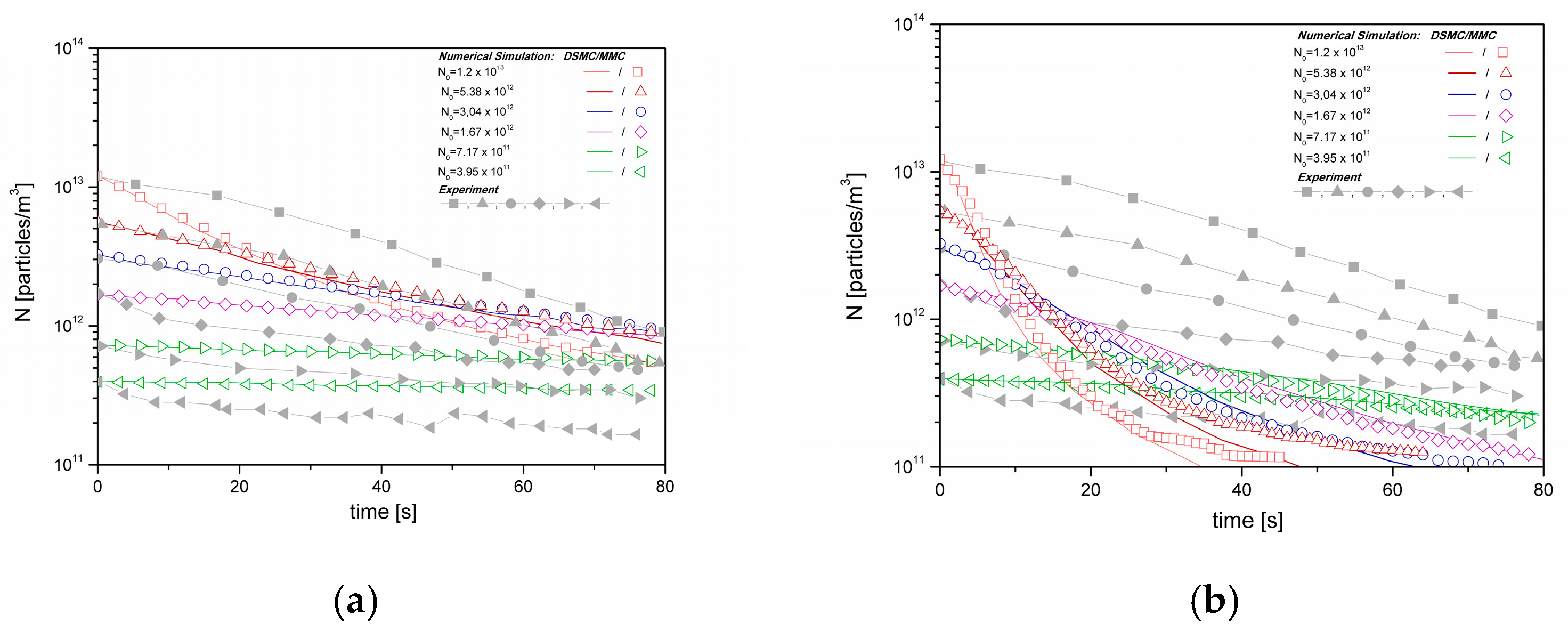
The initial particle number concentration, N0, constitutes a fundamental parameter influencing acoustic agglomeration, as is the case for all agglomeration processes. A higher initial particle number density accelerates the rate of agglomeration. Regarding the orthokinetic mechanism, the reduction in initial inter-particle distance (resulting from increased concentration) enhances its effectiveness, as a greater number of particles are positioned within the agglomeration volume. Likewise, the hydrodynamic mechanism is intensified; since it is inversely proportional to the distance between particle centers, a reduction in this distance leads to a more pronounced interaction. Figure 11 shows the temporal evolution of particle number concentration within a specific acoustic field across six distinct cases of initial concentration. As evidenced by the slope of the individual curves, the agglomeration process intensifies as the initial particle count increases, a trend consistent with the experimental data, corresponding numerical simulations, and acoustic agglomeration studies by other researchers [16,64,70].
Figure 11.
Temporal evolution of the particle number concentration for various initial particle number concentrations. Acoustic agglomeration is simulated utilizing the following kernels: (a) βSong,Or + βKönig,Hy, (b) βSong,Or + βSong,Hy.
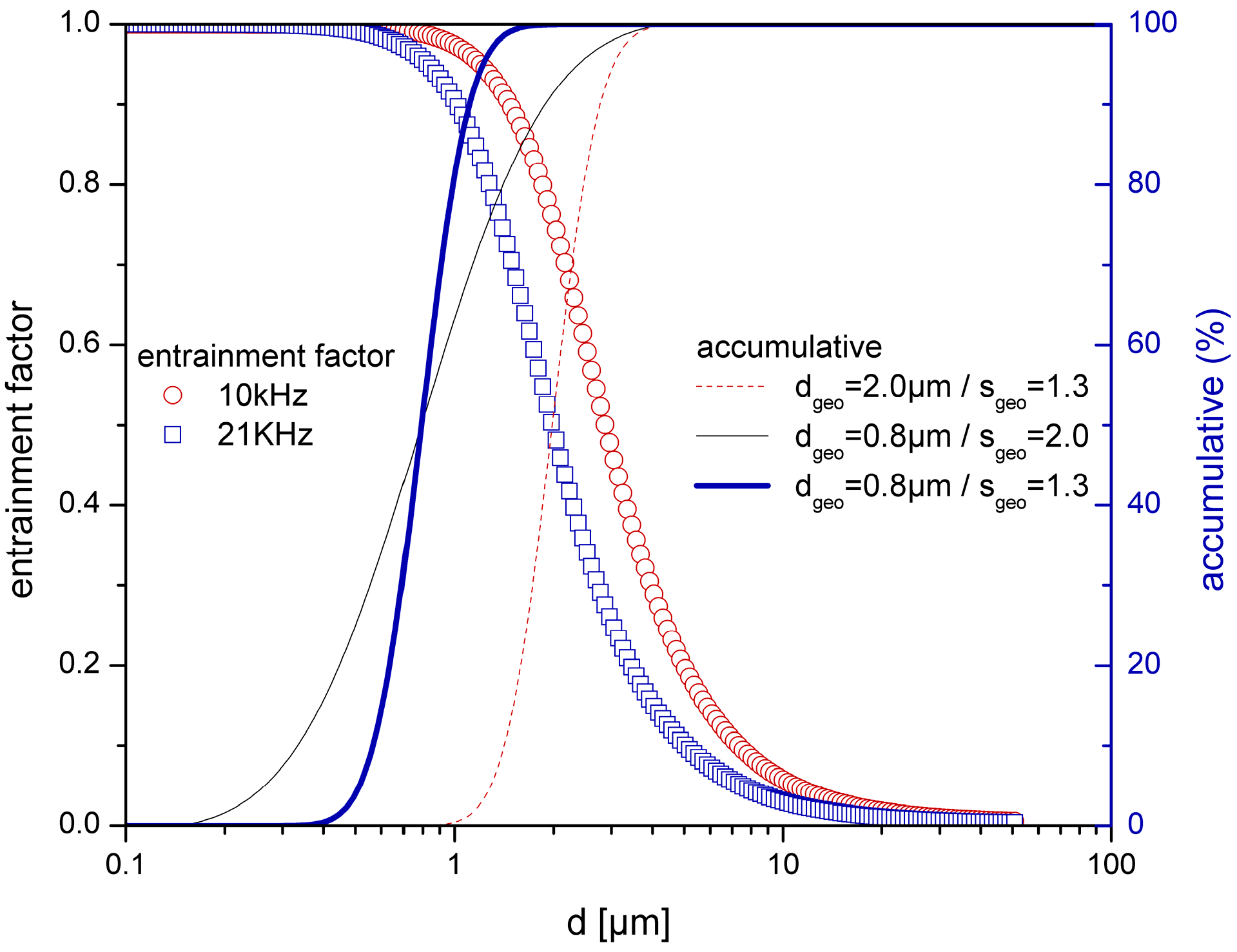
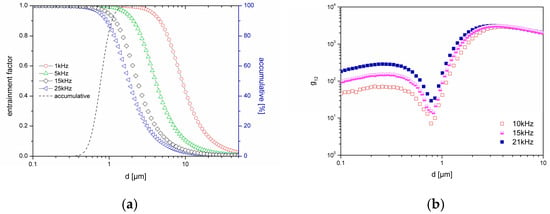
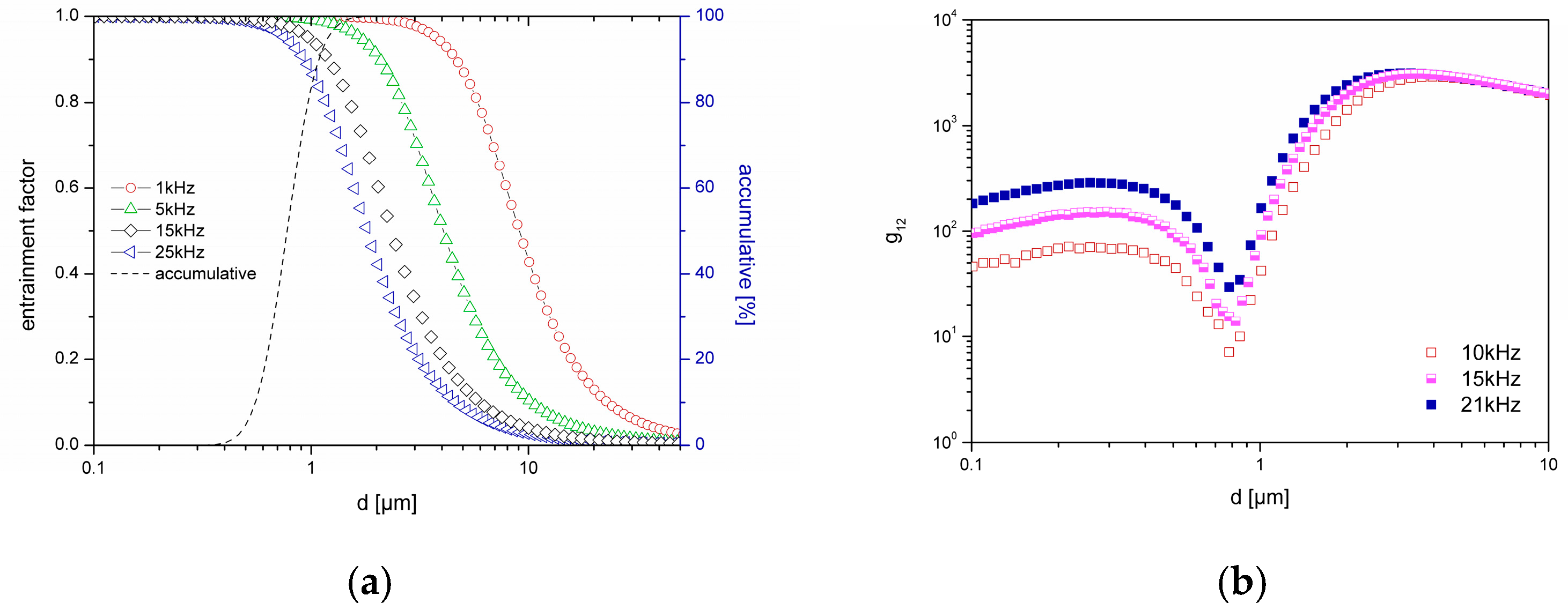
The initial shape of the particle size distribution also influences the acoustic agglomeration process. For this reason, numerical simulations were conducted for two additional forms of the initial distribution: in the first case, the mean diameter was increased (keeping the number of particles and geometric standard deviation fixed), while in the second case, the geometric standard deviation was varied (keeping the mean value and number of particles the same). This influence is best illustrated by examining the intersection of the particle cumulative size distribution curve and the acoustic particle entrainment factor curve, for two different acoustic frequencies, as shown in Figure 12. When the distribution is shifted toward larger particles, it is evident that more particles will acquire high relative velocities, which is expected to favor the agglomeration process insofar as the orthokinetic mechanism is concerned. On the other hand, a distribution with a large initial geometric standard deviation spans a wider range of particle sizes, since the distribution curve is broader. Regarding the action of the hydrodynamic mechanism, this is also favored by the presence of larger particles, as the resulting hydrodynamic force is proportional to their size.
Figure 12.
Curves showing the variation in the particle entrainment factor versus the particle diameter. The particle cumulative size distribution curves, for three different initial shapes, are also shown.
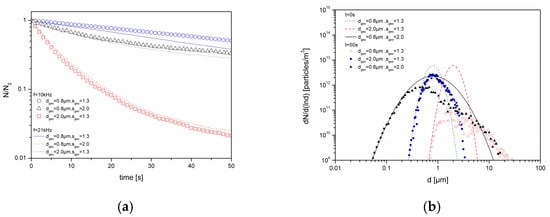
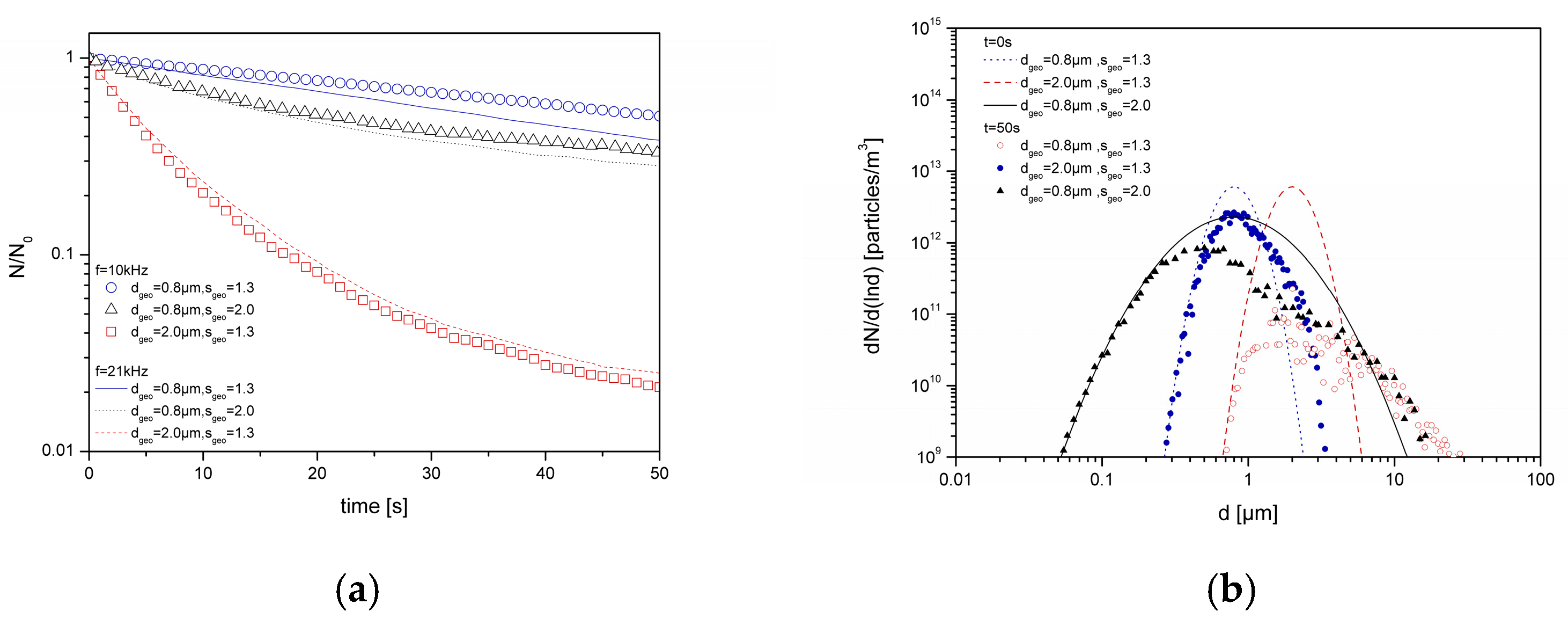
Figure 13 shows the results of the numerical simulation when the combination of Song’s orthokinetic formulation and König’s hydrodynamic formulation is used. The acoustic treatment was considered for a duration of 50 s, incorporating two distinct sound frequencies. It is evident that an increase in the mean diameter of the initial particle size distribution exerts a more substantial influence on acoustic agglomeration than an increase in the geometric standard deviation.
Figure 13.
(a) Temporal evolution of the non-dimensional particle number concentration for varied initial particle size distributions. (b) Snapshots of the particle distribution after 50 s of acoustic treatment are displayed (f = 10 kHz, 100 W).
4.4. Influence of Sound Frequency
Frequency is also a critical parameter influencing both the orthokinetic and hydrodynamic mechanisms. The preceding experimental results and numerical simulations indicate that a higher acoustic field frequency promotes agglomeration of the aerosol mixture. However, the influence of frequency on the evolution of the particle size distribution is not immediately apparent. Acoustic agglomeration investigations have spanned a broad spectrum of acoustic frequencies, ranging from the low values of 44 Hz [16] and 3 kHz [70] to the high frequencies such as 10 kHz and 21 kHz [45,71]. While low-frequency sound sources were historically favored due to their cost-effectiveness and reliability, substantial advancements have been made in recent decades in the development of devices capable of producing high-frequency and high-intensity acoustic fields. These innovations are primarily relevant for the industrial application of acoustic agglomeration [50].
To gain a deeper understanding of how frequency influences the action of each mechanism, one must examine the effect of frequency on the underlying driving force. As demonstrated by the relevant equation, König’s expression for the hydrodynamic kernel depends solely on the acoustic velocity amplitude and not on the sound frequency. This observation stems from the assumption that the fluid is ideal and that the particles are significantly smaller than the acoustic field wavelength. Only when accounting for viscous effects (i.e., wave scattering) and particle entrainment, as incorporated by Song into his expression for the hydrodynamic mechanism, does the frequency exert an influence on the corresponding collision kernel. Figure 14 illustrates the effect of frequency on the acoustic entrainment factor and the hydrodynamic interaction function g12. From this figure, it is observed that the entrainment factor of a particle of a given diameter decreases with increasing sound frequency, indicating a reduced particle oscillatory velocity. However, since the orthokinetic mechanism is directly related to the relative velocity of two particles, an optimal frequency exists, determined by the initial particle distribution, that promotes collisions. This is why the cumulative particle size distribution is also plotted in Figure 14a. When the sound frequency is very low all particles are equally entrained by the acoustic waves (unity entrainment factor), resulting in minimal relative motion and thus few collisions. Conversely, when a higher frequency is selected (>20 kHz), a range of particle sizes exists where the entrainment factor transitions from unity (fully entrained) to a lower value. Particles of different sizes within this range will experience varying entrainment rates, thereby enhancing the probability of agglomeration.
Figure 14.
(a) Particle entrainment factor for various frequencies of the acoustic field along with cumulative particle size distribution. (b) The calculated hydrodynamic interaction function g12 is plotted for one particle of 0.8 μm and a particle with a diameter ranging from 0.1 μm to 10 μm.
Regarding the influence of the sound frequency on the effect of the scattering waves on the hydrodynamic mechanism, the most important property of this interaction between two particles is that these hydrodynamic forces depend on the source strength of these waves, which, in turn, depends on the product of (1 − H1) and (1 − H2) instead of the difference (H1 − H2) [35,50]. Consequently, if H1 and H2 are smaller in magnitude, the hydrodynamic forces will be larger. This indicates that a higher sound frequency corresponds to stronger hydrodynamic interaction. Conversely, for very small particles or low frequencies, the entrainment factor approaches unity, resulting in these strengths being close to zero and the scattered waves being weak [35]. Furthermore, in the case of two particles of identical size, the term simplifies to (1 − H)2, which remains non-zero as long as the particles are not fully entrained. Thus, higher frequencies will also favor the development of relative motion based on the radiation pressure interaction and promote particle collisions. Additionally, higher frequencies result in a greater flow-around velocity, which enhances the distortion of the flow field and consequently increases the agglomeration kernel of hydrodynamic interaction [72].
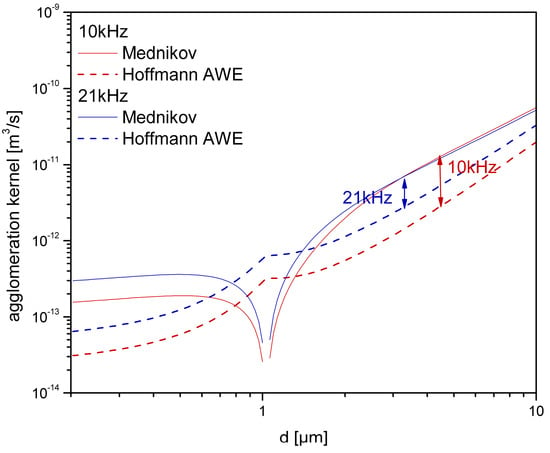
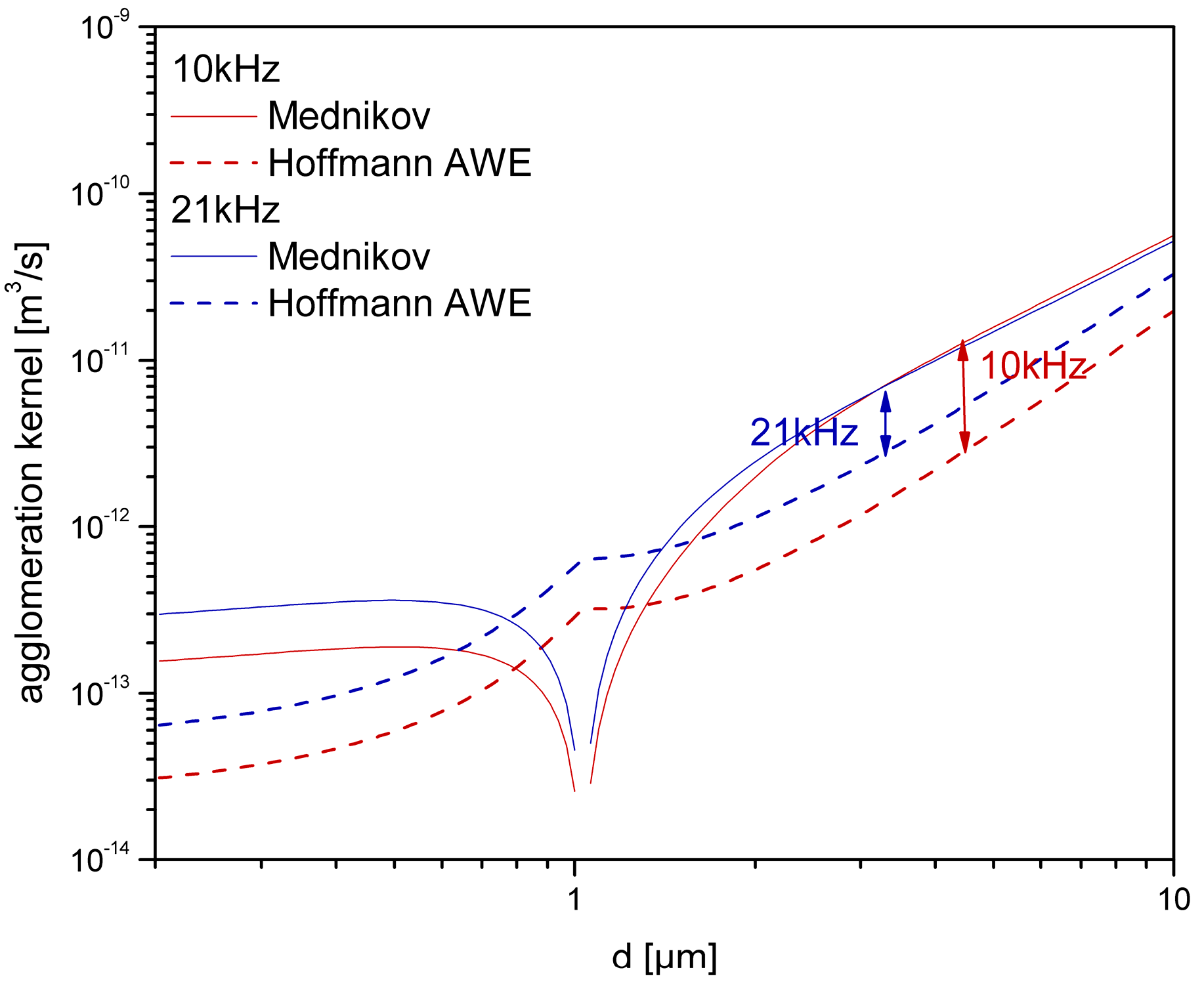
Regarding the influence of sound frequency on the AWE (as investigated by Hoffmann [60]), the extended length of the agglomeration volume increases with higher frequencies, asymptotically approaching a constant value for any given pair of particles. Figure 15 illustrates the effect of sound frequency on the AWE kernel, alongside the corresponding Mednikov formulation. Since the AWE was conceptualized by Hoffmann as variation in the Mednikov expression, a similar trend is observed when considering a pair of particles, where one particle has a fixed diameter of 1 μm and the other ranges from 0.1 μm to 10 μm. Fundamentally, increasing the sound frequency consistently enhances agglomeration [73].
Figure 15.
The effect of the sound frequency (10 kHz and 21 kHz) on the acoustic agglomeration kernels proposed by Mednikov and Hoffmann (AWE). The intensity of the acoustic field is the same (100 W), and the results are for one particle of 1 μm and a second particle with a diameter ranging from 0.1 μm to 10 μm.
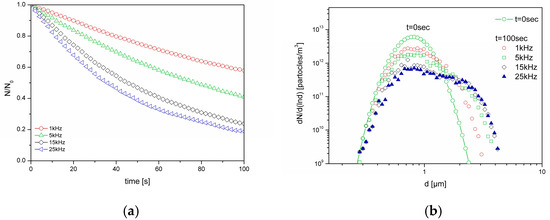
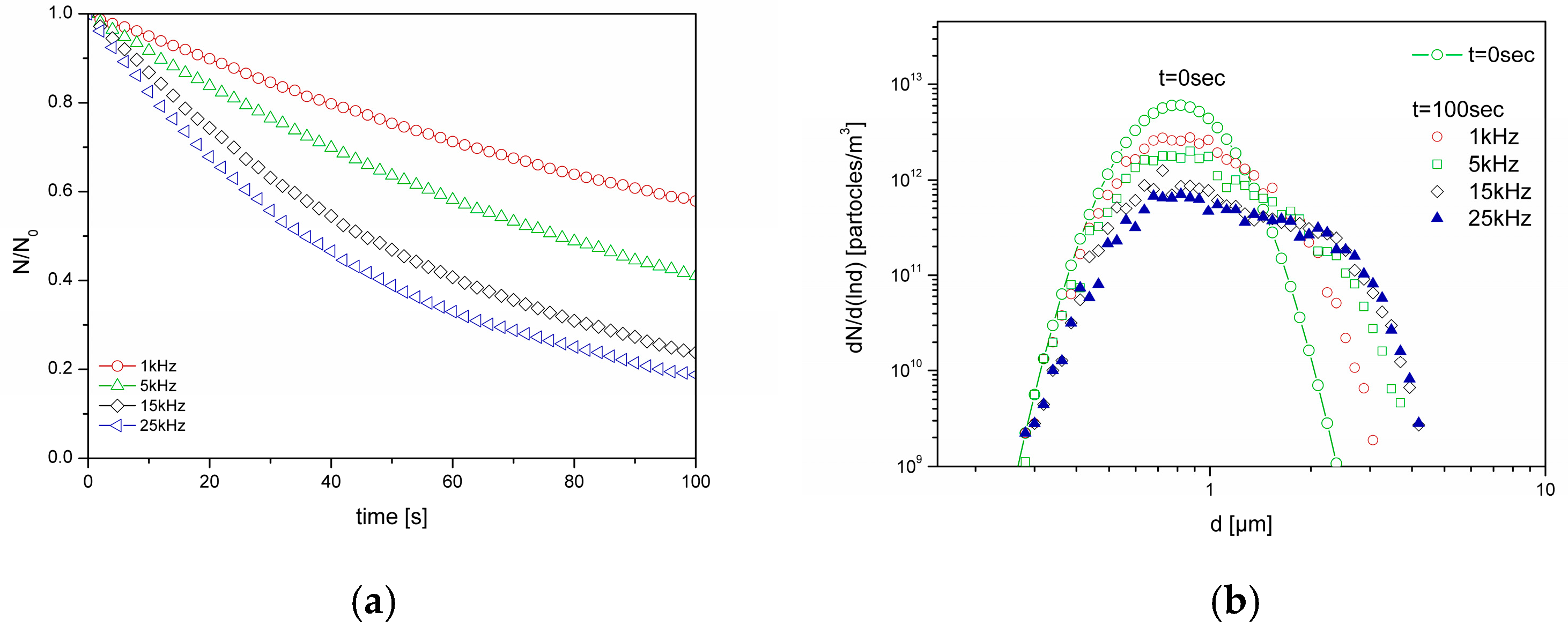
Figure 16 illustrates the numerical simulation results regarding particle number concentration and the predicted particle size distribution after 100 s of acoustic treatment across four distinct acoustic frequencies. The utilized kernel combines Song’s orthokinetic mechanism with König’s hydrodynamic mechanism. Higher frequencies lead to a reduction in particle number concentration and broader distribution shapes, indicating the formation of larger particles at the expense of smaller ones.
Figure 16.
(a) Temporal evolution of the non-dimensional particle number concentration for various sound frequencies with a fixed sound intensity of 100 W. (b) Particle size distributions at 100 s of acoustic treatment (compared with the initial) for various frequencies.
5. Conclusions and Further Work
The present work employs the MMC method to solve the PBE while accounting for acoustic particle agglomeration. The MMC technique utilizes the concept of “weighted fictitious particles” whose number is several orders of magnitude smaller than the actual number of particles. The MMC method has been successfully applied to simulate various acoustic treatment scenarios using different agglomeration kernels. The agglomeration kernel incorporates models for orthokinetic and hydrodynamic mechanisms, as well as Brownian agglomeration and particle deposition. Furthermore, the contribution of the AWE to the agglomeration process is evaluated. The results obtained from the MMC method exhibit good agreement with other numerical approaches such as DSMC and the sectional method (MAEROS), and available experimental results, thereby validating the numerical accuracy and reliability of the MMC approach. The choice of kernel formulation among the available options evaluated for orthokinetic and hydrodynamic mechanisms exerts a substantial influence on the numerical predictions. Specifically, the Mednikov kernel significantly overestimates the experimental particle decay rate, whereas the König formulation underpredicts the agglomeration rate. Furthermore, the acoustic wake effect kernel also overestimates particle depletion, which aligns with expectations given that it represents a modification of the Mednikov formulation. Consequently, a closer agreement with experimental data can be attained only through a hybrid combination of kernels or by calibrating the weighting factors assigned to the primary orthokinetic and hydrodynamic mechanisms. A parametric study investigates the influence of key parameters, such as sound frequency and intensity, along with initial particle size distribution characteristics. Sound frequency is identified as a critical parameter governing the particle size distribution and number concentration of the treated aerosol. However, optimal frequency selection requires joint consideration of the initial particle size distribution.
Although the model presented herein is strictly applicable to liquid particles, it provides a preliminary approximation for investigating the acoustic agglomeration of solid particulates—such as fly ash and soot—typically generated during industrial combustion processes [74,75,76,77]. Such particles are typically defined as fractal-like aggregates composed of smaller spheroidal primary particles, defined by their fractal dimension, with geometries that depart significantly from spherical symmetry [78]. In their investigation of acoustic agglomeration involving fractal-like solid particles using the DSMC method, Sheng and Shen observed consistent trends regarding the impact of residence time, sound intensity, and frequency on overall particle number reduction. However, assuming spherical particles led to an underestimation of the acoustic agglomeration rate; specifically, enhanced coagulation and growth rates, along with diminished depositional losses, were predicted for agglomerates characterized by low-volume fractal dimensionality [79]. Consequently, further research incorporating the fractal morphology of solid aggregates is required to accurately model acoustic agglomeration processes.
In summary, acoustically driven agglomeration leads to a diminished number concentration of fine particles and the subsequent emergence of larger counterparts. The proposed MMC methodology provides an efficient simulation tool for understanding and optimizing the acoustic agglomeration process.
Author Contributions
Conceptualization, C.P. and I.A.; methodology, C.P. and I.A.; software, C.P. and I.A.; validation, C.P. and I.A.; formal analysis, C.P. and I.A.; investigation, C.P. and I.A.; resources, C.P. and I.A.; data curation, C.P. and I.A.; writing—original draft preparation, C.P.; writing—review and editing, I.A.; visualization, C.P. and I.A.; supervision, I.A.; project administration, I.A. All authors have read and agreed to the published version of the manuscript.
Funding
This research has received partial financial support from the “Greek State Scholarships Foundation/IKY”.
Institutional Review Board Statement
Not applicable.
Informed Consent Statement
Not applicable.
Data Availability Statement
The original contributions presented in this study are included in the article. Further inquiries can be directed to the corresponding author.
Acknowledgments
During the preparation of this manuscript, the authors used Google NotebookLM (https://notebook.google.com/, accessed on 22 June 2026) to create schematic graphs. The authors have reviewed and edited the output and take full responsibility for the content of this publication.
Conflicts of Interest
The authors declare no conflicts of interest.
Abbreviations
The following abbreviations are used in this manuscript:
| AWE | acoustic wake effect |
| DSMC | Direct Simulation Monte Carlo |
| MC | Monte Carlo |
| MMC | Multi-Monte Carlo |
| MRPE | mutual radiation pressure effect |
| PAHs | polycyclic aromatic hydrocarbons |
| PBE | population balance equation |
| PM | particulate matter |
References
- Balakrishnan, V.S. Clean Air, Climate Targets, and Respiratory Health in Europe. Lancet Respir. Med. 2025, 13, e12–e13. [Google Scholar] [CrossRef] [Scilit] [PubMed]
- Grantz, D.A.; Garner, J.H.B.; Johnson, D.W. Ecological Effects of Particulate Matter. Environ. Int. 2003, 29, 213–239. [Google Scholar] [CrossRef] [Scilit] [PubMed]
- Thangavel, P.; Park, D.; Lee, Y.-C. Recent Insights into Particulate Matter (PM2.5)-Mediated Toxicity in Humans: An Overview. Int. J. Environ. Res. Public Health 2022, 19, 7511. [Google Scholar] [CrossRef] [Scilit] [PubMed]
- Atkinson, R.W.; Kang, S.; Anderson, H.R.; Mills, I.C.; Walton, H.A. Epidemiological Time Series Studies of PM2.5 and Daily Mortality and Hospital Admissions: A Systematic Review and Meta-Analysis. Thorax 2014, 69, 660–665. [Google Scholar] [CrossRef] [Scilit] [PubMed]
- Lippmann, M. Toxicological and Epidemiological Studies of Cardiovascular Effects of Ambient Air Fine Particulate Matter (PM2.5) and Its Chemical Components: Coherence and Public Health Implications. Crit. Rev. Toxicol. 2014, 44, 299–347. [Google Scholar] [CrossRef] [Scilit] [PubMed]
- Park, M.; Joo, H.S.; Lee, K.; Jang, M.; Kim, S.D.; Kim, I.; Borlaza, L.J.S.; Lim, H.; Shin, H.; Chung, K.H.; et al. Differential Toxicities of Fine Particulate Matters from Various Sources. Sci. Rep. 2018, 8, 17007. [Google Scholar] [CrossRef] [Scilit] [PubMed]
- Manisalidis, I.; Stavropoulou, E.; Stavropoulos, A.; Bezirtzoglou, E. Environmental and Health Impacts of Air Pollution: A Review. Front. Public Health 2020, 8, 14. [Google Scholar] [CrossRef] [Scilit] [PubMed]
- Lin, C.-K.; Lin, R.-T.; Chen, T.; Zigler, C.; Wei, Y.; Christiani, D.C. A Global Perspective on Coal-Fired Power Plants and Burden of Lung Cancer. Environ. Health 2019, 18, 9. [Google Scholar] [CrossRef] [Scilit] [PubMed]
- Shanthakumar, S.; Singh, D.N.; Phadke, R.C. Flue Gas Conditioning for Reducing Suspended Particulate Matter from Thermal Power Stations. Prog. Energy Combust. Sci. 2008, 34, 685–695. [Google Scholar] [CrossRef] [Scilit]
- Riehle, C. Basic and Theoretical Operation of ESPs. In Applied Electrostatic Precipitation; Springer: Dordrecht, The Netherlands, 1997; pp. 25–88. ISBN 9789401071932. [Google Scholar]
- Jaworek, A.; Marchewicz, A.; Sobczyk, A.T.; Krupa, A.; Czech, T. Two-Stage Electrostatic Precipitators for the Reduction of PM2.5 Particle Emission. Prog. Energy Combust. Sci. 2018, 67, 206–233. [Google Scholar] [CrossRef] [Scilit]
- Yang, L.; Bao, J.; Yan, J.; Liu, J.; Song, S.; Fan, F. Removal of Fine Particles in Wet Flue Gas Desulfurization System by Heterogeneous Condensation. Chem. Eng. J. 2010, 156, 25–32. [Google Scholar] [CrossRef] [Scilit]
- Guo, Q.; Yang, Z.; Zhang, J. Influence of a Combined External Field on the Agglomeration of Inhalable Particles from a Coal Combustion Plant. Powder Technol. 2012, 227, 67–73. [Google Scholar] [CrossRef] [Scilit]
- Reethof, G. Acoustic Agglomeration of Power Plant Fly Ash for Environmental and Hot-Gas Clean-Up. J. Appl. Mech. 1988, 100, 552–555. [Google Scholar] [CrossRef] [Scilit]
- Kumar, P.; Biswas, P. Analytical Expressions of the Collision Frequency Function for Aggregation of Magnetic Particles. J. Aerosol Sci. 2005, 36, 455–469. [Google Scholar] [CrossRef] [Scilit]
- Hoffmann, T.L.; Chen, W.; Koopmann, G.H.; Scaroni, A.W.; Song, L. Experimental and Numerical Analysis of Bimodal Acoustic Agglomeration. J. Appl. Mech. 1993, 115, 232–240. [Google Scholar] [CrossRef] [Scilit]
- Hoffmann, T.L. Environmental Implications of Acoustic Aerosol Agglomeration. Ultrasonics 2000, 38, 353–357. [Google Scholar] [CrossRef] [Scilit] [PubMed]
- Brandt, O.; Hiedemann, E. The Aggregation of Suspended Particles in Gases by Sonic and Supersonic Waves. Trans. Faraday Soc. 1936, 32, 1101–1110. [Google Scholar] [CrossRef] [Scilit]
- Cheng, M.T.; Lee, P.S.; Berner, A.; Shaw, D.T. Orthokinetic Agglomeration in an Intense Acoustic Field. J. Colloid Interface Sci. 1983, 91, 176–187. [Google Scholar] [CrossRef] [Scilit]
- Shirokova, L.; Eknadiosyants, O. Interaction of Aerosol Particles in an Acoustic Field. Sov. Phys. Acoust. 1966, 11, 346–348. [Google Scholar]
- Shaw, D.T.; Tu, K.W. Acoustic Particle Agglomeration Due to Hydrodynamic Interaction between Monodisperse Aerosols. J. Aerosol Sci. 1979, 10, 317–328. [Google Scholar] [CrossRef] [Scilit]
- Zhao, H.; Maisels, A.; Matsoukas, T.; Zheng, C. Analysis of Four Monte Carlo Methods for the Solution of Population Balances in Dispersed Systems. Powder Technol. 2007, 173, 38–50. [Google Scholar] [CrossRef] [Scilit]
- Smoluchowski, M.V. Versuch Einer Mathematischen Theorie Der Koagulationskinetik Kolloider Lösungen. Z. Phys. Chem. (N F) 1918, 92U, 129–168. [Google Scholar] [CrossRef] [Scilit]
- Diemer, R.B.; Olson, J.H. A Moment Methodology for Coagulation and Breakage Problems: Part 1—Analytical Solution of the Steady-State Population Balance. Chem. Eng. Sci. 2002, 57, 2193–2209. [Google Scholar] [CrossRef] [Scilit]
- Gelbard, F.; Tambour, Y.; Seinfeld, J.H. Sectional Representations for Simulating Aerosol Dynamics. J. Colloid Interface Sci. 1980, 76, 541–556. [Google Scholar] [CrossRef] [Scilit]
- Landgrebe, J.D.; Pratsinis, S.E. Gas-Phase Manufacture of Particulates: Interplay of Chemical Reaction and Aerosol Coagulation in the Free-Molecular Regime. Ind. Eng. Chem. Res. 1989, 28, 1474–1481. [Google Scholar] [CrossRef] [Scilit]
- Wu, J.J.; Flagan, R.C. A Discrete-Sectional Solution to the Aerosol Dynamic Equation. J. Colloid Interface Sci. 1988, 123, 339–352. [Google Scholar] [CrossRef] [Scilit]
- Liffman, K. A Direct Simulation Monte-Carlo Method for Cluster Coagulation. J. Comput. Phys. 1992, 100, 116–127. [Google Scholar] [CrossRef] [Scilit]
- Friedlander, S.K. Smoke, Dust and Haze; Oxford University Press: London, UK, 1977. [Google Scholar]
- Zhao, H.B.; Kruis, F.E.; Zheng, C.G. Reducing Statistical Noise and Extending the Size Spectrum by Applying Weighted Simulation Particles in Monte Carlo Simulation of Coagulation. Aerosol Sci. Technol. 2009, 43, 781–793. [Google Scholar] [CrossRef] [Scilit]
- Zhao, H.; Zheng, C. Monte Carlo Simulation for Simultaneous Particle Coagulation and Deposition. Sci. China Ser. E-Technol. Sci. (Chin.) 2006, 49, 222–237. [Google Scholar] [CrossRef] [Scilit]
- Ng, B.F.; Xiong, J.W.; Wan, M.P. Application of Acoustic Agglomeration to Enhance Air Filtration Efficiency in Air-Conditioning and Mechanical Ventilation (ACMV) Systems. PLoS ONE 2017, 12, e0178851. [Google Scholar] [CrossRef] [Scilit] [PubMed]
- Jacobson, M.Z. Fundamentals of Atmospheric Modeling; Cambridge University Press: Cambridge, UK, 1999. [Google Scholar]
- Vemury, S.; Pratsinis, S.E. Self-Preserving Size Distributions of Agglomerates. J. Aerosol Sci. 1995, 26, 175–185. [Google Scholar] [CrossRef] [Scilit]
- Song, L.; Koopmann, G.H.; Hoffmann, T.L. An Improved Theoretical Model of Acoustic Agglomeration. J. Vib. Acoust. Trans. ASME 1994, 116, 208–214. [Google Scholar] [CrossRef] [Scilit]
- Ezekoye, O.A.; Wibowo, Y.W. Simulation of Acoustic Agglomeration Processes Using a Sectional Algorithm. J. Aerosol Sci. 1999, 30, 1117–1138. [Google Scholar] [CrossRef] [Scilit]
- Sheng, C.; Shen, X. Modelling of Acoustic Agglomeration Processes Using the Direct Simulation Monte Carlo Method. J. Aerosol Sci. 2006, 37, 16–36. [Google Scholar] [CrossRef] [Scilit]
- Zu, K.; Yao, Y.; Cai, M.; Zhao, F.; Cheng, D.L. Modeling and Experimental Study on Acoustic Agglomeration for Dust Particle Removal. J. Aerosol Sci. 2017, 114, 62–76. [Google Scholar] [CrossRef] [Scilit]
- Fan, F.; Zhang, M.; Peng, Z.; Chen, J.; Su, M.; Moghtaderi, B.; Doroodchi, E. Direct Simulation Monte Carlo Method for Acoustic Agglomeration under Standing Wave Condition. Aerosol Air Qual. Res. 2017, 17, 1073–1083. [Google Scholar] [CrossRef] [Scilit]
- Wang, X.; Li, T.; Li, D.; Liu, S. Research on the Acoustic Agglomeration Process of Oily Fine Particles Based on Dsmc. Soc. Sci. Res. Netw. 2024. Available online: https://papers.ssrn.com/sol3/papers.cfm?abstract_id=4935984 (accessed on 1 June 2026). [CrossRef] [Scilit]
- Liu, P.; Zhang, X.; Liu, G.; Hao Lim, S.; Pun Wan, M.; Lisak, G.; Feng Ng, B. Ultrasonic Aerosol Agglomeration: Manipulation of Particle Deposition and Its Impact on Air Filter Pressure Drop. Ultrason. Sonochem. 2024, 103, 106774. [Google Scholar] [CrossRef] [Scilit] [PubMed]
- Zhao, H.; Fan, F.; Su, J.; Hu, X.; Su, M. An Improved DSMC Method for Acoustic Agglomeration of Solid Particles Assisted by Spray Droplets. Int. J. Multiph. Flow 2024, 176, 104829. [Google Scholar] [CrossRef] [Scilit]
- Liu, P.; Shang, X.; Tan, M.W.; Shi, D.; Zhang, X.; Liu, G.; Lim, S.H.; Yin, H.; Wan, M.P.; Lisak, G.; et al. Rapid and Versatile Numerical Simulations of Acoustic Agglomeration by the Fixed Pivot-Based Population Balance Modeling. Powder Technol. 2025, 456, 120821. [Google Scholar] [CrossRef] [Scilit]
- Zhou, Y.; Su, J.; Zhao, H.; Fan, F. Acoustic Agglomeration of Multiphase Aerosol Particles: A Numerical Study. Aerosol Sci. Technol. 2025, 59, 1405–1423. [Google Scholar] [CrossRef] [Scilit]
- Capéran, P.; Somers, J.; Richter, K.; Fourcaudot, S. Acoustic Agglomeration of a Glycol Fog Aerosol: Influence of Particle Concentration and Intensity of the Sound Field at Two Frequencies. J. Aerosol Sci. 1995, 26, 595–612. [Google Scholar] [CrossRef] [Scilit]
- Tiwary, R.; Reethof, G. Hydrodynamic Interaction of Spherical Aerosol Particles in a High Intensity Acoustic Field. J. Sound Vib. 1986, 108, 33–49. [Google Scholar] [CrossRef] [Scilit]
- Mednikov, E.P. Acoustic Coagulation and Precipitation of Aerosols; Consultants Bureau: Hingham, MA, USA, 1965. [Google Scholar]
- Temkin, S.; Leung, C.M. On the Velocity of a Rigid Sphere in a Sound Wave. J. Sound Vib. 1976, 49, 75–92. [Google Scholar] [CrossRef] [Scilit]
- Lifshitz, E.M.; Landau, L.D. Fluid Mechanics, Second Edition. In Course of Theoretical Physics; Butterworth-Heinemann: Oxford, UK, 1987; Volume 6, ISBN 9780750627672. [Google Scholar]
- Riera, E.; González-Gomez, I.; Rodríguez, G.; Gallego-Juárez, J.A. Ultrasonic Agglomeration and Preconditioning of Aerosol Particles for Environmental and Other Applications. In Power Ultrasonics; Elsevier: Amsterdam, The Netherlands, 2015; pp. 1023–1058. ISBN 9781782420286. [Google Scholar]
- Song, L. Modeling of Acoustic Agglomeration of Fine Aerosol Particles; The Pennsylvania State University: State College, PA, USA, 1990. [Google Scholar]
- Riera, E.; Gallego-Juarez, J.A.; Mason, T.J. Airborne Ultrasound for the Precipitation of Smokes and Powders and the Destruction of Foams. Ultrason. Sonochem. 2006, 13, 107–116. [Google Scholar] [CrossRef] [Scilit] [PubMed]
- König, W. Hydrodynamisch-Akustische Untersuchungen: I. Über Das Mitschwingen Einer Kugel in Einer Schwingenden Flüssigkeit. Ann. Phys. Chem. 1891, 42, 352–370. [Google Scholar]
- Pshenai-Severin, S.V. Aggregation of Aerosol Particles in a Sound Field under the Influence of the Oseen Hydrodynamic Forces. Dokl. Akad. Nauk. SSSR 1959, 125, 775–778. [Google Scholar]
- Crum, L.A. Bjerknes Forces on Bubbles In a Stationary Sound Field. J. Acoust. Soc. Am. 1975, 57, 1363–1370. [Google Scholar] [CrossRef] [Scilit]
- Bjerknes, V. Fields of Force: Supplementary Lectures, Applications to Meteorology; a Course of Lectures in Mathematical Physics Delivered December 1 to 23, 1905; Columbia University Press: New York, NY, USA, 1906. [Google Scholar]
- Danilov, S.D.; Mironov, M.A. Radiation Pressure Force Acting on a Small Particle in a Sound Field. Sov. Phys. Acoust. 1984, 30, 280–283. [Google Scholar]
- González-Gómez, I.; Hoffmann, T.L.; Gallego-Juárez, J.A. Theory and Calculation of Sound Induced Particle Interactions of Viscous Origin. Acustica 2000, 86, 784–797. [Google Scholar]
- Dong, S.; Lipkens, B.; Cameron, T.M. The Effects of Orthokinetic Collision, Acoustic Wake, and Gravity on Acoustic Agglomeration of Polydisperse Aerosols. J. Aerosol Sci. 2006, 37, 540–553. [Google Scholar] [CrossRef] [Scilit]
- Hoffmann, T.L. An Extended Kernel for Acoustic Agglomeration Simulation Based on the Acoustic Wake Effect. J. Aerosol Sci. 1997, 28, 919–936. [Google Scholar] [CrossRef] [Scilit]
- Dianov, D.B.; Podolskii, A.A.; Turubarov, V.I. Calculation of the Hydrodynamic Interaction of Aerosol Particles in a Sound Field under Oseen Flow Conditions. Sov. Phys. Acoust. 1968, 13, 314–319. [Google Scholar]
- Fuchs, N.A. The Mechanics of Aerosols, Rev Enl ed.; Dover Publications: Garden City, NY, USA, 1964. [Google Scholar]
- Bunz, H.; Dlugi, R. Numerical Studies on the Behaviour of Aerosols in Smog Chambers. J. Aerosol Sci. 1991, 22, 441–465. [Google Scholar] [CrossRef] [Scilit]
- Magill, J.; Caperan, P.; Somers, J.; Richter, K.; Rodriguez-Corral, G.; de Sarabia, E.R.F.; Gallego-Juarez, J.A. Frequency Dependence of the Acoustic Agglomeration Rate of a Glycolfog. J. Aerosol Sci. 1991, 22, S27–S30. [Google Scholar] [CrossRef] [Scilit]
- Somers, J.; Caperan, P.; Richter, K.; Fourcaudot, S. 46 O 05 The Influence of Particle Size Distribution on the Acoustic Aerosol Agglomeration Rate. J. Aerosol Sci. 1993, 24, S595–S596. [Google Scholar] [CrossRef] [Scilit]
- Gelbard, F.; Seinfeld, J.H. Simulation of Multicomponent Aerosol Dynamics. J. Colloid Interface Sci. 1980, 78, 485–501. [Google Scholar] [CrossRef] [Scilit]
- Klimin, N.N.; Rivkind, V.Y.; Pachin, V.A. Collision Efficiency Calculation Model as a Software Tool for Microphysics of Electrified Clouds. Meteorol. Atmos. Phys. 1994, 53, 111–120. [Google Scholar] [CrossRef] [Scilit]
- González, I.; Gallego-Juárez, J.A.; Riera, E. The Influence of Entrainment on Acoustically Induced Interactions between Aerosol Particles—An Experimental Study. J. Aerosol Sci. 2003, 34, 1611–1631. [Google Scholar] [CrossRef] [Scilit]
- Zhang, G.X.; Liu, J.Z.; Wang, J.; Zhou, J.H.; Cen, K.F. Numerical Simulation of Acoustic Wake Effect in Acoustic Agglomeration under Oseen Flow Condition. Chin. Sci. Bull. 2012, 57, 2404–2412. [Google Scholar] [CrossRef] [Scilit]
- Liu, J.; Zhang, G.; Zhou, J.; Wang, J.; Zhao, W.; Cen, K. Experimental Study of Acoustic Agglomeration of Coal-Fired Fly Ash Particles at Low Frequencies. Powder Technol. 2009, 193, 20–25. [Google Scholar] [CrossRef] [Scilit]
- Gonzalez, I.; Gallego-Juarez, J.A. Contribution of the Acoustic-Wake Effect to the Attenuation of Sound in Dilute Suspensions of Rigid Particles. IEEE Trans. Ultrason. Ferroelectr. Freq. Control 2003, 50, 334–338. [Google Scholar] [CrossRef] [Scilit]
- Chou, K.H.; Lee, P.S.; Shaw, D.T. Aerosol Agglomeration in High-Intensity Acoustic Fields. J. Colloid Interface Sci. 1981, 83, 335–353. [Google Scholar] [CrossRef] [Scilit]
- Dong, S. Investigation of Orthokinetic Collision and Acoustic Wake Effect for Acoustic Agglomeration of Flyash Aerosols; Virginia Commonwealth University: Richmond, VA, USA, 2004. [Google Scholar]
- Köylü, Ü.Ö.; Faeth, G.M.; Farias, T.L.; Carvalho, M.G. Fractal and Projected Structure Properties of Soot Aggregates. Combust. Flame 1995, 100, 621–633. [Google Scholar] [CrossRef] [Scilit]
- Liu, B.B.; Srinivasachar, S.; Helble, J.J. The Effect of Chemical Composition on the Fractal-like Structure of Combustion-Generated Inorganic Aerosols. Aerosol Sci. Technol. 2000, 33, 459–469. [Google Scholar] [CrossRef] [Scilit]
- Lighty, J.S.; Veranth, J.M.; Sarofim, A.F. Combustion Aerosols: Factors Governing Their Size and Composition and Implications to Human Health. J. Air Waste Manag. Assoc. 2000, 50, 1565–1618; discussion 1619–1622. [Google Scholar] [CrossRef] [Scilit] [PubMed]
- Ristovski, Z.D.; Miljevic, B.; Surawski, N.C.; Morawska, L.; Fong, K.M.; Goh, F.; Yang, I.A. Respiratory Health Effects of Diesel Particulate Matter: Diesel Particulate Matter and Health. Respirology 2012, 17, 201–212. [Google Scholar] [CrossRef] [Scilit] [PubMed]
- Maricq, M.M. Coagulation Dynamics of Fractal-like Soot Aggregates. J. Aerosol Sci. 2007, 38, 141–156. [Google Scholar] [CrossRef] [Scilit]
- Sheng, C.; Shen, X. Simulation of Acoustic Agglomeration Processes of Poly-Disperse Solid Particles. Aerosol Sci. Technol. 2007, 41, 1–13. [Google Scholar] [CrossRef] [Scilit]

Disclaimer/Publisher’s Note: The statements, opinions and data contained in all publications are solely those of the individual author(s) and contributor(s) and not of MDPI and/or the editor(s). MDPI and/or the editor(s) disclaim responsibility for any injury to people or property resulting from any ideas, methods, instructions or products referred to in the content. |
© 2026 by the authors. Licensee MDPI, Basel, Switzerland. This article is an open access article distributed under the terms and conditions of the Creative Commons Attribution (CC BY) license.