


Abstract
Underwater communication is essential for marine research, yet saline environments pose significant challenges as electromagnetic waves suffer from severe attenuation and optical systems face scattering. Consequently, acoustic transmission remains the most practical method for medium- to long-range communication. This study investigates the impact of salinity, transmission frequency, and propagation distance on signal integrity, specifically focusing on the feasibility of using a square-wave carrier with On-Off Keying (OOK) modulation as a simpler, low-cost alternative to traditional sinusoidal frequency-shift keying (FSK). Experiments were conducted in a custom glass tank and analyzed via MATLAB. The results reveal that increased salinity and higher frequencies led to greater signal distortion and attenuation, which complicates reliable binary recovery. However, despite these environmental hurdles, the study demonstrates that square-wave OOK allows for successful binary data recovery over short distances. The findings suggest that simplified modulation schemes could potentially be used for short-range underwater communication in controlled environments, particularly where minimizing system complexity is of concern. Ultimately, the work provides valuable insights into how environmental factors influence acoustic signal integrity, offering a preliminary basis for future development of accessible and efficient underwater communication platforms targeted to shallow water communication.
1. Introduction
Underwater communication is a foundational technology supporting marine exploration, environmental monitoring, autonomous underwater vehicle (AUV) operations, offshore infrastructure inspection, and recovery missions [1,2]. Due to the high conductivity of seawater, electromagnetic waves suffer severe attenuation, while optical systems are limited by scattering and absorption, particularly in turbid environments [1,2]. Consequently, acoustic transmission remains the most practical and widely adopted approach for medium-to-long range underwater communication systems [1,2].
Despite its viability, underwater acoustic communication (UAC) faces substantial physical challenges. The underwater channel is highly time-varying and characterized by multipath propagation, Doppler spreading, frequency-dependent attenuation, and ambient noise interference [3,4,5]. Propagation loss is particularly significant in shallow water regions, where reflection and refraction phenomena increase transmission loss and degrade signal fidelity [6]. These impairments complicate reliable data transmission and necessitate robust modulation, synchronization, and equalization strategies.
Modern UAC systems predominantly employ sinusoidal carrier-based modulation techniques such as frequency-shift keying (FSK), multi-frequency shift keying (MFSK), and coherent communication schemes to improve robustness against fading and Doppler distortion [7,8,9]. Advanced equalization methods and noise-whitening techniques have further enhanced performance in single-carrier systems operating in frequency-selective channels [10]. Additionally, proposed adaptive power allocation strategies have improved energy efficiency under time-varying channel conditions [9], while bit-loading methods attempt to optimize spectral utilization in non-coherent MFSK systems [8].
Although these approaches achieved improved spectral efficiency and reliability, they often require complex synchronization, channel estimation, and signal processing algorithms [5,10]. High-performance underwater acoustic modems and the coherent systems designed for AUVs further increase computational and hardware complexity [11]. Recent research has applied deep learning techniques to classify underwater acoustic signals using statistical characteristics of the waveforms, such as signal amplitude distributions and higher-order relationships, highlighting advances in automated modulation recognition [12].
In contrast to conventional sinusoidal carrier approaches, this study contributes to the preliminary understanding of simplified modulation strategies for short-range underwater communication employing On-Off Keying (OOK) modulation for binary-encoded signals. Square-wave OOK was selected because it offers a simple direct binary representation with minimal modulation complexity, making it suitable for prototype systems and short-range underwater communication experiments. Unlike conventional sinusoidal carriers, square waves naturally encode on-off transitions in a digital form, which simplifies signal generation and recovery. However, their harmonic content also makes them more sensitive to frequency-dependent attenuation and channel distortion in underwater environments. For this reason, the present study does not claim superiority over established sinusoidal modulation schemes such as FSK or MFSK but instead evaluates whether square-wave OOK can support feasible short-range binary recovery under controlled conditions. While OOK schemes have been explored in photoacoustic air-to-water communication contexts [13], their application using square-wave acoustic carriers in saline underwater environments remains underexplored. Square waves inherently contain harmonic components that may interact differently with frequency-dependent attenuation and salinity-driven absorption mechanisms. The Hilbert transform was applied in this study to extract the smoothed envelope of the square-wave signal, enabling more accurate analysis of its amplitude variations and harmonic content.
The viability of square-wave OOK transmission was investigated across varying salinity concentrations of 0 g/L, 17.5 g/L, and 35 g/L including selected frequencies of 1 kHz, 11 kHz, and 20 kHz over propagation distances of 30 cm, 70 cm, and 110 cm. Signal distortion characteristics and binary decoding performance were evaluated using a devised experimental setup. The novelty of this study lies in the use of a simplified square-wave OOK as an underwater acoustic communication method for short-range binary transmission. Rather than relying on conventional sinusoidal carriers, this work examines whether the square-wave signal can support reliable bitstream recovery under varying salinity, frequency, and distance conditions.
2. Literature Review
This section provides a relevant logical overview of underwater acoustic channel characteristics, conventional modulation techniques in underwater acoustic systems, energy efficiency and system complexity considerations, including OOK with non-sinusoidal carriers.
2.1. Underwater Acoustic Channel Characteristics
The underwater acoustic channel is widely recognized as one of the most challenging communication environments due to its non-stationery and multipath-dominated nature. Statistical analyses demonstrate that underwater acoustic channels exhibit time-varying fading behaviour, especially in dynamic or mobile environments [5]. Measurement-based investigations further reveal that fast-moving underwater channels experience significant Doppler spreading and rapid amplitude fluctuations, severely affecting synchronization and demodulation performance [3].
Multipath amplitude variation modelling in high-speed mobile channels shows that reflections from the surface and seabed introduce delay spreads that vary over time, leading to frequency-selective fading [4]. These effects are particularly pronounced in shallow-water environments, where acoustic propagation loss and transmission loss increase due to boundary interactions [6]. Such findings emphasize that transmission frequency selection and environmental conditions significantly influence signal integrity.
Propagation loss and attenuation are also frequency-dependent; therefore, higher-frequency signals typically experience greater absorption. As salinity increases, the ionic concentration in water enhances absorption mechanisms, further degrading high-frequency components. These channel characteristics are particularly relevant for non-sinusoidal waveforms, such as square waves, which contain multiple harmonic components extending beyond the fundamental frequency.
2.2. Conventional Modulation Techniques in Underwater Acoustic Systems
Most underwater acoustic systems rely on sinusoidal carriers combined with FSK-based modulation due to their robustness against amplitude fading. A 4-FSK high-speed underwater communication system demonstrated reliable performance under multipath conditions while maintaining improved spectral efficiency compared to binary FSK [7]. Similarly, adaptive power allocation for non-coherent FSK systems has been proposed to enhance performance in time-varying channels [9].
MFSK systems further improve resilience to fading by distributing energy across multiple frequency bins. Bit-loading techniques have been developed to optimize transmission source levels in non-coherent MFSK systems, balancing reliability and energy efficiency [8]. These techniques, however, require careful channel estimation and dynamic adaptation.
Coherent communication systems designed for small AUV platforms employ more sophisticated modulation and signal processing methods to achieve improved data rates and robustness [11]. Additionally, noise-whitening frequency-domain equalization has been introduced to mitigate coloured noise and frequency-selective fading in single-carrier underwater acoustic communications [10].
Recent advancements also include deep learning-based modulation recognition systems capable of classifying underwater acoustic signals using higher-order cumulants [12], as well as channel-aware demodulation techniques for chaotic non-coherent underwater systems [14]. These developments highlight the increasing complexity and computational demands of modern underwater communication systems.
While effective, these sinusoidal carrier-based techniques often require precise synchronization and equalization mechanisms to maintain performance under Doppler and multipath conditions [5,10].
2.3. Energy Efficiency and System Complexity Considerations
Energy efficiency remains a central challenge in underwater wireless communication networks due to limited battery resources and difficult deployment conditions [2]. Adaptive transmission strategies and power allocation methods have been developed to reduce energy consumption in dynamic channels [9]. However, such adaptive systems increase algorithmic complexity and processing overhead.
Emerging large-scale applications, such as distributed acoustic sensing from sea to shore using optical fibre infrastructure, demonstrate the integration of advanced acoustic systems into broader communication networks [15]. These high-performance implementations typically rely on complex hardware and signal processing architectures, making them less suitable for low-cost or educational deployments.
This growing complexity motivates the exploration of simplified modulation approaches that reduce processing requirements while maintaining functional communication performance for short-range applications.
2.4. OOK and Non-Sinusoidal Carrier Considerations
OOK is one of the simplest forms of amplitude modulation and has been investigated in photoacoustic air-to-underwater communication systems using peak detection-based demodulation schemes [13]. While OOK offers simplicity and direct binary mapping, its application in purely acoustic underwater channels using square-wave carriers remains relatively underexplored.
Unlike sinusoidal carriers, square waves inherently contain odd harmonic frequency components. In a frequency-selective underwater channel, these harmonics may experience varying attenuation depending on salinity and propagation distance. Given the demonstrated frequency-dependent propagation loss characteristics in shallow water [6] and the time-varying multipath behaviour observed in dynamic channels [3,4,5], harmonic distortion may significantly impact decoding reliability.
Therefore, evaluating square-wave OOK transmission under varying salinity conditions provides insight into how non-sinusoidal carriers interact with realistic underwater acoustic channels. This study attempts to address a gap for simplified, low-cost underwater communication by using square-wave transmission within the broader context of established FSK, MFSK, and coherent modulation strategies [7,8,9,11].
In summary, underwater acoustic communication faces challenges of multipath propagation, Doppler effects, and frequency-dependent attenuation. Traditional methods like FSK, MFSK, and coherent systems have improved robustness but often at the cost of complexity. Energy-efficient strategies and adaptive techniques continue to evolve, but simpler approaches that use square-wave OOK may offer practical solutions for low-cost, short-range applications. With further investigation to prove the viability of this square-wave OOK transmission beyond the proof-of-concept stage, it could potentially be used for an educational demonstrator, a short-range AUV communication module, and a laboratory monitoring system. A specific use case could be explored in recovery scenarios, such as the MH370 Malaysian airline disaster, for locating submerged aircraft through the use of a secondary black box containing a refined version of this technology in ocean environments. By investigating the viability of the square-wave signal and the frequency modulation scheme, a new method for simplified underwater communication strategies could be established.
3. Materials and Methods
An experimental setup was devised and implemented to evaluate the feasibility of transmitting binary-encoded signals underwater using square-wave OOK. The system was constructed using low-cost, readily available components to demonstrate that reliable short-range underwater acoustic communication can be achieved without expensive specialized laboratory transducers. The methodology focused on assessing the viability of the square wave signal and frequency scheme based on the effects of salinity, frequency, and distance, and verifying the selected frequency-decoded bit stream to the transmitted frequency. The following hardware included a 400W max speaker (manufactured by FTS), Arduino Uno R4 (manufactured by Arduino), Amplifier TPA3160D2, 2x 50W (Manufactured in Guangdong, China), Lapel Microphone Clip-On Lavalier Mic (manufactured in Shenzhen, Chin), 12V DC, 1.5A Power Supply Switching Adapter ADS-18D-12B 12018G (manufactured by HIOTO, Guangdong, China). The following hardware included MATLAB MathWorks (developed by MathWorks, Inc., Natick, MA, USA, version R2023a), KiCad (developed by KiCad, version 9.0) and Arduino IDE (developed by Arduino SA, version 2.3.6).
3.1. Water Tank Construction
A custom glass test water tank was constructed to provide a controlled environment for signal transmission experiments; however, the glass tank walls and structural boundaries may have influenced the acoustic field through reflections and resonance effects. The tank dimensions used are 1.2 m long by 0.44 m wide by 0.3 m deep with 4 mm glass panels for the sides and a 2 mm glass panel for the mounted speaker. The panels were seated in grooves cut into a wooden base and sealed with acrylic marine silicone that was reinforced with plastic edge strips. Tap water was then mixed with measured quantities of sodium chloride (NaCl) to achieve salinity levels of 0 g/L, 17.5 g/L, and 35 g/L to replicate fresh, mid-ocean and ocean salinity conditions.
3.2. Receiver Construction
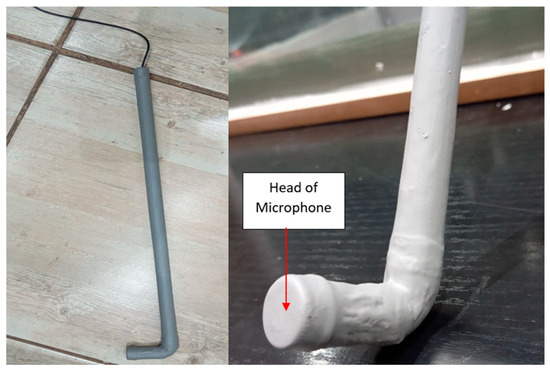
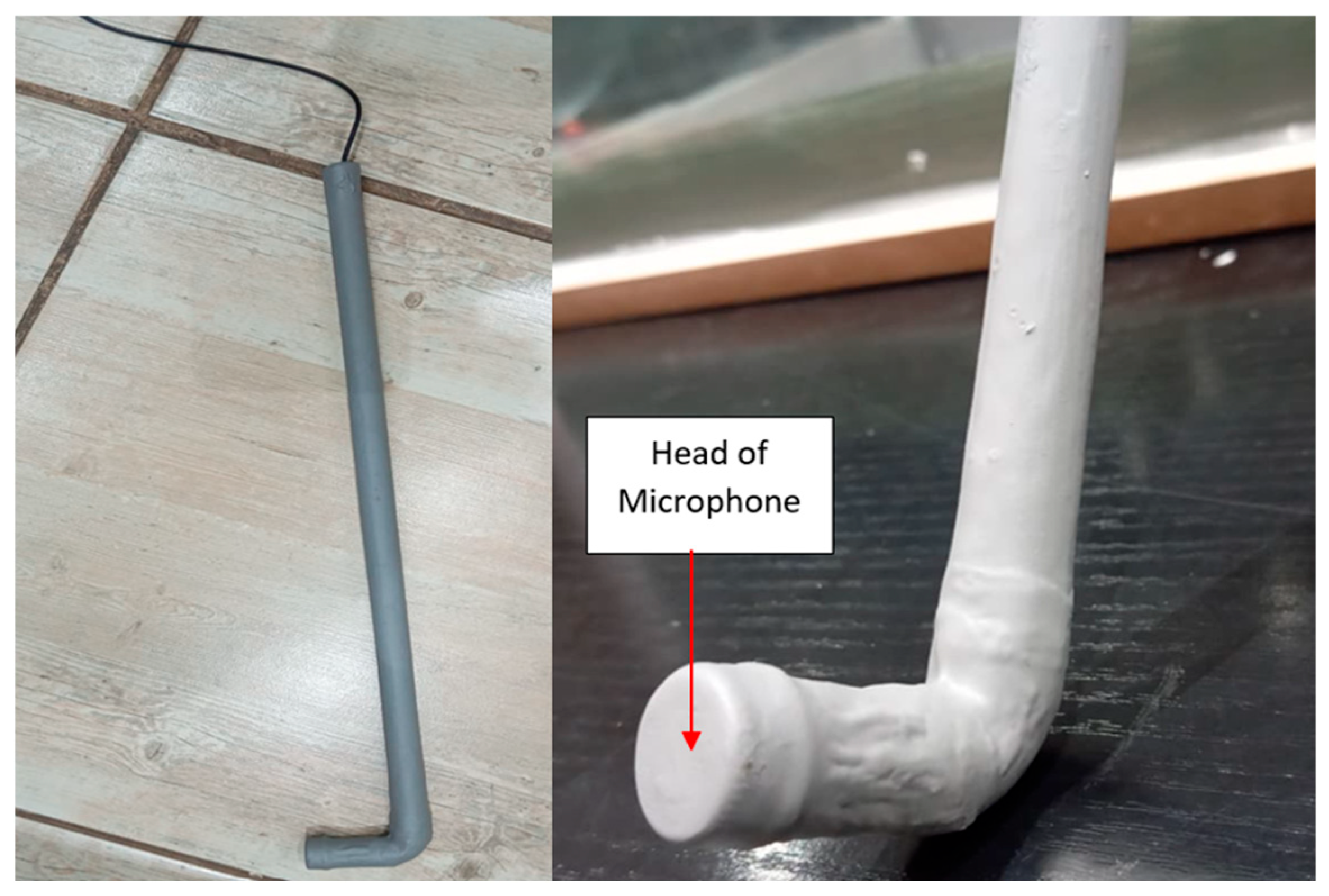
A low-cost hydrophone was constructed to receive underwater transmitted signals. The hydrophone was housed in a 40 mm by 15 mm copper pipe with a plastic cap and a 90° elbow joint for orientation, as shown in Figure 1. A latex membrane (surgical glove) was placed over the microphone head for the acoustic receiver. The entire assembly was coated with rubberized paint to provide waterproofing, while the hydrophone head only received two coats to preserve sensitivity. A waterproofed lapel microphone capsule was used as the receiving element sensor that was coupled to a smartphone for recording. The receiver was positioned inside the water and covered with a latex membrane, as described in the receiver construction section. The signal path therefore did not involve transmission through the glass to the sensor, but rather propagation through the water to the hydrophone. The custom hydrophone setup used in this study was intended to operate within the audio band required for the experiments, with a frequency response of 20 Hz to 20 kHz and a sensitivity of −30 dB ± 2 dB.
Figure 1.
Hydrophone construction.
3.3. Transmitter Construction
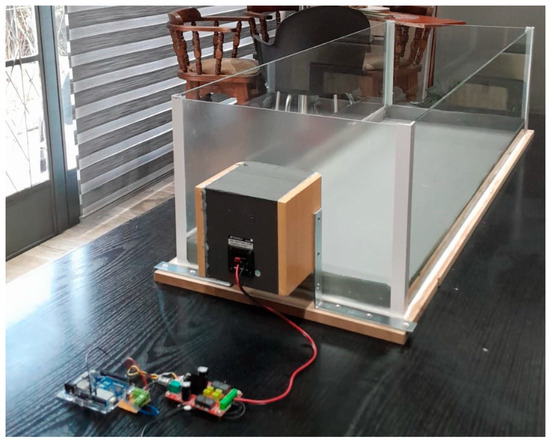
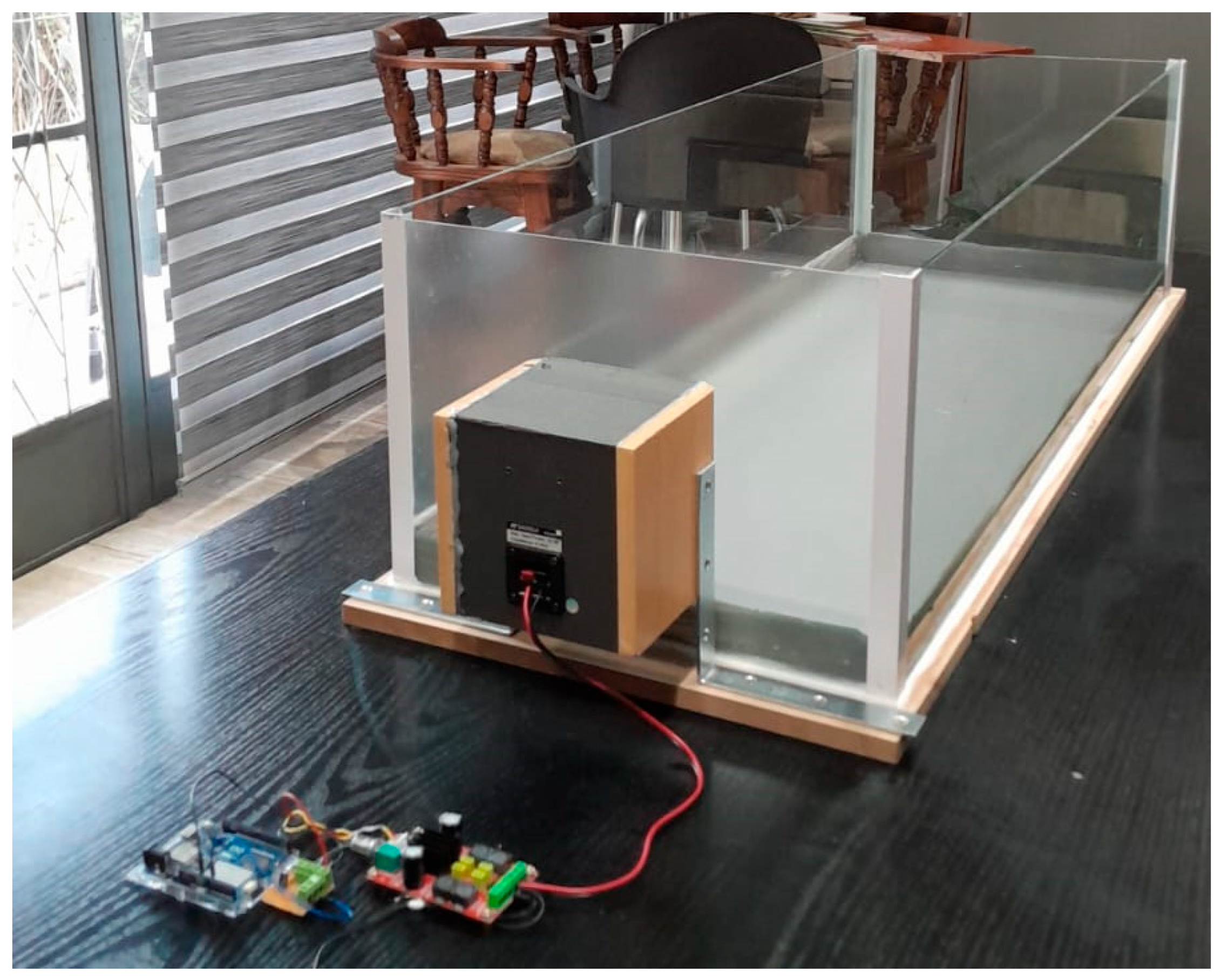
An onboard microcontroller was used to generate binary-encoded data that was converted into a square-wave OOK transmitted signal. A voltage divider was used to reduce the DAC output amplitude to a 50 W class D audio amplifier powered by a 12 V DC supply. A loud 400 W max FTS speaker with a range of 65 Hz to 20 kHz and an 88 dB sensitivity was mounted outside the tank using L-brackets as shown in Figure 2.
Figure 2.
Transmitter construction and entire test setup.
3.4. Experimental Procedure
The experiments were conducted in a controlled indoor laboratory environment to minimize external acoustic interference. Receiver distances of 30 cm, 70 cm, and 110 cm were measured using a ruler from the loudspeaker to the hydrophone position. Salinity levels of 0 g/L, 17.5 g/L, and 35 g/L were prepared by dissolving measured masses of sodium chloride in the known tank volume. The water was stirred until the salt was dissolved before each test. The 35 g/L condition was selected to represent typical seawater, as average ocean salinity is approximately 35 g of dissolved salt per litre of water [16]. The 17.5 g/L condition was included as a mid-range test point to examine system performance under partially saline conditions rather than to represent oceanic water. This selection allowed the study to evaluate square-wave OOK performance across a practical range of controlled laboratory salinity conditions. Measurements were performed at room temperature, and background acoustic noise was kept low by conducting the experiments in a quiet, enclosed room. The transmitted OOK signals carried the binary encoded payloads at carrier frequencies of 1 kHz then 11 kHz and finally 20 kHz, respectively, for each salinity level test at distances of 30 cm then 70 cm and finally 110 cm. The hydrophone captured the transmitted signal via a smartphone’s 3.5 mm jack, and the recorded signals were stored as WAV files. The recorded WAV file signals were analyzed using time-domain waveform inspection, Fast Fourier Transform (FFT) harmonic analysis, spectrogram visualization, and binary bitstream reconstruction using the Hilbert transform for signal correction in MATLAB (R2023a). Bit-shift correction was performed automatically in MATLAB by including a function to align the received waveform with the expected payload structure. The bit-shift correction was used to determine how far the recovered bitstream was offset from the transmitted payload and to assess the decoding robustness of each frequency under the tested conditions. The reported bit-shift values therefore reflect the automatic offset required for successful bitstream recovery. The received signal was first processed using a 4th-order Butterworth bandpass filter centred on the transmitted frequency, with −3 dB cutoff frequencies set to approximately ±25% of the centre frequency. The Hilbert transform was used to extract the amplitude envelope of the received acoustic signal. A moving-average filter was then applied to smooth the envelope and reduce noise. A detection threshold was implemented in the smoothed envelope to generate a binary square-wave representation of the OOK signal, where high amplitudes corresponded to logical ones and low amplitudes corresponded to logical zeros. The durations of the resulting high and low states were then used to reconstruct the transmitted bitstream. The study evaluates the feasibility of square-wave OOK transmission under varying underwater conditions. At least 10 transmission and decoding attempts were performed to assess the viability of the communication signal. The selected frequencies of 1 kHz, 11 kHz, and 20 kHz were analyzed because they represent low, medium, and high-frequency decoding behaviour, respectively. The most viable recovered signal for each frequency, salinity, and distance condition was analyzed in MATLAB to investigate bitstream recovery. The reported pass/fail outcomes therefore represent the best recovered result for each tested condition. The results should be interpreted as the overall performance of the prototype communication system under the tested laboratory conditions rather than as an isolated assessment of salinity effects.
4. Results and Discussion
A systematic performance analysis of square-wave OOK acoustic transmission is conducted under different environmental and propagation conditions. Signal envelopes were extracted using the Hilbert transform to facilitate detailed waveform analysis. The effectiveness of signal recovery was evaluated by comparing transmitted binary-encoded signals with the received signals, thereby determining the ability of specific transmission frequencies to preserve the original information. Experimental evaluations are conducted at salinity levels of 0 g/L, 17.5 g/L, and 35 g/L which represent freshwater, brackish water, and ocean-equivalent conditions, respectively. For each salinity level, signal transmission was analyzed at propagation distances of 30 cm, 70 cm, and 110 cm with specific carrier frequencies of 1 kHz, 11 kHz, and 20 kHz. These conditions provide a controlled laboratory approximation of short-range underwater acoustic propagation and offer a representative comparison between low-to-high-frequency square-wave OOK transmission.
To demonstrate the viability of square-wave OOK as a practical underwater acoustic communication prototype, the received signal was evaluated in terms of its ability to preserve and recover the transmitted binary bitstream under different salinity levels and propagation distances. Successful decoding and reconstruction of the transmitted square-wave binary information indicates that the embedded data stream can be recovered after underwater propagation, supporting the feasibility of the proposed approach. The experiments were conducted in a small laboratory tank, and the measured results may therefore have been influenced by wall reflections, boundary effects, and tank resonance. The transmitted payload was intentionally kept short to establish proof-of-concept feasibility for square-wave OOK communication under controlled laboratory conditions. In addition, the findings should be interpreted as proof-of-concept evidence of square-wave OOK performance under controlled conditions rather than as a direct representation of open-ocean performance. The frequencies of 1 kHz, 11 kHz, and 20 kHz were selected to represent low-, mid-, and high-frequency test points within the audio band, allowing the feasibility of square-wave OOK to be assessed across a practical range of underwater acoustic conditions.
4.1. Bitstream Recovery at 0 g/L Salinity Level
The first stage of analysis focuses on specific carrier frequencies to determine baseline test conditions at 0 g/L salinity for transmission distances of 30 cm, 70 cm, and 110 cm. This initial evaluation serves as a reference point for understanding the system’s inherent performance in fresh water before introducing increased salinity levels. The analysis of the system’s decoding performance at 0 g/L salinity is summarized in Table 1, indicating pass and fail outcomes for selected carrier frequencies of 1 kHz, 11 kHz, and 20 kHz for different propagation distances. Successful bitstream recovery at 1 kHz was achieved at 30 cm and 110 cm, where the transmitted payload was correctly decoded. However, at 70 cm the recovered sequence did not match the transmitted message and failed to recover the correct decoded payload. Only “AT” was obtained after a large alignment correction, missing bit “L”. At 11 kHz, decoding was achieved across all tested distances, although bit alignment corrections were required to recover the transmitted payload. In contrast, 20 kHz transmissions did not produce a recoverable bitstream because the received signal did not form consistent envelope peaks for reliable decoding.
Table 1.
Summary of bitstream recovery at 0 g/L salinity level.
Results indicate that at lower carrier frequencies, reliable signal recovery is possible, whereas at higher carrier frequencies, stable decoding is not possible at the different evaluated distance ranges.
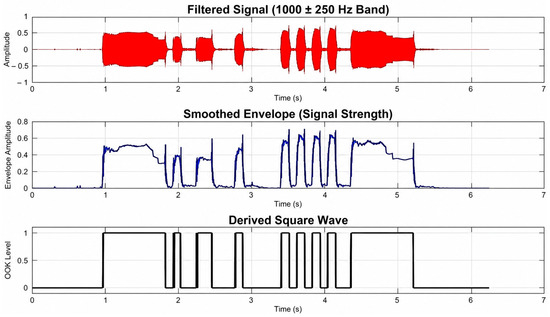
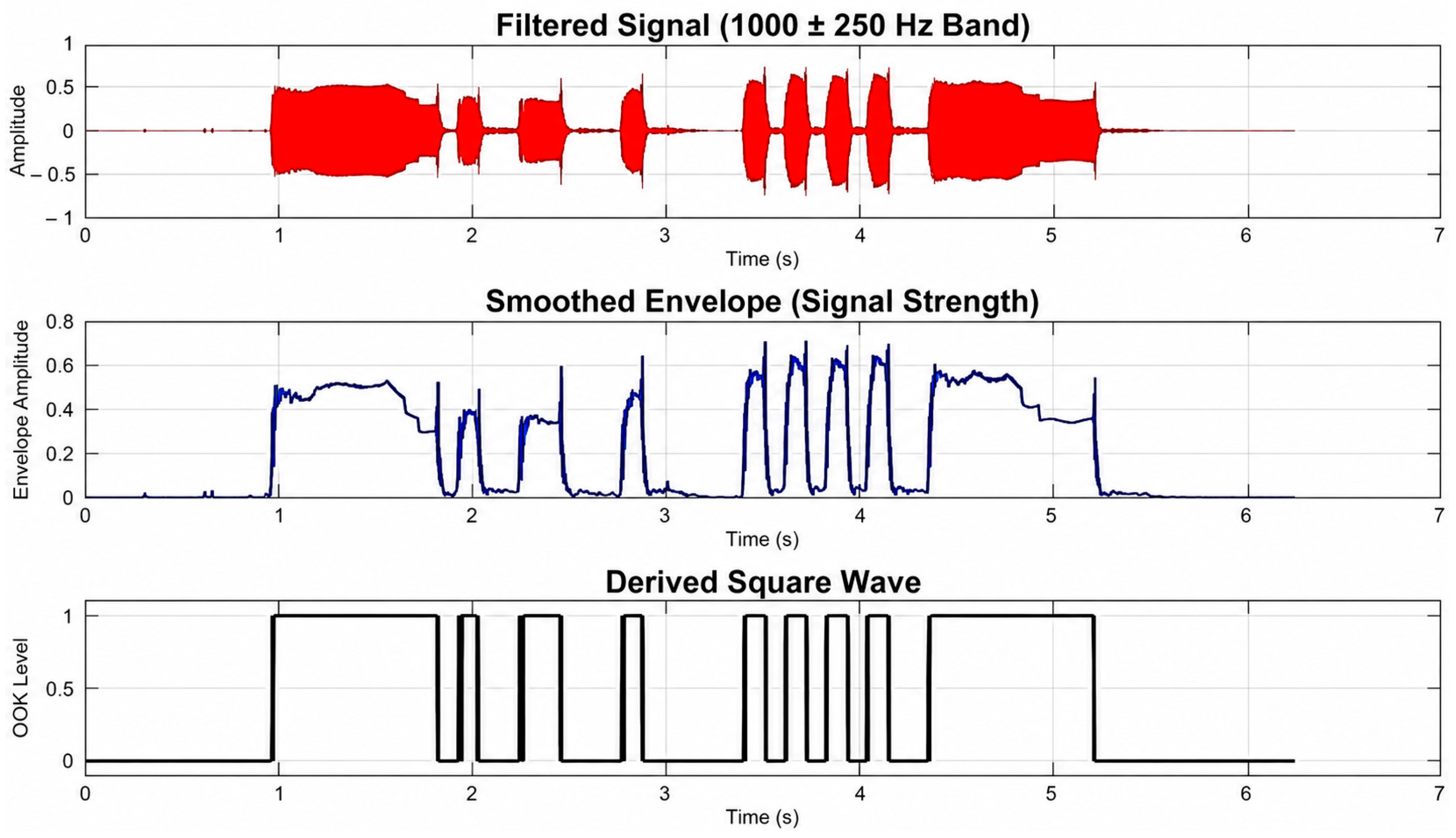
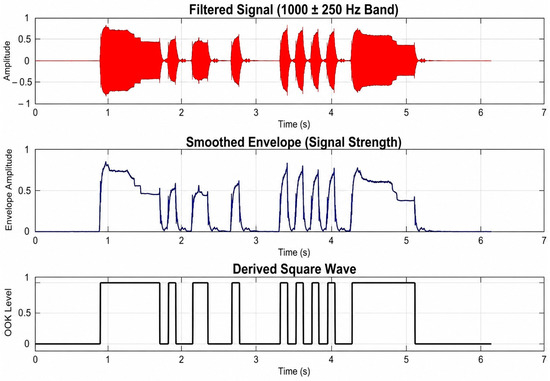
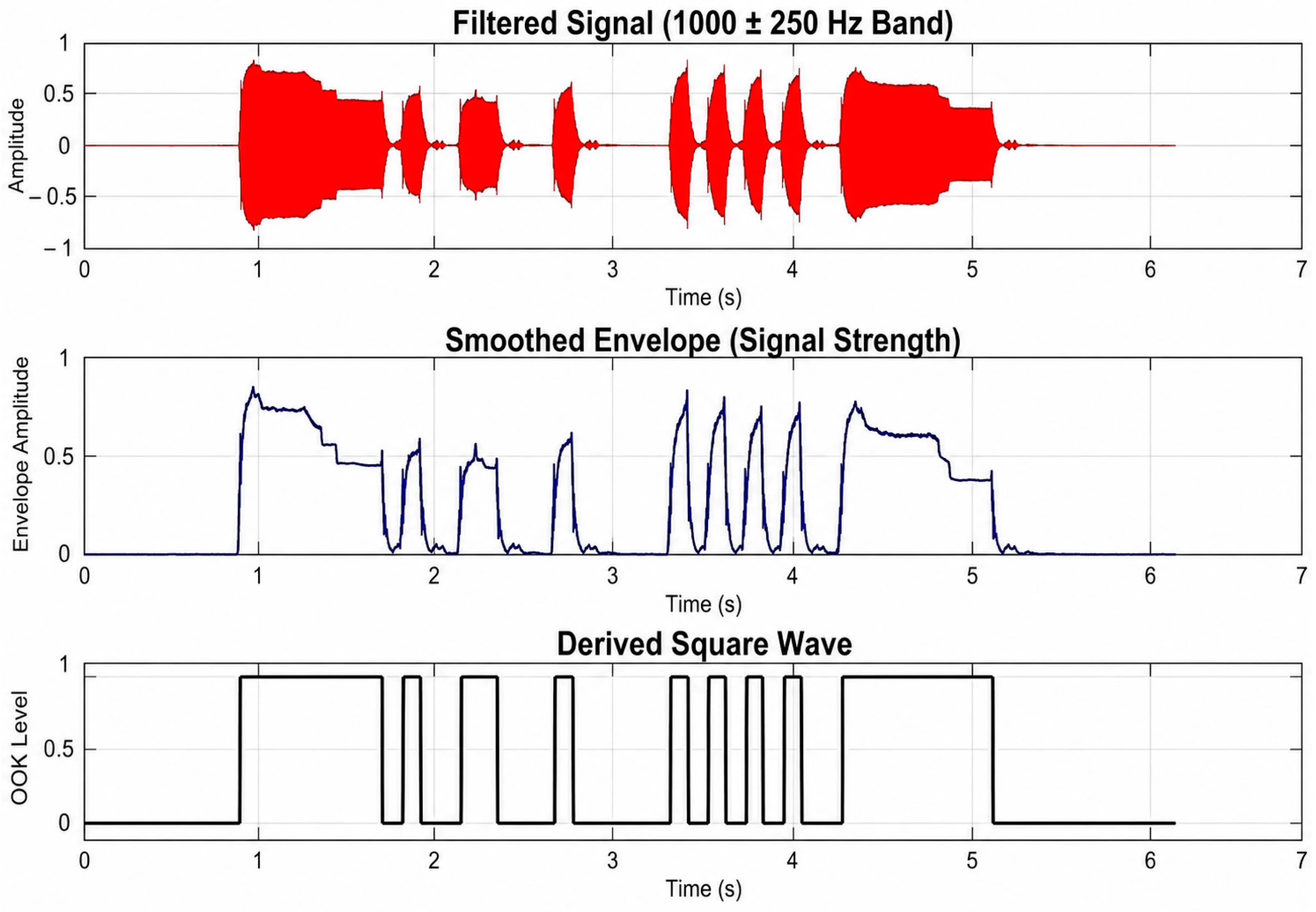
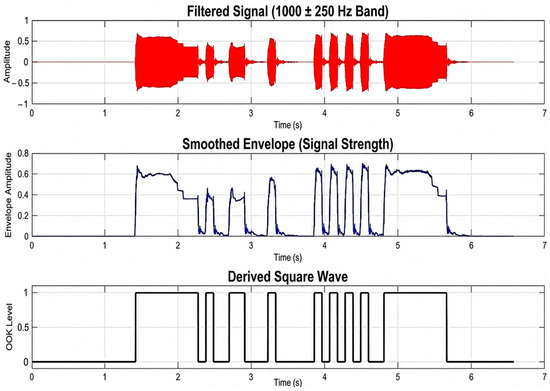
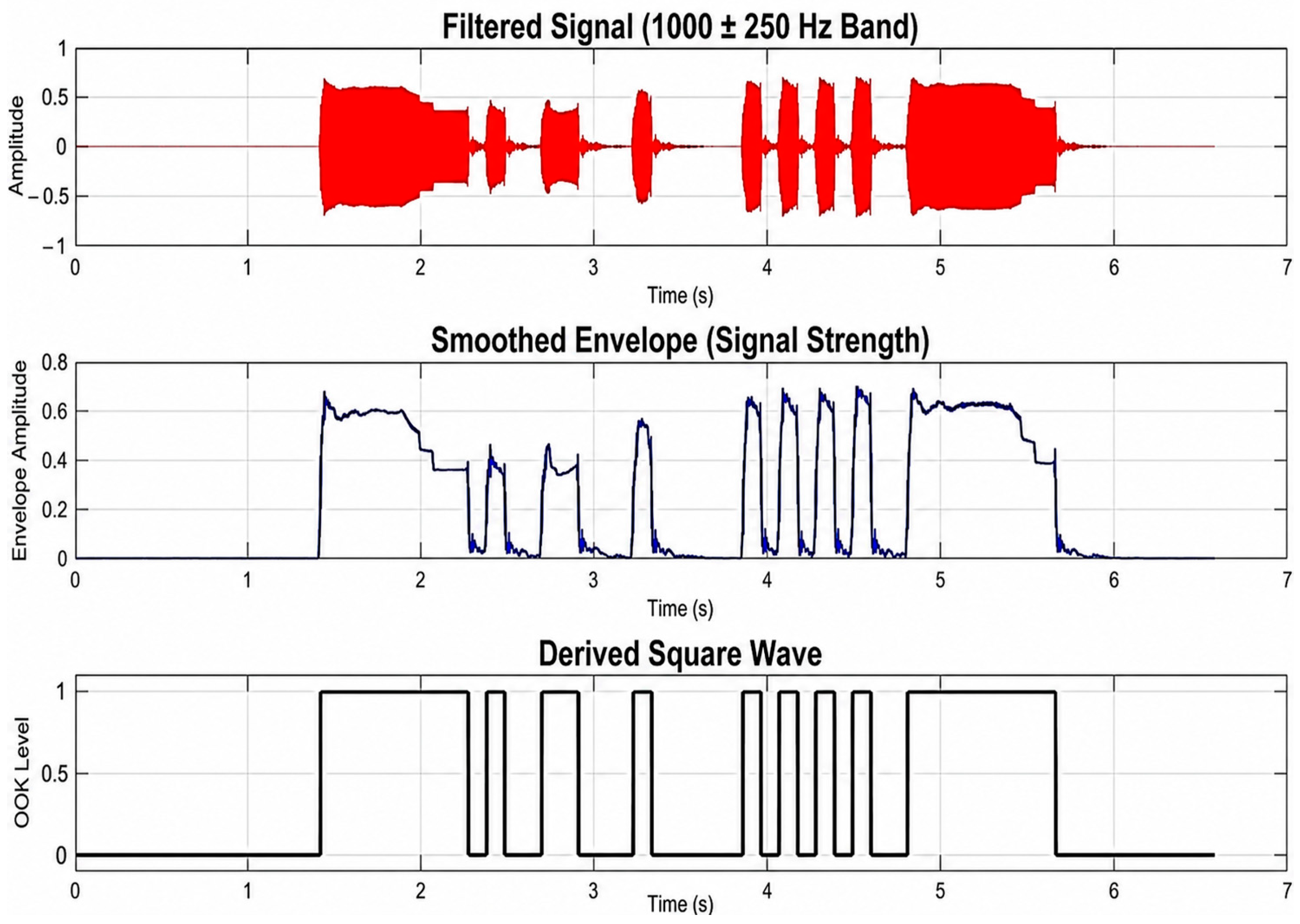
Representative examples of received signal analysis for both pass and fail decoding cases are shown in Figure 3 and Figure 4. At 1 kHz, the Figure 3 example shows the filtered signal, smoothed envelope, and derived square wave of a successful signal recovery at a 110 cm distance corresponding to the maximum range evaluated for this short-range communication study. The decoding was achieved with no bit-alignment correction, and the transmitted payload was recovered accurately.
Figure 3.
Received signal analysis at 110 cm for 0 g/L at 1 kHz illustrating bitstream recovery.
Figure 4.
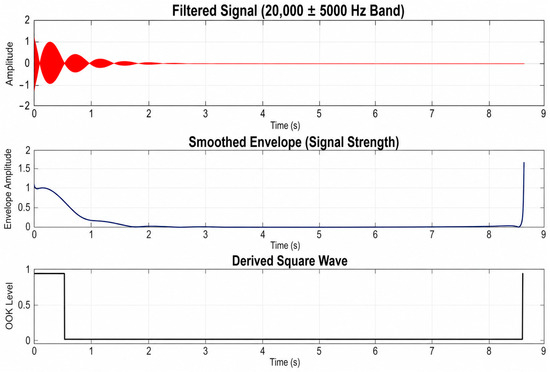
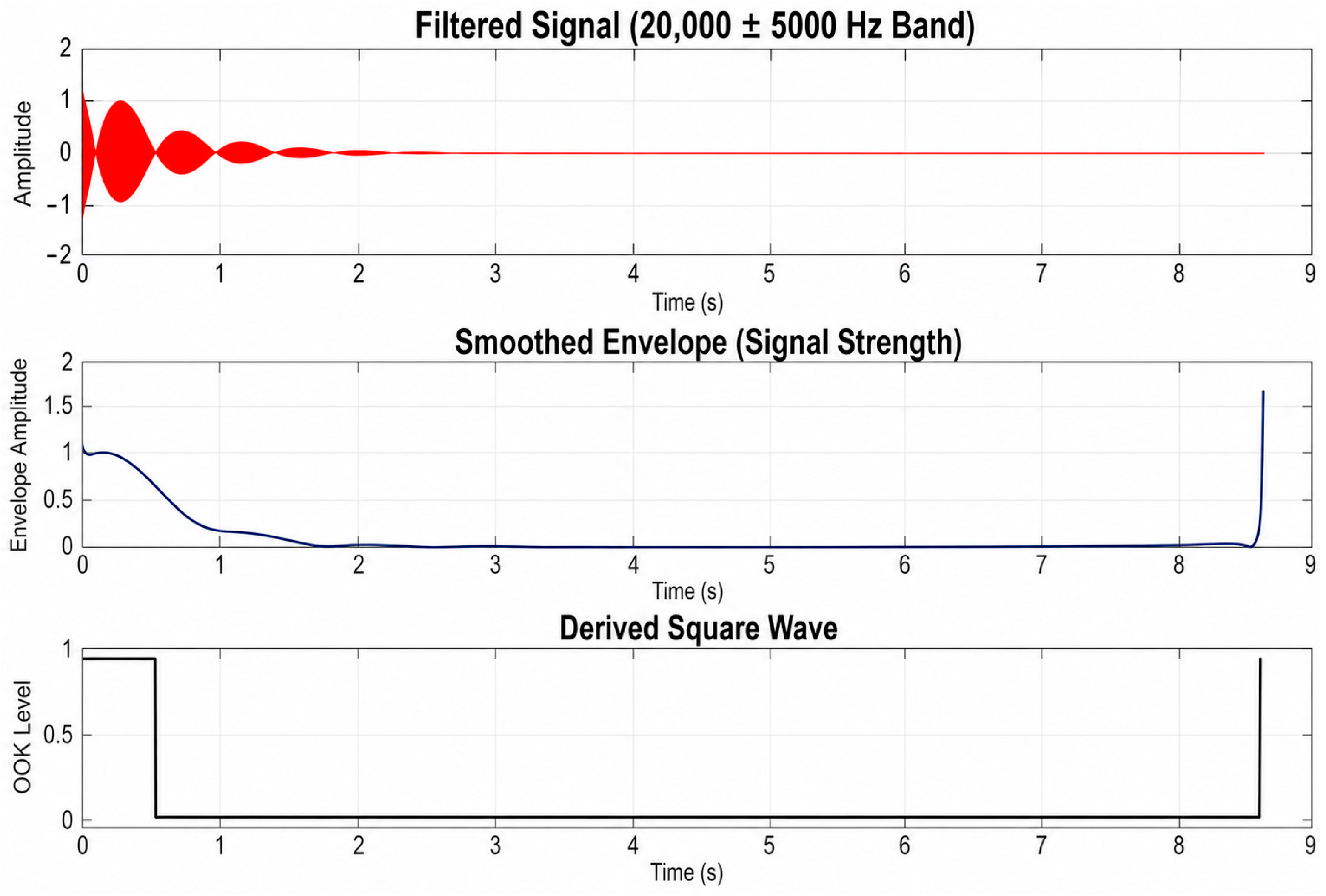
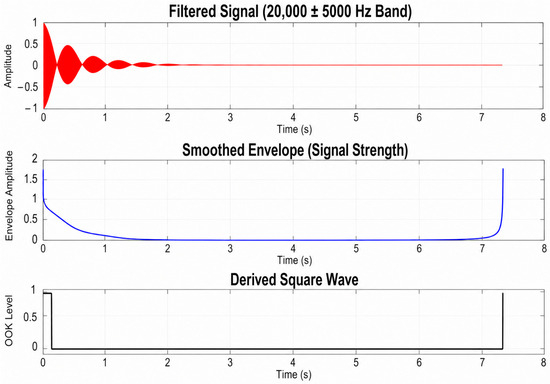
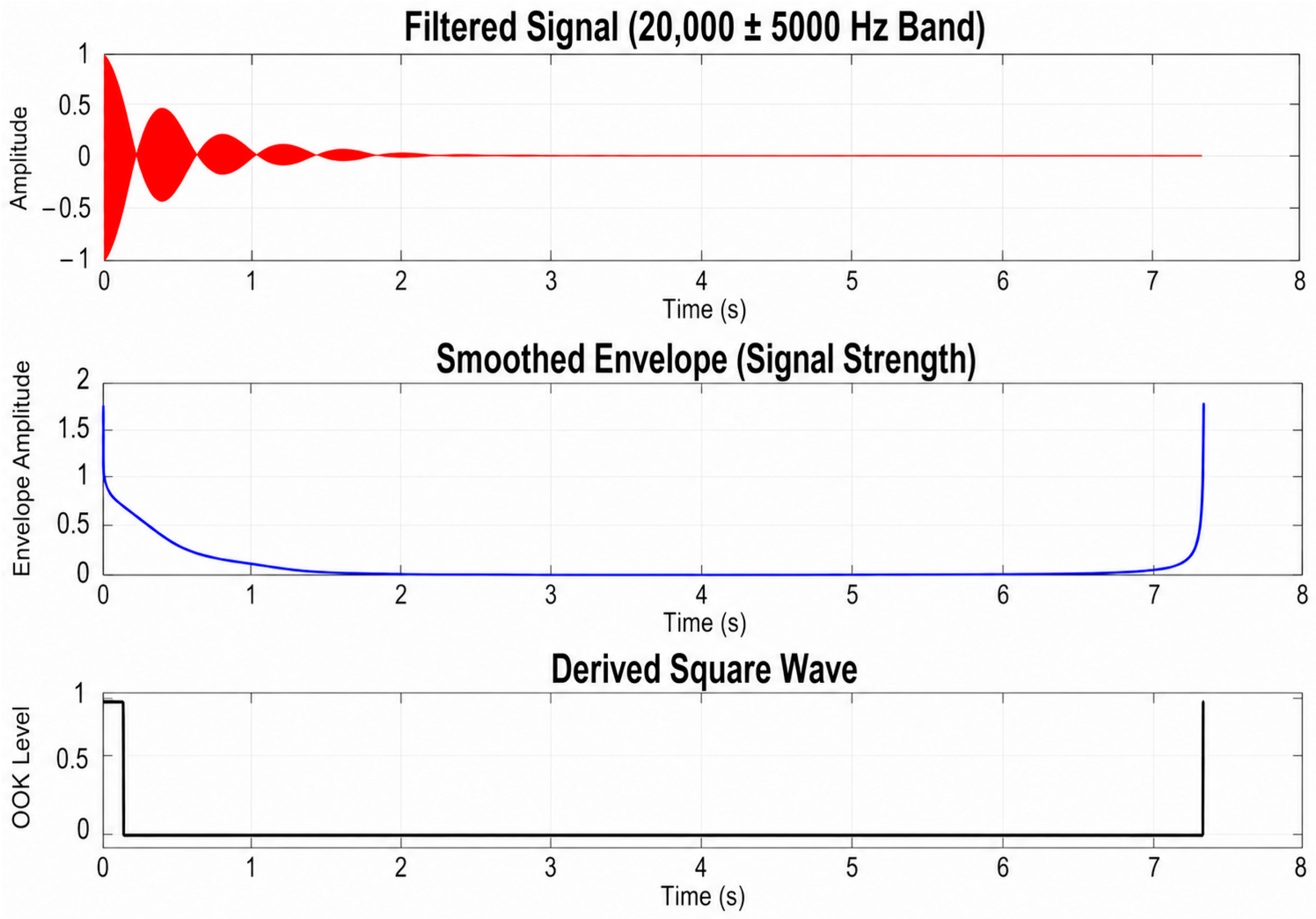
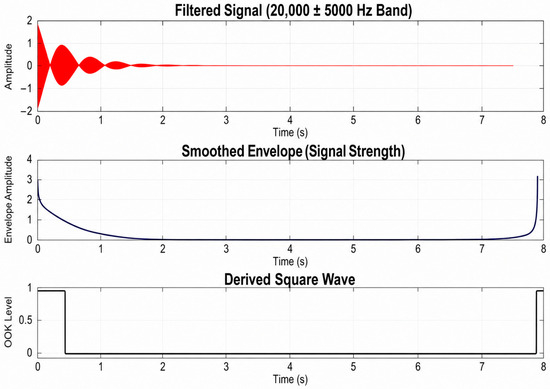
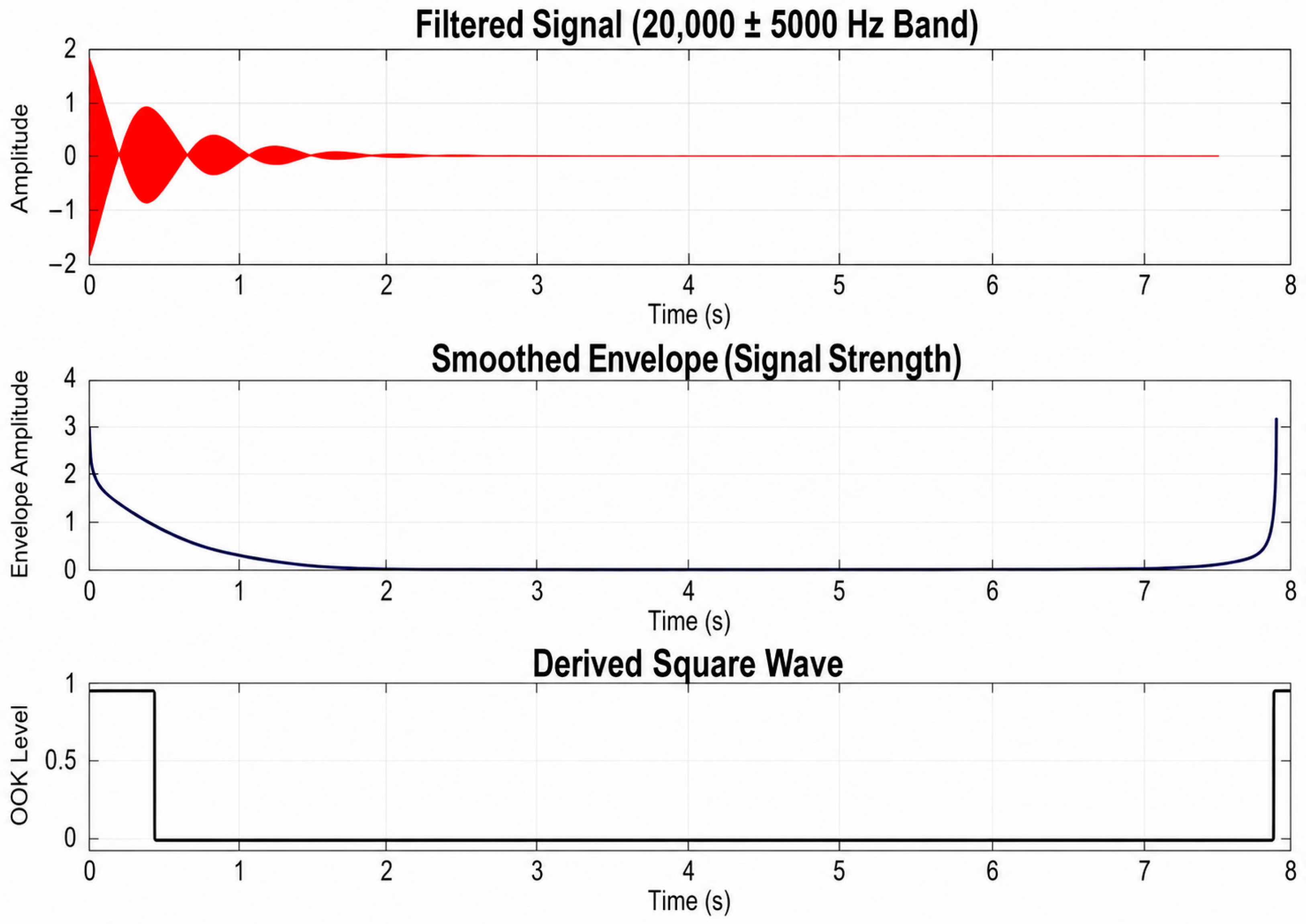
Received signal analysis at 110 cm for 0 g/L at 20 kHz illustrating bitstream recovery.
In contrast, Figure 4 shows the received signal at 20 kHz, where no valid bitstream could be reconstructed, as the received waveform does not contain sufficient structure for reliable decoding.
4.2. Bitstream Recovery at 17.5 g/L Salinity Level
Subsequent testing was conducted at a salinity concentration level of 17.5 g/L. The received signal was analyzed across selected carrier frequencies at selected transmission distances. The decoding performance of the underwater acoustic communication system at 17.5 g/L salinity is summarized in Table 2, indicating whether successful bitstream recovery was achieved for each distance–frequency combination. Successful bitstream recovery was achieved at 1 kHz for 30 cm and 110 cm, while decoding at 70 cm produced errors. At 11 kHz, decoding was achieved across all tested distances, although alignment corrections were required before the transmitted payload could be recovered.
Table 2.
Summary of bitstream recover at 17.5 g/L salinity level.
The observation at the 70 cm and 1 kHz anomaly could possibly be due to laboratory-scale acoustic-field effects rather than propagation loss alone, in conjunction with the change in salinity level, which may have significantly affected signal propagation through the medium, as that was the only parameter that changed. In a small tank, standing waves, boundary reflections, local resonance, salinity and constructive or destructive interference can alter the received signal amplitude at specific receiver positions.
In contrast, 20 kHz transmissions did not produce a recoverable bitstream at any distance. These observations indicate that lower carrier frequencies support more reliable payload recovery under 17.5 g/L saline conditions, while 20 kHz did not support stable decoding within the tested range. Representative examples of successful and unsuccessful signal recovery analysis at a transmission distance of 110 cm under 17.5 g/L salinity for both 1 kHz and 20 kHz are shown in Figure 5 and Figure 6, respectively.
Figure 5.
Received signal analysis at 110 cm for 17.5 g/L at 1 kHz illustrating bitstream recovery.
Figure 6.
Received signal analysis at 110 cm for 17.5 g/L at 20 kHz illustrating bitstream recovery.
The received signal at 1 kHz and a transmission distance of 110 cm with 17.5 g/L salinity demonstrates successful bitstream recovery, as shown in Figure 5. The received filtered signal produces a well-defined envelope, allowing clear identification of transmission bursts. The reconstructed square wave exhibits stable and well-timed transitions, enabling accurate detection of bitstream boundaries. The system detected the start character without requiring any bit alignment correction, and the transmitted payload “LAT” was recovered in full. This result indicates that at tested 17.5 g/L salinity condition, the signal retained sufficient structure to support reliable decoding at this maximum evaluated distance.
In contrast, the received signal at 20 kHz and a transmission distance of 110 cm with 17.5 g/L salinity did not support successful bitstream recovery, as shown in Figure 6. The received filtered signal exhibits a weak and poorly defined envelope, with no consistent peaks corresponding to the transmitted signal. As a result, the reconstructed square wave does not produce a stable or interpretable binary pattern, and no valid bit alignment could be established. Consequently, the transmitted payload could not be recognized. Thus, the signal at 20 kHz lacks sufficient structure for reliable decoding at this maximum evaluated distance.
4.3. Bitstream Recovery at 35 g/L Salinity Level
Subsequent testing was conducted at a salinity concentration of 35 g/L, representing conditions comparable to typical seawater. The received signal was analysed across selected carrier frequencies of 1 kHz, 11 kHz, and 20 kHz at transmission distances of 30 cm, 70 cm, and 110 cm. The decoding performance of the system under these conditions is summarized in Table 3, which indicates whether successful bitstream recovery was achieved for each distance–frequency combination. At 1 kHz, successful bitstream recovery was achieved at 70 cm and 110 cm, while decoding at 30 cm failed, as the recovered sequence did not match the transmitted payload. At 11 kHz, decoding was achieved across all distances, although bit alignment corrections were required before the transmitted payload could be recovered. In contrast, 20 kHz transmissions did not produce a recoverable bitstream at any distance. These results indicate that lower carrier frequencies support more reliable payload recovery under high salinity conditions, whereas 20 kHz did not support stable decoding within the evaluated range.
Table 3.
Summary of bitstream recovery at 35 g/L salinity.
The same anomaly discussion provided for Table 2 is applicable to the 1 kHz and 30 cm bitstream recovery, as seen in Table 3.
Representative examples of successful and unsuccessful received signal analysis for both 1 kHz and 20 kHz at a transmission distance of 110 cm with 35 g/L salinity are shown in Figure 7 and Figure 8, respectively.
Figure 7.
Received signal analysis at 110 cm for 35 g/L at 1 kHz illustrating bitstream recovery.
Figure 8.
Received signal analysis at 110 cm for 35 g/L at 20 kHz illustrating bitstream recovery.
For the received signal at 1 kHz, the system immediately detected the start character “L” and decoded the payload “LAT” exactly as transmitted, with no bit alignment correction required. This result confirms that 1 kHz supports reliable bitstream recovery at the maximum transmission distance evaluated under high salinity conditions. The reconstructed signal exhibits stable transitions and consistent bit timing, enabling accurate decoding without additional processing. In comparison, although 11 kHz transmissions were decodable across all tested distances, bit alignment corrections were consistently required to recover the transmitted payload. The absence of such corrections at 1 kHz, particularly at 110 cm, indicates improved synchronization and more consistent signal reconstruction. These observations demonstrate that 1 kHz provides more robust decoding performance than 11 kHz under the tested conditions, supporting its suitability for reliable short-range underwater acoustic communication at extended distances.
In contrast, for the received signal at 20 kHz, the transmitted payload “LAT” could not be decoded at 110 cm, as no valid bitstream could be reconstructed from the received signal. The filtered output did not produce a consistent envelope, resulting in the absence of stable symbol transitions required for reliable bit detection and frame alignment, as shown in Figure 8. Consequently, the start sequence could not be identified, and the payload remained unrecognized. This behaviour was observed consistently for all tested distances, where 20 kHz transmissions did not produce a recoverable bitstream. The received signal lacked sufficient structure for decoding, indicating that this carrier frequency does not support reliable OOK-based communication under the tested salinity conditions and propagation ranges.
A summary of all the experiments conducted in this study is shown in Table 4, with overall results including their implications.
Table 4.
Summary of all conducted experiments in this study.
The observed signal degradation cannot be attributed to salinity alone, as the loudspeaker, hydrophone, smartphone recorder, amplifier, and tank resonance may also have influenced the received signal. However, the baseline measurements at 0 g/L provided an initial reference for the system response under the experimental setup, and the subsequent tests examined the combined effects of propagation distance and salinity on bitstream recovery. In this context, salinity was treated as a key variable in the study, although the measured signal fidelity likely reflected the combined influence of the underwater channel and the experimental hardware configuration. The observed performance difference between 1 kHz and 20 kHz is consistent with established underwater acoustic absorption behaviour. According to prior studies [17,18,19,20], sound attenuation in seawater increases with frequency, with higher-frequency components being strongly affected by viscous absorption and salinity-dependent relaxation processes. In addition, a square-wave contains harmonic components that extend beyond the fundamental frequency. This makes the received waveform increasingly vulnerable to frequency-selective attenuation and distortion at higher carrier frequencies. As a result, the 20 kHz signal exhibited a weaker envelope structure and poorer bitstream recoverability than the 1 kHz signal under the tested conditions. Although the observed salinity effect was modest under the specific short-range conditions tested in this prototype, salinity remains a relevant parameter in underwater acoustic communication and was retained in the study to reflect realistic environmental variability and to align the experiment with established absorption models [17,18,19,20,21]. The non-monotonic distance-dependent behaviour observed in some cases is consistent with tank-scale acoustic field effects, including standing waves, resonance, and boundary reflections, which can produce local variations in received signal strength despite the general frequency-dependent attenuation predicted by established absorption models.
5. Conclusions
These findings do not indicate that square-wave OOK is inherently superior to conventional underwater acoustic modulation schemes. Rather, they demonstrate its viability as a proof-of-concept approach for short-range binary communication using a simple prototype implementation. Investigations were conducted on the performance of square-wave OOK transmission from fresh to saline water for concentrations of 0 g/L, 17.5 g/L, and 35 g/L, respectively. Across all tested conditions, the low-frequency signals consistently performed adequately. The 1 kHz carrier demonstrated the most consistent decoding performance for all tested conditions. While successful bitstream recovery was not achieved at all distances, reliable decoding with no bit alignment correction was observed at the longest tested transmission distance of 110 cm, indicating improved performance at extended ranges compared to higher carrier frequencies. The 11 kHz signal was recoverable but showed degraded spectral fidelity, with timing slips of one to two bits due to resonance within the tank and attenuation of higher-frequency components in the channel. The 20 kHz transmission signal consistently failed at all distances and salinities, with envelopes collapsing and signal energy lost in noise.
Increasing salinity progressively reduced harmonic content and raised overall signal attenuation. Longer propagation distances amplified these effects, causing amplitude fades, timing slips, and reduced decoding reliability. These results indicate the importance of selecting appropriate transmission frequencies and highlight limitations imposed by channel conditions and environmental factors on square-wave OOK performance. The observation that some longer transmission distances occasionally produced better recovery than shorter distances is likely attributable to laboratory-scale acoustic-field effects rather than to propagation loss alone. In a small tank, standing waves, boundary reflections, local resonance, and constructive or destructive interference can alter the received signal amplitude at specific receiver positions. As a result, the measured response may not vary monotonically with distance. The present study therefore interprets these distance-dependent variations as proof-of-concept laboratory effects, and further validation in larger water bodies or open-water environments will be required to isolate true range-dependent propagation behaviour. These findings suggest that, for the present prototype, lower carrier frequencies are more suitable for short-range binary recovery in saline water.
Future work should focus on improving signal processing and bitstream recovery, particularly for higher-frequency transmission where performance may have been limited by possible effects such as waveform irregularities, noise, distortion, tank resonance, and boundary reflections. Potential approaches include stronger filtering, adaptive thresholding, and improved transducer matching. Repeating the experiments in larger water bodies or open-water environments would also help reduce boundary effects and provide more realistic propagation conditions. In addition, longer and more diverse data streams should be tested to further assess transmission stability, error resistance, and scalability under more realistic underwater communication scenarios. Furthermore, these future investigations could include a direct comparison between square-wave OOK and conventional sinusoidal carrier or FSK/ASK modulation schemes under identical experimental conditions to quantify relative performance, robustness, and efficiency. Such a comparison was outside the scope of the present proof-of-concept study. Subsequent research could focus on extending the prototype toward short-range, shallow-water communication over distances beyond the current laboratory range, while evaluating achievable data rates and BER under more realistic propagation conditions. An improved system should also assess whether the system can maintain reliable recovery for longer payloads with acceptable error performance in controlled field environments, followed by further investigation in oceanic or open-water environments. Additionally, a statistical reliability analysis over multiple trials, together with measurements of SNR, envelope amplitude, signal energy, and experimental uncertainty, would further help quantify the robustness of the proposed system.
In summary, the results of this work demonstrate the effects of equipment limitations, channel conditions, and signal processing constraints for underwater acoustic communication. These findings highlight the challenges in achieving reliable signal transmission and provide insight into system performance under these tested conditions.
Author Contributions
Conceptualization, D.P., J.V. and D.v.N.; Methodology, D.P.; Software, D.P.; Validation, D.P. and J.V.; Formal analysis, D.P.; Investigation, D.P.; Resources, J.V.; Data curation, D.P.; Writing—original draft preparation, D.P.; Writing—review and editing, D.v.N. and J.V. All authors have read and agreed to the published version of the manuscript.
Funding
This research received no external funding.
Institutional Review Board Statement
Not applicable.
Informed Consent Statement
Not applicable.
Data Availability Statement
The original contributions presented in this study are included in the article. Further inquiries can be directed to the corresponding author.
Acknowledgments
The authors would like to thank the University of Johannesburg for providing access to laboratory facilities and measuring equipment used to complete this research.
Conflicts of Interest
The authors declare no conflicts of interest.
Abbreviations
The following abbreviations are used in this manuscript:
| AUV | Autonomous Underwater Vehicle |
| UAC | Underwater Acoustic Communication |
| FSK | Frequency-Shift Keying |
| MFSK | Multi-Frequency Shift Keying |
| OOK | On-Off Keying |
| FFT | Fast Fourier Transfer |
References
- Aman, W.; Al-Kuwari, S.; Muzzammil, M.; Rahman, M.M.U.; Kumar, A. Security of Underwater and Air–Water Wireless Communication: State-of-the-Art, Challenges and Outlook. Ad Hoc Netw. 2023, 142, 103114. [Google Scholar] [CrossRef] [Scilit]
- Islam, K.Y.; Ahmad, I.; Habibi, D.; Waqar, A. A Survey on Energy Efficiency in Underwater Wireless Communications. J. Netw. Comput. Appl. 2022, 198, 103295. [Google Scholar] [CrossRef] [Scilit]
- Wang, Y.; Yan, H.; Pan, C.; Liu, S. Measurement-Based Analysis of Characteristics of Fast Moving Underwater Acoustic Communication Channel. In Proceedings of the 2022 International Conference on Frontiers of Information Technology (FIT), Islamabad, Pakistan, 12–13 December 2022; pp. 47–52. [Google Scholar]
- Yan, H.; Liu, S.; Pan, C.; Adil, M.; Qiao, G. Analysis and Modeling of Time-Varying Multipath Amplitude in High-Speed Mobile Underwater Acoustic Channels. In Proceedings of the OCEANS 2025 Brest, Brest, France, 16–19 June 2025; pp. 1–6. [Google Scholar]
- Yan, H.; Ma, T.; Pan, C.; Liu, Y.; Liu, S. Statistical Analysis of Time-Varying Channel for Underwater Acoustic Communication and Network. In Proceedings of the 2021 International Conference on Frontiers of Information Technology (FIT), Islamabad, Pakistan, 13–14 December 2021; pp. 55–60. [Google Scholar]
- Shaikh, S.; Huang, Y.; Alharbi, A.; Bilal, M.; Shaikh, A.S.; Zuberi, H.H.; Dars, M.A. Acoustic Propagation and Transmission Loss Analysis in Shallow Water of Northern Arabian Sea. J. Mar. Sci. Eng. 2024, 12, 2256. [Google Scholar] [CrossRef] [Scilit]
- Araujo, L.; Matos, T.; Cabral, J.; Martins, M. 4-FSK High-Speed Underwater Acoustic Communication System. In Proceedings of the OCEANS 2023—Limerick, Limerick, Ireland, 5–8 June 2023; pp. 1–5. [Google Scholar]
- Lin, X.; Wan, L.; Chen, Y.; Cheng, E. Bit-Loading for Non-Coherent MFSK Underwater Acoustic Communication Systems with Uneven Transmission Source Level. In Proceedings of the 2024 IEEE International Conference on Signal Processing, Communications and Computing (ICSPCC), Bali, Indonesia, 19–22 August 2024; pp. 1–5. [Google Scholar]
- Zhao, Y.; Wan, L.; Cheng, E.; Xu, F. Adaptive Power Allocation for Non-Coherent FSK in Time-Varying Underwater Acoustic Communication Channels. In Proceedings of the 2022 IEEE International Conference on Signal Processing, Communications and Computing (ICSPCC), Xi’an, China, 25–27 October 2022; pp. 1–6. [Google Scholar]
- Qian, W.; Tao, J.; Liu, C. Improved Frequency-Domain Equalization via Noise Whitening for Single-Carrier Underwater Acoustic Communications. In Proceedings of the OCEANS 2025 Brest, Brest, France, 16–19 June 2025; pp. 1–5. [Google Scholar]
- Jiang, W.; Yang, X.; Tong, F.; Yang, Y.; Zhou, T. A Low-Complexity Underwater Acoustic Coherent Communication System for Small AUV. Remote Sens. 2022, 14, 3405. [Google Scholar] [CrossRef] [Scilit]
- Zhang, R.; He, C.; Jing, L.; Zhou, C.; Long, C.; Li, J. A Modulation Recognition System for Underwater Acoustic Communication Signals Based on Higher-Order Cumulants and Deep Learning. J. Mar. Sci. Eng. 2023, 11, 1632. [Google Scholar] [CrossRef] [Scilit]
- Islam, M.S.; Younis, M.; Mahmud, M.; Carter, G.; Choa, F.-S. A Peak Detection Based OOK Photoacoustic Modulation Scheme for Air to Underwater Communication. Opt. Commun. 2023, 529, 129078. [Google Scholar] [CrossRef] [Scilit]
- Zhang, W.; Zhang, Y.; Wu, L.; Wang, J.; Tai, Y.; Wang, L.; Li, X.; Wang, H. Channel-Aware Demodulation Techniques for Chaotic Non-Coherent Underwater Acoustic Communication. Ocean Eng. 2026, 350, 124172. [Google Scholar] [CrossRef] [Scilit]
- Potter, J.R.; Wengle, E.; RØrstadbotnen, R.A.; Dong, H. First Demonstration of Underwater Acoustic Communication from Sea to Shore via an Optical Fibre Using Distributed Acoustic Sensing. In Proceedings of the 2024 Seventh Underwater Communications and Networking Conference (UComms), Sestri Levante, Italy, 3–5 September 2024; pp. 1–5. [Google Scholar]
- Millero, F.J.; Feistel, R.; Wright, D.G.; McDougall, T.J. The composition of Standard Seawater and the definition of the Reference-Composition Salinity Scale. Deep Sea Res. Part I Oceanogr. Res. Pap. 2008, 55, 50–72. [Google Scholar] [CrossRef] [Scilit]
- Ainslie, M.A.; McColm, J.G. A Simplified Formula for Viscous and Chemical Absorption in Sea Water. J. Acoust. Soc. Am. 1998, 103, 1671–1672. [Google Scholar] [CrossRef] [Scilit]
- Fisher, F.H.; Simmons, V.P. Sound Absorption in Seawater. J. Acoust. Soc. Am. 1977, 62, 558–564. [Google Scholar] [CrossRef] [Scilit]
- Francois, R.E.; Garrison, G.R. Sound Absorption Based on Ocean Measurements: Part I: Pure Water and Magnesium Sulfate Contributions. J. Acoust. Soc. Am. 1982, 72, 896–907. [Google Scholar] [CrossRef] [Scilit]
- Francois, R.E.; Garrison, G.R. Sound Absorption Based on Ocean Measurements: Part II: Boric Acid Contribution and Equation for Total Absorption. J. Acoust. Soc. Am. 1982, 72, 1879–1890. [Google Scholar] [CrossRef] [Scilit]
- Calculation of Absorption of Sound in Seawater. Available online: https://resource.npl.co.uk/acoustics/techguides/seaabsorption/ (accessed on 31 May 2026).

Disclaimer/Publisher’s Note: The statements, opinions and data contained in all publications are solely those of the individual author(s) and contributor(s) and not of MDPI and/or the editor(s). MDPI and/or the editor(s) disclaim responsibility for any injury to people or property resulting from any ideas, methods, instructions or products referred to in the content. |
© 2026 by the authors. Licensee MDPI, Basel, Switzerland. This article is an open access article distributed under the terms and conditions of the Creative Commons Attribution (CC BY) license.