


Abstract
Dust accumulation on photovoltaic (PV) modules reduces power generation efficiency, and traditional water-based cleaning is impractical in arid regions. Inspired by the classical acoustic phenomenon of Chladni figures—specifically the mechanism where an acoustic standing wave field drives the regular migration and accumulation of particles—this study proposes a waterless dust removal method using low-frequency ultrasonic vibration via piezoelectric excitation. Impedance analysis identifies optimal electromechanical coupling at 28 kHz. Experiments demonstrate that higher driving voltages accelerate cleaning, with recovery rates saturating beyond 125 V. Notably, intense friction and collisions between particles within high-density dust layers consume substantial kinetic energy, significantly multiplying the required cleaning time. Macroscopic transport analysis reveals that dust removal relies on the synergy of vibration-induced adhesion decoupling and gravity-driven transport. Sufficient tangential gravity is crucial for macroscopic particle removal, and tilt angles above 30° provide the necessary downward driving force to ensure smooth particle sliding. Under optimal conditions, the system achieves an over 97% short-circuit current recovery at a low power consumption of ~10 W, providing a theoretical basis for waterless PV self-cleaning systems.
1. Introduction
Against the backdrop of the global energy transition, solar photovoltaic (PV) power generation has been widely applied. However, the power generation efficiency of PV plants operating in natural environments is inevitably and negatively impacted by environmental factors. Among these, dust deposition on the surface of PV modules is a prevalent and severe issue [1,2,3,4]. After suspended dust particles in the air settle on the optical glass surface of the panels, they increase the absorption, reflection, and scattering of solar radiation, leading to an attenuation of the incident light intensity. Studies have shown that even a trace amount of dust coverage can cause a significant decrease in light transmittance; prolonged periods without precipitation exacerbate dust accumulation, subsequently resulting in a noticeable degradation of the output power of the PV system [5,6,7,8,9]. Considering that many large-scale PV plants globally are constructed in desert or arid regions with abundant sunshine but dry climates and scarce rainfall, it is difficult for panels to rely on natural rainfall for self-cleaning. Therefore, researching and developing highly efficient dust removal technologies suitable for such environments is of great significance for maintaining the long-term stable operation and economic benefits of PV plants [10,11,12].
To address the dust accumulation issue on PV surfaces, researchers and the engineering community have proposed various surface cleaning methods, mainly including fluid cleaning, mechanical removal, electrostatic dust removal, and surface modification [13,14]. Fluid cleaning (such as water spraying and high-pressure atomization) removes dirt through the physical scouring of water flow and is the most widely applied. Some studies have partially reduced the water consumption per unit area by optimizing nozzles or utilizing air conditioner condensate water [15,16,17]. Compressed air blowing is also a commonly used fluid dust removal method, which utilizes high-speed airflow to carry away dust and can provide a certain cooling effect [18]. In terms of mechanical removal, dry sweeping using handheld tools, vehicle-mounted roller brushes, or automated cleaning robots can achieve a high dust removal rate [19,20]. Electrostatic dust removal utilizes charge induction to detach dust particles from the surface via electrostatic repulsive forces, showing enormous potential in water-scarce environments [21,22]. Regarding passive protection, self-cleaning coatings based on surface engineering, such as superhydrophobic or superhydrophilic coatings, attempt to mitigate dust adhesion and deposition at the material level by altering the surface contact angle, allowing condensed water or rainwater to easily spread or roll off the surface [23,24,25].
Although the aforementioned technologies have achieved certain effects in practical engineering or laboratory tests, they still exhibit respective limitations when facing large-scale applications in arid regions [26]. Water-based cleaning methods consume large amounts of water and are difficult to promote on a large scale in water-scarce areas [27]. Although compressed air or mechanical sweeping can operate under waterless conditions, long-term high-speed airflow easily causes secondary deposition of raised dust, and high-hardness quartz particles in natural dust inevitably wear out the anti-reflective coating of the PV glass under long-term mechanical scratching, thereby affecting light transmittance and module lifespan [28,29]. Furthermore, while self-cleaning coatings based on mechanisms like superhydrophobicity can effectively prevent dust in theory, the durability and stability of their micro–nano surfaces still face significant challenges under complex outdoor working conditions, such as intense UV radiation, severe temperature differences, and wind-sand erosion [30]. Overall, there is an urgent need to explore a PV cleaning method that simultaneously features zero water consumption, zero panel damage, and low energy consumption.
Dust removal technology based on acoustic and mechanical vibration provides a new perspective for solving the above problems. Dust removal technology based on acoustic and mechanical vibration provides a new perspective for solving the above problems. As early as the 18th century, acoustic pioneer Ernst Chladni visually demonstrated through his famous ‘Chladni figures’ experiment how acoustic standing wave fields formed in elastic thin plates drive the detachment, migration, and regular accumulation of fine surface particles [31]. This classic acoustic phenomenon profoundly reveals the coupling mechanism between acoustic waves and particle dynamics, as well as the enormous potential of high-frequency structural vibrations in manipulating microscopic particles. Inspired by this acoustic phenomenon, this paper attempts to engineer this acoustically driven mechanism for the surface cleaning of photovoltaic panels. Vibration-based dust removal mainly utilizes a vibration source to input energy into the PV module, exciting the panel to produce forced vibration. In a dry environment, the interfacial interaction between micro-scale dust particles and PV glass is predominantly governed by van der Waals forces, electrostatic forces, and weak capillary forces [32,33]. When the transient acceleration generated by high-frequency vibration causes the inertial force acquired by the dust particles to exceed these interfacial adhesion forces, the particles will detach from the surface [34,35,36]. Among various vibration excitation methods, ultrasonic technology based on piezoelectric transducers has shown unique potential. The frequency of ultrasonic waves excited by piezoelectric transducers typically ranges from 20 kHz to 100 kHz. Compared to sound waves with frequencies greater than 200 kHz, this specific range is generally referred to as low-frequency ultrasound [37]. Such low-frequency ultrasonic systems can directly convert electrical energy into mechanical vibration through the inverse piezoelectric effect, possessing advantages of a compact structure, easy integration, and precise control [38]. This method does not rely on water or other cleaning media during the dust detachment process and can operate with low energy consumption, highly aligning with the requirements for unattended and automated operation and maintenance in extreme environments, such as PV plants in arid regions and Mars exploration rovers [39].
In recent years, although some literature has explored the application of ultrasonic or mechanical vibration in panel dust removal, this emerging technology remains in the idealized conceptual exploration stage, leaving a gap before mature engineering applications. First, most existing studies focus on verifying the feasibility of vibration-based dust removal from a qualitative perspective, while quantitative coupling research on multiple physical parameters during system operation is relatively insufficient. The initial dust accumulation density on actual PV module surfaces varies greatly, and a thick, heavy dust layer significantly dampens and dissipates acoustic wave transmission. It is urgent to clarify the quantitative response relationship between driving voltage, working frequency, and different dust loads to optimize the cleaning efficiency and energy consumption of the system. Second, existing research often focuses on the microscopic detachment process where dust overcomes adhesion forces to leave the surface but neglects the macroscopic transport dynamics of the particles after detachment. In reality, plate-like structures vibrating at specific frequencies often form complex Chladni acoustic patterns. Particles not only detach but also migrate and accumulate regularly toward nodes or antinodes induced by acoustic radiation forces and air currents [40,41,42]. In actual PV arrays, if the dust particles detached from the interface fail to obtain sufficient driving force to slide off the panel area, but instead become trapped in the node regions of the acoustic standing waves or undergo secondary deposition on the panel surface, the shading effect caused by dust accumulation is not truly eliminated. During this macroscopic transport process, the installation tilt angle of the PV module determines the tangential component of gravity experienced by the particles, making it a critical boundary condition affecting whether dust can be effectively removed macroscopically [43,44], yet this factor is often simplified or ignored in previous mechanism discussions.
To further refine the experimental data and mechanism analysis of low-frequency ultrasonic vibration dust removal technology, this study built a PV module dust removal testing system based on piezoelectric excitation. This paper comprehensively considers both the microscopic detachment and macroscopic transport stages, systematically evaluating the impact of operating parameters and environmental geometric factors on dust removal characteristics. The electromechanical coupling characteristics of the system were tested via impedance analysis, and the optimal working frequency was selected. On this basis, experiments quantitatively investigated the dynamic recovery process of the PV module’s short-circuit current under different driving voltages, as well as the hysteresis effect of various initial dust accumulation densities on dust removal time. Moreover, this study focused on observing the dynamic slip process of dust under different installation tilt angles, analyzing the critical role of the gravity tangential component in assisting macroscopic particle transport and overcoming the standing wave accumulation effect. Through the experimental phenomena and mechanism discussion of multi-parameter coupling, this study hopes to provide objective engineering references for parameter selection and system optimization of waterless PV cleaning technologies.
2. Experimental Method and Setup
2.1. Experimental Setup Construction and Acoustic Characteristic Testing
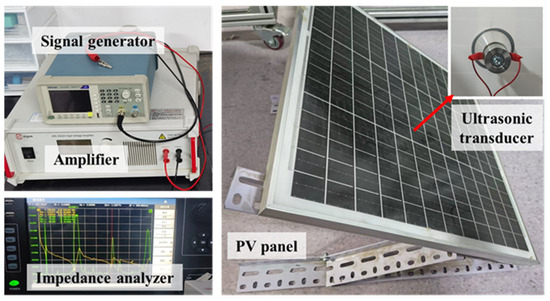
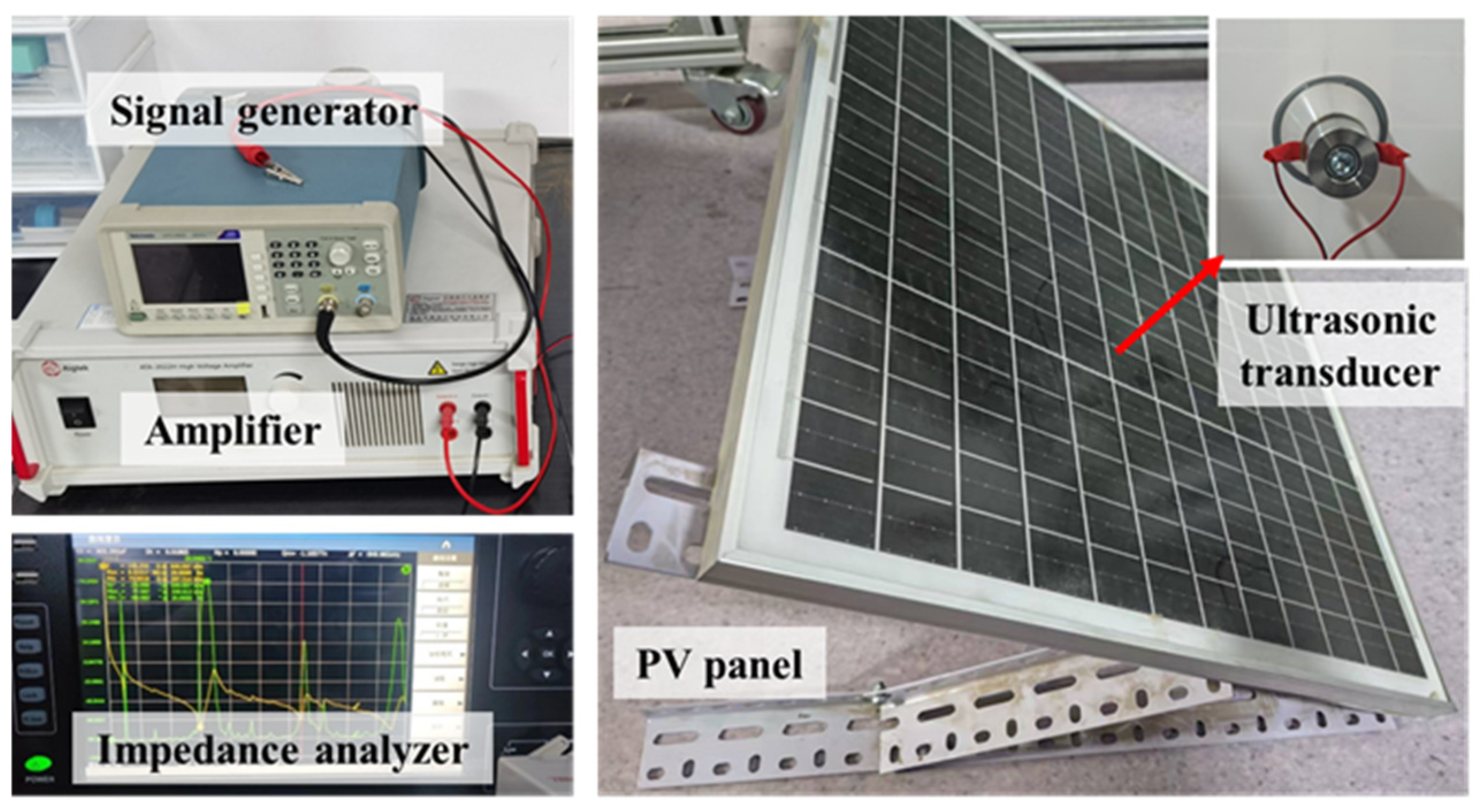
The ultrasonic vibration dust removal experimental system constructed in this study mainly consists of three parts: the PV module load, the piezoelectric driving unit, and the acoustic characteristic testing system. The schematic diagram of the device is shown in Figure 1. The experimental object is a monocrystalline silicon PV module with geometric dimensions of . Under standard test conditions (1000 W/m2, 25 °C), the tested module exhibits a short-circuit current of 8.95 A, an open-circuit voltage of 21.7 V, a peak power of 60 W, and a power tolerance of ±3%. The module was mounted on an angle-adjustable metal bracket to evaluate the effect of varying tilt angles on the dynamic sliding of dust. Except for the specific investigation of the tilt angle effect detailed in Section 3.4, the PV module was maintained at a fixed test tilt angle of 30° throughout all other experiments.
Figure 1.
Schematic diagram of the experimental setup.
To achieve efficient coupling of vibration energy, PZT-4 piezoelectric ceramics were selected as the ultrasonic transducer(PZT-4, Zibo Yuhai Electronic Ceramic Co., Ltd., Zibo, China) and bonded to the geometric center of the PV backplane using high-strength epoxy resin adhesive. Through microscopic measurement, the curing thickness of the adhesive layer was controlled within to minimize interface losses during acoustic wave transmission. The driving system uses a signal generator (AFG1022, Tektronix, Inc., Beaverton, OR, USA) to produce a 28 kHz continuous sine wave signal, which is amplified by a broadband power amplifier (ATA-2022H, Xi’an Aigtek Electronic Technology Co., Ltd., Xi’an, China) before being loaded onto the ends of the piezoelectric ceramic. This amplifier can output high-voltage AC signals of , driving the piezoelectric ceramic to generate the inverse piezoelectric effect, thereby exciting the PV panel to produce forced vibration.
Regarding the testing system, a precision impedance analyzer (TH2848, Changzhou Tonghui Electronic Co., Ltd., Changzhou, China) was used to perform a frequency sweep test on the system in the band with a step of to obtain the system’s admittance and resonance frequency.
The experimental driving voltage range was set from to . Under these conditions, the maximum electric field strength inside the piezoelectric ceramic is less than , and the temperature rise during the experiment is controlled below 50 °C, which is far below the Curie point and coercive field threshold of PZT-4, ensuring the safety and stability of device operation. The key physical parameters of the piezoelectric ceramic are detailed in Table 1.
Table 1.
The exact specifications of the PZT-4 ceramics.
2.2. Experimental Procedure and Characterization Methods
The experiments were conducted in a completely light-shielded, windless indoor environment with a constant temperature of 25 °C and a relative humidity of 30%, to eliminate the interference of natural light variations and environmental climatic factors on particle adhesion forces and photovoltaic output. The dust samples used in the experiment were collected from natural outdoor deposits. After drying, they were sieved using a 300-mesh standard sieve to ensure the particle size distribution of the experimental particles was controlled below [45]. In the dry laboratory environment, the adhesion between micron-level dust particles and the PV glass surface is dominated by van der Waals forces, with relatively small contributions from electrostatic and capillary forces.
To simulate the natural settling process, this study employed the gravity settling method to prepare PV module samples with different dust densities. A precision electronic analytical balance (FA1004, Shanghai Hengping Scientific Instrument Co., Ltd., Shanghai, China) was used to weigh the dust mass. By controlling the sieve drop amount and settling time, a uniform dust coverage layer was formed on the surface of the PV panel.
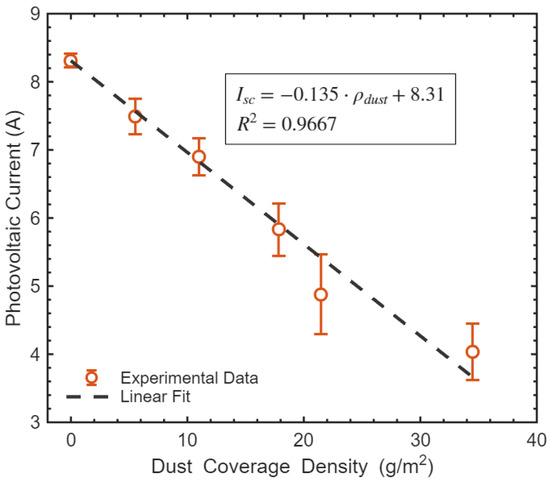
Given the difficulty of directly measuring real-time dust density on large-area PV panels, this study established a calibration curve of “Short-circuit Current Attenuation Rate—Dust Density” for indirect characterization. The short-circuit current of a PV cell has a highly linear relationship with incident light intensity, and the light transmittance of the dust layer directly determines the incident light intensity. Initially, under a constant artificial light source and a fixed tilt angle, the short-circuit current values of the PV module and the corresponding dust mass per unit area were synchronously recorded by gradually increasing the dust accumulation.
To ensure absolute consistency of irradiance during the testing process, a full-spectrum constant photographic light source (BD1600L, with a color temperature set to 5500 K) was employed to simulate sunlight. The light source was positioned directly above the PV module, approximately 1.5 m away from the panel center along the normal direction of the PV panel plane. Under this optical path arrangement, irradiance calibration was performed using a portable solar power meter (LS122, Shenzhen Linshang Technology Co., Ltd., Shenzhen, China) at 9 measurement points uniformly selected on the PV panel surface. The calibration results showed a relatively uniform irradiance distribution across all measurement points, and the average irradiance reaching the panel surface remained stable at 850 W/m2. Under the same illumination conditions, to capture the dynamic variations of the short-circuit current during the dust removal process, a high-precision digital multimeter (Fluke 17B+, Fluke Corporation, Everett, WA, USA) was connected directly in series to the output circuit of the PV module for real-time reading.
The calibration data are presented in Table 2. Through linear fitting using the least squares method, the results indicate that the short-circuit current of the PV module exhibits a monotonic linear downward trend with the increase of dust density, as illustrated in Figure 2. The linear fitting equation is , with a coefficient of determination . Based on this linear relationship, the current surface dust density can be inverted by monitoring the short-circuit current value of the PV module in real-time during the experiment, thereby achieving quantitative evaluation of the dust removal effect.
Table 2.
Dust density corresponding to different short-circuit currents.
Figure 2.
Relationship between dust coverage density and short-circuit current.
2.3. Uncertainty Analysis
The uncertainty of this experiment mainly stems from the measurement errors of the instruments themselves and the propagation errors during data processing. Major directly measured parameters include driving voltage, excitation frequency, PV current, and dust mass, with uncertainties determined by the instrument accuracy specifications, as listed in Table 3.
Table 3.
Experimental parameter measurement range and uncertainty.
Since the current is the core indicator for characterizing the dust removal effect and inverting dust density, its measurement accuracy is crucial. Based on the law of error propagation , and comprehensively considering instrument systematic errors and random environmental interference, the calculated combined expanded uncertainty of the PV short-circuit current is approximately , satisfying the experimental accuracy requirements. Furthermore, regarding the measurement of dust density, although the weighing accuracy of the electronic balance is extremely high, the uncertainty in actual dust accumulation experiments mainly comes from the uniformity of manual scattering and the boundary effects of the sampling area. According to the repeatability tests of this experiment, the combined measurement uncertainty of dust areal density is controlled within . In summary, the measurement uncertainties of various key parameters in this experimental system are controlled within a reasonable range, and the data results possess good credibility.
3. Results and Discussion
3.1. Determination of the Optimal Excitation Frequency and Microscopic Safety Assessment of the Module
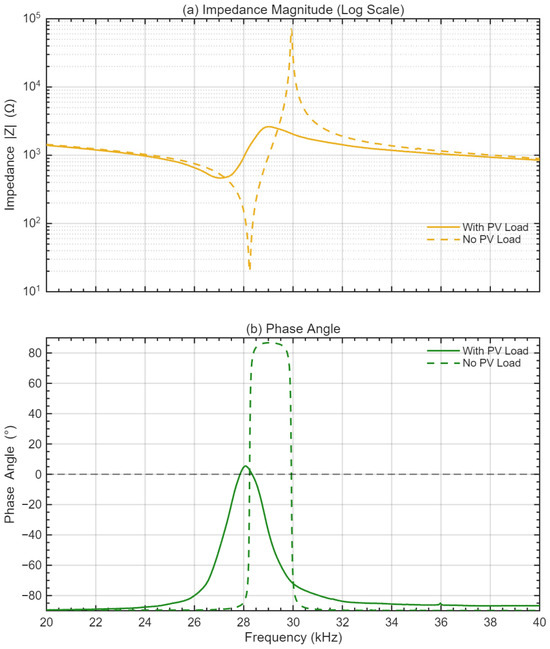
To investigate the effect of the PV module as an acoustic load on the transducer’s performance, this section comparatively analyzes the impedance and phase spectra of the piezoelectric transducer under two conditions: an unloaded free state and a loaded state when bonded to the back of the PV panel. As shown in Figure 3, where the solid and dashed lines represent the loaded and unloaded states respectively, the introduction of the PV panel load significantly alters the vibration mode of the transducer, shifting it from a single, sharp resonance in the unloaded state to a gentle waveform characteristic in the loaded state. This phenomenon is attributed to the fact that the PV panel, acting as a large-scale elastic thin plate, possesses dense natural frequency modes. The transducer excites multiple bending vibration modes on the plate. Simultaneously, the flattening of the impedance peak under the loaded state indicates a significant decrease in the mechanical quality factor of the system. Moreover, in the phase angle spectra, the curve operates close to the 0° reference line, confirming a quasi-series resonance state. These spectral characteristics reflect that the PV panel introduces substantial acoustic radiation impedance and structural damping, allowing the vibration energy of the piezoelectric ceramics to be effectively transferred and dissipated into the PV panel structure, thereby achieving the desired energy coupling for dust removal.
Figure 3.
Impedance and phase angle curves under different loading conditions: (a) impedance magnitude; (b) phase angle spectra.
Based on the frequency sweep analysis and optimal dust removal performance, 28 kHz was selected as the optimal working frequency for the system. At this frequency, the impedance analyzer measured the system’s impedance magnitude as with a phase angle of . The minimal phase angle indicates that the system is in a quasi-series resonance state, appearing almost purely resistive overall, which is highly beneficial for the energy conversion process of the high-power ultrasonic power supply. At this point, the system’s power factor reaches as high as , meaning the vast majority of the input electrical energy is converted into active power.
Compared to the extremely low resonant impedance in the unloaded state, the impedance under the loaded state increases significantly to 933 ohms, further confirming that most of the vibration energy is effectively absorbed by the PV panel load. Calculations show that the active power of the system under typical driving voltages is only about 10.68 W. In summary, the system achieves excellent impedance matching and efficient electromechanical energy conversion at the 28 kHz frequency, capable of driving a large-area PV panel to generate sufficient acceleration for dust removal with low electrical power consumption, thereby validating the design goals of low energy consumption and high efficiency.
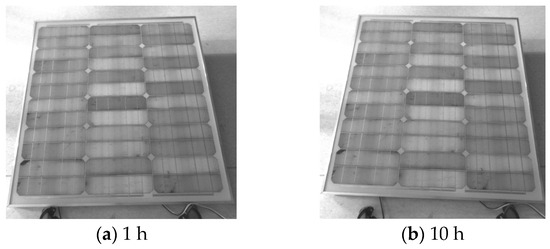
To further verify the structural safety of the PV module under this optimal working frequency and typical high-power states during ultrasonic vibration, this study employed electroluminescence (EL) imaging technology for non-destructive testing of the module’s internal micro-structure. Using the EL image of the original, un-intervened module as a baseline, the module was subjected to continuous ultrasonic excitation at the maximum design power for up to 10 h, a process equivalent to the stress accumulation of over 200 conventional working cycles (results shown in Figure 4). Note that the slight brightness variations among individual solar cell segments represent the inherent luminescent characteristics of the commercial module, rather than induced defects. The post-experiment EL images reveal that even in the area directly beneath the piezoelectric transducer, where stress is most concentrated, the busbars and fingers of the solar cells maintained extremely high continuity, with no observable dendritic fatigue cracks or proliferation of local dead zones. The analysis suggests that the high-frequency alternating stress at the micrometer scale induced by the ultrasound is far below the brittle fracture threshold of the silicon wafers. Additionally, this may be attributed to the excellent viscoelastic damping and buffering effect of the EVA encapsulant, which dissipates the majority of the vertical vibration energy. This fully demonstrates that the proposed ultrasonic dust removal technology possesses long-term structural stability while achieving highly efficient cleaning.
Figure 4.
Comparison of EL images after ultrasonic excitation at 150 V for different durations: (a) after 1 h of excitation; (b) after 10 h of continuous excitation.
3.2. Effect of Driving Voltage
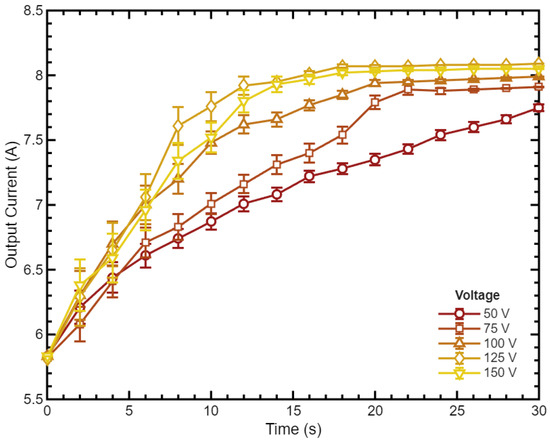
After determining the optimal resonant frequency of the system as 28 kHz, the driving voltage, as the critical variable directly determining the output amplitude of the piezoelectric transducer, plays a decisive role in the dust removal performance. In this section, under the conditions of a fixed PV module tilt angle of 30°, a consistent initial dust coverage density, and an initial short-circuit current controlled at , the dust removal response characteristics of five driving voltage groups ranging from 50 V to 150 V were investigated. To quantify the dust removal effect, the short-circuit current recovery rate was introduced as an evaluation index, using the short-circuit current of a clean PV panel without dust (8.31 A) as the baseline reference.
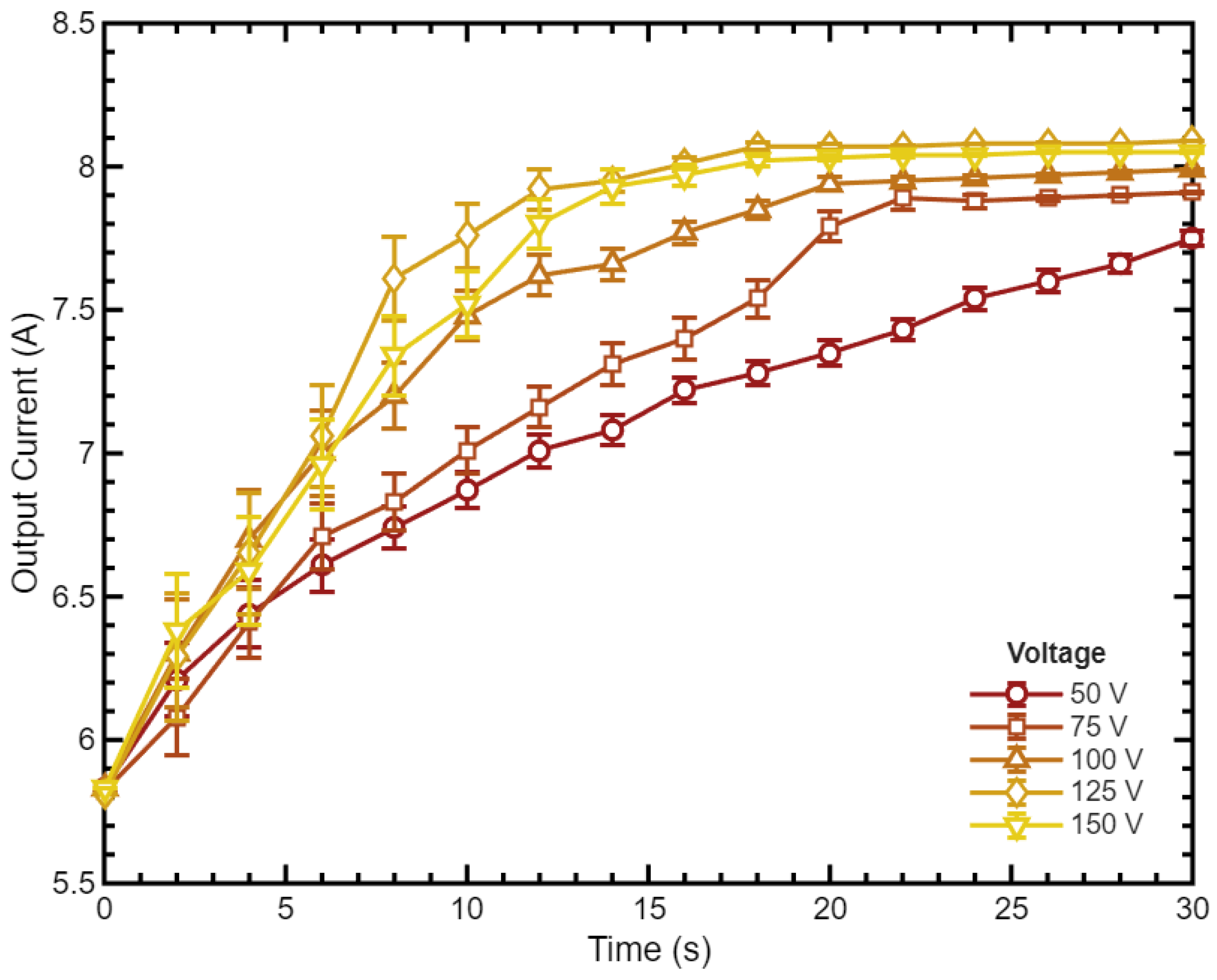
The experimental results, as shown in Figure 5, indicate that the short-circuit current of the PV module exhibits a significant upward trend as the dust removal time progresses. Once the ultrasonic excitation is initiated, the short-circuit currents for all voltage groups achieve a rapid climb within 30 s, indicating that high-frequency vibration effectively disrupts the van der Waals forces and capillary adhesion forces between the dust particles and the glass surface. Specifically, a clear positive correlation exists between the driving voltage and the dust removal rate: when the driving voltage is only 50 V, the current recovery curve is relatively flat, and complete dust removal takes approximately 30 s; when the voltage is increased to 125 V, the slope of the curve increases significantly, and the dust removal time is drastically reduced to 18 s. This occurs because the inverse piezoelectric effect of the piezoceramics dictates that the mechanical strain generated by the structure is proportional to the applied electric field intensity; higher driving voltages excite greater substrate vibration acceleration, enabling dust particles across a broader range of sizes to instantaneously acquire sufficient inertial force to overcome adhesion.
Figure 5.
Variation curves of the short-circuit current recovery rate of the PV module over time under different driving voltages.
However, the experiments also revealed a saturation phenomenon in the dust removal efficiency. As shown in Figure 6, when the driving voltage is further increased from 125 V to 150 V, the final recovery rate reaches approximately 97.5% without any significant further improvement, and the reduction in dust removal time also tends to stagnate. The physical mechanism underlying this threshold effect mainly involves two aspects. First, the macroscopic sliding of dust particles relies primarily on the tangential component of gravity after vibration-induced decoupling; once the vibration acceleration is sufficient to “suspend” or “loosen” the vast majority of particles, further increasing the amplitude does not change the terminal velocity of the particles sliding down the inclined plane. Second, the piezoelectric transducer exhibits non-linear losses and thermal effects under high-power driving. Excessively high voltages can lead to a decrease in electromechanical conversion efficiency and even cause an increase in structural damping, thereby limiting the transfer of effective vibration energy to the edges of the PV panel.
Figure 6.
Visual effects of vibration dust removal for 50 s under different driving voltages.
Comparing the final dust removal morphology under different voltages reveals that under 50 V low-voltage driving, noticeable patchy dust residues remain at the edges of the panel and at the nodal positions, corresponding to insufficient energy in the displacement node areas of standing wave vibrations. As the voltage is elevated above 100 V, this non-uniformity is significantly improved. Considering both the energy efficiency ratio and cleaning thoroughness, the 100–125 V interval is the optimal engineering application voltage for this system. Within this range, the system guarantees a current recovery rate exceeding 97% while avoiding additional power consumption and overheating issues caused by over-voltage driving, achieving an optimal balance between dust removal efficiency and system energy consumption.
3.3. Effect of Dust Density on Dust Removal Characteristics
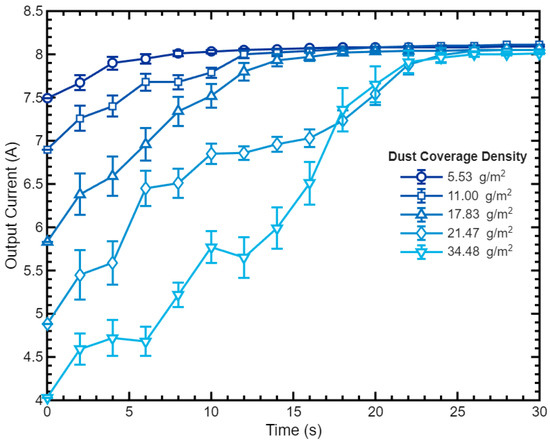
In the actual operation and maintenance scenarios of PV plants, varying cleaning cycles lead to vastly different degrees of dust accumulation on the surfaces of PV modules. To explore the impact of dust loads on the boundary conditions of the ultrasonic dust removal system, five groups of samples with different dust accumulation densities were prepared under the conditions of a fixed driving voltage of 150 V and a 30° tilt angle. The initial dust densities corresponded to a variation range in the PV short-circuit current from 7.46 A to 4.03 A; after conversion, the actual dust coverage density ranged from light soiling (5.53 g/m2) to heavy soiling (34.48 g/m2), representing typical operating conditions.
Figure 7 records the dynamic response process of the short-circuit current of the PV module over vibration time under different dust accumulation densities. Analyzing the evolution of the short-circuit current vs. dust removal time curves reveals that an increase in dust density exerts a significant retarding effect on the dust removal dynamics. Under the 5.53 g/m2 density condition, the dust removal process exhibits a “step-like” response, completing surface cleaning in only about 6 s, with the current rapidly returning to a stable value. However, as the dust density increases to 34.48 g/m2, the time required to achieve the same level of cleanliness is non-linearly extended to over 26 s, and the rising edge of the curve becomes noticeably gentler.
Figure 7.
Short-circuit current vs. dust removal time curves under different dust coverage densities.
The underlying physical mechanism for this phenomenon lies in the dissipation of ultrasonic energy by the thick dust layer. Firstly, a high-density dust accumulation layer no longer acts as a single-layer particle model. When ultrasonic waves propagate through the PV glass substrate and couple to the surface, intense friction and collisions between particles within the thick dust layer consume a substantial amount of vibration energy. This results in the attenuation of the effective acceleration transmitted to the top-layer particles, an effect that is particularly pronounced under heavy soiling. Secondly, high-density dust causes detached particles to undergo frequent secondary collisions and agglomeration during the sliding process. As depicted by the morphological changes in Figure 8, some dust particles that have detached from the surface experience kinetic energy loss during transport, leading to “secondary settling.” They must undergo multiple cycles of “initiation-settling-re-initiation” before eventually moving off the panel area.
Figure 8.
Visual effects of dust removal for 20 s under different dust coverage densities.
Although high-density dust prolongs the cleaning cycle, the final results indicate that after 35 s of continuous vibration, the short-circuit currents for all experimental groups recovered to above 8.0 A. This demonstrates that the system possesses strong load robustness to various dust coverage conditions. Even with severe dust accumulation, given sufficient vibration time, the standing wave field generated by the ultrasound can still progressively eliminate the inter-layer adhesion forces within the dust. It is worth noting that experimental data indicate a slight decrease in dust removal efficiency as dust density increases. This suggests that in engineering applications, the trigger threshold should be reasonably set based on dust accumulation rate monitoring data, avoiding situations where excessively thick dust leads to high single-cleaning energy consumption or incomplete cleaning, thereby optimizing the lifecycle operation and maintenance strategy.
3.4. Effect of Tilt Angle
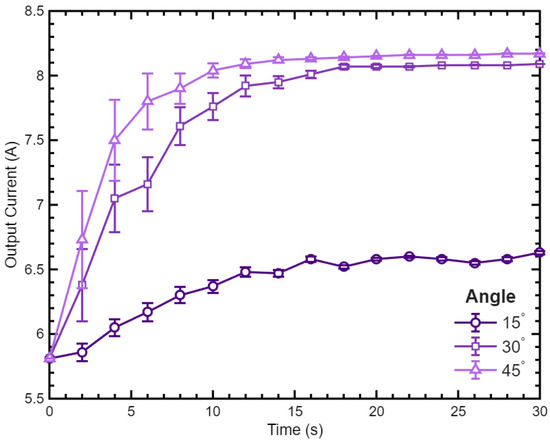
The installation tilt angle of a PV module not only determines the energy density of the solar radiation it receives but also serves as the critical geometric parameter dictating whether dust particles can be macroscopically removed during dry ultrasonic vibration cleaning. In this section, while keeping the driving voltage and initial dust density constant (initial current approximately 5.83 A), the dust removal dynamic behaviors under three typical engineering tilt angles of 15°, 30°, and 45° were systematically compared. The total dust removal time was set to 40 s, with a focus on observing the macroscopic transport trajectories of the particles and their final residual distribution.
The experimental results, as shown in Figure 9, demonstrate that changes in the tilt angle exert a non-linear regulatory effect on the dust removal rate and final cleanliness. Under the large tilt angle condition of 45°, the system exhibited optimal cleaning efficacy: just 5 s after activation, the upper region of the panel exposed the clean glass substrate; within 10 s, the majority of the dust was cleared, yielding a final current recovery rate as high as 98.5%. The 30° tilt angle condition ranked second, requiring 20 s to complete primary dust removal, with a final recovery rate of 97.5%. In contrast, the dust removal performance under the small 15° tilt angle deteriorated significantly; even when the vibration time was extended to 120 s, an obvious dust retention band remained in the lower half of the panel, and the final current recovery rate was only 81%.
Figure 9.
Short-circuit current vs. dust removal time curves under different tilt angles.
Analyzed from a mechanical perspective, ultrasonic vibration dust removal is essentially a synergistic process of vibration-induced decoupling and gravity-driven transport. The standing wave field excited by the piezoelectric transducer primarily provides an acceleration perpendicular to the panel, which is used to break van der Waals forces and other interfacial adhesion forces, causing particles to enter a bouncing and suspended state off the surface. However, the core driving force for particles falling along the panel originates from the tangential component of gravity acting down the slope. When the tilt angle decreases from 45° to 15°, this tangential driving force is drastically weakened. For instance, the curve under the 15° condition not only rises slowly but also exhibits fluctuations or slight declines during certain periods. This occurs because, at small tilt angles, although the particles detach from their original adhesion sites, the lack of sufficient downward sliding momentum causes a massive amount of dust to slowly slide towards the bottom under gravity and accumulate at the module frame. This localized accumulation deteriorates the light transmittance at the bottom of the solar cells. Since PV modules are typically connected in series, the effect triggered by localized shading drags down the overall short-circuit current.
In conclusion, a larger installation tilt angle can effectively suppress the secondary accumulation of dust during the vibration process, significantly enhancing the efficiency of a single cleaning cycle. However, in actual PV plant design, the selection of the tilt angle must also balance the local latitude to maximize the annual solar radiation yield.
3.5. Field Testing and Discussion on Application Limitations
To evaluate the scalability and economic feasibility of the proposed ultrasonic cleaning method under real-world conditions, preliminary field qualitative tests were conducted on commercial large-area PV modules measuring 2.3 m × 1.1 m. To accommodate the large panel size, two ultrasonic transducers were installed at the 1/3 and 2/3 positions of the long edge (along the centerline of the short edge), and dust was artificially and evenly distributed to simulate soiling conditions. In terms of hardware, customized, low-cost piezoelectric driving circuit boards and control boxes were used in the field tests, replacing high-cost laboratory instruments. A single control box can simultaneously drive 26 series-connected PV modules (totaling 52 transducers). Compared to traditional cleaning methods, this system features no mechanical wear parts, low operating power consumption (~10 W per panel), and zero water consumption, presenting a certain cost advantage in arid, water-scarce regions.
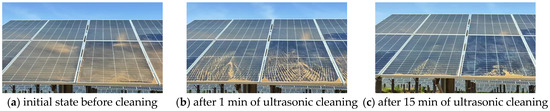
During the dynamic dust removal process, a sequential control strategy was adopted. As shown in Figure 10a, a uniform dust layer covered the surface before startup; when the upper transducer was activated first, the dust on the panel rapidly exhibited a macroscopic standing wave distribution pattern (as shown in Figure 10b), where particles were driven away from the antinodes to gather at the displacement nodes, subsequently forming a continuous sliding band along the inclined plane under gravity. Subsequently, when the lower transducer was activated, the residual dust trapped at the previous standing wave nodes underwent secondary sliding and detachment, achieving effective cleaning of the main panel area (as shown in Figure 10c). This indicates that spatial sequential excitation via multiple transducers can effectively alter the distribution of standing wave nodes, facilitating the removal of dust in blind spots.
Figure 10.
Dynamic process of field ultrasonic dust removal on a large-size commercial PV module using multiple transducers.
However, due to the inherent attenuation of high-frequency mechanical waves propagating across large-area panels, a small amount of residual dust may still exist at the edges and localized areas of the cleaned panel. Future engineering applications need to further optimize the spatial topology of the multi-transducer array, supplemented by phase synchronization and dynamic frequency sweeping strategies, to achieve continuous migration of standing wave nodes for thorough, large-area dust removal.
Furthermore, in actual outdoor environments, this technology faces other limitations. The first is the impact of sticky contaminants. Under real conditions, condensation or light rain mixes with accumulated dust to form viscous mud, significantly increasing the capillary and adhesion forces between the particles and the panel, thereby weakening the dry vibration cleaning effect. To mitigate this issue, preventive cleaning can be performed prior to condensation based on meteorological warnings; alternatively, a hydrophobic anti-soiling coating can be applied to the module surface to form a synergistic dust removal mechanism.
Secondly, the long-term reliability of the system in variable environments requires further verification. Cyclic thermal stress caused by thermal expansion and contraction may lead to fatigue embrittlement or debonding of the adhesive layer between the transducer and the backsheet, thus blocking acoustic wave transmission; prolonged high temperature and humidity may also cause degradation of the polarization characteristics of the piezoelectric ceramics. Therefore, industrial-grade weather-resistant structural adhesives should be used for encapsulation in engineering applications, and it is recommended to integrate an online impedance monitoring module into the control unit. By periodically scanning the impedance spectrum characteristics, potential risks such as debonding or performance degradation can be identified in advance to achieve predictive maintenance.
4. Conclusions and Recommendations
Addressing the issue of decreased power generation efficiency caused by dust accumulation on photovoltaic (PV) module surfaces, this study proposed a dry dust removal method utilizing low-frequency ultrasonic vibration excited by piezoceramics. Combining experiments with simulations, this study systematically investigated the influence of ultrasonic vibration propagation mechanisms, key operating parameters, and environmental parameters on dust removal characteristics and conducted impedance and energy consumption analyses. The main conclusions are as follows:
(1) Highly efficient, low-energy, waterless dust removal was achieved. The system excites a stable standing wave field at the optimally matched frequency (28 kHz), utilizing inertial force to achieve dust detachment. Under optimal conditions, the short-circuit current recovery rate of the PV module exceeds 97%, and the typical active power consumption is only about 10.68 W, verifying its high-efficiency advantage for maintaining power generation performance in water-scarce regions.
(2) Driving voltage and dust density significantly affect the dust removal rate. As the driving voltage increases (from 50 V to 125 V), the dust removal speed accelerates and tends to saturate. Conversely, high-density dust accumulation (e.g., 34.48 g/m2) exhibits a pronounced energy dissipation effect that substantially attenuates the surface amplitude, increasing the required clearance time to roughly four times that of low-density dust accumulation.
(3) The installation tilt angle dictates the transport trajectory of detached particles. The tangential component of gravity at tilt angles of 30° and 45° effectively assists the ultrasonic vibration, allowing detached dust to slide off rapidly. In contrast, at a smaller tilt angle of 15°, insufficient gravitational sliding force causes dust to be prone to “secondary accumulation” at the module edges, limiting the overall dust removal efficiency.
(4) The system demonstrates excellent microscopic safety and long-term stability. Continuous fatigue tests using electroluminescence (EL) imaging confirmed that after ultrasonic excitation equivalent to over 200 operational cycles, no microscopic micro-cracks initiated inside the solar cells.
It should also be noted that while this study experimentally verified the effectiveness of dry ultrasonic vibration dust removal technology, its potential limitations in practical applications must be pointed out. First, the fatigue durability of the coupling layer between the piezoceramics and the backsheet under long-term high-frequency vibration and outdoor temperature variations requires extended observation. Second, this experiment employed a single-center transducer excitation scheme; for larger-sized PV modules, a single vibration source may fail to cover the edge regions, leading to uneven cleaning. Furthermore, current experiments primarily target dry, loose dust; for sticky mud stains formed in high-humidity outdoor environments, the effectiveness of relying solely on vibration for dust removal may be restricted.
Future research will focus on exploring the corresponding relationship between PV panel sizes and optimal transducer array layouts, expanding the effective dust removal area through synergistic excitation from multiple vibration sources. Simultaneously, mixed cleaning strategies will be explored, such as combining ultrasonic vibration with anti-soiling coatings to further reduce dust adhesion and mitigate secondary accumulation issues by lowering surface energy. Subsequent work will involve field tests at actual PV plants to comprehensively evaluate the impact of wind speed, ambient humidity, and dust composition on the long-term operational stability of the system.
Author Contributions
Conceptualization, Y.W. and T.G.; methodology, Y.W.; software, Y.W. and M.J.; validation, X.X. and Z.S.; formal analysis, Y.W. and M.J.; investigation, Y.W. and M.J.; resources, T.G., J.G., X.X. and Z.S.; data curation, M.J.; writing—original draft preparation, Y.W.; writing—review and editing, T.G. and J.G.; visualization, Y.W. and M.J.; supervision, T.G. and J.G.; project administration, T.G.; funding acquisition, T.G., X.X. and Z.S. All authors have read and agreed to the published version of the manuscript.
Funding
Thermal Power Research Institute: TM-25-TYK02.
Institutional Review Board Statement
Not applicable.
Informed Consent Statement
Not applicable.
Data Availability Statement
The data presented in this study are available upon request from the corresponding author.
Conflicts of Interest
Authors Xiaojun Xie and Zichen Song are employees of Xi’an Thermal Power Research Institute Co., Ltd. The funding sponsors had no role in the design of the study; in the collection, analyses, or interpretation of data; in the writing of the manuscript; or in the decision to publish the results. The authors declare no conflicts of interest.
References
- Wan, L.; Zhao, L.; Xu, W.; Guo, F.; Jiang, X. Dust deposition on the photovoltaic panel: A comprehensive survey on mechanisms, effects, mathematical modeling, cleaning methods, and monitoring systems. Sol. Energy 2024, 268, 112300. [Google Scholar] [CrossRef] [Scilit]
- He, B.; Lu, H.; Zheng, C.; Wang, Y. Characteristics and cleaning methods of dust deposition on solar photovoltaic modules-A review. Energy 2023, 263, 126083. [Google Scholar] [CrossRef] [Scilit]
- Song, Z.; Liu, J.; Yang, H. Air pollution and soiling implications for solar photovoltaic power generation: A comprehensive review. Appl. Energy 2021, 298, 117247. [Google Scholar] [CrossRef] [Scilit]
- Zhao, W.; Lv, Y.; Wei, Z.; Yan, W.; Zhou, Q. Review on dust deposition and cleaning methods for solar PV modules. J. Renew. Sustain. Energy 2021, 13, 032701. [Google Scholar] [CrossRef] [Scilit]
- Dhaouadi, R.; Al-Othman, A.; Aidan, A.A.; Tawalbeh, M.; Zannerni, R. A characterization study for the properties of dust particles collected on photovoltaic (PV) panels in Sharjah, United Arab Emirates. Renew. Energy 2021, 171, 133–140. [Google Scholar] [CrossRef] [Scilit]
- Adinoyi, M.J.; Said, S.A.M. Effect of dust accumulation on the power outputs of solar photovoltaic modules. Renew. Energy 2013, 60, 633–636. [Google Scholar] [CrossRef] [Scilit]
- Kazmerski, L.L.; Diniz, A.S.A.C.; Maia, C.B.; Viana, M.M.; Costa, S.C.S.; Brito, P.P.; Campos, C.D.; Neto, L.V.M.; de Morais Hanriot, S.; de Oliveira Cruz, L.R. Fundamental Studies of Adhesion of Dust to PV Module Surfaces: Chemical and Physical Relationships at the Microscale. IEEE J. Photovolt. 2016, 6, 719–729. [Google Scholar] [CrossRef] [Scilit]
- Salamah, T.; Ramahi, A.; Alamara, K.; Juaidi, A.; Abdallah, R.; Abdelkareem, M.A.; Amer, E.-C.; Olabi, A.G. Effect of dust and methods of cleaning on the performance of solar PV module for different climate regions: Comprehensive review. Sci. Total Environ. 2022, 827, 154050. [Google Scholar] [CrossRef] [Scilit] [PubMed]
- Majeed, R.; Waqas, A.; Sami, H.; Ali, M.; Shahzad, N. Experimental investigation of soiling losses and a novel cost-effective cleaning system for PV modules. Sol. Energy 2020, 201, 298–306. [Google Scholar] [CrossRef] [Scilit]
- Farrokhi Derakhshandeh, J.; AlLuqman, R.; Mohammad, S.; AlHussain, H.; AlHendi, G.; AlEid, D.; Ahmad, Z. A comprehensive review of automatic cleaning systems of solar panels. Sustain. Energy Technol. Assess. 2021, 47, 101518. [Google Scholar] [CrossRef] [Scilit]
- Jadhao, M.; Patane, P.; Nadgire, A.; Utage, A. A Study on Impact of Various Solar Panel Cleaning Methods on Its Performance. In Recent Advances in Materials and Modern Manufacturing; Springer: Singapore, 2022; pp. 839–857. [Google Scholar] [CrossRef] [Scilit]
- Zhang, C.; Ma, Y.; Mi, Z.; Yang, F.; Zhang, L. A rolling-horizon cleaning recommendation system for dust removal of industrial PV panels. Appl. Energy 2024, 353, 122168. [Google Scholar] [CrossRef] [Scilit]
- Fan, S.; Liang, W.; Wang, G.; Zhang, Y.; Cao, S. A novel water-free cleaning robot for dust removal from distributed photovoltaic (PV) in water-scarce areas. Sol. Energy 2022, 241, 553–563. [Google Scholar] [CrossRef] [Scilit]
- Lu, H.; Zheng, C. Comparison of Dust Deposition Reduction Performance by Super-Hydrophobic and Super-Hydrophilic Coatings for Solar PV Cells. Coatings 2022, 12, 502. [Google Scholar] [CrossRef] [Scilit]
- Wang, F.; Han, X.; Wang, Z.; Yang, W. Dust removal by water spray, condensation and defrosting based on superhydrophobic fin surface. Energy 2024, 304, 132162. [Google Scholar] [CrossRef] [Scilit]
- Shah, A.H.; Alraeesi, A.; Hassan, A.; Laghari, M.S. A Novel Photovoltaic Panel Cleaning and Cooling Approach through Air Conditioner Condensate Water. Sustainability 2023, 15, 15431. [Google Scholar] [CrossRef] [Scilit]
- Boeing, A.; Neda, M.; Steinberg, S.; Batista, J. The impact of lower quality water on soiling removal from photovoltaic panels. Renew. Sustain. Energy Rev. 2022, 169, 112870. [Google Scholar] [CrossRef] [Scilit]
- Li, D.; King, M.; Dooner, M.; Guo, S.; Wang, J. Study on the cleaning and cooling of solar photovoltaic panels using compressed airflow. Sol. Energy 2021, 221, 433–444. [Google Scholar] [CrossRef] [Scilit]
- Parrott, B.; Carrasco Zanini, P.; Shehri, A.; Kotsovos, K.; Gereige, I. Automated, robotic dry-cleaning of solar panels in Thuwal, Saudi Arabia using a silicone rubber brush. Sol. Energy 2018, 171, 526–533. [Google Scholar] [CrossRef] [Scilit]
- Essam, M.; Abdelaziz, M. A Sustainable Waterless Cleaning Approach for Solar Panels: Influence of Tilt Angle, Coating, and Vibrational Mechanics. In Proceedings of the 2025 IEEE PES/IAS Power Africa, Cairo, Egypt, 28 September–2 October 2025; pp. 1–6. [Google Scholar] [CrossRef] [Scilit]
- Li, H.; Liu, Y.; Li, L.; Yin, X.; Wu, X. New anhydrous de-dusting method for photovoltaic panels using electrostatic adsorption: From the mechanism to experiments. Energy Convers. Manag. 2024, 308, 118399. [Google Scholar] [CrossRef] [Scilit]
- Panat, S.; Varanasi, K.K. Electrostatic dust removal using adsorbed moisture–assisted charge induction for sustainable operation of solar panels. Sci. Adv. 2022, 8, eabm0078. [Google Scholar] [CrossRef] [Scilit] [PubMed]
- Sun, D.; Böhringer, K.F. An active self-cleaning surface system for photovoltaic modules using anisotropic ratchet conveyors and mechanical vibration. Microsyst. Nanoeng. 2020, 6, 87. [Google Scholar] [CrossRef] [Scilit] [PubMed]
- Ragesh, P.; Ganesh, V.A.; Nair, S.V.; Nair, A.S. A review on ‘self-cleaning and multifunctional materials’. J. Mater. Chem. A 2014, 2, 14773–14797. [Google Scholar] [CrossRef] [Scilit]
- Yang, Y.; Zhuang, D.; Ding, G. Effect of surface wettability of fins on dust removal by condensate water. Int. J. Heat Mass Transf. 2019, 130, 1260–1271. [Google Scholar] [CrossRef] [Scilit]
- Salari, A.; Hakkaki-Fard, A. A numerical study of dust deposition effects on photovoltaic modules and photovoltaic-thermal systems. Renew. Energy 2019, 135, 437–449. [Google Scholar] [CrossRef] [Scilit]
- Jones, R.K.; Baras, A.; Saeeri, A.A.; Al Qahtani, A.; Al Amoudi, A.O.; Al Shaya, Y.; Alodan, M.; Al-Hsaien, S.A. Optimized Cleaning Cost and Schedule Based on Observed Soiling Conditions for Photovoltaic Plants in Central Saudi Arabia. IEEE J. Photovolt. 2016, 6, 730–738. [Google Scholar] [CrossRef] [Scilit]
- Zhou, S.; Yang, Y.; Shang, H. Adhesion Behavior of Underground Coal Dust with Fused Silica: Effects of Relative Humidity and Particle Size. Processes 2024, 12, 735. [Google Scholar] [CrossRef] [Scilit]
- Chen, E.Y.-T.; Ma, L.; Yue, Y.; Guo, B.; Liang, H. Measurement of dust sweeping force for cleaning solar panels. Sol. Energy Mater. Sol. Cells 2018, 179, 247–253. [Google Scholar] [CrossRef] [Scilit]
- Zhang, D.; Yan, C.; Bai, J.; Yu, K.; Zhang, J.; Ji, J.; An, Z. Optimization analysis of droplet dust removal mass on tilted superhydrophobic surface based on regulating PV tilt angle and drop height. Sol. Energy 2023, 265, 112077. [Google Scholar] [CrossRef] [Scilit]
- Wheatstone, C. XXV. On the figures obtained by strewing sand on vibrating surfaces, commonly called acoustic figures. Philos. Trans. R. Soc. Lond. 1833, 123, 593–633. [Google Scholar] [CrossRef] [Scilit]
- Tan, C.L.C.; Gao, S.; Wee, B.S.; Asa-Awuku, A.; Thio, B.J.R. Adhesion of Dust Particles to Common Indoor Surfaces in an Air-Conditioned Environment. Aerosol Sci. Technol. 2014, 48, 541–551. [Google Scholar] [CrossRef] [Scilit]
- Dan, Z.; Mingzhi, Z. Experimental Research on Influencing Factors of Surface Friction Coefficient of Solar PV Panels. IOP Conf. Ser. Earth Environ. Sci. 2018, 146, 012038. [Google Scholar] [CrossRef] [Scilit]
- Alagoz, S.; Apak, Y. Removal of spoiling materials from solar panel surfaces by applying surface acoustic waves. J. Clean. Prod. 2020, 253, 119992. [Google Scholar] [CrossRef] [Scilit]
- Attia, O.H.; Adam, N.M.; As’arry, A.; Md Rezali, K.A. Removal of Dust from the Solar Panel Surface using Mechanical Vibrator. J. Phys. Conf. Ser. 2019, 1262, 012021. [Google Scholar] [CrossRef] [Scilit]
- Abubakar, A.A.; Yilbas, B.S.; Al-Qahtani, H.; Alzaydi, A.; Alhelou, S. Environmental dust repelling from hydrophobic and hydrophilic surfaces under vibrational excitation. Sci. Rep. 2020, 10, 14346. [Google Scholar] [CrossRef] [Scilit] [PubMed]
- Ji, R.; Pflieger, R.; Virot, M.; Nikitenko, S.I. Multibubble sonochemistry and sonoluminescence at 100 kHz: The missing link between low-and high-frequency ultrasound. J. Phys. Chem. B 2018, 122, 6989–6994. [Google Scholar] [CrossRef] [Scilit]
- Vasiljev, P.; Borodinas, S.; Bareikis, R.; Struckas, A. Ultrasonic system for solar panel cleaning. Sens. Actuators A Phys. 2013, 200, 74–78. [Google Scholar] [CrossRef] [Scilit]
- Cho, H.; Woo, J.; Park, J.; Lee, J.; Cho, S. Dust removal on solar panels of exploration rovers using Chladni patterns. Sci. Rep. 2025, 15, 1814. [Google Scholar] [CrossRef] [Scilit]
- Zhou, Q.; Sariola, V.; Latifi, K.; Liimatainen, V. Controlling the motion of multiple objects on a Chladni plate. Nat. Commun. 2016, 7, 12764. [Google Scholar] [CrossRef] [Scilit]
- Latifi, K. Motion of Heavy Particles on a Submerged Chladni Plate. Phys. Rev. Lett. 2019, 122, 184301. [Google Scholar] [CrossRef] [Scilit]
- Van Gerner, H.J.; Van Der Weele, K.; Van Der Hoef, M.A.; Van Der Meer, D. Air-induced inverse Chladni patterns. J. Fluid Mech. 2011, 689, 203–220. [Google Scholar] [CrossRef] [Scilit]
- Hassan, G.; Yilbas, B.S.; Bahatab, S.; Al-Sharafi, A.; Al-Qahtani, H. A water droplet-cleaning of a dusty hydrophobic surface: Influence of dust layer thickness on droplet dynamics. Sci. Rep. 2020, 10, 14746. [Google Scholar] [CrossRef] [Scilit]
- Wang, Y.; Gong, J.; Gao, T.; Li, X.; Wu, X. Ultrasound-driven droplet transport: A novel dust removal strategy for optical surfaces. Sol. Energy 2025, 296, 113559. [Google Scholar] [CrossRef] [Scilit]
- Kazem, H.A.; Al-Waeli, A.H.A.; Chaichan, M.T.; Sopian, K.; Gholami, A.; Alnaser, W.E. Dust and cleaning impact on the performance of photovoltaic: An outdoor experimental study. Energy Sources Part A Recovery Util. Environ. Eff. 2023, 45, 3107–3124. [Google Scholar] [CrossRef] [Scilit]










Disclaimer/Publisher’s Note: The statements, opinions and data contained in all publications are solely those of the individual author(s) and contributor(s) and not of MDPI and/or the editor(s). MDPI and/or the editor(s) disclaim responsibility for any injury to people or property resulting from any ideas, methods, instructions or products referred to in the content. |
© 2026 by the authors. Licensee MDPI, Basel, Switzerland. This article is an open access article distributed under the terms and conditions of the Creative Commons Attribution (CC BY) license.