


Abstract
Metabolic and bariatric surgery (MBS) represents the most effective therapeutic approach for achieving substantial and sustained weight loss and improving obesity-related comorbidities. However, the role of routine preoperative esophagogastroduodenoscopy (EGD) remains controversial, and current recommendations vary among international professional societies. Obesity is associated with a high prevalence of upper gastrointestinal disorders, including gastroesophageal reflux disease, erosive esophagitis, hiatal hernia, Barrett’s esophagus, gastritis, Helicobacter pylori infection, gastric intestinal metaplasia, and peptic ulcer disease. Importantly, clinically relevant endoscopic abnormalities may occur in asymptomatic patients, limiting the reliability of symptom-based strategies for selecting candidates for EGD. Preoperative endoscopic findings may require medical treatment, additional diagnostic investigations, endoscopic surveillance, or modification of the planned bariatric procedure. This is particularly relevant when considering sleeve gastrectomy in patients with significant reflux-related disease or Barrett’s esophagus, as well as gastric bypass procedures that may limit subsequent endoscopic access to the excluded stomach. This narrative review summarizes current evidence regarding the clinical value of preoperative EGD in MBS, with particular emphasis on relevant gastroesophageal and gastric findings, standardized endoscopic assessment, their implications for surgical decision-making, and current international recommendations.
1. Introduction
Obesity represents a major global public health concern and is associated with substantial morbidity, reduced life expectancy and quality of life, and increasing healthcare and socioeconomic burden [1,2]. Its management requires a multimodal approach, including nutritional and psychological interventions, structured physical activity, and, when appropriate, pharmacological therapy [3,4]. However, lifestyle-based interventions alone frequently fail to achieve substantial and sustained weight loss. Metabolic and bariatric surgery (MBS) currently represents the most effective evidence-based therapeutic approach for obesity in appropriately selected patients [5]. Its effects extend beyond gastric restriction and nutrient malabsorption and involve complex neurohormonal and metabolic mechanisms [6]. Sleeve gastrectomy (SG) and Roux-en-Y gastric bypass (RYGB) are among the most commonly performed bariatric procedures, while one-anastomosis gastric bypass (OAGB) has emerged as an effective and increasingly used alternative [7,8,9,10]. Current recommendations indicate MBS for patients with a BMI ≥35 kg/m2, irrespective of the presence or severity of obesity-related comorbidities, and support its consideration in patients with a BMI of 30–34.9 kg/m2 and metabolic disease inadequately controlled by nonsurgical treatment [5]. MBS results in substantial and sustained weight loss and provides significant metabolic benefits [11,12]. Randomized clinical trials have demonstrated improvements in metabolic dysfunction-associated steatohepatitis, arterial hypertension, and type 2 diabetes mellitus [12,13,14]. In addition, MBS is associated with low perioperative mortality and may achieve sustained weight loss of approximately 20% or more [15,16]. Given the increasing use of MBS, appropriate preoperative assessment is essential for surgical planning and individualized patient management. Upper gastrointestinal abnormalities may be relevant to the selection and timing of bariatric procedures, yet the role of routine esophagogastroduodenoscopy (EGD) before MBS remains debated. In particular, uncertainty persists regarding whether EGD should be routinely performed in all candidates or selectively according to symptoms, risk factors, and the planned bariatric procedure.
Given this ongoing controversy, this narrative review aims to summarize the current evidence on the role of EGD in patients undergoing MBS. Particular attention is given to clinically relevant endoscopic findings, their potential impact on medical and surgical management and procedure selection, and current international recommendations.
2. Materials and Methods
Electronic Search Strategy
This narrative review was based on a literature search conducted primarily in PubMed/MEDLINE. The literature search was updated in August 2026. No language filter was applied during the electronic search. However, the final narrative synthesis was restricted to publications available in English. When multiple language versions of the same publication were available, the English-language version was used. Non-English publications were therefore not systematically assessed for inclusion in the final narrative synthesis, which should be considered when interpreting the comprehensiveness of the review. The search strategy included combinations of terms related to metabolic and bariatric surgery and preoperative upper gastrointestinal assessment, including “bariatric surgery”, “metabolic surgery”, “preoperative endoscopy”, “esophagogastroduodenoscopy”, “upper gastrointestinal endoscopy”, “gastroesophageal reflux disease”, “Barrett’s esophagus”, “hiatal hernia”, “gastritis”, “Helicobacter pylori”, “gastric intestinal metaplasia”, and “preoperative assessment”. The literature base initially comprised more than 90 potentially relevant publications. Titles and abstracts were screened for relevance to the predefined clinical topics addressed in this review. Publications were retained when they contributed information regarding the prevalence or clinical relevance of upper gastrointestinal abnormalities, the relationship between gastrointestinal symptoms and endoscopic findings, the impact of endoscopic findings on medical or surgical management, implications for bariatric procedure selection, or recommendations regarding preoperative endoscopic assessment. Publications that did not provide clinically or methodologically relevant information directly related to the predefined scope of the review were not retained for the final synthesis. Priority was given to studies evaluating the prevalence and clinical relevance of upper gastrointestinal abnormalities, the impact of endoscopic findings on medical or surgical management, and the implications of these findings for bariatric procedure selection. Original clinical studies, prospective and retrospective observational studies, systematic reviews, meta-analyses, clinical practice guidelines, consensus documents, and position statements were considered. Particular attention was given to recommendations issued by major international professional societies involved in metabolic and bariatric surgery and EGD. Publications were prioritized according to their clinical relevance, methodological contribution, recency, and applicability to contemporary bariatric practice. Seminal publications were retained when required to describe established classifications or diagnostic frameworks. Additional relevant publications were identified through manual screening of the reference lists of selected articles. Following this narrative selection process, 64 references were retained and cited in the manuscript. The included literature spans 1995–2026, reflecting both seminal publications and contemporary evidence relevant to the topic. Because this was a narrative review, study selection was based on relevance to the predefined clinical scope rather than on a formal systematic-review eligibility process. No formal risk-of-bias assessment or meta-analysis was performed.
3. Preoperative Assessment
Optimization of preoperative assessment is essential for reducing perioperative risk and guiding surgical decision-making. It also allows the identification of abdominal or gastrointestinal conditions that may influence the planned therapeutic strategy [17]. According to recommendations from the International Federation for the Surgery of Obesity and Metabolic Disorders (IFSO) and the World Gastroenterology Organisation (WGO), preoperative assessment should involve a multidisciplinary team. At a minimum, this team should include a physician experienced in obesity management, a bariatric surgeon, a dietitian, and behavioral health professionals. Additional specialists may be involved according to the patient’s clinical profile. These may include cardiologists, pulmonologists, endocrinologists, and anesthesiologists [18,19]. This multidisciplinary approach is also routinely adopted at our institution. Professional society guidelines consistently recommend preoperative nutritional counseling, psychological assessment, and screening for clinically significant cardiopulmonary comorbidities [18,20]. However, there is currently no universal consensus regarding the role of routine preoperative esophagogastroduodenoscopy (EGD) in patients undergoing MBS.
4. Preoperative Endoscopic Assessment
Available evidence indicates that EGD is generally safe in patients with severe obesity. Procedure-related risks can be reduced when EGD is performed by experienced endoscopists in collaboration with anesthesia teams familiar with the specific requirements of these patients [21]. Nevertheless, the role of routine EGD before MBS remains controversial. Sedation is not devoid of risk in patients with severe obesity. An additional preoperative procedure may therefore increase exposure to procedure-related adverse events [22]. The economic implications of routine preoperative EGD should also be considered. However, these costs should be weighed against the potential clinical benefits of EGD. Early identification of upper gastrointestinal lesions may facilitate individualized treatment, appropriate procedure selection, and prevention of postoperative complications. These benefits may potentially reduce the need for revisional surgery and associated long-term healthcare costs [21]. The high prevalence of type 2 diabetes mellitus and arterial hypertension reflects the metabolic complexity of patients with severe obesity. In some patients, diabetic neuropathy or concomitant medications may mask gastrointestinal symptoms. Therefore, relying exclusively on symptoms to determine the indication for EGD may lead to underdiagnosis of clinically relevant abnormalities. Clinically silent upper gastrointestinal pathology has been reported in approximately one in five patients. Identifying these abnormalities may influence surgical planning and postoperative management. Importantly, the association between preoperative gastrointestinal symptoms and endoscopic abnormalities appears to be relatively weak [23]. Obesity is associated with a broad spectrum of gastroesophageal disorders [24]. Previous studies have reported a high prevalence of gastritis and peptic ulcer disease in patients with obesity, leading to the proposed term “obesity-related gastritis” [24]. Incidental gastrointestinal tumors have also occasionally been identified during bariatric procedures, further supporting the potential value of preoperative gastroscopy [25]. Pathological findings identified during preoperative EGD may be classified into three clinically relevant categories:
- Findings with minimal impact on management, such as mild inflammatory mucosal abnormalities or minor anatomical changes;
- Findings requiring additional medical treatment, including severe erosive gastritis or duodenitis, gastroduodenal ulcer disease, or Helicobacter pylori infection;
- Findings that may modify the planned surgical strategy, including reflux esophagitis associated with hiatal hernia (HH), Barrett’s esophagus, and premalignant or malignant lesions.
Depending on their nature and severity, these findings may lead the bariatric surgeon to postpone, modify, or, in selected cases, cancel the initially planned procedure [26].
4.1. Esophagitis
Excess body weight, particularly increased abdominal circumference, contributes to increased intra-abdominal pressure and may alter gastroesophageal physiology. Associated changes include increased gastric acid secretion, reduced lower esophageal sphincter (LES) pressure, shortening of its intra-abdominal segment, and esophageal motility disorders [27]. Erosive esophagitis has traditionally been considered an endoscopic marker of gastroesophageal reflux disease (GERD). The Los Angeles (LA) classification is the most widely used system for grading its severity and includes four grades. Grades A and B describe non-confluent mucosal breaks, whereas grades C and D represent more extensive, confluent mucosal injury [28]. Recent guidelines emphasize that LA grade A esophagitis alone is insufficient to establish a diagnosis of GERD. This finding may also occur in approximately 5–8% of asymptomatic healthy individuals and may have other etiologies, including medication use or infection. LA grade B esophagitis may support the diagnosis of GERD when typical reflux symptoms respond to proton pump inhibitor (PPI) therapy. In contrast, LA grades C and D provide conclusive endoscopic evidence of GERD [29]. The interpretation of erosive esophagitis should also consider ongoing acid-suppressive therapy, as mucosal lesions frequently heal during PPI treatment. When clinically appropriate, discontinuation of PPI therapy for at least two weeks before EGD may improve diagnostic accuracy [29].
4.2. Barrett’s Esophagus
Barrett’s esophagus (BE) is a premalignant condition associated with esophageal adenocarcinoma and adenocarcinoma of the gastroesophageal junction (GEJ). It is closely related to chronic GERD. In BE, columnar-lined mucosa extends proximally into the distal esophagus because the squamocolumnar junction no longer coincides with the GEJ [30]. Updated Western guidelines generally require at least 1 cm of endoscopically visible columnar epithelium and/or histological confirmation of specialized intestinal metaplasia for the diagnosis of BE [31]. The Prague C & M Criteria provide a standardized method for documenting the extent of BE. The C value represents the circumferential extent of Barrett’s mucosa, whereas the M value represents its maximal proximal extent. Both are measured in centimeters from the GEJ, and the M value is always equal to or greater than the C value [30]. This standardized assessment is particularly relevant before bariatric surgery because the presence and extent of BE may influence procedure selection and the need for subsequent endoscopic surveillance.
4.3. Assessment of the Gastroesophageal Flap Valve
The Hill classification of the gastroesophageal flap valve (GEFV) provides an endoscopic assessment of the anatomical integrity of the anti-reflux barrier. It may contribute to the evaluation of GERD and other reflux-related upper gastrointestinal disorders [32]. The classification includes four grades. Hill grades I and II generally represent a competent gastroesophageal flap valve, whereas grades III and IV indicate increasing anatomical disruption. Hill grade IV is characterized by an absent flap valve and is associated with hiatal hernia [32]. Higher Hill grades are associated with an increased prevalence of symptomatic GERD, reflux esophagitis, and Barrett’s epithelium. This assessment may therefore be particularly relevant before sleeve gastrectomy (SG), a procedure associated with postoperative GERD and erosive esophagitis. Available evidence suggests an increasing risk of reflux-related complications with higher Hill grades. Patients with Hill grade III or IV appear to have a greater risk of GERD and erosive esophagitis after SG [33]. Therefore, an abnormal GEFV identified during preoperative EGD may provide clinically relevant information for procedure selection. In selected patients with advanced Hill grades, an alternative bariatric procedure may be considered [33].
4.4. Hiatal Hernia
A hiatal hernia (HH) occurs when part of the stomach, or occasionally another abdominal organ, protrudes through the esophageal hiatus into the thoracic cavity. Displacement of the stomach may impair lower esophageal sphincter function and facilitate gastroesophageal reflux [34]. Small hiatal hernias are frequently asymptomatic and may be managed medically. In contrast, large paraesophageal hernias generally require surgical treatment [34]. Obesity is an independent risk factor for both GERD and HH, and the prevalence of HH increases with increasing BMI [35]. Hiatal hernias are classified into four types. Type I, or sliding hiatal hernia, accounts for more than 95% of cases and involves migration of the GEJ into the mediastinum. Type II is a paraesophageal hernia in which the gastric fundus herniates while the GEJ remains below the diaphragm. Type III combines sliding and paraesophageal components. Type IV involves herniation of the stomach together with other abdominal organs [36]. In the bariatric setting, identification of HH is clinically relevant because it may influence the management of GERD and the choice of surgical procedure. It may also indicate the need for concomitant hiatal repair in selected patients.
4.5. Gastritis
Gastritis is characterized by inflammation of the gastric mucosa and requires histopathological evidence for a definitive diagnosis. Its clinical presentation is variable, ranging from asymptomatic disease to symptomatic forms associated with abdominal pain, nausea, bloating, and early satiety. Gastritis may be classified according to its temporal course, histopathological features, anatomical distribution, and underlying pathophysiological mechanism [37]. Chronic gastritis may be classified as atrophic or non-atrophic, with Helicobacter pylori infection representing a major cause. Persistent H. pylori-associated inflammation may progress from non-atrophic to atrophic gastritis and may contribute to the development of precancerous gastric lesions [38]. Particular attention should therefore be given to chronic atrophic gastritis and gastric intestinal metaplasia because of their association with an increased risk of gastric neoplasia [39]. In candidates for MBS, gastritis is a frequently identified endoscopic abnormality; however, its clinical relevance depends on the underlying etiology, histopathological findings, and severity of mucosal disease. Preoperative identification of clinically relevant gastritis may prompt medical treatment, H. pylori testing and eradication when indicated, histopathological assessment, or further endoscopic surveillance. The detection of atrophic gastritis or associated premalignant changes may be particularly relevant when planning bariatric procedures that could subsequently limit conventional endoscopic access to portions of the stomach.
4.6. Helicobacter pylori Infection
Helicobacter pylori is a Gram-negative, microaerophilic bacterium that colonizes the gastric mucosa. The infection is highly prevalent worldwide, particularly in developing countries, and remains asymptomatic in approximately 80% of affected individuals. Clinically, H. pylori infection is associated with peptic ulcer disease, dyspepsia, gastritis, vitamin deficiencies, mucosa-associated lymphoid tissue (MALT) lymphoma, and non-cardia gastric adenocarcinoma. Current guidelines recommend selective testing and eradication therapy in symptomatic or high-risk patients, both to manage H. pylori-associated disorders and to reduce the risk of gastric cancer [40].
H. pylori infection appears to be more prevalent among patients with obesity than in the general population. Consequently, H. pylori status is frequently assessed as part of the preoperative work-up of candidates for bariatric surgery. Some studies have reported an association between H. pylori infection and an increased incidence of complications following bariatric surgery, including marginal ulceration and other gastrointestinal complications. Conversely, other studies have failed to confirm this association and have even reported lower rates of marginal ulceration among patients with a positive preoperative H. pylori status [41]. Furthermore, H. pylori infection may influence the secretion of hormones involved in appetite regulation, including ghrelin and leptin, thereby potentially contributing to the persistence or recurrence of obesity, even in the absence of overt gastric mucosal inflammation [42]. At present, there is no universal consensus regarding routine screening and treatment of H. pylori infection before bariatric surgery [20]. The position statement of the International Federation for the Surgery of Obesity and Metabolic Disorders (IFSO) recommends routine consideration of EGD in candidates for metabolic and bariatric surgery [43], with H. pylori infection representing one of the most frequently identified abnormalities [44]. In the United States, first-line treatment for initial H. pylori infection consists of optimized bismuth quadruple therapy (BQT) administered for 14 days. This regimen includes a proton pump inhibitor (PPI) twice daily, bismuth subsalicylate four times daily, tetracycline 500 mg four times daily, and metronidazole 500 mg four times daily. Successful eradication should subsequently be confirmed at least four weeks after completion of treatment and at least two weeks after discontinuation of PPI therapy, using a urea breath test, fecal antigen testing, or histopathological examination [45].
The heterogeneity of the available evidence regarding H. pylori and postoperative complications may partly reflect differences in diagnostic methods, eradication strategies, bariatric procedures, follow-up duration, and outcome definitions. A recent systematic review and meta-analysis including 19 studies and 261,186 patients reported substantial variability in H. pylori diagnostic and eradication protocols. Although no significant difference was observed in overall postoperative complications, H. pylori infection without preoperative eradication was strongly associated with ulcer formation (OR 6.88, 95% CI 5.60–8.45), while associations with bleeding, leakage, stricture, and abscess formation were not significant. These methodological and clinical differences may partly explain the conflicting findings reported across studies [46].
4.7. Gastric Intestinal Metaplasia
Gastric intestinal metaplasia (GIM) is a premalignant condition associated with an increased risk of gastric cancer and represents an intermediate stage in the progression from chronic atrophic gastritis to dysplasia and gastric adenocarcinoma [47,48]. Histological risk stratification can be performed using the OLGIM system, with stages III–IV identifying patients at higher risk who may require endoscopic surveillance [49,50]. Image-enhanced EGD may improve the assessment of GIM. The Endoscopic Grading of Gastric Intestinal Metaplasia (EGGIM) score evaluates the extent of GIM in five gastric regions and shows good concordance with histological OLGIM staging. Higher EGGIM scores, particularly EGGIM ≥4, are associated with advanced GIM and may facilitate targeted biopsy sampling and risk stratification, although histopathological assessment remains important in high-risk patients [51]. In the preoperative bariatric setting, identification of GIM is particularly relevant because procedures such as RYGB and OAGB may subsequently limit conventional endoscopic access to the excluded stomach. Therefore, detection and risk stratification of premalignant gastric lesions before MBS may influence surveillance planning and, in selected patients, the choice of bariatric procedure [52,53].
4.8. Sydney Biopsy Protocol
When histological assessment is indicated, standardized gastric mapping according to the Sydney protocol includes five biopsy specimens obtained from the antrum, incisura angularis, and gastric body [54,55]. This approach facilitates the assessment of gastritis, atrophy, GIM, and H. pylori infection. However, current evidence does not support routine systematic gastric biopsy in all bariatric candidates; biopsy sampling should be guided by endoscopic findings and the individual clinical context, particularly when premalignant gastric pathology is suspected [5,54].
5. International Recommendations
The European Association for Endoscopic Surgery (EAES) considers EGD an investigation that may be routinely performed before bariatric surgery [20]. A 2015 multisociety statement developed by the American Society for Gastrointestinal Endoscopy (ASGE) Standards of Practice Committee in conjunction with representatives of the Society of American Gastrointestinal and Endoscopic Surgeons (SAGES) and the American Society for Metabolic and Bariatric Surgery (ASMBS) recommended an individualized approach to preoperative EGD. The decision to perform EGD should be made after consideration of the individual clinical context and the type of bariatric procedure planned. This suggestion was based on low-quality evidence [56,57]. The American Society for Metabolic and Bariatric Surgery (ASMBS) has also revised its position. Earlier recommendations favored EGD primarily in patients with significant gastrointestinal symptoms. The 2021 ASMBS position statement reviewed the rationale, indications, and available evidence regarding EGD before and after MBS, particularly in relation to gastroesophageal reflux disease, erosive esophagitis, and Barrett’s esophagus. The document is based on current clinical knowledge, expert opinion, and available peer-reviewed evidence and explicitly states that it should not be interpreted as establishing a local, regional, or national standard of care [22,58]. Accordingly, its recommendations should be interpreted within the individual clinical and procedural context.
More recently, the International Society for Diseases of the Esophagus (ISDE) stated that preoperative EGD should be considered in all patients planning to undergo bariatric surgery. This recommendation was supported by 90.9% expert consensus but was classified as conditional and based on low-quality evidence. The ISDE also emphasized that preoperative EGD may identify abnormalities that influence medical or surgical management in both symptomatic and asymptomatic patients [59].
The International Federation for the Surgery of Obesity and Metabolic Disorders (IFSO) has addressed perioperative endoscopic assessment in dedicated position statements concerning esophagogastroduodenoscopy before and after metabolic and bariatric surgery and Barrett’s esophagus in the bariatric setting. These recommendations were subsequently updated in the 2025 IFSO Position Statement on the role of EGD before and after MBS [43,60]. The updated statement recommends that preoperative EGD should be strongly considered before MBS, particularly because gastrointestinal symptoms do not reliably predict clinically relevant preoperative pathology. However, the document also acknowledges substantial heterogeneity and limitations in the available evidence [60].
Current international recommendations regarding preoperative EGD in candidates for MBS remain heterogeneous and are summarized in Table 1.
Table 1.
International recommendations on preoperative EGD in candidates for metabolic and bariatric surgery.
5.1. The IFSO Position Statement on EGD Provided the Following Recommendations
- Preoperative EGD should be considered in symptomatic patients undergoing evaluation for MBS because pathological findings may influence medical or surgical management.
- EGD should also be considered in asymptomatic patients. Unexpected pathological findings capable of modifying management or contraindicating the planned procedure may be detected in approximately 25.3% of cases.
- Routine EGD should be particularly considered in populations with a high prevalence of significant gastric or esophageal disease. It may also be relevant before procedures that subsequently limit conventional endoscopic access to part of the stomach, such as RYGB and OAGB.
- After SG or OAGB, EGD is recommended at one year and subsequently at 2–3-year intervals to facilitate the detection of Barrett’s esophagus or upper gastrointestinal malignancy.
- After adjustable gastric banding (AGB) or RYGB, postoperative EGD should generally be guided by upper gastrointestinal symptoms [60].
5.2. The IFSO Position Statement on Barrett’s Esophagus (BE) Provided the Following Recommendations
Patients undergoing evaluation for MBS should be assessed for GERD and GERD-related complications, including Barrett’s esophagus (BE). Relevant factors include the duration of reflux symptoms, previous endoscopic findings, and the use of acid-suppressive therapy. Patients considered at increased risk according to gastroenterological guidelines should undergo preoperative EGD. However, because BE may be asymptomatic, a relatively liberal approach to screening has been proposed. When EGD identifies salmon-colored mucosa or an irregular Z-line suspicious for BE, the extent of the lesion should be documented using the Prague classification. Systematic biopsies should then be obtained according to the Seattle protocol to identify possible dysplasia [60].
The Seattle protocol provides standardized biopsy sampling for the surveillance of BE. Four-quadrant biopsies are obtained systematically throughout the Barrett’s segment. In patients without previous dysplasia, biopsies are generally obtained every 1–2 cm. In patients with known dysplasia, 1-cm intervals are used. Any visible lesion or irregular mucosal area should be sampled or resected separately [61]. Patients with dysplastic BE should undergo appropriate evaluation and BE-specific treatment before bariatric surgery. In patients with long-segment or dysplastic BE, procedures that may increase distal esophageal exposure to gastric acid or bile, such as SG or OAGB, should be avoided [60]. In patients with short-segment BE, the benefits and risks of SG and RYGB should be discussed individually. RYGB is generally preferred because available evidence suggests potential regression of BE following this procedure. However, SG is not considered an absolute contraindication solely on this basis. Given the limited high-quality evidence, the 2020 IFSO Task Force recommends extreme caution and systematic prospective monitoring when SG is considered in patients with BE [60]. Because BE appears to occur more frequently after SG than in the general population, IFSO recommends endoscopic screening at one year after surgery. Subsequent surveillance should generally be performed every 2–3 years according to the initial findings [60]. The evidence supporting these recommendations is derived predominantly from Caucasian, Middle Eastern, and South American populations. Its applicability to Asian populations therefore remains uncertain [60]. IFSO consequently emphasizes the need for additional high-quality prospective and population-based studies to clarify the magnitude of the problem and strengthen future evidence-based recommendations [60].
6. Discussion
The role of routine preoperative EGD in metabolic and bariatric surgery remains controversial, despite the high prevalence of upper gastrointestinal abnormalities in patients with obesity. Available evidence indicates that endoscopic findings may have clinically relevant consequences; however, their reported impact on bariatric management varies considerably among studies. An important source of this variability is the lack of a standardized definition of a “clinically significant” endoscopic finding. Some studies include any newly detected abnormality, whereas others restrict clinical relevance to findings that require medical treatment, additional diagnostic evaluation, surgical delay, or modification of the planned bariatric procedure. In a 2023 systematic review and meta-analysis including 23,368 patients, preoperative EGD identified findings affecting surgical planning in approximately 19.8% of patients [62]. However, a substantial proportion of newly identified abnormalities did not alter the planned surgical management. These findings emphasize that the diagnostic yield of preoperative EGD should be distinguished from its actual clinical impact.
Importantly, a high diagnostic yield of preoperative EGD should not be interpreted as direct evidence that routine EGD improves patient-important outcomes, such as postoperative morbidity, the need for revisional surgery, long-term gastrointestinal complications, or survival, as comparative evidence addressing these outcomes remains limited.
This distinction is particularly important when evaluating the rationale for routine rather than selective preoperative EGD. The detection of an abnormality does not necessarily imply a change in bariatric management. Findings such as mild gastritis or other incidental abnormalities may have limited influence on the planned procedure, whereas peptic ulcer disease, clinically significant reflux-related pathology, Barrett’s esophagus, or suspicious gastric lesions may require treatment, further investigation, surveillance, surgical delay, or reconsideration of the operative strategy. Therefore, the clinical value of preoperative EGD depends not only on the prevalence of abnormalities detected but also on their capacity to generate meaningful changes in patient management. Studies reporting these different outcomes should consequently be interpreted separately rather than considered as equivalent measures of the utility of EGD.
The choice between routine and selective preoperative EGD is further complicated by the imperfect relationship between gastrointestinal symptoms and endoscopic findings. Although a selective strategy based on symptoms may reduce the number of unnecessary procedures, clinically relevant abnormalities may also be detected in asymptomatic patients. Consequently, the absence of upper gastrointestinal symptoms cannot reliably exclude underlying pathology. At the same time, the detection of abnormalities in asymptomatic patients does not, by itself, establish the clinical benefit of universal EGD, particularly when many findings do not modify treatment or surgical planning. These considerations highlight the limitations of both universal and strictly symptom-driven strategies and support a more individualized assessment of the indication for preoperative EGD.
The clinical value of preoperative EGD is also unlikely to be uniform across all candidates for MBS. Patients with upper gastrointestinal symptoms, a history of GERD or Barrett’s esophagus, previous upper gastrointestinal disease, or other risk factors for clinically relevant pathology may derive greater benefit from endoscopic assessment. The planned bariatric procedure should also be considered. Reflux-related abnormalities, including erosive esophagitis and Barrett’s esophagus, are particularly relevant when sleeve gastrectomy is planned because they may influence procedure selection and the need for subsequent surveillance. Conversely, before procedures that alter conventional endoscopic access to portions of the stomach, identification of significant gastric pathology may have additional implications for preoperative assessment and long-term management. These procedure-specific considerations suggest that the indication for EGD should be evaluated within the broader clinical and surgical context rather than solely according to the presence or absence of symptoms.
The heterogeneity of international recommendations regarding preoperative EGD reflects, at least in part, limitations and differences in the underlying evidence. Professional societies have evaluated studies that vary substantially in patient populations, endoscopic protocols, definitions of clinically relevant findings, and planned bariatric procedures. Moreover, different recommendations may place different emphasis on the detection of asymptomatic pathology, the likelihood that an endoscopic finding will alter medical or surgical management, procedure-specific considerations, resource utilization, and the potential consequences of missed pathology. These factors may help explain why current recommendations range from selective or individualized EGD to broader consideration of routine preoperative EGD [20,56,57,58,59]. Importantly, society recommendations should be distinguished from primary clinical evidence because position statements and consensus documents may integrate observational data with expert opinion when high-quality comparative evidence is limited.
Routine EGD also has limitations when considered as a screening strategy. Universal endoscopic assessment requires additional EGD capacity, personnel, procedural resources, and, when indicated, sedation and histopathological evaluation. Although EGD is generally considered a safe procedure, it is not entirely free of procedural or sedation-related risks. Furthermore, incidental or low-impact abnormalities may lead to additional investigations, treatment, or postponement of surgery without necessarily resulting in a meaningful change in the planned bariatric procedure or long-term outcome. Conversely, a highly restrictive selective strategy may reduce resource utilization but carries the possibility of missing clinically relevant silent disease. Therefore, the balance between diagnostic yield, clinical benefit, procedural burden, and resource utilization remains central to the debate regarding routine preoperative EGD.
The available quantitative evidence further illustrates the distinction between the detection of endoscopic abnormalities and their actual impact on bariatric management. Most studies have evaluated the diagnostic and clinical yield of routine preoperative EGD rather than directly comparing routine and selective strategies. Furthermore, substantial heterogeneity exists in the definitions of clinically relevant or actionable findings. Representative data from observational studies and meta-analyses are summarized in Table 2.
The economic implications of routine preoperative EGD remain insufficiently defined. Available studies suggest that the frequent detection of endoscopic abnormalities should not automatically be interpreted as evidence of cost-effectiveness, particularly when only a smaller proportion of findings results in substantial modification of surgical management [63,64]. The overall economic impact extends beyond the cost of the endoscopic procedure itself and may include sedation, histopathological examination, additional diagnostic investigations, medical treatment, and potential delays to surgery. Conversely, economic analyses should also consider the potential downstream consequences of clinically significant pathology that remains undetected before MBS. At present, robust comparative health-economic evidence is limited, preventing definitive conclusions regarding the cost-effectiveness of universal versus selective preoperative EGD [64]. In this context, Evans et al. reported in a systematic review and meta-analysis that only 3.9% of routine preoperative EGDs resulted in a change in operative management, decreasing to 0.3% when controversial findings were excluded. Surgical delay occurred in 7.5% of patients, while the estimated cost of identifying an abnormality that changed operative management was substantially increased when low-impact findings were excluded [63]. These findings further emphasize the importance of distinguishing diagnostic yield from clinically meaningful and economically relevant outcomes.
Table 2.
Quantitative evidence regarding the clinical impact of preoperative EGD in metabolic and bariatric surgery.
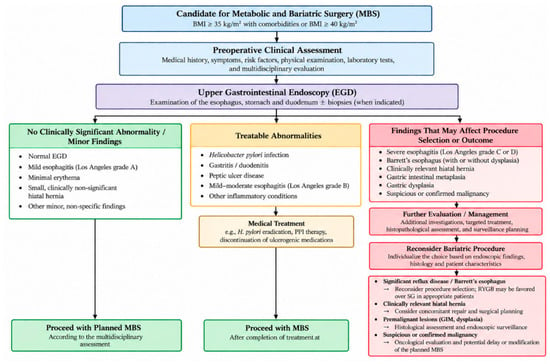
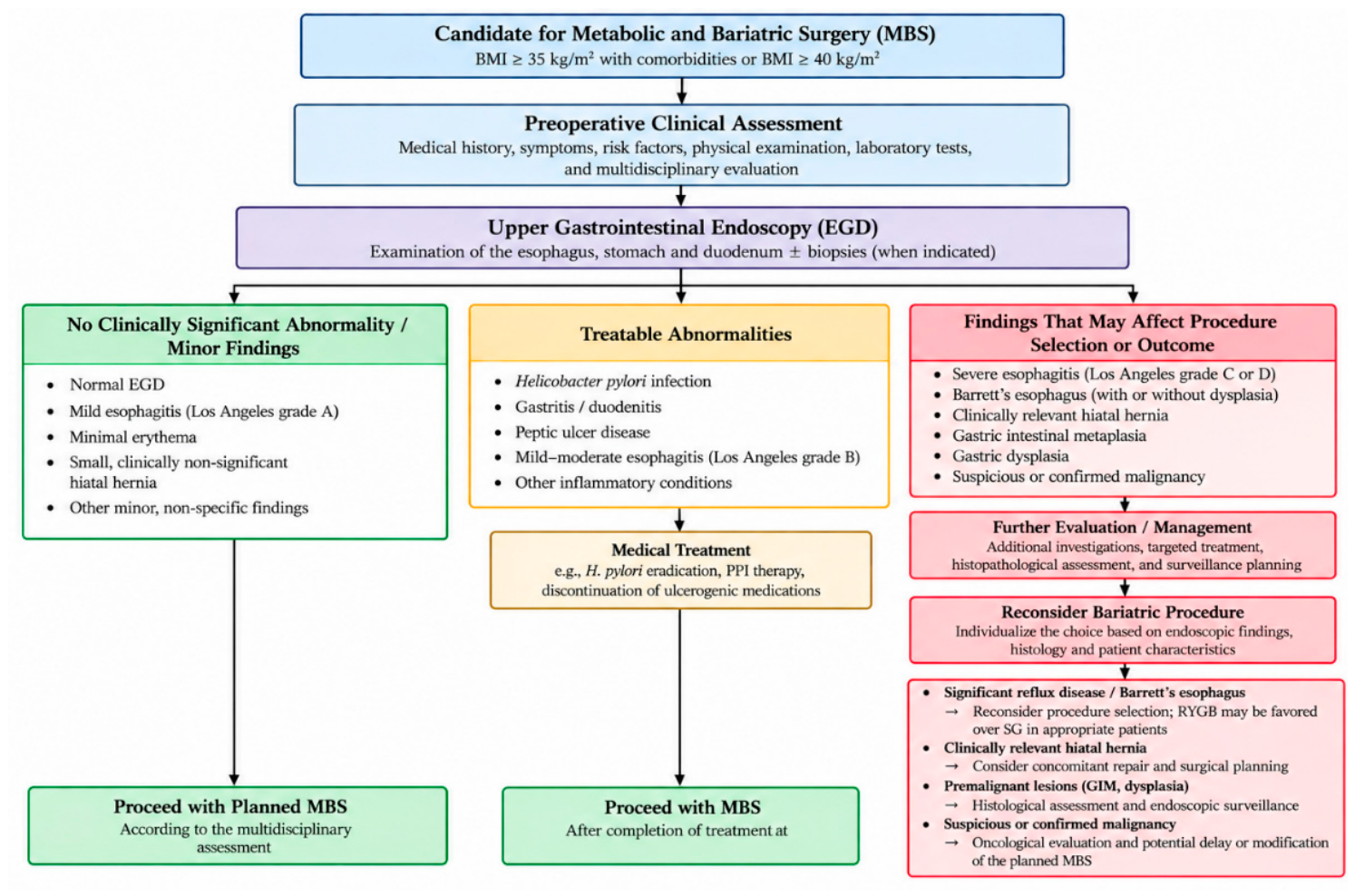
Based on the available evidence and the considerations discussed above, we propose a practical clinical algorithm for integrating EGD into the preoperative assessment of candidates for MBS (Figure 1). The proposed approach emphasizes the interpretation of endoscopic findings according to their clinical relevance and their potential impact on medical treatment, surveillance, and bariatric procedure selection.
Figure 1.
Proposed clinical algorithm for the integration of EGD into the preoperative assessment of candidates for metabolic and bariatric surgery. Blue, initial clinical assessment; purple, endoscopic evaluation; green, findings permitting progression to planned surgery; orange, treatable abnormalities requiring preoperative management; red, findings potentially affecting procedure selection or requiring further evaluation.
From our perspective, consideration of preoperative EGD should form an important component of the comprehensive evaluation of patients undergoing MBS, including those without upper gastrointestinal symptoms.
Patients with obesity may present with clinically silent gastroesophageal or gastric abnormalities that remain unrecognized in the absence of endoscopic assessment. Their identification before surgery may allow appropriate medical treatment, additional diagnostic evaluation, or adaptation of the planned surgical strategy when clinically relevant. Furthermore, establishing the preoperative endoscopic status provides an important baseline for the interpretation of gastrointestinal symptoms that may subsequently develop after MBS. In the absence of such baseline information, distinguishing between previously undiagnosed or pre-existing disease that becomes clinically manifest after surgery and newly developed pathology or a procedure-related complication may be more difficult. In our view, this consideration is particularly relevant because bariatric procedures substantially modify upper gastrointestinal anatomy and physiology and, depending on the procedure performed, may also alter subsequent endoscopic access. Therefore, the value of preoperative EGD extends beyond the immediate detection of abnormalities and should also be considered in relation to surgical planning and the interpretation and management of postoperative gastrointestinal symptoms.
Nevertheless, this perspective should be interpreted in the context of the current evidence, as the detection of an endoscopic abnormality does not necessarily translate into a clinically meaningful change in management, and available meta-analyses have reported considerable heterogeneity in the proportion of findings that actually modify the planned bariatric procedure [63,64].
Limitation of the Review
Several limitations of this review should be acknowledged. First, this study was designed as a narrative review and was not conducted according to a predefined systematic review protocol. Consequently, no formal risk-of-bias assessment or quantitative synthesis of the included studies was performed. In addition, the literature search was conducted using PubMed/MEDLINE as the primary bibliographic database. Although reference lists of relevant publications were manually screened to identify additional sources, studies indexed exclusively in other databases may have been missed. The use of a single primary database therefore represents an important methodological limitation.
Second, the selection of publications was based on their clinical relevance, methodological contribution, recency, and applicability to contemporary bariatric practice. Although more than 90 potentially relevant publications were initially considered, the narrative selection process inherently introduces a potential risk of selection bias and does not ensure the same degree of reproducibility as a systematic review methodology.
A further limitation concerns the substantial clinical and methodological heterogeneity of the available evidence. The included studies differ considerably in study design, patient populations, prevalence of gastrointestinal symptoms, bariatric procedures, indications for EGD, endoscopic and biopsy protocols, and reported outcomes. Moreover, there is no universally accepted definition of a “clinically significant” or “actionable” endoscopic finding. Some studies classify abnormalities according to their diagnostic relevance, whereas others define clinical significance according to the need for medical treatment, additional investigations, postponement of surgery, modification of the planned bariatric procedure, or contraindication to surgery. These outcomes represent different levels of clinical impact and limit direct comparison of the reported rates across studies.
The evidence regarding routine versus selective preoperative EGD should also be interpreted cautiously. Most available studies are observational, and relatively few directly compare universal and symptom- or risk-based strategies within comparable patient populations. Furthermore, recommendations issued by professional societies are not based exclusively on primary clinical evidence but incorporate systematic reviews, observational data, and, in some cases, expert consensus. Differences among international recommendations should therefore be interpreted in the context of the quality and heterogeneity of the underlying evidence rather than as directly comparable conclusions derived from uniform data.
Finally, evidence regarding the cost-effectiveness of routine preoperative EGD remains limited. Although available studies provide information on diagnostic yield and changes in management, fewer studies have evaluated whether universal endoscopic assessment results in sufficient improvement in clinically meaningful outcomes to justify its additional costs, resource utilization, procedural burden, and potential delays to surgery. Future prospective, multicenter studies should directly compare universal and risk-adapted strategies using standardized definitions of clinically relevant findings and should incorporate long-term clinical outcomes and formal health-economic analyses.
7. Conclusions
Overall, available evidence suggests that preoperative EGD may be a valuable component of the comprehensive assessment of patients undergoing MBS. Clinically relevant upper gastrointestinal abnormalities may be present even in asymptomatic patients. These findings may influence medical treatment, surgical planning, procedure selection, and postoperative surveillance.
However, the available literature remains heterogeneous. Studies differ in their definitions of clinically significant endoscopic findings, and international recommendations remain inconsistent. Consequently, a universally accepted screening strategy has not yet been established.
Future research should focus on large, prospective, multicenter studies to identify clinical and endoscopic predictors of relevant pathology. These studies should also determine which patient subgroups benefit most from routine rather than selective EGD.
Particular attention should be given to procedure-specific risk stratification. This is especially important in patients considered for SG who are at risk of postoperative GERD and BE. Preoperative assessment may also be important before bypass procedures that subsequently limit access to the excluded stomach.
Standardized endoscopic reporting and appropriate biopsy protocols may further improve preoperative assessment. Future studies should also evaluate long-term clinical outcomes and cost-effectiveness. Such evidence will be important for developing evidence-based algorithms and improving consistency among international guidelines.
Author Contributions
Conceptualization, M.M.; methodology, P.R.S.; software, V.I.V.; validation, R.V.L.; formal analysis, A.C.P.; investigation, A.O.; resources, L.A.; data curation, B.-M.C. and M.C.A.; writing—original draft preparation, M.M.; writing—review and editing, G.B.; visualization, A.D. and A.F.; supervision, D.V.T.; project administration, D.V.T. All authors have read and agreed to the published version of the manuscript.
Funding
This research received no external funding.
Institutional Review Board Statement
Not applicable.
Informed Consent Statement
Not applicable.
Data Availability Statement
No new data were created or analyzed in this study. Data sharing is not applicable to this article.
Conflicts of Interest
The authors declare no conflicts of interest.
Abbreviations
The following abbreviations are used in this manuscript:
| AGB | Adjustable gastric banding |
| ASGE | American Society for Gastrointestinal Endoscopy |
| ASMBS | American Society for Metabolic and Bariatric Surgery |
| BE | Barrett’s esophagus |
| BMI | Body mass index |
| BQT | Bismuth quadruple therapy |
| EAES | European Association for Endoscopic Surgery |
| EGD | Esophagogastroduodenoscopy |
| EGGIM | Endoscopic Grading of Gastric Intestinal Metaplasia |
| GEFV | Gastroesophageal flap valve |
| GEJ | Gastroesophageal junction |
| GERD | Gastroesophageal reflux disease |
| GI | gastrointestinal |
| GIM | Gastric intestinal metaplasia |
| HH | Hiatal hernia |
| IFSO | International Federation for the Surgery of Obesity and Metabolic Disorders |
| ISDE | International Society for Diseases of the Esophagus |
| LES | Lower esophageal sphincter |
| MALT | Mucosa-associated lymphoid tissue |
| MASH | Metabolic dysfunction-associated steatohepatitis |
| MBS | Metabolic and bariatric surgery |
| OAGB | One-anastomosis gastric bypass |
| OLGIM | Operative Link on Gastric Intestinal Metaplasia Assessment |
| PPI | Proton pump inhibitor |
| RYGB | Roux-en-Y gastric bypass |
| SAGES | Society of American Gastrointestinal and Endoscopic Surgeons |
| SCJ | Squamocolumnar junction |
| SG | Sleeve gastrectomy |
| WGO | World Gastroenterology Organisation |
References
- Boutari, C.; Mantzoros, C.S. A 2022 update on the epidemiology of obesity and a call to action: As its twin COVID-19 pandemic appears to be receding, the obesity and dysmetabolism pandemic continues to rage on. Metabolism 2022, 133, 155217. [Google Scholar] [CrossRef] [Scilit] [PubMed] [PubMed Central]
- Simó-García, E.; Bochud, M.; Clair, C.; Lasserre, A.M.; Berney, A.; Vaucher, J.; Strippoli, M.P.; Peter Vollenweider, P.; Marques-Vidal, P. Obesity prevalence varies markedly by definition: Multiple cross-sectional and prospective studies. Nutr. Res. 2026, 152, 145–156. [Google Scholar] [CrossRef] [Scilit] [PubMed]
- World Health Organization. Physical Status: The Use and Interpretation of Anthropometry. Report of a WHO Expert Committee; WHO Technical Report Series; 854; World Health Organization: Geneva, Switzerland, 1995; pp. 1–452. [Google Scholar]
- Gómez-Ambrosi, J.; Catalán, V.; Frühbeck, G. The evolution of the understanding of obesity over the last 100 years. Int. J. Obes. 2025, 49, 168–176. [Google Scholar] [CrossRef] [Scilit] [PubMed]
- Eisenberg, D.; Shikora, S.A.; Aarts, E.; Aminian, A.; Angrisani, L.; Cohen, R.V.; De Luca, M.; Faria, S.L.; Goodpaster, K.P.S.; Haddad, A.; et al. 2022 American Society for Metabolic and Bariatric Surgery (ASMBS) and International Federation for the Surgery of Obesity and Metabolic Disorders (IFSO): Indications for Metabolic and Bariatric Surgery. Surg. Obes. Relat. Dis. 2022, 18, 1345–1356. [Google Scholar] [CrossRef] [Scilit] [PubMed]
- Runkel, N.; Colombo-Benkmann, M.; Hüttl, T.P.; Tigges, H.; Mann, O.; Sauerland, S. Bariatric surgery. Dtsch. Arztebl. Int. 2011, 108, 341–346. [Google Scholar] [CrossRef] [Scilit] [PubMed] [PubMed Central]
- By-Band-Sleeve Collaborative Group. Roux-en-Y gastric bypass, adjustable gastric banding, or sleeve gastrectomy for severe obesity (By-Band-Sleeve): A multicentre, open label, three-group, randomised controlled trial. Lancet Diabetes Endocrinol. 2025, 13, 410–426. [Google Scholar] [CrossRef] [Scilit] [PubMed] [PubMed Central]
- Braga, J.G.R.; Callejas, G.H.; da Silva Costa, L.C.; Montes, C.G.; Chaim, F.D.M.; Gestic, M.A.; Utrini, M.P.; Callejas-Neto, F.; Ramos, A.C.; Chaim, E.A.; et al. Endoscopic and histopathological assessment of individuals undergoing one anastomosis gastric bypass: A 2-year follow-up. Surg. Endosc. 2023, 37, 3720–3727. [Google Scholar] [CrossRef] [Scilit] [PubMed]
- Mahawar, K.K.; Carr, W.R.J.; Balupuri, S.; Small, P.K. Controversy Surrounding ‘Mini’ Gastric Bypass. Obes. Surg. 2014, 24, 324–333. [Google Scholar] [CrossRef] [Scilit] [PubMed]
- Cazzo, E.; Jimenez, L.S.; Valerini, F.G.; Bezerra de Freitas Diniz, T.; Cardoso Ramos, A.; Adami Chaim, E. Weight Loss and Vomiting 1 Year After Banded Versus Non-banded One Anastomosis Gastric Bypass: A Prospective Randomized Trial. Obes. Surg. 2020, 30, 1719–1725. [Google Scholar] [CrossRef] [Scilit] [PubMed]
- Schauer, P.R.; Bhatt, D.L.; Kirwan, J.P.; Wolski, K.; Brethauer, S.A.; Navaneethan, S.D.; Aminian, A.; Pothier, C.E.; Kim, E.S.; Nissen, S.E.; et al. Bariatric surgery versus intensive medical therapy for diabetes—3-Year outcomes. N. Engl. J. Med. 2014, 370, 2002–2013. [Google Scholar] [CrossRef] [Scilit] [PubMed] [PubMed Central]
- Schauer, P.R.; Bhatt, D.L.; Kirwan, J.P.; Wolski, K.; Aminian, A.; Brethauer, S.A.; Navaneethan, S.D.; Singh, R.P.; Pothier, C.E.; Nissen, S.E.; et al. Bariatric Surgery versus Intensive Medical Therapy for Diabetes—5-Year Outcomes. N. Engl. J. Med. 2017, 376, 641–651. [Google Scholar] [CrossRef] [Scilit] [PubMed] [PubMed Central]
- Verrastro, O.; Panunzi, S.; Castagneto-Gissey, L.; De Gaetano, A.; Lembo, E.; Capristo, E.; Guidone, C.; Angelini, G.; Pennestrì, F.; Sessa, L.; et al. Bariatric-metabolic surgery versus lifestyle intervention plus best medical care in non-alcoholic steatohepatitis (BRAVES): A multicentre, open-label, randomised trial. Lancet 2023, 401, 1786–1797. [Google Scholar] [CrossRef] [Scilit] [PubMed]
- Schiavon, C.A.; Bersch-Ferreira, A.C.; Santucci, E.V.; Oliveira, J.D.; Torreglosa, C.R.; Bueno, P.T.; Frayha, J.C.; Santos, R.N.; Damiani, L.P.; Noujaim, P.M.; et al. Effects of Bariatric Surgery in Obese Patients with Hypertension: The GATEWAY Randomized Trial (Gastric Bypass to Treat Obese Patients with Steady Hypertension). Circulation 2018, 137, 1132–1142, Erratum in Circulation 2019, 140, e718. https://doi.org/10.1161/CIR.0000000000000577. [Google Scholar] [CrossRef] [Scilit] [PubMed] [PubMed Central]
- Kim, J.C.; Kim, M.G.; Park, J.K.; Lee, S.; Kim, J.; Cho, Y.S.; Kong, S.H.; Park, D.J.; Lee, H.J.; Yang, H.K. Outcomes and Adverse Events After Bariatric Surgery: An Updated Systematic Review and Meta-analysis, 2013–2023. J. Metab. Bariatr. Surg. 2023, 12, 76–88. [Google Scholar] [CrossRef] [Scilit] [PubMed] [PubMed Central]
- Clapp, B.; Cottam, S.; Salame, M.; Marr, J.D.; Galvani, C.; Ponce, J.; English, W.J.; Ghanem, O.M. Comparative analysis of sleeve conversions of the Metabolic and Bariatric Surgery Accreditation and Quality Improvement Program 2020 Database. Surg. Obes. Relat. Dis. 2024, 20, 47–52. [Google Scholar] [CrossRef] [Scilit] [PubMed]
- Budny, A.; Janczy, A.; Szymanski, M.; Mika, A. Long-Term Follow-Up After Bariatric Surgery: Key to Successful Outcomes in Obesity Management. Nutrients 2024, 16, 4399. [Google Scholar] [CrossRef] [Scilit] [PubMed]
- Mechanick, J.I.; Apovian, C.; Brethauer, S.; Garvey, W.T.; Joffe, A.M.; Kim, J.; Kushner, R.F.; Lindquist, R.; Pessah-Pollack, R.; Seger, J.; et al. Clinical practice guidelines for the perioperative nutrition, metabolic, and nonsurgical support of patients undergoing bariatric procedures—2019 update: Co-sponsored by American Association of Clinical Endocrinologists/American College of Endocrinology, The Obesity Society, American Society for Metabolic & Bariatric Surgery, Obesity Medicine Association, and American Society of Anesthesiologists. Surg. Obes. Relat. Dis. 2020, 16, 175–247. [Google Scholar] [CrossRef] [Scilit] [PubMed]
- Kow, L.; Sharaiha, R.Z.; O’kAne, M.; White, K.P.; Macedo, G.; Toouli, J.; Shikora, S. Methodology and Results of a Joint IFSO-WGO Delphi Survey of 94 Intercontinental, Interdisciplinary Experts in Obesity Management. Obes. Surg. 2023, 33, 3337–3352. [Google Scholar] [CrossRef] [Scilit] [PubMed]
- Lorenzo, N.D.; Antoniou, S.A.; Batterham, R.L.; Busetto, L.; Godoroja, D.; Iossa, A.; Carrano, F.M.; Agresta, F.; Alarçon, I.; Azran, C.; et al. Clinical practice guidelines of the European Association for Endoscopic Surgery (EAES) on bariatric surgery: Update 2020 endorsed by IFSO-EC, EASO and ESPCOP. Surg. Endosc. 2020, 34, 2332–2358. [Google Scholar] [CrossRef] [Scilit] [PubMed]
- Ghaderi, I.; Gondal, A.B.; Samamé, J.; Serrot, F.; Galvani, C.A. Preoperative Endoscopic and Radiologic Evaluation of Bariatric Patients: What Do They Add? J. Gastrointest. Surg. 2020, 24, 764–771. [Google Scholar] [CrossRef] [Scilit] [PubMed]
- Campos, G.M.; Mazzini, G.S.; Altieri, M.S.; Docimo, S., Jr.; DeMaria, E.J.; Rogers, A.M. ASMBS position statement on the rationale for performance of upper gastrointestinal endoscopy before and after metabolic and bariatric surgery. Surg. Obes. Relat. Dis. 2021, 17, 837–847. [Google Scholar] [CrossRef] [Scilit] [PubMed]
- Doğan, S.; Kanat, B.H. Routine endoscopy prior to bariatric surgery: Evidence-based necessity or institutional tradition? BMC Surg. 2025, 25, 493. [Google Scholar] [CrossRef] [Scilit] [PubMed] [PubMed Central]
- Camilleri, M.; Malhi, H.; Acosta, A. Gastrointestinal Complications of Obesity. Gastroenterology 2017, 152, 1656–1670. [Google Scholar] [CrossRef] [Scilit] [PubMed] [PubMed Central]
- Fernández, J.A.; Frutos, M.D.; Ruiz-Manzanera, J.J. Incidental Gastrointestinal Stromal Tumors (GISTs) and Bariatric Surgery: A Review. Obes. Surg. 2020, 30, 4529–4541. [Google Scholar] [CrossRef] [Scilit] [PubMed]
- Choi, I.J.; Kim, C.G.; Lee, J.Y.; Kim, Y.I.; Kook, M.C.; Park, B.; Joo, J. Family History of Gastric Cancer and Helicobacter pylori Treatment. N. Engl. J. Med. 2020, 382, 427–436. [Google Scholar] [CrossRef] [Scilit] [PubMed]
- Anggiansah, R.; Sweis, R.; Anggiansah, A.; Wong, T.; Cooper, D.; Fox, M. The effects of obesity on oesophageal function, acid exposure and the symptoms of gastro-oesophageal reflux disease. Aliment Pharmacol. Ther. 2013, 37, 555–563. [Google Scholar] [CrossRef] [Scilit] [PubMed]
- Armstrong, D.; Bennett, J.R.; Blum, A.L.; Dent, J.; De Dombal, F.T.; Galmiche, J.P.; Lundell, L.; Margulies, M.; Richter, J.E.; Spechler, S.J.; et al. The endoscopic assessment of esophagitis: A progress report on observer agreement. Gastroenterology 1996, 111, 85–92. [Google Scholar] [CrossRef] [Scilit] [PubMed]
- Katz, P.O.; Gerson, L.B.; Vela, M.F. Guidelines for the diagnosis and management of gastroesophageal reflux disease. Am. J. Gastroenterol. 2013, 108, 308–328, Erratum in Am. J. Gastroenterol. 2013, 108, 1672. [Google Scholar] [CrossRef] [Scilit] [PubMed]
- Sharma, P.; Dent, J.; Armstrong, D.; Bergman, J.J.; Gossner, L.; Hoshihara, Y.; Jankowski, J.A.; Junghard, O.; Lundell, L.; Tytgat, G.N.; et al. The development and validation of an endoscopic grading system for Barrett’s esophagus: The Prague C & M criteria. Gastroenterology 2006, 131, 1392–1399. [Google Scholar] [CrossRef] [Scilit] [PubMed]
- Ishimura, N.; Okimoto, E.; Shibagaki, K.; Ishihara, S. Endoscopic diagnosis and screening of Barrett’s esophagus: Inconsistency of diagnostic criteria between Japan and Western countries. DEN Open 2021, 2, e73. [Google Scholar] [CrossRef] [Scilit] [PubMed] [PubMed Central]
- Brännström, L.; Werner, M.; Wallner, B.; Franklin, K.A.; Karling, P. What is the significance of the Hill classification? Dis. Esophagus 2023, 36, doad004. [Google Scholar] [CrossRef] [Scilit] [PubMed] [PubMed Central]
- Hansdotter, I.; Björ, O.; Andreasson, A.; Agreus, L.; Hellström, P.; Forsberg, A.; Talley, N.J.; Vieth, M.; Wallner, B. Hill classification is superior to the axial length of a hiatal hernia for assessment of the mechanical anti-reflux barrier at the gastroesophageal junction. Endosc. Int. Open 2016, 4, E311–E317. [Google Scholar] [CrossRef] [Scilit] [PubMed] [PubMed Central]
- Kasotakis, G.; Mittal, S.K.; Sudan, R. Combined treatment of symptomatic massive paraesophageal hernia in the morbidly obese. JSLS J. Soc. Laparosc. Robot. Surg. 2011, 15, 188–192. [Google Scholar] [CrossRef] [Scilit] [PubMed] [PubMed Central]
- Salvador-Sanchis, J.L.; Martinez-Ramos, D.; Herfarth, A.; Rivadulla-Serrano, I.; Ibañez-Belenguer, M.; Hoashi, J.S. Treatment of morbid obesity and hiatal paraesophageal hernia by laparoscopic Roux-en-Y gastric bypass. Obes. Surg. 2010, 20, 801–803. [Google Scholar] [CrossRef] [Scilit] [PubMed]
- Wang, Y.; Lv, Y.; Liu, Y.; Xie, C. The effect of surgical repair of hiatal hernia (HH) on pulmonary function: A systematic review and meta-analysis. Hernia 2023, 27, 839–848. [Google Scholar] [CrossRef] [Scilit] [PubMed] [PubMed Central]
- Kayaçetin, S.; Güreşçi, S. What is gastritis? What is gastropathy? How is it classified? Turk. J. Gastroenterol. 2014, 25, 233–247. [Google Scholar] [CrossRef] [Scilit] [PubMed]
- Sipponen, P.; Maaroos, H.I. Chronic gastritis. Scand. J. Gastroenterol. 2015, 50, 657–667. [Google Scholar] [CrossRef] [Scilit] [PubMed] [PubMed Central]
- Wang, L.; Jiang, W.; Li, H. Global, regional, and national burden of gastritis and duodenitis from 1990 to 2021 with projections to 2050: A systematic analysis of the Global Burden of Disease Study 2021. Int. J. Med. Sci. 2025, 22, 2570–2582. [Google Scholar] [CrossRef] [Scilit] [PubMed] [PubMed Central]
- Dantas, A.C.B.; Jayme, V.R.; Filardi, K.F.X.C.; Pajecki, D.; Santo, M.A. Impact of helicobacter pylori on early postoperative complications after sleeve gastrectomy: A systematic review and meta-analysis. Arq. Bras. Cir. Dig. 2023, 36, e1788. [Google Scholar] [CrossRef] [Scilit] [PubMed]
- Kelly, J.J.; Perugini, R.A.; Wang, Q.L.; Czerniach, D.R.; Flahive, J.; Cohen, P.A. The presence of Helicobacter pylori is not associated with long-term anastomotic complications in gastric bypass patients. Surg. Endosc. 2015, 29, 2885–2890. [Google Scholar] [CrossRef] [Scilit] [PubMed]
- Heiat, M.; Javanbakht, M.; Abyazi, M.A.; Modarresi, F.; Gholizadeh, H. How reliable is pre-sleeve endoscopy to characterize pathological features? Ann. Diagn. Pathol. 2024, 72, 152319. [Google Scholar] [CrossRef] [Scilit] [PubMed]
- Brown, W.A.; Johari Halim Shah, Y.; Balalis, G.; Bashir, A.; Ramos, A.; Kow, L.; Herrera, M.; Shikora, S.; Campos, G.M.; Himpens, J.; et al. IFSO Position Statement on the Role of Esophago-Gastro-Duodenal Endoscopy Prior to and after Bariatric and Metabolic Surgery Procedures. Obes. Surg. 2020, 30, 3135–3153. [Google Scholar] [CrossRef] [Scilit] [PubMed]
- Sawathanon, S.; Promchan, D.; Thongwong, M.; Wangkulangkul, P.; Cheewatanakornkul, S.; Keeratichananont, S.; Yolsuriyanwong, K. Impact of preoperative esophagogastroduodenoscopy in patients undergoing bariatric surgery and development of a model to predict clinically significant abnormal endoscopic findings. Surg. Endosc. 2023, 37, 2202–2208. [Google Scholar] [CrossRef] [Scilit] [PubMed] [PubMed Central]
- Chey, W.D.; Leontiadis, G.I.; Howden, C.W.; Moss, S.F. ACG clinical guideline: Treatment of Helicobacter pylori infection. Off. J. Am. Coll. Gastroenterol. 2017, 112, 212–239. [Google Scholar] [CrossRef] [Scilit] [PubMed]
- Kermansaravi, M.; Valizadeh, R.; ShahabiShahmiri, S.; Zakeri, R.; Safari, S.; Eghbali, F.; Farazmand, B.; Shahsavan, M.; DavarpanahJazi, A.; Pouwels, S. Effect of Helicobacter pylori infection on metabolic and bariatric surgical complications: A systematic review and meta-analysis. Updat. Surg. 2025, 77, 2121–2134. [Google Scholar] [CrossRef] [Scilit] [PubMed]
- Bray, F.; Laversanne, M.; Sung, H.; Ferlay, J.; Siegel, R.L.; Soerjomataram, I.; Jemal, A. Global cancer statistics 2022: GLOBOCAN estimates of incidence and mortality worldwide for 36 cancers in 185 countries. CA Cancer J. Clin. 2024, 74, 229–263. [Google Scholar] [CrossRef] [Scilit] [PubMed]
- Lee, J.W.J.; Zhu, F.; Srivastava, S.; Tsao, S.K.; Khor, C.; Ho, K.Y.; Fock, K.M.; Lim, W.C.; Ang, T.L.; Chow, W.C.; et al. Severity of gastric intestinal metaplasia predicts the risk of gastric cancer: A prospective multicentre cohort study (GCEP). Gut 2022, 71, 854–863. [Google Scholar] [CrossRef] [Scilit] [PubMed] [PubMed Central]
- Dinis-Ribeiro, M.; Shah, S.; El-Serag, H.; Banks, M.; Uedo, N.; Tajiri, H.; Coelho, L.G.; Libanio, D.; Lahner, E.; Rollan, A.; et al. The road to a world-unified approach to the management of patients with gastric intestinal metaplasia: A review of current guidelines. Gut 2024, 73, 1607–1617, Erratum in Gut 2024, 73, e1. https://doi.org/10.1136/gutjnl-2024-333029corr1. [Google Scholar] [CrossRef] [Scilit] [PubMed]
- Zhang, G.; Zheng, J.; Zheng, L.; Yu, S.; Jiang, C.; Lin, W.; Li, D.; Qu, L.; Wang, W. Gastric intestinal metaplasia assessment between linked color imaging based on endoscopy and pathology. Scand. J. Gastroenterol. 2021, 56, 103–110, Erratum in Scand. J. Gastroenterol. 2021, 56, I. https://doi.org/10.1080/00365521.2020.1860557. [Google Scholar] [CrossRef] [Scilit] [PubMed]
- Trinh, N.A.; Luu, M.N.; Nguyen, D.T.N.; Le Thanh Tran, T.; Le, Q.D.; Tran, V.L.T.; Vo, U.P.P.; Vu, N.T.H.; Le, H.M.; Le, N.Q.; et al. The Predictive Value of the EGGIM Score for Extensive and Incomplete Gastric Intestinal Metaplasia: Implications for Biopsy Reduction in Endoscopic Practice. Dig. Dis. Sci. 2026, 71, 2298–2306. [Google Scholar] [CrossRef] [Scilit] [PubMed]
- Saarinen, T.; Kettunen, U.; Pietiläinen, K.H.; Juuti, A. Is preoperative gastroscopy necessary before sleeve gastrectomy and Roux-en-Y gastric bypass? Surg. Obes. Relat. Dis. 2018, 14, 757–762. [Google Scholar] [CrossRef] [Scilit] [PubMed]
- Elkin, B.; El-Dahdah, J.; Yang, Q.; Wu, Y.; McMichael, J.; Kim, M.K.; Corcelles Codina, R.; Simons Linares, C.R.; Rouphael, C. Preoperative Upper Endoscopy and Surgical Specimen Findings in Bariatric Surgery Patients. Obes. Surg. 2025, 35, 2736–2744. [Google Scholar] [CrossRef] [Scilit] [PubMed] [PubMed Central]
- Latorre, G.; Vargas, J.I.; Shah, S.C.; Ivanovic-Zuvic, D.; Achurra, P.; Fritzsche, M.; Leung, J.S.; Ramos, B.; Jensen, E.; Uribe, J.; et al. Implementation of the updated Sydney system biopsy protocol improves the diagnostic yield of gastric preneoplastic conditions: Results from a real-world study. Gastroenterol. Hepatol. 2024, 47, 793–803. [Google Scholar] [CrossRef] [Scilit] [PubMed] [PubMed Central]
- Shanti, H.; Almajali, N.; Al-Shamaileh, T.; Samarah, W.; Mismar, A.; Obeidat, F. Helicobacter pylori Does not Affect Postoperative Outcomes After Sleeve Gastrectomy. Obes. Surg. 2017, 27, 1298–1301. [Google Scholar] [CrossRef] [Scilit] [PubMed]
- Sages Guidelines Committee. SAGES guideline for clinical application of laparoscopic bariatric surgery. Surg. Obes. Relat. Dis. Off. J. Am. Soc. Bariatr. Surg. 2009, 5, 387–405. [Google Scholar] [CrossRef] [Scilit] [PubMed]
- Evans, J.A.; Muthusamy, V.R.; Acosta, R.D.; Bruining, D.H.; Chandrasekhara, V.; Chathadi, K.V.; Eloubeidi, M.A.; Fanelli, R.D.; Faulx, A.L.; Fonkalsrud, L.; et al. The role of endoscopy in the bariatric surgery patient. Gastrointest. Endosc. 2015, 81, 1063–1072. [Google Scholar] [CrossRef] [Scilit] [PubMed]
- Chen, J.; Razzouk, J.; Martinez, P.; Kohler, R.; Ellen Morrow, E.; Anna Ibele, A.; Eric Volckmann, E. The utility of endoscopy prior to bariatric surgery: An 11-year retrospective analysis of 885 patients. Surg. Endosc. 2023, 37, 3127–3135. [Google Scholar] [CrossRef] [Scilit] [PubMed]
- Visaggi, P.; Ghisa, M.; Barberio, B.; Chiu, P.W.; Ishihara, R.; Kohn, G.P.; Morozov, S.; Thompson, S.K.; Wong, I.; Hassan, C.; et al. Gastro-esophageal diagnostic workup before bariatric surgery or endoscopic treatment for obesity: Position statement of the International Society of Diseases of the Esophagus. Dis. Esophagus 2024, 37, doae006. [Google Scholar] [CrossRef] [Scilit] [PubMed]
- Brown, W.; Fisher, O.; Johari, Y.; Au, J.; Stier, C.; Moore, R.; Parmar, C.; Dixon, J.B.; Paulina Salminen, P. International Federation for Surgery for Obesity and Metabolic Disorders Position Statement on the role of Upper Gastrointestinal Endoscopy Before and After Metabolic Bariatric Surgery. Obes. Surg. 2025, 35, 4889–4916. [Google Scholar] [CrossRef] [Scilit] [PubMed]
- Peleg, N.; Ollech, J.E.; Shamah, S.; Sapoznikov, B. Seattle Protocol Is More Effective in Detection of Dysplasia Compared to Technology-Assisted Targeted Biopsies in Patients with Barrett’s Esophagus. J. Clin. Med. 2023, 12, 2544. [Google Scholar] [CrossRef] [Scilit] [PubMed] [PubMed Central]
- Muir, D.; Choi, B.; Holden, M.; Clements, C.; Stevens, J.; Ratnasingham, K.; Irukulla, S.; Humadi, S. Preoperative Oesophagogastroduodenoscopy and the Effect on Bariatric Surgery: A Systematic Review and Meta-Analysis. Obes. Surg. 2023, 33, 2546–2556. [Google Scholar] [CrossRef] [Scilit] [PubMed]
- Evans, G.; Barker, A.; Simon, L.; Kushnir, V. High Cost for Low Yield: A Systematic Review and Meta-Analysis to Assess Cost of Routine Preoperative Esophagogastroduodenoscopy Before Bariatric Surgery. J. Clin. Gastroenterol. 2020, 54, 398–404. [Google Scholar] [CrossRef] [Scilit] [PubMed]
- El Ansari, W.; El-Menyar, A.; Sathian, B.; Al-Thani, H.; Al-Kuwari, M.; Al-Ansari, A. Is Routine Preoperative Esophagogastroduodenoscopy Prior to Bariatric Surgery Mandatory? Systematic Review and Meta-analysis of 10,685 Patients. Obes. Surg. 2020, 30, 3073–3083. [Google Scholar] [CrossRef] [Scilit] [PubMed]

Disclaimer/Publisher’s Note: The statements, opinions and data contained in all publications are solely those of the individual author(s) and contributor(s) and not of MDPI and/or the editor(s). MDPI and/or the editor(s) disclaim responsibility for any injury to people or property resulting from any ideas, methods, instructions or products referred to in the content. |
© 2026 by the authors. Licensee MDPI, Basel, Switzerland. This article is an open access article distributed under the terms and conditions of the Creative Commons Attribution (CC BY) license.