


Abstract
Zn-Fe-Cr coatings were successfully deposited on sintered Nd-Fe-B matrix through the addition of the complexing agent etidronic acid (HEDP) to the plating solution; the electrodeposited process of the metal elements and the corrosion behavior of the coatings were also investigated. Through cyclic voltammetry (CV) tests, it was observed that the reduction potential difference between the metal elements was reduced by the addition of HEDP, which contributed to a more feasible electrodeposited process. The surface of Zn-Fe-Cr coating was covered by a chromate conversion film, and its microstructure was identified as the solid solution of Fe and Cr in Zn matrix. Compared with Zn and Zn-Fe coatings, the corrosion current density (Jcorr) of Zn-Fe-Cr coating was decreased to 0.28 × 10⁻⁶ A·cm−2, and the corrosion potential (Ecorr) was increased to −1.01 V. Compared with the Zn and Zn-Fe coatings, the corrosion rate of the Zn-Fe-Cr coating has decreased by 90% and 98%, respectively. The corrosion resistance of coatings was further analyzed by neutral salt spray tests (NSS), and the analysis results showed that a composite oxide layer, composed of ZnO and Cr2O3, was formed in the corroded area of Zn-Fe-Cr coating during the corrosion process, which is capable of effectively inhibiting the expansion of the corrosion area. This research provides a promising strategy for ensuring the long-term service integrity of sintered Nd-Fe-B materials in marine environments.
1. Introduction
Sintered Nd-Fe-B is used in a variety of fields, including electronics, communications and automation. It is due to the advantages of its magnetic properties, which include high remanence and coercivity, as well as its cost-effectiveness [1,2,3,4,5]. Much research has been done to explore the improvement of magnetic properties and thermal stability of Nd-Fe-B magnets [6,7,8]. However, apart from the magnetic properties of Nd-Fe-B needing to be improved, the problem of its poor corrosion resistance, due to the large gap between the potential of the intergranular phase and the potential of the main phase within its three-phase structure, remains to be solved [9,10,11]. In order to improve the corrosion resistance of sintered Nd-Fe-B, alloying and surface protection are effective ways. By using alloying methods, intermetallic compounds are formed in the intergranular phase of the magnet, thereby reducing the difference in potential between the main phase and the intercrystalline phase [12,13,14,15]. However, the magnets are still susceptible to invasion by corrosive media after treatment by alloying methods, resulting in limited enhancement of their corrosion resistance.
By surface protection methods, protective coatings are applied to the surface of the magnet, thus preventing the intrusion of corrosion agents. Electroplating, a method of surface protection, has the advantages of low cost, good protection, and the ability to process complex workpieces [16,17,18,19]. In various electroplated coatings, Zn coating exhibits a more negative corrosion potential; thus, it is widely employed as a sacrificial anode coating to protect the steel substrate. It is also extensively utilized in the protection of Nd-Fe-B [20,21]. However, the easily oxidized nature of Zn prevents it from providing effective long-term protection for magnets. Wang et al. significantly improved the corrosion resistance of Zn coatings by composite passivation with molybdate and phosphate [22]. However, due to the complexity of the passivation method, cost and efficiency control in the production process are not utilized. It has been proven that alloy coatings are formed on the surface of steel substrates by anomalous co-deposition of Zn and iron group elements and exhibit better corrosion resistance than Zn coatings, due to forming an alloying phase or changing the surface morphology of the coatings [23,24,25,26]. In a related study, Lei et al. electroplated γ-phase Zn-Ni coatings in deep eutectic solvents by the pulse electroplating method, demonstrating that Zn-Ni coatings with a single γ-phase possess better corrosion resistance than Zn or Ni coatings [27]. Li et al. electroplated the Zn-Fe alloy coating on the sintered Nd-Fe-B substrate and found that the corrosion current density of the Zn-Fe alloy coating increased from 1.9 × 10⁻⁵ A·cm−2 to 4.1 × 10⁻⁶ A·cm−2 compared with the Zn coating, and the corrosion potential increased from −1.074 V to −1.032 V [28]. However, alloy coatings formed by Zn and the Iron group elements have limited corrosion resistance in a corrosion environment [29]. Yu et al. plated Zn-Cr alloy coatings on sintered Nd-Fe-B, and the results showed that the alloy coatings had superior corrosion resistance compared to both Zn and Ni coatings, without affecting the magnetic properties of the magnets [30]. To enable electrodeposition to occur more easily, additives are often added to the electroplating solution to alter its chemical properties. Complexing agents, as a type of electroplating additive, are often used to alter the deposition characteristics of metal elements, therefore also affect the electrodeposition process [31,32]. Zhou et al. successfully electroplated a Ni-Co-Zn alloy coating on a Ti substrate by means of a plating solution containing sodium citrate and demonstrated that the complexing agent altered the deposition potential of the metal ions and influenced the electrodeposition process [33].
In this study, Zn-Fe-Cr coatings with better corrosion resistance than Zn-Fe and Zn coatings were plated on Nd-Fe-B substrates. The effects of a complexing agent, the etidronic acid (HEDP), on the electrodeposition behavior of Zn2+, Fe2+, and Cr3+ in the plating solution were investigated. The corrosion mechanism explained the differences in corrosion resistance between alloy coatings and Zn coatings. The possibility of replacing binary alloy coatings with ternary alloy coatings in marine environments is evaluated.
2. Experiment
2.1. Electroplating Solution and Preparation Method
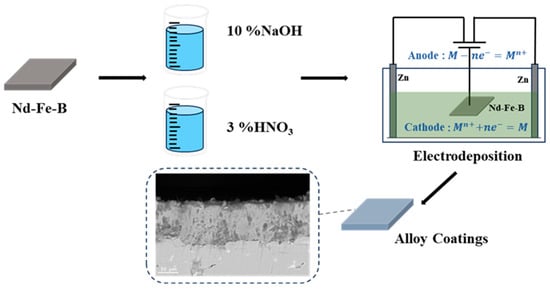
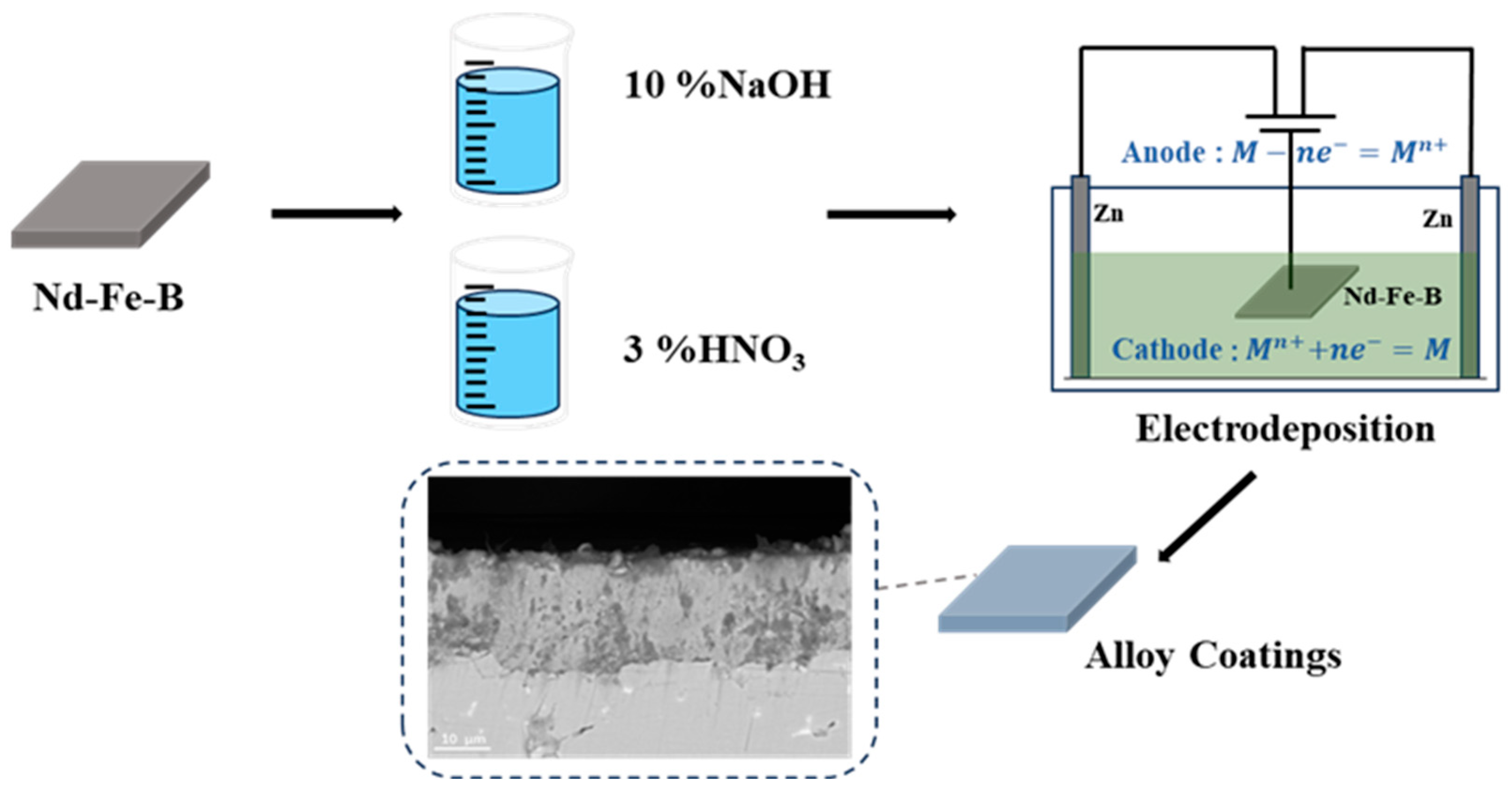
Commercial sintered Nd-Fe-B and the chemical reagents used in the experiment were supplied by Grirem (Rongcheng) Co., Ltd (Weihai, China), and sintered Nd-Fe-B was used as the matrix, with a size of 20 mm × 15 mm × 2 mm. Before deposition, a pretreatment was applied to the substrate to ensure improved adhesion of coatings. The pretreatment method consisted of the following steps: the magnet was first immersed in a 10 wt.% NaOH solution for 40 s to remove surface grease, which was followed by an acid wash in a 3 wt.% HNO3 solution for 40 s to remove surface oxidation products. Finally, the magnet was subjected to ultrasonic cleaning in anhydrous ethanol.
The corrosion resistance of electroplated coatings is affected by multiple factors. Consequently, optimization of the experimental parameters during plating is required to obtain an alloy coating with optimal corrosion resistance. Using orthogonal experiments, the factor levels that produce coatings with the best corrosion resistance can be identified through a relatively small set of representative tests [34,35]. Therefore, the main salt content, current density, pH, and deposition time of the plating bath were selected as the influencing factors. Based on this selection, orthogonal experiments were conducted to investigate and optimize these parameters, resulting in a coating with optimal corrosion resistance. The compositions of the optimized plating solutions for Zn, Zn-Fe, and Zn-Fe-Cr, along with the corresponding experimental conditions, are summarized in Table 1. All chemical reagents used were of analytical grade. Initially, all chemical reagents except FeSO4 and CrCl3 were dissolved in deionized water. Subsequently, the pH of the plating solution was adjusted with a diluted sulfuric acid solution. Finally, FeSO4 and CrCl3 were added to prevent Fe2+ and Cr3+ from being oxidized to Fe3+ and Cr6+ due to a high pH in the solution. A zinc sheet was used as the anode during electroplating. The coating was deposited from the plating solution at 25 ± 2 °C for 40 min. Subsequently, the sample was rinsed with deionized water and dried in an oven at 60 °C for 1 h. The complete preparation process is illustrated in Figure 1.
Table 1.
Components of different plating solutions.
Figure 1.
Coating process of the sintered Nb-Fe-B alloy.
2.2. Characterization Methods
Each sample was placed in a 25 °C oven for one hour before the test to ensure its stability. Electrochemical and neutral salt spray (NSS) tests were employed to evaluate the deposition properties and corrosion resistance of the coatings. The test was conducted at a temperature of 35 °C and a humidity of 47% RH until corrosion appeared on all test coating surfaces. The electroplated Nd-Fe-B substrate with an area of 20 mm × 15 mm was used as the working electrode. Platinum sheets were used as the counter electrode, calomel electrodes were used as the reference electrode, and the test solution was the 3.5% NaCl solution. The selected frequency for electrochemical impedance spectroscopy testing (EIS) is 100,000 to 0.01 Hz, and the results of the EIS test were fitted using the Zview2 software. The selected voltage range for potentiodynamic polarization testing (Tafel) is ±0.25 V based on open circuit potential (OCP). The Tafel test and the EIS test, respectively, follow the standards of ASTM G5 and ASTM G106. The deposition characteristics of the coating were analyzed by cyclic voltammetry (CV) tests. The voltage range was selected as −1.5 V to 0.5 V, and the scanning rate was 20 mV/s. Before conducting electrochemical tests, an OCP test was conducted for 30 min to stabilize the electrode potential. The corrosion resistance of the coating in a simulated marine environment was characterized by the NSS tests in the 5% NaCl solution.
The NSS test is conducted through a high/low temperature salt spray cycling test system (China testing Equipment (Suzhou) Co., Ltd., CTE-THFC-590S, Suzhou, China). The electrochemical experiment is conducted using an electrochemical workstation (AMETEK VersaSTAT 3F, Princeton, NJ, USA). The microstructure and elemental distribution of the coating were analyzed by scanning electron microscopy (SEM, ZEISS Gemini 300, Gel Baden-Württemberg) and the equipped energy dispersive spectrometer (EDS, OXFORD X-MaxN50, Oxfordshire, UK). A Cu-Kα X-ray diffractometer (XRD, Ultima IV, Rigsku, Akishima, Japan) generated at 40 kV and 40 mA is used to analyze the phase composition of the coating. X-ray photoelectron spectroscopy (XPS, Thermo K-alpha, Thermo K-alpha, USA Massachusetts, MA, USA) is used to analyze the valence state distribution of elements on the surface of coatings.
3. Results and Discussion
3.1. Cyclic Voltammetry Test
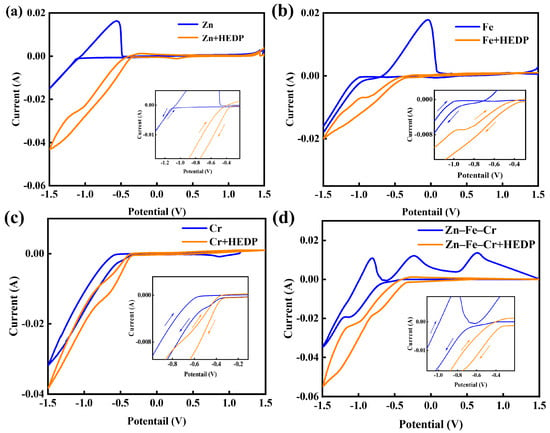
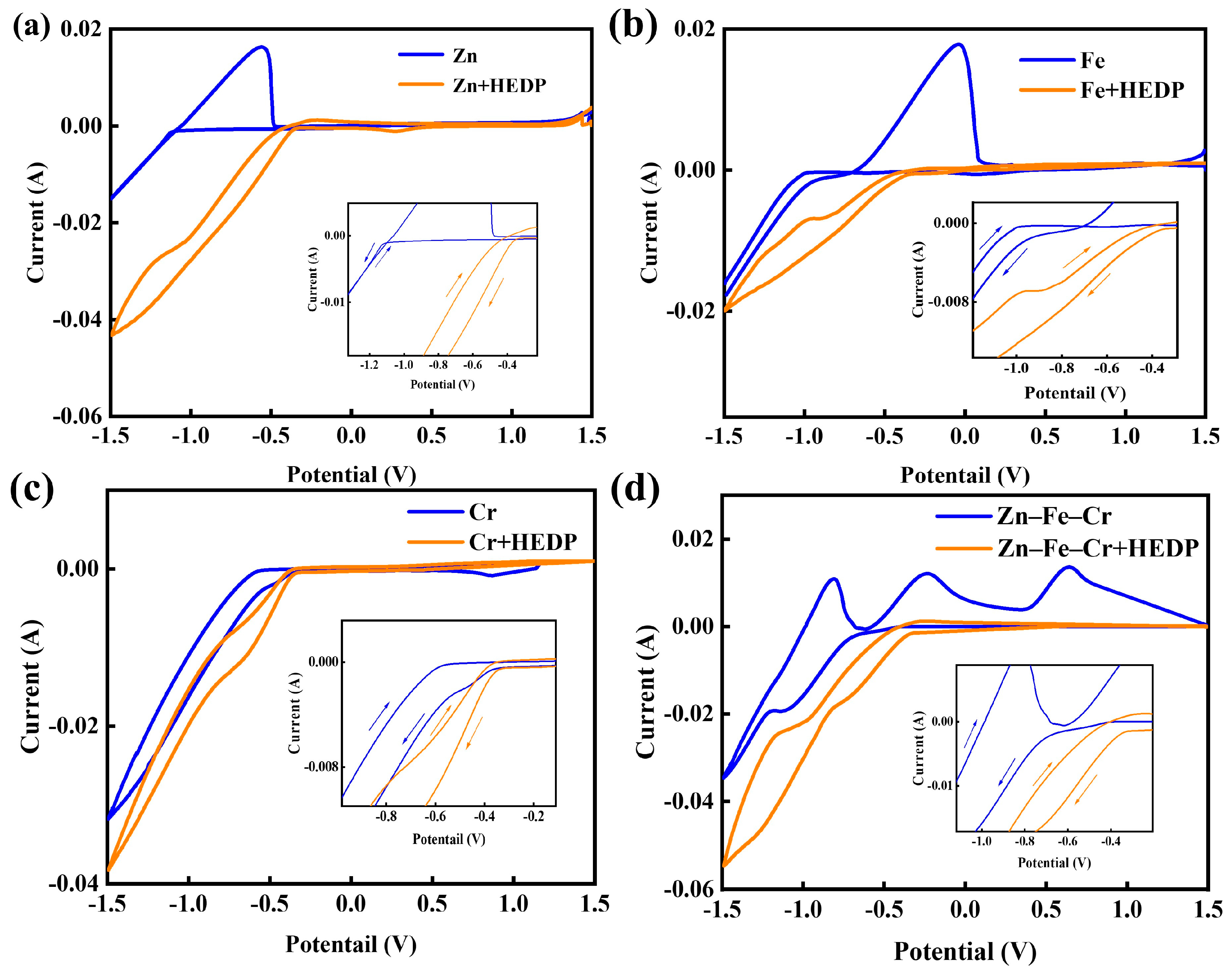
The successful electrodeposition of different metal ions requires the possession of equal or closely matched reduction potentials during the reduction process. To alter the reduction potentials of metal ions and promote their electrodeposition process, an effective approach is to introduce a complexing agent into the solution, which forms stable complexes with the ions and modifies their reduction potentials [36,37]. Owing to the hydroxyl (-OH) and phosphate (-PO3H2) groups in its molecular structure, HEDP can form complexes with most metal ions, enabling its use as both a complexing agent and a corrosion inhibitor [38,39]. To investigate the influence of HEDP on the deposition process of metal elements, CV tests were performed on solutions of ZnCl2, FeSO4, and CrCl3, both with and without the addition of HEDP. The results are shown in Figure 2.
Figure 2.
Cyclic voltammetry curves of the plating solution before and after the addition of HEDP: (a) ZnCl2 bath; (b) FeSO4 bath; (c) CrCl3 bath; (d) Zn-Fe-Cr bath. In the local magnification diagram, the blue arrow represents the scanning direction without adding HEDP, and the yellow arrow represents the scanning direction after adding HEDP.
The CV curves of the ZnCl2 solution with and without HEDP are presented in Figure 2a, scanned from −1.5 V to 0.5 V. In the absence of HEDP, a cathodic current emerges as the potential is scanned negatively to −1.1 V, corresponding to the onset of Zn2+ reduction. Only one reduction process was identified for Zn2+, as no further reduction peaks were detected. Following this reduction, when the scan was reversed from −1.5 V to positive potentials, an oxidation peak emerged at approximately −0.6 V, attributed to the loss of electrons from Zn to form Zn2+. After the addition of HEDP to the ZnCl2 solution, the onset of the reduction current was observed at approximately −0.4 V during the cathodic scan. This corresponds to the reduction potential of Zn2+ shift from −1.1 V to −0.4 V. At the research of Zhou et al., the complexing agent ethylene diamine tetra-acetic acid (EDTA) was added to the Ni-Co-Zn plating solution which can enable EDTA to form organic macromolecules with metal ions, and shift the reduction potential of metal ions positively, which is conducive to the co-deposition of Zn2+, Co2+, and Ni2+ whose original reduction potentials differ greatly [40]. HEDP also exhibits complexation ability, forming organic complexes with Zn2+ and leading to an alteration in their reduction potential [41].
Figure 2b,c show the CV curves of FeSO4 and CrCl3 solutions within the range of −1.5 V to 0.5 V before and after the addition of HEDP. During the cathodic scan of the FeSO4 solution without HEDP, a reduction current was observed commencing at approximately −1.0 V, suggesting the onset of Fe2+ reduction. Subsequently, when the scan was reversed, an oxidation peak was observed at around −0.2 V, corresponding to the oxidation reaction of Fe. A similar effect was observed when HEDP was added to the FeSO4 solution. The potential at which the reduction current appeared was shifted from −1.0 V to −0.4 V. This shift is due to complex formation between HEDP and Fe2+, which alters their reduction potential [42]. For the CrCl3 solution, the addition of HEDP did not produce a significant shift in the reduction potential, even though HEDP is capable of complexing with Cr3+ [41]. A possible explanation is that the reduction potentials of free Cr3+ and its HEDP complex are similar. It was observed that due to complexed with HEDP, the deposition potentials of both Zn2+ and Fe2+ increased to approximately −0.4 V, which is close to that of Cr3+. This demonstrates that complexation by HEDP reduces the potential difference between different ions, promoting their electrodeposition process. After the addition of HEDP, oxidation peaks corresponding to Zn and Fe were not observed. Due to the strong complexation ability of hydroxyethyl diphenyl phosphate towards metal ions [43], the concentration of free metal ions in the solution significantly decreases after the addition of hydroxyethyl diphenyl phosphate. During the forward scan, the amount of reduced metal ions on the working electrode surface decreases, resulting in a very weak oxidation reaction on the working electrode surface during the reverse scan, and the oxidation peak is not obvious. Moreover, in the hydroxyethyl diphenyl phosphate system, the reduction process of metal ions is a highly irreversible electrochemical process [39]. For highly irreversible reduction processes, the position of the oxidation peak may significantly shift to the positive direction, and the intensity of the peak will also significantly decrease. Therefore, after adding hydroxyethyl diphenyl phosphate, the oxidation peaks of zinc and iron in the cyclic voltammogram become less obvious or even disappear.
Figure 2d shows the CV curves of the Zn-Fe-Cr plating solution in the range of −1.5 V to 0.5 V before and after the addition of HEDP. Before the addition of HEDP, the onset of reduction current at −0.4 V was attributed to the beginning of Cr3+ reduction. As the potential was scanned more negatively, a change in the reduction current around −0.7 V marked the start of Fe2+ reduction. Finally, a reduction peak observed at −1.2 V indicated the commencement of Zn2+ reduction. During reverse scanning, oxidation peaks were shown at −0.8 V, −0.3 V, and 0.6 V, corresponding, respectively, to the oxidative dissolution of Zn, Fe, and Cr in the reduction products. Following the addition of HEDP, a marked enhancement in the reduction current was observed from −0.4 V during the cathodic scan. This is because the reduction processes at this potential now include not only Cr3+ but also Zn2+ and Fe2+ that were complexed with HEDP. Subsequently, during the anodic scan, the absence of oxidation peaks was noted, which may be related to the corrosion-inhibiting effect of HEDP.
3.2. Morphology and Phase Composition
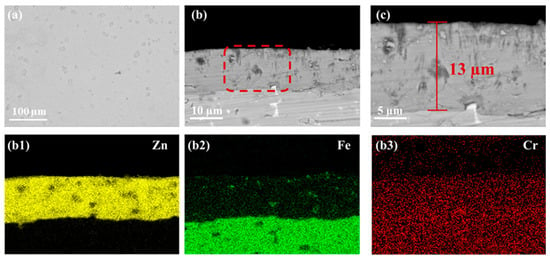
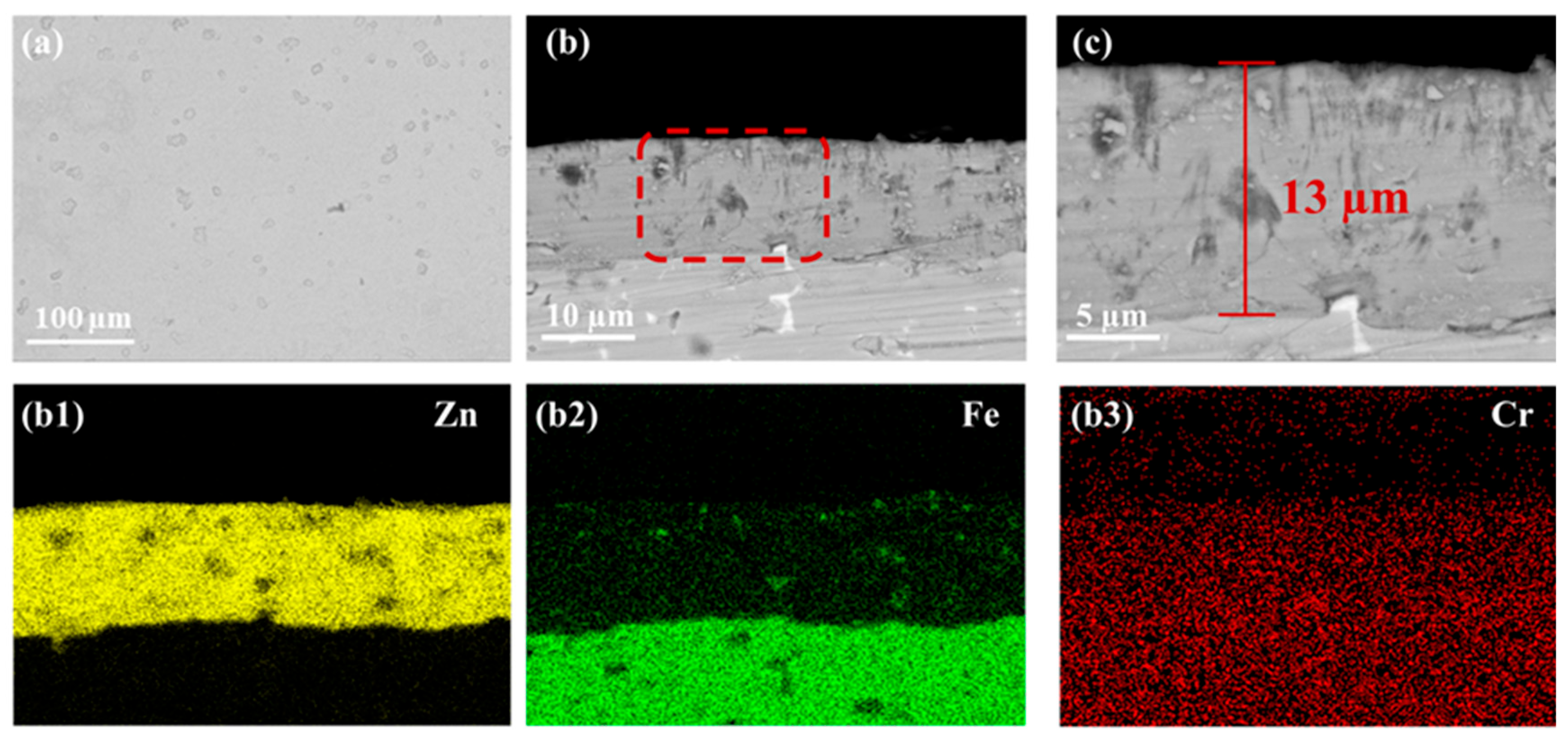
In order to characterize the surface and cross-sectional morphology of the Zn-Fe-Cr coating, as well as the element distribution within the coating, SEM and EDS tests were conducted. Figure 3 shows the SEM images of the morphology of the Zn-Fe-Cr coating, and the elemental distribution of the cross-section of the coating.
Figure 3.
The SEM images of (a) the surface of Zn-Fe-Cr coating; (b) the cross-section of Zn-Fe-Cr coating; (c) the enlarged region of Zn-Fe-Cr coating in the cross-section; and the elemental distribution of (b1) Zn elements (yellow area in b1); (b2) Fe elements (green area in b2); and (b3) Cr elements (red area in b3) in the cross-section.
Figure 3 shows the BSE-SEM images of the morphology of the Zn-Fe-Cr coating, and the elemental distribution of the cross-section of the coating. The Zn-Fe-Cr coating obtained with HEDP in the plating solution was observed to have a relatively smooth surface, with only minor microscopic protrusions in localized areas. At the micrometer scale, no distinct grain morphology could be resolved, indicating a refined grain structure. It has been noted in some studies that a reduction in grain size is correlated with enhanced corrosion resistance in coatings [44]. The thickness of the Zn-Fe-Cr coating was measured to be approximately 18 μm, and it exhibited good adhesion to the Nd-Fe-B substrate. The elemental compositions of this coating, along with those of the comparative Zn and Zn-Fe coatings, are presented in Table 2. Compared to the Zn-Fe coating, a lower Fe content was found in the Zn-Fe-Cr coating. This suggests that the anomalous electrodeposition between Zn and Fe-group elements is more significant in the ternary metal system [45].
Table 2.
The mass fraction of elements in the coating is shown by the EDS result.
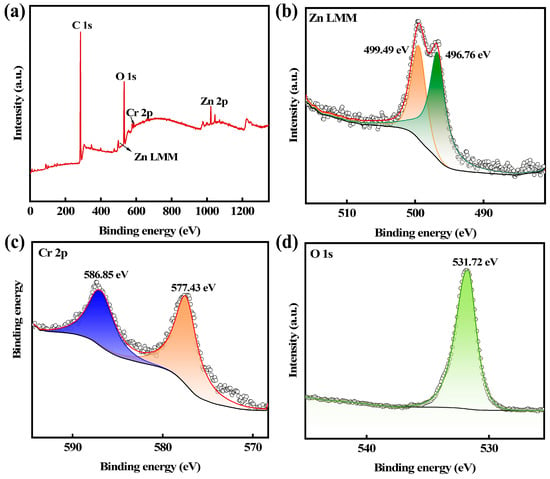
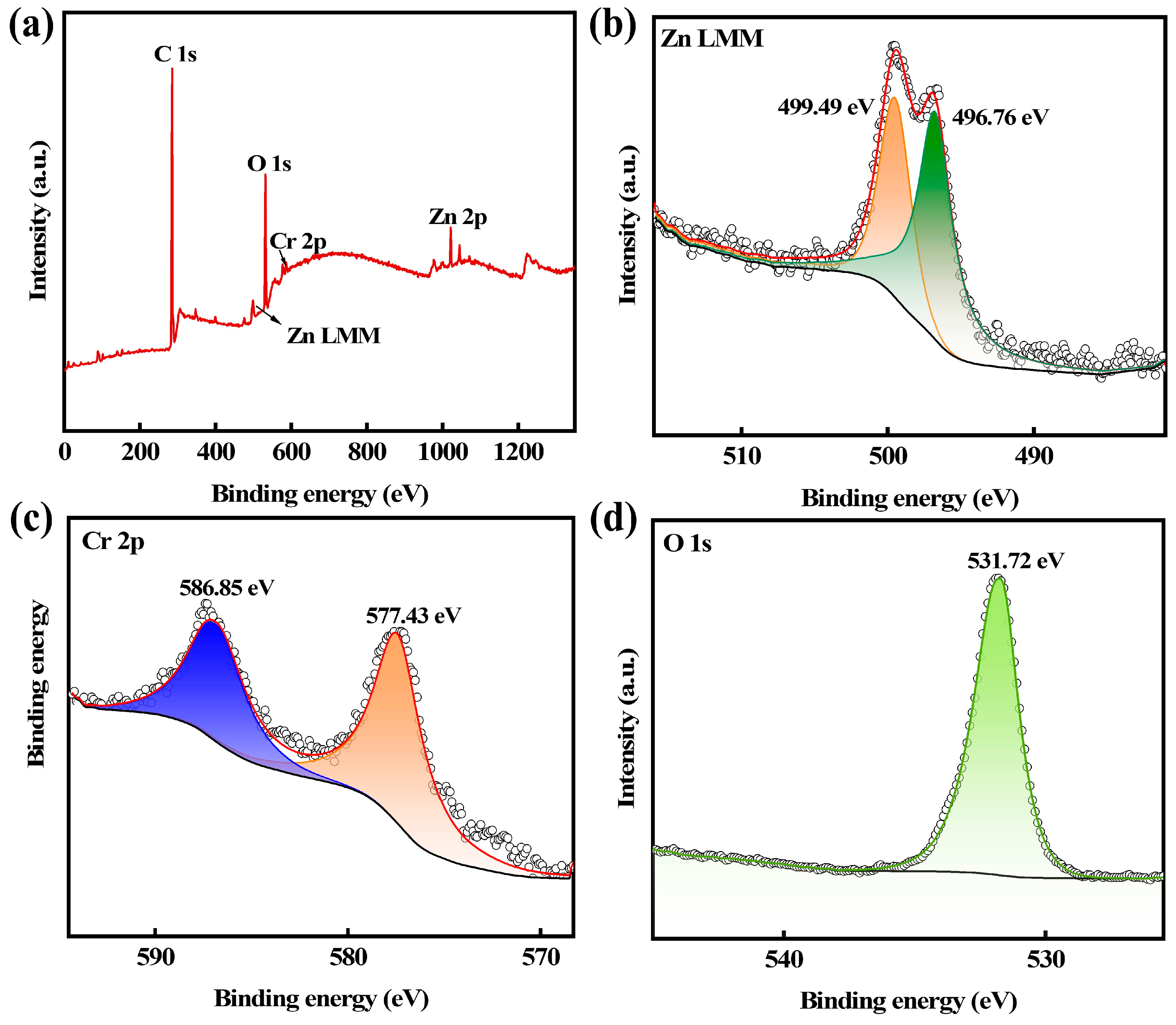
When a zinc coating is immersed in a low-pH solution containing Cr3+, a passivation film composed of chromate can be formed on its surface, thereby protecting the coating [46]. XPS measurements were performed on the surface of the Zn-Fe-Cr coating to examine the presence of a chromate passivation film, the corresponding spectra are shown in Figure 4. Analysis of the Zn chemical state was carried out using the Zn LMM orbital, as the Zn 2p orbital does not provide sufficient resolution to distinguish between the metallic state (1021.6 eV) and the oxidized state (1021.7 eV) [47]. Two binding energy peaks of 499.49 eV and 496.76 eV were generated on Zn LMM, indicating the presence of Zn2+ on the surface of the coating [22]. The peak at 531.72 eV in the O 1s spectrum indicates that the O on the surface exists in the form of OH− [48]. The Cr 2p fine spectrum showed characteristic doublet peaks at 577.43 eV and 586.85 eV, which are attributed to Cr(OH)3. This provides direct evidence that a chromate conversion film was formed on the surface [49]. The results suggest that a chromate conversion film is present on the surface of the Zn-Fe-Cr coating, in which Zn(OH)2 and Cr(OH)3 are involved.
Figure 4.
XPS results of Zn-Fe-Cr coating before corrosion: (a) Survey patterns; (b) Zn LMM; (c) Cr 2p; (d) O 1s.
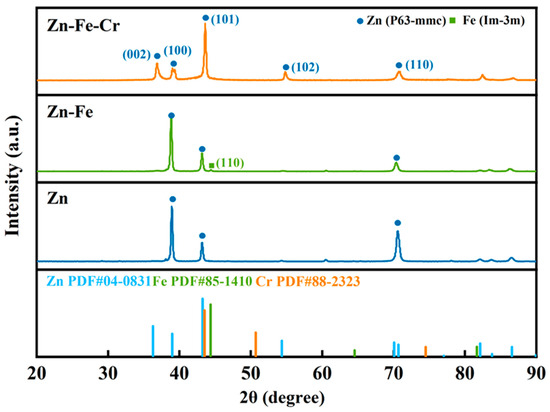
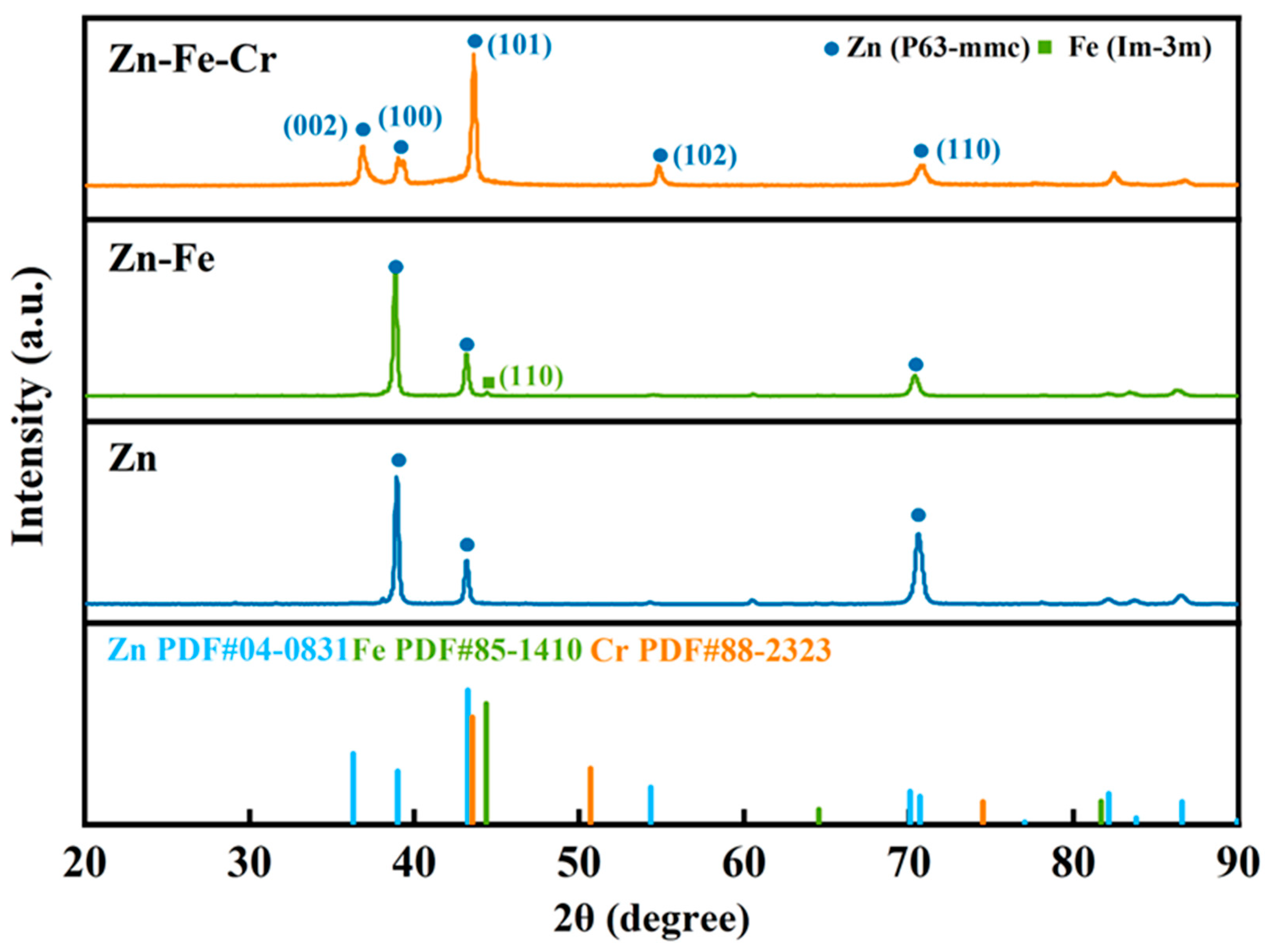
Figure 5 shows the XRD patterns of Zn, Zn-Fe, and Zn-Fe-Cr coatings. In the XRD patterns from the zinc and zinc-iron coatings, the primary diffraction peaks, located at 38°, 43.2°, and 70.7°, are indexed to the (100), (101), and (110) planes of zinc. These positions are consistent with the values reported in the literature [28]. A distinct difference was that a diffraction peak corresponding to the (110) plane of Fe was observed at 44.4° for the Zn-Fe coating. In the Zn-Fe-Cr coating, electrodeposition with Cr resulted in the appearance of additional peaks for Zn at 36.7° and 54.8°, corresponding to the (002) and (102) planes, respectively, alongside the original Zn peaks. Concurrently, the most intense peak shifted from the Zn (100) to the Zn (101) plane. The electrodeposition of Zn2+ is affected by the crystal growth direction. Dendritic precipitation is more likely to happen when Zn grows along the (100) and (101) planes, which is adverse to corrosion resistance. Conversely, growing along the (002) plane leads to a more uniform deposition and a smoother surface, thereby improving the coating’s overall corrosion resistance [50,51]. An enhanced preference for growth along the (002) plane was observed for zinc grains in the Zn-Fe-Cr coating compared to Zn and Zn-Fe coatings. This alteration in growth orientation, caused by Cr addition, may contribute to the enhanced corrosion resistance. Additionally, the XRD spectrum revealed no distinct peaks for Fe or Cr, and the Zn peaks were shifted from their standard positions. These findings indicate that Fe and Cr atoms likely substitute for Zn atoms within the lattice, leading to the formation of a solid solution [52,53].
Figure 5.
XRD patterns of Zn coating, Zn-Fe coating, and Zn-Fe-Cr coating.
3.3. Corrosion Resistance
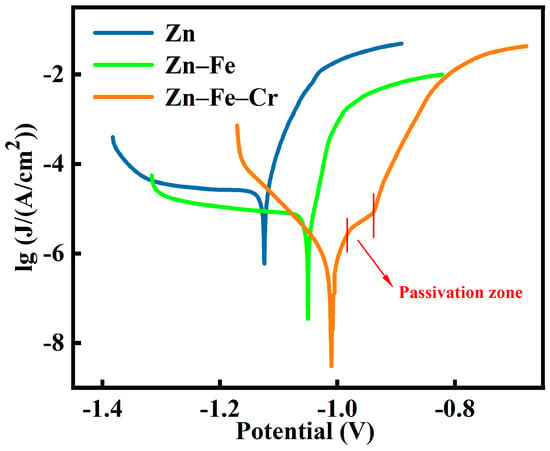
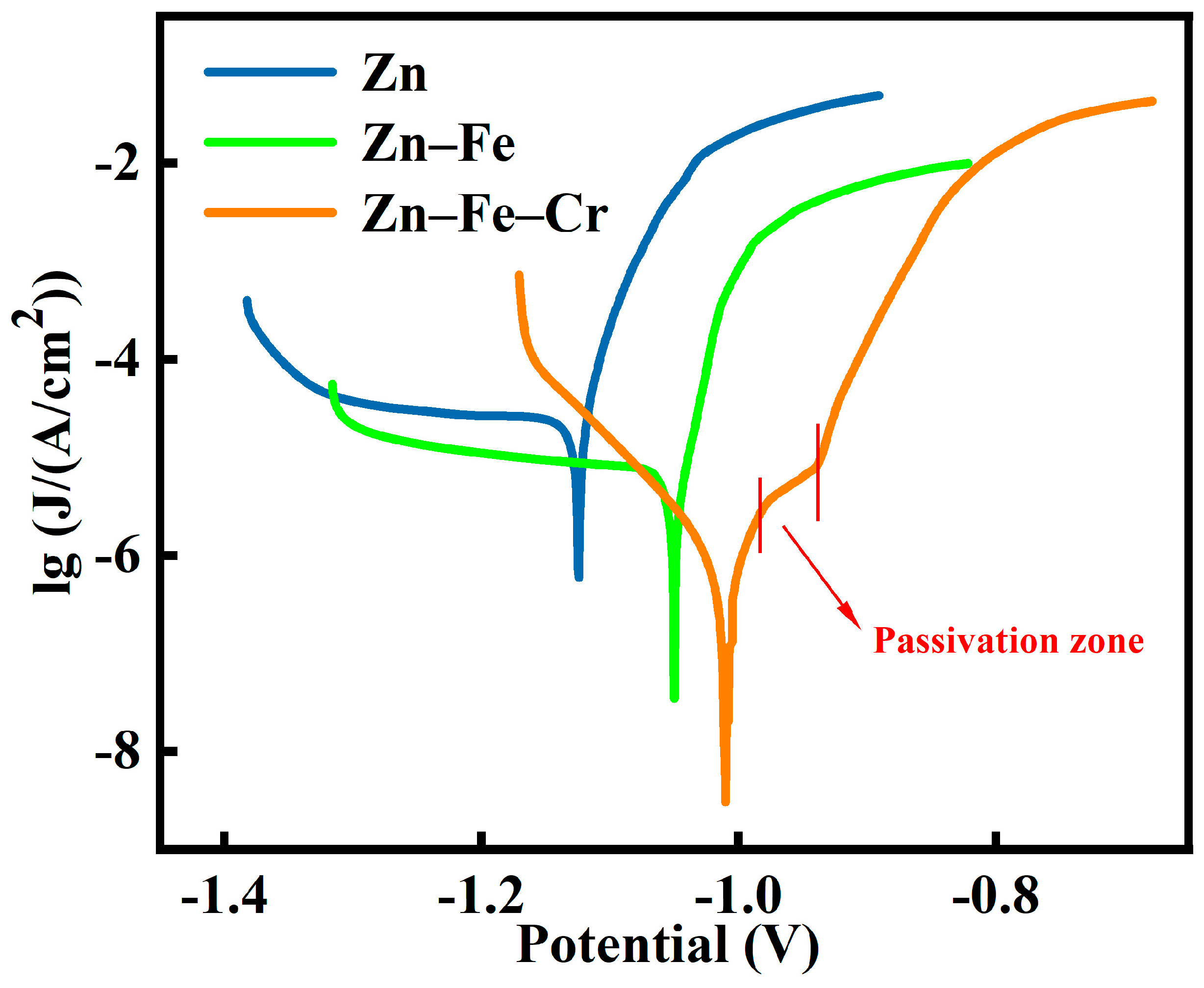
Figure 6 shows the Tafel test curves of different coatings in 3.5% NaCl solution. Unlike the polarization curves of Zn and Zn-Fe coatings, the curve for the Zn-Fe-Cr coating shows a passivation region in the anodic domain. This behavior can be attributed to oxidative processes occurring at the working electrode surface during corrosion [54], indicating that a protective oxide layer may be formed by corrosion on the surface of the Zn-Fe-Cr coating. The corrosion potential (Ecorr) and corrosion current density (Jcorr) for the three coatings were calculated using the Tafel extrapolation method, and the results are summarized in Table 3. A higher Ecorr is associated with a lower thermodynamic tendency for corrosion, while a lower Jcorr indicates a slower kinetics of the corrosion reaction [55]. The Zn coating showed an Ecorr of −1.12 V and a Jcorr of 10.03 × 10⁻⁶ A·cm−2. In contrast, the Zn-Fe coating showed a significantly more positive Ecorr of −1.04 V, while its Jcorr was approximately four times higher. Compared to the Zn-Fe coating, the Zn-Fe-Cr coating exhibited a substantial decrease in Jcorr from 2.23 × 10⁻⁶ to 0.28 × 10⁻⁶ A·cm−2, which was accompanied by only a slight shift in Ecorr of 0.03 V. This marked reduction in Jcorr may be related to the passivation region observed in its polarization curve. Tafel results indicate that, compared to both Zn-Fe and Zn coatings, the Zn-Fe-Cr coating shows superior corrosion resistance.
Figure 6.
The potentiodynamic polarization curves of different coatings.
Table 3.
Ecorr and Jcorr of different coatings.
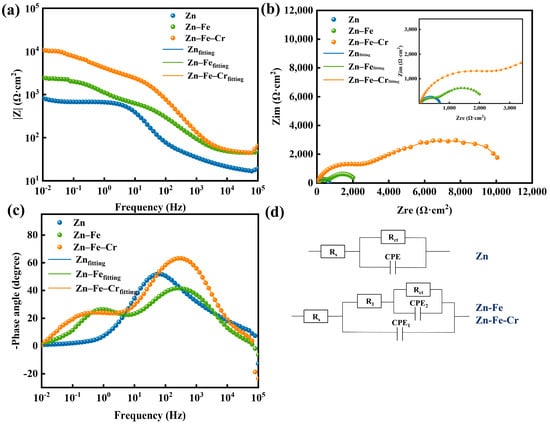
EIS testing provides a means to evaluate the overall corrosion performance of samples and guide the analysis of the corrosion behavior of the coating [56]. The test results of EIS testing of different coatings are shown in Figure 7. The equivalent circuit method was employed to fit the EIS data and calculate the resistance and capacitance values of the coatings. The impedance response of the Zn coating was characterized by a single semicircular arc in the Nyquist plot and a single time constant in the Phase angle plot. Accordingly, a model with one capacitor loop was used for fitting. Conversely, the Nyquist and Phase angle plots for both the Zn-Fe and Zn-Fe-Cr coatings each exhibited two semicircular arcs and two time constants, respectively. Therefore, an equivalent circuit with two capacitive loops was employed for the fitting. In the low-frequency region of the Phase angle plot, the additional time constant observed for the alloy coatings is attributed to a porous oxide layer that forms on the surface as a result of corrosion. In the equivalent circuit, R1 corresponds to the resistance to ionic conduction between the electrolyte and the porous layer of corrosion products on the surface of the coating, while CPE1 is attributed to the dielectric properties of this porous layer. Rs represents the solution resistance, Rct denotes the charge transfer resistance at the coating-solution interface, and CPE2 characterizes the capacitance of the electrical double layer [57,58,59].
Figure 7.
Electrochemical impedance spectra of different coatings: (a) Bode diagram; (b) Nyquist diagram; (c) Phase Angle diagram; (d) Equivalent circuit diagram.
The resistance values and dispersion coefficients calculated by the fitting procedure are summarized in Table 4. As the same test solution was used for all coatings, the fitted values for Rs were essentially identical. Therefore, the protective effect of a coating against corrosive media is quantified by the total polarization resistance, defined as Rp = R1 + Rct. A larger R1 value was observed for the Zn-Fe-Cr coating relative to the Zn-Fe coating. This is likely due to Cr incorporating the formation of the corrosion product layer, which consists of a mixture of zinc, iron, and chromium oxides. The composite oxide layer provides superior protection against corrosion compared to layers composed of a single oxide. This enhanced performance is consistent with the passivation region observed in the Tafel curve. After fitting, the values of n1 and n2 obtained for the Zn-Fe coating and the Zn-Fe-Cr coating are closer to 0 than the n value of the Zn coating, indicating that the surfaces of the Zn-Fe coating and the Zn-Fe-Cr coating are more similar to non-uniform surfaces [60]. This is related to the porous corrosion product layer that exists on the surfaces of Zn-Fe coatings and Zn-Fe-Cr coatings. A significant enhancement in corrosion resistance was shown for the Zn-Fe-Cr coating by its EIS parameters. The Rct value of the Zn-Fe-Cr coating increased to 9787 Ω·cm2 compared to 1416 Ω·cm2 of the Zn coating and 2241.8 Ω·cm2 of the Zn-Fe coating, indicating an enhancement in the corrosion resistance of Zn-Fe-Cr itself. Additionally, the R1 value of the Zn-Fe-Cr coating was higher than that of the Zn-Fe coating, rising from 663 Ω·cm2 to 2669 Ω·cm2, suggesting that the porous oxide layer on the surface of the Zn-Fe-Cr coating can provide better protection. Due to the increase in R1 and Rct, the total impedance of the Zn-Fe-Cr coating increased to 12,456 Ω·cm2, indicating that the Zn-Fe-Cr coating has better overall corrosion resistance. This trend is further reflected in the greater impedance modulus observed at low frequencies in the Bode plots. Overall, these EIS results demonstrate a substantial improvement in the corrosion resistance of the Zn-Fe-Cr coating, which is consistent with the findings from the Tafel tests.
Table 4.
The electrochemical parameters were obtained by fitting the equivalent circuit method.
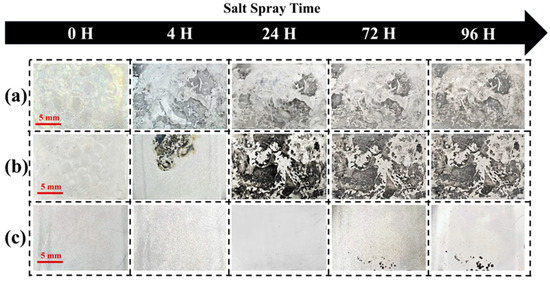
The results of NSS tests on different coatings are shown in Figure 8. Extensive corrosion was observed on the Zn coating after only 4 h of NSS tests, which shows a large area of white rust on its surface. Subsequent exposure led to further expansion of the corrosion products. In contrast, the formation of black corrosion products was localized at Zn-Fe coating corners after 4 h of NSS tests. After 8 h, the corrosion products were expanded, eventually covering the entire surface of the coating. No significant alteration in the macroscopic corrosion morphology was observed with further exposure. No obvious corrosion was observed on the Zn-Fe-Cr coating during the initial 72 h of NSS tests, which can be attributed to the protective chromate conversion film on its surface. After 72 h, tiny corrosion areas appear on the edges of the Zn-Fe-Cr coating. The corroded area was observed to further expand upon extending the exposure to 96 h.
Figure 8.
Results of NSS tests on different coatings: (a) Zn coating; (b) Zn-Fe coating; (c) Zn-Fe-Cr coating.
3.4. Corrosion Behavior Analysis
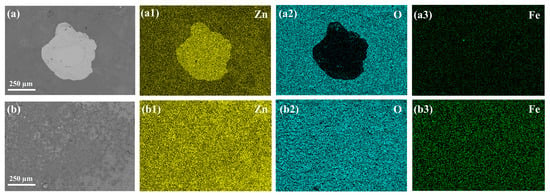
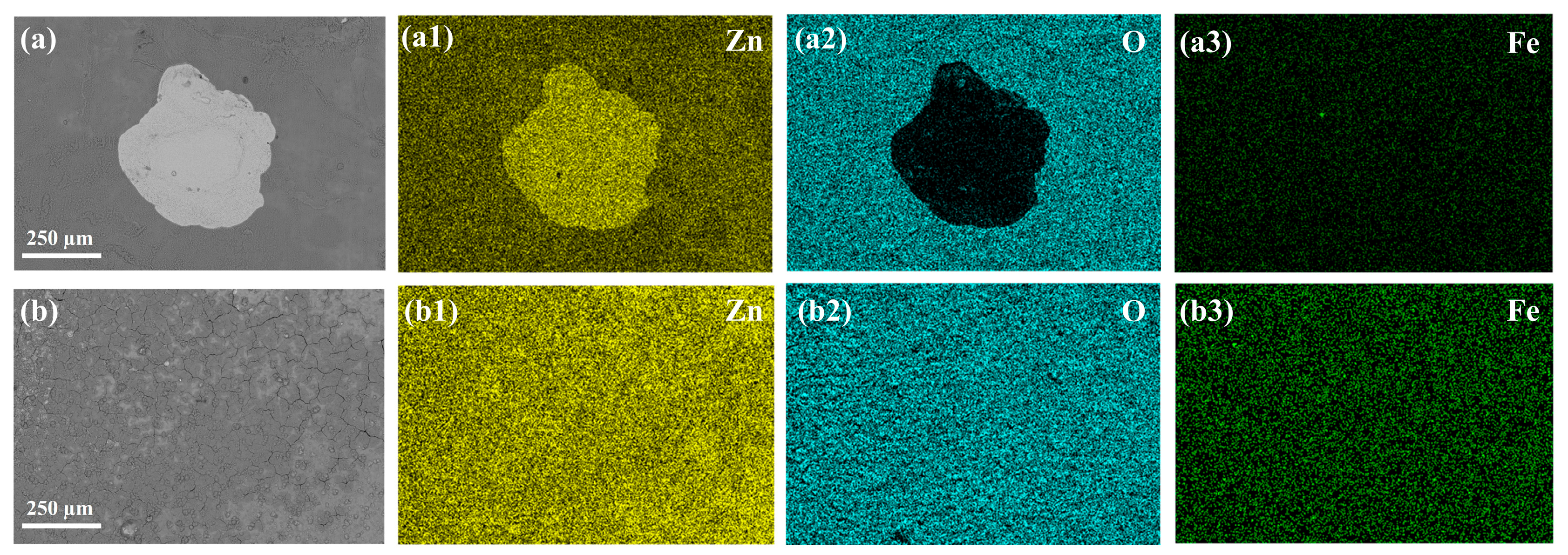
Figure 9 shows the corrosion morphology of the Zn and Zn-Fe coating after 96 h of NSS tests. Analysis of the BSE-SEM images indicated that corrosion severity correlated with image darkness. Local corrosion products on the surface of the Zn coating have fallen off, resulting in the formation of large-scale corrosion pits. Consistent with this, regions that appeared darkest, and thus most corroded, exhibited elevated oxygen levels according to elemental analysis. Previous literature indicates that the corrosion products of Zn coatings are mainly a mixture of ZnO, Zn(OH)2, and Zn5(OH)8Cl2·H2O [61,62]. Unlike the Zn coating, the surface of the Zn-Fe coating is covered with a layer of corrosion products containing microcracks. This is consistent with the secondary time constant seen in EIS, associated with a porous surface layer. The cracks likely resulted from the growth and interconnection of pores within this porous layer due to ongoing corrosion.
Figure 9.
BSE-SEM image of the surface of coatings after 96 h of NSS tests: (a) Zn coating; (b) Zn-Fe coating; (a1–a3,b1–b3) the elemental distribution of Zn (yellow area in a1,b1), O (blue area in a1,b2), Fe (green area in a3,b3).
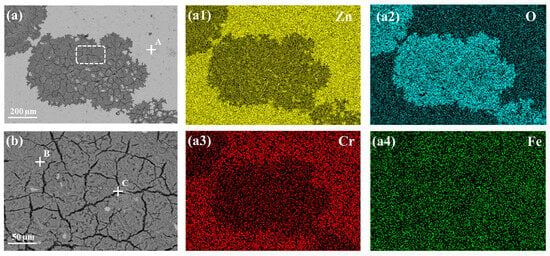
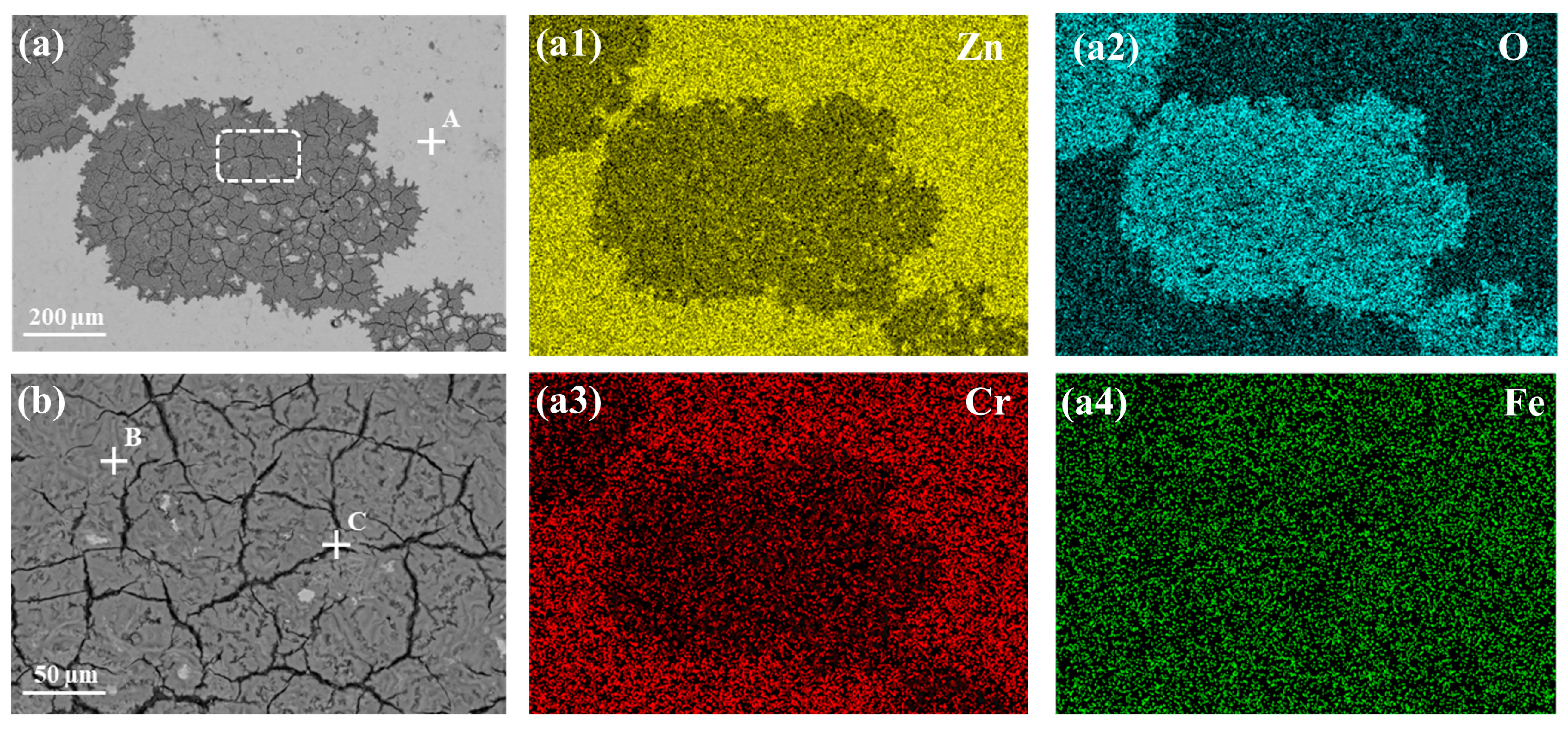
Figure 10 shows the corrosion morphology of the Zn-Fe-Cr coating after corrosion in NSS tests. The Zn-Fe-Cr coating was observed to exhibit a corrosion morphology similar to that of the Zn-Fe coating, with densely distributed microcracks present in the corroded regions of both. In the NSS tests, unlike the Zn-Fe coating, the Zn-Fe-Cr coating did not undergo large-scale corrosion, and its microcracks were confined to a small, localized area of complete corrosion. As shown in Figure 7, a second capacitive loop was also shown in the EIS spectrum of the Zn-Fe-Cr coating, which was attributed to its surface corrosion product layer. Moreover, the Tafel polarization curve revealed a distinct passivation zone of the Zn-Fe-Cr coating. These findings suggest that during corrosion, oxidation reactions occur among the elements within the Zn-Fe-Cr coating. This leads to the formation of a cracked corrosion product layer on the surface, which functions as a passivating film to protect the underlying coatings. Large-area corrosion can be effectively suppressed by the cracked passivation layer that results from this form of corrosion [63,64]. And the R1 value for Zn-Fe-Cr coating was larger than that of the Zn-Fe coating, indicating that the corrosion product layer of Zn-Fe-Cr coating shows more effective protection roles than the corrosion product layer of Zn-Fe coating, which is due to Cr incorporating the formation of the corrosion product layer. And made the expansion rates of the corrosion areas on Zn-Fe-Cr coating significantly slower than Zn-Fe coating. From the perspective of the corrosion morphology of the coatings, the Zn coating was dominated by local corrosion within 96 h of the neutral salt spray test, while the Zn-Fe and Zn-Fe-Cr coatings were dominated by uniform corrosion [64]. After 96 h of neutral salt spray test, the surface of the Zn coating exhibited a morphology of corrosion products falling off, indicating that the pitting corrosion on the coating surface had expanded and the corrosion products had fallen off, forming corrosion pits, which was a severe local pitting corrosion. The local thickness of the coating surface had significantly decreased. After 96 h of salt spray corrosion, the Zn-Fe coating and Zn-Fe-Cr coating still had a corrosion product layer covered with microcracks on their surfaces. The coatings were in the stage of thickening, indicating that at this point, the Zn-Fe coating and Zn-Fe-Cr coating were still in the stage of uniform corrosion. The difference is that the area of the corroded region of the Zn-Fe-Cr coating is much smaller than that of the Zn-Fe coating. Table 5 shows the results of EDS elemental analysis at the selected points. It was observed that in regions exhibiting less corrosion, the concentrations of oxygen and chlorine were significantly lower than in severely corroded regions. Furthermore, analysis of the cracks within the corroded area revealed a higher iron content compared to the bulk coating, suggesting an enrichment of iron at these crack sites.
Figure 10.
BSE-SEM image of Zn-Fe-Cr coating after 96 h of NSS tests: (a) surface; (b) enlarged region in (a); (a1–a4) the elemental distribution of Zn (yellow area in a1), O (blue area in a2), Fe (red area in a3), Cr (green area in a4).
Table 5.
The EDS results of the mass fraction of elements at each selected point.
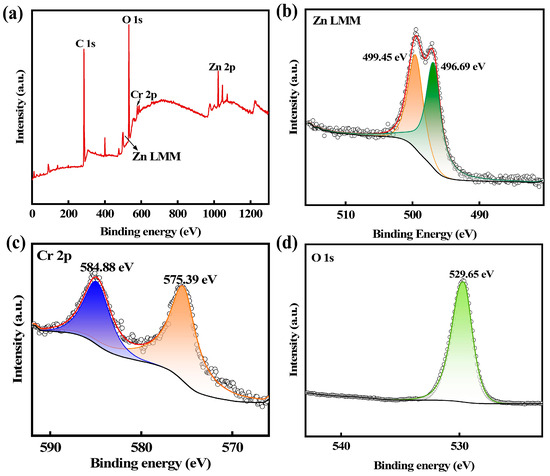
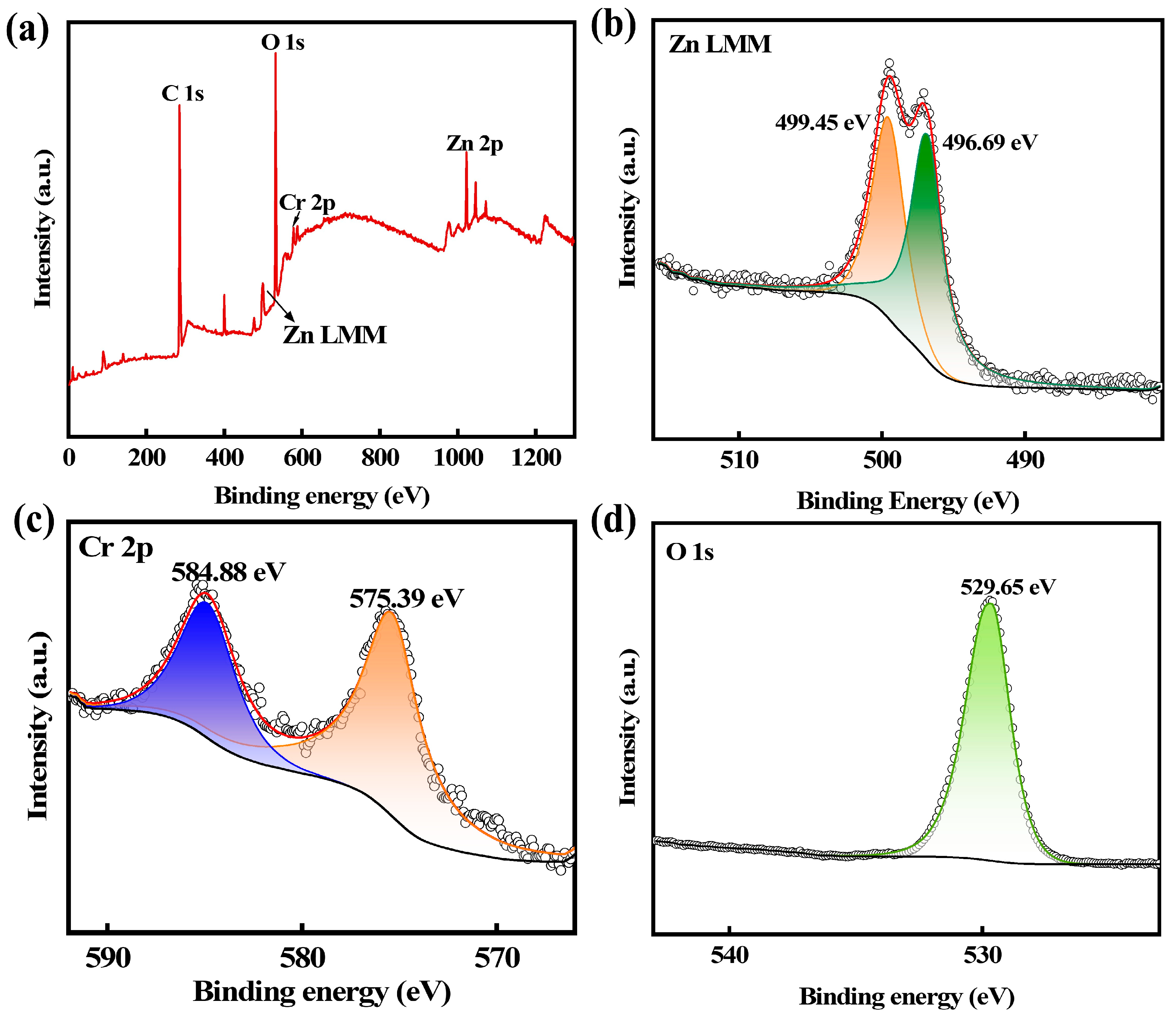
The formation of a composite corrosion product layer on the Zn-Fe-Cr coating was investigated by analyzing its corroded surface regions using XPS tests. The test results are shown in Figure 11. In the Zn LMM spectrum, two peaks were observed at 499.73 eV and 496.8 eV, corresponding to the presence of Zn2+ on the corroded area of the coating [22]. The presence of Cr2+ on the corroded area of the coating was confirmed by the Cr 2p fine spectrum, which showed characteristic peaks at 575.39 eV (Cr 2p3/2) and 584.88 eV (Cr 2p1/2) [49,65]. In the O 1s spectrum, a peak was observed at a binding energy of 529.65 eV. This peak is associated with the oxygen bonded to metal ions in oxide form [48]. No binding energy peak for OH− was detected, suggesting the failure of the original chromate film’s protection in corroded areas. Instead, under the corrosive conditions, a composite oxide layer consisting of ZnO and Cr2O3 was formed on the corroded area of the coating. This newly formed oxide layer can provide protection roles by inhibiting the further spread of corrosion.
Figure 11.
XPS results of Zn-Fe-Cr coating after corrosion: (a) Survey patterns; (b) Zn LMM; (c) Cr 2p; (d) O 1s.
4. Conclusions
The Zn-Fe-Cr coating was produced by electrodeposition from a bath containing HEDP. This work aimed to prepare and evaluate the Zn-Fe-Cr coating by analyzing how HEDP affects the metal electrodeposition process, comparing its corrosion resistance with Zn and Zn-Fe coatings, and examining its corrosion behavior under NSS tests. The following conclusions were reached:
(1) After adding HEDP, the reduction potentials of Zn2+ and Fe2+ shifted positively from the original −1.1 V and −1.0 V to −0.4 V, the difference in reduction potential with Cr3+ became smaller, and facilitating the co-deposition process.
(2) The Zn-Fe-Cr alloy coating is achieved through an anomalous co-deposition process. Its surface shows a chromate conversion film formed by immersion in a low-pH Cr3+ solution, and its microstructure consists of a solid solution with Fe and Cr in Zn. Furthermore, a preferred growth orientation of zinc grains along the (002) plane is enhanced. The coating exhibits a significantly reduced corrosion current density (Jcorr = 0.28 × 10⁻⁶ A·cm−2) and a substantially increased impedance compared to both Zn and Zn-Fe coatings. Consequently, its protective performance in NSS tests is markedly improved.
(3) During corrosion, an oxide layer containing ZnO and Cr2O3 is formed on the corroded areas of the Zn-Fe-Cr coating. This layer functions similarly to a passivation film, which alters the corrosion behavior of the coating. Compared to Zn and Zn-Fe coatings, the corrosion mode shifts from widespread corrosion to localized corrosion, and the rate at which the corroded area expands is significantly lower.
Author Contributions
R.C.: Investigation, methodology, data curation, formal analysis, writing—original draft. C.P.: conceptualization, formal analysis, writing—reviewing and editing, funding acquisition. X.W.: methodology, formal analysis, validation. M.W.: formal analysis, validation. J.C. and Y.Z.: resources. L.W.: project administration, funding acquisition2, writing—reviewing and editing. All authors have read and agreed to the published version of the manuscript.
Funding
This work was supported by the Key R&D Program of Shandong Province, China (Nos. 2023JMRH0303, 2024JMRH0304, 2025TSGCCZZB0742).
Data Availability Statement
The original contributions presented in this study are included in the article. Further inquiries can be directed to the corresponding authors.
Conflicts of Interest
Author Jiali Cui was employed by the company Shandong Zhuangfa Pump Co., Ltd.,. The remaining authors declare that the research was conducted in the absence of any commercial or financial relationships that could be construed as a potential conflict of interest.
References
- Sun, Q.S.; Zhu, M.G.; Wang, Q.; Zhu, C.; Yang, J.; Li, W. Design of novel quasi-trivalent dual-main-phase Ce magnets with high performance by manipulating the chemical state of Ce. Acta Mater. 2023, 246, 118703. [Google Scholar] [CrossRef] [Scilit]
- Trench, A.; Sykes, J.P. Rare Earth Permanent Magnets and Their Place in the Future Economy. Engineering 2020, 6, 115–118. [Google Scholar] [CrossRef] [Scilit]
- Ullah, R.; Daza, J.; Wederni, A.; Escoda, L.; Saurina, J.; Suñol, J.-J. A Review on Sustainable Recycling of NdFeB Waste: Methodologies, Challenges, and the Integration of Machine Learning (ML). Materials 2026, 19, 594. [Google Scholar] [CrossRef] [Scilit]
- Zhang, P.J.; Liu, Q.; Huang, J.; Cui, J.; Sun, W.; Li, B.; Xu, G. Phosphate conversion of electroplated Ni coatings on NdFeB magnets improving the anticorrosion property. J. Alloys Compd. 2022, 922, 166206. [Google Scholar] [CrossRef] [Scilit]
- Ye, L.S.; Yao, H.M.; Fang, Q.; Liang, T.; Wang, L. Effect of Ti Doping on the Grain Boundary Phases in Sintered Nd-Ce-Fe-B and Its Influence on the Diffusion Behavior of Heavy Rare Earth Dy. Materials 2026, 19, 916. [Google Scholar] [CrossRef] [Scilit]
- Hu, J.K.; Peng, C.X.; Zhan, H.; Bai, X.; Wang, L. Effect of grain boundary diffusion in TbF3-Al mixed electrophoresis on properties of sintered Nd-Fe-B magnets. J. Magn. Magn. Mater. 2023, 15, 170324. [Google Scholar] [CrossRef] [Scilit]
- Zhan, H.; Peng, C.X.; Xue, Y.Z.; Wang, X.; Lin, X.; Bai, X.; Wang, L. Effect of different deposition sequences on the magnetic properties of sintered Nd-Fe-B magnets diffused with multicomponent Tb-Cu films. J. Mater. Res. Technol. 2023, 27, 3161–3169. [Google Scholar] [CrossRef] [Scilit]
- Zhan, H.; Wang, Y.N.; Peng, C.X.; Yu, J.; Wang, Z.; Hu, J.; Bai, X.; Luo, Y.; Wang, L. Effect of multicomponent Tb-Cu films diffusion on the magnetic properties and thermal stability of sintered Nd-Fe-B magnets. J. Alloys Compd. 2023, 945, 169303. [Google Scholar] [CrossRef] [Scilit]
- Zhou, Q.Y.; Li, G.; Liu, Z.; Guo, S.; Yan, A.; Lee, D.; Li, J. Influence of the electroplating pretreatment on corrosion mechanism of NdFeB magnets. J. Rare Earths 2016, 34, 152–157. [Google Scholar] [CrossRef] [Scilit]
- Xu, J.L.; Xiao, Q.F.; Mei, D.D.; Tong, Y.; Zheng, Y.; Li, L.; Zhong, Z. Microstructure, corrosion resistance and formation mechanism of alumina micro-arc oxidation coatings on sintered NdFeB permanent magnets. Surf. Coat. Technol. 2017, 309, 621–627. [Google Scholar] [CrossRef] [Scilit]
- Rao, Z.H.; Xu, J.L.; Zhang, X.H.; Huang, J.; Zhang, J.; Luo, J. Corrosion resistance of Al2O3/Cr composite coating on sintered NdFeB magnet. J. Magn. Magn. Mater. 2025, 619, 172895. [Google Scholar] [CrossRef] [Scilit]
- Di, J.H.; Guo, S.; Chen, L.; Yi, P.; Ding, G.; Chen, K.; Li, M.; Lee, D.; Yan, A. Improved corrosion resistance and thermal stability of sintered Nd-Fe-B magnets with holmium substitution. J. Rare Earths 2018, 36, 826–831. [Google Scholar] [CrossRef] [Scilit]
- Ji, M.; Zhang, H.G.; Liu, W.Q.; Wang, X.; Wang, Z.; Guo, Z.; Wu, H.; Du, R.; Dong, S.; Li, Y.; et al. Strengthening magnetic and corrosion performances of NdFeB magnets via grain boundary diffusion with Tb element. Mater. Charact. 2025, 223, 114881. [Google Scholar] [CrossRef] [Scilit]
- Zhou, T.J.; Yang, X.X.; Wang, Q.R.; Chen, J.; Bao, W.; Yu, B.; Liu, R.; Xie, G. Effect of diffusing TbH3 on magnetic, corrosion and mechanical properties of NdFeB magnet. J. Alloys Compd. 2023, 968, 172079. [Google Scholar] [CrossRef] [Scilit]
- Shao, Y.X.; Ni, J.J.; Wang, Z.W.; Wang, X.; Xu, K.; Song, B.; Xu, Y.; Zhou, S.; Liu, T.; Luo, L. Relations of magnetic and electrochemical anti-corrosion properties of (Zr, Ti)-doped NdCeFeB magnets with Ti content. J. Mater. Res. Technol. 2024, 33, 4083–4091. [Google Scholar] [CrossRef] [Scilit]
- Huang, L.C.; Song, J.M.; Chen, C.M. Effects of initial Cu grain size and impurity residues on the liquid phase reactions between molten solder and electroplated Cu. Mater. Charact. 2023, 206, 113459. [Google Scholar] [CrossRef] [Scilit]
- Hsu, P.C.; Chang, S.C.; Lu, W.X.; Liu, H.-C.; Ho, C.-E. Enhanced adhesion strength between electroplated Cu and ABF substrate with isothermal annealing treatment. Surf. Coat. Technol. 2024, 479, 130576. [Google Scholar] [CrossRef] [Scilit]
- Hudson, J.A.; Cardenas, H.E. Corrosion Behavior of Fe-Ni Electrodeposited Coatings in Weak Ammonium Hydroxide Solution. Corros. Mater. Degrad. 2025, 6, 15. [Google Scholar] [CrossRef] [Scilit]
- Lee, C.Y.; Chen, W.Y.; Chang, J.K.; Lee, H.-B. Deep-eutectic solution adding threonine additive associating with supercritical carbon dioxide to enhance zinc electroplating characteristics. Mater. Today Commun. 2024, 38, 107941. [Google Scholar] [CrossRef] [Scilit]
- Li, X.Y.; Ma, Y.C.; Peng, S.S. The microstructure and protective properties of electroplating zinc films on NdFeB from a chloride-free nonaqueous bath. RSC Adv. 2024, 14, 8641–8651. [Google Scholar] [CrossRef] [Scilit]
- Duan, L.S.; Chen, J.; Zhang, P.J.; Xu, G.; Lv, J.; Wang, D.; Shen, W.; Wu, Y. Organic-inorganic composite passivation and corrosion resistance of zinc coated NdFeB magnets. J. Alloys Compd. 2023, 936, 168292. [Google Scholar] [CrossRef] [Scilit]
- Wang, X.R.; Dai, Z.L.; Peng, C.X.; Zhan, H.; Xue, Y.; Chen, R.; Chi, Q.; Luo, Y.; Wang, L. Corrosion resistance of molybdate and phosphate composite passivation film on Zn-plated sintered Nd-Fe-B magnets. Appl. Surf. Sci. 2025, 689, 162543. [Google Scholar] [CrossRef] [Scilit]
- Sheu, H.H.; Lee, H.B.; Jian, S.Y.; Hsu, C.; Lee, C. Investigation on the corrosion resistance of trivalent chromium conversion passivate on electroplated Zn-Ni alloy. Surf. Coat. Technol. 2016, 305, 241–248. [Google Scholar] [CrossRef] [Scilit]
- Meng, X.; Wang, J.L.; Zhang, J.; Niu, B.-L.; Gao, X.-H.; Yan, H. Electroplated super-hydrophobic Zn-Fe coating for corrosion protection on magnesium alloy. Trans. Nonferrous Met. Soc. China 2022, 32, 3250–3258. [Google Scholar] [CrossRef] [Scilit]
- Maniam, K.K.; Paul, S. Corrosion Performance of Electrodeposited Zinc and Zinc-Alloy Coatings in Marine Environment. Corros. Mater. Degrad. 2021, 2, 163–189. [Google Scholar] [CrossRef] [Scilit]
- Abedini, B.; Parvini Ahmadi, N.; Yazdani, S.; Magagnin, L. Electrodeposition and corrosion behavior of Zn−Ni−Mn alloy coatings deposited from alkaline solution. Trans. Nonferrous Met. Soc. China 2020, 30, 548–558. [Google Scholar] [CrossRef] [Scilit]
- Lei, C.H.; Alesary, H.F.; Khan, F.; Abbott, A.P.; Ryder, K.S. Gamma-phase Zn-Ni alloy deposition by pulse-electroplating from a modified deep eutectic solution. Surf. Coat. Technol. 2020, 403, 126434. [Google Scholar] [CrossRef] [Scilit]
- Li, B.; Zhou, X.S.; Chen, X.P.; Fu, S.; Wang, X.; Zhao, D. Morphology and Anti-Corrosive Performance of Cr (III) Passivated Zn–Fe Alloy Coating on NdFeB Substrate. Materials 2022, 15, 7523. [Google Scholar] [CrossRef] [Scilit] [PubMed]
- Kwon, M.J.; Jo, D.H.; Cho, S.H.; Kim, H.T.; Park, J.-T.; Park, J.M. Characterization of the influence of Ni content on the corrosion resistance of electrodeposited Zn-Ni alloy coatings. Surf. Coat. Technol. 2016, 288, 163–170. [Google Scholar] [CrossRef] [Scilit]
- Yu, S.X.; Chen, L. Preparation Technology and Performances of Zn-Cr Coating on Sintered NdFeB Permanent Magnet. J. Rare Earths 2006, 24, 223–226. [Google Scholar] [CrossRef] [Scilit]
- He, M.S.; Shao, D.Y.; Feng, Y.Q.; Wei, Z.; Wu, W. Study on enhancing corrosion resistance of zinc-nickel alloy by synergistic action of dual-acids complexing agents. Mater. Today Commun. 2025, 43, 111700. [Google Scholar] [CrossRef] [Scilit]
- Zheng, J.W.; Wang, S.Y.; Zhang, S.; Cai, W.; Qiao, L.; Chen, H.; Ying, Y.; Li, W.; Yu, J.; Che, S. A novel self-repairing hydrophobic composite coating for anti-corrosion protection of sintered Nd-Fe-B. J. Mater. Res. Technol. 2023, 22, 3020–3032. [Google Scholar] [CrossRef] [Scilit]
- Zhou, X.W.; Guo, Y.; Lu, Z. 3D Xanthium-like of Ni-Co-Zn ternary alloys as superhydrophobic coatings toward porous Ti surface for its anti-icing performances. Surf. Coat. Technol. 2023, 473, 130034. [Google Scholar] [CrossRef] [Scilit]
- Yuan, X.T.; Sun, D.B.; Yu, H.Y.; Meng, H.; Fan, Z.; Wang, X. Preparation of amorphous-nanocrystalline composite structured Ni-P electrodeposits. Surf. Coat. Technol. 2007, 202, 294–300. [Google Scholar] [CrossRef] [Scilit]
- Lu, Y.J.; Luo, S.G.; Yang, M.N.; Ren, Z.H.; Liu, C.; Zou, Y.R.; Zhong, S.W.; Wu, Y. Corrosion mechanism of Ni deposits on magnets by pulse current electro-deposition. Surf. Coat. Technol. 2021, 409, 126833, Correction in Surf. Coat. Technol. 2021, 421, 127477. https://doi.org/10.1016/j.surfcoat.2021.127477. [Google Scholar] [CrossRef] [Scilit]
- Safavi, M.S.; Ghazijahani, S.S.; Rasooli, A. Pulsed electroplating of ZrO2-reinforced Ni-Cr alloy coatings from the duplex complexing agents-containing bath for engineering applications: Importance of operating conditions. Heliyon 2024, 10, e37631. [Google Scholar] [CrossRef] [Scilit]
- Jo, Y.; Kim, S.M.; Jeong, E.S.; Lee, K.T.; Jin, S.; Lee, W.Y.; Lee, S.-Y.; Lee, M.H. On the role of complexing agents in co-electrodeposition of SnAg alloy with uniform composition. Mater. Sci. Semicond. Process. 2023, 166, 107751. [Google Scholar] [CrossRef] [Scilit]
- Yan, R.; Gao, X.; He, W.; Chen, T.; Ma, H. 1-Hydroxyethylidene-1,1-diphosphonic acid (HEDP)-Zn complex thin films for the corrosion protection of cold-rolled steel (CRS). Corros. Sci. 2019, 157, 116–125. [Google Scholar] [CrossRef] [Scilit]
- Zheng, J.W.; Chen, H.B.; Cai, W.; Qiao, L.; Ying, Y.; Li, W.; Yu, J.; Jiang, L.; Che, S. Reaction mechanisms of copper electrodeposition from 1-hydroxyethylidene-1,1-diphosphonic acid (HEDP) solution on glassy carbon. Mater. Sci. Eng. B—Adv. Funct. Solid-State Mater. 2017, 224, 18–27. [Google Scholar] [CrossRef] [Scilit]
- Zhou, X.W.; Guo, Y.; Lu, Z. Magnetic and structural characteristics of self-assembly Co-Ni-Zn ternary nanocrystals. J. Alloys Compd. 2023, 969, 172438. [Google Scholar] [CrossRef] [Scilit]
- Wang, D.; Yang, J.X.; Xue, F.; Wang, J.; Hu, W. Experimental and computational study of zinc coordinated 1-hydroxyethylidene-1,1-diphosphonic acid self-assembled film on steel surface. Colloid. Surf. A—Physicochem. Eng. Asp. 2021, 612, 126009. [Google Scholar] [CrossRef] [Scilit]
- Lacour, S.; Deluchat, V.; Bollinger, J.C.; Serpaud, B. Complexation of trivalent cations (Al (III), Cr (III), Fe (III)) with two phosphonic acids in the pH range of fresh waters. Talanta 1998, 46, 999–1009. [Google Scholar] [CrossRef] [Scilit]
- Scheglova, N.V.; Popova, T.V.; Druzhinina, A.V.; Smotrina, T. Spectrophotometric study of complexation of cobalt (II) with HEDP in aqueous solutions. J. Mol. Liq. 2019, 285, 110909. [Google Scholar] [CrossRef] [Scilit]
- Qin, X.H.; Liu, S.Y.; Duan, J.Q.; Chen, W.; Fu, Z. Influence of grain sizes and secondary phases on the mechanical behavior and corrosion resistance in a non-equiatomic NiCrCoFeMoAlTi high-entropy alloy. Corros. Sci. 2024, 240, 112452. [Google Scholar] [CrossRef] [Scilit]
- Eliaz, N.; Venkatakrishna, K.; Chitharanjan Hegde, A. Electroplating and characterization of Zn-Ni, Zn-Co and Zn-Ni-Co alloys. Surf. Coat. Technol. 2010, 205, 1969–1978. [Google Scholar] [CrossRef] [Scilit]
- Di Sarli, A.R.; Culcasi, J.D.; Tomachuk, C.R.; Elsner, C.; Ferreira, J., Jr.; Costa, I. A conversion layer based on trivalent chromium and cobalt for the corrosion protection of electrogalvanized steel. Surf. Coat. Technol. 2014, 258, 426–436. [Google Scholar] [CrossRef] [Scilit]
- Szczygieł, B.; Laszczyńska, A.; Tylus, W. Influence of molybdenum on properties of Zn–Ni and Zn–Co alloy coatings. Surf. Coat. Technol. 2010, 204, 1438–1444. [Google Scholar] [CrossRef] [Scilit]
- Zhang, F.Y.; Zhang, L.J.; Wei, X.M.; Zhang, C.; Jia, Q.; Sun, K.; Duan, D.; Li, G. Corrosion and passive behaviors of the Co-Cr-Fe-Ni-Nb eutectic high-entropy alloys in different electrolyte solutions. Intermetallics 2025, 177, 108586. [Google Scholar] [CrossRef] [Scilit]
- Pan, J.; Cheng, Y.; Ding, Y.J.; Zhao, R.-C.; Jiang, T.; Feng, Z.-L.; Li, Y. Effect of square wave potential polarity and amplitude on property of trivalent chromium conversion coating applied on Zn−Al hot-dip coating. Trans. Nonferrous Met. Soc. China 2023, 33, 3067–3082. [Google Scholar] [CrossRef] [Scilit]
- Zhang, Y.; Hu, Z.; Bi, Y.; Sun, L.; Tian, S.; Sun, H.; Li, K.; Liu, W.; Liu, W.; Huang, G.; et al. Epitaxial Zn (002) growth directed by Cu (111): A dual-layer strategy toward stable and reversible Zn metal anodes. Energy Storage Mater. 2025, 79, 104366. [Google Scholar] [CrossRef] [Scilit]
- Wei, T.; Zhang, H.; Ren, Y.; Mo, L.; He, Y.; Tan, P.; Huang, Y.; Li, Z.; Zhu, D.; Hu, L. Building Near-Unity Stacked (002) Texture for High-Stable Zinc Anode. Adv. Funct. Mater. 2024, 34, 2312506. [Google Scholar] [CrossRef] [Scilit]
- Winiarski, J.; Tylus, W.; Krawczyk, M.S.; Szczygieł, B. The influence of molybdenum on the electrodeposition and properties of ternary Zn–Fe–Mo alloy coatings. Electrochim. Acta 2016, 196, 708–726. [Google Scholar] [CrossRef] [Scilit]
- He, J.Y.; Wu, Z.K.; Wang, C.; Peng, Y.; Wu, N.; Luo, F. Evolution of microstructure and mechanical properties of electroplated nanocrystalline Ni–Co coating during heating. Mater. Today Commun. 2024, 41, 110414. [Google Scholar] [CrossRef] [Scilit]
- Chen, C.C.; Gao, X.; Qiu, J.; Kang, X.; Gongsun, K.; Bu, C.; Zhao, C.; Ma, H. Dual-functional ionic liquid-thiophene nanoassembly for copper fine protection via simultaneous passivation and π-electron conduction. Chem. Eng. J. 2025, 522, 168143. [Google Scholar] [CrossRef] [Scilit]
- Xu, S.Y.; Li, F.; Chen, C.Y.; Bai, N.; Ju, D.; Zhang, J.; Li, X. Innovative deep eutectic solvent approaches in zinc electroplating for morphology enhancement, superior strength, and corrosion protection. J. Mol. Liq. 2024, 397, 124094. [Google Scholar] [CrossRef] [Scilit]
- Yang, Y.; Bian, Y.; Gao, Q.; Dong, S.; Ma, R.; Fan, Y.; Du, A.; Zhao, X.; Yang, M.; Cao, X. Corrosion resistance study of Zn-Ni-B4C composite superhydrophobic coatings with hierarchical rough structure. Appl. Surf. Sci. 2023, 622, 156882. [Google Scholar] [CrossRef] [Scilit]
- Winiarski, J.; Tylus, W.; Winiarska, K.; Szczygieł, B. The influence of molybdenum on the corrosion resistance of ternary Zn-Co-Mo alloy coatings deposited from citrate-sulphate bath. Corros. Sci. 2015, 91, 330–340. [Google Scholar] [CrossRef] [Scilit]
- Park, J.; Kosugi, D.; Hagio, T.; Kamimoto, Y.; Ichino, R.; Lee, M.-H. Improvement in corrosion resistance of ternary Zn-Fe-Mo plating by additional Mo-oxide coating. Surf. Coat. Technol. 2020, 389, 125567. [Google Scholar] [CrossRef] [Scilit]
- Punith Kumar, M.K.; Rekha, M.Y.; Agrawal, J.; Agarwal, T.M.; Srivastava, C. Microstructure, morphology and electrochemical properties of ZnFe-Graphene composite coatings. J. Alloys Compd. 2019, 783, 820–827. [Google Scholar] [CrossRef] [Scilit]
- Cordoba-Torres, P.; Mesquita, J.T.; Nogueira, P.R. Relationship between the Origin of Constant-Phase Element Behavior in Electrochemical Impedance Spectroscopy and Electrode Surface Structure. J. Phys. Chem. C 2015, 8, 4136–4147. [Google Scholar] [CrossRef] [Scilit]
- Cong, S.Y.; Zhou, H.X.; Li, W.Q.; Wei, X. The corrosion behavior of novel cold-sprayed Zn-xTa coating. Surf. Coat. Technol. 2025, 512, 132389. [Google Scholar] [CrossRef] [Scilit]
- Li, W.S.; Zhang, J.L.; Cui, S.; Wang, S.; Cheng, B. Influence of Al contents on the long-term corrosion behaviors of cold-sprayed Zn-xAl coatings. Surf. Coat. Technol. 2024, 476, 130201. [Google Scholar] [CrossRef] [Scilit]
- Xie, T.; Xiao, L.; Wang, Y.Y.; Lin, Y.; Dai, Y.; Wu, J. Corrosion behavior in novel lightweight steel produced by additive manufacturing using electrochemical methods and neutral salt spray test. Corros. Sci. 2025, 253, 112996. [Google Scholar] [CrossRef] [Scilit]
- Li, Z.; Shi, Z.Z.; Yan, Y.; Zhang, D.; Yang, K.; Li, H.F.; Zhang, H.; Wang, L.N. Suppression mechanism of initial pitting corrosion of pure Zn by Li alloying. Corros. Sci. 2021, 189, 109564. [Google Scholar] [CrossRef] [Scilit]
- Zeng, P.; Qiu, Z.G.; Wang, G.; Zheng, Z.; Zhou, Q.; Liao, X.; Zeng, D.; Huang, J. Enhanced corrosion resistance of NdFeB magnets via arc ion plated CrAlN coatings: Microstructure optimization and property evaluation. J. Alloys Compd. 2025, 1031, 180921. [Google Scholar] [CrossRef] [Scilit]

Disclaimer/Publisher’s Note: The statements, opinions and data contained in all publications are solely those of the individual author(s) and contributor(s) and not of MDPI and/or the editor(s). MDPI and/or the editor(s) disclaim responsibility for any injury to people or property resulting from any ideas, methods, instructions or products referred to in the content. |
© 2026 by the authors. Licensee MDPI, Basel, Switzerland. This article is an open access article distributed under the terms and conditions of the Creative Commons Attribution (CC BY) license.