


Abstract
Background/Objectives: Circadian clock gene variants have been linked to mood disorders, including seasonal affective disorder (SAD), suggesting that molecular pathways affecting seasonal mood are influenced by the circadian clock and sleep–wake patterns, but the molecular mechanisms underlying these links are poorly understood. Building on animal and human evidence that SLC20A2 influences seasonal circadian adaptation, we tested associations between five SLC20A2 single-nucleotide polymorphisms (SNPs) and symptoms of SAD and depression. Methods: We examined both single-SNP and multi-SNP genotypes in a deeply phenotyped undergraduate population and assessed whether these associations differed by sex. Results: Seasonality scores were strongly associated with differences in seasonal sleep duration in this population. Three SNPs (rs6988483, rs13281070, rs3763510) were significantly associated with self-reported SAD symptom severity, with the effects of SLC-3 and SLC-4 concentrated in males. Multi-SNP genotype analysis identified eight multi-SNP combinations associated with self-reported SAD. One risk genotype conferred roughly nine times greater odds of SAD symptoms in females, and this genotype and two protective genotypes showed no corresponding association with general depressive symptoms, suggesting these variants influence seasonal depression specifically, rather than depressive symptoms broadly. Five additional genotypes were protective against both SAD and depression. Conclusions: These findings provide initial evidence that SLC20A2 variation, at both the single-SNP and genotype level, may contribute to SAD risk in a sex-specific manner and that a subset of this variation may act on seasonal mood regulation independent of general depression risk. Our results support SLC20A2 as a candidate gene for circadian-related mood disorders and point to potential new therapeutic targets, though replication in larger, sex-balanced cohorts is needed.
1. Introduction
Seasonal Affective Disorder (SAD) is a subtype of major depressive disorder marked by recurrent episodes that follow a seasonal pattern, typically emerging in late autumn or winter [1,2]. SAD is distinguished from non-seasonal depression by atypical features including hypersomnia, overeating, carbohydrate cravings, and reduced energy, despite sharing core symptoms such as low mood and disrupted sleep with depression [3,4]. Although it presents a distinct seasonal course, SAD is not classified as a standalone disorder in the DSM-5-TR, but rather as a “with seasonal pattern” specifier applied to major depressive disorder and bipolar disorder [3]. SAD symptom prevalence, as measured by the self-reported Seasonal Pattern Assessment Questionnaire (SPAQ), rises approximately 0.2% per degree of latitude, with far-northern regions showing winter SAD symptom rates near 18.7% and subsyndromal SAD symptom rates as high as 44% [5]. These prevalence values are likely overestimates, as rates of SAD are lower when clinical diagnoses of SAD are considered [6]. North American rates are roughly twice those of Europe overall, suggesting that climate, genetic vulnerability, and sociocultural context also drive risk [7]. SAD represents a significant public health concern given its meaningful clinical and economic burden [8].
These geographic and latitudinal patterns point to light-dependent circadian mechanisms as a plausible biological factor for SAD. The endogenous circadian clock is a self-sustaining molecular oscillator centered in the SCN of the hypothalamus that requires continual entrainment to the external day-night cycle via a dedicated retinal pathway, with this regulation extending beyond the SCN to circadian clocks distributed throughout other brain regions and peripheral tissues [9,10,11]. Because shorter winter photoperiods provide a delayed and reduced light signal relative to summer, individuals whose internal clocks are less able to adjust to these shifts may be disproportionately susceptible to mood disturbances and sleep disruptions during shorter days or when shifting back to long days [12]. This raises the possibility that genetic variation influences circadian adaptability rather than seasonal light exposure alone and helps explain why individuals under similar environmental conditions may differ in SAD susceptibility. Circadian regulation and chronotype are thought to be key links between SAD and depression more broadly [13,14], though evidence for related phenomena, such as social jetlag, remains mixed [15].
Evidence for a genetic contribution to SAD comes from family studies, which show 14% to 26% elevated rates of this disorder among relatives of SAD patients [16,17,18], and from a twin study of seasonality attributing at least 29% of the variance in seasonal mood and behavior to genetic factors in both sexes [19]. Genes involved in serotonergic transmission, with variants in the serotonin transporter gene, were thought to influence seasonal depression symptoms [20,21,22], but a pooled case–control study did not find associations between the serotonin transporter promoter repeat length polymorphism (5-HTTLPR) and SAD [23]. In addition, a recent study reported no seasonal changes in brain serotonin availability, suggesting that genes involved in serotonergic transmission may not have a seasonal effect [24]. In addition, multiple circadian clock or clock-related genes, including CLOCK, CRY2, PER2, PER3, ZBTB20, and OPN4, have been found to have strong associations with symptoms of SAD [25,26,27,28,29]. The first GWAS of SAD (1380 cases and 2937 controls of European American ancestry) found no genome-wide statistical significance for single genes, though the strongest signal was an intronic variant within ZBTB20, a gene involved in neurogenesis, suggesting a complex and polygenic architecture of SAD, rather than a small number of large-effect genes [30].
SLC20A2 encodes PiT2, a type III sodium-dependent phosphate symporter that mediates cellular uptake of inorganic phosphate and is linked to cellular energy metabolism and signal transduction [31,32]. SLC20A2 is expressed broadly, including in VIP- and neuromedin-S-expressing neurons within the core of the SCN, placing it directly within the circadian pacemaker circuitry [33,34]. More direct mechanistic support comes from a murine study showing that SCN neurons in PiT2 knockout mice failed to adjust locomotor activity to stimulated winter photoperiods despite normal behavior under summer photoperiods and standard circadian phase shifts [35]. This inability to adapt to photoperiod changes indicates a potential role for this gene in seasonal rather than general circadian timekeeping. A subsequent human study using heart rate activity data from a genotyped cohort of 3000 medical interns found that certain SLC20A2 genotype combinations were associated with the reduced ability to adapt circadian rhythms to new shift-work sleep schedules, an effect that was again most pronounced in winter [12]. Together, these findings identify SLC20A2 as a strong candidate gene for seasonal depression. What remains missing is a link between these SLC20A2 variants and mood disruption.
In this study, we address this gap by testing associations between five independent SNPs in SLC20A2 and self-reported symptoms of SAD and general depression in a deeply phenotyped population sample (n = 567). We analyzed associations of both single-SNP and multi-SNP genotypes and tested whether these associations differ by sex.
2. Results
2.1. Sample Characteristics
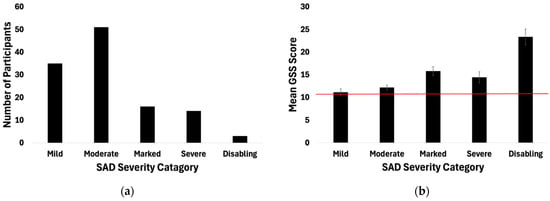
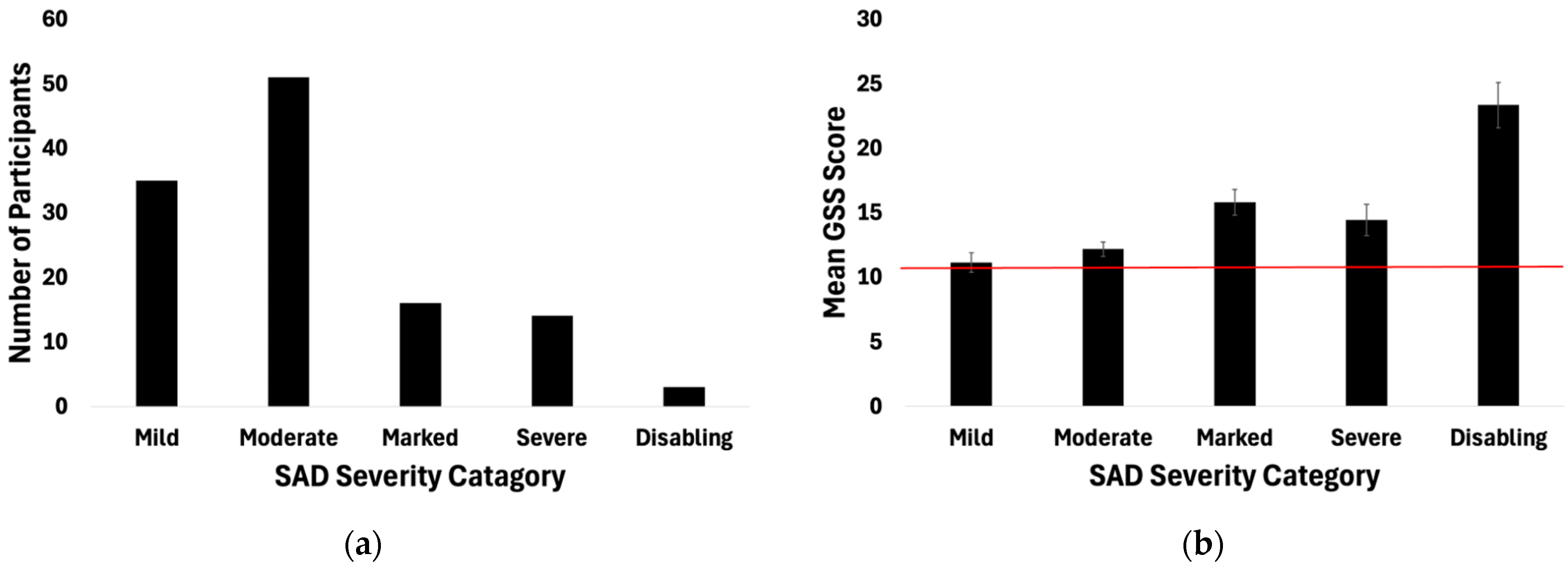
A total of 567 participants, primarily university students, took part in this study (mean age = 19 years, range 18–79). The sample included 406 female, 151 male, and 10 non-binary participants. Non-binary participants were omitted in the male/female sex comparisons; missing genotypes for some individuals altered sample sizes across SNP and genotype analyses. Based on Global Seasonality Scores (GSSs), 218 of 509 (42.83%) participants met the diagnostic threshold for SAD (GSS ≥ 11), including 180 of 367 (49.1%) females and 37 of 139 (26.62%) males. Average GSS was significantly higher in females than males (Mf = 10.66 ± 0.26; Mm = 7.74 ± 0.40; t = 6.062, df = 500, p = 2.644 × 10⁻⁹). 21% of individuals self-reported seasonality as an issue, with approximately a third of these individuals reporting a marked, severe, or disabling condition with high average GSSs (Figure 1). Based on BDI scores, 174 of 540 (32.2%) participants met the diagnostic threshold for depression (BDI ≥ 14), including 146 of 396 (36.87%) females and 28 of 144 (18.79%) males. Average BDI was also significantly higher in females than males (Mf = 11.83 ± 0.42; Mm = 9.11 ± 0.75; t = 3.612, df = 538, p = 3.324 × 10⁻⁴). GSS scores were not significantly correlated with BDI scores (Supplementary Figure S1).
Figure 1.
Self-reported assessment of severity of SAD symptoms. among participants. (a) Number of participants who reported issues related to seasonality on the Seasonal Pattern Assessment Questionnaire (SPAQ). Respondents rated the extent to which seasonal changes in mood, weight, sleep, energy, appetite, and social activity affected their lives (e.g., mild, moderate, marked, severe, or disabling). Bars represent the number of respondents in each category (n = 119). (b) Average GSS (±SE) of participants by self-reported rating of severity. The red line indicates the diagnostic threshold for SAD (GSS ≥ 11).
2.2. Relationship Between Sleep Differentials Across Seasons and GSSs
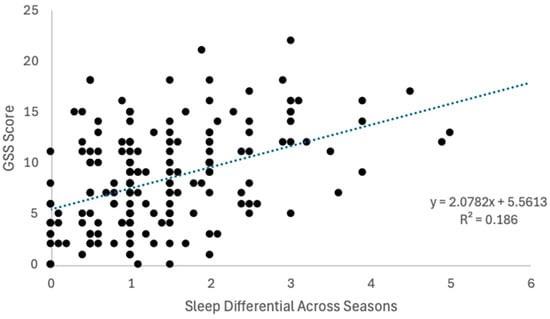
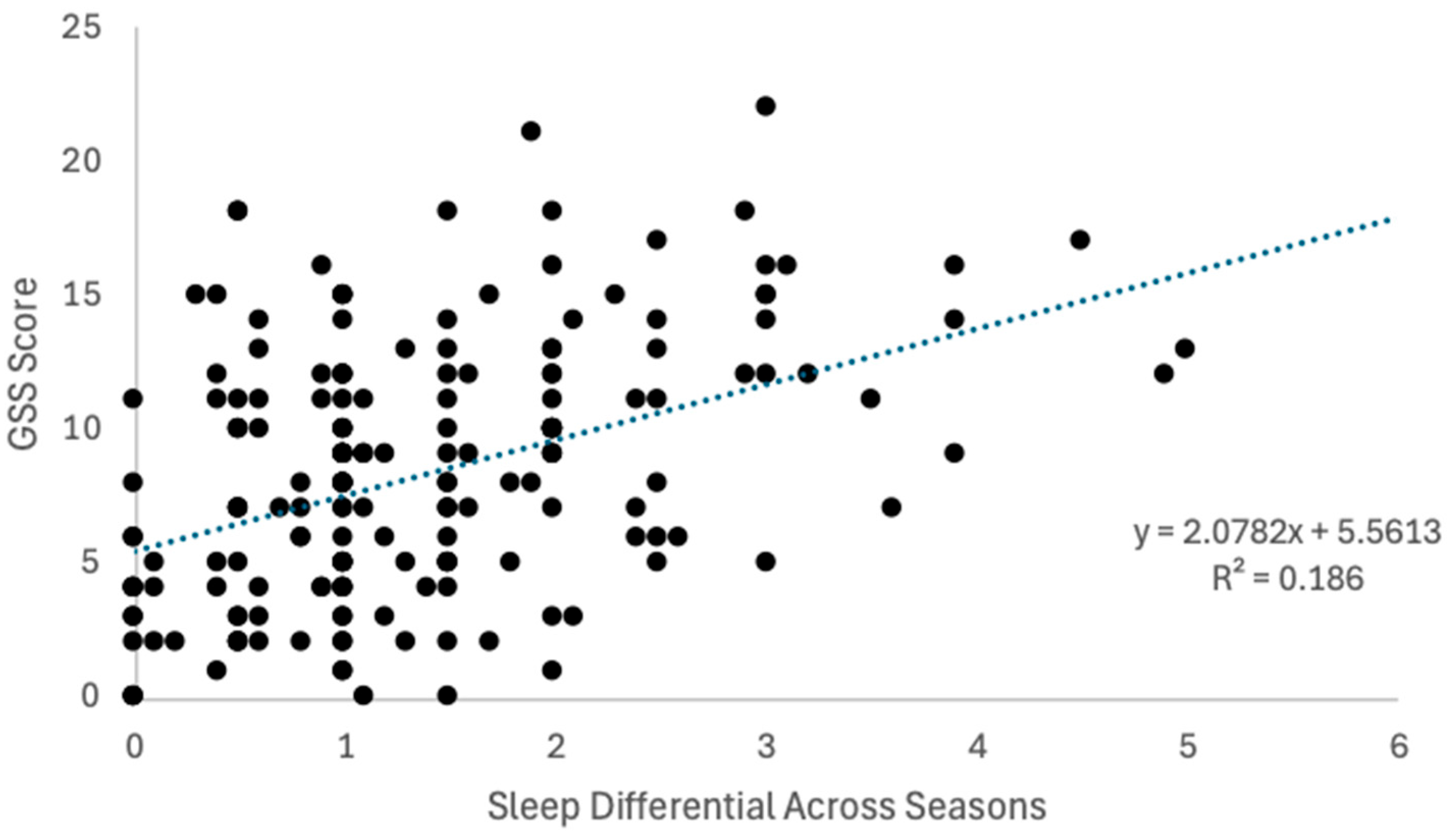
Individual GSSs and the average sleep duration differential across seasons were highly correlated (r = 0.425, t = 7.28, p = 4.6 × 10⁻¹²; Figure 2), suggesting that SAD symptoms may be related, in part, to differences in seasonal sleep patterns.
Figure 2.
. Positive correlation between individual seasonality (GSS) scores and sleep differential across seasons. Sleep differential (hrs) is calculated as the absolute value of the difference in average sleep duration during the summer and winter months for each individual. Sleep differential is significantly correlated with seasonality scores (r = 0.425, t = 7.28, p = 4.6 × 10⁻¹; individuals who have higher seasonality (worse mood) scores tend to have greater differences in their average sleep duration between winter and summer months.
2.3. Single SNP Genotype Associations
Of the five single SNPs investigated in this study, SLC-4 and SLC-5 genotypes showed overall and/or sex-specific associations with GSS and BDI scores, and SLC-3 showed a marginal association in males (Table 1 and Table 2). SLC-1 and SLC-2 showed no significant associations with either measure.
Table 1.
ANOVA results for associations of Global Seasonality Scores (GSSs) and Beck’s Depression Index (BDI-II) scores with single SLC20A2 SNP genotypes. Bold text indicates significance at p < 0.1.
Table 2.
ANOVA results for associations of Global Seasonality Scores (GSSs) with single SLC20A2 SNP genotypes by sex. Bold text indicates significance at p < 0.05.
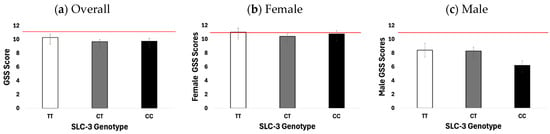
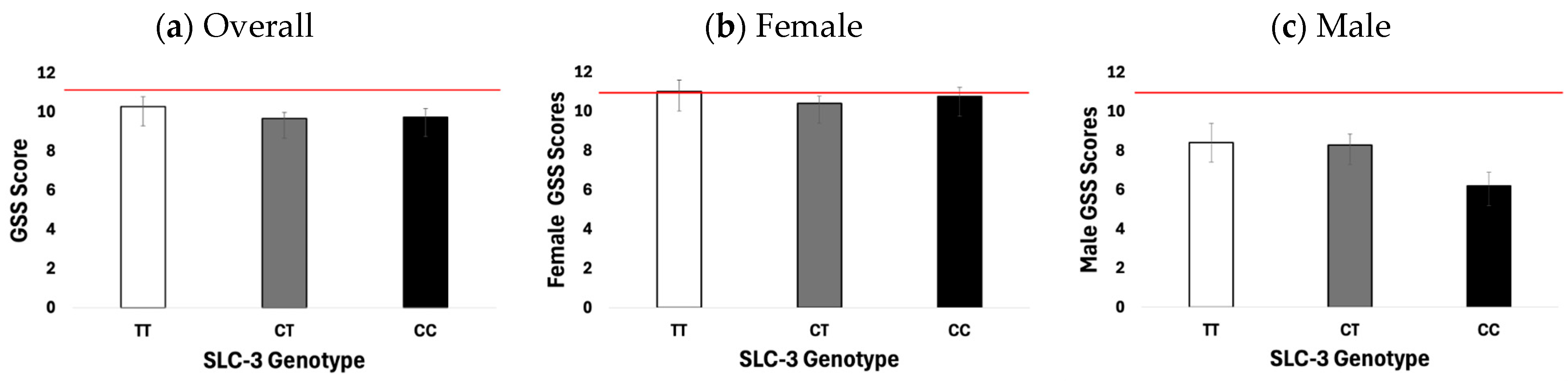
SLC-3. Overall GSS scores did not differ significantly across SLC-3 genotypes (F2,501 = 0.578, p = 0.561), though scores for this SNP tended to be lower in individuals with a C-allele compared to TT homozygotes (GSS(w/C) = 9.70 ± 5.02; GSS(TT) = 10.29 ± 5.38; t = 1.467, df = 499, p = 0.1431, Figure 3). This pattern did not hold in females alone (F(2,360) = 0.449, p = 0.639; Table 2), but males with the CC genotype showed a trend toward lower GSS than T-allele carriers (M = 6.19 ± 0.69 vs. 8.32 ± 0.49; F(1,137) = 2.355, p = 0.098; Table 2). Consistent with this, genotype distribution for SAD individuals vs. controls also differed across SLC-3 genotypes for males (χ2 = 6.53, df = 2, p = 0.0382), and when comparing males carrying a T-allele to CC homozygotes (χ2 = 5.41, df = 1, p = 0.02). Males with the CC genotype were nearly 5 times less likely to report SAD symptoms (OR = 0.2173, CI = 0.0618 to 0.7644, z = 2.379, p = 0.0174, Table 3), though this result was not significant after correction for multiple testing.
Figure 3.
Average seasonality (GSS) score (± SE) across SLC3 genotypes. Across all individuals (a) and among females (b), mean GSS did not differ significantly by SLC-3 genotype (overall: F(2,501) = 0.578, p = 0.561; females: F(2,360) = 0.449, p = 0.639). (c) Among males, mean GSS tended to differ by SLC3 genotype, with the lowest scores in CC homozygotes (F(2,137) = 2.355, p = 0.098). The red line indicates the diagnostic threshold for SAD (GSS ≥ 11).
Table 3.
Odds ratio results for associations of SLC20A2 SNPs and Global Seasonality Scores (GSSs) and Beck’s Depression Index (BDI) scores. Bold text indicates significance at p < 0.05 with correction for multiple testing.
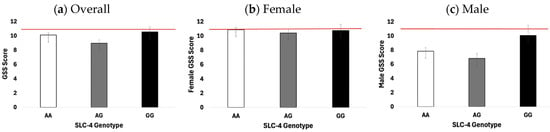
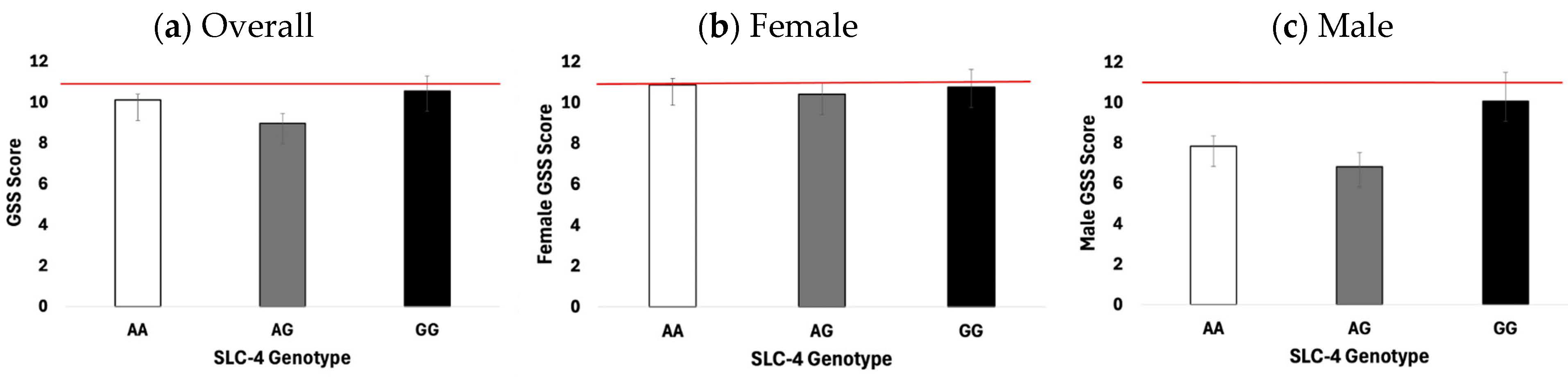
SLC-4. Overall GSS scores were significantly higher in individuals with the GG genotype relative to AA or AG genotypes at SLC-4 (F(2,501) = 3.450, p = 0.033; Tukey’s b: GG vs. AG&AA, Figure 4). This difference was absent in females (M = 10.87 ± 0.31 vs. 10.53 ± 0.48; F(2,361) = 0.225, p = 0.799; Table 3), but males with the GG genotype scored significantly higher in GSS than other genotypes (M = 10.07 ± 1.42 vs. 7.50 ± 0.42; F(2,134) = 2.663, p = 0.047, Table 3). Males with the AG genotype showed a non-significant trend toward lower odds of SAD symptoms relative to other genotypes (OR = 0.4968, CI = 0.1966 to 1.2551, z = 1.480, p = 0.1390, Table 3).
Figure 4.
Average GSS (± SE) differs across SLC-4 genotypes for overall and male samples. (a) Overall, mean GSS was significantly higher in individuals with the GG genotype compared to AA or AG genotypes (F(2,501) = 3.450, p = 0.033; Tukey’s b: GG > AG, AA). (b) Among females, mean GSS did not differ significantly by genotype (F(2,361) = 0.225, p = 0.799). (c) Among males, mean GSS score was significantly higher in individuals with the GG genotype compared to AA or AG genotypes (F(2,134) = 2.663, p = 0.047; Tukey’s b: GG > AG, AA). The red line indicates the diagnostic threshold for SAD (GSS ≥ 11).
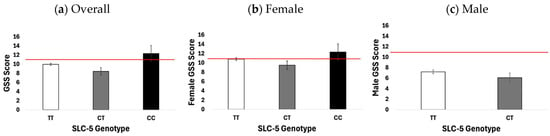
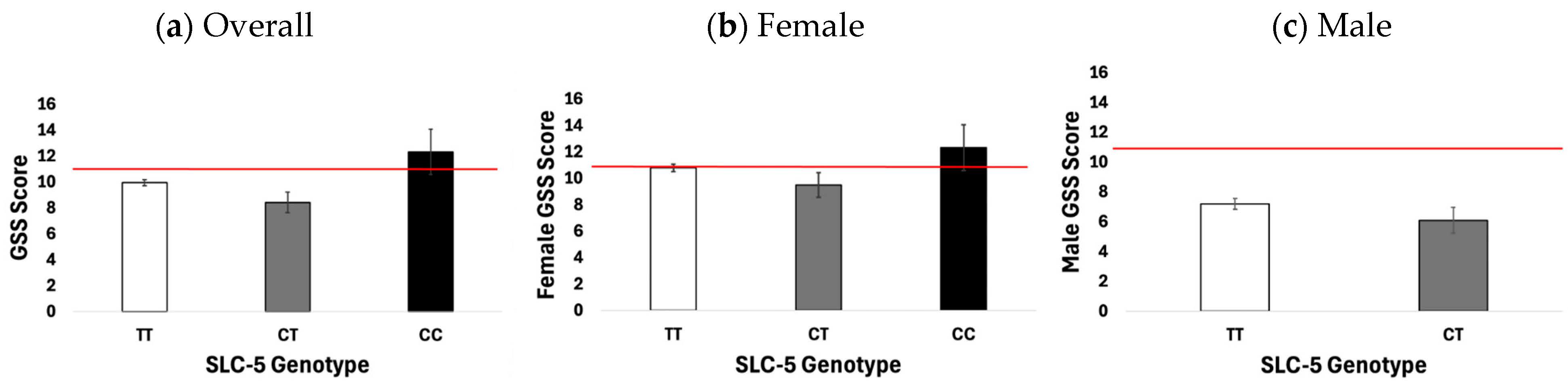
SLC-5. Overall GSS scores were significantly higher among CC carriers (F2,500 = 3.483, p = 0.031; Tukey’s b: CC vs. CT&TT, Figure 5). This effect did not reach significance within either sex alone, though females with the CC genotype showed a trend toward higher GSSs consistent with greater SAD symptoms relative to other genotypes (M = 12.33 ± 1.75 vs. 10.71 ± 0.27; F(2,360) = 1.134, p = 0.323).
Figure 5.
Average GSS (± SE) differs across SLC-5 genotypes for the overall sample. (a) Overall, mean GSS was significantly higher in individuals with the CC genotype compared to CT or TT genotypes (F(2,500) = 3.483, p = 0.031; Tukey’s b: CC > CT, TT). Genotypes for females (b) and males (c) did not differ significantly in GSS (females: F(2,360) = 1.134, p = 0.323; males: F(1,140) = 2.267, p = 0.134). The red line indicates the diagnostic threshold for SAD (GSS ≥ 11).
2.4. Multi-SNP Genotype Associations
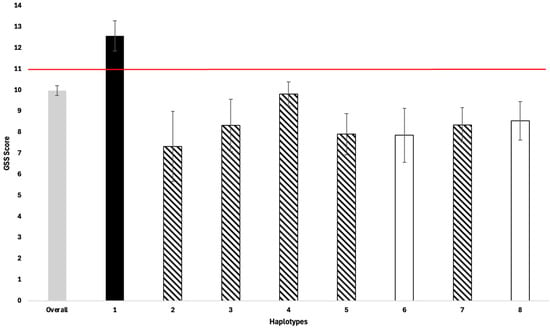
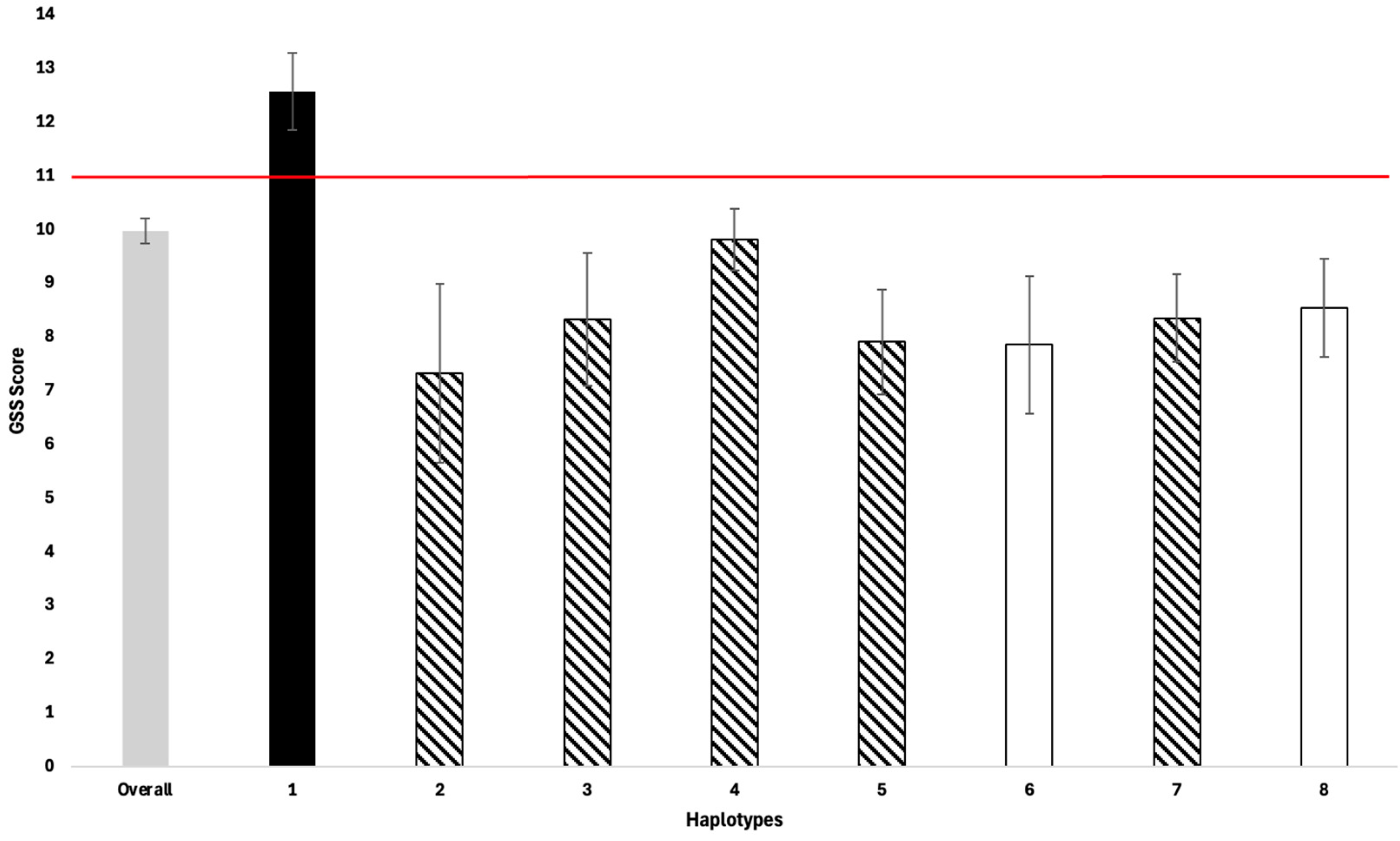
Of the 22 unique multi-SNP SLC genotypes tested, eight were associated with SAD (Figure 6; Table 4). Genotype 1 (= 7), found exclusively in females, was associated with a mean GSS (M = 12.57 ± 0.72) above the SAD threshold, indicating elevated SAD risk for individuals with this genotype. BDI scores in this group did not exceed the threshold for depression, suggesting that this genotype confers risk specific to seasonal depression rather than generalized depression. Females carrying this multi-SNP genotype had significantly higher odds of reporting SAD symptoms (OR = 8.79, CI: 1.23–75.33, z = 2.027, p = 0.043). The remaining seven genotypes had significantly lower mean GSSs (<11), indicating a protective effect against SAD. Of these, five (2, 3, 4, 5, 7) were also associated with below-threshold BDI scores, indicating protection against both SAD and generalized depression. The remaining two protective genotypes (6 and 8) were protective against SAD specifically, with no corresponding association with depression.
Figure 6.
Multi-SNP SLC20A2 genotypes significantly different from GSS (11) at the SAD diagnostic threshold. Bars represent average GSS for SLC Genotypes (±SE). Genotype 1 (black bar) is associated with increased risk of SAD (GSS = 12.57 ± 0.72). Genotypes 2, 3, 4, 5, 6, 7, and 8 are protective against SAD. Black and white striped bars indicate genotypes with associations with both SAD and depressive symptoms. White bars indicate a genotype protective against SAD only. The gray bar represents the overall average GSS for the population sample. The red line indicates the diagnostic threshold for SAD (GSS ≥ 11).
Table 4.
Multi-SNP genotypes significantly associated with Global Seasonality Scores (GSSs).
3. Discussion
A principal aim of the study was to determine whether SLC20A2 variation is associated with seasonal mood dysregulation specifically, or with depressive symptoms more generally. This distinction was motivated by murine evidence that SCN-specific SLC20A2 deletion produces a phenotype unable to adapt under simulated winter photoperiods, with locomotor behavior remaining normal under summer photoperiods [32] and human evidence that SLC20A2 genotype combinations were associated with a reduced ability to adapt circadian rhythms to new shift-work sleep schedules in winter [11]. Here, we report that seasonality scores in this undergraduate population are associated with differences in individual seasonal sleep schedules. Within this population, we also find multiple single-SNP associations in the SLC20A2 gene with self-reported SAD symptoms and robust associations of multi-SNP genotypes with self-reported SAD and depression symptoms. Our findings are consistent with this seasonal-specificity model: two protective genotypes (Genotypes 6 and 8) and a single risk genotype (Genotype 1) were associated with SAD risk without a corresponding association with general depressive symptoms, indicating a dissociation between seasonality-specific and general depressive outcomes.
3.1. Association of Single-SNP Genotypes with Self-Reported SAD
Of the five SNPs examined, SLC-3, SLC-4, and SLC-5 showed significant overall associations with SAD symptoms, while SLC-1 and SLC-2 did not. Because SLC20A2 has only recently been proposed as a candidate gene for seasonal regulation, prior single-SNP data on these loci come almost entirely from the medical intern cohort study that first identified SLC20A2 as a candidate gene [12]. As such, our findings should be read as an initial test of the association of these candidate variants with seasonal mood regulation in an independent population.
SLC-1 showed no significant overall association with SAD, though C-allele carriers trended toward higher odds of depression than non-carriers. SLC-2 showed no signal for either phenotype. This null result may partly reflect the low global minor allele frequency at this locus, which limits the statistical power available to detect a genotype-phenotype association even when a true effect exists [36]. Because no prior independent human data exists for the effect of this SNP on SAD, these null findings should be treated as preliminary rather than as evidence against a role for SLC-1 or SLC-2.
SLC-3 was associated with SAD, specifically in males; CC homozygotes had significantly lower average SAD symptom scores than T-allele carriers, and male genotype distributions differed significantly between more and less severely affected groups, an effect that was not observed in females or in the sample overall.
SLC-4 showed both an overall and a male-specific association with SAD. Individuals with the AG genotype had significantly lower overall SAD symptom scores than AA or GG homozygotes, and males had roughly 36% lower odds of reporting SAD symptoms for AG heterozygotes relative to homozygotes in the sample. Notably, at this same locus, individuals with the AG genotype had more than twice the odds of depression compared with AA or GG homozygotes, the opposite direction of effect from the AG genotype’s relationship with SAD. This dissociation between SAD and depression risk for the AG genotype is, to our knowledge, a novel finding for SLC20A2, and it strengthens the case that this gene contributes differently to seasonal-pattern symptoms than to general depressive symptoms, rather than acting as a single shared risk factor for both. As with SLC-3, there is no independent prior human dataset examining this SNP, so replication in an independent cohort will be needed before this dissociation can be considered established rather than a chance effect.
SLC-5 is the rarest of the five SNPs examined. Despite this low frequency, CT heterozygotes showed significantly lower SAD symptom scores than homozygotes overall, with a similar non-significant trend in females alone. At the allelic level, C-carriers also showed roughly ten times the odds of depression when compared with no-carriers. This locus may behave more like a general mood risk variant than a seasonality-specific one.
3.2. Sex-Specificity
Female participants showed significantly higher GSS and BDI scores than men, and the odds of females reporting SAD were four times higher than males. This mirrors clinical samples in which the female-to-male ratio for winter-pattern SAD has been reported as high as roughly 3.6 to 1, with men appearing to underreport symptoms relative to women [37], and a population-based cohort finding women’s prevalence of SAD roughly 1.5 times that of men, with women and men also differing qualitatively in which seasonal cues (temperature versus sunlight) most strongly trigger their symptoms [38]. A consistent pattern across the three significant SNPs showed that genotype-level associations were detected predominantly in males for SLC-3 and SLC-4, even though females in this sample had substantially higher rates of SAD and depression overall. This apparent paradox of a stronger genetic signal in the sex with lower prevalence has precedent in the broader SAD literature, where women show higher prevalence and greater symptom severity while men show more distinct behavioral response patterns to seasonal cues [39], and where a seasonal pattern of depressive symptoms has been detected in women but not men in very large population cohorts [36]. One plausible explanation is hormonal: estrogen’s modulation of serotonergic tone has been proposed to increase vulnerability to affective disorders through effects on serotonin receptors and intracellular signaling pathways [40]. Interactions within these pathways could introduce additional, non-genetic variance into female mood scores that partially obscures a direct SLC20A2 genotype-phenotype relationship without eliminating female risk itself.
3.3. Association of Multi-SNP Genotypes with SAD
Because the circadian clock is a complex system with multiple genetic redundancies playing a critical role in its function [41], it is unlikely that a single SLC20A2 SNP would confer substantial SAD risk on its own. An additive effect across multiple SNPs is more plausible and consistent with broader patterns in complex traits, including mood disorders, where risk typically reflects the combined contribution of multiple variants rather than any single locus [42].
This rationale motivated our genotype analyses, which identified eight SLC20A2 genotypes associated with SAD. Genotype 1 was associated with elevated SAD risk, with a mean GSS above the diagnostic threshold and approximately 9 times the odds of reporting SAD symptoms. However, Genotype 1 had no association with depression. A recent study has confirmed that SAD’s seasonal symptoms are distinct from major depression, validating the distinction between the two disorders [43]. The identification of an SLC20A2 multi-SNP genotype associated with SAD risk independent of depression risk suggests a link between SLC20A2 variation, altered photoperiod adaptation, and the mood changes characteristic of SAD specifically. This finding should be interpreted cautiously, as Genotype 1 was one of 22 unique genotypes identified in our sample and was carried by only seven individuals, all female. Replication in a larger, sex-balanced study will be needed before this association can be considered robust.
Two additional genotypes (6 and 8) were protective against SAD without any association with depression, reinforcing the presence of genotype-level effects specific to seasonality rather than mood more broadly. The five remaining multi-SNP genotypes were protective against both SAD and depression. This co-occurring protective effect suggests that a subset of SLC20A2 variation may relate to both general depression risk and seasonality. This pattern is not without precedent, as other circadian clock genes, such as BMAL1 (ARNTL), are involved with both major depression and SAD in mice [44]. Future studies should examine the role of SLC20A2 in generalized depression and other depressive disorders.
3.4. Limitations
This study uses a candidate-gene design, an approach that has faced replication challenges in psychiatric genetics, in conjunction with a multi-SNP genotype analysis. Because the link between SLC20A2 and SAD is currently supported by a mouse model and one prior human study [12,35], independent replication in an adequately powered sample will help establish the robustness of these findings. Additionally, SAD and depression status were derived from self-report instruments in a university-student sample with a relatively narrow age range representing primarily Caucasians of European descent, which may affect how well these findings generalize to older or more diverse populations. Several of the associations reported here, particularly at SLC-4 and SLC-5, involved lower-frequency alleles or smaller subgroups and correspondingly wider confidence intervals. These findings are best viewed as an early step that would benefit from replication in larger, sex-balanced cohorts.
4. Materials and Methods
4.1. Participants
Data was collected as part of a multi-year study investigating circadian rhythms and mood in the Colgate University community (total n = 567; median age = 19 years). Participants were recruited primarily through introductory biology courses from 2016 to 2026 using consecutive sampling. These courses included mostly first- and second-year undergraduate students. The only eligibility requirement was that participants be at least 18 years of age. A majority of the participants (85%) were Caucasian of European descent. Participants were not screened for psychiatric or substance use disorders, nor for a family history of mental illness.
All study procedures were approved by the Colgate University Institutional Review Board (#ER-F16-20 (6 October 2016, 28 September 2017, 14 February 2019, 7 October 2020), #ER-S24-05 (5 February 2024), and #ER-F25-06 (12 January 2026)), and written informed consent was obtained from all participants before enrollment. Data were de-identified, with access restricted to the principal investigator and research technician.
4.2. Self-Reported Surveys
Participants completed a computerized survey including the Beck Depression Inventory-II (BDI-II) and the Seasonal Pattern Assessment Questionnaire (SPAQ). Depressive symptoms were measured using the BDI-II, with scores categorized as not depressed (<14), mildly depressed (14–19), moderately depressed (20–28), or severely depressed (>28). Seasonal affective disorder symptoms were evaluated using the self-reported Seasonal Pattern Assessment Questionnaire (SPAQ) and its associated Global Seasonality Score (GSS) [2]. We classified individuals with SAD if they reported GSSs of 11 or greater, responded yes to an additional question that asked whether their seasonal symptoms were a problem, and indicated that their symptoms were moderate, marked, severe, or disabling. We did not classify SAD with clinical interviews or consider subsyndromal SAD symptoms in our study. Sleep differentials between seasons (the absolute value of summer-winter hours of mean sleep duration) were estimated for a subset of individuals for whom sleep data was available (n = 147).
4.3. Genotyping
DNA was extracted from 10 to 20 hair follicles collected from each participant. Hair follicles were digested for 24 h at 56 °C using Proteinase K, and DNA was purified with the DNeasy Micro Kit (Qiagen, Frederick, MD, USA). Genotyping of the SLC20A2 SNPs, SLC-1 (rs4737046), SLC-2 (rs34749433), SLC-3 (rs6988483), SLC-4 (rs13281070), and SLC-5 (rs3763510) (Table 5), and concentrations were estimated using the NanoDrop 2.0. Analysis of single nucleotide polymorphisms (SNPs) was performed using TaqMan SNP Genotyping Assays with real-time quantitative PCR. Blanks were used in every qPCR run and confirmed before genotyping. A previous study tested for linkage disequilibrium (LD) and confirmed that the five SNPs were independent [12]. Raw data (genotypes and GSS & BDI scores) are provided in Supplementary File S1.
Table 5.
Descriptive information about the five SLC20A2 SNPs.
4.4. Statistical Analysis
Associations between each SLC20A2 polymorphism (SLC-1, SLC-2, SLC-3, SLC-4, and SLC-5) and scores from the BDI-II and SPAQ questionnaires were evaluated individually, in the overall sample, and separately by sex. Linear regression analysis was used to measure the correlation between an individual’s seasonality (GSS) score and their sleep differential between seasons (absolute value of summer-winter). One-way ANOVAs were used to compare questionnaire scores across genotype groups with post hoc analyses using Tukey’s b and LSD comparisons; chi-square tests of independence examined associations between genotype and SAD status; and odds ratios were calculated for each polymorphism overall and by sex. Benjamini–Hochberg corrections for multiple testing were used to adjust p-values for chi-square tests and odds ratio tests.
For the multi-SNP analysis, complete SLC20A2 genotype data were available for 501 participants, yielding 22 unique genotypes with n = 6 or more individuals. One-sample t-tests were performed on each of the 22 most common multi-SNP genotypes by comparing mean GSS and BDI-II scores for each genotype against the diagnostic thresholds of each disorder (GSS ≥ 11, BDI ≥ 14). Benjamini–Hochberg corrections for multiple testing were used to adjust p-values for one-sample t-tests. Odds ratio analyses were calculated only for multi-SNP genotypes that showed significant differences from diagnostic thresholds of mood measures. All analyses were conducted in IBM SPSS Statistics version 29. Generative artificial intelligence (GenAI) was not used in the design of this study or the drafting of this manuscript.
5. Conclusions
This study offers early evidence in an independent human sample that SLC20A2 variation relates to self-reported SAD symptoms, that several of these associations are sex-specific, and that a subset of protective and risk multi-SNP genotypes may relate to seasonality independent of general depression risk. These patterns are consistent with SLC20A2’s proposed role in regulating seasonality. Future work could prioritize replication in larger, more demographically diverse cohorts, functional characterization of the SLC-3, SLC-4, and SLC-5 variants in SCN neurons, and formal testing of gene-by-sex interactions to clarify the mechanisms underlying the sex-specific patterns observed here.
Supplementary Materials
The following supporting information can be downloaded at: https://www.mdpi.com/article/10.3390/clockssleep8040076/s1.
Author Contributions
Conceptualization, K.K.I.; methodology, K.K.I.; validation, K.K.I., S.M. and E.C.C.; formal analysis, K.K.I., S.M. and E.C.C.; investigation, S.M. and E.C.C.; resources, K.K.I.; data curation, K.K.I.; writing—original draft preparation, K.K.I., S.M. and E.C.C.; writing—review and editing, K.K.I., S.M. and E.C.C.; visualization, K.K.I., S.M. and E.C.C.; funding acquisition, K.K.I. All authors have read and agreed to the published version of the manuscript.
Funding
This research was funded by the Picker Interdisciplinary Science Institute and the Robert H. N. Ho Mind, Brain, and Behavior Initiative at Colgate University.
Institutional Review Board Statement
The study was conducted in accordance with the Declaration of Helsinki and approved by the Institutional Review Board of Colgate University (#ER-F16-20 (6 October 2016, 28 September 2017, 14 February 2019, 7 October 2020), #ER-S24-05 (5 February 2024), and #ER-F25-06 (12 January 2026)).
Informed Consent Statement
Informed consent was obtained from all subjects involved in the study.
Data Availability Statement
The original dataset analyzed in this study is included in the Supplementary Materials (Supplementary File S1).
Acknowledgments
We would like to thank the Colgate undergraduate students and professors who volunteered to participate in this study. We also thank G. De Souza, L. Devens, A. Osteen, C. Quatrone, G. LaFave, and A. Rozales for their assistance with data collection.
Conflicts of Interest
The authors declare no conflicts of interest.
Abbreviations
The following abbreviations are used in this manuscript:
| BDI | Beck’s Depression Inventory |
| SLC20A2 | Solute Carrier Family 20 Member 2 |
| SCN | Suprachiasmatic nucleus |
| SNP | Single-nucleotide polymorphism |
| SAD | Seasonal affective disorder |
| SPAQ | Seasonal Pattern Assessment Questionnaire |
| GSS | Global Seasonality Score |
References
- Melrose, S. Seasonal Affective Disorder: An Overview of Assessment and Treatment Approaches. Depress. Res. Treat. 2015, 178564. [Google Scholar] [CrossRef] [Scilit] [PubMed]
- Rosenthal, N.; Bradt, G.; Wehr, T. Seasonal Pattern Assessment Questionnaire (SPAQ); National Institute of Mental Health: Bethesda, MD, USA, 1984.
- Munir, S.; Gunturu, S.; Abbas, M. Seasonal Affective Disorder. In StatPearls; StatPearls Publishing: Treasure Island, FL, USA, 2026. [Google Scholar]
- Lee, H.-J.; Rex, K.M.; Nievergelt, C.M.; Kelsoe, J.R.; Kripke, D.F. Delayed Sleep Phase Syndrome Is Related to Seasonal Affective Disorder. J. Affect. Disord. 2011, 133, 573–579. [Google Scholar] [CrossRef] [Scilit] [PubMed]
- Kim, K.; Kim, J.; Jung, S.; Kim, H.-W.; Kim, H.-S.; Son, E.; Ko, D.S.; Yoon, S.; Kim, B.S.; Kim, W.K.; et al. Global Prevalence of Seasonal Affective Disorder by Latitude: A Systematic Review and Meta-Analysis. J. Affect. Disord. 2025, 390, 119807. [Google Scholar] [CrossRef] [Scilit] [PubMed]
- Blazer, D.G.; Kessler, R.C.; Swartz, M.S. Epidemiology of Recurrent Major and Minor Depression with a Seasonal Pattern: The National Comorbidity Survey. Br. J. Psychiatry 1998, 172, 164–167. [Google Scholar] [CrossRef] [Scilit] [PubMed]
- Mersch, P.P.A.; Middendorp, H.M.; Bouhuys, A.L.; Beersma, D.G.M.; Van Den Hoofdakker, R.H. Seasonal Affective Disorder and Latitude: A Review of the Literature. J. Affect. Disord. 1999, 53, 35–48. [Google Scholar] [CrossRef] [Scilit] [PubMed]
- Fineberg, N.A.; Haddad, P.M.; Carpenter, L.; Gannon, B.; Sharpe, R.; Young, A.H.; Joyce, E.; Rowe, J.; Wellsted, D.; Nutt, D.J.; et al. The Size, Burden and Cost of Disorders of the Brain in the UK. J. Psychopharmacol. 2013, 27, 761–770. [Google Scholar] [CrossRef] [Scilit] [PubMed]
- Ashton, A.; Foster, R.; Jagannath, A. Photic Entrainment of the Circadian System. Int. J. Mol. Sci. 2022, 23, 729. [Google Scholar] [CrossRef] [Scilit] [PubMed]
- McCarthy, M.J.; Welsh, D.K. Cellular Circadian Clocks in Mood Disorders. J. Biol. Rhythm. 2012, 27, 339–352. [Google Scholar] [CrossRef] [Scilit] [PubMed]
- Johansson, C.; Willeit, M.; Smedh, C.; Ekholm, J.; Paunio, T.; Kieseppä, T.; Lichtermann, D.; Praschak-Rieder, N.; Neumeister, A.; Nilsson, L.-G.; et al. Circadian Clock-Related Polymorphisms in Seasonal Affective Disorder and Their Relevance to Diurnal Preference. Neuropsychopharmacology 2003, 28, 734–739. [Google Scholar] [CrossRef] [Scilit] [PubMed]
- Kim, R.; Fang, Y.; Lee, M.; Kim, D.W.; Tang, Z.; Sen, S.; Forger, D.B. Seasonal Timing and Interindividual Differences in Shiftwork Adaptation. NPJ Digit. Med. 2025, 8, 300. [Google Scholar] [CrossRef] [Scilit] [PubMed]
- Tonetti, L.; Fabbri, M.; Martoni, M.; Natale, V. Circadian Type and Mood Seasonality in Adolescents. Psychiatry Clin. Neurosci. 2012, 66, 157–159. [Google Scholar] [CrossRef] [Scilit] [PubMed]
- Zhang, L.; Evans, D.S.; Raheja, U.K.; Stephens, S.H.; Stiller, J.W.; Reeves, G.M.; Johnson, M.; Ryan, K.A.; Weizel, N.; Vaswani, D.; et al. Chronotype and Seasonality: Morningness Is Associated with Lower Seasonal Mood and Behavior Changes in the Old Order Amish. J. Affect. Disord. 2015, 174, 209–214. [Google Scholar] [CrossRef] [Scilit] [PubMed]
- Henderson, S.E.M.; Brady, E.M.; Robertson, N. Associations between Social Jetlag and Mental Health in Young People: A Systematic Review. Chronobiol. Int. 2019, 36, 1316–1333. [Google Scholar] [CrossRef] [Scilit] [PubMed]
- Thompson, C.; Isaacs, G. Seasonal Affective Disorder—A British Sample Symptomatology in Relation to Mode of Referral and Diagnostic Subtype. J. Affect. Disord. 1988, 14, 1–12. [Google Scholar] [CrossRef] [Scilit] [PubMed]
- Rosenthal, N.E.; Sack, D.A.; Gillin, J.C.; Lewy, A.J.; Goodwin, F.K.; Davenport, Y.; Mueller, P.S.; Newsome, D.A.; Wehr, T.A. Seasonal Affective Disorder: A Description of the Syndrome and Preliminary Findings with Light Therapy. Arch. Gen. Psychiatry 1984, 41, 72–80. [Google Scholar] [CrossRef] [Scilit] [PubMed]
- Wirz-Justice, A.; Bucheli, C.; Graw, P.; Kielholz, P.; Fisch, H.-U.; Woggon, B. Light Treatment of Seasonal Affective Disorder in Switzerland. Acta Psychiatr. Scand. 1986, 74, 193–204. [Google Scholar] [CrossRef] [Scilit] [PubMed]
- Madden, P.A.F.; Heath, A.C.; Rosenthal, N.E.; Martin, N.G. Seasonal Changes in Mood and Behavior: The Role of Genetic Factors. Arch. Gen. Psychiatry 1996, 53, 47–55. [Google Scholar] [CrossRef] [Scilit] [PubMed]
- Rosenthal, N.E.; Mazzanti, C.M.; Barnett, R.L.; Hardin, T.A.; Turner, E.H.; Lam, G.K.; Ozaki, N.; Goldman, D. Role of Serotonin Transporter Promoter Repeat Length Polymorphism (5-HTTLPR) in Seasonality and Seasonal Affective Disorder. Mol. Psychiatry 1998, 3, 175–177. [Google Scholar] [CrossRef] [Scilit] [PubMed]
- Enoch, M.-A.; Goldman, D.; Barnett, R.; Sher, L.; Mazzanti, C.M.; Rosenthal, N.E. Association between Seasonal Affective Disorder and the 5-HT2A Promoter Polymorphism, −1438G/A. Mol. Psychiatry 1999, 4, 89–92. [Google Scholar] [CrossRef] [Scilit] [PubMed]
- Molnar, E.; Lazary, J.; Benko, A.; Gonda, X.; Pap, D.; Mekli, K.; Juhasz, G.; Kovacs, G.; Kurimay, T.; Rihmer, Z.; et al. Seasonality and Winter-Type Seasonal Depression Are Associated with the Rs731779 Polymorphism of the Serotonin-2A Receptor Gene. Eur. Neuropsychopharmacol. 2010, 20, 655–662. [Google Scholar] [CrossRef] [Scilit] [PubMed]
- Johansson, C.; Willeit, M.; Levitan, R.; Partonen, T.; Smedh, C.; Del Favero, J.; Bel Kacem, S.; Praschak-Rieder, N.; Neumeister, A.; Masellis, M.; et al. The Serotonin Transporter Promoter Repeat Length Polymorphism, Seasonal Affective Disorder and Seasonality. Psychol. Med. 2003, 33, 785–792. [Google Scholar] [CrossRef] [Scilit] [PubMed]
- Pak, K. Brain Serotonin Transporter Remains Stable across Seasons: A Bayesian and Frequentist Meta-Analysis. NeuroImage 2026, 340, 122231. [Google Scholar] [CrossRef] [Scilit] [PubMed]
- Dang, T.; Russel, W.A.; Saad, T.; Dhawka, L.; Ay, A.; Ingram, K.K. Risk for Seasonal Affective Disorder (SAD) Linked to Circadian Clock Gene Variants. Biology 2023, 12, 1532. [Google Scholar] [CrossRef] [Scilit] [PubMed]
- Zhang, L.; Hirano, A.; Hsu, P.-K.; Jones, C.R.; Sakai, N.; Okuro, M.; McMahon, T.; Yamazaki, M.; Xu, Y.; Saigoh, N.; et al. A PERIOD3 Variant Causes a Circadian Phenotype and Is Associated with a Seasonal Mood Trait. Proc. Natl. Acad. Sci. USA 2016, 113, E1536–E1544. [Google Scholar] [CrossRef] [Scilit] [PubMed]
- Kim, H.-I.; Lee, H.-J.; Cho, C.-H.; Kang, S.-G.; Yoon, H.-K.; Park, Y.-M.; Lee, S.-H.; Moon, J.-H.; Song, H.-M.; Lee, E.; et al. Association of CLOCK, ARNTL, and NPAS2 Gene Polymorphisms and Seasonal Variations in Mood and Behavior. Chronobiol. Int. 2015, 32, 785–791. [Google Scholar] [CrossRef] [Scilit] [PubMed]
- Partonen, T.; Treutlein, J.; Alpman, A.; Frank, J.; Johansson, C.; Depner, M.; Aron, L.; Rietschel, M.; Wellek, S.; Soronen, P.; et al. Three Circadian Clock Genes Per2, Arntl, and Npas2 Contribute to Winter Depression. Ann. Med. 2007, 39, 229–238, Erratum in Ann. Med. 2007, 42, 555. [Google Scholar] [CrossRef] [Scilit] [PubMed]
- Roecklein, K.A.; Rohan, K.J.; Duncan, W.C.; Rollag, M.D.; Rosenthal, N.E.; Lipsky, R.H.; Provencio, I. A Missense Variant (P10L) of the Melanopsin (OPN4) Gene in Seasonal Affective Disorder. J. Affect. Disord. 2009, 114, 279–285. [Google Scholar] [CrossRef] [Scilit] [PubMed]
- Ho, K.W.D.; Han, S.; Nielsen, J.V.; Jancic, D.; Hing, B.; Fiedorowicz, J.; Weissman, M.M.; Levinson, D.F.; Potash, J.B. Genome-Wide Association Study of Seasonal Affective Disorder. Transl. Psychiatry 2018, 8, 190. [Google Scholar] [CrossRef] [Scilit] [PubMed]
- Beck-Cormier, S.; Lelliott, C.J.; Logan, J.G.; Lafont, D.T.; Merametdjian, L.; Leitch, V.D.; Butterfield, N.C.; Protheroe, H.J.; Croucher, P.I.; Baldock, P.A.; et al. Slc20a2, Encoding the Phosphate Transporter PiT2, Is an Important Genetic Determinant of Bone Quality and Strength. J. Bone Miner. Res. 2019, 34, 1101–1114. [Google Scholar] [CrossRef] [Scilit] [PubMed]
- SLC20A2 Solute Carrier Family 20 Member 2—NIH Genetic Testing Registry (GTR)—NCBI. Available online: https://www.ncbi.nlm.nih.gov/gtr/genes/6575/ (accessed on 23 July 2026).
- Inden, M.; Iriyama, M.; Takagi, M.; Kaneko, M.; Hozumi, I. Localization of Type-III Sodium-Dependent Phosphate Transporter 2 in the Mouse Brain. Brain Res. 2013, 1531, 75–83. [Google Scholar] [CrossRef] [Scilit] [PubMed]
- Soria, V.; Martínez-Amorós, È.; Escaramís, G.; Valero, J.; Pérez-Egea, R.; García, C.; Gutiérrez-Zotes, A.; Puigdemont, D.; Bayés, M.; Crespo, J.M.; et al. Differential Association of Circadian Genes with Mood Disorders: CRY1 and NPAS2 Are Associated with Unipolar Major Depression and CLOCK and VIP with Bipolar Disorder. Neuropsychopharmacology 2010, 35, 1279–1289. [Google Scholar] [CrossRef] [Scilit] [PubMed]
- Pierre-Ferrer, S.; Collins, B.; Lukacsovich, D.; Wen, S.; Cai, Y.; Winterer, J.; Yan, J.; Pedersen, L.; Földy, C.; Brown, S.A. A Phosphate Transporter in VIPergic Neurons of the Suprachiasmatic Nucleus Gates Locomotor Activity during the Light/Dark Transition in Mice. Cell Rep. 2024, 43, 114220. [Google Scholar] [CrossRef] [Scilit] [PubMed]
- Border, R.; Johnson, E.C.; Evans, L.M.; Smolen, A.; Berley, N.; Sullivan, P.F.; Keller, M.C. No Support for Historical Candidate Gene or Candidate Gene-by-Interaction Hypotheses for Major Depression Across Multiple Large Samples. Am. J. Psychiatry 2019, 176, 376–387. [Google Scholar] [CrossRef] [Scilit] [PubMed]
- Lucht, M.J.; Kasper, S. Gender Differences in Seasonal Affective Disorder (SAD). Arch. Women’s Ment. Health 1999, 2, 83–89. [Google Scholar] [CrossRef] [Scilit]
- Chotai, J.; Smedh, K.; Johansson, C.; Nilsson, L.; Adolfsson, R. An Epidemiological Study on Gender Differences in Self-Reported Seasonal Changes in Mood and Behaviour in a General Population of Northern Sweden. Nord. J. Psychiatry 2004, 58, 429–437. [Google Scholar] [CrossRef] [Scilit] [PubMed]
- Lyall, L.M.; Wyse, C.A.; Celis-Morales, C.A.; Lyall, D.M.; Cullen, B.; Mackay, D.; Ward, J.; Graham, N.; Strawbridge, R.J.; Gill, J.M.R.; et al. Seasonality of Depressive Symptoms in Women but Not in Men: A Cross-Sectional Study in the UK Biobank Cohort. J. Affect. Disord. 2018, 229, 296–305. [Google Scholar] [CrossRef] [Scilit] [PubMed]
- Joffe, H.; Cohen, L.S. Estrogen, Serotonin, and Mood Disturbance: Where Is the Therapeutic Bridge? Biol. Psychiatry 1998, 44, 798–811. [Google Scholar] [CrossRef] [Scilit] [PubMed]
- Erzberger, A.; Hampp, G.; Granada, A.E.; Albrecht, U.; Herzel, H. Genetic Redundancy Strengthens the Circadian Clock Leading to a Narrow Entrainment Range. J. R. Soc. Interface 2013, 10, 20130221. [Google Scholar] [CrossRef] [Scilit] [PubMed]
- Wendt, F.R.; Pathak, G.A.; Tylee, D.S.; Goswami, A.; Polimanti, R. Heterogeneity and Polygenicity in Psychiatric Disorders: A Genome-Wide Perspective. Chronic Stress 2020, 4, 2470547020924844. [Google Scholar] [CrossRef] [Scilit] [PubMed]
- Rohan, K.J.; Terman, J.M.; Iyiewuare, P.; Perez, J.; Camuso, J.A.; Postolache, T.T.; DeSarno, M.J.; Vacek, P.M. Prospectively Assessed Summer Mood Status in Major Depression, Recurrent with Seasonal Pattern: Evidence for SAD’s Construct Validity. J. Affect. Disord. 2024, 349, 32–38. [Google Scholar] [CrossRef] [Scilit] [PubMed]
- Ren, L.; Okimura, K.; Ishikawa, A.; Kon, N.; Shimba, S.; Yoshimura, T. The Role of Circadian Clock Gene Arntl in the Winter Depression-like Behavior in Melatonin-Proficient Female CBA/N Mice. Biochem. Biophys. Res. Commun. 2024, 734, 150790. [Google Scholar] [CrossRef] [Scilit] [PubMed]

Disclaimer/Publisher’s Note: The statements, opinions and data contained in all publications are solely those of the individual author(s) and contributor(s) and not of MDPI and/or the editor(s). MDPI and/or the editor(s) disclaim responsibility for any injury to people or property resulting from any ideas, methods, instructions or products referred to in the content. |
© 2026 by the authors. Licensee MDPI, Basel, Switzerland. This article is an open access article distributed under the terms and conditions of the Creative Commons Attribution (CC BY) license.