You are currently viewing a new version of our website. To view the old version click .

Clocks & Sleep, Volume 3, Issue 4

December 2021 - 10 articles

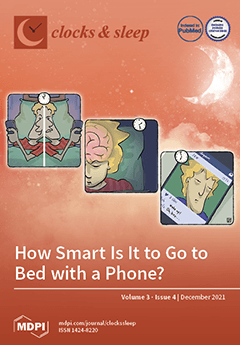
Cover Story: Smartphone usage before sleep can hinder restorative sleep, and it is disputed whether blue-light filters can prevent such adverse effects. Using a novel real-life approach we recorded polysomnography after participants read on a smartphone with or without a blue-light filter as opposed to a book and assessed affective states and hormone levels. Blue light negatively influenced sleep physiology and circadian rhythmicity. Furthermore, affective states at bedtime had an impact on subjective sleep quality. Thus, it is not smart to go to bed with a phone; however, blue-light filters can weaken the negative effects stemming from such actions. View this paper.
  • Issues are regarded as officially published after their release is announced to the table of contents alert mailing list .
  • You may sign up for email alerts to receive table of contents of newly released issues.
  • PDF is the official format for papers published in both, html and pdf forms. To view the papers in pdf format, click on the "PDF Full-text" link, and use the free Adobe Reader to open them.

Articles (10)

  • Article
  • Open Access
3 Citations
3,891 Views
9 Pages

Player Chronotype Does Not Affect In-Game Performance during the Evening (>18:00 h) in Professional Male Basketball Players

  • Michael Pengelly,
  • Nathan Elsworthy,
  • Joshua Guy,
  • Aaron Scanlan and
  • Michele Lastella

29 November 2021

Sport-specific skills display diurnal variation across various team sports such as badminton and tennis serving accuracy and soccer dribbling, volleying, and chipping execution. However, the effects of athlete chronotype on in-game sport-specific ski...

  • Article
  • Open Access
2 Citations
4,642 Views
9 Pages

29 November 2021

The influence of magnetic fields and natural geomagnetic storms on biological circadian rhythms are actively studied. This study reveals an impact of local natural perturbations in the geomagnetic field that occurred at different times of the day on...

  • Article
  • Open Access
2 Citations
4,079 Views
6 Pages

24 November 2021

Many dream content analytic studies focus on dream characters, animals, social interactions and so on, but they rarely analyze the frequency of everyday objects in dreams. In the present paper, the frequency and phenomenology of clock dreams in a dre...

  • Article
  • Open Access
4 Citations
3,856 Views
11 Pages

12 November 2021

Circadian rhythm disruption can elicit the development of various diseases, including breast cancer. While studies have used cell lines to study correlations between altered circadian rhythms and cancer, these models have different genetic background...

  • Article
  • Open Access
3 Citations
4,599 Views
17 Pages

GI-SleepNet: A Highly Versatile Image-Based Sleep Classification Using a Deep Learning Algorithm

  • Tianxiang Gao,
  • Jiayi Li,
  • Yuji Watanabe,
  • Chijung Hung,
  • Akihiro Yamanaka,
  • Kazumasa Horie,
  • Masashi Yanagisawa,
  • Masahiro Ohsawa and
  • Kazuhiko Kume

1 November 2021

Sleep-stage classification is essential for sleep research. Various automatic judgment programs, including deep learning algorithms using artificial intelligence (AI), have been developed, but have limitations with regard to data format compatibility...

  • Article
  • Open Access
21 Citations
10,313 Views
23 Pages

How Smart Is It to Go to Bed with the Phone? The Impact of Short-Wavelength Light and Affective States on Sleep and Circadian Rhythms

  • Sarah R. Schmid,
  • Christopher Höhn,
  • Kathrin Bothe,
  • Christina P. Plamberger,
  • Monika Angerer,
  • Belinda Pletzer and
  • Kerstin Hoedlmoser

28 October 2021

Previously, we presented our preliminary results (N = 14) investigating the effects of short-wavelength light from a smartphone during the evening on sleep and circadian rhythms (Höhn et al., 2021). Here, we now demonstrate our full sample (N = 33 me...

  • Perspective
  • Open Access
13 Citations
5,301 Views
11 Pages

25 October 2021

Available evidence on the risk of acute myocardial infarction (AMI) in the days after the spring daylight saving time (DST) transition suggests either a modest increase or no risk increase. Partial sleep deprivation and enhanced circadian clock misal...

  • Article
  • Open Access
12 Citations
14,952 Views
11 Pages

Timing and Composition of Last Meal before Bedtime Affect Sleep Parameters of Night Workers

  • Luciana F. R. Nogueira,
  • Pollyanna Pellegrino,
  • José Cipolla-Neto,
  • Claudia R. C. Moreno and
  • Elaine C. Marqueze

14 October 2021

Night workers tend to eat irregularly, both in terms of meal times and composition. The disruption in energy metabolism caused by inappropriate eating habits can negatively affect the sleep quality of these individuals. The objectives of this study w...

  • Article
  • Open Access
7 Citations
4,726 Views
8 Pages

The Impact of Chronotype on the Sleep and Training Responses of Elite Female Australian Footballers

  • Michele Lastella,
  • Dean J. Miller,
  • Manuella Quilelli,
  • Spencer Roberts,
  • Brad Aisbett and
  • Dominique Condo

11 October 2021

The primary aims of the present study were to examine the impact of chronotype on sleep/wake behaviour, perceived exertion, and training load among professional footballers. Thirty-six elite female professional football player’s (mean ± SD: age, 25 ±...

  • Article
  • Open Access
7 Citations
5,143 Views
13 Pages

Pilot Sleep Behavior across Time during Ultra-Long-Range Flights

  • Jaime K. Devine,
  • Jake Choynowski,
  • Caio R. Garcia,
  • Audrey S. Simoes,
  • Marina R. Guelere,
  • Bruno de Godoy,
  • Diego S. Silva,
  • Philipe Pacheco and
  • Steven R. Hursh

23 September 2021

Fatigue risk to the pilot has been a deterrent for conducting direct flights longer than 12 h under normal conditions, but such flights were a necessity during the COVID-19 pandemic. Twenty (N = 20) pilots flying across five humanitarian missions bet...

Get Alerted

Add your email address to receive forthcoming issues of this journal.

XFacebookLinkedIn
Clocks & Sleep - ISSN 2624-5175