


Abstract
Properties of natural bamboo fibers produced by Neosinocalamus affinis were studied. The natural bamboo fiber was evaluated for its mechanical properties, moisture absorption and thermal properties using Optical Contact Angle Meter (OCA), Thermo-gravimetric Analyzer and Electronic Fiber Strength Tester. Flax and jute fibers were selected as control fibres. The results show that the bamboo fiber is high in tenacity, but low in elongation, similar to all bast fibers. By testing, it was found that the bamboo fiber is low in density with a small contact angle when water dropped, since it is constituted by cellulose along with lignin and hemicellulose. The bamboo fiber has advantages in terms of moisture absorption, drying rate and thermal property. Hence, we predict that the bamboo fiber is suitable for summer textiles, similar to flax and jute fibers.
1. Introduction
As there is scarcity of information on bamboo fibers, the Chinese bamboo fiber market is confused. In our previous studies, we learnt the structural characteristics of the fiber [1,2]. The research results show that the bamboo fiber is alike bast fibers in chemical composition, that is, cellulose constitutes the major portion, and lignin needs to be reduced further for usage in textiles. The cellulose of bamboo fiber has smaller molecular mass and degree of polymerization than other bast fibers. However, natural bamboo fiber belongs to cellulose I crystalline structure, like that of cotton and ramie. Cross section of bamboo single fiber is similar to that of small lumen. Generally the structural characteristics of bamboo fiber are different from other textile plant fibers, which are often used in textile industry. Being a new textile fiber, what about the properties of bamboo fiber?
2. Experimental
2.1. Materials
In order to learn the chemical and physical properties of natural bamboo fiber, jute fiber (provided by Zhejiang Linen CO. LTD.) and flax fiber (provided by Haerbing Linen Mill) were chosen as control fibers. We produced the natural bamboo fiber from the bamboo of Neosinocalamus affinis.
Since bamboo fiber and jute fiber were semi-finished goods, it was necessary to pre-treat them, however, flax was a finished good. The flax was extracted by carbon tetrachloride to remove oil. The bamboo fiber and the jute fiber were chlorine bleached under the condition of 3g/l available chlorine concentration for 60-min at room temperature. After treatment, parameters of the fibers are listed in Table 1.
Table 1.
Parameters of the fibers.
In order to learn the relationships between the properties and the chemical composition of the bamboo fiber, chemical compositions of the bamboo fiber are listed in Table 2 [1]. It shows that natural bamboo fiber consists of more than 70% cellulose, while the contents of lignin and hemi-cellulose (especially lignin) are much more than that of the flax, and a little lower than that of the jute fiber.
Table 2.
Chemical components of the fibers [1].
We know that lignin is responsible for the stiffness and yellowness of natural bamboo fiber. However, it is impossible to remove the lignin clearly, as it is highly resistant to alkalis, resulting in great difficulties in delignification. Therefore, the properties of the bamboo fiber in this paper are obtained from the bamboo fiber with the chemical composition results listed in Table 2. Non-cellulose matters like pectin and hemi-cellulose will have significant effects on fiber properties, such as strength, flexibility, moisture, and even density.
2.2. Instruments and methods
2.2.1. Density
The experiment is conducted according to the Chinese standard FZ/T01057.9-1999 Identification of Textile Fiber is done by the Density Gradient Method. The density range of the standard balls is from 1.437g/cm3 to 1.562g/cm3. The n-heptane and carbon tetrachloride are mixed and poured slowly into the density gradient tube, which was immersed into a constant temperature trough at 25±0.5°C. The fiber balls are centrifuged in a centrifugal machine at a speed of 2000r/min, and then dried in a vacuum drying oven at 60°C.
2.2.2. Thermal properties
Thermal properties of the fibers are measured by Thermogravimetric Analyzer (TGA Q500) by Seiko Instruments Inc. The samples are tested under N2 atmosphere, which flow at the rate of 60ml/min. The temperature is increased at a velocity of 10°C/min from 25-600°C.
2.2.3. Strength and elongation
The fibers are drawn according to Chinese standard GB5886-86 Determination of Breaking Strength of Ramie Single Fiber is done. Before which, the specimens are pre-conditioned at RH65±5%, 20±3°C for 24h. Each fiber is pretensioned by 0.05cN/dtex. The clamping length between up clip and down clip is 20mm. And the down clip goes down at the speed of 20mm/min.
2.2.4. Moisture regain and water-retention rate
Moisture regain and water-retention rate are measured according to the Chinese standard GB/T9995 "The Determination of Water Absorption and Moisture Regain of the Textile Materials": Oven-Dry Method and DIN 53814 Methods separately.
When testing for water-retention rate of material, the specimens were immersed into distilled water for 30min. Then specimens were put into TDL-5 low-speed and high-capacity centrifugal machine which rotates at a speed of 3000r/min for 10min. After weighing, the specimens were dried at 105°C for 1h. Results were calculated by the following equation:
Where R—water-retention rate, %;
R = (W - W0)/ W0 × 100%
- W—wet weight after centrifuging, g;
- W0— dry weight, g。
2.2.5. Contact angle
By means of Optical Contact Angle Meter (OCA40) made in Germany, contact angles of the fibers were found. The experimental conditions are as follows: dropping method, the volume of water drop is 15pl; the contact angle of the fibers is measured by width and height of the drop.
2.2.6. Drying speed
After immersing in distilled water for 2h, the specimens were rotated in centrifugal machine at a speed of 3000r/min for 10min to remove free water. After drying in room under a certain temperature and humidity, fiber specimen was then weighed at 0s, 5s, 10s, 20s, 30s, 40s, 50s, 70s, 90s and 120s separately by AR2140 electronic balance. Finally, the three specimens were oven-dried in Y802L eight-baskets constant temperature oven. Results were calculated by the following equation:
Where, M — remaining water rate, %;
M=(Wtn-W0)/(Wt0-W0)× 100%
- Wtn— wet weigh at some time, g;
- W0 — dry weight after cooling, g;
- Wt0— wet weight after centrifuging, g
Drying speed of fiber is equal to the slope of drying curve.
3. Results and discussions
3.1. Density
The density gradient method is an effective way to determine the density of fiber, which partly reflects the characteristics of the fiber in terms of chemical component and physical construction. According to the density results, the crystallinity can also be calculated. The tested and calculated results are listed in Table 3.
Table 3.
Density and crystallinity of the fibers.
From Table 3, it can be concluded that the density of the natural bamboo fiber is in close proximity to to that of jute, far lower than that of cotton, ramie and flax and viscose fibers.
On one hand, density of the fiber reflects the crystallinity of cellulose which is the main component of plant fiber. On the other hand the density is related to the rates at which each of the material components involved were mixed. The density of the natural cellulose, like cotton, is close to 1.54 g·cm-3, which is higher than that of both bamboo fiber and jute fiber. The smaller density of the bamboo and jute fiber is due to the existance of amorphous hemi-cellulose and lignin. So the density of natural bamboo fiber and bast fibers is related to their degumming techniques and qualities. If it is degummed throughly, the density of the cellulose fiber will ascend to 1.54g·cm-3.
For pure cellulose fibers, like cotton and degummed ramie, there is almost no difference between crystallinity obtained by density and X-ray diffiraction. Whereas, the crystallinity calculated from density is quite different from the one calculated by X-ray diffraction for fibers like flax and natural bamboo. Therefore, the method of calculating crystallinity by density is not appropriate for all the fibers.
3.2. Thermal properties
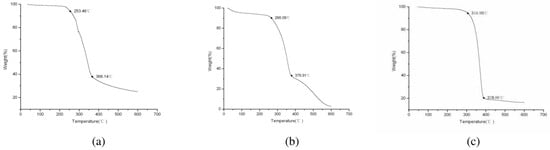
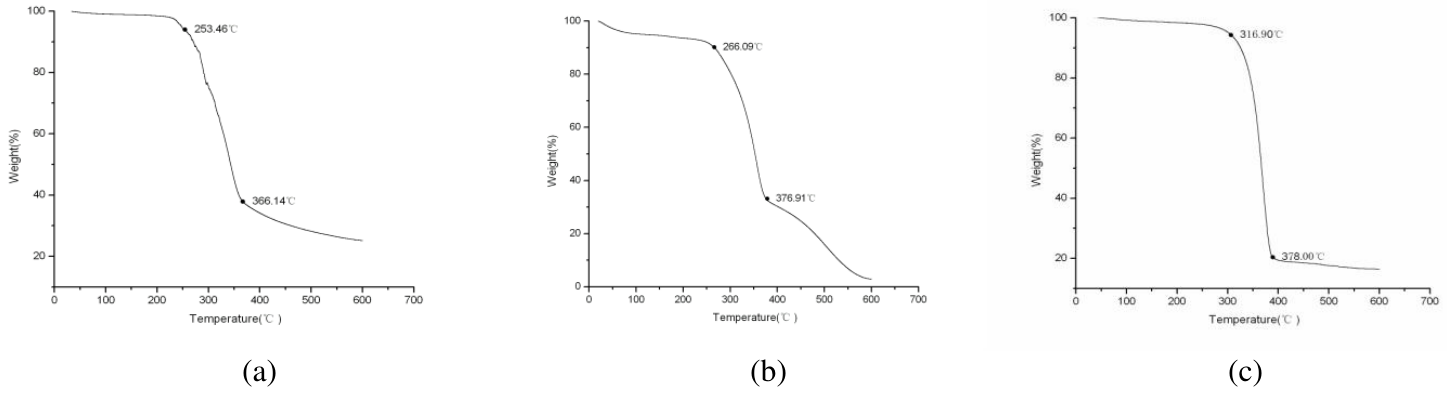
TG curve indicates weight loss of fiber as temperature goes down under a controlled gas atmosphere. It reflects the thermal stability and can provide information about physical structure and chemical component of the fiber. It’s confirmed that, for lignin, the decomposition temperature of holocellulose (cellulose and hemi-cellulose) is at 250-350°C and 350-450°C respectively [2]. Therefore, the main composition of the fiber can be determined by TG technique.
TG curve of the bamboo fiber is shown in Figure 1(a). According to its decomposition temperature, the bamboo fiber mainly consists of cellulose and hemi-cellulose, while a little lignin. Generally, the higher the content of lignin is, stiffer the fiber is. Further has a higher strength and lower elongation, which will induce difficulties while dying and also need more bleaching agents.
Figure 1.
TG graphs of the fibers.
From Figure 1(c), we learn that a pure cellulose fiber, like degummed ramie, has different initial decomposition temperature (Ti) and final decomposition temperature (Tf), which has been marked on the curve. In order to compare clearly, their temperatures are listed in Table 4.
Table 4.
Decomposition temperature of holocellulose in different fibers.
Decomposition temperatures of Holocellulose of fibers listed in Table 4 contains cellulose mainly, so its characteristics represent cellulose’s thermal properties. The initial decomposition temperature is influenced by the structure of macromolecular aggregation state in the fiber. The higher the temperature is, more closed the structure of the aggregating state is, resulting in a better thermal stability. Meanwhile, if the range from the initial decomposition temperature to the final temperature is very low the purity of cellulose in the fiber is high. Since the decomposition temperature of hemi-cellulose is lower than that of cellulose, the more the hemi-cellulose matter exists in the fiber, the temperature range is spread more. TG curve of the ramie fiber in Figure 1(c) has validated the same. Hence, lower initial decomposition temperature and wider range of decomposition temperature of jute, bamboo and flax fibers have great relations with a higher proportion of hemi-cellulose matter to holocellulose in the fibers.
According to the results of chemical composition in Table 2, there is a higher lignin content in the jute fiber. Hence on the TG curve in Figure 1(b), there is another small descent after 370°C, which is consistent with the results from infrared absorption spectrum and solid state 13C nuclear magnetic resonance spectrum [1].
3.3. Breaking strength and elongation
From Table 5, it can be concluded that the natural bamboo fiber is alike other bast fibers, which have high strength and low elongation. Since both bamboo and jute fibers are technical fibers, instead of single fiber, there is no comparison between ramie, cotton, bamboo and jute fiber in terms of tension. However, from the results, we learn that the tension of the bamboo fiber is strong enough to meet the needs of textile processing. The strength comes from the glutinous gums between fibers, and not the fiber itself. Of course, natural bamboo fiber is low in elongation and poor in elasticity, which needs to be improved.
Table 5.
Breaking Strength and elongation of the fibers.
3.4. Moisture regain and water-retention rate
Moisture regain is an index of fiber’s moisture sorption characteristics. To some extent, the value of moisture regain reflects the structure characteristics of the fiber also. Different samples have different results as listed in Table 6.
Table 6.
Moisture regain and water-retention rate of the fibers.
The value of moisture regain is very important to assess the comfort of textile materials. Since these fibers are different in crystallinity and chemical components [1], some differences in hygroscopicity exists between them. Like jute fiber, the bamboo fiber has a high moisture regain, which can be classified as hydrophilic fiber. Low crystallinity and containing lots of hydrophilic impurities can explain why the moisture absorbibg property of bamboo fiber is good. So being a summer fabric it will be cool and comfortable. Meanwhile, ramie fiber has the lowest moisture regain among the six samples, which is due to high crystallinity and little hemicellulose matter.
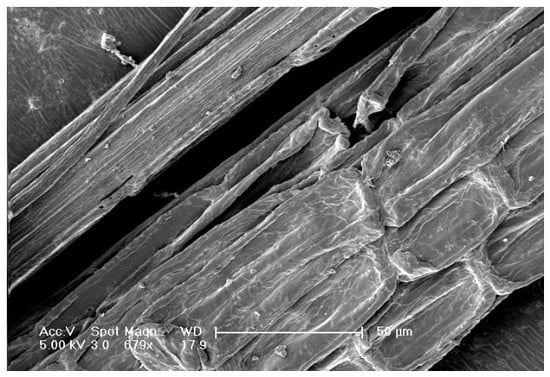
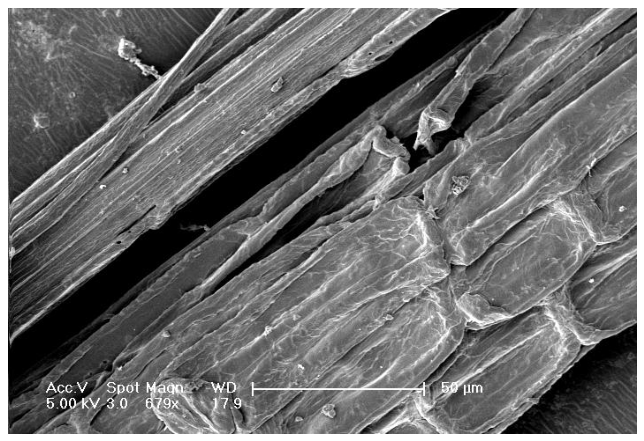
It is noticed that the water-retention rate of the bamboo fiber is too high. Moderate water-retention rate will ensure body’s adjustment to water, makes fiber absorb more water but not lead to dampness and sticky feeling. While very high water-retention rate will make people feel uncomfortable. The natural bamboo fiber has a water-retention rate up to 130%, which is of great disadvantage while wearing. From the longitudinal photograph of the bamboo fiber by SEM, we found that some thin-wall cell tissues remained during deguming which was attached on the surface of the bamboo fiber (Figure 2). Some researches revealed that [5] the absorbency of thin-wall cell tissues is 15 times than its weight, bringing about high water-retention rate.. Nevertheless, by deguming further and smoothening the fiber surface, the value will be decreased. Also being a water-maintaining material the natural bamboo fiber of high water-retention rate can be used in construction field or in home textiles.
Figure 2.
Thin-wall cells in the surface of bamboo fiber under scanning electron microscope.
3.5. Contact angle
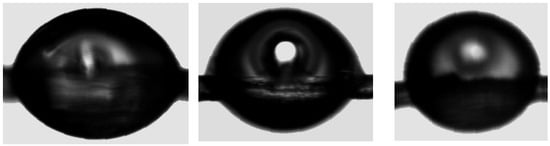
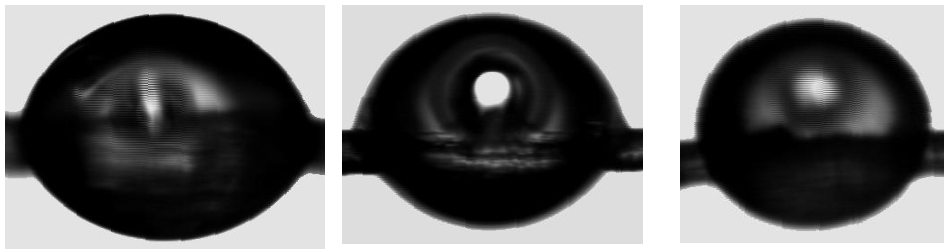
Results of contact angle by liquid dropping method are listed in Table 7 and also shown in Figure 3. From the results the flax fiber and the bamboo fiber have small contact angles, they are more hydroscopic than ramie.However jute fiber has the biggest contact angle. All the four kinds of samples are cellulose fibers. Though all of them do not have the same chemical components, distinctions in macroscopic shape is the main reason responsible for the different contact angles of the four samples. The jute fiber has a large lumen [1], which prevents wicking inside the fiber; however, the flax and bamboo fibers have thick cell wall and small lumen [1], which supports the wicking effect, reducing their contact angles. Good hydroscopicity is advantageous for water and perspiration absorption in materials.
Table 7.
Contact angle of the fibers.
Figure 3.
Photograph of the liquid dropping method used in fibers.
3.6. Drying speed
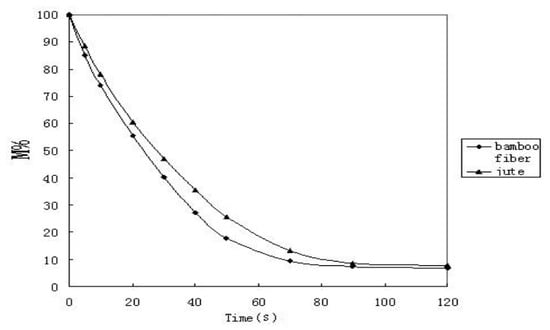
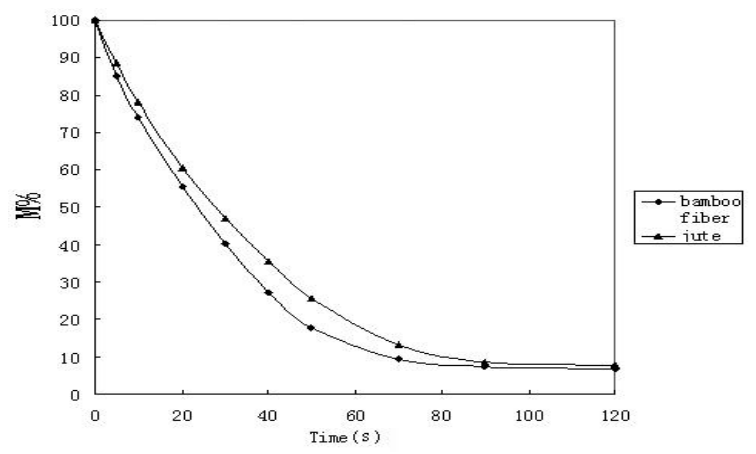
Besides high water-retention rate, natural bamboo fiber is not only faster in absorbing waterand more hydrophilic than jute fiber, but also has a fast drying speed (from Figure 4). When the natural bamboo fibers are used in summer textiles, it will absorb water easily, dry quickly and exhibit no messy feelings after absorbing much water. The reason why the natural bamboo fiber dries more quickly than jute fiber, is due to fineness of a single fiber, which is 8-12μm [5], and large specific surface area.
Figure 4.
Drying curve of bamboo fiber and jute fiber.
4. Conclusions
Firstly the testing results indicate that the natural bamboo fiber has a high tenacity, low elongation and poor elasticity. The existence of lignin is the main reason for its stiffness among the mechanical properties. Secondly, the bamboo fiber has a larger moisture regain capability than cotton, ramie and flax fibers because of its loose structure and existence of disordered non-cellulose substances. Meanwhile, the bamboo fiber has characteristics of small contact angle, high water-retention rate and can be dried faster, which are suitable for summer use. Besides, the natural bamboo fiber also has a low density and good resistance to heat.
Overall, the properties of the bamboo fiber are similar to that of jute fiber. Hence, the bamboo fiber, like jute fiber, is a potential material to be used in textiles during summer.
Furthermore, with optimization of bamboo species and modification in degumming techniques, the lignin and hemi-cellulose substances, which have great influences on the properties of natural bamboo fiber, can be removed from bamboo fibers.
Acknowledgments
We would like to express our sincere thanks to the State Scientific and Technical Ministry and Beijing Key Laboratory of Clothing Materials R&D and Assessment for their financial assistance. This research was supported by grant of No.2006BAD19B07 from National Scientific and Technical Supporting 11th Five-year Plan Project and No. 2007ZK-10 from project subsidized by Beijing Key Laboratory of Clothing Materials R&D and Assessment in 2007.
References
- Wang YP, Wang G, Cheng HT. Structures of bamboo fiber for textiles, Textile Research Journal, 2010; 84(4): 334-343. [CrossRef] [Scilit]
- Han XJ. Preparation of natural bamboo fiber for textile application and study on its structure and properties [D], Beijing: Beijing Institute of Clothing Technology 2007; 32-46.
- Xing SY, Kong LP. Identification methods for textile fibers, Beijing: Textile Press of China, 2004; 54-60.
- Wang YP, Gao XS. Comparing and testing for bamboo fiber and several natural cellulose fibers[J], Knitted Industry 2005, 11.
- Jiang ZH. Bamboo and Rattan in the World[M], Shenyang: Liaoning Science and Technology Publishing House, 2002, 224.
- Thakur R, Sarkar CR, Sarmah R. Chemical composition of some varieties of ramie and their fibre characteristics[J]. India Journal of Fiber & Textile Research 1999; 12: 276-278.

© 2010 Textile Bioengineering and Informatics Society. This article is an open access article distributed under the terms and conditions of the Creative Commons Attribution (CC BY) license (https://creativecommons.org/licenses/by/4.0/).