


Abstract
The subjective wearing pressure sensation developed by foundation garment was surveyed and reported in this paper. Wearing experimental procedure was designed and fifteen female undergraduates were employed as subjects for this study. We obtained results of subjective wearing pressure sensation and shaping effect assessment through the questionnaire. Firstly, we studied the correlation between pressure evaluation, shaping effect assessment and time. Secondly, we analyzed the overall pressure sensation and different body part pressure sensation developed by corsets, three main factors were extracted from the 15 positions through statistical analysis, the subjective regression formula Y = -0.807 +0.499 X1 + 0.187 X3 was gained. The overall subjective pressure sensation had significant correlation with the waist (X1) and near waist (X3) pressure evaluation.
1. Introduction
Foundation garment is one of the lingerie for body shaping such as corsets, girdles and waister-nippers. Women show high interests in their functional role to shape the body more ideally by redistributing the body fat now. However, at the same time people often complain against the uncomfortable feeling caused by the excessive negative pressure. On the one hand, many studies (Sugimoto, 1991; Nagayama, 1995; Takasu, 2000; Yoshiaki, 2000; Okura, 2000; SUGITA, 2002; Nakahashi, 2005; Liu, 2008; Jin, 2008) have demonstrated that the pressure had negative or positive physiological effects on the body [1,2,3,4,5,6,7], we also did a complete research between clothing pressure and physiological variables [8].
On the other hand, Subjective assessment is also very important for the assessment of clothing comfort, which is a complex synthesis of psychological and physiological response of individuals and of the physical properties of the clothing materials, many studies have focused on the predictability between objective physical factors of fabrics and subjective preference [9,10,11]. But many fundamental problems haven’t been clarified which can give supports to designg comfortable clothing, such as which parts of body are more sensitive to the pressure sensation. In this paper, we developed a wearing experimental procedure and investigated the relationship between the overall subjective pressure sensation and different body parts pressure sensation using factor analysis. This can give a suggestion for the design of foundation garment, and also we can explain that the overall pressure sensation for these clothing were mainly composed by what part wearing sensation of the body, so we can give reasonable plan for garment ease, and the placement of hard material such as strong whale bones.
2. Experiment
2.1. Test Samples and Sizes
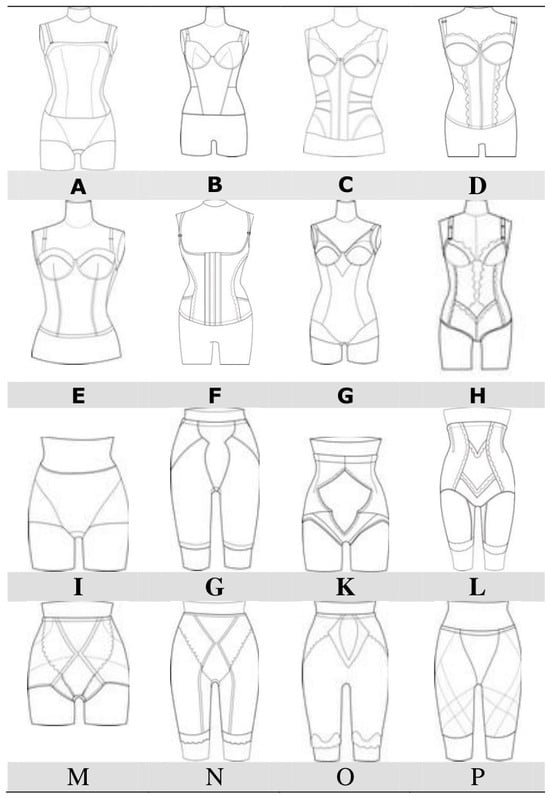
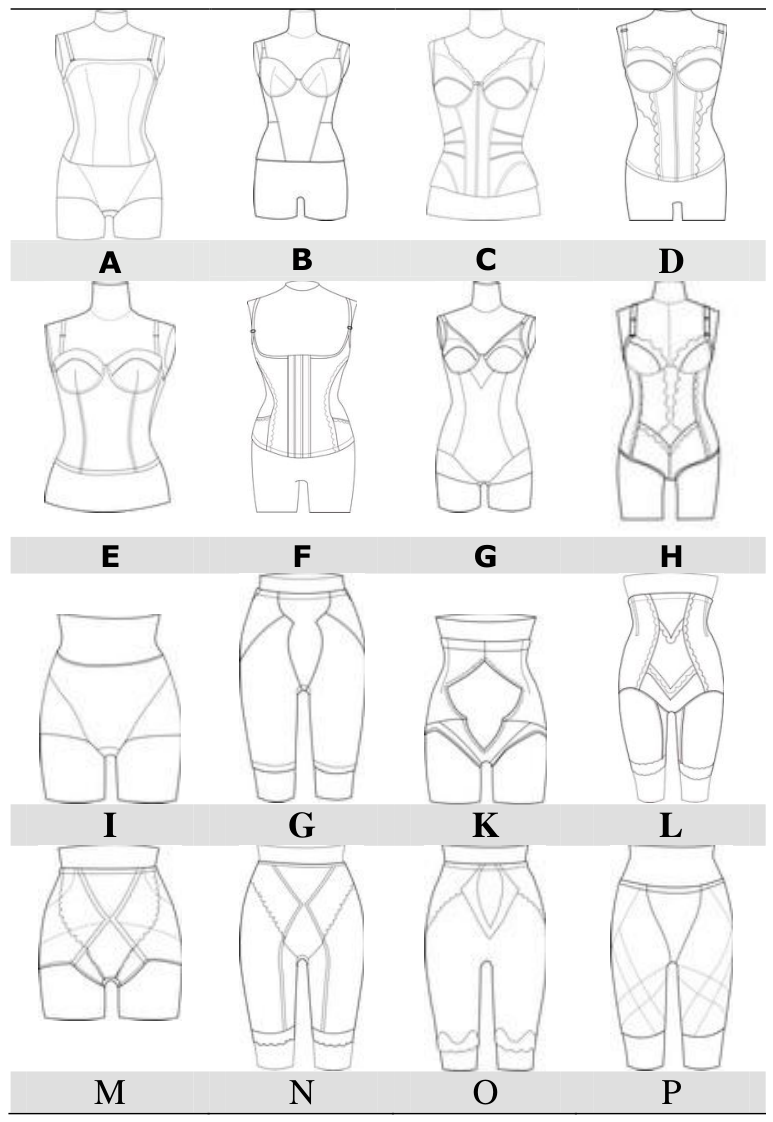
Some test samples were supported by the Beijing Aimer Lingerie Co., Ltd., there were eight corsets and eight girdles sample all together for the experimental, and all the foundation garment had different structures and more than 3 sizes, as shown in Figure 1. The size and materials used for foundation garment are shown in Table 1.
Figure 1.
Structures of the foundation garment.
Table 1.
Size and Material Used for Garment.
2.2. Subjects
The subjects of this study were 18 healthy female graduates within the age range of 21-26 years. They were all about 161cm with the standard deviation 4.17 chosen among 300 students. We shifted 42 female graduates at first and took their body measurements through 3d body scanner, and 15 students were finally invited as experiment samples for their body measurements and wearing habit. Details of physical constitutions are given in Table 2, which were taken respectively by the Martin instruments only with non- elasticity underwear and nude upper body.
Table 2.
Physical Constitutions of Subjects.
2.3. Experimental Method
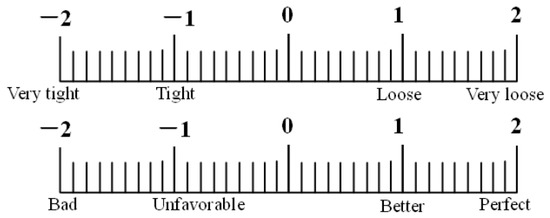
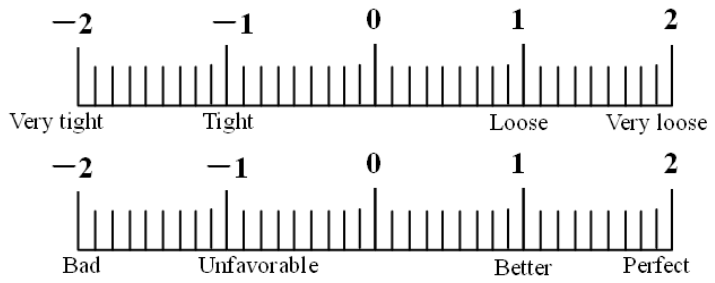
The experiments were conducted in an artificial climate chamber where the temperature was controlled at 27±1.4°C and the relative humidity at 32±2%. To minimize the effects of menstrual cycles and circadian rhythm on body’s physical response, the experiment was carried out during the early follicular phase of each woman, and several garments were tested at the same time for each woman on each day. In the experiment, we selected suited size of the foundation garment for the subjects according to their body measurements. Each subject entered the chamber 30 minutes or more before the start of the experiment so that she could become accustomed to the experimental environment. We asked subjects about pressure sensation at 15 positions on the torso and the shaping effect at several parts. The pressure sensation and the shaping effect were evaluated from - 2-2 five-grade psychological scale, as shown in Figure 2.
Figure 2.
Psychological scale for pressure sensation and shaping effect evaluation.
3. Result and Discussion
3.1. The correlation between pressure sensation, shaping effect assessment and time
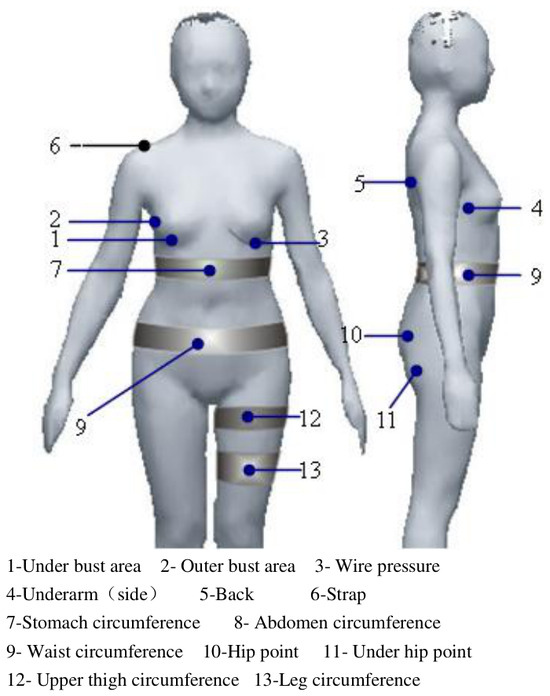
We designed an experiment to give the pressure sensation and shaping effect evaluation for short and long time conditions. The positions of subjects evaluation were 13 parts on the body as shown in Figure 3.
Figure 3.
The positions of pressure sensation evaluation.
Each subject entered the chamber 30 minutes or more before the start of the experimental, and then took on the experimental foundation garment. The short time evaluation was tested after taking clothing for 30 minutes, and the long time evaluation was tested after 4 hours, the subjects can leave chamber during the long time test with daily action and back again at the fixed time.
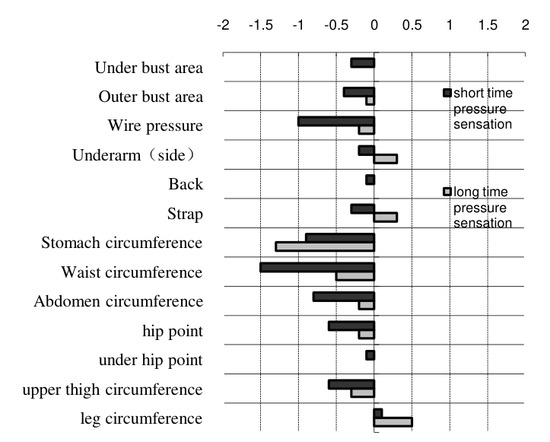
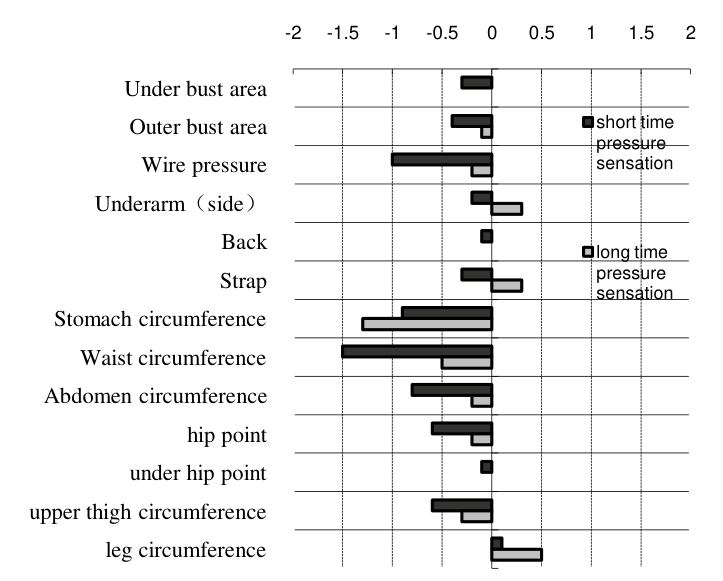
During the experiment, the pressure sensation evaluation changed with time as shown in Figure 4. In the short time test, the pressure sensation evaluations were most in the -2-0, because we selected suitable size for the subjects according to their measurement, the foundation garment inevitably gave negative pressure to the body, but we found that the pressure sensation evaluation at the back, under hip point and leg circumference positions was small. After subjects with the clothing for 4 hours, we found that most pressure sensation evaluations were lower because they were accustomed to the negative pressure at most parts of the body, especially at the bust area, most female felt little pressure because they feel bra pressure in the daily life. But at the stomach circumference, subjects felt more strong pressure than in short time test. At the leg circumference of girdle, subjects felt loose after a long time.
Figure 4.
The pressure sensation evaluation changed with time.
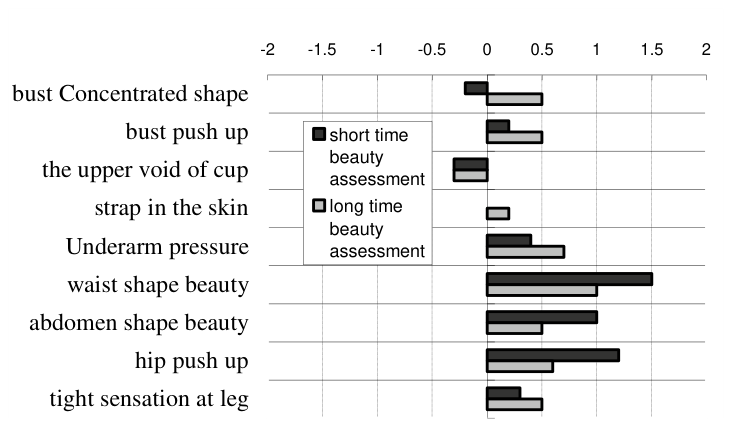
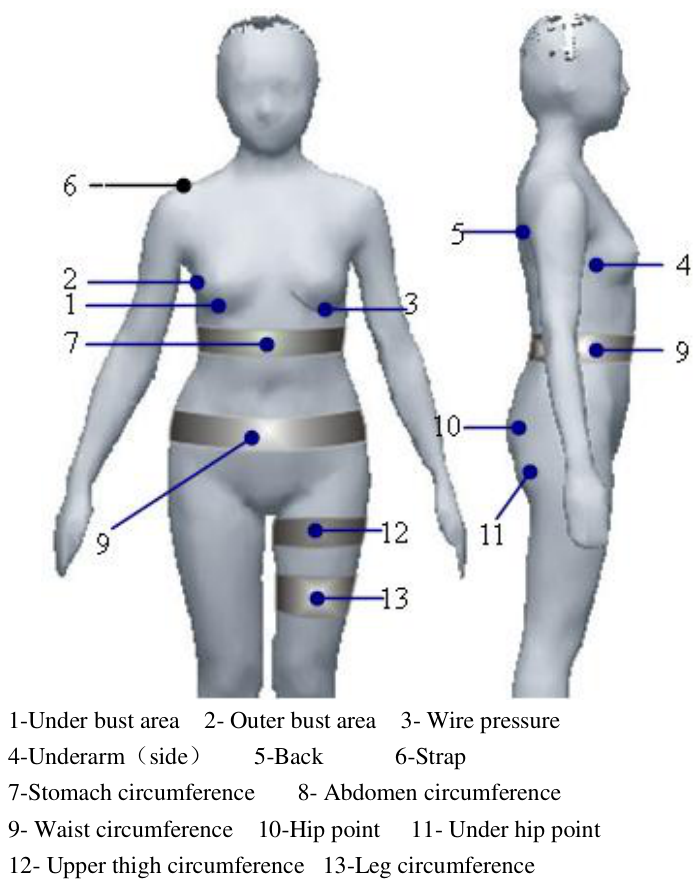
The shape beauty assessments were also surveyed in the experiment. The shaping effect assessment of most parts was changed during the long time test. But the shaping effect evaluations at the waist, abdomen and hip were lower than short time test, because subjects accustomed to the pressure, and elasticity of clothing material will release a little ease.
Figure 5.
The shaping effect assessment changing with time.
3.2. The overall pressure sensation and the body parts developed by corsets
We designed an experiment for investigating the overall pressure sensation and the different body parts. The overall and 15 parts (shown as Table 3) of the body subjective pressure sensation with different corsets were asked. We obtained factor matrices using KMO& Bartlett’s Test and principal factor solutions, which constitute the proportion of the test variance ascribed to the action of the common factors. Using factor analysis, three factors were extracted from fifteen components. After rotating the factor axes the structure of the test relations was more clearly indicated. The results of factor matrices rotated by the Varimax method are shown in Table 3, the three factors obtained were sufficient to describe the data. The side waist, front waist, back waist, side area at the bust line (below the armpits), side area at stomach circumference could be explained by common factor (Factor I), named the Factor of waist pressure sensation. The Factor II named the Factor of bust wire and back pressure sensation was constituted by the outer bust, side bust, middle between bust points, wire pressure, and back. The Factor III named the Factor of near waist pressure sensation was constituted by the front, side and back area at abdomen circumference, front and back area at stomach circumference.
Table 3.
Rotated component matrix.
Table 4 shows the correlation coefficients between the overall pressure sensation and the parts of the body, we found that the overall pressure sensation had significant correlation with Factor I and Factor III. So we concluded that the overall pressure sensation had a significant correlation with the waist pressure and near waist pressure.
Table 4.
Correlation coefficients between the overall pressure sensation and the parts of the body.
Liner regression analysis showed that variables for the pressure sensation at waist (X1) and the pressure sensation at near waist (X3) were good predictors for the overall pressure sensation assessment (Y), as shown in Table 5. Regression equation was Y= - 0.807+0.499 X1+ 0.187X3.
Table 5.
Coefficients analysis.
4. Conclusions
In this study, the overall wearing comfort of pressure sensation and different parts of body were surveyed, the main conclusion are described as follows.
- The wearing comfort of pressure sensation and the shaping effect assessment changed with time.
- The overall wearing comfort of pressure sensation had a significant correlation with the 15 parts of the body pressure sensation. The 15 parts of the body pressure sensation could be described by three factors, they were the Factor of waist pressure sensation (Factor I), the Factor of bust wire and back pressure sensation (Factor II), and the Factor of near waist pressure sensation (Factor III).
- From the correlation coefficients and step regression analysis, we could conclude the whole wearing comfort of pressure sensation had a significant correlation with two factors of the three, we can give the regression equation was Y= - 0.807+0.499 X1+ 0.187X3. This showed that the whole pressure sensation assessment (Y) had significant correlation with variables for the pressure sensation at waist (X1) and near waist (X3). This can give a foundational suggestion for the design of these clothing, such as the ease suggestion and positions of strong whale bone.
Acknowledgments
This study was supported financially by the Science Fund of Beijing Clothing Materials Development and Evaluation Laboratory (NO.2008zk-13) and the Doctor Innovation Fund of Donghua University (NO. 107060019027). The authors also acknowledge Aimer Lingerie Co., Ltd. for their material and garment support.
References
- Nagayama, Y. Cardiovascular responses in wearing girdle. J. Jap Res. Assn Text. End. 1995, 1, 68–73. [Google Scholar]
- Sugita, A. Effects of girdles on comfort of aged women-results from early responses of a heart rate, a skin temperature and an electroencephalograph. J. Jap Res. Assn Text. End. 2002, 6, 365–376. [Google Scholar]
- Miyatsuji, A.; Matsumoto, T.; Mitarai, S.; Kotabe, T. Effects of skin pressure caused by different types of brassieres on autonomic nervous system activity evaluated by heart rate variability power spectral analysis. J. Phys. Anthropol. Appl. Hum. Sci. 2002, 1, 67–74. [Google Scholar] [CrossRef] [Scilit] [PubMed]
- Nakahashi, M.; Morooka, H.; Nakammura, N. An analysis of waist-nipper factors that affact subjective feeling and physiological response. SEN'I GAKKAISHI 2005, 1, 40–46. [Google Scholar]
- Liu, R.; Lao, T.T.; Li, Y.; Kwok, Y.L.; Ying, M. Physiological Response and Comfort Sensory Perception towards Physical-Mechanical Performance of Compression Hosiery Textiles. J. Fiber Bioeng. Inf. 2008, 1, 55–64. [Google Scholar] [CrossRef] [Scilit]
- Jin, Z.M.; Yan, Y.X.; Luo, X.J.; Tao, J.W. A Study on the Dynamic Pressure Comfort of Tight Seamless Sportswear. J. Fiber Bioeng. Inf. 2008, 1, 217–224. [Google Scholar] [CrossRef] [Scilit]
- Zhou, F.P.; Dai, X.Q.; Wang, J.; Lu, Y.H. Change of skin blood flow at lower limb under external pressure. J. Fiber Bioeng. Inf. 2008, 2, 45–50. [Google Scholar]
- Liu, L.; Zhang, W.; Wang, Y.; Xiao, P. The Study of shaping Effects developed by foundation garment and physiological response by the clothing pressure. Proceedings of 2008 Appl Hum Fact Ergon Int Confer (AHFE).
- Li, Y.; Keighley, J.H.; Mcintyre, J.E.; Hampton, I.F.G. Predictability between objective physical factors of fabrics and subjective preference votes for derived garments. J. Text. Inst. 1991, 3, 277–84. [Google Scholar] [CrossRef] [Scilit]
- Li, Y. Clothing comfort and its application. Text. Asia 1998, 29–33. [Google Scholar]
- You, F.; Wang, J.M. Garment’s pressure sensation (1): subjective assessment and predictability for the sensation. Int. J. Cloth. Sci. Technol. 2002, 5, 307–316. [Google Scholar] [CrossRef] [Scilit]

Disclaimer/Publisher’s Note: The statements, opinions and data contained in all publications are solely those of the individual author(s) and contributor(s) and not of MDPI and/or the editor(s). MDPI and/or the editor(s) disclaim responsibility for any injury to people or property resulting from any ideas, methods, instructions or products referred to in the content. |
© 2009 Textile Bioengineering and Informatics Society. This article is an open access article distributed under the terms and conditions of the Creative Commons Attribution (CC BY) license (https://creativecommons.org/licenses/by/4.0/).