


Abstract
Room temperature ionic liquids were adsorbed on the surface of the multiwalled carbon nanotubes (MWCNTs) by electrostatic interaction between carboxyl groups on the chemically oxidized MWCNTs surface and room temperature ionic liquids. The cations of ionic liquids and carboxyl groups on the carbon nanotube surface are put into a one-to-one correspondence by the electrostatic interaction. Negatively charged 15 nm gold nanoparticles are subsequently anchored to the surface of the MWCNTs through the electrostatic interaction between the ionic liquids and the gold nanoparticles. Gold nanoparticles are selectively attached to chemically functionalized surface sites of carbon nanotubes. This approach provides an efficient method to attach other nanostructures to carbon nanotubes and can be used as an illustrative detection of the functional groups on carbon nanotube surfaces.
1. Introduction
Since the discovery of carbon nanotubes (CNTs) by Iijima [1], a great amount of research work on CNTs and related nanostructures has been carried out due to their unique electronic structure, molecular dimensions, and shape, making them attractive in nanotechnology and materials science. Their potential applications include nanodevices [2], quantum wires [3], ultrahigh-strength engineering fibers [4], sensors [5], and catalyst support [6]. To optimize the use of nanotubes, many times there is a need to attach functional groups to their surface and then assemble the nanotubes into structures or attach other nanostructures to the nanotubes [7].
These unique properties make carbon nanotubes very useful for supporting metal nanoparticles in many potential applications, ranging from advanced catalytic systems through very sensitive electro-chemical sensors to highly efficient fuel cells. Consequently, the functionalization of carbon nanotubes with metal nanoparticles has attracted great interest in recent years. And a few interesting routes have now been devised for either covalently or noncovalently attaching certain metal nanoparticles onto carbon nanotubes. In addition, there is a need to attach functional groups to the carbon nanotube surface and then assemble the nanotubes into structures or attach other nanostructures to the nanotubes [8,9,10,11,12,13,14].
Room temperature ionic liquids (ILs), which are composed of cation and anion, are widely used as an excellent green reaction media. We have reported the modification of MWCNTs with ionic liquids to improve their compatibility and stability, creating more opportunity for applications of MWCNTs in sensors and actuators by improving the electrical contact with bulky media. As the ionic liquids are composed of micromolecular cation, such as quaternary ammonium, dialkylimidazolium, tetra-alkylphosphonium, and anions, such as Br-, BF4-, PF6-, the electrostatic interaction between carboxyl groups on the nanotube surface and cations of ionic liquids are put into a one-to-one correspondence. Here we report a method to functionalize carbon nanotubes by the electrostatic interaction between carboxyl groups on the chemically oxidized nanotube surface and ionic liquids, and to attach gold nanoparticles from a gold colloid suspension to the surface of the nanotubes through the electrostatic interaction between the ionic liquids and the nanoparticles. It can be used for illustrative detection of the functional groups on carbon nanotube surfaces. And it can be of better use for illustrative detection of the functional groups on carbon nanotube surfaces [15]. In the present study, a new and simple method to attach gold nanoparticles on the surface of carbon nanotubes is introduced.
2. Experimental Section
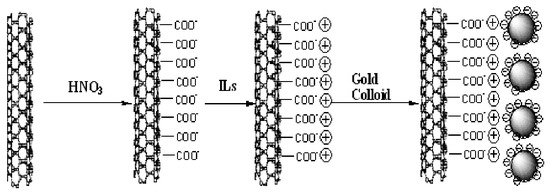
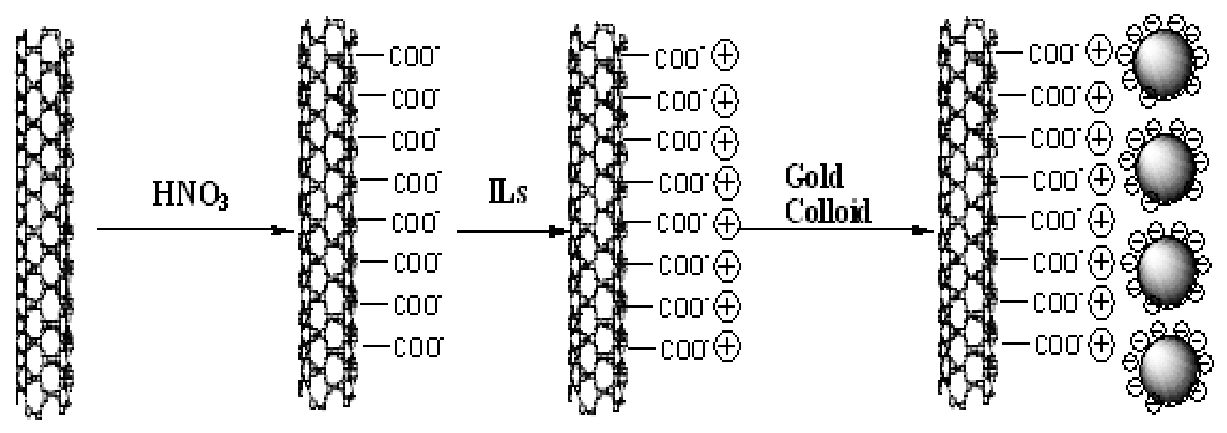
The MWCNTs material consists of structures containing highly oriented nanotubes of diameter 40-100 nm. According to the reference [16], the carbon nanotubes are modified by acid-treatment, which results in carboxyl, carbonyl and hydroxyl on the carbon nanotubes. The ionic liquid chosen in this reaction is 1-methy-3- hexylimidazolium bromide. The nanotubes suspension was mixed with ionic liquids aqueous solution for 120 mins at room temperature. Ionic liquids were adsorbed to the surface of the nanotubes because of the electrostatic interaction between the carboxyl groups and the cations of ionic liquids. After filtrating and thoroughly washing with deionized water, the nanotubes were dispersed in water again, and mixed with a gold colloid (15 nm) for 30 mins by stirring. The negatively charged gold nanoparticles (NPs) were anchored to the surface of the nanotubes through the electrostatic interaction between the cations of ionic liquids and the nanoparticles. After filtrating and thoroughly washing with deionized water, TEM samples were prepared by dispersing the nanotubes in water. The complete scheme for the modification of the nanotube surface and the attachment process of the gold nanoparticle on the nanotube surfaces is shown in Figure 1.
Figure 1.
Schematic view of the process for anchoring gold nanoparticles to nanotubes.
3. Results and Discussion
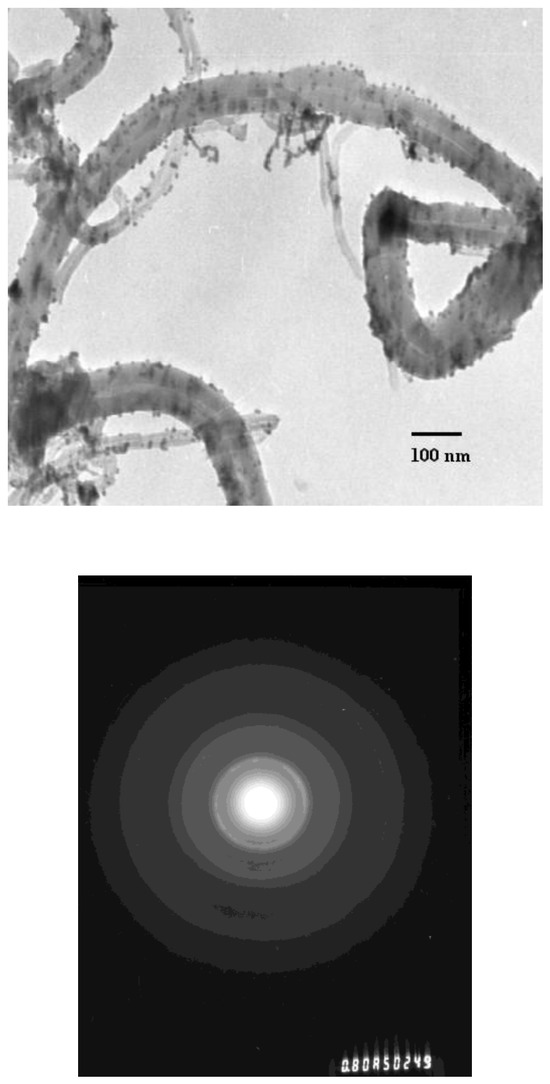
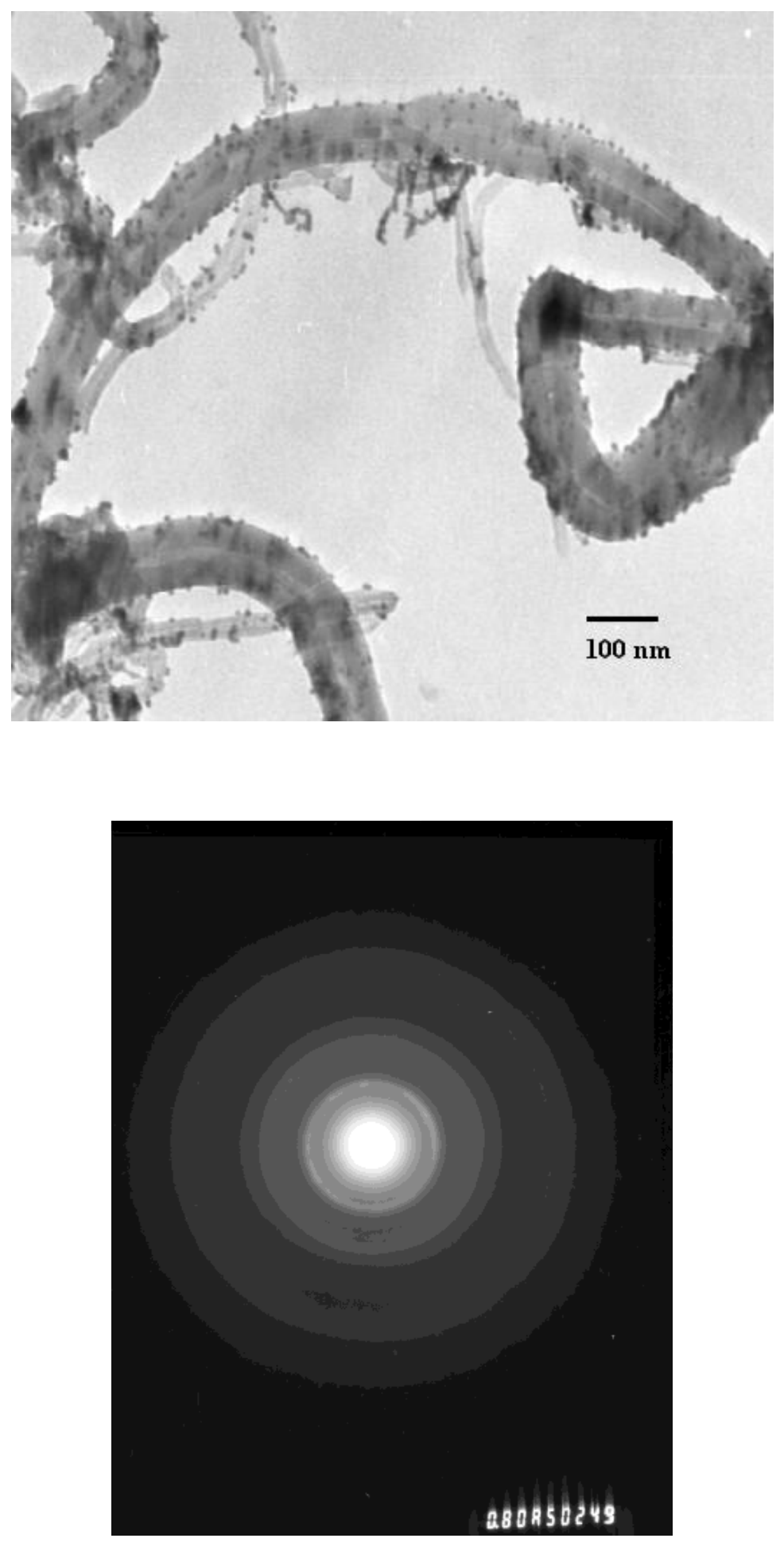
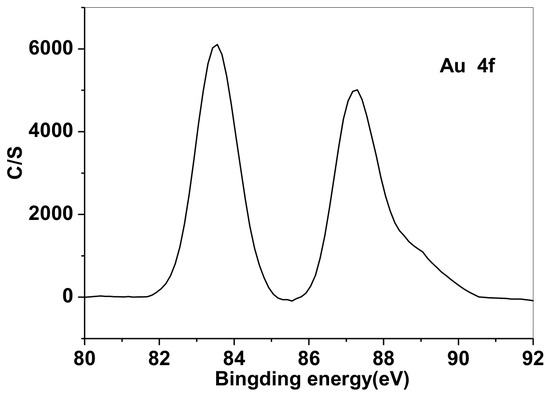
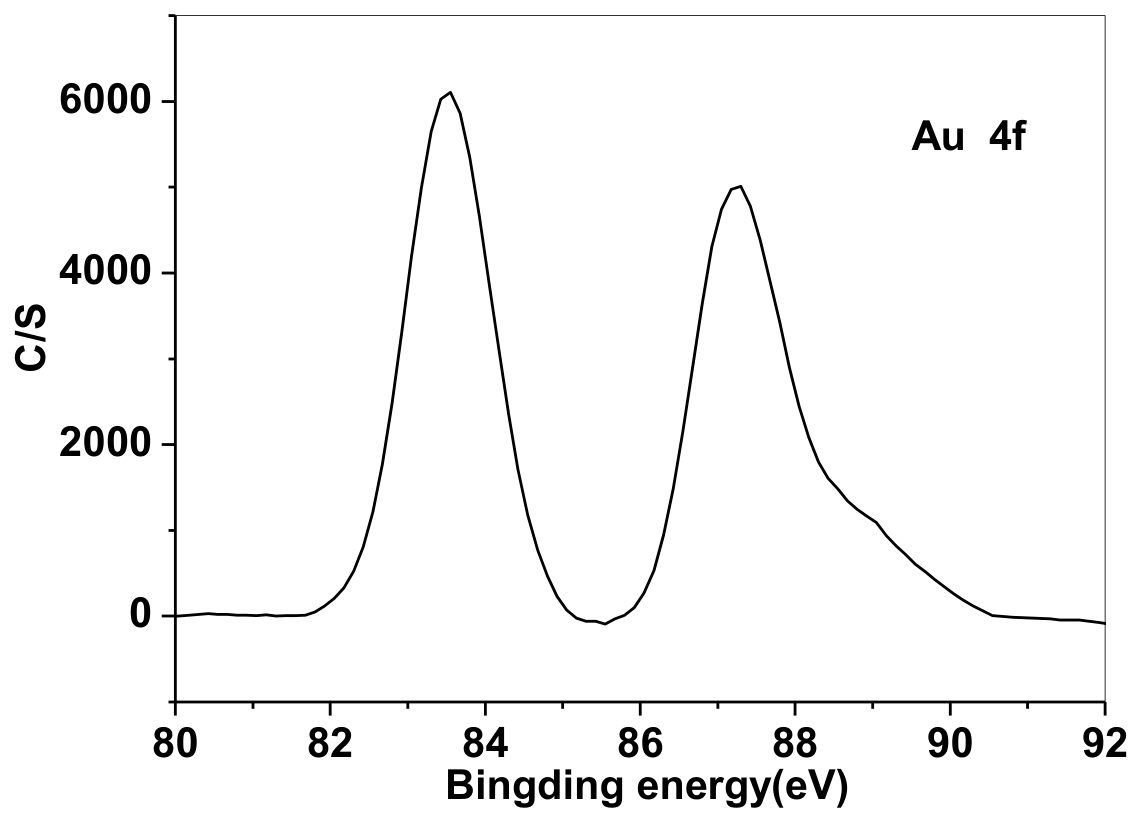
The attachment of gold NPs on MWCNTs is confirmed by the TEM image. Figure 2 shows the TEM image of the MWNTs modified with gold particles. It can be seen that the gold particles preferentially adhere to the surfaces of MWNTs rather than to other regions without MWNTs. And the interaction between the gold nanoparticles and nanotubes is quite strong, because thorough washing does not remove them. Figure 3 represents the XPS signal of the Au 4f for the MWCNTs-Au. The binding energies of the doublet for Au 4f7/2 and 4f5/2 are 83.2 and 86.9 eV, respectively, which are consistent with Au0 oxidation state. The above results indicate that those assembled Au particles are predominantly Au0 at the surface.
Figure 2.
TEM and TED images of gold nanoparticles supported on undoped MWCNTs.
Figure 3.
The narrow XPS spectra of the Au 4f region for MWCNTs–gold nanoparticles.
Single acid-treated MWCNTs (without ionic liquids treatment) were also mixed with gold colloid, and no gold nanoparticles were found on the nanotubes. This indicates that ionic liquid acts as a bridge to connect gold nanoparticles with MWCNTs nanotubes. Subsequent treatment with ionic liquids at room temperature and exposure to negatively charged gold nanoparticles showed that the carboxyl functional groups were present at the ends of the nanotubes. So it acts as an excellent method for monitoring the presence of carboxyl chemical groups on the surfaces of nanotubes [14].
4. Conclusion
In summary, gold nanoparticles were anchored to the surfaces of MWCNTs nanotubes by a simple electrostatic adsorption. On account of the design ability of ionic liquids, some functional radical, such as hydrosulfuryl, amino, carboxyl and hydroxyl, etc., can be introduced into the ionic liquids by the molecular design. By choosing different kinds of functional ionic liquids, the surfaces of carbon nanotubes can be tailored to be negatively or positively charged, so many other nanoparticles, such as metal nanoparticles, semiconductor nanocrystals, magnetic nanoparticles, etc., can be selectively attached to the surfaces of nanotubes. Hopefully it opens up a new research branch of selective attachment of different nanoparticles on the surface of carbon nanotubes. And these nanoparticle-decorated nanotube heterostructures could be used in catalytic, electronic, optical, and magnetic applications. In addition, compared with the polyelectrolyte, ionic liquid is a simple micromolecule and the designability, as well as the method of decorating nanotubes by ionic liquids will be a more efficient way to be used to identify the location of functional groups.
Acknowledgments
The authors acknowledge the financial support of this work by the National 973 program of China (NO: 2007CB607601) and the “Top Hundreds Talent” program of Chinese Academy of Sciences and The Hong Kong Polytechnic University through projects BB6K and BB6R.
References
- Iijima, S. Helical microtubules of graphitic carbon. Nature 1991, 354, 56–58. [Google Scholar] [CrossRef] [Scilit]
- Collins, P.G.; Zettl, A.; Bando, H.; Thess, A.; Smalley, R.E. Nanotube nanodevice. Science 1997, 278, 100–102. [Google Scholar] [CrossRef] [Scilit]
- Tans, S.J.; Devoret, M.H.; Dai, H.J.; Thess, A.; Smalley, R.E.; Geerligs, L.J.; et al. Individual single-wall carbon nanotubes as quantum wires. Nature 1997, 386, 474–477. [Google Scholar] [CrossRef] [Scilit]
- Treacy, M.M.J.; Ebbesen, T.W.; Gibson, J.M. Exceptionally high Young’s modulus observed for individual carbon nanotubes. Nature 1996, 381, 678–680. [Google Scholar] [CrossRef] [Scilit]
- Kong, J.; Franklin, N.R.; Zhou, C.W.; Chapline, M.G.; Peng, S.; Cho, K.J.; Dai; et al. Nanotube molecular wires as chemical sensors. Science 2000, 287, 622–625. [Google Scholar] [CrossRef] [Scilit] [PubMed]
- Planeix, J.M.; Coustel, N.; Coq, B.; Brotons, V.; Kumbhar, P.S.; Dutartre, R.; et al. Application of carbon nanotubes as supports in heterogeneous catalysis. J. Am. Chem. Soc. 1994, 116, 7935–7936. [Google Scholar] [CrossRef] [Scilit]
- Qu, L.; Dai, L. Substrate-enhanced electroless deposition of metal nanoparticles on carbon nanotubes. J. Am. Chem. Soc. 2005, 127, 10806–10807. [Google Scholar] [CrossRef] [Scilit] [PubMed]
- Chen, Q.; Dai, L.; Gao, M.; Huang, S.; Mau, A. Plasma activation of carbon nanotubes for chemical modification. J. Phys. Chem. B 2001, 105, 618–622. [Google Scholar] [CrossRef] [Scilit]
- Hamon, M.A.; Chen, J.; Hu, H.; Chen, Y.; Itkis, M.E.; Rao, A.M.; Eklund, P.C.; Haddon, R.C. Dissolution of single-walled carbon nanotubes. AdV. Mater. 1999, 11, 834–840. [Google Scholar] [CrossRef] [Scilit]
- Cheng, J.; Hammon, M.A.; Hu, H.; Chen, Y.S.; Rao, A.M.; Eklund, P.C.; Haddon, R.C. Solution properties of single-walled carbon nanotubes. Science 1998, 282, 95–98. [Google Scholar] [CrossRef] [Scilit] [PubMed]
- Liu, J.; Casavant, M.J.; Cox, M.; Walters, D.A.; Boul, P.; Lu, W.; Rimberg, A.J.; Smith, K.A.; Colbert, D.T.; Smalley, R.E. Controlled deposition of individual single-walled carbon nanotubes on chemically functionalized templates. Chem. Phys. Lett. 1999, 303, 125–129. [Google Scholar] [CrossRef] [Scilit]
- Chen, R.J.; Zhang, Y.; Wang, D.; Dai, H. Noncovalent sidewall functionalization of single-walled carbon nanotubes for protein immobilization. J. Am. Chem. Soc. 2001, 123, 3838–3839. [Google Scholar] [CrossRef] [Scilit] [PubMed]
- Fullam, S.; Cottell, D.; Rensmo, H.; Fitzmaurice, D. Carbon nanotube templated self-assembly and thermal processing of gold nanowires. Adv. Mater. 2000, 12, 1430–1432. [Google Scholar] [CrossRef] [Scilit]
- Jiang, K.; Eitan, A.; Schadler, L.S.; Ajayan, P.M.; Siegel, R.W.; Grobert, N.; et al. Selective attachment of gold nanoparticles to nitrogen-doped carbon nanotubes. Nano Lett. 2003, 3, 275–277. [Google Scholar] [CrossRef] [Scilit]
- Yu, B.; Zhou, F.; Liu, G.; Liang, Y.; Wilhelm Huck, T.S.; Liu, W.M. The electrolyte switchable solubility of multi-walled carbon nanotube/ionic liquid (MWCNT/IL) hybrids. Chem. Comm. 2006, 22, 2356–2358. [Google Scholar] [CrossRef] [Scilit] [PubMed]
- Yu, R.; Chen, L.; Liu, Q.; Lin, J.; Tan, K.L.; Ng, S.C.; Chan, H.S.; et al. Platinum deposition on carbon nanotubes via chemical modification. Chem. Mater. 1998, 10, 718–722. [Google Scholar] [CrossRef] [Scilit]
© 2009 Textile Bioengineering and Informatics Society. This article is an open access article distributed under the terms and conditions of the Creative Commons Attribution (CC BY) license (https://creativecommons.org/licenses/by/4.0/).