


Abstract
To find out the distribution of pressure on brassiere’s under wires, two tests of under wires were done using AMI-3037 Air-pack type contact surface pressure measuring system. The brassieres used were commercial brassieres. In test 1 (T1), three different styles of brassieres were all 75A in size and each piece is tested by the same subject (S1). In test 2 (T2), a brassiere of 75A size was tested by three different subjects (S1, S2, S3). Three subjects were healthy unmarried women of age group 22 to 26 years. Seven points were measured in T1. Four points were measured when the subject made four different poses in T2. The results indicate: 1) There are three different pressure distributions in T1; 2) The pressure values are affected significantly at different points, brassieres, the interaction of points and brassiere, the interaction of points and subjects; 3) Most pressures of center front are larger and most pressures of the lowest point are small at the under wires; 4) The pressure values change while breathing. The range of most pressure values is between 0 and 0.5kPa except few ranging from 0.5 kPa to 1.5 kPa. 5) The shape of under wires is an important factor in healthcare of women.
1. Introduction
As one among the skin-tight clothing, brassieres are studied by more and more countries recently [1]. The main effects of brassiere are shaping curves of female’s breasts, protecting and supporting breast. There are varied brassieres in the markets now, such as common brassieres, sports brassieres, sleeping brassieres, seamless brassieres, nursing brassieres, and so on. The structure of brassiere is mainly composed of gore, under wires, cups, shoulder straps, torso straps and decorations [2,3]. Most of daily brassieres include under wires because they can support the lower part of breasts and shape better breasts’ curve. The main materials of the under wires are steel, rigid plastic and other materials that are not easily deformed.
The comfort degree of brassiere wearing is affected by the shape of under wires directly when choosing and purchasing brassieres. The shape of the under wires should be conformed to the lower curve of the breast base line, otherwise it will be felt like under wires move up or press breasts. If women wear the in appropriate brassiere, the under wires will press their galactophores, blood vessels, nerves, lymphatic and other organs. The long-term pressure of the under wires will lead to pathological changes of breasts, such as hyperplasia of mammary glands, mastitis, nipple discharge, etc.
More and more studies have been reported on the pressure made by brassiere and the measurement of breasts [4,5,6,7,8]. However, there is a little information available on the analysis of pressure distribution and comfort of brassiere under wires.
2. Experiment
2.1. Brassieres and Subjects
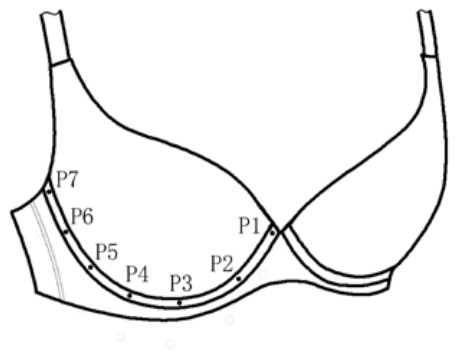
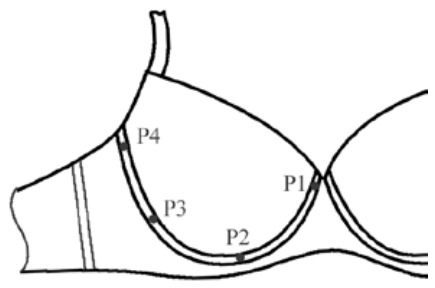
In the test 1 (abbreviated as T1), the main purpose is to test the effects of different brassieres’ under wires on the same subject. So, three different brands of commercial brassieres were used. They were all 3/4 cups and 75A size. And their styles are similar. The subject was a healthy woman of 24 years of age. Seven test points along the curve of under wire at right breast were tested. The style of brassieres and test points are shown in Figure 1.
Figure 1.
The style of brassieres and test points in T1.
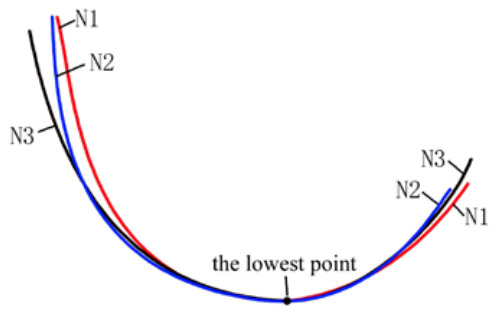
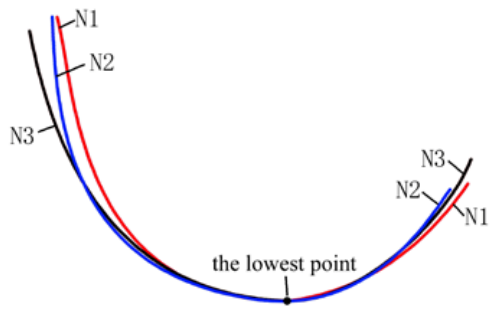
It was found that the under wires of three brassieres were different when compared according to their shapes where the lowest points of three under wires were superposition [9]. The shapes of three under wires are shown in Figure 2.
Figure 2.
The shapes of three under wires.
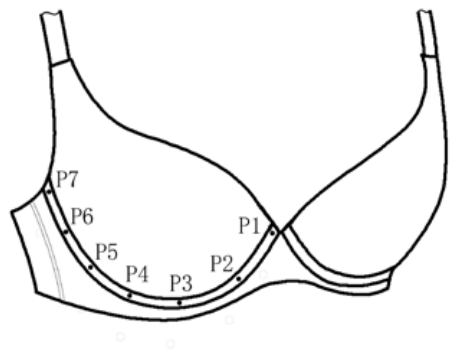
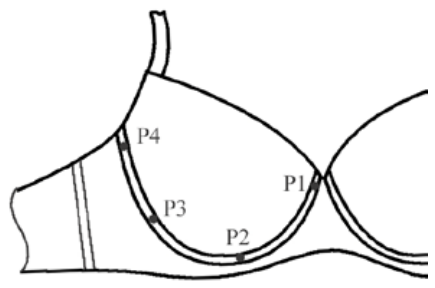
In the test 2 (abbreviated as T2), the main purpose is to test the influence of different subjects and motions on the pressure values of under wires. Two commercial brassieres were used. They are all 3/4 cups and 75A sizes. Three subjects were healthy women in age group 22 to 26 years. Four test points along the right side of the under wire were tested when the subjects made four different poses including standing, sitting down and relaxing, stretching arms forward and raising up the arms. The style of brassiere and the test points are shown in Figure 3.
Figure 3.
The style of brassiere and the test points in T2.
The differences between two tests were more clearly compared by their test items. The details of T1 and T2 are shown in Table 1.
Table 1.
The details of T1 and T2.
2.2. Measurements
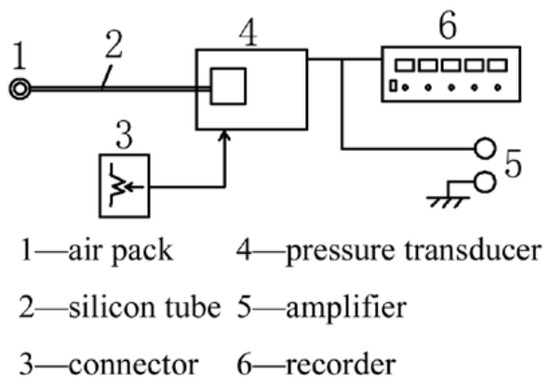
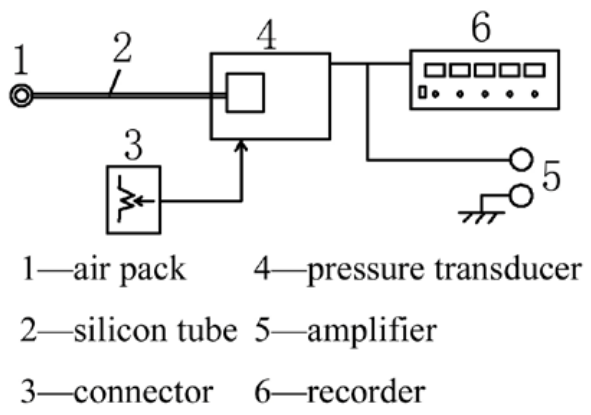
The pressure values were measured using AMI-30375S Air-pack type contact surface pressure measuring system [10,11]. The principles of the measuring system are shown in Figure 4. The temperature and humidity were at 25 ± 2 °C and 65 ± 2% in the laboratory, respectively.
Figure 4.
Measuring system of clothing pressure.
3. Results and Discussion
3.1. The Details of Subjects
Table 2 shows the basic information of subjects in T1 and T2. The subject “S1” was tested in both T1 and T2.
Table 2.
The details of the subjects.
3.2. Pressure Values in T1
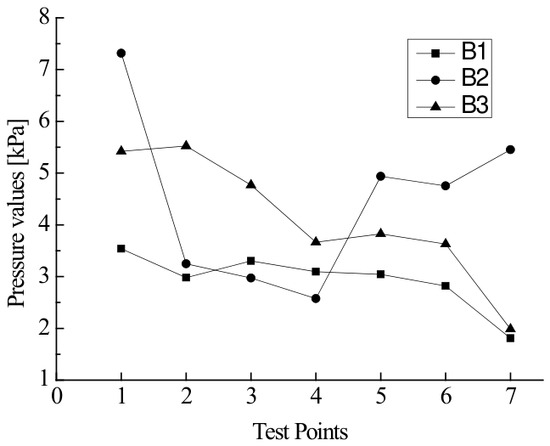
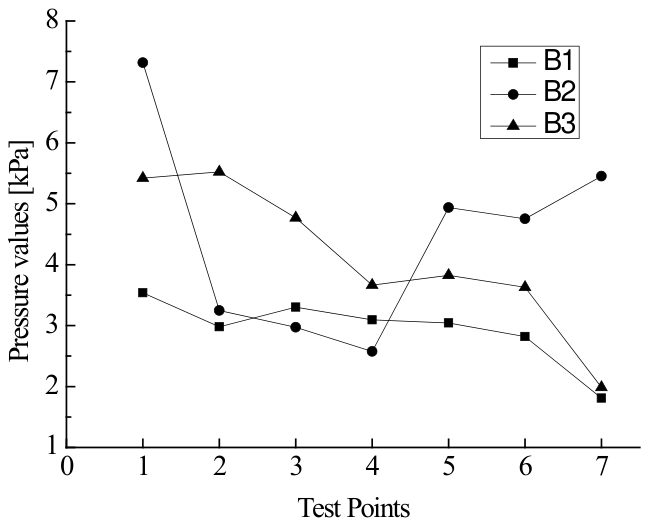
Figure 5 shows the pressure values of seven points when the subject was standing naturally in T1.
Figure 5.
The pressure values of test points in T1.
Univariate analysis was performed using the scores in Figure 5 in order to find out the significant differences of different points and brassieres in T1. The significant values of points and brassieres (significance level, 0.05) are shown in Table 3.
Table 3.
Significance values in T1.
The results from between-subjects effects significance show that there are no significant differences in group points and brassieres. But the significance of Levene’s test of Equality of Error Variances is just equal 0.05. So, Duncan’s multiple range test had been done to the brassiere and it indicated that there existed difference between the brassieres B1 and B2. That means the pressure values differed when the subject wore different brassieres.
3.3. Pressure Values in T2
Table 4 shows the pressure values when three subjects wore two brassieres in turns and made four different motions in T2.
Table 4.
The pressure values in T2.
Table 5 shows the significant values with the Levene’s test of Equality of Error Variances and the Test of Between-Subjects Effects. It indicates that there are significant differences about point, brassiere, point* brassiere and point* subject. Next, Duncan’s multiple range test was done to these items. The statistical results are as follows: P1differs from P2, P3, P4; B4 differs from B5; there were marked interaction to point* brassiere and point* subject.
Table 5.
Significance values in T2.
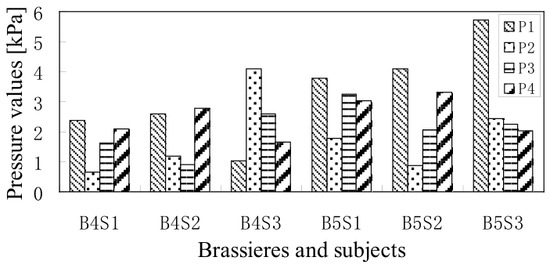
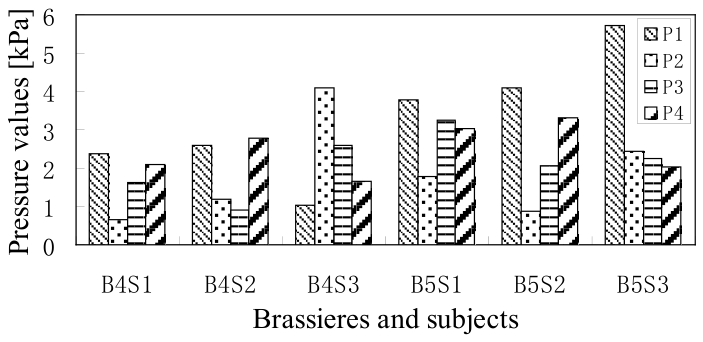
Figure 6 shows the pressure values at standing posture in T2. Most pressure values of center front are more than others in one test as shown in Figure 6. The breasts are squeezed toward center front by the under wires and cups of brassiere which add pressure to center front. And most of the pressure values of brassiere B4 are less than the corresponding values of brassiere B5.which indicates the pressure values are affected by different brassieres. Its mainly caused by the shapes of under wires and cups of a brassiere.
Figure 6.
The pressure values at standing posture.
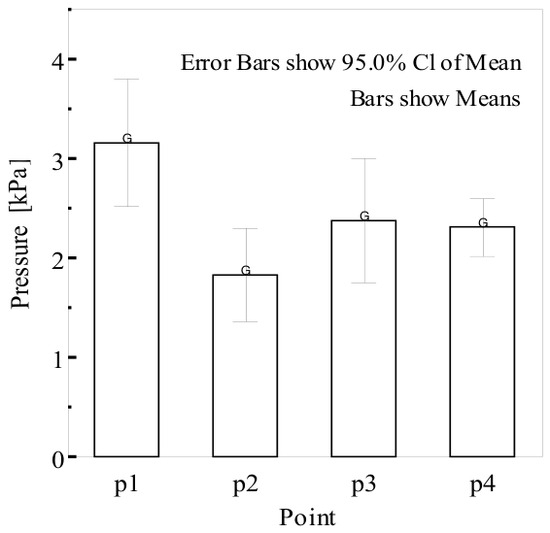
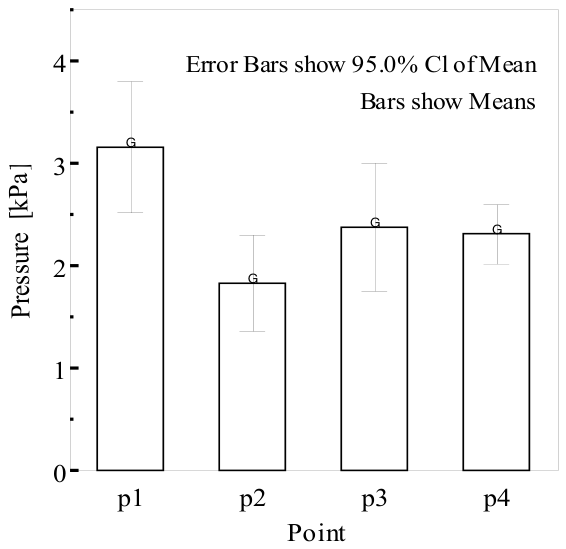
Figure 7 shows 95% confidence interval error pressure values and means of each point. T-test was performed on the pressure values and the results shows that 95% Confidence Interval of the pressure was not less than 2.14kPa and not more than 2.68kPa. The pressure values are small and the subjects don’t feel too much pressure obviously as the breast tissue is soft and flexible. The reason that few pressure values are too large or too small is subjects wear brassiere improperly or the shapes of under wires are not anastomosis with the bottom shapes of breasts. At present, women don’t consider the shapes of under wires when they select the brassieres. This results to the shape of under wires being unfit to most brassieres’ wearers. These women would have a variety of breast disease for wearing inappropriate under wires for long time.
Figure 7.
Means and errors of each point.
3.4. The Frequency of Pressure Differences
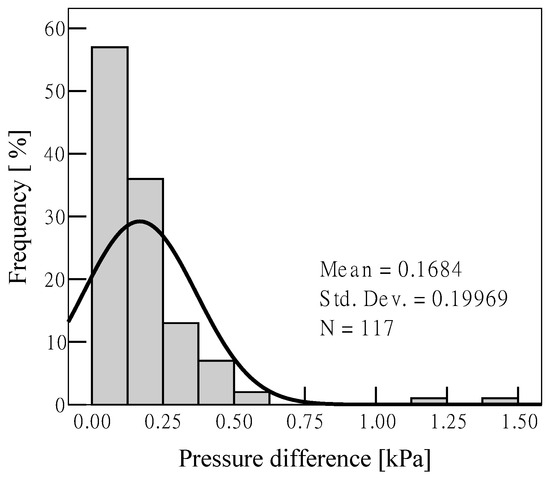
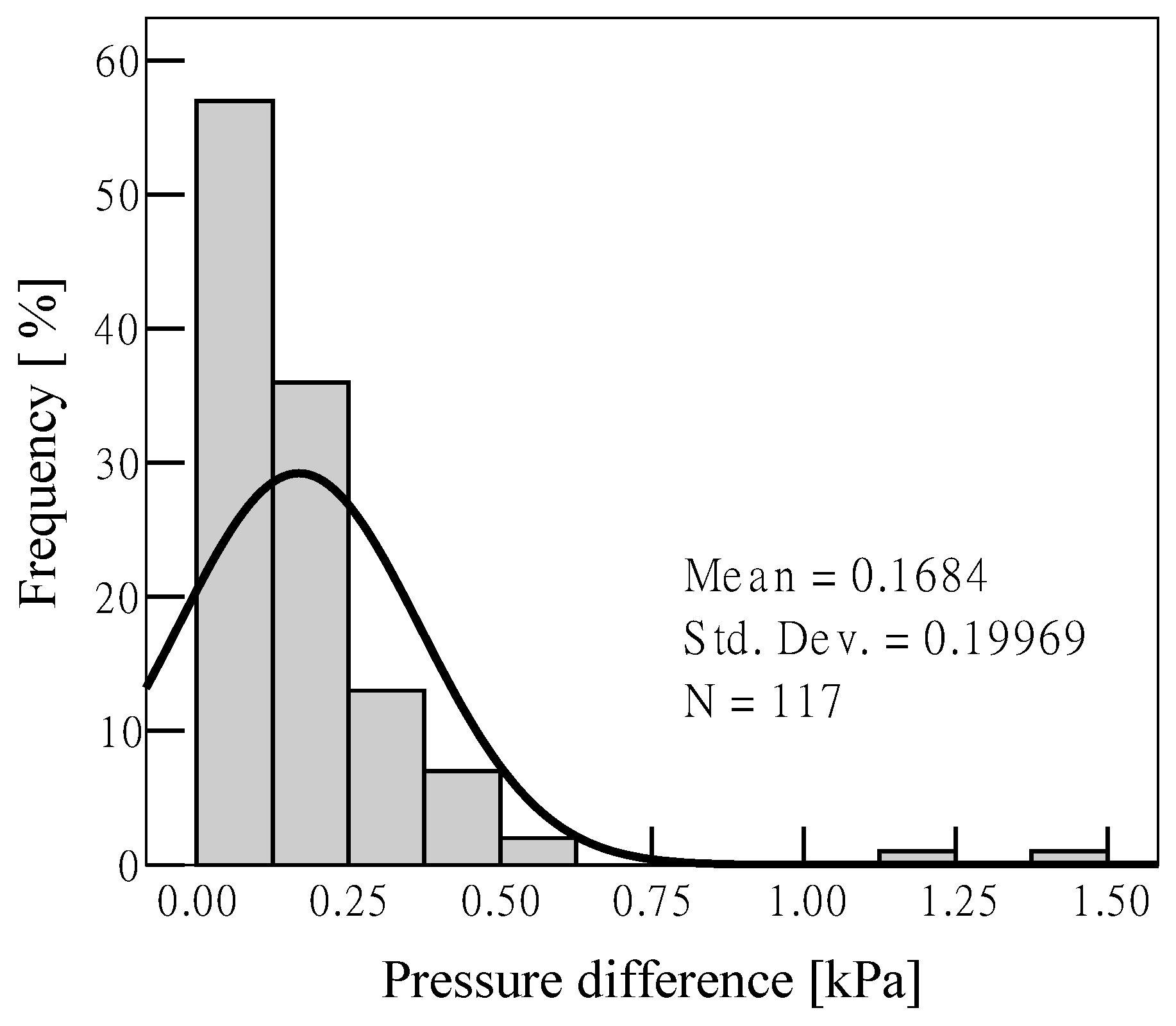
Figure 8 shows the frequency of pressure differences in T1 and T2. Most of pressure values are changed between 0 and 0.5 kPa except for few values between 0.5 and 1.5 kPa. Therefore, the influence of respiration on pressure values of brassiere bottom is mainly less than 0.5kPa. This shows that the pressure is less affected by normal respiration.
Figure 8.
The frequency of pressure differences.
4. Conclusion
In this study, the pressure distribution on under wires of brassiere was analyzed by two tests. In T1, the pressure values were measured by one subject wearing three brassieres. The pressure distribution in three brassieres is different. In T2, the pressure values were measured by three subjects wearing one brassiere. The pressure values were affected significantly by points, brassieres, the interaction of points and brassiere, the interaction of points and subjects. The breasts are squeezed toward center front by the cups and under wires of brassiere, which makes the pressure of center front larger. The entire pressure values are not too large as the breast tissue is soft and flexible. 95% Confidence Interval of the pressure was not less than 2.14 kPa and not more than 2.68kPa. The influence of respiration on pressure difference is small. The range of most pressure differences is between 0 and 0.5 kPa except for few values between 0.5 and 1.5 kPa.
Whether a piece of brassiere is suitable for a woman depends not only on the bust and under bust, but also on the shape of under wires.
References
- Wang, L.Z.; Chen, D.S. Study of pressure comfort of brassiere: a pilot study. TEXT. RES J. 2008, 4, 134–138. [Google Scholar]
- Yin, J.R.; Chang, J.L. Design principles and techniques of underwear patterns; Yin, J.R., Chang, J.L., Eds.; Shanghai technology and science publishing house: Shanghai, 2004; p. 1926. [Google Scholar]
- Chang, J.L.; Yin, J.R. The principles and examples of underwear patterns; Chang, J.L., Yin, J.R., Eds.; Shanghai technology and science publishing house: Shanghai, 2007; pp. 7–9. [Google Scholar]
- Okabe, K.; Kurokawa, T. Characteristics of threedimensional displacement of the breasts wearing different kind of brassieres in young japanese women. 2004; 6, pp. 36–44.
- Yu, Y.W. Innovation and technology of women’s intimate apparel. In Woodhead pubishing limited; Yu, W., Fan, J., Harlock, S.C., Ng, S.P., Eds.; Cambridge, UK, 2006; pp. 28–55. [Google Scholar]
- Lee, H.Y.; Hong, K.; Kim, E.A. Measurement protocol of women’s nude breasts using a 3Dscanning technique. Appl. Ergon. 2007, 39, 353359. [Google Scholar]
- Li, Y.; Zhang, X.; Yeung, K.W. A 3D Biomechanical model for numerical simulation of dynamic mechanical interactions of bra and breast during wear. Sen’i Gakkaishi 2003, 1, 12–21. [Google Scholar] [CrossRef] [Scilit]
- Choi, D.E. An analysis of feelings of brassierewearing and possibility to simulate them based on body shape. 11th International Conference on Knowledge-Based Intelligent Information and Engineering Systems (KES 2007), and 17th Italian Workshop on Neural Nets (WIRN 2007), 2007; 3, pp. 342–353. [Google Scholar]
- Lee, H.Y.; Hong, K. Optimal brassiere wire based on the 3D anthropometric measurements of under breast curve. Appl. Ergon. 2007, 5, 377384. [Google Scholar] [CrossRef] [Scilit] [PubMed]
- Komimami, Y. Air-pack type contact pressure method. U.S. Patent No. 5922.
- Komimami, Y. Contact pressure measurement and a method of calibration. Journal of the Japan Research Association for Textile End-Uses 2002, 348–355. [Google Scholar]

© 2009 Textile Bioengineering and Informatics Society. This article is an open access article distributed under the terms and conditions of the Creative Commons Attribution (CC BY) license (https://creativecommons.org/licenses/by/4.0/).