


Abstract
With the development of 3D printing technology, its application in the apparel industry, especially in bra cup design, has drawn attention. Previous studies have explored the use of 3D printing for underwear customisation. Yet, issues such as poor flexibility, heavy weight, excessive material consumption, and low comfort of printed materials remain, limiting the wide application of 3D-printed bra cups. There is a research gap in effectively optimising the structural design of 3D-printed bra cups to overcome these drawbacks. This paper aims to address this gap by investigating the use of lattice structures in designing 3D-printed bra cups and analysing how rod diameter and material hardness affect the elastic modulus of the lattice-based cup designs. Through a series of experiments, it is found that both parameters significantly influence the modulus, with material hardness being more crucial. By using the RESIONE F80 material with a 1 mm rod diameter for lattice infill, the volume of the 3D printed cup is reduced by 45.16%, porosity is enhanced, and ventilation and comfort are greatly improved.
1. Introduction
Additive manufacturing, also known as 3D printing, is a technology that builds things by layering materials [1]. As 3D printing technology advances, it has been widely used in many industries, particularly apparel. Unprecedented disruptive innovations have been brought about by this technology [2,3], particularly new possibilities for the design and production of moulded cup bras. Its benefits are mostly shown in the following: (1) This technique may create customised goods based on client requirements by doing away with the conventional mould production process. (2) Material waste is significantly decreased by progressively adding layers of materials to achieve near-net formation. (3) It can also produce goods with intricate structures, increasing design flexibility.
The use of 3D printing for the individualised customisation of underwear has been studied. The benefits of this technique above conventional approaches were disclosed by Wang et al., who also identified its drawbacks and recommended technical advancement to encourage its use [4]. To get a comfortable fit, Kajtaz et al. concentrated on customising sports bra cups using 3D printing and reverse engineering [5]. A thorough review of the use of 3D printing in the garment industry was given by Vanderploeg et al., who included examples from the fashion, underwear, and smart clothing industries. They spoke about its potential for development and provided a useful resource for relevant studies [6]. However, issues still prevent the current state-of-theart 3D-printed bra cups from being widely used. Compared to typical bra goods, there is a noticeable difference in comfort and wearability because of problems including excessive weight from printing materials, poor breathability, and higher manufacturing costs because of the printing method and material properties. These restrictions prevent 3D printing technology from reaching its full potential in intimate clothing. This study suggests using lattice structures strategically to optimise the structural design of 3D-printed bra cups to solve these urgent issues. Through thorough investigation, testing, and methodical assessment of several lattice configurations, the study seeks to determine the best structure that may be used to fill the bra cup model. This method will make it possible to compare the structural characteristics of the bra cup model before and after the lattice-based optimisation, offering important information to enhance the 3D-printed bras’ comfort, breathability, and affordability.
To fully realise this technology’s revolutionary potential in the apparel sector, 3D-printed bra cups must overcome their present constraints. This study’s results will improve the practicality of 3D-printed intimate clothing and offer new design approaches that may be used in other 3Dprinted fashion and textile product categories.
2. Method: Lattice Structure Compression Elasticity Experiment
2.1. Lattice Structure Selection
There are two-dimensional categories of lattice structures: two-dimensional and three-dimensional. Strong compressive and bending resistance, high impact resistance, and the capacity to absorb energy are all attributes of two-dimensional lattice systems. Three-dimensional lattices can have superior mechanical properties in various directions and offer great design flexibility [7]. From a practical application perspective, the two-dimensional lattice unit structure and the three-dimensional lattice unit structure exhibit significant differences in porosity and material consumption, which directly impact the performance of the final 3D printed bra cup. The two-dimensional lattice unit has a relatively lower porosity, requiring more printing material to fill, which is not conducive to effectively reducing the weight of the bra cup. On the other hand, the three-dimensional lattice unit’s higher porosity characteristic can significantly lower the amount of printing material needed for the same volume, which not only helps to lower the bra cup’s overall weight but also greatly increases the rate of material use, lowering manufacturing costs. In the structural design of bra cups, a higher porosity can improve the breathability performance and enhance the product’s comfort while facilitating a more lightweight design. Considering the advantages of the three-dimensional lattice structure in terms of porosity and material consumption, it can better meet the functional requirements of bra cup design compared to the two-dimensional lattice.
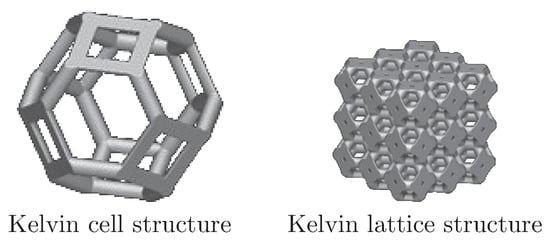
Choosing the right three-dimensional lattice structure is essential for bra cup design optimisation. Several representative 3D lattice configurations, such as body-centred cubic (BCC), octet, and Kelvin cell structures, have been extensively studied. These lattice topologies have different geometrical characteristics and mechanical properties, which make them suitable for different application scenarios. The specific weight, breathability, and structural integrity requirements in the context of bra cup design necessitate carefully evaluating the available lattice options. Research has indicated that the Kelvin cell, a space-filling polyhedron with 14 faces, is a promising candidate for porous structure design [8]. This lattice geometry provides high porosity and superior mechanical performance under compressive loading, crucial for load-bearing components like bra cups.
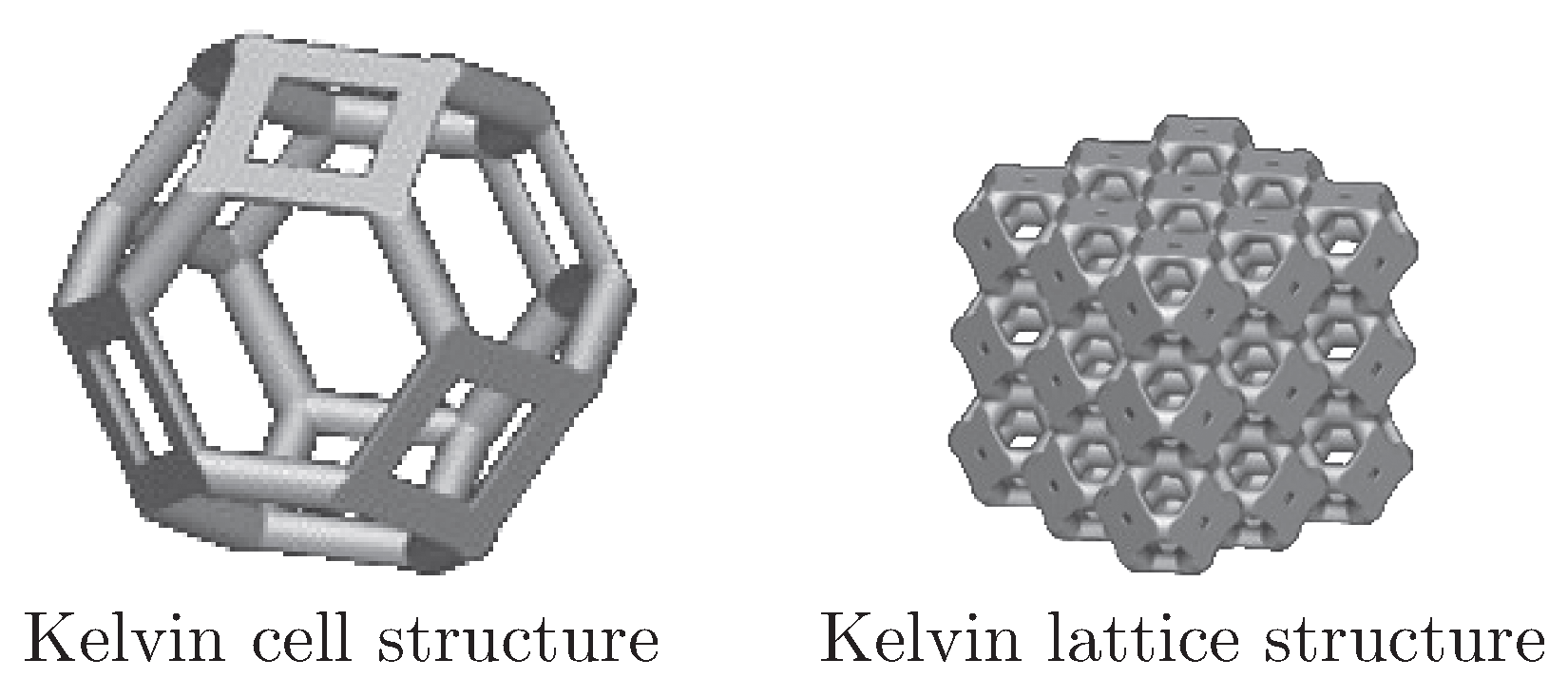
Furthermore, it is worth noting that natural porous structures, such as the ubiquitous hexagonal honeycomb, have long been recognised for their exceptional structural stability and heat transfer efficiency. The design space for structural applications has been further expanded by researchers who have developed a range of topologically optimised honeycomb-based lattice designs based on these naturally occurring patterns. This work chooses the three-dimensional Kelvin cell & lattice structure as the main emphasis for structural optimisation, as shown in Figure 1, in light of the particular functional requirements of bra cups and the insightful information gained from studying natural and artificial porous structures.
Figure 1.
Schematic diagram of kelvin cell & lattice structure.
2.2. Design of Experimental Scheme for Lattice Structure Compression
According to existing research, the structural characteristics of bra cups feature a top section with a thickness of around 3–6 mm and a thicker bottom section of approximately 16–22 mm [9,10,11].
The lattice unit size in this investigation is selected at 3 mm to guarantee full unit cell filling in the thinnest part. The lattice rod diameter selection is an important step in the actual filling process. Setting the rod diameter too small can easily lead to partial filling, and the success rate decreases as printing precision increases. On the other hand, an overly large rod diameter could result in an unduly rigid filling, which would decrease ventilation and affect wearing comfort. As a result, this study fills a cubic model with an edge length of 9 mm with three distinct rod diameters: 0.8 mm, 1 mm, and 1.2 mm. Using lattice rods of different diameters allows a comprehensive analysis of the impact of rod diameter on structural performance. Smaller diameters can increase porosity and improve breathability, but also increase filling difficulty. Larger diameters enhance structural strength but may increase weight and reduce breathability. By systematically comparing the performance of different configurations, this research aims to identify the optimal rod diameter that balances weight, strength, and breathability, supporting the practical application of 3Dprinted lingerie.
This experiment was utilised using a Rayshape Shape 1 HD 3D printer. According to the bra cup’s performance requirements, three 3D printing materials with lower but different Shore hardness values were selected: JIUYUE, BOXIN, and REGIONE F80. The key performance and printing parameters are summarised in Table 1.
Table 1.
Performance and printing parameters of printing materials.
Therefore, this study selects two factors, rod diameter and printing material hardness, for experimental design. The rod diameter is A, and the material hardness is B. The experimental design scheme is shown in Table 2. According to the experimental design, the stress-to-strain ratio in the sample’s elastic stage is measured, and the compressive elastic modulus of each sample is obtained to select appropriate unit structural parameters for mould filling.
Table 2.
Experimental results.
2.3. Experimental Process
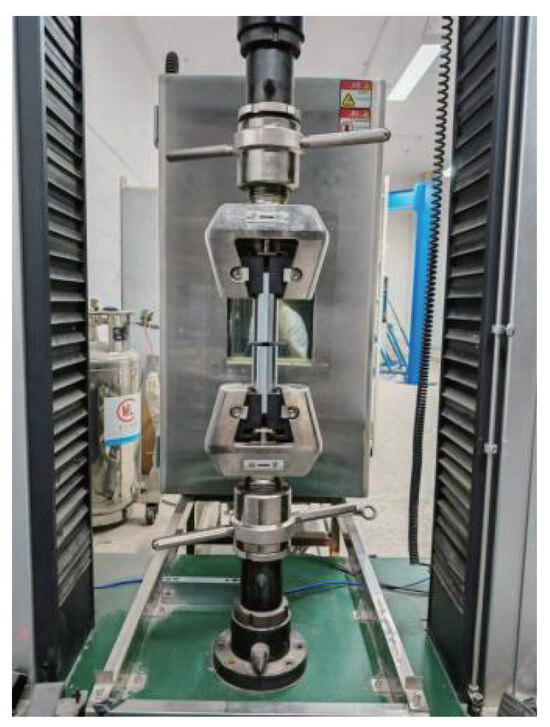
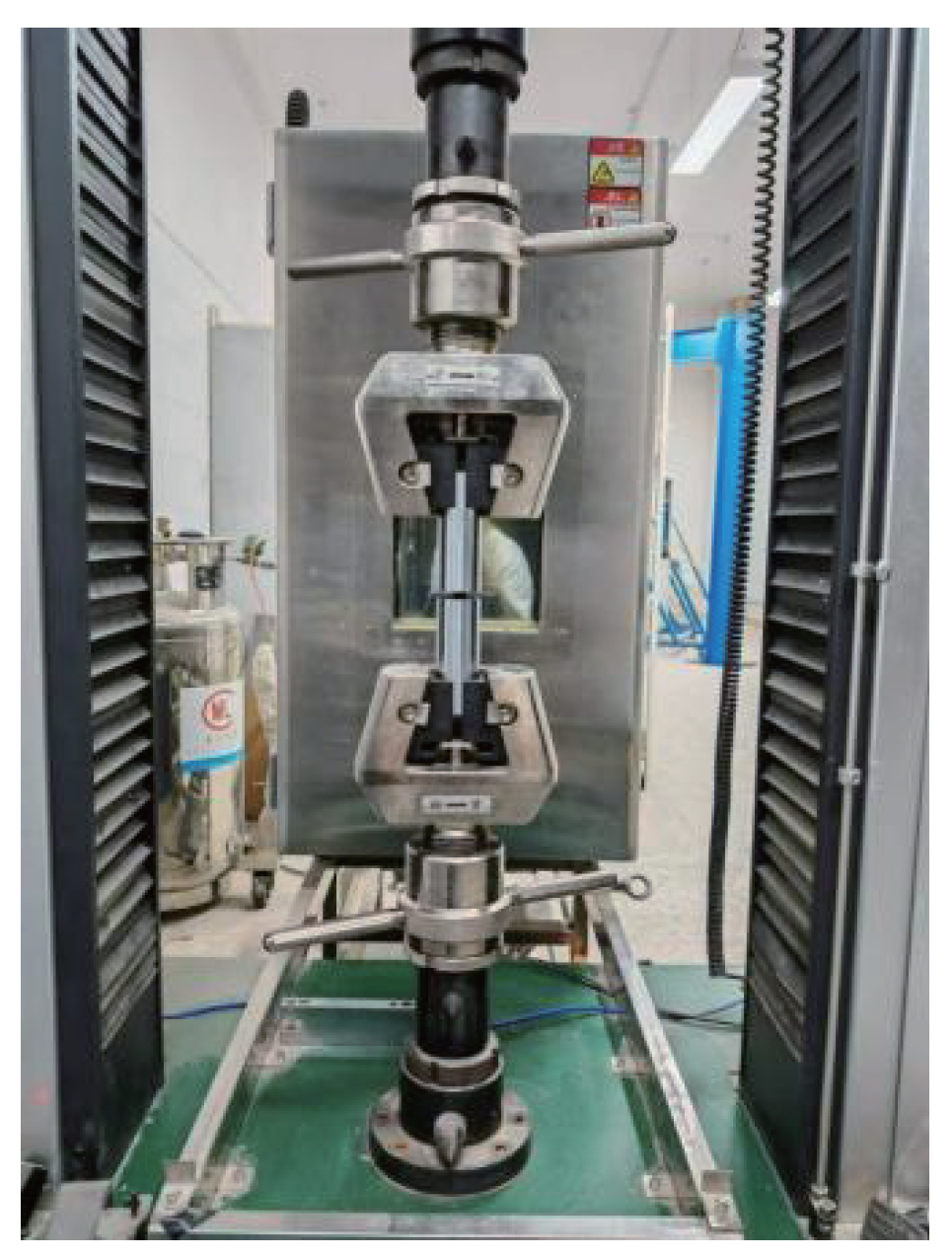
The experiment was conducted using the UTM5205X electronic universal testing machine. According to GB/T 1041-2008, the sample’s compression modulus of elasticity was measured; the findings kept three significant digits. Figure 2 shows the universal testing machine.
Figure 2.
Schematic diagram of a universal testing machine.
Before the experiment, the sample was checked to ensure it had sufficient rebound and was free of defects or damage. The sample was then placed between the two pressure plates, with the centerline of the sample aligned with the centerline of the two pressure plates. The sample’s two end faces were made to line up with the pressure plate. The upper-pressure plate’s height was changed to barely touch the specimen’s surface. The sample was then kept in a quasi-static state and compressed along the main axis at a steady rate of 0.18 mm/min until its length had decreased by 60%.
3. Experimental Results and Analysis
3.1. Analysis of Compression Elasticity Test Results
The slope of the specimen’s elastic compression portion’s stress-strain curve was used to determine the compressive modulus of elasticity. Table 2 presents the experimental outcomes. In the table, the overall experimental findings of the relevant factors at the first, second, and third levels are denoted by K1, K2, and K3, respectively. The range is represented by R, which is the difference between the highest and minimum values of each factor at various levels. As can be observed from Table 2’s data, RB>RA indicates that of the two factors—rod diameter and material hardness—hardness has the biggest influence [12].
An analysis of variance was conducted on the two factors of diameter and hardness, and significance tests were performed using the F-value and p-value. The analysis results are presented in Table 3. The F-test results indicate a significant difference in the effects of the two factors, with a small error term. The experimental accuracy is high, and a p-value less than 0.01 indicates an extremely significant difference between the two groups.
Table 3.
Analysis of variance of factors.
The investigation showed that the material hardness had a stronger effect on the magnitude of the elastic modulus than the rod diameter. Therefore, choosing the right printing material hardness and rod diameter should be considered more when developing 3D-printed bra cups. After carefully examining the experimental results, we discovered a positive association between the rod diameter and the elastic modulus value when the material hardness is constant. As the rod diameter gradually increased, the corresponding elastic modulus value exhibited a significant upward trend. This indicates that the rod geometric dimension is a key parameter influencing the overall stiffness performance of the 3D printed structure. According to additional investigation, material hardness influenced the elastic modulus value more significantly than rod diameter. Stated differently, the total stiffness characteristics of the 3D printed structure were more significantly influenced by the material hardness performance indicator than by the structural parameter of rod diameter. It is essential to look into the inherent connections between rod diameter, material hardness, and elastic modulus to develop a thorough performance prediction model that can be used for bra-cup design.
3.2. Analysis of Optimised Cup Structure
A typical mould cup’s elastic modulus ranges from 0.5 to 1.5 MPa [9,10,11], and several sets of samples in the experimental results fall within this range. The mould cup’s shaping effect will be impacted by its excessive elasticity, and wearing it will be uncomfortable if it is too low [13,14]. However, the elastic modulus and rod diameter values of sample 10# are both moderate. Therefore, we chose to fill the mould cup with a Kelvin cell structure made of REACIONE F80 printed material with a rod diameter of 1 mm [15,16].
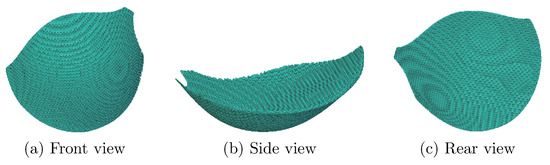
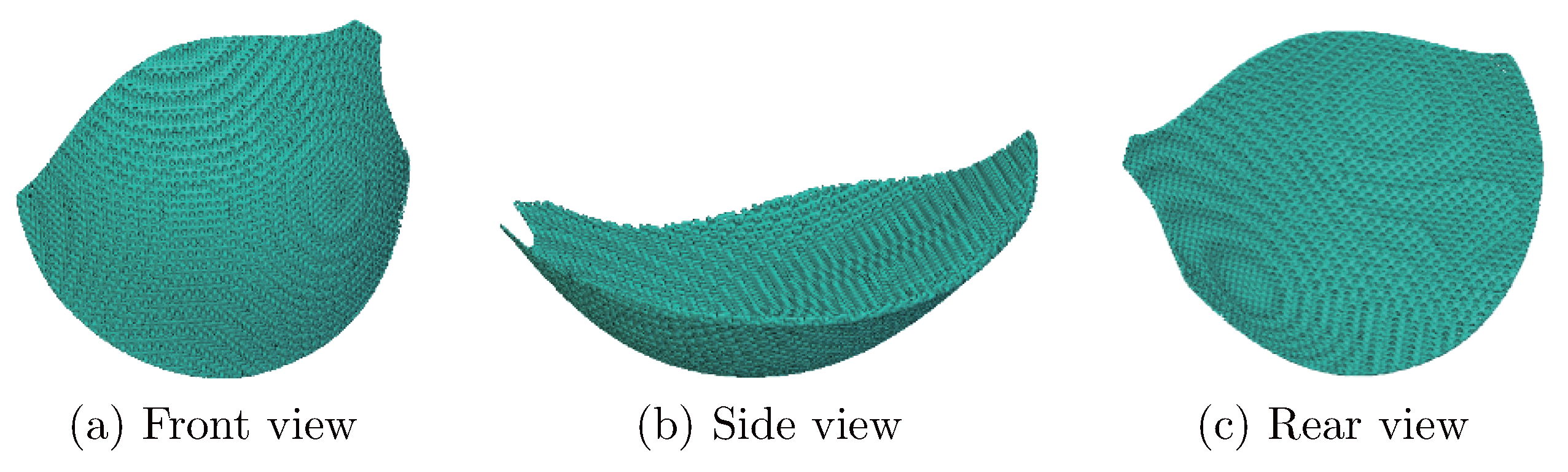
A mould cup model was created in UG with the narrowest component measuring 3 mm and the thickest part measuring 21 mm. Following filling, as illustrated in Figure 3, the mould cup’s volume was 61.970 cm3 after the lattice was filled, compared to 137.237 cm3 before filling, as determined by Creo software. Equation 1 can be used to express porosity φp.
Figure 3.
Effect of mould cup after lattice filling.
In the formula, Vp is the pore volume, Vz is the total volume, and Vs is the volume of the solid. According to the porosity calculation formula, the filled cup’s porosity is 54.84%, reducing the volume by 45.16%, greatly reducing the cup’s weight, improving its breathability, and reducing printing costs.
By regulating the geometric parameters and material qualities, the bra cup design based on the Kelvin lattice structure optimises mechanical performance, greatly improves ventilation, and lowers the structure’s weight. This method reduces manufacturing costs and meets comfort standards at the same time. This offers crucial theoretical direction and technical assistance for creating 3D-printed bra cups that more effectively satisfy environmental and human requirements.
4. Conclusion
This work thoroughly evaluated the fundamental elements impacting the elastic modulus of 3Dprinted bra cups: the printing material’s hardness and the lattice structure’s rod diameter. Carefully performed compression tests clarified the link between these parameters and the elastic modulus.
(1) Rod diameter and material hardness strongly affected the elastic modulus, with the former having a stronger effect. Instead of concentrating only on the structural parameters, more attention should be paid to selecting and optimising the printing material’s hardness when designing 3D-printed bra cups.
(2) By incorporating a lattice infill structure into the bra cup design, the weight of the printed part can be significantly decreased while increasing overall breathability. This approach meets comfort requirements and results in significant cost savings regarding material consumption and printing expenses.
(3) While the current study has produced encouraging results, it is restricted to examining the relationships between the factors under investigation and the elastic modulus; additional research is required to fully characterise the intricate interactions between the geometric, material, and performance attributes and their effects on the overall comfort, fit, and durability of the 3Dprinted bra cups.
Acknowledgement
The authors would like to thank Wuhan Textile and Apparel Digital Engineering Technology Research Center for the following programs in 2022 and 2003 (SZH202202 and SZH202302), the Shaanxi Natural Science Basic Research Program (Program No. 2023-YBSF-203 and 2024JCYBMS-789), the 2022 Xi’an Polytechnic University Ideological and Political Curriculum Demonstration Course Project (PX-1923673), the 2024 Graduate Innovation Fund Project of Xi’an Polytechnic University (Project No. chx2024011), the open project of the Key Laboratory of Silk Culture Heritage and Products Design Digital Technology, Ministry of Culture and Tourism, P. R. China, and the Shaanxi Research Center of Clothing Engineering and Technology at Xi’an Polytechnic University.
References
- Quan, H.; Zhang, T.; Xu, H.; Luo, S.; Nie, J.; Zhu, X. Photo-curing 3D printing technique and its challenges. Bioact. Mater. 2020, 5(1), 110–115. [Google Scholar] [CrossRef] [Scilit]
- Wu, S.; Zeng, T.; Liu, Z.; Ma, G.; Xiong, Z.; Zuo, L.; Zhou, Z. 3D printing technology for smart clothing: A Topic Review. Materials 2022, 15, 7391. [Google Scholar] [CrossRef] [Scilit]
- Spahiu, T.; Canaj, E.; Shehi, E. 3D printing for clothing production. J. Eng. Fibers Fabr. 2020, 15, 1–8. [Google Scholar] [CrossRef] [Scilit]
- Wang, Z.; Suh, M. Bra underwire customization with 3-D printing. Cloth. Text. Res. J. 2019, 37(4), 281–296. [Google Scholar] [CrossRef] [Scilit]
- Kajtaz, M.; Subic, A.; Brandt, M.; Leary, M. Three-dimensional printing of sports equipment. Mater. Sports Equip. 2019, 161–198. [Google Scholar] [CrossRef] [Scilit]
- Vanderploeg, A.; Lee, S. E.; Mamp, M. The application of 3D printing technology in the fashion industry. Int. J. Fash. Des. Technol. Educ. 2017, 10(2), 170179. [Google Scholar] [CrossRef] [Scilit]
- Chougrani, L.; Pernot, J. P.; V’eron, P.; Abed, S. Parts internal structure definition using non-uniform patterned lattice optimization for mass reduction in additive manufacturing. Eng. With Comput. 2019, 35(1), 277–289. [Google Scholar] [CrossRef] [Scilit]
- Hales, T. C. The honeycomb conjecture. Discret. Comput. Geom. 2001, 25, 1–22. [Google Scholar] [CrossRef] [Scilit]
- Guo, Z.; Zhang, Y.; Chen, J.; Long, Y.; Du, L.; Zou, F. Study on realizing the personalized customization of bra cup by solving the inverse problem of bra cup design. Text. Res. J. 2021, 23/24, 91. [Google Scholar] [CrossRef] [Scilit]
- Ying, B.; Bai, Y.; Zhang, X.; Qi, J.; Wang, J. 3D modelling of outer surface of moulded bra cup. J. Fiber Bioeng. Inform. 2011, 4(2), 145–154. [Google Scholar]
- Ying, B.; Wang, Y.; Liu, F.; Zhang, X. Study on the definition of moulded bra cup Features and parametric modeling. J. Fiber Bioeng. Inform. 2011, 4(4), 389–402. [Google Scholar] [CrossRef] [Scilit]
- Wang, H. Y.; Wu, L.; Qi, J.; Ding, J. T.; Wang, Y. Optimising 3D printing bra cup structure design using lattice structure. Text. Bioeng. Inform. Symp. Proc. 2024, 340–347. [Google Scholar] [CrossRef] [Scilit]
- Sun, Y.; Yick, K. L.; Cai, Y.; Yu, W.; Chen, L.; Lau, N.; Zhang, S. Finite element analysis on contact pressure and 3D breast deformation for application in women’s bras. Fibers Polym. 2021, 22, 2910–2921. [Google Scholar] [CrossRef] [Scilit]
- Chen, L. H.; Ng, S. P.; Yu, W.; Zhou, J.; Wan, K. F. A study of breast motion using non-linear dynamic FE analysis. Ergonomics 2013, 56(5), 868–878. [Google Scholar] [CrossRef] [Scilit]
- Gou, J. J.; Wu, L.; Qi, J.; Ying, B. A.; Wang, Y. A construction method for personalized bra sample models. J. Fiber Bioeng. Inform. 2023, 16, 269–281. [Google Scholar] [CrossRef] [Scilit]
- Ma, J. J.; Ying, B. A.; Wu, L.; Qi, J.; Zhang, X. Parametric modeling method for inner surface of functional bra mold cup in personalized customization. J. Fiber Bioeng. Inform. 2022, 15, 105–116. [Google Scholar] [CrossRef] [Scilit]

© 2025 Textile Bioengineering and Informatics Society. This article is an open access article distributed under the terms and conditions of the Creative Commons Attribution (CC BY) license (https://creativecommons.org/licenses/by/4.0/).