


Abstract
Fire behavior of textiles varies depending on fiber composition, manufacturing process and any additional treatments applied. Such variables can contribute to significant differences in the flammability making it difficult to estimate the risk of fire ignition. Clothing fires can cause burns with minor injuries and burns leading to serious injuries that may require hospitalization. The elderly and children are especially at risk since they may not recognize the dangers of a clothing fire and how to react quickly to extinguish the flames. Health and safety professionals are frequently asked to recommend reducing such risks. However, information about the flammability properties of non-FR treated clothing worn by the public is generally not available. The objective of this research program was to develop a simplified method for defining the flammability of commercially available fabrics. 50 samples were tested including Cotton, Wool, Silk, Nylon and Polyester. Changes in the weight of a sample resulting from combustion including the time involved in the combustion cycle was used as a indictor of the total heat generated by the fire and the risk and severity of a burn injury. The results showed that the Cotton and Wool fabric samples created the highest risk of burn injury while the Polyester fabric created the lowest risk. These conclusions are based on two criteria: Total time associated with a combustion cycle and the loss of fabric mass during the combustion cycle. The proposed method can be carried out using a standard laboratory fume-hood, a precision weight scale and a stopwatch.
1. Background
Clothing fires are a significant public health challenge globally. Thousands of deaths and injuries occur each year from the ignition, propagation and smoldering of flames in clothing. Approximately two million persons suffer burn injuries each year and over 100000 require hospitalization [1,2]. Burn injuries caused by ignited clothing are most prevalent among young children and the older populations [3,4]. All fabrics will burn to varying degrees if exposed long enough to a flame. However, the fiber content, construction, fabric weight and fabric finish can influence their flammability characteristics. The same fiber used in different fabrics can burn at different rates. Use of Nano-materials in the future will likely present additional challenges in characterizing the flammability of clothing.
Standards related to fabric flammability testing have been developed by organizations such as the International Organization for Standardization (ISO), the American Society for Testing and Materials (ASTM) and the National Fire Protection Association (NFPA). Examples of standards that address minimum performance requirements include firefighter protective clothing [5,6] and clothing used by industrial workers [7,8]. Some standards address fabric flame spread [9,10] and clothing used for extreme exposures [11,12].
The severity of skin injury caused by an exposure to a fabric fire is proportional to the total heat transferred to the skin and the duration of the flaming cycle [13,14]. The risk of injury can be estimated by observing the duration of the flaming cycle and measuring the fabric mass (weight) consumed by the fire. While fire exposure guidelines employ thermodynamic variables, such guidelines primarily apply to protective clothing used in high-risk occupational settings [15]. The flammability ratings of commercially available clothing worn by the public are generally unavailable. A simplified method for testing the flammability of commercially available fabrics is proposed which can provide relative comparisons among and between different fabric materials. This approach will allow health and safety professionals to “rank order” consumer relevant fabric materials from “least” flammable to “most” flammable when considering the availablilty of multiple fabric types.
2. Methods and Procedures
2.1. Fabric Samples
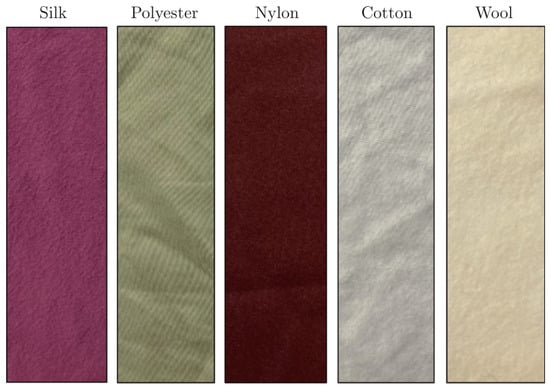
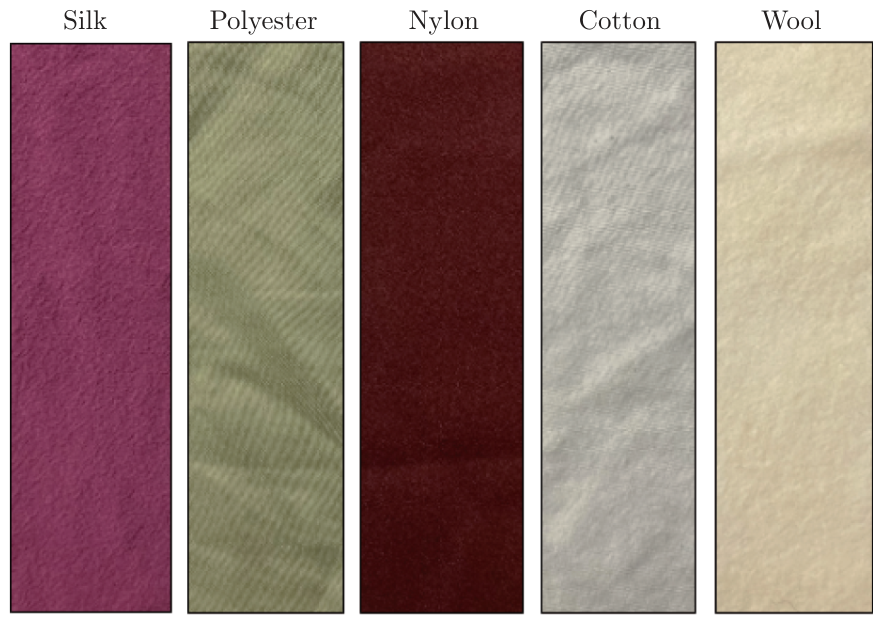
Five types of fabric material were evaluated, including 10 samples of Silk (100%), 10 samples of Polyester (100%), 10 samples of Nylon (100%), 10 samples of Cotton (100%), and 10 samples of Wool (100%). Each sample tested was 20 cm in length and 5 cm in width. The average weight of the Silk samples was 0.79 g, the average weight of the Polyester samples was 0.71 g, the average weight of the Nylon samples was 1.31 g, the average weight of the Cotton samples was 1.90 g, and the average weight of the Wool samples was 1.30 g. The weights and sizes are summarized in Table 1 and illustrated in Figure 1.
Table 1.
Fabric sample dimensions and weights.
Figure 1.
Illustration of the fabric samples tested for flammability.
2.2. Equipment
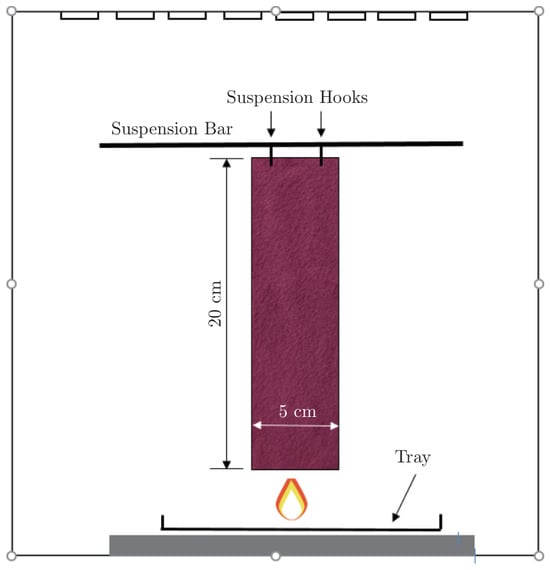
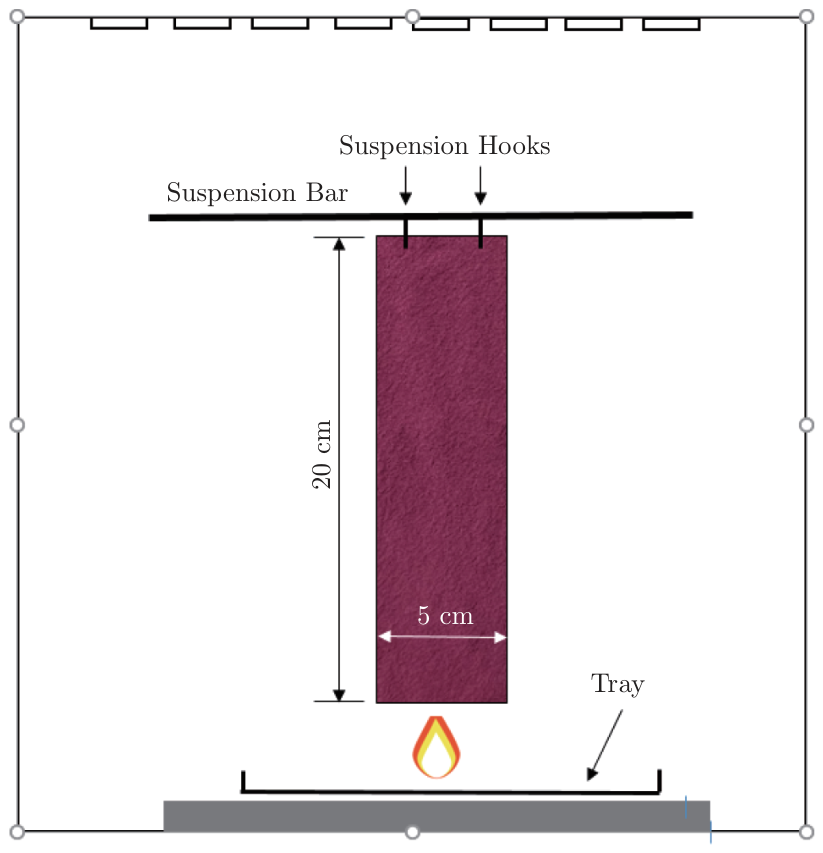
All flammability tests were performed inside a laboratory fume hood that shielded against extraneous airflow and provided an exhaust for smoke. The ambient air temperature was 20 °C and the relative humidity was 24%. Each sample was attached to a suspension bar inside the fume-hood as illustrated in Figure 2. Before, and after each combustion event, the weight of the sample was determined using a Mettler 100 precision weight scale. A digital stopwatch was used to record the time associated with each combustion cycle.
Figure 2.
Illustration of a fabric sample suspended inside the laboratory fume-hood. The tray was used to collect ashes and all un-burned fabric material for weighing.
2.3. Measurement Steps
The weight of a fabric sample was determined before the sample was mounted onto the suspension bar inside the fume-hood. Once mounted, the sample was exposed to a 1 cm Butane flame for 1-3 seconds. The stopwatch was started and continued until the combustion cycle ended. The weight of the ashes and remaining fabric material not consumed by the flames was obtained. The difference between the fabric weight before and after combustion was then determined.
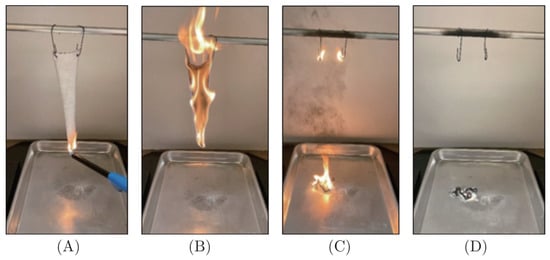
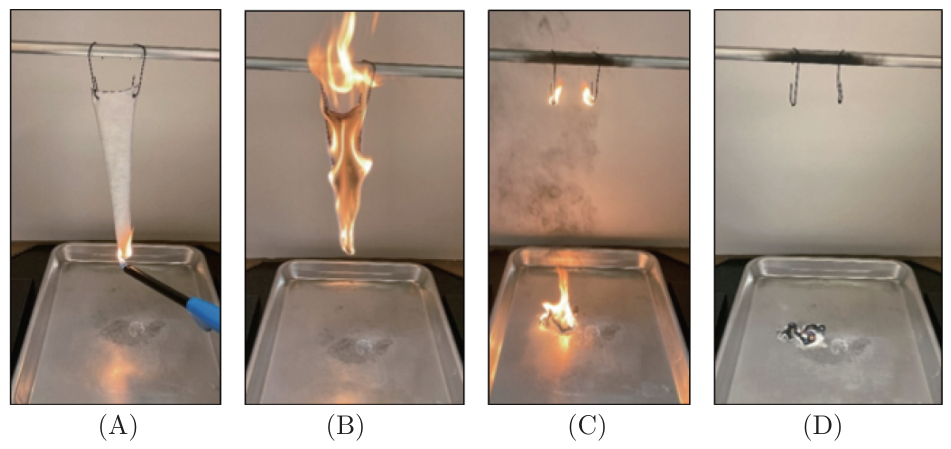
The fabric combustion cycle including the initiation phase (fabric ignition), the propagation phase (self-sustaining flame) and the termination phase (smoldering) is illustrated in Figure 3.
Figure 3.
Illustration of a typical combustion cycle including the initiation phase (A), the propagation phase (B) the termination phase (C) and the smoldering phase (D).
3. Results
3.1. Burn-Times and Heat Intensity
The observed burn-times and amounts of material consumed by the fire are summarized in Table 2. The average burn time associated with the Silk samples was 14 seconds, 44 seconds for the Cotton samples, 78 seconds for the Wool samples, 6 seconds for the Polyester samples and 33 seconds for the Nylon samples. The average fabric combustion rate (%/sec) defining the total heat generated by the fire was 2.8% for Silk, 2.2% for Cotton, 1.2% for Wool, 0.8% for Polyester and 06% for the Nylon samples.
Table 2.
Summary of fabric sample weight changes, burn times, material consumed, and combustion rates.
4. Analysis
The results illustrate significant differences in the flaming characteristics of the five types of fabric samples evaluated. The burn time (in seconds) for each fabric type can be used to describe the duration of heat exposure. In contrast, the combustion rate (percentage of fabric material consumed per second) can describe the heat intensity. Together, the two parameters define the overall potential for a heat-related injury [13,14,15]. A short burn time linked to a low combustion rate will represent a lower injury potential than a fabric fire exhibiting a longer burn time and a higher combustion rate. Since each fabric type will exhibit different combinations of burn times and combustion rates, fabrics can be ranked relative to each other regarding the burn injury potential. Table 3 illustrates this ranking method. It can be seen that the Polyester fabric ranked low in heat exposure and heat intensity. However, both Wool and Cotton ranked high and medium for heat exposure and heat intensity.
Table 3.
Injury potential ranking based on fabric burn times and combustion rates.
5. Conclusions
The results illustrate that a reduced fabric weight resulting from fire combustion can be linked to fire intensity. This can serve as the basis for ranking the risk of burn injury. Table 4 illustrates this format. Using both exposure time and heat intensity as the criteria, Polyester exhibited a low risk for both criteria, while Wool, Silk and Cotton were rated as high risk. Cotton, Nylon and Wool exhibited a medium risk. This approach provides a method for public health professionals to communicate relative clothing flammability risks to the community.
Table 4.
Fabric flammability risk categories based on flame exposure time and heat intensity.
6. Limitations
The fabric samples used in this study were obtained from previously worn clothing that may have been impacted by previous use. In addition, the structural fiber characteristics such as yarn count, weave type and density could not be determined. However, such variables may have influenced the observed burn characteristics. Limiting the tests to 100% Silk, Cotton, Wool, Polyester and Nylon was done to control potential confounders.
References
- Hoebel, J.F.; Damant, G.H.; Spivak, S.M.; Berlin, G.N. Clothing Related Casualties: An Overlooked Problem? Fire Technol. 2010, 46, 629–649. [Google Scholar] [CrossRef] [Scilit]
- Peck, M.D. Epidemiology of burns throughout the world. Part I: Distribution and risk factors. Burns 2011, 37, 1087–1100. [Google Scholar] [CrossRef] [Scilit] [PubMed]
- Oglesbay, F.B. The flammable fabrics problem. Inj. Prev. 1998, 4, 317–320. [Google Scholar] [CrossRef] [Scilit]
- American Academy of Pediatrics. Committee on Accident Prevention, Investigation of Fabrics Involved in Wearing Apparel Fires. Pediatrics 1964, 34(5), 728–733. [Google Scholar] [PubMed]
- NFPA 1977 Standard; on Protective Clothing and Equipment for Wild Land Firefighting. 2011.
- BS EN 1486 Protective Clothing for Fire fighters; Test Methods and Requirements for Reflective Clothing for Specialized Fire fighting. 2007.
- ISO 11611; Protective Clothing for Use in Welding and Allied Processes. 2007.
- ISO 11612; Protective Clothing – Clothing to Protect against Heat and Flame. 2008.
- ISO 15025; Protective Clothing – Protection against Heat and Flame – Method of Test for Limited Flame Spread. 2000.
- ISO 14116; Protective Clothing – Protection against Heat and Flame – Limited Flame Spread Materials, Material Assemblies and Clothing. 2008.
- ASTM F 2302 Standard; Performance Specification for Labeling Protective Clothing as Heat and Flame Resistant. 2008.
- ASTM D 6413 Standard; Test Method for Flame Resistance of Textiles (Vertical Test). 2013.
- Xu, F.; Wang, P.F.; Lin, M.; Lu, T.J.; Ng, E.Y.K. Quantification and the Underlying Mechanism of Skin Thermal Damage: A Review. J. Mech. Med. Biol. 2010, 10(3), 373–400. [Google Scholar] [CrossRef] [Scilit]
- Noodleman, F.R.; Pounds, D.; Faber, E.M.; Orenberg, E.K. Thermal Dosimetry Studies on HumanSkin-Association of Depth of Heating with Clinical Efficacy in the Treatment of Isolated Psoriatic Plaques. J. Investig. Dermatol. 1983, 80(4), 361–365. [Google Scholar]
- Udayraj, T.; Talukdar, P.; Das, A.; Alagirusamy, R. Heat and Mass Transfer Through Thermal Protective Clothing: A Review. Int. J. Therm. Sci. 2016, 106, 32–56. [Google Scholar] [CrossRef] [Scilit]

© 2023 Textile Bioengineering and Informatics Society. This article is an open access article distributed under the terms and conditions of the Creative Commons Attribution (CC BY) license (https://creativecommons.org/licenses/by/4.0/).