


Abstract
Human beings depend on vision to obtain external information from their surroundings. It is, therefore, difficult for visually impaired people to perceive visual sensations in their daily lives. Currently, there are many related designs for the convenience of visually impaired people in urban construction and daily use. Still, little research has been done on their clothing design, especially designs that combine their functional and emotional requirements. In this study, interviews were conducted to examine the difficulties visually impaired people face in dressing and their functional and emotional requirements for clothing. Based on the design investigation of visually impaired people and the interview survey on their requirements for clothing, this study also explored the application of the sensory compensation design concept (mainly tactile compensation) in clothing design. As a result, four clothing styles were designed to meet their physical and psychological needs. It is hoped that the study will provide a way of thinking about clothing design for visually impaired people and call for more attention and help.
1. Introduction
According to data from The Second China National Sample Survey On Disability [1], about 85 million disabled people in China, among which 1.2 million are visually impaired, accounting for 14.86% of the total population. Visual impairment refers to those who are blind and those with poor vision [2]. Most people lose their vision due to macular degeneration, glaucoma, and diabetes, while a small percentage are born without sight. Human acquisition of external information relies heavily on vision, and about 80–90% of the information captured and perceived from the surrounding environment depends on vision [3]. Therefore, visually impaired people have many physical and psychological obstacles daily. Products tailored for them need to take into consideration their respective requirements.
Currently, the research and the design of products related to the disabled are gradually developing domestically and overseas, most of which are designed specifically for the physically disabled and hearing impaired [4]. The design for the visually impaired initially focused on studying urban safety and facilities [5,6,7], and later, daily necessities appeared. However, few studies have been on clothing design for the visually impaired. The study developed a range of clothing by investigating and analysing visually impaired people’s functional and emotional needs. It is expected to facilitate the daily wear of the visually impaired and, to some extent, improve their self-esteem and confidence.
2. Methodology
2.1. Design Investigation for Visually Impaired People
Firstly, this study investigated the market of existing blind products, including infrastructure, daily products and clothing-related products, to understand product characteristics, design ideas, and methods.
2.2. Requirements Investigation of Visually Impaired People
Visually impaired people crave acceptance just as sighted people do. We can design for them by incorporating their needs into the corresponding products. In this paper, a group of visually impaired people were interviewed to investigate the problems they encountered while wearing clothing and their requirements for clothing. Interviews were conducted with 18 people, ten males and eight females, aged 28 to 60.
3. Results and Analysis of Product and Requirements Investigation
3.1. Analysis of the Design Method of Products for Visually Impaired People
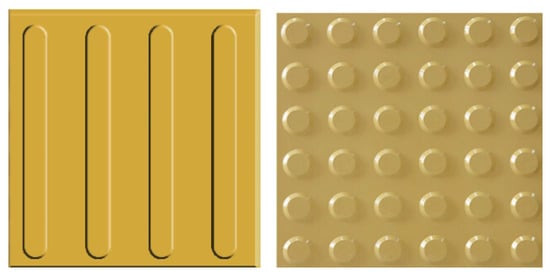
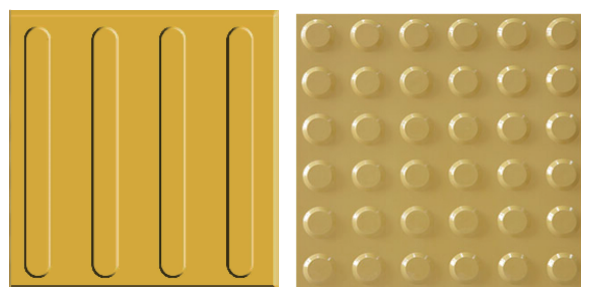
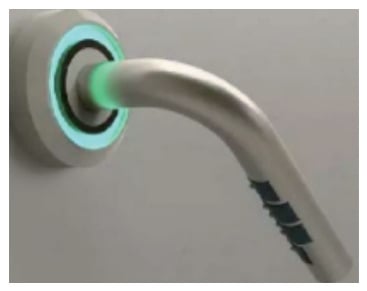
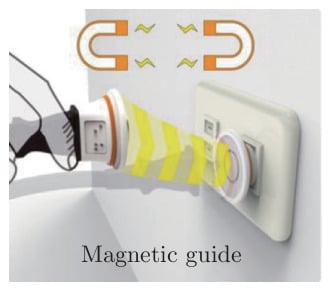
The most common example of a product used by the visually impaired is the blind road (Figure 1). The surface of the road is secured by specialised floor tiles on footpaths and other areas of importance to help provide a reference point and guide their direction using blind guides and the touch of the foot [8]. The Blind Water Cup [9] and door handle (Figure 2) are other designs that rely on tactile recognition of braille or an extended form. A Blind Adapter (Figure 3) designed by Ching-Tzu Tsai [10] is equipped with a circular magnetic electrode, non-directional, and can be easily inserted using magnetic force. The magnetic plugs can prevent the blind from being tripped by the cord. Meanwhile, the plugs have Braille labels that tell visually impaired people what kind of appliance they are using. This design is completed by combining Braille tactile and magnetic sensing principles. In addition, the common smart blind-guide stick [11] uses infrared to detect obstacles in front of it. This is also a design based on the tactile sense.
Figure 1.
Road tiles designed for the visually impaired.
Figure 2.
Blind water cup.
Figure 3.
Blind adapter [10].
Two Blind Brothers [12] is a clothing brand founded by twin blind brothers (Bradford & Bryan Manning). Because of their visual impairment, they mostly rely on touch to purchase clothes. This made them think visually impaired people have a big advantage in touch. So, their products feature comfortable fabrics [13]. Braille design is used on the trademark of the clothing [14], through which visually impaired wearers can understand the information of the clothing they are wearing, helping them to match the clothes. Another researcher [15] designed a dress for the visually impaired, which is reversible between the front and back, as well as the inside and outside. Besides this, the fabrics used in this design are 100% wool twill for the outer layer and 100% cotton twill in the inner, which helps the visually impaired to achieve tactile identification easily.
In short, the current products are more sensory compensation, especially tactile compensation, and the design method is convenient for the blind.
3.2. Results and Analysis of Requirements for Visually Impaired People
During the investigation, it was found that many visually impaired people were mentally strong and eager for the outside world. They could not integrate well into society due to apparent physical defects, which led to them sharing some psychological characteristics. For example, loneliness, because of physiological problems, they fear the eyes of others, thus reducing contact with people. Another characteristic is a sense of inferiority that comes from within and from society’s incorrect understanding and assessment of the visually impaired. And, because of their visual impairment, they are unable to recognise and grasp changes in their environment, creating insecurity that can easily lead to a sense of helplessness in life.
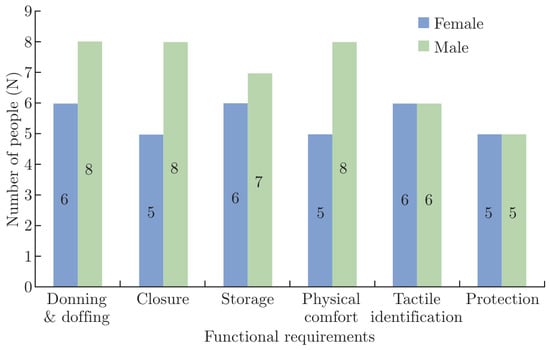
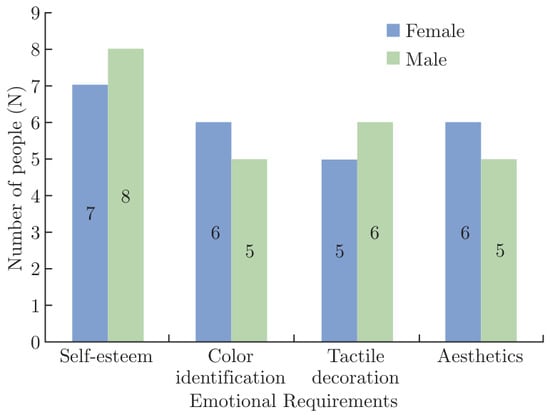
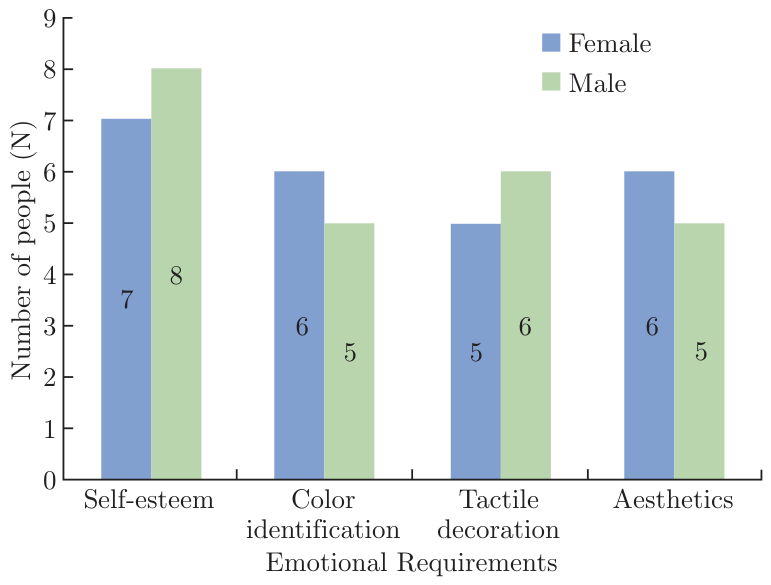
Therefore, considering the psychological characteristics of visually impaired people, this paper divides their clothing requirements into functional and emotional requirements. Among the numerous requirements, the main ones mentioned more frequently are shown in Table 1, consisting of six functional and four emotional requirements. The number and gender of people selected for the two requirements are shown in Figure 4 and Figure 5.
Table 1.
Functional and emotional requirements of clothing for visually impaired people.
Figure 4.
Functional requirements for samples.
Figure 5.
Emotional requirements for samples.
3.2.1. Functional Requirements
The functional requirements in Figure 4 are described and analysed in detail below.
- (1)
- Donning & doffing and closures
The most common problems frequently mentioned in the interview sample group were the donning & doffing and the closures selected by 14(14/18) and 13(13/18) people, respectively. Most female participants found it inconvenient to put on/take off a dress because it was too tight or the closure method was time-consuming or difficult to put on smoothly. Male participants stated that buttons or zippers were difficult to position, thus affecting the donning & doffing process. Thus, the issues of donning & doffing and closing are particularly important for the visually impaired, and there is a strong correlation between the two. For both functional requirements, males are more likely than females to be strong, with a ratio of 8:6 to 8:5.
- (2)
- Storage
The storage function of clothing was also significant for many participants in this study, as many of them (13/18) needed to carry assistive devices or some necessities daily, such as cell phones, tissues, ID cards, etc. But they prefer not to carry bags. For some participants, there was an additional need to carry a blind guide walking stick with them. As a result, they wanted clothing to have deep, closed pockets for safe storage of everyday items. Men and women have equal needs.
- (3)
- Physical comfort
The participants (13/18) mentioned that physical comfort meant that, on the one hand, the clothing is fit and can meet the needs of appearance and activity. On the other hand, the fabrics and styles are relaxed. This comfort is also reflected in clothing that is easy and convenient to wear. Among the samples, men were more focused on comfort characteristics.
- (4)
- Tactile identification
As mentioned in the literature overview, due to their impaired vision, they tend to rely on other organs to compensate for visual function. The participants (12/18) interviewed hoped that there would be more tactile marks on the clothes to facilitate them to identify the front/back & outside/inside of the clothing or the position or to warn them. It was like braille or something tangible that they could touch. Typically, they can identify the front or back of a garment by label or style features and distinguish inside or out by seam allowances. However, in some instances, apparel manufacturers design seamless products or switch from sewn-in labels to heat transfer labels, making the clothing ’seamless’ or ’tagless’. These designs are, therefore not suitable for the visually impaired.
- (5)
- Protection & security
About 10 participants mentioned occasional bumps and bruises to various degrees. They hoped that clothing accessories would help protect the body from accidental injury. Safety needs are also particularly critical for the visually impaired. The sense of security is reflected in reasonable clothing sizes and appropriate accessories, but can also play a protective role in the user’s daily life to avoid serious consequences.
3.2.2. Emotional Requirements
The emotional requirements in Figure 5 are described and analysed in detail below.
- (1)
- Self-esteem/Psychological comfort
Regarding emotional requirements, the survey participants (15/18) needed to be respected by society. Their self-esteem is also a psychological comfort closely related to how people perceive their appearance. At the same time, they want to be the same as everyone else, not different from ordinary people. They object to special labels on their clothing that would allow others to identify them as visually impaired. This labelling would make them uncomfortable and should, therefore, be avoided as much as possible in the design process [16].
- (2)
- Colour Identification
The participants (11/18) wanted the clothing colour to express their confidence and positivity, while satisfying their desire not to stand out too often from ordinary people. The investigation found that some visually impaired people were amblyphs and low-vision people with light perception. They had a variety of reactions and requests for the colour of the clothing. They have strong visual demands for colour brightness and purity.
- (3)
- Tactile decoration
Their requirement (11/18) for tactile decoration included two aspects. On the one hand, they hoped that the tactile embellishments on the clothes would enhance the visual effect of the clothes and make them look appealing. On the other hand, they can perceive the beauty of clothing through tactile decoration.
- (4)
- Aesthetics
The participants (11/18) believed that beauty had always been the high value of clothing. They have lost the opportunity to see beauty but would like to have others see their beauty or perceive it for themselves. The group sees this as a psychological desire and comfort. This element of beauty is also stated in the design of the tactile decoration.
Emotional requirements are equally important to men and women.
4. Design and Development of Clothing
4.1. Concept of Design
When the function of one organ of the body is impaired or absent, the function of another can or may be improved. This is called sensory compensation [17]. Generally, sensory compensation design usually includes three stages: instinct, behaviour, and self-reflection of human beings [18].
For visually impaired people, their visual instincts cannot be expressed, so they can use other senses (including vision, touch, hearing, etc.) to compensate for design, thus giving a sense of security to a large extent. It’s a design based on human instincts. Design at the behavioural level is human-centred, focusing on understanding and meeting the user’s needs for the product [19], focusing particularly on product functions. During this design process, the conscious activity of a sensory organ is stimulated, which can compensate for the alternative sensory organ that is damaged or missed [20]. In clothing design, common shapes and symbols can be presented as touches and stimuli. After long-term use, they can master the operation process through memory. Design at the level of self-reflection incorporates cultural information, the message conveyed and the meaning of the product. At this level, the design considers the cognition and experience that the product brings to the user, which is the highest level of design for visually impaired people.
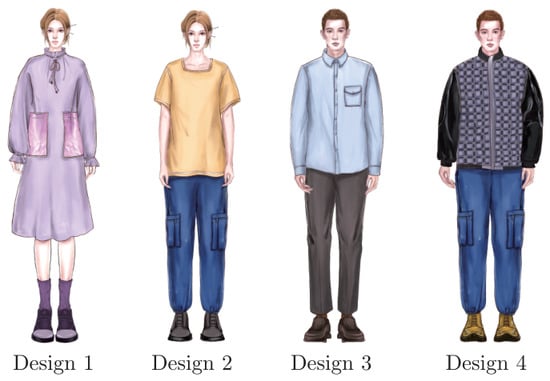
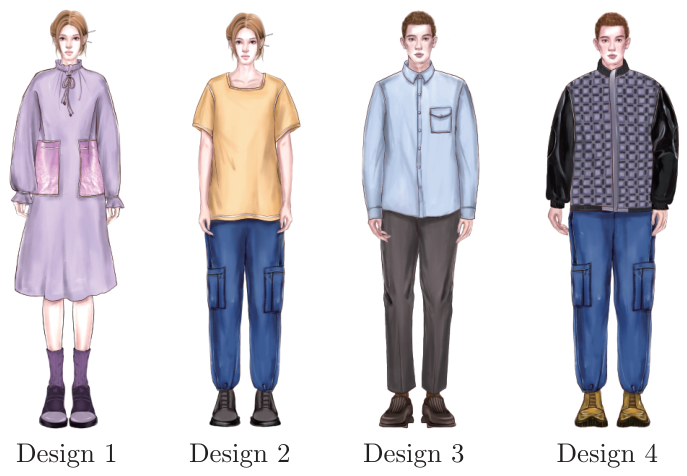
According to the functional and emotional requirements of visually impaired people investigated and based on the concept of sensory compensation, four sets of clothing styles were designed to be more intimate and easy to use (see Figure 6). This research has led to targeted design and development in terms of colour, fabric, silhouette, style and details.
Figure 6.
Working sketches of four styles.
4.2. Design Description for Emotional Requirements
Colour is one of the important elements in fashion design. It not only adds to the aesthetic taste of clothing but also helps visually impaired people realise their self-worth and meet their psychological needs. Considering that they do not want to attract attention to themselves but to express a positive attitude, the clothes designed in this study are mainly in soft and pure colours, which can give a pleasant and dynamic impression and facilitate the collocation of the clothes.
In terms of silhouette and style, these four sets of clothing are mainly straight silhouette, simple and generous, and confident. All styles and appearances look the same as normal people. In the design details of the clothing, some touch decorations were added, such as drawstrings, folds, decorative patch pockets, decorative lines, raised air pockets, etc., so that visually impaired people can perceive beauty through tactile decoration.
4.3. Design Description for Functional Requirements
4.3.1. Easy to Don and Doff with Storage Security
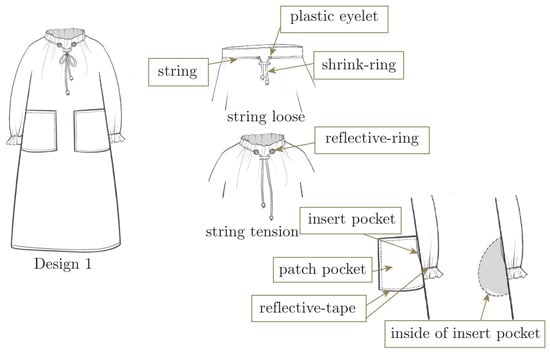
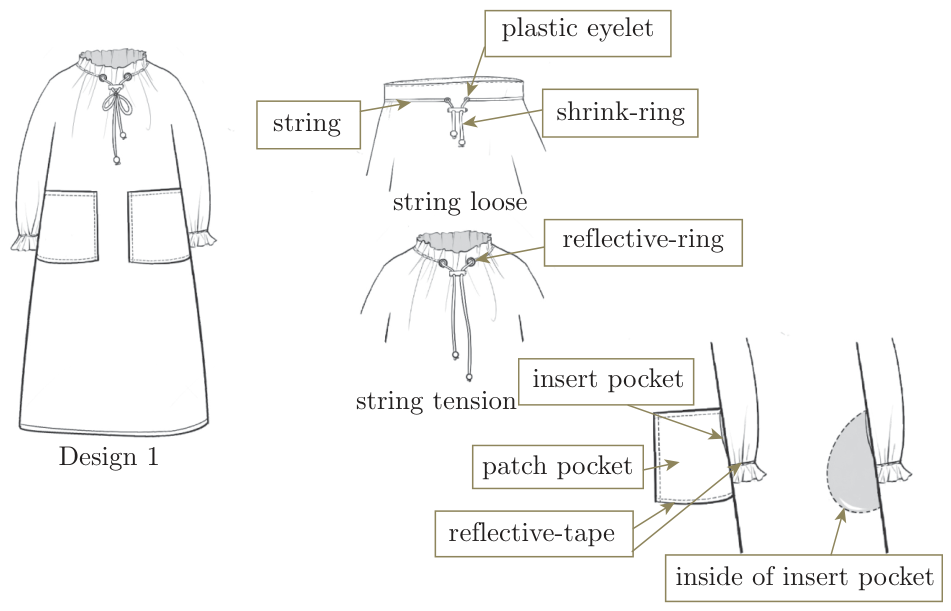
Design 1 in Figure 6 is a dress designed for women, and its functional details are shown in Figure 7. This design uses a string in the neckline, through which it can be fastened & unfastened and easily closed by loosening the string. After donning the dress, the visually impaired can pull the string to the desired fit. The shrink-ring controls the length of the string and acts as a termination point. In addition, the ends of the strings were decorated to prevent the strings from being pulled out. The plastic eyelet at the neckline, the loop, and the trim at the end of the string can be used as tactile identification to locate the neckline and string easily.
Figure 7.
Functional details of the Design 1.
The dress design includes four pockets. The patch pockets on the outside are also used primarily for tactile identification of the front and back of the garment. This was designed to be relatively large to be used for storage. On the side of each patch pocket are two insert pockets, the main storage pockets. The large pocket volume and invisible design could provide added storage space and security as items will be hidden. With this design, the edge of the patch pocket can assist the wearer in easily identifying the opening position of the insert pocket simply by touch.
Reflective decoration was used in the neckline drawstring, patch pocket edge and cuff position. These are aesthetic decorations, but when there is light at night, reflective information can be presented to the nearby crowd to ensure the safety of the visually impaired people.
4.3.2. Reversible between the Front/back & the Outside/inside
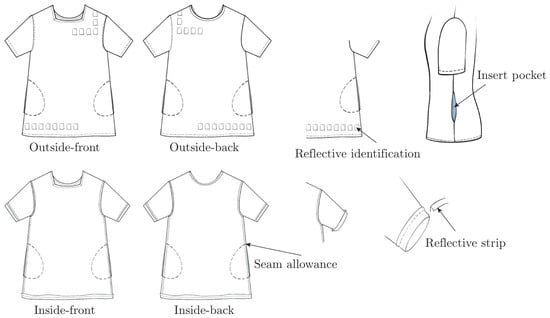
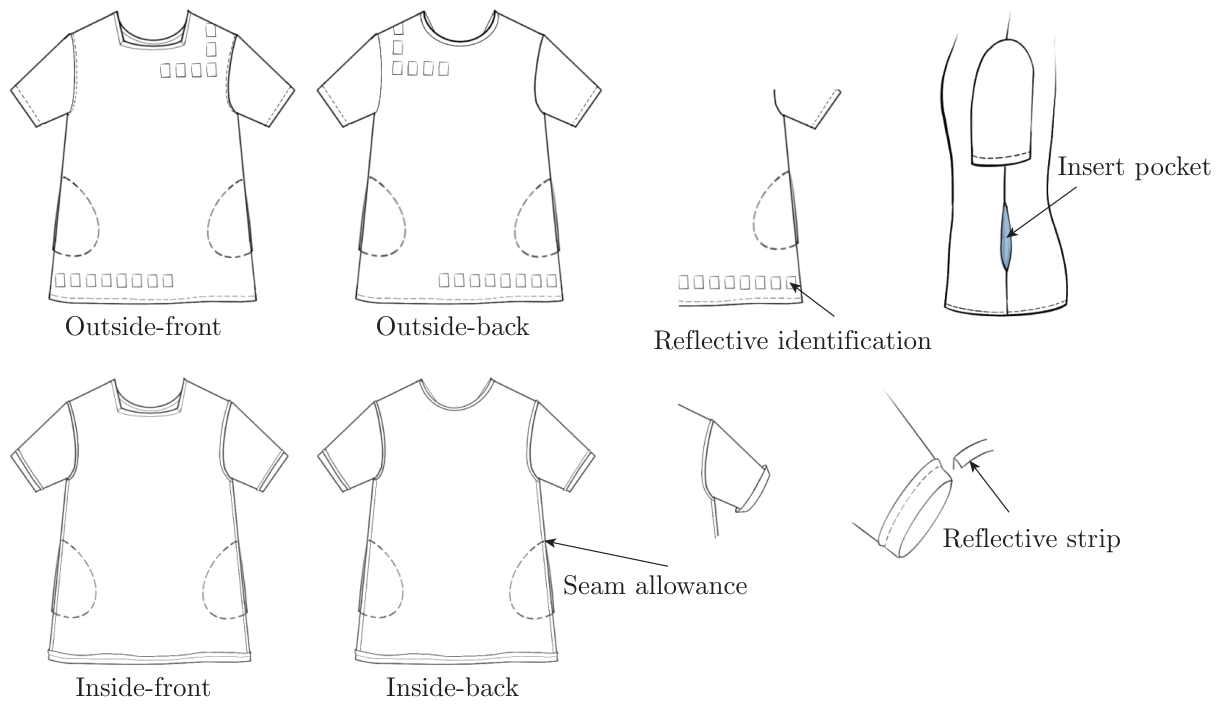
Design 2 in Figure 6 is a reversible short-sleeved T-shirt for women; its functional details are shown in Figure 8. The fabric of this T-shirt is cotton, soft and comfortable. Its structural characteristics are that it can be reversible between the front and back and between the outside and inside after the pattern and seam allowances have been treated. The insert pocket is designed in a side-slit position and can be placed outside or inside. In addition, there is reflective identification at the shoulder and hem locations on the shirt’s exterior. On the inside of the shirt, reflective strips are on the cuffs, and the sleeves can be folded with them. The fabric of the pants, which matched the T-shirt, was made of Tencel fibres, soft and draping. The patch pockets on the pants can be used as front/back tactile identification or as storage.
Figure 8.
Functional details of the Design 2.
4.3.3. Easy to Close
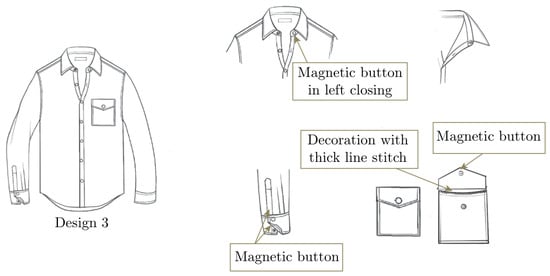
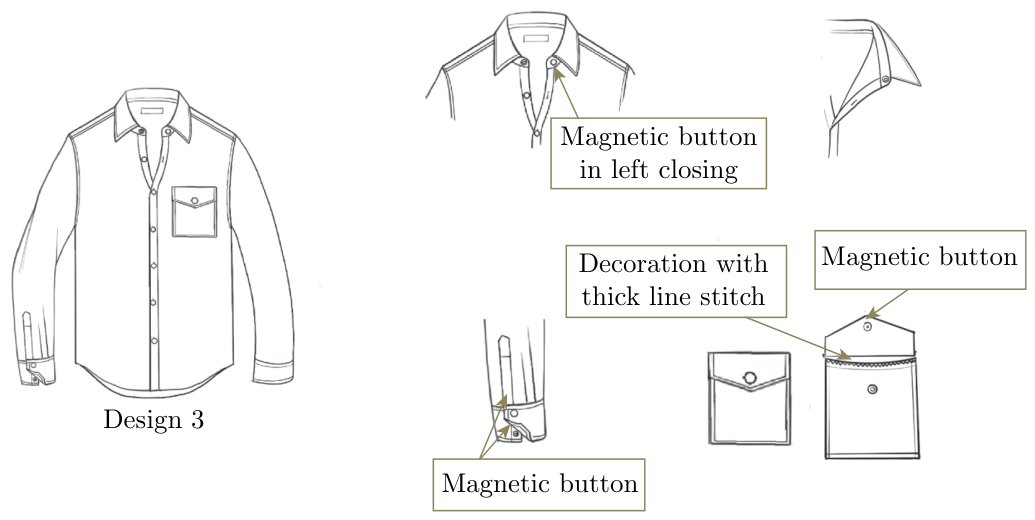
Design 3 in Figure 6 is a shirt designed for men, and its functional details are shown in Figure 9. It mainly features a magnetic buckle design that is extremely easy to close. The first button on the front closure is magnetic. After the first button is closed, the buttons below can be easily closed in sequence, which solves the problem of wrong button positions when wearing a shirt. Magnetic buttons are also used on the cuff and breast pocket. The appearance of the magnetic buttons is the same as the other buttons. In addition, to enhance the sense of touch, the pocket is decorated with coarse stitching to increase the tactile texture of the pocket edge and facilitate the wearer to find its location.
Figure 9.
Functional details of the Design 3.
4.3.4. Protection & Security
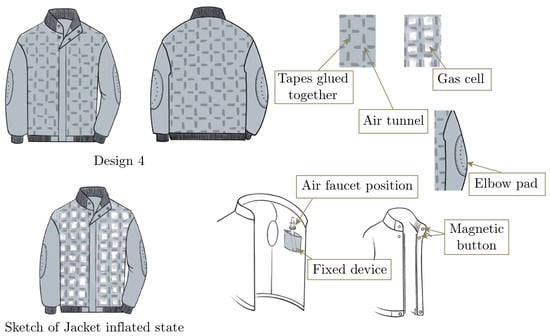
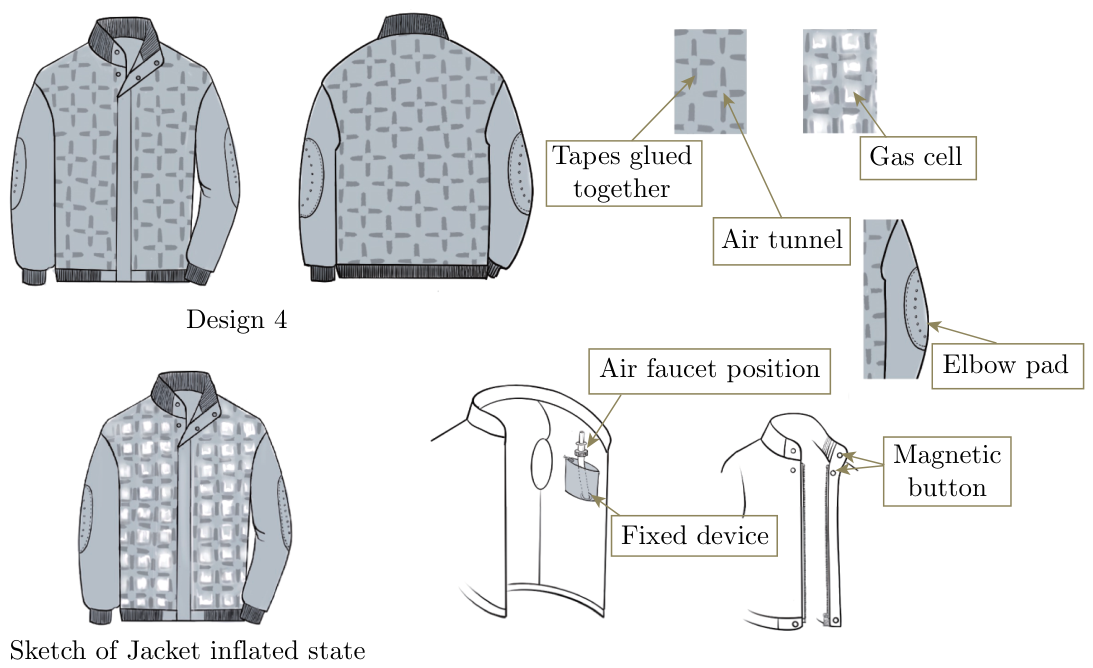
Design 4 in Figure 6 is a jacket designed for men, whose functional details are shown in Figure 10, which is suitable for daily wear in spring and fall. The airbag is designed into the jacket bodice, and the air faucet is located inside the jacket’s front closure, where it can be easily found by hand. Visually impaired people in unfamiliar environments can manually inflate the airbags. This acts as a layer of protection when the body encounters a collision. The airbag could play a certain cushioning and protection role. Moreover, when inflated, the airbag can add an extra insulation layer to keep the wearer warm.
Figure 10.
Functional details of the Design 4.
In addition, the jacket has elbow pads on the sleeves to protect the elbow from injury. A combination of a zip and a magnetic button is used. The head of the zipper is designed to be larger than that of the ordinary zipper so that the zipper tail can be easily matched.
5. Conclusions
According to the survey in this study, the main functional clothing requirements for the visually impaired include Donning and doffing, Closure, Storage, Comfort, Protection and Inside/Outside and Front/Back. Emotional requirements of the sample under investigation mainly include Esteem, Color Densification, Tactile Decoration and Aesthetics. In clothing research and development, four sets of clothing styles were designed based on visually impaired people’s functional and emotional requirements and the concept of sensory compensation. The combination of string and style solves the difficulty of don and doff. The magnetic button is used to solve the closure misalignment problem. Invisible insert pocket designs can increase storage volume and storage security. The self-inflating clothing airbags are designed to help reduce or mitigate physical injuries caused by knocks.
In the human-centred era, the visually impaired should not be isolated. They have the same strong desire for a better life as ordinary people. Because of their visual impairment, they also have severe psychological problems. Only with a deep understanding of their functional and emotional requirements can products be designed specifically for them to effectively solve their problems. Care for the visually impaired is more integrated into the products designed for them, which is the responsibility of designers and society as a whole. It is hoped that research on this topic will draw positive attention from people in all aspects of society and give humanity care to the visually impaired.? Further work must be carried out to validate the design by conducting wear trials with human subjects.
Acknowledgments
The paper is financially supported by the research project (grant number KM201910012012) of the Beijing Municipal Commission of Science and Technology and the research project (grant number 120301990132 and KCSZZT-2101) of the Beijing Institute of Fashion Technology. Special thanks to the interviewers who participated in this study.
References
- The second National Sample Survey Group of Persons with Disabilities and the National Bureau of Statistics. Bulletin on Major Statistics of The Second China National Sample Survey on Disability: 2006. Information on http://www.gov.cn.
- Jia, R.T. Elements of user experience: The design of a user-center Web; China Machine Press: Beijing, 2008. [Google Scholar]
- Chen, W.W. Product design for visual impairment based on human care. Public Art. Lit. Mag. 2013, 17, 79–81. [Google Scholar]
- Feng, H.R. Research on the Emotional Design of Life Assistance Products for Deaf College Students Based on Sensory Compensation; Beijing Institute of Fashion Technology, 2021. [Google Scholar]
- Zhang, S. A research on behavior characteristics and Smart Safety Strategies of Visually impaired people in the City; Tianjin University, 2017. [Google Scholar]
- Chen, B.Z.; Gao, Y.M.; Zhou, Z.W.; et al. Research on barrier-free city Construction based on the demand of visually impaired people. Coop. Econ. Technol. 2022, 5x, 185–187. [Google Scholar]
- Hu, Q. Present Situation and Improvement Strategy of Barrier-Free Environment of Urban Public Transportation. Sci. J. Intell. Syst. Res. 2021, 3. [Google Scholar]
- GB 50763-2012; Design code for accessibility.
- Wang, Y. Design and research auxiliary products for out-of-home use based on the behavioral characteristics of visually impaired people; Wuhan Textile University, 2021. [Google Scholar]
- Information on https://ifdesign.com/en/winner-ranking/project/blind-adapter/145235.
- Yao, H.Z.; Niu, Y.C.; Zhang, X.Z.; et al. An intelligent blind-guide stick. CN: 202120802900.3.
- Information on https://twoblindbrothers.com.
- Wu, C.Z.; Zhang, W. The bold vision of a pair of blind fashion designers and visually impaired brothers. People 2017. [Google Scholar]
- Li, M.Q.; Zhang, L.; Wang, X.Y.; et al. A multifunctional barrier-free garment for the blind. CN:202121395322.2.
- Sunhyung, C.; Lida, A.; Kristen, M.; et al. Development of garment design strategies for women with visual impairments. Int. J. Fash. Des. Technol. Educ. 2020, 13, 181–189. [Google Scholar] [CrossRef] [Scilit]
- Lu, H.M.; Wu, Y.F. The Influence of Happy Emotion on Visual Communication Design. J. Juamjusi Educ. Inst. 2018, 482–483. [Google Scholar]
- Tang, X.F.; Zhao, F.F. Research of the design of sensory compensation foe visually impaired people based on motion. Design 2020, 33, 10–12. [Google Scholar]
- Norman, Donald A. Emotional Design; Basic Books: New York, 2005. [Google Scholar]
- Zhang, X.L. Research on the application of experience design-Taking an example of adults’ toy design in “3040” example; Shan Dong University, 2014. [Google Scholar]
- Li, S.Y. Sensory Compensation In Product Design; Nanchang University, 2010. [Google Scholar]

© 2023 Textile Bioengineering and Informatics Society. This article is an open access article distributed under the terms and conditions of the Creative Commons Attribution (CC BY) license (https://creativecommons.org/licenses/by/4.0/).