


Abstract
This paper studied the mechanical properties of carbon fiber reinforced polybutylene terephthalate (PBT) composites, selected the different sizing agent to improve the interface binding capacity of carbon fibers (CFs) and PBT. Some CFs were modified with polyvinyl acetate (PVAc), and they were named p-C. Some other CFs were modified by ethylene acrylic acid (EAA), and they were named e-C. After modification, the groups of carboxyl were introduced into the surface of p-C. For e-C, the groups of C=C were introduced. For PBT/p-C composites, the maximum of tensile strength reached 68.22 MPa and elastic modulus reached 3263.18MPa, while the content of CFs is 15 wt.%. For PBT/e-C composites, with addition of the same content of CFs, the tensile strength and elastic modulus could reach 90.76 MPa and 4334.76 MPa respectively. Compared with pure PBT, the mechanical properties of the composites were improved significantly, and the reinforcement effect was more obvious in PBT/e-C composites, because of the better binding capacity between CFs and PBT. The decomposition temperature of the composites was between 378 °C and 417 °C, and they presented better heat resistance property.
1. Introduction
Carbon fibers (CFs) with high tensile strength, high temperature, friction and other advantages, are used to improve the mechanical properties of polymer materials [1,2,3,4]. They are mixed with thermoplastic resin and present high strength, good rigidity, light quality, and recyclable [5,6,7]. These kinds of composites have excellent abrasion resistance, self-lubricity, anti-electrostatic, electromagnetic interference, small thermal expansion, coefficient fatigue resistance and creep resistance properties and were used in aerospace equipment, aircraft parts, electronic instrument, weaponry and automobile [8,9,10,11].
Polybutylene terephthalate (PBT) is a kind of semi-crystalline thermoplastic polymer. It is one of the top five engineering plastics. Because of good mechanical properties, especially excellent tensile property, electrical performance, abrasion and chemical resistance, It is widely used in automotive, electrical and electronic industries [12,13].
In the case of that CFs without any surface treatment, the interfacial adhesion is poor in com- posites and it is difficult to make full use of advantages of CFs [14]. Thus, the surface modification of carbon fibers is very important to improve the interfacial adhesion between carbon fibers and resin matrix [15,16,17].
There are some surface treatments, such as gas phase oxidation, acid oxidation treatment, plasma treatment and so on [18,19]. This article select surface sizing.The carbon fiber filament is immersed in the slurry tank by the guide roller and the immersion roller, and then pressed by rollers, it is simple and effective [20].
2. Experimental Section
2.1. Materials
CFs (T700) were purchased from TORAY Company in Japan. PBT pellets were purchased from Xin jiang Blue Mountain station River Polyester Co. Ltd.
2.2. Preparation of Samples
Before melt blending, PBT pellets and CFs were dried at 80 °C for 24 h in a vacuum oven. Com- posites with varying CFs contents were prepared by melt blending in a Haake mixer (RheoDrive 7) at 230 °C for 5 min with 30 rpm.
Plate specimens were prepared by compression molding at 235 °C for 10 min. The drawing dumbbell specimens were cut to 1.2 mm thickness, 5 mm width, and 55 mm length.
Table 1.
Mass fraction of CFs in PBT.
2.3. Characterization
Fourier Transform infrared spectroscopy (FTIR, TENSOR-27) was used to characterize the func- tional groups on CFs. The spectra were measured between 400 and 4000 cm−1, and the resolution was set at 4 cm−1.
Thermogravimetric Analysis (TGA, TG-209F1) was employed to characterize the stability of composites under argon atmosphere. TGA curves were obtained at temperatures ranging from 50 °C to 600 °C at 10 °C/min heating rate.
The mechanical properties of the samples were determined using an electronic universal tensile testing machine (WDW-20). The tensile strength, elastic modulus and elongation at breakage point were measured at room temperature at 50 mm/min.
Scanning Electron Microscope (SEM, JSM-IT300) was used to obverse the surface of CFs and the cross-section of composites.
3. Experimental Results and Discussion
3.1. Analysis of CFs by FTIR
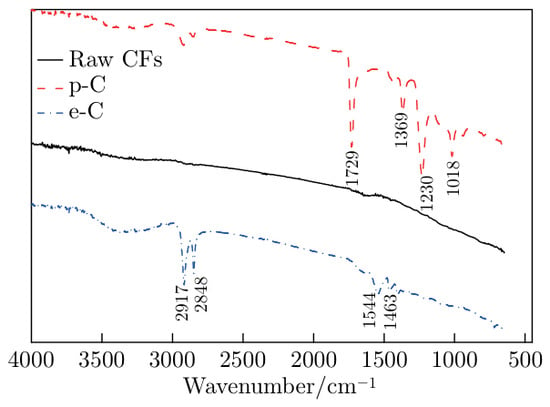
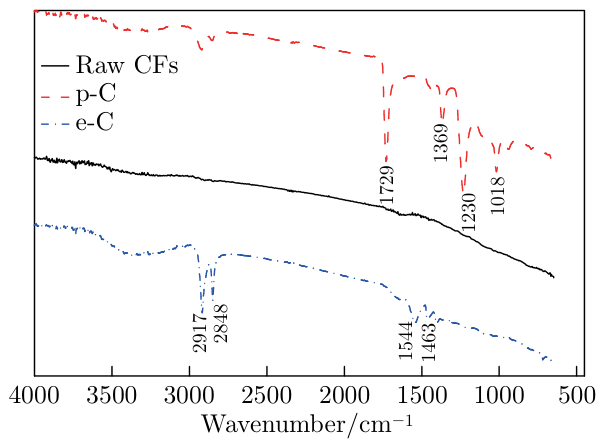
The absorption peaks of functional groups in CFs are shown in Figure 1. According to the FTIR result, it is found that the characteristic peaks of raw CFs are not obvious. For p-C, the strong absorption peak at 1729 cm−1 indicates the characteristic peaks of C=O, the strong peaks at 1230 cm−1 and 1018 cm−1 indicate that the groups of O-H are introduced into the surface of p-C, and a peak at 1369 cm−1is the signal that the surface of CFs have some methyl groups. For e-C, the strong absorption peaks at 2917 cm−1 and 2848 cm−1 suggest that the surface of CFs have some C-H bonds, and the strong absorption peaks at 1544 cm−1 and 1463 cm−1 state that the C=C bonds are introduced into the surface of e-C.
Figure 1.
FTIR spectra of raw CFs and surface treated CFs.
3.2. TGA Curves of PBT/CFs Composites
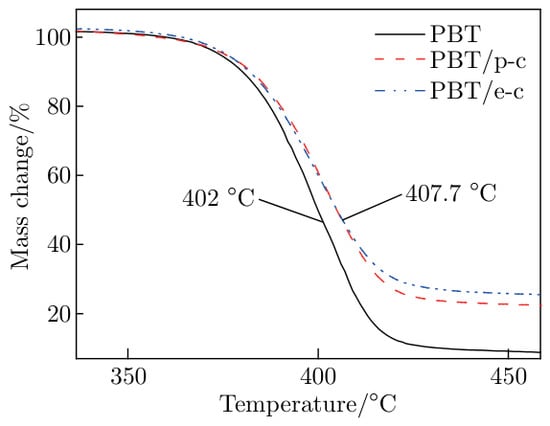
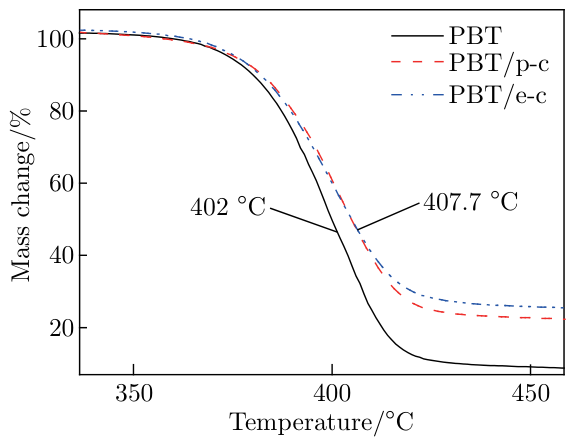
The quality of material changed in heating process is shown in Figure 2. The decomposition tem- perature of the composites were between 378 °C and 417 °C. After adding CFs, the maximum of thermal decomposition temperature of the material increased from 402 °C to 407.7 °C. The decomposition temperatures of three kinds of materials were comparatively analyzed. It is found that the thermal stability of PBT/CFs composites are improved. The addition of carbon fiber has some influence on the crystallinity of PBT.
Figure 2.
TGA curves of PBT resin, PBT/p-C and PBT/e-C.
3.3. Mechanical Properties of PBT/CFs Composites
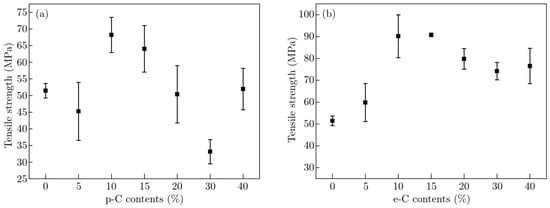
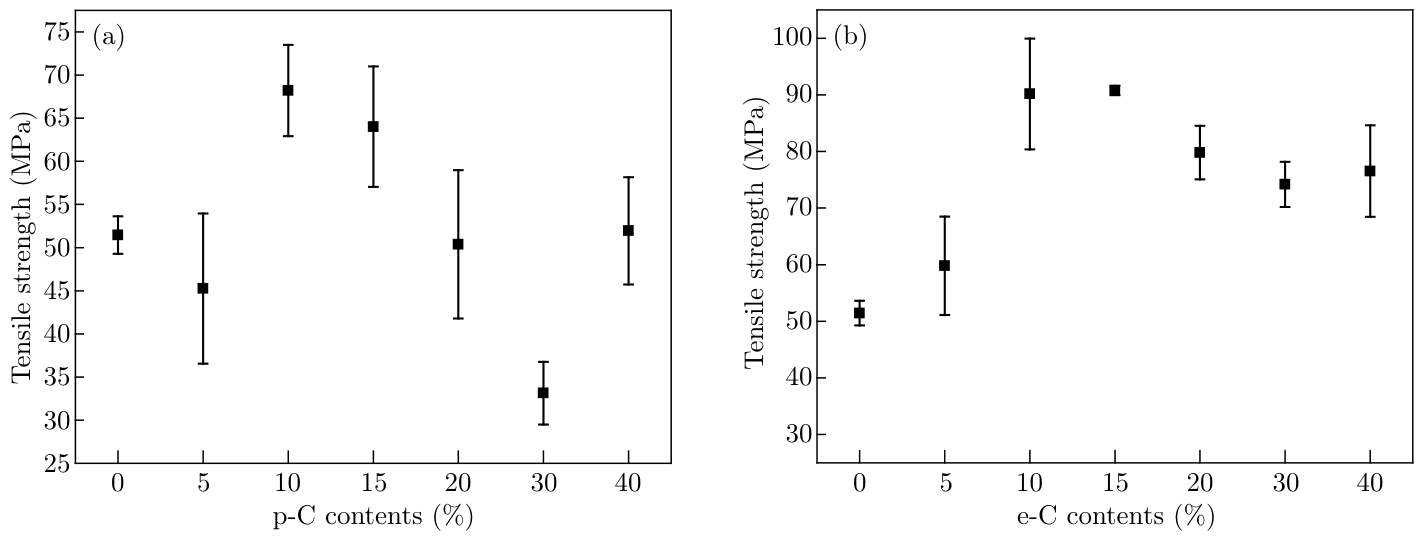
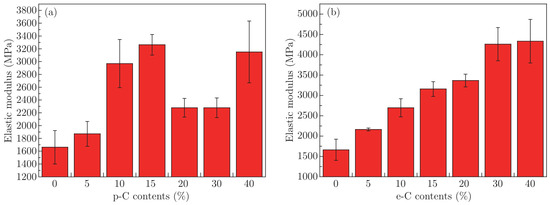
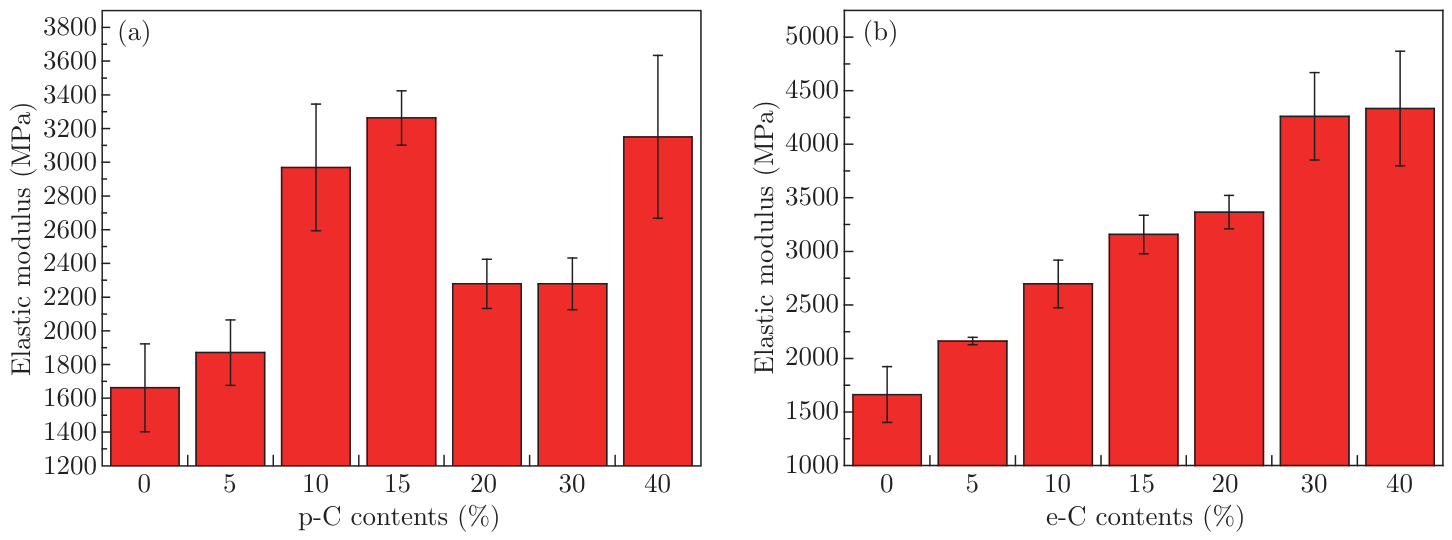
For Figure 3(a) and Figure 4(a), with the increase of p-C content, tensile strength and elastic modulus reach to maximum, when carbon fiber content is 15%. For Figure 3(b) and Figure 4(b), with the increase of e-C content, the tensile strength has a first decreases after increasing, the elastic modulus increases gradually. Mechanical properties of different PBT/CFs composites are shown in Figure 3 and Figure 4. By comparing the p-C and e-C, the enhancement effect of e-C is better, the strength and modulus of composites have been significantly improved, Sizing agent has played an important role, EAA makes CFs and PBT more closely connected.
Figure 3.
Tensile properties of composites for (a) p-C/PBT, (b) e-C/PBT.
Figure 4.
Composite elastic modulus for (a) p-C/PBT, (b) e-C/PBT.
When the carbon fiber content is less, the reinforced effect of CFs is not obvious in the composite material, but when the carbon fiber content is too high, in the matrix resin, the distribution of CFs is uneven and it will lead to stress concentration. Because the carbon fiber has high strength, high modulus characteristics, therefore, the elastic modulus of composites has obvious enhancement by adding CFs. The reasonable ratio of CFs and PBT is very important, in this condition, the excellent mechanical properties of CFs and PBT can be used fully .
3.4. SEM Analysis of PBT/CFs Composites
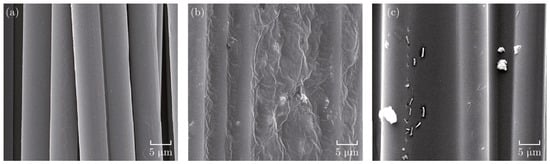
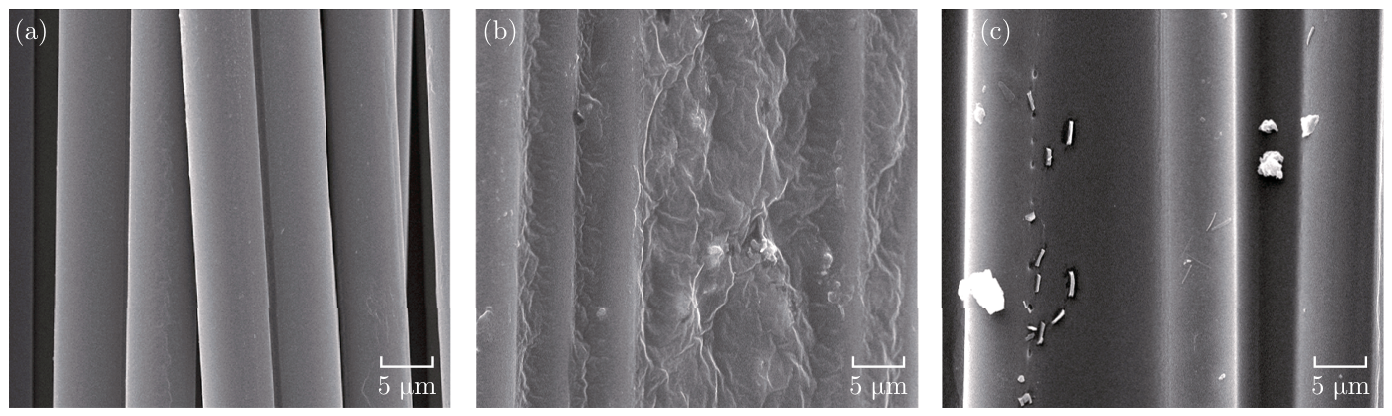
The surface of CFs are shown in Figure 5. The binding force of fibers and matrix are determined by Fiber’s surface. For Figure 5(a), the surface of CFs are very smooth, it is difficult to combine resin with fibers tightly because of the inert surface. For Figure 5(b) and Figure 5(c), when the CFs are modified, the surface area is increased. The better interface of composites is very important for composites. Sizing agent as a bridge makes the relationship of CFs and resin matrix more closely.
Figure 5.
SEM images of surface for (a) Raw CFs, (b) p-C, and (c) e-C.
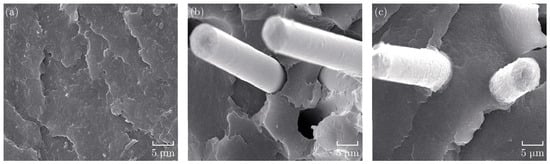
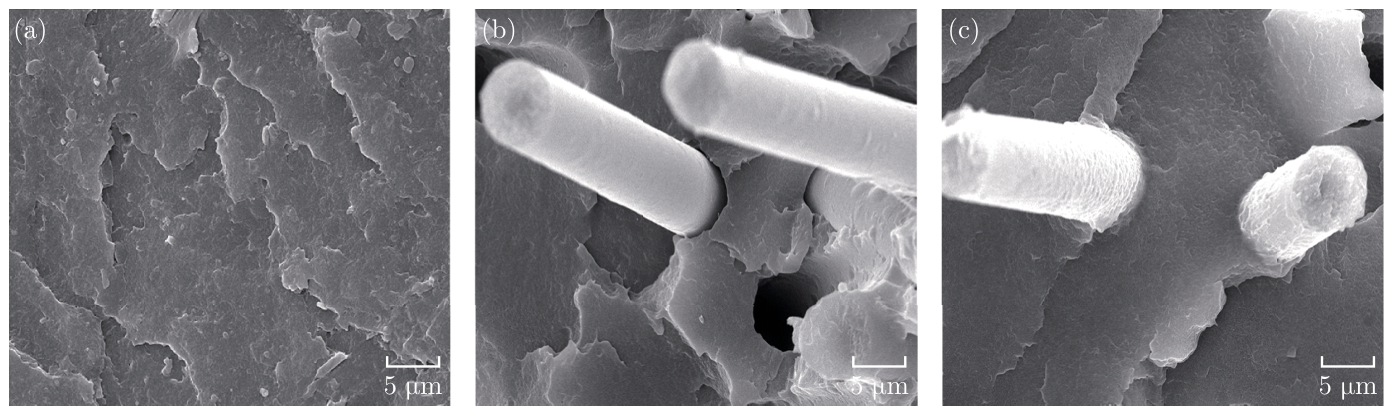
The cross-sectional morphology of the material are shown in Figure 6. Due to the external force, fibers were pulled out from the matrix, the surface of some CFs adhere to some resin. In Figure 6(a), the fracture surface of PBT has stratified, it indicates that the fracture is brittle fracture. For Figure 6(b), there is a gap between the fiber and matrix, the surface of fiber is smooth, it indicates that the composites have a poor bonding performance. For Figure 6(c), there is nearly no gap between CFs and PBT, the surface of fibers have a layer of matrix material. In summary e-C is better to modify CFs, the adhesion of CFs and PBT resin has been improved obviously.
Figure 6.
SEM images of fracture surface for (a) pure PBT, (b) PBT/p-C, and (c) PBT/e-C.
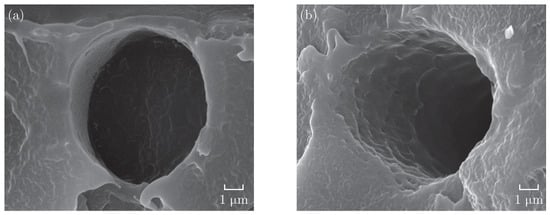
After CFs pulled out, there are some holes in matrix. For Figure 7(a), the wall of the hole is very smooth, on the contrary, for Figure 7(b), the wall of the hole is more rough. EAA makes composites form a better interface.The resin matrix can be better to transfer the stress to the CFs, the mechanical properties of the material are improved.
Figure 7.
SEM imagines of the inner surface of the voids left for (a) PBT/p-C, and (b) PBT/e-C after fibers were pulled out.
4. Conclusions
According to the mechanical properties of two kinds of composites, and the SEM imagines of dif- ferent composites, when the content of CFs was 15 wt.%, the mechanical properties of composites reached the best level. The reinforcing effect of e-C in PBT was more obvious, the maximum of tensile strength could reach 90.76 MPa, and the elastic modulus reached 3157.28 MPa, the mechanical properties of the composites were improved significantly. When combination of the fiber and resin was very close, the mechanical properties of materials had been improved greatly. For the SEM images of CFs in the composites, they indicate that the surface of CFs were inert, and they were difficult to be dispersed well in resin, the adhesion of interface between the matrix and fibers need to be strengthened. When CFs were modified by EAA, the compatibility of the CFs with matrix was improved, which was beneficial to mix the CFs with PBT resin. Meanwhile, the thermal stability of PBT/CFs composites was improved.
Acknowledgments
This work was supported by Youth Talent Projects of Science and Technology Research Plans from Education Department in Hubei Province (No. Q20171603).
References
- Li, X.P.; Zhang, X.P.; Wang, H.W. Preparation and Application of Carbon Fiber. J. High-Tech Fiber Appl. 2005, 5, 28–34, 44. [Google Scholar]
- Chen, X.M. Property, development and application research of carbon fiber. Text. Aux. 2015, 07, 1–4. [Google Scholar]
- Donent, J.B.; Park, S.J. Surface characteristics of pitch-based carbon fibers by inverse gas chromatog- raphy method. Carbon 1991, 29, 955–961. [Google Scholar] [CrossRef] [Scilit]
- Qian, B.Z. Domestic and international application of carbon fiber applications, market demand and carbon fiber production capacity. High-Teach. Fiber 2010, 01, 43–46. [Google Scholar]
- La Rosa, A.D.; Banatao, D.R.; Pastine, S.J.; Latteri, A.; Cicala, G. Recycling treatment of carbon fi- bre/epoxy composites: Materials recovery and characterization and environmental impacts through life cycle assessment. Compos. Part B Eng. 2016, 104, 17–25. [Google Scholar] [CrossRef] [Scilit]
- Li, X.; Bai, R.B.; McKechnie, J. Environmental and financial performance of mechanical recycling of carbon fibre reinforced polymers and comparison with conventional disposal routes. J. Clean. Prod. 2016, 127, 451–460. [Google Scholar] [CrossRef] [Scilit]
- Longana, M.L.; Ong, Natalie; Yu, H.N.; Potter, K.D. Multiple closed loop recycling of carbon fibre com- posites with the HiPerDiF (High Performance Discontinuous Fibre) method. Compos. Struc-Tures 2016, 153, 271–277. [Google Scholar] [CrossRef] [Scilit]
- Ning, F.D.; Cong, W.L.; Qiu, J.J.; Wei, J.H.; Wang, S.R. Additive manufacturing of carbon fiber reinforced thermoplastic composites using fused deposition modeling. Compos. Part B Eng. 2015, 60, 369–378. [Google Scholar] [CrossRef] [Scilit]
- Naito, K.; Oguma, H. Tensile properties of novel carbon/glass hybrid thermoplastic composite rods. Compos. Struct. 2017, 161, 23–31. [Google Scholar] [CrossRef] [Scilit]
- Lai, Y.; Liu, Y.; Ma, D. Automatically melting snow on airport cement concrete pavement with carbon fiber grille. Cold Reg. Sci. Technol. 2014, 103, 57–62. [Google Scholar] [CrossRef] [Scilit]
- Zhang, F.Y.; Wang, H.Q.; Zhang, X.P. Application prospect of carbon fiber/thermoplastic resin com- posites in China’s civil industry. New Chem. Mater. 1994, 01, 5–7. [Google Scholar]
- Hwang, S.S. Tensile, electrical conductivity and EMI shielding properties of solid and foamed PBT/carbon fiber composites. Compos. Part B Eng. 2016, 98, 1–8. [Google Scholar] [CrossRef] [Scilit]
- Chopra, S.; Deshmukh, K. A.; Peshwe, D. Theoretical prediction of interfacial properties of PBT/CNT nanocomposites and its experimental evaluation. Mech. Mater. 2017, 109, 11–17. [Google Scholar] [CrossRef] [Scilit]
- Cai, Z.Q.; Meng, X.Y.; Ye, H.M.; Cong, C.B.; Wang, Y.F.; Cui, L.H.; Zhou, Q. Reinforcing polyamide 1212 nanocomposites with aligned carbon nanofibers. Mater. Des. 2014, 63, 691–698. [Google Scholar] [CrossRef] [Scilit]
- Jiang, B.; Zhang, T.; Zhao, L.W.; Huang, Y.D. Interfacially reinforced carbon fiber composites by graft- ing modified methylsilicone resin. Compos. Sci. Technol. 2017, 140, 39–45. [Google Scholar] [CrossRef] [Scilit]
- Gao, B.; Zhang, R.L.; He, M.S.; Wang, C.G.; Liu, L.; Zhao, L.F.; Wen, Z.J.; Ding, Z.P. Interfacial microstruc- ture and mechanical properties of carbon fiber composites by fiber surface modification with poly (amidoamine)/ polyhedral oligomeric silsesquioxane. Compos. Part A Appl. Sci. Man.-Ufacturing 2016, 90, 653–661. [Google Scholar] [CrossRef] [Scilit]
- Zhang, R.L.; Gao, B.; Du, W.T.; Zhang, J.; Cui, H.Z.; Liu, L.; Ma, Q.H.; Wang, C.G.; Li, F.H. Enhanced mechanical properties of multiscale carbon fiber/epoxy composites by fiber surface treatment with graphene oxide/ polyhedral oligomeric silsesquioxane. Compos. Part A Appl. Sci. Manuf. 2016, 84, 455–463. [Google Scholar] [CrossRef] [Scilit]
- Zhang, Y.Y.; Zhang, Y.Z.; Liu, Y.; Wang, X.L.; Yang, B. A novel surface modification of carbon fiber for high-performance thermoplastic polyurethane composites. Appl. Surf. Sci. 2016, 382, 144–154. [Google Scholar] [CrossRef] [Scilit]
- Lee, H.; Ohsawa, I.; Takahashi, J. Effect of plasma surface treatment of recycled carbon fiber on carbon fiber-reinforced plastics (CFRP) interfacial properties. Appl. Surf. Sci. 2015, 328, 241–246. [Google Scholar] [CrossRef] [Scilit]
- Song, X.F.; Chen, D.S. Study on carbon fiber sizing technology. Mod. Text. Technol. 2004, 12(1), 4–6. [Google Scholar]
Disclaimer/Publisher’s Note: The statements, opinions and data contained in all publications are solely those of the individual author(s) and contributor(s) and not of MDPI and/or the editor(s). MDPI and/or the editor(s) disclaim responsibility for any injury to people or property resulting from any ideas, methods, instructions or products referred to in the content. |
© 2018 Textile Bioengineering and Informatics Society. This article is an open access article distributed under the terms and conditions of the Creative Commons Attribution (CC BY) license (https://creativecommons.org/licenses/by/4.0/).