


Abstract
In view of the many problems in the coating of the trademark, such as the poor stability of the filler, the poor adhesive resistance and ink absorption of the fabric, the high pH value and insufficient printing stability, etc. this paper focuses on the study of two kinds of common inorganic fillers, wollastonite and kaolin, on the structure of the polyamide 6 coating film and the properties of the wet coating trademark fabric. The mixture of these two kinds of filler is applied to the coating slurry, and the ratio and dosage are optimized. On this basis, combined with production practice, the wet coating process conditions were optimized. The results showed that the mass ratio of wollastonite and kaolin is 1:1 (the mass of the filler is 22% of anhydrous methanol), the compatibility of coating slurry is higher than that of the coating slurry prepared from single wollastonite, it is not easy to settle, but also the dispersion of coating slurry is better than that of only kaolin, and the microporous structure on the surface of coating film is more uniform. Moreover, the coated fabrics presented higher ink absorption performance. When the coating temperature is 35 °C, the viscosity of the coating is 2∼3 Pa·s, the baking temperature is 160 °C, and the baking time is 80 s. The color fastness to the soaping color of the coated fabric reaches to grade 4-5, the printing effect reaches to 3-4, the whiteness and the fabric style are better.
1. Introduction
At present, the trademark coating processing methods are mainly dry [1,2] (direct coating) and wet [3,4] coating. Dry coating is a process in which a coating agent is directly coated on a fabric to form a continuous film, thereby changing the function of the coating surface. Wet coating is the main process for making artificial leather. It is also called wet artificial leather technology. After coating or impregnating different types of base cloth through polyurethane coating agent, it solidifies to form a continuous micro porous structure in solution, and then makes products after grinding or embossing, calming and other processing procedures. The polyamide wet coating is prepared by dissolving waste polyamide filament [4] with methanol and anhydrous calcium chloride solvent, and adding proper filler to get polyamide coating slurry, the coating slurry undergoes phase transformation in a coagulating bath to form a layer of polymer film on the surface of the fabrics, thereby giving the fabric excellent elasticity, wear resistance, air permeability and moisture permeability, etc [5,6,7].
In the fabric coating, fillers play extremely important roles in the coating slurry viscosity, coating fabric style, whiteness, ink absorption property and washable color fastness of the coated fabric. Inorganic fillers that are often used, calcium carbonate, hydrotalcite, kaolin and wollastonite etc [8,9,10], of which kaolin as filler coating slurry stability is high, but its hardness is larger, the wear of the cutter is more serious, and ink absorption property is poor; While the rheological property of the coating with wollastonite is excellent. The surface of the coating film has a large number of microporous structure, excellent ink absorption and high whiteness, but the stability of the coating slurry prepared by wollastonite is poor and easy to settle. When the filler is applied to the trademark fabric coating, it not only needs high compatibility and dispersibility, but also needs to meet the requirements of whiteness, stiffness, smoothness, low price and the environmental protection. In this paper, the best compounding ratio and dosage were obtained by the combination of kaolin and wollastonite of fillers, testing its sedimentation, rheology, coating film surface structure, and tensile properties. Based on this, the wet coating process conditions were optimized in combination with the actual production.
2. Experimental Methods
2.1. Materials
Calcined kaolin (5 µm, Yangzhou god chemical raw material co., Ltd), anhydrous calcium chloride, polyamide 6 waste silk (Huzhou Xinli trademark belt co., Ltd), polyether NJ-220 (Jurong Ningwu new material development co., Ltd), wollastonite (5 µm, Changxing Huayuan powder material co., Ltd).
2.2. Formulation and Preparation of Coating
In the coating slurry formula [11], there were 17 g of wast polyamide 6 filament, x g of fillers, 35 g of anhydrous calcium chloride, 2 g of polyether and 100 g of absolute methanol.
Absolute methanol and calcium chloride were added to the three-neck flask, and then placed in a water bath at 65 °C for dissolution. After the reaction completed, 17 g of polyamide 6 wasted silk was taken and cut into pieces, and slowly added to the mixed liquor to dissolve. Meanwhile, fillers were added with stirring when waste nylon was dissolved completely. After 45 minutes, when the temperature of the water bath decreased from 65 °C to room temperature, polyether was slowly added and stired until evenly dispersed.
According to the preparation method of coating film in the literature [4], the polyamide coating slurry was evenly coated on 10 cm×10 cm glass plate (on both sides with transparent adhesive tape of about 0.16 mm thickness). The glass plate was then solidified in a water bath at room temperature for 2 minute, then the coated glass plate was solidified in an electrothermal blast dryer at 140 °C.
2.3. Combination Method of Coating and Fabric
The polyamide fabric was coated by wet method, and the coated fabric was solidified in a water bath at room temperature. After full solidification, the polyamide fabric was solidified by continuous molding machine at 140 °C for 80 s.
3. Test Methods
3.1. Test of Coating Slurry
The fineness of the filler in the coating slurry was determined by reference to GB 1724-79 Method for Measuring Fineness of Coatings in order to analyze the dispersity of the filler in the coating slurry.
The viscosity of the coating slurry was measured by rotating rheometer, and under the constant temperature of 25 °C, 50 times of viscosity values were measured under the condition of constant shear rate γ of 50 s−1, and the average value was obtained.
80 ml slurry was placed in a 100 ml beaker (50 mm inside diameter) and sealed to determine the settlement of the coating slurry in the constant temperature and humidity room (temperature 25 °C, humidity 65%) to characterize the compatibility of the fillers in the coating slurry, compatibility evaluation using the rod drop method to produce the precipitation height at the bottom for a certain period of time as the standard.
The rheological properties of polyamide coating slurry was measured at 25 °C by MCR52 rotary rheometer.
3.2. Test of Polyamide Coating Film
The polyamide coating film made of standard dumbbell-shaped specimen was tested by Instron 2365 electronic universal testing machine. Test method: the clamping distance of electronic tension machine was 20 mm, the tensile speed was set to 5 mm/min, the stress - strain curves of the coating filmwere were measured in a constant temperature and constant humidity room (temperature 20 °C, relative humidity 65%).
The surface morphology and inner structure of the polyamide coating film were observed by Ultra 55 thermal field emission scanning electron microscope.
The contact angle of each drop of 3 µl ink was measured by the DSA-20 video contact angle meter to judge its ink absorption.
3.3. Test of Coating Fabric
The coating fabric style was tested by PhabroMeter 3 fabric styling instrument. Each sample was tested three times, then taken the average of the data. The test data mainly included stiffness, softness, smoothness and so on.
According to GB/T 3920—2008 Textile Color Fastness Test Soaping Fastness, the color fastness to washing was tested for the trademark coated fabric after printing ink.
The test of whiteness is based on GB/T 8424.2-2001 “Evaluation Method of Textile Whiteness”. The sample is folded into four layers and the whiteness of the coated fabric was tested using the WSB-2 Smart Whiteness Tester. The samples were tested at 5 points and the average of the test results was the test results for that sample.
The method of assessing the printing effect of coated fabrics was to randomly select 5 experimental personnel to print the coated fabrics through a trademark printing factory and evaluate the printed coated fabrics. Observe the appearance of the trademark fabric after printing. Level 1: Infiltrated ink is severe, the printed part is exposed to the bottom, and the clarity and continuity are poor. Level 2: Slight infiltration, the printed portion is slightly exposed. Level 3: The printed portion is slightly broken. Level 4: Printed part of the line is clear and bare, with high gloss and no seepage. Take the average of the sample evaluation to characterize its printing effect.
4. Results and Discussion
4.1. Feasibility Analysis of Themixed Use of Kaolin and Wollastonite
The rheological property of the coating made from wollastonite is excellent. The surface of the coating film has a large number of microporous structure, excellent ink absorption, high whiteness, and the color fastness of the coating fabric canachieve 4-5 grade. However, the stability of the coating slurry is not high, and it is easy to settle. While the stability of the coating with kaolin is high, the pH value of the coating fabric is 7.21, which meets the requirements of environmental protection products, but its hardness is large, the wear of the cutter is serious, and ink absorption property is poor. Therefore, the feasibility analysis of kaolin and wollastonite was carried out. According to the formula of coating slurry, 22 g wollastonite, 22 g kaolin, 11 g wollastonite and 11 g kaolin were mixed respectively to test the stability and rheology of the coating slurry containing three different fillers, the mechanical properties, surface structure and ink absorption of the coating film.
4.1.1. Effect of the Compound of Fillers on the Stability of Coating Slurry
It can be seen from Table 1 that under the same placing condition, wollastonite has smaller fineness than kaolin in slurry, which indicates that the dispersion of wollastonite is better than that of kaolin, and the agglomeration is not easy to occur. At the same time, the viscosity of coating slurry is relatively low, and the sedimentation phenomenon is easy to occur, indicating that the compatibility is poor; The wollastonite and kaolin are compounded and applied to the coating slurry, and it was found that the viscosity and fineness ratio is larger than that of wollastonite only, which is smaller than that of kaolin, and the sedimentation of the coating slurry is also improved. After 3 days, slight settlement occurred, indicating that the compatibility of wollastonite and kaolin in the coating slurry is much higher than that of the single wollastonite coating, and has higher stability.
Table 1.
Effect of fillers on the stability of coatingslurry.
4.1.2. Effect of the Compound of Fillers on Rheological Properties of Coating Slurry
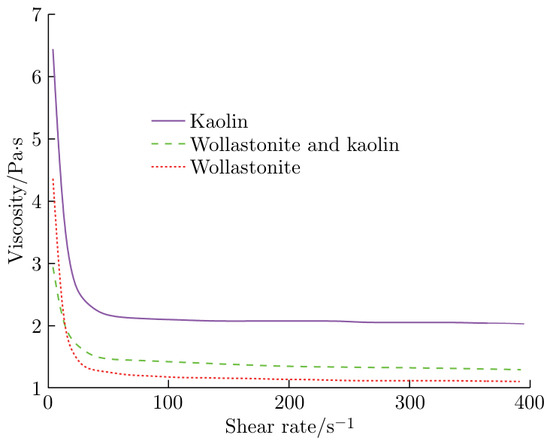
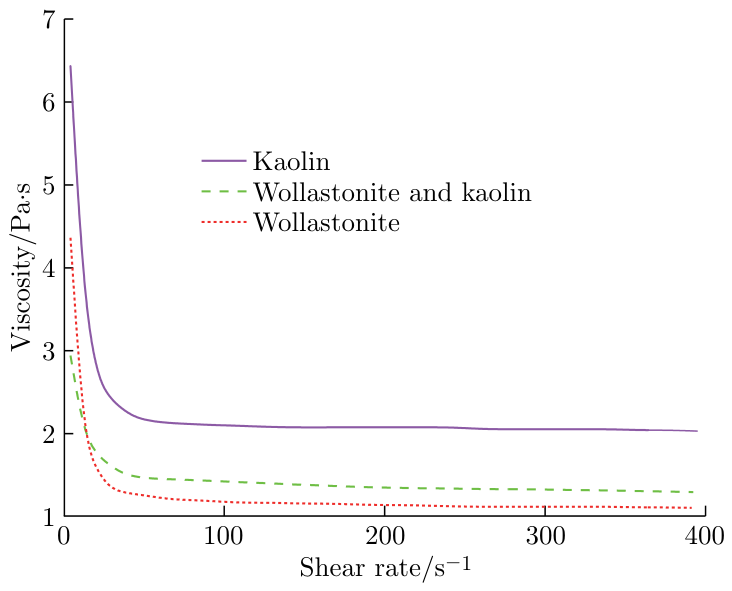
Figure 1 shows that at the same shear rate, the viscosity of the coating slurry containing wollastonite is lower than that of the coating slurry containing kaolin, which indicates that the rheological property of the wollastonite coating slurry is more suitable for the coating process than the kaolin coating slurry.
Figure 1.
Viscosity-shear stress curves of coating slurry.
The viscosity of the coating slurry prepared by the combination of wollastonite and kaolin is relatively lower than the coating slurry containing single kaolin, and the viscosity of wollastonite coating slurry is not different from that of wollastonite coating slurry, and the shear rate is 400 S−1. The viscosity of the coating slurry still decreases obviously. The results show that the rheological properties of the coating slurry after the mixture of wollastonite and kaolin is more suitable for the coating process than that with only kaolin, and the rheological property of the coating slurry made of wollastonite is lower than the coating slurry prepared with only wollastonite.
4.1.3. Effect of the Compound of Fillers on Mechanical Properties of Coating Film
The polyamide 6 composite coating is made by combining the coating film with the fabric. Therefore, the performance of the coating film plays an important role in the development of the composite filler. According to the preparation method of the coating film, the stress-strain curve of the coating film was measured.
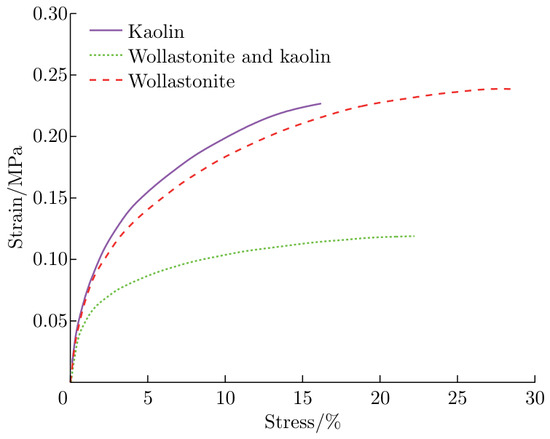
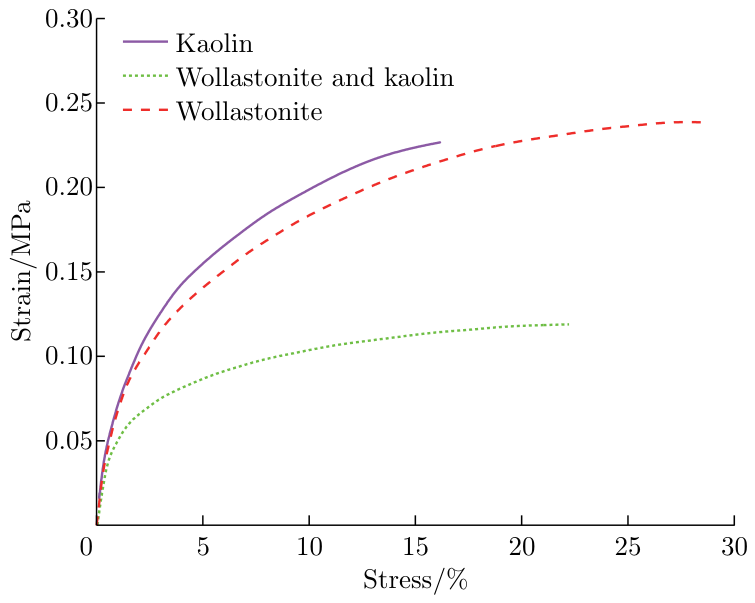
From Figure 2 and Table 2, it is known that the initial elastic modulus of the coating made of kaolin as a filler is relatively high, and the fracture stress is relatively large, that is, the rigidity is larger, and the subsequent fabric slicing may easily cause damage to the cutter. In addition, it can be seen from the table that the elongation at break of the coating film made of kaolin is only 16.12%, which indicates that the flexibility of the coating is poor; However, the rigidity of the coating with wollastonite decreases, and the toughness is better. The coating film made of wollastonite and kaolin has high elongation at break, and the initial modulus of elasticity is relatively small, indicating that its flexibility is good, and may be due to the filler of single kaolin in the coating slurry having significantly improvement on the rheological properties of the coating slurry, and the mission polymer can be effectively dispersed, so as to improve the elongation at break of the coating film, it show that the compound of kaolin and wollastonite is feasible.
Figure 2.
Stress-strain curves of coating film.
Table 2.
Effect of fillers on the mechanical properties of coating film.
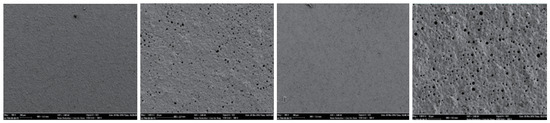
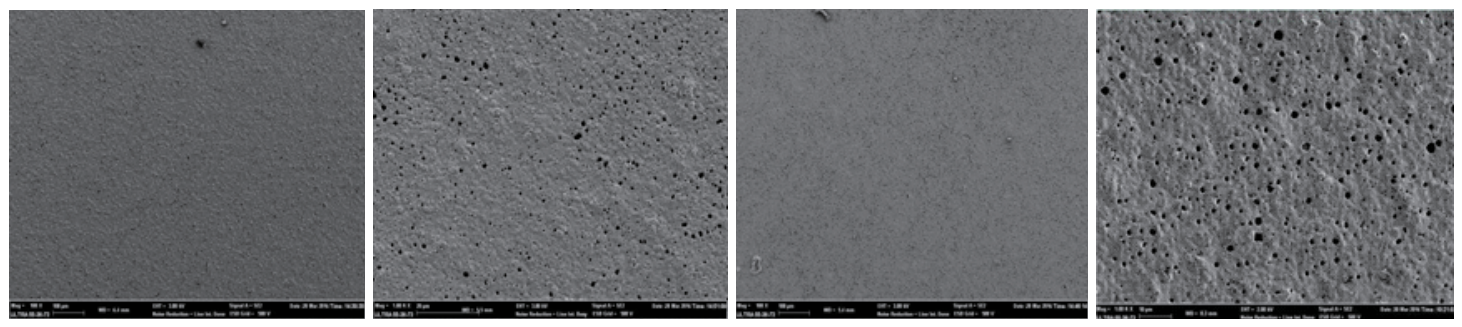
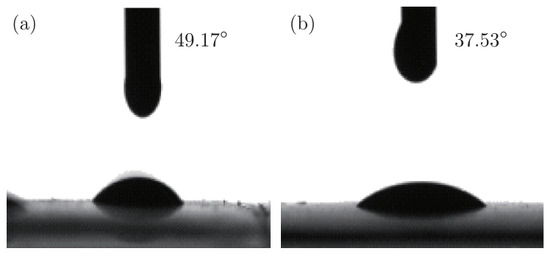
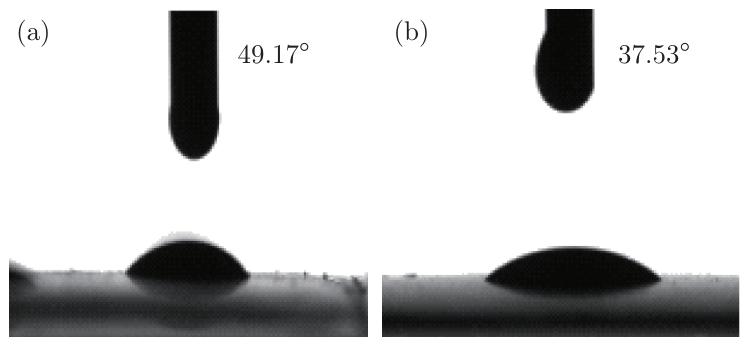
It can be seen from Figure 3 and Figure 4 that the surface micropore structure of the coating film made of kaolin is relatively small, and the distribution is not even. The pore size is relatively small, and the average contact angle of ink on its surface was 49.17°; On the other hand, a large number of micropore structures are distributed on the surface of the coating film prepared by the compound of wollastonite and kaolin, and the pore size is relatively large. The average contact angle was 37.53°. As a result, the specific surface area of the coating film increases, which is conducive to ink adsorption and fixation on its surface. The ink absorption rate of the coating film is improved, and the ink can be fixed quickly to prevent the occurrence of the seepage phenomenon.It shows that the addition of wollastonite in the filler is beneficial to improve the ink absorption of the coating film.
Figure 3.
SEM surface structure of coating film. (a) Surface structure of coating film with kaolin (×100); (b) Surface structure of coating film with kaolin (×1000); (c) Surface structure of compound coating film (×100); (d) Surface structure of compound coating film (×1000).
Figure 4.
Contact angle of coating film with kaolin (a) and contact angle of compound coating film (b).
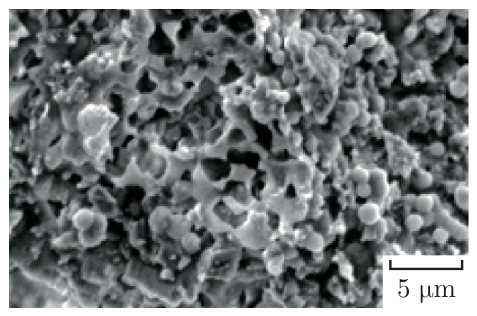
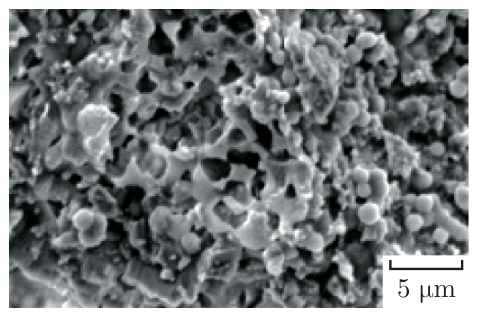
It can be seen from Figure 5 that the inner layer of the coating film prepared by the combination of wollastonite and kaolin is a honeycomb structure with a large number of holes and the size of the holes varies. The formation of micropore structure makes the coated fabric have excellent permeability, handle and elasticity.
Figure 5.
Inner structure of polyamide coating film (×4000).
4.2. Effect of Compounding Ratio on Properties of Coatings
4.2.1. Effect of Compounding Ratio on the Stability of Coating Slurry
It can be seen from Table 3 that the coating slurry with more wollastonite content has a relatively small fineness, which indicates that the filler has better dispersion and lower viscosity in the coating slurry, but its compatibility is poor and the sedimentation is easy to occur. The consistency of the coating slurry with more kaolin is higher. The fineness of the filler in coating slurry is relatively large, and the dispersion is not good. At the same time, it can be found that with the increase of the storage time, the compatibility of the coating slurry with different blending ratio becomes worse and the sedimentation height increases, and the viscosity and the particle fineness also increase, which indicate that the storage time of the slurry should not be too long. This is due to the difference of polarity between inorganic functional fillers and matrix materials, the lack of physical entanglement between the components, and the poor compatibility. When the storage time is too long, it is easy to lead to precipitation and serious stratification. Furthermore, the quality of coating products is affected.
Table 3.
Effect of the ratio of wollastonite and kaolin on the stability of coating slurry.
When the ratio is 1:1, the compatibility of the fillers in the coating slurry is better. The settlement is 2 mm after 1 days, and the dispersibility is better than that of 1:3 and 1:5. The comprehensive analysis shows that the composite ratio of the wollastonite and kaolin is 1:1, more suitable for wet coating.
4.2.2. Effect of Composite Ratio on Mechanical Properties of Coating Film
Because of the different mechanical properties of the coating film of wollastonite and kaolin, the effects of different blending ratio of wollastonite and kaolin on the mechanical properties of the coating film were investigated.
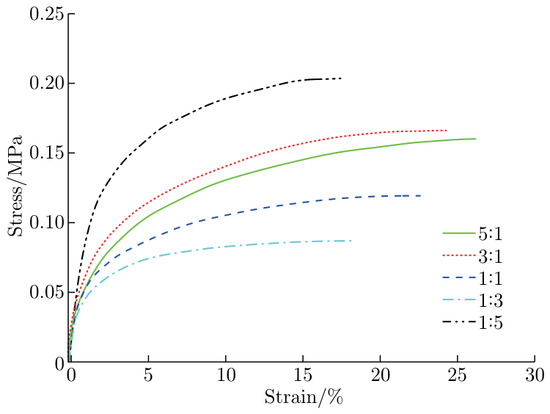
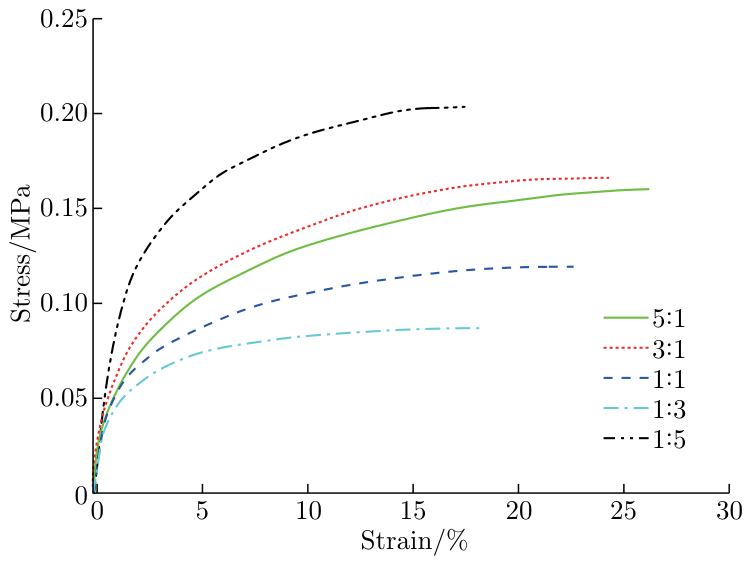
From Figure 6 and Table 4, it can be seen that with the decrease of the mass ratio of wollastonite and kaolin, the elongation at break of the coating film decreases gradually. The initial elastic modulus is relatively low when the mass ratio of wollastonite and kaolin is 1:1 or 1:3, which indicates that the rigidity of the coating film is relatively poor. Considering the high rigidity of the coating film, it might easily cause damage to the cutter in the subsequent process of coating products with the increase of production cost, which is not conducive to the continuous production of enterprises.
Figure 6.
Effect of the ratio of wollastonite and kaolin on the stress-strain curves of coating film.
Table 4.
Effect of the ratio of wollastonite and kaolin on the mechanical properties of coating film.
To sum up, when the mass ratio of wollastonite and kaolin is 1:1, the coating film has higher elongation at break and lower initial elastic modulus, which meets the requirements of enterprise production. At the same time, the stability of the coating slurry is relatively good.
4.3. The Effect of Process Conditions on the Wet Coating of Polyamide
4.3.1. Effect of Temperature on Viscosity of Coating Slurry
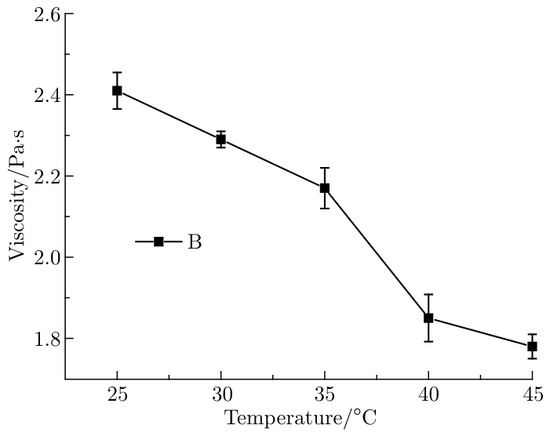
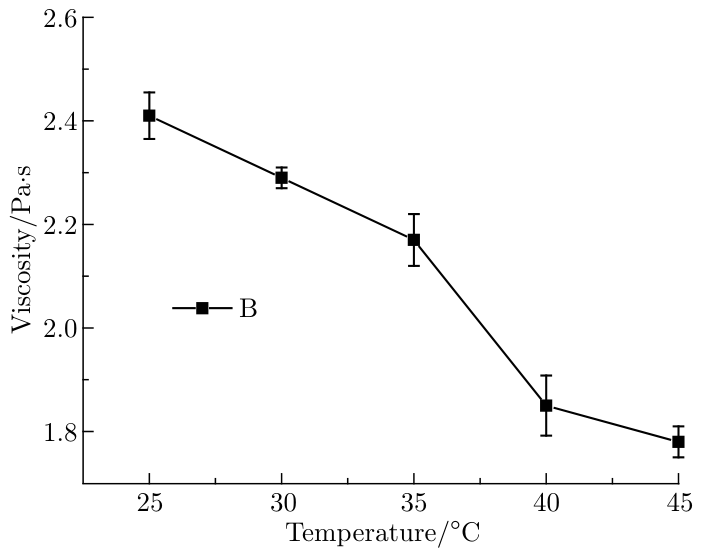
The temperature has an important influence on the viscosity of the coating slurry. The experiment was combined with the actual enterprise’s mixing and use conditions. The prepared coating slurry was placed for 24 hours, and the coating slurry temperature was set to 25 °C, 30 °C, 35 °C, 40 °C, and 45 °C respectively. The viscosity of the coating slurry was tested under this condition, and the results were shown in Figure 7.
Figure 7.
Effect of Temperature on Viscosity of Coating Slurry.
As can be seen from Figure 7, the viscosity of the coating slurry gradually decreaseed with the increase of temperature. This is because the increase in temperature would accelerate the movement of nylon 6 molecular chain in the coating slurry, reduce the degree of interchain twisting, and lead to the reduction of viscosity. When the range of temperature is 30∼35 °C, the range of viscosity was 2.06∼2.31 Pa·s, more suitable for wet coating. However considering that the slurry tank was open in the actual production of the enterprise, with the production process, the methanol volatilization in the coating slurry leaded to the increasing viscosity of the coating slurry. Therefore, properly raising the temperature of the coating slurry, the viscosity of the coating slurry was maintained between 2 Pa·s and 3 Pa·s, but the temperature should not be too high. It not only causes the viscosity of the coating to be reduced, which can not meet the production demand, but also increases the production cost, Therefore, the temperature of the coating slurry was determined to be 35 °C.
4.3.2. Effect of Baking Temperature on the Properties of Coated Fabric
The sizing amount was maintained in the range of 45 to 50 g/m2, the baking time was set to 70 s, and the baking temperatures were 140 °C, 150 °C, 160 °C, 170 °C, and 180 °C, respectively, the style of the coated fabric, the color fastness to the soap and the coating effect are shown in Table 5, Table 6 and Table 7.
Table 5.
Effect of baking temperature on the style of coated fabric.
Table 6.
Effect of baking temperature on color fastness to soaping of printed coated fabrics.
Table 7.
Effect of baking temperature on coating effect.
From Table 5, it can be seen that as the baking temperature increaseed, the hardness, the drapability coefficient and the peak area of the coated fabric gradually increased, and the softness gradually decreases. When the temperature reacheed 170 °C, the temperature continues to increase. The stiffness and peak area begin to become smaller, the softness begins to increase gradually. At the same time, it can be seen that the smoothness of the coated fabric was gradually increased. When the temperature reached 160 °C, it began to decline. From the experiment, it was found that when the baking temperature reached 160 °C and the temperature continued to increase, the flatness of the coated fabric began to decrease, curling and yellowing occurred. From the above analysis, it can be seen that when the baking temperature is 160 °C, the coated fabric has good hardness and smoothness, moderate softness and drape, and the coated fabric has good flatness without yellowing and curling phenomenon. Therefore, the baking temperature was determined to be 160 °C.
From Table 6, it can be seen that the color fastness to soaping of the printed coating fabric is increased with the increase of the baking temperature. When the baking temperature reaches 160 °C, the baking temperature is further increased, and the color fastness to soaping is continued. Basically, this is because when the baking temperature is low, the coated fabric is not fully baked, and the coating slurry is not tightly bonded to the fabric fibers, thereby affecting the soapingfastness of the coated fabric. Therefore, determine the baking temperature at 160 °C.
From Table 7, it can be seen that as the baking temperature increaseed, the whiteness of the coated fabric increaseed gradually. When the baking temperature reached 160 °C, the temperature continued to increase, and the whiteness begins to gradually decrease. This is because when the temperature is too high, the fabric would turn yellow. The printing effect of the coated fabric increased with the increase of baking temperature. When the baking temperature was higher than 150 °C, the printing performance did not change much, reaching 3-4 grades, that is, the printed portion had a slight broken pattern. Some lines of the system are not visible at the end, and there is no seepage phenomenon. When the temperature was higher than 170 °C, the printing effect was deteriorated to reach level 3. This is due to the fact that when the coated fabric was not fully baked, the adhesion fastness of the coating slurry to the nylon fabric was reduced, and the surface of the fabric was sticky, resulting in deterioration of the printing performance. However, when the baking temperature is too high, the coated fabric occurs Shrinkage, flatness of the surface is reduced, and slight bleeding and tearing may occur during printing. Therefore, the baking temperature of the coated fabric was determined to be 150 °C to 160 °C.
Considering the effect of baking temperature on the style of the coated fabric, the degree of soaping-fastness, and the coating effect, it was determined that the baking temperature was 160 °C.
4.3.3. Effect of Baking Time on the Properties of Coated Fabric
When the sizing volume was kept in the range of 45 to 50 g/m2 and the baking temperature was 160 °C, the baking time was set to 60 s, 70 s, 80 s, 90 s, and 100 s respectively, and the coated fabric, color fastness to washing and coating effects was tested under this condition. The results were shown in Table 8, Table 9 and Table 10.
Table 8.
Effect of baking time on the style of coated fabric.
Table 9.
Effect of baking time on color fastness to soaping of printed coated fabrics.
Table 10.
Effect of baking time on the effect of coating.
From Table 8, it can be seen that as the baking time increased, the stiffness, smoothness, drape coefficient, and peak area of the coated fabric gradually increased, while the softness decreases. When the time reached 80 s, the growth rate gradually slowed down. From the experiment process, it was also found that when the baking time reached 80 s, the baking time continued to increase, shrinkage of the fabric occurred, flatness decreased, and the prolonged baking time would increase the production cost of the company. Therefore, choosing an appropriate baking time is beneficial to obtain a soft and elastic fabric style. When the baking time was 70 s and 80 s, the coated fabric has better stiffness and smoothness, and the softness is also better. Therefore, the baking time of 70 s and 80 s is most suitable.
It can be seen from Table 9 that with the increase of curing time, the colorfastness of soaping resistance of the coated fabric was improved. When the baking time reacheed 80 s, the baking time was further increased, and the soaping color of the coated fabric was kept strong. The degree was basically unchanged. This is because when the baking time was short, the coated fabric was not fully baked, and the adhesion between the coating slurry and the fabric was not firm, and the color fastness to soaping was reduced. Therefore, the baking time was determined as 80 s.
It can be seen from the Table 10 that when the baking time reached 70 to 80 s, the whiteness and the printing effect of the coated fabric were high. When the baking time continued to increase, the whiteness of the coated fabric started to gradually decrease. It may be because the baking time was too long and the coating fabric would produce the phenomenon of yellowing, which would reduce its whiteness. Meanwhile, the printed effect of the coated fabric was also reduced.
Therefore, the baking time should not exceed 80 s.
Taking into account the influence of curing time on the style of the coated fabric, the colorfastness of soaping resistance, and the coating effect, it was determined that the baking time was 80 s.
5. Conclusions
By studying the effects of wollastonite, kaolin and their mixture on the properties of polyamide coating, it was found that the compatibility of wollastonite and kaolin in the coating slurry was higher than that of the single wollastonite coating slurry. The flexibility of the coating film was also good, indicating the feasibility of the mixture of kaolin and wollastonite.When the mass ratio of wollastonite and kaolin was 1:1, and their mass accounts for 22% of the anhydrous methanol, the inner layer of the coating film was obviously honeycomb, and a large number of micropore structures were distributed on the surface. The contact angle of the ink on its surface was 37.53°, and it had excellent ink absorption property.
By studying the effect of coating slurry temperature on the viscosity of the coating slurry, when the coating slurry temperature was 35 °C, the coating viscosity was 2 to 3 Pa·s, which was more suitable for the polyamide wet coating.
By studying the influence of baking technology on the style of the coated fabric, the colorfastness of soaping resistance and the effect of the coating, the baking temperature of 160 °C and the baking time 80 s are determined. Under this condition, the color fastness of the coated fabric was 4-5, the printing effect reached 3-4, the whiteness and the style of the fabric were better.
Acknowledgments
This research was funded by Huzhou Xinli label belt Co., Ltd. The author would like to thank Key Laboratory of Advanced Textile Materials and Manufacturing Technology (Hangzhou, 310018).
References
- Wang, R.; Du, W. Production method and development trend of coating fabric. China Text. Lead. 2011, 2, 58–58. [Google Scholar]
- Jiang, S.; Wang, X.; Zhang, X. Processing method and application of industrial coated fabrics. Shaanxi Text. 2008, 1, 46–47. [Google Scholar]
- Jiang, X. Wet solidified coating for polyamide. In Proceedings of Shanghai Printing and Dyeing Technology on 2007; Shanghai TextileEngineering Society: Shanghai, 2007; p. 318. [Google Scholar]
- Zhi, H.; Zhang, L.; Zheng, J. Preparation mechanism and membrane properties of polyamide wet coating. J. Text. Res. 2015, 36(9), 65–69. [Google Scholar]
- Nadaraah, V.; Richard, K. Lewis acid base complexation of polyamide 66 to control hydrogenbon ding, extensibility and crystallinity. Polymer 2004, 45, 4077–4085. [Google Scholar] [CrossRef] [Scilit]
- Chen, Y.; Zheng, J.; Guo, Y. Preparation of nylon 6 waste silk coating slurry and properties of its coating film. J. Zhejiang Sci.-Tech Univ. 2013, 30(6), 830–833. [Google Scholar]
- Zhi, H.; Zheng, J.; Pan, Y. Study on the application of black colorant in wet coating. J. Zhejiang Sci.-Tech Univ. Nat. Sci. Ed. 2015, 33(1), 20–25. [Google Scholar]
- Xiao, X.; Zheng, C.; Hu, J.; et al. Study on Nanometer Calcium Carbonate Used in Coatings. Heilongjiang Pulp Pap. 2001, (4), 18–21. [Google Scholar]
- Zou, X. Study on the property of PA6/kaolin composite; Qingdao University of Science & Technology, 2010. [Google Scholar]
- Yu, L. Effect of fillers, heat stabilizers and carbon black on properties of PVC paste. Mod. Plast. Process. Appl. 2006, 18(5), 31–34. [Google Scholar]
- Du, Y.; Zhi, H.; Zhang, L.; et al. Study on preparation technology of black label fabrics in wet coating. Adv. Text. Technol. 2015, 23(3), 21–25. [Google Scholar]

Disclaimer/Publisher’s Note: The statements, opinions and data contained in all publications are solely those of the individual author(s) and contributor(s) and not of MDPI and/or the editor(s). MDPI and/or the editor(s) disclaim responsibility for any injury to people or property resulting from any ideas, methods, instructions or products referred to in the content. |
© 2018 Textile Bioengineering and Informatics Society. This article is an open access article distributed under the terms and conditions of the Creative Commons Attribution (CC BY) license (https://creativecommons.org/licenses/by/4.0/).