


Abstract
We performed a theoretical analysis (the PBE-D2/DNP level of the density functional theory with the use of the DSPP pseudopotentials) of the geometries, bonding and frontier orbital energies, spin and charge distribution for the entire series (from La to Lu) of lanthanide atoms interacting with Ih−C80 cage, for both η5 and η6 exohedral coordination patterns. In certain regards, the exohedral η5 and η6 coordination of Ln atoms to the C80 fullerene cage exhibits similar qualitative and semi-quantitative trends (the bonding strength, shortest Ln…C distances, charge and spin of lanthanide atoms). The most interesting aspect is the molecular spin of the complexes, where we observed different patterns of ferromagnetic and antiferromagnetic coupling. Three complexes represent an extreme, when the antiferromagnetic coupling results in zero or close-to-zero molecular spin. In some cases, the molecular spin is a simple sum of 2 e of the isolated C80 cage and the spin of an isolated Ln atom. However, the most common situation is when another 2 e spin adds: it is best illustrated with Eu (spin of 7 e for the atomic ground state), where the molecular spin of its η5 and η6 complexes is not about 9 e but reaches almost 11 e.
1. Introduction
The noncovalent interactions of metal-containing species with the fullerene cages of variable size are fairly considered one of the most high-impact and extensively studied areas of nanocarbon chemistry. Within this area, it is hard to overestimate the importance of research on the formation, physicochemical properties and applications of endohedral metal fullerenes, where the rare-earth (first of all, lanthanide, Ln)-containing derivatives are the systems of particular interest [1,2,3,4,5,6,7,8,9,10,11,12,13,14,15,16,17,18,19,20,21]. One can easily explain the latter research focus: many endohedral fullerenes are very stable; they can be isolated and purified and have a well-defined molecular structure, which can be characterized using X-ray crystallography and other traditional experimental techniques, as well as exhibit unique chemical and physical properties, useful for a wide range of electronic, magnetic and biomedical applications.
In stark contrast to endohedral fullerenes, the knowledge available on exohedral metal–fullerene interactions remains very limited, as the related research reports are comparatively sporadic. In this regard, the systems best explored are those including the main group and transition metals [22,23,24,25,26,27,28,29,30,31,32,33,34,35,36,37]. The aspects of interest in exohedral metal–fullerene complexes are rather versatile: they include the preferable coordination pattern of metal atoms and electronic structure of the complexes [24,25,26,27,28], the interaction of fullerene cages with gold nanoparticles [29,30,31,32], magnetic [33,34], hydrogen storage [35,36], and free radical scavenger properties [37] of exohedral metal–fullerene systems, among others.
The systems including lanthanides, which are f-elements, are always more difficult to study both experimentally and theoretically, and the area of exohedral Ln–fullerene complexes is no exception. Its emergence was apparently stimulated by the search for new high-temperature superconductors, where the preparation and characterization of the very first crystalline lanthanide fulleride, Yb2.75C60, was reported by Özdaş et al. in 1995 [38]. Among the most important structural features found by the authors was the fact that the orientational ordering of C60 molecules aligns electron-poor five-membered rings with Yb species; in other words, the η5 is preferred over η6 coordination pattern and other theoretically possible hapticities (η2, η3, etc.). The latter study was followed by others, which further explored the preparation, structure determination and properties of the same and similar crystalline Ln (Ln = Sm, Eu) fullerides [39,40,41,42,43,44] and where the preferential coordination of the Ln atom to the five-membered ring of the C60 cage was observed again [39].
One should also mention other papers [45,46,47,48,49,50] that analyzed the exohedral Ln–fullerene interactions at a molecular level. Some experimental techniques, such as mass spectrometry and photoionization spectroscopy [45,47,48,49], convey information about the complex stoichiometry and charge distribution within them but are unable to provide any insight into the pattern of Ln–fullerene coordination. Under such circumstances, it is difficult to overestimate the usefulness of quantum-chemical calculations, in particular of those based on density functional theory (DFT) [46,50]. Andreoni and Curioni [46], by means of gradient-corrected BLYP functional calculations, compared the geometries and formation energies of exohedral La + C60 and endohedral La@C60 complexes and concluded that, in both cases, the η6 coordination pattern is preferred, with the bonding strength for La + C60 lower by 10 kcal/mol than for the endohedral La@C60 complex. In a more recent report, Kumari and Singh [50] focused on the theoretical analysis of Dy–fullerene interactions through the η5 coordination pattern, without considering the possibility of η6 hapticity. Such a preference can be explained by the relative electron deficiency of five-membered rings (like in the reports on crystalline fullerides [38,39]), which increases stability of Ln complexes with different cyclopentadienyl-derived ligands [51,52,53].
An obvious lack of information on the structure and properties of exohedral Ln–fullerene complexes motivated us to undertake a systematic DFT analysis of the geometries, bonding strength, frontier orbital energies, spin and charge distribution for the entire series from La to Lu [54]. We compared the data obtained for η5 and η6 coordination patterns, as well as for the respective endohedral fullerenes Ln@C60 studied in a previous work [55]. We found that, in terms of the complex stability, the geometric parameters and positive charge acquired by lanthanide atoms, the exohedral η5 and η6 coordination exhibits similar qualitative and semi-quantitative trends. The most interesting result was the behavior of molecular spins of the complexes, where both ferromagnetic and antiferromagnetic coupling was observed, with the η5 coordination exhibiting a stronger trend to increase the molecular spin. Naturally, a part of the unpaired electron density of the spin-rich Ln atoms is transferred to the usually closed-shell C60 cage, thus converting the latter into an open-shell system.
As the reader can see, the main body of data discussed above deals with the systems based on the most common and well-studied C60 fullerene, which has icosahedral symmetry Ih. The ‘next of kin’ in the icosahedral fullerene family is Ih−C80, but its chemistry turns to be much more complicated. To begin with, the empty Ih−C80 cage is very unstable due its open-shell nature and was not isolated in its pure form [56,57,58]. On the other hand, it can become very stable due to encapsulation of a broad variety of atoms, molecules and ions, forming endohedral fullerenes, in which electrons are transferred from the encapsulated species to Ih−C80 (see, for example, the comprehensive review [6] and references therein). Speaking of the simplest endohedral Ln species, which are the neutral atoms, the data available can be summarized as follows. The most efficient way to stabilize the C80 cage is to encapsulate two Ln atoms, providing in this way the six electrons necessary to close the fullerene shell (lanthanide atoms convert into Ln3+ ions), as reported for La [59,60,61,62], Ce [63,64], Gd [65,66,67], Tb [64] and Dy [64] derivatives. Regarding the corresponding mono-metal analogs, their stability is much lower, thus drastically complicating separation and characterization of the pure compounds. Nevertheless, Ln@C80 was demonstrated (by using mass spectrometry and high-performance liquid chromatography, HPLC) to exist in the soot generated by the DC arc discharge method using La/graphite rods [68]. One should note, however, that mass spectrometry is unable to determine the symmetry of the fullerene cage. Similar studies with Sm [69] and Eu [70] derivatives showed that Sm@C80 and Eu@C80 exhibit rather long HPLC retention times, suggesting an elongated geometry of the fullerene cage (i.e., symmetry other than Ih). On the other hand, Gu and collaborators [71,72] presented UV–Vis-NIR absorption spectra favoring the icosahedral symmetry of Gd@C80 [71] and Tb@C80 [72]. Mass spectrometric detection of Gd@C80 was also reported elsewhere [73,74], without discussing its symmetry.
Bearing in mind the problematic existence of icosahedral Ln@C80 complexes, it is not surprising that (to the best of our knowledge) no data are available on the exohedral interactions of lanthanide species with the Ih−C80 cage. Nevertheless, there might exist one type of potentially stable systems combining the two components. Let us recall the crystalline fullerides Ln2.75C60 (Ln = Sm, Eu, Yb) [38,39,40,41,42,43,44]. The stoichiometry 2.75:1 implies that, if C60 is replaced by Ih−C80, the number of Ln atoms is more than sufficient to supply the number of electrons necessary to stabilize the fullerene cage. In turn, in case such C80-based crystalline fullerides can indeed be synthesized, it is intriguing to foresee what structural and electronic characteristics they can have, especially as compared to those of the C60-based fullerides: first of all, in terms of the orientational ordering of fullerene molecules, where the η5 coordination pattern for Ln atoms is preferred over η6 pattern.
Given the impossibility to perform quantum-chemical calculations on a crystalline phase of this level of complexity, the goal of the present study was a theoretical DFT analysis of the geometries, bonding and frontier orbital energies, spin and charge distribution for the entire series (from La to Lu) of lanthanide atoms interacting with the Ih−C80 cage, for both η5 and η6 exohedral coordination patterns (hereafter, the corresponding complexes are referred to as Ln + C80_5 and Ln + C80_6), similar to the one reported previously for the Ln atom interactions with the C60 cage [54].
2. Computational Methodology
To facilitate comparison with the data previously obtained, we followed the same general computational methodology as in the studies with the C60 fullerene cage [54] and graphene models [75,76]. That is, we employed the DMol3 numerical-based DFT module [77,78,79,80] of the Materials Studio package. More specifically, we used the Perdew–Burke–Ernzerhof (PBE) general gradient approximation (GGA) functional [81] combined with the empirical dispersion correction developed by Grimme [82] (that is, PBE-D2). The basis set was the DND double-numerical, which has a polarization d-function added on all non-H atoms (considered to be an equivalent of the 6-31G(d) Pople-type basis set). Based on our own [15,54,55,75,76,83] and many other authors’ experiences, when studying carbon nanomaterial interactions with chemical species of different natures, the PBE-based methodology offers a much better efficiency, along with a competitive computational cost compared, for example, for the use of the popular B3LYP hybrid functional [84].
The DMol3 module incorporates two types of pseudopotentials to treat heavy elements including lanthanides: the quasirelativistic effective core potentials (ECPs) [85,86] and the norm-conserving DFT semi-core pseudopotentials (DSPPs; more recent and specially developed for use within DMol3), which implement relativistic effects and spin-orbit coupling. In a number of previous studies, we observed systematic failures of the ECP when analyzing the interaction of a Tb atom with carbon nanoclusters; furthermore, we found that the use of ECP prevents even single-point calculations on an isolated Tb atom, contrary to DSPP [87]. Therefore, in the present work, we continued to employ the latter pseudopotentials, even though they exhibit certain imperfections, such as a strong frontier orbital inversion in the case of Sm and Gd atoms, yielding unrealistic negative HOMO–LUMO gap values [87]. In that study, however, the DNP basis set was employed: after reducing it to DND, the problem is eliminated for Sm, whereas it persists for Gd, producing the gap value of −0.674 eV (Table S1).
The convergence criteria we applied in the full geometry optimization and calculations of electronic parameters were ‘fine’, in particular: energy change, 2·10−5 Ha; maximum force, 0.004 Ha/Å; maximum displacement, 0.005 Å; SCF tolerance, 10−5 Ha. The global orbital cutoff [88], defined by the inclusion of Ln species, was as high as 5.0 Å. This value is automatically set in DMol3 when the system, to be treated with the DND basis set, contains La to Lu; for the sake of a valid comparison, we also manually adjusted it for pure C80 (for carbon-only-containing models, the default value is 3.3 Å).
The main challenge in our calculations was achieving self-consistent field (SCF) convergence. The presence of 4f orbitals in the lanthanide species implies the existence of a series of very close degenerate states near the Fermi level, which usually makes reaching the SCF convergence impossible without appealing to the thermal (or Fermi) smearing protocol. Previous publications (see [54,55,75,76] and references therein) have explained how to use it correctly. Briefly, the final (following a series of auxiliary) calculations at a very low smearing value of 0.0001 Ha (equivalent temperature of 31.6 K) produce stable and consistent results for most lanthanide-containing systems. Thus, all the data reported here correspond to the final smearing value of 0.0001 Ha.
The formation energies ΔELn+C80 (thereafter, simply ΔE) were calculated by using the following general equation:
where Ei is the respective absolute energy for the Ln atom or C80 cage.
ΔELn+C80 = ELn+C80 − (ELn + EC80)
3. Results and Discussion
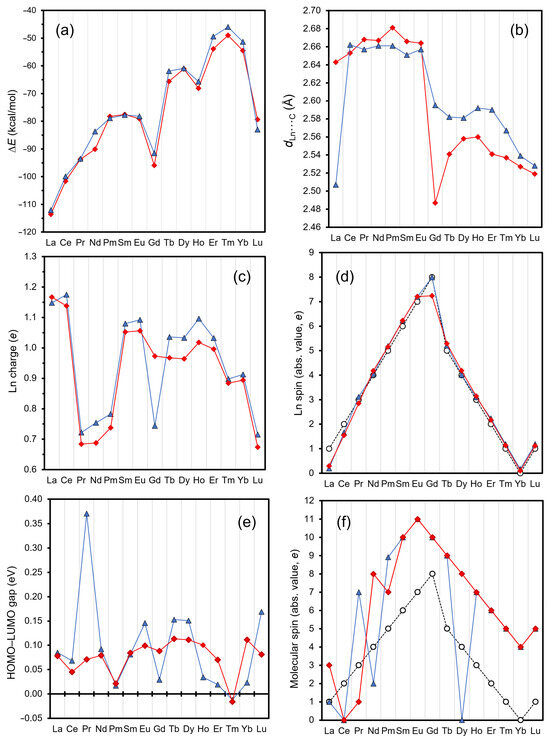
The very first important result is that the formation energies ΔE for Ln + C80_5 and Ln + C80_6 essentially coincide (given the general precision of DFT calculations of a few kcal/mol). For the first type of complexes (η5 hapticity), the ΔE values are found between −112.1 (La + C80_5) and −46.0 kcal/mol (Tm + C80_5) (Table 1; Figure 1a), whereas, for the complexes with η6 hapticity, the bonding energies span from −113.6 (La + C80_6) to −49.0 kcal/mol (Tm + C80_6). Compared to the results obtained for the C60 analogs [54], the bonding is considerably stronger; this can be explained by the open-shell nature of the C80 (contrary to C60) cage, giving rise to an increased interaction strength with equally open-shell 4f Ln species.
Table 1.
The bonding energies ΔE, HOMO, LUMO and HOMO–LUMO gap energies; the distances dLn…C; the charge and spin of Ln species, as well as the molecular spin retrieved from the Mulliken population analysis, for the fifteen Ln + C80 complexes with η5 hapticity and their counterparts with η6 hapticity.
Figure 1.
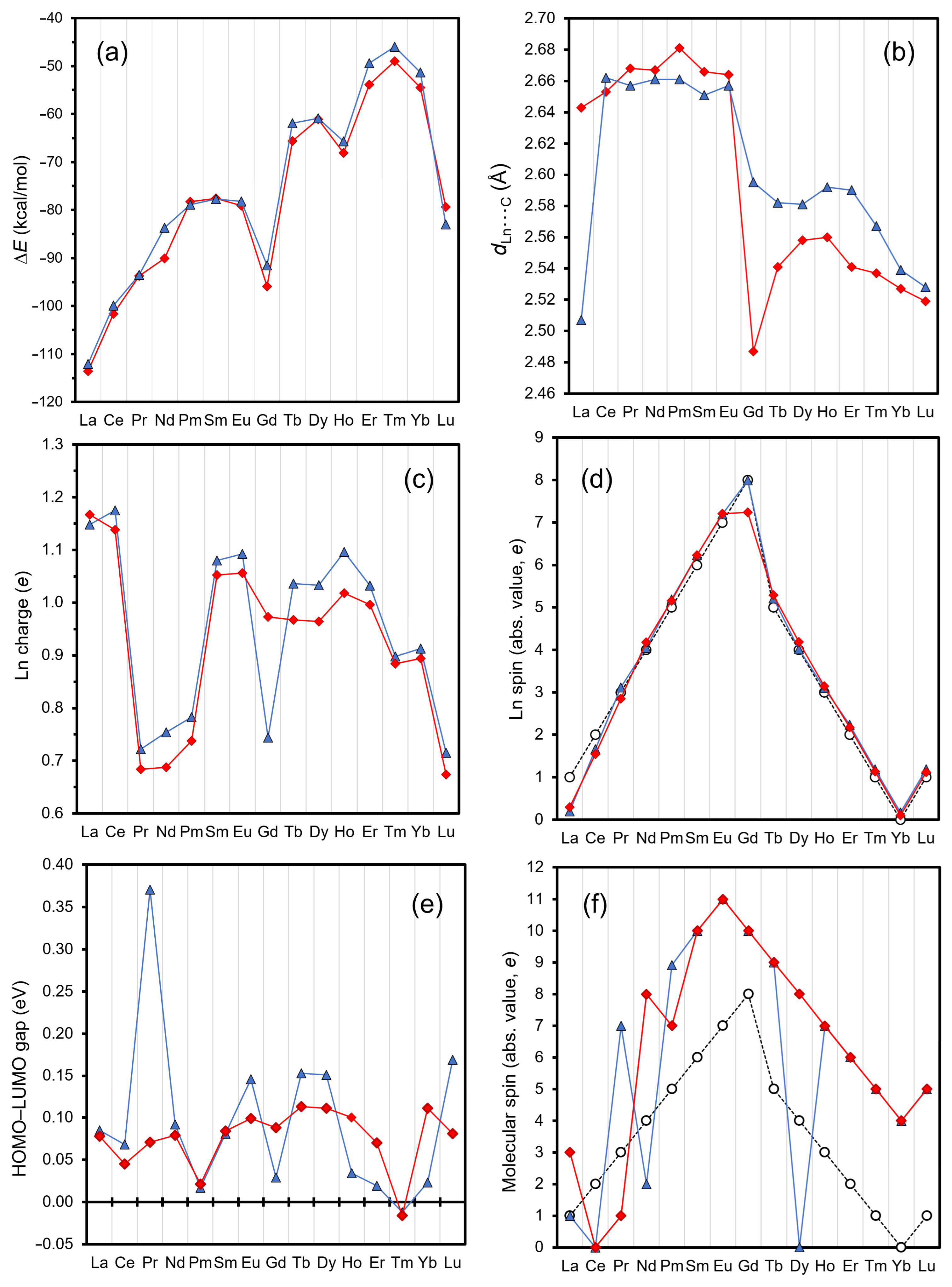
Comparison of the changes in (a) the formation energies ΔE, (b) the shortest Ln…C distances, (c) the charge and (d) spin (absolute values) of the Ln atoms, (e) the HOMO–LUMO gap energies, and (f) molecular spin for the Ln + C80_5 and Ln + C80_6 complexes (solid lines and datasets in blue and red, respectively). In the plots (d,f), the black dashed line and open circle points correspond to the spin of isolated Ln atoms in their ground state.
In terms of the shape of the curves of ΔE vs. Ln (Figure 1a), the general pattern does not change, compared to the one for the C60-derived exohedral fullerenes [54]. Furthermore, it closely follows the general trend observed previously for the endohedral fullerenes Ln@C60 [55]. More specifically, the ΔE values (the points for the complexes of Eu, Gd and Ho fall out) increase until Ho + C80_5 and Ho + C80_6, then slightly decrease for the Yb, when the 4f shell becomes full, and finally drop for both Lu complexes (when one 5d electron adds).
The above similarity in the changes of ΔE values for Ln + C80_5 and Ln + C80_6 complexes demonstrates a good reason to expect a close similarity in the trends for the shortest Ln…C distances in them (Figure 1b). One should note that they turned out to be very different compared to those reported for their C60 analogs [54]. The blue and red curves shown in Figure 1b follow a very similar pattern, with the exception of the data points for La, Gd and Tb. In the previous study [54], the Ln…C approaches were systematically closer for Ln + C60_6 than for the Ln + C60_5 series, which was interpreted as the result of a larger number of the C atoms the fullerene cage Ln interacts with (six versus five). In the present case, the latter rule works only for the later lanthanides Gd to Lu, plus Ce (the only exception from the earlier Ln group; Table 1 and Figure 1b). The largest difference in the Ln…C distances for the Ln + C80_5 and Ln + C80_6 series is observed for La and Gd. For the entire Ln + C80_5 series, the shortest separations span from 2.507 (La) to 2.662 Å (Ce) and, for the Ln + C80_6 series, from 2.487 (Gd) to 2.681 Å (Pm). Note, however, that within each particular complex, in very rare cases, all the Ln…C distances strictly coincide: they are limited to six Ln + C80_5 complexes, for Eu to Er (Table 1). A much more common (and actually normal) situation is when they exhibit at least minimal variations of roughly 10−2 Å, as a manifestation of the Jahn–Teller effect.
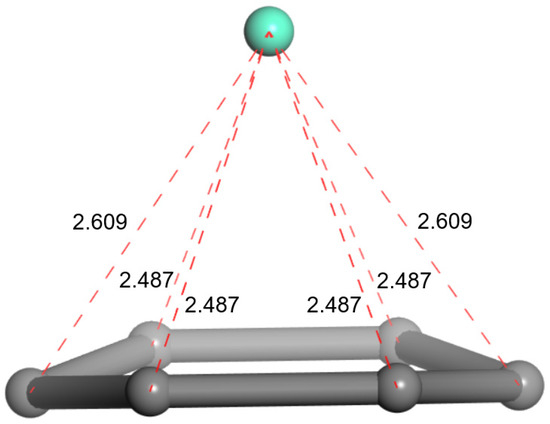
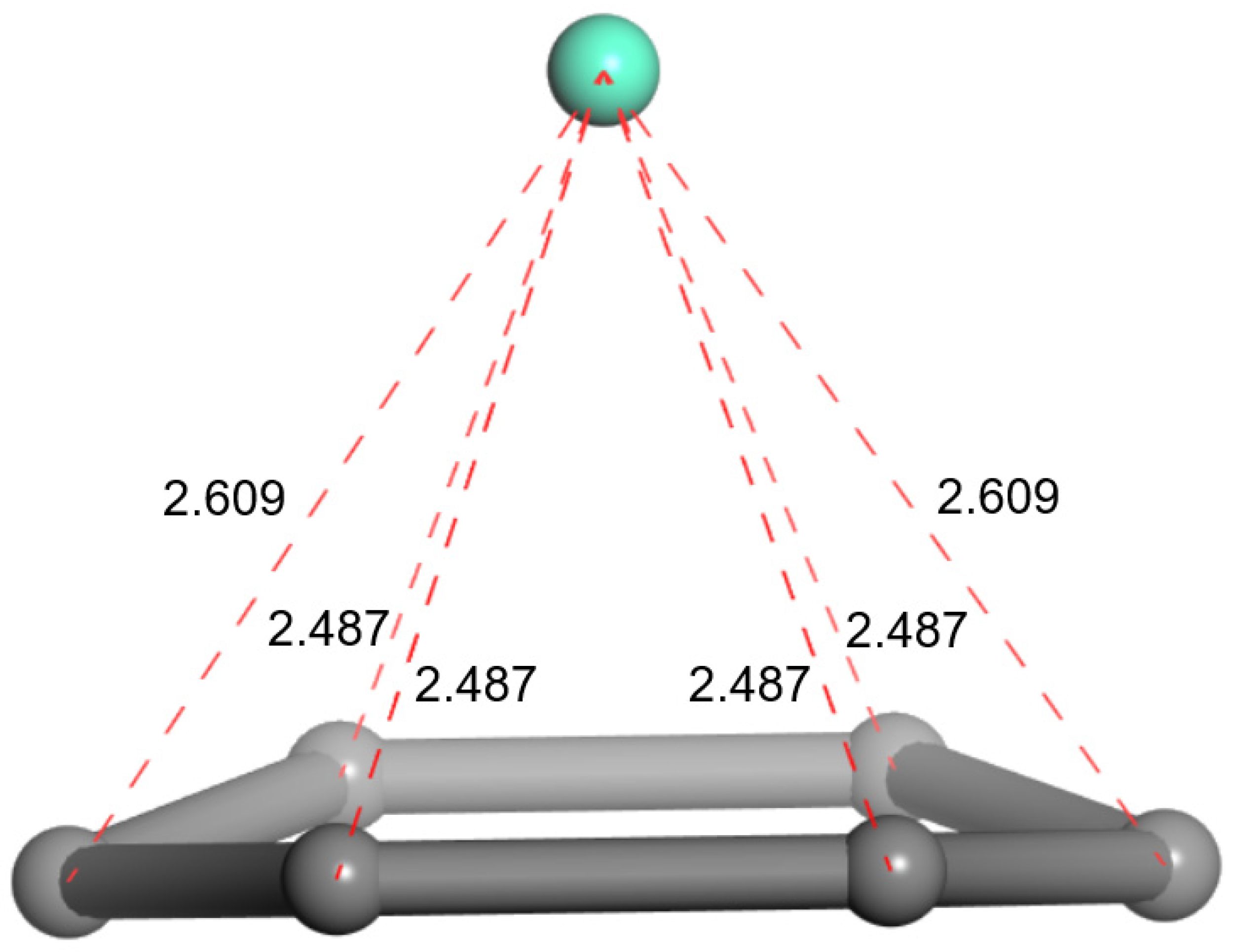
In the latter context, a very interesting feature distinguishing the Ln + C80_6 complexes analyzed here from their previously studied C60-derived counterparts [54] is a notable ‘bottom-up’ boat-like distortion of the η6-coordinated six-membered ring, as illustrated in Figure 2 for Gd + C80_6. No similar effect was observed for either Ln + C60_6 [54] or for endohedral fullerenes Ln@C60 [55]. Opposite to the Ln-coordinated hexagons in Ln + C80_6, the pentagonal rings in Ln + C80_5 complexes always conserve their planarity.
Figure 2.
The typical ‘bottom-up’ boat-like distortion of hexagonal rings upon the η6 coordination of Ln atoms in Ln + C80_6 complexes, illustrated for a particular case of Gd + C80_6 (Table 1).
Another parameter of special interest is the positive charge acquired by lanthanide atoms when interacting with the open-shell C80 cage in order to stabilize it. As it was described in the Introduction section, the most efficient way to do that is to encapsulate two Ln atoms, providing the six electrons necessary to close the fullerene shell (lanthanide atoms convert into Ln3+ ions), as reported for the endohedral derivatives of La [59,60,61,62], Ce [63,64], Gd [65,66,67], Tb [64] and Dy [64]. Nevertheless, the real-life situation is quite different, as it was summarized in the review [6]. Specifically, while the ionic model explains many spectroscopic and structural properties of such endohedral fullerenes, the transfer of a large integer number of electrons from an encapsulated metal atom or cluster to the fullerene cage is merely formal and should not be understood literally. This concept is supported by numerous research reports, which showed that the ionic model is oversimplified. Due to the effect termed by some researchers as ‘back-donation’, the calculated atomic charges are always significantly smaller than the formal 3+ charges, which is interpreted as a clear manifestation of the covalent contribution to the metal–cage interactions [6]. One additional argument becomes clear when considering the Ln2@C80 systems [67]: in this case, due to the repelling between the two ions Ln3+, the ‘naked’ (Ln2)6+ system, confined within a relatively small C80 cavity, simply cannot exist.
The charges (as well spin values analyzed below) of Ln species in their Ln + C80_5 and Ln + C80_6 complexes were retrieved from the Mulliken population analysis, usually preferred for Ln-containing and other fullerene-based systems (see, for example, [89,90,91]). The largest positive charges are 1.175 e (Ce) in the Ln + C80_5 series and 1.167 e (La) in the Ln + C80_6 series, with the lowest values of 0.715 e and 0.674 e, both for Lu, respectively (Table 1). In terms of the corresponding plots (Figure 1c), they exhibit very similar behavior, except for the charge of Gd, which is much lower in Gd + C80_5 (0.744 e) than in Gd + C80_6 (0.973 e). For both series, there is a deep charge minimum around 0.7 e for the early lanthanides Pr, Nd and Pm, as well as similar values for both Lu complexes. Thus, the general picture matches the one reported previously for the η5- and η6-coordinated complexes with C60 [54].
As usual, the most predictable parameter is the spin (absolute value) of Ln atoms: it cannot differ very much from the spin of isolated lanthanide atoms in their ground state (the black dashed line and open circle data points in Figure 1d). (One should note that, for some systems, the Mulliken analysis yields negative values of Ln atomic spins. However, in the absence of an external field, the sign of atomic spin considered as an isolated parameter does not matter, so that, in the plot shown in Figure 1d, we used the absolute values, for convenience.) As a result, all three plots almost coincide. The most visible feature is a much lower spin of the Gd atom in the Gd + C80_6 complex (7.238 e) compared to the one in the Gd + C80_5 complex (7.994 e), which is almost the same as the spin of an isolated Gd atom in its ground state (8 e). One can also see that, in both series: Ln + C80_5 and Ln + C80_6, the spin of the La atom drops from 1 e to almost zero (absolute values of 0.196 and 0.292 e, respectively); likewise, the spin of the Ce atom decreases from 2 e (ground state) to 1.660 and 1.545 e (again, absolute values), respectively. For other lanthanide complexes, the differences are much less significant, typically less than 0.2 e. As a whole, the spin behavior of Ln atoms in both the Ln + C80_5 and Ln + C80_6 series is much more uniform compared to their C60-derived complexes [54].
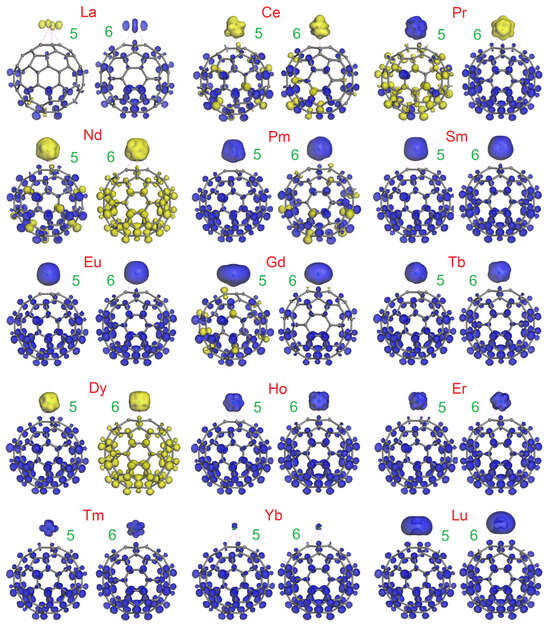
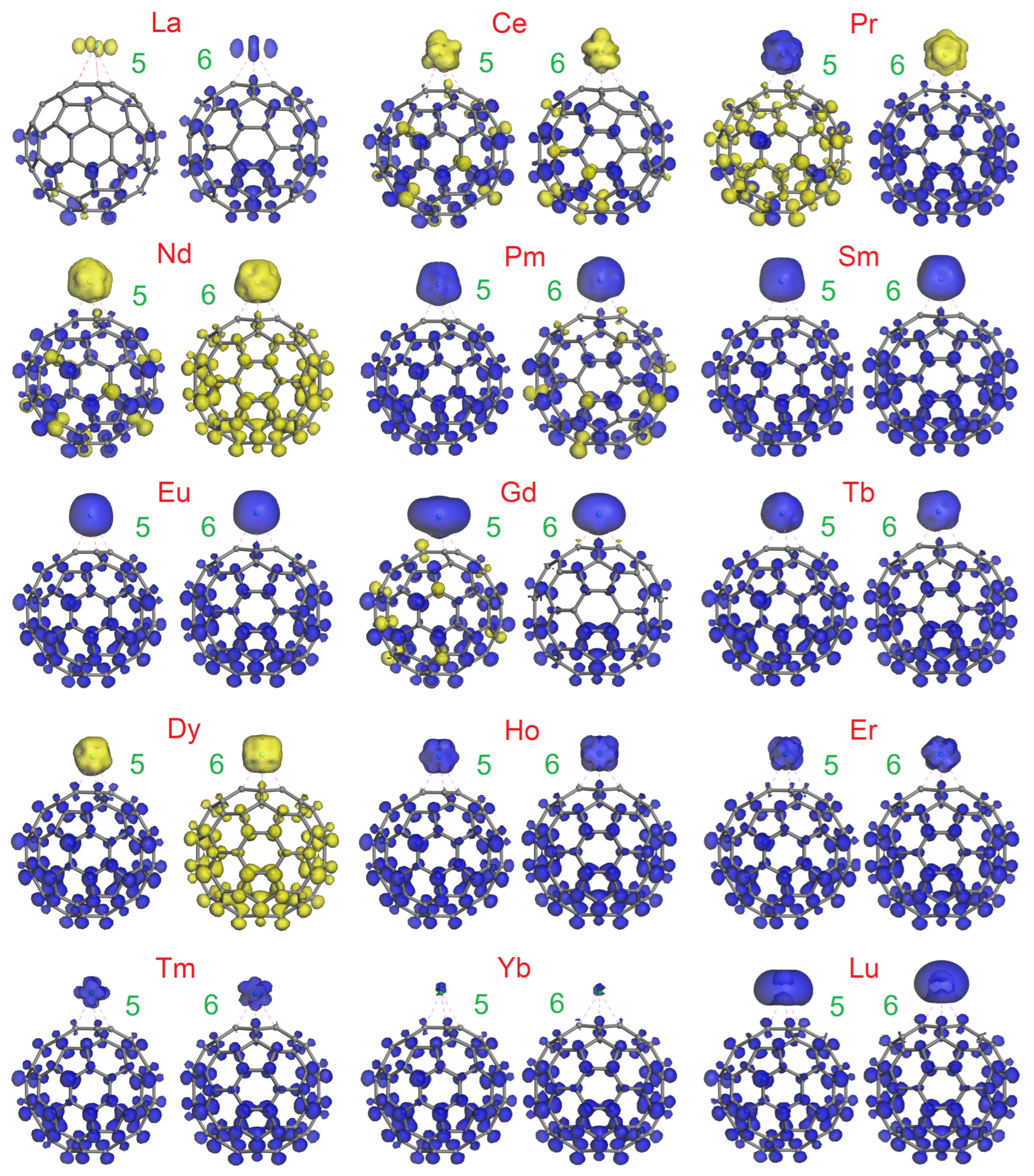
Nevertheless, the account for spin direction becomes important when the entire Ln + C80 complexes are analyzed. The first aspect is the spin density plots (i.e., spatial distribution of unpaired electrons), which can be compared in Figure 3 for the Ln + C80_5 and Ln + C80_6 series. One can see that the spin-up direction (blue lobes) generally prevails, and most complexes only exhibit these lobes (ferromagnetic coupling). The exceptions observed can be of two types. For the first one, limited to two complexes, Nd + C80_6 and Dy + C80_6, all the unpaired electrons have spin-down orientation (again, ferromagnetic coupling). The second type, with antiferromagnetic coupling, is more broadly represented, including the Ln + C80_5 complexes of La, Ce, Pr, Nd, Gd and Dy, as well as Ln + C80_5 complexes of Ce, Pr and Pm. The fullerene cage usually contains unpaired electrons of the same orientation, except for both Ce complexes, La + C80_5 (barely noticeable), Pr + C80_5, Nd + C80_5, Pm + C80_6 and Gd + C80_5.
Figure 3.
Comparison of the spin density plots (at 0.02 a.u. isosurfaces) for the fifteen Ln + C80 complexes with η5 hapticity and their counterparts with η6 hapticity (the green 5 and 6 numbers, respectively). Blue and yellow lobes correspond to spin-up and spin-down unpaired electron orientation, respectively.
If the spin-down electrons dominate, the values of molecular spins (Table 1) become negative, as observed for the η5 coordination complexes of Nd and Dy, as well as for the η6 complexes of Ce, Nd and Dy. In very rare cases, the antiferromagnetic coupling results in zero (Ce + C80_5) or close-to-zero molecular spin (Dy + C80_5, of −0.004 e, and Ce + C80_6, of −0.002 e). This can be conveniently visualized by the plot of the changes in molecular spins presented in Figure 1f. Other complexes, in which the molecular spin drops below the spin of isolated Ln atoms (the black dashed line and open circle points in Figure 1f), are Nd + C80_5 and Pr + C80_6. The La + C80_5 complex is the only one for which the molecular spin of 1 e is the same as for the isolated La atom. As the plot in Figure 3 shows, the lobes due to unpaired electrons are smallest among all the systems studied: in other words, this complex most closely approaches a closed-shell state (still remaining a doublet). However, the most common phenomenon turns out to be an increase in the molecular spin. Furthermore, while the isolated C80 cage contains two unpaired electrons, the resulting molecular spin is a simple sum of 2 e of fullerene and the spin of an isolated Ln atom for a limited number of complexes only: namely, for Ln + C80_6 complexes of La (2.998 e) and Pm (7.000 e), as well as for both complexes of Gd (about 10 e). For all the remaining systems, another 2 e spin adds: for example, for Eu (spin of 7 e for the atomic ground state), the molecular spin of its η5 and η6 complexes is not about 9 e, but almost exactly 11 e.
It can be appropriate to compare the present results with the ones reported for the C60-based analogs [54]. The C60 cage is a closed-shell species, which is not supposed to directly contribute two unpaired electrons into the molecular spin. Nevertheless, in the Ln + C60_6 series, compared to the spin of the corresponding Ln atoms in their ground state, the molecular spin increases by about 2 e for Pm, Eu, Tb, Dy, Yb and Lu. The same effect is observed in the Ln + C60_5 series for ten complexes: La to Eu, Dy, Ho and Yb. Since the new spin density is detected within (and in the proximity of) the coordinated pentagonal or hexagonal rings and, on the other hand, the spin of the coordinated Ln atoms does not decrease (but on the contrary, tends to increase, with rare exceptions, compared to their ground state), one can conclude that the lanthanide coordination gives rise to the ‘unpairing’ of two electrons belonging to the C60 cage. Apparently, a similar phenomenon takes place in the present case of Ln complexes with C80.
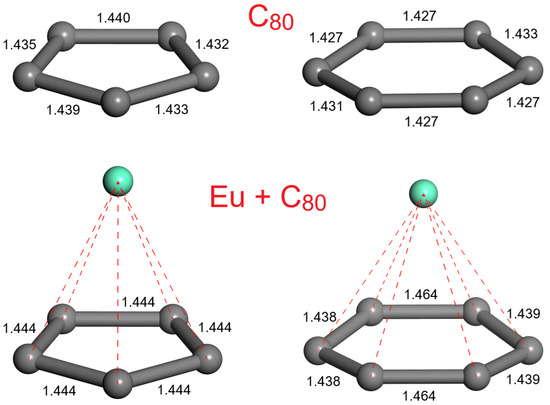
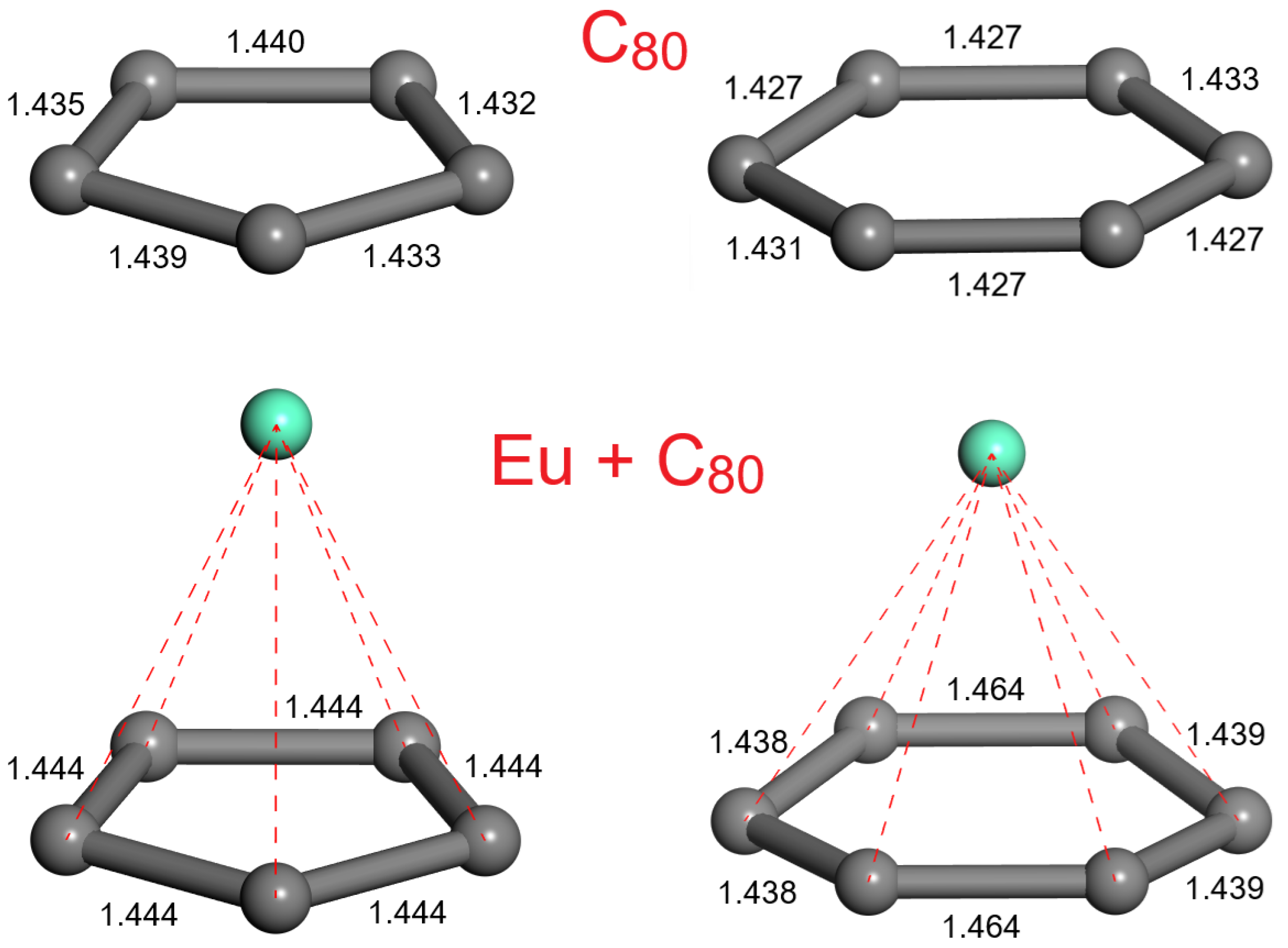
At the same time, this ‘unpairing’ should not be interpreted literally, as the breaking of one particular double bond but instead as reducing the ‘spherical aromaticity’ [92] of the CC bonds at the coordination site: in other words, as their lengthening. For the most interesting case of the Eu + C80_5 and Eu + C80_6 complexes, mentioned above, this effect is illustrated in Figure 4. In the case of η5 coordination, the CC bond lengths increase from 1.432–1.440 Å to a uniform value of 1.444 Å (all five bonds have the same length). In the case of η6 coordination, they increase from 1.427–1.433 to 1.438–1.464 Å. On the other hand, this does not result in an expansion of the spin density lobes at the bonding site (Figure 3); instead, apparently due to repulsive action of the electrons of lanthanide atom, the lobes on C80 turn out to be larger on the opposite side of the cage. (We realize that this explanation is too straightforward, since it cannot explain the spin behavior of all the complexes studied.)
Figure 4.
Lengthening of the CC bonds as a result of the lanthanide coordination to the C80 cage, illustrated for the case of Eu complexes with η5 (left) and η6 hapticity (right).
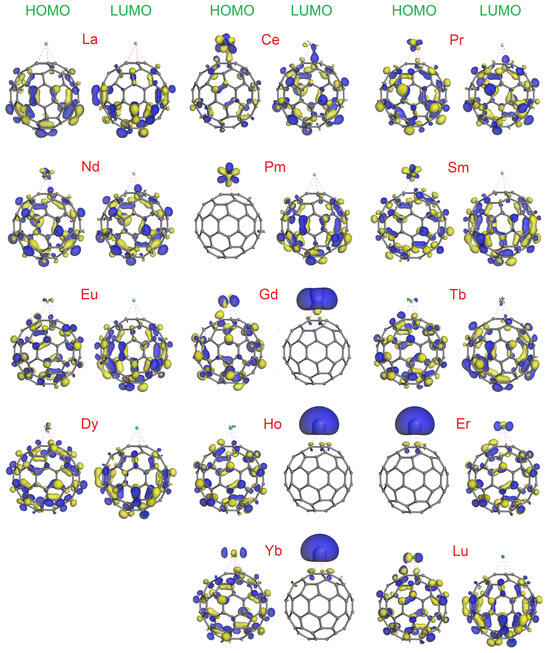
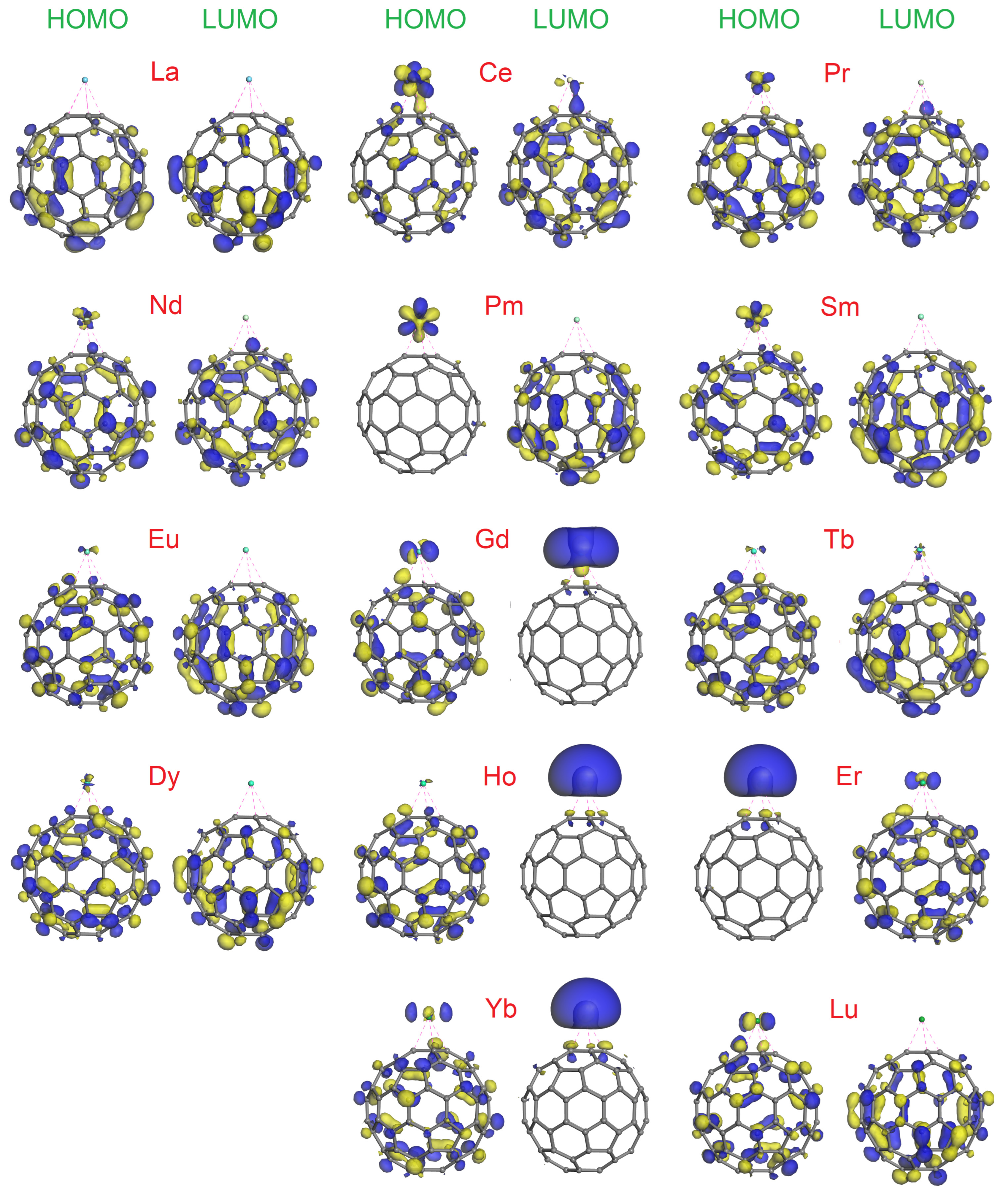
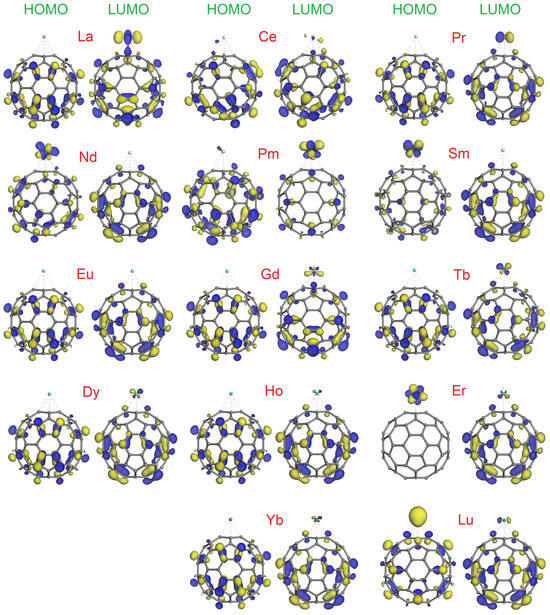
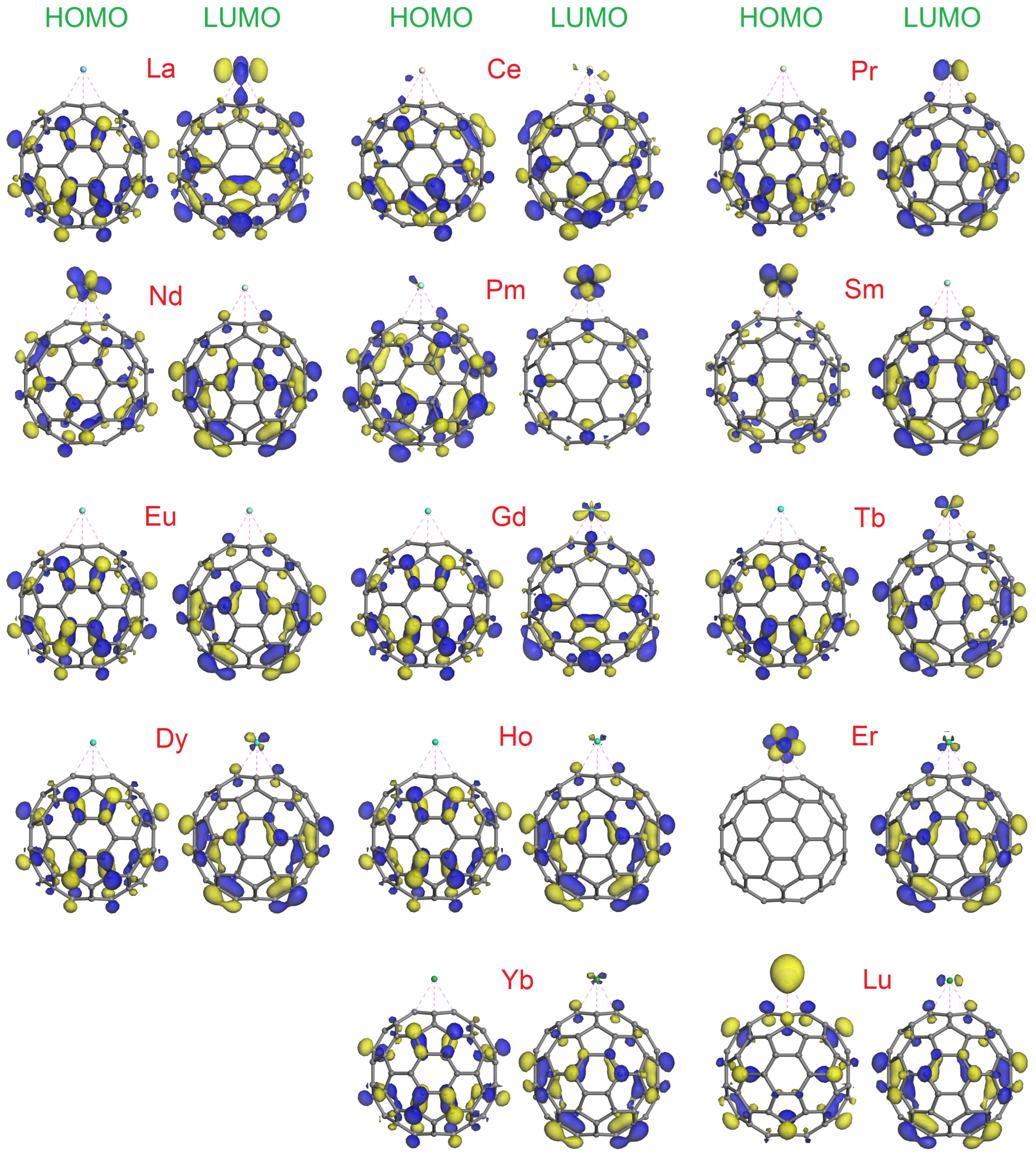
The last electronic parameters we analyzed are the frontier orbital energies (Table 1) and their spatial distribution (HOMO–LUMO plots; Figure 5 and Figure 6). For the isolated Ln atoms, HOMO–LUMO gap energies span from 0.166 eV for Sm to 2.508 eV for Lu [54]. (As we mentioned above, the value of −0.674 eV (Table S1) obtained for Gd results from a rare computational artifact, yielding a very strong frontier orbital inversion [87]. In the present work, a similar artifact was observed for both η5 and η6 complexes of Tm, with the HOMO–LUMO gap energies of −0.012 and −0.016 eV, respectively; these complexes will be excluded from the discussion.) In the η5-coordinated series, the lowest gap value of 0.017 eV was obtained for Pm + C80_5 and the highest one of 0.371 eV, for Pr + C80_5. In the case of η6 coordination, the lowest value was 0.021 eV (again for Pm) and the highest, 0.113 eV (for Tb). In other words, similar to Ln@C60 endohedral fullerenes [55] and their η5 and η6 exohedral analogs [54], both types of the exohedral coordination to the C80 cage tend to dramatically, roughly by one to two orders of magnitude, reduce the HOMO–LUMO gap energy compared to the one calculated for both isolated Ln atoms and C80 fullerene (0.078 eV at the theoretical level employed).
Figure 5.
HOMO and LUMO plots (at 0.03 a.u. isosurfaces) for the fifteen Ln + C80_5 (η5 hapticity). Tm + C80_5 is not included due to the anomalous frontier orbital behavior (HOMO–LUMO inversion; Table 1).
Figure 6.
HOMO and LUMO plots (at 0.03 a.u. isosurfaces) for the fifteen Ln + C80_6 (η6 hapticity). Tm + C80_6 is not included due to the anomalous frontier orbital behavior (HOMO–LUMO inversion; Table 1).
The respective HOMO-LUMO distribution plots are presented in Figure 5 (η5) and Figure 6 (η6). (We omit the plots for Tm + C80_5 and Tm + C80_6 due to the anomalous negative HOMO–LUMO gap energies.) Like in the cases of Ln@C60 endohedral fullerenes [55] and their η5 and η6 exohedral analogs [54], they have a complex structure with individual distinctive features but can be classified into several groups for both Ln + C80_5 and Ln + C80_6 series. For the η5 series, the three most representative patterns are as follows (Figure 5):
- (1)
- both HOMO and LUMO are distributed to a similar degree over the fullerene cage, and additional HOMO lobes appear on the Ln atom: for Pr, Nd, Sm, Eu (barely seen), Dy and Lu;
- (2)
- as in the previous group, but minor LUMO lobes appear on the Ln atom: for Ce, Tb (barely seen);
- (3)
- HOMO comprises all the atoms, with a distinctive feature of a large LUMO lobe localized on the metal atom, with almost no extension to the carbon atoms: for Gd, Ho and Yb.
The additional three individual cases are as follows:
- (1)
- La + C80_5, in which both HOMO and LUMO are distributed to a similar degree over the fullerene cage, without extending to the Ln atom;
- (2)
- Pm + C80_5, in which HOMO is found (almost) solely on the metal and LUMO solely on the C atoms;
- (3)
- Er + C80_5, which exhibits an inverted orbital distribution with respect to that found in the Gd, Ho and Yb complexes; that is, now HOMO is found almost solely on Er, and LUMO is distributed over all the atoms.
The η6-coordinated series exhibits less bright features (Figure 6). Here, the patterns observed can be summarized as follows:
- (1)
- both HOMO and LUMO are distributed to a similar degree over the fullerene cage, and additional HOMO lobes appear on the Ln atom: for La, Pr, Gd, Tb, Dy, Ho and Yb;
- (2)
- both HOMO and LUMO are distributed to a similar degree over the C80 cage, with additional LUMO lobes appearing on the metal atom: for Nd and Sm;
- (3)
- both HOMO and LUMO can be found on all atoms of the complex: for Ce, Pm and Lu.
Eu + C80_6 is the only complex in which both HOMO and LUMO are localized to a similar degree over the fullerene cage, without extending to the metal atom. Finally, in Er + C80_6, LUMO can be found on both C80 and Er atoms, where HOMO is localized solely on the metal.
Compared to the frontier orbital distribution in the exohedral complexes with C60 fullerene [54], the general trend is a similar contribution of the carbon atoms of C80 into both HOMO and LUMO, along with a strongly reduced contribution of the lanthanide atoms into both orbitals.
4. Conclusions
We found that, in certain regards, the exohedral η5 and η6 coordination of Ln atoms to the C80 fullerene cage exhibits similar qualitative and semi-quantitative trends. The brightest example is the bonding strength, where the ΔE formation energies differ very insignificantly between the two series. Compared to the results obtained for their C60 analogs [54], the bonding is considerably stronger, which can be explained by the open-shell nature of the C80 cage, giving rise to an increased interaction strength with equally open-shell 4f Ln species. The shortest Ln…C distances and positive charge acquired by lanthanide atoms for the Ln + C80_5 and Ln + C80_6 complexes follow similar trends as well, though less closely. The absolute spin values of the Ln atoms in the complexes differ insignificantly from the spins of isolated lanthanide atoms in their ground state, with the exception of three complexes: Ln + C80_5, Ln + C80_6 and Gd + C80_6.
The most interesting aspect is the spin behavior of the complexes in terms of their molecular spins, where we observed different patterns of ferromagnetic and antiferromagnetic coupling. The complexes Dy + C80_5, Ce + C80_5 and Ce + C80_6 represent an extreme, when the antiferromagnetic coupling results in zero or close-to-zero molecular spins. The most common phenomenon is an increase of the molecular spin compared to the spin of isolated lanthanide atoms. In a limited number of cases, the molecular spin is a simple sum of 2 e of the isolated C80 cage and the spin of an isolated Ln atom. However, the most common situation is when another 2 e spin adds: it is best illustrated for Eu (spin of 7 e for the atomic ground state), where the molecular spin of its η5 and η6 complexes is not about 9 e but reaches almost 11 e. We reported a similar 2-e augmentation for the C60 analogs [54].
Similar to the case of the η5 and η6 exohedral complexes with C60 [54], both types of exohedral coordination to the C80 cage tend to dramatically (roughly by one to two orders of magnitude) reduce the HOMO–LUMO gap energy compared to the one calculated for both isolated Ln atoms and C80 fullerene. Compared to the frontier orbital distribution in the exohedral complexes with C60 fullerene [54], the general trend is a similar contribution of the carbon atoms of C80 into both HOMO and LUMO, along with a strongly reduced contribution of the lanthanide atoms into both orbitals.
Supplementary Materials
The following supporting information can be downloaded at https://www.mdpi.com/article/10.3390/surfaces9020042/s1: Table S1: The total energies E, HOMO, LUMO and HOMO-LUMO gap energies for the isolated Ln atoms, C80 fullerene, their fifteen Ln + C80 complexes with η5 hapticity and the corresponding complexes with η6 hapticity.
Author Contributions
Conceptualization, E.V.B.; methodology, V.A.B.; validation, V.A.B.; formal analysis, V.A.B.; investigation, V.A.B.; resources, E.V.B.; data curation, V.A.B.; writing—original draft preparation, V.A.B.; writing—review and editing, E.V.B. and V.A.B.; funding acquisition, E.V.B. All authors have read and agreed to the published version of the manuscript.
Funding
This research was funded by the Dirección General de Asuntos del Personal Académico (DGAPA) of the National Autonomous University of Mexico (UNAM; grant DGAPA-IG100125).
Data Availability Statement
Data are contained within the article or Supplementary Materials.
Acknowledgments
The authors thank E. Álvarez-Zauco for hosting their sabbatical stay at the Facultad de Ciencias of the National Autonomous University of Mexico (UNAM).
Conflicts of Interest
The authors have no competing interests to declare.
References
- Rodriguez-Fortea, A.; Alegret, N.; Balch, A.L.; Poblet, J.M. The maximum pentagon separation rule provides a guideline for the structures of endohedral metallofullerenes. Nat. Chem. 2010, 2, 955–961. [Google Scholar] [CrossRef] [Scilit] [PubMed]
- Popov, A.A.; Dunsch, L. Electrochemistry in cavea: Endohedral redox reactions of encaged species in fullerenes. J. Phys. Chem. Lett. 2011, 2, 786–794. [Google Scholar] [CrossRef] [Scilit]
- Rodriguez-Fortea, A.; Balch, A.L.; Poblet, J.M. Endohedral metallofullerenes: A unique host-guest association. Chem. Soc. Rev. 2011, 40, 3551–3563. [Google Scholar] [CrossRef] [Scilit]
- Popov, A.A.; Avdoshenko, S.M.; Cuniberti, G.; Dunsch, L. Dimerization of radical-anions: Nitride clusterfullerenes versus empty fullerenes. J. Phys. Chem. Lett. 2011, 2, 1592–1600. [Google Scholar] [CrossRef] [Scilit]
- Náfrádi, B.; Antal, Á.; Pásztor, Á.; Forró, L.; Kiss, L.F.; Fehér, T.; Kováts, É.; Pekker, S.; Jánossy, A. Molecular and spin dynamics in the paramagnetic endohedral fullerene Gd3N@C80. J. Phys. Chem. Lett. 2012, 3, 3291–3296. [Google Scholar] [CrossRef] [Scilit]
- Popov, A.A.; Yang, S.; Dunsch, L. Endohedral fullerenes. Chem. Rev. 2013, 113, 5989–6113. [Google Scholar] [CrossRef] [Scilit]
- Ma, Y.; Wang, T.; Wu, J.; Feng, Y.; Li, H.; Jiang, L.; Shu, C.; Wang, C. Electron spin manipulation via encaged cluster: Differing anion radicals of Y2@C82-Cs, Y2C2@C82-Cs, and Sc2C2@C82-Cs. J. Phys. Chem. Lett. 2013, 4, 464–467. [Google Scholar] [CrossRef] [Scilit]
- Zhang, Y.; Schiemenz, S.; Popov, A.A.; Dunsch, L. Strain-driven endohedral redox couple CeIV/CeIII in nitride clusterfullerenes CeM2N@C80 (M = Sc, Y, Lu). J. Phys. Chem. Lett. 2013, 4, 2404–2409. [Google Scholar] [CrossRef] [Scilit]
- Aparicio-Anglès, X.; Alegret, N.; Clotet, A.; Rodríguez-Fortea, A.; Poblet, J.M. Endohedral metallofullerenes containing lanthanides: A robust yet simple computational approach. J. Phys. Chem. C 2013, 117, 12916–12921. [Google Scholar] [CrossRef] [Scilit]
- Cerón, M.R.; Li, F.-F.; Echegoyen, L.A. Endohedral fullerenes: The importance of electronic, size and shape complementarity between the carbon cages and the corresponding encapsulated clusters. J. Phys. Org. Chem. 2014, 27, 258–264. [Google Scholar] [CrossRef] [Scilit]
- Gao, X.; Sun, B.; Zhao, Y.; Chen, B.-Z.; Gao, X. Divalent metals can reside on bonds in fullerenes. Dalton Trans. 2015, 44, 9561–9568. [Google Scholar] [CrossRef] [Scilit] [PubMed]
- Krisilov, A.V.; Nechaev, I.V.; Kotova, A.L.; Shikhaliev, K.S.; Chernov, V.E.; Zon, B.A. The role of the encapsulated atom in the vibrational spectra of La@C60–Lu@C60 lanthanide endofullerenes. Comput. Theor. Chem. 2015, 1054, 100–108. [Google Scholar] [CrossRef] [Scilit]
- Reveles, J.U.; Karle, N.N.; Baruah, T.; Zope, R.R. Electronic and structural properties of C60 and Sc3N@C80 supported on graphene nanoflakes. J. Phys. Chem. C 2016, 120, 26083–26092. [Google Scholar] [CrossRef] [Scilit]
- Schlesier, C.; Liu, F.; Dubrovin, V.; Spree, L.; Büchner, B.; Avdoshenko, S.M.; Popov, A.A. Mixed dysprosium-lanthanide nitride clusterfullerenes DyM2N@C80-Ih and Dy2MN@C80-Ih (M = Gd, Er, Tm, and Lu): Synthesis, molecular structure, and quantum motion of the endohedral nitrogen atom. Nanoscale 2019, 11, 13139. [Google Scholar] [CrossRef] [Scilit]
- Basiuk, V.A.; Tahuilan-Anguiano, D.E. Complexation of free-base and 3d transition metal(II) phthalocyanines with endohedral fullerene Sc3N@C80. Chem. Phys. Lett. 2019, 722, 146–152. [Google Scholar] [CrossRef] [Scilit]
- Shen, Y.; Roselló, Y.; Abella, L.; Qiu, J.; Du, X.; Meng, Q.; Zheng, L.; Cao, Z.; He, Z.; Poblet, J.M.; et al. Fluoride clusterfullerenes: Tuning metal–metal bonding and magnetic properties via single fluorine atom doping. J. Am. Chem. Soc. 2024, 146, 34924–34933. [Google Scholar] [CrossRef] [Scilit] [PubMed]
- Pei, C.; Sundqvist, B.; Yao, Z.; Yan, Z.; Liu, G.; Samanta, S.; Xiao, H.; Wang, Y.; Qi, Y.; Chen, N.; et al. n- to p-Type conductivity transition of Lu3N@C80 due to anisotropic deformation of fullerene and pyramidalization of endohedral clusters. Nano Lett. 2024, 24, 16099–16105. [Google Scholar] [CrossRef] [Scilit]
- Yang, W.; de Souza Barbosa, M.F.; Alfonsov, A.; Rosenkranz, M.; Israel, N.; Büchner, B.; Avdoshenko, S.M.; Liu, F.; Popov, A.A. Thirty years of hide-and-seek: Capturing abundant but elusive MIII@C3v(8)-C82 isomer, and the study of magnetic anisotropy induced in Dy3+ ion by the fullerene π-ligand. J. Am. Chem. Soc. 2024, 146, 25328–25342. [Google Scholar] [CrossRef] [Scilit]
- Lu, Z.; Wu, Y.; Wang, Z. Theoretical design of mixed-metal endohedral fullerenes Gd2M@C80 (M = group IA or IIIA metal) with strong intramolecular magnetic coupling. Inorg. Chem. 2025, 64, 15292–15300. [Google Scholar] [CrossRef] [Scilit]
- Han, Y.; Zheng, H.; He, J.; Li, M.; Ehara, M.; Zhao, X. Stabilities referring to the f electron effect in erbium-based endohedral metallofullerenes: Revisiting Er2@C80 and the missing Er2C2@C78. Inorg. Chem. 2025, 64, 8302–8312. [Google Scholar] [CrossRef] [Scilit]
- Chen, J.; Shui, Y.; Shen, W.; Wang, F.; Mao, Y.; Qi, H.; Liu, X.; Du, Y.; Fei, F.; Qin, Y.; et al. Stable unpaired electron states in the Lu–Lu bond leading to the absence of odd–even parity in the Kondo effect of Lu2@C82 transistors. Nano Lett. 2025, 25, 5762–5769. [Google Scholar] [CrossRef] [Scilit] [PubMed]
- Lebedeva, M.A.; Chamberlain, T.W.; Khlobystov, A.N. Harnessing the synergistic and complementary properties of fullerene and transition-metal compounds for nanomaterial applications. Chem. Rev. 2015, 115, 11301–11351. [Google Scholar] [CrossRef] [Scilit]
- Balch, A.L.; Winkler, K. Two-component polymeric materials of fullerenes and the transition metal complexes: A bridge between metal–organic frameworks and conducting polymers. Chem. Rev. 2016, 116, 3812–3882. [Google Scholar] [CrossRef] [Scilit]
- Lichtenberger, D.L.; Wright, L.L.; Gruhn, N.E.; Rempe, M.E. Electronic structure and bonding of C60 to metals. Synth. Met. 1993, 59, 353–367. [Google Scholar] [CrossRef] [Scilit]
- Lichtenberger, D.L.; Wright, L.L.; Gruhn, N.E.; Rempe, M.E. Electronic structure of exohedral interactions between C60 and transition metals. J. Organometal. Chem. 1994, 478, 213–221. [Google Scholar] [CrossRef] [Scilit]
- Lyon, J.T.; Andrews, L. Infrared spectrum of the Au–C60 complex. ChemPhysChem 2005, 6, 229–232. [Google Scholar] [CrossRef] [Scilit]
- Shukla, M.K.; Dubey, M.; Leszczynski, J. Theoretical investigation of electronic structures and properties of C60–gold nanocontacts. ACS Nano 2008, 2, 227–234. [Google Scholar] [CrossRef] [Scilit]
- Zeng, Q.; Chu, X.; Yang, M.; Wu, D.-Y. Spin–orbit coupling effect on Au–C60 interaction: A density functional theory study. Chem. Phys. 2012, 395, 82–86. [Google Scholar] [CrossRef] [Scilit]
- Fang, Y.; Huang, Q.J.; Wang, P.; Li, X.Y.; Yu, N.T. Adsorption behavior of C60 fullerene on golden crystal nanoparticles. Chem. Phys. Lett. 2003, 381, 255–261. [Google Scholar] [CrossRef] [Scilit]
- Luo, Z.; Fang, Y. SERS of gold/C60(/C70) nano-clusters deposited on floppy disk and hard disk. Chem. Phys. 2006, 321, 86–90. [Google Scholar] [CrossRef] [Scilit]
- Kröger, H.; Gerhards, I.; Milinović, V.; Reinke, P. Synthesis of Au−C60 cluster materials. J. Phys. Chem. C 2007, 111, 10170–10174. [Google Scholar] [CrossRef] [Scilit]
- Luo, Z.; Yang, W.; Peng, A.; Ma, Y.; Fu, H.; Yao, J. Single-molecule surface-enhanced Raman scattering of fullerene C60. J. Raman Spectrosc. 2011, 42, 319–323. [Google Scholar]
- Chegeni, M.H.; Boostani-Poor, R.; Jalilian, J. Spin and orbital magnetism of exohedral fullerene doped with single transition metal atom (Sc-Ni): A relativistic density functional theory study. Comp. Theor. Chem. 2022, 1215, 113842. [Google Scholar]
- Javan, M.B.; Tajabor, N.; Behdani, M.; Rokn-Abadi, M.R. Influence of 3d transition metals (Fe,Co) on the structural, electrical and magnetic properties of C60 nano-cage. Phys. B 2010, 405, 4937–4942. [Google Scholar]
- De, D.S.; Flores-Livas, J.A.; Saha, S.; Genovese, L.; Goedecker, S. Stable structures of exohedrally decorated C60-fullerenes. Carbon 2018, 129, 847–853. [Google Scholar] [CrossRef] [Scilit]
- Wang, Q.; Jena, P. Density functional theory study of the interaction of hydrogen with Li6C60. J. Phys. Chem. Lett. 2012, 3, 1084–1088. [Google Scholar] [CrossRef] [Scilit]
- Andrade, E.B.; Martínez, A. Free radical scavenger properties of metal-fullerenes: C60 and C82 with Cu, Ag and Au (atoms and tetramers). Comp. Theor. Chem. 2017, 1115, 127–135. [Google Scholar] [CrossRef] [Scilit]
- Özdaş, E.; Kortan, A.; Kopylov, N.; Ramirez, A.P.; Siegrist, T.; Rabet, K.M.; Bair, H.E.; Schuppler, S.; Citrin, P.H. Superconductivity and cation-vacancy ordering in the rare-earth fulleride Yb2.75C60. Nature 1995, 375, 126–129. [Google Scholar] [CrossRef] [Scilit]
- Zhao, W.; Tang, J.; Falster, A.U.; Simmons, W.B.; Sweany, R.L. Infrared transmission study of lanthanide fullerides SmxC60 prepared by metal vapor synthesis. J. Alloys Compd. 1997, 249, 242–246. [Google Scholar] [CrossRef] [Scilit]
- Claves, D.; Hamwi, A. The polymorphism of samarium fullerides. Solid State Comm. 2000, 113, 357–362. [Google Scholar] [CrossRef] [Scilit]
- Arvanitidis, J.; Papagelis, K.; Margadonna, S.; Prassides, K. Lattice collapse in mixed-valence samarium fulleride Sm2.75C60 at high pressure. Dalton Trans. 2004, 19, 3144–3146. [Google Scholar] [CrossRef] [Scilit]
- Margadonna, S.; Arvanitidis, J.; Papagelis, K.; Prassides, K. Negative thermal expansion in the mixed valence ytterbium fulleride, Yb2.75C60. Chem. Mater. 2005, 17, 4474–4478. [Google Scholar] [CrossRef] [Scilit]
- Shiroka, T.; Riccò, M.; Ligabue, O.; Bolzoni, F.; Concas, G.; Spano, G. Investigation of Eu6C60 magnetic properties. J. Magn. Magn. Mater. 2004, 272–276, 544–545. [Google Scholar] [CrossRef] [Scilit]
- Qian, W.; Lin, L.; Xia, Z.; Zou, Y.; Qian, S.; Ma, G.; Lin, Y.; Cai, R.; Chen, Y.; Huang, Z.-E. Measurement of third-order optical nonlinearity of C60M2 (M = Pd, Pt, and Sm) organometallic compounds by the femtosecond optically heterodyned optical Kerr effect. Chem. Phys. Lett. 2000, 319, 89–94. [Google Scholar] [CrossRef] [Scilit]
- Hao, C.; Xu, W.; Liu, Z.; Guo, X.; Liu, S. Mass spectral study of extractable La- and Lu-containing fullerenes. Rapid Commun. Mass Spectrom. 1997, 11, 451–454. [Google Scholar] [CrossRef] [Scilit]
- Andreoni, W.; Curioni, A. Ab initio approach to the structure and dynamics of metallofullerenes. Appl. Phys. A 1998, 66, 299–306. [Google Scholar] [CrossRef] [Scilit]
- Nagao, S.; Negishi, Y.; Kato, A.; Nakamura, Y.; Nakajima, A.; Kaya, K. Pyramidal structures of lanthanide–C60 clusters (Lnn(C60)m: Ln = Eu and Ho). J. Phys. Chem. A 1999, 103, 8909–8914. [Google Scholar] [CrossRef] [Scilit]
- Klingeler, R.; Bechthold, P.S.; Neeb, M.; Eberhardt, W. Mass spectra of metal-doped carbon and fullerene clusters. J. Chem. Phys. 2000, 113, 1420–1425. [Google Scholar] [CrossRef] [Scilit]
- Suzumura, J.-i.; Hosoya, N.; Nagao, S.; Mitsui, M.; Nakajima, A. Electronic structures of exohedral lanthanide-C60 clusters. J. Chem. Phys. 2004, 121, 2649–2654. [Google Scholar] [CrossRef] [Scilit]
- Kumari, K.; Singh, S.K. Substituted fullerenes as a promising capping ligand towards stabilization of exohedral Dy(III) based single-ion magnets: A theoretical study. Dalton Trans. 2024, 53, 16495–16511. [Google Scholar] [CrossRef] [Scilit] [PubMed]
- Nodaraki, L.E.; Liu, J.; Ariciu, A.-M.; Ortu, F.; Oakley, M.S.; Birnoschi, L.; Gransbury, G.K.; Cobb, P.J.; Emerson-King, J.; Chilton, N.F.; et al. Metal–carbon bonding in early lanthanide substituted cyclopentadienyl complexes probed by pulsed EPR spectroscopy. Chem. Sci. 2024, 15, 3003–3010. [Google Scholar] [CrossRef] [Scilit]
- Gunther, S.O.; Qiao, Y.; Smith, P.W.; Ciccone, S.R.; Ditter, A.S.; Huh, D.N.; Moreau, L.M.; Shuh, D.K.; Sun, T.; Arnold, P.L.; et al. 4f-Orbital mixing increases the magnetic susceptibility of Cp’3Eu. Chem. Sci. 2024, 15, 12667–12675. [Google Scholar] [CrossRef] [Scilit] [PubMed]
- Beltran-Leiva, M.J.; Moore, W.N.G.; Jenkins, T.F.; Evans, W.J.; Albrecht, T.E.; Celis-Barros, C. A comprehensive approach for elucidating the interplay between 4fn+1 and 4fn5d1 configurations in Ln2+ complexes. Chem. Sci. 2025, 16, 2024–2033. [Google Scholar] [CrossRef] [Scilit]
- Basiuk, V.A.; Prezhdo, O.V.; Basiuk, E.V. Exohedral complexes of lanthanide atoms with the C60 fullerene cage: Hexagonal versus pentagonal ring coordination. J. Phys. Chem. Lett. 2025, 16, 12499–12506. [Google Scholar] [PubMed]
- Martínez-Flores, C.; Basiuk, V.A. Ln@C60 endohedral fullerenes: A DFT analysis for the complete series from lanthanum to lutetium. Comp. Theor. Chem. 2022, 1217, 113878. [Google Scholar] [CrossRef] [Scilit]
- Sun, M.-L.; Slanina, Z.; Lee, S.-L.; Uhlik, F.; Adamowicz, L. AM1 computations on seven isolated-pentagon-rule isomers of C80. Chem. Phys. Lett. 1995, 246, 66–72. [Google Scholar]
- Bühl, M.; Hirsch, A. Spherical aromaticity of fullerenes. Chem. Rev. 2001, 101, 1153–1183. [Google Scholar] [CrossRef] [Scilit]
- Khamatgalimov, A.R.; Kovalenko, V.I. Electronic structure and stability of C80 fullerene IPR isomers. Fuller. Nanotub. Carbon Nanostruct. 2011, 19, 599–604. [Google Scholar] [CrossRef] [Scilit]
- Yeretzian, C.; Hansen, K.; Alvarez, M.M.; Min, K.S.; Gillan, E.G.; Holczer, K.; Kaner, R.B.; Whetten, R.L. Collisional probes and possible structures of La2C80. Chem. Phys. Lett. 1992, 196, 337–342. [Google Scholar] [CrossRef] [Scilit]
- Kobayashi, K.; Nagase, S.; Akasaka, T. A theoretical study of C80 and La2@C80. Chem. Phys. Lett. 1995, 245, 230–236. [Google Scholar] [CrossRef] [Scilit]
- Akasaka, T.; Nagase, S.; Kobayashi, K.; Walchli, M.; Yamamoto, K.; Funasaka, H.; Kako, M.; Hoshino, T.; Erata, T. 13C and 139La NMR Studies of La2@C80: First evidence for circular motion of metal atoms in endohedral dimetallofullerenes. Angew. Chem. Int. Ed. Engl. 1997, 36, 1643–1645. [Google Scholar] [CrossRef] [Scilit]
- Alvarez, M.M.; Gillan, E.G.; Holczer, K.; Kaner, R.B.; Min, K.S.; Whetten, R.L. La2C80: A soluble dimetallofullerene. J. Phys. Chem. 1991, 95, 10561–10563. [Google Scholar]
- Ding, J.; Yang, S. Isolation and characterization of the dimetallofullerene Ce2@C80. Angew. Chem. Int. Ed. Engl. 1996, 35, 2234–2235. [Google Scholar] [CrossRef] [Scilit]
- Gillan, E.G.; Yeretzian, C.; Min, K.S.; Alvarez, M.M.; Whetten, R.L.; Kaner, R.B. Endohedral rare-earth fullerene complexes. J. Phys. Chem. 1992, 96, 6869–6871. [Google Scholar] [CrossRef] [Scilit]
- Lu, X.; Li, H.; Sun, B.; Shi, Z.; Gu, Z. Selective reduction and extraction of Gd@C82 and Gd2@C80 from soot and the chemical reaction of their anions. Carbon 2005, 43, 1546–1549. [Google Scholar]
- Sun, B.; Gu, Z. Solvent-dependent anion studies on enrichment of metallofullerene. Chem. Lett. 2002, 31, 1164–1165. [Google Scholar] [CrossRef] [Scilit]
- Cimpoesu, F.; Frecus, B.; Oprea, C.I.; Ramanantoanina, H.; Urland, W.; Daul, C. On exchange coupling and bonding in the Gd2@C80 and Gd2@C79N endohedral dimetallo-fullerenes. Mol. Phys. 2015, 113, 1712–1727. [Google Scholar]
- Feil, S.; Głuch, K.; Matt-Leubner, S.; Echt, O.; Lifshitz, C.; Cao, B.; Wakahara, T.; Akasaka, T.; Scheier, P.; Märk, T.D. The stability of singly and multiply charged La@C80 and La@C82 ions determined from kinetic energy release measurements. Int. J. Mass Spectr. 2006, 249–250, 396–402. [Google Scholar]
- Okazaki, T.; Lian, Y.F.; Gu, Z.N.; Suenaga, K.; Shinohara, H. Isolation and spectroscopic characterization of Sm-containing metallofullerenes. Chem. Phys. Lett. 2000, 320, 435–440. [Google Scholar] [CrossRef] [Scilit]
- Sun, B.-Y.; Inoue, T.; Shimada, T.; Okazaki, T.; Sugai, T.; Suenaga, K.; Shinohara, H. Synthesis and characterization of Eu-metallofullerenes from Eu@C74 to Eu@C90 and their nanopeapods. J. Phys. Chem. B 2004, 108, 9011–9015. [Google Scholar]
- Lu, X.; Shi, Z.; Sun, B.; He, X.; Gu, Z. Isolation and spectroscopic study of a series of monogadolinium endohedral metallofullerenes. Fuller. Nanotub. Carbon Nanostruct. 2005, 13, 13–20. [Google Scholar] [CrossRef] [Scilit]
- Feng, L.; Sun, B.; He, X.; Gu, Z. Isolation and spectroscopic study of a series of monoterbium endohedral metallofullerenes. Fuller. Nanotub. Carbon Nanostruct. 2002, 10, 353–361. [Google Scholar]
- Boltalina, O.V.; Ioffe, I.N.; Sorokin, I.D.; Sidorov, L.N. Electron affinity of some endohedral lanthanide fullerenes. J. Phys. Chem. A 1997, 101, 9561–9563. [Google Scholar] [CrossRef] [Scilit]
- Sun, B.; Feng, L.; Shi, Z.; Gu, Z. Improved extraction of metallofullerenes with DMF at high temperature. Carbon 2002, 40, 1591–1595. [Google Scholar] [CrossRef] [Scilit]
- Basiuk, V.A.; Wu, Y.; Prezhdo, O.V.; Basiuk, E.V. Lanthanide atoms induce strong graphene sheet distortion when adsorbed on Stone–Wales defects. J. Phys. Chem. Lett. 2024, 15, 9706–9713. [Google Scholar] [CrossRef] [Scilit]
- Basiuk, V.A.; Basiuk, E.V. Adsorption of lanthanide atoms on a graphene cluster model incorporating Stone–Wales defect. Surfaces 2025, 8, 63. [Google Scholar] [CrossRef] [Scilit]
- Delley, B. An all-electron numerical method for solving the local density functional for polyatomic molecules. J. Chem. Phys. 1990, 92, 508–517. [Google Scholar] [CrossRef] [Scilit]
- Delley, B. Fast calculation of electrostatics in crystals and large molecules. J. Phys. Chem. 1996, 100, 6107–6110. [Google Scholar] [CrossRef] [Scilit]
- Delley, B. From molecules to solids with the DMol3 approach. J. Chem. Phys. 2000, 113, 7756–7764. [Google Scholar] [CrossRef] [Scilit]
- Delley, B.; Ellis, D.; Freeman, A.; Baerends, E.; Post, D. Binding energy and electronic structure of small copper particles. Phys. Rev. B 1983, 27, 2132–2144. [Google Scholar] [CrossRef] [Scilit]
- Perdew, J.; Burke, K.; Ernzerhof, M. Generalized gradient approximation made simple. Phys. Rev. Lett. 1996, 77, 3865–3868. [Google Scholar] [CrossRef] [Scilit]
- Grimme, S. Semiempirical GGA-type density functional constructed with a long-range dispersion correction. J. Comput. Chem. 2006, 27, 1787–1799. [Google Scholar] [PubMed]
- Basiuk, V.A.; Flores-Sánchez, L.J.; Meza-Laguna, V.; Flores-Flores, J.O.; Bucio-Galindo, L.; Puente-Lee, I.; Basiuk, E.V. Noncovalent functionalization of pristine CVD single-walled carbon nanotubes with 3d metal(II) phthalocyanines by adsorption from the gas phase. Appl. Surf. Sci. 2018, 436, 1123–1133. [Google Scholar] [CrossRef] [Scilit]
- Basiuk, V.A. Interaction of tetraaza [14]annulenes with single-walled carbon nanotubes: A DFT study. J. Phys. Chem. B 2004, 108, 19990–19994. [Google Scholar]
- Dolg, M.; Wedig, U.; Stoll, H.; Preuss, H. Energy-adjusted ab initio pseudopotentials for the first row transition elements. J. Chem. Phys. 1987, 86, 866. [Google Scholar]
- Bergner, A.; Dolg, M.; Kuechle, W.; Stoll, H.; Preuss, H. Ab initio energy-adjusted pseudopotentials for elements of groups 13–17. Mol. Phys. 1993, 80, 1431–1441. [Google Scholar] [CrossRef] [Scilit]
- Basiuk, V.A. DFT calculations on single lanthanide atoms: Is the task as simple as it seems? Comp. Theor. Chem. 2025, 1248, 115170. [Google Scholar] [CrossRef] [Scilit]
- Basiuk, V.A.; Henao-Holguín, L.V. Effects of orbital cutoff in DMol3 DFT calculations: A case study of meso-tetraphenylporphine–C60 complex. J. Comput. Theor. Nanosci. 2013, 10, 1266–1272. [Google Scholar]
- Slanina, Z.; Uhlík, F.; Akasaka, T.; Lu, X.; Adamowicz, L. Computational modeling of the Ce@C82 metallofullerene isomeric composition. ECS J. Solid State Sci. Technol. 2019, 8, M118–M121. [Google Scholar] [CrossRef] [Scilit]
- Slanina, Z.; Uhlík, F.; Akasaka, T.; Lu, X.; Adamowicz, L. Calculated relative thermodynamic stabilities of the Gd@C82 isomers. ECS J. Solid State Sci. Technol. 2021, 10, 071013. [Google Scholar] [CrossRef] [Scilit]
- Rossi, C.; Rasmussen, A.P.; Gans, B.; Jacovella, U. Metal-induced tuning of fullerene reactivity: Application to nucleophile addition. ChemPhysChem 2025, 26, e202500487. [Google Scholar] [CrossRef] [Scilit]
- Reiher, M.; Hirsch, A. From rare gas atoms to fullerenes: Spherical aromaticity studied from the point of view of atomic structure theory. Chem. Eur. J. 2003, 9, 5442–5452. [Google Scholar] [CrossRef] [Scilit] [PubMed]

Disclaimer/Publisher’s Note: The statements, opinions and data contained in all publications are solely those of the individual author(s) and contributor(s) and not of MDPI and/or the editor(s). MDPI and/or the editor(s) disclaim responsibility for any injury to people or property resulting from any ideas, methods, instructions or products referred to in the content. |
© 2026 by the authors. Licensee MDPI, Basel, Switzerland. This article is an open access article distributed under the terms and conditions of the Creative Commons Attribution (CC BY) license.