


Abstract
This study examines how tourists engage with non-daily and non-modern experiences through Hanfu costume tourism in China. In the context of the growing revival of Hanfu and the expansion of cultural heritage tourism, the research explores how costume-based practices enable participants to immerse themselves in imagined historical lifeworlds and negotiate cultural meaning. A mixed-method design was adopted, combining a quantitative survey of 476 tourists with qualitative textual analysis of travel blogs and vlogs shared on social media platforms. The findings support a three-dimensional framework: cultural–historical imagination (embodied nostalgia and connection to an idealized past), ritualized festivity (collective performance and liminal engagement in heritage spaces), and aesthetic appreciation (non-utilitarian visual and sensory pleasure contrasting with everyday clothing). We conclude that Hanfu costume tourism is not historical reenactment but an active, embodied process of cultural engagement and identity negotiation, predominantly practised by a subculture of young, educated, urban Han Chinese women. By providing empirical evidence for a three-dimensional framework, this research contributes to theories of nostalgia, liminality, and embodied heritage in cultural tourism and offers practical implications for designing immersive heritage experiences.
1. Introduction
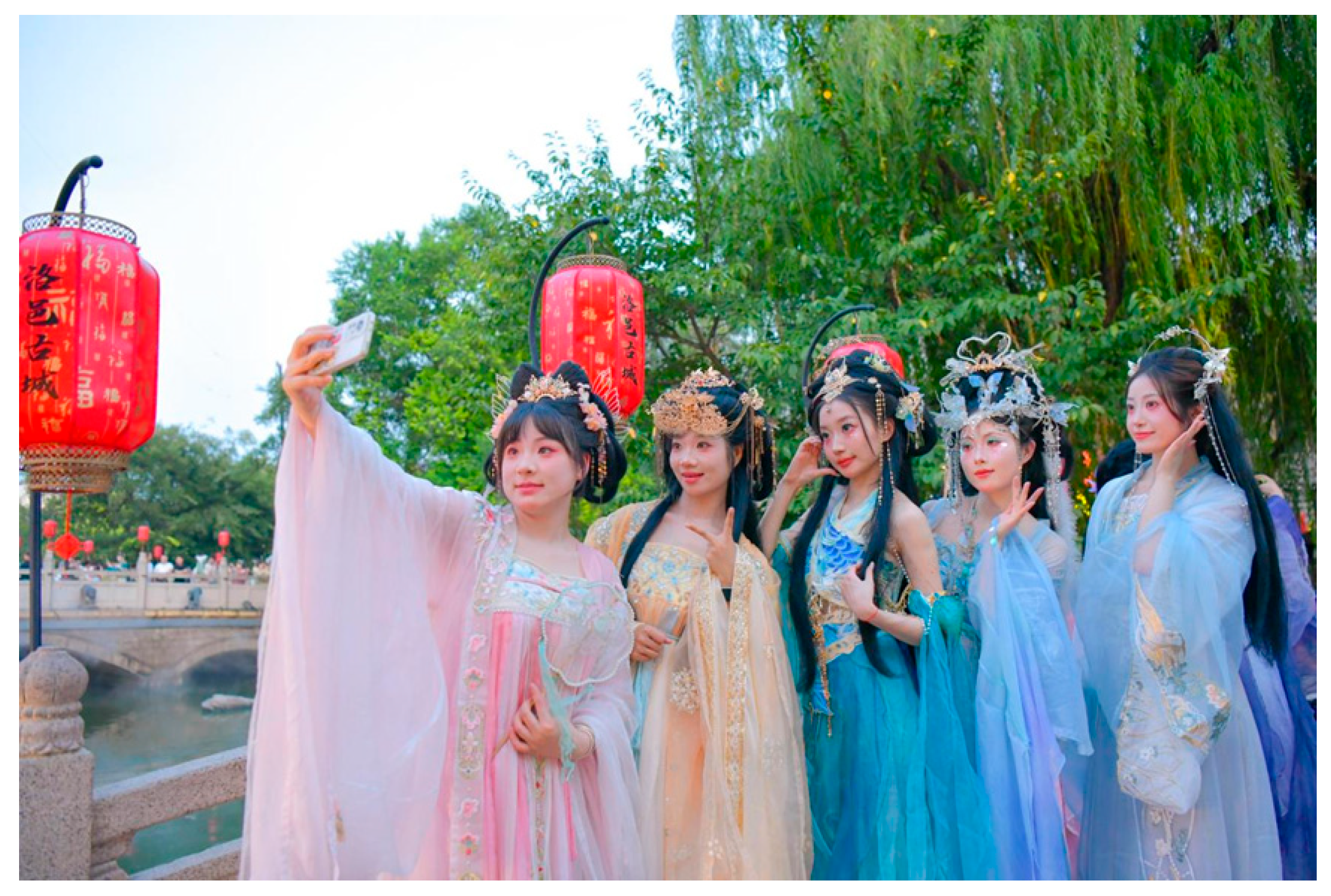
Cultural tourism has become a central focus in tourism studies, yet the ways tourists actively engage with cultural forms remain underexplored [1,2,3]. Hanfu, the traditional attire of China’s Han ethnic group, has recently gained prominence in heritage destinations, giving rise to Hanfu costume tourism, a phenomenon where tourists wear historical garments to visit cultural sites [4,5,6,7,8,9] (Figure 1). While previous studies have examined motivations for wearing Hanfu and destination applications [9,10,11,12,13,14], they have not systematically addressed why tourists choose Hanfu, a garment seldom worn in daily life, over everyday clothing, nor what experiential dimensions this practice generates. In particular, the mechanisms through which Hanfu tourism enables non-daily and non-modern experiences remain undertheorized.
Figure 1.
Tourists wearing Hanfu pose for a selfie in Luoyang City in Henan Province, China [15].
This study proposes that Hanfu costume tourism can be understood through three interrelated dimensions: aesthetic appreciation (sensory pleasure derived from traditional attire, contrasting with modern clothing), ritualized festivity (performative engagement in culturally significant spaces, especially during festivals), and cultural–historical imagination (emotional connection to an idealized past, mediated by nostalgia and collective memory). These dimensions collectively constitute the distinctive non-daily and non-modern character of the Hanfu tourism experience. These dimensions are not merely empirical categories but are theoretically derived from distinct traditions: aesthetic appreciation from tourism aesthetics, ritualized festivity from liminality and secular ritual, and cultural–historical imagination from historical nostalgia and embodied heritage. Their boundaries are conceptually clear: aesthetic appreciation focuses on sensory and visual pleasure, ritualized festivity on collective performance, and cultural–historical imagination on cognitive–emotional transportation to an imagined past. Together, they constitute the distinctive non-daily and non-modern character of Hanfu tourism.
To examine this framework, we adopt an exploratory sequential mixed-method design. Qualitative analysis of 20 travel blogs and vlogs from the social media platform Little Red Book (Xiaohongshu) identifies key experiential themes, while a quantitative survey of 476 Hanfu-wearing tourists assesses the prevalence and interrelationships of these dimensions across a broader population. This approach enables us to move beyond descriptive accounts toward a systematic explanation of how costume-based practices construct heritage experiences.
The findings suggest that Hanfu tourism is not mere historical reenactment but an active process of cultural engagement and identity negotiation. By clarifying how aesthetic, ritual, and imaginative dimensions interact, the study contributes to cultural tourism theory and offers practical implications for designing immersive heritage experiences that resonate with tourists’ desires to temporarily inhabit imagined historical lifeworld.
2. Literature Review
2.1. Hanfu Costume Tourism
Engagement with traditional clothing has been recognized as an important dimension of cultural tourism experience, contributing to tourists’ perceptions of authenticity, immersion, and destination distinctiveness [16]. Many tourist destinations have integrated traditional clothing into their marketing strategies to attract tourists [14]. Hanfu, as one of China’s traditional clothes, is an essential element of the nation’s historical and cultural heritage [5] and significantly contributes to enriching tourists’ on-site activities at cultural destinations [9,14].
Despite this growing interest, academic definitions of Hanfu costume tourism remain nascent. Existing research remains largely descriptive, clustered around two separate streams. The first stream focuses on tourists’ motivations, documenting factors such as cultural pride, aesthetic appeal, and social recognition [13,14]. The second stream examines destination management, exploring how sites incorporate Hanfu culture through rental services, themed events, and photo-friendly infrastructure [9,17]. While these studies provide valuable initial observations, they suffer from two fundamental shortcomings. First, they lack an integrated conceptual framework that explains how wearing Hanfu transforms the tourism experience. Second, they treat Hanfu as an isolated variable rather than examining the mechanisms through which it enables tourists to step away from modern routines and engage with imagined pasts. Consequently, three specific gaps persist: (1) no framework captures the multidimensional nature of costume-based tourism experiences; (2) no empirical testing has determined whether proposed dimensions are distinct or overlapping; and (3) the relationship between everyday Hanfu use and tourism-specific experiences remains unexplored.
To move beyond description toward explanation, this study addresses these gaps by proposing a conceptually clear and empirically validated framework. This framework must do more than categorize motivations—it must specify the experiential dimensions that distinguish Hanfu tourism from conventional heritage tourism and explain their interrelationships. A brief cross-cultural comparison sharpens this theoretical need. In South Korea, hanbok tourism at heritage sites enhances perceived authenticity and cultural immersion [16]. In Japan, kimono tourism in historic districts similarly offers aesthetic pleasure and cultural connection [18]. However, these international parallels have not yet generated a transferable theoretical model. This study draws on these comparisons to argue that while the three-dimensional framework proposed below (cultural–historical imagination, ritualized festivity, aesthetic appreciation) may be transferable, the weighting of each dimension and the tolerance for historical inauthenticity likely vary across cultural contexts.
2.2. Non-Daily and Non-Modern Experience in Cultural Heritage Tourism
Cultural heritage tourism is often understood as an opportunity for tourists to escape the routines of everyday life and immerse themselves in historical environments [19,20,21]. Tourism scholars have long framed travel as a form of “modern ritual” that enables individuals to transition from habitual environments into extraordinary spaces [22,23,24,25,26,27]. This distinction between ordinary and extraordinary experiences is central to understanding why tourists seek activities that contrast with daily life. In the context of heritage tourism, the appeal lies partly in the chance to engage with non-modern lifestyles, historical settings, and traditional customs that differ markedly from contemporary urban existence [28,29].
Several theoretical concepts have been used to explain this phenomenon. Nostalgia, particularly historical nostalgia, a longing for an idealized past not personally experienced, plays a key role in motivating heritage tourism [30,31]. Nostalgia serves psychological functions such as enhancing social connectedness, providing existential meaning, and reinforcing self-continuity [32]. Liminality and heterotopia offer additional lenses: tourism is conceptualized as a liminal space where normal social rules are suspended [26,33,34], while heritage sites can function as heterotopias—real spaces that reflect and invert everyday reality [35]. Embodied heritage tourism further highlights how tourists use their bodies, through dress and performance, to actively construct heritage experiences [17,36,37,38,39,40].
Although these concepts have been applied individually to heritage tourism contexts, few studies have integrated them into a coherent framework for examining costume-based practices. Specifically, existing research does not clarify how aesthetic, ritual, and imaginative dimensions converge to produce the distinctive non-daily and non-modern experiences associated with wearing traditional attire at heritage sites. This study addresses that gap by proposing a multidimensional framework that is both theoretically grounded and empirically testable.
2.3. An Analytical Framework: Three Dimensions of Hanfu Tourism Experience
Drawing on the literature above, we propose that Hanfu costume tourism experiences can be understood through three theoretically distinct yet interrelated dimensions: aesthetic appreciation, ritualized festivity, and cultural–historical imagination. Each dimension is anchored in a specific theoretical tradition, and their boundaries are defined by distinct experiential foci.
Aesthetic appreciation refers to the sensory and visual pleasure derived from wearing traditional attire. Unlike modern clothing, which is often designed for utility and convenience, Hanfu emphasizes flowing silhouettes, harmonious color schemes, and intricate craftsmanship [6]. This dimension is theoretically anchored in tourism aesthetics scholarship, which, as systematically reviewed by Kirillova (2024), centers on how tourists consume aesthetic value through the perception of beauty and sensory engagement, thereby enriching travel experiences [41]. It is conceptually distinguished from the other two dimensions by its primary focus on sensory perception and visual pleasure, rather than collective performance (ritualized festivity) or cognitive–emotional transportation (cultural–historical imagination). For many tourists, wearing Hanfu provides an aesthetic experience that contrasts sharply with the functional aesthetics of everyday life, offering a form of “experiential escapism” [13,14].
Ritualized festivity captures the performative and ceremonial aspects of wearing Hanfu in culturally significant spaces. This dimension aligns with the understanding of tourism as a “modern ritual” [26,33], where activities are set apart from ordinary life through spatial and temporal markers. When tourists dress in Hanfu during festivals or at heritage sites, they engage in symbolic performances that connect them to traditional customs and seasonal rhythms. This dimension is distinguished from aesthetic appreciation by its emphasis on collective, rule-bound, and temporally marked behavior. This performativity is not merely individual but often collective, as visitors join a community of Hanfu-wearers, creating shared ritualized experiences [17].
Cultural–historical imagination encompasses the emotional and cognitive processes through which tourists connect with an idealized past. This dimension draws on theories of historical nostalgia [30,31] and embodied heritage [36]. Unlike personal nostalgia (yearning for one’s own past), historical nostalgia is collective and often mediated by cultural representations [31,32]. Wearing Hanfu enables tourists to momentarily inhabit imagined historical identities, such as a Tang dynasty princess or a scholar—thus bridging the temporal gap between present and past. This imaginative engagement is often facilitated by heritage sites, whose historical ambience provides a fitting stage for such identity performance [14,17].
Based on this framework, the study expects that the three dimensions will be positively associated with tourists’ overall experience, and that their relationships with everyday Hanfu use will differ. Furthermore, the three dimensions are hypothesized to be empirically distinct, warranting validation through factor analysis.
3. Materials and Methods
3.1. Research Design
This study adopted a mixed-method design combining qualitative content analysis of user-generated social media materials with a quantitative online questionnaire survey. The qualitative phase served an exploratory purpose: to identify and refine the experiential dimensions of Hanfu costume tourism through in-depth analysis of user-generated social media content. Findings from this phase informed the development of survey instruments used in the quantitative phase, which aimed to assess the prevalence and interrelationships of these dimensions across a larger sample. This sequential logic ensures that the qualitative and quantitative components are not merely juxtaposed but analytically integrated, with each phase building upon and extending the other.
3.2. Qualitative Data Collection
Qualitative data consisted of 20 publicly accessible travel blogs and vlogs published between 2023 and 2025 on the social media platform Little Red Book (Xiaohongshu) (Table 1). The platform combines image-based sharing with short-form video and livestream functions and is widely used for travel experience documentation. Materials were selected according to the following criteria: (1) the content explicitly documented Hanfu costume tourism experiences; (2) the authors described motivations, on-site activities, or reflections; (3) the posts were publicly accessible at the time of data collection; and (4) the posts received at least 500 interactions (likes, comments, or shares), indicating moderate visibility.
Table 1.
Participants’ blogs and vlogs’ contents regarding their Hanfu costume tourism experiences.
All selected materials were archived in textual form through transcription of video narration and written captions. To ensure confidentiality, usernames and identifiable details were removed, and participants were assigned pseudonyms (Participant 1–Participant 20). As the materials were publicly available and analyzed anonymously, no direct interaction with content creators occurred. This approach aligns with ethical guidelines for social media research that prioritize the use of publicly accessible data with minimal privacy intrusion. To ensure diversity and thematic saturation, the selected posts covered a range of destination types (e.g., imperial sites, natural landscapes, ancient towns), seasonal contexts (e.g., festivals and non-festival periods), and stylistic variations of Hanfu (e.g., Tang, Song, Ming Dynasties’ styles). This variation strengthens the representativeness and analytical robustness of the qualitative sample. Data collection ceased when thematic saturation was reached, as no substantially new themes emerged from additional materials.
3.3. Quantitative Data Collection
The questionnaire was developed based on the thematic dimensions identified in the qualitative phase. Quantitative data were collected through an online questionnaire administered between 5 November and 11 November 2025. Two screening questions were used to ensure eligibility: (1) “Have you ever worn Hanfu while visiting a tourism destination?” and (2) “Was your most recent Hanfu tourism experience within the past three years?” Only respondents answering “yes” to both proceeded to the full questionnaire. A total of 476 valid responses were obtained from adult participants who had previously worn Hanfu while visiting tourism destinations. The sample size of 476 exceeds commonly recommended thresholds for exploratory social science research and provides sufficient statistical power for correlation analysis.
The questionnaire was developed through a multi-step process. An initial 12-item pool was generated from the three qualitative themes (cultural–historical imagination, ritualized festivity, aesthetic appreciation) and adapted from existing scales [33,42,43]. Three tourism researchers reviewed the items for face validity, resulting in an 8-item version. A pilot test with 52 Hanfu-wearing tourists assessed clarity and internal consistency, yielding Cronbach’s α values of 0.84, 0.81, and 0.78 for the three dimensions respectively, all exceeding the 0.70 threshold. Minor wording adjustments were made based on pilot feedback. The final questionnaire comprised three sections: (1) demographic information; (2) the eight experiential items; and (3) daily Hanfu habits. All items used seven-point Likert scales (1 = strongly disagree to 7 = strongly agree). The original Chinese version was translated into English through back-translation to ensure conceptual consistency.
Participation was voluntary and anonymous. Respondents were informed about the academic purpose of the study prior to completing the questionnaire. No personally identifiable information was collected. The survey was distributed through Hanfu enthusiast communities on social media platforms, ensuring that the sample captured individuals with direct experience of the phenomenon. A non-probability purposive sampling strategy was adopted, targeting individuals with prior experience of Hanfu costume tourism. The survey was primarily distributed through online Hanfu enthusiast communities and social media groups, where such participants are most accessible.
3.4. Data Analysis
Data were analyzed using inductive thematic content analysis following Braun and Clarke’s (2006) six-phase procedure [44] Two researchers independently coded all transcripts, generating 47 initial codes (e.g., “time-travel feeling,” “princess fantasy”). Through iterative discussion, codes were consolidated into nine sub-themes and then organized into three higher-order themes (cultural–historical imagination, ritualized festivity, aesthetic appreciation). Disagreements were resolved by consensus, with a third researcher consulted when necessary. Chinese-language materials were translated into English for reporting. Table 1 presents all posts with illustrative quotes.
Quantitative analysis proceeded in three stages. First, descriptive statistics (frequencies, proportions, means) were calculated. Second, reliability (Cronbach’s α) was assessed and confirmatory factor analysis (CFA) using maximum likelihood estimation tested the three-dimensional structure. Model fit was evaluated using χ2, CFI, TLI, RMSEA, and SRMR (acceptable fit: CFI/TLI ≥ 0.90, RMSEA ≤ 0.08, SRMR ≤ 0.08). Discriminant validity was assessed by comparing the square root of AVE with inter-dimension correlations. Third, correlation analysis (Pearson’s r) explored relationships between daily Hanfu wear frequency and the three experiential dimensions. All analyses used SPSS 26.0 and AMOS 24.0.
Integration of qualitative and quantitative findings occurred at the interpretation stage. Qualitative themes provided the conceptual vocabulary and contextual depth for interpreting quantitative patterns, while quantitative results offered evidence of the generalizability of qualitative insights. This integrative approach enables the study to move beyond description toward a more systematic explanation of how Hanfu tourism constructs non-daily and non-modern experiences.
4. Results
4.1. Qualitative Findings: Social Media Narratives
Twenty travel blogs and vlogs published on Little Red Book (Xiaohongshu) between 2023 and 2025 were analyzed. These posts document Hanfu costume tourism experiences across destinations including Nanjing, Luoyang, Xi’an, Harbin, the Imperial Palace, Suzhou, Hangzhou, and other heritage sites. Thematic analysis of the 20 posts, following the procedures outlined in Section 3.4, generated three interrelated themes that correspond to the proposed analytical framework: cultural–historical imagination, ritualized festivity, and aesthetic appreciation. Table 1 presents all 20 posts with their titles and illustrative quotes.
The 20 posts cover a diverse range of destinations: ancient capitals (Xi’an, Luoyang, Nanjing), imperial sites (Forbidden City), natural landscapes (Harbin snowfield, Changbai Mountain, West Lake, Dunhuang desert), water towns (Suzhou, Phoenix), and modern cities with historical districts (Chengdu, Wuhan). Participants were predominantly young women (18 of 20 identifiable as female), consistent with the survey demographic profile. Thematic analysis revealed that all three themes—cultural–historical imagination, ritualised festivity, and aesthetic appreciation—appeared across most posts, though their prominence varied. Below, we present each theme with representative quotes from the full set of 20.
4.1.1. Theme 1: Cultural–Historical Imagination
A profound respect for Chinese history and cultural heritage underlies the choice to dress in Hanfu at historical sites. As Participant 1 expressed in the blog with the title ‘It was an hour of beauty spent at the Confucius Temple in Nanjing’, the blogger dressed in a Warring States robe highlights the ‘fated connection’ between this style of Hanfu and the ancient city of Nanjing. Traditional clothing, like Hanfu, acts as a ‘cultural symbol’ that bridges past and present, fostering a physical manifestation of cultural memory for wearers and spectators alike [17]. Participant 6 also states in the blog that ‘dressing in Hanfu feels like time-travelling back to the Tang Dynasty [A.D. 618 to 907] as a royal princess’. This also illustrates how dressing in Hanfu within a Tang Dynasty-style architectural setting can evoke a strong sense of disconnection from contemporary life, creating an experience that feels distinctly removed from the everyday and the modern. The historical ambience of such a setting renders Hanfu—an attire rarely worn in daily life today—particularly appropriate and evocative. As Participants 7 and 8 express in the blogs, tourists dressed in Hanfu appear like princesses from ancient China. It is important to note that contemporary China is a republic without a royal family, which further highlights the constructed and imagined nature of this non-modern experience. Dressing in Hanfu, then, becomes a way for tourists to temporarily inhabit an idealized past, intensifying their sense of escapism and engagement with history and providing a means to feel rooted in the legacy of ancient China.
This imaginative dimension extended beyond imperial fantasies. Participant 9 described the Forbidden City as “like stepping into a Ming dynasty painting”. Participant 10 connected Hanfu to classical poetry: “My friend said I looked like a lady from a Song lyric poem”. Participant 14 articulated a spiritual connection: “It’s not just a photoshoot; it’s a spiritual connection to the Tang Dynasty”. Participant 19 offered a reflexive commentary: “No, I’m from the present, but I bring the past with me”, explicitly acknowledging the performative nature of the practice. Hanfu costume tourism, in this context, reflects broader trends in China where younger generations actively seek to reclaim and connect with their heritage. By dressing in Hanfu, tourists symbolically immerse themselves in the history of their ancestors, creating a physical and emotional link with the past [14]. This practice is a manifestation of cultural identity, where the ‘everyday performance’ of tradition allows individuals to reaffirm and celebrate their heritage [43].
4.1.2. Theme 2: Ritualized Festivity
For some tourists, dressing in Hanfu during holidays and festivals amplifies the ritualistic and seasonal atmosphere of travel. Participant 2, in a blog titled “I heard the two ladies from the prime minister’s residence have sneaked out to see the lanterns again!”, described how pairing a New Year visit with vibrant Hanfu enhanced the festive, ceremonial mood. This reflects traditional Chinese conceptions of seasonal harmony, where human activities align with cultural and natural rhythms. Dressing in traditional attire during major holidays, such as the Lunar New Year, signifies a contemporary revitalization of historical customs.
This ritualized dimension was also evident in collective performances. Participant 3 observed that streets were “full of girls dressed in Hanfu,” transforming Luoyang into “a modern city full of girls in ancient costumes” as “a new landscape”. Participant 11 described a night tour: “When the night lights turn on, everyone in Hanfu gathers under the lanterns. It feels like the Tang dynasty’s Lantern Festival. Strangers smile at each other—we’re all part of this dream.” Participant 17 shared an emotional moment: “A local uncle said, ‘Finally, young people are bringing back our traditions.’ I almost cried.” Participant 18 noted that when everyone is in Hanfu, “You don’t feel weird at all. You just belong here.” These narratives suggest that ritualized festivity is not merely individual performance but a shared, socially validated practice that produces a sense of belonging and temporal dislocation. The integration of traditional clothing and historic landscapes creates what may be called an ‘experiential aesthetic’, allowing tourists to enter symbolic representations of the past within modern settings.
4.1.3. Theme 3: Aesthetic Appreciation
Beyond cultural reverence, Hanfu tourism enriches aesthetic experience by blending personal expression with scenic environments. In a blog titled “Indulge in Chinese aesthetics”, Participant 4 described dressing in Wei Jin-style Hanfu and admiring its timeless elegance: “The beauty of Chinese aesthetics is that you never get tired of looking at it.” Such narratives reveal how Hanfu functions as a medium for engaging with the visual principles of traditional Chinese culture—through flowing silhouettes, harmonious colour schemes, and ornate detailing [6]. Participant 8 described “shimmering silk and satin catching the sunlight… Intricate embroidery and delicate patterns highlight the elegance and luxury befitting royalty.” The growing popularity of Hanfu tourism reflects a resurgence of aesthetic nationalism, wherein tourists express cultural pride through the embodied revival of traditional fashion [45].
For a group of tourists, Hanfu tourism serves as a romanticized form of escapism, allowing them to create visually captivating memories in idealized natural landscapes. According to Participant 5’s blog titled “Sister, I’m going to the snowy mountains to have fun—Don’t tell your elder brother!”, her trip to Harbin’s snowy mountains in Hanfu paired expansive snowfields with traditional attire. Such posts suggest that the combination of Hanfu and natural scenery evokes classical Chinese aesthetics, particularly the pastoral themes seen in ancient poetry and paintings [14]. This phenomenon can be understood as part of a cultural ideal of harmony between humanity and nature, a concept deeply embedded in classical Chinese philosophy. The appeal of wearing Hanfu in scenic landscapes taps into a desire to experience nature as a symbolic realm of Chinese aesthetics [46]. Participant 20 acknowledged the physical sacrifice for beauty: “My hands were freezing, but the photos look like a winter fairy tale. Some things are worth the cold.” Participant 13 combined natural and aesthetic appreciation: “Wearing a pink Tang-style blouse among cherry blossoms makes me feel like I’m part of the flowers.” Participant 15 received validation from an older generation: “A grandma said, ‘You look just like the young ladies in old paintings.’ That made my day.” Ultimately, Hanfu costume tourism enables individuals to reimagine cultural heritage through visual storytelling, reaffirming identity and heritage via ritualized, aesthetic participation in the tourism encounter.
Across all 20 posts, the three themes—cultural–historical imagination, ritualized festivity, and aesthetic appreciation—were consistently present and often intertwined. The qualitative analysis provides empirical support for the proposed three-dimensional framework and offers rich contextual material for interpreting the quantitative results that follow.
4.2. Tourists’ Travel Experiences Presented and Reflected on Questionnaires
4.2.1. Participants Profile
Table 2 outlines the participant profile, indicating that the majority of respondents who choose to wear Hanfu when visiting tourism destinations are female. The majority were female (65.34%), aged 26–35 (60.5%), held undergraduate degrees or higher (89.28%), and identified as Han Chinese (95.59%). Occupations were concentrated on corporate/sales roles (66.81%). This profile suggests that Hanfu tourism is predominantly practiced by young, educated, Han female adults—a specific consumer subculture rather than a universal heritage tourism phenomenon.
Table 2.
Basic information on the questionnaire participants.
4.2.2. Operationalization of the Three Experiential Dimensions
Based on the qualitative themes identified in Section 4.1, the eight Likert-scale items (1 = strongly disagree to 7 = strongly agree) were mapped onto the three theoretical dimensions:
Cultural–historical imagination (2 items): “Dressing in Hanfu allowed me to experience the charm of traditional Chinese culture” and “Dressing in Hanfu made me feel pride in being Chinese.”
Aesthetic appreciation (2 items): “Dressing in Hanfu gave me a different sense of beauty from the clothes I wear in everyday life” and “Photos and videos taken on Hanfu tourism received more feedback from friends and more reactions on social media.”
Ritualized festivity (4 items): “Dressing in Hanfu made me more immersed in the historical and cultural atmosphere of the destinations,” “Dressing in Hanfu allowed me to be more integrated into a group of Hanfu enthusiasts,” “Dressing in Hanfu allowed me to temporarily detach myself from the real world and escape from the worries of life,” and “Dressing in Hanfu enhanced the completeness of my journey and added greater significance to the travel experience.”
Reliability analysis was conducted to assess internal consistency. Cronbach’s α values were as follows: cultural–historical imagination (α = 0.82), aesthetic appreciation (α = 0.79), and ritualized festivity (α = 0.76). All three exceed the commonly accepted threshold of 0.70, indicating that the items within each dimension reliably measure the same underlying construct.
4.2.3. Descriptive Findings: On-Site Experiences
The questionnaire designed to explore tourists’ on-site experiences comprised eight response items, each reflecting a distinct behavior or emotional response, rated on a seven-point Likert scale. Participants evaluated each item based on personal experience, where a score of 7 indicated the most reflective action or feeling, and 1 the least. As shown in Table 3, the mean scores for all items exceeded 5, which is well above the neutral midpoint of 4, with over 45% of respondents rating each item at either 6 or 7.
Table 3.
Participants’ viewpoints to their Hanfu costume tourism on-site experiences.
The three highest-scoring statements were: ‘Dressing in Hanfu allowed me to experience the charm of traditional Chinese culture’ (mean = 6.18), ‘Dressing in Hanfu made me feel pride in being Chinese’ (6.01), and ‘Dressing in Hanfu gave me a unique sense of beauty compared to everyday clothing’ (5.92). These results suggest that participants experienced a strong sense of cultural pride and identification with Chinese heritage while dressing in Hanfu, as well as an enhanced appreciation for the distinct aesthetics of traditional attire in contrast to modern clothing [14]. Existing studies have highlighted the role of clothing in reinforcing cultural identity and strengthening one’s sense of belonging, particularly within heritage-rich environments [37].
Moreover, the responses reinforce the notion that dressing in Hanfu allows tourists not only to connect with history in a tangible way, but also to express cultural pride and individuality within a shared social context. As a symbolic practice, dressing in Hanfu transforms a conventional tourism experience into one of immersive heritage participation and cultural expression [6,17]. This also underscores the significance of aesthetics in cultural tourism, as traditional attire enriches tourists’ perception of beauty and contributes to a deeper sense of harmony with historical settings [13].
4.2.4. Confirmatory Factor Analysis of the Three-Dimensional Structure
Confirmatory factor analysis (CFA) tested the three-factor model (cultural–historical imagination, aesthetic appreciation, ritualized festivity) on the 8-item measurement scale. Fit indices indicated good model fit: χ2 (17) = 48.23, p < 0.001; CFI = 0.96; TLI = 0.94; RMSEA = 0.062 (90% CI: 0.041–0.083); SRMR = 0.045.
Standardized factor loadings ranged from 0.71 to 0.89 (all p < 0.001). Discriminant validity was supported, as the square root of AVE for each dimension (0.84, 0.75, 0.81) exceeded its inter-dimension correlations (r = 0.58–0.61). Reliability was acceptable: cultural–historical imagination (α = 0.82), aesthetic appreciation (α = 0.79), and ritualized festivity (α = 0.76).
4.2.5. Everyday Hanfu Habits and Their Relationship to Tourism Experiences
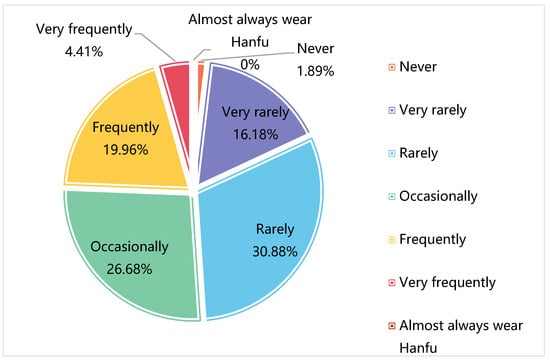
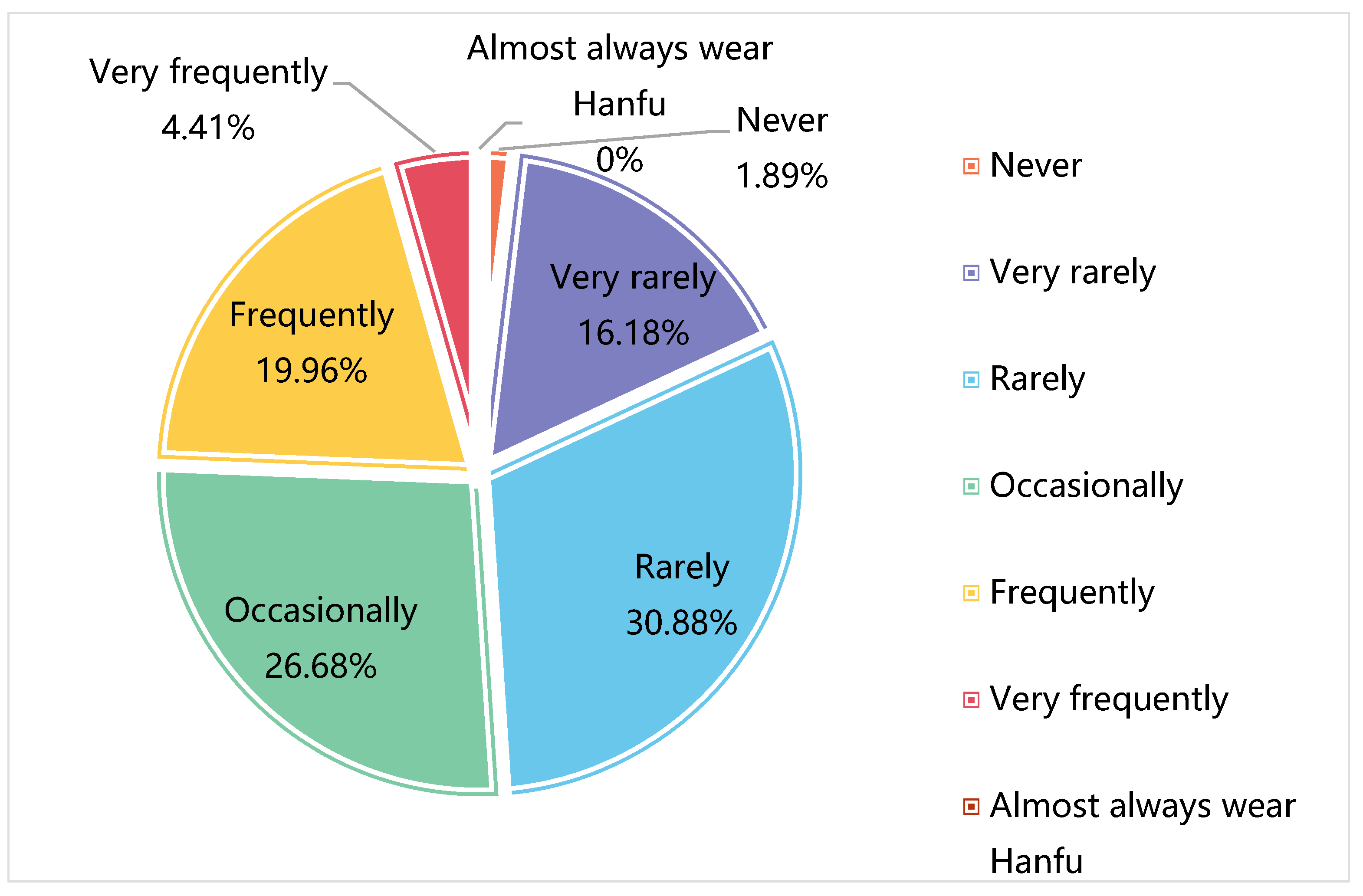
Figure 2 examines how frequently participants wear Hanfu in their daily lives. The distribution is skewed toward infrequent use: 1.89% never wear Hanfu, 16.18% very rarely, and 30.88% rarely—together accounting for 48.95% of respondents. A further 26.68% wear Hanfu occasionally. Only 19.96% wear Hanfu frequently, 4.41% very frequently, and none almost always. This confirms that for the vast majority, Hanfu is not everyday clothing. It is a garment reserved for special occasions, travel, and heritage settings—precisely the contexts that enable non-daily and non-modern experiences.
Figure 2.
Frequency of participants dressing in Hanfu in daily life.
To explore the relationship between everyday habits and tourism experiences, Pearson correlation coefficients were calculated between daily wear frequency (an ordinal variable from 1 = never to 7 = almost always) and the three experiential dimensions. Daily wear frequency showed a weak but statistically significant positive correlation with aesthetic appreciation (r = 0.18, p < 0.01) and with ritualized festivity (r = 0.14, p < 0.05). However, no significant correlation was found with cultural–historical imagination (r = 0.07, p > 0.05). This pattern suggests two things. First, the sense of cultural–historical connection is equally strong regardless of how often one wears Hanfu in daily life—even infrequent wearers experience high levels of cultural pride and heritage connection when wearing Hanfu at tourism destinations. Second, those who wear Hanfu more frequently in daily life derive slightly enhanced aesthetic and ritualistic benefits from the tourism experience. This may be because they are more accustomed to the garment and can focus more on the aesthetic and performative dimensions without the distraction of novelty.
5. Discussions
Although the participants in this research cannot present the entire tourist population of people dressing in Hanfu to visit tourism destinations and experience local tourism activities, their viewpoints provide valuable insights into the reasons why people experience Hanfu costume tourism and what they can obtain through dressing in Hanfu at tourism destinations. Accordingly, we summarize the contributions of this study into three key areas.
5.1. Cultural–Historical Imagination
Amid increasingly modernized lifestyles, tourists are exhibiting a growing desire to reconnect with cultural and historical heritage through immersive heritage tourism. A prominent expression of this trend is the act of wearing Hanfu, the traditional attire of the Han ethnic majority, at cultural heritage destinations. For many, Hanfu is seldom worn in everyday life, and donning it while travelling intensifies a sense of cultural nostalgia and historical longing. Our survey item “experiencing the charm of traditional Chinese culture” received the highest mean score (6.18/7), and qualitative narratives consistently invoked time-travel, princess fantasies, and historical paintings. This aligns with what Goulding (2001) terms “vicarious nostalgia”, a longing for an idealized past not personally experienced [30]. Unlike personal nostalgia (yearning for one’s own past), historical nostalgia is collective and often constructed through media, heritage sites, and peer communities [31,32]. Our data extends this concept by showing that nostalgia in Hanfu tourism is not merely cognitive or emotional but embodied. Donning Hanfu physically situates the tourist in a sensory relationship with history—the feel of silk, the weight of a cloak, the sound of sleeves brushing against ancient walls. This embodied dimension is crucial: tourists do not just think about the past; they perform it through their bodies. As Participant 19 reflexively noted, “I’m from the present, but I bring the past with me.” This finding supports and specifies the notion of “embodied heritage tourism” proposed by Zhou and Zhu (2024) [17], demonstrating that traditional attire serves as a material anchor for historical imagination.
Importantly, the CFA confirmed that cultural–historical imagination is empirically distinct from the other two dimensions, with discriminant validity supported by AVE comparisons. Moreover, our quantitative analysis revealed that daily wear frequency of Hanfu is not significantly correlated with cultural–historical imagination (r = 0.07, p > 0.05). In other words, even tourists who rarely or never wear Hanfu in daily life experience strong historical connections when doing so at heritage sites. This suggests that the imaginative power of Hanfu is not dependent on familiarity or habit. Rather, it emerges from the juxtaposition of the garment with the heritage setting. The site itself, whether the Forbidden City, Luoyang Ancient City, or West Lake, activates the historical meaning of the attire. This person–place–attire synergy is a distinctive mechanism of non-modern experience that has not been fully theorized in previous heritage tourism literature.
5.2. Ritualized Festivity
The second dimension, ritualized festivity, captures the ceremonial and performative use of Hanfu during holidays, festivals, and group visits. Qualitative narratives emphasized “New Year’s ritual feel” (Participant 2), “everyone in Hanfu gathers under the lanterns” (Participant 11), and “you just belong here” (Participant 18). These accounts resonate with Graburn’s (2001) conceptualization of tourism as “secular ritual”—a liminal activity set apart from everyday routines [33]. However, our findings add a collective layer: the presence of multiple Hanfu-wearers transforms individual performance into a shared ritual. This is not simply role-playing; it is a co-created social reality where strangers become “all part of this dream” (Participant 11). The CFA confirmed that ritualized festivity is empirically distinct from cultural–historical imagination and aesthetic appreciation, with standardized factor loadings ranging from 0.74 to 0.89. The survey results support this dimension, with immersion in historical atmosphere (mean = 5.77) and integration with fellow enthusiasts (mean = 5.67) scoring positively, though slightly lower than cultural–historical imagination. The relatively lower score for “escape from worries” (mean = 5.20) suggests that ritualized festivity is less about escaping problems than about entering a different mode of being—one characterized by ceremony, harmony, and shared aesthetic experience.
Importantly, ritualized festivity was most pronounced at sites with strong temporal markers (e.g., Spring Festival, lantern festivals) or designed heritage spaces (e.g., Song Town, where staff and visitors all wear Hanfu). This points to a practical implication: heritage destinations can amplify this dimension by scheduling seasonal events that align with traditional Chinese calendars, thereby providing legitimate “occasions” for ritualized dress.
5.3. Aesthetic Appreciation
The third dimension, aesthetic appreciation, was present in all 20 qualitative posts and scored highly in the survey (mean = 5.92 for “different sense of beauty from everyday clothing”). This finding aligns with Wu’s (2015) notion of “dwelling poetically”—a temporary suspension of pragmatic concerns in favor of imaginative immersion [34]. Everyday clothing is functional, designed for efficiency, comfort, and social conformity. Hanfu, by contrast, prioritizes flowing silhouettes, layered textures, and historical ornamentation—qualities that are impractical for daily tasks but highly desirable for the tourism gaze.
The CFA confirmed that aesthetic appreciation is a distinct construct (factor loadings: 0.79 and 0.71), though it showed the highest correlation with ritualized festivity (r = 0.61), suggesting that visual pleasure and performative engagement are closely intertwined in practice. Our correlation analysis showed that daily wear frequency had a weak positive correlation with aesthetic appreciation (r = 0.18, p < 0.01). Unlike cultural–historical imagination, which is equally accessible to infrequent wearers, aesthetic appreciation is slightly enhanced among those who wear Hanfu more often in daily life. This may be because frequent wearers have developed a more refined aesthetic sensibility or greater comfort with the garment, allowing them to focus on visual harmony rather than the mechanics of wearing it. Foucault’s (1986) concept of heterotopia—real spaces that reflect and invert everyday reality—is useful here [35]. Heritage sites, when populated with Hanfu-wearing tourists, become “othered” spaces where modern fashion norms are suspended. The aesthetic experience is not merely individual but relational: tourists take photos, receive social media feedback (mean = 5.66), and are validated by strangers (“a grandma said I looked like young ladies in old paintings”—Participant 15). This digital–aesthetic feedback loop amplifies the non-daily character of the experience.
5.4. Implications for Cultural Sustainability
Hanfu tourism contributes to cultural sustainability not through passive preservation but through active, everyday re-interpretation. As a form of “living heritage”, traditional attire is continuously recontextualized by contemporary participants—primarily young, urban, digitally active women. This aligns with recent scholarship on cultural sustainability, which emphasizes that heritage survives when it is valued, practiced, and passed on rather than frozen in museums [5,6]. Unlike institutional approaches centered on top-down heritage narratives, Hanfu tourism represents a community-driven, bottom-up mode of cultural reproduction [5,6,7,8,9,47]. This aligns with Soini and Birkeland’s (2014) framework of cultural sustainability, which emphasizes cultural vitality, continuity, and heritage as a resource for the present rather than a relic to be protected [48]. As Yong et al. (2025) demonstrate in their study of community-driven heritage tourism, grassroots practices, when rooted in local cultural logics, can generate sustainable outcomes even without formal infrastructure [49]. Hanfu tourism exemplifies this: through embodied practice and social media sharing, cultural meanings are simultaneously preserved and transformed. Hanfu tourism represents such upgrading—traditional dress is repurposed for contemporary aesthetic consumption. Similarly, Hunter (2025) shows that UNESCO heritage sites sustain identity when they maintain “an unbroken link to the past” while embracing diversified framing for present relevance [50]. However, this bottom-up model carries risks. Commercialization may dilute authenticity, and the dominance of young, female, urban participants raise questions about whose heritage is represented. As Yong (2025) cautions, governance challenges, including the exclusion of local voices, must be addressed for truly sustainable outcomes [49]. Despite these tensions, Hanfu tourism offers a compelling case of how heritage can be “revived in the present” through voluntary, joyful engagement.
6. Conclusions
This study explores Hanfu costume tourism in China, examining the cultural, aesthetic, and social motivations of tourists who wear traditional Hanfu garments at cultural heritage sites. Using an exploratory sequential mixed-method design—qualitative analysis of 20 social media posts and a quantitative survey of 476 Hanfu-wearing tourists—we proposed and empirically validated a three-dimensional framework: cultural–historical imagination, ritualized festivity, and aesthetic appreciation.
The findings demonstrate that Hanfu tourism is not historical reenactment but an active, embodied process of cultural engagement and identity negotiation. Cultural–historical imagination emerged as the most salient dimension, followed by aesthetic appreciation and ritualized festivity. The study further found that daily Hanfu use is rare among participants, with functional barriers—impracticality and lack of suitable occasions—as the primary constraints. Notably, the imaginative power of Hanfu does not depend on daily familiarity but emerges from its juxtaposition with heritage settings. Beyond individual experience, these findings can be situated within the framework of cultural sustainability, which emphasizes not only the preservation of heritage but also its ongoing reinterpretation through everyday practices. In this sense, Hanfu costume tourism can be understood as a form of “living heritage”, where traditional clothing is actively worn and recontextualized by contemporary participants. Unlike institutional approaches centered on museums and formal narratives, Hanfu tourism represents a bottom-up mode of cultural reproduction driven by tourists. Through embodied participation and social media practices, cultural meanings are both preserved and transformed. This indicates that Hanfu tourism supports cultural sustainability by linking historical continuity with contemporary relevance.
This study makes three theoretical contributions. First, it provides an integrated framework for understanding costume-based heritage tourism, moving beyond fragmented descriptive accounts. Second, it specifies how historical nostalgia operates through embodied dress practices, revealing the sensory and performative mechanisms of heritage engagement. Third, it identifies Hanfu tourism as a consumer subculture of young, educated, urban Han Chinese women, reframing sample specificity as analytical insight.
The study also has several limitations. Although the sample size is sufficient, reliance on self-reported data may introduce biases such as social desirability and recall effects. The sample is also likely skewed towards younger, digitally active participants, potentially limiting the generalizability of the findings. Moreover, the predominantly quantitative approach may not fully capture the embodied and affective dimensions of Hanfu tourism experiences. At the conceptual level, the focus on authenticity and cultural sustainability may overlook issues such as commercialization and identity negotiation. Future research could adopt mixed methods and more diverse samples to provide a more comprehensive understanding.
Author Contributions
Conceptualization, X.C. and Z.S.; methodology, X.C. and Z.S.; software, X.C.; validation, X.C., Z.S. and X.T.; formal analysis, X.C.; investigation, X.C. and X.T.; resources, Z.S.; data curation, X.C.; writing—original draft preparation, X.C.; writing—review and editing, Z.S. and X.T.; visualization, X.C.; supervision, Z.S.; project administration, Z.S. All authors have read and agreed to the published version of the manuscript.
Funding
This research was funded by the Research Center for Xi Jinping Thought on Culture Secretariat of the Collaborative Research Base of the Ministry of Culture and Tourism, grant number 25DCT03. The APC was funded by the Research Center for Xi Jinping Thought on Culture Secretariat of the Collaborative Research Base of the Ministry of Culture and Tourism.
Data Availability Statement
The survey data presented in this study are available on request from the corresponding author due to privacy and ethical restrictions, as participants did not provide consent for public data archiving. The qualitative data analyzed in this study consist of publicly accessible blogs and vlogs from the Xiaohongshu platform. The data is available directly from the source platform, but access may be subject to its terms of service. No new datasets were generated or publicly archived during this study.
Conflicts of Interest
The authors declare no conflicts of interest.
References
- Richards, G. What is Cultural Tourism? In Erfgoed voor Toerisme; van Maaren, A., Ed.; Nationaal Contact Monumenten: Weesp, The Netherlands, 2003. [Google Scholar]
- Bonetti, E.; Simoni, M.D.; Cercola, R. Creative Tourism and Cultural Heritage: A New Perspective. In Handbook of Research on Management of Cultural Products: E-Relationship Marketing and Accessibility Perspectives; Aiello, L., Ed.; IGI Global: Pennsylvania, PA, USA, 2014; pp. 367–395. [Google Scholar]
- Singh, P.; Najar, A. Regional Food as the Catalyst for Cultural Tourism in India. In Strategies for Promoting Sustainable Hospitality and Tourism Services; Korstanje, M.E., George, B., Nedelea, A.-M., Eds.; IGI Global: Pennsylvania, PA, USA, 2020; pp. 84–96. [Google Scholar]
- MacCannell, D. The Tourist: A New Theory of the Leisure Class; Schocken Books: New York, NY, USA, 1976. [Google Scholar]
- Chen, X. Inheritance and Innovation of Hanfu Culture from the Development Significance of Hanfu. Chem. Fibre Text. Technol. 2022, 12, 176–178. [Google Scholar]
- Wang, T. An Introduction to Hanfu and Its Cultural Characteristics. Lantai World 2013, 16, 85–86. [Google Scholar]
- Yin, J. A Novel Expression of Traditional Culture: Hanbok, Hanbok Movement and Its Cultural Revival. Yishubaijia 2021, 6, 181–185. [Google Scholar]
- Qu, Z.; Hu, C.-Y.; Jiang, X.-W. Analysis of Different Factors Affecting the Multiple Purchase of Hanfu Clothing. In Proceedings of the Textile Bioengineering and Informatics Symposium (TBIS); Li, Y., Zhang, K., Pan, Z., Li, G., Eds.; Textile Bioengineering & Informatics Society Ltd.: Hong Kong, China, 2019; pp. 631–638. [Google Scholar]
- Huang, X. Research on the Embodied Experience of Hanfu Tourism Based on Network Text Analysis. J. Wuxi Coll. Commer. Vocat. Technol. 2023, 23, 60–66. [Google Scholar]
- Hansen, K.T. The World in Dress: Anthropological Perspectives on Clothing, Fashion, and Culture. Annu. Rev. Anthropol. 2004, 33, 369–392. [Google Scholar] [CrossRef] [Scilit]
- Dodds, R.; Pitts, R.E.; Smith, W.W. Willingness to Pay for Environmentally Linked Clothing at an Event: Visibility, Environmental Certification, and Level of Environmental Concern. Tour. Recreat. Res. 2016, 41, 283–290. [Google Scholar] [CrossRef] [Scilit]
- Liu, Y.; Wang, H. Study on the Development of Tourist Attractions Assisted by Hanfu Culture under the Background of Rural Revitalization—Taking Liuzhou Yaobu Ancient Town as an Example. Intell. Agric. J. 2022, 2, 92–94. [Google Scholar]
- Yan, Q. Research on the Integration Development Path of Hanfu Culture and Ancient City. Text. Rep. 2024, 43, 143–145. [Google Scholar]
- Zhong, L.; Yang, L.; Morrison, A.M.; Zhu, M.; Nguyen, H.; Lang, W. Who Wears Hanfu Clothing When They Travel? Experience-Based Cultural Tourism Market Segmentation—The Case of Xi’an, China. Curr. Issues Tour. 2023, 27, 805–818. [Google Scholar] [CrossRef] [Scilit]
- People’s Daily Online. Hanfu Culture Draws Tourists to C China’s Luoyang. 2025. Available online: https://en.people.cn/n3/2025/1225/c90000-20406652.html (accessed on 5 April 2026).
- Lee, K.-Y.; Lee, H. Traditional Costume Experience at a Cultural Heritage Festival. Tour. Manag. Perspect. 2019, 32, 100555. [Google Scholar] [CrossRef] [Scilit]
- Zhou, Y.; Zhu, H. Perspectives on the “Hanbok Wave”: Value Recycling of Chinese Cultural Products under the Perspective of Symbolic Consumption. Xuehai 2024, 3, 143–149. [Google Scholar]
- Hall, J. Kyoto revisited: Heritage tourism in contemporary Japan (book review). Jpn. Stud. 2024, 44, 363–366. [Google Scholar] [CrossRef] [Scilit]
- Wang, J.; Wang, Y. A Study on the Value and Development Strategies of Xuzhou Hanfu Culture and Tourism Resources. Prog. Text. Sci. Technol. 2021, 9, 47–50. [Google Scholar]
- Hwang, J.; Lee, J. A Strategy for Enhancing Senior Tourists’ Well-Being Perception: Focusing on the Experience Economy. J. Travel Tour. Mark. 2018, 36, 314–329. [Google Scholar] [CrossRef] [Scilit]
- Hwang, J.; Hyun, S.S. Perceived Firm Innovativeness in Cruise Travelers’ Experience and Perceived Luxury Value: The Moderating Effect of Advertising Effectiveness. Asia Pac. J. Tour. Res. 2016, 21, S101–S128. [Google Scholar] [CrossRef] [Scilit]
- Oh, H.; Fiore, A.M.; Jeoung, M. Measuring Experience Economy Concepts: Tourism Applications. J. Travel Res. 2007, 46, 119–132. [Google Scholar] [CrossRef] [Scilit]
- Xie, Y.; Xie, Z. Tourism Experience in the Phenomenal World: The Tourism World and the Lifeworld. Tour. Trib. 2006, 4, 13–18. [Google Scholar]
- Kannisto, P. Extreme Mobilities: Challenging the Concept of “Travel”. Ann. Tour. Res. 2016, 57, 220–233. [Google Scholar] [CrossRef] [Scilit]
- Guan, J.; Chan, J.H.; Bi, J.; Qi, X. Cultural Proximity, Destination Familiarity and Tourists’ Sense of Away-from-Home (SAFH). J. Destin. Mark. Manag. 2022, 23, 100670. [Google Scholar] [CrossRef] [Scilit]
- Zeng, S.; Xie, Y.; Shi, Y. Tourism Experience in the Timeline: Representation of Collective Memory and the Gaze of Landscapes in the Daily Life of Historic and Cultural Districts. Tour. Trib. 2021, 36, 70–79. [Google Scholar]
- Li, L.; Tang, Y.; Li, C.; Xie, S. Unconventional Environments and Behavior: A Reconsideration Based on the Tourism Context. Tour. Trib. 2022, 37, 40–51. [Google Scholar]
- Timothy, D.J.; Boyd, S.W. Heritage Tourism; Prentice Hall: Harlow, UK, 2003. [Google Scholar]
- Robinson, J.; Yerbury, H. Re-Enactment and Its Information Practices: Tensions between the Individual and the Collective. J. Doc. 2015, 71, 591–608. [Google Scholar] [CrossRef] [Scilit]
- Goulding, C. Romancing the past: Heritage visiting and the nostalgic consumer. Psychol. Mark. 2001, 18, 565–592. [Google Scholar] [CrossRef] [Scilit]
- Marchegiani, C.; Phau, I. The value of historical nostalgia for marketing management. Mark. Intell. Plan. 2011, 29, 108–122. [Google Scholar] [CrossRef] [Scilit]
- Wildschut, T.; Sedikides, C. Psychology and nostalgia: Towards a functional approach. In Intimations of Nostalgia: Multidisciplinary Explorations of an Enduring Emotion; Jacobsen, M.H., Ed.; Bristol University Press: Bristol, UK, 2022; pp. 110–128. [Google Scholar]
- Graburn, N. Secular Ritual: A General Theory of Tourism; Cognizant Communications: London, UK, 2001; pp. 42–47. [Google Scholar]
- Wu, H. A philosophical interpretation of tourism aesthetics. Tour. Trib. 2015, 30, 111–118. [Google Scholar]
- Foucault, M. Of Other Spaces. Diacritics 1986, 16, 22–27. [Google Scholar] [CrossRef] [Scilit]
- Zhang, R.; Wang, J.; Brown, S. ‘The Charm of a Thousand Years’: Exploring tourists’ perspectives of the ‘culture-nature value’ of the Humble Administrator’s Garden, Suzhou, China. Landsc. Res. 2021, 46, 1071–1088. [Google Scholar] [CrossRef] [Scilit]
- Xu, Y.; Zhang, H.; Tian, Y.; Xia, X.; Chen, X.; Yang, Y.; Zhang, J. When technology meets heritage: A moderated mediation of immersive technology on the constraint-satisfaction relationship. Curr. Issues Tour. 2022, 25, 32–649. [Google Scholar] [CrossRef] [Scilit]
- Yang, W.; Chen, Q.; Huang, X.; Xie, M.; Guo, Q. How do aesthetics and tourist involvement influence cultural identity in heritage tourism? The mediating role of mental experience. Front. Psychol. 2022, 13, 990030. [Google Scholar] [CrossRef] [Scilit]
- Pine, B.J.; Gilmore, J.H. Welcome to the experience economy. Harv. Bus. Rev. 1998, 76, 97–105. [Google Scholar]
- Cui, X.; Song, Z. Cultural heritage tourism at film-related tourism sites: Staged and existential authenticity at Hengdian World Studios. J. Herit. Tour. 2024, 19, 559–576. [Google Scholar] [CrossRef] [Scilit]
- Kirillova, K. A review of aesthetics research in tourism: Launching the Annals of Tourism Research Curated Collection on beauty and aesthetics in tourism. Ann. Tour. Res. 2023, 100, 103553. [Google Scholar] [CrossRef] [Scilit]
- Wu, H. The object in tourism aesthetics and its meaning construction in the context of Chinese culture. J. South-Cent. Univ. Natl. (Humanit. Soc. Sci. Ed.) 2021, 41, 66–72. [Google Scholar]
- Earl, A.; Hall, C.M. Nostalgia and tourism. J. Herit. Tour. 2023, 18, 307–317. [Google Scholar] [CrossRef] [Scilit]
- Braun, V.; Clarke, V. Using thematic analysis in psychology. Qual. Res. Psychol. 2006, 3, 77–101. [Google Scholar] [CrossRef] [Scilit]
- Fan, C.; Ip, P.T.T. ‘When showing Hanfu to foreigners, I feel very proud’: The imagined community and affective economies of Hanfu (Chinese traditional couture) among Chinese migrant youth in the United Kingdom. Eur. J. Cult. Stud. 2023, 26, 781–802. [Google Scholar] [CrossRef] [Scilit]
- Wang, H. Hanfu Revival is not a Symbol of China’s Nationalism. Global Times. 2018. Available online: https://www.globaltimes.cn/page/201811/1129228.shtml (accessed on 13 February 2026).
- Zhang, H.; Huang, K.; Feng, W.; Zhu, J. Authentic well-being in the third space among Hanfu-wearing Chinese tourists: A PERMA analysis. Tour. Manag. Perspect. 2023, 47, 101106. [Google Scholar] [CrossRef] [Scilit]
- Soini, K.; Birkeland, I. Exploring the scientific discourse on cultural sustainability. Geoforum 2014, 51, 213–223. [Google Scholar] [CrossRef] [Scilit]
- Yong, H.-N.A.; Kalhoro, M.; Morrison, C.; Hanna, D.; Rehman, H.M. Community-driven sustainability practices in cultural heritage tourism: A qualitative study. Qual. Quant. 2025. [Google Scholar] [CrossRef] [Scilit]
- Hunter, W.C. Dolmen UNESCO Sites Are Tourism Attractions in Korea: Semiotics of Sustainability for Cultural Heritage. Sustainability 2025, 17, 8021. [Google Scholar] [CrossRef] [Scilit]

Disclaimer/Publisher’s Note: The statements, opinions and data contained in all publications are solely those of the individual author(s) and contributor(s) and not of MDPI and/or the editor(s). MDPI and/or the editor(s) disclaim responsibility for any injury to people or property resulting from any ideas, methods, instructions or products referred to in the content. |
© 2026 by the authors. Licensee MDPI, Basel, Switzerland. This article is an open access article distributed under the terms and conditions of the Creative Commons Attribution (CC BY) license.