


Abstract
This paper (re)construes the remains of a bulk timber carrier called Optimist that reportedly wrecked in the port of Greenville, Liberia during the Liberian civil wars (1989–2003). Its monstrous hull is an uncanny reminder of militarization, industrialization, and deterioration through extractive industries and global regimes of resource exploitation. This unique wreck site illustrates how landscapes created by ruin, abandonment, rust, and decay, especially when associated with times of mass conflict and violence, force us to rethink the meaning of materiality when it comes to modern metal shipwrecks in postconflict contexts. Through the lens of three monsters—skeletons, zombies, and ghosts—this paper suggests that a single, disarticulated wreck can shed light on bigger issues like memory, violence, the future, and archaeological practice in such shipwreck graveyards. Optimist demonstrates how shipwreck graveyards are not only final resting places for exhausted ships but are also conceptual spaces where human emotions like despair, hope, and fear are materialized through ghost stories, local lore, attempts to manage undead and threatening pasts, and material remains of the skeletons of ships past.
1. The Monster in the Harbor
When the ship sank in 1993, the war was only four years old. No one knew how long it would last—ten more years, hundreds of thousands dead, hundreds of thousands more fleeing burning homes.
The ship’s decks shuddered under gunfire, and the explosions in the hull turned the cargo into fuel. As the tide shifted, the ship drifted, scraping along the shallow rocks, mud rising to meet it. The metal bones groaned as it came to rest on its side. The flames dimmed, but the damage had already settled into those same bones.
Within days, people began salvaging what they could, carving up the charred and rusted hull. The charred ashes of the cargo were long since washed to sea. Half in the river, half in the air, rust spreading across it like a second skin, the wreck was called a hazard, a monument to a violence no one in Liberia could escape and a presence the landscape cannot quite absorb.
The journalists came later, after the war ended. Prints of their photos of the wreck now sell for hundreds of dollars [1,2]. The prints juxtapose the massive metal wreck with a small canoe with a recycled tarpaulin sail in front of it. They describe a dramatic and salacious story of a failed weapons smuggling, of a rebel force protecting its port; it is implicitly suggested in those accounts that this metal monstrosity represented a failed West African state ruled by chaotic violence.
A contract to dredge the port and remove the wreck in 2011 never came to fruition. Another in 2016. Day by day, the rust grows; the skeletal aesthetics thicken along with it as the hull gets thinner, metal sloughing off in the persistent sea air.
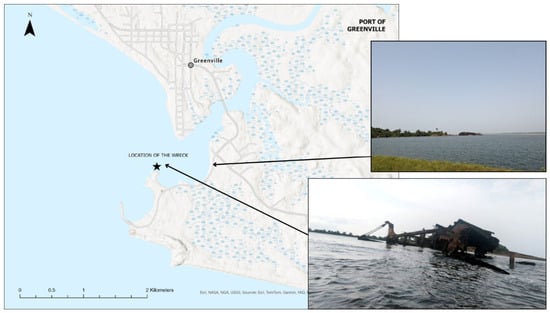
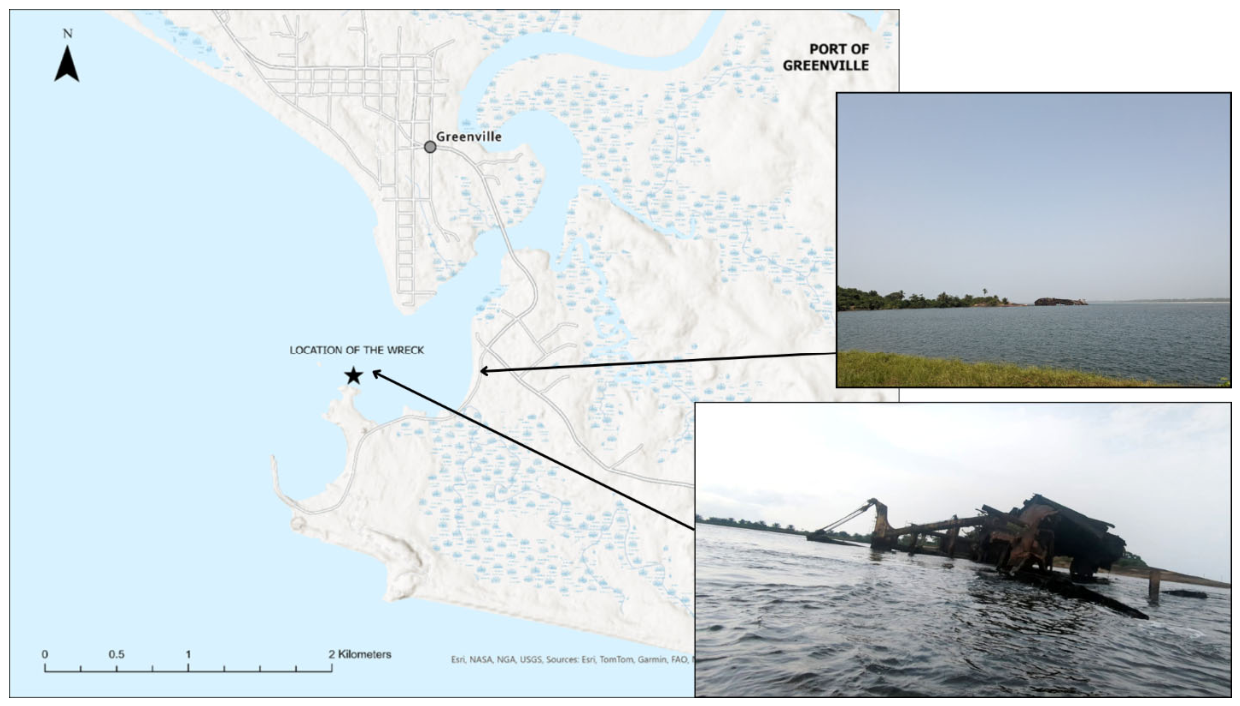
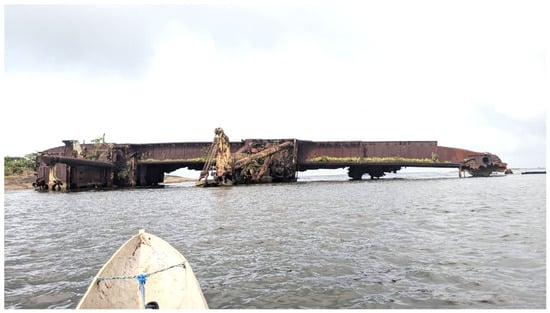
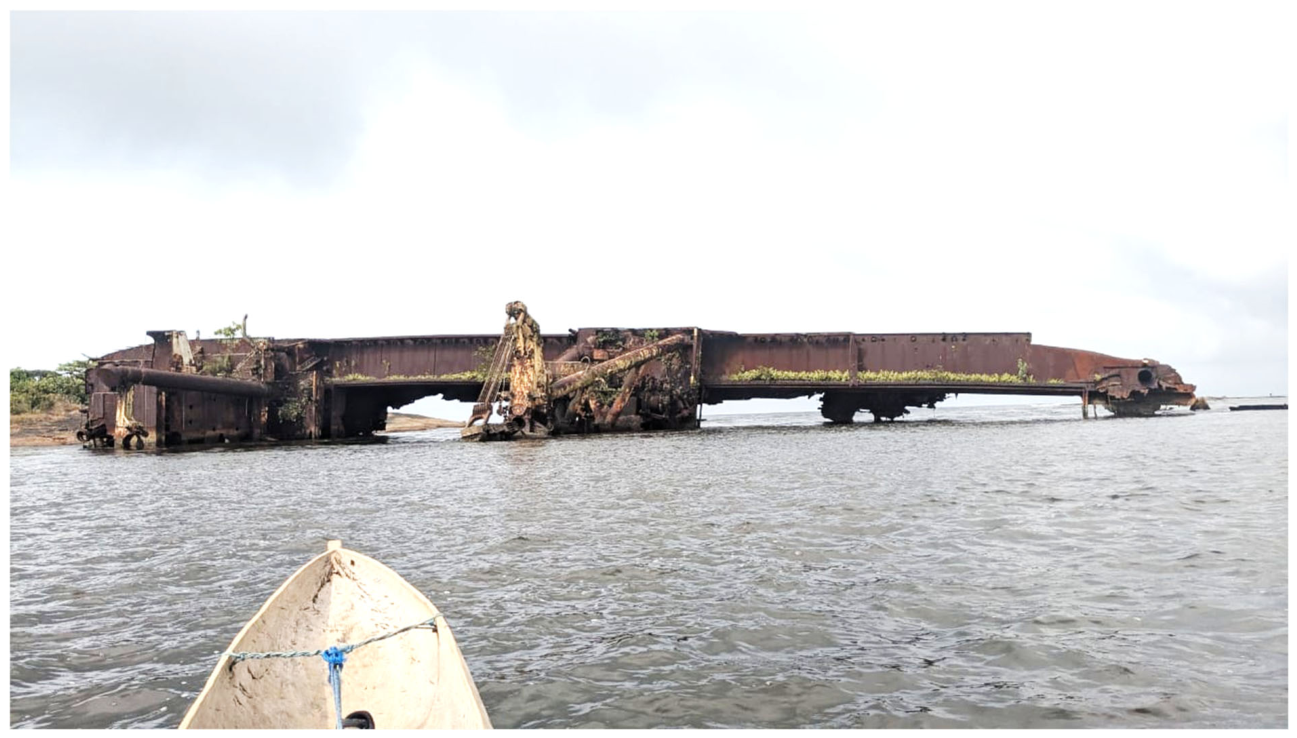
From a distance and on a map, the wreck blends into the landscape (Figure 1 and Figure 2) but up close, the wreck appears huge, its hull chasmic. It lies on its starboard side, with the bow facing the river mouth while the stern is positioned as if protecting itself, with its back against the land. Only the port side is exposed, the starboard side submerged in water and silt.
Figure 1.
Map of the wrecksite with geolocated photos. (Authors, 2026).
Figure 2.
The Monster in the Harbor (Authors, 2026).
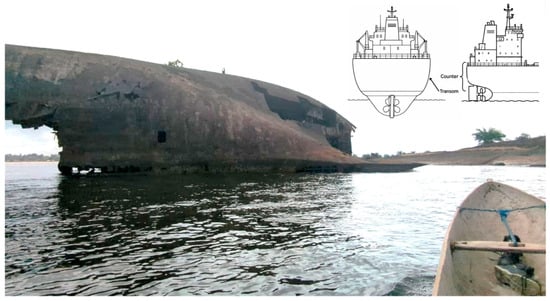
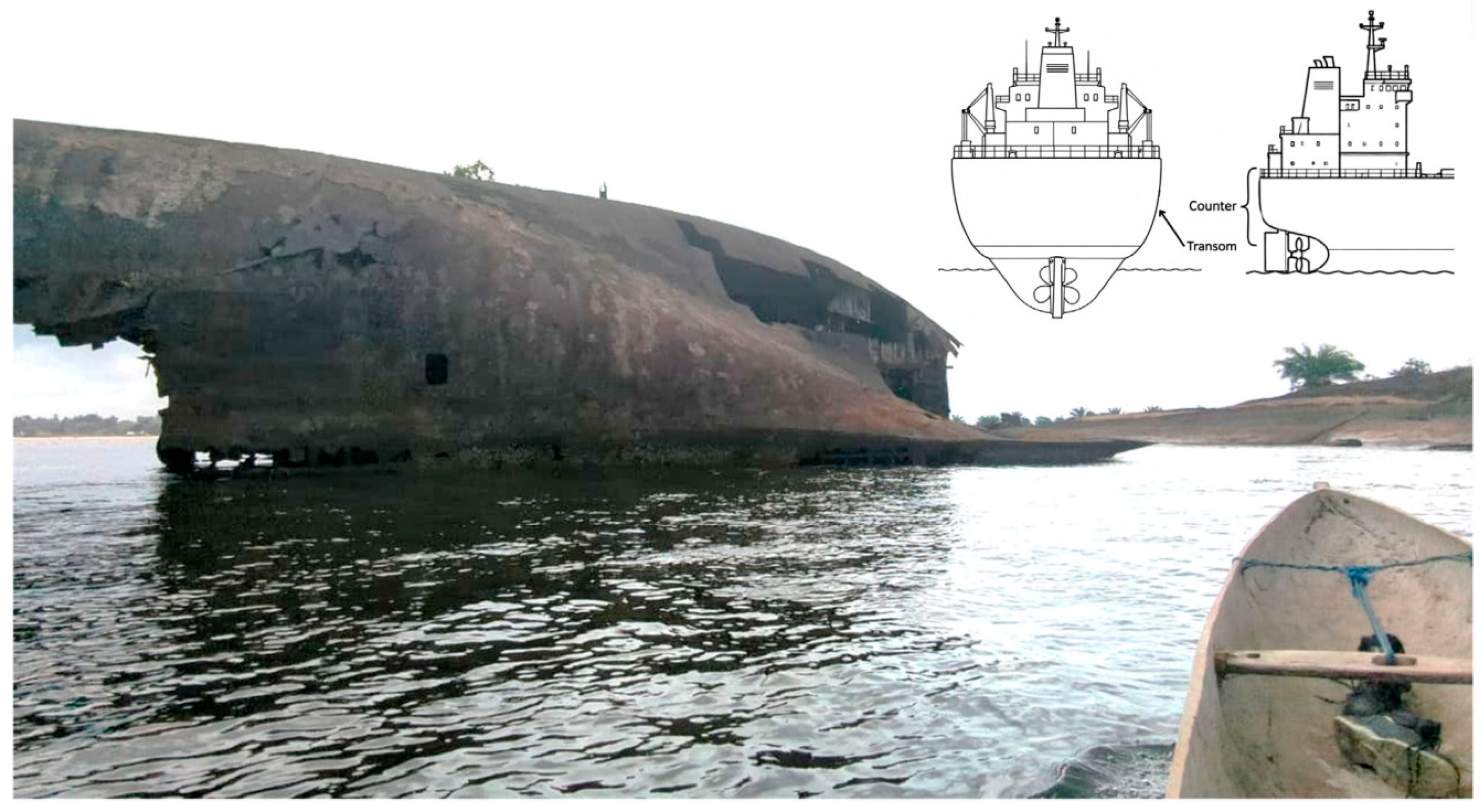
The skeletal bones of this ship near the port of Greenville, in Sinoe County, Liberia, are the remains of the Maltese-flagged Optimist (IMO #7110529), which burned and sank here sometime before 1994 [3]. Only the structural shell of the vessel remains. Built in 1971 as the Regent Cosmos, the ship was later renamed Nikos II in 1983 and was given the name Optimist in 1991. International Maritime Organization (IMO) records give the original tonnage as 5970 T with a length and beam of 127 m and 18 m, respectively. Optimist was built in Japan, operated by a Maltese company called Optimist Shipping Limited, and owned by a Greek national, according to IMO records. It is a long engine-aft bulk carrier, most likely a timber carrier, a medium sized freighter with masts and kingposts (masts used to support cargo-loading cranes) at wide spacing on the forecastle and poop deck “in order to clear a continuous cargo hold” [4]. In keeping with this architecture, Optimist has a set of kingposts at the stern and the hold is not subdivided. Usually, the bows of timber carriers are plumb (perpendicular to the waterline), and the sterns are counter with a transom overhang above the propeller, as seen in Figure 3 of Optimist’s stern.
Figure 3.
Missing bones. View of the overturned stern with the counter and transom visible, but the propeller missing. (Authors, 2026).
Optimist’s wrecking event is shrouded in mystery and memory, despite being relatively recent (1993 or 1994). The barebones facts of the case are that the ship was firebombed and then listed and sank while unmoored in the port of Greenville, Liberia during the first Liberian civil war (1989–1997). The shipwreck is bisected at the centerline, with the starboard side submerged in the Sinoe River and the port side exposed. The only remaining material is the hull of the ship; fittings, engines, and other mechanical components were likely either salvaged or destroyed after it was firebombed. Based on a beam of 18 m, it can be estimated that about 9 m of the hull remains underwater along the entire length of the 127 m long hull. Tests conducted by our team demonstrated that the cavernous inside of the hull was navigable; a canoe can be paddled under the hull and the metal components of the hull are below the depth of the canoe’s hull and paddles. The geological impacts of the wreck within the Sinoe River have not been studied but present an opportunity for future research in Liberia.
In this material, historical, and geographic context, the conceptual frameworks of three graveyard monsters—skeletons, zombies, and ghosts—reveal the power of narrative and storytelling in cultural and emotional healing through the wreck of Optimist. These monsters also reflect the three analytical levels we have taken to interpret narratives of the wreck: the extant remains and documented history of the wrecking event, the current rumors and narratives that surround its sinking, and the theoretical interventions and interpretations that we propose in this paper. Through the aesthetics and the affective impressions of three types of monsters—skeletons, zombies, and ghosts—we analyze the afterlife/lives and the memory of this shipwreck and how these monsters are resurrected more broadly from the shipwrecks created by contemporary violent conflict. In doing so, we urge nautical archaeologists to consider how discard, decay, and dismantling of ships in shipwreck graveyards are social and political processes illuminated by this singular example from Liberia. Resting in a graveyard, from whence all three monsters arise, Optimist demonstrates how shipwreck graveyards are not only final resting places for exhausted ships but are also conceptual spaces where human emotions like despair, hope, and fear are materialized through ghost stories, attempts to manage undead and threatening pasts, and material remains of the skeletons of ships past.
2. The History and Afterlife of a Monster
While Liberia, a coastal nation, has numerous shipwreck sites yet to be studied, and several notable ghost ships or abandoned modern ships that have become tourist attractions, Optimist is a unique site. It was not intended to be discarded when it came into the port, nor was it intended to find its final resting place there. It is not a tourist attraction like similar sites in Liberia’s northern Cape Mount, where some modern ghost ships have become tourist destinations. In that sense, it exhibits remarkable parallels to much earlier sunken ships that were wartime casualties or the result of violence or forced abandonment in conflict, such as US ironclads or British warships [5,6]. However, few contemporary metal shipwrecks have been studied in detail, and those that have been well-studied archaeologically have typically been the focus of major conservation and documentation projects [7]. A few archaeological studies investigate modern contemporary wrecks, but they are limited in number given the recency of the wrecking events [8,9,10,11,12,13,14]. One study conducted in North Carolina, US investigated the remains of several modern (post-1950) abandoned vessels across North Carolina’s rivers and waterways. However, these vessels were all small, local craft, not large commercial shipping vessels like the one in Greenville; they also had well-documented personal histories of ownership, use, and abandonment [14]. Optimist does not have this type of definitive record and memory associated with it.
The setting in which Optimist wrecked is also historically unique. The country of Liberia was established in 1822 as a haven for free Black Americans and Caribbeans seeking a return to Africa after centuries of experiences of slavery and racism in the Americas [15,16,17,18,19,20,21,22,23,24,25,26,27]. Liberia, the first Independent Black Republic in West Africa, is one of two African countries never to have been colonized by Europeans during the scramble for Africa (the other being Ethiopia). Historically, Liberia’s economy was built on maritime shipping and trade that conducted goods and, prior to British and American abolition in 1807, enslaved people from the interior and ‘hinterland’ to the coast [28,29,30,31,32]. Greenville, in southeastern Sinoe County, Liberia, is one of the original four coastal port towns in Liberia. Greenville was established in 1838 by free Black settlers from Mississippi, Louisiana, and Lexington as an important coastal trading port [26]. It sits at the mouth of the Sinoe River in modern day Sinoe County. Sinoe County is one of the least densely populated counties of Liberia’s 15 major counties, but it holds many important historical sites, especially for Indigenous groups in Liberia. (There are 17 recognized Indigenous groups in Liberia: the Kru, Bassa, Grebo, Krahn, Belleh, De, Mano, Gio/Dan, Lorma/Loma, Gbandi, Mandingo, Mende, Vai, Gola, Kissi, Kpelleh, and Sapo.)
Throughout Liberia’s history, a majority Indigenous population was governed under a political system led primarily by a small population of elites with settler connections. The Liberian settlers have sometimes been called Americo-Liberians, Congo people, or ‘civilized’ people. There remains in Liberia a divide between ‘native’ and ‘civilized,’ often along socioeconomic rather than ethnic or cultural lines [33,34,35,36,37]. Liberia’s social, economic, and political history has been treated elsewhere, as have the causes of the 20th and 21st century civil wars [15,16,17,21,22,25] which have been given various causes ranging from ‘ethnic conflict’ to global capitalist-colonialism [38,39,40,41,42,43]. The Liberian conflict and civil wars started with a military coup in 1980 led by Samuel Kanyon Doe that deposed and executed sitting president William Tolbert. Under Doe’s new regime, tensions grew throughout the 1980s. In 1989 Charles Taylor, an American-educated, Libyan-trained militant politician and leader of the National Patriotic Liberation Front (NPFL), launched an invasion from neighboring Côte d’Ivoire, capturing and executing Doe. From 1989 to 1997, the first civil war killed hundreds of thousands of civilians and fractured the country as multiple rebel factions emerged, some of them tied to ethnic identities and others tied to material interests. The first war ended in 1997 with elections that brought Charles Taylor to the presidency. However, by 1999, a new conflict, led primarily by the Liberians United for Reconciliation and Democracy (LURD) faction, triggered the Second Liberian Civil War. Fighting continued until a ceasefire was reached in 2003. Throughout the conflict and its aftermath, the United Nations and the Economic Community of West African States (ECOWAS) deployed peacekeeping forces to stabilize the country. They were reinforced by U.N. Military Observers and troops (UNOMIL) in 1993. After 14 years of nearly continuous conflict, hundreds of thousands of Liberians had lost their lives. In 2003, Taylor was indicted for war crimes related to his financing of civil war in neighboring Sierra Leone, and by 2005, Liberia held its first truly democratic election. Ellen Johnson Sirleaf, a future Nobel Peace Prize laureate, became the first female head of state in modern African history in 2006.
The wars ended with over 250,000 civilians dead and there are few memorials to the atrocities that were committed during the war in Sinoe County. Therefore, Optimist, which was sunk during the first civil war, has potential as a memorial site. Because of Optimist’s unique history and due to methodological limitations on the ground, discussed in the next section, our team has not approached this wreck with what we may consider typical maritime or nautical archaeological methods of documentation (e.g., direct survey measurement, photogrammetry, line drawings, geophysical analysis). Rather, we use the ship as an entry point to theorize where ships go when they die, how this ship’s afterlife reflects the wartime context of its wrecking, and how this theorization allows us to interpret a ship for which we have—and will likely continue to have—limited data. The narratives and rumors spread by people both who witnessed its wrecking and who were born years after the wrecking are important pieces of data because they tell us how the site becomes an informal memorial outside of official means of commemorating the civil wars or excavating Liberia’s archaeological past. Archaeologically, the question of ships’ afterlives sometimes refers to site formation processes, which have been addressed for shipwrecks around the world [44,45,46,47]. For modern hulls, there are typically three fates or site formation processes: they become ghost ships, abandoned shipwrecks or hulks, or they are ‘buried’ in ship graveyards. A ghost ship is typically defined as an abandoned, floating ship, normally not docked or moored in port, while an abandoned ship is typically a scrapped hull, called a hulk, that is either intentionally beached, moored and scuttled, or abandoned [9,48,49,50]. Intentional abandonment contrasts with an existing modern industry around scrapping ships wherein ships are taken to junk yards and scrapped for metal salvage, called shipbreaking [51,52,53]. An area in which many abandoned shipwrecks become layered atop one another is a ship graveyard, where shipwrecks can be deposited primarily or transferred into the graveyard after their initial deposition somewhere else (e.g., Mallows Bay National Marine Sanctuary in the Potomac River, USA).
Typically, the term “graveyard” refers to a location where ships are left to ‘die’ and decompose or alternatively to later be reanimated through the preserving power of maritime archaeology. A ship graveyard normally consists of initial deposition, shipwrecks which sank and are preserved in the same place. A dumping ground, however, is a secondary location where the remains of sunken ships are placed to be buried. Such dumped ships face “additional salvage and damage during a final deposition process that involved different extraction processes (such as being re-floating using pumps or raised in slings, torn apart with clamshell dredges, demolished with dynamite, or removed in pieces) from their original resting places” [10]. Ships that remain at dumping grounds have typically undergone “primary salvage, transportation to site, and discard with the intention of abandonment” [54].
At rest in a watery grave, the location of Optimist can be seen as a ship graveyard. Indeed, there are other modern wrecks—trawlers and tugs—in the port of Greenville and surrounding environs. Removal and dredging procedures for these wrecks have not been implemented. According to local residents and newspaper reports, efforts to remove the wreck were reportedly in place in 2011 and again in 2016, but they never materialized. Rather, ports at Monrovia and Buchanan were prioritized due to their use as mining and import/export ports [55]. The port of Greenville was reopened for commerce after the civil wars only in late 2011, despite the wars having ended in 2003 [56]. In 2016, plans to continue dredging and removal of abandoned shipwrecks were foiled by a prominent and politicized corruption case that was later dismissed [57,58,59]. However, many abandoned wrecks remain at the port of Greenville as of 2026 [29]. As has been argued elsewhere, these wrecks constitute an important aspect of the maritime cultural landscape of Liberia [29].
3. The Shape of a Monster
The morphology of Optimist appears mostly standard for a bulk carrier as described in the introduction [4], and there are already numerous forms of commercial documentation for modern metal bulk carriers, though few of these are archaeological in nature. Bulk carrier or cargo ships, including timber carriers, of the contemporary late 20th and early 21st century tend to exhibit similar characteristics, which can vary depending on whether the ship is intended to be a tanker or a dry bulk carrier. Oil tankers require specific construction features, such as a rounded turn of the bilge, that minimize liquid movement during transport [60]. Most dry bulk carriers have a double bottom, square cross-section, and a single deck with a subdivided hold where goods will be carried. The double bottom conceals the framing, leaving the hold smooth [60,61]. In contemporary bulk carriers, the bridge is located aft of the ship with engines also located aft (termed an “engine-aft bulk carrier”). These carriers have large forward hulls that are not hampered by heavy machinery. In addition, the operation, maintenance, and living quarters of the ship are placed strictly aft which allows for tight packing of containers and other cargo in the rest of the hull and on deck. The heavy engine weight at the stern helps balance the ship when the cargo holds are fully loaded [60]. Large bulk carriers are typically designed to fit the Panama or Suez Canals, which means they must have a beam of less than 32.25 m and a draft less than 19 m [61]. Optimist is well within these limits.
A unique feature of bulk carriers is the presence of large hatchways into the divided hold, which are intended to lessen the time needed to load or unload the ship using cranes [61]. Optimist is overturned and gutted, which makes viewing the hatches difficult given current conditions. It is also possible that the deck of the ship, where the hatches would have been, is completely disintegrated below the waterline. Because the hollowed skeleton is all that remains, it is difficult to tell if the ship’s hull was modified for any specific transport need or wartime function. The framing is visible, meaning that the double bottom was removed or destroyed. The hold also does not appear to be subdivided, but the bulkheads could have been removed or destroyed as well.
3.1. Methods: Measuring and Analyzing a Monster
Optimist is in a country and a region of the word largely overlooked within maritime archaeology, making application of typical methodology of recording and documentation difficult [29,62,63]. To document the wreck with methods at our disposal given the conditions on the ground in rural southeastern Liberia, a series of reconnaissance surveys were conducted at the site, two from the land outside the port of Greenville and two in a dugout canoe in the public area of the Sinoe River. Because the wreck lies slightly outside the bounds of the port of Greenville, it can be accessed by anyone. Canoe surveys were conducted by the authors in 2026 and the land surveys were conducted by the authors in 2025. During these surveys, photos and videos were taken of the wreck which were then compared to copyrighted ship blueprints published by major bulk carrier constructors today. Currently, there is not capacity for maritime archaeological diving in Liberia and there are hazards in the Sinoe River that limited our canoe survey around the vessel. The visual estimates of dimensions were taken based on comparison with the dugout canoe, which had a known length of 21 feet, as a scale and then compared with satellite imagery and Google’s measuring tool to confirm that the wreck fit within Optimist’s listed IMO dimensions. Photos were also compared with the copyrighted journalist photos mentioned in the introduction, taken in 2005 and 2006 respectively, as well as with photos taken by unidentified individuals in Liberia between 2011 and 2016 and posted to an online forum for cargo ship afficionados, ShipSpotting and to Flickr. The 2026 documentation was also compared to a YouTube video posted by an anonymous poster in 2016 of the wreck. We also consulted Liberian newspapers published since the reestablishment of democratic governance in 2005 to see if the wreck was mentioned, and these have been cited briefly in discussion of the attempted removal of the wreck.
The initial reconnaissance surveys on land were conducted as part of a larger project surveying the Indigenous maritime heritage and landscape of southeastern Liberia and aimed at identifying areas of interest on land near the port of Greenville related to the Blue Barre people from whom the land was taken in the early 20th century. The wreck was deemed outside the scope of that project, which focused on the 19th and 20th centuries, and research on Optimist was tabled. Later, we identified the wreck as an important site of memory of the wars in Sinoe County, an area where few other sites of memory are immediately evident. This conceptual reinterpretation of the wreck led us to conduct two canoe surveys in 2026 in order to investigate the wreck in light of new knowledge about the impact of the war in Greenville and the port. Then, a series of informal, unstructured conversations was held by Liberian team members with members of port administration as well as with local youth (ages 25 to 40) who are seasonally employed at the port. The overall project was permitted by relevant local and national authorities and especially local tribal governance in Liberia, with whom we have preexisting collaborations. In total team members spoke to 15 individuals with knowledge of the wrecking event itself, all men. These conversations were held with consent between male Liberian members of the project and local stakeholders in a community-based and community-driven research format. The accounts of non-Liberians (journalists, online forums, and publications) have been collated with these local stories where they overlap, which is how we have derived the common narratives or ghost stories that we will discuss in later sections. The few online accounts of the ship (e.g., ShipSpotting, YouTube, and Flickr [64,65,66]) do align overall with Liberian narratives, but where they differ we privilege the versions repeated by Liberians. The stories repeatedly told about this wreck—whether online by visitors to Liberia or within Greenville as recognized local lore—are valuable sources of information and should be treated as valid interpretations of an incredibly complicated and poorly documented period in contemporary history rather than as intentional or unintentional exaggerations or as irrelevant town gossip. Future researchers should certainly consider formalizing conversations on local history of the wars in southeastern Liberia. Rumors and gossip collected with consent as part of informal conversation networks reflect widespread local lore that is not written down or formally documented.
Our purpose in this paper is to understand why and how Optimist continues to live in popular local imagination, and how this wreck reflects Liberian concerns about the past and hope for the future; “what is history and what is icon is difficult to discern” in this case [6]. Optimist is a standard cargo ship from the 1970s, not unique or exemplary of any undocumented or rare construction tradition. Instead, Optimist is significant because it is part of a contemporary history of war and international collusion with violence that remains buried—sometimes purposefully. There is no official record of Optimist’s sinking, and there are both accidental and intentional obfuscations of the wrecking event due to its association with illegal activities. How does the wreck reflect concepts of a skeleton and a zombie? What do these stories speak to; why do they even exist? And why does this (un)dead shipwreck continue to inspire ghost stories that reanimate it in the present?
3.2. Skeleton
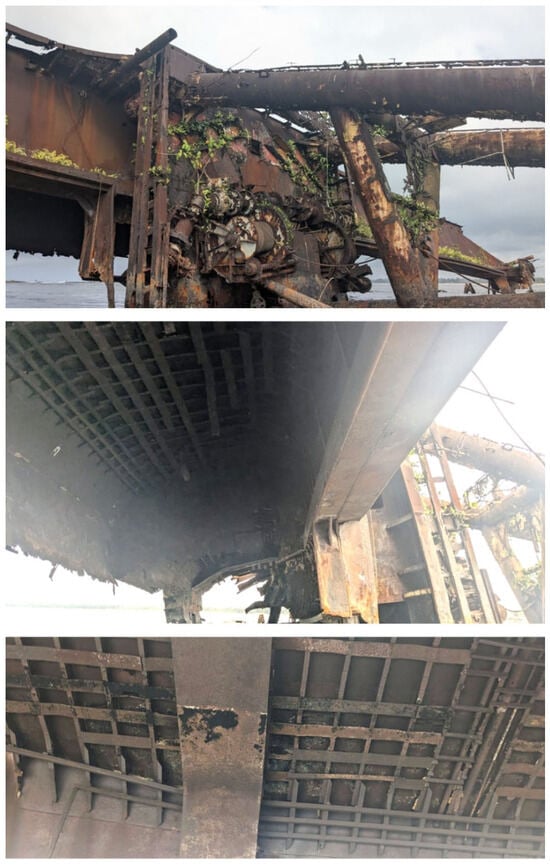
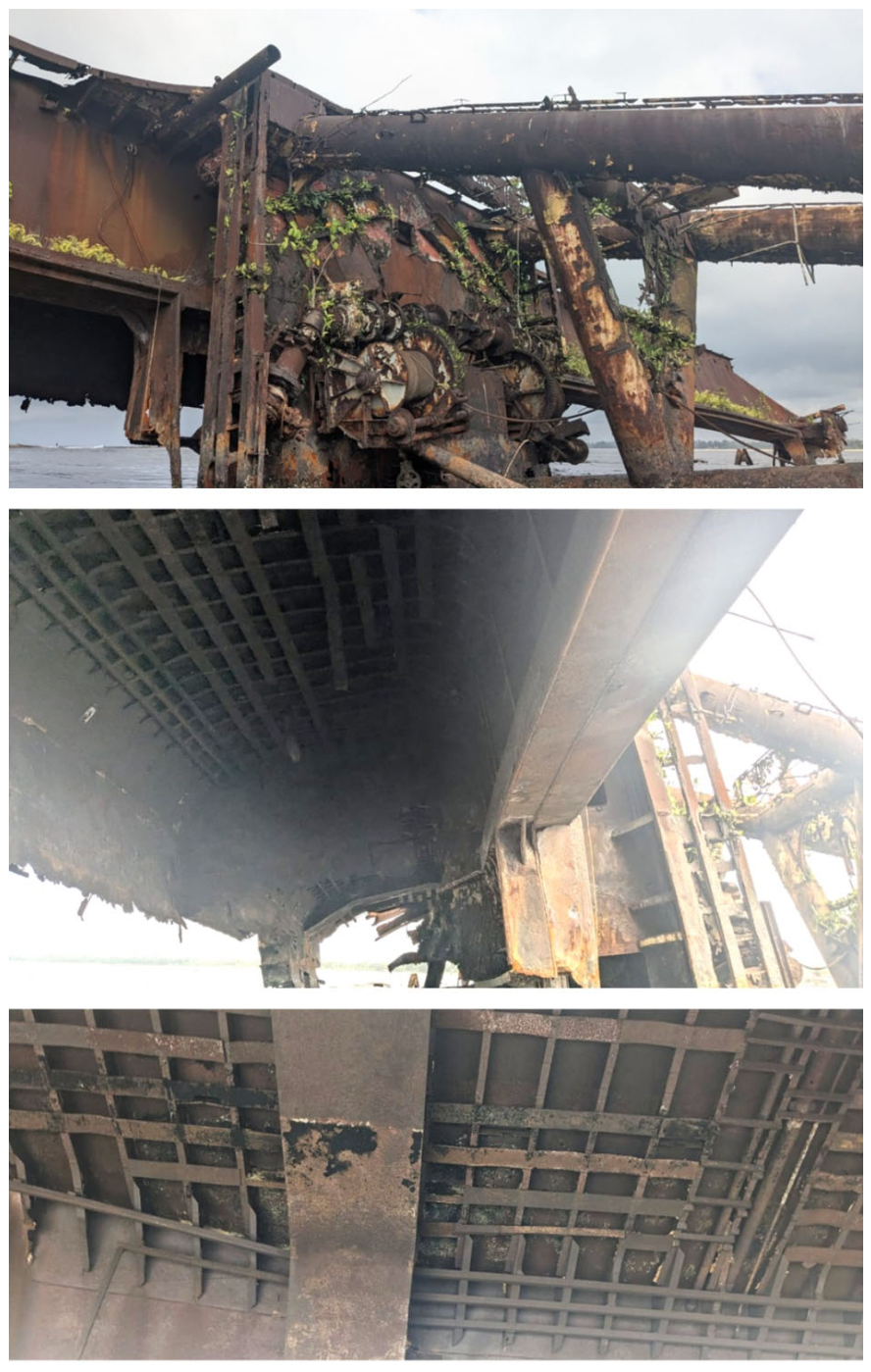
Based on sheer size, the skeleton of Optimist is monstrous. Viewed from below, as in Figure 4, the skeletal, hollowed, and empty hull shows signs of charring, rust, and disintegration. 127 by 18 m, with a tonnage of almost 6000 T, it had a robust carrying capacity. At the same time, it was also frail by the time it even set sail for Greenville (by 1993, it had been at sea for 22 years), what mariners call a “rust bucket.” Today, the entire ship has been gutted, leaving only the bones. Photographic evidence from 2006 to 2025 shows a gradual skinning and dismembering of the hull, probably for scrap metal. At some point between 2006 and 2011, the propeller was removed [1,64]. Metal has also been removed from the stern of the vessel, as shown by the symmetrical cutouts visible on the stern. These activities were probably carried out unofficially and in unregulated ways, and so the ship’s bones live on in the various contexts in which they have been reused, dissipating the material in a country rebuilding but still traumatized by its aftermath [67,68,69,70].
Figure 4.
The skeletal ribcage. Note the piping alongside the frames, which would probably have been covered at some point by the double-walled hull structure. (Authors, 2026).
Some maritime archaeologists have used the concept of a phantom place to explain how absence of material is indicative of meaning, especially in the case where the cargo of a shipwreck remains but the wooden remains of the ship have disintegrated: “the actual ship can perish and leave only its cargo on the seafloor. The cargo safely indicates that a merchant ship has sunk but it does not constitute a spatial remnant per se—only the content of a bygone place. So the actual past place, which is the ship, can be completely absent from the shipwreck site” [71]. Optimist is the opposite—no cargo remains, only the skeletal remains of the hull, which are disintegrating and being repurposed day by day. The skeletal remains of Optimist become a ghostly reminder of the haunting presence of the past in postconflict places, but without a well-documented historical context, an observer is left to imagine a multitude of reasons for the presence.
3.3. The Zombie
Just as zombies exist between life and death, this ship is “a human thing but, like zombies, it is not a human being”[72]. While made and used by humans, it is now mostly divorced from this human context. The aesthetics of the wreck and its ongoing state of disrepair increase as natural processes of degradation separate the ship even further from its use by humans. The metaphor of zombies for heritage has been used in postindustrial archaeology—ghost towns, zombie mines, and uncanny ruins captivate imagination and stir emotions [72,73] and it can be applied—albeit imperfectly—in this case. For example, Keeling and Sandos (2017) investigated the remains of abandoned mine sites in northern Canada as zombie sites [73]. They define a zombie mine as an abandoned site closed due to economic or ecological exhaustion which is later reopened or reanimated for another purpose, or a site which has continued impacts on people or the local environment. The two case studies that they focused on were mining sites that produced toxic chemicals like arsenic trioxide, which now need to be contained and mitigated in perpetuity. The long term impacts of mines and the environmental degradation they cause reflected the colonial seizure, extraction, and pollution of Indigenous lands that Canada’s First Nations have faced for centuries [73]. In another case, Juola, Herva, and Paphitis (2025) investigated the ruins of a wood-chip silo in Finland that was part of the Toppila pulp mill and designed by a famous Finnish architect [72]. The silo remains aesthetically troubling, resembling a fang or shard, and local communities disagreed about how to preserve it. The researchers argued that the silo, as a built structure but also a “biographical entity,” is a zombie because it refuses to easily be characterized as dead or alive [72]. Part of Juola et al.’s argument is that the silo has become a zombie partially because it is ugly, or perceived as ugly, in comparison to the surrounding buildings and in the eyes of the local community. It is also zombiefied because it is seen as useless—attempts to revitalize it or create another purpose for it have repeatedly failed [72].
In this paper, a zombie is a working metaphor for Optimist because of its uncanny, neither-dead-nor-alive, presence on the landscape and in memory but not necessarily because it is aesthetically displeasing nor useless. The wreck is a zombie because it is not allowed to lie in rest, but is reanimated through removal of material, memory, and discussion. The metaphor of a zombie has been used in shipwreck contexts in this way. Like postindustrial sites that remain in a state of constant reinterpretation and negotiation with local communities and the landscape, Optimist is a type of undead site. Underwater, “shipwrecks are notoriously isolated, secluded, really physically withdrawn from human accessibility. Shipwrecks are not present or absent, not dead or alive. They characterize a near ontological void, the lack of a sense of presence, which leads to a lack of perceived being…”[74]. But Optimist has the unique quality of being only partially underwater; unlike other shipwreck zombies, which may be fully underwater, it is always visible and present existing in a liminal space (see Figure 5). Zombies also exist in a liminal temporal space: they belong to both the past and the present [75]. Optimist continues to be reanimated, living in both past and present through stories told about its wrecking. As a similar metaphor, zombies have a quality of “uncertainty and liminality”; they are neither dead nor alive, they are apocalyptic [72]. While skeletons bring up aesthetics of hollowness, zombies “prompt us to think about the ‘civility’ and ‘order’ of our society and broader environment” in eras of apocalyptic collapse [72]. While this approach has often been applied to the catastrophic Anthropocene, during the Liberian civil wars, it may have seemed to many that their world was ending and that catastrophic violence would destroy everything they had striven to build. Optimist both confirms and complicates this feeling. The ship is a symbol of a troubling but silent history of colonial extraction and violence in this region as well as of a civil war that was fought and financed through such extraction. Silence has long been the modus operandi in Liberian treatment of the civil wars [76]. And “when history ‘comes alive’, it’s hard to make it rest in peace again”[77]. As Liberian scholar Aaron Weah explained in a 2019 article on Liberia’s postconflict memoryscape, “the proximity of mass graves and casual exposure to fresh memory makes it impossible to forget the past. It also makes conditions of trauma and transmission of such memory a particularly vicious circle”[78]. To put it simply: everyone knows about the war, but no one is talking about it ‘on the record.’ In this context, ghost stories about the wreck may become a way to deal with the memories it evokes.
Figure 5.
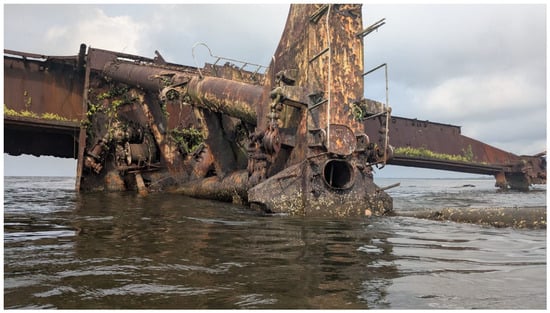
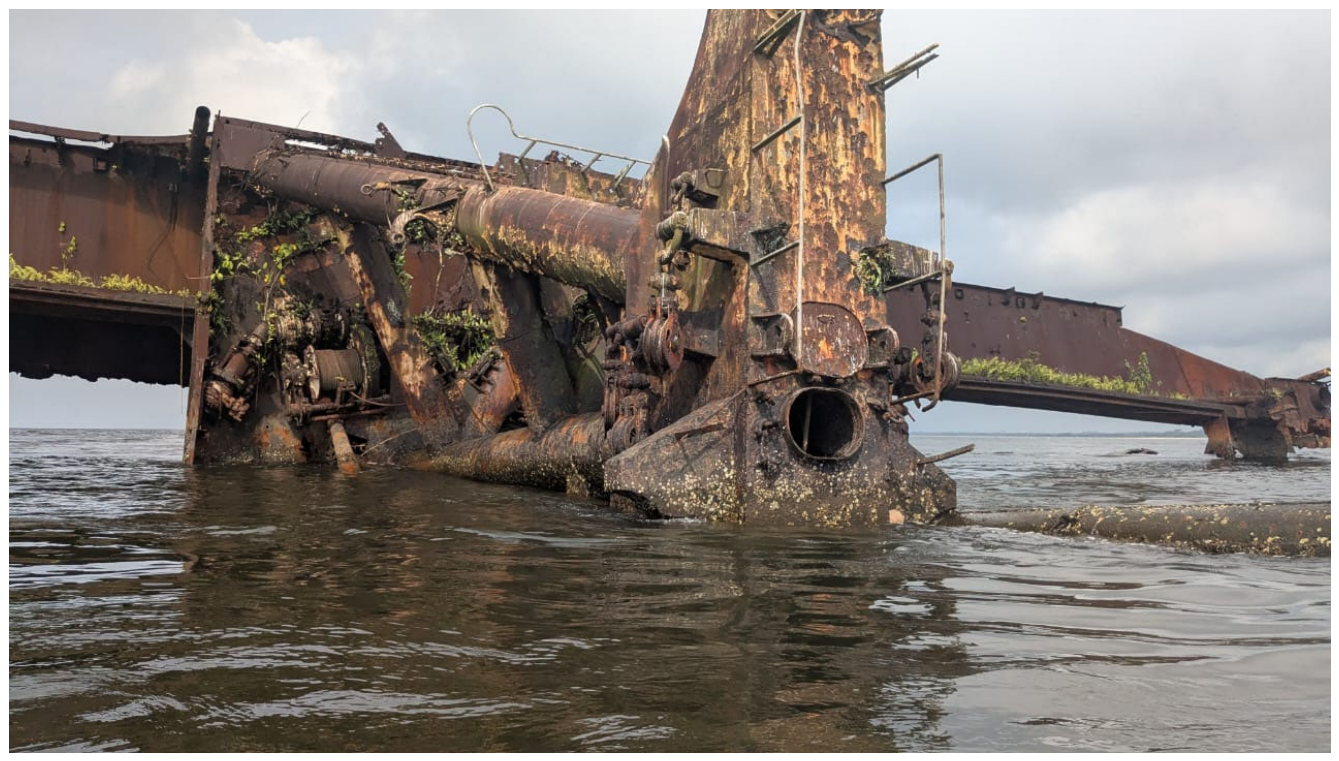
The Zombie metaphorically reaches out its arms (Authors, 2026).
3.4. Ghost Stories
Another fitting metaphor to understand Optimist and memory is through the framework of a ghost or a ghost story. Rumors in the global maritime community began within 10 years of the wrecking event, suggesting that the ship wrecked in May or January of 1993 after being bombed and set on fire at Greenville. Hobbyist maritime enthusiasts posted original images of the wreck on a popular website called ShipSpotting, and the idea that the ship was “set on fire by rockets & gunfire at Sinu, Liberia 1.5.93, and abandoned” was suggested by several users [65]. Posters also shared links to an anonymously created YouTube video of the wreck by a channel based in Europe [66]. Some observers, like the journalists mentioned in the introduction, suggested in these accounts that the ship was smuggling arms and had been attacked by legitimate government forces or peacekeeping forces to prevent them being unloaded at Greenville [1,2]. Parallel accounts from the U.N. and the repeated lore of local stories demonstrate that arms smuggling through the port was one of the ways that various forces armed themselves during the wars, especially after the U.N. instituted an embargo and blockade on Liberian shipping in 1992, followed by an ECOWAS naval blockade of the Liberian coast [79]. During the wars, the port of Greenville was not an official port of entry either for the ECOWAS forces or for the Liberian rebel governments [70]. At Greenville, reports suggested the import of illicit arms to supply other factions besides Charles Taylor’s NPFL [80]. However, Optimist had no active sanctions and no embargoes on it at the time of sinking, according to IMO records. This means that if it was engaged in any illegal activities or wartime violations, such as arms smuggling, these were not reported or tracked by the U.N. or by ECOWAS. There is also no written record of Optimist landing or unloading cargo at Greenville. Today, the IMO record for the ship simply notes its position as “out of range.” While other merchant vessels did land at Greenville during the wars, there is no record of Optimist landing there, and the port was officially blockaded by ECOWAS naval forces until late 1996 (though ships did land there illicitly) [79]. Nor is there an IMO record of the ship’s sinking or scrapping as there are for other abandoned or sunken ships. Therefore, the rumors of the ship’s firebombing and of other nefarious activities connected to it does seem to indicate that Optimist was caught between or directly involved in illegal activity at the time of the wrecking event.
Another local ghost story was that Optimist was carrying oil, which was also smuggled into Liberia’s ports during the wars [80,81,82]. Based on construction and size, however, it is unlikely that Optimist carried any oil, especially since the ship’s hold is not that of a typical tanker. Oil tanker wrecks are an immense environmental hazard. In this same journal Special Issue, Brennan (2026) investigates the legacy of oil tanker wrecks and the environmental consequences of neglecting such wrecks: “shipwrecks are not lost forever once they sink beneath the waves, and the hazardous materials they carried persist in the modern marine environment” [83]. Ships powered by diesel engines, like Optimist, can also endanger environments when they sink with full tanks. Thankfully, Optimist does not appear to be carrying any oil today; the hull is completely hollowed, and the contents of the ship were removed, including any fuel.
Another story about the ship recounts that in 1993, the vessel was reportedly loading logs when it became entangled in the conflict between rebels and ECOWAS. ECOWAS forces targeted the ship with gunboat fire and aerial bombardment. The crew allegedly abandoned the vessel and fled toward Côte d’Ivoire, leaving the ship unsecured at the pier. In the days that followed the purported assault, an American logger known locally as “Redhill” was said to have arranged for the vessel to be again firebombed and deliberately destroyed, both to eliminate evidence of illicit logging and to secure an insurance payout. “Redhill” was reportedly associated with inland logging concession companies [80].
Scant evidence of these illicit activities does exist, though none of them have a documented connection to the port or to an American named Redhill, probably because these were illegal activities at the time without a paper trail or because these figures have been passed around in ways where the narrative changes slightly over time. Certainly, logging in inland old-growth forests in Sinoe County supplied finances and weapons to a variety of factions engaged in the civil wars, and a private militia loyal to Charles Taylor ran the port of Greenville throughout the 1990s. The United Nations Security Council’s 2001 report documented how logging operations in Sinoe County continued throughout the wars as a way to finance Charles Taylor’s NPFL [84]. Ships like Optimist could have been loaded with illegal timber cargoes and sent abroad from Greenville’s port. According to a report by the Environmental Protection Agency of Liberia, Greenville accounted for 34.7% of logging exports during the height of the wars [85]. Allegedly, port taxes levied by the rebel government out of Greenville added up to over $500,000 in 1991 alone [82]. The leaders of various factions alleged that logging exports from Sinoe County through Greenville financed their weapons purchases [80].
There are parallels in this ghost story to the zombiefication of mining concessions on northern Canada’s Indigenous land and to the colonial expropriation of natural resources in other areas of the world [73]. Liberia’s ports were designed after World War II by the US as part of a concession and loan agreement that gave corporations direct pathways to export raw materials from the country, bypassing traditional brokerages [86,87,88]. Historically, the port of Greenville allowed companies to export goods like palm oil and timber from Sinoe County aboard large, foreign ships, while port leadership collected the customs taxes. The port itself was built on land expropriated from the Blue Barre Kru community after they lost a conflict with the local government, and the Indigenous landholders were never renumerated [86,89,90]. The same practice of land seizure secured logging concessions for various companies in Sinoe County in the mid-20th century. Echoes of this expropriation remain today as raw resources are exported from the ports and processed elsewhere; the largest lessor of the port of Greenville today is Golden Veroleum Liberia, which is frequently in the Liberian news for labor issues [91,92,93,94]. And during the civil wars, the two largest logging companies based outside the country paid less than 1% tax on multimillion dollar logging exports [80,82,95,96,97,98,99].
Ghosts of colonial resource extraction, militarized intervention, and violence haunt these stories, and the wreck itself becomes the wraith that remains. While it is not clear which force or entity was actually responsible for the firebombing (ECOWAS, NPFL, LPC, or “Redhill”), the result was that Optimist’s cargo was destroyed—and with it, evidence of any collusion between international companies and local militias and armed groups. However, despite its shadowy cast of characters, this ghost story is more than a rumor. Although the precise sequence of events remains difficult to verify, the account of Optimist’s sinking reflects widespread local perceptions that commercial logging interests were deeply entangled with the political economy of the war and that maritime assets near Liberia’s territorial waters were vulnerable to both military action and intentional manipulation.
4. The Trouble with Monsters: A View from the Graveyard
The wreck of Optimist at Greenville seems monstrous in many ways—its size, its rust and obvious deterioration, its skeletal and decaying appearance, and its contrast to the majority of local and artisanal watercraft used in the Sinoe River today. The depth of water, currents, or visibility underwater are potential sources of fear for canoers near the wreck, as we discussed in the section on methodological limitations. Unknowns lurk below the surface. But ontologically, the hull is no more monstrous than the rock it rests upon. It is skeletal because we have interpreted it that way; but some members of the local community clearly saw it as a source of metal to be used and recycled, while it could also be seen as evidence of the ineffectiveness of port dredging operations or as a memory of wartime, depending on the interests and focus of the viewer. It is made a zombie or a skeleton by the ghost stories told about it, not because it contains some inherent, ontological quality or aesthetic that makes it monstrous. In that, we differ in our use of the concept of a zombie or a monster from the ways it has sometimes been discussed in the literature on the Anthropocene [100,101] or the context of posthumanist archaeology as an affective or aesthetic concept like in the previously discussed case of the silo in Finland [72].
‘Normal days’ are what many Liberians call the time before the civil wars. In contrast, the wars brought about abnormality; metaphorical skeletons, zombies, and ghosts are littered across the abnormal memoryscapes of the civil war just as mass graves are still unmarked. Emotion, trauma, and frustration about how the civil wars allowed some groups to profit from the exploitation and violence against others are expressed through stories of this wreck. In the last version of the ghost story, it was the mysterious “Redhill” or his logging company that profited from the alleged insurance payout on the timber cargo. It could be that these villainous figures serve as symbols reflecting the concerns of Liberians about external influence and extractive industries, regardless of whether they represent real historical figures. The ever-present nature of the civil war has led some researchers to characterize Liberian interaction with the present as “flirtation,” where “both young and old pretend to be living in the present, but they only flirt with the present because much of their existential being is domiciled in the past. Flirtation with the present is constantly disrupted by the memoryscape and what it invokes”[78].
The ghost stories and symbols may serve as representations of reality that allow people to deal with the trauma and violence they observed and experienced while also remaining detached from it in a context where the aftermath of war is still present. When this ship sank, it did not feel pain, loss, or terror. People did. When the goods aboard went up in flames under heavy fire, it was not the logs or the cargo that suffered fear. Who profited from this destruction and fear? Who suffered? Who emerged unscathed [102]? Even after peace has been achieved geopolitically, skeletons like Optimist do not rest in peace. They are ever present like zombies, haunting the landscape and those living on it. For example, none of us three authors were born when the wreck was reportedly bombed, but we are here writing about it and investigating its material because we are interested in learning about the past—both our own (in the case of the two Liberians of us) and that of our friends and collaborators in Liberia (in the case of our American colleague). Many of the ghost stories have to do with the firebombing of the ship or the extractive and violent industries with which it was involved. But these stories tell us about how people have processed Liberia’s history, specifically the maritime history of the civil wars, and more broadly about how the persistent visibility of shipwreck graveyards ties up past, present, and future.
The three monsters that Optimist resembles (skeletons, zombies, and ghosts) all come from a graveyard (in this case a shipwreck graveyard). Graveyards require us to think about all three dimensions of time—the past, in which we knew the deceased; the present act of burial or commemoration of a life; and the future—to which we now turn.
Scholarly and journalistic narratives of Liberia’s civil wars often draw on literature on trauma, state fragility or instability, and warlord politics, viewing the civil wars as the result of tribalism and chaotic ‘warlord’ violence in the absence of effective (really meaning colonial) sovereign state rule [38,41,67,78,82]. The recommendations of the country’s Truth and Reconciliation Commission have yet to be implemented in a context where sites of violence and massacres are innumerable [78,103]. Liberia’s plunge into civil wars has often been seen as a failure of governance and failure of the original vision of this utopic settlement in Africa. However, as archaeologists Reilly et al. note, “conflicts in Africa are often pathologized as tribalism” but the civil wars in Liberia are more than “evidence of the dramatic failure of a utopic vision for Africa’s first republic”[104]. The wars in Liberia can more accurately be seen as the result of several centuries of structural violence and inequality on a global scale as argued by Liberian scholar George Klay Kieh [105]. The extraction of timber and other resources during the civil wars, and the violence wrought by attempts to control these export commodities, reflected longstanding historical tensions and global regimes of extraction and inequality from outside the nation itself [105]. The hidden colonial history of Liberia, land seizures, and US expropriation through Firestone has been more fully addressed elsewhere [19], but these are also apparent within stories about the wreck of Optimist. Optimist invites us to accept the layers of story, grief, trauma, and the entanglements of a site or shipwreck with these—an undead trouble that Liberian citizens of Greenville have been sitting with for more than two decades.
Can Optimist’s legacy be reshaped into something other than a monster and wraith of war? If it is not removed from the port as part of future dredging operations, we believe that it could be. Whether future removal attempts succeed or not, ghost stories may continue to be told about Optimist, speaking to deeper desires to remember Liberia’s civil wars, to reckon with the political and economic violence of the wars, and to question the extractive regimes the wars exacerbated. The wreck also asks scholars of Liberia to consider the historical maritime involvement of Liberia as well as how maritimity functions in the present, and to envision a future for this heritage where extractive industries and the civil wars’ destruction no longer characterize the country’s past and present [29,106]. Liberia’s largest industry today is the maritime industry; the country’s flag of convenience allows ships to register cheaply, and over 14% of commercial vessels fly the Liberian flag [107]. Optimist is still part of this legacy, not solely part of the memory of the civil wars and the violence and destruction they wrought. Like other postconflict sites in Liberia, it is both a ruin, a memory, and a reminder of possibility.
These narratives are still politically fraught within Liberia, which is why local lore allows us to investigate their afterlives in a different way than official documents. In agreement with Reilly et al. (2025) and Weah (2019), we see in the ruins of monuments, sites, and structures associated with the civil wars a precarious vision for reconciliation, revitalization, and repair that Liberians will decide to either operationalize or discard [78,108]. Optimist, and the memory around its sinking and continued existence, reflect Liberian hopes of a future where conflict, socioeconomic disadvantage, and ruin no longer characterize the global perception of their country and their heritage. Whether it is memorialized, scrapped, or finally put to rest, it will be for Liberians to decide what this maritime future—and the future of Optimist—will look like.
Author Contributions
Conceptualization, Funding acquisition, Software, Supervision, Validation, Resources, Writing—original draft—M.C.; Methodology, Investigation, Data curation, Formal analysis, Project administration, Writing—review and editing—M.C., P.D.K., L.S. Visualization—M.C., P.D.K. All authors have read and agreed to the published version of the manuscript.
Funding
This research received no external funding.
Data Availability Statement
All new data generated is contained within the article.
Acknowledgments
2026 monitoring photos of the wreck were taken by Prince D. Kondeh. Lawrence Saydee, Trokon Zeon, Johnny Browne, and Samuel Togba collected information on the history of the wreck, and Lawrence Saydee coordinated inquiries on the wreck’s history. Previous research in maritime archaeology in Liberia by the Kru Coast Heritage Initiative (directed by Megan Crutcher and Prince D. Kondeh) has been supported by the Institute of Nautical Archaeology, Society for Post-Medieval Archaeology, Texas A&M University, and Trinity College. Permission has been granted for the research by the relevant institutions, counties, and local communities as well as their paramount, town, and clan chiefs. An early version of this paper was presented by Crutcher to the Archaeological Institute of America-Hartford Chapter in February 2026 and Susana Pacheco and Akshay Sarathi provided additional feedback and comments on drafts of the paper. Any views expressed in this piece are those of the authors alone and do not reflect the official policy or stance of their institutions or funders.
Conflicts of Interest
The authors declare no conflicts of interest.
References
- Hetherington, T. Greenville, Liberia, September 2005. Photo. Umbrage Editions: New York, NY, USA, 2005. Available online: https://www.vanityfair.com/news/2009/06/tim-hetherington-documents-liberia?srsltid=AU7gw4VzwiXFRChn9lRYcyrgcOnAuF5GbrDcJNaSLK1YWHGKWLPNmcRW (accessed on 24 August 2026).
- van de Mark, S. After War. Greenville Liberia. Photo. 2006. Available online: https://www.flickr.com/photos/worldphotography/290464804 (accessed on 24 August 2026).
- International Maritime Organization. Record for Optimist (7110529); GISIS Ship and Company Particulars; IMO: London, UK, 1991. [Google Scholar]
- Division of Naval Intelligence. Merchant Ship Shapes; Office of Naval Intelligence Handbooks: Washington, DC, USA, 2022; Volume ONI 223-M. [Google Scholar]
- Hunter, J.W. Vessel Reuse and Abandonment in Post-Military Contexts: Examples from the Colonial and Early National Navies of Australia and New Zealand. In The Archaeology of Watercraft Abandonment; Richards, N., Seeb, S.K., Eds.; Springer: New York, NY, USA, 2013; pp. 297–321. [Google Scholar]
- Garrison, E.G. Three Ironclad Warships—The Archaeology of Industrial Process and Historical Myth. Hist. Archaeol. 1995, 29, 26–38. [Google Scholar]
- Moore, J.D. Long-Term Corrosion Processes of Iron and Steel Shipwrecks in the Marine Environment: A Review of Current Knowledge. J. Marit. Archaeol. 2015, 10, 191–204. [Google Scholar] [CrossRef] [Scilit]
- Daniel, J.A. A Ship Graveyard at City Point, Virginia. In The Archaeology of Watercraft Abandonment; Richards, N., Seeb, S.K., Eds.; Springer: New York, NY, USA, 2013; pp. 79–97. [Google Scholar]
- Richards, N. Abandoned Ships and Ship Graveyards: Exploring Site Significance and Research Potential. In The Archaeology of Watercraft Abandonment; Richards, N., Seeb, S.K., Eds.; Springer: New York, NY, USA, 2013; pp. 1–16. [Google Scholar]
- LaRoche, D. The Thunder Bay Ship Graveyard, Lake Superior: From Abandonment to Deliberate Discard in a Deep Resting Place. In The Archaeology of Watercraft Abandonment; Richards, N., Seeb, S.K., Eds.; Springer: New York, NY, USA, 2013; pp. 39–58. [Google Scholar]
- Hoyt, J.D. Graveyard of the Atlantic: An Overview of North Carolina’s Maritime Cultural Landscape; Office of National Marine Sanctuaries: Silver Spring, MD, USA, 2014. [Google Scholar]
- Moore, J. Resting Places of the Pioneer Craft: Ship Abandonment at Kingston, Canada. In The Archaeology of Watercraft Abandonment; Richards, N., Seeb, S.K., Eds.; Springer: New York, NY, USA, 2013; pp. 59–78. [Google Scholar]
- Shomette, D.G. The United States Shipping Board Fleet at Mallows Bay, Maryland: Inventory and Assessment. In The Archaeology of Watercraft Abandonment; Richards, N., Seeb, S.K., Eds.; Springer: New York, NY, USA, 2013; pp. 99–117. [Google Scholar]
- Babits, L.E. The Rural Vessel Abandonment Areas of North Creek, North Carolina. In The Archaeology of Watercraft Abandonment; Richards, N., Seeb, S.K., Eds.; Springer: New York, NY, USA, 2013; pp. 175–192. [Google Scholar]
- Banton, C.A. More Auspicious Shores: Barbadian Migration to Liberia, Blackness, and the Making of an African Republic; Cambridge University Press: Cambridge, UK, 2019. [Google Scholar]
- Burrowes, C.P.; Cooper, S. Sea Salt, Kola & Grains of Paradise: The Untold History of Liberia’s Early Ancestors; Know Your Self Press: Bomi County, Republic of Liberia, 2025. [Google Scholar]
- Burrowes, C.P. Between the Kola Forest and the Salty Sea: A History of the Liberian People Before 1800; Know Your Self Press: Bomi County, Republic of Liberia, 2016. [Google Scholar]
- Murray, R. Atlantic Passages: Race, Mobility, and Liberian Colonization, 1st ed.; University Press of Florida: Gainesville, FL, USA, 2021. [Google Scholar]
- Shick, T.W. Behold the Promised Land: A History of Afro-American Settler Society in Nineteenth-Century Liberia; Johns Hopkins University Press: Baltimore, MD, USA, 1980. [Google Scholar]
- Sullivan, J.M. Mississippi in Africa: Settlers among the Kru, 1835–1847. Liberian Stud. J. 1978, 8, 79–94. [Google Scholar]
- Mitman, G. Empire of Rubber: Firestone’s Scramble for Land and Power in Liberia; The New Press: New York, NY, USA, 2021. [Google Scholar]
- Gardner, L.A. Sovereignty Without Power: Liberia in the Age of Empires, 1822–1980; Cambridge University Press: Cambridge, UK, 2023. [Google Scholar]
- Burin, E. Slavery and the Peculiar Solution: A History of the American Colonization Society; Southern Dissent; UPF: Gainesville, FL, USA, 2008. [Google Scholar]
- Everill, B. Abolition and Empire in Sierra Leone and Liberia; Palgrave Macmillan: Basingstoke, UK, 2013. [Google Scholar]
- Gershoni, Y. Black Colonialism: The Americo-Liberian Scramble for the Hinterland; Westview Press: Boulder, CO, USA, 1985. [Google Scholar]
- Huffman, A. Mississippi in Africa: The Saga of the Slaves of Prospect Hill Plantation and Their Legacy in Liberia Today; University Press of Mississippi: Jackson, MS, USA, 2010. [Google Scholar]
- Liebenow, J.G. Liberia: The Quest for Democracy; Indiana University Press: Bloomington, IN, USA, 1987. [Google Scholar]
- Syfert, D.N. The Liberian Coasting Trade, 1822–1900. J. Afr. Hist. 1977, 18, 217–235. [Google Scholar] [CrossRef] [Scilit]
- Crutcher, M. A Maritime Cultural Landscape of Liberia, West Africa. J. Mari. Arch. 2026, 21, 6. [Google Scholar] [CrossRef] [Scilit]
- Beyan, A.J. Transatlantic Trade and the Coastal Area of Pre-Liberia. Historian 1995, 57, 757–768. [Google Scholar]
- Handwerker, W.P. Market Places, Travelling Traders, and Shops: Commercial Structural Variation in the Liberian Interior Prior to 1940. Afr. Econ. Hist. 1980, 9, 3–26. [Google Scholar] [CrossRef] [Scilit]
- Akingbade, H. The Liberian Settlers and the Campaign Against the Slave Trade 1825–1865. Afr. Riv. Trimest. Studi Doc. Ist. Ital. Afr. Oriente. 1983, 38, 339–368. [Google Scholar]
- Moran, M.H. Woman and “Civilization”: The Intersection of Gender and Prestige in Southeastern Liberia. Can. J. Afr. Stud./Rev. Can. Études Afr. 1988, 22, 491–501. [Google Scholar] [CrossRef] [Scilit]
- Mullins, J.A. “They Become Some Thing like the Natives”: Liberia, Colonization, and the Rhetoric of Belonging. In Archiving Settler Colonialism; Routledge: London, UK, 2018. [Google Scholar]
- Brown, D. On the Category ‘Civilised’ in Liberia and Elsewhere. J. Mod. Afr. Stud. 1982, 20, 287–303. [Google Scholar] [CrossRef] [Scilit]
- Mark-Thiesen, C.; Mihatsch, M.A. Liberia an(d) Empire?: Sovereignty, ‘Civilisation’ and Commerce in Nineteenth-Century West Africa. J. Imp. Commonw. Hist. 2019, 47, 884–911. [Google Scholar] [CrossRef] [Scilit]
- Tonkin, E. Jealousy Names, Civilised Names: Anthroponomy of the Jlao Kru of Liberia. Man 1980, 15, 653–664. [Google Scholar] [CrossRef] [Scilit]
- Bøås 1, M. The Liberian Civil War: New War/Old War? Glob. Soc. 2005, 19, 73–88. [Google Scholar] [CrossRef] [Scilit]
- Kieh, G.K. The Roots of the Second Liberian Civil War. Int. J. World Peace 2009, 26, 7–30. [Google Scholar]
- Ballah, K. The History of the Civil War in Liberia. Int. J. Political Sci. Gov. 2025, 7, 98–105. [Google Scholar] [CrossRef] [Scilit]
- Conteh-Morgan, E.; Kadivar, S. Ethnopolitical Violence in the Liberian Civil War. J. Confl. Stud. 1995, 15, 30–44. [Google Scholar]
- Kieh, G.K. Civilians and Civil Wars in Africa: The Cases of Liberia, Sierra Leone, and Côte D’Ivoire. Peace Res. 2016, 48, 203–228. [Google Scholar]
- Sesay, M.A. Civil War and Collective Intervention in Liberia. Rev. Afr. Political Econ. 1996, 23, 35–52. [Google Scholar] [CrossRef] [Scilit]
- Horlings, R.L. Of His Bones Are Coral Made: Submerged Cultural Resources, Site Formation Processes, and Multiple Scales of Interpretation in Coastal Ghana. Ph.D. Dissertation, Syracuse University, Syracuse, NY, USA, 2011. [Google Scholar]
- Brennan, M.L.; Delgado, J.P.; Jozsef, A.; Marx, D.E.; Bierwagen, M. Site Formation Processes and Pollution Risk Mitigation of World War II Oil Tanker Shipwrecks: Coimbra and Munger T. Ball. J. Mari. Arch. 2023, 18, 321–335. [Google Scholar] [CrossRef] [Scilit]
- Mires, C.H.; Meyer-Kaiser, K.S. A Case Study in Maritime Heritage Ecology: Understanding How Structural Changes to the 1898 Shipwreck Portland Affect Biological Diversity and Colonization. J. Mari. Arch. 2023, 18, 197–218. [Google Scholar] [CrossRef] [Scilit]
- Jones, J.E.; Mires, C.H.; Zwick, D. Intertidal Shipwrecks: Management of a Historic Resource in an Unmanageable Environment; University Press of Florida: Gainesville, FL, USA, 2025. [Google Scholar]
- Richards, N.; Staniforth, M. The Abandoned Ships’ Project: An Overview of the Archaeology of Deliberate Watercraft Discard in Australia. Hist. Arch. 2006, 40, 84–103. [Google Scholar] [CrossRef] [Scilit][Green Version]
- Kreutz, B.M. Ghost Ships and Phantom Cargoes: Reconstructing Early Amalfitan Trade. J. Mediev. Hist. 1994, 20, 347–357. [Google Scholar] [CrossRef] [Scilit]
- Snake-Beings, E. A Creative Ethnography Approach: Reconstructing the Socio-Material Remains of the Ghost Ships of Suva. Vis. Anthropol. 2023, 36, 280–295. [Google Scholar] [CrossRef] [Scilit]
- Devault, D.A.; Beilvert, B.; Winterton, P. Ship Breaking or Scuttling? A Review of Environmental, Economic and Forensic Issues for Decision Support. Environ. Sci. Pollut. Res. 2017, 24, 25741–25774. [Google Scholar] [CrossRef] [Scilit]
- Pastron, A.G.; Delgado, J.P. Archaeological Investigations of a Mid-19th-Century Shipbreaking Yard, San Francisco, California. Hist. Arch. 1991, 25, 61–77. [Google Scholar] [CrossRef] [Scilit]
- Carvalho, I.S.; Antão, P.; Soares, C.G. Modelling of Environmental Impacts of Ship Dismantling. In Analysis and Design of Marine Structures; CRC Press: Boca Raton, FL, USA, 2009. [Google Scholar]
- Marcotte, J.L. The Commercial Fishing Graveyard and Memory: Wright’s Creek, Belhaven, North Carolina. In The Archaeology of Watercraft Abandonment; Richards, N., Seeb, S.K., Eds.; Springer: New York, NY, USA, 2013; pp. 193–213. [Google Scholar]
- Sinoe Port Dredging Almost Done. The New Dawn Liberia. Available online: https://www.thenewdawnliberia.com/sinoe-port-dredging-almost-done/ (accessed on 24 August 2026).
- Friedman, J. Saving a Sinking Agency: The National Port Authority of Liberia, 2006—2011; Princeton University: Princeton, NJ, USA, 2012. [Google Scholar]
- Criminal Court “C” Finally Clears Matilda Parker Without Conditions. Global News Network (GNN) Liberia. 2022. Available online: https://gnnliberia.com/criminal-court-c-finally-clears-matilda-parker-without-conditions/ (accessed on 24 August 2026).
- Parley, W.; Garblah, O. Wrecks still at Greenville Port Basin. The New Dawn Liberia. 2016. Available online: https://www.thenewdawnliberia.com/wrecks-still-at-greenville-port-basin/ (accessed on 24 August 2026).
- Yangian, K. Liberia: Matilda Parker Acquitted. Front Page Africa. 2019. Available online: https://allafrica.com/stories/201904110577.html (accessed on 24 August 2026).
- Tupper, E.C. Chapter 15—Ship Types. In Introduction to Naval Architecture (Fifth Edition); Butterworth-Heinemann: Oxford, UK, 2013; pp. 379–412. [Google Scholar]
- Molland, A.F. (Ed.) Chapter 2—Marine Vehicle Types. In The Maritime Engineering Reference Book; Butterworth-Heinemann: Oxford, UK, 2008; pp. 43–74. [Google Scholar]
- Crutcher, M.; Gueye, M.; Sarathi, A. Developing a New Theoretical Model for West African Maritime Archaeology. Crit. Afr. Stud. 2025, 17, 1–19. [Google Scholar] [CrossRef] [Scilit]
- Kennedy, C.; Crutcher, M. Challenging Exoticization: Maritime Archaeology Logistics in West Africa and East Canada. Mainsheet 2025, 3, 50–68. [Google Scholar] [CrossRef] [Scilit]
- Fayz Files. New Ship at the Port of Greenville. Blog. FLICKR: San Francisco, CA, USA, 2011. Available online: https://fayzwordz.wordpress.com/2011/12/17/new-ship-in-town-greenville-port-liberia/ (accessed on 24 August 2026).
- Optimist. ShipSpotting. 2016. Available online: https://www.shipspotting.com/photos/gallery?imo=7110529 (accessed on 24 August 2026).
- Shipwreck Channel. Shipwreck in Liberia YouTube Video. 2016. Available online: https://www.youtube.com/watch?v=Oitr04hrlw0 (accessed on 24 August 2026).
- Johnson, K.; Asher, J.; Kisielewski, M.; Lawry, L. Former Combatants in Liberia: The Burden of Possible Traumatic Brain Injury Among Demobilized Combatants. Mil. Med. 2012, 177, 531–540. [Google Scholar] [CrossRef] [Scilit][Green Version]
- Cruz, J. Memories of Trauma and Organizing: Market Women’s Susu Groups in Postconflict Liberia. Organization 2014, 21, 447–462. [Google Scholar] [CrossRef] [Scilit]
- Sharma, M.; Backman, A.; Vesga-Lopez, O.; Zayas, L.; Harris, B.; Henderson, D.C.; Koenen, K.C.; Williams, D.R.; Borba, C.P.C. Trauma, Risk, and Resilience: A Qualitative Study of Mental Health in Post-Conflict Liberia. Transcult. Psychiatry 2024, 61, 652–667. [Google Scholar] [CrossRef] [Scilit]
- Truth and Reconciliation Commission of Liberia. Report of the Truth and Reconciliation Commission of Liberia; Liberian Truth and Reconciliation Commission: Monrovia, Liberia, 2009. [Google Scholar]
- Papadopoulou, C. The Phenomenon of the Phantom Place: Archaeology and Ships. J. Mater. Cult. 2016, 21, 367–382. [Google Scholar] [CrossRef] [Scilit]
- Juola, M.A.; Herva, V.-P.; Paphitis, T. Monstrous Heritage: Zombies, Industrial Ruination, and the Uncertainty of Being in a Deindustrialized World. GeoHumanities 2025, 11, 72–93. [Google Scholar] [CrossRef] [Scilit]
- Keeling, A.; Sandlos, J. Ghost Towns and Zombie Mines: The Historical Dimensions of Mine Abandonment, Reclamation, and Redevelopment in the Canadian North; University of Calgary Press: Calgary, AB, Canada, 2017. [Google Scholar]
- Rich, S.A. Hauntography of an Ordinary Shipwreck: Paradox, Appellation, Provenance, Apparition. In Heritage and the Sea; Crespo Solana, A., Castro, F., Nayling, N., Eds.; Springer International Publishing: Cham, Switzerland, 2022; pp. 59–72. [Google Scholar]
- Kajda, K.; Kobiałka, D. Night of the Living Dead: Modern Ruins and Archaeology; Archaeolog Blog: Stanford, CA, USA, 2014. [Google Scholar]
- Rowlands, M. Civilization, Violence and Heritage Healing in Liberia. J. Mater. Cult. 2008, 13, 135–152. [Google Scholar] [CrossRef] [Scilit]
- Rich, S.A.; Sievers-Cail, C.; Patterson, K. What Is There to Do If You Find an Old Indian Canoe? Anti-Colonialism in Maritime Archaeology. Heritage 2022, 5, 3664–3679. [Google Scholar] [CrossRef] [Scilit]
- Weah, A. Declining Ethnic Relations in Post-War Liberia: The Transmission of Violent Memories. Int. Rev. Red Cross 2019, 101, 151–171. [Google Scholar]
- Appiah Mensah, S. Lessons from Liberia. Proc. US Nav. Inst. 2000, 126, 1165. [Google Scholar]
- Harwell, E.; Farah, D.; Blundell, A. Forests, Fragility and Conflict: Overview and Case Studies; World Bank Program on Forests: Washington, DC, USA, 2011. [Google Scholar]
- Basosi, C.D.; Legrenzi, C.M.; Farina, N. The United Nations Arms Embargoes on Liberia and the Role of Arms Brokers; Università Ca’ Foscari Venezia: Venice, Italy, 2015. [Google Scholar]
- Reno, W. Warlord Politics and African States; Lynne Rienner Publishers: Boulder, CO, USA, 1999. [Google Scholar]
- Brennan, M.L. The Archeology of Oil Tanker Shipwrecks and Their Potential to Pollute. Heritage 2025, 9, 3. [Google Scholar] [CrossRef] [Scilit]
- United Nations Security Council. Report of the Panel of Experts Pursuant to Security Council Resolution 1343 (2001), Paragraph 19, Concerning Liberia; United Nations: Geneva, Switzerland, 2001. [Google Scholar]
- Vohiri, A. Initial National Communication Report of Liberia; United Nations Framework Convention on Climate Change (UNFCCC): Monrovia, Liberia, 2013. [Google Scholar]
- Schulze, W. The Ports of Liberia: Economic Significance and Development Problems. In Seaports and Development in Tropical Africa; Hoyle, B.S., Hilling, D., Eds.; Palgrave Macmillan UK: London, UK, 1970; pp. 75–101. [Google Scholar]
- Hilling, D. The Evolution of the Major Ports of West Africa. Geogr. J. 1969, 135, 365–378. [Google Scholar] [CrossRef] [Scilit]
- White, H.P. The Morphological Development of West African Seaports. In Seaports and Development in Tropical Africa; Hoyle, B.S., Hilling, D., Eds.; Palgrave Macmillan UK: London, UK, 1970; pp. 11–25. [Google Scholar]
- Davis, R.W. The Liberian Struggle for Authority on the Kru Coast. Int. J. Afr. Hist. Stud. 1975, 8, 222–265. [Google Scholar] [CrossRef] [Scilit]
- Sprute, P. “From the Pit to the Port”. Navigating the Bong Mining Company Site in Liberia through a Children’s Drawing. ABE J. Archit. Beyond Eur. 2022, 22. [Google Scholar] [CrossRef] [Scilit]
- Palm Oil Companies Sime Darby & Golden Veroluem Accused of Landgrabs in Liberia. Available online: https://www.business-humanrights.org/en/latest-news/palm-oil-companies-sime-darby-golden-veroluem-accused-of-landgrabs-in-liberia/ (accessed on 27 March 2026).
- Fox, A. Civil Society Organizations Urge Palm Oil Body to Maintain Moratorium on Golden Veroleum Liberia to Protect Invaluable Forests and Communities. Friends of Earth. 2025. Available online: https://foe.org/news/civil-society-organizations-urge-palm-oil-body-to-maintain-moratorium-on-golden-veroleum-liberia-to-protect-invaluable-forests-and-communities/ (accessed on 24 August 2026).
- Madan, Gaurav Roundtable on Sustainable Palm Oil Must Halt Liberian Palm Oil Company’s Abuses (Commentary). Mongabay. 2025. Available online: https://news.mongabay.com/2025/10/roundtable-on-sustainable-palm-oil-must-halt-liberian-palm-oil-companys-abuses-commentary/ (accessed on 24 August 2026).
- Magee, V.; O’Hanlon, J.; Abugan, A. Liberia’s Road Out of Poverty: Golden Veroleum and the Promise of Sustainable Palm Oil Development. Zenodo 2015. [Google Scholar] [CrossRef]
- Price, S.; Donovan, D.; Jong, W.D. Confronting Conflict Timber. In Extreme Conflict and Tropical Forests; Jong, W.D., Donovan, D., Abe, K.-I., Eds.; Springer: Dordrecht, The Netherlands, 2007; pp. 117–132. [Google Scholar]
- Beevers, M.D. Peace Resources? Governing Liberia’s Forests in the Aftermath of Conflict. Int. Peacekeeping 2015, 22, 26–42. [Google Scholar] [CrossRef] [Scilit]
- Beevers, M.D. (Ed.) From Settlement and State Consolidation to Civil War and “Conflict Timber”. In Peacebuilding and Natural Resource Governance After Armed Conflict: Sierra Leone and Liberia; Springer International Publishing: Cham, Switzerland, 2019; pp. 65–86. [Google Scholar]
- Omeje, K.C. Extractive Economies and Conflicts in the Global South: Multi-Regional Perspectives on Rentier Politics; Ashgate Publishing, Ltd.: Farnham, UK, 2008. [Google Scholar]
- Siakor, S.K.A. Reforming Liberia’s Forestry Sector The Sur File on Natural Resources and Human Rights: The Role of Law in Preventing Exploitation. SUR—Int. J. Hum. Rights 2017, 14, 27–36. [Google Scholar]
- McReynolds, P. Zombie Cinema and the Anthropocene: Posthuman Agency and Embodiment at the End of the World. Cine. J. Philos. Mov. Image 2015, 7, 149–168. [Google Scholar]
- Tsing, A.; Swanson, H.; Gan, E.; Bubandt, N. (Eds.) Arts of Living on a Damaged Planet: Ghosts and Monsters of the Anthropocene; University of Minnesota Press: Minneapolis, MN, USA, 2017. [Google Scholar]
- McGuire, R.H. A Relational Marxist Critique of Posthumanism in Archaeology. Camb. Archaeol. J. 2021, 31, 495–501. [Google Scholar] [CrossRef] [Scilit]
- Weah, A. Inventory of the Memoryscape. In Remembering and Narrating Conflict: Resources for Doing Historical Memory Work; University of British Columbia: Vancouver, BC, Canada, 2013; pp. 72–76. [Google Scholar]
- Reilly, M.C.; Banton, C.A.; Stevens, C. Aspirational Architecture and AK-47s: Fragmented Violence in Liberia from Settlement to the Contemporary. Am. Anthropol. 2023, 125, 404–419. [Google Scholar] [CrossRef] [Scilit]
- Kieh, G.K. Beyond Ethnicity: The Political Economy of Liberia’s Civil Wars. Liberian Stud. J. 2009, 34, 63–89. [Google Scholar]
- Crutcher, M.; Kondeh, P.D.S. “Mississippi Street Was Eaten by the Sea:” Climate Justice and Coastal Heritage in Liberia. Int. J. Hist. Archaeol. 2025, 29, 928–953. [Google Scholar] [CrossRef] [Scilit]
- LISCR Liberian Shipping Registry Statistics. Available online: https://www.liscr.com/about-us/largest-flag-worldwide (accessed on 26 September 2025).
- Reilly, M.C.; Banton, C.A.; Laurie Laurore, C.; Stevens, C. Archaeologies of Black Futurity. In Undoing Things; Routledge: London, UK, 2025; pp. 313–335. [Google Scholar]
Disclaimer/Publisher’s Note: The statements, opinions and data contained in all publications are solely those of the individual author(s) and contributor(s) and not of MDPI and/or the editor(s). MDPI and/or the editor(s) disclaim responsibility for any injury to people or property resulting from any ideas, methods, instructions or products referred to in the content. |
© 2026 by the authors. Licensee MDPI, Basel, Switzerland. This article is an open access article distributed under the terms and conditions of the Creative Commons Attribution (CC BY) license.