


Abstract
Successful establishment during the first growing season is essential for productive short-rotation coppice plantations, yet the effectiveness of establishment management under mountainous conditions remains poorly understood. We evaluated early establishment of one single hybrid poplar clone, Mori-no-Mirai 17, in mountainous Japan using a 2 × 2 × 2 factorial treatment structure comprising propagation type (rooted vs. unrooted cuttings), mulching (with vs. without mulch), and fertilization (with vs. without fertilizer). Survival and growth were assessed eight months after planting using mixed-effects models accounting for the experimental structure. Propagation type was the strongest determinant of establishment success. Rooted cuttings had significantly higher predicted survival than unrooted cuttings (50.4% vs. 32.5%). Mulching had a positive but non-significant effect on survival and did not significantly improve growth. Fertilization had no significant effect on survival, but the estimated increases in height and root collar diameter (RCD) under fertilization were greater for unrooted than rooted cuttings, narrowing differences between propagation types. Plot effects accounted for 20–28% of the total variation in height and RCD, indicating substantial fine-scale environmental heterogeneity. These findings suggest that the rooting status of cuttings at planting may be an important factor associated with early hybrid poplar establishment success under site conditions similar to those examined in this study.
1. Introduction
To mitigate climate change and reduce dependence on fossil fuels, the development of renewable energy sources has become an urgent global priority [1]. Among the available renewable resources, woody biomass has attracted increasing attention because of its potential to provide sustainable feedstock for bioenergy and other bio-based products [2]. In this context, short-rotation coppice (SRC) systems, which cultivate fast-growing tree species over short harvesting cycles, have been recognized as an efficient approach for producing large amounts of woody biomass [3,4]. Because the productivity of SRC plantations ultimately depends on the successful establishment of young trees during the initial growing season, maximizing establishment success is a fundamental prerequisite for achieving productive and economically viable plantations [5,6].
The success of plantation establishment depends largely on management decisions made before and during the establishment phase. Appropriate management practices influence stand establishment by affecting factors such as early survival, root development, resource acquisition, and early growth, thereby influencing subsequent plantation productivity [7,8]. However, the effectiveness of these practices is highly context-dependent, varying with environmental conditions, genetic background, and planting material [9,10]. Because failures during the establishment phase are difficult to compensate for in later growing seasons [6,11], optimizing management during this critical stage is essential for achieving sustainable and productive SRC plantations. Consequently, identifying site-specific management strategies that maximize establishment success during the first growing season remains a key challenge for improving long-term plantation performance.
Among the fast-growing tree species used in SRC systems, poplar is one of the most widely studied because of its rapid growth, high biomass productivity, and adaptability to diverse environmental conditions [12,13,14]. However, successful establishment in poplar SRC requires the selection of appropriate genetic materials and the optimization of establishment practices. The selection of appropriate genetic material, ranging from species and subspecies to individual clones, has been recognized as a fundamental factor, as substantial differences in survival, growth, and biomass productivity have been reported across different genetic materials [9,13,15]. In addition to genetic selection, the type and quality of planting material represent another important determinant of successful establishment. Studies have demonstrated that the performance of rooted seedlings and unrooted cuttings varies with site conditions, particularly on forest land where rooted planting stock generally exhibits superior establishment and early growth [10,16]. Beyond the selection of planting material, subsequent silvicultural interventions are often required to ensure successful establishment under field conditions. Vegetation management has been recognized as an important component of SRC establishment, as effective weed control reduces competition for light, water, and nutrients during the first growing season [6,7,17]. Nutrient management has likewise been widely investigated, with numerous studies demonstrating that appropriate fertilization can enhance early growth and biomass accumulation; however, fertilizer responses are often inconsistent and depend on site fertility, genotype characteristics, and fertilization strategies [18,19]. Collectively, these studies demonstrate that successful establishment depends on the interaction between genetic selection and establishment management, emphasizing the need for site-specific evaluation under different environmental conditions.
Although previous studies have demonstrated that plantation establishment can be improved through appropriate management, whether these findings can be generalized across different environmental conditions remains uncertain. Poplar plantations and SRC systems have been extensively studied across diverse regions, including Europe, China, and North America [20,21,22,23]. However, many of these studies have focused on relatively accessible plantation sites, such as managed forest land, agricultural land, or abandoned farmland, where planting operations and subsequent management are generally easier to implement [9,10,13]. In contrast, plantation establishment on mountainous sites presents additional challenges associated with steep slopes, variable soil conditions, and naturally regenerated shrub vegetation, which may influence survival, resource availability, and early growth. In Japan, where mountainous terrain dominates much of the landscape, understanding how establishment practices perform under such conditions is particularly important [24]. Therefore, the applicability of management strategies developed under conventional plantation environments remains uncertain for mountainous plantations, highlighting the need for site-specific evaluation.
To address these knowledge gaps, this study investigated the early establishment of a hybrid poplar SRC plantation under mountainous conditions in Japan. We evaluated the effects of three key establishment management practices—propagation type, mulching, and fertilization—on establishment success, as assessed by survival and early growth during the first growing season. The objectives of this study were to (i) evaluate the individual and interactive effects of these management practices, (ii) identify effective management strategies for improving establishment success under mountainous site conditions, and (iii) provide a scientific basis for optimizing the establishment of hybrid poplar SRC plantations in challenging environments.
2. Materials and Methods
2.1. Site Description and Plant Material
The study site is in Minamiizu Town, Shizuoka Prefecture, Japan, within the Aono Research Forest of the Arboricultural Research Institute, The University of Tokyo Forests. The climate is mild oceanic, with a mean annual temperature of 15.8 °C during 2013–2022 and an average of 17 days per year with temperatures below 0 °C. Mean annual precipitation is 2289 mm, and snowfall is rare [25]. In 2025, when planting and assessment were conducted, the mean annual air temperature was 16.4 °C, and total annual precipitation was 1755 mm [26]. During February–October 2025, encompassing the planting and first assessment periods, the mean air temperature was approximately 18.9 °C, and cumulative precipitation was 1618.5 mm [26]. The Aono Research Forest ranges from approximately 100 to 500 m above sea level and is characterized by complex and steep terrain. The soil is classified as moderately dry brown forest soil [25]. The study site covered an area of approximately 0.27 ha and was previously dominated by naturally regenerated shrubs and grasses. Prior to plantation, the existing vegetation was clear-cut, and the site was enclosed by a deer fence to prevent browsing damage. The plantation is located at an elevation of 125–160 m above sea level on an east-facing slope. The terrain is steep, with slope gradients ranging from 30° to 40°.
The planting material used in this study was the hybrid poplar clone Mori-no-Mirai 17th, developed by Hongo Research Institute and officially registered at the Ministry of Agriculture, Forestry and Fisheries of Japan in 2021. This clone was derived from crosses of several species known for their rapid growth, site adaptability, and drought tolerance. Previous field trials on abandoned agricultural land in Miyagi Prefecture demonstrated promising juvenile growth performance of Mori-no-Mirai 17th. However, its establishment performance under slope conditions has not yet been evaluated. Therefore, this clone was selected for the present study.
2.2. Experimental Design
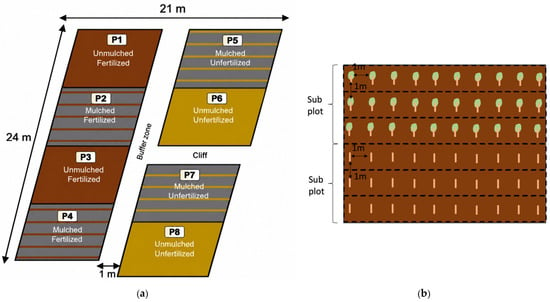
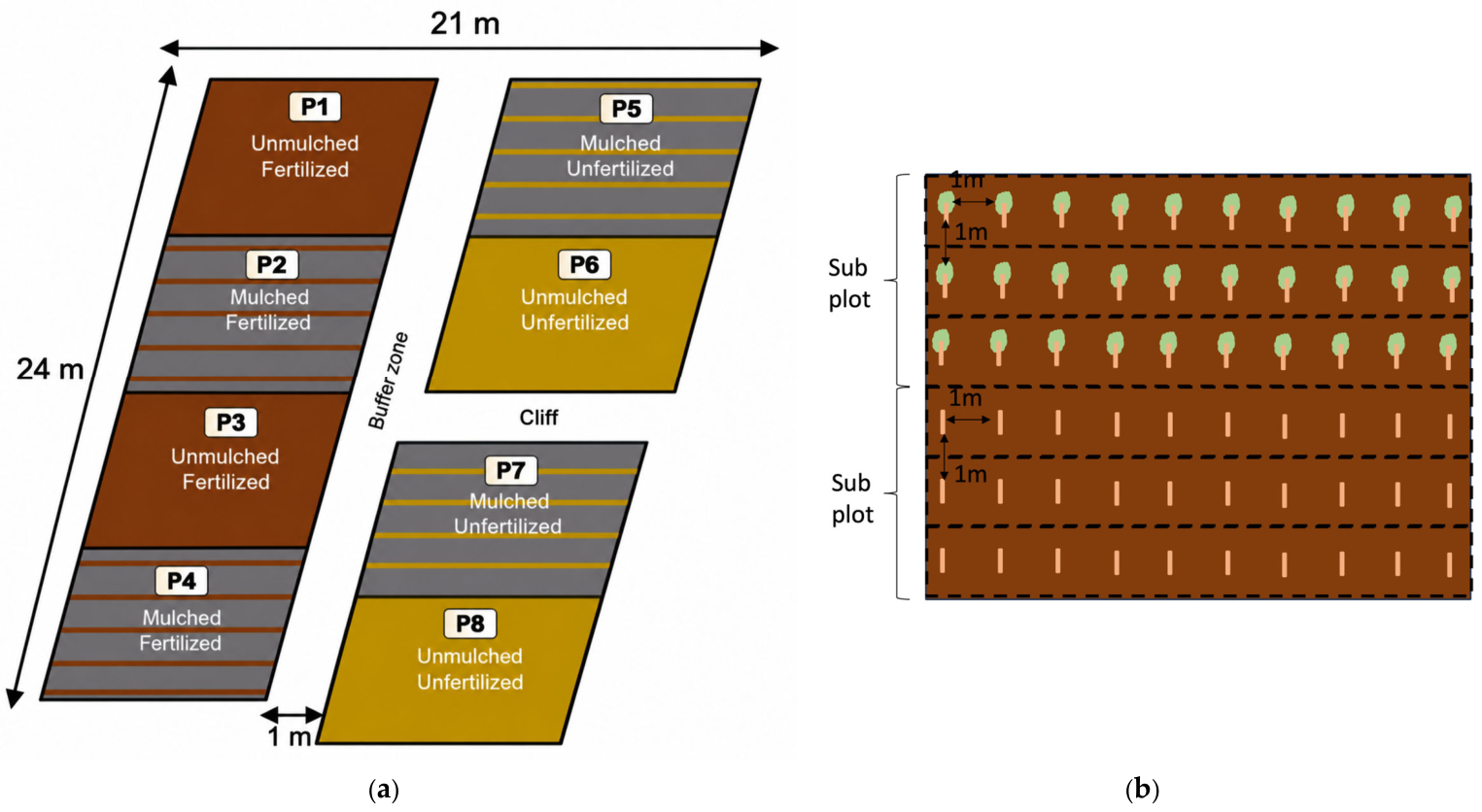
The experiment had a 2 × 2 × 2 factorial treatment structure involving propagation type (rooted vs. unrooted cuttings), fertilization (with vs. without fertilizer), and mulching (with vs. without mulch), arranged in a split-plot configuration. Fertilization and mulching were applied at the whole-plot level across eight plots (P1–P8; Figure 1a), with each of the four combinations represented by two separate whole plots. Each whole plot was divided into two subplots, with 30 rooted cuttings planted in the upper subplot and 30 unrooted cuttings in the lower subplot (Figure 1b). Thus, propagation type was applied at the subplot level, resulting in 16 subplots and a total of 480 trees. The eight treatment combinations (T1–T8) and their corresponding replicate plots are summarized in Table 1.
Figure 1.
Experimental layout and split-plot arrangement. (a) Spatial arrangement of the eight whole plots (P1–P8) and allocation of fertilization and mulching treatments. All dimensions are horizontal (plan-view) distances. (b) Within-plot subplot arrangement and planting spacing. Each whole plot was divided into an upper subplot containing 30 rooted cuttings and a lower subplot containing 30 unrooted cuttings, resulting in 16 split plots in total.
Table 1.
Treatment combinations and corresponding replicate plots.
A granular compound fertilizer (Green Fever; Nihon Ringyo Hiryo Co., Ltd., Tokyo, Japan; N:P:K = 15:15:15) was applied uniformly at a rate of approximately 5 kg per plot and incorporated into the upper soil layer (approximately 20 cm) before planting. For the mulching treatment, six parallel strips of permeable black non-woven fabric (1.0 m wide; Takii & Co., Ltd., Kyoto, Japan) were installed within each plot. The strips were arranged at equal intervals, and cross-shaped slits were cut at predetermined planting positions. The mulch sheets were secured using L-shaped stakes and washers. Within each plot, the two propagation types were established in separate adjacent planting sections, with 30 rooted cuttings and 30 unrooted cuttings planted in fixed positions. Planting positions were spaced at 1 m × 1 m in terms of horizontal distance, and the distance between the outermost cuttings and each lateral edge of the mulch sheet was approximately 24 cm in terms of slope distance.
Planting was conducted on 13 February 2025. This planting date was consistent with established late-winter planting practices for dormant poplar cuttings and rooted planting stock [27]. For rooted cuttings, planting holes were excavated using a Moller auger (GM50-200; Sun-A Co., Ltd., Kusatsu, Shiga, Japan), into which the saplings were planted. For unrooted cuttings, pilot holes were prepared using pegs before the cuttings were inserted to a depth of 15–17 cm with the winter buds oriented upward. The surrounding soil was then firmly compacted. Rainfall of 14.0 mm was recorded at the Aono meteorological station on 12 February 2025, the day before planting. The soil was observed to be moist at the time of planting, and research forest staff considered supplemental irrigation unnecessary. No supplemental irrigation was applied throughout the establishment period. The mean and minimum air temperatures on the planting date were 9.4 °C and 1.4 °C, respectively. During 19–25 February 2025, daily minimum air temperatures fell below 0 °C, reaching −2.7 °C on 20 February [26].
2.3. Measurements
Eight months after planting, all trees were assessed for survival, height (cm), root collar diameter (RCD, mm), and diameter at breast height (DBH, mm). Survival was assessed visually based on the condition of the cuttings. Cuttings showing complete apparent dieback were classified as dead, whereas those with yellowing or insect-damaged leaves were still classified as alive if their stems showed visible signs of vitality. Tree height was measured using a measuring tape for individuals shorter than 100 cm and a Lenker’s rod (ATP series; Senshin Industry Co., Ltd., Osaka, Japan) for those 100 cm or taller. Both RCD and DBH were measured using an electronic diameter gauge (Mitutoyo Corporation, Kawasaki, Kanagawa, Japan). DBH was recorded only for trees that reached a height of at least 130 cm.
2.4. Statistical Analysis
Survival was analyzed using a generalized linear mixed-effects model (GLMM) with a binomial distribution and logit link function, whereas height and RCD were analyzed using linear mixed-effects models (LMMs). Propagation type, fertilization, and mulching were treated as fixed effects. Initial models included all two-way and three-way interactions among the three factors. To account for the split-plot structure, random intercepts for plot and split plot were initially considered, with individual trees treated as observations nested within split plots and plots. The linear predictors of the initial full candidate models were specified as follows:
The corresponding response-specific distributions and link functions were defined as follows:
Survival:
Height and RCD:
Note: Indices i, j, and k denote plot (eight whole plots), subplot (two within each plot), and individual tree, respectively; superscript r identifies the response: survival (S), height (H), or root collar diameter (RCD). The binary indicators T, F, and M represent propagation type, fertilization, and mulching, respectively. Fertilization and mulching were assigned at the plot level, whereas propagation type was assigned at the subplot level. The coefficients β are response-specific fixed-effect parameters. The terms b and u are initially considered random intercepts for plot and subplot nested within plot, respectively, assumed to be independent, mean-zero normally distributed random variables; the Gaussian residuals are also assumed independent of the random intercepts. For survival, η is the logit of the conditional survival probability; for height and RCD, η is the conditional mean. Equation (1) represents the initial full candidate specification rather than the final selected models. The retained fixed effects and random-effect structures for each response are reported with the final models in Section 3.
Random-effect structures were assessed for singularity, and variance components estimated at the boundary were removed when they did not contribute to model fit.
Fixed-effect structures were evaluated hierarchically by comparing nested models using likelihood ratio tests (LRTs). For the LMMs, candidate models were fitted using maximum likelihood (ML) during model selection, and non-supported higher-order interactions were sequentially removed while maintaining the corresponding lower-order terms. Final LMMs were refitted using restricted maximum likelihood (REML) for parameter estimation. Fixed effects in the final survival GLMM were evaluated using Wald chi-square tests, whereas those in the final height and RCD LMMs were evaluated using F-tests with Kenward–Roger-adjusted degrees of freedom.
Estimated marginal means (EMMs) and pairwise contrasts were calculated to facilitate interpretation of treatment effects and interactions. For survival, EMMs were expressed as predicted survival probabilities. For the LMMs, pairwise comparisons were conducted using Kenward–Roger-adjusted degrees of freedom. For each continuous response, four targeted simple-effect contrasts were treated as one family, and the resulting p-values were adjusted using the Holm method. Ninety-five percent confidence intervals were calculated for estimated responses. The GLMM was evaluated using simulation-based residual diagnostics, whereas the LMMs were assessed using residual and Q–Q plots. Sensitivity analyses based on split-plot-level mean height and RCD were additionally conducted to assess the robustness of the growth-model results.
The variance associated with the plot-level random effect was examined to assess the magnitude of unexplained variation among plots after accounting for the fixed effects. For the linear mixed models, the proportion of total variance attributable to plot-level differences was quantified using the intraclass correlation coefficient (ICC). Marginal and conditional R2 were calculated for all final mixed-effects models. In-sample root mean square error (RMSE) was calculated for height and RCD, whereas the Brier score was calculated for survival. RMSE and Brier scores were based on conditional fitted predictions.
All analyses were performed using R version 4.6.1, and p < 0.05 was considered statistically significant.
3. Results
3.1. Survival
A total of 480 cuttings were planted, of which 201 survived until the assessment in October 2025, resulting in an overall survival rate of 41.9%. Observed survival rates across the eight treatment combinations ranged from 30.0% (T1 and T5) to 60.0% (T8), as summarized in Table 2.
Table 2.
Observed survival and growth of the hybrid poplar clone Mori-no-Mirai 17 under eight treatment combinations.
Fixed-effect estimates and Wald chi-square tests for the final survival GLMM are presented in Table 3.
Table 3.
Fixed-effect estimates and Wald chi-square tests for the final survival GLMM.
In the GLMM analyses, a full interaction model was compared with an additive model containing only the main effects. The three-way interaction did not significantly improve model fit (LRT, p = 0.879). Subsequent removal of the two-way interactions also did not significantly reduce model fit (LRT, p = 0.833); therefore, the additive model was selected for subsequent inference. In the initial GLMM model, the split-plot random-intercept variance was estimated as zero, resulting in a singular fit; therefore, the split-plot random intercept was removed from the final model.
Accordingly, the final survival GLMM was specified as follows:
logit(pijk) = β0,S + β1,STij + β2,SFi + β3,SMi + bi,S
Note: Tij = 1 indicates rooted cuttings (0 = unrooted cuttings). The remaining notation follows Equation (1).
Wald chi-square tests indicated a significant effect of propagation type (χ2 = 14.87, df = 1, p < 0.001), whereas fertilization (χ2 = 0.14, df = 1, p = 0.709) and mulching (χ2 = 1.81, df = 1, p = 0.179) were not statistically significant. The marginal and conditional R2 values of the final survival GLMM were 0.054 and 0.098, respectively, with an in-sample Brier score of 0.223 based on conditional fitted probabilities.
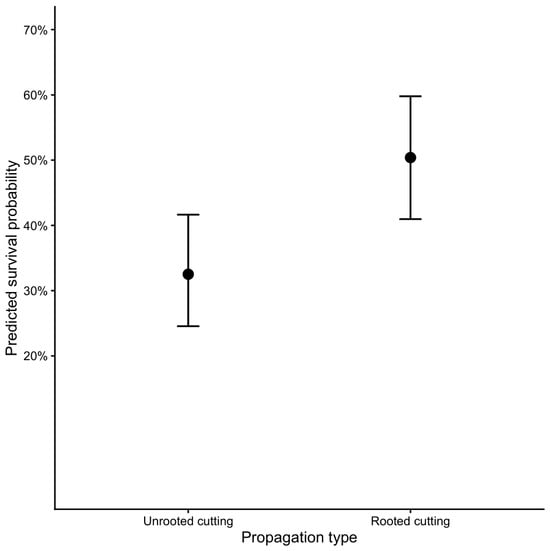
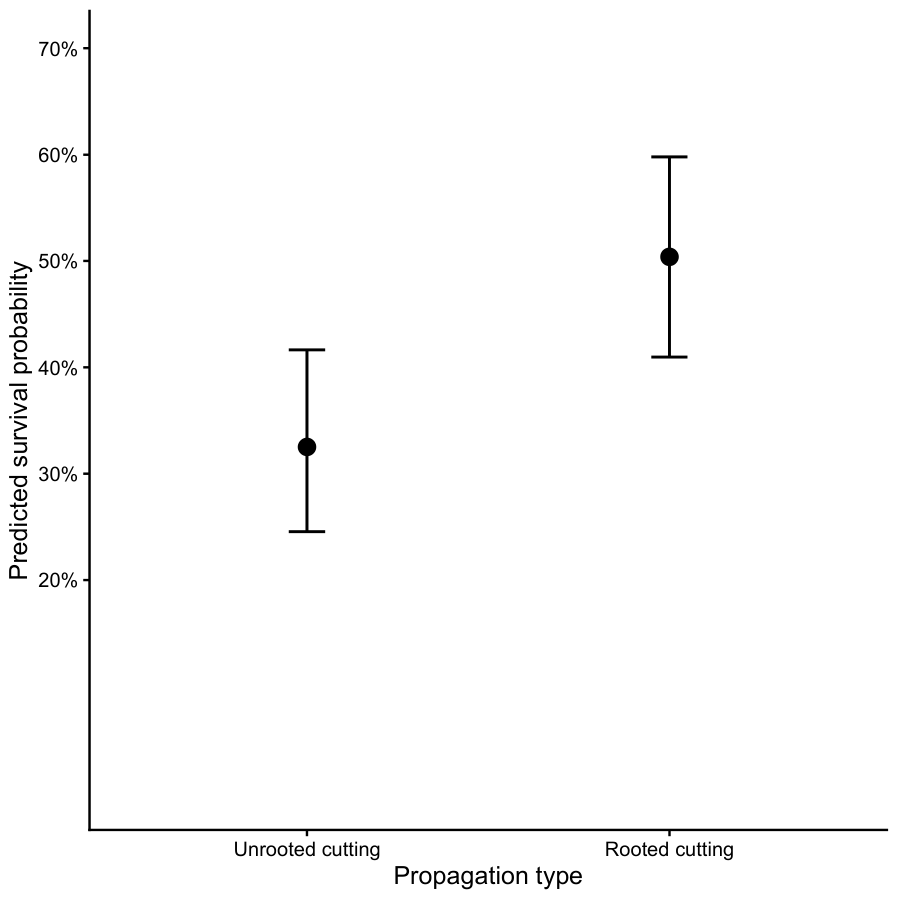
After accounting for plot-level variation, propagation type was the strongest predictor of sapling survival. Rooted cuttings had 2.11-fold higher odds of survival than unrooted cuttings (95% CI: 1.44–3.08). The predicted survival probability was 50.4% for rooted cuttings and 32.5% for unrooted cuttings, corresponding to a difference of 17.9 percentage points (Figure 2). Fertilization increased the odds of survival by 1.14-fold (95% CI: 0.58–2.23), whereas mulching increased survival odds by 1.59-fold (95% CI: 0.81–3.12). However, neither treatment effect was statistically significant after accounting for plot-level variation.
Figure 2.
Predicted survival probability by propagation type. Error bars indicate 95% confidence intervals estimated from the GLMM.
The estimated standard deviation of the plot-level random effect was 0.40, indicating residual variation among plots after accounting for propagation type, fertilization, and mulching.
3.2. Growth Responses
Growth analyses included 200 of the 201 surviving individuals with available height and RCD measurements. Across the eight treatment combinations, observed mean height ranged from 21.4 ± 11.2 cm (T1) to 122.2 ± 55.2 cm (T8), while observed mean RCD ranged from 5.23 ± 1.11 mm (T1) to 10.72 ± 4.01 mm (T8; Table 2).
For both height and RCD, the final LMMs retained an interaction between propagation type and fertilization, indicating that the response to fertilization differed depending on propagation type. Mulching was retained as an additive effect in both models. Fixed-effect estimates for the final height and RCD LMMs are presented in Table 4.
Table 4.
Fixed-effect estimates from the final linear mixed-effects models for height and root collar diameter (RCD).
For height, inclusion of the propagation type × fertilization interaction significantly improved model fit (LRT, χ2 = 5.20, df = 1, p = 0.023; Table S1). Accordingly, the final height LMM was specified as follows:
Hijk = β0,H + β1,H(1 − Tij) + β2,HFi + β3,HMi + β4,H(1 − Tij)Fi + bi,H + uij,H + εijk,H
Note: The term (1 − Tij) indicates unrooted cuttings, with rooted cuttings as the reference category. The remaining notation follows Equation (1).
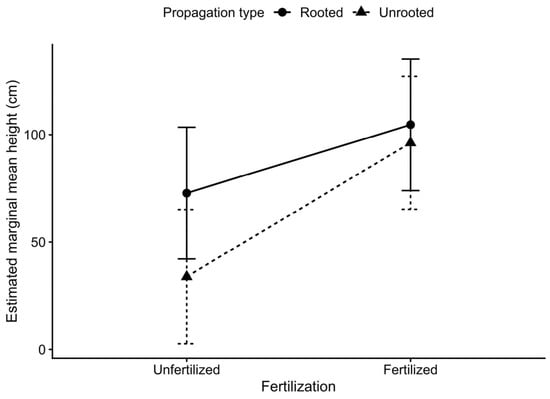
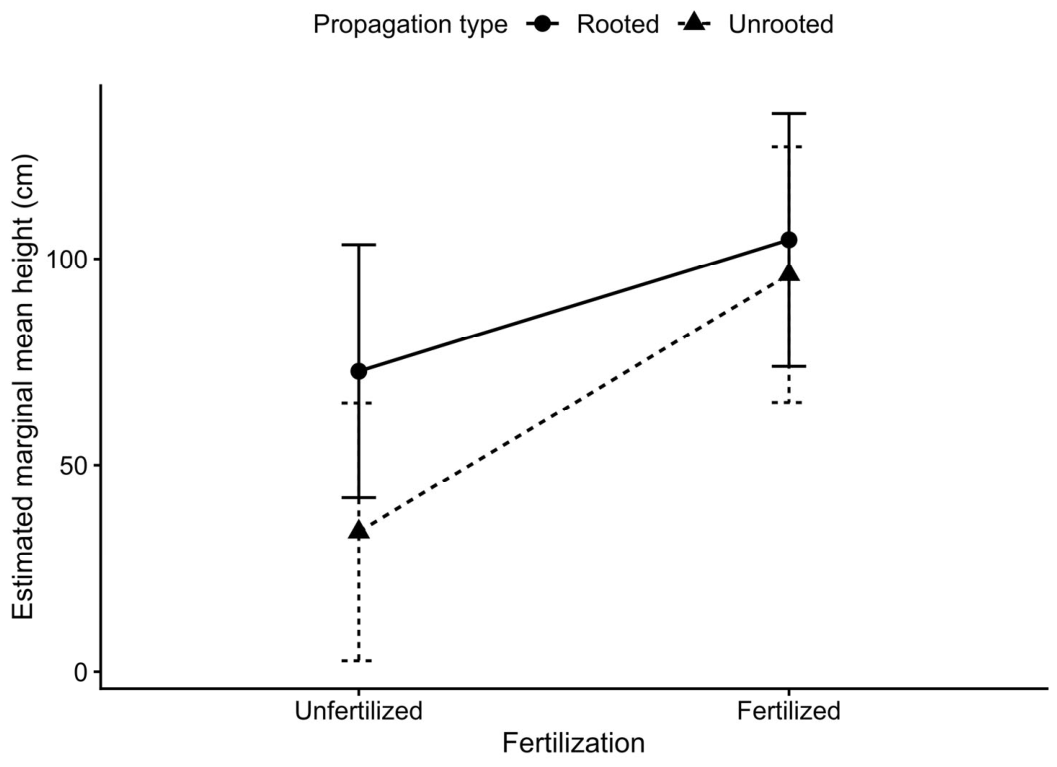
However, the interaction did not reach statistical significance in the Kenward–Roger F-test (F(1, 5.45) = 5.19, p = 0.067; Table 5). Based on estimated marginal means, fertilization was associated with an increase in height of unrooted cuttings from 33.9 cm to 96.2 cm, corresponding to an increase of 62.3 cm (Holm-adjusted p = 0.037). For rooted cuttings, estimated height increased from 72.7 cm to 104.6 cm, corresponding to an increase of 31.9 cm (Holm-adjusted p = 0.245). Accordingly, the estimated height difference between rooted and unrooted cuttings decreased from 38.9 cm under unfertilized conditions (Holm-adjusted p = 0.032) to 8.4 cm under fertilized conditions (Holm-adjusted p = 0.401) (Figure 3). Plot-level variation accounted for approximately 28% of the total variance in height (plot-level ICC = 0.28), while an additional small proportion of variation was attributable to the split-plot level.
Table 5.
Kenward–Roger F-tests for fixed effects in the final height and RCD LMMs.
Figure 3.
Interaction between propagation type and fertilization on estimated marginal mean height. Error bars indicate 95% confidence intervals.
A similar interaction pattern was observed for RCD. Inclusion of the propagation type × fertilization interaction significantly improved model fit (LRT, χ2 = 4.67, df = 1, p = 0.031; Table S1). Accordingly, the final RCD LMM was specified as follows:
RCDijk = β0,RCD + β1,RCD(1 − Tij) + β2,RCDFi + β3,RCDMi + β4,RCD(1 − Tij)Fi + bi,RCD + εijk,RCD
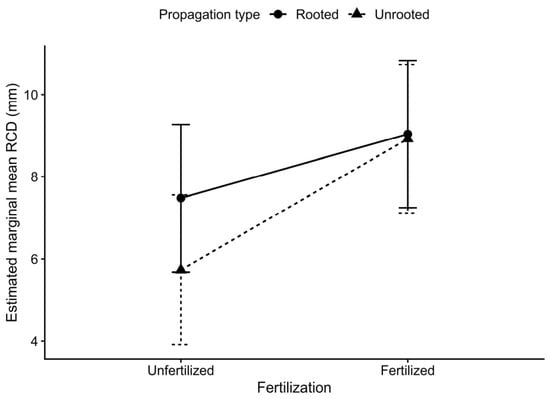
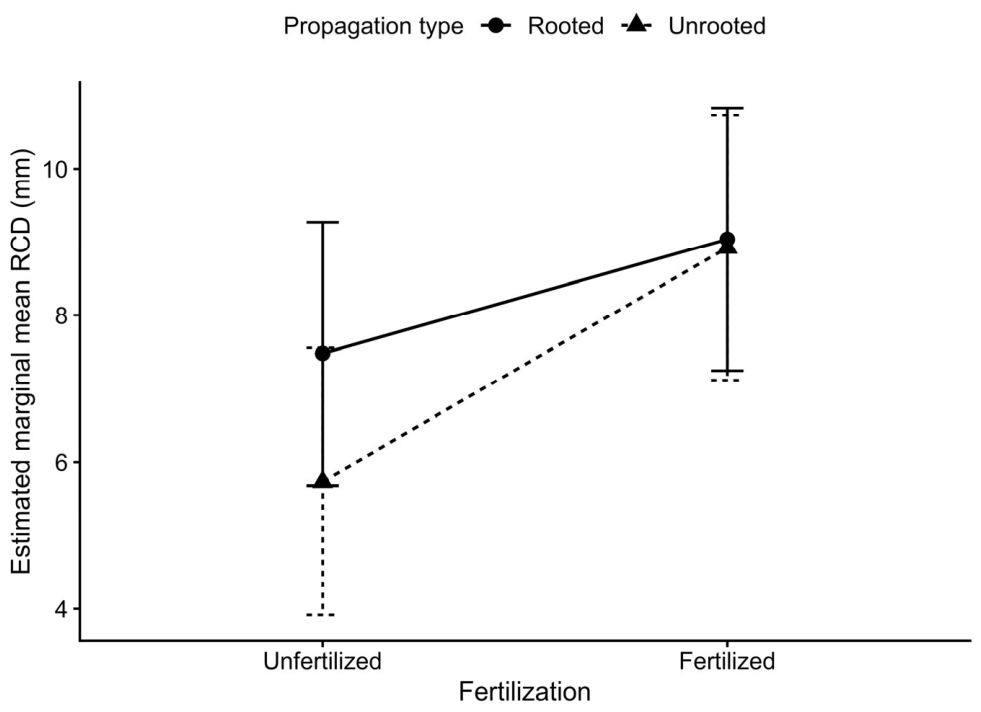
The interaction was also statistically significant in the Kenward–Roger F-test (F(1, 191.50) = 4.71, p = 0.031; Table 5). Fertilization was associated with an increase in estimated RCD of unrooted cuttings from 5.73 mm to 8.92 mm, corresponding to an increase of 3.19 mm (Holm-adjusted p = 0.065). For rooted cuttings, estimated RCD increased from 7.48 mm to 9.04 mm, corresponding to an increase of 1.56 mm (Holm-adjusted p = 0.364). Consequently, the estimated difference between rooted and unrooted cuttings decreased from 1.74 mm under unfertilized conditions (Holm-adjusted p = 0.006) to 0.12 mm under fertilized conditions (Holm-adjusted p = 0.822) (Figure 4). Mulching was associated with a higher estimated RCD (8.71 vs. 6.88 mm), although the Kenward–Roger-adjusted marginal contrast was not statistically significant (p = 0.124). Plot-level variation accounted for approximately 20% of the total variance in RCD (plot-level ICC = 0.20).
Figure 4.
Interaction between propagation type and fertilization on estimated marginal mean RCD. Error bars indicate 95% confidence intervals.
The marginal and conditional R2 values were 0.319 and 0.532 for height, and 0.231 and 0.388 for RCD, respectively. The corresponding in-sample RMSE values based on conditional fitted values were 33.57 cm and 2.49 mm.
Split-plot-level sensitivity analyses produced consistent results, with the propagation type × fertilization interaction retained for both height (p = 0.017) and RCD (p = 0.026; Table S2).
DBH measurements were available for only 25 surviving individuals that had reached breast height. The observed DBH ranged from 0.0 to 11.9 mm, with a median of 6.4 mm and a mean of 6.5 mm. Given the small number and uneven distribution of measurable individuals among treatments and plots, DBH was not subjected to formal treatment-effect analysis.
4. Discussion
4.1. Propagation Type Had the Strongest Influence on Establishment Success
In this study, propagation type had the strongest influence on early establishment success among the three evaluated management practices. Rooted cuttings exhibited higher survival than unrooted cuttings, and the GLMM indicated a strong association between propagation type and survival after accounting for plot-level variation. However, propagation types were established in fixed adjacent sections within each plot, with rooted and unrooted cuttings consistently occupying different slope positions. Consequently, the effects of propagation type and within-plot microsite position cannot be fully separated. The observed differences should therefore be interpreted as associations under the present experimental layout rather than as unequivocal causal effects of propagation type. For growth, the LMM analyses further indicated a propagation type × fertilization interaction for both height and RCD, with the estimated growth response associated with fertilization being greater for unrooted than for rooted cuttings.
The overall survival rate of 41.9% observed eight months after planting was relatively low compared with those reported in several previous poplar establishment studies. Broeckx et al. [6] reported a cumulative mortality rate of 18.2% (equivalent to approximately 81.8% survival) during the first growing season in a Belgian plantation established using dormant unrooted hardwood cuttings on former cropland and pastureland. Similarly, Hjelm et al. [10] compared short cuttings, long cuttings, and container-grown rooted plants at three agricultural sites in Sweden, reporting five-year survival rates of 63% without mulch and 73% with mulch.
However, relatively low survival rates have also been documented. Heilig et al. [28] reported 43% survival after two growing seasons for the hybrid poplar clone ‘AF2’ (Populus deltoides × P. nigra), established using 35-cm unrooted cuttings at a former agricultural site in western Slovakia. More recently, Hallett et al. [29] reported first-year survival of 51% for directly planted Populus cuttings, compared with more than 97% for nursery-grown potted trees in urban forest canopy gaps, where supplemental watering was provided during a dry period. These comparisons indicate substantial variation in poplar establishment success across studies. Differences in clone, planting material, site conditions, management practices, and assessment periods make direct comparisons difficult and prevent the relatively low survival observed in the present study from being attributed solely to mountainous site conditions.
The superior survival of rooted cuttings may be associated with differences in root system development between the two propagation types. Unlike unrooted cuttings, which must first initiate adventitious roots after planting, rooted cuttings already possess a functional root system capable of immediately supporting water and nutrient uptake during the critical establishment phase [30]. Because successful establishment of hardwood cuttings depends on the rapid development of these adventitious roots [31], rooted cuttings are likely to experience lower transplant stress and establish more rapidly after planting, an advantage that may be particularly important under mountainous conditions where steep slopes and variable soil moisture can further constrain root development. Earlier establishment of a functional root system may therefore contribute to greater shoot growth during the first growing season. This interpretation is consistent with previous findings that the morphological and physiological quality of planting stock strongly influences post-planting survival and early growth across a wide range of environmental conditions [32].
The present results are generally consistent with previous studies demonstrating that propagation type strongly influences the establishment success of hybrid poplar plantations. Hjelm et al. [10] found that long cuttings generally outperformed short cuttings and rooted plants across three agricultural sites in Sweden, although treatment responses varied among sites. Similarly, Böhlenius and Övergaard [16] reported greater early growth of unrooted cuttings than bare-rooted seedlings on former agricultural land. These findings suggest that the performance of different planting materials depends on site conditions and management practices. Collectively, these studies indicate that the relative performance of different propagation materials is strongly context-dependent. Because previous studies have mainly focused on agricultural land or conventional forest sites, evidence from mountainous plantation environments remains limited. The present study extends existing knowledge by demonstrating that rooted cuttings maintained a clear survival advantage over unrooted cuttings under steep mountainous conditions, suggesting that propagation type becomes increasingly important as establishment conditions become more challenging.
4.2. Mulching Showed Limited Benefits Under Mountainous Conditions
In the present study, mulching showed a positive but non-significant effect on plant survival, increasing the odds of survival by 1.59-fold (95% CI: 0.81–3.12). Mulching was not associated with a clear improvement in height during the first growing season. Estimated RCD was greater under mulching than under non-mulching conditions (8.71 vs. 6.88 mm), although the Kenward–Roger-adjusted marginal contrast was not statistically significant (p = 0.124). Overall, these results provide limited evidence that mulching substantially improved early establishment under the conditions examined.
Vegetation competition is widely recognized as an important constraint affecting early growth and survival during hybrid poplar establishment. Broeckx et al. [6] reported that although initial survival of planted poplar cuttings was high, mortality increased substantially after competitive vegetation became established, highlighting the importance of vegetation control during early plantation development. Similarly, Bilodeau-Gauthier et al. [7] demonstrated that competition control significantly enhanced juvenile growth of hybrid poplar, particularly at sites with strong vegetation pressure. Pinno and Bélanger [20] further showed that complete weed control increased juvenile hybrid poplar growth across sites, suggesting that competition for belowground resources, particularly soil water, is an important mechanism limiting early tree development. In SRC poplar systems, Morhart et al. [33] also demonstrated that weed management practices implemented during the establishment year influenced subsequent biomass production, with herbicide-based vegetation control resulting in greater biomass production than mulch-based treatments.
Mulching has therefore been proposed as an alternative vegetation management strategy because it can simultaneously reduce weed competition and improve soil conditions. Böhlenius and Övergaard [17] demonstrated that polypropylene mulch enhanced early growth of poplar by reducing vegetation competition, with larger mulch treatments producing greater height and diameter growth. In addition, Machado et al. [34] showed that organic mulching increased tree survival by improving soil moisture conditions and reducing soil temperature fluctuations. Yáñez et al. [35] further demonstrated that moderate water restriction reduced shoot growth, photosynthetic rate, and stomatal conductance in nursery-grown hybrid poplar clones, highlighting the importance of water availability for early poplar growth. These studies collectively indicate that effective vegetation management and adequate water availability are critical components of successful hybrid poplar establishment, whereas benefits of mulching may depend strongly on site conditions, the dominant environmental constraints, and mulch application conditions.
In the present study, the limited response to mulching may be partly explained by site-specific constraints associated with the mountainous environment. Although the experimental area had been clear-cut and prepared before planting, substantial shrub and herbaceous vegetation had re-established by the measurement period, indicating that vegetation competition remained present during early plantation development. Furthermore, the steep terrain and uneven soil surface may have reduced the effectiveness of mulch application. In particular, mulch sheets could not always maintain complete contact with the soil surface on steep slopes, potentially limiting their ability to suppress weeds and conserve soil moisture compared with flatter plantation sites. In addition, the strong effect of propagation type observed in this study suggests that initial planting material characteristics were a more important determinant of early establishment success than mulching under the conditions examined.
Nevertheless, the lack of clear evidence of a mulching effect does not indicate that vegetation management can be neglected in mountainous SRC plantations. Rather, the present results suggest that mulching alone may not provide sufficient vegetation control under steep mountainous conditions. Because repeated mechanical or chemical weed control is often difficult and costly on such sites, selecting appropriate weed management strategies according to site-specific constraints remains an important consideration for successful hybrid poplar establishment.
4.3. Fertilization Effects Depended on Propagation Type Under Mountainous Conditions
In the present study, fertilization increased the odds of plant survival by approximately 1.14-fold (95% CI: 0.58–2.23), although this effect was not statistically significant. For growth, the fitted LMMs retained propagation type × fertilization interaction terms, with the estimated differences in height and RCD between rooted and unrooted cuttings becoming smaller under fertilization. These results suggest that the effects of fertilization were not uniform across establishment responses but depended on the initial characteristics of planting materials.
Fertilization is widely used in hybrid poplar plantations because nutrient availability can limit biomass production and early growth. Previous studies have demonstrated that nitrogen and phosphorus additions can enhance hybrid poplar growth and stem volume, particularly when nutrient availability is a major limiting factor [18,19]. However, fertilizer responses are not universal and often depend on site fertility, clone characteristics, and the timing and method of fertilizer application [19]. For example, Hansen et al. [36] demonstrated that fertilizer effects varied with soil fertility and vegetation competition, with limited growth responses during early establishment when nutrient availability was not the primary constraint. Similarly, Bilodeau-Gauthier et al. [7] showed that fertilization could not compensate for inadequate site conditions, emphasizing that nutrient management should be considered together with other factors influencing early plantation development. More recently, Ghezehei et al. [37] found that nitrogen fertilization did not significantly affect poplar survival and increased sixth-year stem biomass at a fertile sandy site but not at two marginal sandy sites. Muraro et al. [38] reported improved early poplar growth following wood ash and lime application on acidic forest and forested arable soils. Furthermore, Muraro et al. [39] documented variation in early establishment performance across forest land and forested arable land, with wood ash improving poplar survival on forested arable land.
The lack of a significant survival response to fertilization in the present study may therefore indicate that nutrient availability was not the only factor limiting early establishment under the examined mountainous conditions. Instead, establishment success appeared to be more strongly influenced by planting material characteristics, as demonstrated by the significant effect of propagation type. However, fertilization reduced the differences in height and RCD between rooted and unrooted cuttings by promoting greater growth in unrooted cuttings, indicating that fertilizer responses depended on propagation type. This interaction suggests that nutrient addition may have partially alleviated the initial disadvantage of unrooted cuttings after establishment. Because nutrient uptake in unrooted cuttings is constrained during the early establishment phase, additional nutrient availability may become increasingly beneficial once adventitious roots begin to develop. Previous studies on hybrid poplar grown from unrooted cuttings have emphasized the importance of nutrient acquisition and balanced plant nutrition for maximizing biomass accumulation [40]. Furthermore, previous studies have shown that treatment responses vary with planting material and site conditions [10,18], highlighting that the benefits of fertilization depend on the physiological status of plants and the factors limiting growth.
Together, these findings indicate that fertilization should not be considered as an independent solution for improving early establishment of hybrid poplar plantations. Under challenging mountainous environments, fertilizer benefits may be limited when other constraints, such as the establishment capacity of planting materials or microsite conditions, dominate early growth responses. Therefore, nutrient management strategies should be integrated with appropriate selection of propagation materials and site-specific management practices to maximize early plantation performance.
4.4. Implications for Hybrid Poplar Establishment on Mountainous Sites
The plot-level random effects indicated residual variation among plots after accounting for propagation type, fertilization, and mulching, suggesting that fine-scale environmental heterogeneity influenced early survival and growth beyond the measured management treatments. In particular, approximately 28% and 20% of the total variance in height and RCD, respectively, were attributable to plot-level differences, indicating that local site conditions contributed substantially to growth variation. Although elevation and other microsite characteristics were not explicitly included as fixed effects, variation in topographic position and within-site environmental conditions among plots may have contributed to differences in establishment performance. Therefore, site-specific characteristics should be considered when developing establishment strategies for hybrid poplar plantations in mountainous environments.
From a practical perspective, the observed differences in establishment success between rooted and unrooted cuttings suggest that establishment reliability should be considered alongside initial planting costs under comparable site conditions. Although unrooted cuttings are widely used in SRC systems because of their low production cost and ease of transportation and deployment, the improved establishment performance associated with rooted planting materials may justify their use on challenging sites where establishment failure represents a major risk. However, further research is required to determine whether the initial survival advantage of rooted planting materials persists throughout later rotation stages and compensates for their higher establishment costs.
4.5. Limitations and Future Research
Although this study provides insights into the early establishment dynamics of hybrid poplar SRC under mountainous conditions, several limitations should be considered when interpreting the results.
First, the experiment was conducted using a single clone, Mori-no-Mirai 17th, and at one mountainous site. Therefore, the observed responses may reflect clone- and site-specific characteristics, and further studies involving multiple clones and contrasting site conditions are required to evaluate the general applicability of these findings. The experimental design also included only eight whole plots, with two independent plot replicates for each fertilization × mulching combination. Because fertilization and mulching were applied at the whole-plot level, this limited replication may have reduced the statistical power to detect their effects. Therefore, non-significant treatment effects should be interpreted cautiously and should not be regarded as evidence of no effect. Second, SRC productivity depends not only on initial establishment but also on the ability of plants to regenerate through repeated coppice cycles. Resprouting capacity, which determines stand persistence and biomass accumulation over successive rotations, was not assessed in the present study and should be incorporated into future evaluations of propagation and management strategies. Third, this study focused on survival and aboveground growth responses, whereas direct biomass measurements were not available during the first assessment. Future analyses incorporating biomass estimation and carbon accumulation will provide a more comprehensive evaluation of establishment strategies for SRC production systems. In particular, the second measurement campaign will enable the development of biomass estimation equations based on tree growth measurements, allowing subsequent assessment of biomass production and carbon sequestration potential under different management scenarios. An additional limitation concerns planting timing and low-temperature exposure following planting. Although late-winter planting is consistent with established poplar planting practices, subzero minimum air temperatures were recorded during the two weeks following planting, which may have affected establishment success. However, because frost injury was not directly assessed and alternative planting dates were not evaluated, the contribution of these factors to the observed survival rate of 41.9% remains uncertain. Finally, the mechanisms underlying treatment responses could not be fully evaluated because physiological traits, such as root development, leaf nutrient status, and plant water relations, were not measured. Future studies integrating physiological measurements with long-term growth monitoring would help clarify how propagation type and management practices may interact to influence establishment under stressful mountainous environments.
Supplementary Materials
The following supporting information can be downloaded at https://www.mdpi.com/article/10.3390/j9040034/s1, Table S1: Likelihood-ratio tests used for fixed-effect model selection in mixed-effects models of survival, height, and RCD.; Table S2: Sensitivity analyses of the propagation type × fertilization interaction using split-plot-level mean growth responses.
Author Contributions
Methodology, software, validation, formal analysis, investigation, data curation, writing—original draft preparation, W.L.; conceptualization, methodology, validation, writing—review and editing, T.H.; writing—review and editing, H.S. All authors have read and agreed to the published version of the manuscript.
Funding
This research was funded by Mohammed bin Salman Center for Future Science and Technology for Saudi-Japan Vision 2030 at the University of Tokyo (MbSC2030).
Institutional Review Board Statement
Not applicable.
Informed Consent Statement
Not applicable.
Data Availability Statement
The analyzed datasets used in this study belong to the University of Tokyo, and are not publicly available; however, these datasets can be provided by the corresponding author upon request and with appropriate justification.
Acknowledgments
We are grateful to the members of Arboricultural Research Institute, The University of Tokyo Forests, Graduate School of Agricultural and Life Sciences, The University of Tokyo, for their support with experimental site settings and data measurements.
Conflicts of Interest
The authors declare no conflicts of interest.
Abbreviations
The following abbreviations are used in this manuscript:
| RCD | root collar diameter |
| SRC | short-rotation coppice |
| DBH | diameter at breast height |
| LRT | likelihood ratio test |
| LMMs | Linear Mixed Models |
| ICC | intraclass correlation coefficient |
References
- Intergovernmental Panel on Climate Change (IPCC). Climate Change 2023: Synthesis Report. Contribution of Working Groups I, II and III to the Sixth Assessment Report of the Intergovernmental Panel on Climate Change; Core Writing Team, Lee, H., Romero, J., Eds.; IPCC: Geneva, Switzerland, 2023; pp. 35–115. [Google Scholar] [CrossRef] [Scilit]
- Bukoski, J.J.; Cook-Patton, S.C.; Melikov, C.; Ban, H.; Chen, J.L.; Goldman, E.D.; Harris, N.L.; Potts, M.D. Rates and drivers of aboveground carbon accumulation in global monoculture plantation forests. Nat. Commun. 2022, 13, 4206. [Google Scholar] [CrossRef] [Scilit] [PubMed]
- Ceulemans, R.; Deraedt, W. Production physiology and growth potential of poplars under short-rotation forestry culture. For. Ecol. Manag. 1999, 121, 9–23. [Google Scholar] [CrossRef] [Scilit]
- Mitchell, C.P.; Stevens, E.A.; Watters, M.P. Short-rotation forestry—Operations, productivity and costs based on experience gained in the UK. For. Ecol. Manag. 1999, 121, 123–136. [Google Scholar] [CrossRef] [Scilit]
- Al Afas, N.; Marron, N.; Van Dongen, S.; Laureysens, I.; Ceulemans, R. Dynamics of biomass production in a poplar coppice culture over three rotations (11 years). For. Ecol. Manag. 2008, 255, 1883–1891. [Google Scholar] [CrossRef] [Scilit]
- Broeckx, L.S.; Verlinden, M.S.; Ceulemans, R. Establishment and two-year growth of a bio-energy plantation with fast-growing Populus trees in Flanders (Belgium): Effects of genotype and former land use. Biomass Bioenergy 2012, 42, 151–163. [Google Scholar] [CrossRef] [Scilit]
- Bilodeau-Gauthier, S.; Paré, D.; Messier, C.; Bélanger, N. Juvenile growth of hybrid poplars on acidic boreal soil determined by environmental effects of soil preparation, vegetation control, and fertilization. For. Ecol. Manag. 2011, 261, 620–629. [Google Scholar] [CrossRef] [Scilit]
- Grossnickle, S.C.; MacDonald, J.E. Why seedlings grow: Influence of plant attributes. New For. 2018, 49, 1–34. [Google Scholar] [CrossRef] [Scilit]
- Truax, B.; Gagnon, D.; Fortier, J.; Lambert, F. Biomass and volume yield in mature hybrid poplar plantations on temperate abandoned farmland. Forests 2014, 5, 3107–3130. [Google Scholar] [CrossRef] [Scilit]
- Hjelm, K.; Mc Carthy, R.; Rytter, L. Establishment strategies for poplars, including mulch and plant types, on agricultural land in Sweden. New For. 2018, 49, 737–755. [Google Scholar] [CrossRef] [Scilit] [PubMed]
- Larsen, S.U.; Jørgensen, U.; Kjeldsen, J.B.; Lærke, P.E. Long-term yield effects of establishment method and weed control in willow for short rotation coppice (SRC). Biomass Bioenergy 2014, 71, 266–274. [Google Scholar] [CrossRef] [Scilit]
- Kauter, D.; Lewandowski, I.; Claupein, W. Quantity and quality of harvestable biomass from Populus short rotation coppice for solid fuel use—A review of the physiological basis and management influences. Biomass Bioenergy 2003, 24, 411–427. [Google Scholar] [CrossRef] [Scilit]
- Labrecque, M.; Teodorescu, T.I. Field performance and biomass production of 12 willow and poplar clones in short-rotation coppice in southern Quebec (Canada). Biomass Bioenergy 2005, 29, 1–9. [Google Scholar] [CrossRef] [Scilit]
- Oliveira, N.; Sixto, H.; Cañellas, I.; Rodríguez-Soalleiro, R.; Pérez-Cruzado, C. Productivity model and reference diagram for short rotation biomass crops of poplar grown in Mediterranean environments. Biomass Bioenergy 2015, 72, 309–320. [Google Scholar] [CrossRef] [Scilit]
- Dillen, S.Y.; Djomo, S.N.; Al Afas, N.; Vanbeveren, S.; Ceulemans, R. Biomass yield and energy balance of a short-rotation poplar coppice with multiple clones on degraded land during 16 years. Biomass Bioenergy 2013, 56, 157–165. [Google Scholar] [CrossRef] [Scilit]
- Böhlenius, H.; Övergaard, R. Exploration of optimal agricultural practices and seedling types for establishing poplar plantations. Forests 2015, 6, 2785–2798. [Google Scholar] [CrossRef] [Scilit]
- Böhlenius, H.; Övergaard, R. Growth response of hybrid poplars to different types and levels of vegetation control. Scand. J. For. Res. 2015, 30, 516–525. [Google Scholar] [CrossRef] [Scilit]
- DesRochers, A.; van den Driessche, R.; Thomas, B.R. NPK fertilization at planting of three hybrid poplar clones in the boreal region of Alberta. For. Ecol. Manag. 2006, 232, 216–225. [Google Scholar] [CrossRef] [Scilit]
- Guillemette, T.; DesRochers, A. Early growth and nutrition of hybrid poplars fertilized at planting in the boreal forest of western Quebec. For. Ecol. Manag. 2008, 255, 2981–2989. [Google Scholar] [CrossRef] [Scilit]
- Pinno, B.D.; Bélanger, N. Competition control in juvenile hybrid poplar plantations across a range of site productivities in central Saskatchewan, Canada. New For. 2009, 37, 213–225. [Google Scholar] [CrossRef] [Scilit]
- Mao, R.; Zeng, D.-H.; Hu, Y.-L.; Li, L.-J.; Yang, D. Soil organic carbon and nitrogen stocks in an age-sequence of poplar stands planted on marginal agricultural land in Northeast China. Plant Soil 2010, 332, 277–287. [Google Scholar] [CrossRef] [Scilit]
- O’Neill, M.K.; Shock, C.C.; Lombard, K.A.; Heyduck, R.F.; Feibert, E.B.G.; Smeal, D.; Arnold, R.N. Hybrid poplar (Populus ssp.) selections for arid and semi-arid intermountain regions of the western United States. Agrofor. Syst. 2010, 79, 409–418. [Google Scholar] [CrossRef] [Scilit]
- Toromani, E.; Sanxhaku, M.; Sallaku, M.; Shaho, E. Biomass production and carbon storage of Populus × canadensis Guinier I-214 plantations grown at Pogradeci region in Albania. South. For. 2011, 73, 91–99. [Google Scholar] [CrossRef] [Scilit]
- Ministry of the Environment, Government of Japan. Nature Conservation in Japan: Natural Environment of Japan—Land Use. Available online: https://www.env.go.jp/en/nature/npr/ncj/section1.html (accessed on 30 July 2026).
- Arboricultural Research Institute, The University of Tokyo Forests. Arboricultural Research Institute (2025 Brochure). Available online: https://www.uf.a.u-tokyo.ac.jp/jyugei/gaiyo_ari_en.pdf (accessed on 18 October 2026).
- Arboricultural Research Institute, The University of Tokyo Forests. Monthly Report of Meteorological Data at Aono, 2025. Available online: https://www.uf.a.u-tokyo.ac.jp/research_division/data/kishou/21c/monthly/2025/2025Jaon.pdf (accessed on 18 October 2026).
- Stanturf, J.A.; van Oosten, C.; Netzer, D.A.; Coleman, M.D.; Portwood, C.J. Ecology and silviculture of poplar plantations. In Poplar Culture in North America; Dickmann, D.I., Isebrands, J.G., Eckenwalder, J.E., Richardson, J., Eds.; NRC Research Press: Ottawa, ON, Canada, 2001; pp. 153–206. [Google Scholar]
- Heilig, D.; Heil, B.; Leibing, C.; Röhle, H.; Kovács, G. Comparison of the Initial Growth of Different Poplar Clones on Four Sites in Western Slovakia—Preliminary Results. BioEnergy Res. 2021, 14, 374–384. [Google Scholar] [CrossRef] [Scilit] [PubMed]
- Hallett, R.A.; Sonti, N.F.; Piana, M.R.; Zalesny, R.S., Jr. Early establishment performance of hybrid Populus and Salix in canopy gaps of a post emerald ash borer urban forest. Urban For. Urban Green. 2026, 124, 129564. [Google Scholar] [CrossRef] [Scilit]
- Riikonen, J.; Luoranen, J. Seedling production and the field performance of seedlings. Forests 2018, 9, 740. [Google Scholar] [CrossRef] [Scilit]
- Krabel, D.; Meyer, M.; Solger, A.; Müller, R.; Carvalho, P.; Foulkes, J. Early root and aboveground biomass development of hybrid poplars (Populus spp.) under drought conditions. Can. J. For. Res. 2015, 45, 1289–1298. [Google Scholar] [CrossRef] [Scilit]
- Grossnickle, S.C.; MacDonald, J.E. Seedling quality: History, application, and plant attributes. Forests 2018, 9, 283. [Google Scholar] [CrossRef] [Scilit]
- Morhart, C.; Sheppard, J.; Seidl, F.; Spiecker, H. Influence of different tillage systems and weed treatments in the establishment year on the final biomass production of short rotation coppice poplar. Forests 2013, 4, 849–867. [Google Scholar] [CrossRef] [Scilit]
- Machado, D.L.; Dourado, M.N.; de Freitas, M.S.; de Souza, L.M.; da Silva, E.M.; Podadera, D.S.; Andrade, C.R.; Ferreira, W.C.; Guilherme, F.A.G. Organic mulching alters the soil microclimate, increases survival and growth of tree seedlings in restoration planting. Forests 2024, 15, 1777. [Google Scholar] [CrossRef] [Scilit]
- Yáñez, M.A.; Espinoza, S.; Ovalle, J.; Magni, C.; Martínez-Herrera, E. Variations in the performance of hybrid poplars subjected to the inoculation of a microbial consortium and water restriction. iForest Biogeosci. For. 2023, 16, 352–360. [Google Scholar] [CrossRef] [Scilit]
- Hansen, E.A.; McLaughlin, R.A.; Pope, P.E. Biomass and nitrogen dynamics of hybrid poplar on two different soils: Implications for fertilization strategy. Can. J. For. Res. 1988, 18, 223–230. [Google Scholar] [CrossRef] [Scilit]
- Ghezehei, S.B.; Ewald, A.L.; Hazel, D.W.; Zalesny, R.S., Jr.; Nichols, E.G. Productivity and profitability of poplars on fertile and marginal sandy soils under different density and fertilization treatments. Forests 2021, 12, 869. [Google Scholar] [CrossRef] [Scilit]
- Muraro, L.; Adler, A.; Böhlenius, H. Effect of wood ash, lime, and biochar on the establishment and early growth of poplars on acidic soil conditions. BioEnergy Res. 2025, 18, 29. [Google Scholar] [CrossRef] [Scilit]
- Muraro, L.; Robinson, K.; Liziniewicz, M.; Böhlenius, H. Early establishment of fast-growing tree species on forest land and forested arable land in southern Sweden: Implications for forest diversification. For. Ecol. Manag. 2026, 609, 123642. [Google Scholar] [CrossRef] [Scilit]
- Zabek, L.M.; Prescott, C.E. Steady-state nutrition of hybrid poplar grown from un-rooted cuttings. New For. 2007, 34, 13–23. [Google Scholar] [CrossRef] [Scilit]

Disclaimer/Publisher’s Note: The statements, opinions and data contained in all publications are solely those of the individual author(s) and contributor(s) and not of MDPI and/or the editor(s). MDPI and/or the editor(s) disclaim responsibility for any injury to people or property resulting from any ideas, methods, instructions or products referred to in the content. |
© 2026 by the authors. Licensee MDPI, Basel, Switzerland. This article is an open access article distributed under the terms and conditions of the Creative Commons Attribution (CC BY) license.