


Abstract
Background: This study explored the observations and experiences of athletic trainers (ATs) regarding food security constraints and drivers among collegiate student-athletes through the framework of the social determinants of health (SDOH). Methods: Seventeen ATs from nine public Mountain West Division I schools participated in one of six 90 min, virtual focus groups conducted in July–December 2023. A phenomenological design and constructivist theoretical framework were employed to analyze transcripts, compile themes, infer food security constraints and drivers, and map them to SDOH domains. Results: Emerging constraints and drivers mapped to seven of the eight SDOH domains (education, employment, health systems and services, housing, income and wealth, physical environment, and social environment); no themes related to the public safety domain. Conclusions: ATs identified a considerable number of food security constraints and drivers; however, based on the findings of other studies, their observations were not comprehensive. Incorporating the findings of those other studies, food security constraints and drivers exist across all eight SDOH domains. Four concepts spanned multiple domains: student-athlete normative expectations, nutrition/food security prioritization, financial disparities, and residing off campus. To ensure food security among collegiate student-athletes, AT perceptions suggest that structural changes facilitating the implementation of necessary food drivers may be warranted.
1. Introduction
In 2020, the Commission for Accreditation of Athletic Training Education added population health educational components to the core competency standards for the profession [1]. This shift requires athletic trainers (ATs) to anticipate potential health risks among their student-athletes and introduce preventive interventions [1]. It also mandates an understanding of how the social determinants of health (SDOHs), the environmental factors that shape individual lifelong wellbeing, can impact collegiate student-athletes [2]. Examples of SDOH domains include education, employment, health systems and services, housing, income and wealth, physical environment (including transportation), public safety, and social environment [2].
A 2024 cross-sectional study found that only 4.1% (70/1694) of ATs were “extremely familiar” with the SDOH framework; 2.7% (46/1686) were “extremely knowledgeable” [3]. In a separate analysis of the same cohort, ATs were most familiar with the impact of lifestyle choices, social support, income, and healthcare access on student-athlete health status [4]. Picha et al. advocated for research on SDOH domains that ATs typically encounter when working with student-athletes [3,4]. Foster et al. surveyed 673 Division I student-athletes regarding SDOH issues during preparticipation physical examinations (PPEs); approximately 7.5% reported at least one issue [5]. Food insecurity (FI) was a commonly reported concern [5].
Bhavnani et al. illustrated how health status factors can span multiple SDOH domains [6]. FI has been found to intersect with multiple SDOH domains [5,7]. Defined as limited access to food through socially acceptable means or inadequate access to the quantity of nutrient-dense food required to sustain optimal health, FI is a serious health and performance concern among student-athletes; prevalence rates in this population range from 18.9% to 60% [8,9]. Of note, FI can increase injury risk and delay injury rehabilitation [10]. Factors contributing to FI among student-athletes include insufficient nutrition from campus meal plans, limited personal funds, lack of transportation, and conflicts between dining hall hours and athletic schedules [9,11,12].
Study Aim
The AT scope of practice includes identifying factors that increase student-athlete risk for health disparities, such as poverty, food scarcity, housing insecurity, substance abuse, public safety, and mental health [1]. Given FI prevalence rates among student-athletes, the potential impact of FI on athletic performance, and the population health core competency standard, we investigated AT observations and experiences regarding food security constraints and drivers among student-athletes through the framework of the SDOH. Studies investigating AT perceptions on this topic are sparse.
2. Materials and Methods
To glean insights into the lived experiences of ATs regarding their observations of food security constraints and drivers among collegiate student-athletes, the researchers employed a phenomenologically informed research design coupled with a constructivist worldview [13]. This approach enabled the collection of rich descriptive and interpretive data from ATs on a topic [14]. The completed Consolidated Criteria for Reporting Qualitative Research (COREQ) protocol checklist is provided as Supplementary Table S1 [15].
This study reports on a subset of data from the Running on Empty Study [8]. Recruitment of the full Running on Empty Study dataset entailed a purposeful sample of 106 athletic professionals from 12 Mountain West USA Division-I universities (invited via email to participate in the study). Twenty-seven individuals (27/106, 25.5%) completed an online survey, providing both demographic data and consent to participate in a 90 min online focus group. School profile data for participating institutions was collected from university websites [8]. Table 1 provides a breakdown of the full Running on Empty Study dataset and the AT data subset analyzed in this study. ATs per group are highlighted to demonstrate their distribution across the focus groups.
Table 1.
Composition of focus groups by athletic profession for the Running on Empty study dataset and the AT data subset analyzed in this study.
The Running on Empty recruitment survey requested information on food security among student-athletes as observed and experienced by athletic professionals [8]. For this discrete study, IDs were compiled for participants self-identifying as ATs. Focus group data for that subset of participants (n = 17 ATs from nine public Mountain West Division I schools) was extracted from the full dataset. Thus, unlike previous analyses, this study includes only AT-specific insights into food security constraints and drivers among student-athletes. Furthermore, this study employed a novel approach to analyze the data subset; specifically, the AT-only insights were analyzed through the SDOH framework.
The “information power” approach established a sample size of 5–25 participants to ensure the study’s qualitative rigor [16,17]. Furthermore, a sample size of 6–10 participants per focus group was set based upon guidelines for phenomenology qualitative research. Six discrete focus groups were anticipated to achieve code and meaning saturation of the qualitative data collected. Among the AT subset, the fifth focus group yielded the final codes for food security constraints, and the sixth group yielded the final codes for food security enablers [16].
A focus group moderator’s guide was developed for this study; it included 14 sequenced questions with associated probes to guide facilitated semi-structured discussions. Content in the moderator’s guide was critically evaluated to ensure both suitability for athletic professionals and alignment with the study’s research objectives. Food security and FI were described to participants using US Department of Agriculture definitions [8]. Six focus groups were conducted in July through December 2023.
After uploading cleaned transcripts into Lumivero NVivo (v14), three of the four researchers in this study identified themes and their incidence density [18]. Using both inductive and deductive coding approaches, researchers used retrospective structural coding to independently identify themes and infer food security constraints and drivers [19]. Food security constraints were defined as university/community policies, procedures, practices, or norms that impede access to adequate quantities of nutritious and culturally appropriate food, and food security drivers were defined as policies, procedures, practices, or norms that facilitate access to adequate quantities of nutritious and culturally appropriate food.
Descriptive coding was used for hybrid thematic analysis [19]. Data were parsed into participant observations, themes, and subthemes. Participant observations were defined as distinct inferences about a food security constraint or driver. Participants could generate multiple subtheme observations within the same thematic category; in some instances, text segments of participant quotes were parsed and mapped to more than one subtheme observation. Quotes addressing multiple themes were cross-coded to ensure every theme and subtheme was captured.
The researchers used triangulation to add rigor and build credibility; after triangulation by two of the authors, the two other authors provided a peer review of the interpretations. Comparisons of coding decisions were made, and disagreements regarding coding decisions were discussed amongst the group; however, no formal measure of agreement was calculated. Final themes were agreed upon by majority consensus.
For each overarching theme, comparative constraint and driver subthemes were identified; themes and subthemes were stratified by the SDOH domains as defined in Picha et al. [2]. Given the lens of AT as organizational representatives, the Picha et al. definitions were adapted to include both individual and system-level student-athlete food security themes. For the education SDOH domain, the theme considered the provision of learning opportunities by teams, athletic departments, and/or schools. The employment domain was defined as the need to work (or not work), considering that both individual financial status and the generosity of scholarship funding have been found to influence student-athletes’ need for paid employment. Health systems and services were defined as access to nutrition care and/or social services (supplemental food resources). The housing domain considered the influence of residing on or off campus and related factors such as access to university dining hall facilities. In the income and wealth domain, emerging themes on university finances and athletic department/team budgets were included, as well as individual financial considerations. Physical environment domain themes were defined as access to and availability of food. This domain also included individual factors, such as transportation, and system-level factors such as food acceptability and kcalorie variability. The public safety domain was the degree of personal safety on and off campus. Social environment themes were stratified into sports team norms, school norms, and National Collegiate Athletic Association (NCAA, the governing body that oversees the intercollegiate sports competitions) responsibility. Table 2 maps the SDOH domains to the student-athlete food security themes.
Table 2.
Student-athlete food security themes mapped to social determinants of health domains.
Secondary analyses were conducted using 2025 JMP® 18. (JMP Statistical Discovery LLC, Cary, NC, USA). Frequencies and percentages of responses, based on the number of participant observations, were calculated to provide insights into the importance (dominance) of each theme [18,19]. These descriptive statistics were discussed during consensus weighting meetings; major themes across this cohort of ATs and schools were identified. SDOH domains were assigned a weight-dominance category of high, medium, low, or very low, reflecting the percentage of food security themes identified by the participants for each SDOH domain.
3. Results
Participants (n = 17) represented nine Mountain West Division I schools (100% public, 64.7% urban, 52.9% with student populations >15,000). In 2022, athletic department budgets for most schools (64.7%) ranged from $10 to $19 million. Three participants were athletic department administrators with backgrounds in AT. One AT was also an RDN. Participants were primarily females (12/17, 70.6%) who had held their current positions for 1–3 years (8/17, 47.1%). Overall, the number of years in the AT profession ranged from 1 to 3 years to ≥10 years. Most participants (14/17, 82.4%) completed their AT degree before the population health core competency was required by the Commission for Accreditation of Athletic Training Education. Table 3 provides an overview of participant demographics.
Table 3.
Demographics of participants (n = 17 athletic trainers) at nine Division 1 public colleges/universities.
In the focus group registration survey, ten participants (10/17, 58.8%) reported nutrition-related job responsibilities, including fueling station management (2/17, 11.8%), nutrition counseling (3/17, 17.6%), and nutrition education (7/17, 41.2%). Six participants reported no nutrition-related responsibilities, and one did not respond. All but one participant (16/17, 94.1%) estimated the percentage of time spent discussing nutrition and FI with student-athletes; time spent discussing nutrition ranged from 2.5% to 95% (mean 21.98% ± 27.03%, median 14.00%) and discussing FI ranged from 0.0% to 37.5% (mean 7.36% ± 9.57%, median 5.00%).
“Basically, we stay out of the food part, and we leave that to the dietitian…That’s her area. That’s how we operate here.”(010)
“…from an athletic trainer’s perspective, if anyone mentions anything about food…we just immediately refer to the dietitian.”(011)
All participants shared their level of understanding about the potential impact of FI on mental health, academics, physical health, and athletic performance. Most (14/17, 82.4%) reported being knowledgeable about the underlying scientific mechanism by which suboptimal diets can impair health, academics, and athletics. One AT said, although aware of the connection, he could not explain the underlying scientific mechanisms; two ATs understood only the physiological link between insufficient dietary intake and physical health and athletic performance.
3.1. Food Security Observations Identified by Athletic Trainers
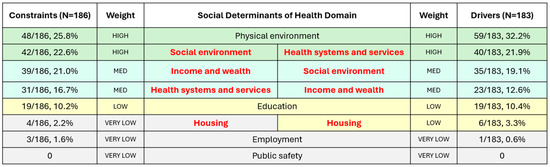
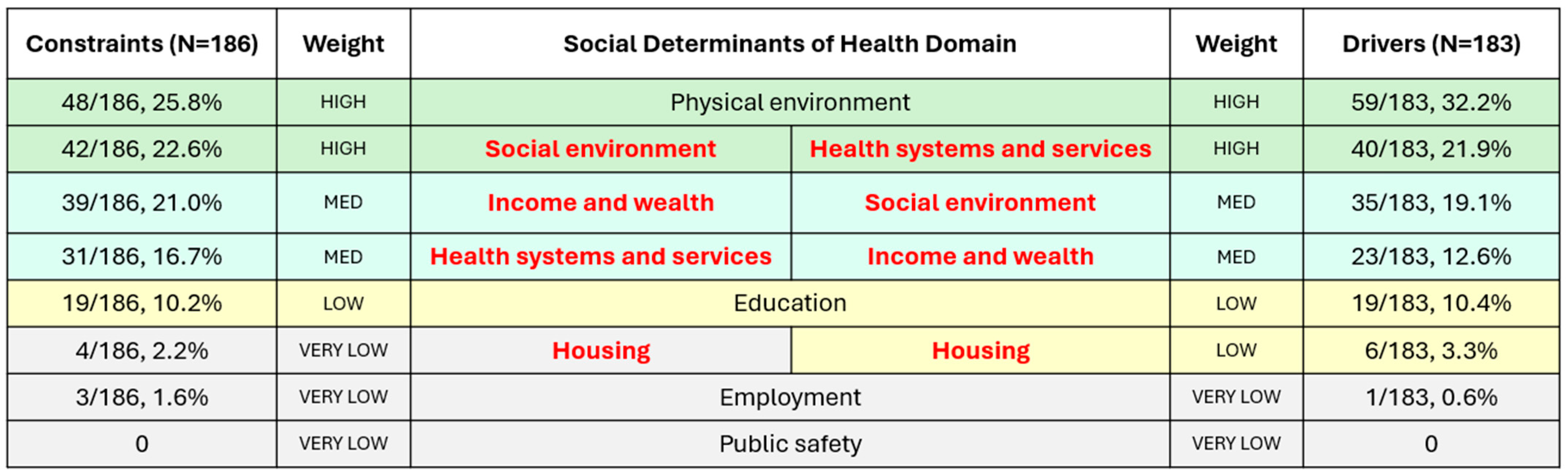
A total of 186 observations on food security constraints emerged; over two-thirds fell within three SDOH domains—physical environment (48/186, 25.8%), social environment (42/186, 22.6%), and income and wealth (39/186, 21.0%). In descending order, the volume of observations for the remaining domains included health systems and services (31/186, 16.7%), education (19/186, 10.2%), housing (4/186, 2.2%), and employment (3/186, 1.6%). No constraints were identified for the public safety SDOH domain.
A total of 183 observations on food security drivers were documented among the 17 ATs. The most dominant themes fell into three domains: 32.2% (59/183) of drivers mapped to the physical environment domain, about one-fifth to health systems and services (40/183, 21.9%), and another fifth to social environment (35/183, 19.1%). Twenty-three drivers (23/183, 12.6%) mapped to the income and wealth domain. Driver observations for the remaining domains included education (19/183, 10.4%), housing (6/183, 3.3%), and employment (1/183, 0.6%). No drivers surfaced for the public safety domain.
Based on the number of observations per SDOH domain, ATs identified factors in the physical environment domain as the main contributors of food security constraints and drivers among student-athletes. The social environment domain for food security constraints and the health systems and services domain for food security drivers were weighted as high. The income and wealth domain was weighted medium for both food security constraints and drivers; however, the number of food security constraints for this domain was higher than the number of food security drivers. The weight of the health systems and services domain was medium for food security constraints based on the volume of observations. For food security drivers, the other medium-weight domain was income and wealth. The education domain was weighted low. The influence of housing as a food security driver emerged as a more dominant theme than housing as a food security constraint. Both the employment and public safety domains received very low weights due to the limited volume of food security constraints and drivers. Figure 1 illustrates the volume and consensus weighting of AT (n = 17) observations on constraints and drivers stratified by SDOH domain.
Figure 1.
Volume and consensus weighting of AT (n = 17) observations on food security constraints and drivers stratified by SDOH domain.
Overarching Themes on Food Security Constraints and Drivers
Fifteen overarching food security themes emerged; stratified by SDOH domains, they were food access and food availability (physical environment), sports team norms, school norms, and NCAA responsibility (social environment), nutrition care and social services (health systems and services), individual, athletic department/team, and school finances (income and wealth), nutrition knowledge and life skills (education), residing off campus vs. on campus (housing), and competing priorities (employment).
An imposed analytical structure organically emerged during the process of organizing the themes and subthemes. Constraints were defined as factors that inhibited food security; drivers as factors that promoted food security. In addition, the degree to which constraints and drivers impacted food security status was considered. Table 4 provides a breakdown of overarching food security themes and food security constraint and driver subthemes stratified by SDOH domain weighting.
Table 4.
Breakdown of Overarching food security themes and food security constraints/drivers subthemes identified by athletic trainers (n = 17) stratified by SDOH domain weighting.
About 71% of participants (12/17, 70.6%) identified six to 15 food security constraints and drivers affecting student-athletes. Regarding constraints, nearly one-fifth of participants (3/17, 17.6%) identified four to five constraints; one participant (1/17, 5.9%) identified 17 constraints, and one identified 22 constraints (1/17, 5.9%). Three participants (3/17, 17.6%) identified 16–20 drivers, and two participants (2/17, 11.8%) identified two to five drivers. Some participants expressed a lack of awareness about food security drivers. Findings on overarching food security themes and food security constraint and driver subthemes follow; findings are stratified by SDOH domains and appear in descending order of SDOH domain consensus weights (high, medium, low, very low). Representative participant quotes are peppered throughout the text.
3.2. Physical Environment SDOH Domain Food Security Constraints and Drivers
Two themes emerged within the physical environment domain: food access and food availability. Food access subthemes included scheduling, acceptability, proximity, and affordability. Food availability subthemes were fueling stations, quantity of food, and transportation.
3.2.1. Food Access Subthemes
Scheduling issues: Conflicts vs. accommodations. Scheduling issues related to conflicts between mealtimes and athletic practices/events, and restricted weekend dining hall hours. An example of scheduling accommodation was the provision of supplemental foods in the athletic facilities.
“…dining hall access is a common struggle… working women’s basketball last semester, if they don’t get that drill right, we’re staying until 7:30 PM, and our dining hall closes at 6:45 PM.”(029)
“I believe the athlete strength and conditioning coaches prepare snacks, like yogurt and granola bars, which provide Omega 3, vitamin C, iron, and probiotics.”(014)
Acceptability: Mediocre options vs. alternatives. Student-athlete dissatisfaction with dining hall menu options was also discussed. Food security drivers were alternative options provided by the school or athletic department.
“Another is the quality of our dining hall… They always complain about the quality …”(006)
“…we’re working on getting snack stations and food stations for our athletes.”(013)
Proximity: Living off campus vs. on campus. Regarding the food access subtheme of proximity, living off campus emerged as a constraint and a driver. A factor discussed as influencing the constraint of living off campus was the cost of living in the local community, as well as the ease of access to grocery stores.
“I think living off campus is truly a big one. If you live off campus, you’re likely not on a dining hall plan, so you don’t have someone preparing the food for you.”(001)
“I find that our athletes that live off campus are the ones that are going grocery shopping. They’re planning meals, planning dinners, and…roommates and all of them eat together.”(007)
Affordability: No food safety net vs. safety net/name, image, and likeness (NIL) earnings. The cost of dining hall meal plans or off-campus groceries emerged as a constraint theme. In contrast, the provision of food safety net programs surfaced as a driver (e.g., emergency dining hall access and/or free supplemental food at events). Of note, campus food pantries were a dominant food safety net available to student-athletes. Some participants shared that stigma was associated with pantry usage. Participants also discussed pantry staff concerns that student-athletes overused this service. But most ATs viewed campus pantries as food security drivers. Potential NIL earnings were also discussed as a food access driver (mitigating the affordability constraint).
“…the price of the meal plans… alienates a lot of the student population that can’t afford it.”(030)
“We have emergency swipes; with that comes a student care report through the university…The need for this extra care can be put onto their card or provided to their emergency person.”(016)
3.2.2. Food Availability Subthemes
Fueling Stations: Suboptimal vs. optimal. Several ATs connected the theme of food availability with suboptimal fueling stations. In contrast, the role of fueling stations in expanding food availability emerged as a food security driver.
“Ours is just a shelf with snacks that have been vetted by our nutritionist and determined to be appropriate for either pre- or post-activity.”(028)
“As far as sandwiches, protein shakes, stingers, and stuff like that, we have two facilities with fueling stations.”(019)
Quantity: Inadequate vs. adequate. One subtheme related to the food quantity theme was kcalorie deficits; ATs discussed inadequate consumption as a detriment, given the higher energy needs of student-athletes compared with the general college population. Some ATs discussed approaches for increasing the quantity of food available to student-athletes. For example, partnering with supplementation sponsors for protein shakes or serving food during team meetings.
“…they’re not getting the caloric intake that they should.”(006)
“Our strength staff has really stepped up. We’re to the point where we’re making food and handing it out to them before meetings.”(014)
Transportation: Challenges vs. access. The transportation subtheme of food availability emerged regarding the distance to supermarkets to purchase and get food home. Tangible concern was expressed about the poor availability of international grocers for international student-athletes. In contrast, others discussed the ease of accessing off-campus food options.
“…they don’t live close to a grocery store… having to walk there and walk back while carrying their groceries can be a whole other workout in itself.”(010)
“I believe they always go to the grocery store, Sam’s Club, or Costco and get some extra jerky, a high-protein type of yogurt, apple, banana, orange, vitamin C.”(014)
3.3. Social Environment SDOH Domain Food Security Constraints and Drivers
Themes in the social environment SDOH domain were sports team norms, school norms, and NCAA responsibility. Constraints and drivers relating to sports team norms were athlete demands, nutritional status, and situational awareness. For the school norms theme, two subthemes surfaced: food security and the administration role. Regarding the NCAA responsibility theme, the constraint subtheme was policy needed and the driver was policy provided.
3.3.1. Sports Team Norms Subthemes
Athlete demands: Self-managed vs. shared by team. The impact of student-athlete expectations and exigencies emerged as a subtheme under sports team norms. The food security driver for modulating expectations and exigencies was the provision of free food. Disparate strategies for achieving this driver were discussed, including paying for dining hall services for student-athletes, providing food via a supplementation sponsor, having a food truck follow the team bus, and offering free food at events.
“They have so many things that they’re having to do that food gets put on the back burner of their brain.”(010)
“I think some of the teams have elected to pay for dining hall services. You just got to structure it in their day, like practice, a required meal that they have to be at.”(026)
Nutrition: No/low priority vs. high priority. A second constraint subtheme was that nutrition was a nonexistent or low priority. Participants described cutting the budget food dollars to accommodate team budget deficits and heavy reliance on team coaches to determine the level of criticality assigned to student-athletes’ nutritional needs. Some participants described a recent shift in sport team norms regarding student-athlete nutrition. They observed that both ATs and athletic leadership appear to be making student-athlete nutrition needs a higher priority.
“… as budget cuts come around, food is the first thing to be cut from a team’s program.”(027)
“This is making time during part of your practice or your team activities to talk about those things and educate.”(025)
Situational awareness: Unaware vs. aware. The situational unawareness subtheme was the level of AT awareness about student-athlete food security risk. A food security constraint was a lack of awareness about food security as an issue for student-athletes. In contrast, a food security driver was AT situational awareness and a willingness to address. On the midline were the ATs who appeared somewhat aware of the issue but considered it outside their purview. Notably, for some of these ATs, referral to a sports RDN or dietitian to seek FI resolution surfaced as a food security driver.
“…from an athletic training side to take that perspective on food insecurity, it’s just the awareness factor. We’re just not super aware.”(010)
“…our head coach tasked me with food education for the girls…And we have Information Mondays (we need to give it a better name) where I give a short presentation.”(029)
3.3.2. School Norms Subthemes
Food security: No/low priority vs. high priority. Many in the cohort expressed a concern that their school was not prioritizing food security. A food security constraint for some was the need for school leaders to facilitate changes to school norms—for example, making food security a high priority for the student body, including student-athletes. Another constraint was the lack of infrastructure needed for sustainable food security solutions. Some participants, in contrast, identified the food security driver of schools prioritizing food security for their student body.
“The school should… want to provide better service for student-athletes and other students.”(014)
“We have wellness food trucks which students can go to if they are food insecure… just provide your student ID, and they’ll give you a free meal—no questions asked.”(030)
Administration role: Challenges vs. support. According to the participants, administrative policies posed challenges that constrained FI risk reduction programs. For example, fundraising policies that prevented the acceptance of special grocery store discount programs and bureaucratic inefficiencies regarding constructing fueling stations. A small number of participants described scenarios of strong administrative support. They discussed school-level food programs that were classified as food security drivers.
“…we’ve tried to get hooked up with… a wholesale shop (half price), a healthy food store… The fundraisers would rather have the cash in hand, and not a deal with meals…”(007)
“I’m fortunate to be able to have access to a lot of campus resources. Not necessarily our athletics ‘department resources but campus-wide.”(030)
3.3.3. NCAA Responsibility Subthemes
Conference: Policy needed vs. provided. Three participants advocated that the athletic conference should craft policy to reduce FI risk among student-athletes—for example, by requiring every school to have a dietitian on staff. The lack of a policy surfaced as a food security constraint. All the participants were affiliated with schools in which their conference’s strategic plan required that $50,000 be spent on fueling stations and student-athletes have access to a nutritionist. More than half (10/17, 58.8%) of participants were familiar with these requirements and identified the policy as a potential food security driver.
“The conference should figure it out…They should make an action that each institution has to do for athletes.”(014)
“I heard about the $50,000… I knew it was coming down… and that we were working on getting those fueling stations.”(013)
3.4. Health Systems and Services Food Security Constraints and Drivers
The two themes in the health systems and services SDOH domain were nutrition care and social services. The three nutrition care subthemes included FI screenings, dietitian access, and AT nutrition counseling. The two subthemes in the social services theme were SNAP and other community resources.
3.4.1. Nutrition Care Subthemes
FI screenings: Not done vs. done. Not conducting formal screenings emerged as a food security constraint under the nutrition care subtheme. Several ATs noted they did not know if FI screenings were conducted for their student-athletes. One participant noted that screenings were not conducted due to confidentiality issues. Others discussed conducting informal screenings via visual observation or casual conversation with student-athletes. In contrast, some schools reported the food security driver of conducting FI screenings in concert with their PPEs.
“I’ve not noticed any formal or informal ways of identifying any sort of food insecurity.”(028)
“We do the food security screening during our PPE.”(019)
Dietitian access: None/limited vs. good. A second emerging food security constraint in the nutrition care subtheme was the degree of access to a dietitian/nutritionist or sports RDN. Some ATs shared that their teams had no access to RDNs; one tied the lack of access to limited school finances. Others noted inadequate access—for example, relying on the university RDN. Envy was expressed about schools with access to a dedicated RDN, which surfaced as a food security driver.
“For us… you get access to the university registered dietitian who serves all 10,000 students”(027)
“I know our sports dietitian meets with every team and provides them with the basic nutritional information that they need… I would love more sports dietitians on staff.”(006)
AT Nutrition counseling: Ancillary vs. part of role. A nutrition care constraint was identified when nutrition counseling was ancillary to the AT purview. Requiring ATs to address food security was viewed by many as adding responsibilities to already overworked athletic professionals. ATs taking a role in nutrition counseling, however, emerged as a food security driver in the nutrition care theme.
“I can speak for AT’s… We have enough to worry about when we’re getting people through physicals and all that…”(026)
“…we do try to do some nutrition education… the sports medicine, and athletic training staff, as well as our sports performance staff.”(002)
3.4.2. Social Services Subthemes
SNAP: Ineligibility vs. application help. The constraint subtheme in the social services subtheme focused on ineligibility for the Supplemental Nutrition Assistance Program (SNAP). Eligibility restrictions included state work requirements and international student status. Conversely, the food security driver focused on helping student-athletes access SNAP. Some schools noted that ATs were trained to identify student-athletes likely to qualify and to help them navigate the SNAP application process.
“…for SNAP… in our state to be eligible, you must work 10 h a week. And for student-athletes that’s just not realistic. So, a lot of our students don’t qualify for SNAP.”(016)
“All athletic trainers are well-versed enough to help student-athletes apply for SNAP in our state… If they’re on Medicaid, we know to talk through the different offers of SNAP as well.”(027)
Community resources: Stigma vs. referrals. Reluctance to access community resources surfaced as a food security constraint. Other participants reflected on student-athletes’ willingness to accept referrals to community resources as a food security driver.
“The challenge is that we have is the psychological component regarding asking for help or how to ask for assistance… they’re afraid they’ll be stigmatized if they ask for that type of assistance.”(002)
“…other outreach programs in the community as well. They’re made available to those different church organizations and welfare programs that offer things to anyone in the local area.”(027)
3.5. Income and Wealth SDOH Domain Food Security Constraints and Drivers
Themes in the income and wealth SDOH domain were individual finances, school finances, and athletic department/team finances. Two subthemes precipitated in the individual finances theme: socioeconomic status and NIL earnings. The school finances subtheme was fiscal position. Two subthemes surfacing for the athletics department/team finances were funding allocations and staffing levels.
3.5.1. Individual Finances Subthemes
Socioeconomic status (SES): Low vs. middle/high. Socioeconomic background emerged as a potential constraint or driver for student-athlete food security. The cohort agreed that lower SES student-athletes were more likely to experience FI. A lack of consensus emerged regarding the role of scholarship funds in mitigating FI risk. Only a subset of the cohort noted that at an individual level, no or insufficient scholarship funds were a potential food security constraint. Family socioeconomic status emerged as a food security driver among student-athletes from middle- and high-SES families.
“… [for] most of the individuals [student-athletes] that I’ve worked with… limited finances were more prevalent than insufficient scholarship funds.”(030)
“We have a pretty good range of more privileged backgrounds that have a lot of money from their parents. They don’t have to worry about the finances part of it.”(025)
NIL earnings: None vs. some. The ability of student-athletes to earn passive income was also discussed as a food security driver under the individual finances theme.
“It’s a huge, big game changer for athletes who can put their name on social media and say that they got a sponsorship.”(014)
3.5.2. School Finances Subthemes
Fiscal position: Suboptimal vs. optimal. For schools with scarce resources, the limited school finances constraint subtheme was a palpable concern. On a school level, insufficient scholarship funds were also identified by several participants as a food security constraint for student-athletes. Plus, participants discussed how the ability to fund fueling stations depended on a school’s fiscal position. ATs noted that for some student-athletes, fueling stations were a primary source of food; however, school funding allocations did not account for this reality. Fueling station budgets varied widely, ranging from no budget to $110,000.
“Our school’s highest issue… limited finances or insufficient scholarship funds.”(019)
“Currently, we spend probably $8000 to 10,000 on protein shakes in the weight room.”(007)
3.5.3. Athletic Department/Team Budget Subthemes
Funding allocations: Disparities vs. equitable. The perception that underfunding is prevalent across athletics was expressed and classified as a food security constraint. Participants discussed the value of fundraising to address underfunding and supplement athletic department and team food budgets; thereby, fundraising was classified as a potential food security driver. Further probing also revealed that funding disparities appeared to increase FI risk among student-athletes on non-revenue-generating teams; however, one AT, who was currently serving in an administrative role, noted that at her school, all athletes have equal access to the same resources. Equitable distribution of funding allocations, thus, surfaced as a food security driver.
“The food that is given to the teams depends on the team’s budget.”(019)
“Unfortunately, yes, the football and basketball teams get a lot more attention than the other smaller sports, but that still doesn’t necessarily mean they don’t have something. Sometimes those students don’t realize they still have the same access as the bigger sports athletes have.”(001)
Staffing levels: Inadequate vs. adequate. The discussion on underfunding segued into the subtheme of inadequate staffing levels due to subpar budget allocations. Inadequate staffing levels were, thereby, classified as a potential food security constraint. Consensus was reached about the need for additional staff to address food security among student-athletes. The contrasting driver was, thus, hiring a staff person dedicated to addressing food security concerns, such as a dietitian.
“My staff is already completely understaffed and underpaid.”(007)
“…having a point person, rather than them just going to their athletic trainer or their strength coach when they have a problem.”(027)
3.6. Education SDOH Domain Food Security Constraints and Drivers
In the education domain, the themes of nutrition knowledge and life skills emerged. Under nutrition knowledge, the level of prioritization of providing educational programming to student-athletes was a subtheme. Life skill subthemes were culinary literacy and financial management.
3.6.1. Nutrition Knowledge Subthemes
Nutrition education: No/low priority vs. high priority. Nutrition education for student-athletes, as a nonexistent/low priority, emerged as a food security constraint under the nutrition knowledge subtheme. Another constraint was limited access to dietitians because this cohort of ATs overwhelmingly deferred to RDNs as the nutrition educators for student-athletes. Administrative challenges also emerged as a food security constraint in the nutrition education subtheme. One participant noted they had developed an academic nutrition course for student-athletes but were unable to obtain approval for it as a general education requirement, limiting student-athlete enrollment. Limited nutrition knowledge among coaches was also identified as a food security constraint. In contrast, participants discussed food security drivers such as the utilization of social media platforms to reach student-athletes with nutrition messages and RDNs being invited to present at administrative meetings on food security-related topics and initiatives.
“The challenge we have is that we have a dietitian, but it’s one person… it’s so hard to have one person continue education sessions throughout the year for everybody.”(026)
“I was in an administrative meeting, and our volunteer sports nutritionist was also there. She’s been… doing surveys that include food insecurity questions, and presented her findings…”(019)
3.6.2. Life Skills Subthemes
Culinary literacy/financial management: Limited skills vs. skills training. Limited culinary literacy and financial management skills surfaced as examples of food security constraints in the nutrition knowledge theme. A tendency to reach for less nutrient-dense foods due to limited knowledge and/or lack of food preparation skills was highlighted. The contrary food security drivers for this subtheme were the provision of basic culinary skills and fiscal management training provided by the school, athletic department, or team. The concept of nutrition-focused financial literacy was discussed. The inclusion of RDNs as leaders for life skill training initiatives also emerged as a food security driver.
“Some of them don’t even know how to boil water, so that is another big factor that covers a lot of things.”(010)
“I’m starting to come to the realization that some of these kids come in here, and they have zero idea how to prioritize and how to manage their money. It’s almost a lack of education…”(026)
“…our team nutritionist… She also works on soft skills… and cooking on a budget program.”(030)
3.7. Housing SDOH Domain Food Security Constraints and Drivers
The emerging themes in the housing SDOH domain were residing off campus and residing on campus. For each of these themes, subthemes related to FI risk. Ultimately, FI risk related to housing varied by school; the cost of living off campus compared with the ease of food availability and access on campus were contrary factors.
3.7.1. Residing off Campus Subtheme
Disparate perceptions regarding living situation and the food constraints and drivers of student-athlete food security surfaced. The increasing cost of living in some school communities was discussed as a food security constraint. In contrast, a precipitating benefit (food security driver) of living off campus was the opportunity for student-athletes to prepare their own meals, which increased their food access and food availability.
“I don’t know how people live off campus and can afford rent and car insurance and food. I really don’t.”(006)
“…some of them are so excited to get off campus because they want to be able to make their own food.”(009)
3.7.2. Residing on Campus Subtheme
Contradictory opinions also emerged regarding the impact of residing on campus on food security constraints and drivers. Some noted the more profound impacts of food access and availability challenges (food security constraints) among student-athletes living on campus; living on campus was, thereby, classified as a potential food security constraint. Others shared that at their schools, living on campus was a food security driver because it provided access to campus dining facilities. Ultimately, individual school dining hall options were paramount to the food security constraints and drivers associated with student-athletes opting to live on campus.
“…living on campus is probably the biggest factor in food insecurity.”(007)
“…if they live off campus, then they don’t eat at the dining hall…. I would say our biggest factors are related to limited finances and living off campus…”(016)
3.8. Employment SDOH Domain Food Security Constraints and Drivers
In the employment domain, a competing priorities theme emerged. The food security constraint subtheme was the degree to which student-athletes needed paid employment to ensure food security.
Paid job: No need vs. need to work. Contradictory insights were offered about the need and/or time available to hold paid employment as a student-athlete. Some ATs shared stories about student-athletes who needed to work and how this requirement was a food security constraint. One participant, for example, explained that adding a paid job to an already full schedule risks insufficient kilocalorie consumption among student-athletes. Others noted that student-athletes do not commonly hold paid jobs. In their view, employment was thus not a constraint for student-athletes. The potential role of NIL earnings in eliminating the need to work was a food security driver suggested by the cohort.
“What I see the most is probably the competition priorities just with the schools, the sport, and then work…So, then they’re skipping a meal or skipping a snack in between, and they’re not getting the caloric intake that they should.”(006)
“Student-athletes definitely don’t typically have another job.”(019)
4. Discussion
In this study, ATs identified multiple interconnected themes that map to food security constraints and drivers impacting student-athletes and spanning multiple SDOH domains. Based on the application of best standards for qualitative research, data saturation was reached [16]. The findings suggest the need for further research on structural changes that support food security among student-athletes.
4.1. Multidimensional Nature of Food Security
Analysis of food security constraints and drivers through the lens of the SDOH framework illuminates the multidimensional nature of food security among student-athletes.
4.1.1. Acceptance of Student-Athlete Normative Expectations
Themes and subthemes on the acceptance of the student-athlete normative expectations intersected across five SDOH domains: social environment, physical environment, health systems and services, education, and housing. Participants discussed that athletics takes precedence over nutrition (social environment domain). Echoing this theme, Pacenta et al. found a higher FI risk among student-athletes compared to the general college population [20]. Furthermore, the acceptance of scheduling conflicts was found to influence food access and availability (physical environment domain) in this study. This finding was reported in other studies [9,11,12,20,21,22,23,24,25,26,27,28].
An additional student-athlete-centric constraint identified by this cohort of ATs was the need for special nutritional considerations (health systems and services domain). Other studies support this finding; for example, Lundstrom et al. reported that ensuring optimal dietary intake reduces the risk of injury and diminished athletic performance [29]. The need for the NCAA to lead the effort to shift this norm emerged. Participants discussed the required nutrition strategies detailed in the most recent Big Sky Conference Strategic Plan (fueling station funds and access to a nutritionist) [30] as an important first step. A past example of an effective NCAA nutrition-related policy was the deregulation of providing meals for Division 1 student-athletes in 2014 [21]. Goldrick-Rab et al. also emphasized the importance of NCAA leadership in the issue, suggesting that athletic conference-related policies may contribute to the risk of homelessness among student-athletes (housing domain); a higher percentage of homeless students were found to be food insecure [31].
The need to educate student-athletes on nutrition emerged in this study (education domain). Notably, Uriegas et al. found that student-athletes possessed poor sports nutrition knowledge [28]. Studies have linked low nutrition literacy with higher levels of FI among college students [32,33,34].
4.1.2. Higher Prioritization of Nutrition and Food Security May Be Warranted
The theme that nutrition and food security were not high enough priorities for schools, athletic departments, or sports teams spanned four domains (income and wealth, health systems and services, physical environment, and education). A cross-sectional study (n = 108 individuals involved in campus FI programming across the USA, 23-item survey) found that only 38.9% of schools allocated funding for food security initiatives [35]. Several participants of this study echoed this sentiment; one noted that during budget shortfalls (income and wealth domain), athletic departments/teams reduced or eliminated funding for food.
Fundraising emerged in this study as a food security driver because it offered an avenue for the school/athletic department/sports team to acquire additional funds to stock fueling stations, offer supplemental meals, or hire a dietitian. Participants discussed sources of supplemental food as a driver vis-a-vis increased access to kilocalories. Bosson et al. found that student-athletes relied on fueling stations to meet required dietary needs (health systems and services domain); however, these options were not optimal [22].
A subset of study participants shared the food security driver of conducting regular nutrition screenings (health systems and services domain). Pacenta et al. (scoping review, n = 18 articles) also reported this food security driver, noting that some coaches and athletic staff have started employing screenings to encourage dialog about FI [20]. Many of the ATs in this study relied on observation rather than formal FI surveys. Cutts et al. found observation to be less effective than formal screening because FI may not be immediately apparent from physical signs, and individuals may be ashamed to discuss their food security status [36]. The “starving student lifestyle” norm [37,38] may also influence observational FI assessments.
Lack of priority regarding nutrition/food security was also demonstrated vis-a-vis the acceptance of the scheduling conflicts discussed above (physical environment domain) and limited access to nutrition education programming (education domain); others also reported this finding [12,22,28]. The need to educate ATs about food security and raise ATs’ awareness about food security and existing campus resources emerged. Picha et al. also reported this finding [3]. Exemplifying this finding, only one participant (1/17, 5.9%) discussed meal-sharing programs as a food security driver to ensure optimal kcaloric intake. According to Swipe Out Hunger, a national organization offering meal-sharing programs aimed at ending FI among college students, seven of the nine schools represented by the participants offered meal-sharing programs [39]. Other food security drivers that our study participants did not discuss were university-wide emergency food scholarships, supplemental meal plans, community gardens, basic needs hubs, campus farmers’ markets, food recovery, and free food alert systems [22,39,40]. When this study was conducted, no studies were found about the usage of these programs by collegiate student-athletes.
4.1.3. Financial Disparities Impact Student-Athlete Food Security
Participants identified disparities in student-athlete financial status across five SDOH domains: income and wealth, social environment, physical environment, health systems and services, and education. Personal revenues obtained via NIL earnings were identified in this study as food security drivers; however, Misiner et al. noted that NIL opportunities will likely vary by sport [27]. Financial disparities may, thus, widen under this new policy. For student-athletes who are not financially stable (income and wealth domain), some participants perceived campus food pantries as a driver of food security. Others discussed the limitations of campus pantries, including stigma associated with food pantries, complaints from pantry staff that student-athletes frequented them too often, and dissatisfaction with the quality of pantry options (physical and social environment domains) [23,28]. Additional campus food pantry limitations documented in the literature were inconvenient location and restricted hours of operation [23,28]. These realities can shift campus pantries from a driver to a constraint. A driver reported by this cohort and in other studies was the provision of SNAP application education (health and human services domain) [23,24,28]; however, many student-athletes are not eligible due to the required number of work hours or international student status [23,24,28].
The theme of financial disparities extended beyond individual income and wealth; participants discussed differences in food access/availability for revenue-generating teams as well as team coach spending priorities. This financial constraint was discussed as both a reality and a misconception of student-athletes. Financial disparities included the inability to hire sufficient staff due to budgetary constraints. Other studies identified these school and team financial challenges [27,40].
4.1.4. Residing off Campus Can Be a Food Security Constraint and Driver
The residing off-campus theme was interconnected with the housing, physical environment, employment, and public safety domains. Other studies identified living on campus as a food security driver associated with access to campus dining halls, unlimited meal plans, and dorm suites with kitchens [11,20,22,24,28]. For some participants in this study, however, living off campus (housing domain) emerged as a driver of food security, because student-athletes living off campus did not experience the same degree of food access and availability challenges (physical environment domain) as student-athletes living on campus. Hsuan et al. found that for student-athletes living off campus and needing to work (employment domain), limited work hours failed to yield income needed to cover rent, living expenses, and college costs [24,28]. Though not identified by participants in this study, public safety concerns were identified by others [22,41]. In a cross-sectional, mixed-methods study (n = 98 student-athletes, 66.3% female, CA university), one student was not comfortable using public transportation to purchase food [22]. Carey et al. reported an additional public safety-related food security issue; student-athletes perceived that they were not part of the general college population; thus, they did not utilize campus public safety services [41].
4.2. Structural Changes May Help Ensure Food Security Among Student-Athletes
Ultimately, the perceptions of this AT cohort suggest that structural changes may help ensure food security among student-athletes. Examples of schools effectively making such changes include establishing basic needs offices [35,42]. Financial hardships associated with the 2007–2009 USA recession spurred the creation of these campus-wide entities to address hunger, housing, and related issues [42]. The establishment of such offices emphasizes that nutrition/food security concerns may hold a higher priority than perceived by the participants in this study. The ability (funding level) of such offices to tailor solutions to the special needs of student-athletes requires further exploration utilizing more rigorous study designs. Bodian et al. noted that these offices have established coalitions tasked with designing sustainable solutions within the collegiate setting [21]. The need to engage athletic professionals, such as ATs, in such coalitions emerged in this study. For example, ATs could contribute to negotiations with third-party dining hall vendors on hours of operation and student-athlete nutritional needs.
Consistent with other studies, key findings suggest that infrastructure changes may be needed to mitigate food access/availability challenges [22,23,26,28]. Specific examples were expanded dining hall hours, supplemental food support offering athlete-centric options, changes in food pantry policies, dedicated athletic department budgets for nutrition, and other structural changes to promote healthy and adequate dietary choices [22,23,26,28,40].
The vital role of sports RDNs/dietitians/nutritionists as stewards for food security emerged in this study. Though many participants in this study discussed no or limited access to a sports RDN/dietitian/nutritionist, Vento et al. found that most NCAA athletes (65%) obtained nutrition information from RDNs [40]. For universal access, the Interassociation Consensus Statement on Sports Nutrition Models suggests a structural shift for schools and athletic departments that cannot address the food security constraint of limited access to nutrition care [43]. For athletic departments/teams with fewer nutrition resources, Lambert et al. recommended employing part-time/consulting dietitians and collaborating with student dining services. Division III schools might also utilize dietetics students/interns for education classes or require a nutrition course in their programs [43].
A potentially important driver identified by the participants in this study was the concept of rethinking athlete expectations and exigencies. More rigorous studies are needed to evaluate this theme. For example, the NCAA and schools could conduct studies modeling potential structural changes. Considering parallels with other student populations may be helpful, specifically, those that require a demanding schedule. A change in the expectations and exigencies of student doctors offers a potential approach for testing structural changes. Much like student-athletes, the expected performance norm for physicians-in-training was demanding (36 h work shifts with ≤12 h rest, culminating in 90 h workweeks); the rigor was considered necessary to train competent physicians [44,45]. NCAA’s parallel, the Accreditation Council for Graduate Medical Education (ACGME), implemented national expectations regarding training schedules [44]. Since that time, a review (n = 108 studies; 8 RCTs and 100 observational studies) found that shorter shifts (24 vs. 36 h shifts, 80 vs. 90 h workweeks) improved work–life balance while maintaining performance [45]. The authors noted that such structural shifts had to be tailored to the needs of all involved stakeholders. In a different vein, for schools with scarcer resources, food security drivers beyond fundraising may appear elusive. Bradford offers strategies for stretching funding, such as reminding decision-makers of the important role athletics plays in the college experience for all students, partnering with academic business schools for financial planning assistance, and collaborating on balancing academic and athletic budgets [46].
4.3. Avenues for Future Research
Much of the relevant research employed qualitative and cross-sectional study designs to explore food security constraints among student-athletes and provided suggestions on food security drivers. Pilot testing student-athlete-centric solutions utilizing more rigorous study designs is warranted (e.g., evaluating student-athlete experiences with campus-wide basic needs programs and conducting feasibility testing for programs designed to overcome student-athlete barriers to utilizing those potentially beneficial interventions). Likewise, pilot testing of revised athlete expectations and exigencies with non-revenue-generating teams to see if structural shifts help mitigate food security constraints would be a relatively low-risk initiative that could offer important insights into the feasibility and efficacy of this type of structural change.
4.4. Strengths and Limitations of This Study
The findings of this study offer unique insights into food security constraints and drivers beyond the individual student-athlete experience—for example, the impact of school and athletic department budgets and the influence of athlete expectations and exigencies. The qualitative design employed in this study yielded less rigorous findings than those ascertained via a quantitative design; however, best practices of phenomenological design were employed.
A strength of this study was the collection of insights from ATs, who work closely with collegiate student-athletes. However, transferability of the findings is limited by the participant pool (small sample size (17 ATs), only Division 1 public schools, and regional restriction of northwestern U.S. schools). Further studies are needed to evaluate the relevance to ATs working at Division II or III schools, private institutions, or other regions of the country. Though a powered qualitative sample, the response rate was also low; more robust quantitative studies are warranted to evaluate the validity of this study’s findings.
The transferability of the findings is further limited given that this study analyzed a subset of data from a larger participant pool, which included other athletic professionals (registered dietitian nutritionists, performance/strength and conditioning coaches, and athletic administrators) [8]. The presence of non-AT participants may have influenced the focus-group discussions. Furthermore, the inclusion of three ATs who were currently serving as administrators and one who also held the RDN credential may have skewed the results; however, those participants clarified which perspective they were speaking from during the focus groups.
The emergence of an imposed analytical structure in coding for food security constraints and drivers risks introducing preconceived theme and subtheme concepts. The need for additional testing of the precipitating framework is required to confirm this study’s findings.
5. Conclusions
Perceptions from this small cohort of ATs yielded a considerable number of observations inferred to be food security constraints and drivers experienced by student-athletes; based on the findings of other studies, their observations were not comprehensive. Food security constraints and drivers crossed a spectrum of SDOH domains. The findings suggest the need for further research on structural changes that support food security among student-athletes.
Supplementary Materials
The following supporting information can be downloaded at https://www.mdpi.com/article/10.3390/j9030021/s1. Table S1: Consolidated Criteria for Reporting Qualitative Research (COREQ): 32-item Checklist.
Author Contributions
Conceptualization, B.G., J.R. and N.C.; methodology, B.G. and J.R.; formal analysis, B.G., J.R., C.B. and N.C.; investigation, B.G. and J.R.; data curation, B.G., J.R. and N.C.; writing—original draft preparation, B.G.; writing—review and editing, B.G., C.B., J.R. and N.C.; supervision, B.G. and J.R.; project administration, J.R.; funding acquisition, B.G. and J.R. All authors have read and agreed to the published version of the manuscript.
Funding
This research was funded by the Idaho State University College of Health Research Grant (internal grant; no funding number) and the Idaho State University Office for Research Internal Seed Grant Program (internal grant; no funding number).
Institutional Review Board Statement
The study was conducted in accordance with the Declaration of Helsinki and approved by the Institutional Review Board of Idaho State University (IRB-FY2023-247, 16 June 2023) for studies involving humans.
Informed Consent Statement
Informed consent was obtained from all subjects involved in the study.
Data Availability Statement
The data set presented in this article is not readily available because of ethical concerns related to the small sample size. Requests to access the datasets should be directed to jeniferreader@uidaho.edu.
Conflicts of Interest
The authors declare no conflicts of interest.
Abbreviations
The following abbreviations are used in this manuscript:
| AT | athletic trainer |
| FI | food insecurity |
| NCAA | National Collegiate Athletic Association (USA, Canada, and Puerto Rican teams) |
| NIL | name, image, and likeness |
| PPE | preparticipation physical examination |
| RDN | registered dietitian nutritionist |
| SDOH | social determinants of health |
References
- Beaupre, J.; Meske, S.W.; Buckley, M. Athletic training and population health science. J. Athl. Train. 2022, 57, 136–139. [Google Scholar] [CrossRef] [Scilit] [PubMed]
- Picha, K.J.; Welch Bacon, C.E.; Normore, C.; Snyder Valier, A.R. Social determinants of health: Considerations for athletic health care. J. Athl. Train. 2022, 57, 521–531. [Google Scholar] [CrossRef] [Scilit] [PubMed]
- Picha, K.J.; Welch Bacon, C.E.; Bay, C.; Lewis, J.H.; Snyder Valier, A.R. Athletic trainers’ familiarity, comfort, knowledge, and recognition of social determinants of health. J. Athl. Train. 2024, 59, 403–409. [Google Scholar] [CrossRef] [Scilit] [PubMed]
- Picha, K.J.; Welch Bacon, C.E.; Lewis, J.H.; Snyder Valier, A.R. Athletic trainers’ perceptions of and experience with social determinants of health. Int. J. Environ. Res. Public Health 2023, 20, 5602. [Google Scholar] [CrossRef] [Scilit] [PubMed]
- Foster, Z.J.; Winkelmann, Z.K. Prevalence of social determinants of health concerns for collegiate student-athletes: A review of annual preparticipation physical examination screening data. Clin. J. Sport Med. 2026. [Google Scholar] [CrossRef] [Scilit] [PubMed]
- Bhavnani, S.K.; Zhang, W.; Bao, D.; Raji, M.; Ajewole, V.; Hunter, R.; Kuo, Y.F.; Schmidt, S.; Pappadis, M.R.; Smith, E.; et al. Subtyping social determinants of health in the “All of Us” program: Network analysis and visualization study. J. Med. Internet Res. 2025, 27, e48775. [Google Scholar] [CrossRef] [Scilit] [PubMed]
- Centers for Disease Control and Prevention. Available online: https://www.cdc.gov/health-equity-chronic-disease/social-determinants-of-health-and-chronic-disease/index.html (accessed on 26 December 2025).
- Gordon, B.; Christensen, N.; Reader, J. Systemic factors fuel food insecurity among collegiate student-athletes: Qualitative findings of the Running on Empty Study. Nutrients 2025, 17, 2254. [Google Scholar] [CrossRef] [Scilit] [PubMed]
- Anziano, J.; Zigmont, V.A. Understanding food insecurity among collegiate athletes: A qualitative study at a public university in New England. J. Athl. Train. 2024, 59, 410–418. [Google Scholar] [CrossRef] [Scilit] [PubMed]
- Men, F.; Urquia, M.L.; Tarasuk, V. Examining the relationship between food insecurity and causes of injury in Canadian adults and adolescents. BMC Public Health 2021, 21, 1557. [Google Scholar] [CrossRef] [Scilit] [PubMed]
- Brown, M.; Abbey, E.; McKenzie, M.; Karpinski, C. Prevalence of food insecurity in NCAA Division III collegiate athletes. J. Am. Coll. Health 2021, 71, 1374–1380. [Google Scholar] [CrossRef] [Scilit] [PubMed]
- Brauman, K.; Achen, R.; Barnes, J.L. The five most significant constraints to healthy eating in collegiate student-athletes. J. Am. Coll. Health 2023, 71, 578–583. [Google Scholar] [CrossRef] [Scilit] [PubMed]
- Creswell, J.W.; Creswell, J.D. Research Design: Qualitative, Quantitative, and Mixed Methods Approaches, 5th ed.; SAGE Publications, Inc.: Thousand Oaks, CA, USA, 2018. [Google Scholar]
- Ciesielska, M.; Jemeielniak, D. (Eds.) Qualitative Methodologies in Organization Studies, Volume I: Theories and New Approaches; Palgrave Macmillan: Cham, Switzerland, 2018. [Google Scholar]
- Tong, A.; Sainsbury, P.; Craig, J. Consolidated criteria for reporting qualitative research (COREQ): A 32-item checklist for interviews and focus groups. Int. J. Qual. Health Care 2007, 19, 349–357. [Google Scholar] [CrossRef] [Scilit] [PubMed]
- Hennink, M.; Kaiser, B.N. Sample sizes for saturation in qualitative research: A systematic review of empirical tests. Soc. Sci. Med. 2022, 292, 114523. [Google Scholar] [CrossRef] [Scilit] [PubMed]
- Sharma, S.K.; Mudgal, S.K.; Gaur, R.; Chaturvedi, J.; Rulaniya, S.; Sharma, P. Navigating sample size estimation for qualitative research. J. Med. Evid. 2024, 5, 133–139. [Google Scholar] [CrossRef] [Scilit] [PubMed]
- Safdar, N.; Abbo, L.M.; Knobloch, M.J.; Seo, S.K. Research methods in healthcare epidemiology: Survey and qualitative research. Infect. Control Hosp. Epidemiol. 2016, 37, 1272–1277. [Google Scholar] [CrossRef] [Scilit] [PubMed]
- Saldaña, J.; Omasta, M. Qualitative Research: Analyzing Life; Sage Publications: Thousand Oaks, CA, USA, 2018. [Google Scholar]
- Pacenta, J.; Starkoff, B.E.; Lenz, E.K.; Shearer, A. Prevalence of and contributors to food insecurity among college athletes: A scoping review. Nutrients 2024, 16, 1346. [Google Scholar] [CrossRef] [Scilit] [PubMed]
- Bodian, G.; Starkoff, B.; Lenz, E. Addressing food insecurity among college athletes: Strategies to overcome barriers to food access. J. Nutr. Educ. Behav. 2026, 58, 494–500. [Google Scholar] [CrossRef] [Scilit] [PubMed]
- Bosson, B.; Shodahl, S.; Duran, N.; Herman, D.R. Food insecurity among Division I student-athletes at a California state university: A mixed methods study. J. High. Educ. Athlet. Phys. Educ. 2023, 2, 47–68. [Google Scholar] [CrossRef] [Scilit]
- Douglas, C.C.; Camel, S.P.; Mayeux, W. Food insecurity among female collegiate athletes exists despite university assistance. J. Am. Coll. Health 2022, 72, 1904–1910. [Google Scholar] [CrossRef] [Scilit] [PubMed]
- Hsuan, A.; Alger, A.; Giovanni, M.; Berman, T.; Silliman, K. Food insecurity among NCAA student athletes at a NCAA Division II university. J. Am. Coll. Health 2025, 73, 3776–3779. [Google Scholar] [CrossRef] [Scilit] [PubMed]
- Landry, M.J.; Hagedorn-Hatfield, R.L.; Zigmont, V.A. Constraints to college student food access: A scoping review examining policies, systems, and the environment. J. Nutr. Sci. 2024, 13, e51. [Google Scholar] [CrossRef] [Scilit] [PubMed]
- Mayeux, W.; Camel, S.; Douglas, C. Prevalence of food insecurity in collegiate athletes warrants unique solutions. Cur. Dev. Nutr. 2020, 4, nzaa043_090. [Google Scholar] [CrossRef] [Scilit]
- Misiner, P. Food Insecurity and College Athletes: A Study on Food Insecurity/Hunger Among Division III Athletes. Ph.D. Thesis, State University of New York, Binghamton, NY, USA, 2020. [Google Scholar]
- Uriegas, N.A.; Winkelmann, Z.K.; Emerson, D.M.; Torres-McGehee, T.M. The nutritional environment and food access of female athletes at HBCUs: A qualitative analysis. Front. Nutr. 2026, 12, 1675069. [Google Scholar] [CrossRef] [Scilit] [PubMed]
- Lundstrom, E.A.; De Souza, M.J.; Don, P.K.; Williams, N.I. Interrelationships between stress, eating attitudes, and metabolism in endurance athletes across a competitive season. Appl. Physiol. Nutr. Metab. 2024, 49, 1558–1572. [Google Scholar] [CrossRef] [Scilit] [PubMed]
- Big Sky Conference. Available online: https://bigskyconf.com/sports/2022/10/12/GEN_1012224018.aspx (accessed on 19 May 2026).
- The Hope Center for College, Community and Justice. Available online: https://www.luminafoundation.org/wp-content/uploads/2020/04/hungry-to-win.pdf (accessed on 28 December 2025).
- Knol, L.L.; Robb, C.A.; McKinley, E.M.; Wood, M. Very low food security status is related to lower cooking self-efficacy and less frequent food preparation behaviors among college students. J. Nutr. Educ. Behav. 2019, 51, 357–363. [Google Scholar] [CrossRef] [Scilit] [PubMed]
- Matias, S.L.; Rodriguez-Jordan, J.; McCoin, M. Integrated nutrition and culinary education in response to food insecurity in a public university. Nutrients 2021, 13, 2304. [Google Scholar] [CrossRef] [Scilit] [PubMed]
- Morgan, M.; Arrowood, J.; Farris, A.; Griffin, J. Assessing food security through cooking and food literacy among students enrolled in a basic food science lab at Appalachian State University. J. Am. Coll. Health 2023, 71, 30–35. [Google Scholar] [CrossRef] [Scilit] [PubMed]
- Hagedorn-Hatfield, R.L.; Richards, R.; Qamar, Z.; Hood, L.B.; Landry, M.J.; Savoie-Roskos, M.R.; Vogelzang, J.L.; Machado, S.S.; OoNorasak, K.; Cuite, C.L.; et al. Campus-based programmes to address food insecurity vary in leadership, funding and evaluation strategies. Nutr. Bull. 2022, 47, 322–332. [Google Scholar] [CrossRef] [Scilit] [PubMed]
- Cutts, D.; Cook, J. Screening for food insecurity: Short-term alleviation and long-term prevention. Am. J. Public Health 2017, 107, 1699–1700. [Google Scholar] [CrossRef] [Scilit] [PubMed]
- Hattangadi, N.; Vogel, E.; Carrol, L.J.; Cote, P. “Everybody I know is always hungry…but nobody asks why”: University students, food insecurity, and mental health. Sustainability 2019, 11, 1571. [Google Scholar] [CrossRef] [Scilit]
- Peterson, N.; Freidus, A.; Tereshenko, D. Why college students don’t access resources for food insecurity: Stigma and perceptions of need. Ann. Anthropol. Pract. 2022, 46, 140–154. [Google Scholar] [CrossRef] [Scilit]
- Swipe Out Hunger. Available online: https://swipehunger.org/wp-content/uploads/2024/03/Campus-Food-Pantries-Insights-From-a-2023-Survey.pdf (accessed on 31 August 2025).
- Vento, K.A.; Delgado, F.; Skinner, J.; Wardenaar, F.C. Funding and college-provided nutritional resources on diet quality among female athletes. J. Am. Coll. Health 2023, 71, 1732–1739. [Google Scholar] [CrossRef] [Scilit] [PubMed]
- Carey, D.S.; Sumstine, S.; Amabile, C.; Helvink, H.; Sorin, C.R.; Swendeman, D.; Park, E.; Wagman, J.A. Student-athletes’, coaches’, and administrators’ perspectives of sexual violence prevention on three campuses with National Collegiate Athletic Association Division I and II athletic programs. J. Interpers. Violence 2022, 37, NP10565–NP10593. [Google Scholar] [CrossRef] [Scilit] [PubMed]
- University of California. Available online: https://basicneeds.ucop.edu/about/history.html (accessed on 19 May 2026).
- Lambert, V.; Carbuhn, A.; Culp, A.; Ketterly, J.; Twombley, B.; White, D. Interassociation Consensus Statement on Sports Nutrition Models for the Provision of Nutrition Services From Registered Dietitian Nutritionists in Collegiate Athletics. J. Athl. Train. 2022, 57, 717–732. [Google Scholar] [CrossRef] [Scilit] [PubMed]
- Imrie, K.R.; Frank, J.R.; Parshuram, C.S. Resident duty hours: Past, present, and future. BMC Med. Educ. 2014, 14, S1. [Google Scholar] [CrossRef] [Scilit] [PubMed]
- Daitch, V.; Poran, I.; Leibovici, L. The impact of shortening shifts of physicians during their residency on patients and physicians: A systematic review and meta-analysis. Isr. J. Health Policy Res. 2025, 14, 53. [Google Scholar] [CrossRef] [Scilit] [PubMed]
- Bradford, T.P., Sr. Balancing funding: How can colleges & universities budget athletics & academics with limited resources. J. Manag. Sci. Bus. Intell. 2022, 7, 7–12. [Google Scholar] [CrossRef]

Disclaimer/Publisher’s Note: The statements, opinions and data contained in all publications are solely those of the individual author(s) and contributor(s) and not of MDPI and/or the editor(s). MDPI and/or the editor(s) disclaim responsibility for any injury to people or property resulting from any ideas, methods, instructions or products referred to in the content. |
© 2026 by the authors. Licensee MDPI, Basel, Switzerland. This article is an open access article distributed under the terms and conditions of the Creative Commons Attribution (CC BY) license.