


Abstract
Tillage management practices have a dynamic impact on soil hydraulic properties and processes. There is a need for information about the effect of tillage practices on soil hydraulic properties for crops growing under sprinkler irrigation in the northern Great Plains. A long-term study was conducted from 2014 to 2018 to examine the effect of no tillage (NT) and conventional tillage (CT) on the saturated hydraulic conductivity (Ks) of a sandy loam soil in a two-year corn (Zea mays L.)–soybean (Glycine max L.) rotation. In situ Ks measurements were taken in the center of crop rows within NT and CT plots using a pressure ring infiltrometer at the soil surface (0–15 cm) and a constant head well permeameter at the subsurface (15–30 cm). Results indicated that Ks values were well described by a log-normal distribution at both depths. Results showed that logarithmic Ks (log Ks) was not significantly impacted by tillage. Averaged over the five-year study, the log-transformed Ks of 100 measurements was not significantly affected by tillage in the surface layer under either corn or soybean nor in the subsurface layer under soybean. However, the mean soil log Ks in CT plots (1.784 mm h−1) was significantly greater than that in NT plots (1.186 mm h−1) in the 15–30 cm layer under corn, while Ks was nearly 50% greater in CT than in NT. Large values for the coefficient of variation (CV%) of Ks measurements exhibited significant spatial variations of Ks among plots within each tillage treatment at both the soil surface and subsurface layers under corn and soybean. Thus, more studies under different soils and cropping systems with a larger sample size per treatment are needed to lower spatial variability within treatments and validate the effect of tillage on soil hydraulic properties.
1. Introduction
Tillage is considered one of the most effective agricultural management practices that can greatly influence physical and hydraulic properties of the soil [1]. The most common physical properties affecting water movement into the soil surface and through the subsurface are pore size distribution, pore continuity and tortuosity, soil texture, soil structure, and total porosity [2,3,4]. Saturated hydraulic conductivity (Ks) is an important soil property that determines the ability of soil to transmit water under saturated conditions [5], is potentially affected by management practices such as tillage that impact physical properties, and plays an integral role in many soil, environmental, and hydrological processes. In situ measurements of Ks are important for evaluating and modeling water flow and chemical movement in the soil [2,3]. Previous studies showed that Ks can vary considerably over space and time within agricultural fields, indicating spatial and temporal variability [6,7,8,9,10,11].
Numerous studies have evaluated the effect of various tillage practices on hydraulic properties of soil and showed mixed and contrary results. Some studies showed that saturated hydraulic conductivity measurements were greater under no-till practices than under conventional tillage or other intensive tillage practices [10,12,13,14,15,16,17].
Other studies revealed that tillage has no noticeable effect on saturated hydraulic conductivity compared to untilled soil [8,18,19,20,21,22,23,24]. Blanco-Canqui et al. [20] evaluated the effect of no-till, chisel plow, and disk and moldboard plow tillage practices on total porosity, water infiltration, saturated hydraulic conductivity, and water retention characteristics under continuous corn after 35 years in silty clay loam soils in eastern Nebraska. They reported no significant differences in any of these soil hydraulic properties among the four tillage systems.
Meanwhile, numerous studies suggested that tillage increases saturated hydraulic conductivity as a result of increasing soil macroporosity and disturbance induced by mechanical effects of tillage processes [10,25,26,27,28,29,30]. Haruna et al. [30] studied the influence of tillage and cover crops on soil hydraulic properties including saturated hydraulic conductivity. They concluded that tillage increased the proportion of coarse soil mesoporosity by 32%, resulting in 87% greater saturated hydraulic conductivity compared to under no-tillage practices.
The aforementioned and contrasting results from various tillage studies indicate that no consensus has yet been reached on the effects of tillage practices on soil hydraulic characteristics including saturated hydraulic conductivity. Therefore, a long-term tillage study was carried out to examine the effect of no-tillage (NT) and conventional tillage (CT) practices on saturated hydraulic conductivity (Ks) at 0–15 and 15–30 cm depths in a sandy loam soil in a sprinkler-irrigated corn–soybean rotation.
2. Materials and Methods
2.1. Study Site and Field Operations
This study was conducted from 2014 to 2018 at the North Dakota State University irrigated research farm in western North Dakota, USA (48.1640 N, 103.0986 W, altitude 560 m). The soil at the research site is mapped as Lihen sandy loam (sandy, mixed, frigid Entic Haplustoll), consisting of very deep, somewhat excessively or well-drained, nearly level soil that forms in sandy alluvium, glacio-fluvial, and eolian deposits in places over till or sedimentary bedrock.
The average amounts of sand (0.05–2.0 mm), silt (0.002–0.05 mm), and clay (<0.002 mm) were approximately 71, 16, and 13% for the 0–15 cm depth and 74, 14, and 12% for the 15–30 cm depth. The soil structure ranged between weak fine platy and massive or single grain in the A horizon [4]. Soil bulk density and total porosity for untilled and conventionally tilled soils at 0–15 cm and 15–30 cm depths in corn and soybean plots are given in Table 1. Soil bulk density measurements were determined using an intact soil core (5 cm long × 5 cm diameter) method [31]. Total soil porosity was calculated from soil bulk density and particle density data [2].
Table 1.
Mean and coefficient of variation (CV%) of soil bulk density and total porosity for a Lihen sandy loam under no tillage (NT) and conventional tillage (CT) at 0–15 and 15–30 cm depths in corn and soybean plots.
Research plots were arranged as a split plot of rotation and tillage treatments in a randomized complete block design with each phase of the rotation and tillage present each year. The whole-plot treatment was determined by crop type (i.e., corn or soybean), and subplot treatments were two types of tillage (i.e., NT or CT) with five replications. The subplots were 24 m long by 15 m wide [4,32].
The tillage treatments used in this study were no tillage (NT) with minimal soil disturbance and conventional tillage (CT, tillage depth 30 cm) with intensive soil disturbance. The only disturbance in NT occurred during the planting operation using a John Deere MaxEmerge (model 1700, Moline, IL, USA) row crop planter for corn and a Great Plains no-till grain drill (model 3P806NT, Great Plains, Salina, KS, USA) for soybean. The same planter and drills were used for both the untilled and tilled plots. Detailed information regarding tillage operations, planting methods and dates, fertilizer types and applications, corn and soybean varieties, irrigation type and amounts, and other farming activities is given by Jabro et al. [4,32,33].
2.2. Saturated Hydraulic Conductivity (Ks) Measurement
In situ soil Ks measurements at the 0–15 cm and 15–30 cm depths were taken approximately 1 m apart in the center of crop rows within NT and CT plots under both corn and soybean. Measurements were taken after planting when the initial water content in the soil was below the field capacity level of 0.23 cm3 cm−3 (Table 1). Soil Ks measurements were taken on 6–12 June 2014, 12–15 June 2015, 1–2 June 2016, 1–5 June 2017, and 30–31 May 2018.
Soil Ks measurements for the surface layer (0–15 cm) were determined in both corn and soybean plots with a single-head pressure ring infiltrometer method [3,34]. The Ks measurements at steady state were calculated using the following equation:
where Ks (L·T−1) is the saturated hydraulic conductivity in the surface soil layer, and G is a dimensionless shape parameter determined by the numerical solution of Richards’ equation [3,34], given as:
Q is the steady-state water flow rate out of the infiltrometer into the soil (L3·T−1), α is a soil texture/structure parameter (L−1), d is the depth of ring insertion into the soil (L), and a is the radius of the stainless-steel infiltration ring (L). The (L) and (T) are length and time units, respectively.
Saturated hydraulic conductivity measurements for the subsurface soil layer (15–30 cm) were determined in both corn and soybean plots with a constant head well permeameter [34,35,36], adjacent to the position of surface measurements in the same row.
In situ Ks using a steady-state flow rate of water from a cylindrical borehole augered to a given depth below the soil surface was computed using Richards’ equation as follow:
where C is a dimensionless shape factor that depends primarily on the H/r ratio and soil texture/structure properties and is a function of both H and r (C = 0.803), Q is the steady-state water flow rate out of the borehole, H is the steady depth of water in the hole (L), r is the radius of the hole (L), and α is a soil texture/structure parameter (L−1) set to α = 36 m−1 (0.36 cm−1) for sandy loam soil [34,37].
2.3. Statistical Data Analyses
Soil Ks values were checked for normality of distribution using univariate histogram parameter estimates for a goodness-of-fit frequency distribution procedure [38]. The Ks measurements were found to be well defined by a log-normal distribution. Therefore, the log-transformed Ks values for both surface and subsurface soil layers under each tillage treatment in corn and soybean plots were analyzed using the ANOVA procedure for mixed models [38]. Treatment effects on Ks were estimated using repeated measures with year as a repetition factor. Crop and tillage were considered fixed effects and replication (block) a random effect. Treatment differences for log-transformed Ks values were reported at the 0.05 level of significance.
Coefficients of variation (CV%) were computed based on log-normal distributions [39,40] using logarithmic transformation of Ks data to express the spatial and temporal variability as follows:
Using alegbra, Equation (4) can be simplified as:
The μ and σ2 parameters are the arithmetic mean and variance of log-transformed Ks data, respectively. The base of a natural logarithm is e, which is approximately equal to 2.71828.
3. Results and Discussion
3.1. Frequency Distribution of Ks Measurements
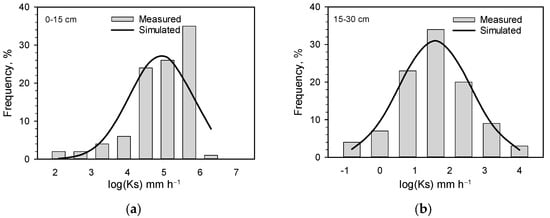
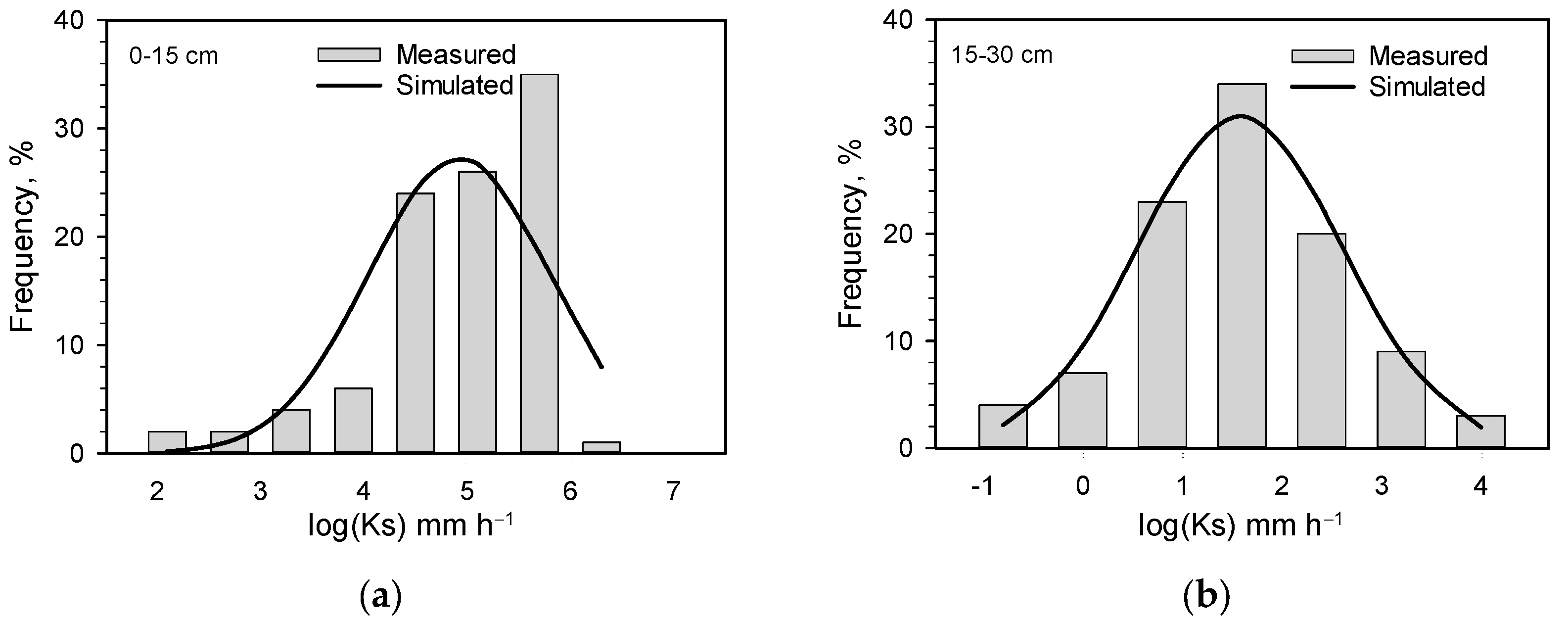
Probability frequency distribution curves for in situ Ks measurements of both NT and CT treatments under corn and soybean for 2014, 2015, 2016, 2017, and 2018 combined at 0–15 cm and 15–30 cm depths were generated. Both frequency distribution curves showed that Ks measurements were best fitted by log-normal distributions (Figure 1a,b). The frequency distribution at each depth showed that the 100 measurements of untransformed Ks were not symmetrical or bell shaped but rather positively skewed to the left toward low values of Ks. The mean, standard deviation, and skewness were 179.5 mm h−1, 110.2 mm h−1, and 0.544, respectively, for the 0–15 cm depth (Figure 1a) and were 8.046 mm h−1, 10.53 mm h−1, and 3.712, respectively, for the 15–30 cm depth (Figure 1b). These frequency distributions of log Ks measurements coincided with those reported by Awal et al. [9]. From this point forward, Ks is used as a natural logarithmic-transformed Ks (log Ks).
Figure 1.
Measured and simulated logarithmic frequency distribution for 100 values of saturated hydraulic conductivity (Ks): (a) at 0–15 cm soil depth; (b) at 15–30 cm soil depth.
3.2. Effect of Tillage on Soil Ks
Analysis of variance showed that log Ks was not significantly affected by tillage; however, it was significantly influenced by year and crop at the 0–15 cm depth but not significantly affected by either parameter at the 15–30 cm depth (Table 2). All interactions were not significant. Soil Ks varied from year to year in NT and CT systems at the 0–15 cm depth under corn and soybean, indicating temporal variability of Ks across the years of this study. Results from analysis of variance of log Ks for soil depths of 0–15 and 15–30 in the planting rows of NT and CT systems under corn and soybean for the 2014–2018 growing seasons are listed in Table 3. Higher Ks values were observed at the soil surface (0–15 cm) compared to at the subsurface layer (15–30 cm) in NT and CT systems under corn and soybean for all five years. The effect of depth on Ks values is associated with the measurement techniques and equations used for calculation of Ks values. Different measurement techniques can provide different values for Ks due to various factors related to the measurement method [41,42].
Table 2.
Analysis of variance for logarithmic saturated hydraulic conductivity (Ks) of sandy loam soil as affected by year (2014, 2015, 2016, 2017, and 2018), crop (corn and soybean), tillage type (no tillage and conventional tillage) at 0–15 and 15–30 cm depths and their interactions.
Table 3.
Effect of no tillage (NT) and conventional tillage (CT) on natural logarithmic saturated hydraulic conductivity (Ks) of sandy loam soil at 0–15 and 15–30 cm depths for the 2014–2018 growing seasons and their means across five years in corn and soybean plots.
Soil Ks measurements were not significantly impacted by tillage except at the 15–30 cm depth in 2015 and at the 0–15 cm depth in 2018 under corn, as well as at the 0–15 cm depth in 2014 under soybean. There were significant differences in soil Ks values between NT and CT treatments at 0–15 cm and 15–30 cm depths under corn in 2018 and 2015, respectively, whereas Ks results in CT plots were significantly greater than in NT plots at the 0–15 cm depth under soybean in 2014. These significant Ks variations between the two tillage treatments in these three years could be related to differences in macroporosity between CT and NT in these plots across the field.
Averaged throughout the five-year period (2014–2018), soil Ks measurements were not significantly affected by tillage in the surface layer (0–15 cm) under either crop nor in the subsurface layer (15–30 cm) under soybean (Table 3). This could be due to the high degree of variability among replications within each tillage treatment across the field. However, the mean soil Ks of 25 measurements in CT (1.784 mm h−1) was significantly greater than that in NT (1.186 mm h−1) in the 15–30 cm layer under corn, while Ks was approximately 50% larger in CT than in NT (Table 3). This variation in Ks could be attributed to soil loosening and macroporosity caused by the mechanical effect of tillage in CT plots compared to NT plots at this depth under corn [4,10,20,25,26,28,30,43]. Generally, sandy loam soils are prone to soil compaction under NT because they have poor soil structure with fewer macropores and weaker aggregate stability formation compared with clay-textured soils [4].
The large coefficients of variation (CV%) presented in Table 4 indicate high spatial variation in Ks measurements under the two tillage practices in both surface and subsurface layers over the study period. Averaged over 5 years, the CV% values of Ks measurements under corn (n = 25) were approximately 59% and 121% for NT and 44% and 74% for CT at the 0–15 cm and 15–30 cm depths, respectively, and, under soybean, were approximately 153% and 128% for NT and 71% and 84% for CT at the 0–15 cm and 15–30 cm depths, respectively.
Table 4.
Coefficients of variation (CV%) of natural logarithmic saturated hydraulic conductivity (log Ks) under no tillage (NT) and conventional tillage (CT) at 0–15 and 15–30 cm depths of sandy loam soil for 2014, 2015, 2016, 2017, and 2018 growing seasons and their means across five years in corn and soybean plots.
The degree of variability for both tillage systems and depths within corn and soybean plots (Table 4) varied from medium (15–75%) to high or even to extremely high (>75%) for Ks based on the category suggested by Dahiya et al. [39].
The above Ks results align with those of Alletto and Coquest [6], Jabro et al. [7,8], Awal et al. [9], Schluter et al. [10], and Kargas, et al. [11], who reported that Ks varies considerably over space and time. Further, the discrepancies in Ks measurements among replications within each treatment may have been caused by the complexity of the disturbances in the soil ecosystem induced by the external dynamic effect of tillage and due to spatial variability in soil properties across the experimental site [7]. However, part of the variability of soil properties within and among treatments could also have been induced by internal factors associated with pedogenic soil-forming processes [44].
Our results concur with those found by Celik [29], Karuma et al. [19], Jabro et al. [8], Blanco-Canqui et al. [20], Nouri et al. [21], Castillani et al. [22], Ordoñez-Morales et al. [23], and Sadiq et al. [24], who reported that tillage practices do not have a significant effect on soil Ks compared to untilled soils.
4. Summary and Conclusions
The mean values of Ks across 5 years (2014–2018) were not significantly affected by type of tillage under either corn or soybean, except in the 15–30 cm layer under corn, where Ks was about 50% greater in CT than in NT. This variation in Ks measurements at this depth could be attributed to soil loosening and manipulation of the macroporosity and pore size distribution caused by the mechanical effect of CT compared with NT at this depth under corn.
The large coefficients of variation (CV%) indicate significant spatial variability of Ks measurements among replications within each tillage treatment at the 0–15 cm and 15–30 cm depths under corn and soybean across the experimental site during the course of the study. Overall, Ks values showed medium to high degrees of spatial variability and significant temporal variation at surface and subsurface depths in both tillage systems under corn and soybean.
Based on our findings and those reported by previous studies, the effect of tillage on soil Ks measurements is not well understood due to profound natural soil variability and heterogeneity resulting from pedogenic soil-forming factors across agricultural fields.
Therefore, more studies with larger sample sizes within each tillage treatment are needed in order to minimize the effect of spatial variability on Ks measurements in field soils and to fully understand the direct impact of tillage practices on this highly variable and important soil property.
Author Contributions
Conceptualization, J.D.J.; methodology, J.D.J.; formal analysis, J.D.J.; investigation, J.D.J.; resources, J.D.J. and W.B.S.; data curation, J.D.J.; writing—original draft preparation, J.D.J.; writing—review and editing, J.D.J., W.B.S., W.M.I., U.M.S. and B.L.A.; visualization, J.D.J. All authors have read and agreed to the published version of the manuscript.
Funding
This research received no external funding.
Institutional Review Board Statement
Not applicable.
Informed Consent Statement
Not applicable.
Data Availability Statement
Data are included in this manuscript.
Acknowledgments
The authors wish to thank Dale Spracklin for his help with soil measurements. Mention of trade names, proprietary products, or specific equipment is intended for reader information only and does not constitute a guarantee or warranty by the USDA-ARS nor does it imply approval of the product named to the exclusion of other products.
Conflicts of Interest
The authors declare no conflict of interest.
References
- Lal, R.; Shukla, M.K. Principle of Soil Physicsl; Marcel Dekker, Inc.: New York, NY, USA, 2004. [Google Scholar]
- Hillel, D. Introduction to Soil Physics; Academic Press, Inc.: San Diego, CA, USA, 1982. [Google Scholar]
- Reynolds, W.D.; Elrick, D.E. Pressure infiltrometer. In Methods of Soil Analysis: Part 4. Physical Methods; Dane, J.H., Topp, G.C., Eds.; Soil Science Society of America: Madison, WI, USA, 2002; pp. 826–836. [Google Scholar]
- Jabro, J.D.; Stevens, W.B.; Iversen, W.M.; Sainju, U.M.; Allen, B.L. Soil cone index and bulk density of a sandy loam under no-till and conventional tillage in a corn-soybean rotation. Soil Tillage Res. 2021, 206, 104842. [Google Scholar] [CrossRef] [Scilit]
- Klute, A.; Dirksen, C. Hydraulic conductivity and diffusivity: Laboratory methods. In Methods of Soil Analysis, Part 1. Agronomy No. 9; Klute, A., Ed.; American Society of Agronomy: Madison, WI, USA, 1986; pp. 687–734. [Google Scholar]
- Alletto, L.; Coquet, Y. Temporal variability and spatial variability of soil bulk density and near-saturated hydraulic conductivity under two contrasted tillage management systems. Geoderma 2009, 152, 85–94. [Google Scholar] [CrossRef] [Scilit]
- Jabro, J.D.; Stevens, W.B.; Evans, R.G.; Iversen, W.M. Spatial variability and correlation of selected soil properties in the A-horizon of the CRP grassland. Appl. Eng. Agric. 2010, 26, 419–428. [Google Scholar] [CrossRef] [Scilit]
- Jabro, J.D.; Iversen, W.M.; Stevens, W.B.; Evans, R.G.; Mikha, M.M.; Allen, B.L. Physical and hydraulic properties of a sandy loam soil under zero, shallow and deep tillage practices. Soil Tillage Res. 2016, 159, 67–72. [Google Scholar] [CrossRef] [Scilit]
- Awal, R.; Safeeq, M.; Abbas, F.; Fares, F.; Deb, S.K.; Ahmad, A.; Faris, A. Soil physical properties spatial variability under long-term no-tillage corn. Agronomy 2019, 9, 750. [Google Scholar] [CrossRef] [Scilit]
- Schluter, S.; Albrecht, L.; Schwarzel, K.; Kreiselmeier, J. Long-term effects of conventional tillage and no-tillage on saturated and near-saturated hydraulic conductivity- Can their prediction be improved by pore metrics obtained with X-ray CT? Geoderma 2020, 3619, 114082. [Google Scholar] [CrossRef] [Scilit]
- Kargas, G.; Londra, P.A.; Sotirakoglou, K. Saturated hydraulic conductivity measurements in a loam soil covered by native vegetation: Spatial and temporal variability in the upper soil layer. Geosciences 2021, 11, 105. [Google Scholar] [CrossRef] [Scilit]
- Benjamin, J.G. Tillage effects on near-surface soil hydraulic properties. Soil Tillage Res. 1993, 26, 277–288. [Google Scholar] [CrossRef] [Scilit]
- Azooz, R.H.; Arshad, M.A. Soil infiltration and hydraulic conductivity under long-term no-tillage and conventional tillage systems. Can. J. Soil Sci. 1996, 76, 143–152. [Google Scholar] [CrossRef] [Scilit]
- Osunbitan, J.A.; Oyedele, D.J.; Adekalu, K.O. Tillage effects on bulk density, hydraulic conductivity and strength of a loamy sand soil in southwestern Nigeria. Soil Tillage Res. 2005, 82, 57–64. [Google Scholar] [CrossRef] [Scilit]
- Vogeler, I.; Rogasik, J.; Funder, U.; Panten, K.; Schnug, E. Effect of tillage systems and P-fertilization on soil physical and chemical properties, crop yield and nutrient uptake. Soil Tillage Res. 2009, 103, 137–143. [Google Scholar] [CrossRef] [Scilit]
- Soane, B.D.; Ball, B.C.; Arvidsson, J.; Basch, G.; Moreno, F.; Roger-Estrade, J. No-till in northern, western and south-western Europe: A review of problems and opportunities for crop production and the environment. Soil Tillage Res. 2012, 118, 66–87. [Google Scholar] [CrossRef] [Scilit]
- Chichongue, O.; van Tol, J.; Cerronio, G.; Preez, C.D. Effects of tillage systems and cropping patterns on soil physical properties in Mozambique. Agriculture 2020, 10, 448. [Google Scholar] [CrossRef] [Scilit]
- Moret, D.; Arrue, J.L. Dynamics of soil hydraulic properties during fallow as affected by tillage. Soil Tillage Res. 2007, 96, 103–113. [Google Scholar] [CrossRef] [Scilit]
- Karuma, A.; Mtakwa, P.; Amuri, N.; Gachene, C.K.; Gicheru, P. Tillage effects on selected soil physical properties in a maize-bean intercropping system in Mwala district, Kenya. Int. Sch. Res. Not. 2014, 2014, 497205. [Google Scholar] [CrossRef] [Scilit] [PubMed]
- Blanco-Canqui, H.; Wiehold, B.J.; Jin, V.L.; Schmer, M.R.; Kibet, L.C. Long-term tillage impact on soil hydraulic properties. Soil Tillage Res. 2017, 170, 38–42. [Google Scholar] [CrossRef] [Scilit]
- Nouri, A.; Lee, J.; Yin, X.; Tyler, D.D.; Jagadamma, S.; Arelli, P. Soil physical properties and soybean yield as influenced by long-term tillage systems and cover cropping in the Midsouth USA. Sustainability 2018, 10, 4696. [Google Scholar] [CrossRef] [Scilit]
- Castellini, M.; Fornaro, F.; Garofalo, P.; Giglio, L.; Rinaldi, M.; Ventrella, D.; Vitti, C.; Vonella, A.V. Effects of no-tillage and conventional tillage on physical and hydraulic properties of fine textured soils under winter wheat. Water 2019, 11, 484. [Google Scholar] [CrossRef] [Scilit]
- Ordoñez-Morales, K.D.; Cadena-Zapata, M.; Zermeño-González, A.; Campos-Magaña, S. Effect of tillage systems on physical properties of a clay loam soil under oats. Agriculture 2019, 9, 62. [Google Scholar] [CrossRef] [Scilit]
- Sadiq, M.; Li, G.; Rahman, N.; Tahir, M.M. Sustainable conservation tillage technique for improving soil health by enhancing soil physiochemical quality indicators under wheat mon-cropping system conditions. Sustainability 2021, 13, 8177. [Google Scholar] [CrossRef] [Scilit]
- Carter, M.R.; Kunelius, H.T. Comparison of tillage and direct drilling for Italian ryegrass on the properties of a fine sandy loam soil. Can. J. Soil Sci. 1986, 66, 197–207. [Google Scholar] [CrossRef] [Scilit]
- Heard, J.R.; Kladivko, E.J.; Mannering, J.V. Soil macoporosity, hydraulic conductivity and air permeability of silty soil under long-term conservation tillage in Indiana. Soil Tillage Res. 1988, 11, 1–18. [Google Scholar] [CrossRef] [Scilit]
- Radcliffe, D.E.; Tollner, E.W.; Hargrove, W.L.; Clark, R.L.; Golabi, M.H. Effect of tillage practices on infiltration and soil strength of Typic Hapladult soil after 10 years. Soil Sci. Soc. Am. J. 1988, 52, 798–804. [Google Scholar] [CrossRef] [Scilit]
- Horne, D.; Ross, C.; Hughes, K. Ten years of a maize/oats rotation under three tillage systems on a silt loam in New Zealand. 1. A comparison of some soil properties. Soil Tillage Res. 1992, 22, 131–143. [Google Scholar] [CrossRef] [Scilit]
- Celik, I. Effects of tillage methods on penetration resistance, bulk density and saturated hydraulic conductivity in a clayey soil conditions. J. Agric. Sci. 2011, 17, 143–156. [Google Scholar] [CrossRef] [Scilit]
- Haruna, S.I.; Anderson, S.H.; Nsalambi, V.N.; Zaibon, S. Soil hydraulic properties: Influence of tillage and cover crops. Pedosphere 2018, 28, 430–442. [Google Scholar] [CrossRef] [Scilit]
- Blake, G.R.; Hartge, K.H. Bulk Density. In Methods of Soil Analysis. Part I-Physical and Mineralogical Methods, 2nd ed.; Klute, A., Ed.; ASA-SSSA: Madison, WI, USA, 1986; pp. 363–375. [Google Scholar]
- Jabro, J.D.; Iversen, W.M.; Stevens, W.B.; Sainju, U.M.; Allen, B.L. Tillage effects on drainage fluxes and nitrate leaching through unsaturated zone under irrigated corn-soybean rotation. Appl. Eng. Agric. 2019, 35, 293–300. [Google Scholar] [CrossRef] [Scilit]
- Jabro, J.D.; Stevens, W.B. Soil-water characteristic curves and their estimated hydraulic parameters in no-tilled and conventionally tilled soils. Soil Tillage Res. 2022, 219, 105342. [Google Scholar] [CrossRef] [Scilit]
- Jabro, J.D.; Stevens, W.B.; Evans, R.G.; Iversen, W.M. Tillage effects on physical properties in two soils of the Northern Great Plains. Appl. Eng. Agric. 2009, 25, 377–382. [Google Scholar] [CrossRef] [Scilit]
- Reynolds, W.D.; Elrick, D.E.; Clothier, B.E. The constant head well permeameter: Effect of unsaturated flow. Soil Sci. Soil Sci. 1985, 139, 172–180. [Google Scholar] [CrossRef] [Scilit]
- Salverda, A.P.; Dane, J.H. An examination of the Guelph permeameter for measuring the soil’s hydraulic properties. Geoderma 1993, 57, 405–421. [Google Scholar] [CrossRef] [Scilit]
- Reynolds, W.D. Saturated hydraulic conductivity: Field measurement. In Soil Sampling and Methods of Analysis; Carter, M.R., Ed.; Canadian Society of Soil Science Lewis Publishers: Ann Arbor, MI, USA, 1993; pp. 599–613. [Google Scholar]
- SAS Institute. SAS for Windows, Version 9.1; SAS Institute: Cary, NC, USA, 2003.
- Dahiya, I.S.; Richter, J.; Malik, R.S. Soil Spatial Variability: A review. Int. J. Trop. Agric. 1984, 2, 1–102. [Google Scholar]
- Rothschild, V.; Logothetis, N. Probability Distributions; John Wiley and Sons Inc.: New York, NY, USA, 1986. [Google Scholar]
- Morbidelli, R.; Saltalippi, C.; Falmmini, A.; Cifrodelli, M.; Picciafuoco, T.; Corradini, C.; Govindaraju, R.S. In situ measurements of saturated hydraulic conductivity: Assessment of reliability through rainfall-runoff experiments. Hydrol. Process. 2017, 31, 3084–3094. [Google Scholar] [CrossRef] [Scilit]
- Liao, K.; Feng, J.; Lai, X.; Qing Zhu, Q. Effects of environmental factors on the influence of tillage conversion on soil saturated hydraulic conductivity obtained with different methodologies: A global meta-analysis. Soil 2022, 8, 309–317. [Google Scholar] [CrossRef] [Scilit]
- Blanco-Canqui, H.; Ruis, S.J. No-tillage and soil physical environment. Geoderma 2018, 326, 164–200. [Google Scholar] [CrossRef] [Scilit]
- Vasu, D.; Singh, S.K.; Tiwary, P.; Chandran, P.; Ray, S.K. Pedogenic processes and soil-landform relationships for identification of yield-limiting soil properties. Soil Res. 2016, 55, 273–284. [Google Scholar] [CrossRef] [Scilit]

Disclaimer/Publisher’s Note: The statements, opinions and data contained in all publications are solely those of the individual author(s) and contributor(s) and not of MDPI and/or the editor(s). MDPI and/or the editor(s) disclaim responsibility for any injury to people or property resulting from any ideas, methods, instructions or products referred to in the content. |
© 2023 by the authors. Licensee MDPI, Basel, Switzerland. This article is an open access article distributed under the terms and conditions of the Creative Commons Attribution (CC BY) license (https://creativecommons.org/licenses/by/4.0/).