


Abstract
Critical Zone Science (CZS) provides an integrated understanding of interactions among soil, water, rock, atmosphere and biota, while Soil Security offers a complementary framework for evaluating soils through the dimensions of Capability, Condition, Capital, Connectivity and Codification. However, the relationship between Critical Zone (CZ) processes and these dimensions, and the extent to which Soil Security is represented within Critical Zone Observatories (CZOs), remain insufficiently articulated. This review examines relationships between major Critical Zone processes and the five Soil Security dimensions, assesses their documented representation across 62 CZOs and associated long-term monitoring-site entries, and identifies opportunities for strengthening their integration. The study combined a conceptual synthesis of the relevant literature with a structured desk-based assessment using an established historical inventory of 62 entries, supplemented by information from individual CZOs and institutional websites and associated publications. Each entry was evaluated against predefined evidence criteria for the five Soil Security dimensions using binary coding. Condition was documented most frequently (55/62; 88.7%), followed by Capital (42/62; 67.7%), Capability (33/62; 53.2%), Connectivity (32/62; 51.6%) and Codification (7/62; 11.3%). The findings show that CZOs activities provide substantial process-based evidence relevant to the biophysical dimensions of Soil Security, while societal and institutional dimensions, particularly Codification, are less consistently documented. Integrating Soil Security with CZOs research can therefore complement established strengths in long-term CZ observation by strengthening interpretation of soil functions and natural capital and by promoting greater attention to stakeholder engagement, knowledge exchange, stewardship and pathways for translating scientific evidence into institutional decision-making. This integration provides a basis for connecting understanding of how the CZ functions with how soil resources are valued, stewarded and governed.
1. Introduction
Soil security constitutes a critical, multifunctional framework for global sustainability, as soils directly underpin approximately 95% of food production, regulate water cycles through filtration and retention, and act as the planet’s second-largest carbon sink by storing over 1500 billion tons of carbon, which is approximately three times more than that stored in vegetation [1,2], thereby offering a powerful nature-based solution for climate change mitigation when managed with regenerative practices. Concurrently, soils host more than a quarter of the Earth’s biodiversity and drive essential ecosystem services like nutrient cycling [3], while their widespread degradation, with approximately one-third of global soils already moderately to highly degraded, poses profound threats to national and international stability by compromising food supply chains and exacerbating socio-economic vulnerabilities. To holistically address these interconnected challenges, the soil security paradigm, which is articulated through its five dimensions of Capability, Condition, Capital, Connectivity, and Codification [3], provides a robust, science-based framework for integrated monitoring and governance. Given the scale of global soil degradation, urgently embedding this framework into policy agendas is imperative to ensure resilient agricultural systems, counteract climate warming, and preserve the biosphere’s fundamental life-support functions.
The emergence of CZS reflects a shift toward studying the Earth’s near-surface environment as a single, interconnected system rather than separate disciplinary domains. The term was first introduced in 1998 by Ashley to highlight the zone between the land surface and bedrock as crucial for life [4]. It was subsequently formalized by the National Research Council, which defined the CZ as the heterogeneous, near-surface environment in which complex interactions involving rock, soil, water, air, and living organisms regulate natural habitats and determine the availability of life-sustaining resources [4,5]. Since the establishment of the CZOs programme by the NRC and the National Science Foundation, CZ research has evolved considerably, expanding from a small number of intensively studied sites into a global network intended to capture the diversity of landscapes, climates, and human impacts shaping the near-surface Earth system [6]. This research has become increasingly interdisciplinary, drawing together geology, soil science, hydrology, geomorphology, ecology, and atmospheric science to understand how these processes jointly transform rock and biomass into soil and sustain the broader biosphere [7]. What makes CZ science provide a genuinely new perspective is its systems-based framing. Rather than treating soil, water, vegetation, and rock as separate objects of study, it treats their interactions and co-evolution as the primary subject of inquiry, offering an integrated lens through which to understand landscape evolution, resource availability, and human impacts on the environment [8].
Despite growing recognition of soil as a central component of the CZ, the relationship between CZ processes and the five dimensions of Soil Security remains insufficiently articulated. CZS provides a process-based understanding of how weathering, hydrology, geomorphology, biological activity, vegetation dynamics, and climate and human activities interact to regulate soil formation, functioning and change [9,10]. However, understanding these processes does not, by itself, fully account for how soils and the knowledge generated about them are valued, connected with society, or incorporated into governance and decision-making.
Soil Security provides a complementary framework through its five dimensions of Capability, Condition, Capital, Connectivity and Codification [3,11]. Capability and Condition provide perspectives on the potential functionality and current state of soils, while Capital recognizes their stocks, functions and value. Connectivity extends the framework to societal knowledge, awareness, engagement and stewardship, whereas Codification concerns the incorporation of soil knowledge into policy, regulation and institutional arrangements [3,11]. These dimensions therefore provide a means of extending process-based CZ knowledge towards the functional, societal and governance considerations required for sustainable soil management.
CZOs provide an important setting for examining this complementarity because they generate long-term, interdisciplinary observations of interactions among rock, soil, water, atmosphere and biota and have substantially advanced understanding of the CZ’s structure, processes and evolution [9,12]. However, the extent to which the knowledge and activities generated through CZOs encompass the broader dimensions of Soil Security remains less clear. In particular, process-based observations may provide strong evidence concerning soil Capability and Condition and contribute to understanding soil Capital, but societal Connectivity and the translation of knowledge into governance through Codification require additional forms of engagement and institutional application. Examining CZOs through a Soil Security lens therefore provides an opportunity to identify both existing strengths and gaps that could inform the future development and management of CZOs.
The aim of this paper is to examine how integrating CZ processes with the Soil Security framework can strengthen the scientific and management relevance of CZOs. Specifically, this paper seeks to: (i) examine the relationships between key CZ processes and the five dimensions of Soil Security; (ii) assess the extent to which the five Soil Security dimensions are represented in the documented activities of 62 CZOs and associated long-term monitoring sites; and (iii) identify gaps and future directions for strengthening the integration of Soil Security within CZ research, observation and management.
2. The Study Approach
This study combined a conceptual synthesis of CZ processes and Soil Security with a structured desk-based assessment of CZOs and associated long-term monitoring sites. The conceptual synthesis drew on the established and contemporary literature to examine how major CZ processes relate to the five dimensions of Soil Security: Capability, Condition, Capital, Connectivity and Codification [3,10,11]. The CZOs assessment used the established international inventory of 62 CZOs and associated monitoring-site entries presented in Appendix 3 of Sustaining Earth’s CZ: Basic Science and Interdisciplinary Solutions for Global Challenges [13]. The inventory provided a predefined analytical framework for examining how the five Soil Security dimensions are represented within documented CZOs activities. Other studies related to CZOs and soil security were identified through searches on Google Scholar and only SCOPUS-indexed peer-reviewed papers were considered.
Information contained in the inventory was used as the initial source for identifying and characterizing the 62 entries. Because the inventory did not provide sufficient detail to evaluate all five Soil Security dimensions consistently, each entry was subsequently investigated individually using available CZOs or institutional websites and publications associated with the respective observatory or monitoring site. These supplementary sources were used to identify additional documented information on research and monitoring activities, soil and CZ processes, ecosystem services, stakeholder engagement, knowledge exchange, management applications, and policy or institutional linkages that were not reported in the original inventory. Evidence from these sources was evaluated using the same predefined operational criteria, and the source supporting each classification was recorded in the observatory-level assessment provided in the Supplementary Materials.
Each observatory was evaluated against the five Soil Security dimensions: Capability, Condition, Capital, Connectivity and Codification; operational screening criteria adapted from the conceptual definitions of the Soil Security framework were used [3]. Capability represented documented assessment of the potential of soils to perform defined functions; Condition represented measurement of their current physical, chemical or biological state and change; Capital represented soil stocks, natural assets or ecosystem-service values; Connectivity represented societal connection with soil through knowledge, education, communication, stakeholder engagement or stewardship; and Codification represented translation of soil knowledge into policy, regulation, standards, institutional arrangements or formal decision-support mechanisms. Substantive evidence was defined as explicit documentation that an observatory assessed, monitored or supported an activity corresponding to a particular domain; inference based solely on the observatory name, location or general CZ mandate was insufficient. Evidence documented only at the level of a broader CZOs network or research programme was not automatically attributed to individual observatories unless the source explicitly identified the observatory as participating in the relevant activity. Each domain was coded as 1 when substantive evidence was documented and 0 when evidence was insufficient, producing an integration score ranging from 0 to 5 (see Table 1). The score represents the breadth of documented Soil Security integration and not the scientific quality or performance of an observatory. For each observatory, the supporting evidence and corresponding source were recorded to provide an auditable basis for classification. Detailed coding criteria, observatory-level assessments and supporting evidence are provided in the Supplementary Materials.
Table 1.
Operational criteria used to assess representation of Soil Security dimensions across CZOs.
Coding was conservative such that measurements or activities were assigned to a Soil Security dimension only where the available documentation explicitly supported the corresponding operational criterion. Measurements that could potentially inform a dimension, but for which that application was not documented, were not assigned a positive score. A single activity could contribute to more than one dimension only where evidence independently satisfied the criteria for each.
Because the underlying inventory represents an established historical compilation of international CZOs rather than a census of all currently active observatories, the assessment was used to examine patterns of Soil Security integration within this defined set of observatories and should not be interpreted as a comprehensive assessment of the contemporary global CZOs network.
3. Linking CZ Processes with Soil Security
CZS and Soil Security provide complementary perspectives for understanding and managing soils. CZS situates soil within a vertically integrated Earth-surface system extending from the vegetation canopy through the soil and weathered regolith to groundwater and underlying bedrock. Within this system, soil formation and functioning emerge from interactions among weathering, hydrology, geomorphology, biological activity, vegetation, climate and human activities. Soil Security, in contrast, provides a framework for evaluating the capability of soils to continue supporting environmental and societal needs through five interrelated dimensions: Capability, Condition, Capital, Connectivity and Codification [3].
Integrating these perspectives provides a broader basis for interpreting and applying knowledge of soil systems. CZS explains the interacting biophysical and human processes through which soils form, function and change, whereas Soil Security provides a framework for evaluating the capacity, state, value, societal connection and governance of soil resources through Capability, Condition, Capital, Connectivity and Codification [3,10,11]. This relationship is therefore complementary rather than one-to-one: individual CZ processes may influence several Soil Security dimensions, while some dimensions, particularly Connectivity and Codification, depend on societal and institutional processes that extend beyond biophysical CZ observation. Integrating these two perspectives can consequently help translate process-based knowledge generated through CZ research into a broader understanding of soil value, stewardship and governance. See Table 2 below for more detail.
Table 2.
Relationships between major CZ processes, soil functions and Soil Security dimensions.
The comparison highlights an important distinction between the two perspectives. CZ processes provide a strong mechanistic understanding of the controls on soil formation, functions and change and therefore generate evidence particularly relevant to Capability, Condition and Capital. Weathering and regolith development influence long-term functional potential; hydrological and geomorphological processes regulate water storage, erosion and redistribution; biological and vegetation processes regulate nutrient cycling, carbon storage and biodiversity; and climate and human activities modify these interacting processes across temporal and spatial scales [9,10]. These process-based observations are fundamental to understanding why soil properties and functions vary and how they respond to environmental change.
However, process understanding alone does not necessarily establish how CZ knowledge is connected with society or incorporated into institutions and governance. These aspects are explicitly captured by the Soil Security dimensions of Connectivity and Codification [3,11]. Connectivity concerns societal relationships with soil through knowledge, awareness, education, communication, stakeholder engagement and stewardship, whereas Codification concerns the translation of soil knowledge into policy, regulation, standards and institutional decision-making. Soil Security therefore adds an explicit societal and governance perspective that can complement the predominantly process-based knowledge generated through CZ research.
For CZOs, this distinction has practical implications. Long-term measurements of soil, water, vegetation, weathering and biogeochemical processes provide the scientific evidence needed to understand CZ functioning, but greater attention to knowledge exchange, stakeholder participation, stewardship and pathways for translating observations into policy and decision-making could extend the relevance of that evidence beyond scientific monitoring. Applying a Soil Security lens to CZOs activities therefore provides a means of identifying where existing process observations already contribute to soil security and where additional societal or institutional engagement could strengthen their management relevance.
4. Monitoring Soil Security Through CZOs
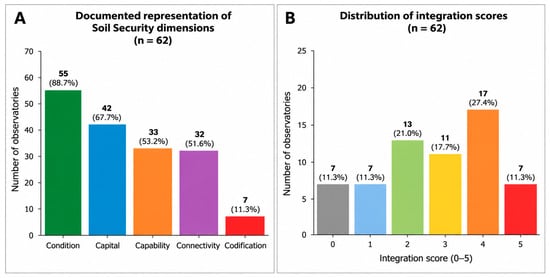
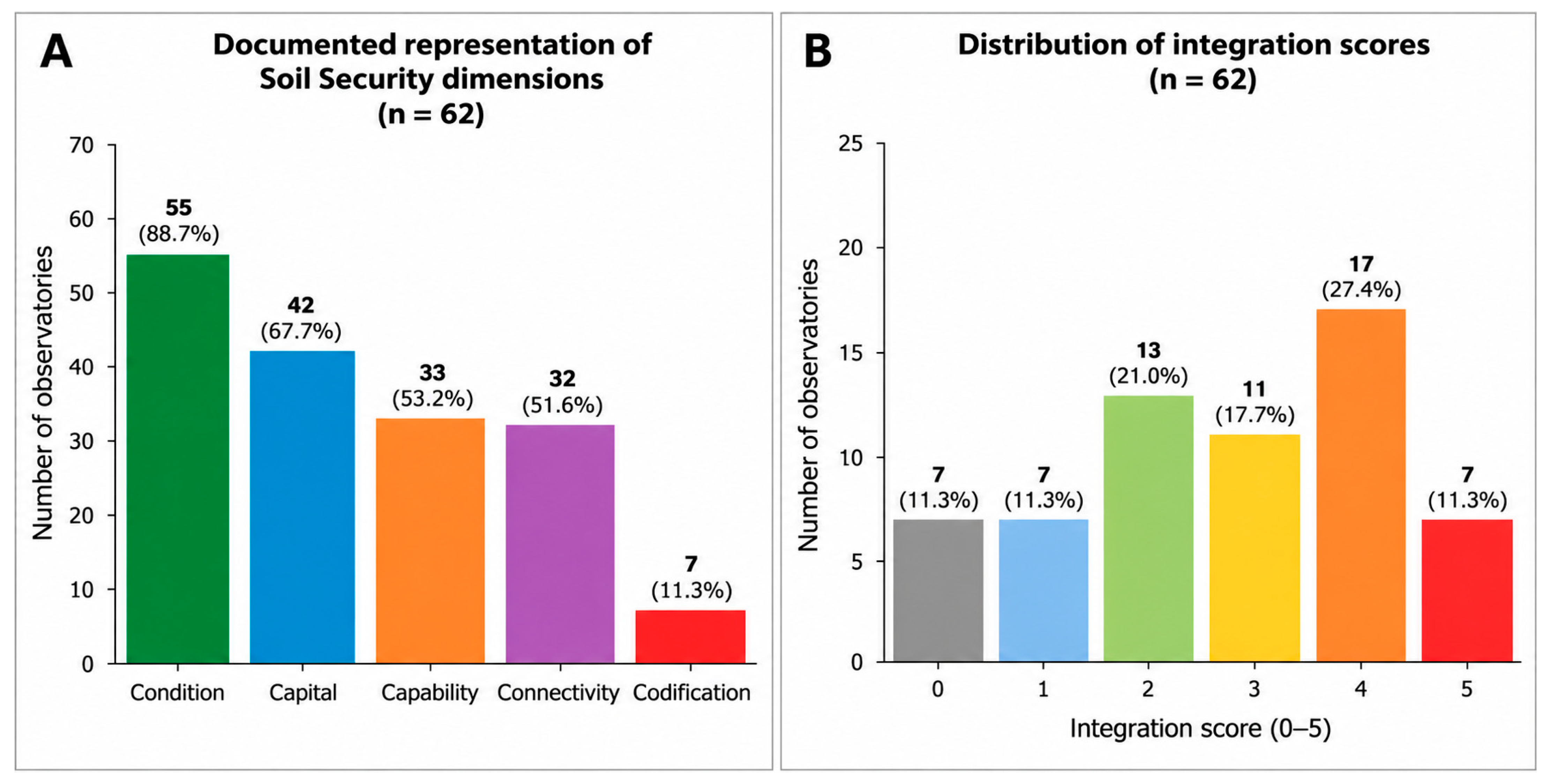
CZOs provide long-term research infrastructure for observing interactions among soil, water, rock, atmosphere and biota and for understanding how CZ processes respond to environmental and anthropogenic changes [9,12]. Their contribution to Soil Security, however, depends not only on the biophysical processes and soil properties they monitor, but also on the extent to which generated knowledge addresses soil functional potential, condition and value and connects with societal engagement and institutional decision-making. To examine this integration, the 62 CZOs and associated long-term monitoring-site entries identified in the historical inventory were assessed using the five Soil Security dimensions (see Figure 1) and the operational criteria described in Section 2.
Figure 1.
Documented integration of Soil Security dimensions across the 62 CZOs and associated long-term monitoring-site entries assessed. (A) Number and percentage of entries with qualifying documented evidence for each Soil Security dimension. (B) Distribution of overall integration scores, calculated as the sum of the five binary domain classifications (0–5). Scores represent the breadth of documented Soil Security integration rather than the scientific quality or performance of individual observatories. Absence of qualifying documented evidence was coded as 0 and should not be interpreted as evidence that the corresponding activity was absent.
The assessment revealed uneven documented integration of the five Soil Security dimensions across the 62 observatories and associated monitoring-site entries (Figure 1). Condition was the most frequently documented dimension, with qualifying evidence identified for 55 entries (88.7%), followed by Capital in 42 (67.7%). Capability and Connectivity were documented in 33 (53.2%) and 32 (51.6%) entries, respectively, whereas Codification was documented in only seven (11.3%). This pattern indicates that documentation more frequently addressed soil state, functional potential and associated natural assets than the formal translation of CZ knowledge into policy, standards, institutional arrangements or decision-support mechanisms.
The breadth of documented integration also varied among individual entries. Seven entries (11.3%) showed qualifying evidence across all five Soil Security dimensions, while 17 (27.4%) represented four dimensions and 11 (17.7%) represented three. Thirteen entries (21.0%) represented two dimensions, seven (11.3%) represented one, and seven (11.3%) had no qualifying evidence under the applied criteria. These scores represent the breadth of documented Soil Security integration and should not be interpreted as rankings of observatory quality or scientific performance.
The pattern demonstrates a clear imbalance in the types of Soil Security evidence documented across the assessed CZOs entries. The predominance of Condition is consistent with the traditional strength of CZOs in observing soil properties, environmental change and interacting biophysical processes. The comparatively high representation of Capital also indicates that many CZOs activities provide information on soil stocks, ecosystem functions or ecosystem-service values. Capability was less consistently demonstrated because measurements of soil properties or processes were not interpreted as evidence of Capability unless they were explicitly used to assess the potential of soils to perform defined functions.
More importantly, the results reveal where the Soil Security perspective can extend conventional CZOs activities. Although Connectivity was documented in approximately half of the entries, Codification was identified in only seven (11.3%), indicating that explicit translation of CZOs knowledge into policy, standards, institutional arrangements or formal decision-support remains comparatively uncommon in the documentation assessed. This does not imply that the remaining observatories have no policy or institutional influence; instead, this influence could not be substantiated under the applied evidence criteria. The findings therefore suggest that stronger pathways linking process-based CZOs knowledge with stakeholder engagement, knowledge exchange and institutional decision-making could broaden the contribution of CZOs to Soil Security.
Long-term observations remain foundational, since many CZ processes, such as weathering, soil formation, and hydrological connectivity, operate over years to millennia and can only be detected through sustained, systematic monitoring at fixed sites rather than one-off surveys. This is increasingly supported by sensor technologies, including field Internet of Things devices, which enable continuous, real-time monitoring of critical soil parameters and ensure the ongoing acquisition of accurate, up-to-date data on soil moisture, temperature, and chemistry [14]. These ground-based sensor networks are complemented by digital soil mapping, which increasingly relies on remote sensing data, from multispectral and hyperspectral satellite imagery to UAV-based sensors, either as a substitute for costly field measurements or as covariates related to the environmental factors controlling soil formation and spatial variability [15]. Machine learning has become central to translating these large, heterogeneous datasets into usable soil information, with algorithms such as Random Forest and neural networks now used to predict soil properties including organic carbon, salinity, and nutrient status with reported accuracies as high as 80–97% under favourable conditions [16]. Beyond sensor- and satellite-based approaches, citizen science is emerging as a complementary monitoring strategy, engaging non-specialists in soil data collection to expand spatial coverage and public engagement, although such programmes still face challenges around data validation rigour and consistency across projects [16,17]. Environmental DNA (eDNA) analysis, which involves collecting environmental samples and applying high-throughput sequencing to identify multiple species from a single sample, offers a further non-invasive avenue for monitoring soil biodiversity and can similarly be integrated into citizen science initiatives to accelerate biodiversity assessment [18]. Finally, digital twins are emerging as an integrative technology capable of drawing these diverse data streams together: a cognitive soil digital twin can seamlessly combine sensor data, remote sensing, field measurements, and digital cartography into a dynamic virtual representation of the soil ecosystem, enabling scenario analysis and supporting more holistic, real-time understanding of soil condition and function [14]. Together, these approaches strengthen the capacity of CZOs to observe CZ processes and generate evidence relevant to Soil Security. Their full contribution to Soil Security, however, also depends on how effectively this scientific information is connected with societal knowledge, stakeholder engagement and institutional decision-making. (See Table 3).
Table 3.
Indicators and monitoring approaches for assessing soil security within the CZ.
Physical connectivity remains an important component of CZ functioning and can be assessed through hydrological monitoring, sediment measurements, tracer studies, GIS and related approaches. However, physical transfers of water, sediments, solutes and organisms should not be interpreted as evidence of the Soil Security Connectivity dimension. Within Soil Security, Connectivity specifically concerns societal relationships with soil through knowledge, awareness, communication, engagement and stewardship [3,11]. Physical CZ connectivity may instead influence soil functions and provide evidence relevant to Capability, Condition or Capital, depending on the process and application being assessed.
5. Research Gaps and Future Directions
Despite advances in CZS, important gaps remain in connecting process-based understanding with the broader dimensions of Soil Security. CZ research has generated substantial knowledge of interactions among soil, water, rock, atmosphere and biota, but explicit integration with the five-dimensional Soil Security framework remains limited [3,10,11]. The assessment of the 62 CZOs and associated monitoring-site entries reinforces this distinction: documented evidence was strongest for Condition and Capital, whereas Connectivity was less consistently represented and Codification was particularly limited. These patterns indicate opportunities to complement the established biophysical strengths of CZOs with greater attention to societal engagement, knowledge exchange and pathways through which CZ knowledge informs institutions and decision-making.
An initial priority is therefore to strengthen integration between CZ process knowledge and Soil Security assessment. Existing soil-health and environmental monitoring approaches generate extensive information on soil properties and processes, but translating these observations into comparable evidence of soil functional potential, condition, natural capital, societal connection and governance remains challenging. Developing approaches that explicitly relate CZOs observations to the five Soil Security dimensions could improve the interpretability and application of long-term CZ datasets while avoiding assumptions that individual measurements automatically represent particular Soil Security dimensions.
A second priority concerns the societal and institutional dimensions of CZOs research. The comparatively low documented representation of Codification in the present assessment suggests a need to strengthen pathways through which CZOs-generated knowledge informs policy, standards, planning and formal decision-support. Similarly, greater stakeholder participation, knowledge exchange, education and citizen-science approaches could strengthen Soil Security Connectivity by linking process-based scientific knowledge with land managers, communities and other users of CZ information [3,11].
Long-term monitoring and emerging digital technologies provide further opportunities for strengthening this integration. Sensor networks, remote sensing, digital soil mapping, machine learning and digital-twin approaches can increase the temporal and spatial resolution of CZ observations, while interoperable and open datasets can facilitate comparison across observatories. However, technological development alone does not ensure Soil Security integration. Future CZOs development should therefore combine advances in process monitoring with mechanisms for stakeholder engagement, knowledge exchange, natural-capital assessment and science–policy translation. Table 4 summarizes the principal research gaps identified in this review and the corresponding approaches through which they could be addressed.
Table 4.
Key research gaps and approaches for strengthening the integration of CZS, CZOs and Soil Security.
Collectively, these priorities suggest that the future development of CZOs should not move away from their core strength in process-based observations but should build upon it. Soil Security provides a complementary structure for extending CZ knowledge towards explicit consideration of soil functions and value, societal engagement and institutional application. Strengthening these connections could enhance the capacity of CZOs to generate not only long-term understanding of CZ processes but also knowledge that is more readily connected to stewardship and decision-making.
Bridging CZS, Society and Policy
One of the continuing challenges for CZS is not simply generating better environmental data but strengthening the pathways through which this knowledge contributes to soil management and decision-making. The assessment of the 62 CZOs and associated long-term monitoring-site entries illustrates this challenge. Documented representation was strongest for Condition (55/62; 88.7%) and Capital (42/62; 67.7%), while Capability (33/62; 53.2%) and Connectivity (32/62; 51.6%) were represented in approximately half of the assessed entries. Codification was substantially less represented (7/62; 11.3%). This pattern suggests that although CZOs generate considerable evidence on soil and CZ states, processes and associated ecosystem functions, the explicit translation of this knowledge into policy, standards, institutional arrangements and formal decision-support is less consistently documented.
Bringing CZStogether with the Soil Security framework provides an opportunity to strengthen this science–society–policy connection. Process-based CZ observations can provide evidence relevant to soil Capability, Condition and Capital, while the Connectivity and Codification dimensions draw explicit attention to how that knowledge is communicated, shared with stakeholders and incorporated into institutional and governance processes [3,11]. Greater collaboration among natural scientists, social scientists, land managers, communities and policy-makers could therefore complement the established biophysical strengths of CZ research and increase its relevance to soil stewardship and sustainable land management.
Looking ahead, CZOs could increasingly function not only as platforms for long-term environmental observation but also as interfaces between scientific knowledge, society and decision-making. This does not require shifting their primary purpose away from understanding CZ processes. Rather, it involves building upon that scientific foundation through stakeholder engagement, knowledge exchange, participatory approaches and clearer pathways for translating long-term observations into management and policy. The Soil Security framework provides a useful structure for this broader role by connecting knowledge of soil functioning and value with societal engagement and governance.
6. Limitations of the Review
This review has several limitations that should be considered when interpreting its findings. First, as a critical narrative review, the synthesis prioritized conceptual relevance and interdisciplinary integration rather than exhaustive systematic coverage or statistical aggregation. Consequently, some relevant studies may not have been captured, particularly given the diverse disciplinary literature encompassed by CZS and Soil Security. Differences in terminology, methods, spatial and temporal scales, and disciplinary emphasis across the reviewed literature also limited direct comparison of evidence.
Second, the assessment of the 62 CZOs and associated long-term monitoring-site entries was based on a predefined historical inventory rather than a comprehensive census of all contemporary CZOs. Information from the inventory was supplemented with evidence obtained from individual CZOs or institutional websites and associated publications; however, the availability and level of detail of public documentation varied among entries. Absence of qualifying documented evidence was therefore coded conservatively and should not be interpreted as evidence that a particular Soil Security-related activity was absent. This limitation is especially important for activities such as stakeholder engagement and policy or institutional influence, which may occur without being comprehensively documented in publicly accessible sources.
Finally, the relationships identified between CZ processes and Soil Security dimensions are conceptual and should not be interpreted as fixed or exclusive one-to-one associations. Their expression and management relevance may vary according to climate, geology, soils, land use, ecological conditions and socio-economic and governance contexts. The proposed integration should therefore be regarded as a framework for interpreting and extending CZ observations through a Soil Security perspective rather than as a universally prescriptive classification.
7. Conclusions
CZS and Soil Security provide complementary perspectives for understanding and managing soils. CZS provides process-based understanding of interactions among soil, water, rock, atmosphere and biota, including weathering, hydrological, biological, biogeochemical, geomorphological and vegetation processes and their responses to climate and human activities. These observations provide particularly important evidence for understanding soil Capability, Condition and Capital. Soil Security extends this process-based perspective by explicitly considering the societal relationship with soil through Connectivity and the translation of soil knowledge into policy, regulation and institutional arrangements through Codification.
The assessment of 62 CZOs and associated long-term monitoring-site entries showed uneven documented representation of these dimensions. Condition was most frequently represented (55/62; 88.7%), followed by Capital (42/62; 67.7%), Capability (33/62; 53.2%) and Connectivity (32/62; 51.6%), whereas Codification was documented in only seven entries (11.3%). These results reflect the evidence available from the assessed historical inventory and supplementary CZOs, institutional and publication sources and should not be interpreted as rankings of observatory quality or as evidence that undocumented activities are absent.
The findings suggest that the contribution of CZOs to Soil Security can be strengthened by building on, rather than replacing, their established strengths in long-term process observation. More explicit interpretation of CZ observations in relation to soil functions and natural capital, together with stronger stakeholder engagement, knowledge exchange, stewardship and pathways for translating scientific evidence into institutional decision-making, could broaden the societal and management relevance of CZOs research. Integrating CZ processes, long-term observatory evidence and the five dimensions of Soil Security therefore provides a basis for connecting understanding of how the CZ functions with how soil resources are valued, stewarded and governed.
Supplementary Materials
The following supporting information can be downloaded at https://www.mdpi.com/article/10.3390/soilsystems10110138/s1. Table S1: Observatory-level assessment of documented Soil Security integration. References [19,20,21,22,23,24,25,26,27,28,29,30,31,32,33,34,35,36,37,38,39] are cited in the Supplementary Materials, and their full bibliographic details are included in the reference list of the main manuscript.
Author Contributions
Conceptualization; I.S. and J.G.C.; methodology, I.S., J.G.C. and J.K.; literature search and synthesis, I.S. and J.G.C.; analysis and interpretation, I.S.; visualization, I.S.; writing—original draft preparation, I.S.; writing—review and editing, I.S., J.K., J.K.P., P.C.N., J.G.C. and L.G.; supervision, J.G.C. and P.C.N. All authors have read and agreed to the published version of the manuscript.
Funding
This research was funded by the Science for Africa Foundation (SFA) via the Developing Excellence in Leadership, Training and Science in Africa (DELTAS Africa II) programme [Grant Number: Del:22-010] with support from Wellcome Trust and the UK Foreign, Commonwealth & Development Office, which is part of the EDCPT2 programme supported by the European Union.
Data Availability Statement
No new datasets were generated during this study. The data and information supporting the findings of this review were derived from publicly available literature and sources cited in the article. The dataset used for the assessment of CZOs and their integration of Soil Security domains is available from the corresponding author upon reasonable request.
Acknowledgments
Artificial intelligence (AI) tools were not used to write the content of this manuscript. During earlier stages of manuscript preparation, ChatGPT (OpenAI, GPT-6.1 Sol), Figurelabs.ai, and Napkin.ai were used solely to assist with the visual design and refinement of conceptual illustrations based on author-defined concepts and specifications. However, the AI-assisted graphics produced during that process were subsequently removed during manuscript revision and are not included in the final manuscript. The authors take full responsibility for the content, accuracy, originality, and integrity of the final publication.
Conflicts of Interest
The authors declare no conflicts of interest.
Abbreviations
The following abbreviations are used in this manuscript:
| AI | Artificial Intelligence |
| CEC | Cation Exchange Capacity |
| CZ | Critical Zone |
| CZOs | Critical Zone Observatory |
| CZS | Critical Zone Science |
| eDNA | Environmental DNA |
| GIS | Geographic Information System |
| IoT | Internet of Things |
| SOC | Soil Organic Carbon |
References
- Ontl, T.A.; Schulte, L.A. Soil Carbon Storage. Nat. Educ. Knowl. 2012, 3, 35. Available online: https://www.scirp.org/reference/referencespapers?referenceid=3048870 (accessed on 13 August 2026).
- Scharlemann, J.P.W.; Tanner, E.V.J.; Hiederer, R.; Kapos, V. Global soil carbon: Understanding and managing the largest terrestrial carbon pool. Carbon. Manag. 2014, 5, 81–91. [Google Scholar] [CrossRef] [Scilit]
- McBratney, A.; Field, D.J.; Koch, A. The dimensions of soil security. Geoderma 2014, 213, 203–213. [Google Scholar] [CrossRef] [Scilit]
- NRC Basic Research Opportunities in Earth Science. 2001. Available online: https://search.worldcat.org/title/613360297 (accessed on 22 July 2026).
- Richardson, J.B. Critical Zone. In Encyclopedia of Geochemistry; Springer: Cham, Switzerland, 2017; pp. 1–5. [Google Scholar] [CrossRef] [Scilit]
- Singha, K.; Sullivan, P.L.; Billings, S.A.; Walls, L.; Li, L.; Jarecke, K.M.; Barnard, H.R.; Gasparini, N.M.; Madoff, R.D.; Dhital, S.; et al. Expanding the Spatial Reach and Human Impacts of Critical Zone Science. Earths Future 2024, 12, e2023EF003971. [Google Scholar] [CrossRef] [Scilit]
- SEG Wiki. Critical Zone; SEG Wiki: Houston, TX, USA, 2017; Available online: https://wiki.seg.org/wiki/Critical_zone (accessed on 22 September 2026).
- Brantley, S.L.; Goldhaber, M.B.; Vala Ragnarsdottir, K. Crossing Disciplines and Scales to Understand the Critical Zone. Elements 2007, 3, 307–314. [Google Scholar] [CrossRef] [Scilit]
- Brantley, S.L.; McDowell, W.H.; Dietrich, W.E.; White, T.S.; Kumar, P.; Anderson, S.P.; Chorover, J.; Lohse, K.A.; Bales, R.C.; Richter, D.D.; et al. Designing a network of critical zone observatories to explore the living skin of the terrestrial Earth. Earth Surf. Dyn. 2017, 5, 841–860. [Google Scholar] [CrossRef] [Scilit]
- Banwart, S.A.; Nikolaidis, N.P.; Zhu, Y.G.; Peacock, C.L.; Sparks, D.L. Soil functions: Connecting earth’s critical zone. Annu. Rev. Earth Planet. Sci. 2019, 47, 333–359. [Google Scholar] [CrossRef] [Scilit]
- Field, D.J.; Morgan, C.L.S.; McBratney, A.B. (Eds.) Global Soil Security; Progress in Soil Science; Springer International Publishing: Cham, Switzerland, 2017. [Google Scholar] [CrossRef] [Scilit]
- White, T.; Brantley, S.; Banwart, S.; Chorover, J.; Dietrich, W.; Derry, L.; Lohse, K.; Anderson, S.; Aufdendkampe, A.; Bales, R.; et al. The Role of Critical Zone Observato-ries in Critical Zone Science. Dev. Earth Surf. Process. 2015, 19, 15–78. [Google Scholar] [CrossRef] [Scilit]
- Banwart, S.A.; Chorover, J.; Gaillardet, J.; Sparks, D.; White, T.; Anderson, S.; Aufdenkampe, A.; Bernasconi, S.; Brantley, S.L.; Chadwick, O.; et al. Sustaining Earth’s Critical Zone: Basic Science and Interdisciplinary Solutions for Global Challenges; The University of Sheffield: Sheffield, UK, 2013; Available online: www.sheffield.ac.uk/kroto (accessed on 22 September 2026).
- Tsakiridis, N.L.; Samarinas, N.; Kalopesa, E.; Zalidis, G.C. Cognitive Soil Digital Twin for Monitoring the Soil Ecosystem: A Conceptual Framework. Soil Syst. 2023, 7, 88. [Google Scholar] [CrossRef] [Scilit]
- Richer-De-Forges, A.C.; Chen, Q.; Baghdadi, N.; Chen, S.; Gomez, C.; Jacquemoud, S.; Martelet, G.; Mulder, V.L.; Urbina-Salazar, D.; Vaudour, E.; et al. Remote Sensing Data for Digital Soil Mapping in French Research—A Review. Remote Sens. 2023, 15, 3070. [Google Scholar] [CrossRef] [Scilit]
- Howari, F. AI–Remote Sensing for Soil Variability Mapping and Precision Agrochemical Management: A Comprehensive Review of Methods, Limitations, and Climate-Smart Applications. Agrochemicals 2026, 5, 1. [Google Scholar] [CrossRef] [Scilit]
- Charvát, K.; Šmejkal, J.; Horák, P.; Kollerová, M.; Horáková, Š.; Renault, P. Citizen Science for Soil Monitoring and Protection in Europe: Insights from the PREPSOIL Project Under the European Soil Mission. Sustainability 2025, 17, 5042. [Google Scholar] [CrossRef] [Scilit]
- Broadhurst, H.A.; Smith, E.E.; Jackman, J.M.; Singleton, N.; Tansley, D.; Raynor, R.; Sales, N.G.; Ochu, E.; McDevitt, A.D. Citizen Scientists’ Motivation to Participate in Environmental DNA (eDNA) Surveys: A Case Study on Monitoring Mammals in the UK. Citiz. Sci. 2025, 10, 19. [Google Scholar] [CrossRef] [Scilit]
- Adirondack Long-Term Stream Soil Monitoring; U.S. Geological Survey: New York, NY, USA, 2015. Available online: https://www.usgs.gov/centers/new-york-water-science-center/science/adirondack-long-term-stream-and-soil-monitoring (accessed on 22 September 2026).
- Gaillardet, J.; Braud, I.; Hankard, F.; Anquetin, S.; Bour, O.; Dorfliger, N.; de Dreuzy, J.; Galle, S.; Galy, C.; Gogo, S.; et al. OZCAR: The French Network of Critical Zone Observatories. Vadose Zone J. 2018, 17, 1–24. [Google Scholar] [CrossRef] [Scilit]
- Bernasconi, S.M. Measuring the Critical Zone: Lessons from the Damma Glacier Critical Zone Observatory. Procedia Earth Planet. Sci. 2014, 10, 38–45. [Google Scholar] [CrossRef] [Scilit]
- Bonanza Creek LTER. Available online: https://www.lter.uaf.edu/ (accessed on 22 September 2026).
- CZNet. Available online: https://criticalzone.org/education_outreach (accessed on 22 September 2026).
- Christina River Basin Critical Zone Observatory. Available online: https://stroudcenter.org/research/CZOs/ (accessed on 22 September 2026).
- DRAIX BLÉONE—OSUG, Grenoble Observatory of Sciences of the Universe. Available online: https://www.osug.fr/missions/observation/ocean-atmosphere-surfaces-continentales/draix-bleone/ (accessed on 22 September 2026).
- Home—Hubbard Brook Ecosystem Study. Available online: https://hubbardbrook.org/ (accessed on 22 September 2026).
- Environmental Monitoring and Data Hosting Sediments. Available online: https://www.sgu.se/en/physical-planning/sea-and-coast/environmental-monitoring-and-data-hosting-sediments/ (accessed on 22 September 2026).
- Mines and Environmental Impact. Available online: https://www.sgu.se/en/mineral-resources/mines-and-environmental-impact/ (accessed on 22 September 2026).
- Jónsson, J.Ö.G.; Davíðsdóttir, B.; Nikolaidis, N.P. Valuation of Soil Ecosystem Services. Adv. Agron. 2017, 142, 353–384. [Google Scholar] [CrossRef] [Scilit]
- Susquehanna Shale Hills CZOs Time Series Data. Available online: https://www.CZOs.psu.edu/About.html (accessed on 22 September 2026).
- Harden, J.W. A quantitative index of soil development from field descriptions: Examples from a chronose-quence in central California. Geoderma 1982, 28, 1–28. [Google Scholar] [CrossRef] [Scilit]
- Multiscale TROPical CatchmentS (M-TROPICS)—Experimental Tropical Watersheds. Available online: https://mtropics.obs-mip.fr/ (accessed on 22 September 2026).
- Braun, J.; Riotte, J.; Battacharya, S.; Violette, A.; Oliva, P.; Prunier, J.; Maréchal, J.; Ruiz, L.; Audry, S.; Subramanian, S. REY-Th-U Dynamics in the Critical Zone: Combined Influence of Reactive Bedrock Accessory Minerals, Authigenic Phases, and Hydrological Sorting (Mule Hole Watershed, South India). Geochem. Geophys. Geosystems 2018, 19, 1611–1635. [Google Scholar] [CrossRef] [Scilit]
- Riotte, J.; Meunier, J.-D.; Zambardi, T.; Audry, S.; Barboni, D.; Anupama, K.; Prasad, S.; Chmeleff, J.; Poitrasson, F.; Sekhar, M.; et al. Processes controlling silicon iso-topic fractionation in a forested tropical watershed: Mule Hole Critical Zone Observatory (Southern India). Geochim. Cosmochim. Acta 2018, 228, 301–319. [Google Scholar] [CrossRef] [Scilit]
- NevCAN: The Nevada Climate-Ecohydrological Assessment Network. Available online: https://nevcan.dri.edu/ (accessed on 22 September 2026).
- Establishment of the North Eastern Soil Monitoring Cooperative. Bull. Ecol. Soc. Am. 2007, 88, 278–279. Available online: https://www.researchgate.net/publication/238446831_Establishment_of_the_North_Eastern_Soil_Monitoring_Cooperative (accessed on 22 September 2026). [CrossRef] [Scilit]
- The Mediterranean Observatory of Rural Environment and Water. Available online: https://www.obs-omere.org/geonetwork/srv/api/records/72ed6284-5330-4921-a41e-184609f01f14 (accessed on 22 September 2026).
- CZNet. Available online: https://criticalzone.org/ (accessed on 22 September 2026).
- Tenderfoot Creek Experimental Forest. US Forest Service Research and Development. Available online: https://research.fs.usda.gov/rmrs/forestsandranges/locations/tcef (accessed on 22 September 2026).

Disclaimer/Publisher’s Note: The statements, opinions and data contained in all publications are solely those of the individual author(s) and contributor(s) and not of MDPI and/or the editor(s). MDPI and/or the editor(s) disclaim responsibility for any injury to people or property resulting from any ideas, methods, instructions or products referred to in the content. |
© 2026 by the authors. Licensee MDPI, Basel, Switzerland. This article is an open access article distributed under the terms and conditions of the Creative Commons Attribution (CC BY) license.