


Abstract
Soil microbial communities play essential roles in maintaining soil functions, nutrient cycling, and sustainable crop production. Beneficial fungi such as Trichoderma represent promising biological tools for integrated soil management by enhancing plant performance and reducing reliance on chemical inputs. However, the consistency of Trichoderma-mediated benefits across agricultural systems and the functional mechanisms underlying these effects remain unclear. This study integrates a global meta-analysis with soil metagenomic profiling to evaluate the contribution of Trichoderma to sustainable wheat production. Analysis of 293 independent experiments demonstrated that Trichoderma inoculation significantly improved wheat plant height, root length, shoot and root biomass, and grain yield, with the strongest responses observed in root-related traits. Species-specific effects were evident, with T. afroharzianum, T. harzianum, T. asperellum, T. longibrachiatum, and T. viride all showing positive impacts, whereas unidentified Trichoderma spp. did not. Metagenomic analysis of long-term wheat soils from Australia and China identified 45 Trichoderma-assigned genes, mostly related to metabolism, including pathways linked to nutrient acquisition, nitrate reduction, secondary metabolite biosynthesis, and pathogen suppression. These findings demonstrate that Trichoderma contributes to soil functional improvement by promoting nutrient-related processes, strengthening plant–microbe interactions, and supporting wheat productivity. The results highlight the potential of beneficial soil fungi as sustainable components of integrated soil management strategies for improving food production while reducing environmental impacts.
1. Introduction
Soil is a fundamental resource supporting agricultural productivity, food security, and ecosystem sustainability. Maintaining soil functions, including nutrient cycling, biological activity, and disease suppression, is essential for achieving sustainable crop production under increasing environmental pressures. Soil microorganisms represent key drivers of soil functionality through their involvement in nutrient transformation, organic matter turnover, and plant–soil interactions [1]. Beneficial microorganisms have attracted increasing attention as biological solutions for improving soil quality and crop productivity while reducing environmental impacts associated with intensive agricultural practices [2].
Through multiple soil-mediated mechanisms, Trichoderma improves plant performance by enhancing nutrient availability, stimulating root development, and promoting plant defence responses [3]. Trichoderma fungi (Hypocreaceae) are ubiquitous in soil ecosystems and play pivotal roles in nutrient cycling, plant health, and disease suppression [4]. This genus comprises numerous species that are widely distributed in soils across diverse global ecosystems [5,6], from temperate regions to the tropics, plant rhizospheres, and humus, often acting as plant growth-promoting fungi (PGPF) and biological control agents against plant pathogens [7]. These include enhancing nutrient availability through the production of organic acids and extracellular enzymes, such as phosphatases and cellulases, which facilitate the mobilisation of phosphorus, iron, and other micronutrients [7,8]. In addition, Trichoderma can produce plant growth-regulating compounds, including auxins, gibberellins, and cytokinins, which stimulate root development and improve plant nutrient acquisition [9]. Root colonisation by Trichoderma further promotes root hair formation and lateral root growth, increasing the capacity of plants to acquire water and nutrients from soil [10,11].
In addition to improving nutrient acquisition, Trichoderma contributes to soil biological regulation through pathogen suppression. These fungi employ diverse mechanisms, including mycoparasitism, antibiosis, competition, and induction of systemic resistance, to reduce the impact of soil-borne pathogens [7,12]. Through the production of hydrolytic enzymes, secondary metabolites, and antimicrobial compounds, Trichoderma can suppress a range of fungal pathogens and contribute to healthier soil–plant systems [13,14]. These multifunctional properties highlight the potential of Trichoderma as a biological component of integrated soil management strategies aimed at improving agricultural productivity and sustainability.
Wheat (Triticum aestivum L.) is one of the most important staple crops globally, and maintaining stable wheat production is essential for food security. Wheat, maize and rice together accounted for 91% of global cereal production in 2023, illustrating the concentration of cereal production in these three staple crops [15]. Previous studies have demonstrated that Trichoderma inoculation can enhance wheat growth and yield; however, the magnitude and consistency of these effects vary considerably depending on Trichoderma species, environmental conditions, soil characteristics, and the plant traits measured [16]. For example, Mahato [17] reported that soil inoculation with T. viride in a wheat pot experiment produced a 36.5% higher mean grain yield but a 17.4% lower mean root length than the uninoculated control. In contrast, a wheat field experiment comprising 12 plots found no statistically significant grain-yield response to seed inoculation with T. harzianum T34 at 2 × 10⁶ conidia per seed [18]. These contrasting observations highlight the need to distinguish responses among plant traits and experimental contexts when synthesising the effects of Trichoderma inoculation. Furthermore, although previous research has identified several physiological mechanisms underlying Trichoderma-mediated plant growth promotion, the broader contribution of Trichoderma to soil functional processes and sustainable crop production remains insufficiently quantified.
Understanding the functional mechanisms that enable beneficial microorganisms to improve soil functions and crop productivity is critical for developing effective biological soil management practices. Meta-analysis provides an opportunity to evaluate the consistency of microbial inoculation effects across diverse agricultural environments [19], while metagenomic approaches allow the identification of functional genetic traits associated with microbial ecological roles [3]. Integrating these approaches can provide a comprehensive understanding of how beneficial fungi contribute to sustainable soil management and agricultural performance.
Therefore, this study integrates a global meta-analysis with soil metagenomic analysis to investigate the contribution of Trichoderma to sustainable wheat production. Specifically, this study aimed to (i) quantify the effects of Trichoderma inoculation on wheat growth and yield across different experimental conditions; (ii) evaluate the influence of Trichoderma species and environmental factors on crop responses; and (iii) identify Trichoderma-associated functional genes in wheat soils related to nutrient cycling, plant growth promotion, and pathogen suppression. These findings provide insights into the role of beneficial soil fungi in integrated soil management and their potential application for improving agricultural sustainability and food production.
2. Materials and Methods
2.1. Study 1: A Meta-Analysis to Evaluate the Effect of Trichoderma Inoculation on Wheat Growth
In this study, the Web of Science Core Collection was used as the primary data source, with a search covering publications from January 1990 to May 2026. The keyword combination (“Trichoderma”) AND (“wheat”) AND (“grow*” OR “yield” OR “biomass” OR “weight” OR “product*”) was used. Only articles published in English were eligible for inclusion. Subsequent screening applied four criteria: (1) studies must use exclusively Trichoderma as the inoculant, with no additional microbial species; (2) comparative data between Trichoderma-treated and untreated wheat plants must be provided; (3) quantitative measurements (mean, standard deviation, standard error, and sample size) of growth parameters must be reported; and (4) studies involving biotic or abiotic stress were excluded. This exclusion was intended to focus on the growth-promoting effects of Trichoderma on wheat under non-stress conditions, rather than its role in stress alleviation. Studies conducted under non-stress conditions provide a baseline against which the additional benefits of Trichoderma under stress can be quantified [20]. Without establishing this baseline, it is difficult to determine whether the reported improvements under drought, salinity, or disease result from intrinsic growth promotion or simply from the alleviation of stress-induced yield losses [21].
After screening, 40 articles meeting all criteria were selected for meta-analysis. From these publications, 293 independent experimental studies were extracted to ensure sufficient statistical power (see Supplementary Materials). The effects of Trichoderma inoculation on wheat growth were further investigated through subgroup analysis, considering potential sources of heterogeneity. We assessed key plant traits including plant height, root length, fresh/dry weight of shoots and roots, individual grain mass and grain yield, and Trichoderma species, including T. harzianum, T. asperellum, T. afroharzianum, T. longibrachiatum, T. viride, and unidentified Trichoderma spp. Experimental conditions (field and pot) and application method were examined in an exploratory subgroup analysis.
All meta-analyses were conducted using R version 4.4.3 [22] with the metafor package [23]. Effect sizes were calculated as the natural log response ratio (LRR) [24], defined as:
where and represent the mean values for the Trichoderma-treated and control groups, respectively, for effect-size record .
Corresponding sampling variances defined as:
where and are the group standard deviations, and and are the numbers of independent experimental replicates in the treatment and control groups, respectively.
Multilevel random-effects models were used to estimate the effects of Trichoderma inoculation. Potential sources of heterogeneity were examined using mixed-effects meta-regression and subgroup analyses based on plant trait, Trichoderma category, and experimental setting. Heterogeneity was assessed using Cochran’s Q test for models without moderators and the Q_E test for residual heterogeneity in models with moderators [23]. These tests evaluated whether variability among LRR estimates, or the variability remaining after accounting for moderators, exceeded that expected from sampling error under the specified working sampling-variance structure. Heterogeneity was quantified using model-based I2, representing the estimated percentage of total variability attributable to heterogeneity rather than sampling error, and H2, representing the ratio of total variability to sampling variability [25]. For models with moderators, I2 and H2 described the corresponding unexplained variability.
Publication Bias and Sensitivity Analyses
In additional sensitivity analyses, the six vegetative growth traits were analysed separately using intercept-only multilevel random-effects models fitted by restricted maximum likelihood. Multiple effect sizes within each trait were retained, with random intercepts for publications and effect-size records nested within publications. Publication-clustered robust inference used CR2-adjusted standard errors and Satterthwaite degrees of freedom, implemented using the clubSandwich package [26,27]. Models were refitted assuming within-publication sampling correlations of = 0, 0.3, 0.6, and 0.9. For distinct records i and j within the same publication, sampling covariances were set to
where and are the sampling variances of effect-size records i and j, respectively, and is the assumed within-publication sampling correlation, while sampling variances were held constant and sampling covariances between publications were set to zero.
As an additional multiplicity sensitivity analysis, Holm’s correction was applied jointly to the six publication-clustered CR2 P values from the full-data intercept-only models under ρ = 0, treating the six vegetative growth traits as one family of hypotheses.
Small-study effects were examined separately for the six vegetative growth traits using sample-size-based multilevel Egger-type regressions [28]. For each effect-size record, the sample-size indicator was calculated as
where and are the numbers of independent experimental replicates in the treatment and control groups, respectively. This indicator was included as a moderator of LRR, retaining the publication and nested effect-size random intercepts described above. Models were fitted by restricted maximum likelihood using diagonal working sampling-variance matrices. The slope of was tested using publication-clustered CR2 inference and Satterthwaite degrees of freedom. For visual assessment, marginal residuals (observed LRR minus the fitted fixed-effect mean) from the corresponding full-data intercept-only models were plotted against .
Leave-one-publication-out analyses were performed separately for the six vegetative growth traits [29]. In each iteration, all effect-size records from one publication within the trait being analysed were removed, and the intercept-only multilevel model was refitted by restricted maximum likelihood using a diagonal working sampling-variance matrix (p = 0). Variance components, publication-clustered CR2 standard errors, and Satterthwaite degrees of freedom were recalculated after each omission. The resulting pooled LRRs and 95% confidence intervals were compared with the corresponding full-data estimates.
2.2. Study 2: Assigned Genes of Trichoderma spp. Based on Soil Metagenomics from Wheat Cropping Systems
Two long-term wheat cropping experiments, one in Australia and one in China, were selected to broaden the geographical and environmental coverage of the metagenomic survey. Previous research has associated Trichoderma diversity and community composition with ecosystem, climate, and geographic location [5]. Sampling geographically separated and environmentally contrasting sites was therefore intended to increase the opportunity to detect a broad Trichoderma pan-genome from soil metagenomes. Both sites employed a randomised complete block design with no-tillage (NT) and conventional tillage (CT) treatments, each with three replicates, and followed the same soil sampling and storage protocol. The Australian field experimental site was established in 1998 at Longerenong in the Wimmera region of western Victoria (36.8400 S, 142.8180 E) [30], and follows a three-year canola–wheat–pulse rotation. In 2021, eight soil cores (0–10 cm depth) were collected using a soil auger and stored at −80 °C for DNA extraction. The experiment in China was located in Linyi, Shandong Province, in Northern China (37.7667 N, 117.5500 E). Xu [31] described the Linyi site as a Cambisol under wheat–maize double cropping with different tillage and stubble-management treatments. Fertiliser inputs were 225 kg N, 52.4 kg P and 87.1 kg K ha−1 for wheat, and 240 kg N, 52.4 kg P and 74.7 kg K ha−1 for maize. In 2021, topsoil (0–10 cm) had a pH of 8.23–8.45, organic C of 9.65–11.4 g kg−1, total N of 1.08–1.26 g kg−1, and Colwell P of 20.7–37.3 mg kg−1. No nematodes were detected in the soil samples. This field experiment began in 2015, and the field was double cropped to wheat and maize each year. Soil samples were collected and stored in 2022, using the same procedure as in Australia.
Soil DNA was extracted from the samples using the PowerSoil DNA Isolation Kit (Mo Bio Carlsbad, Carlsbad, CA, USA) and sequenced on the Illumina NovaSeq 6000 (Illumina, Inc., San Diego, CA, USA) platform according to the manufacturer’s instructions. Clean reads from all samples were pooled and subjected to de novo metagenomic assembly using the de Bruijn graph method [32]. The clean reads were then aligned to the assembled contigs using Bowtie2 version 2.1.0 [33]. Open reading frames were predicted using Prodigal version 2.60 [34], retaining genes with lengths of at least 100 bp, which were subsequently translated into amino acid sequences. These predicted genes were clustered into a non-redundant gene set [35] and annotated using the NCBI Microbial NR database, covering Bacteria, Fungi, Archaea, and Viruses. Taxonomic assignment was performed using the lowest common ancestor (LCA) method implemented in MEGAN [36]. The LCA method assigned taxonomic identities to DNA sequences based on their best matches in a reference database. When a sequence matches multiple taxa, the method identifies the most specific taxonomic level shared by those matches. For example, if a sequence matches several different Trichoderma species, it is assigned to the genus Trichoderma rather than to a particular species. Gene sequences that were taxonomically assigned to the genus Trichoderma were operationally designated as “Trichoderma-assigned genes”.
3. Results
3.1. Effects of Trichoderma Inoculation on Wheat Growth Parameters: A Meta-Analysis
In the sensitivity analyses, the pooled LRRs for all six vegetative growth traits remained positive, with 95% CR2-adjusted confidence intervals excluding zero across the four assumed within-publication sampling correlations (ρ = 0, 0.3, 0.6, and 0.9; Table S1). The maximum absolute change relative to ρ = 0 was 0.029 LRR units, observed for root length. The sample-size-based multilevel Egger-type regressions showed no statistically significant slopes for the sample-size indicator in any of the six vegetative growth traits; all 95% confidence intervals included zero, and P values ranged from 0.2405 to 0.8263 (Table S2). Consistent with these results, visual inspection of the residual diagnostic plots showed no clear systematic relationship between marginal residuals and the sample-size indicator q across the six vegetative growth traits (Figure S1). However, effective degrees of freedom were low (2.39–5.23), and confidence intervals were wide. These non-significant results demonstrated the absence of publication bias.
All 112 leave-one-publication-out analyses across the six vegetative growth traits yielded positive pooled LRRs, with all 95% CR2-adjusted confidence intervals excluding zero (Table S3). The largest absolute change occurred for root length after excluding publication T010: the pooled LRR decreased from 0.4085 to 0.2909, a change of 0.1176 LRR units. Thus, the positive mean responses remained statistically distinguishable from zero after each publication was omitted, although the estimated effect magnitudes varied. The positive pooled effects for all six vegetative growth traits remained statistically distinguishable from zero after Holm correction (adjusted p = 0.0092–0.0348; Table S4). Heterogeneity was evident in all six trait-specific full-data intercept-only models under the diagonal working sampling-variance assumption (ρ = 0; Cochran’s Q = 233.99–2811.94; all p < 0.001). Total I2 ranged from 91.8% to 98.9%, and H2 ranged from 12.20 to 90.83 (Table S5). Thus, positive pooled responses coexisted with substantial heterogeneity among effect sizes.
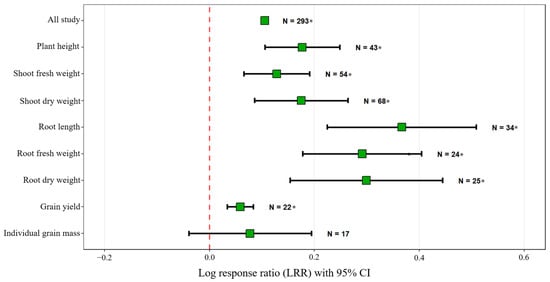
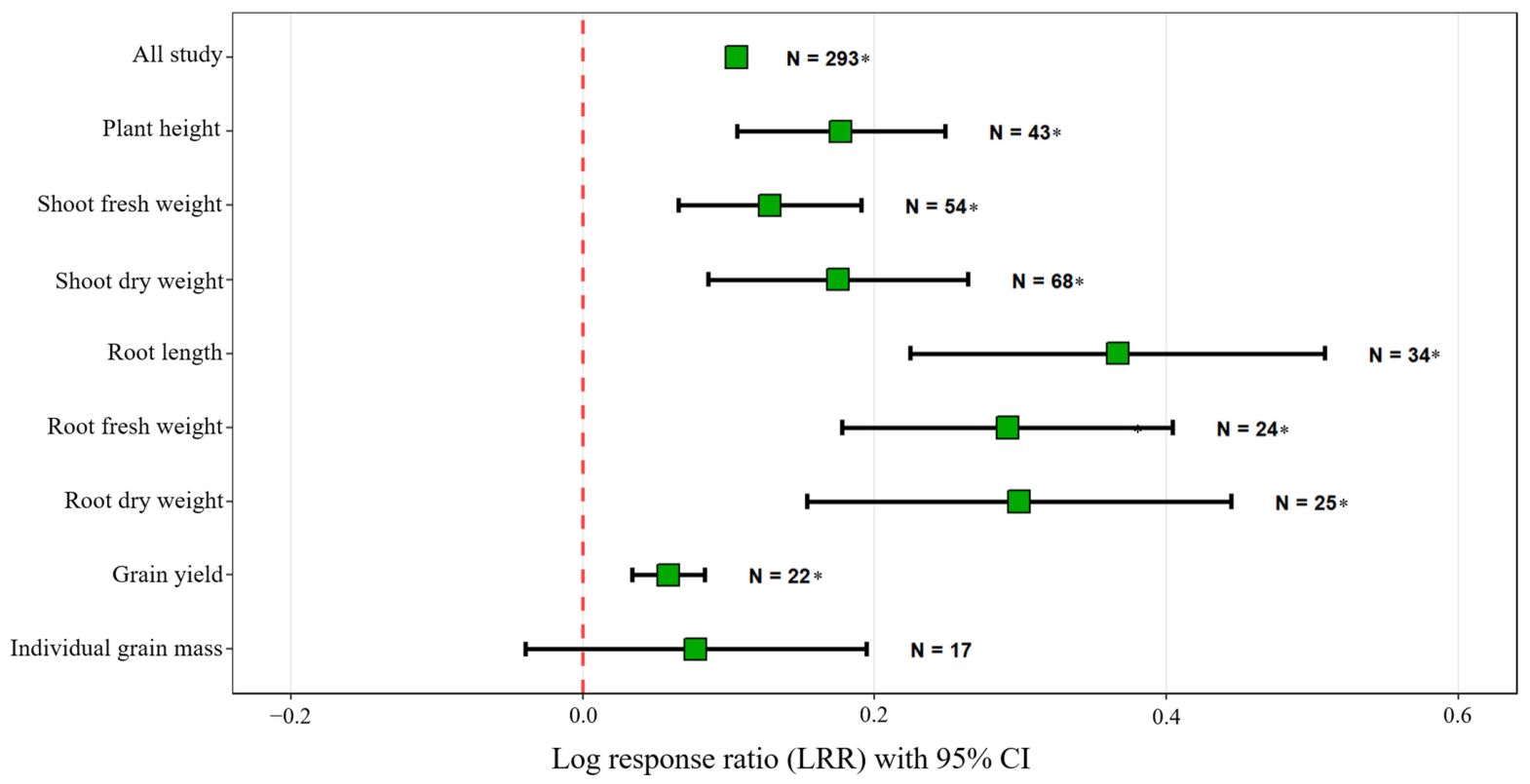
The meta-analysis demonstrated that Trichoderma inoculation significantly promoted various wheat growth parameters (Figure 1). The LRR values of the plant growth parameters were statistically different. Inoculated treatments consistently outperformed uninoculated controls across all studies, with log response ratios (LRR) significantly greater than zero (p < 0.05). Specifically, plant height (n = 43), root length (n = 34), shoot fresh weight (n = 54), shoot dry weight (n = 68), root fresh weight (n = 24), root dry weight (n = 25), and grain yield (n = 22) all exhibited significantly positive LRRs (p < 0.001), while individual grain mass (n = 17) was not significantly different from zero.
Figure 1.
Effects of Trichoderma inoculation on wheat growth parameters. N is the number of data observations. Green squares show the average log response ratios (LRR) of the trait. Error bars are 95% confidence intervals (CIs). * indicates that LRR is significantly different from 0, and NS indicates no significant difference from 0 based on the 95% CI.
Among these traits, LRRs for plant height, root length, shoot dry weight, and root dry weight were higher than that for grain yield. Notably, root length showed a significantly greater LRR compared with shoot fresh weight (p < 0.05). The 95% confidence interval (CI) of LRR was narrowest when all traits were pooled, reflecting the large sample size used in the analysis. Grain yield had the second narrowest CI, despite having the second fewest studies, whereas CIs for root-related traits (length, fresh and dry weight) were generally broader than those for shoot traits.
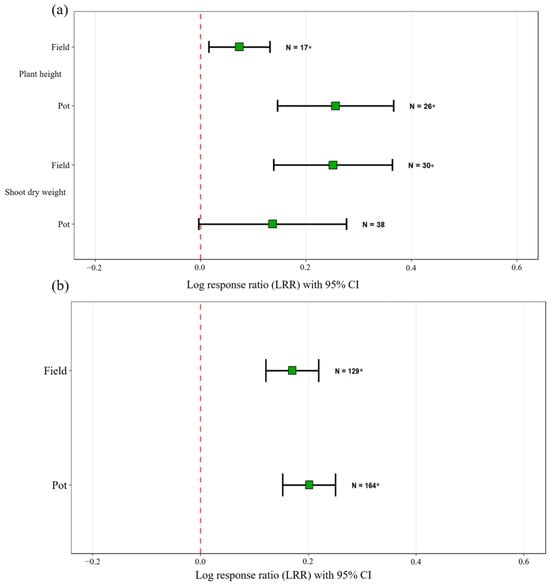
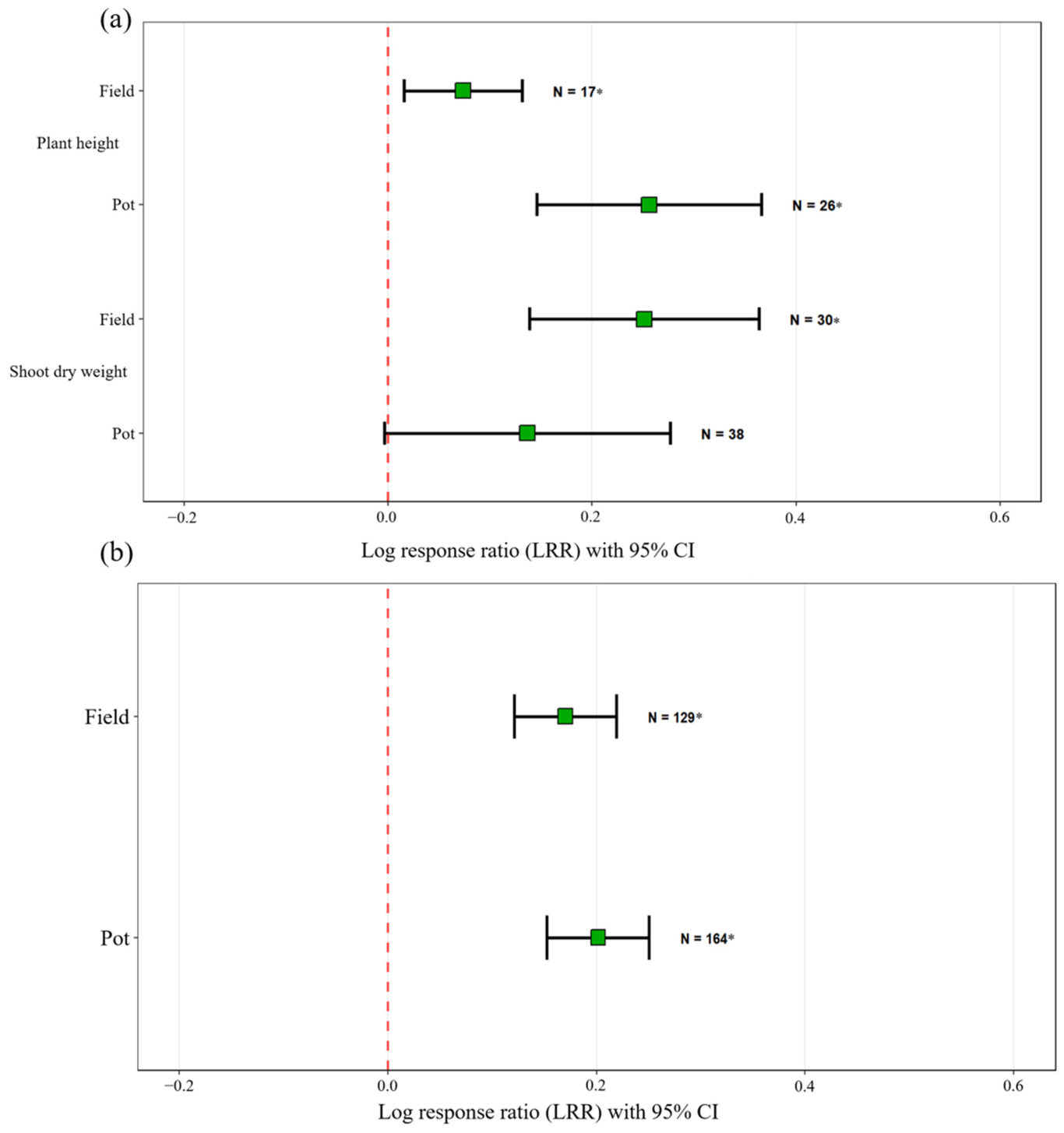
Further comparisons across experimental conditions revealed that plant height was significantly increased in both field and pot experiments (Figure 2a), with a higher LRR observed in pot trials than in field trials (p < 0.05). Shoot dry weight significantly increased only under field conditions (p < 0.05), while under pot conditions, the LRR was not significantly different from zero. The CI for plant height under field conditions was the narrowest, although it was based on the smallest number of studies.
Figure 2.
(a) Effects of Trichoderma inoculation on plant height and dry weight of shoots under field and pot conditions. (b) Effects of Trichoderma inoculation on all wheat growth parameters under different environment settings. N is the number of data observations. Green squares show the average log response ratios (LRR) of the trait. Error bars are 95% confidence intervals (CIs). * indicates that LRR is significantly different from 0, and NS indicates no significant difference from 0 based on the 95% CI.
Additionally, experimental conditions significantly affected the LRR. In both field (n = 129) and pot (n = 164) trials, the LRR values were significantly higher than zero, with no substantial difference between the two conditions (Figure 2b).
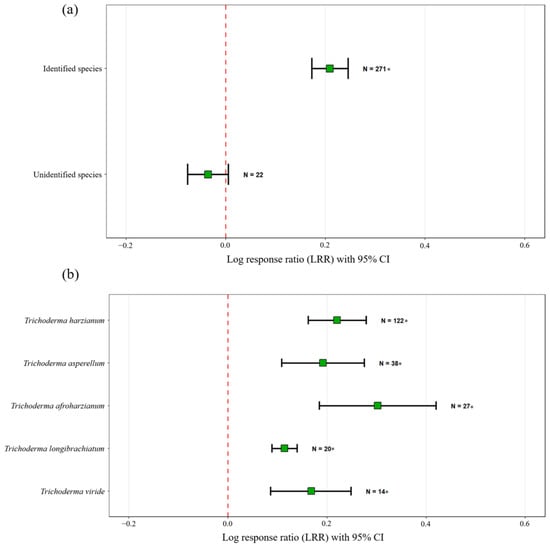
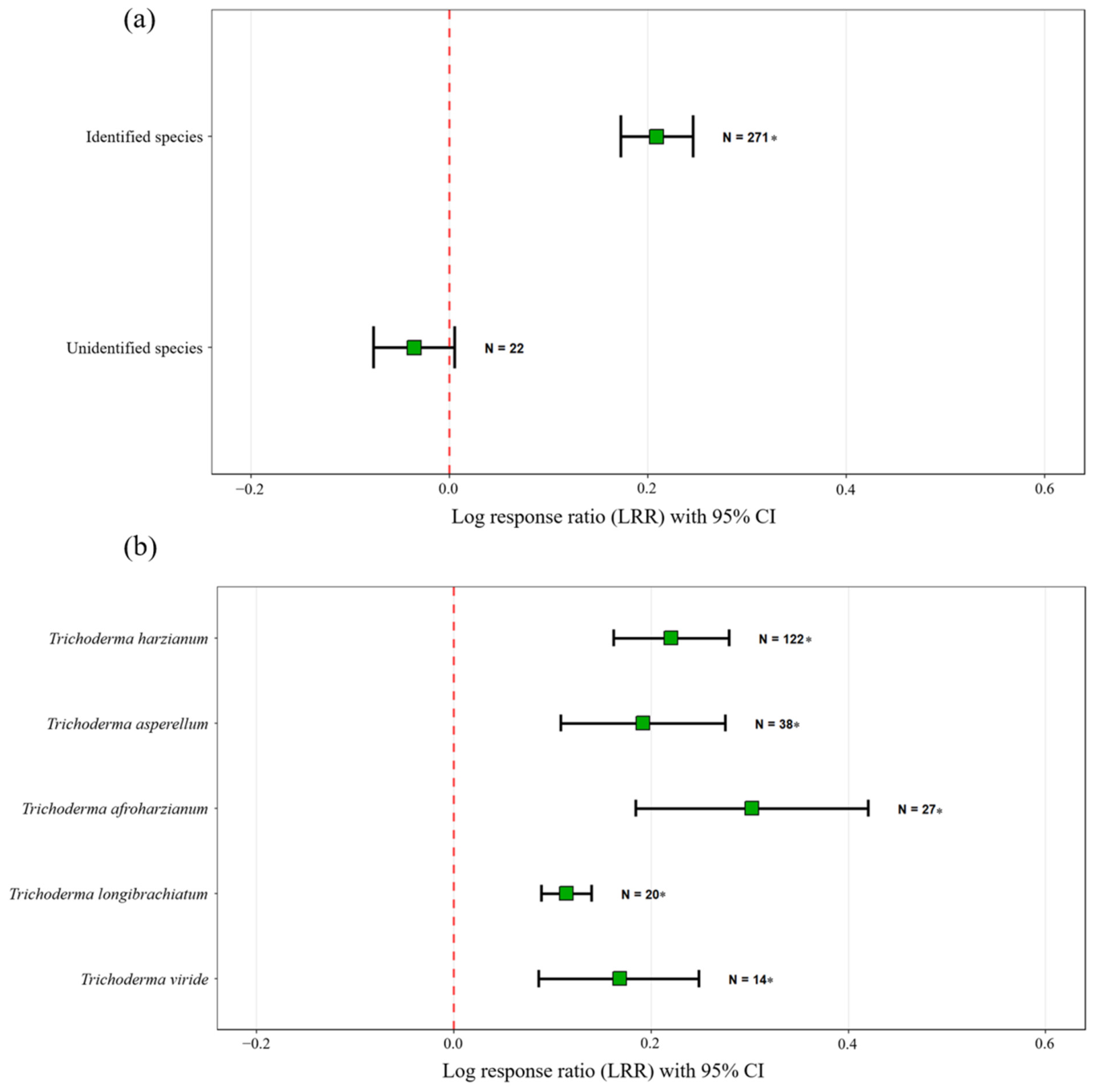
The LRR values of the identified Trichoderma species (n = 271) were significantly greater than zero (p < 0.05), whereas the pooled unidentified Trichoderma species (n = 22) did not exhibit a significant difference from zero (Figure 3a).
Figure 3.
Effects of Trichoderma species on all wheat growth parameters. (a) pooled effects for identified Trichoderma species and unidentified Trichoderma spp.; (b) species-specific pooled effects for T. harzianum, T. asperellum, T. afroharzianum, T. longibrachiatum, and T. viride. N is the number of data observations. Green squares show the average log response ratios (LRR) of the trait. Error bars are 95% confidence intervals (CIs). * indicates that LRR is significantly different from 0, and NS indicates no significant difference from 0 based on the 95% CI. The application-method subgroup analysis showed positive pooled responses for seed coating (N = 108) and seed soaking (N = 81), whereas estimates for several other categories were less precise with a larger confidence interval and lower N values (Figure S2). However, application methods were unevenly represented, and differences in statistical significance may partly reflect differences in the number of studies analysed.
The meta-analysis revealed that T. species significantly influenced LRR. T. harzianum (n = 122), T. asperellum (n = 38), T. afroharzianum (n = 27), T. longibrachiatum (n = 20) and T. viride (n = 14) all had LRR values that were significantly greater than zero (p < 0.05) (Figure 3b). Notably, T. afroharzianum demonstrated a significantly higher LRR than T. longibrachiatum. Despite having the second-lowest replicate count, T. longibrachiatum exhibited the narrowest CI.
3.2. Assigned Genes of Trichoderma spp. Identified from the Soil Metagenomics of the Wheat Cropping Systems
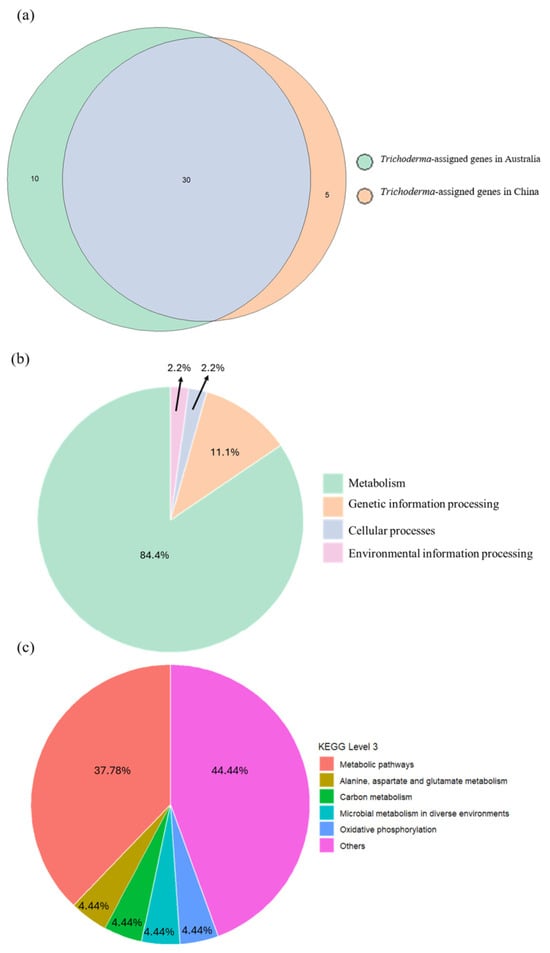
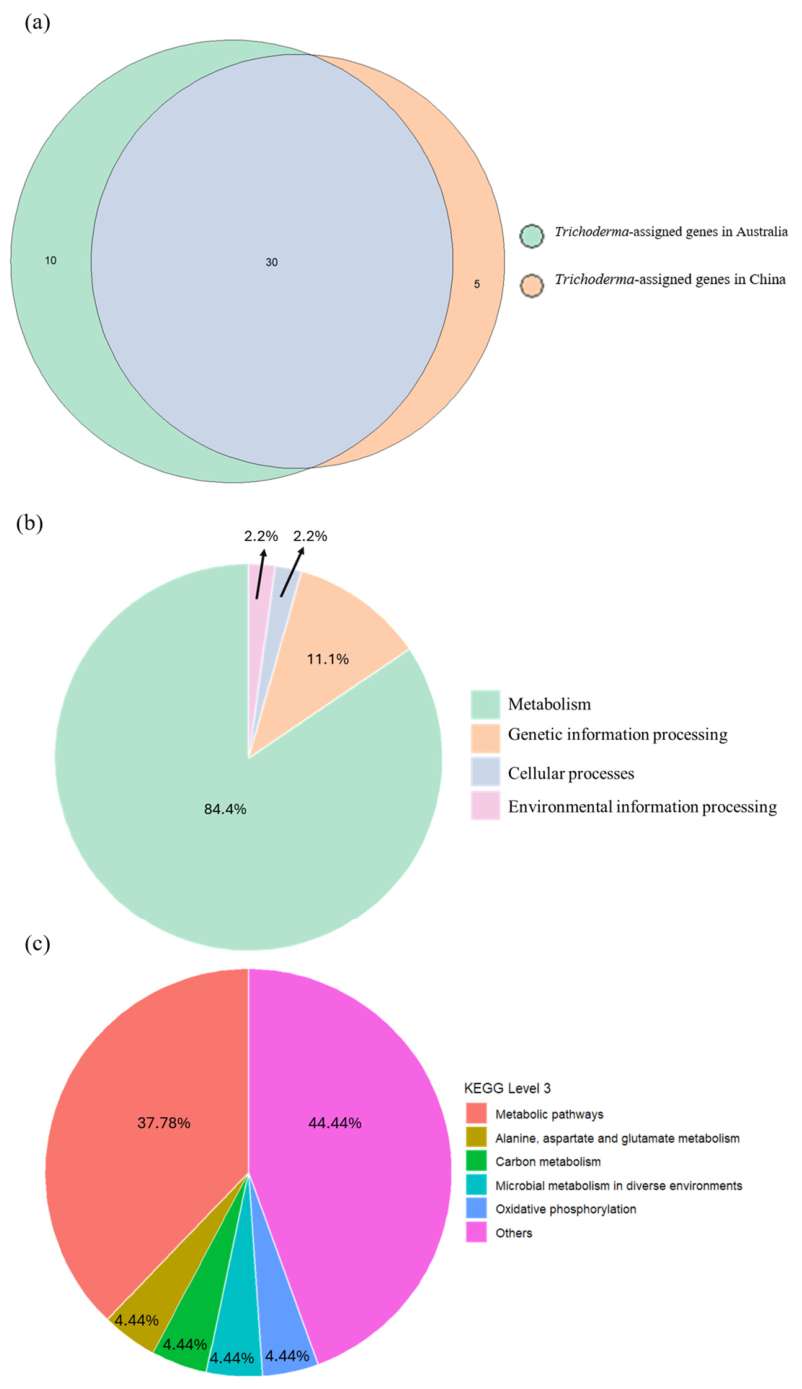
The combined non-redundant catalogue comprised 45 Trichoderma genes. Of these, 30 were detected at both sites, 10 were detected only at the Australian site, and five were detected only at the Chinese site (Figure 4a). Thus, combining the two sites expanded the detected gene repertoire from 40 genes in Australia or 35 genes in China to 45 genes overall. Their geographic distribution showed that 10 genes were assigned to Australia, five to China, and 30 were present in both (Figure 4a). Of these, 38 genes (84.4%) were associated with metabolism (Figure 4b). Within this group, amino acid metabolism, carbohydrate metabolism, and energy metabolism accounted for five (13.2%), four (10.5%), and five (13.2%) genes, respectively, while the majority (24 genes, 63.2%) were classified under global and overview maps. The remaining seven genes (15.6%) included five (71.4%) involved in genetic information processing (Figure 4b), along with one gene each assigned to cellular processes and environmental information processing (Figure 4b). These results indicate a strong metabolic bias among the assigned Trichoderma genes, particularly in broad metabolic pathways, with a smaller subset contributing to genetic regulation and cellular functions. The 45 reported gene records are presented in explicit KEGG Level 2 groups, with all the gene annotations retained in Table S6. Their distribution across Level 3 categories is summarised in Figure 4c. A total of 45 genes were assigned to KEGG Level 3 pathways (Figure 4c). Of these, 17 genes (37.78%) were classified under metabolic pathways. Alanine, aspartate and glutamate metabolism, carbon metabolism, microbial metabolism in diverse environments, and oxidative phosphorylation each accounted for two genes (4.44%). The remaining 20 genes (44.44%) were grouped as “Others” and were distributed across 19 additional KEGG Level 3 pathways.
Figure 4.
(a) Trichoderma-assigned genes identified from the metagenome of the soils collected from long-term wheat cropping experiments in Australia and China. (b) Functional annotation of the 45 Trichoderma-assigned genes across KEGG (b) Level 1 and (c) Level 3 categories.
4. Discussion
Soil microbial management is increasingly recognised as an important component of sustainable agriculture, as beneficial microorganisms can enhance soil functions and improve crop performance [1,2]. In this study, we combined a global meta-analysis with soil metagenomic analysis to investigate the contribution of Trichoderma spp. to wheat production and soil biological functions. The meta-analysis of 293 independent experiments demonstrated that Trichoderma inoculation consistently improved wheat growth, particularly root development, biomass accumulation, and grain yield, although responses varied among species and experimental conditions. From different perspectives, metagenomic analysis identified Trichoderma-assigned genes associated with nutrient metabolism, nitrogen cycling, secondary metabolite production, and pathogen suppression in long-term wheat soils. Together, these findings highlight the multifunctional role of Trichoderma in regulating plant–soil interactions and demonstrate its potential as a biological tool for integrated soil management and sustainable crop production.
4.1. Effects of Trichoderma on Soil-Mediated Wheat Productivity and Agricultural Performance
In this meta-analysis, Trichoderma inoculation significantly enhanced multiple wheat growth parameters compared with uninoculated controls (Figure 1). Positive effects were consistently observed for plant height, root length, shoot fresh and dry weights, root fresh and dry weights, and grain yield. However, individual grain mass showed no statistically significant response to Trichoderma inoculation. Grain mass has been reported to exhibit lower phenotypic plasticity than grain-number-related yield components, indicating greater relative stability across environmental conditions [37], including the rhizosphere biological environment modified by Trichoderma inoculation.
Among these traits, root length showed the greatest improvement in response to Trichoderma inoculation, outperforming both shoot fresh weight and grain yield [10]. Our results were in line with the previous finding that root-related traits respond more strongly to Trichoderma inoculation than grain yield [38]. This difference may be attributed to the direct interaction between Trichoderma and roots, as the fungus colonises the rhizosphere and physically contacts root surfaces [39,40]. In contrast, effects on grain yield will be more indirect, potentially mediated through improved nutrient or water uptake or systemic plant responses rather than immediate microbial-root interactions [18]. Root association also involves biochemical exchanges that may contribute to fungal establishment. In the maize–Trichoderma virens system, plant-derived sucrose provides a fungal carbon resource, while its metabolism by fungal invertase participates in the regulation of root colonisation and expression of the elicitor Sm1 [41]. In wheat, metabolomic profiling following inoculation with T. atroviride or Rhizoglomus irregulare demonstrated changes in root-exudate composition, with glycolic acid, catechol and 4-vinylphenol among the metabolites modulated by fungal association [42]. These observations suggest that root-derived metabolites can shape the nutritional and chemical environment supporting plant–fungus interactions.
While fewer studies reported grain yield data, Trichoderma inoculation demonstrated more stable effects on grain yield, as indicated by narrower confidence intervals relative to other traits. These findings indicate that grain yield responded more consistently to Trichoderma inoculation across diverse experimental conditions. Notably, this stability is particularly significant because grain yield represents the apex of agronomic traits in wheat production systems. The results further suggest that Trichoderma’s influence on yield parameters may be more reliable than its effects on other growth parameters [43].
Species-specific effects were also evident [7,16]. Inoculation with five individual Trichoderma species—T. harzianum, T. asperellum, T. afroharzianum, T. longibrachiatum, and T. viride—significantly improved wheat growth compared with the no addition. In contrast, studies involving unidentified Trichoderma species (Trichoderma spp.) did not show a significant overall effect. This lack of a consistent response could be attributed to either (1) the inclusion of non-effective or functionally variable strains within this broad category [7], or (2) suboptimal adaptation of these wild isolates to the specific plant–soil system employed in the studies [44]. Importantly, these findings align with previous reports suggesting that different Trichoderma species vary in their functional roles and efficacy [45]. This functional divergence likely reflects their distinct ecological adaptations and evolutionary histories, as Trichoderma species have undergone significant ecological shifts and interkingdom host jumps throughout their evolution [46,47]. While some Trichoderma species are recognised for their plant growth-promoting and biocontrol capabilities, others are primarily used in industrial enzyme production (e.g., T. reesei) or have been identified as opportunistic pathogens in humans [48,49]. This underscores the necessity of precise species identification and intentional selection when applying Trichoderma in agriculture, biotechnology, or medical contexts.
Among the tested species, T. afroharzianum exhibited the strongest growth-promoting effects, though with greater variability in effect size. The beneficial effects of T. afroharzianum may be attributed to its particularly rich secondary metabolism, as evidenced by its genome containing 64 natural product biosynthetic gene clusters (BGCs). Notably, these BGCs encode for various bioactive compounds, including the siderophores ferricrocin, tricholignan A, and fusarinine-like siderophores, which are known to facilitate nutrient acquisition and transport in plants [50].
Lastly, the comparison between experimental conditions (Figure 2b) showed that Trichoderma inoculation had a positive impact under both field and pot settings. The magnitude of the effect was generally similar between the two conditions, further supporting the robustness of Trichoderma as a plant growth-promoting agent in diverse agricultural environments [51].
4.2. Functional Contribution of Soil-Associated Trichoderma Genes to Nutrient Cycling and Sustainable Soil Management
Most Trichoderma-assigned genes were associated with housekeeping and general metabolic functions, while only a small subset was related to pathogen suppression and nutrient acquisition.
Notably, Trichoderma-assigned genes involved in glutamine biosynthesis (Table S1, TU_gene02 from Australia and China) regulated cellulase biosynthesis, which was found to be significantly altered during the mycoparasitism of Trichoderma against fungal pathogens such as Fusarium graminearum, Gibberella fujikuroi, and Aspergillus flavus [52]. Additionally, transcriptomic analysis revealed a marked upregulation of the tartrate dehydrogenase gene (Table S6, TU_gene06 from China) in Trichoderma spp. during interaction with Puccinia graminis f. sp. tritici (Pgt), which correlated with the suppression of the wheat stem rust pathogen [53]. Additionally, aconitate hydratase (Table S6, TU_gene08 from Australia and China) was found to play a pivotal role in regulating organic acid metabolism and secondary metabolite synthesis via the TCA cycle, enhancing both plant nutrient uptake and stress resistance while also inducing systemic resistance (ISR) against pathogens like Fusarium [54]. Cytochrome enzymes (Table S6, TU_gene23 from Australia and China) in Trichoderma further contribute to xenobiotic degradation and cellular defence during fungal interactions [55]. During confrontation with Rhizoctonia solani, Trichoderma harzianum upregulated genes related to dihydroorotase (Table S6, TU_gene35 from Australia), which include oxidative energy metabolism (e.g., NADH-dehydrogenase) and nucleotide biosynthesis (e.g., adenylosuccinate synthase), indicating enhanced energy production and nucleic acid synthesis to sustain antifungal activity [56,57]. These findings collectively highlight the strategies employed by Trichoderma in pathogen antagonism, reinforcing its mechanisms for biological control [58].
There were two Trichoderma-assigned genes related to nitrate reductase (Table S1, TU_gene10 from Australia and TU_gene33 from Australia and China) which may play a critical role in enhancing plant nitrogen use efficiency and growth promotion, as supported by indirect evidence from prior studies. For example, Trichoderma harzianum has been shown to modulate the expression of nitrogen metabolism and root development genes in wheat under varying inorganic nitrogen supplies, indicating its active involvement in host nitrogen signalling pathways [59]. Furthermore, Trichoderma atroviride exhibited stronger root-branching promotion in Arabidopsis seedlings under nitrogen-deficient conditions, suggesting that its plant-growth-promoting activity is closely tied to nitrogen availability, potentially mediated by its own nitrogen metabolic capabilities [60]. Notably, in pea plants, Trichoderma-induced improvements in nitrogen use efficiency and biomass production were linked to nitric oxide generation, a process that can be driven by nitrate reductase activity [61]. These findings collectively highlight the potential importance of these assigned nitrate reductase genes in Trichoderma, warranting further investigation into their roles in microbial regulation of plant nitrogen metabolism and growth responses.
5. Conclusions
This study demonstrates the potential of Trichoderma spp. as a biological component of integrated soil management for sustainable wheat production. The meta-analysis of 40 studies and 293 experiments showed that Trichoderma inoculation significantly improved wheat growth under non-stress conditions, with particularly strong positive effects on root traits, including root length and biomass. These findings establish a baseline for understanding the growth-promoting effects of Trichoderma in wheat in the absence of biotic and abiotic stresses.
The metagenomic analysis identified Trichoderma-assigned genes predominantly associated with general metabolic functions, together with a smaller number of genes related to nitrogen metabolism, secondary metabolism, and hydrolytic enzymes. These findings provide insights into the potential functional mechanisms underlying Trichoderma–plant interactions. Future research should investigate the effects of Trichoderma under abiotic and biotic stress conditions and use multi-omics approaches, including metabolomics, proteomics, and transcriptomics, to further characterise the functions and expression of these genes.
Supplementary Materials
The following supporting information can be downloaded at: https://www.mdpi.com/article/10.3390/soilsystems10100126/s1, Figure S1: Sample-size-based residual diagnostics for six vegetative growth traits. Panels show (a) plant height, (b) root length, (c) shoot fresh weight, (d) shoot dry weight, (e) root fresh weight, and (f) root dry weight; Figure S2: Exploratory subgroup analysis of Trichoderma application methods across wheat growth outcomes. Green squares represent pooled log response ratios (LRRs), and horizontal error bars indicate 95% confidence intervals. The dashed vertical line marks LRR = 0; positive values indicate higher mean outcomes in inoculated than in uninoculated treatments. N denotes the number of effect-size records in each category, not the number of publications. Estimates combine different growth outcomes within each application-method category. These results are exploratory subgroup summaries and should not be interpreted as demonstrating statistically significant differences between application methods; Table S1: Sensitivity of pooled wheat growth responses to assumed within-publication sampling correlations; Table S2: Sample-size-based multilevel Egger-type regressions for small-study effects in six vegetative growth traits; Table S3: Leave-one-publication-out sensitivity analyses for six vegetative growth traits; Table S4: Holm-adjusted tests of pooled effects for six vegetative growth traits; Table S5: Heterogeneity statistics for six trait-specific full-data multilevel models; Table S6: Functional annotation of Trichoderma unique genes according to KEGG database classifications, including pathway levels and specific gene functions.
Author Contributions
C.X., R.T., M.D.D. and Y.Z. conceptualised the work; C.X., R.T., J.L. and Y.W. performed the investigation; C.X. and Y.Z. performed the original draft writing; C.X., R.T., J.L., Y.W., Y.L., J.C., R.A., M.D.D. and Y.Z. performed the writing (review and editing); and J.L., R.A. and M.D.D. acquired the funding. All authors have read and agreed to the published version of the manuscript.
Funding
This work was financially supported by The University of Adelaide for a Research Training Program Scholarship awarded to Chang Xu, the Australian Research Council (project ID: LP200200813); and Qilu University of Technology (Shandong Academy of Sciences) Pilot Project for the Integration of Science, Education and Industry (Major Innovation) (Grant number: 2025ZDZX18). The long-term field trial in Australia is funded by Agriculture Victoria.
Institutional Review Board Statement
Not applicable. Ethics approval was not required for this study, as it did not involve human participants or animals.
Informed Consent Statement
Not applicable.
Data Availability Statement
The datasets generated during the current study are available in the GitHub repository (https://github.com/YiZhou-Lab/growth-promoting-mechanisms-of-Trichoderma-in-wheat, accessed on 14 October 2026). Raw sequence data have been deposited into BioProject database of the European Nucleotide Archive under accession PRJEB127046.
Acknowledgments
The authors would like to thank Nasir Iqbal for statistical assistance with the meta-analysis, and Judith Rathgen for the comments on the research design.
Conflicts of Interest
The authors declare no competing financial or personal interests that could have influenced the research presented in this research.
References
- Alemneh, A.A.; Zhou, Y.; Ryder, M.H.; Denton, M.D. Is phosphate solubilizing ability in plant growth-promoting rhizobacteria isolated from chickpea linked to their ability to produce ACC deaminase? J. Appl. Microbiol. 2021, 131, 2416–2432. [Google Scholar] [CrossRef] [Scilit] [PubMed]
- Alemneh, A.A.; Zhou, Y.; Ryder, M.H.; Denton, M.D. Soil environment influences plant growth-promotion traits of isolated rhizobacteria. Pedobiologia 2022, 90, 150785. [Google Scholar] [CrossRef] [Scilit]
- Zhou, Y.; Wang, Y.; Chen, K.; Wu, Y.; Hu, J.; Wei, Y.; Li, J.; Yang, H.; Ryder, M.; Denton, M.D. Near-complete genomes of two Trichoderma species: A resource for biological control of plant pathogens. Mol. Plant-Microbe Interact. 2020, 33, 1036–1039. [Google Scholar] [CrossRef] [Scilit] [PubMed]
- Aguirrebengoa, M.; Moreno, B.; Alcalá-Herrera, R.; Núñez, R.; Guirado, N.; García, J.M.; Pozo, M.J.; Benítez, E. Modulation of volatile emissions in olive trees: Sustained effect of Trichoderma afroharzianum T22 on induced plant defenses after simulated herbivory. Biol. Fertil. Soils 2024, 60, 593–602. [Google Scholar] [CrossRef] [Scilit]
- Hu, J.; Zhou, Y.; Chen, K.; Li, J.; Wei, Y.; Wang, Y.; Wu, Y.; Ryder, M.H.; Yang, H.; Denton, M.D. Large-scale Trichoderma diversity was associated with ecosystem, climate and geographic location. Environ. Microbiol. 2020, 22, 1011–1024. [Google Scholar] [CrossRef] [Scilit] [PubMed]
- Chaverri, P.; Castlebury, L.A.; Overton, B.E.; Samuels, G.J. Hypocrea/Trichoderma: Species with conidiophore elongations and green conidia. Mycologia 2003, 95, 1100–1140. [Google Scholar] [CrossRef] [Scilit]
- Harman, G.E.; Howell, C.R.; Viterbo, A.; Chet, I.; Lorito, M. Trichoderma species—Opportunistic, avirulent plant symbionts. Nat. Rev. Microbiol. 2004, 2, 43–56. [Google Scholar] [CrossRef] [Scilit] [PubMed]
- Altomare, C.; Norvell, W.A.; Björkman, T.; Harman, G.E. Solubilization of phosphates and micronutrients by the plant-growth-promoting and biocontrol fungus Trichoderma harzianum Rifai 1295-22. Appl. Environ. Microbiol. 1999, 65, 2926–2933. [Google Scholar] [CrossRef] [Scilit] [PubMed]
- Contreras-Cornejo, H.A.; Macías-Rodríguez, L.; Cortés-Penagos, C.; López-Bucio, J. Trichoderma virens, a plant beneficial fungus, enhances biomass production and promotes lateral root growth through an auxin-dependent mechanism in Arabidopsis. Plant Physiol. 2009, 149, 1579–1592. [Google Scholar] [CrossRef] [Scilit] [PubMed]
- Naseby, D.C.; Pascual, J.A.; Lynch, J.M. Effect of biocontrol strains of Trichoderma on plant growth, Pythium ultimum populations, soil microbial communities and soil enzyme activities. J. Appl. Microbiol. 2000, 88, 161–169. [Google Scholar] [CrossRef] [Scilit] [PubMed]
- Yedidia, I.; Srivastva, A.K.; Kapulnik, Y.; Chet, I. Effect of Trichoderma harzianum on microelement concentrations and increased growth of cucumber plants. Plant Soil 2001, 235, 235–242. [Google Scholar] [CrossRef] [Scilit]
- Shoresh, M.; Harman, G.E.; Mastouri, F. Induced systemic resistance and plant responses to fungal biocontrol agents. Annu. Rev. Phytopathol. 2010, 48, 21–43. [Google Scholar] [CrossRef] [Scilit] [PubMed]
- Howell, C.R. Mechanisms employed by Trichoderma species in the biological control of plant diseases: The history and evolution of current concepts. Plant Dis. 2003, 87, 4–10. [Google Scholar] [CrossRef] [Scilit] [PubMed]
- Zhang, F.; Huo, Y.; Xu, X.; Hu, J.; Sun, X.; Xiao, Y.; Zhang, Y. Trichoderma improves the growth of Leymus chinensis. Biol. Fertil. Soils 2018, 54, 685–696. [Google Scholar] [CrossRef] [Scilit]
- Food and Agriculture Organization of the United Nations (FAO). Agricultural Production Statistics 2010–2023. Available online: https://www.fao.org/statistics/highlights-archive/highlights-detail/agricultural-production-statistics-2010-2023/ (accessed on 29 September 2026).
- Stummer, B.E.; Zhang, X.; Zhang, D.P.; Harvey, P.R.; Mathivanan, N.; Neate, S.M.; Solaiman, Z.M.; Gupta, V.V.S.R. Quantification of Trichoderma afroharzianum, Trichoderma harzianum and Trichoderma gamsii inoculants in soil, the wheat rhizosphere and in planta suppression of the crown rot pathogen Fusarium pseudograminearum. J. Appl. Microbiol. 2020, 129, 971–990. [Google Scholar] [CrossRef] [Scilit] [PubMed]
- Mahato, S.; Bhuju, S.; Shrestha, J. Effect of Trichoderma viride as biofertilizer on growth and yield of wheat. Malays. J. Sustain. Agric. 2018, 2, 1–5. [Google Scholar] [CrossRef] [Scilit]
- Illescas, M.; Rubio, M.B.; Hernández-Ruiz, V.; Morán-Diez, M.E.; Martínez de Alba, Á.E.; Nicolás, C.; Monte, E.; Hermosa, R. Effect of inorganic N top dressing and Trichoderma harzianum seed inoculation on crop yield and the shaping of root microbial communities of wheat plants cultivated under high basal N fertilization. Front. Plant Sci. 2020, 11, 575861. [Google Scholar] [CrossRef] [Scilit] [PubMed]
- Cheng, L.; Xu, Z.; Zhou, X. Application of Trichoderma species increases plant salinity resistance: A bibliometric analysis and a meta-analysis. J. Soils Sediments 2023, 23, 2641–2653. [Google Scholar] [CrossRef]
- Woo, S.L.; Hermosa, R.; Lorito, M.; Monte, E. Trichoderma: A multipurpose, plant-beneficial microorganism for eco-sustainable agriculture. Nat. Rev. Microbiol. 2023, 21, 312–326. [Google Scholar] [CrossRef] [Scilit] [PubMed]
- dos Santos, L.B.P.R.; Oliveira-Santos, N.; Novais, D.P.S.; Cruz-Magalhães, V.; Loguercio, L.L. Beneficial plants-Trichoderma interactions on host tolerance to abiotic stresses: A meta-analysis. Front. Plant Physiol. 2025, 3, 1569221. [Google Scholar] [CrossRef] [Scilit]
- R Core Team. R: A Language and Environment for Statistical Computing; R Foundation for Statistical Computing: Vienna, Austria, 2025; Available online: https://www.R-project.org/ (accessed on 14 August 2026).
- Viechtbauer, W. Conducting meta-analyses in R with the metafor package. J. Stat. Softw. 2010, 36, 1–48. [Google Scholar] [CrossRef] [Scilit]
- Hedges, L.V.; Gurevitch, J.; Curtis, P.S. The meta-analysis of response ratios in experimental ecology. Ecology 1999, 80, 1150–1156. [Google Scholar] [CrossRef]
- Higgins, J.P.T.; Thompson, S.G. Quantifying heterogeneity in a meta-analysis. Stat. Med. 2002, 21, 1539–1558. [Google Scholar] [CrossRef] [Scilit] [PubMed]
- Tipton, E. Small sample adjustments for robust variance estimation with meta-regression. Psychol. Methods 2015, 20, 375–393. [Google Scholar] [CrossRef] [Scilit] [PubMed]
- Pustejovsky, J.E.; Tipton, E. Small-sample methods for cluster-robust variance estimation and hypothesis testing in fixed effects models. J. Bus. Econ. Stat. 2018, 36, 672–683. [Google Scholar] [CrossRef] [Scilit]
- Nakagawa, S.; Lagisz, M.; Jennions, M.D.; Koricheva, J.; Noble, D.W.A.; Parker, T.H.; Sánchez-Tójar, A.; Yang, Y.; O’Dea, R.E. Methods for testing publication bias in ecological and evolutionary meta-analyses. Methods Ecol. Evol. 2022, 13, 4–21. [Google Scholar] [CrossRef] [Scilit]
- Viechtbauer, W.; Cheung, M.W.-L. Outlier and influence diagnostics for meta-analysis. Res. Synth. Methods 2010, 1, 112–125. [Google Scholar] [CrossRef] [Scilit] [PubMed]
- Armstrong, R.D.; Perris, R.; Munn, M.; Dunsford, K.; Robertson, F.; Hollaway, G.J.; O’Leary, G.J. Effects of long-term rotation and tillage practice on grain yield and protein of wheat and soil fertility on a Vertosol in a medium-rainfall temperate environment. Crop Pasture Sci. 2019, 70, 1–15. [Google Scholar] [CrossRef] [Scilit]
- Xu, C.; Toh, R.; Li, J.; Zhou, Y.; Denton, M.D. Stubble management plays a greater role than tillage practice in shaping soil microbiome structure and function. Agriculture 2025, 15, 143. [Google Scholar] [CrossRef] [Scilit]
- Li, D.; Liu, C.M.; Luo, R.; Sadakane, K.; Lam, T.W. MEGAHIT: An ultra-fast single-node solution for large and complex metagenomics assembly via succinct de Bruijn graph. Bioinformatics 2015, 31, 1674–1676. [Google Scholar] [CrossRef] [Scilit] [PubMed]
- Langmead, B.; Salzberg, S.L. Fast gapped-read alignment with Bowtie 2. Nat. Methods 2012, 9, 357–359. [Google Scholar] [CrossRef] [Scilit] [PubMed]
- Liu, Y.; Guo, J.; Hu, G.; Zhu, H. Gene prediction in metagenomic fragments based on the SVM algorithm. BMC Bioinform. 2013, 14, S12. [Google Scholar] [CrossRef] [Scilit] [PubMed]
- Li, W.; Godzik, A. Cd-hit: A fast program for clustering and comparing large sets of protein or nucleotide sequences. Bioinformatics 2006, 22, 1658–1659. [Google Scholar] [CrossRef] [Scilit] [PubMed]
- Huson, D.H.; Auch, A.F.; Qi, J.; Schuster, S.C. MEGAN analysis of metagenomic data. Genome Res. 2007, 17, 377–386. [Google Scholar] [CrossRef] [Scilit] [PubMed]
- Sadras, V.O.; Slafer, G.A. Environmental modulation of yield components in cereals: Heritabilities reveal a hierarchy of phenotypic plasticities. Field Crops Res. 2012, 127, 215–224. [Google Scholar] [CrossRef] [Scilit]
- Gupta, V.K.; Schmoll, M.; Herrera-Estrella, A.; Upadhyay, R.S.; Druzhinina, I.S.; Tuohy, M.G. (Eds.) Biotechnology and Biology of Trichoderma; Elsevier: Amsterdam, The Netherlands, 2014. [Google Scholar] [CrossRef] [Scilit]
- Guzmán-Guzmán, P.; Etesami, H.; Santoyo, G. Trichoderma: A multifunctional agent in plant health and microbiome interactions. BMC Microbiol. 2025, 25, 81. [Google Scholar] [CrossRef] [Scilit] [PubMed]
- Stummer, B.E.; Gupta, V.V.S.R.; Solaiman, Z.M.; Harvey, P.R. Wheat rhizosphere dynamics of Trichoderma gamsii A5MH and suppression of Pythium–Fusarium root disease complexes. J. Appl. Microbiol. 2024, 135, lxae069. [Google Scholar] [CrossRef] [Scilit] [PubMed]
- Vargas, W.A.; Mandawe, J.C.; Kenerley, C.M. Plant-derived sucrose is a key element in the symbiotic association between Trichoderma virens and maize plants. Plant Physiol. 2009, 151, 792–808. [Google Scholar] [CrossRef] [Scilit] [PubMed]
- Lucini, L.; Colla, G.; Miras Moreno, M.B.; Bernardo, L.; Cardarelli, M.; Terzi, V.; Bonini, P.; Rouphael, Y. Inoculation of Rhizoglomus irregulare or Trichoderma atroviride differentially modulates metabolite profiling of wheat root exudates. Phytochemistry 2019, 157, 158–167. [Google Scholar] [CrossRef] [Scilit] [PubMed]
- Elazab, A.; Castillo, D.; Matus, I.; Romero-Bravo, S.; Espinoza-Meza, S.; Sadras, V.; Del Pozo, A. The role of phenotypic plasticity of physiological and agronomic traits on the adaptation of spring wheat genotypes to Mediterranean environments. Field Crops Res. 2025, 322, 109740. [Google Scholar] [CrossRef] [Scilit]
- Bulgarelli, D.; Schlaeppi, K.; Spaepen, S.; Ver Loren van Themaat, E.; Schulze-Lefert, P. Structure and functions of the bacterial microbiota of plants. Annu. Rev. Plant Biol. 2013, 64, 807–838. [Google Scholar] [CrossRef] [Scilit] [PubMed]
- Kubicek, C.P.; Steindorff, A.S.; Chenthamara, K.; Manganiello, G.; Henrissat, B.; Zhang, J.; Cai, F.; Kopchinskiy, A.G.; Kubicek, E.M.; Kuo, A.; et al. Evolution and comparative genomics of the most common Trichoderma species. BMC Genom. 2019, 20, 485. [Google Scholar] [CrossRef] [Scilit] [PubMed]
- Chaverri, P.; Samuels, G.J. Evolution of habitat preference and nutrition mode in a cosmopolitan fungal genus with evidence of interkingdom host jumps and major shifts in ecology. Evolution 2013, 67, 2823–2837. [Google Scholar] [CrossRef] [Scilit] [PubMed]
- Druzhinina, I.S.; Seidl-Seiboth, V.; Herrera-Estrella, A.; Horwitz, B.A.; Kenerley, C.M.; Monte, E.; Mukherjee, P.K.; Zeilinger, S.; Grigoriev, I.V.; Kubicek, C.P. Trichoderma: The genomics of opportunistic success. Nat. Rev. Microbiol. 2011, 9, 749–759. [Google Scholar] [CrossRef] [Scilit] [PubMed]
- Peterson, R.; Nevalainen, H. Trichoderma reesei RUT-C30—Thirty years of strain improvement. Microbiology 2012, 158, 58–68. [Google Scholar] [CrossRef] [Scilit] [PubMed]
- Kredics, L.; Antal, Z.; Manczinger, L.; Szekeres, A.; Kevei, F.; Nagy, E. Influence of environmental parameters on Trichoderma strains with biocontrol potential. Food Technol. Biotechnol. 2003, 41, 37–42. [Google Scholar]
- Han, W.; Wu, Z.; Zhong, Z.; Williams, J.; Jacobsen, S.E.; Sun, Z.; Tang, Y. Assessing the biosynthetic inventory of the biocontrol fungus Trichoderma afroharzianum T22. J. Agric. Food Chem. 2023, 71, 11502–11519. [Google Scholar] [CrossRef] [Scilit] [PubMed]
- Stummer, B.E.; Gupta, V.V.S.R.; Solaiman, Z.M.; Harvey, P.R. Wheat rhizosphere persistence of Trichoderma gamsii A5MH and impacts on fungal and oomycete communities. J. Appl. Microbiol. 2025, 136, lxaf158. [Google Scholar] [CrossRef] [Scilit] [PubMed]
- Pang, A.P.; Zhang, F.; Hu, X.; Luo, Y.; Wang, H.; Durrani, S.; Wu, F.G.; Li, B.Z.; Zhou, Z.; Lu, Z.; et al. Glutamine involvement in nitrogen regulation of cellulase production in fungi. Biotechnol. Biofuels 2021, 14, 199. [Google Scholar] [CrossRef] [Scilit] [PubMed]
- El-Sharkawy, H.H.A.; Mostafa, N.A.; Yousef, S.A.M.; El-Blasy, S.A.S.; Badeea, O.A.E. Enhancing Trichoderma efficacy in managing wheat stem rust disease and boosting production through the application of certain chemical inducers. BMC Plant Biol. 2025, 25, 364. [Google Scholar] [CrossRef] [Scilit] [PubMed]
- Atanasova, L.; Marchetti-Deschmann, M.; Nemes, A.; Bruckner, B.; Rehulka, P.; Stralis-Pavese, N.; Łabaj, P.P.; Kreil, D.P.; Zeilinger, S. Mycoparasitism related targets of Tmk1 indicate stimulating regulatory functions of this MAP kinase in Trichoderma atroviride. Sci. Rep. 2023, 13, 19976. [Google Scholar] [CrossRef] [Scilit] [PubMed]
- Chadha, S.; Mehetre, S.T.; Bansal, R.; Kuo, A.; Aerts, A.; Grigoriev, I.V.; Druzhinina, I.S.; Mukherjee, P.K. Genome-wide analysis of cytochrome P450s of Trichoderma spp.: Annotation and evolutionary relationships. Fungal Biol. Biotechnol. 2018, 5, 12. [Google Scholar] [CrossRef] [Scilit] [PubMed]
- Rabinal, C.; Bhat, S. Identification of differentially expressed genes in Trichoderma koningii IABT1252 during its interaction with Sclerotium rolfsii. Curr. Microbiol. 2020, 77, 396–404. [Google Scholar] [CrossRef] [Scilit] [PubMed]
- Scherm, B.; Schmoll, M.; Balmas, V.; Kubicek, C.P.; Migheli, Q. Identification of potential marker genes for Trichoderma harzianum strains with high antagonistic potential against Rhizoctonia solani by a rapid subtraction hybridization approach. Curr. Genet. 2009, 55, 81–91. [Google Scholar] [CrossRef] [Scilit] [PubMed]
- Druzhinina, I.S.; Chenthamara, K.; Zhang, J.; Atanasova, L.; Yang, D.; Miao, Y.; Rahimi, M.J.; Grujic, M.; Cai, F.; Pourmehdi, S.; et al. Massive lateral transfer of genes encoding plant cell wall-degrading enzymes to the mycoparasitic fungus Trichoderma from its plant-associated hosts. PLoS Genet. 2018, 14, e1007322. [Google Scholar] [CrossRef] [Scilit] [PubMed]
- Rubio, M.B.; Martínez de Alba, Á.E.; Nicolás, C.; Monte, E.; Hermosa, R. Early root transcriptomic changes in wheat seedlings colonized by Trichoderma harzianum under different inorganic nitrogen supplies. Front. Microbiol. 2019, 10, 2444. [Google Scholar] [CrossRef] [Scilit] [PubMed]
- López-Bucio, J.; Esparza-Reynoso, S.; Pelagio-Flores, R. Nitrogen availability determines plant growth promotion and the induction of root branching by the probiotic fungus Trichoderma atroviride in Arabidopsis seedlings. Arch. Microbiol. 2022, 204, 380. [Google Scholar] [CrossRef] [Scilit] [PubMed]
- Singh, B.N.; Dwivedi, P. Trichoderma-induced promotion of nitrogen use efficiency is mediated by nitric oxide generation leading to improved growth and yield in pea (Pisum sativum L.) plants. J. Plant Growth Regul. 2023, 42, 6397–6412. [Google Scholar] [CrossRef] [Scilit]
Disclaimer/Publisher’s Note: The statements, opinions and data contained in all publications are solely those of the individual author(s) and contributor(s) and not of MDPI and/or the editor(s). MDPI and/or the editor(s) disclaim responsibility for any injury to people or property resulting from any ideas, methods, instructions or products referred to in the content. |
© 2026 by the authors. Licensee MDPI, Basel, Switzerland. This article is an open access article distributed under the terms and conditions of the Creative Commons Attribution (CC BY) license.