


Abstract
Experimental studies on the spontaneous nucleon emission in nuclei around the drip line enable us to explore new isotopes or resonant states, and to reveal exotic structures and decay properties of nuclei located far from the stability line; consequently, they are of critical importance for probing limits of nuclear stability and understanding nucleon–nucleon interactions under extreme conditions of isospin asymmetry. With the radioactive isotope beam 20Mg provided by the National Superconducting Cyclotron Laboratory at Michigan State University, we studied the proton decays of nuclei around the proton drip line at mass region. Complete-kinematics measurements were performed for proton decays of one-proton resonant states in 18Na, two-proton resonant states in 20Mg, three-proton resonant states in 21Al, and four-proton resonant states in 18Mg, yielding decay energy spectra for all four nuclei. With the invariant mass method, the ground state of 18Na was firmly identified, clarifying previous ambiguities of its position. The isotope 18Mg, which is located two neutrons beyond the proton drip line, was experimentally observed for the first time. Multi-body correlation analysis of emitted protons from 20Mg, 21Al, and 18Mg, combined with Monte Carlo simulations, reveals that the identified resonant states in 20Mg and 21Al predominantly decay via two and three sequential steps of emission, respectively, whereas the 18Mg ground state decays mainly through a two-step cascade of prompt emission.
1. Introduction
A nucleus is a quantum many-body system composed of protons and neutrons, tightly bound by the strong interaction. For nuclei increasingly distant from the -stability line, the binding energy of the outermost nucleons gradually decreases, reaching zero for the last proton (or neutron) on the proton (or neutron) drip line. In the vicinity of the drip line, the outermost nucleons are weakly bound or unbound. Consequently, some excited states of bound nuclei inside the drip line, as well as the ground states of unbound nuclei beyond it, can decay via spontaneous nucleon emission.
As early as the 1960s, it was predicted that nuclei near the proton drip line might undergo spontaneous decay by emitting one or two protons [1,2]. Beginning in the 1970s, experiments successively discovered that the ground states of many odd-Z nuclei exhibit one-proton radioactivity [3,4]. Constrained by energy and momentum conservation, the decay kinematics of one-proton emission can be fully determined. As the number of emitted protons increases, although the correlations among the decay products become complex, multi-proton decay reveals many novel phenomena [5,6]. The experimental measurement of momentum and angular correlations among the emitted protons provides information on nucleon wave functions and nucleon–nucleon interactions, which is crucial for understanding nuclear structure under extreme conditions of isospin asymmetry. To date, ground-state two-proton decay has been experimentally observed in 6Be, 11O, 12O, 15Ne, 16Ne, 19Mg, 30Ar, 45Fe, 48Ni, 54Zn, and 67Kr [4,7,8,9,10,11,12]. With the continued expansion of the nuclear chart beyond the proton drip line, five ground-state three-proton emitters (7B [13], 13F [14], 17Na [15], 20Al [16], and 31K [17]), two ground-state four-proton emitters (8C [18] and 18Mg [19]), and one ground-state five-proton emitter (9N [20]) have been identified in recent years.
With the accumulation of experimental results, many related theoretical developments have been made in recent years regarding various aspects of proton decay, including the identification of decay candidates, the exploration of decay mechanisms, and the investigation of the structure of proton emitters [6]. Using a self-consistent Hartree-Fock-Bogoliubov (HFB) approach, Ref. [21] explored candidates for ground-state emitters, suggesting that nearly all elements between Ar and Pb could have isotopes decaying via emission. Moreover, a fundamental challenge remains in understanding the decay mechanisms and structure of nuclei near the proton drip line. For weakly bound and unbound nuclei, an appropriate treatment of resonant state and continuum effects is essential. In contrast to the conventional shell model, the Gamow shell model (GSM) [22] and the Gamow coupled-channel (GCC) method [23] provide a more suitable framework for describing exotic phenomena in these open quantum systems. Employing the Berggren ensemble [24], these approaches offer a unified description of the interplay between bound states, resonances, and scattering states within a many-body framework. In recent years, these theoretical models have been successfully applied to describe the decay mechanisms and structure of many proton emitters [12,19,20,25,26,27,28].
This article reviews our recent experimental studies of proton decay of nuclei around the proton drip line at mass region [19,29,30,31]. Complete-kinematics measurements were performed for proton decays of one-proton resonant states in 18Na, two-proton resonant states in 20Mg, three-proton resonant states in 21Al, and four-proton resonant states in 18Mg, yielding decay energy spectra for all four nuclei with the invariant mass method. The experiment enabled the identification of the ground state of 18Na and led to the first observation of the isotope 18Mg. Furthermore, by analyzing the correlations in the subsystem decay energy spectra of 20Mg, 21Al and 18Mg, their multi-proton decay mechanisms were discussed.
2. Experiment
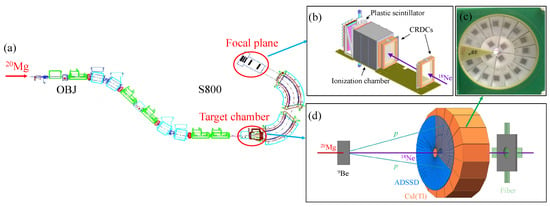
The experiment was performed at the National Superconducting Cyclotron Laboratory (NSCL) at Michigan State University. The experimental setup is depicted in Figure 1. A radioactive beam of 20Mg was produced using the Coupled Cyclotron Facility (CCF) and the A1900 fragment separator at NSCL [32,33]. The beam had an energy of = 103 MeV/u, an intensity of 5600 pps, and a purity of 31%. Resonant states of various nuclei near the proton drip line, including 18Na, 20Mg, 21Al, and 18Mg, were populated via different reactions of the 20Mg beam with a 9Be target. These resonant states decayed promptly within the 9Be target, emitting one or more protons along with the residues. The proton decay processes of these resonances were investigated experimentally by performing coincidence measurements of the decay products.
Figure 1.
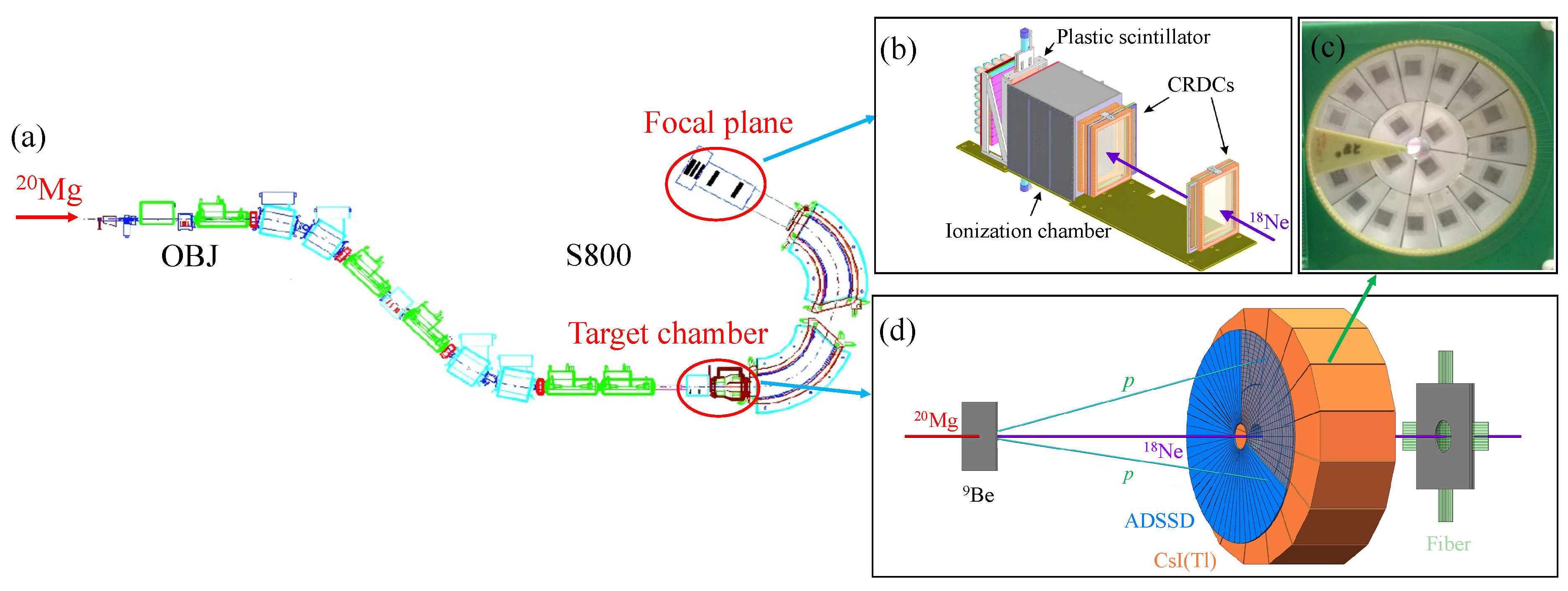
Experimental setup. (a) S800 spectrograph [34]; (b) S800 focal plane detector array [35]; (c) Annular CsI(Tl) detector array; (d) Reaction target and target chamber detector array.
The emitted protons were detected by a –E telescope system, which consisted of an annular double-sided silicon strip detector (ADSSD) and an annular CsI(Tl) array. This system provided information on the position, energy and particle identification of the decay protons. The majority of the residues, focused around zero degrees, passed through a 10-mm diameter central hole of the –E telescope array. Their positions were determined by a position-sensitive scintillating fiber array. Subsequent to this, the residues entered the S800 spectrograph for particle identification and energy measurement [36,37].
3. Results and Discussion
3.1. One-Proton Decay of 18Na
18Na, with 11 protons and 7 neutrons, is located two neutron steps beyond the proton drip line and decays by emitting one proton to the bound nucleus 17Ne. Zerguerras et al. first observed 18Na experimentally using a 20Mg beam impinging on a 9Be target via nucleon knockout reaction [38]. Through invariant mass reconstruction of 17Ne + 1p events, two peaks at = 0.42(17) and 1.27(17) MeV were observed in the decay energy spectrum, both of which were suggested as possible ground state of 18Na [38]. Subsequently, Assié et al. investigated the low-lying resonant states of 18Na using the resonant-elastic-scattering reaction of 17Ne + 1p [39,40]. By performing an R-matrix analysis of the measured excitation function, they reported four resonant states in 18Na with decay energies of = 1.552(5), 1.842(40), 2.030(20), and 2.084(5) MeV, and spin-parities of , , , and , respectively. Around the same time period, Mukha et al. studied 18Na using a 20Mg beam on a 9Be target, employing nucleon knockout reaction and the decay-in-flight decay method [41]. By analyzing the p-17Ne angular correlations from decay events of low-lying states in 19Mg, two resonant states in 18Na at = 1.23(15) and 1.55(7) MeV, with spin-parities of and , respectively, were determined. The first resonance was considered a candidate for the ground state of 18Na, while the second corresponded to the excited state at = 1.552(5) MeV reported in Refs. [39,40]. No resonant structure corresponding to the peak at = 0.42(17) MeV reported in Ref. [38] was observed in Ref. [41]. More recently, Charity et al. populated resonant states of 18Na via the proton transfer reaction with a 17Ne beam and a 9Be target [42]. Two excited states at = 1.527(25) and 2.085(23) MeV with spin-parities of and , respectively, were identified, while the ground state of 18Na was not observed in this invariant-mass study. To unambiguously determine the exact position of the ground state of 18Na, we populated its resonant states via the nucleon knockout reaction of a 20Mg beam on a 9Be target.
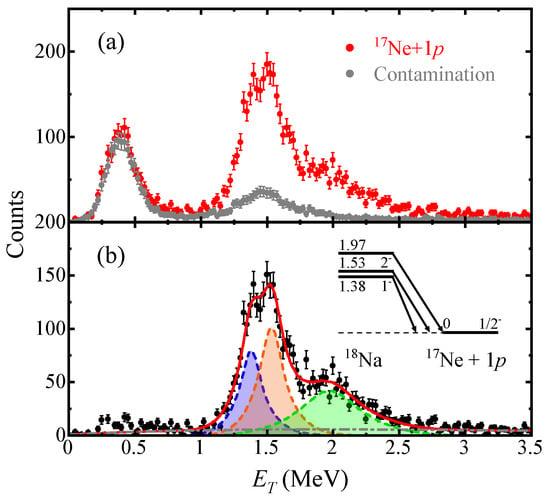
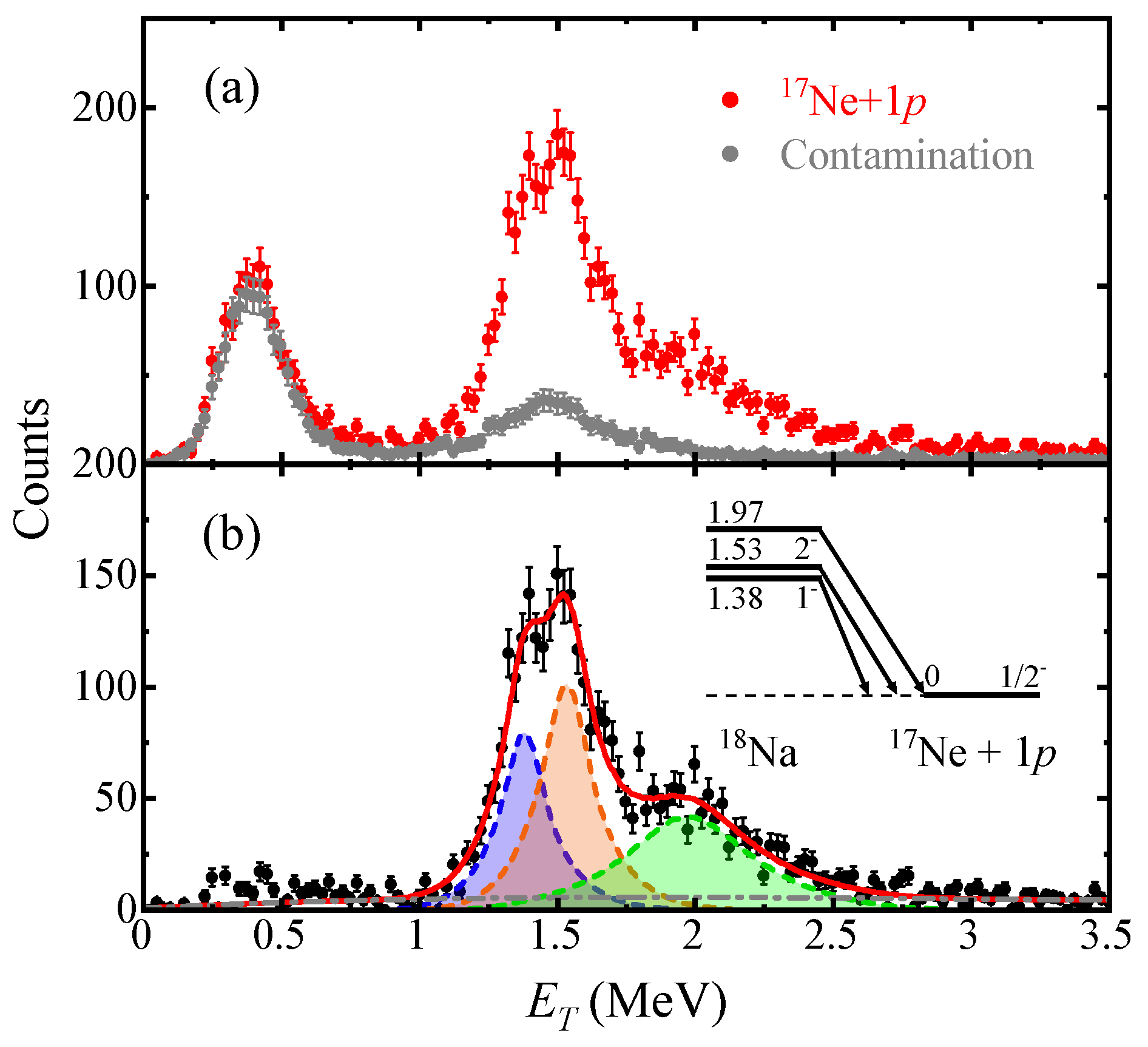
Figure 2a displays the invariant mass spectrum reconstructed from all the 17Ne + 1p events in the present work [29]. The corresponding detection efficiency, determined via Monte Carlo simulations, is approximately 29%. A clear resonant peak is seen at MeV, consistent with the MeV candidate for the ground state of 18Na reported in Ref. [38] using the same reaction. However, further coincidence analysis indicates that the measured 17Ne + 1p events may originate not only from the one-proton decay of 18Na resonant states but also from contamination of the two-proton decay of 19Mg, produced by the knockout reaction of 20Mg [30,43]. In the two-proton decay process of 19Mg, it is possible that only one of the two emitted protons is detected by both the ADSSD and CsI(Tl) detectors, while the other proton is missed. This also leads to the 17Ne + 1p coincidence events, thereby constituting contamination in the true decay spectrum of 18Na. By randomly selecting one proton from 17Ne + 2p events to construct a 17Ne + 1p spectrum, the contamination spectrum due to one-proton loss can be approximated, as shown by the gray data points in Figure 2a. For the prompt decay of the 19Mg ground state ( MeV), the probability is maximized when the two protons share the decay energy equally, resulting in a peak around MeV in the 17Ne + 1p spectrum. Since the ground state decay of 19Mg does not proceed through an intermediate state of 18Na, it is confirmed that the peak at MeV observed in our experiment and in Ref. [38] actually originates from the prompt decay of the 19Mg ground state, rather than from the one-proton decay of an 18Na resonant state.
Figure 2.
Decay energy spectra for (a) all detected 17Ne + events (red points), and (b) 17Ne + events after subtracting the contamination from the decay of 19Mg [29]. The grey spectrum in (a) indicates the contamination from 19Mg decay, which is estimated from invariant-mass reconstruction of the two possible 17Ne + subevents within each 17Ne + event. The solid-red curve in (b) shows the fitted spectrum, which includes the contributions from individual states (dashed curves) and a smooth background (dashed-dotted-grey curve). The inset shows the decay paths of the three resonant states in 18Na.
After subtracting the contamination from the decay of 19Mg, the decay energy spectrum of 18Na is presented in Figure 2b [29]. The experimental resolutions (FWHM) at the centroids of the three observed peaks are 200, 220, and 250 keV, respectively. The spectrum was fitted using Breit-Wigner intrinsic line shapes generated by Monte Carlo simulations. The decay energies and intrinsic widths for the three resonant states of 18Na, including the ground state, were obtained. The one-proton decay energy of the 18Na ground state is determined to be 1.38(2) MeV, consistent with the previously reported ground-state candidates at 1.27(17) MeV [38] and 1.23(15) MeV [41], with the new result significantly reducing the uncertainty in the 18Na ground-state mass. The second resonant state has a decay energy of = 1.53(2) MeV and a width of MeV, matching the state in 18Na reported in Refs. [39,40] at = 1.552(5) MeV with = 0.005(3) MeV, and also consistent with results in Refs. [41,42]. The third resonance at = 1.97(2) MeV with = 0.32(4) MeV may arise from the combined contributions of all the three known resonant states in this energy region (, , and ) [39,40], with its width closest to the intrinsic width of the state. As shown in the inset of Figure 2b, all three resonant states decay to the ground state of 17Ne.
3.2. Two-Proton Decay of 20Mg
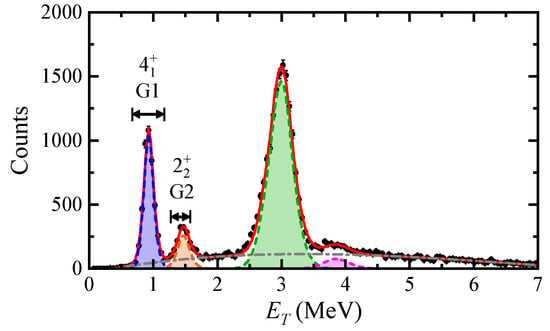
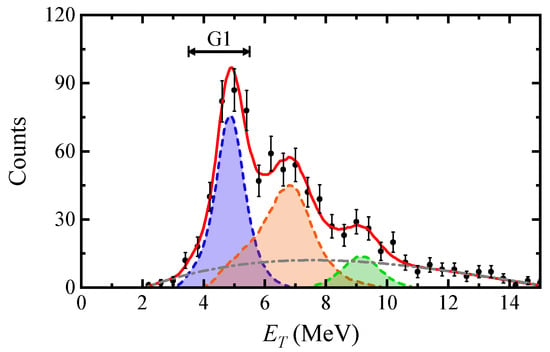
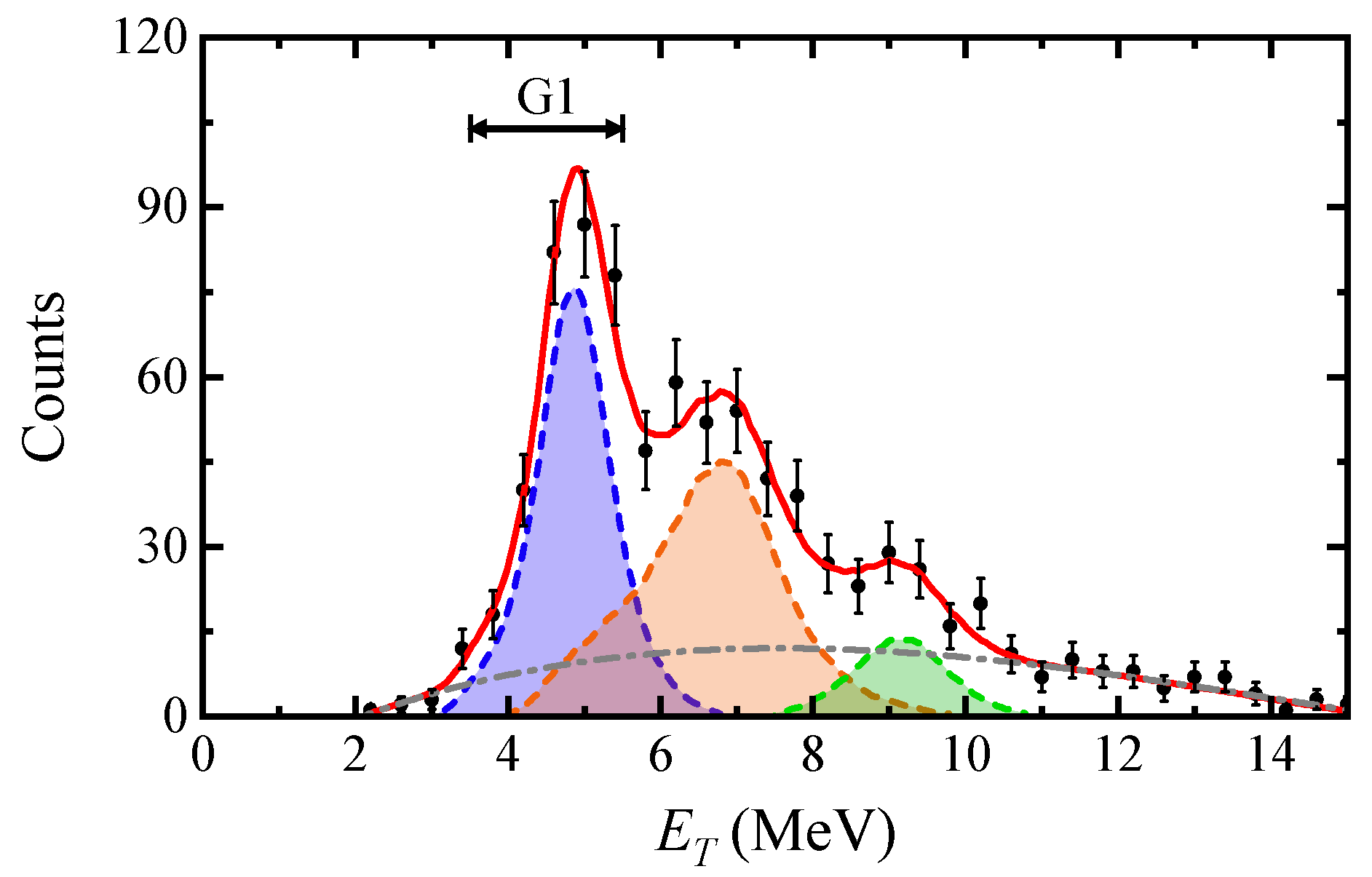
As a nucleus located at the proton drip line, only the ground state () and the first excited state () of 20Mg are bound. Two resonant structures above its two-proton separation threshold ( = 2.418(2) MeV [44]), at excitation energies of = 3.7(2) and 5.37(2) MeV, have been reported in previous study using the 20Mg () reaction [45]. The first relatively wide resonant peak was suggested to potentially result from an overlap of the and resonant states in 20Mg [45]. In the present experiment, the two-proton resonant states of 20Mg were populated via projectile inelastic-excitation reaction. The decay energy spectrum of 20Mg, reconstructed from the measured 18Ne + events, is shown in Figure 3 [30]. The associated detection efficiency is approximately 16%. By fitting the experimental spectrum, the energies and widths of four resonant states in 20Mg were determined. With improved resolution, the new results clearly separate the overlapping resonant structure previously observed near = 3.7(2) MeV in Ref. [45]. Through comparison with shell model (SM) calculations from Ref. [45] and the level structure of the mirror nucleus 20O [46], the first two resonances in Figure 3 were assigned as the and states of 20Mg, with decay energies of = 0.930(2) and 1.468(5) MeV, respectively [30]. The corresponding experimental resolutions (FWHM) for these two states are 210 keV and 260 keV.
Figure 3.
Decay energy spectrum for all detected 18Ne + events [30]. The solid-red curve shows the fitted spectrum along with the contributions of each state (dashed curves) and the smooth background (dashed-dotted-grey curve).
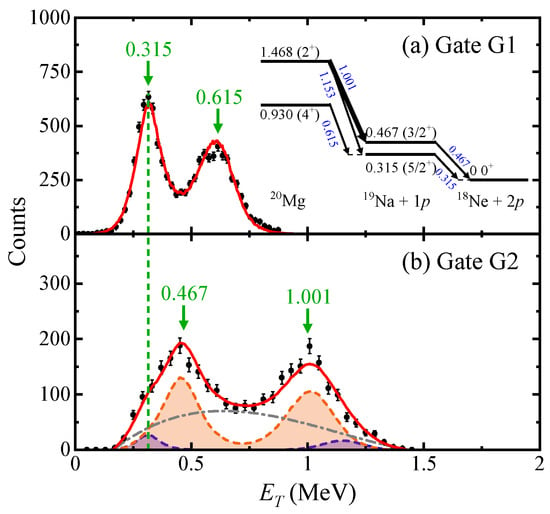
To investigate the decay paths of the and states in 20Mg, we analyzed their 18Ne + subsystem decay spectra, which are selected using the gates G1 and G2 indicated in Figure 3. The smooth background under the two gates constitutes 10.7% and 31.0% of the total events, respectively. The influence of the higher background level was taken into account in the decay path analysis for the state. The results are shown in Figure 4a and Figure 4b, respectively.
Figure 4.
Decay energy spectra for the 18Ne + subsystem with the gates on (a) = 0.930 MeV (G1), and (b) 1.468 MeV (G2) resonant states in 20Mg [30]. Red lines are the results of simulations, assuming sequential decay for the resonant states in 20Mg resulting from decay paths through the state at = 0.315 MeV in 19Na (dashed-blue curve) and the state at = 0.467 MeV in 19Na(dashed-orange curve). A smooth background (dashed-dotted-grey curve), accounting for 35.2% of the total, is included in (b) because of the relatively high background contribution (31.0%) under the = 1.468 MeV state as shown in Figure 3. The green arrows with numbers and dashed-green vertical line show the positions of decay energies in MeV. The inset in (a) shows the main decay paths of the first two resonant states in 20Mg. The energies of the states in 20Mg and 19Na relative to the 2p and 1p thresholds, respectively, are listed on the levels in MeV. The energies of the intermediate states in 19Na are consistent with the available experimental results [47,48,49]. The blue numbers in the inset are the decay energies in MeV between the corresponding states. The bold arrow is the main decay branch of the = 1.468 MeV state in 20Mg.
For the state at = 0.930 MeV, its 18Ne + subsystem spectrum displays two clear peaks at 0.315 and 0.615 MeV. The lower-energy peak at 0.315 MeV corresponds well to the one-proton decay energy of the 19Na ground state to the 18Ne ground state [see inset in Figure 4a], confirming that the state in 20Mg decays predominantly via two sequential steps of emission. The first step proceeds to the ground state of 19Na, which subsequently decays to the bound ground state of 18Ne. The red curve in Figure 4a shows the Monte Carlo simulation for this decay path, which agrees well with the experimental data. The state at = 1.468 MeV exhibits a different decay path. Its 18Ne + subsystem spectrum, shown in Figure 4b, reveals two peaks at 0.467 and 1.001 MeV, respectively. These correspond to two sequential steps of decay via the first excited state of 19Na at = 0.467 MeV [see inset in Figure 4a]. Similar to its ground state, the first excited state of 19Na also decays to the ground state of 18Ne. Further analysis of the subsystem spectrum indicates a minor decay branch for the state in 20Mg proceeding through the 19Na ground state [blue dashed line in Figure 4b], with a branching ratio of 10.4%. This analysis demonstrates that the distinct decay paths of the first two resonances ( and ) are consistent with their different spin-parities: the higher-spin state favors decay to the ground state of 19Na, while the lower-spin state decays primarily to the first excited state of 19Na. The third resonant state in 20Mg at = 3.008 MeV decays mainly via a sequential emission through the 19Na ground state, similar to the state, and is not discussed in detail here.
3.3. Three-Proton Decay of 21Al
Recently, Kostyleva et al. observed two resonant states in 21Al via the in-flight decay method [50]. They were tentatively identified as the ground state and a low-lying excited state, both of which decay by emitting one proton to the ground state of 20Mg. Limited by the insufficient statistics, the angular correlation spectrum in Ref. [50] did not reveal higher-lying resonances. Considering that the two-proton separation energy of 20Mg is only MeV [44], higher resonant states in 21Al may become unbound against three-proton emission, decaying via the two-proton unbound states of 20Mg. In this work, 21Al was produced in a transfer reaction where a proton was added to 20Mg and its three-proton decay mechanisms were studied using 18Ne events [31].
The three-proton decay energy spectrum of 21Al, obtained by invariant mass reconstruction from 18Ne + events, is shown in Figure 5. The corresponding detection efficiency is approximately 10%. Three peaks are suggested, with the first resonance being the most prominent. Their experimental resolutions (FWHM) are 560, 820, and 960 keV, respectively. The decay energies and intrinsic widths of the three resonant states were extracted by fitting the experimental spectrum. For the first resonant state at MeV, analysis of the reconstructed kinetic energy distribution confirmed that its population mechanism is consistent with a one-proton transfer reaction. Based on the ab initio valence-space in-medium similarity renormalization group (VS-IMSRG) calculations [51,52], as well as the yields of these high-lying resonant states calculated using the distorted-wave Born approximation (DWBA) method, the spin-parity of the MeV resonance in 21Al was assigned as - [31].
Figure 5.
Decay energy spectrum for all detected 18Ne + events [31]. The solid-red curve shows the fitted spectrum along with the contributions of each state (dashed curves) and the smooth background (dashed-dotted-grey curve).
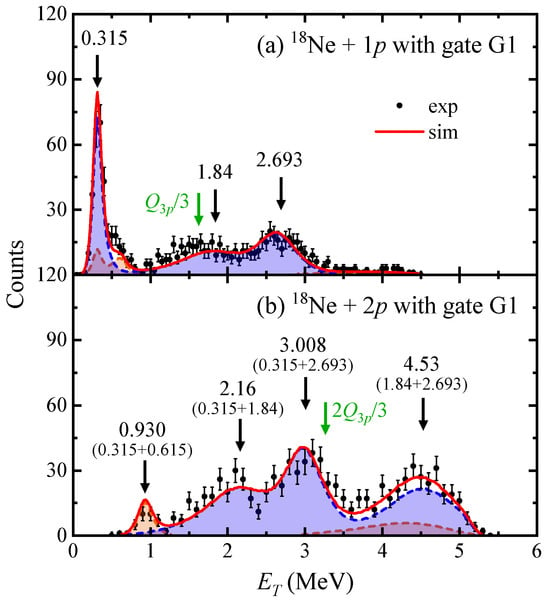
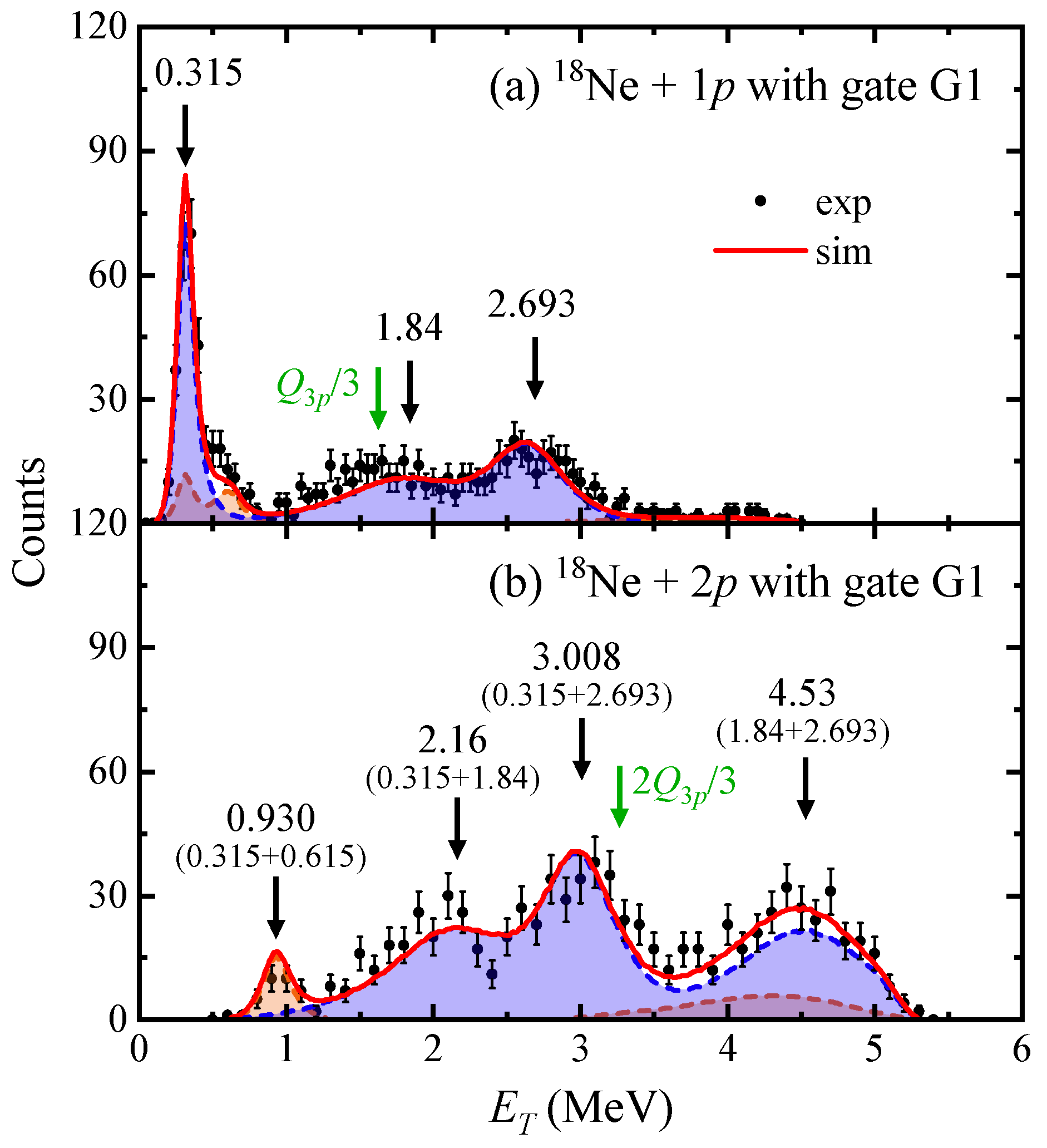
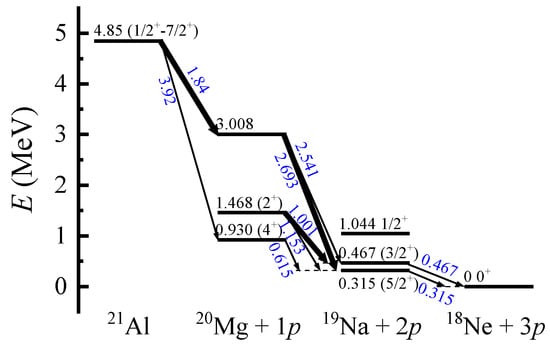
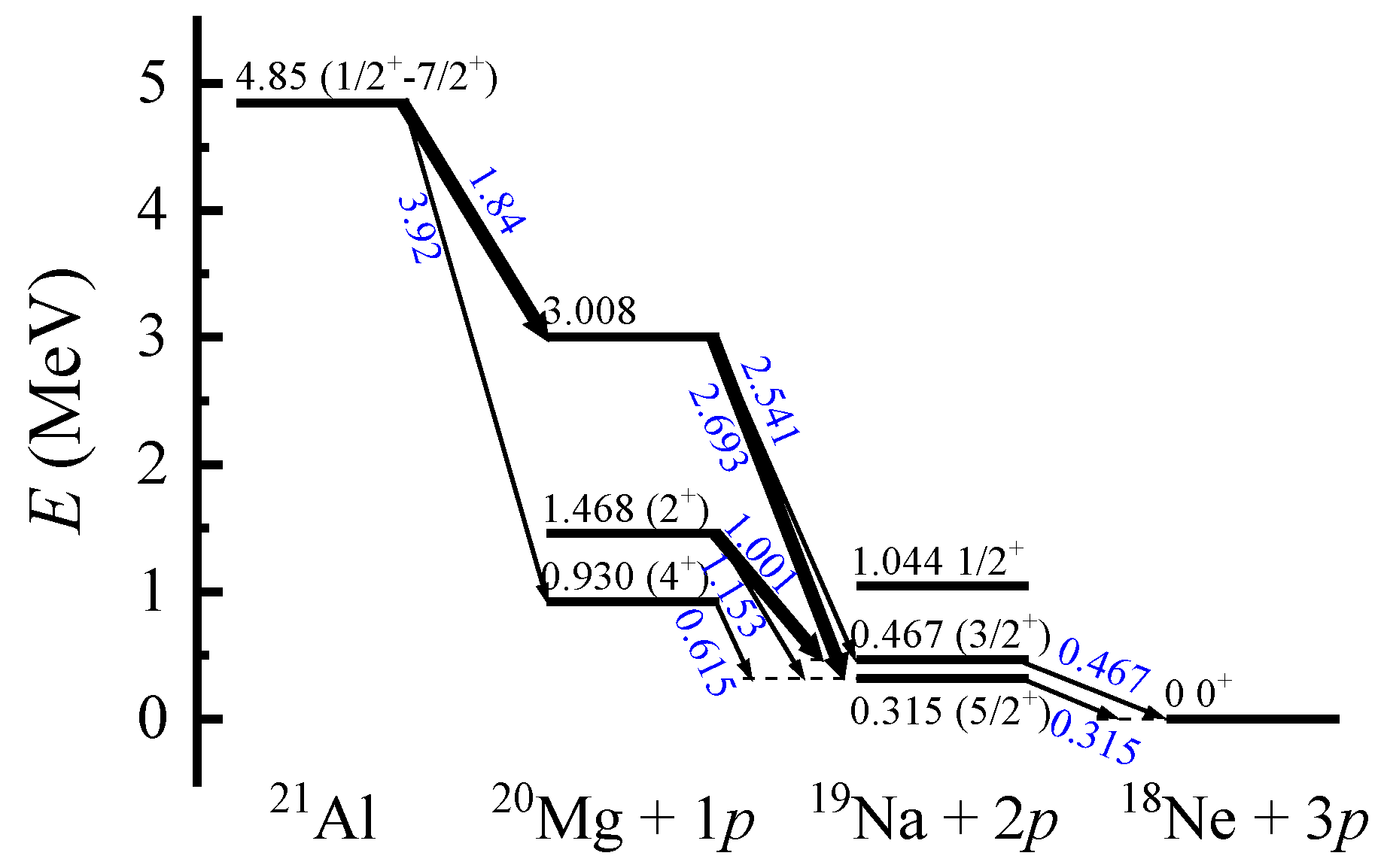
By selecting events corresponding to the MeV resonance within the energy gate G1 indicated in Figure 5, the decay energy spectra of its 18Ne + and 18Ne + subsystems were obtained [31], as shown in Figure 6a and Figure 6b, respectively. Within gate G1, the contribution from the smooth background is 14.6%. Three peaks appear in Figure 6a, corresponding to the one-proton decay energies from a three-step sequential decay via the MeV intermediate state in 20Mg, following the path 1.84 MeV → 2.693 MeV → 0.315 MeV (see Figure 7). This indicates a significant decay branch for this resonance proceeding via a sequential three-step decay chain, ultimately decaying to the ground state of 18Ne. Additionally, the counts near 3.92 MeV and 0.615 MeV in Figure 6a correspond to a sequential decay via the MeV intermediate state in 20Mg, showing a minor contribution from another sequential decay path: 3.92 MeV → 0.615 MeV → 0.315 MeV.
Figure 6.
Decay energy spectra for the (a) 18Ne + and (b) 18Ne + subsystems with the gate G1 on the = 4.85(5) MeV resonant state in 21Al [31]. Red lines are the results of simulations, assuming a three-sequential-steps of decay for the resonant state at = 4.85(5) MeV in 21Al and consisting of simulated results passing through different states in 20Mg (dashed-blue curve corresponds to the decay path via the intermediate state at = 3.008 MeV in 20Mg; dashed-orange curve corresponds to the decay path via the intermediate state at = 0.930 MeV in 20Mg). The black arrows with numbers show the positions of (a) decay energies and (b) summed energies of two decay energies (in brackets) in MeV. The green arrows are located at (a) one-third and (b) two-thirds of the total decay energy of the resonant state at = 4.85(5) MeV in 21Al, where the corresponding distribution should peak for prompt decay.
Figure 7.
Main decay paths of the resonant state at = 4.85(5) MeV in 21Al [31]. The energies of the states in 21Al, 20Mg, and 19Na relative to the 3p, 2p, and 1p thresholds, respectively, are listed on the levels in MeV. The energies of the intermediate states in 20Mg and 19Na are consistent with the available experimental results [30,47,48,49]. The blue numbers are the 1p decay energies in MeV between the corresponding states. The bold arrows are the main decay path among the two decay paths of corresponding states.
For the 18Ne subsystem, pairwise combinations of the three decay energies from the primary decay path yield three summed peaks at 2.16 MeV (0.315 + 1.84), 3.008 MeV (0.315 + 2.693), and 4.53 MeV (1.84 + 2.693). These three summed peaks are clearly seen in Figure 6b. Furthermore, a small peak at 0.930 MeV (0.615 + 0.315) reflects the contribution from the minor decay path (3.92 MeV → 0.615 MeV → 0.315 MeV). The red solid curves in Figure 6a,b represent the results of Monte Carlo simulations for these two sequential decay paths, with branching ratios of 73.7% and 26.3%, respectively. The experimental spectra of both subsystems are well reproduced by the simulations [31].
It is well known that in prompt decay, the two core + p relative energies are approximately equal, maximizing the product of the barrier penetration factors [53,54,55,56]. Consequently, if a prompt decay branch exists for the MeV resonance in 21Al, the relative energies between the three protons and the residue are also expected to be roughly equal. This would manifest as peaks near one-third and two-thirds of the total decay energy in the 18Ne + and 18Ne + subsystem spectra, respectively [indicated by green arrows in the Figure 6a,b]. It can be seen that although prompt decay is not the dominant decay mode, the current experimental results cannot entirely rule out the possibility of such a branch existing [31].
3.4. Four-Proton Decay of 18Mg
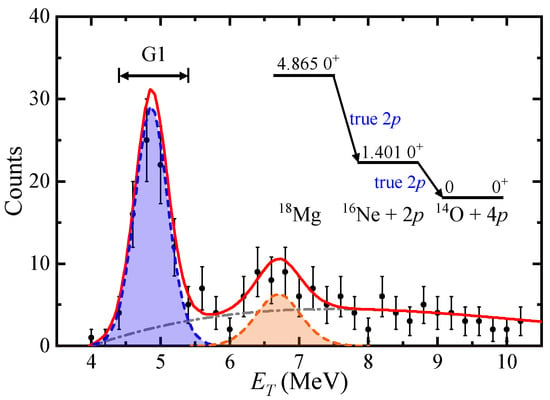
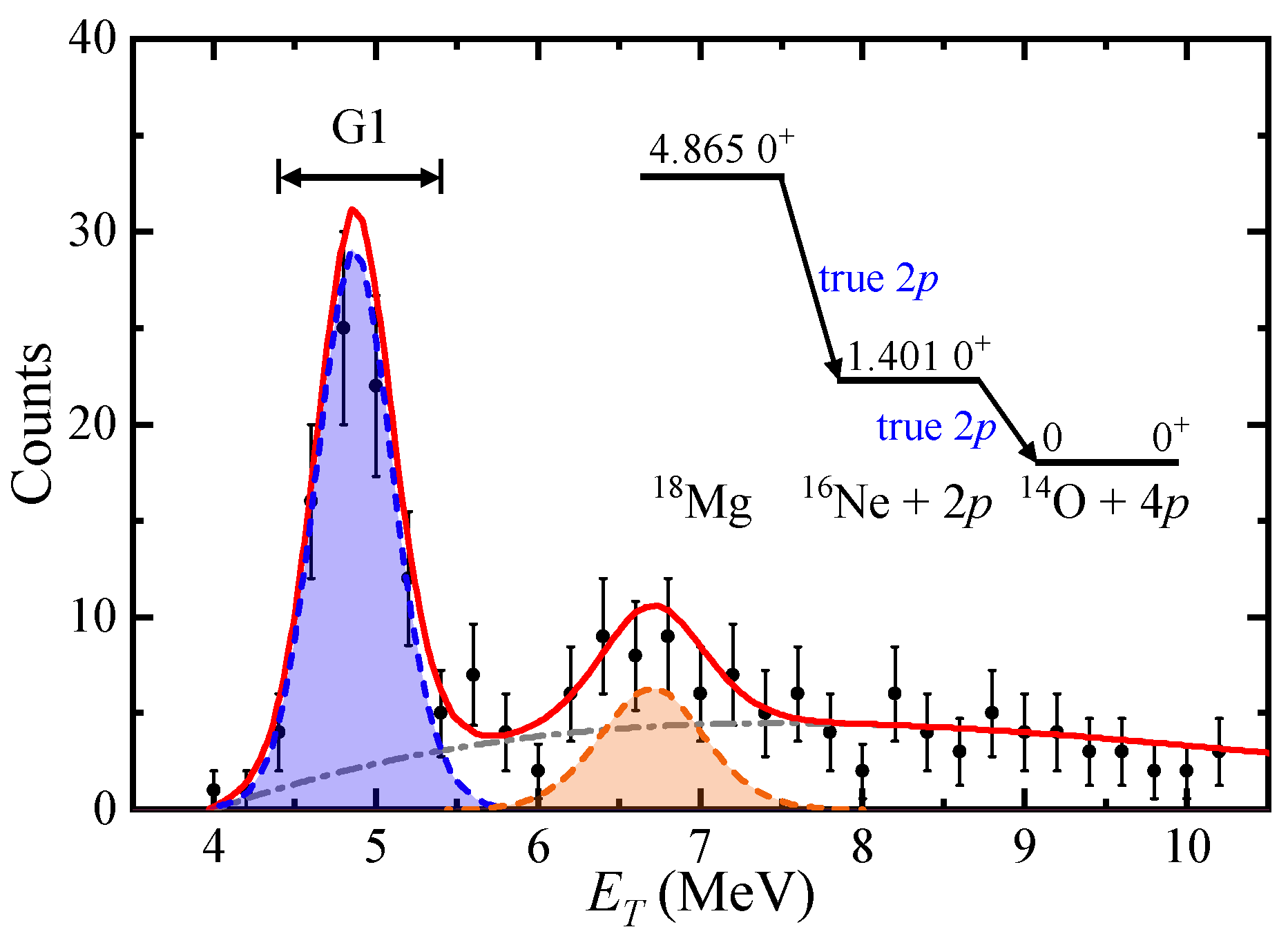
Recently, we have experimentally observed the isotope 18Mg for the first time, which lies two neutrons beyond the proton drip line [19,57] and represents the second observed case of a four-proton unbound nucleus. Using all measured 14O + coincidence events, whose detection efficiency is approximately 3.5%, the invariant mass spectrum of 18Mg [19] was reconstructed, as shown in Figure 8. Two distinct peaks in the spectrum correspond to two resonant states of 18Mg, with experimental resolutions (FWHM) of 520 keV and 620 keV, respectively. By fitting the experimental spectrum, we obtained the decay energies and intrinsic widths for the ground state and first excited state of 18Mg, which are = 4.865(34) MeV, = 115(100) keV, and = 6.71(14) MeV, = 266(150) keV, respectively. Based on the systematics of the states in the mirror nucleus 18C and the isotopes 20,22Mg, the observed excited state is identified as the state of 18Mg [19].
Figure 8.
Decay energy spectrum for all detected 14O + events [19]. The solid-red curve shows the fitted spectrum along with the contributions of each state (dashed curves) and the smooth background (dashed-dotted-grey curve). The inset shows the main decay path of the ground state in 18Mg. The energies of the states in 18Mg and 16Ne relative to the 4p and 2p thresholds, respectively, are listed on the levels in MeV. The energies of the resonant states in 18Mg and 16Ne are taken from Refs. [19,58].
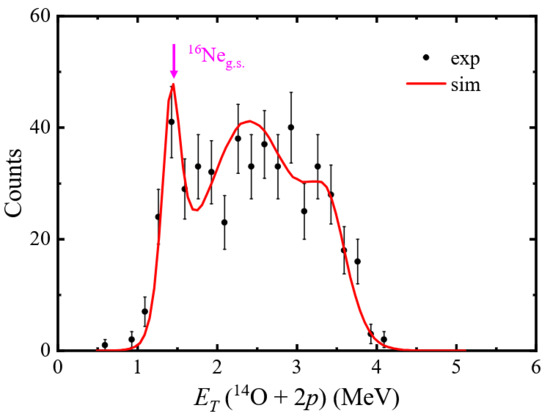
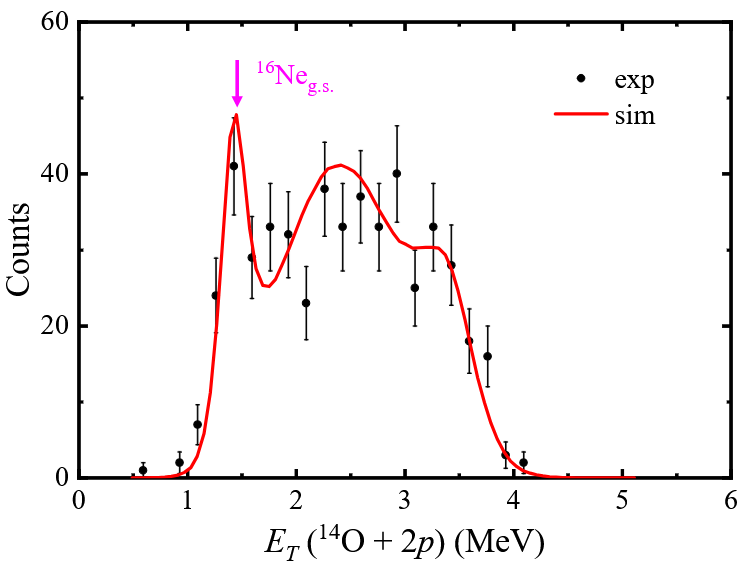
To investigate the decay mechanism of the four-proton emission from the ground state of 18Mg, the corresponding events were selected by using the energy gate G1 in Figure 8, within which the background proportion is approximately 17.3%. The relative energy spectrum for its 14O subsystem was then obtained, which is shown in Figure 9 [19]. It can be seen that the four-proton decay of the 18Mg ground state has significant counts at the position corresponding to the 16Ne ground state, visually indicating that the decay proceeds through the ground state of 16Ne (see inset in Figure 8). It should be noted that there are six possible ways to choose two protons from four. Figure 9 shows the relative energies of the 14O subsystem calculated for all six combinations. When the 18Mg ground state decays via the 16Ne ground state, only one combination yields the two-proton decay energy of the 16Ne ground state, while the other five combinations constitute the background. Moreover, since the decay energy for the first step of two-proton emission from 18Mg ground state is 3.464 MeV, which is much larger than the 1.401 MeV for the second step from 16Ne ground state, the background from the five incorrect combinations predominantly appears at higher energies in the spectrum. This is clearly reflected in Figure 9, where a narrow peak at around 1.4 MeV corresponds to the two-proton decay energy of the 16Ne ground state, while a broad background at higher energies arises from the five incorrect combinations.
Figure 9.
Relative energy spectrum for the 14O + subsystem with the gate G1 on 18Mgg.s. [19]. Red lines are the results of simulations assuming 18Mgg.s. decays to 14O + 4p by two sequential steps of prompt decay through 16Neg.s., where the decay correlations are assumed to be the same as those observed for 16Neg.s.. The arrow shows the decay energy of the ground state of 16Ne.
We further investigated the decay path of the 18Mg ground state using Monte Carlo simulations [19]. The simulations assumed that the 18Mg ground state decays to the 14O ground state via two sequential prompt emissions through the intermediate 16Ne ground state. The simulated spectrum, shown as the red curve in Figure 9, agrees well with the experimental data, supporting this proposed decay path. This decay mode is similar to that of 8C. As the first observed four-proton emitter, 8C primarily decays via a two-step cascade of prompt emissions through the ground state of 6Be [18]. It is worth noting that 28O, as a four-neutron emitter, also decays mainly via a two-step cascade of prompt emissions [59,60], resembling the decay patterns of 8C and 18Mg ground states. In the sequential two-step prompt decay of the 18Mg ground state via 16Ne ground state, the two protons emitted in the first step (from 18Mg to 16Ne) most likely share the decay energy of about 1.7 MeV each, and those in the second step (from 16Ne to 14O) about 0.7 MeV each. Thus, when randomly selecting two protons, there is a 2/3 probability of obtaining MeV. Hence, the high counts near 2.4 MeV in Figure 9 do not correspond to a real resonant state in 16Ne, but rather represent a background from incorrect proton combinations. Due to the low statistics for the 18Mg first excited state, it is difficult to determine which resonant state of 16Ne is involved based on the current two-dimensional spectrum analysis and further experimental studies are needed.
4. Conclusions
Investigations of exotic decays and structures of nuclei under extreme conditions of isospin asymmetry have played a pivotal role in revealing new nuclear phenomena and in developing theoretical models, representing one of the most active frontiers in nuclear physics. Compared to one-nucleon emission, the inherent complexity of multi-nucleon emission can shed more light on the structure and decay mechanisms of drip-line nuclei. This article reviews our recent experimental studies on proton decay in nuclei near the proton drip line around . Utilizing the invariant mass method, we investigated the one-proton decay of 18Na, the two-proton decay from excited states of 20Mg, the three-proton decay of 21Al, and the four-proton decay of 18Mg, reconstructing the decay energy spectra for these four nuclei. The ground-state energy of 18Na was determined, clarifying previous controversies regarding its position. Four two-proton resonant states in 20Mg and three three-proton resonant states in 21Al were identified, respectively. Furthermore, the isotope 18Mg, located two neutrons beyond the proton drip line, was observed experimentally for the first time. Through correlation analysis of the decay products from the multi-proton decay processes of 20Mg, 21Al, and 18Mg, combined with Monte Carlo simulations, the decay mechanisms of these resonant states were discussed. The results indicate that the resonant states in 20Mg and 21Al decay predominantly via two-step and three-step sequential emission cascades, respectively, while the ground state of 18Mg decays mainly through a two-step sequential prompt emission process.
It is important to note that the simultaneous emission of three or more protons has not been experimentally observed to date. All known multi-proton (≥3) decay processes can be described as sequences of sequential or decays. Whether genuine simultaneous emission of a larger number of protons exists, and how its underlying mechanism might differ from the currently observed or decay processes, will be a key question for future research on proton decay.
Author Contributions
Conceptualization, L.N. and H.H.; Writing—original draft, L.N.; Writing—review and editing, H.H., Z.L. and Y.J. All authors have read and agreed to the published version of the manuscript.
Funding
This research was funded by the National Key R&D Program of China under Grant No. 2022YFA1602302, and the National Natural Science Foundation of China under Grants No. 12035001 and No. 12535008.
Data Availability Statement
No new data were created or analyzed in this study. Data sharing is not applicable to this article.
Acknowledgments
The authors appreciate the referee for their careful reading of the paper and for their valuable comments.
Conflicts of Interest
The authors declare no conflicts of interest.
Abbreviations
The following abbreviations are used in this manuscript:
| Hartree-Fock-Bogoliubov | HFB |
| Gamow shell model | GSM |
| Gamow coupled-channel | GCC |
| NSCL | National Superconducting Cyclotron Laboratory |
| CCF | Coupled Cyclotron Facility |
| pps | particles per second |
| ADSSD | annular double-sided silicon strip detector |
| SM | shell model |
| VS-IMSRG | valence-space in-medium similarity renormalization group |
| DWBA | distorted-wave Born approximation |
| FWHM | full width at half maximum |
References
- Goldansky, V. On neutron-deficient isotopes of light nuclei and the phenomena of proton and two-proton radioactivity. Nucl. Phys. 1960, 19, 482–495. [Google Scholar] [CrossRef] [Scilit]
- Zel’dovich, Y.B. The Existence of New Isotopes of Light Nuclei and the Equation of State of Neutrons. Sov. Phys. JETP 1960, 38, 812. [Google Scholar]
- Blank, B. One- and Two-Proton Radioactivity. Lect. Notes Phys. 2009, 764, 153. [Google Scholar] [CrossRef] [Scilit]
- Pfützner, M.; Karny, M.; Grigorenko, L.V.; Riisager, K. Radioactive decays at limits of nuclear stability. Rev. Mod. Phys. 2012, 84, 567–619. [Google Scholar] [CrossRef] [Scilit]
- Pfützner, M.; Mukha, I.; Wang, S. Two-proton emission and related phenomena. Prog. Part. Nucl. Phys. 2023, 132, 104050. [Google Scholar] [CrossRef] [Scilit]
- Zhou, L.; Wang, S.M.; Fang, D.Q.; Ma, Y.G. Recent progress in two-proton radioactivity. Nucl. Sci. Tech. 2022, 33, 105. [Google Scholar] [CrossRef] [Scilit]
- Giovinazzo, J.; Blank, B.; Chartier, M.; Czajkowski, S.; Fleury, A.; Lopez Jimenez, M.J.; Pravikoff, M.S.; Thomas, J.C.; de Oliveira Santos, F.; Lewitowicz, M.; et al. Two-Proton Radioactivity of 45Fe. Phys. Rev. Lett. 2002, 89, 102501. [Google Scholar] [CrossRef] [Scilit]
- Pfützner, M.; Badura, E.; Bingham, C.; Blank, B.; Chartier, M.; Geissel, H.; Giovinazzo, J.; Grigorenko, L.V.; Grzywacz, R.; Hellström, M.; et al. First evidence for the two-proton decay of 45Fe. Eur. Phys. J. A 2002, 14, 279. [Google Scholar] [CrossRef] [Scilit]
- Wamers, F.; Marganiec, J.; Aksouh, F.; Aksyutina, Y.; Álvarez-Pol, H.; Aumann, T.; Beceiro-Novo, S.; Boretzky, K.; Borge, M.J.G.; Chartier, M.; et al. First Observation of the Unbound Nucleus 15Ne. Phys. Rev. Lett. 2014, 112, 132502. [Google Scholar] [CrossRef] [Scilit]
- Mukha, I.; Grigorenko, L.V.; Xu, X.; Acosta, L.; Casarejos, E.; Ciemny, A.A.; Dominik, W.; Duénas-Díaz, J.; Dunin, V.; Espino, J.M.; et al. Observation and Spectroscopy of New Proton-Unbound Isotopes 30Ar and 29Cl: An Interplay of Prompt Two-Proton and Sequential Decay. Phys. Rev. Lett. 2015, 115, 202501. [Google Scholar] [CrossRef] [Scilit]
- Goigoux, T.; Ascher, P.; Blank, B.; Gerbaux, M.; Giovinazzo, J.; Grévy, S.; Kurtukian Nieto, T.; Magron, C.; Doornenbal, P.; Kiss, G.G.; et al. Two-Proton Radioactivity of 67Kr. Phys. Rev. Lett. 2016, 117, 162501. [Google Scholar] [CrossRef] [Scilit] [PubMed]
- Webb, T.B.; Wang, S.M.; Brown, K.W.; Charity, R.J.; Elson, J.M.; Barney, J.; Cerizza, G.; Chajecki, Z.; Estee, J.; Hoff, D.E.M.; et al. First Observation of Unbound 11O, the Mirror of the Halo Nucleus 11Li. Phys. Rev. Lett. 2019, 122, 122501. [Google Scholar] [CrossRef] [Scilit] [PubMed]
- Charity, R.J.; Elson, J.M.; Manfredi, J.; Shane, R.; Sobotka, L.G.; Brown, B.A.; Chajecki, Z.; Coupland, D.; Iwasaki, H.; Kilburn, M.; et al. Investigations of three-, four-, and five-particle decay channels of levels in light nuclei created using a 9C beam. Phys. Rev. C 2011, 84, 014320. [Google Scholar] [CrossRef] [Scilit]
- Charity, R.J.; Webb, T.B.; Elson, J.M.; Hoff, D.E.M.; Pruitt, C.D.; Sobotka, L.G.; Brown, K.W.; Cerizza, G.; Estee, J.; Lynch, W.G.; et al. Observation of the Exotic Isotope 13F Located Four Neutrons beyond the Proton Drip Line. Phys. Rev. Lett. 2021, 126, 132501. [Google Scholar] [CrossRef] [Scilit]
- Brown, K.W.; Charity, R.J.; Elson, J.M.; Reviol, W.; Sobotka, L.G.; Buhro, W.W.; Chajecki, Z.; Lynch, W.G.; Manfredi, J.; Shane, R.; et al. Proton-decaying states in light nuclei and the first observation of 17Na. Phys. Rev. C 2017, 95, 044326. [Google Scholar] [CrossRef] [Scilit]
- Xu, X.D.; Mukha, I.; Li, J.G.; Wang, S.M.; Acosta, L.; Bajzek, M.; Casarejos, E.; Cortina-Gil, D.; Espino, J.M.; Fomichev, A.; et al. Isospin Symmetry Breaking Disclosed in the Decay of Three-Proton Emitter 20Al. Phys. Rev. Lett. 2025, 135, 022502. [Google Scholar] [CrossRef] [Scilit]
- Kostyleva, D.; Mukha, I.; Acosta, L.; Casarejos, E.; Chudoba, V.; Ciemny, A.A.; Dominik, W.; Dueñas, J.A.; Dunin, V.; Espino, J.M.; et al. Towards the Limits of Existence of Nuclear Structure: Observation and First Spectroscopy of the Isotope 31K by Measuring Its Three-Proton Decay. Phys. Rev. Lett. 2019, 123, 092502. [Google Scholar] [CrossRef] [Scilit]
- Charity, R.J.; Elson, J.M.; Manfredi, J.; Shane, R.; Sobotka, L.G.; Chajecki, Z.; Coupland, D.; Iwasaki, H.; Kilburn, M.; Lee, J.; et al. 2p-2p decay of 8C and isospin-allowed 2p decay of the isobaric-analog state in 8B. Phys. Rev. C 2010, 82, 041304. [Google Scholar] [CrossRef] [Scilit]
- Jin, Y.; Niu, C.Y.; Brown, K.W.; Li, Z.H.; Hua, H.; Anthony, A.K.; Barney, J.; Charity, R.J.; Crosby, J.; Dell’Aquila, D.; et al. First Observation of the Four-Proton Unbound Nucleus 18Mg. Phys. Rev. Lett. 2021, 127, 262502. [Google Scholar] [CrossRef] [Scilit]
- Charity, R.J.; Wylie, J.; Wang, S.M.; Webb, T.B.; Brown, K.W.; Cerizza, G.; Chajecki, Z.; Elson, J.M.; Estee, J.; Hoff, D.E.M.; et al. Strong Evidence for 9N and the Limits of Existence of Atomic Nuclei. Phys. Rev. Lett. 2023, 131, 172501. [Google Scholar] [CrossRef] [Scilit]
- Olsen, E.; Pfützner, M.; Birge, N.; Brown, M.; Nazarewicz, W.; Perhac, A. Landscape of Two-Proton Radioactivity. Phys. Rev. Lett. 2013, 110, 222501. [Google Scholar] [CrossRef] [Scilit]
- Michel, N.; Nazarewicz, W.; Płoszajczak, M.; Vertse, T. Shell model in the complex energy plane. J. Phys. G Nucl. Part. Phys. 2008, 36, 013101. [Google Scholar] [CrossRef] [Scilit]
- Wang, S.M.; Michel, N.; Nazarewicz, W.; Xu, F.R. Structure and decays of nuclear three-body systems: The Gamow coupled-channel method in Jacobi coordinates. Phys. Rev. C 2017, 96, 044307. [Google Scholar] [CrossRef] [Scilit]
- Berggren, T. On the use of resonant states in eigenfunction expansions of scattering and reaction amplitudes. Nucl. Phys. A 1968, 109, 265–287. [Google Scholar] [CrossRef] [Scilit]
- Michel, N.; Li, J.G.; Xu, F.R.; Zuo, W. Proton decays in 16Ne and 18Mg and isospin-symmetry breaking in carbon isotopes and isotones. Phys. Rev. C 2021, 103, 044319. [Google Scholar] [CrossRef] [Scilit]
- Michel, N.; Li, J.G.; Ru, L.H.; Zuo, W. Calculation of the Thomas-Ehrman shift in 16F and 15O(p,p) cross sections within the Gamow shell model. Phys. Rev. C 2022, 106, L011301. [Google Scholar] [CrossRef] [Scilit]
- Wang, S.M.; Nazarewicz, W. Puzzling Two-Proton Decay of 67Kr. Phys. Rev. Lett. 2018, 120, 212502. [Google Scholar] [CrossRef] [Scilit]
- Wang, S.M.; Nazarewicz, W. Fermion Pair Dynamics in Open Quantum Systems. Phys. Rev. Lett. 2021, 126, 142501. [Google Scholar] [CrossRef] [Scilit]
- Ni, L.; Jin, Y.; Li, Z.H.; Brown, K.W.; Hua, H.; Niu, C.Y.; Anthony, A.K.; Barney, J.; Charity, R.J.; Dell’Aquila, D.; et al. Resonant structure of 18Na and the N=8 shell. Phys. Rev. C 2025, 112, 024321. [Google Scholar] [CrossRef] [Scilit]
- Ni, L.; Jin, Y.; Li, Z.H.; Brown, K.W.; Yuan, C.X.; Hua, H.; Niu, C.Y.; Anthony, A.K.; Barney, J.; Charity, R.J.; et al. Neutron magicity in the proton drip-line nucleus 20Mg: First invariant-mass reconstruction of 19,20Mg. Phys. Rev. C 2024, 110, L061301. [Google Scholar] [CrossRef] [Scilit]
- Ni, L.; Jin, Y.; Li, Z.; Brown, K.; Hua, H.; Niu, C.; Li, J.; Anthony, A.; Barney, J.; Charity, R.; et al. Observation of three-proton-decaying resonant states in 21Al. Phys. Lett. B 2025, 868, 139660. [Google Scholar] [CrossRef] [Scilit]
- Stolz, A.; Baumann, T.; Ginter, T.; Morrissey, D.; Portillo, M.; Sherrill, B.; Steiner, M.; Stetson, J. Production of rare isotope beams with the NSCL fragment separator. Nucl. Instrum. Methods Phys. Res. Sect. B 2005, 241, 858–861. [Google Scholar] [CrossRef] [Scilit]
- Morrissey, D.; Sherrill, B.; Steiner, M.; Stolz, A.; Wiedenhoever, I. Commissioning the A1900 projectile fragment separator. Nucl. Instrum. Methods Phys. Res. Sect. B 2003, 204, 90–96. [Google Scholar] [CrossRef] [Scilit]
- S800 Spectrograph. Available online: https://wikihost.nscl.msu.edu/S800Doc/doku.php?id=introduction (accessed on 26 March 2026).
- S800 Focal Plane Detector Array. Available online: https://wikihost.nscl.msu.edu/S800Doc/doku.php?id=detectors (accessed on 26 March 2026).
- Yurkon, J.; Bazin, D.; Benenson, W.; Morrissey, D.; Sherrill, B.; Swan, D.; Swanson, R. Focal plane detector for the S800 high-resolution spectrometer. Nucl. Instrum. Methods Phys. Res. Sect. A 1999, 422, 291–295. [Google Scholar] [CrossRef] [Scilit]
- Bazin, D.; Caggiano, J.; Sherrill, B.; Yurkon, J.; Zeller, A. The S800 spectrograph. Nucl. Instrum. Methods Phys. Res. Sect. B 2003, 204, 629–633. [Google Scholar] [CrossRef] [Scilit]
- Zerguerras, T.; Blank, B.; Blumenfeld, Y.; Suomijärvi, T.; Beaumel, D.; Brown, B.A.; Chartier, M.; Fallot, M.; Giovinazzo, J.; Jouanne, C.; et al. Study of light proton-rich nuclei by complete kinematics measurements. Eur. Phys. J. A 2004, 20, 389–396. [Google Scholar] [CrossRef] [Scilit]
- Assié, M.; de Oliveira, F.; e521as Collaboration. Spectroscopy of the unbound nucleus 18Na in link with 19Mg two-proton radioactivity. AIP Conf. Proc. 2011, 1409, 93–97. [Google Scholar] [CrossRef] [Scilit]
- Assié, M.; de Oliveira Santos, F.; Davinson, T.; de Grancey, F.; Achouri, L.; Alcántara-Núñez, J.; Al Kalanee, T.; Angélique, J.C.; Borcea, C.; Borcea, R.; et al. Spectroscopy of 18Na: Bridging the two-proton radioactivity of 19Mg. Phys. Lett. B 2012, 712, 198–202. [Google Scholar] [CrossRef] [Scilit]
- Mukha, I.; Grigorenko, L.; Acosta, L.; Alvarez, M.A.G.; Casarejos, E.; Chatillon, A.; Cortina-Gil, D.; Espino, J.M.; Fomichev, A.; García-Ramos, J.E.; et al. New states in 18Na and 19Mg observed in the two-proton decay of 19Mg. Phys. Rev. C 2012, 85, 044325. [Google Scholar] [CrossRef] [Scilit]
- Charity, R.J.; Brown, K.; Webb, T.; Sobotka, L.G. Invariant-mass spectroscopy of 10B,11C,14F,16F, and 18Na. Phys. Rev. C 2023, 107, 054301. [Google Scholar] [CrossRef] [Scilit]
- Mukha, I.; Sümmerer, K.; Acosta, L.; Alvarez, M.A.G.; Casarejos, E.; Chatillon, A.; Cortina-Gil, D.; Espino, J.; Fomichev, A.; García-Ramos, J.E.; et al. Observation of Two-Proton Radioactivity of 19Mg by Tracking the Decay Products. Phys. Rev. Lett. 2007, 99, 182501. [Google Scholar] [CrossRef] [Scilit]
- Wang, M.; Huang, W.; Kondev, F.; Audi, G.; Naimi, S. The AME 2020 atomic mass evaluation (II). Tables, graphs and references. Chin. Phys. C 2021, 45, 030003. [Google Scholar] [CrossRef] [Scilit]
- Randhawa, J.S.; Kanungo, R.; Holl, M.; Holt, J.D.; Navrátil, P.; Stroberg, S.R.; Hagen, G.; Jansen, G.R.; Alcorta, M.; Andreoiu, C.; et al. Observation of excited states in 20Mg sheds light on nuclear forces and shell evolution. Phys. Rev. C 2019, 99, 021301(R). [Google Scholar] [CrossRef] [Scilit]
- LaFrance, S.; Fortune, H.T.; Mordechai, S.; Cobern, M.E.; Moore, G.E.; Middleton, R.; Chung, W.; Wildenthal, B.H. 20O from 18O(t,p). Phys. Rev. C 1979, 20, 1673–1679. [Google Scholar] [CrossRef] [Scilit]
- Benenson, W.; Guichard, A.; Kashy, E.; Mueller, D.; Nann, H.; Robinson, L. Mass measurements of 19Na and 23Al using the (3He, 8Li) reaction. Phys. Lett. B 1975, 58, 46–48. [Google Scholar] [CrossRef] [Scilit]
- Angulo, C.; Tabacaru, G.; Couder, M.; Gaelens, M.; Leleux, P.; Ninane, A.; Vanderbist, F.; Davinson, T.; Woods, P.J.; Schweitzer, J.S.; et al. Identification of a new low-lying state in the proton drip line nucleus 19Na. Phys. Rev. C 2003, 67, 014308. [Google Scholar] [CrossRef] [Scilit]
- Mukha, I.; Sümmerer, K.; Acosta, L.; Alvarez, M.A.G.; Casarejos, E.; Chatillon, A.; Cortina-Gil, D.; Egorova, I.A.; Espino, J.M.; Fomichev, A.; et al. Spectroscopy of proton-unbound nuclei by tracking their decay products in-flight: One- and two- proton decays of 15F, 16Ne, and 19Na. Phys. Rev. C 2010, 82, 054315. [Google Scholar] [CrossRef] [Scilit]
- Kostyleva, D.; Xu, X.D.; Mukha, I.; Acosta, L.; Bajzek, M.; Casarejos, E.; Ciemny, A.A.; Cortina-Gil, D.; Dominik, W.; Dueñas, J.A.; et al. Observation and spectroscopy of the proton-unbound nucleus 21Al. Phys. Rev. C 2024, 110, L031301. [Google Scholar] [CrossRef] [Scilit]
- Li, H.H.; Li, J.G.; Xie, M.R.; Zuo, W. Ab initio calculations of mirror energy difference in sd-shell nuclei*. Chin. Phys. C 2023, 47, 124101. [Google Scholar] [CrossRef] [Scilit]
- Xu, X.Y.; Fan, S.Q.; Yuan, Q.; Hu, B.S.; Li, J.G.; Wang, S.M.; Xu, F.R. Progress in abinitio in-medium similarity renormalization group and coupled-channel method with coupling to the continuum. Nucl. Sci. Tech. 2024, 35, 215. [Google Scholar] [CrossRef] [Scilit]
- Egorova, I.A.; Charity, R.J.; Grigorenko, L.V.; Chajecki, Z.; Coupland, D.; Elson, J.M.; Ghosh, T.K.; Howard, M.E.; Iwasaki, H.; Kilburn, M.; et al. Democratic Decay of 6Be Exposed by Correlations. Phys. Rev. Lett. 2012, 109, 202502. [Google Scholar] [CrossRef] [Scilit]
- Brown, K.W.; Charity, R.J.; Sobotka, L.G.; Chajecki, Z.; Grigorenko, L.V.; Egorova, I.A.; Parfenova, Y.L.; Zhukov, M.V.; Bedoor, S.; Buhro, W.W.; et al. Observation of Long-Range Three-Body Coulomb Effects in the Decay of 16Ne. Phys. Rev. Lett. 2014, 113, 232501. [Google Scholar] [CrossRef] [Scilit]
- Webb, T.B.; Charity, R.J.; Elson, J.M.; Hoff, D.E.M.; Pruitt, C.D.; Sobotka, L.G.; Brown, K.W.; Barney, J.; Cerizza, G.; Estee, J.; et al. Particle decays of levels in 11,12N and 12O investigated with the invariant-mass method. Phys. Rev. C 2019, 100, 024306. [Google Scholar] [CrossRef] [Scilit]
- Miernik, K.; Dominik, W.; Janas, Z.; Pfützner, M.; Grigorenko, L.; Bingham, C.R.; Czyrkowski, H.; Ćwiok, M.; Darby, I.G.; Dąbrowski, R.; et al. Two-Proton Correlations in the Decay of 45Fe. Phys. Rev. Lett. 2007, 99, 192501. [Google Scholar] [CrossRef] [Scilit]
- Zhou, L.; Fang, D.Q.; Wang, S.M.; Hua, H. Structure and 2p decay mechanism of 18Mg. Nucl. Sci. Tech. 2024, 35, 107. [Google Scholar] [CrossRef] [Scilit]
- NNDC. Available online: https://www.nndc.bnl.gov/ensdf/ (accessed on 26 March 2026).
- Kondo, Y.; Achouri, N.L.; Al Falou, H.; Atar, L.; Aumann, T.; Baba, H.; Boretzky, K.; Caesar, C.; Calvet, D.; Chae, H.; et al. First observation of 28O. Nature 2023, 620, 965–970. [Google Scholar] [CrossRef] [Scilit]
- Li, J.G.; Hu, B.S.; Zhang, S.; Xu, F.R. Unbound 28O, the heaviest oxygen isotope observed: A cutting-edge probe for testing nuclear models. Nucl. Sci. Tech. 2024, 35, 21. [Google Scholar] [CrossRef] [Scilit]
Disclaimer/Publisher’s Note: The statements, opinions and data contained in all publications are solely those of the individual author(s) and contributor(s) and not of MDPI and/or the editor(s). MDPI and/or the editor(s) disclaim responsibility for any injury to people or property resulting from any ideas, methods, instructions or products referred to in the content. |
© 2026 by the authors. Licensee MDPI, Basel, Switzerland. This article is an open access article distributed under the terms and conditions of the Creative Commons Attribution (CC BY) license.