


Abstract
This is a comprehensive review that examines Interplanetary Coronal Mass Ejections (ICMEs) as critical drivers of energetic particle dynamics across the heliosphere, influencing both solar energetic particle (SEP) acceleration at ICME-driven shocks and the modulation of galactic cosmic rays (GCRs). The interaction of these heliospheric transients with planetary magnetospheres provides a natural laboratory for studying acceleration and transport processes in complex plasma environments. Saturn’s magnetosphere, while internally dynamic, allows partial penetration of heliospheric energetic particles into the outer and middle magnetosphere, enabling indirect solar wind diagnostics and revealing ICME-induced variations such as Forbush decreases and SEP-driven transient radiation belts. In contrast, Jupiter’s much stronger and rapidly rotating magnetosphere presents a fundamentally different regime. External solar particles—particularly SEPs—encounter significant barriers to entry due to the planet’s intense magnetic field and dense, internally sourced plasma environment, limiting direct penetration into the inner magnetosphere. Instead, Jupiter sustains high-efficiency internal acceleration processes, including wave–particle interactions and rotationally driven transport. These mechanisms energize particles to MeV and, in some cases, relativistic energies, producing radiation belts and current systems that largely mask signatures of heliospheric transients. Comparative examination of these two systems provides insight into the regulation of energetic particle acceleration, transport, and modulation in strong-field planetary environments.
1. Introduction
Interplanetary Coronal Mass Ejections (ICMEs) are key drivers of energetic particle processes in the heliosphere. During such interactions with planetary magnetospheres, complex environments emerge for studying particle acceleration and transport. As ICMEs propagate outward through the heliosphere, they undergo structural evolution as a result of complex interactions with the ambient solar wind and other transient plasma structures. During recent decades, the coordinated observations of the propagation and evolution of ICMEs have become increasingly prevalent, and these studies reveal key information about their large-scale structure and heliospheric impact.
Energetic particles constitute a dynamic component of the heliospheric plasma environment. Solar energetic particles (SEPs) are accelerated by transient solar eruptive processes, and galactic cosmic rays (GCRs), entering from interstellar space, both contribute to the radiation conditions throughout the heliosphere and serve as diagnostic probes of plasma transport [1,2,3,4]. Their acceleration, transport, and modulation are governed by large-scale magnetic field structures, solar-wind variability, and planetary magnetospheres. SEP intensities and spectra depend on shock geometry, Mach number, and upstream turbulence, while GCR fluxes respond to large-scale magnetic compressions, sheath turbulence, and flux-rope topology through Forbush decreases. These processes evolve significantly with heliocentric distance due to ICME expansion, interaction with background solar-wind streams, and the formation of merged interaction regions. Understanding these changes is essential for interpreting energetic particle observations beyond 1 AU.
Planetary magnetospheres represent strong-field plasma environments in which magnetic pressure often exceeds thermal pressure (β < 1). Their intrinsic magnetic fields, internal plasma sources, and rotation-driven circulation regulate particle trapping, mirroring, and acceleration. These systems provide valuable environments for studying electromagnetic acceleration processes [5,6]. Under such conditions, charged particles undergo drift, pitch-angle evolution, and energization through wave–particle interactions and large-scale electric fields.
Giant-planet magnetospheres provide additional contexts in which energetic particle populations are modified by both heliospheric drivers and internal acceleration mechanisms. Saturn’s magnetosphere, characterized by rapid rotation, a weaker magnetic field, and greater accessibility to heliospheric energetic particles, permits partial penetration of heliospheric SEPs and GCRs, producing observable signatures that reflect upstream solar-wind structures. In contrast, Jupiter’s rapidly rotating, plasma-rich magnetosphere supports efficient internal acceleration through radial diffusion, wave–particle interactions, and rotation-driven electric fields, while largely shielding its inner regions from heliospheric particle access. These distinct environments offer complementary perspectives on energetic particle dynamics in strong-field plasmas.
The present review examines these processes in an integrated framework. It outlines the heliospheric evolution of ICMEs and their associated SEP and GCR signatures, summarizes the conditions under which heliospheric particles can access giant-planet magnetospheres, and assesses the internal mechanisms that generate high-energy particle populations at Jupiter and Saturn. It also discusses these giant planetary plasma environments as natural particle accelerators, providing broader context for understanding acceleration, transport, and modulation processes across the heliosphere.
2. ICME Evolution Across the Heliosphere
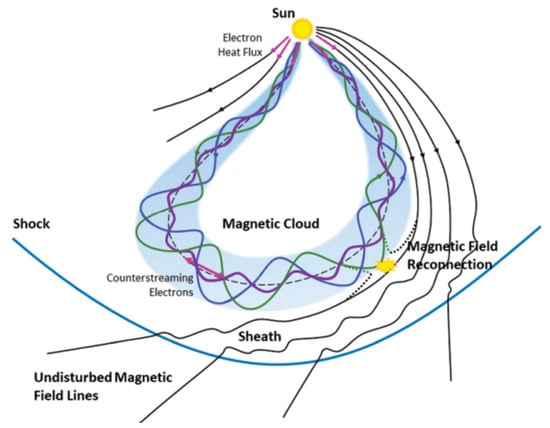
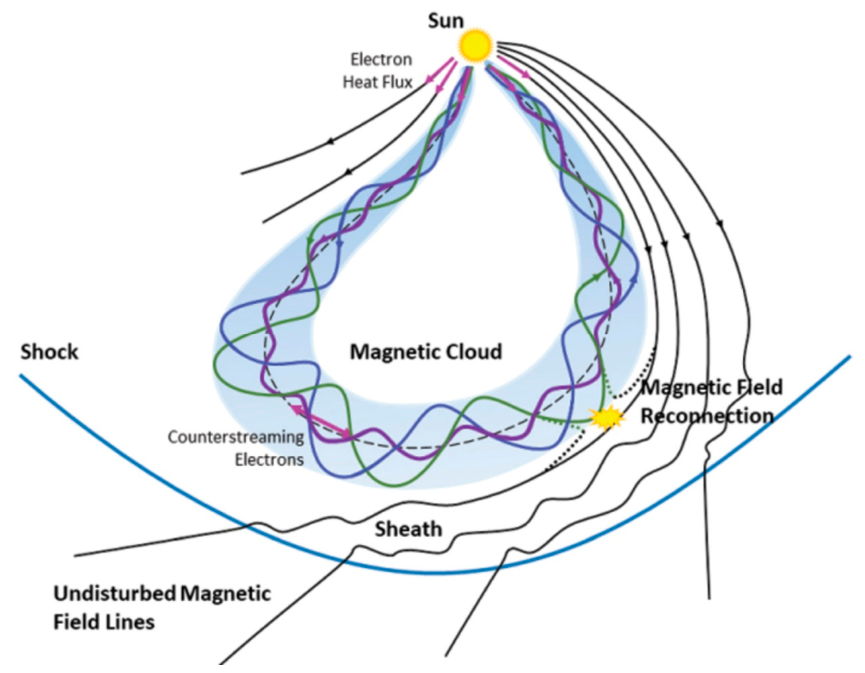
Interplanetary Coronal Mass Ejections (ICMEs) are the interplanetary forms of coronal mass ejections (CMEs) launched from the solar corona. An ICME typically consists of a leading shock, a turbulent sheath region, and, in many cases, a magnetic cloud (MC) [7] (Figure 1). Magnetic clouds are coherent flux-rope structures characterized by enhanced magnetic field strength, low plasma beta (β < 1), smooth rotation of the magnetic field components [8], and bidirectional electron flows [9,10].
Figure 1.
Schematic illustration of a typical ICME structure, showing a magnetic cloud with a flux-rope configuration and magnetic reconnection associated with erosion. Adapted from [11], with full attribution, in accordance with AGU’s permissions policy.
Corotating Interaction Regions (CIRs) form where fast solar-wind streams from coronal holes overtake slower streams, producing compressed plasma and magnetic fields at the stream interface [12,13]. CIRs recur with the solar rotation period and may develop forward and reverse shocks beyond ~2–3 AU, where the fast–slow stream velocity contrast becomes sufficiently large [14,15]. CIRs interact with propagating ICMEs in the heliosphere by modifying the background solar-wind conditions through which the ICME travels. Such interactions can distort ICME structures, alter shock strength, and contribute to the formation of merged interaction regions (MIRs) when CIRs and ICMEs combine into large-scale, long-lived compressions [16,17]. These regions influence energetic particle populations through sustained magnetic compression, enhanced scattering, and shock-associated acceleration [17,18,19].
Their propagation from the inner heliosphere to distances beyond 10 AU involves continuous dynamical and structural evolution. As they travel outward, ICMEs interact with the ambient solar wind, undergoing deceleration due to drag forces and modifying the interplanetary magnetic field through compression, reconnection [20,21], and rotation. These changes impact particle scattering conditions both upstream and downstream of the shock. Within ~0.1–0.5 AU, fast ICMEs undergo significant deceleration [22]. Inside 1 AU, ICME plasma density is comparable to the ambient solar wind, while magnetic field strength is enhanced; beyond 1 AU, density tends to be lower and field strength approaches background values [23].
As ICMEs travel outward, the shock weakens due to momentum exchange with the background solar wind, while sheath regions broaden as magnetic turbulence accumulates. The magnetic field amplitude within flux ropes decreases approximately as R−1–R−1·5, and the flux-rope geometry becomes increasingly distorted with distance from the Sun. Fast CMEs (>1000 km s−1 at launch) experience rapid deceleration, converging toward background solar-wind speeds within several AU. Drag-based models predict typical speeds of ~450–600 km s−1 by the time ICMEs reach 8–10 AU [24,25]. Multi-spacecraft observations from STEREO, Wind, Ulysses, and Voyager confirm that ICME magnetic signatures remain coherent across large heliospheric distances, although broadened and weakened by interactions with CIRs. In [26], an ICME event from October 2014 was tracked from near-Earth space through Mars, Saturn, and New Horizons, and ultimately to Voyager 1 beyond 100 AU. Such rare opportunities allow researchers to study ICME evolution across vast spatial scales, revealing temporal and structural changes as these magnetized plasma structures traverse the heliosphere [27].
The expansion of ICME fronts has been studied at various heliocentric distances, ranging from 0.3 to 30 AU. During expansion, the internal magnetic topology can become distorted through interactions with high-speed streams, previous ICMEs, or background inhomogeneities. Between 2 and 15 AU, ICMEs tend to expand laterally, with angular widths increasing before stabilizing or decreasing beyond ~15 AU [18], while shock intensity typically decreases. ICMEs continue to expand until they reach pressure balance with the ambient solar wind. Expansion factors range from 0.4–1 within 2 AU, reaching ~5 beyond 10 AU. Shock fronts broaden and weaken with distance [25], and ICME merging may also contribute to the observed expansion.
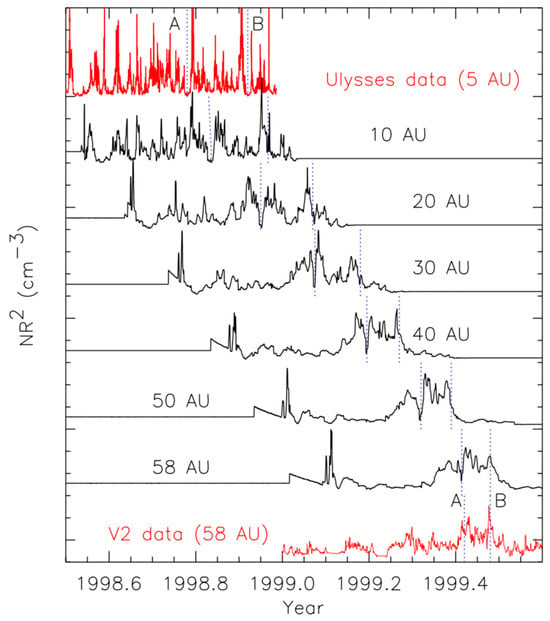
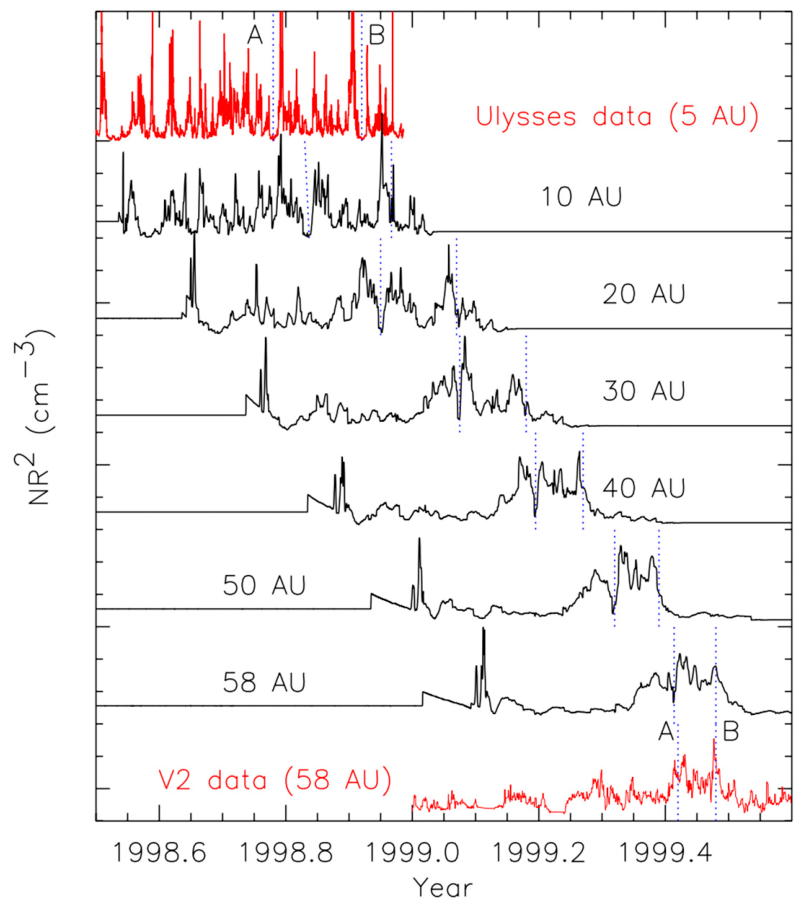
The broadening of shock fronts can lead to the merging of originally separate ICMEs, especially during solar maximum conditions. These merged structures, known as Global Merged Interaction Regions (MIRs or GMIRs), can generate strong shock fronts and enhanced energetic ion fluxes [28,29] (Figure 2). Such merging may result in more complex energetic intensity profiles, including the appearance of multiple peaks. These structures exhibit sustained magnetic compression, increased plasma pressure, and broadened magnetic signatures observable over extended distances [16,17]. GMIRs persist far longer than isolated ICMEs and act as efficient modulators of galactic cosmic rays (GCRs). Similarly, Corotating Interaction Regions (CIRs) may merge into Corotating Merged Interaction Regions (CMIRs), particularly evident at Saturn, where two magnetic compressions per solar rotation are often observed, one significantly stronger than the other [30]. The strength of CIR-associated shocks generally peaks within 5 AU.
Figure 2.
Two ICMEs (A and B) merging into MIR. ICME propagation analyzed across different regions of the heliosphere using an MHD model (black curves: modeled density profiles) [17].
Statistical studies confirm that CME and ICME occurrence rates peak during solar maximum, while CIR frequency is highest during the declining phase and solar minimum [31]. This solar cycle dependence underscores the dynamic interplay between transient and recurrent solar wind structures in shaping heliospheric conditions. The cumulative effect of ICME expansion, merging, and interaction with background solar wind streams highlights the importance of multi-point observations in constraining models of heliospheric evolution.
In summary, ICME evolution throughout the heliosphere is governed by a combination of internal expansion, external interactions, and solar cycle variability. From structured flux ropes in the inner heliosphere to the formation of GMIRs and CMIRs in the outer regions, these processes shape the large-scale dynamics of the heliosphere and its modulation of energetic particles.
3. Energetic Particle Acceleration at ICME Shocks
Energetic particle dynamics at ICME structures are governed by shock acceleration, adiabatic transport, and diffusion along interplanetary magnetic field (IMF) lines. Solar energetic particles (SEPs) observed during ICME passages include suprathermal to relativistic protons, heavy ions, and electrons. These populations originate from flare-associated acceleration, CME-driven coronal shocks, or interplanetary shocks formed as CMEs evolve into the heliosphere. CIR-driven shocks and compressions can also contribute to the suprathermal seed population and, in some cases, to additional acceleration.
In this study, SEP acceleration refers to particle energization in the ~10 keV to few hundred MeV range, consistent with typical ICME-driven gradual SEP events [1,2]. This regime is distinct from relativistic ground-level enhancement (GLE) events, which may reach energies exceeding several hundred MeV to GeV levels and involve additional constraints on shock geometry, turbulence, and pre-existing suprathermal populations [32]. The energy range considered here reflects the dominant acceleration processes associated with CME-driven shocks within ~0.1–10 AU.
The primary large-scale accelerator of SEPs in the heliosphere is diffusive shock acceleration (DSA), operating at CME-driven shocks in both the low corona and interplanetary space [1,2,33]. In DSA, particles scatter repeatedly across the shock due to magnetic turbulence, gaining energy at each crossing. This process produces power-law energy spectra whose indices depend primarily on the shock compression ratio. High-Mach-number shocks and enhanced upstream turbulence favor efficient acceleration and higher-energy cutoffs, with extreme events exceeding several hundred MeV.
Shock drift acceleration (SDA) contributes to particle energization at quasi-perpendicular shocks, where gradient and curvature drifts along the shock surface allow particles to gain energy during shock encounters. Shock surfing acceleration (SSA) may occur in the shock ramp, where electrostatic potentials trap particles and accelerate them to suprathermal energies before injection into DSA.
The efficiency of these acceleration mechanisms is influenced by shock geometry, Mach number, magnetic topology, and the level of upstream magnetic fluctuations. Quasi-parallel shocks favor sustained DSA with extended particle trapping and gradual energy gain, while quasi-perpendicular shocks can produce rapid initial energization over shorter durations. Enhanced turbulence in ICME sheaths promotes resonant wave–particle interactions, and local turbulence levels regulate pitch-angle scattering rates and effective mean free paths, thereby controlling acceleration timescales and maximum achievable energies [34,35,36]. Variability within ICME-driven shock–sheath systems contributes to differences in SEP onset timing, intensity, and spectral evolution.
A key requirement for SEP acceleration is the presence of a suprathermal seed population originating from the solar wind, preceding CMEs, CIR compressions, or pickup ions formed from interstellar neutrals. Variations in seed density and composition strongly influence SEP peak intensities, event-to-event variability, and elemental abundance ratios such as Fe/O [35]. Differences in seed populations also help explain contrasting responses at Saturn and Jupiter, where heliospheric suprathermal particles can penetrate into the outer Saturnian magnetosphere, while Jupiter’s stronger, more closed magnetospheric configuration limits external access and favors internally sourced populations.
Impulsive SEP events, lasting hours to ~1 day, are typically associated with magnetic reconnection in solar flares and often feature enhanced electron fluxes, high Fe/O ratios, and narrow longitudinal distributions. Gradual SEP events, in contrast, are associated with CME-driven shocks and may persist for several days. Their wide longitudinal spread, high proton fluxes, and correlation with shock parameters identify them as heliospheric signatures of particle acceleration at ICME fronts. Multi-spacecraft observations frequently show longitudinal separations exceeding 100°, demonstrating the broad spatial reach of interplanetary shocks. Heavy-ion signatures provide additional constraints on shock geometry and seed populations.
Gradual SEP events can show pronounced spectral and longitudinal evolution as the magnetic connection between the observer and the expanding shock changes [37,38]. Early-phase spectra may be harder and gradually soften as magnetic connectivity weakens. Because the interplanetary magnetic field is organized into Parker-spiral structures, spacecraft located at different heliolongitudes and radial distances intersect different sections of the expanding shock. Well-connected observers detect rapid rises and higher peak intensities, whereas poorly connected locations observe delayed onsets or weaker enhancements [38]. Higher-energy channels often peak earlier due to their larger rigidities and longer mean free paths, producing characteristic energy-dispersion signatures.
4. Modulation of Galactic Cosmic Rays in the Outer Heliosphere
Galactic Cosmic Rays (GCRs) are high-energy charged particles originating outside the solar system and spanning a broad energy range from tens of MeV to GeV and beyond. In heliospheric studies, modulation signatures are typically tracked in spacecraft channels above tens to hundreds of MeV. Their transport through the heliosphere is governed by the Parker transport equation, incorporating diffusion, convection, drift, and adiabatic energy changes [39]. Modulation of GCRs is strongly influenced by solar activity, particularly by large-scale transient structures such as ICMEs. In the outer heliosphere, where the solar wind transitions into the heliosheath, ICME-driven modulation remains detectable, providing insights into heliospheric structure and cosmic ray transport.
The passage of ICMEs produces Forbush decreases (FDs), characterized by sudden reductions in GCR intensity followed by gradual recovery. The FD mechanism involves two primary components: (i) the shock front preceding the ICME, which scatters incoming GCRs, and (ii) the magnetic flux rope within the ICME, which excludes or deflects GCRs due to its closed magnetic topology [40]. The two-step nature of FDs has been confirmed by multi-spacecraft observations, highlighting the distinct roles of shock and flux rope substructures. Merged Interaction Regions (MIRs) trailing shocks act as extended barriers to inward GCR transport [41].
In the inner heliosphere, [42] demonstrated that ICME-driven FDs are strongest near Mercury, with decreasing amplitude at Earth and Mars, reflecting radial weakening of ICME magnetic fields. In the outer heliosphere, Voyager 1 and 2 observations revealed persistent GCR modulation in the heliosheath, even beyond the termination shock. Reference [43] extended Gleeson and Urch’s force-field approximation to model anisotropies in GCR streaming, confirming modulation signatures at large heliocentric distances.
Voyager 2 measurements show correlated enhancements in solar wind velocity, proton density, and magnetic field strength, together with decreases in >70 MeV/nucleon cosmic ray intensities, confirming the presence of large-scale solar wind structures and consistent with ICME-driven modulation in the outer heliosphere [27,43,44]. ICME-driven modulation superposes on solar cycle variations, producing both short-term FDs and longer-term modulation patterns [45,46]. Long-timescale evolution of solar wind structures interacting with ICMEs contributes to observed pulsations in GCR flux [3]. In some cases, dynamic pressure enhancements displace the termination shock by several AU [47,48], demonstrating that the outer heliosphere does not remain in steady-state equilibrium.
The efficiency of ICME-driven modulation depends critically on magnetic topology. Closed flux ropes produce stronger FDs than turbulent or eroded structures. Numerical models, including HelMod, incorporate time-dependent diffusion and drift coefficients to reproduce observed solar-cycle modulation patterns [45]. Advanced simulations further confirm that ICME structures significantly modify GCR transport parameters across heliocentric distances [49].
Beyond ~5 AU, both SEPs and GCRs exhibit variability on timescales of days to weeks, primarily driven by ICMEs and Corotating Interaction Regions (CIRs). Observed signatures include Forbush decreases, transient flux enhancements, and spectral variations associated with magnetic compressions and changes in particle scattering mean free paths [50,51]. Multi-spacecraft observations demonstrate that ICME and MIR structures persist across large heliospheric distances, sustaining enhanced magnetic fields and plasma pressures that regulate cosmic ray transport [16,17].
ICME-driven GCR modulation is therefore observable from the inner solar system to the heliosheath. Multi-point spacecraft measurements and numerical transport models converge on the conclusion that ICME topology, heliocentric distance, and solar cycle variability jointly determine modulation efficiency [52]. These observations establish the outer heliosphere as a dynamic regime where large-scale magnetic structures govern the transport and spectral evolution of GCRs.
5. SEP and GCR Observations at Saturn
Observations at Saturn demonstrate the long-range influence of heliospheric transients. Cassini’s Magnetospheric Imaging Instrument (MIMI) and its Low-Energy Magnetospheric Measurement System (LEMMS) provided long-term monitoring of energetic particles between 2004 and 2016, recording more than 46 SEP events and 17 intervals of periodic GCR variations [53]. SEPs are distinguishable from magnetospheric ions in LEMMS P2 and P3 channels, while GCRs appear as low-count signals in higher-energy E6 channels. Observations include recurrent 27-day modulations associated with CIRs, combined 13- and 26-day periodicities indicating dual CIR configurations, and 10–20% amplitude Forbush decreases coincident with ICME and MIR passages [54]. During late 2008, expansions of Saturn’s electron belts correlated with GCR periodicities, suggesting coupling between radiation belt dynamics and heliospheric forcing. SEP occurrence rates decreased during the extended solar minimum (2008–2010), consistent with CIR-dominated modulation during that phase of the solar cycle.
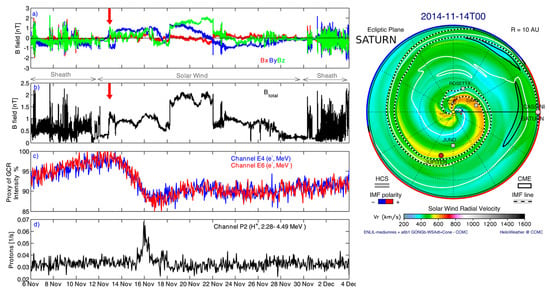
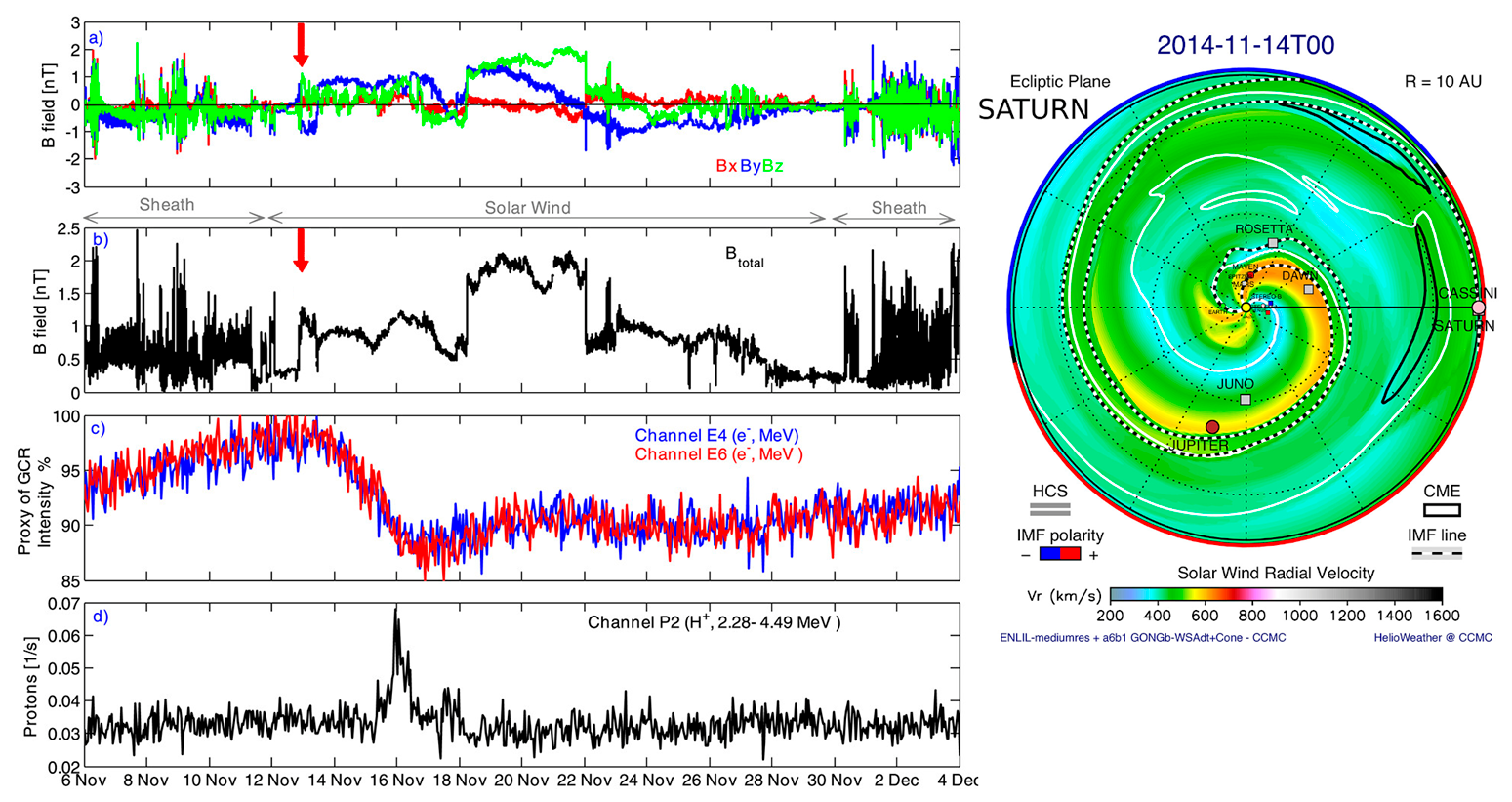
Propagation of CMEs from the Sun to Saturn has been reconstructed using coronagraph observations, in situ measurements, and numerical modeling. Initially fast (>1000 km s−1) halo CMEs decelerate to ~450–600 km s−1 by Saturn’s orbit, consistent with drag-based model predictions [24,55,56]. ICME shocks retain sufficient dynamic pressure to compress Saturn’s magnetosphere, as demonstrated in multi-spacecraft observations (e.g., [26,57]) and during strong compression intervals such as the 2008 T96 Titan flyby [57,58]. An example of an ICME front detected by multiple spacecraft [26] and its arrival at Saturn is shown in Figure 3. Cassini observations further revealed that SEP events can drive transient radiation belts of MeV protons extending to L-shells ~10–12, sometimes accompanied by long-duration Forbush decreases [53,59].
Figure 3.
Arrival of the October 2014 ICME at Saturn. Left: Cassini observations showing, from top to bottom, magnetic field components, total magnetic field strength, GCR intensity proxies derived from the LEMMS E4 and E6 channels, and proton count rates in the LEMMS P2 channel. Red arrows indicate the shock arrival. The left-hand panels are adapted from [26]. Right: WSA–ENLIL+Cone simulation showing the radial solar wind velocity in the ecliptic plane on 14 November 2014. Visualization obtained from Helioweather.net (http://helioweather.net, accessed on 29 September 2026). The ENLIL model was developed by D. Odstrcil.
Forbush decreases at Saturn exhibit amplitudes of 10–20% at energies of several hundred MeV. These reductions arise from magnetic shielding and enhanced pitch-angle scattering within ICME sheaths and flux ropes, together with adiabatic cooling of cosmic-ray populations [3,60]. Recovery occurs as heliospheric magnetic fields relax and diffusion coefficients increase. Recovery timescales at Saturn are longer than at Earth, reflecting slower solar-wind speeds and the larger spatial extent of heliospheric structures at ~9–10 AU.
The Parker spiral geometry near Saturn’s orbit, which is nearly tangential to the planet’s heliolongitude, reduces the likelihood of direct magnetic connection to Earth-directed CMEs [61]. Nevertheless, SEPs may arrive as precursors ahead of shock fronts. Cassini detected SEP electrons 2–3 days before bow shock crossings, confirming early heliospheric access of energetic particles [53,62]. In several cases (e.g., 2012/105 and 2013/332), such SEP arrivals were associated with strong magnetospheric compressions and tail flux loading, highlighting their role as external drivers of Saturnian magnetospheric dynamics.
Energetic particle spectra downstream of shocks are typically softer due to increased scattering, adiabatic cooling, and reduced particle mean free paths, while upstream particles may be detected days before shock arrival depending on IMF geometry [63]. These features are consistent with Cassini observations of early-arriving SEP electrons.
Strong ICME events illustrate how high-speed, interacting transients can generate broad interplanetary shocks detectable across multiple heliocentric distances [64,65]. Multi-point observations from 1 AU to Mars and Saturn confirm that such disturbances may propagate over large angular extents and retain dynamically significant shock signatures beyond Earth’s orbit [66]. Cassini measurements during this interval revealed extended SEP enhancements and Forbush-type reductions consistent with ICME-driven modulation at ~9–10 AU [53]. These observations support earlier findings that shock-dominated structures can persist to large heliocentric distances even when flux-rope signatures weaken [17,57], emphasizing the role of CME–CME interaction and wide angular expansion in long-range heliospheric propagation.
6. Comparative Magnetospheric Environments: Saturn and Jupiter
Saturn and Jupiter represent contrasting regimes of giant-planet magnetospheres. Differences in plasma sources, rotation rates, magnetic field strengths, and solar-wind coupling establish fundamentally different particle environments. Jupiter’s magnetosphere is dominated by strong internal plasma sources and rapid rotation, sustaining extreme radiation belts and efficient internal acceleration while largely limiting heliospheric particle penetration into its inner regions. Saturn’s magnetosphere, in contrast, is more permeable to external solar energetic particles and galactic cosmic rays, while also supporting internally accelerated populations within its radiation belts.
This comparative framework illustrates how giant-planet magnetospheres balance internal and external drivers, providing the basis for the following discussion of Jupiter (Section 6.1), Saturn (Section 6.2), and their similarities and differences (Section 6.3).
6.1. Jupiter’s Magnetosphere
Jupiter’s magnetosphere is the largest and most powerful in the solar system, extending millions of kilometers sunward and forming an extended magnetotail on the nightside. Its immense scale and strong magnetic field (dipole moment ~20,000 times that of Earth) create a plasma environment dominated by internal sources and rotational dynamics rather than direct solar wind forcing [67].
Jupiter’s magnetosphere is dominated by rapid rotation, strong magnetic fields, and intense internal plasma sources. Due to the frozen-in condition, the magnetized plasma is constrained to move (co-rotate) with the field lines. To enforce corotation, the upper neutral atmosphere must rotate with the planet and remain coupled to the ionosphere through collisions. Charged particles gyrate along magnetic field lines and mirror between magnetic conjugate points. Centrifugal forces acting on the corotating plasma stretch it outward, forming a magnetodisc—a flattened structure where field lines are deformed in the equatorial plane and filled with plasma from internal sources such as Io and other moons. The inner magnetospheric plasma sources release large amounts of material that rapidly becomes ionized, contributing to the plasma population of the equatorial current sheet. The surfaces and exospheres of the moons are continuously bombarded by co-rotating energetic magnetospheric particles, solar EUV radiation, micrometeoroids, and dust.
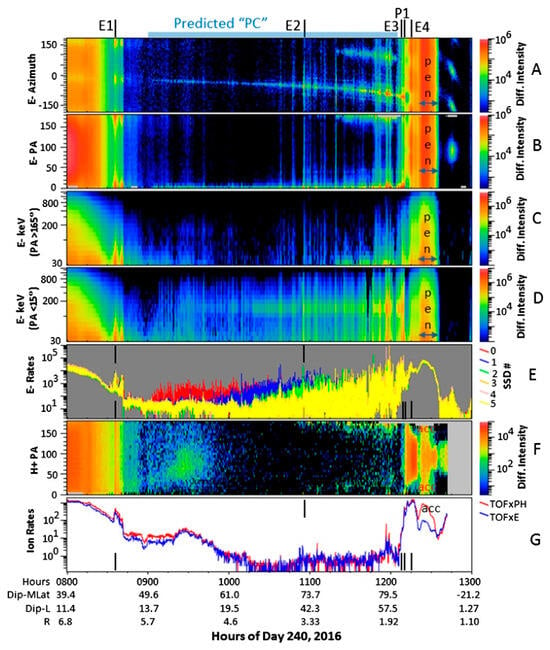
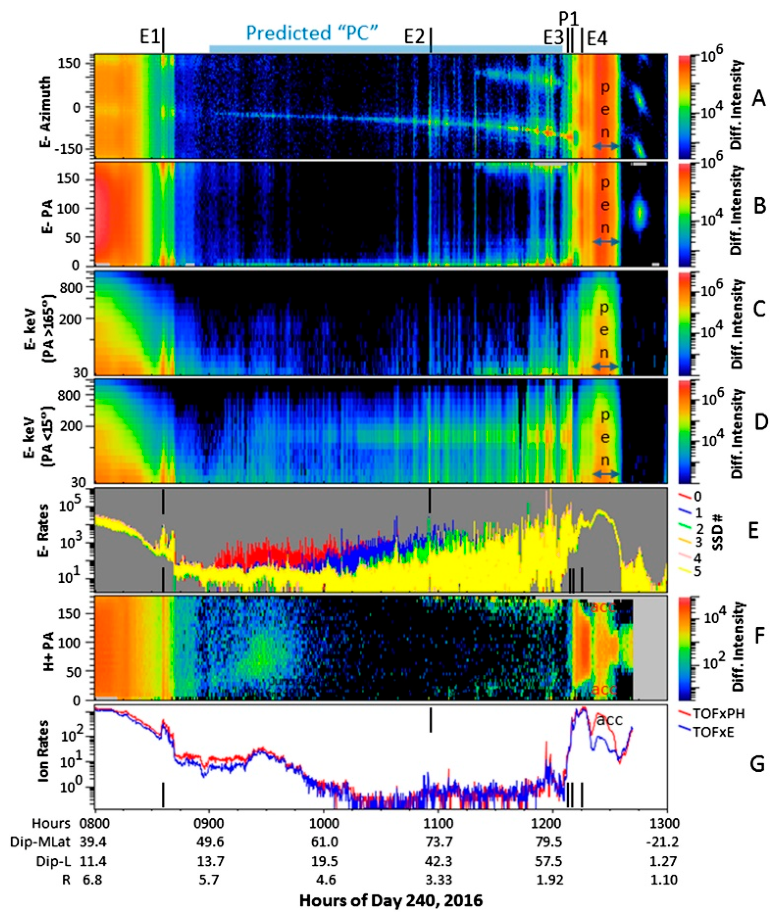
Io’s volcanic activity injects approximately 1 ton s−1 of SO2 gas into the Jovian plasma environment [68], producing a dense plasma torus and populating the magnetodisc [6]. The resulting plasma circulation, driven by Jupiter’s ~10-h rotation period, generates large-scale electric fields that energize particles through radial diffusion, centrifugal interchange, and wave–particle interactions. These internal processes accelerate electrons to tens of MeV (reaching ~70 MeV and, in some cases, approaching ~100 MeV) and protons to hundreds of MeV, thereby sustaining one of the most intense radiation belt systems in the solar system [5,69]. Juno/JEDI observations further illustrate the intense energetic-particle environment encountered during low-altitude polar passes (Figure 4).
Figure 4.
Juno/JEDI observations of energetic charged particles over Jupiter’s northern polar region, illustrating electron pitch-angle organization, energetic particle beams, and intervals affected by penetrating radiation. Reproduced from [70], with full attribution, in accordance with AGU’s permissions policy.
In addition to Io’s plasma input, Jupiter’s radiation belts are partly sustained by the Cosmic Ray Albedo Neutron Decay (CRAND) process. Galactic Cosmic Rays (GCRs) with sufficient energy can penetrate planetary magnetic fields and interact with atmospheric material, producing secondary neutrons. These neutrons β-decay into protons and electrons that become trapped by the planet’s magnetic field [71]. This mechanism continuously seeds the inner radiation belts with energetic particles, providing a background population that is independent of solar wind variability. Although CRAND is a major source of energetic protons in the radiation belts of Earth and Saturn, its relative efficiency at Jupiter differs due to the planet’s magnetic geometry and atmospheric properties.
Energetic electrons leaking from Jupiter’s magnetosphere have been observed in the heliosphere at MeV energies and may locally exceed galactic cosmic ray (GCR) electron intensities under favorable magnetic connection conditions [71,72,73]. The energetic particle intensity in the inner magnetosphere of Jupiter is so high that spacecraft must be heavily shielded, as electron fluxes surpass those of GCRs by orders of magnitude. This highlights Jupiter’s efficiency as a natural particle accelerator.
Jupiter’s radiation belts are sustained by a combination of internal sources (Io plasma, CRAND) and acceleration mechanisms (radial diffusion, wave–particle interactions). Radial transport is driven in part by interchange instabilities, which redistribute plasma, while inward radial diffusion of energetic particles toward regions of stronger magnetic field leads to adiabatic energization through conservation of the first adiabatic invariant. Wave–particle interactions, including whistler-mode chorus and EMIC waves, scatter particles in pitch angle and energy, producing efficient acceleration and loss processes. The belts contain electrons up to tens of MeV and protons exceeding 100 MeV, rivaling or exceeding Earth’s Van Allen belts by orders of magnitude. Transport processes also couple the inner and middle magnetosphere, redistributing energetic particles and sustaining the belts over long timescales.
Jupiter’s aurorae provide a visible manifestation of magnetospheric acceleration. They are observed across multiple wavelengths, including ultraviolet and X-ray emissions. The X-ray aurora originates from precipitating heavy ions (O, S) accelerated within the magnetosphere and colliding with the atmosphere [74,75]. While primarily driven by internal magnetospheric processes, observations show that the solar wind can modulate auroral intensity, with enhanced X-ray brightness during periods of increased dynamic pressure or ICME arrival [76]. This demonstrates that, despite Jupiter’s strong shielding, external heliospheric drivers can occasionally imprint signatures on its auroral activity.
External heliospheric particles, such as SEPs and GCRs, encounter significant barriers to entry. Jupiter’s strong magnetic field and dense plasma environment limit penetration of solar energetic particles into the inner magnetosphere. Observations show that SEP access is largely confined to the outer magnetosphere, while the inner regions remain dominated by internally accelerated populations. Galactic cosmic rays can penetrate deeper due to their higher energies, but their signatures are masked by the overwhelming intensity of Jupiter’s radiation belts. As a result, heliospheric transients such as ICMEs or CIRs produce only subtle modulations compared to the dominant internal variability.
6.2. Saturn’s Magnetosphere
Saturn’s magnetosphere, while extensive and dynamic, differs from Jupiter’s in its balance between internal and external drivers of energetic particle populations. Its magnetic field is weaker, and although the planet rotates rapidly (~10.7 h), the magnetosphere is more permeable to heliospheric energetic particles. The rapid rotation enforces co-rotation of magnetospheric plasma with the magnetic field lines. Saturn’s rotation axis is tilted by ~27° relative to the ecliptic, while its internal magnetic field is closely aligned with the rotation axis (<1°), so the magnetodisc—located in the magnetic equatorial plane—is correspondingly tilted. Like Jupiter, Saturn has an active inner magnetospheric moon: Enceladus, whose continuous plume activity supplies plasma and maintains Saturn’s E-ring. The dominant plasma constituents are water-group ions that contribute to plasma loading and radial transport [6].
Cassini observations revealed that Saturn’s radiation belts and energetic particle environment are shaped by both heliospheric transients and icy moons [59,77,78,79,80]. The LEMMS instrument detected multiple solar energetic particle (SEP) events penetrating into Saturn’s magnetosphere, sometimes producing transient MeV proton belts that decayed over weeks to months. Galactic cosmic rays (GCRs) were also observed, including Forbush decreases during ICME passages and periodic modulations linked to corotating interaction regions (CIRs) [54]. These signatures demonstrate that Saturn’s magnetosphere is more permeable to heliospheric particle access than Jupiter’s, allowing external variability to imprint directly on its energetic particle environment.
Saturn’s radiation belts are less intense than Jupiter’s but exhibit a structure strongly shaped by rings and moons. CRAND is an important source of energetic protons at Saturn. In this process, galactic cosmic rays interact with atmospheric material to produce secondary neutrons, which subsequently decay into trapped charged protons [81]. Its effectiveness at Saturn is influenced by the planet’s magnetic configuration and the presence of rings, which modify particle production and loss processes. This mechanism sustains long-lived proton belts even in the absence of external injections. The icy satellites act as absorbers of energetic particles, carving out distinct gaps in the radiation belts. Cassini data show sharp flux dropouts at satellite orbital locations, directly linking belt morphology to moon absorption [82]. Within ~6 Saturn radii (RS), the moons limit inward diffusion and isolate the inner belts. The main radiation belt (2.3–3.5 RS) contains relativistic electrons (>100 keV–10 MeV) and energetic protons, the latter likely produced by CRAND. Electron populations may originate from the outer magnetosphere or the solar wind, diffusing inward and gaining energy through adiabatic heating. During enhanced solar wind conditions, a transient belt near Dione’s orbit (the “Dione belt”) can form, while inner belts remain comparatively stable due to Tethys’s shielding effect.
Enceladus supplies water-group ions that provide seed populations for acceleration and contribute to radiation belt variability. Together with CRAND and heliospheric injections, these processes produce a hybrid radiation belt system: internally sustained yet externally modulated.
A dominant source of energetic protons in the innermost belt (between Saturn’s atmosphere and the D-ring) is CRAND. This belt is decoupled from the rest of the magnetosphere by a particle-absorbing corridor formed by the rings. Radial transport, driven by internal dynamics and solar wind compressions, plays a major role in populating the belts with MeV electrons. Saturn’s electron belts are sustained by recurrent global-scale enhancements occurring roughly every 2–3 weeks, during which electrons from the middle magnetosphere are rapidly injected inward.
Energetic particle transport at Saturn is governed by radial diffusion, drift, and wave–particle interactions. The relatively weaker magnetic field and lower plasma density make Saturn’s belts more susceptible to external modulation. Cassini observed GCR Forbush decreases with amplitudes of 10–20% during ICME passages [3,60]. SEP-driven injections demonstrated rigidity-dependent decay, with higher-energy channels declining faster than lower-energy ones. These transport processes, combined with moon absorption, produce a radiation belt morphology that is structured and variable.
Saturn’s magnetosphere therefore represents a system where internal and external drivers coexist. CRAND provides a steady proton background, icy moons sculpt belt structure through absorption, and heliospheric transients inject SEPs and modulate GCRs. The resulting radiation belt system is less intense than Jupiter’s but more permeable and strongly structured by moon–particle interactions, forming a natural contrast to Jupiter’s internally dominated environment.
6.3. Comparative Synthesis: Jupiter vs. Saturn
The contrasting characteristics of Jupiter and Saturn reflect two distinct modes of magnetospheric operation. At Jupiter, energetic particle acceleration and transport are predominantly controlled by internal processes, whereas at Saturn external heliospheric drivers contribute substantially to observed variability. These systems therefore provide complementary perspectives on particle acceleration and transport in strong-field plasmas.
Jupiter’s strong magnetic field and rapid rotation sustain a magnetodisc configuration in which centrifugal interchange, radial diffusion, and wave–particle interactions efficiently energize particles. Internal plasma sources, primarily Io, together with CRAND seeding, maintain persistent and intense radiation belts. The inner magnetosphere is largely shielded from heliospheric access, and external SEP or GCR signatures are generally confined to outer regions or appear as secondary modulations.
Saturn, in contrast, represents a more permeable and structurally segmented system. Although internal sources such as Enceladus and CRAND establish a baseline energetic particle population, heliospheric drivers—including ICME- and CIR-associated compressions—produce clear SEP injections and GCR Forbush decreases. The presence of rings and icy satellites introduces strong absorptive boundaries that sculpt belt morphology and enhance variability.
Both planets share common physical mechanisms—radial diffusion, interchange transport, and wave–particle acceleration—but their relative importance differs. At Jupiter, rotation-driven electric fields and sustained internal mass loading dominate the energetic particle budget, resulting in persistent high-intensity belts. At Saturn, internal and external contributions are more evenly balanced, leading to hybrid radiation belts in which heliospheric variability is clearly imprinted.
Differences in magnetic field strength, seed populations, and plasma sources further modulate acceleration efficiency. Jupiter’s stronger field enhances confinement and adiabatic energization while suppressing external penetration. Saturn’s weaker field permits greater heliospheric access and shorter confinement times, making its belts more sensitive to external perturbations.
In summary, Jupiter exemplifies an internally dominated magnetospheric accelerator with limited external imprint, whereas Saturn illustrates a coupled system in which internal processes coexist with and are visibly modulated by heliospheric forcing. Together, these two regimes bracket the range of giant-planet responses to solar-wind disturbances and provide a natural comparative framework for understanding energetic particle dynamics in planetary magnetospheres.
Building on this comparison, the contrasting behavior of Jupiter and Saturn can be interpreted in terms of the interplay between particle acceleration efficiency, confinement, and external access. In both systems, energization processes such as radial diffusion and wave–particle interactions operate under strong magnetic fields, but their relative impact is controlled by the balance between internal plasma sources and heliospheric coupling. Efficient confinement enhances multi-stage acceleration by allowing repeated particle energization, while limited external access suppresses direct heliospheric signatures. Conversely, increased accessibility to heliospheric particles introduces variability and modulation, but reduces long-term confinement and peak intensities. These competing factors define two limiting regimes: an internally dominated accelerator with strong confinement and weak external imprint, and a more open, externally modulated system in which acceleration and transport remain coupled to heliospheric conditions. These distinctions are summarized in Table 1.
Table 1.
Summary of the most notable features and physical parameters of the Jovian and Kronian magnetospheres.
7. Jupiter and Saturn as Natural Particle Accelerators
The magnetospheres of Jupiter and Saturn demonstrate that large-scale planetary magnetic fields combined with rapid rotation can sustain long-lived, nonthermal particle populations. In both systems, rotationally induced electric fields, radial diffusion, and wave–particle interactions operate within structured magnetic geometries, enabling multi-stage energization over extended spatial scales.
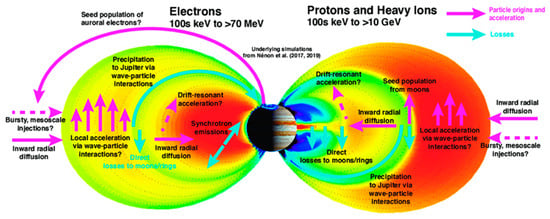
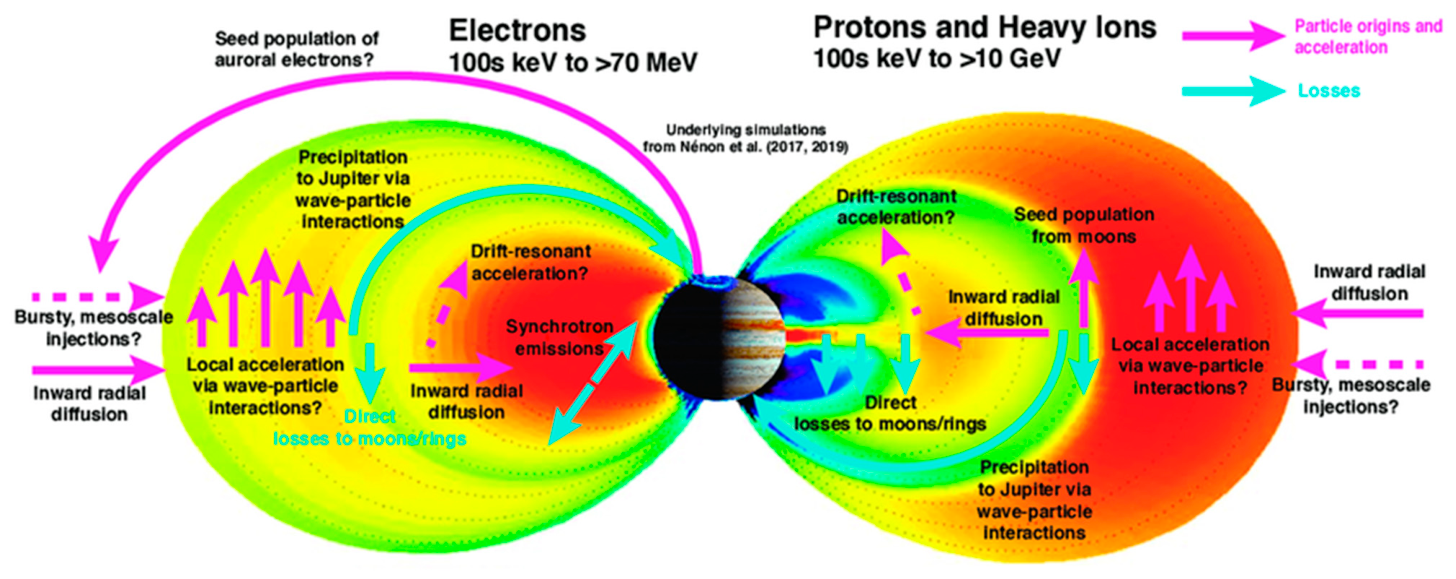
At Jupiter, strong magnetic confinement and continuous plasma supply from Io maintain persistent radiation belts in which electrons reach tens of MeV and ions exceed 100 MeV. Centrifugal interchange and large-scale magnetodisc currents support sustained inward–outward transport, while chorus and EMIC waves regulate pitch-angle scattering and energy diffusion. The result is a stable, internally maintained accelerator regime with limited heliospheric imprint in the inner magnetosphere (Figure 5).
Figure 5.
Conceptual illustration of particle acceleration, radial transport, and loss processes in Jupiter’s radiation belts [83].
At Saturn, lower magnetic field strength and the presence of rings and icy satellites produce a more segmented system. CRAND processes sustain inner proton belts, while Enceladus-derived water-group ions provide seed populations for acceleration. External drivers such as ICME- and CIR-associated compressions introduce additional injections and enhanced scattering, leading to transient belt intensifications and measurable GCR modulation. Acceleration and loss processes therefore coexist with strong absorptive boundaries imposed by moons and rings.
In both magnetospheres, particle confinement through magnetic mirroring and drift shell dynamics allows repeated energization, while large-scale electric fields and wave activity shape spectral evolution. The resulting energy distributions are broad and nonthermal, governed by coherent electromagnetic structure rather than collisional processes.
Taken together, Jupiter and Saturn illustrate how rotation, magnetic topology, plasma sources, and heliospheric coupling determine the efficiency and variability of planetary particle acceleration.
8. Conclusions
Coordinated spacecraft observations have demonstrated that interplanetary coronal mass ejections (ICMEs) and corotating interaction regions (CIRs) retain coherence and dynamical influence well into the outer heliosphere. Multi-point measurements confirm that shocks and compressed plasma structures can be traced from near-Earth distances to Saturn’s orbit, where they continue to modulate energetic-particle populations and magnetospheric dynamics [16,17]. These results establish that heliospheric transients remain relevant drivers of planetary environments at large heliocentric distances and act as large-scale energy and momentum transport channels that couple the inner and outer heliosphere.
Within this broader context, Saturn and Jupiter illustrate two contrasting regimes of strong-field magnetospheres. Saturn’s magnetosphere, despite rapid rotation comparable to Jupiter’s, is characterized by weaker magnetic confinement and more modest internal plasma sources. Consequently, it remains permeable to heliospheric energetic particles, and Cassini observations show that SEPs, GCRs, and associated Forbush decreases correlate with ICME and CIR passages [53,54]. Saturn’s radiation environment therefore provides a remote probe of heliospheric variability.
Jupiter’s magnetosphere, by contrast, combines rapid rotation, a strong magnetic field, and substantial plasma input from Io. These factors sustain efficient internal acceleration processes, including corotational electric fields, radial diffusion, and wave–particle interactions [5,69]. The result is persistent MeV–GeV particle populations largely decoupled from heliospheric variability. External solar-wind pressure changes mainly affect the outer magnetosphere and auroral morphology, while the inner radiation belts remain dominated by internally driven dynamics.
The comparative analysis underscores the decisive role of internal plasma sources, magnetic-field strength, and rotational forcing in regulating magnetospheric response. Saturn exemplifies a system in which external modulation plays a substantial role in energetic-particle variability, producing a stronger heliospheric imprint than at Jupiter, whereas Jupiter demonstrates how powerful internal processes can dominate particle acceleration and confinement. Together, these two systems provide complementary insights into strong-field plasma physics and heliospheric coupling.
In conclusion, Saturn and Jupiter extend our understanding of particle acceleration and magnetospheric dynamics into the outer heliosphere. Their contrasting behaviors illustrate how planetary magnetospheres function as natural laboratories for electromagnetic processes, linking planetary magnetospheric physics with heliospheric transport and broader astrophysical plasma processes.
Funding
This research received no external funding.
Data Availability Statement
No new data were created or analyzed in this study. Data sharing is not applicable to this article.
Acknowledgments
The author acknowledges the Community Coordinated Modeling Center (CCMC) at NASA Goddard Space Flight Center for providing the WSA–ENLIL+Cone simulation results illustrated in Figure 3, and D. Odstrcil for developing the ENLIL model. The visualization was obtained from the Helioweather.net archive.
Conflicts of Interest
The author declares no conflict of interest.
References
- Reames, D.V. Particle acceleration at the Sun and in the heliosphere. Space Sci. Rev. 1999, 90, 413–491. [Google Scholar] [CrossRef] [Scilit]
- Desai, M.I.; Giacalone, J. Large gradual solar energetic particle events. Living Rev. Sol. Phys. 2016, 13, 3. [Google Scholar] [CrossRef] [Scilit] [PubMed]
- Potgieter, M.S. Solar modulation of cosmic rays. Living Rev. Sol. Phys. 2013, 10, 3. [Google Scholar] [CrossRef] [Scilit]
- Guo, J.; Wang, B.; Whitman, K.; Plainaki, C.; Zhao, L.; Bain, H.M.; Cohen, C.; Dalla, S.; Dumbovic, M.; Janvier, M.; et al. Particle radiation environment in the heliosphere: Status, limitations, and recommendations. Adv. Space Res. 2024; in press. [CrossRef] [Scilit]
- Delamere, P.A.; Bagenal, F. Solar wind interaction with Jupiter’s magnetosphere. J. Geophys. Res. Space Phys. 2010, 115, A10201. [Google Scholar] [CrossRef] [Scilit]
- Bagenal, F.; Adriani, A.; Allegrini, F.; Bolton, S.J.; Bonfond, B.; Bunce, E.J.; Connerney, J.E.P.; Cowley, S.W.H.; Ebert, R.W.; Gladstone, G.R.; et al. Magnetospheric science objectives of the Juno mission. Space Sci. Rev. 2017, 213, 219–287. [Google Scholar] [CrossRef] [Scilit]
- Kilpua, E.K.J.; Koskinen, H.E.J.; Pulkkinen, T.I. Coronal mass ejections and their sheath regions in interplanetary space. Living Rev. Sol. Phys. 2017, 14, 5. [Google Scholar] [CrossRef] [Scilit] [PubMed]
- Rodriguez, L.; Masías-Meza, J.J.; Dasso, S.; Démoulin, P.; Zhukov, A.N.; Gulisano, A.M.; Mierla, M.; Kilpua, E.; West, M.; Lacatus, D.; et al. Typical profiles and distributions of plasma and magnetic field parameters in magnetic clouds at 1 AU. Sol. Phys. 2016, 291, 2145–2163. [Google Scholar] [CrossRef] [Scilit]
- Burlaga, L.F.; Sittler, E.; Mariani, F.; Schwenn, R. Magnetic loop behind an interplanetary shock: Voyager, Helios, and IMP 8 observations. J. Geophys. Res. Space Phys. 1981, 86, 6673–6684. [Google Scholar] [CrossRef] [Scilit]
- Richardson, I.G.; Cane, H.V. Near-Earth interplanetary coronal mass ejections during solar cycle 23 (1996–2009): Catalog and summary of properties. Sol. Phys. 2010, 264, 189–237. [Google Scholar] [CrossRef] [Scilit]
- Wang, Y.; Shen, C.; Liu, R.; Liu, J.; Guo, J.; Li, X.; Xu, M.; Hu, Q.; Zhang, T. Understanding the twist distribution inside magnetic flux ropes by anatomizing an interplanetary magnetic cloud. J. Geophys. Res. Space Phys. 2018, 123, 3238–3261. [Google Scholar] [CrossRef] [Scilit]
- Smith, E.J.; Wolfe, J.H. Observations of interaction regions and corotating shocks between one and five AU: Pioneers 10 and 11. Geophys. Res. Lett. 1976, 3, 137–140. [Google Scholar] [CrossRef] [Scilit]
- Gosling, J.T.; Pizzo, V.J. Formation and evolution of corotating interaction regions and their three dimensional structure. Space Sci. Rev. 1999, 89, 21–52. [Google Scholar] [CrossRef] [Scilit]
- Richter, A.K.; Luttrell, A.H. Superposed epoch analysis of CIRs at 0.3 and 1.0 AU: A comparative study. J. Geophys. Res. Space Phys. 1986, 91, 5873–5884. [Google Scholar] [CrossRef] [Scilit]
- Jian, L.K.; Russell, C.T.; Luhmann, J.G.; Skoug, R.M. Properties of stream interactions at one AU during 1995–2004. Sol. Phys. 2006, 239, 337–392. [Google Scholar] [CrossRef] [Scilit]
- Burlaga, L.F.; Ness, N.F. Radial evolution of corotating merged interaction regions and flows between ~14 AU and ~43 AU. J. Geophys. Res. Space Phys. 1997, 102, 4661–4671. [Google Scholar] [CrossRef] [Scilit]
- Richardson, J.D.; Paularena, K.I.; Wang, C.; Burlaga, L.F. The life of a CME and the development of a MIR: From the Sun to 58 AU. J. Geophys. Res. Space Phys. 2002, 107, 1177. [Google Scholar] [CrossRef] [Scilit]
- Mishra, W.; Doshi, U.; Srivastava, N. Radial sizes and expansion behavior of ICMEs in Solar Cycles 23 and 24. Front. Astron. Space Sci. 2021, 8, 713999. [Google Scholar] [CrossRef] [Scilit]
- Temmer, M.; Scolini, C.; Richardson, I.G.; Heinemann, S.G.; Paouris, E.; Vourlidas, A.; Bisi, M.M.; Al-Haddad, N.; Amerstorfer, T.; Barnard, L.; et al. CME propagation through the heliosphere: Status and future of observations and model development. Adv. Space Res. 2023; in press. [CrossRef] [Scilit]
- Gopalswamy, N. Properties of Interplanetary Coronal Mass Ejections. Space Sci. Rev. 2006, 124, 145–168. [Google Scholar] [CrossRef] [Scilit]
- Burlaga, L.F.; Ness, N.F. Merged interaction regions and large-scale magnetic field fluctuations during 1991: Voyager 2 observations. J. Geophys. Res. 1994, 99, 19341–19350. [Google Scholar] [CrossRef] [Scilit]
- Luhmann, J.G.; Gopalswamy, N.; Jian, L.K.; Lugaz, N. ICME Evolution in the Inner Heliosphere. Sol. Phys. 2020, 295, 61. [Google Scholar] [CrossRef] [Scilit]
- Gopalswamy, N. History and development of coronal mass ejections as a key player in solar terrestrial relationship. Geosci. Lett. 2016, 3, 8. [Google Scholar] [CrossRef] [Scilit]
- Vršnak, B.; Žic, T.; Vrbanec, D.; Temmer, M.; Rollett, T.; Möstl, C.; Veronig, A.; Čalogović, J.; Dumbović, M.; Lulić, S.; et al. Propagation of Interplanetary Coronal Mass Ejections: The Drag-Based Model. Sol. Phys. 2013, 285, 295–315. [Google Scholar] [CrossRef] [Scilit]
- Temmer, M.; Bothmer, V. Characteristics and evolution of sheath and leading edge structures of interplanetary coronal mass ejections in the inner heliosphere based on Helios and Parker Solar Probe observations. Astron. Astrophys. 2022, 665, A70. [Google Scholar] [CrossRef] [Scilit]
- Witasse, O.; Sánchez-Cano, B.; Mays, M.L.; Kajdič, P.; Opgenoorth, H.; Elliott, H.A.; Richardson, I.G.; Zouganelis, I.; Zender, J.; Wimmer-Schweingruber, R.F.; et al. Interplanetary coronal mass ejection observed at STEREO-A, Mars, comet 67P/Churyumov-Gerasimenko, Saturn, and New Horizons en route to Pluto: Comparison of its Forbush decreases at 1.4, 3.1, and 9.9 AU. J. Geophys. Res. Space Phys. 2017, 122, 7865–7890. [Google Scholar] [CrossRef] [Scilit]
- Richardson, J.D.; Liu, Y.; Wang, C.; Burlaga, L.F. ICMEs at very large distances. Adv. Space Res. 2006, 38, 528–534. [Google Scholar] [CrossRef] [Scilit]
- Lugaz, N.; Salman, T.M.; Winslow, R.M. Inconsistencies Between Local and Global Measures of CME Radial Expansion as Revealed by Spacecraft Conjunctions. Astrophys. J. 2020, 899, 2. [Google Scholar] [CrossRef] [Scilit]
- Potgieter, M.S.; Le Roux, J.A.; Burlaga, L.F.; McDonald, F.B. The Role of Merged Interaction Regions and Drifts in the Heliospheric Modulation of Cosmic Rays beyond 20 AU: A Computer Simulation. Astrophys. J. 1993, 403, 760. [Google Scholar] [CrossRef] [Scilit] [PubMed]
- Jackman, C.M.; Forsyth, R.J.; Dougherty, M.K. The overall configuration of the interplanetary magnetic field upstream of Saturn as revealed by Cassini observations. J. Geophys. Res. 2008, 113, A08114. [Google Scholar] [CrossRef] [Scilit]
- Richardson, I.G. Solar wind stream interaction regions throughout the heliosphere. Living Rev. Sol. Phys. 2018, 15, 1. [Google Scholar] [CrossRef] [Scilit] [PubMed]
- Wijsen, N.; Li, G.; Ding, Z.; Lario, D.; Poedts, S.; Filwett, R.J.; Allen, R.C.; Dayeh, M.A. On the Seed Population of Solar Energetic Particles in the Inner Heliosphere. Front. Astron. Space Sci. 2023, 128, e2022JA031203. [Google Scholar] [CrossRef] [Scilit]
- Silwal, A.; Zhao, L.; Zank, G.P.; Wang, B.; Pitña, A.; Gautam, S.P.; Park, B.; Nakanotani, M.; Zhu, X. Multispecies Energetic Particle Acceleration Associated with CIR and ICME-driven Shocks. Astrophys. J. 2024, 972, 2. [Google Scholar] [CrossRef] [Scilit]
- Kilpua, E.; Vainio, R.; Cohen, C.; Dresing, N.; Good, S.; Ruohotie, J.; Trotta, D.; Bale, S.D.; Christian, E.; Hill, M.; et al. Energetic ion enhancements in sheaths driven by interplanetary coronal mass ejections. Astrophys. Space Sci. 2023, 368, 66. [Google Scholar] [CrossRef] [Scilit]
- Giacalone, J.; Jokipii, J.R. The transport of energetic particles and cosmic rays in the heliosphere. Adv. Space Res. 2001, 27, 461–469. [Google Scholar] [CrossRef] [Scilit]
- Rice, W.K.M.; Zank, G.P. Particle acceleration at CME driven shock waves. Adv. Space Res. 2003, 31, 901–906. [Google Scholar] [CrossRef] [Scilit]
- Cane, H.V.; Reames, D.V.; von Rosenvinge, T.T. The role of interplanetary shocks in the longitude distribution of solar energetic particles. J. Geophys. Res. 1988, 93, 9555–9567. [Google Scholar] [CrossRef] [Scilit]
- Reames, D.V. How Do Shock Waves Define the Space-Time Structure of Gradual Solar Energetic Particle Events? Space Sci. Rev. 2023, 219, 14. [Google Scholar] [CrossRef] [Scilit]
- Parker, E.N. The passage of energetic charged particles through interplanetary space. Planet. Space Sci. 1965, 13, 9–49. [Google Scholar] [CrossRef] [Scilit]
- Janvier, M.; Démoulin, P.; Guo, J.; Dasso, S.; Regnault, F.; Topsi-Moutesidou, S.; Gutierrez, C.; Perri, B. The two-step Forbush decrease: A tale of two substructures modulating galactic cosmic rays within CMEs. Astrophys. J. 2021, 919, 131. [Google Scholar] [CrossRef] [Scilit]
- Burlaga, L.F.; Ness, N.F.; McDonald, F.B. Large-scale fluctuations between 13 AU and 25 AU and their effects on cosmic rays. J. Geophys. Res. 1987, 92, 13647–13652. [Google Scholar] [CrossRef] [Scilit]
- Winslow, R.M.; Schwadron, N.A.; Lugaz, N.; Guo, J.; Joyce, C.J.; Jordan, A.P.; Wilson, J.K.; Spence, H.E.; Lawrence, D.J.; Wimmer-Schweingruber, R.F.; et al. Opening a Window on ICME-driven GCR Modulation in the Inner Solar System. Astrophys. J. 2018, 856, 2. [Google Scholar] [CrossRef] [Scilit]
- Fedorov, Y.; Stehlik, M. The Modulation of Galactic Cosmic Ray Intensity in the Outer Heliosphere. Sol. Phys. 2017, 292, 119. [Google Scholar] [CrossRef] [Scilit]
- Richardson, J.D. Shocks and sheaths in the heliosphere. J. Atmos. Sol.-Terr. Phys. 2011, 73, 1385–1389. [Google Scholar] [CrossRef] [Scilit]
- Boschini, M.; Della Torre, S.; Gervasi, M.; La Vacca, G.; Rancoita, P. The HelMod model in the works for inner and outer heliosphere: From AMS to Voyager probes observations. Adv. Space Res. 2019, 64, 2459–2476. [Google Scholar] [CrossRef] [Scilit]
- von Forstner, J.L.F.; Guo, J.; Wimmer-Schweingruber, R.F.; Dumbović, M.; Janvier, M.; Démoulin, P.; Veronig, A.; Temmer, M.; Papaioannou, A.; Dasso, S.; et al. Comparing the Properties of ICME-Induced Forbush Decreases at Earth and Mars. JGR Space Phys. 2020, 125, e2019JA027662. [Google Scholar] [CrossRef] [Scilit]
- McDonald, F.B.; Stone, E.C.; Cummings, A.C.; Heikkila, B.; Lal, N.; Webber, W.R. Enhancements of energetic particles near the heliospheric termination shock. Nature 2003, 426, 48–51. [Google Scholar] [CrossRef] [Scilit] [PubMed]
- Richardson, J.D.; McDonald, F.B.; Stone, E.C.; Wang, C.; Ashmall, J. Relation between the solar wind dynamic pressure at Voyager 2 and the energetic particle events at Voyager. J. Geophys. Res. 2005, 110, A09106. [Google Scholar] [CrossRef] [Scilit]
- Shestakov, D.A.; Izmodenov, V.V. Numerical Modeling of Galactic Cosmic Ray Modulation in the Heliosphere. arXiv 2025, arXiv:2509.03326. [Google Scholar] [CrossRef] [Scilit]
- Balogh, A.; Bothmer, V.; Crooker, N.; Forsyth, R.; Gloeckler, G.; Hewish, A.; Hilchenbach, M.; Kallenbach, R.; Klecker, B.; Linker, J.; et al. The Solar Origin of Corotating Interaction Regions and Their Formation in the Inner Heliosphere. Space Sci. Rev. 1999, 89, 141–178. [Google Scholar] [CrossRef] [Scilit]
- Richardson, J.; Burlaga, L. The Solar Wind in the Outer Heliosphere and Heliosheath. Space Sci. Rev. 2011, 176, 217–235. [Google Scholar] [CrossRef] [Scilit]
- Shen, Z.-N.; Qin, G. Modulation of Galactic Cosmic Rays in the Inner Heliosphere over Solar Cycles. arXiv 2017, arXiv:1709.08017. [Google Scholar] [CrossRef] [Scilit]
- Roussos, E.; Jackman, C.; Thomsen, M.; Kurth, W.; Badman, S.; Paranicas, C.; Kollmann, P.; Krupp, N.; Bučík, R.; Mitchell, D.; et al. Solar Energetic Particles (SEP) and Galactic Cosmic Rays (GCR) as tracers of solar wind conditions near Saturn: Event lists and applications. Icarus 2018, 300, 47–71. [Google Scholar] [CrossRef] [Scilit]
- Roussos, E.; Krupp, N.; Paranicas, C.; Kollmann, P.; Mitchell, D.G.; Krimigis, S.M.; Palmaerts, B.; Dialynas, K.; Jackman, C. Heliospheric conditions at Saturn during Cassini’s Ring-Grazing and Proximal orbits. Geophys. Res. Lett. 2018, 45, 10812–10818. [Google Scholar] [CrossRef] [Scilit]
- Temmer, M.; Reiss, M.A.; Nikolic, L.; Hofmeister, S.J.; Veronig, A.M. Preconditioning of Interplanetary Space Due to Transient CME Disturbances. Astrophys. J. 2017, 835, 2. [Google Scholar] [CrossRef] [Scilit]
- Odstrcil, D.; Mays, M.L.; Hess, P.; Jones, S.I.; Henney, C.J.; Arge, C.N. Operational Modeling of Heliospheric Space Weather for the Parker Solar Probe. Astrophys. J. Suppl. Ser. 2020, 246, 2. [Google Scholar] [CrossRef] [Scilit]
- Palmerio, E.; Nieves-Chinchilla, T.; Kilpua, E.K.J.; Barnes, D.; Zhukov, A.N.; Jian, L.K.; Witasse, O.; Provan, G.; Tao, C.; Lamy, L.; et al. Magnetic structure and propagation of two interacting CMEs from the Sun to Saturn. J. Geophys. Res. Space Phys. 2021, 126, e2021JA029770. [Google Scholar] [CrossRef] [Scilit] [PubMed]
- Burne, S.; Bertucci, C.; Sergis, N.; Morales, L.F.; Achilleos, N.; Sánchez-Cano, B.; Collado-Vega, Y.; Dasso, S.; Edberg, N.J.T.; Kurth, B.S. Space Weather in the Saturn–Titan System. Astrophys. J. 2023, 948, 1. [Google Scholar] [CrossRef] [Scilit]
- Roussos, E.; Krupp, N.; Paranicas, C.P.; Kollmann, P.; Mitchell, D.G.; Krimigis, S.M.; Armstrong, T.P.; Went, D.R.; Dougherty, M.K.; Jones, G.H. Long- and short-term variability of Saturn’s ionic radiation belts. J. Geophys. Res. (Space Phys.) 2011, 116, A02217. [Google Scholar] [CrossRef] [Scilit]
- Moraal, H. Cosmic-Ray Modulation Equations. Space Sci. Rev. 2013, 176, 299–319. [Google Scholar] [CrossRef] [Scilit]
- Jackman, C.M.; Achilleos, N.; Bunce, E.J.; Cowley, S.W.H.; Dougherty, M.K.; Jones, G.H.; Milan, S.E.; Smith, E.J. Interplanetary magnetic field at ~9 AU during the declining phase of the solar cycle and its implications for Saturn’s magnetospheric dynamics. J. Geophys. Res. Space Phys. 2004, 109, A11203. [Google Scholar] [CrossRef] [Scilit]
- Jackman, C.M.; Arridge, C.S.; Slavin, J.A.; Milan, S.E.; Lamy, L.; Dougherty, M.K.; Coates, A.J. In situ observations of the effect of a solar wind compression on Saturn’s magnetotail. J. Geophys. Res. Space Phys. 2010, 115, A10240. [Google Scholar] [CrossRef] [Scilit]
- Perri, S.; Prete, G.; Zimbardo, G.; Trotta, D.; Wilson, L.B., III; Lario, D.; Servidio, S.; Valentini, F.; Giacalone, J. Interpretation of Flat Energy Spectra Upstream of Fast Interplanetary Shocks. Astrophys. J. 2023, 950, 62. [Google Scholar] [CrossRef] [Scilit]
- Prangé, R.; Pallier, L.; Hansen, K.C.; Howard, R.; Vourlidas, A.; Courtin, R.; Parkinson, C. An interplanetary shock traced by planetary auroral storms from the Sun to Saturn. Nature 2004, 432, 78–81. [Google Scholar] [CrossRef] [Scilit] [PubMed]
- Möstl, C.; Farrugia, C.J.; Miklenic, C.; Temmer, M.; Galvin, A.B.; Luhmann, J.G.; Kilpua, E.K.J.; Leitner, M.; Nieves-Chinchilla, T.; Veronig, A.; et al. Multispacecraft recovery of a magnetic cloud and its origin from magnetic reconnection on the Sun. J. Geophys. Res. 2009, 114, A4. [Google Scholar] [CrossRef] [Scilit]
- Andrews, D.J.; Barabash, S.; Edberg, N.J.T.; Gurnett, D.A.; Hall, B.E.S.; Holmström, M.; Lester, M.; Morgan, D.D.; Opgenoorth, H.J.; Ramstad, R.; et al. Plasma observations during the Mars atmospheric “plume” event of March–April 2012. J. Geophys. Res. Space Phys. 2016, 121, 3139–3154. [Google Scholar] [CrossRef] [Scilit] [PubMed]
- Kivelson, M.G.; Bagenal, F. CHAPTER 28—Planetary Magnetospheres. In Encyclopedia of the Solar System, 2nd ed.; Elsevier: Amsterdam, The Netherlands, 2007; pp. 519–540. [Google Scholar] [CrossRef] [Scilit]
- Bagenal, F.; Delamere, P.A. Flow of mass and energy in the magnetospheres of Jupiter and Saturn. J. Geophys. Res. 2011, 116, A05209. [Google Scholar] [CrossRef] [Scilit]
- Delamere, P.A.; Bagenal, F.; Paranicas, C.; Masters, A.; Radioti, A.; Bonfond, B.; Ray, L.; Jia, X.; Nichols, J.; Arridge, C. Solar Wind and Internally Driven Dynamics: Influences on Magnetodiscs and Auroral Responses. Space Sci. Rev. 2015, 187, 51–97. [Google Scholar] [CrossRef] [Scilit]
- Mauk, B.H.; Haggerty, D.K.; Paranicas, C.; Clark, G.; Kollmann, P.; Rymer, A.M.; Mitchell, D.G.; Bolton, S.J.; Levin, S.M.; Adriani, A.; et al. Juno observations of energetic charged particles over Jupiter’s polar regions: Analysis of monodirectional and bidirectional electron beams. Geophys. Res. Lett. 2017, 44, 4410–4418. [Google Scholar] [CrossRef] [Scilit]
- Roussos, E.; Allanson, O.; André, N.; Bertucci, B.; Branduardi-Raymont, G.; Clark, G.; Dialynas, K.; Dandouras, I.; Desai, R.T.; Futaana, Y.; et al. The in-situ exploration of Jupiter’s radiation belts. Exp. Astron 2022, 54, 745–789. [Google Scholar] [CrossRef] [Scilit]
- Ma, Q.; Li, W.; Zhang, X.; Shen, X.; Daly, A.; Bortnik, J.; Mauk, B.H.; Kollmann, P.; Paranicas, C.; Becker, H.N.; et al. Energetic Electron Distributions Near the Magnetic Equator in the Jovian Plasma Sheet and Outer Radiation Belt Using Juno Observations. Geophys. Res. Lett. 2021, 48, e2021GL095833. [Google Scholar] [CrossRef] [Scilit]
- Krupp, N.; Woch, J.; Lagg, A.; Espinosa, S.A.; Livi, S.; Krimigis, S.M.; Mitchell, D.G.; Williams, D.J.; Cheng, A.F.; Mauk, B.H.; et al. Leakage of energetic particles from Jupiter’s dusk magnetosphere: Dual spacecraft observations. Geophys. Res. Lett. 2002, 29, 26-1–26-4. [Google Scholar] [CrossRef] [Scilit]
- Gladstone, G.R.; Waite, J.H.; Grodent, D.; Lewis, W.S.; Crary, F.J.; Elsner, R.F.; Weisskopf, M.C.; Majeed, T.; Jahn, J.-M.; Bhardwaj, A.; et al. A pulsating auroral X-ray hot spot on Jupiter. Nature 2002, 415, 1000–1003. [Google Scholar] [CrossRef] [Scilit] [PubMed]
- Dunn, W.R.; Branduardi-Raymont, G.; Elsner, R.F.; Vogt, M.F.; Lamy, L.; Ford, P.G.; Coates, A.J.; Gladstone, G.R.; Jackman, C.M.; Nichols, J.D.; et al. The impact of an ICME on the Jovian X-ray aurora. JGR Space Phys. 2016, 121, 2274–2307. [Google Scholar] [CrossRef] [Scilit] [PubMed]
- Cravens, T.E.; Waite, J.H.; Gombosi, T.I.; Lugaz, N.; Gladstone, G.R.; Mauk, B.H.; MacDowall, R.J. Implications of Jovian X-ray emission for magnetosphere-ionosphere coupling. J. Geophys. Res. 2003, 108, A12. [Google Scholar] [CrossRef] [Scilit]
- Roussos, E.; Kollmann, P. The Radiation Belts of Jupiter and Saturn. In Magnetospheres in the Solar System; Maggiolo, R., André, N., Hasegawa, H., Welling, D.T., Zhang, Y., Paxton, L.J., Eds.; John Wiley & Sons, Inc.: Hoboken, NJ, USA, 2021. [Google Scholar] [CrossRef] [Scilit]
- Roussos, E.; Krupp, N.; Armstrong, T.P.; Paranicas, C.; Mitchell, D.G.; Krimigis, S.M.; Jones, G.H.; Dialynas, K.; Sergis, N.; Hamilton, D.C. Discovery of a transient radiation belt at saturn. Geophys. Res. Lett. 2008, 35, 22106. [Google Scholar] [CrossRef] [Scilit]
- Roussos, E.; Krupp, N.; Mitchell, D.; Paranicas, C.; Krimigis, S.; Andriopoulou, M.; Palmaerts, B.; Kurth, W.; Badman, S.; Masters, A.; et al. Quasi-periodic injections of relativistic electrons in Saturn’s outer magnetosphere. Icarus 2016, 263, 101–116. [Google Scholar] [CrossRef] [Scilit]
- Roussos, E.; Krupp, N.; Paranicas, C. The variable extension of Saturn’s electron radiation belts. Planet. Space Sci. 2014, 104, 3–17. [Google Scholar] [CrossRef] [Scilit]
- Roussos, E.; Kollmann, P.; Krupp, N.; Kotova, A.; Regoli, L.; Paranicas, C.; Mitchell, D.G.; Krimigis, S.M.; Hamilton, D.; Brandt, P.; et al. A radiation belt of energetic protons located between Saturn and its rings. Science 2018, 362, eaat1962. [Google Scholar] [CrossRef] [Scilit] [PubMed]
- Roussos, E.; Krupp, N.; Paranicas, C.P.; Mitchell, D.G.; Müller, A.L.; Kollmann, P.; Bebesi, Z.; Krimigis, S.M.; Coates, A.J. Energetic electron microsignatures as tracers of radial flows and dynamics in Saturn’s innermost magnetosphere. J. Geophys. Res. Magnetos. Phys. 2010, 115, A03202. [Google Scholar] [CrossRef] [Scilit]
- Clark, G.; Kollmann, P.; Kinnison, J.; Kelly, D.; Li, W.; Blum, L.; Marshall, R.; Turner, D.; Ukhorskiy, A.; Cohen, I.; et al. Comprehensive Observations of Magnetospheric Particle Acceleration, Sources, and Sinks (COMPASS). Bull. AAS 2023, 55, 067. [Google Scholar] [CrossRef] [Scilit]

Disclaimer/Publisher’s Note: The statements, opinions and data contained in all publications are solely those of the individual author(s) and contributor(s) and not of MDPI and/or the editor(s). MDPI and/or the editor(s) disclaim responsibility for any injury to people or property resulting from any ideas, methods, instructions or products referred to in the content. |
© 2026 by the author. Licensee MDPI, Basel, Switzerland. This article is an open access article distributed under the terms and conditions of the Creative Commons Attribution (CC BY) license.