


Abstract
We quantify the benefit of nuclear momentum-transfer information in invisible-dark-boson searches at the Electron–Ion Collider. We compare optimized rectangular cuts, an estimated likelihood selection, and boosted decision trees (BDTs) for coherent scalar and vector production in electron–gold collisions at 18 GeV by 100 GeV per nucleon. Each method uses electron-only inputs or adds t, the positive magnitude of the squared nuclear four-momentum transfer. The generator-level comparison uses common weighted samples, preselection, and a significance objective, with ten independent runs at 11 masses for each boson type. At 10 GeV, adding t improves significance by approximately 31–39% across the three methods. With t included in all methods, BDT and likelihood selections give approximately 3% further improvement over cuts and have similar performance. At this mass, the benefit of t persists under illustrative 10% and 20% relative smearing and the tested photon-loss variations.
1. Introduction
The Electron–Ion Collider (EIC) at Brookhaven National Laboratory offers opportunities to search for light, weakly coupled particles beyond the Standard Model [1], alongside its main program of investigating the quark and gluon structure of protons and nuclei [2].
Dark sectors containing new particles and forces provide possible descriptions of dark matter and its interactions with visible matter. Additional Abelian gauge interactions and scalar portals supply motivations for vector and scalar mediators, respectively [3,4]. Davoudiasl and Liu proposed an EIC search for invisibly decaying scalar and vector bosons through coherent exclusive production, , with the nucleus remaining intact [1]. Their search applies mass-dependent rectangular cuts to the recoil-electron momentum transfer , transverse momentum , pseudorapidity , and energy .
Momentum-transfer information is already used to select exclusive signals, including coherent and incoherent vector-meson production [5]. Davoudiasl and Liu also show that the correlation between electron and nuclear momentum transfer differs between the dark-boson signal and coherent Standard Model scattering [1]. Their selection nevertheless uses only the electron variables. We quantify the benefit of adding the positive nuclear momentum-transfer variable t, which provides information not fully determined by the electron when is invisible.
We compare optimized rectangular cuts, an estimated multidimensional likelihood, and a BDT with electron-only inputs and with t added. Common samples and a common optimization objective separate the benefit of the additional information from the choice of method. Ten independent runs at each of eleven masses per boson type establish the mass dependence. Resolution benchmarks and photon-loss variations test the 10 GeV result.
2. Signal Model and Event Generation
2.1. Coherent Exclusive Production Process
We use the electron interactions
where is a real CP-even scalar and is a massive vector with a purely vector electron coupling. We denote either boson by when describing the common kinematics. The signal process is , with an intact outgoing nucleus. The electron energy is 18 GeV and the gold energy is 100 GeV per nucleon; and . A Helm elastic form factor describes the nuclear response [6].
The benchmark follows Ref. [1] as a common normalization choice. The two couplings are independent parameters, held fixed with no running in this leading-order calculation. A scalar portal can induce electron couplings through Higgs mixing [4]; we keep the couplings generic without specifying an ultraviolet completion and assume a unit invisible branching fraction.
At fixed mass and spin, production weights scale as . Changing a constant coupling rescales signal yields without changing normalized kinematics, efficiencies, or the selection objective. Momentum-dependent couplings or additional interactions can change the distributions and would require recalculation.
2.2. Kinematic Definitions
All cuts and classifier inputs are evaluated in the collider laboratory frame. We choose the incoming gold beam to define and the incoming electron beam to travel in the opposite direction. Let be the four-momentum lost by the electron. The positive electron momentum-transfer variable is . The electron observables used by the reference selection are , , , and .
The nuclear momentum transfer is defined using the positive spacelike convention, .
We use exact generator-level t and examine finite-resolution benchmarks in Section 5.5.
2.3. Event Generation, Weights, and Cut Efficiencies
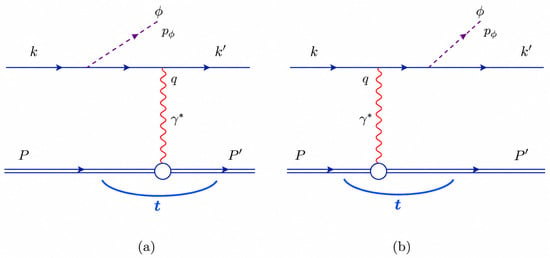
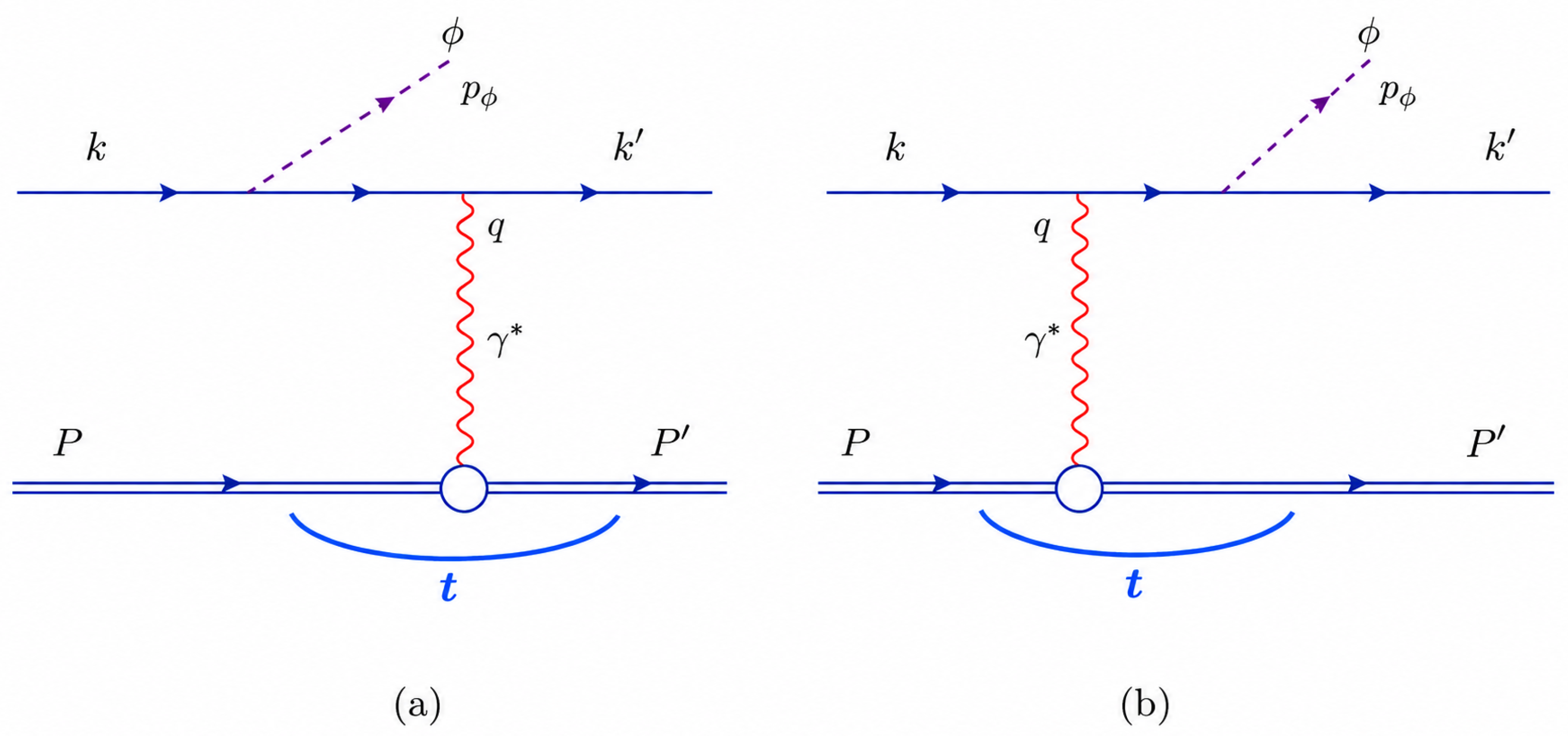
Signal events are generated by direct numerical integration of the exact three-body phase space and the cited scalar and vector matrix elements [1,7,8]. The calculation includes the Helm form factor, both diagrams in Figure 1 and their interference, and the full vector-polarization sum. Observables are calculated after transforming the generated four-momenta to the collider laboratory frame.
Figure 1.
Coherent dark-boson production through electron bremsstrahlung, with initial-state radiation (a) and final-state radiation (b).
Our TFoam implementation uses adaptive importance sampling to generate events with Monte Carlo weights . Cross sections and efficiencies are calculated from sums of weights. For a selection C, the efficiency is , where equals one if event i passes and zero otherwise.
The inclusive cross sections and those selected by the mass-dependent electron cuts in Table I of Ref. [1] are obtained from the same matrix element and phase-space measure, without an independent normalization fitted to the selected rates. Samples for the selection comparison are generated conditional on this preselection, and all three methods act as second-stage refinements.
2.4. Vector and Scalar Signal Cross Sections
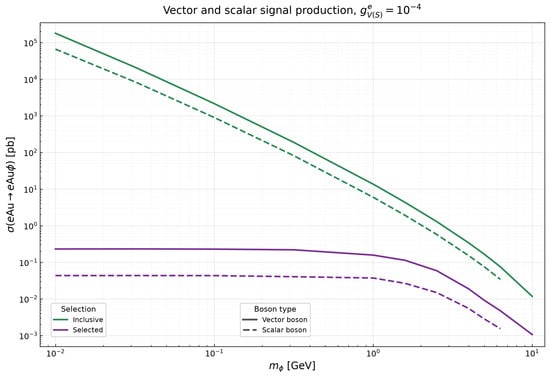
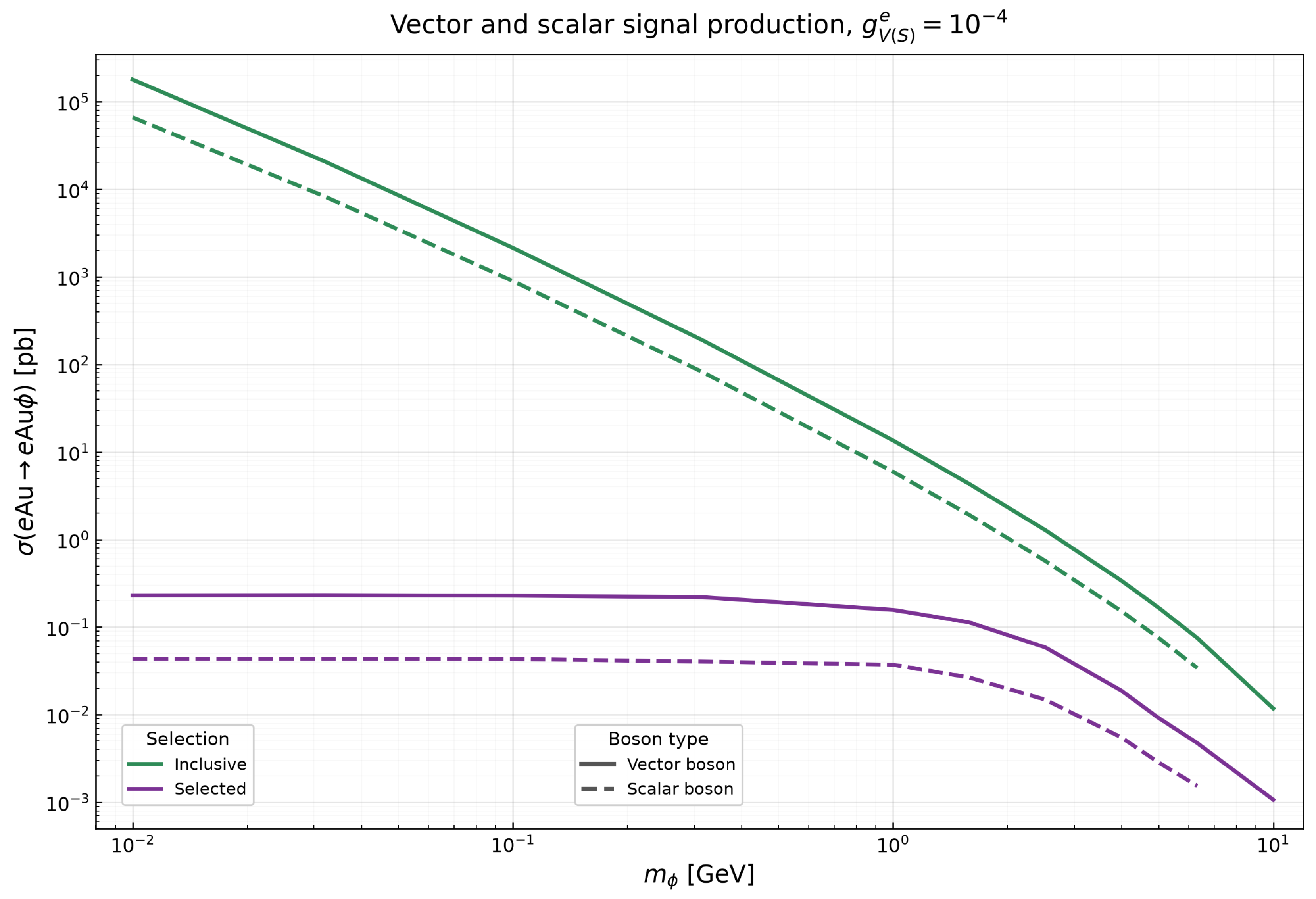
Figure 2 shows the inclusive and preselected scalar and vector production cross sections over the mass range 0.01–10 GeV for the setup in Section 2.1.
Figure 2.
Coherent dark-boson production cross sections versus boson mass. Green and purple curves show our calculations before and after the electron preselection described in Section 2.3, respectively. Solid and dashed lines represent vector and scalar bosons, respectively.
The inclusive cross sections decrease rapidly with boson mass, with the vector rate exceeding the scalar rate throughout the scan. Table 1 gives the rates at GeV, where the preselection efficiencies are approximately 1.16% for the vector and 0.625% for the scalar.
Table 1.
Inclusive and selected signal cross sections from our weighted numerical integration at GeV and . The selected rates include the mass-dependent electron preselection.
3. Background Model
3.1. Photon and DIS Prescriptions
The dominant reducible background in Ref. [1] is coherent bremsstrahlung, , when the photon is missed. Its parametric detector model assigns a miss probability of to photons with and unit miss probability outside that range. Table I of Ref. [1] lists effective photon and deep-inelastic scattering (DIS) rates after each electron preselection. The DIS estimate includes a 95% nuclear-breakup veto efficiency and a jet-miss probability. An irreducible neutrino-pair background is reported to be negligible [1].
3.2. Coherent-Photon Calculation and Comparison
We generate photon events from the massless-vector limit of our coherent matrix element, using electromagnetic coupling and a photon-mass regulator of GeV. The beam kinematics match the signal calculation. For each mass hypothesis, the signal and photon samples share the corresponding electron preselection in Table I of Ref. [1].
Photons inside and outside are generated separately. Their raw integration weights are converted to cross sections and combined with the photon-miss probabilities,
where nominally. Thus the mixture follows the calculated contributions, rather than the numbers of generated events. Each sample’s combined shape is normalized to a common effective photon rate obtained from a separate calibration integration, independent of training, validation, and test events.
Independent phase-space mappings and nonadaptive center-of-mass checks identified missed configurations in six outside-region files. We regenerated them with an electron-energy mapping resolving the low-energy region and explicit treatment of reflection-related azimuths, then repeated the affected fitting, validation, and test steps. These corrections followed inspection of the earlier results.
Table 2 compares those calibration rates with Table I of Ref. [1], arXiv v4. Our rates are approximately 26–28% larger below 1 GeV and differ by 0.3–6.6% at the remaining masses. At 10 GeV, the reference gives pb and our calibration gives pb. The first four selections have identical electron cuts; their different estimates reflect independent numerical integrations. The selection comparison uses these calibration rates directly.
Table 2.
Effective photon rates after the electron preselection in Table I of Ref. [1] and photon-miss weighting. This work uses independent calibration integrations. The quoted errors are internal TFoam integration estimates; they do not include the observed variation between integrations or physical model uncertainties.
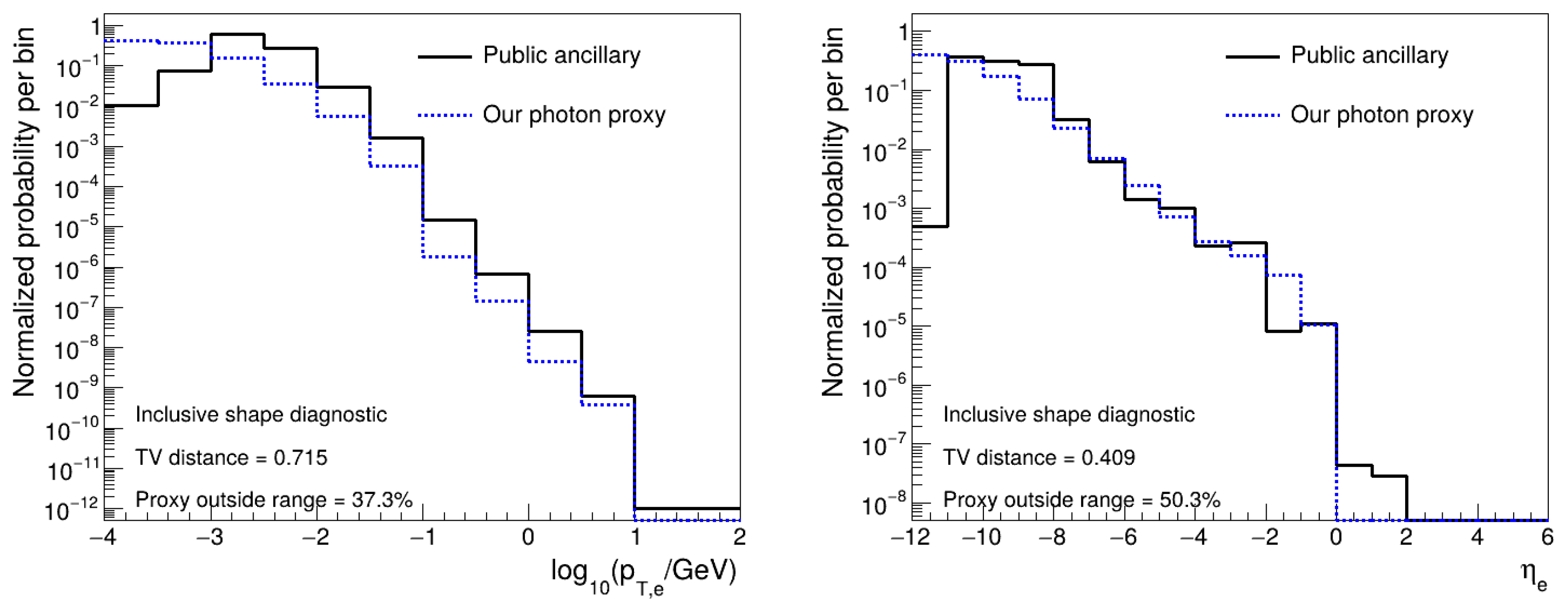
Figure 3 compares a separately generated inclusive photon sample with the published one-dimensional distributions, using integration weights before electron preselection and photon-miss weighting. The range-conditioned total-variation distances are 0.715 for and 0.409 for . Our weighted fractions outside these ranges are 37.3% and 50.3%, respectively. The reference does not specify all generation boundaries and infrared restrictions required for a matched inclusive comparison, so the origin of this shape difference remains unresolved.
Figure 3.
Recoil-electron transverse-momentum (left) and pseudorapidity (right) distributions for the photon background. Black curves show the published reference distributions; blue curves show our inclusive simulation. Curves are normalized separately over the displayed ranges.
Only our generated samples enter training and model selection. Section 5.6 tests documented changes to the central/outside photon mixture.
3.3. DIS Contribution
The reference effective DIS rate is retained after every second-stage selection. No event-level DIS sample is classified, so neither BDT, likelihood, nor cuts receives credit for additional DIS rejection.
As a separate rate check, we simulate leading-order with MadGraph5_aMC@NLO 3.7.0 [9] and CT10nlo parton distributions, scaling by , 5% veto survival, and the assumed jet-miss probability. Across the eleven selections in Table I of Ref. [1], the estimates differ from the reference DIS rates by 4.30–6.23%.
4. Selection Methods and Statistical Procedure
4.1. Inputs and Sample Preparation
The electron-only input set comprises , , , and ; the extended set adds . All three methods receive identical events, weights, and inputs within each comparison. Each method is optimized separately with and without t, so the benefit of this additional information can be measured directly.
Ten independent event-generation and fitting runs are evaluated at each of the eleven masses for both boson types. This gives 220 analyses, each containing the six selections. Photon samples are shared between the two boson types within each mass and run. Training, validation, and test samples use separate seeds. Each photon split contains 100,000 central-region and 40,000 outside-region generation attempts, with 2500 TFoam cells and 1500 sampling points per cell for the central region, and 1000 cells and 1000 points for the outside region. Signal training and validation samples are retained from the independent earlier generation; new signal test samples use 50,000 attempts. Stored event counts can be smaller than the attempted counts.
Input files, configurations, and checksums are recorded in the accompanying analysis.
4.2. BDT, Likelihood, and Rectangular Optimization
BDTs use TMVA [10] with four configurations: 400 trees at maximum depths two, three, or four, and 800 trees at depth three. The likelihood selection uses the TMVA multidimensional probability-density estimator with range searching (PDERS), retaining correlations among inputs. Signal and photon densities are estimated from weighted training samples using a Gaussian kernel of relative width 0.3 in RMS-scaled search volumes. Four volume widths, 0.2, 0.4, 0.8, and 1.6, are considered.
Rectangular cuts use weighted grids of 40, 80, and 160 quantiles with twenty starting points per grid. The unchanged preselection is also an allowed candidate.
We estimate the expected statistical significance in the background-dominated limit as , where S and B are the expected signal and background event counts. A larger Z means that the signal stands out more strongly above statistical fluctuations in the background. Configurations and operating points for all methods are selected on validation data using the significance relative to preselection,
where and are weighted efficiencies relative to preselection, and and are the effective rates before second-stage selection. The DIS rate is retained without further rejection. Values of above unity represent improvement.
We report both the benefit of adding t within each method and the difference between methods with the same inputs:
Here a and b denote selection methods, e denotes electron-only inputs, and adds t. These are changes in the approximate significance, rather than increases in the produced signal.
4.3. Uncertainty and Independent Runs
For each run, 2000 paired resamples preserve the common-event comparison across all six selections. Photon regions are resampled separately, including unstored zero-weight attempts in the region normalization; signal resampling is conditional on the generated sample. Aggregate estimates are geometric means of the ten runwise ratios. We obtain 95% intervals from one million draws that resample runs and then select a paired event-resampled result within each selected run. These intervals describe simulation statistics and variation between generation and training runs. The photon calibration is held fixed; its integration uncertainty, physical model uncertainties, and detector systematics are not included.
The scan contains 66 within-method t comparisons and 132 pairwise method comparisons. We treat the combined 198 comparisons as one family and use two-sided Bonferroni intervals with tail probability on each side. Plots and Appendix Table A1, Table A2, Table A3 and Table A4 show ordinary pointwise 95% intervals for readability; scan-wide statements use the adjusted bounds. Candidate configurations and fitting budgets are specified before the new final test evaluations. Resolution and photon-loss tests are descriptive checks outside this primary family.
5. Results
5.1. Weighted Kinematic Structure After Electron Preselection
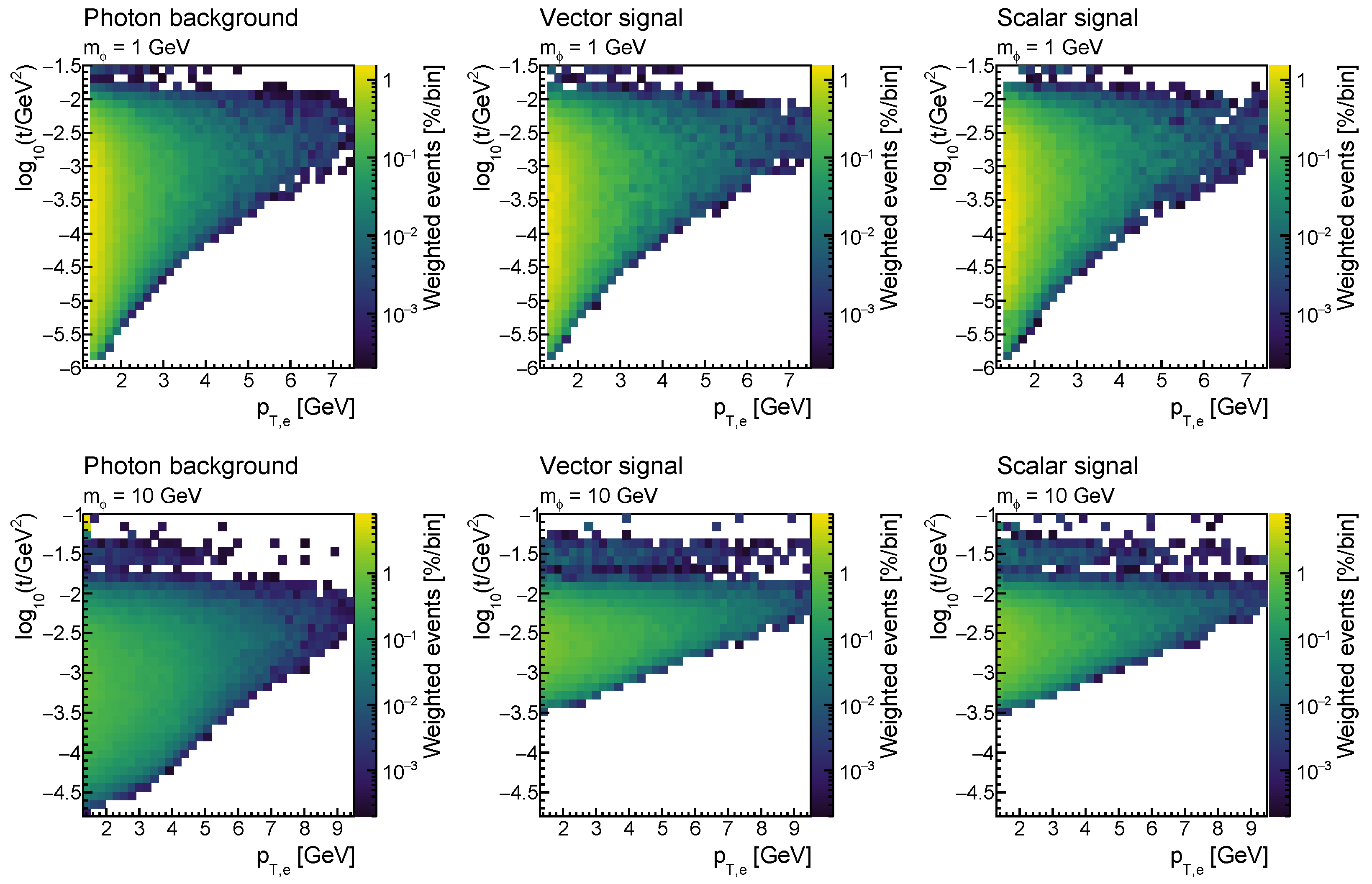
At 1 GeV, the three classes populate broadly similar wedge-shaped regions in the t- plane (Figure 4). At 10 GeV, both signals shift toward larger t, while the photon background retains more weight at smaller t. The different correlations with motivate selections that can follow sloped structures beyond separate bounds on each input.
Figure 4.
Weighted distributions in and after electron preselection, from the first independent test run. Rows show 1 and 10 GeV; columns show photon background, vector signal, and scalar signal. Each panel is normalized to its full class weight, including events outside the displayed ranges. Photon weights include the photon-miss probability. Identical axes, bins, and color scales are used within each mass row. Weighted fractions outside the displayed rectangles, in photon/vector/scalar order, are 3.43%/0.0668%/0.0734% at 1 GeV and 5.34%/0.0166%/0.0116% at 10 GeV.
5.2. Benefit of Nuclear Momentum-Transfer Information
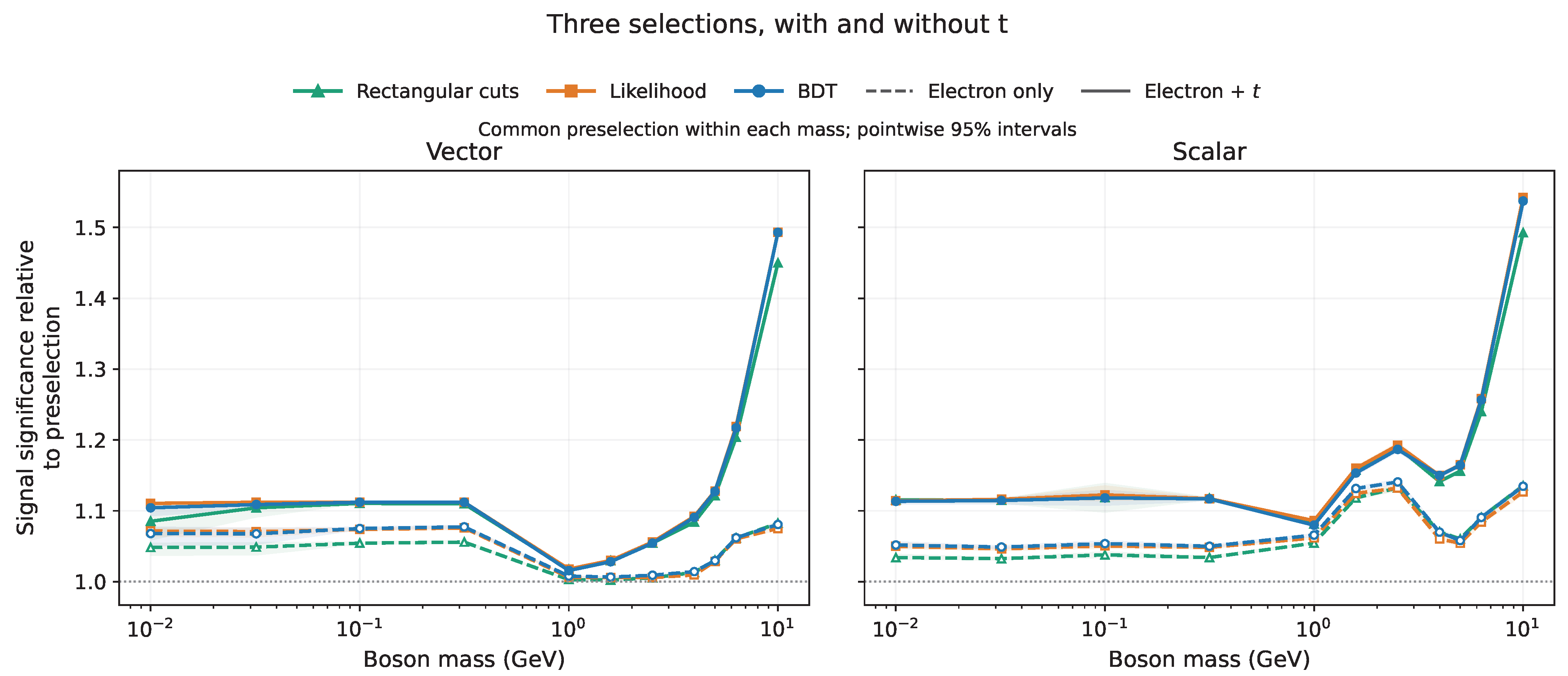
Figure 5 compares all six selections against the common mass-dependent preselection. The largest benefits from adding t occur at the upper end of the mass range.
Figure 5.
Simulated significance relative to the common preselection for rectangular cuts, likelihood, and BDT selections, with electron-only inputs (dashed) and with t (solid). Panels show vector and scalar signals. Curves are geometric means over ten independent runs; bands are pointwise 95% intervals.
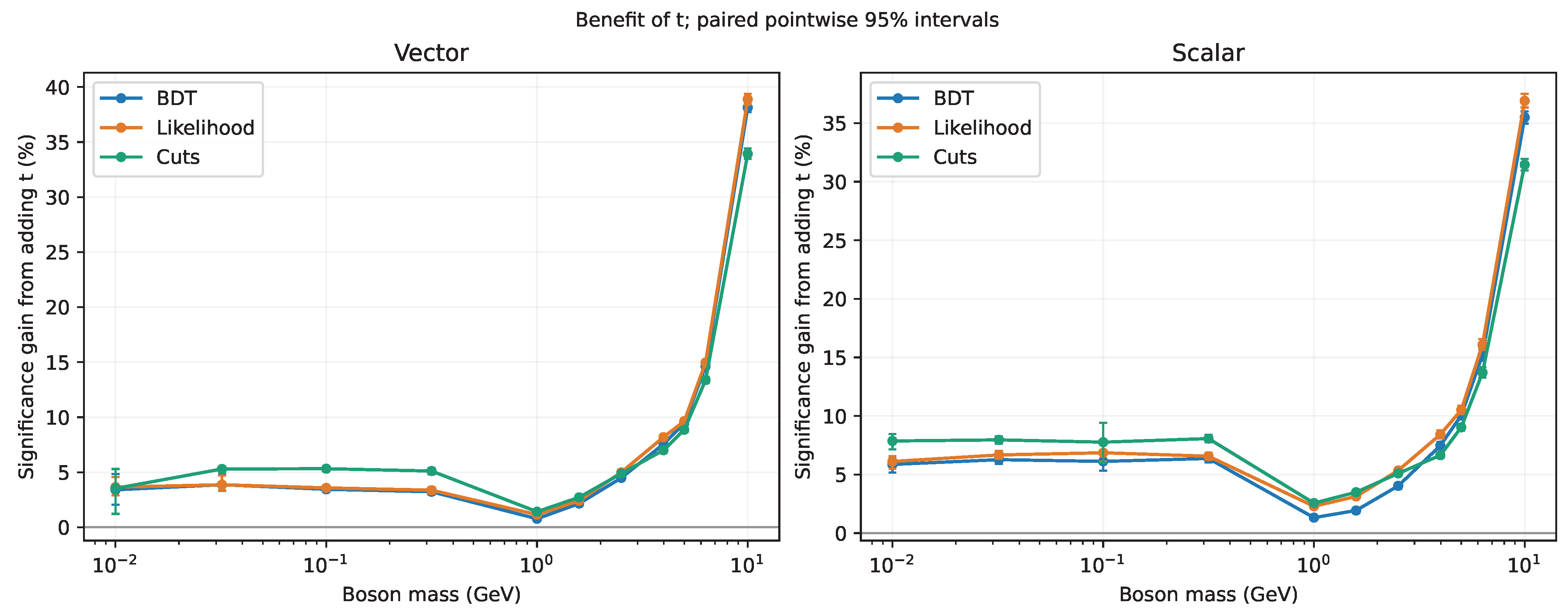
BDT and likelihood show a positive gain from adding t at all eleven masses for both boson types after accounting for multiple comparisons (Figure 6). Cuts also show a positive gain except at the smallest vector mass, 0.01 GeV, where the interval does not resolve an improvement. At 10 GeV, adding t improves significance by approximately 34%, 39%, and 38% for vector cuts, likelihood, and BDT selections, respectively. The corresponding scalar gains are approximately 31%, 37%, and 35%.
Figure 6.
Significance gain from adding t within each selection method. Positive values favor the t-inclusive selection over the same method using electron inputs alone. Bars are paired pointwise 95% intervals; Table A1 lists the values.
5.3. Comparison of Selection Methods
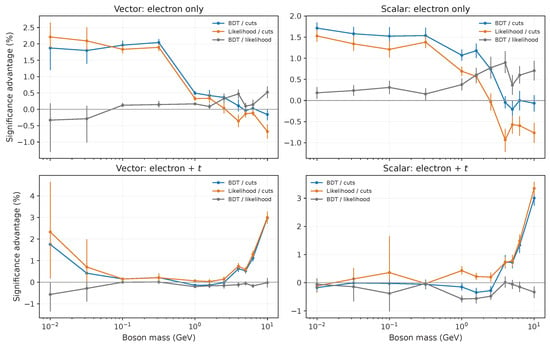
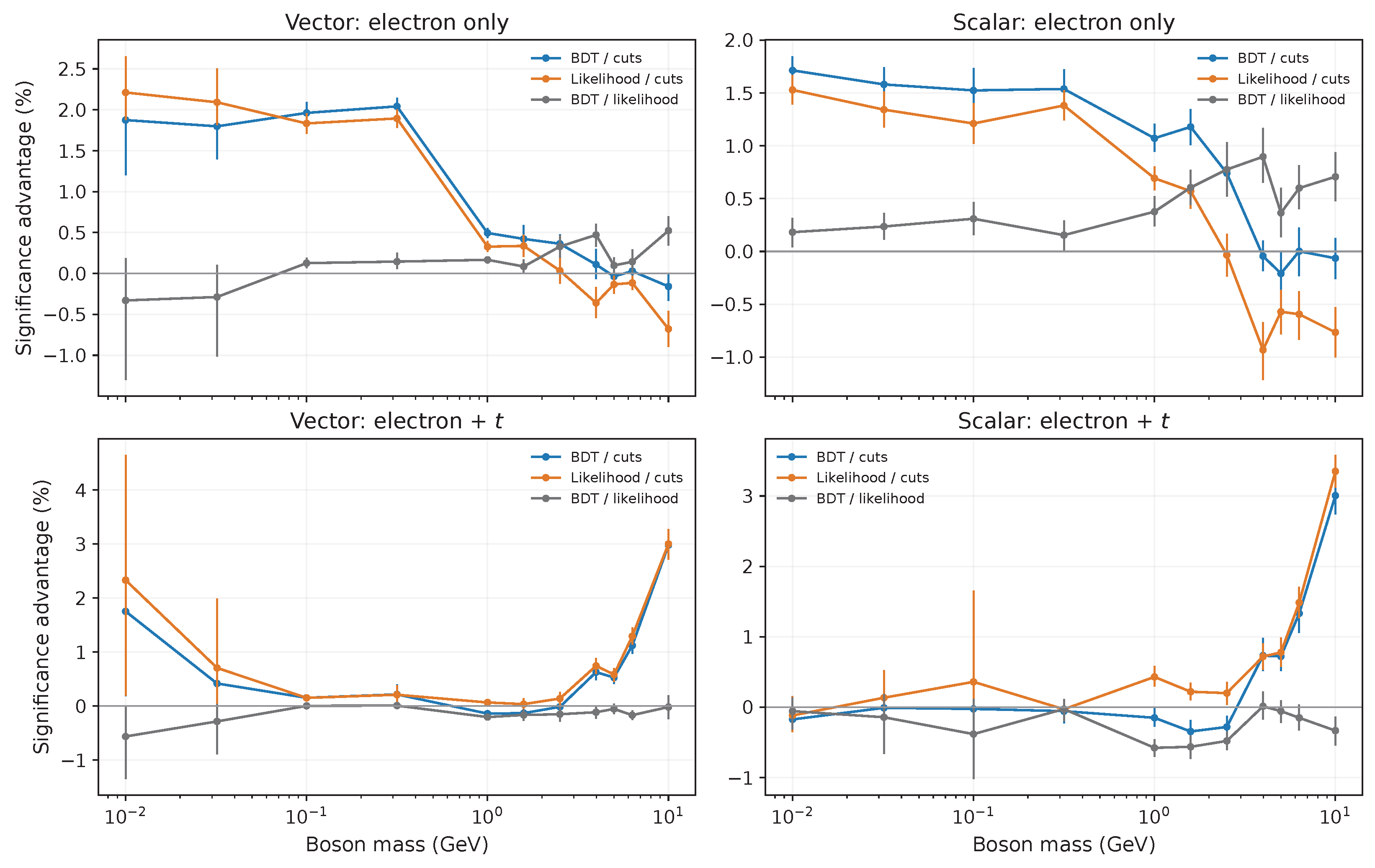
Figure 7 compares methods using the same inputs. With electron-only inputs, BDT has a small advantage over cuts at the seven masses up to 2.512 GeV for both boson types, after accounting for multiple comparisons. Its estimated advantages range from approximately 0.3% to 2.0% at those points.
Figure 7.
Pairwise significance advantages with electron-only inputs (top) and with t (bottom), for vector (left) and scalar (right) signals. Positive values favor the first method in each ratio. Bars are paired pointwise 95% intervals. Table A2 and Table A3 give the values; scan-wide claims use the 198-comparison adjustment in Section 4.3.
With t, both BDT and likelihood outperform cuts at 3.981, 5, 6.31, and 10 GeV for each boson type after the scan-wide correction. At 10 GeV their gains over cuts are approximately 3.0% and 3.0% for the vector, and 3.0% and 3.4% for the scalar. Their estimated differences remain below 1% throughout the scan. Four adjusted comparisons favor likelihood, and none favors BDT.
5.4. Operating Characteristics and Variable Attribution at 10 GeV
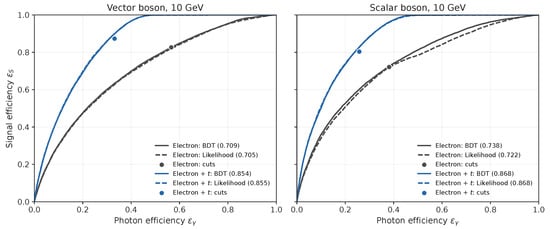
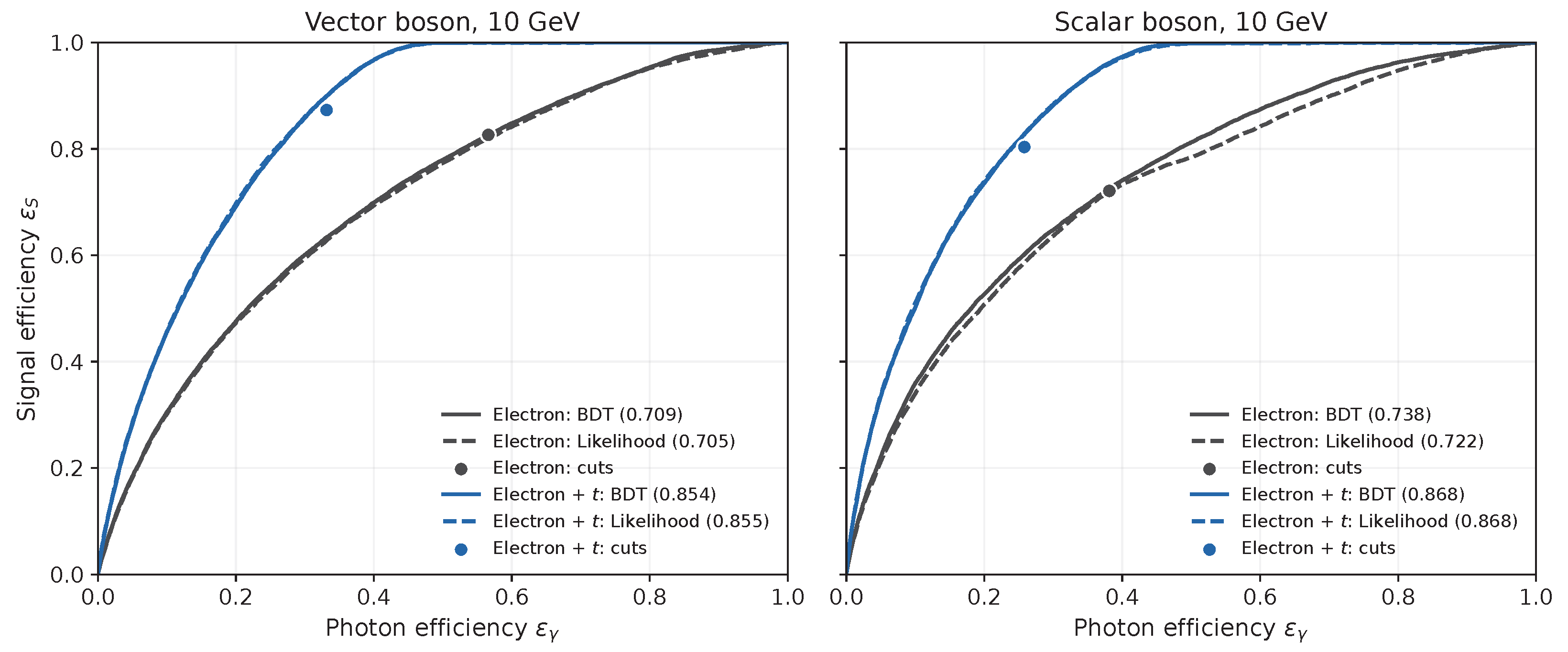
Adding t improves signal–photon ranking (Figure 8). The significance at the selected operating point also depends on the residual photon rate and the unrejected DIS contribution.
Figure 8.
Signal efficiency versus photon efficiency on the first independent 10 GeV test run for vector (left) and scalar (right) signals. BDT and likelihood curves vary their score thresholds; cut markers show the validation-selected rectangular operating points. Colors distinguish electron-only inputs from electron inputs plus t. Parenthetical legend values are weighted areas under the curves.
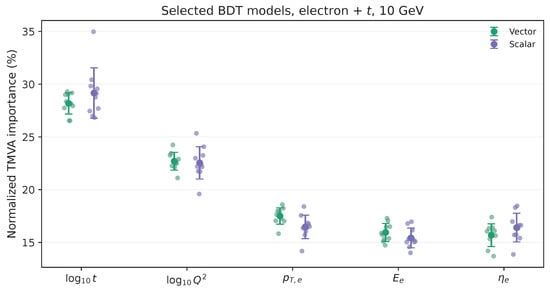
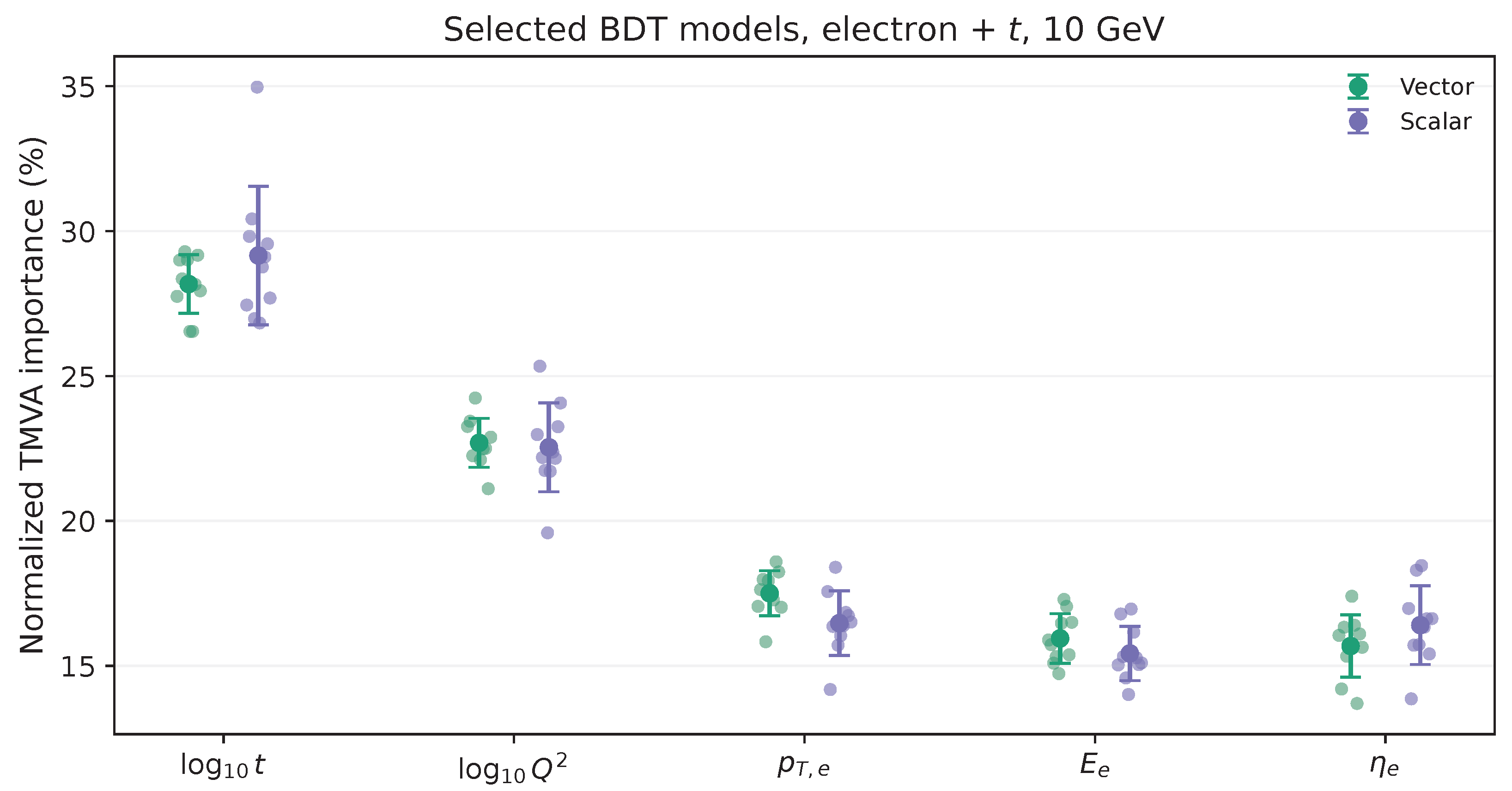
The selected BDTs assign the highest mean importance to t for both boson types (Figure 9). These scores depend on correlations among the inputs.
Figure 9.
Normalized TMVA variable importances of the selected t-inclusive BDTs in ten independent 10 GeV runs. Small points show individual runs; large markers and bars show means and sample standard deviations.
5.5. Sensitivity to Finite t Resolution
At GeV, we perturb the signal and photon test events according to
with factors giving redrawn before taking the logarithm. Within each run, all methods receive the same perturbed events. Other inputs, weights, rates, fitted models, score thresholds, and rectangular boundaries remain unchanged.
The widths provide illustrative resolution benchmarks. Section 8.4.6 and Tables 8.11–8.12 of the EIC Yellow Report [2] report – in selected bins of GeV2 for coherent visible-vector-meson production with baseline tracking assumptions, with poorer resolution at lower . Those studies reconstruct t from the electron and visible meson decay products. They motivate the scale of our benchmarks without specifying a detector response for this invisible final state.
Adding t remains beneficial for all three methods under both perturbations (Table 3). At 20% smearing the gains remain approximately 30–37%. BDT and likelihood also retain positive pointwise advantages over smeared cuts. Intervals follow Section 4.3 without the scan-wide adjustment. One smearing realization is used per run; detector acceptance and correlated measurement errors are not modeled.
Table 3.
Significance gain from adding t at 10 GeV, in percent, for exact and perturbed t. Entries are geometric means across ten runs with pointwise 95% intervals. Fitted selections are unchanged under smearing.
5.6. Sensitivity to the Photon-Background Shape
We vary the central photon-miss probability over , , , and , the range considered in Ref. [1], while retaining unit loss outside acceptance. This changes the relative central and outside contributions and therefore the selected background shape. We separate this effect from the total photon rate by comparing shape variations at fixed rate, rate variations at fixed shape, and changes of both together. All cases use the same nominal models, thresholds, and rectangular boundaries; Appendix B gives the prescription.
At 10 GeV, BDT and likelihood retain positive advantages over cuts in all tested scenarios with t, including the shape variations at fixed total rate (Table A4). The within-method improvement from adding t also remains positive for all three selections. The sizes of these gains vary with the photon-loss probability.
6. Discussion
The recoil electron does not fully determine the invisible final state. Nuclear t adds information about production kinematics that all three selections can use. The sizeable improvement of rectangular cuts shows that most of the benefit comes from adding the observable.
The choice of method provides a smaller further gain when inputs are held fixed. BDT and likelihood perform similarly with t, so the extra separation is not unique to the BDT. Small electron-only BDT gains also appear at some masses; t supplies most of the additional separation at 10 GeV rather than being required for every method improvement.
7. Conclusions
We compared optimized rectangular cuts, an estimated likelihood, and BDTs with and without nuclear t for invisible scalar and vector dark-boson searches at the EIC. At 10 GeV, adding t improves simulated significance by approximately 31–39%. With t included in all methods, BDT and likelihood give approximately 3% further improvement over cuts.
The benefit of t persists at 10 GeV under the tested smearing and photon-loss variations. These results identify nuclear momentum transfer as the dominant source of improvement in this comparison. The DIS contribution is retained without further rejection; different selection efficiencies for this background could change the relative method gains.
Author Contributions
Conceptualization, R.M. and A.R.K.; methodology, software, validation, formal analysis, visualization, data curation, and writing—original draft preparation, R.M.; supervision and writing—review and editing, A.R.K. All authors have read and agreed to the published version of the manuscript.
Funding
This research received no external funding.
Data Availability Statement
Simulation code, figure inputs, and numerical results are available in the v2 directory of the Dark-Boson-ML-EIC repository, https://github.com/iRojae/Dark-Boson-ML-EIC/tree/main/v2, accessed on 5 November 2026. Saved statistical arrays, run records, and selected models for the current analysis are available in the v2 data release, https://github.com/iRojae/Dark-Boson-ML-EIC/releases/tag/revision-data-v2, accessed on 5 November 2026. The original inclusive photon sample used in Figure 3 is available in the v1 data release, https://github.com/iRojae/Dark-Boson-ML-EIC/releases/tag/data-v1, accessed on 5 November 2026. Instructions for plotting and statistical replay are provided in the repository.
Acknowledgments
The authors thank Hongkai Liu and Hooman Davoudiasl for helpful discussions and feedback, and Hongkai Liu for discussing the numerical cross-checks that contributed to corrections of the reference calculations. During preparation of this work, the authors used ChatGPT 6 to polish the language and assist with numerical cross-checks. The authors reviewed and edited the output and take full responsibility for the content of this publication.
Conflicts of Interest
The authors declare no conflicts of interest.
Appendix A
Table A1, Table A2 and Table A3 give geometric-mean percentage gains across ten independent runs with pointwise 95% intervals. Positive values favor t or the first method in a ratio; scan-wide statements use the 198-comparison adjustment in Section 4.3.
Table A1.
Significance gain from adding t within each method [pointwise 95% interval], in percent.
Table A2.
Pairwise significance advantages [pointwise 95% interval], in percent, for electron inputs.
Table A3.
Pairwise significance advantages [pointwise 95% interval], in percent, for electron inputs and t.
Appendix B
The photon-loss scenarios use the separately generated central and outside photon samples. Let and denote their raw event contributions in cross-section units before the miss probability is applied. Their effective sum at central loss probability is
We use , retaining unit loss outside . This range follows the detector-response benchmarks in Ref. [1]. The central and outside samples have different kinematic distributions, so changing their mixture changes the background shape.
For the shape comparison, the events receive weights and , followed by a common rescaling to the nominal independent calibration rate. The rate-only control keeps the normalized mixture and uses as the total photon rate. The combined variation uses both the new mixture and its calculated rate . In the latter two controls, is calculated separately for each test sample. The nominal calibration and test-sample integrals need not be identical.
Signal events and the fixed unrejected DIS rate are unchanged. BDT and likelihood models, score thresholds, and rectangular boundaries remain at their nominal validation-selected values. The same varied photon events are supplied to all six selections, including their electron-only versions, in each of the ten independent runs. This measures how the existing selections respond to the loss assumptions, without retraining for each scenario.
Allowing both rate and shape to change gives BDT/cuts advantages of 2.75–4.84% for vector and 2.64–5.44% for scalar signals; likelihood/cuts advantages are 3.00–3.05% and 3.10–4.99%, respectively. All corresponding pointwise intervals lie above zero. Adding t also improves each method over its electron-only version in every 10 GeV scenario: the smallest point estimate across methods, boson types, probabilities, and the three controls is 20.0%, with a pointwise lower bound of 17.0% for that comparison.
The intervals use 2000 paired event resamples per run and 20000 combined run/event draws. They are descriptive pointwise 95% intervals outside the nominal 198-comparison family. These scenarios vary the photon-loss mixture with the underlying photon matrix element unchanged.
Table A4.
Photon-loss shape variations at 10 GeV with t. The total photon rate is held at its nominal calibration value. Entries give significance advantages over cuts, in percent, followed by descriptive pointwise 95% intervals. The same nominal selections are used in every scenario.
References
- Davoudiasl, H.; Liu, H. Electron-Ion Collider as a Discovery Tool for Invisible Dark Bosons. Phys. Rev. D 2025, 112, 075001, Erratum in Phys. Rev. D 2026, 114, 019902. https://doi.org/10.1103/nw5p-k61z. [Google Scholar] [CrossRef] [Scilit]
- Abdul Khalek, R.; Accardi, A.; Adam, J.; Adamiak, D.; Akers, W.; Albaladejo, M.; Al-bataineh, A.; Alexeev, M.G.; Ameli, F.; Antonioli, P.; et al. Science Requirements and Detector Concepts for the Electron-Ion Collider. Nucl. Phys. A 2022, 1026, 122447. [Google Scholar] [CrossRef] [Scilit]
- Holdom, B. Two U(1)’s and ϵ Charge Shifts. Phys. Lett. B 1986, 166, 196–198. [Google Scholar] [CrossRef] [Scilit]
- Patt, B.; Wilczek, F. Higgs-field Portal into Hidden Sectors. arXiv 2006, arXiv:hep-ph/0605188. [Google Scholar] [CrossRef] [Scilit]
- HERMES Collaboration. The Q2-Dependence of Nuclear Transparency for Exclusive ρ0 Production. Phys. Rev. Lett. 2003, 90, 052501. [Google Scholar] [CrossRef] [Scilit]
- Helm, R.H. Inelastic and Elastic Scattering of 187-MeV Electrons from Selected Even-Even Nuclei. Phys. Rev. 1956, 104, 1466–1475. [Google Scholar] [CrossRef] [Scilit]
- Davoudiasl, H.; Marcarelli, R.; Neil, E.T. Displaced Signals of Hidden Vectors at the Electron-Ion Collider. Phys. Rev. D 2023, 108, 075017. [Google Scholar] [CrossRef] [Scilit]
- Balkin, R.; Hen, O.; Li, W.; Liu, H.; Ma, T.; Soreq, Y.; Williams, M. Probing Axion-Like Particles at the Electron-Ion Collider. J. High Energy Phys. 2024, 2, 123. [Google Scholar] [CrossRef] [Scilit]
- Alwall, J.; Herquet, M.; Maltoni, F.; Mattelaer, O.; Stelzer, T. MadGraph 5: Going Beyond. J. High Energy Phys. 2011, 6, 128. [Google Scholar] [CrossRef] [Scilit]
- Hoecker, A.; Speckmayer, P.; Stelzer, J.; Therhaag, J.; von Toerne, E.; Voss, H. TMVA: Toolkit for Multivariate Data Analysis. arXiv 2007, arXiv:physics/0703039. [Google Scholar]

Disclaimer/Publisher’s Note: The statements, opinions and data contained in all publications are solely those of the individual author(s) and contributor(s) and not of MDPI and/or the editor(s). MDPI and/or the editor(s) disclaim responsibility for any injury to people or property resulting from any ideas, methods, instructions or products referred to in the content. |
© 2026 by the authors. Licensee MDPI, Basel, Switzerland. This article is an open access article distributed under the terms and conditions of the Creative Commons Attribution (CC BY) license.