


Abstract
Elastic scattering angular distributions of 17Ne + 28Si at MeV/u and 15O + 28Si at MeV/u, well above the Coulomb barrier ( and , respectively), have been measured at the HIRFL–RIBLL facility in Lanzhou. Time of flight– (TOF–) beam identification, PPAC-based trajectory tracking, and a target–detector integrated DSSD telescope were employed for event-by-event reconstruction of scattering angles and particle identification. Detection efficiencies and solid angles were evaluated and corrected by means of Geant4 simulations. Theoretically, the real parts of the optical potentials were calculated within a double-folding model using the density-dependent BDM3Y1–Paris effective interaction, while the imaginary parts were taken as Woods–Saxon forms and adjusted by fits to the data using the SFRESCO code. 17Ne has a larger matter distribution than 15O. However, once mass scaling is removed, the real potential remains essentially unchanged, indicating the structural effects are not encoded in the real part. At the same time, a substantially deeper imaginary potential is required for the 17Ne + 28Si system, pointing to stronger absorption and coupling effects. A further analysis in terms of the reduced distance of closest approach shows that both the strong-absorption distance and the effective coupling range are larger for 17Ne than for 15O, whereas the Coulomb barrier height follows the known systematics and is insensitive to structural differences. These findings provide reaction-based evidence that the more diffuse and weakly bound structure of 17Ne has a pronounced impact on the scattering dynamics on a light- to medium-mass target.
1. Introduction
Over the past few decades, the structure and reaction properties of exotic nuclei near the drip lines have remained at the forefront of nuclear physics research [1,2]. Such nuclei often possess weakly bound valence nucleons, extended matter distributions, and possible halo or skin structures, posing a serious challenge to traditional theories of nuclear structure and reactions. Owing to its relatively simple reaction mechanism and straightforward interpretation, nuclear elastic scattering has long been regarded as a basic tool to extract information on the size, shape, and surface diffuseness of unstable nuclei [3,4], and it provides crucial constraints on various microscopic optical potentials.
For weakly bound and halo nuclei, strong coupling between elastic scattering and continuum states (including breakup, transfer, and inelastic excitation) can markedly modify the elastic angular distributions. Typical signatures include an increase in the total reaction cross section, changes in the Fresnel peak structure, and an outward shift of the strong-absorption radius [5,6]. The relative importance of these coupling effects depends on the charge and mass of the target. For heavy targets such as 208Pb, Coulomb breakup induced by the long-range Coulomb field is dominant [6,7]. In contrast, for light- to medium-mass targets, the nuclear potential plays a more significant role and Coulomb breakup is relatively suppressed, providing an ideal platform to investigate coupling mechanisms governed primarily by nuclear interactions [8,9].
The nucleus 17Ne is a proton-rich, weakly bound system near the two-proton drip line. Its ground state can be approximated as a Borromean three-body system consisting of a 15O core plus two valence protons [10], with a two-proton separation energy of only about 0.94 MeV. Whether 17Ne exhibits a two-proton halo structure remains controversial, both experimentally and theoretically. Early measurements of reaction cross sections and momentum distributions suggested the possible presence of a two-proton halo [11,12], whereas later coincidence measurements and optical model analyses favored a moderately extended structure with a large d-wave component in the valence-proton wave function [13]. In comparison, 15O is a well-bound, stable, proton-rich nucleus with a one-proton separation energy MeV, corresponding to a more compact density distribution. A systematic comparison of the reaction dynamics of 17Ne and 15O on the same target therefore offers an opportunity to highlight characteristic effects arising from weakly bound valence nucleons and possible exotic structure, while minimizing differences associated with the core [2,7,8].
The nucleus–nucleus optical potential is a key quantity for understanding heavy-ion reaction mechanisms. The double-folding model, which has a microscopic foundation, constructs the mean-field potential between projectile and target by folding an effective nucleon–nucleon (NN) interaction with the matter density distributions of the two nuclei [14,15,16,17], thus providing a direct link between structure and reaction. Within this framework, differences in the density distributions—especially in the surface diffuseness—manifest themselves as changes in macroscopic observables [14,15,18,19]. While the real part of the folding potential is sensitive to the overall mass-number scaling, the dynamical signatures associated with weak binding and extended density are generally expected to be reflected in the imaginary part of the optical potential and the strong-absorption radius [2,20,21,22,23]. However, how these structural features quantitatively manifest themselves in a light- to medium-mass target system, and whether they produce distinct signatures in the real and imaginary parts of the potential, remains an open question and serves as the focus of the present comparative study.
In recent years, a systematics based on the reduced distance of closest approach d has been proposed as an energy-independent framework for comparing elastic scattering in different systems and at different incident energies [18,20,21]. Using the quarter-point method applied to as a function of d, one can extract the strong-absorption distance , the Coulomb barrier height , and a parameter describing the width of the transition region from surface-dominated coupling to volume-dominated absorption. These quantities provide a quantitative characterization of the spatial range of coupling effects in weakly bound or halo systems [18,20,21]. Previous studies of halo nuclei such as 6He and 11Li have shown that both and are systematically larger than in tightly bound systems, reflecting their more diffuse structures and stronger long-range couplings [18,21,24].
Experimental studies of the elastic scattering of 17Ne are scarce. Ovejas et al. [25] measured the elastic scattering and inclusive 15O production for a 136 MeV 17Ne beam on a 208Pb target at the SPIRAL1 facility, i.e., close to the Coulomb barrier, where a suppression of the Coulomb rainbow peak was observed and attributed mainly to the nuclear interaction rather than to Coulomb breakup [26]. Systematic comparisons with the core nucleus 15O on lighter targets are still lacking.
In this paper, we have performed a comparative measurement of elastic scattering for the 17Ne + 28Si and 15O + 28Si systems at energies well above the Coulomb barrier. Section 2 describes the experimental setup, the beam identification and the data reduction procedure. Section 3 presents the theoretical framework with three subsections. Section 4 summarizes the results and discusses their implications for the reaction dynamics of weakly bound nuclei on light- to medium-mass targets.
2. Experimental Setup and Data Analysis
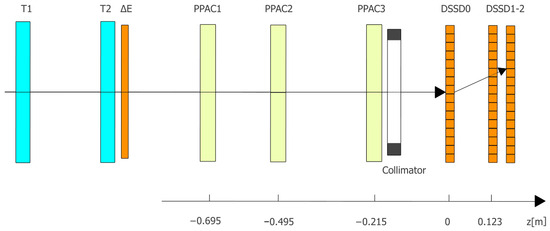
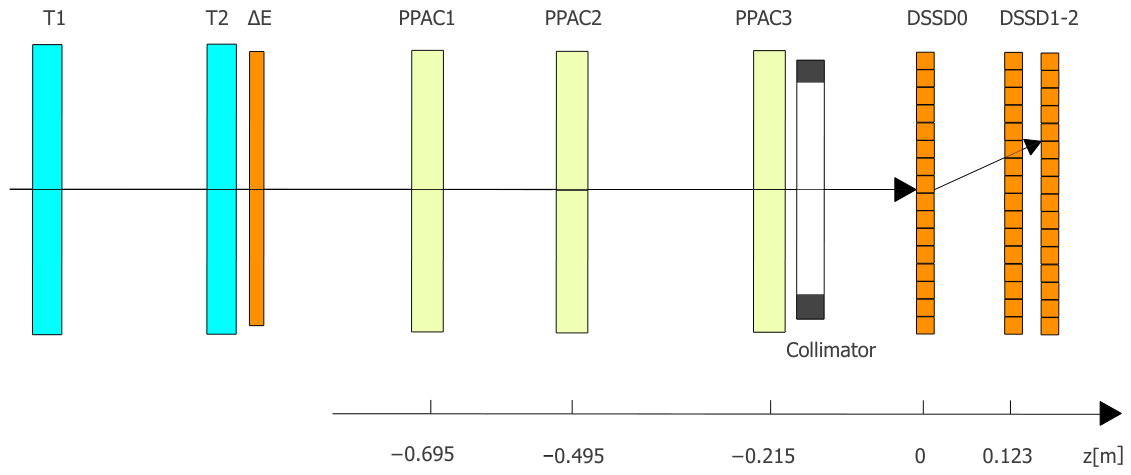
The experiment was performed at the terminal of the Radioactive Ion Beam Line in Lanzhou (RIBLL) [27,28] at the Heavy Ion Research Facility in Lanzhou (HIRFL) [29]. Secondary beams of 17Ne and 15O were produced via projectile fragmentation of a 20Ne primary beam with an energy of 77.19 MeV/u impinging on a 3056 m thick 9Be production target. Along the beam line, a time of flight (TOF) system combined with an energy loss () detector provided particle identification (PID) for trigger and beam purity monitoring; a schematic layout is shown in Figure 1.
Figure 1.
Schematic layout of detector arrangement in the beam line and the main target chamber.
The detector configuration in the main experimental chamber is also illustrated in Figure 1. Along the beam direction, three parallel-plate avalanche counters (PPACs) were followed by a secondary target/front double-sided silicon strip detector (DSSD0), and two additional double-sided silicon strip detectors (DSSD1 and DSSD2) placed downstream of the target. Each PPAC had an active area of mm2 and was used to measure the time of flight and incoming trajectory of the beam particles, enabling reconstruction of the beam spot position and incident angle at the target. The secondary target was a 28Si foil of thickness 144 m, integrated with DSSD0, which simultaneously recorded the energy loss of the incident particles. DSSD1 and DSSD2, with thicknesses of 72 m and 1004 m, respectively, were employed to measure the energy and outgoing tracks of the heavy reaction products. All DSSDs had an active area of mm2 with a strip pitch of 3 mm, providing good angular and position resolution over a relatively wide solid angle.
From beam transport calculations and energy loss estimations, the laboratory energies of the 15O and 17Ne beams at the center of the 28Si target were determined to be MeV/u and MeV/u (equivalently MeV and MeV in total kinetic energy), respectively. The energies were obtained from a LISE++ transport calculation of the beam line and energy loss calculation through the upstream detectors and the front half of the target; these calculated values are directly verified by the reconstructed energy peaks measured with the DSSDs in the present experiment, and the two are in full agreement. They are quoted at the target centre. The uncertainty is taken as the standard deviation of a Gaussian fit to the reconstructed energy peak, which covers the intrinsic momentum spread of the secondary beam and the residual uncertainty of the beam-energy determination.
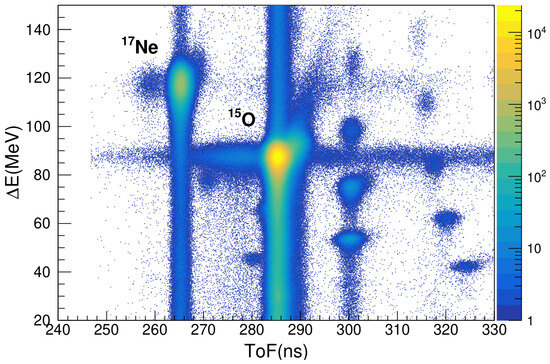
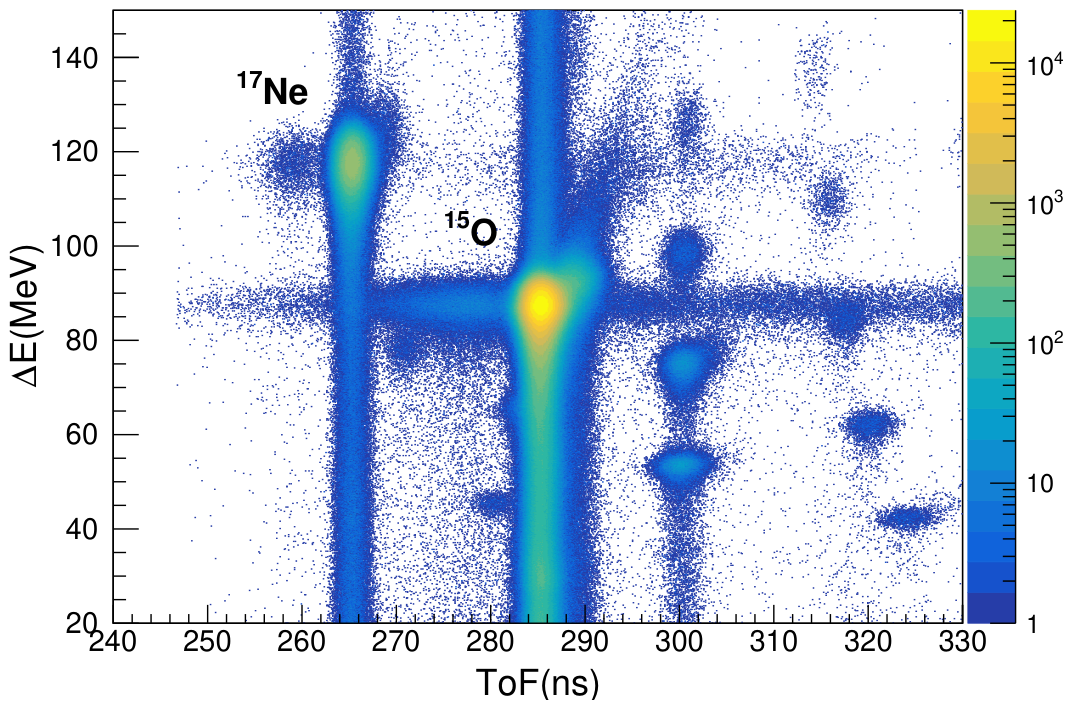
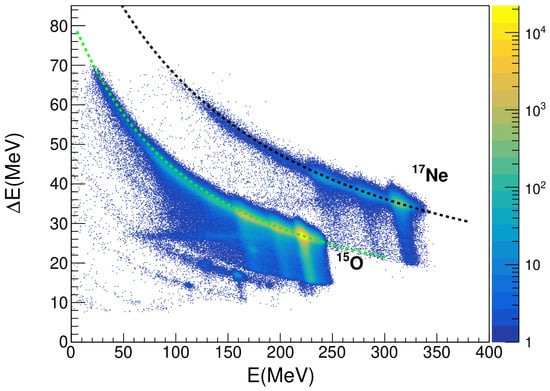
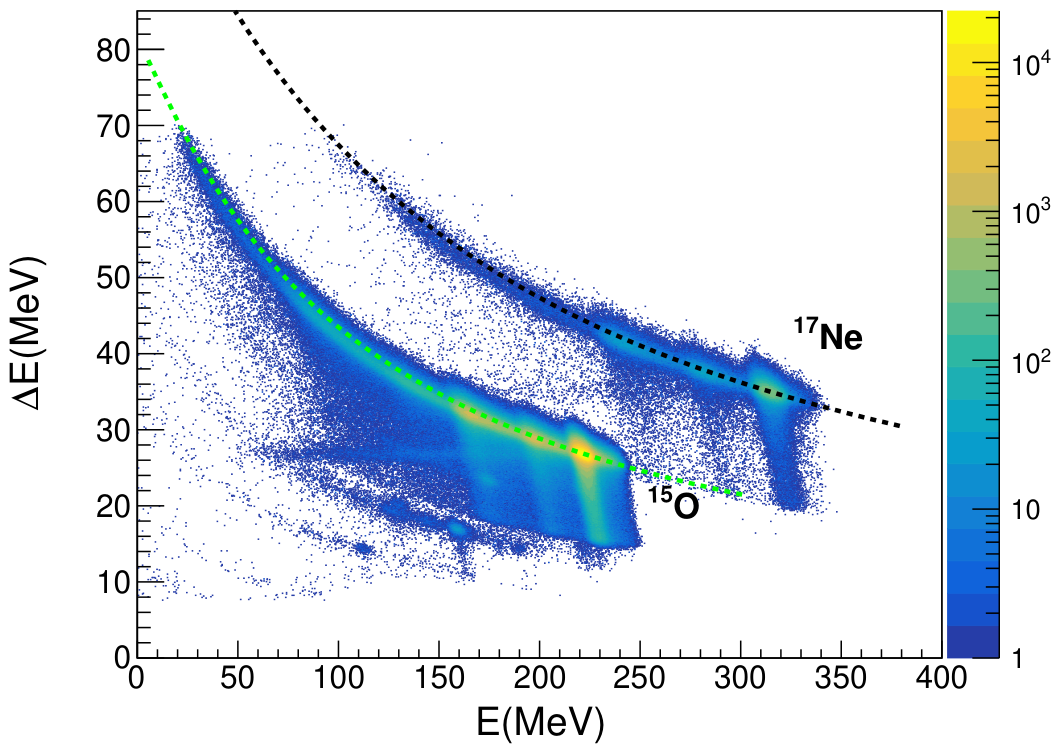
The beam PID spectrum is shown in Figure 2. A clear separation between 17Ne and 15O components was achieved using the TOF– correlation, allowing selection of the corresponding incident events. Behind the target, a –E telescope formed by DSSD1 and DSSD2 was used to identify outgoing charged particles. A typical two-dimensional –E spectrum is displayed in Figure 3, where elastically scattered 17Ne (15O) can be clearly distinguished from other reaction products.
Figure 2.
The beam particle identification spectrum.
Figure 3.
The –E spectrum of ejected particles, detected by DSSD1–DSSD2.
The hit-strip information from the three PPACs and DSSD0 was used to reconstruct the three-dimensional incident trajectory and the impact point on the target plane, while the hits in DSSD0, DSSD1, and DSSD2 provided the outgoing trajectory of the heavy fragment. The scattering angle for each event was then obtained by geometrical extrapolation of the incoming and outgoing tracks, and elastic events were selected based on the PID information. The energy loss data from DSSD0 were further used to reject nuclear reactions occurring in detectors upstream of the target and to eliminate spurious events with anomalously low incident energy, thereby improving the purity of the elastic sample.
The differential cross section for elastic scattering is calculated using the following formula:
where is the number of elastic scattering events selected by the outgoing energy, is the total number of incident particles obtained from DSSD0, and is the areal density of the target nuclei. is the solid angle subtended by the outgoing detector at the target position, precisely calculated from the dimensions and positions of the DSSDs. is the detection efficiency of the outgoing detector. The numbers of elastic scattering events in each angular bin were corrected for detection efficiency and solid angle coverage using a detailed Geant4 simulation of the entire setup. After correction, is considered to be 100% in the present experiment. The relative differential cross sections were defined as the ratio of the measured elastic cross section to the Rutherford yield under identical geometrical conditions, with the latter obtained from the simulation. The uncertainties quoted for the individual data points are dominated by counting statistics; the systematic contributions from the efficiency and solid angle corrections, from the target areal density and from the beam counting were estimated to be below 5% in total and are common to all angular bins, so that they affect the overall normalization rather than the shape of the angular distribution. A detailed description of the tracking, alignment and calibration procedures underlying this analysis is given in a companion methodological paper [30].
3. Theoretical Calculations and Analysis
3.1. Construction of the Double-Folding Optical Potential
To understand the differences between 15O and 17Ne elastic scattering from 28Si at the microscopic level, we describe the angular distributions within the optical model (OM), with the real part of the potential obtained from a double-folding calculation. In this model, the average nuclear potential between projectile and target is expressed as the statistical average of the effective NN interaction over all nucleon pairs in the two nuclei [14,15,16], as follows:
where denotes the separation vector between the mass centers of projectile and target, and are the internal coordinates of the nucleons in the two nuclei, and is the NN relative coordinate. The functions and are the ground state matter density distributions of the projectile and target, respectively, and is the effective interaction between point-like nucleons.
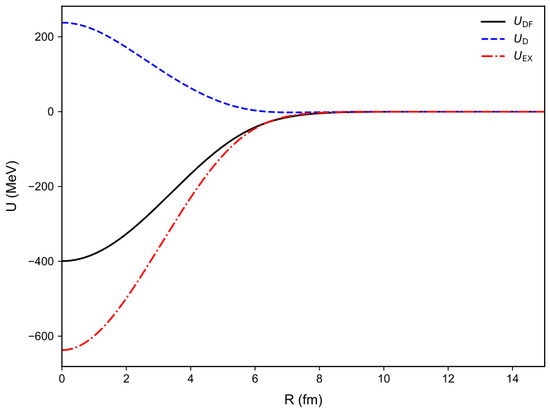
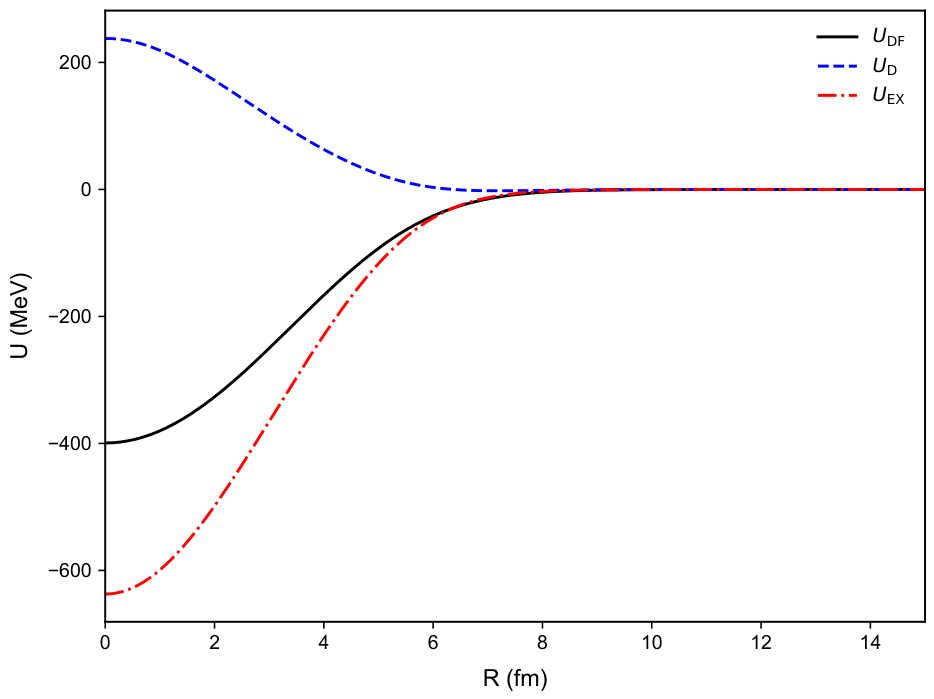
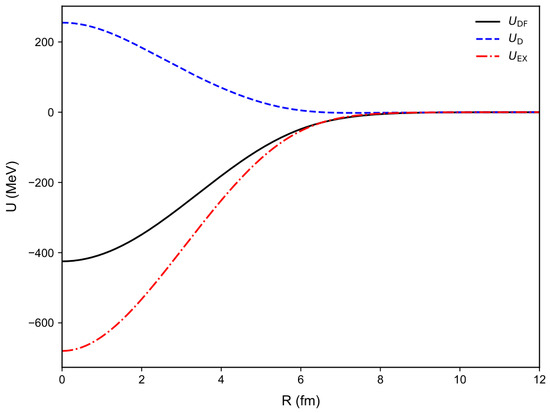
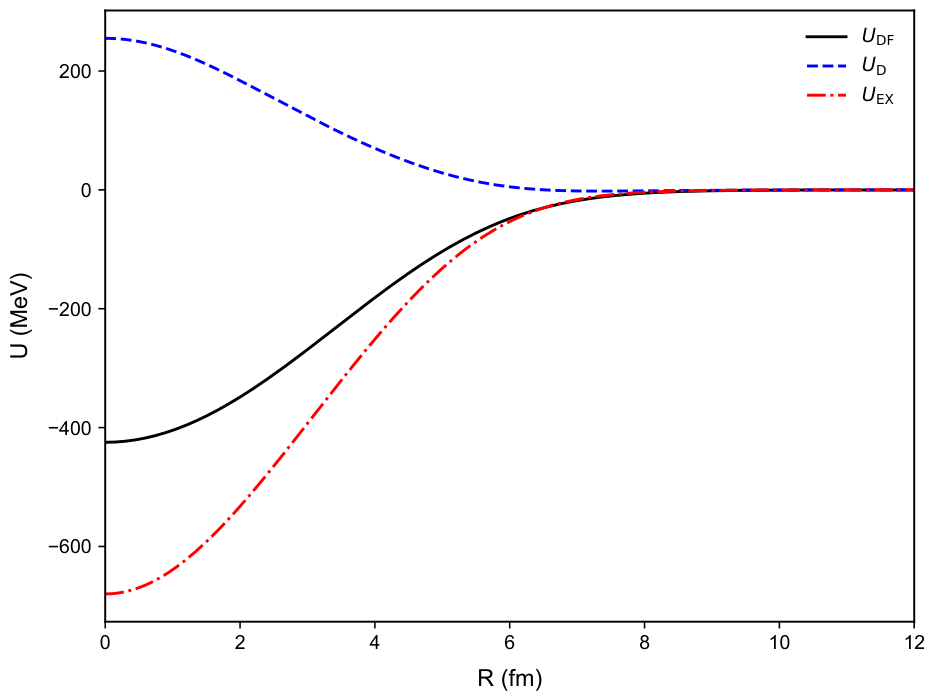
Because the NN interaction consists of direct and exchange components, the double-folding potential can be written as the sum of a direct term and an exchange term . The numerical calculations were carried out using the BiFold code [19] for both the 15O + 28Si and 17Ne + 28Si systems at the laboratory energies of the experiment, as shown in Figure 4 and Figure 5. The effective NN interaction adopted was the density-dependent BDM3Y1–Paris interaction [15]. Its density-dependent factor accounts for Pauli blocking and finite-density effects in the nuclear medium, while an energy-dependent factor describes the gradual variation in the effective interaction strength with incident energy [31,32].
Figure 4.
The double-folding potential for the 15O + 28Si system at MeV/u, together with its direct and exchange components, calculated with the BDM3Y1–Paris interaction. Solid black line: total folding potential ; dashed blue line: direct term ; dash-dotted red line: exchange term .
Figure 5.
The double-folding potential for the 17Ne + 28Si system at MeV/u, together with its direct and exchange components, calculated with the BDM3Y1–Paris interaction. Line styles as in Figure 4.
The ground state matter density distributions of the projectile and the target were taken from the microscopic calculations compiled in the RIPL-3 library [33]. In constructing the local Fermi momentum , an improved expression including a Weizsäcker gradient term was used [16], with the gradient coefficient taken as , in order to improve the description of the kinetic energy density and of the exchange potential in the nuclear surface region. The calculated parameters of the double-folding potentials for both systems are summarized in Table 1. Radii are quoted as root-mean-square (rms) values in fm; the mean-square values returned by the folding code are their squares. and are the projectile and target mass numbers.
Table 1.
Key parameters of the double-folding potentials for the 15O + 28Si and 17Ne + 28Si systems.
It is worth noting that the per-nucleon incident energy of the 17Ne beam is higher than that of 15O, which leads to a slightly smaller energy-dependent factor and thus somewhat reduces the strength of the effective NN interaction [31]. Nevertheless, when the trivial mass-number scaling is removed by introducing reduced quantities, such as the reduced matter radius and the volume integral per interacting nucleon pair , the real part of the folding potential for 17Ne does not exhibit a significant enhancement compared to 15O. In fact, its normalized strength is slightly weaker, which can be largely attributed to the energy dependence of . This implies that, while 17Ne is weakly bound and potentially halo-like, its influence on the strength of the real folded potential is secondary once the mass-number dependence is factored out.
Furthermore, the exchange term consistently exhibits a larger rms radius than the direct term, reflecting its inherent sensitivity to the surface density gradient—a known feature of the BDM3Y1 interaction [14,15]. However, once the trivial mass-number scaling is removed via the reduced radius , the differences in the spatial extent of the real potentials between the two projectiles become minimal. This suggests that the geometric range of their real folded potential is predominantly governed by the mass-number scaling.
3.2. Optical Model Analysis of the Elastic Angular Distributions
The goodness of fit between the experimental data and the optical model calculations was quantified using the standard statistic. For each data point i, the deviation between the measured relative differential cross section and the calculated value is weighted by , the statistical uncertainty of that point. As explained in Section 2, the systematic contributions are common to all angular bins and therefore displace the whole angular distribution coherently rather than altering its shape; they are excluded from and no normalization factor was left free in the fit. The function is defined as follows:
where N is the number of data points. The best-fit optical model parameters were obtained by minimizing using the SFRESCO code (a local modified version of FRESCO) [34]. In the fits, the absolute normalization was fixed by the Geant4-based efficiency and solid angle corrections; no additional normalization freedom was introduced. The reported values are computed as defined above, without rescaling the experimental uncertainties.
With the real part of the potential fixed by the double-folding calculations, we performed optical model calculations of the elastic differential cross sections for 15O + 28Si and 17Ne + 28Si using the SFRESCO code [34,35], and fitted them to the experimental data by minimization. In the fits, the real part of the potential was taken directly from the double-folding results discussed above. The imaginary part was assumed to have a Woods–Saxon form, with its radius fm and its diffuseness fm. The value of is increased from the typical fm used for heavy targets (e.g., 208Pb) [36] because the present 28Si target is lighter, requiring a larger surface diffuseness to better describe the absorption in the surface region. Only the depth W of the imaginary potential was treated as a free parameter, in order to avoid an excessive number of adjustable parameters and to isolate the effect of weak binding on the absorption strength. The fitted potential parameters are listed in Table 2.
Table 2.
Optical model fit parameters for elastic scattering of 17Ne + 28Si and 15O + 28Si.
It is worth noting that, although the density input has some model dependence, Ref. [36] studied the 16O + 208Pb system using four microscopic density functionals (SLy4, KIDS, QHD, QMC) and found that the elastic scattering cross sections calculated with different models are almost identical at forward angles (see Figure 4 of Ref. [36]). This indicates that elastic scattering is primarily sensitive to the surface density. Therefore, our conclusions based on the RIPL-3 densities are robust. The quantities that carry the physical conclusions of Table 1 and Table 3 are differences between the two systems evaluated with the same interaction, the same code and densities taken from the same compilation; a common bias in the density input therefore largely cancels in the comparison. We nevertheless stress that the absolute values of the volume integral and of the rms radii in Table 1 retain a model dependence at the level of a few percent, and that a dedicated survey of 17Ne density models is beyond the scope of the present work.
Table 3.
Extracted strong-absorption parameters for the 15O + 28Si and 17Ne + 28Si systems.
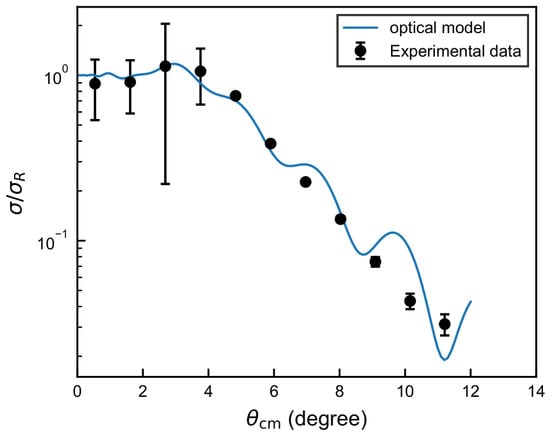
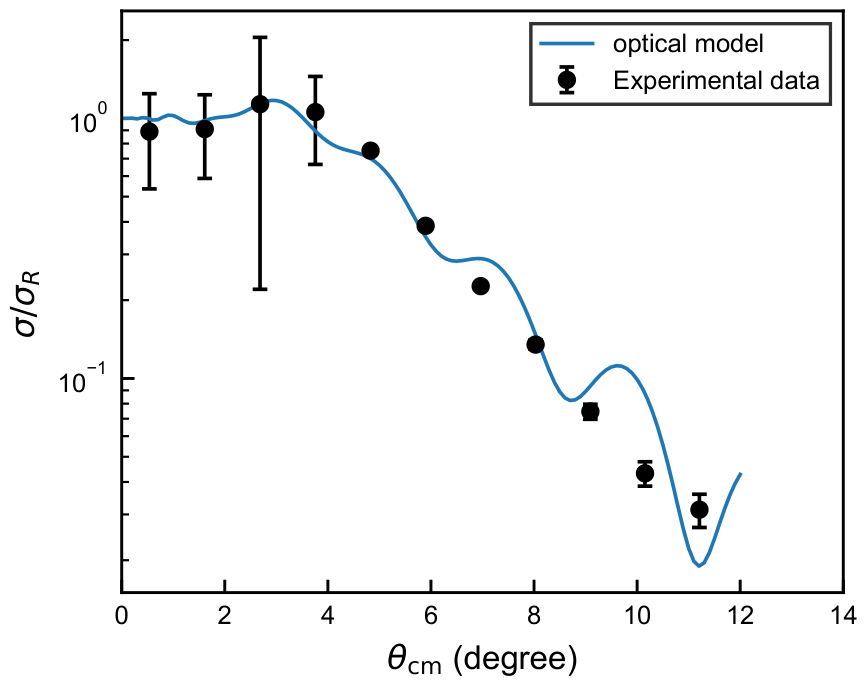
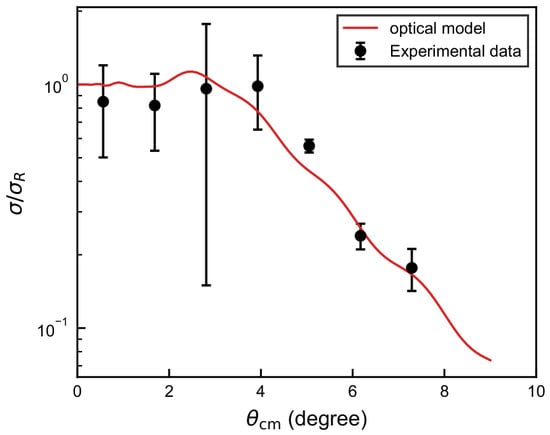
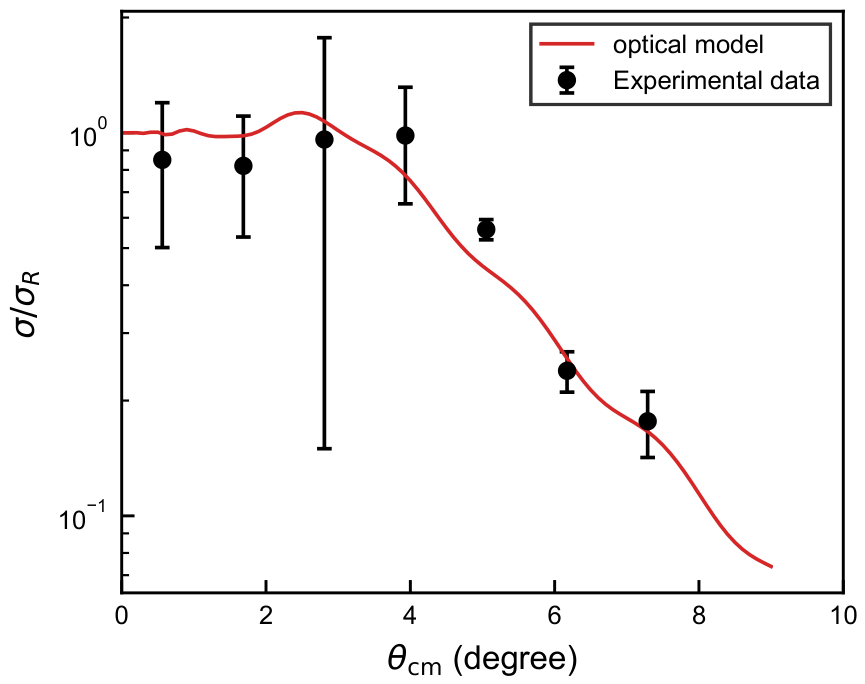
The calculated elastic angular distributions obtained with these optical potentials are compared with the experimental data in Figure 6 and Figure 7. For the 17Ne system, the theoretical curve reproduces the measured cross sections well over the entire angular range, including the Fresnel-type structure at forward angles and the interference oscillations at larger angles, whereas for the 15O system, the fit quality is poorer, indicating limitations of the present optical model description.
Figure 6.
Elastic scattering angular distribution for the 15O + 28Si system at MeV/u. Experimental data are compared with optical model calculations using a double-folding real potential and a Woods–Saxon imaginary potential.
Figure 7.
Elastic scattering angular distribution for the 17Ne + 28Si system at MeV/u. Experimental data are compared with optical model calculations using a double-folding real potential and a Woods–Saxon imaginary potential.
The large difference between the two values in Table 2 deserves an explicit comment. It does not reflect a correspondingly large difference in the absolute deviation between data and calculation, but originates mainly from two effects. First, 15O constitutes about 90% of the cocktail beam whereas 17Ne contributes only a few percent, so the statistical uncertainties of the 15O points are several times smaller and the same fractional deviation produces a much larger . Second, contains only the statistical uncertainty of each point, and no theoretical uncertainty is folded in.
The fits show that a substantially deeper imaginary potential is required for the 17Ne + 28Si system than for 15O + 28Si, indicating a stronger absorption. This difference can be understood in terms of the structural properties of the two projectiles. The weakly bound two-proton drip-line nucleus 17Ne, with its low breakup threshold, is prone to breakup, transfer, and inelastic excitation when approaching the target, opening many direct reaction channels that remove a large fraction of the flux from the elastic channel and thus require a deep imaginary potential to be properly described [2,23]. In contrast, the well-bound stable nucleus 15O has a high breakup threshold, which suppresses the contribution of breakup and related channels, so that absorption is dominated by inelastic excitation and a small number of transfer reactions, and a shallower imaginary potential is sufficient. The systematic difference in the imaginary depths thus provides quantitative evidence for the enhanced role of weak binding in reactions on light- to medium-mass targets.
3.3. Reduced Distance of Closest Approach and Strong-Absorption Observables
To compare the elastic scattering characteristics of different systems and energies in an energy-independent way, we adopt a strong-absorption analysis based on the reduced distance of closest approach d [18,20,21]. Near the Coulomb barrier, assuming that the relative motion of the two nuclei is well-described by a classical Coulomb trajectory, the distance of closest approach D and the center-of-mass scattering angle are related by the standard Coulomb-scattering relation [18,20], given by the following:
where and are the projectile and target charge numbers, and is the center-of-mass incident energy.
To remove the trivial dependence on the overall size of the colliding system, one introduces the reduced distance of closest approach
where and are the projectile and target mass numbers. This transformation allows elastic scattering data for different systems and energies to be represented on a common d axis and compared in a systematic way [20].
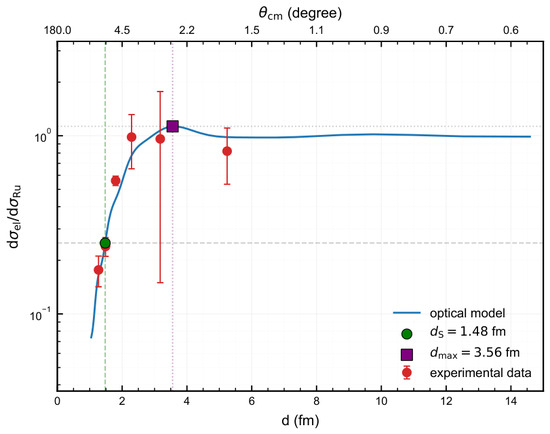
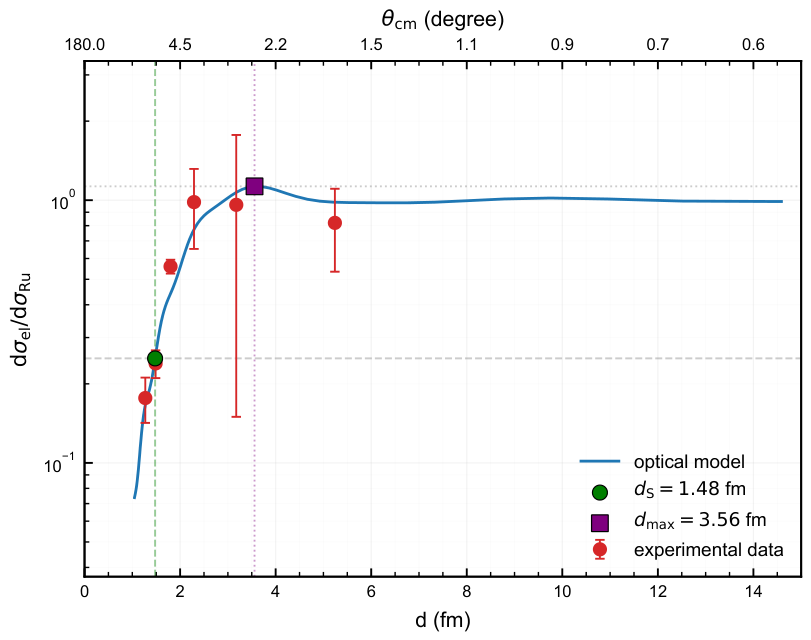
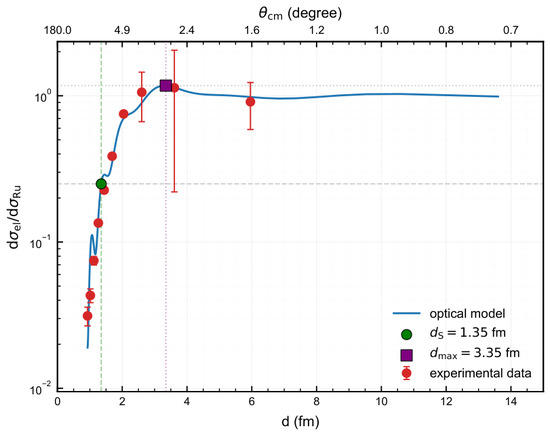
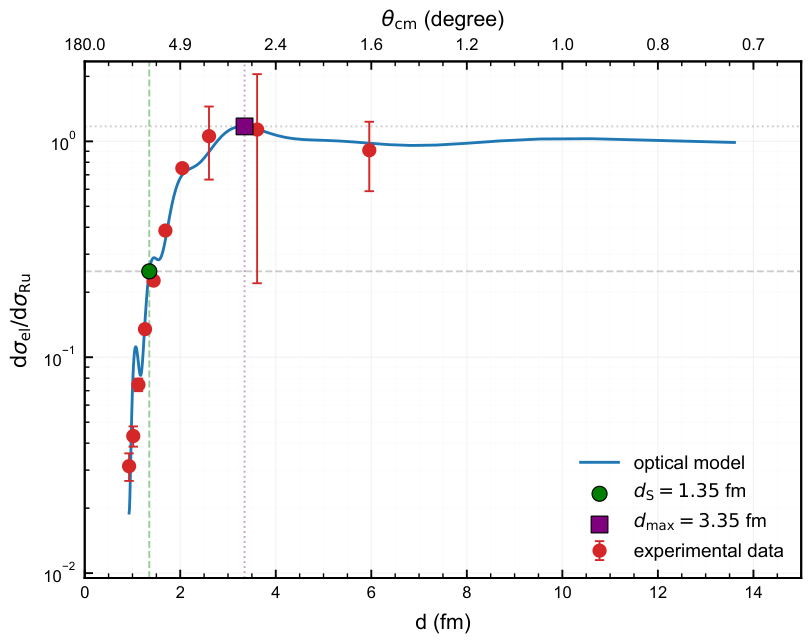
In the present work, both the experimental and optical model elastic differential cross sections were converted into the ratios as functions of d, and plotted on a semi-logarithmic scale for the 17Ne + 28Si and 15O + 28Si systems, as shown in Figure 8 and Figure 9. According to the strong-absorption model, when d is smaller than a critical value, nuclear absorption dominates the reaction and the elastic cross section deviates strongly from the Rutherford prediction. We employ the quarter-point method, defining the strong-absorption distance as the reduced distance at which [18,20]. From , one can further obtain the strong-absorption radius , which characterizes the geometrical scale at which absorption starts to dominate the reaction,
Figure 8.
Ratio of elastic cross section to Rutherford as a function of the reduced distance d for the 17Ne + 28Si system at MeV. Experimental data are compared with optical model calculations using the double-folding real potential and Woods–Saxon imaginary potential.
Figure 9.
Ratio of elastic cross section to Rutherford as a function of the reduced distance d for the 15O + 28Si system at MeV. Experimental data are compared with optical model calculations using the double-folding real potential and Woods–Saxon imaginary potential.
Following the prescription of Ref. [20], the Coulomb barrier height can also be extracted from the quarter-point angle using the relation between energy and angular momentum in the strong-absorption model.
Combining Equations (4)–(7) shows that , i.e., and are related through the Coulomb parameter z by and are therefore not independent observables; the comparison below relies on the fact that z differs by 23% between the two systems while differs by 9%. Systematic analyses for a wide range of systems have shown good agreement between values obtained from elastic scattering and from fusion reactions [20,37], and have demonstrated that scales approximately linearly with the Coulomb parameter
and is largely insensitive to details of nuclear structure.
In the classical strong-absorption model, the reduced distance corresponding to is often defined as the critical interaction distance, marking where nuclear forces first begin to influence the elastic scattering. However, for weakly bound and halo nuclei, strong coupling between the breakup and elastic channels and the associated dynamic polarization potential cause significant deviations from Rutherford scattering already at relatively large d, well outside the region of strong absorption. In particular, an enhancement with may occur in the vicinity of the Fresnel peak [18,20]. In the present work, both the 17Ne + 28Si and 15O + 28Si systems exhibit such Fresnel peak enhancement, indicating that the traditional definition of is no longer adequate to characterize the onset of coupling effects.
We therefore take as a characteristic measure of the maximum coupling strength the reduced distance at which the cross section ratio reaches its maximum. The interval
between the strong-absorption distance and is defined as the effective coupling range, representing the spatial width of the transition region from surface-dominated coupling to volume-dominated absorption [18,21]. In this region, direct reaction channels such as breakup, transfer, and inelastic excitation compete with complete absorption, and the width is highly sensitive to the static spatial extension and dynamical coupling properties of the projectile [18].
Following the above procedure, we used the optical model curves that reproduce the experimental data to extract , , and for the 17Ne + 28Si and 15O + 28Si systems. The results are summarized in Table 3. The uncertainties of and are estimated from the angular resolution and the interpolation uncertainty, with those of , , and propagated accordingly via standard error propagation formulas. It is seen that for 17Ne + 28Si is clearly larger than that for 15O + 28Si, indicating that the strong-absorption region is pushed out to larger distances, consistent with the more diffuse matter distribution of 17Ne and the deeper absorptive potential. The extracted values for both systems fall on the linear –z systematics of Ref. [20], confirming that the Coulomb barrier height is mainly governed by macroscopic quantities such as charge and mass and is rather insensitive to nuclear structure details. By contrast, the effective coupling range is noticeably larger for 17Ne than for 15O, implying that the weakly bound 17Ne, owing to its low breakup threshold and possible halo/skin structure, exhibits more pronounced long-range coupling effects, which extend the region where nonelastic and breakup channels significantly influence the elastic scattering.
To place the present values in a broader context, we first examine the relative change in the strong-absorption distance between the two-proton halo candidate 17Ne and its tightly bound core 15O. The extracted for 17Ne is 1.48 fm, exceeding that of 15O by 0.13 fm. This increment directly reflects the spatial extension of the valence protons and serves as a macroscopic signature of a diffuse matter distribution in 17Ne. We then compare this difference with the systematics established by Yang et al. [20], who analyzed a comprehensive dataset of elastic scattering and identified that halo nuclei typically exhibit values 0.05–0.22 fm larger than those of tightly bound projectiles (see Figure 2 of Ref. [20]). The observed 0.13 fm enhancement for 17Ne falls squarely within this characteristic halo interval, thereby quantitatively confirming the systematic trend that a more diffuse, weakly bound projectile is associated with a larger strong-absorption distance.
4. Summary
Elastic scattering of 17Ne and 15O from a 28Si target has been measured, and the data have been analyzed within the framework of double-folding optical potentials. Folding calculations reveal the real potential remains essentially unchanged after mass scaling removed, implying structural effects do not manifest there. Optical model fits further reveal that the imaginary part of the potential is significantly deeper for the 17Ne + 28Si system, reflecting stronger absorption and coupling to nonelastic channels. The reduced distance analysis yields larger values of both and for 17Ne, while follows the established Coulomb-barrier systematics. Taken together, these results demonstrate, from both the nuclear potential and strong-absorption perspectives, that the weak binding and diffuse structure of 17Ne play a key role in its reaction dynamics on a light- to medium-mass target.
Author Contributions
Conceptualization, F.L.; methodology, H.J., C.G. and F.L.; software, L.L., H.J. and C.G.; validation, H.J., C.G. and F.L.; formal analysis, H.J., C.G. and F.L.; investigation, H.J., C.G. and F.L.; resources, F.L., J.L., Q.H. and J.W., P.M.; data curation, F.L.; writing—original draft preparation, H.J. and C.G.; writing—review and editing, F.L.; visualization, H.J. and C.G.; supervision, F.L., D.F., T.L.; project administration, F.L.; funding acquisition, F.L., J.L. and J.W. All authors have read and agreed to the published version of the manuscript.
Funding
This research was supported by the National Key R&D Program of China (No. 2023YFA1606701) and the National Natural Science Foundation of China (No. U2441220, U1332129, U1332126, U20321240).
Institutional Review Board Statement
Not applicable.
Informed Consent Statement
Not applicable.
Data Availability Statement
The data presented in this study are available on request from the corresponding author due to the ongoing nature of the research and institutional data management policies.
Acknowledgments
The authors would like to thank the staff of the HIRFL–RIBLL facility, the experimental team of Shanghai Institute of Applied Physics, Institute of Modern Physics and Peking University for their support during the experiment.
Conflicts of Interest
The authors declare no conflicts of interest.
References
- Tanihata, I.; Savajols, H.; Kanungo, R. Recent experimental progress in nuclear halo structure studies. Prog. Part. Nucl. Phys. 2013, 68, 215–313. [Google Scholar] [CrossRef] [Scilit]
- Canto, L.F.; Gomes, P.R.S.; Donangelo, R.; Lubian, J.; Hussein, M.S. Recent developments in fusion and direct reactions with weakly bound nuclei. Phys. Rep. 2015, 596, 1–86. [Google Scholar] [CrossRef] [Scilit]
- Kolata, J.J.; Guimarães, V.; Aguilera, E.F. Elastic scattering, fusion, and breakup of light exotic nuclei. Eur. Phys. J. A 2016, 52, 123. [Google Scholar] [CrossRef] [Scilit]
- Keeley, N.; Alamanos, N.; Kemper, K.W.; Rusek, K. Elastic scattering and reactions of light exotic beams. Prog. Part. Nucl. Phys. 2009, 63, 396–447. [Google Scholar] [CrossRef] [Scilit]
- Di Pietro, A.; Randisi, G.; Scuderi, V.; Acosta, L.; Amorini, F.; Borge, M.J.G.; Figuera, P.; Fisichella, M.; Fraile, L.M.; Gomez-Camacho, J.; et al. Elastic scattering and reaction mechanisms of the halo nucleus 11Be around the Coulomb barrier. Phys. Rev. Lett. 2010, 105, 022701. [Google Scholar] [CrossRef] [Scilit]
- Duan, F.F.; Yang, Y.Y.; Lei, J.; Wang, K.; Sun, Z.Y.; Pang, D.Y.; Wang, J.S.; Liu, X.; Xu, S.W.; Ma, J.B.; et al. Elastic scattering and breakup reactions of the neutron-rich nucleus 11Be on 208Pb at 210 MeV. Phys. Rev. C 2022, 105, 034602. [Google Scholar] [CrossRef] [Scilit]
- Yang, Y.Y.; Wang, J.S.; Wang, Q.; Pang, D.Y.; Ma, J.B.; Huang, M.R.; Han, J.L.; Ma, P.; Jin, S.L.; Bai, Z.; et al. Elastic scattering of the proton drip-line nucleus 8B off a natPb target at 170.3 MeV. Phys. Rev. C 2013, 87, 044613. [Google Scholar] [CrossRef] [Scilit]
- Aguilera, E.F.; Martinez-Quiroz, E.; Lizcano, D.; Gomez-Camacho, A.; Kolata, J.J.; Lamm, L.O.; Guimarães, V.; Lichtenthaler, R.; Camargo, O.; Becchetti, F.D.; et al. Reaction cross sections for 8B, 7Be, and 6Li+58Ni near the Coulomb barrier: Proton-halo effects. Phys. Rev. C 2009, 79, 021601. [Google Scholar]
- Di Pietro, A.; Figuera, P.; Amorini, F.; Angulo, C.; Cardella, G.; Cherubini, S.; Davinson, T.; Leanza, D.; Lu, J.; Mahmud, H.; et al. Reactions induced by the halo nucleus 6He at energies around the Coulomb barrier. Phys. Rev. C 2004, 69, 044613. [Google Scholar] [CrossRef] [Scilit]
- Zhukov, M.V.; Thompson, I.J. Existence of proton halos near the drip line. Phys. Rev. C 1995, 52, 3505–3508. [Google Scholar] [CrossRef] [Scilit]
- Ozawa, A.; Kobayashi, T.; Sato, H.; Hirata, D.; Tanihata, I.; Yamakawa, O.; Omata, K.; Sugimoto, K.; Olson, D.; Christie, W.; et al. Interaction cross sections and radii of the mass number A=17 isobar (17N, 17F, and 17Ne). Phys. Lett. B 1994, 334, 18–22. [Google Scholar] [CrossRef] [Scilit]
- Kanungo, R.; Chiba, M.; Adhikari, S.; Fang, D.Q.; Iwasa, N.; Kimura, K.; Maeda, K.; Nishimura, S.; Ohnishi, T.; Ozawa, A.; et al. Possibility of a two-proton halo in 17Ne. Phys. Lett. B 2003, 571, 21–28. [Google Scholar] [CrossRef] [Scilit]
- Lehr, C.; Wamers, F.; Aksouh, F.; Aksyutina, Y.; Álvarez-Pol, H.; Atar, L.; Aumann, T.; Beceiro-Novo, S.; Bertulani, C.A.; Boretzky, K.; et al. Unveiling the two-proton halo character of 17Ne: Exclusive measurement of quasi-free proton-knockout reactions. Phys. Lett. B 2022, 827, 136957. [Google Scholar] [CrossRef] [Scilit]
- Satchler, G.R.; Love, W.G. Folding model potentials from realistic interactions for heavy-ion scattering. Phys. Rep. 1979, 55, 183–254. [Google Scholar] [CrossRef] [Scilit]
- Kobos, A.M.; Brown, B.A.; Hodgson, P.E.; Satchler, G.R.; Budzanowski, A. Folding model analysis of α-particle elastic scattering with a semirealistic density-dependent effective interaction. Nucl. Phys. A 1982, 384, 65–87. [Google Scholar] [CrossRef] [Scilit]
- Khoa, D.T.; von Oertzen, W.; Bohlen, H.G. Double-folding model for heavy-ion optical potential: Revised and applied to study 12C and 16O elastic scattering. Phys. Rev. C 1994, 49, 1652–1668. [Google Scholar] [CrossRef] [Scilit]
- Brandan, M.E.; Satchler, G.R. The interaction between light heavy-ions and what it tells us. Phys. Rep. 1997, 285, 143–243. [Google Scholar] [CrossRef] [Scilit]
- Guimarães, V.; Lubian, J.; Kolata, J.J.; Aguilera, E.F.; Assunção, M.; Morcelle, V. Phenomenological critical interaction distance from elastic scattering measurements on a 208Pb target. Eur. Phys. J. A 2018, 54, 223. [Google Scholar] [CrossRef] [Scilit]
- Karakoç, M. BiFold: A Python code for the calculation of double-folded (bifold) potentials with density-in/dependent nucleon-nucleon interactions. Comput. Phys. Commun. 2023, 284, 108613. [Google Scholar] [CrossRef] [Scilit]
- Yang, Y.; Wen, P.W.; Lin, C.J.; Jia, H.M.; Yang, L.; Ma, N.R.; Yang, F.; Luo, T.P.; Mo, T.H.; Chang, C.; et al. Systematic extraction of the strong absorption distance and Coulomb barrier from elastic scattering. Chin. Phys. C 2023, 47, 124104. [Google Scholar] [CrossRef] [Scilit]
- Cubero, M.; Fernández-García, J.P.; Rodríguez-Gallardo, M.; Acosta, L.; Alcorta, M.; Alvarez, M.; Borge, M.; Buchmann, L.; Diget, C.; Falou, H.; et al. Do halo nuclei follow Rutherford elastic scattering at energies below the barrier? The case of 11Li. Phys. Rev. Lett. 2012, 109, 262701. [Google Scholar] [CrossRef] [Scilit]
- Christensen, P.R.; Winther, A. The evidence of the ion–ion potentials from heavy ion elastic scattering. Phys. Lett. B 1976, 65, 19–22. [Google Scholar] [CrossRef] [Scilit]
- Nunes, F.M.; Thompson, I.J. Nuclear interference effects in 8B sub-Coulomb breakup. Phys. Rev. C 1998, 57, 2818–2820. [Google Scholar] [CrossRef] [Scilit]
- Kakuee, O.R.; Rahighi, J.; Sánchez-Benítez, A.M.; Andrés, M.V.; Cherubini, S.; Davinson, T.; Galster, W.; Gómez-Camacho, J.; Laird, A.M.; Lamehi-Rachti, M.; et al. Elastic scattering of the halo nucleus 6He from 208Pb above the Coulomb barrier. Nucl. Phys. A 2003, 728, 339–349. [Google Scholar] [CrossRef] [Scilit]
- Ovejas, J.D.; Martel, I.; Dell’Aquila, D.; Acosta, L.; Aguado, J.L.; de Angelis, G.; Borge, M.J.G.; Briz, J.A.; Chbihi, A.; Colucci, G.; et al. Suppression of Coulomb-nuclear interference in the near-barrier elastic scattering of 17Ne from 208Pb. Phys. Lett. B 2023, 843, 138007. [Google Scholar] [CrossRef] [Scilit]
- Heo, K.; Cheoun, M.K.; Choi, K.S.; Kim, K.S.; So, W.Y. Suppression of the elastic scattering cross section for the 17Ne + 208Pb system. Phys. Rev. C 2024, 109, 024603. [Google Scholar] [CrossRef] [Scilit]
- Sun, Z.; Zhan, W.L.; Guo, Z.Y.; Xiao, G.; Li, J.X. RIBLL, the radioactive ion beam line in Lanzhou. Nucl. Instrum. Methods Phys. Res. A 2003, 503, 496–503. [Google Scholar] [CrossRef] [Scilit]
- Zhan, W.L.; Guo, Z.Y.; Liu, G.H.; Dang, J.R.; He, R.R.; Zhou, S.X.; Yin, Q.M.; Luo, Y.X.; Wang, Y.F.; Wei, B.W.; et al. Radioactive ion beam line in Lanzhou. Sci. China Ser. A 1999, 42, 528–536. [Google Scholar] [CrossRef] [Scilit][Green Version]
- Xia, J.W.; Zhan, W.L.; Wei, B.W.; Yuan, Y.J.; Song, M.T.; Zhang, W.Z.; Yang, X.D.; Yuan, P.; Gao, D.Q.; Zhao, H.W.; et al. The heavy ion cooler-storage-ring project (HIRFL-CSR) at Lanzhou. Nucl. Instrum. Methods Phys. Res. A 2002, 488, 11–25. [Google Scholar] [CrossRef] [Scilit]
- Jiang, H.; Lu, F.; Liu, L.X.; Pang, D.Y.; Fang, D.Q.; Ma, Y.G.; Li, J.X.; Hu, Q.; Wang, J.S.; Yang, Y.Y.; et al. A measurement method for small-angle direct-reaction products of radioactive ion beams. Nucl. Sci. Tech. 2026; submitted.
- Khoa, D.T.; von Oertzen, W.; Bohlen, H.G.; Bartnitzky, G.; Clement, H.; Sugiyama, Y.; Gebauer, B.; Ostrowski, A.N.; Wilpert, T.; Wilpert, M.; et al. Equation of state for cold nuclear matter from refractive 16O + 16O elastic scattering. Phys. Rev. Lett. 1995, 74, 34–37. [Google Scholar] [CrossRef] [Scilit]
- Khoa, D.T.; von Oertzen, W. A nuclear matter study using the density dependent M3Y interaction. Phys. Lett. B 1993, 304, 8–16. [Google Scholar] [CrossRef] [Scilit]
- Capote, R.; Herman, M.; Oblǒzinský, P.; Young, P.G.; Goriely, S.; Belgya, T.; Ignatyuk, A.V.; Koning, A.J.; Hilaire, S.; Plujko, V.A.; et al. RIPL–Reference Input Parameter Library for calculation of nuclear reactions and nuclear data evaluations. Nucl. Data Sheets 2009, 110, 3107–3214. [Google Scholar] [CrossRef] [Scilit]
- Thompson, I.J. FRESCO: A Coupled-Channels Scattering Code, Version FRES 3.4. October 2020. Available online: https://github.com/I-Thompson/fresco (accessed on 31 March 2026).
- Thompson, I.J. Coupled reaction channels calculations in nuclear physics. Comput. Phys. Rep. 1988, 7, 167–212. [Google Scholar] [CrossRef] [Scilit]
- Heo, K.; Gil, H.; Choi, K.S.; Kim, K.S.; Hyun, C.H.; So, W.Y. Folding potential with modern nuclear density functionals and application to the 16O + 208Pb reaction. Phys. Rev. C 2024, 110, 034616. [Google Scholar] [CrossRef] [Scilit]
- Bass, R. Nuclear Reactions with Heavy Ions; Springer: Berlin/Heidelberg, Germany, 2010. [Google Scholar]

Disclaimer/Publisher’s Note: The statements, opinions and data contained in all publications are solely those of the individual author(s) and contributor(s) and not of MDPI and/or the editor(s). MDPI and/or the editor(s) disclaim responsibility for any injury to people or property resulting from any ideas, methods, instructions or products referred to in the content. |
© 2026 by the authors. Licensee MDPI, Basel, Switzerland. This article is an open access article distributed under the terms and conditions of the Creative Commons Attribution (CC BY) license.