


Abstract
Laser-driven proton acceleration in hydrogen-rich media can be strongly modified by embedded plasmonic nanoantennas that localize electromagnetic energy on nanometer scales. The National Ignition Facility (NIF) project at the Lawrence Livermore National Laboratory has achieved 8.6 MJ of fusion energy output from an estimated 2 MJ of energy delivered to the target. This has led to several laser fusion startup projects. Most of these operate on the same principle as the NIF project: relatively slow, mechanical compression and the resulting large thermal temperature increase. Most often, cryogenically frozen deuterium–tritium fuel is used in this reaction. This initial conventional method has disadvantages. The strongly compressed target expands faster than the fusion burn from the ignited center, so only a small part of the target fuses, and slow mechanical instabilities may also develop. The NAPLIFE Collaboration uses another method with radiation-dominated limited compression, aiming for simultaneous ignition. This is achieved by nanotechnology; laser light absorption is regulated by resonant nanoantennas.
1. Introduction
Resonant metallic nanoantennas are one of the most effective approaches for enhancing electromagnetic energy deposition in laser-induced fusion targets. In such systems, nanoantennas act as plasmonic resonators that concentrate the incident electromagnetic radiation into nanoscale volumes, increasing local field intensity and facilitating ionization and particle acceleration in their vicinity [1,2,3].
The early implementations of plasmonic resonators focused primarily on core–shell or spherical nanoparticles, which efficiently absorb and scatter light from all directions, thus serving as omnidirectional receivers for solar and thermal radiation [4]. Later, similar field enhancement principles were incorporated into high-energy-density physics, notably in the context of inertial confinement fusion (ICF). The National Ignition Facility (NIF) at Lawrence Livermore National Laboratory employed cylindrically symmetric X-ray “hohlraum” irradiation to compress deuterium–tritium (DT) microcapsules to fusion conditions [5]. While highly effective in achieving isotropic compression to a central hot-spot with extreme pressure, the resulting expansion becomes faster than the spreading of nuclear fusion. Thus, only part of the target fuel is “burning”, which inherently limits efficiency.
As early as the 1970s, it was observed that electrons could be extracted from the surface of gold samples with nanosecond laser pulses at intensities of around 1010 W/cm2—as opposed to the expected values of around 1014 W/cm2. It was soon proven that so-called surface plasmon polaritons were responsible for this discrepancy [6]. These plasmons can collect the energy of the laser pulses at a small volume on the nanoparticles of suitable materials. Due to this property, surface plasmons can also be considered to excite the resonant nanoworld, and this can lead to nuclear reactions [7]. The lifetime of surface plasmons in the case of gold nanoparticles is in the range of a few tens of femtoseconds; therefore Ti:Sa lasers operating in this time range are optimal for our application. It was therefore natural to try to combine this technology with nuclear processes that result in nuclear fusion. Thus, we can get rid of several problems (see below) that occur with “slow” laser pulses, sometimes 10 nanoseconds long. This is how the new method was developed.
Nanotechnology was already used earlier in laser-induced fusion energy projects, but these did not use resonant nanoantenna arrays tuned precisely to laser frequency and polarization. A recent review [8] summarizes about 150 (!) such works, which primarily use nanoparticles to increase light absorption and thereby raise the temperature of the system as in solar panels. Nanowires force the laser energy deep into the target before it expands, creating ultra-high-energy-density plasmas and preventing plasma mirror effects [9,10]. These are essential for driving target core compression. Arrays of structured nanowires with short pulse lasers directly maximize the localized plasma temperatures required for fusion and also counteract plasma mirror effects [11]. Nanoparticles may influence the spatial and temporal shape of a laser’s impact on inertial confinement fusion targets, while random sizes of nanoparticles were used to enhance light absorption [12]. Nanofoam targets for laser-driven inertial fusion were also used in several experiments [13,14], primarily to achieve stronger compression and to avoid instabilities.
2. The NAPLIFE Method
New strategies emerged aiming to bypass thermalization and achieve direct, non-thermal energy transfer. Within this context, the NAPLIFE collaboration proposed the concept of radiation-dominated implosion in flat, two-sided irradiated targets, exploiting linearly polarized, monochromatic laser irradiation to drive collective plasmonic oscillations in the embedded nanoantennas [2,3,4]. The resonating nanoantennas can directly accelerate protons from ionized hydrogen atoms. This configuration enables moderate, bidirectional plasma compression and proton acceleration in the direction of the dipole antennas, without relying on global heating. The approach is inherently scalable, more energy-efficient, and compatible with nanostructured target design.
A patent application was filed in 2017 [15] for a new method of laser fusion. We described this in a short publication [2]. Then, in 2019, the NAPLIFE collaboration was established in Kőszeg [16]. The method proposed by NAPLIFE was first published in detail in 2020 [3]. The need for the new method was inspired by ultra-relativistic heavy ion reaction research and the results from plasmonics, where radiation-dominated energy-emitting detonations behave fundamentally differently.
The burning (hadronization) of the quark–gluon plasma produced in such reactions typically occurs simultaneously in most of the reaction volume. This was considered impossible by the followers of the initial, traditional approach, because they follow either the non-relativistic Rankine–Hugoniot description or the constrained relativistic version of Taub [17]. This was corrected and generalized by Csernai but only in 1987 [1]. By that time, it had already been experimentally shown that Taub’s description was incomplete. Unfortunately, this description has been adopted by most textbooks until now.
The description of detonations can be derived from the conservation of energy and momentum and is therefore valid for both thermal and non-thermal systems. Consequently, fusion must be ignited with a laser pulse, short enough that the light passes through the target once and only once. A further condition is that the irradiation from the two directions must be synchronized so that their superposition is constructive. This requires an accuracy of 1 femtosecond. These requirements can be met by ELI ALPS.
In laser-induced fusion, the initial laser light is close to monochromatic, not thermal, and polarized in the transverse direction. In the final state, we also want to extract electric current rather than heat. Thus, each thermalization step results in a decrease in efficiency. One of the essential features of our method is that we try to avoid each thermalization step. In the case of NIF, most of the incoming 400 MJ energy is already lost in the “hohlraum” containing the target DT pellet, and only ~2 MJ reaches the DT pellet. In the traditional method, an attempt is made to enhance the absorption of light by a series of shock waves.
3. Experimental Status
Using a small tabletop Ti:Sa laser with 25 mJ pulses, we already demonstrated that a single laser beam can induce proton → deuteron and proton + 11B → 3 α nuclear reactions [4,7] and that these processes are accompanied by energy release. Deuteron formation occurs via nuclear transmutation from the different nuclei of the target polymer, C, N, and O. The new method uses the theory of radiation-dominated detonation as well as the latest results in heavy ion physics. Thus, we obtain a non-thermal and moderate but very rapidly compressed, room-temperature target with non-radioactive fusion fuel and reaction products. The non-thermal nature and the ignition from two directions greatly improve the efficiency of the process and also enable industrial-scale application.
Controlling the absorption of laser light in a fusion target is not trivial; in our method, we solve this for the first time using nanotechnology. We used ignition laser pulses of vacuum wavelength 800 nm, a period of 2.65 fs and pulse length between 30 and 250 fs, i.e., ~12–95 wave periods. Thus, in most of the tests, irradiation was close to monochromatic. In our method, we take advantage of the fact that laser light is close to monochromatic, so we implant gold nanorod antennas in the target, resonant at this frequency, with which we can control the absorption of laser light. These nanorod antennas are perpendicular to the direction of the laser light (thus parallel to the electric field vector) to control and maximize absorption. The plasmonic electron wave vibrating in the nanorod antennas, as a vibrating dipole, accelerates the protons next to the rod to an energy of 150–200 keV even at a laser energy of 25 mJ. The protons accelerated in this way are non-thermal, their energy is almost the same, and their direction is almost parallel to the nanorod antennas [18]. Thus, we managed to create a p + 11B reaction without thermalization and compression with a laser energy of 25 mJ [19]. Another key feature of the method followed by NAPLIFE is the appropriate nanotechnological design of the target. This is currently under development—in terms of both target arrangement and target production. The University of Debrecen, the Budapest University of Technology and Economics, the ELI ALPS Ultrafast Nanotechnology Department, and the Nanotechnology Group of the University of Bergen within the framework of the FUSENOW collaboration are also involved in this development.
One objection to our method is that high-temperature ionized gas, plasma, similarly to metals, does not allow light to pass through the target; laser light can only penetrate to the skin depth. We have investigated the penetration of laser light into plasma in detail in our experiments, and since 2022, we have published our findings in numerous publications and lectures. The depth of the crater created by laser light for a laser pulse with a pulse energy of 25 mJ and an intensity of 1017 W/cm2 is 27 micrometers, while if nanorod antennas are implanted in the target, this increases to 45 micrometers [19]. The craters on the irradiated target are visible to the naked eye, and the images of their surfaces are convincing. Recent articles also show that plasma reflection ceases at high intensities [20,21].
In the conventional method used by NIF, the extreme compression of the target takes approximately 10 nanoseconds, which is of course not relevant to us, since compression is not the goal. Extreme compression apparently causes more problems than benefits. In our method, the protons are directly accelerated by the dipole field created by the resonant electrons, and their motion is not thermal at all. The directly accelerated protons do indeed produce p + 11B fusion, as shown in the experiment [4]. The emitted α-particles were observed and were also confirmed in subsequent experiments.
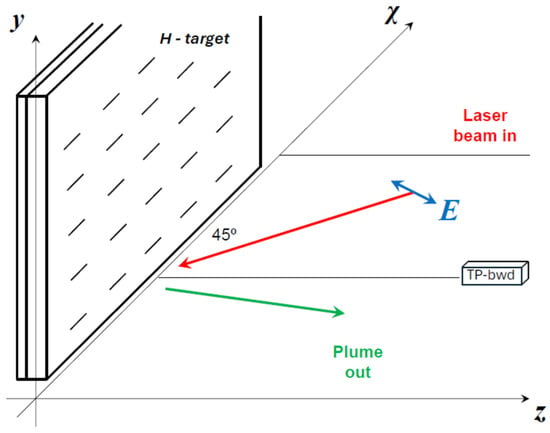
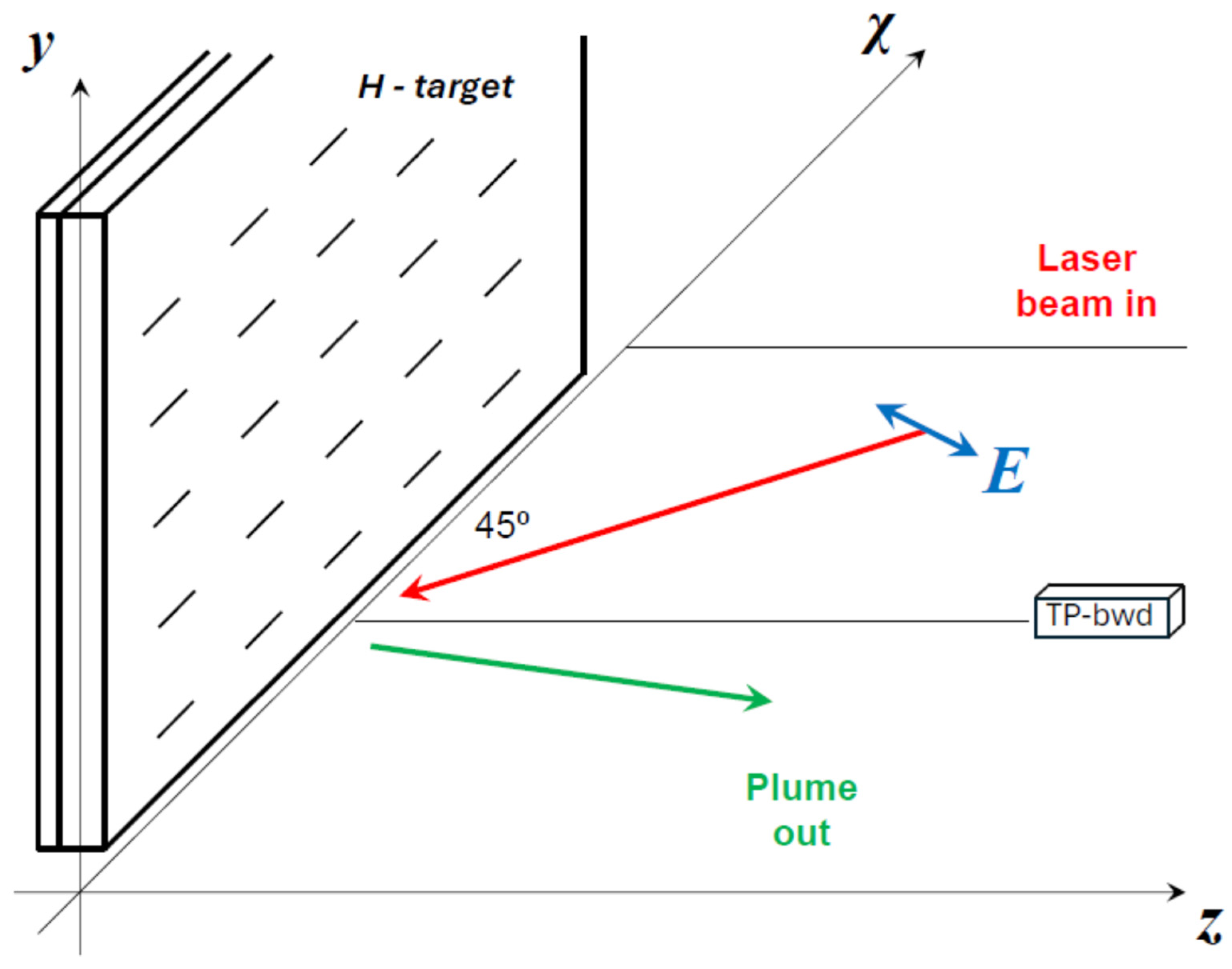
In addition to achieving nuclear reactions like deuterium formation [7] and nuclear fusion, including p + 11B reactions [4], we also succeeded in verifying that protons are accelerated in the direction of the nanorod antennas, which is close to the polarization direction of the incident laser beam, as shown in Figure 1.
Figure 1.
The test of directional proton acceleration by the antenna array of nanorods which are approximately parallel to the polarization of the incident laser beam, in the horizontal plane of the target chamber. The reflected, accelerated protons are preferably emitted in this horizontal plane and were detected by the backward Thomson parabola detector (TP-bwd). From ref. [22].
4. Industrial Realization
In the traditional method, industrial-scale implementation is hardly conceivable with the required complicated cryogenic target with an ablator surface. The production of a target and the cryogenic technology of energy production involve costs that make the traditional method not feasible on an industrial scale. The industrial implementation of the method introduced by us and currently under development can be much more favorable. The direction of the laser injection, the emission of the resulting reaction products and the introduction of the fusion fuel and the target(s) are possible in three mutually perpendicular directions. The cost of producing the target is also orders of magnitude lower and does not require either cryogenic or radioactive technology.
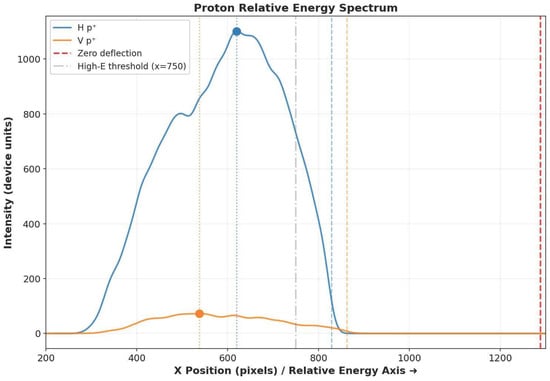
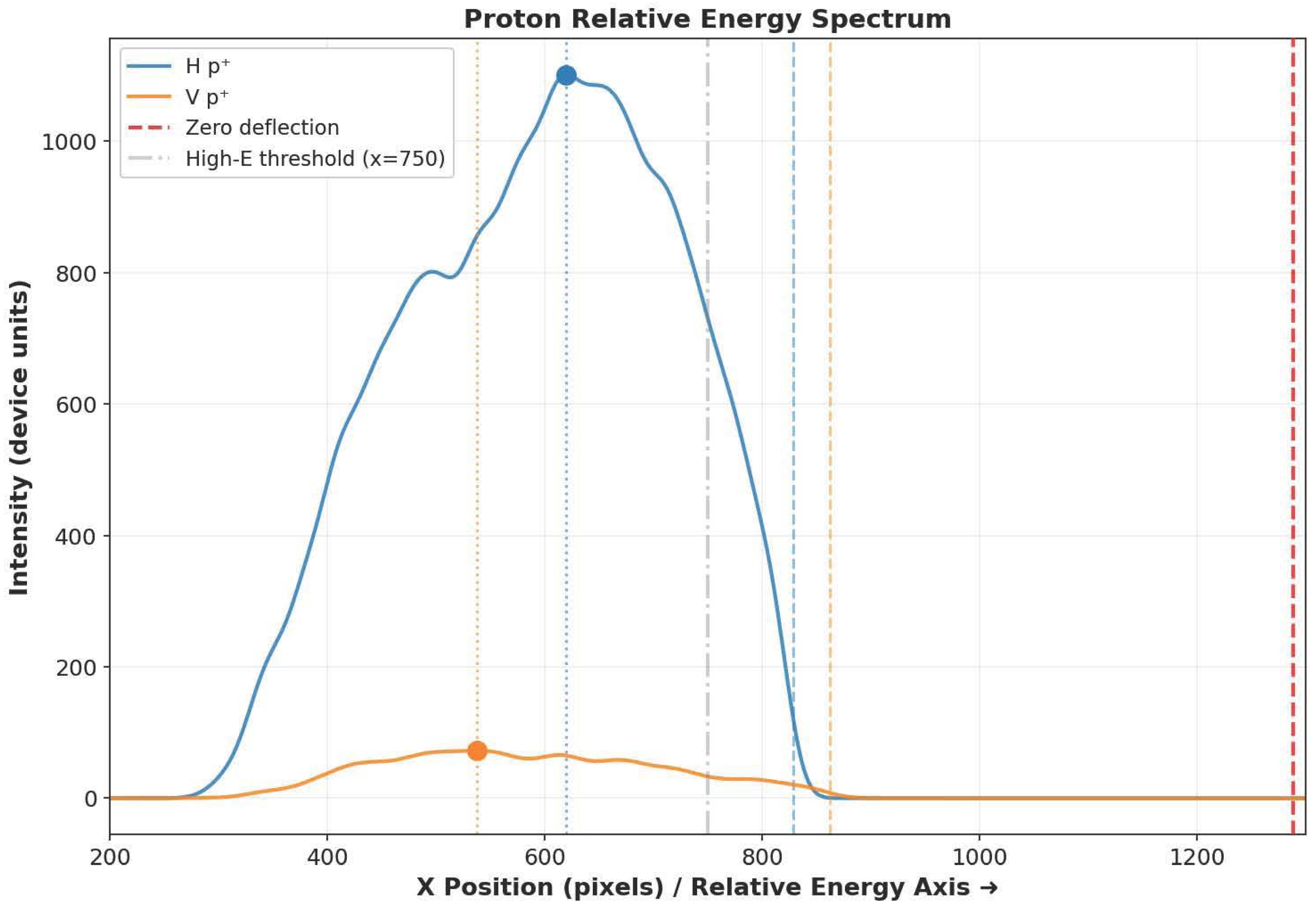
The accelerated protons had a sharp peak at a given energy and (horizontal) direction, and at the energy maximum, they had more than an order of magnitude higher intensity than in the orthogonal (vertical) direction, as shown in Figure 2. This indicates that up to the stage of ignition, we avoid thermalization and the connected losses. Thus, we maximize efficiency as much as possible. Even in the next stage during the nuclear fusion reaction, we maintain this preferred direction for the fusion reaction products, keeping the final distribution non-thermal.
Figure 2.
The relative energy spectrum of emitted protons with respect to the zero deflection point energy (x = 1280, red dashed line) after the irradiation of targets with horizontal (H, blue line) and vertical (V yellow line) nanorod targets, measured by the TP-bwd detector in the z-direction. The horizontal target has nanorod antennas that are at 450 to the polarization vector direction of the incident laser light, while the vertical target has nanorod antennas orthogonal to the polarization of the laser light. Partly parallel polarization leads to increased resonance and proton acceleration; both energy and the proton number are significantly larger in this case. From ref. [22].
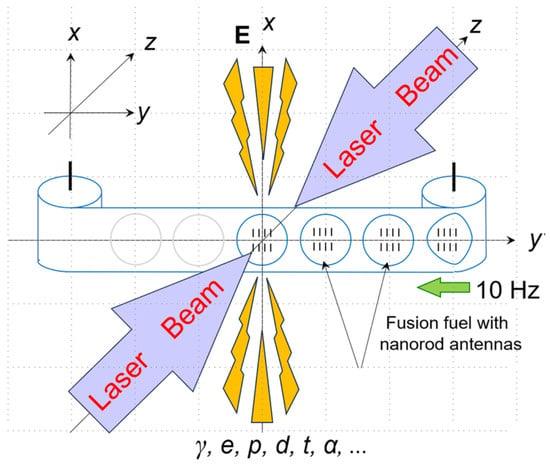
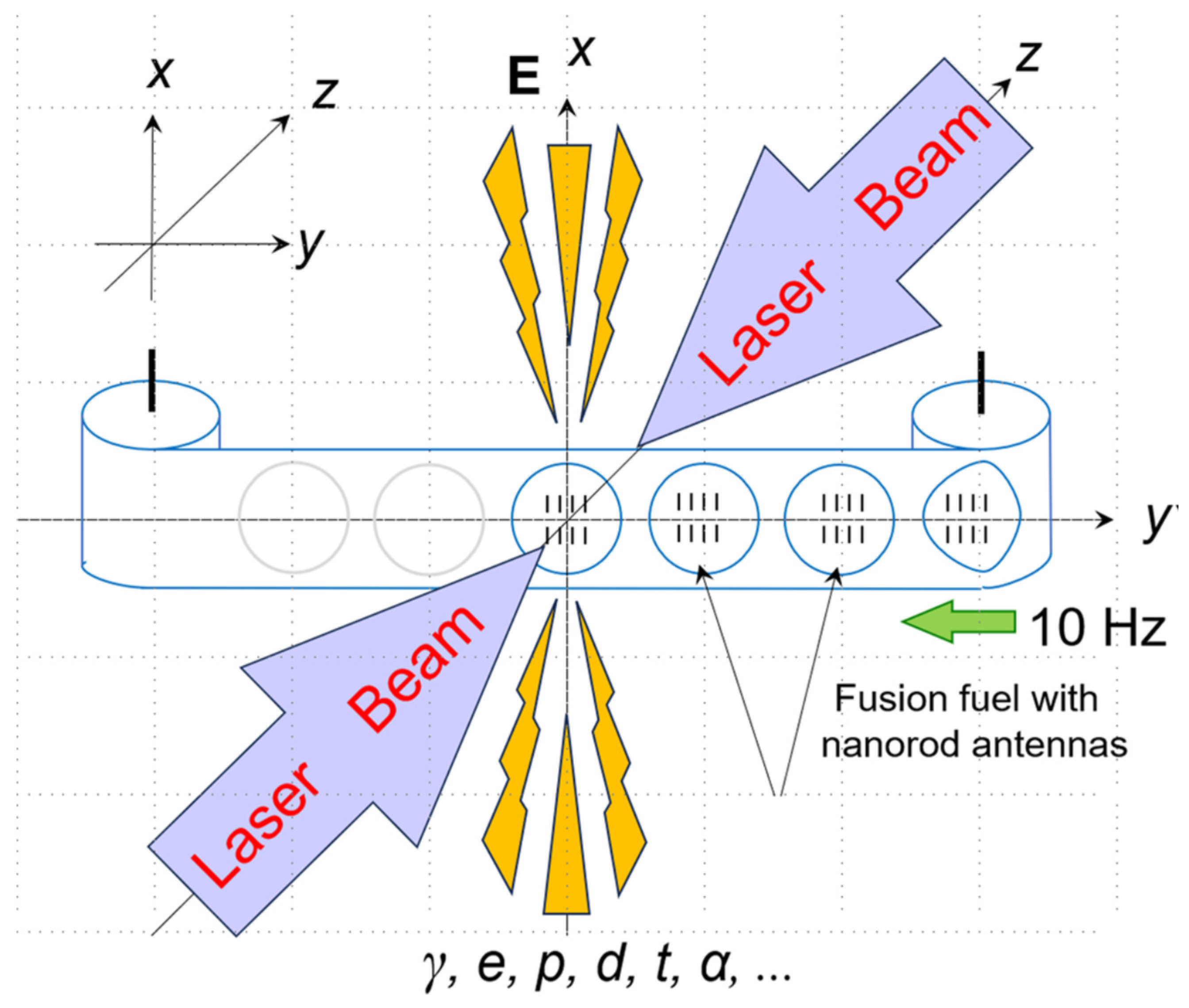
The directed proton acceleration in the direction of the embedded nanorod antennas and its realization in targets with an antenna array of directed nanorod antennas [22] enable us to design a favorable industrial configuration, as shown in Figure 3. Present laser technology with pulse energies around 10 J allows for repetition frequencies up to about 10 Hz. Future developments may increase this frequency, as well as the feed frequency by about an order of magnitude.
Figure 3.
The industrial-scale realization of a fusion reaction with a high repetition rate. The incident laser beam (z-directed), its polarization, the nanorod antennas, and the preferred emission of fusion reaction [4] products (x-direction) are orthogonal to each other [20]. This enables us to feed targets sequentially from the third orthogonal y-direction. The feed of targets is mechanically possible at a frequency of 25 Hz or with dynamic adaptive optics at an even higher frequency. From ref. [23].
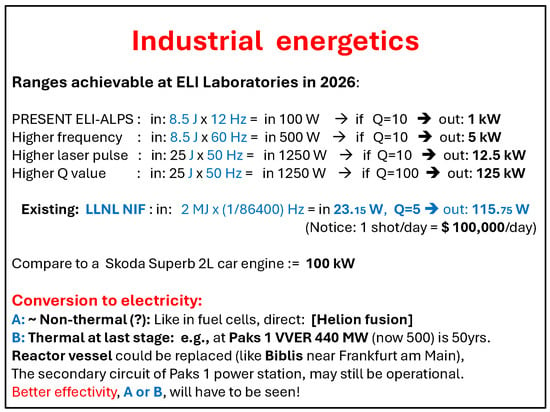
The decisive issue is the efficiency of a given laser-induced nuclear fusion method. By eliminating losses, as much as possible, one may scale down energy production technology to an affordable level, as indicated in Figure 4. Present laser-induced fusion methods are still far from being energetically positive. Two issues are essential: (I) avoiding thermalization losses and (II) avoiding losses from impractical reaction geometry.
Figure 4.
Fusion reactions have no critical mass for chain reactions and can consequently be scaled down. On the other hand, technology limits efficiency, which provides a lower limit at which efficiency remains positive. The scaling of laser pulse energy, pulse frequency and fusion reaction gain, Q, allows for different lower limits of electric energy production. Non-thermal conversion to electricity is under development by the Helion fusion project.
I: Most present approaches immediately thermalize the incoming laser energy (e.g., in a hohlraum), although the incoming laser beam is not thermal. Given two-sided laser irradiation, non-thermal proton acceleration is possible, and this non-thermal feature is inherited to some extent by the fusion reaction products. This configuration resembles particle accelerators but attempts to apply the principle to a macroscopic amount of material.
II: Most present affordable and non-thermal approaches use one incoming laser beam. Due to energy and momentum conservation, the incoming momentum and energy of the projectile (usually the lighter element of the fusion fuel, like of protons) are conserved and taken away from the system, in the direction of the incoming laser beam. Thus, only (a smaller) part of the incoming energy fuels fusion reactions. This can be avoided by irradiation from two (almost) opposite sides, which reduces the incoming momentum to zero and allows all incoming energy to be used for fusion. This is the reasoning of the “little boy” geometry. Unfortunately, two-sided irradiation is hardly accessible at present high-power laser facilities.
The international NAPLIFE collaboration is open to all partners and organizations wishing to participate in the development of the method and positively contribute to it. Several university researchers and research groups have already participated in the development of the method. The cornerstones of the NAPLIFE collaboration are Wigner FK Budapest and ELI ALPS, Szeged. The latter partner is special because the desired high-precision (femtosecond) laser beam is only available here today. As a result of their achievements, Norway (although traditionally anti-nuclear) has also joined laser fusion research using the new method: the Norwegian FUSENOW project, which is significantly supported by the Trond Mohn Research Foundation/Tromsø Science Foundation, is cooperating with the NAPLIFE [*] (https://csernai.no/naplife/hu/index-hirek.html, accessed on 5 June 2025) project.
5. Conclusions
The simulations presented in this work demonstrate that the geometry and resonant order of metallic nanoantennas have a decisive influence on plasmon lifetime, field enhancement, ionization dynamics, and ultimately proton acceleration in dense hydrogen-rich media. Fundamental λ/2 dipoles, while capable of producing valuable near-field enhancement, rapidly lose their resonant properties in strong fields, above ≈ 1018 W/cm2; thus longer 3λ/2 dipoles may also be investigated.
The NAPLIFE and FUSENOW programs aim to explore new theoretical predictions and new data suggesting that high fusion reaction rates may be possible in relatively low-temperature solids, more precisely in non-thermal systems. We attempt to enable small-scale (kilowatt- or megawatt-scale), small-footprint power generation. We explore which amplification methods might be used to scale fusion technology to useful rates for the future applications of novel radiation sources in material analysis and for power generation. This project is complementary to high-temperature plasma fusion approaches.
In summary, this work establishes extended resonance dipole antennas and coupled multi-element configurations, antenna arrays [22] formed from directed resonant dipoles, all parallel to the polarization of the incoming laser light in a two-dimensional (or three-dimensional) square grid array. This was achieved by using Electron Beam Lithography. Other technologies for manufacturing large antenna arrays of resonant nanoantennas are also under development. These are highly effective tools for sustaining plasmonic excitation and maximizing ion acceleration in dense matter. Their ability to maintain resonance under strong fields, support multiple hot-spots, and generate high-energy proton populations positions them as promising components for advanced nano-fusion target designs and future laser-driven particle source technologies.
Funding
This work is funded in part by Tromsø Research Foundation through Trond Mohn Research Foundation’s UiT initiative, FUSENOW (TMF2025UiT01). This work is supported in part by the Frankfurt Institute for Advanced Studies, Germany; the Hungarian Research Network and the National Research, Development and Innovation Office of Hungary, for the projects of Nanoplasmonic Laser Fusion Research Laboratory under project numbers NKFIH-874-2/2020, 468-3/2021, and 2022-2.1.1-NL-2022-00002.
Data Availability Statement
Third-party data was used. Restrictions apply to the availability of these data. Data were obtained from the authors of the cited third party, with their permission. The raw data supporting the conclusions of this article are available by the cited third-party authors on request.
Acknowledgments
L. P. Csernai acknowledges support from HUN-REN Wigner RCP, Budapest, project number 2022-2.1.1-NL-2022-00002.
Conflicts of Interest
The author declares no conflict of interest.
References
- Csernai, L.P. Detonation on a time-like front for relativistic systems. Zh. Eksp. Teor. Fiz. 1987, 92, 379–386. Available online: http://www.jetp.ras.ru/cgi-bin/r/index/r/92/2/p379?a=list (accessed on 20 August 2026).
- Csernai, L.P.; Kroó, N.; Papp, I. Radiation-dominated implosion with nano-plasmonics. Laser Part. Beams 2018, 36, 171–178. [Google Scholar] [CrossRef] [Scilit]
- Csernai, L.P.; Csete, M.; Mishustin, I.N.; Motornenko, A.; Papp, I.; Satarov, L.M.; Stöcker, H.; Kroó, N. Radiation-dominated implosion with flat target. Phys. Wave Phenom. 2020, 28, 187–199. [Google Scholar] [CrossRef] [Scilit]
- Kroó, N.; Csernai, L.P.; Papp, I.; Kedves, M.A.; Aladi, M.; Bonyár, A.; Szalóki, M.; Osvay, K.; Varmazyar, P.; Biró, T.S.; et al. Indication of p+11B reaction in Laser Induced Nanofusion experiment. Sci. Rep. 2024, 14, 30087. [Google Scholar] [CrossRef] [Scilit] [PubMed]
- Hurricane, O.A.; Callahan, D.A.; Casey, D.T.; Casey, D.T.; Celliers, P.M.; Cerjan, C.; Dewald, E.L.; Dittrich, T.R.; Döppner, T.; Hinkel, D.E.; et al. Fuel gain exceeding unity in inertial confinement fusion. Nature 2014, 506, 343–348. [Google Scholar] [CrossRef] [Scilit] [PubMed]
- Kroó, N.; Varró, S.; Rácz, P. Dombi: Surface plasmons: A strong alliance of electrons and light. Phys. Scr. 2016, 91, 053010. [Google Scholar] [CrossRef] [Scilit]
- Kroó, N.; Aladi, M.; Kedves, M.; Ráczkevi, B.; Kumari, A.; Rácz, P.; Veres, M.; Galbács, G.; Csernai, L.P.; Biró, T.S.; et al. Monitoring of nanoplasmonics assisted deuterium production in a polymer seeded with resonant Au nanorods using in situ femtosecond laser induced breakdown spectroscopy. Sci. Rep. 2024, 14, 18288. [Google Scholar] [CrossRef] [Scilit] [PubMed]
- Baimler, I.V.; Simakin, A.V.; Dorokhov, A.S.; Gudkov, S.V. Mini-review on laser-induced nanoparticle heating and melting. Front. Chem. 2024, 12, 1463612. [Google Scholar] [CrossRef] [Scilit] [PubMed]
- Kaymak, V.; Pukhov, A.; Shlyaptsev, V.N.; Rocca, J.J. Nanoscale ultradense Z-pinch formation from laser-irradiated nanowire arrays. Phys. Rev. Lett. 2016, 117, 035004. [Google Scholar] [CrossRef] [Scilit] [PubMed]
- Kaymak, V.; Pukhov, A.; Shlyaptsev, V.N.; Rocca, J.J. Strong ionization in carbon nanowires. Quantum Electron. 2016, 46, 327–331. [Google Scholar] [CrossRef] [Scilit]
- Rubovič, P.; Bonasera, A.; Burian, P.; Cao, Z.; Fu, C.; Kong, D.; Lan, H.; Luo, W.; Lv, C.; Ma, Y.; et al. Measurements of D–D fusion neutrons generated in nanowire array laser plasma using Timepix3 detector. Nucl. Instrum. Meth. A 2021, 985, 164680. [Google Scholar] [CrossRef] [Scilit]
- Witteman, D.R. Advancements and Applications of Laser-Produced Plasmas. Prem. J. Sci. 2025, 2, 100054. [Google Scholar] [CrossRef] [Scilit]
- Maffini, A.; Cipriani, M.; Orecchia, D.; Ciardiello, V.; Formenti, A.; Consoli, F.; Passoni, M. Numerical Study of Carbon Nanofoam Targets for Laser-Driven Inertial Fusion Experiments. Laser Part. Beams 2023, 2023, 1214430. [Google Scholar] [CrossRef] [Scilit]
- Khaghani, D.; Lobet, M.; Borm, B.; Burr, L.; Gärtner, F.; Gremillet, L.; Movsesyan, L.; Rosmej, O.; Toimil-Molares, M.E.; Wagner, F. Enhancing laser-driven proton acceleration by using micro-pillar arrays at high drive energy. Sci. Rep. 2017, 7, 11366. [Google Scholar] [CrossRef] [Scilit] [PubMed]
- Csernai, L.P.; Kroó, N.; Papp, I. Procedure to Improve the Stability and Efficiency of Laser-Fusion by Nano-Plasmonics Method. Patent Note # P1700278/3, 23 June 2017. [Google Scholar]
- Csernai, L.P. Laser driven fusion for energy—Invited talk. In Proceedings of the International Workshop on Collectivity—2019, Kőszeg, Hungary, 14–19 September 2019. [Google Scholar]
- Taub, A.H. Relativistic Rankine-Hugoniot equations. Phys. Rev. 1948, 74, 328. [Google Scholar] [CrossRef] [Scilit]
- Benabdelghani, I.; Aladi, M.; Rácz, P.; Hegedüs, G.; Inger, Á.; Csernai, L.P.; Biró, T.S.; Kroó, N.; Kedves, M.Á.; Osvay, K.; et al. Experimental investigations of laser-driven ion acceleration and fusion reaction enhanced by Plasmonic Nanostructured Targets. In Proceedings of the XIV International Conference on New Frontiers in Physics, OAC, Kolymbari, Crete, Greece, 17–31 July 2025. [Google Scholar]
- Szokol, Á.N.; Kámán, J.; Holomb, R.; Rigó, I.; Aladi, M.; Kedves, M.; Ráczkevi, B.; Rácz, P.; Bonyár, A.; Borók, A.; et al. Morphology studies on craters created by femtosecond laser irradiation in UD MA polymer targets embedded with plasmonic gold nanorods. Eur. Phys. J. Spec. Top. 2025, 234, 3007–3013. [Google Scholar] [CrossRef] [Scilit]
- Földes, I.B.; Gilicze, B.; Kovács, Z.; Szatmári, S. Plasma mirrors for cleaning laser pulses from the infrared to the ultraviolet. EPJ Web Conf. 2018, 167, 04001. [Google Scholar] [CrossRef] [Scilit][Green Version]
- Kovács, Z.; Bali, K.; Gilicze, B.; Szatmári, S.; Földes, I.B. Reflectivity and spectral shift from laser plasmas generated by high-contrast, high-intensity KrF laser pulses. Phil. Trans. R. Soc. A 2020, 378, 20200043. [Google Scholar] [CrossRef] [Scilit] [PubMed]
- Márton, Z.; Aladi, I.B.M.; Budai, J.; Bonasera, A.; Bonyár, A.; Csete, M.; Gillinger, T.; Greve, M.; Hansen, J.P.; Hegedűs, G.; et al. Directed Nano-antennas for Laser Fusion. arXiv 2026, arXiv:2601.05331v2. [Google Scholar] [CrossRef] [Scilit]
- Csernai, L.P.; NAPLIFE Collaboration. High-energy non-thermal, laser-induced nano-fusion. Eur. Phys. J. Spec. Top. 2025, 234, 2991–2992. [Google Scholar] [CrossRef] [Scilit]
Disclaimer/Publisher’s Note: The statements, opinions and data contained in all publications are solely those of the individual author(s) and contributor(s) and not of MDPI and/or the editor(s). MDPI and/or the editor(s) disclaim responsibility for any injury to people or property resulting from any ideas, methods, instructions or products referred to in the content. |
© 2026 by the author. Licensee MDPI, Basel, Switzerland. This article is an open access article distributed under the terms and conditions of the Creative Commons Attribution (CC BY) license.