


Abstract
The effect of a tendency toward coplanarity of sub-cores in gamma-ray–hadron families, observed in high-mountainous and stratospheric experiments with X-ray emulsion chambers at super-high energies, is discussed. Based on simulations within the framework of the traditional FANSY 2.0/QGSJ model and the radical FANSY 2.0/2D model, the possibility of studying coplanar energy flows in the cores of Extensive Air Showers (EAS) arriving at the surface of the ADRON-55 calorimeter is considered. An assessment of the sensitivity of the ADRON-55 calorimeter for studying the coplanarity effect of energy flows in EAS cores has been made.
1. Introduction
In stratospheric and high-mountainous experiments with X-ray emulsion chambers (REC), which began in the seventies of the last century to study the most energetic particles in EAS cores, an azimuthal effect was discovered. This effect manifests as a tendency toward coplanarity in the arrival of the most energetic particles of the so-called gamma-ray–hadron (γ-h) families. Families are defined as groups of genetically related, highly energetic (E ≳ 5–10 TeV) particles (γ, e±, h±) in the central cores of EAS. The overwhelming majority of γ -ray–hadron families are initiated by protons and helium nuclei of primary cosmic radiation (PCR) with energies E0 ≳ n·1015 eV (√s ≳ 5 TeV).
There are four independent sets of experimental data. Two events, “Strana” [1] and “JF2af2” [2], with measured energies above 1000 TeV, were registered in stratospheric experiments: on a high-altitude balloon at an average altitude of ∼30 km above sea level (at a depth of ∼15 g/cm2 in the atmosphere) and on the supersonic “Concorde” airliner at an average altitude of ∼17 km above sea level (∼100 g/cm2 in the atmosphere). Both events demonstrate an extremely high degree of coplanarity among the most energetic particles. Additionally, there are results obtained by the “Pamir” Collaboration at an altitude of 4340 m above sea level (at a depth of 594 g/cm2 in the atmosphere) using so-called “carbon” (C) and “lead” (Pb) RECs in γ-h families with measured energies ΣEγ > 700 TeV [3,4,5].
It is obvious that the characteristics of stratospheric events are much more sensitive to the parameters of the first interactions of PCR particles in the atmosphere (due to the much smaller thickness of the atmospheric layer above the detectors) than are those observed in high-altitude experiments. The properties of γ-h families observed at the mountain level are distorted to a greater extent by secondary interactions of cascade hadrons compared with those of stratospheric events. Nevertheless, it was concluded at the time that the probability of observing coplanar γ-h families as a result of EAS development fluctuations was small, even in high-altitude experiments [6].
The main conclusions made at that time can be summarized as follows: the phenomenon is characterized by a relatively large cross-section; it is not described by traditional models based on QCD and QGSM; and it is associated with Coplanar Particle Generation (CPG) in the fragmentation region (xLab = E/E0 ≳ 0.01–0.05), i.e., with the most energetic particles born at the initial stage of the EAS.
Hypotheses proposed to explain the appearance of CPG at ultra-high energies are divided into two fundamentally different directions. The first direction involves nuclear physics mechanisms of hadronic interactions [7,8,9,10]. In this case, the plane of coplanarity is determined by large transverse momenta, while transverse momenta directed perpendicular to this plane retain traditional values. Therefore, from a phenomenological point of view, a more attractive hypothesis is one that assumes the space dimensionality evolution from three to two dimensions (3D ↔ 2D) at very high energies on small scales (hereinafter, the 2D hypothesis) [11,12]. This concept assumes the localization of traditional transverse momenta of particles within a certain plane and the nullification of their components directed perpendicular to this plane.
The tendency towards the coplanar arrival of high-energy particles (and/or sub-cascades) (>10 TeV) is observed in the field of central EAS cores, where traditional methods used to study EAS are unsuitable. The effect is based only on the results of the XREC experiments, which, unfortunately, have already been discontinued. Therefore, the statistical reliability of the above-mentioned results is low. This phenomenon cannot be investigated at the LHC, since its design makes it possible to study the effects of azimuthal correlations only in a relatively narrow pseudorapidity range, which does not capture the characteristics of the most energetic particles in cascades. As a result, the coplanarity effect remains an intriguing mystery rather than a proven phenomenon.
Currently, the only active cosmic ray detector that is able to obtain some information about the real existence of the coplanarity effect or, conversely, about its absence, is the high-altitude ionization calorimeter ADRON-55 [13].
2. ADRON-55 Ionization Calorimeter
A detailed description of the ionization calorimeter ADRON-55 is given in [13]. In this section, we will only briefly recall its characteristics. The calorimeter is a multi-layer detector system designed to detect ionization generated by charged particles in sub-cascades initiated by EAS particles, namely, by e±, γ, and hadrons. The design of the ADRON-55 calorimeter consists of two main blocks, namely, the upper and lower parts (the so-called gamma and hadron blocks, respectively). The main materials of the calorimeter are layers of iron and lead. The total thickness of the iron layers is 86 cm, and the total thickness of the lead layers is 44 cm. The area of each layer is 55 m2. Taking into account the density of the material and the design features, the total mass of the absorbing layers is 372.25 tons of iron and 274.4 tons of lead.
The total calorimeter thickness is about six mean hadronic interaction lengths. This configuration makes it possible to study the hadron component of the structure of the central cores of air showers.
The main sensitive elements of the calorimeter are rectangular copper ionization chambers (IC) with dimensions of 300 × 11 × 6 cm3. These ICs are arranged in nine layers covering the full transverse area of the calorimeter. Each subsequent IC layer is oriented perpendicular to the previous one. This makes it possible to reconstruct the two-dimensional distribution of the ionization density at a given depth of the calorimeter. By comparing the signals from successive IC layers, we can reconstruct the three-dimensional structure of the ionization distribution over the entire volume of the ADRON-55 calorimeter.
All the aforementioned XREC experiments were characterized by very good lateral spatial resolution (less than 1 mm). This allowed for the registration of individual high-energy particles (E ≳ 5–10 TeV). In ADRON-55, the lateral resolution is determined by the width of the ionization chambers and, even in an ideal case, it cannot be better than 10 cm. Furthermore, the energy threshold for particle registration is much lower. These factors do not allow for a direct comparison between the results obtained using XRECs and the hadron calorimeter. In this work, we will evaluate only the energy flows in EAS [Extensive Air Shower] cores arriving in cells of 10 × 10 cm2. Due to the existing differences in the experiments, the term “events” will henceforth be used instead of the term “families” used in XREC experiments.
In this work, only two models are considered, namely, the traditional FANSY 2.0/QGSJ (to estimate the contribution of fluctuations) and the radical FANSY 2.0/2D, based on the 3D ↔ 2D concept. This work is a continuation of article [13], in which it was shown that, firstly, ADRON-55 possesses a certain sensitivity to such effects, and secondly, the importance of applying the decascading procedure across a wide range of values for the decascading parameter ZC was demonstrated in Section 4. In this sense, the present article is a development of the ideas set out in [13].
It is important to note that, as shown in [14], the entire set of results for coplanar families obtained in XREC experiments at three atmospheric depths cannot be explained even within the framework of the radical FANSY 2.0/2D model. Therefore, one can hope that it will be possible to obtain a stronger effect in the experiment than is predicted in the present work.
3. Hadron Interaction Model
To simulate the experimentally observed effects of coplanarity, the phenomenological model FANSY 2.0 [15] was developed, which reproduces both traditional and coplanar particle generation—the QGSJ and CPG versions, respectively. In the CPG version, maximum coplanarity is associated with the most energetic hadrons, whose transverse momenta relative to the coplanarity plane are much smaller than the momenta forming the plane. As the rapidity |y| decreases, the coplanarity weakens and disappears entirely in the central kinematic region at |y| ≲ ythr = y2 − Δy. Here, y2 is the rapidity of the second most energetic particle, and Δy is a variable parameter. In this case, ⟨y2⟩ = 7.1 and Δy =5. The degree of particle coplanarity can be varied. In this study, the ultimate version of coplanarization is applied, hereafter referred to as FANSY 2.0/2D, in which the transverse momenta of the most energetic hadrons relative to the coplanarity plane are set to zero.
During interaction simulation, the coplanarization process is applied after the interaction is generated within the framework of the traditional FANSY 2.0 QGSJ version by rotating the particles’ transverse momenta toward a randomly selected coplanarity plane. The cross-section of the CPG process is at E0 ≈ 500 TeV and increases to σinel at E0 ≈ 10 PeV [16]. Here, E0 is the energy of the primary proton.
4. Modeling the Cascade in the Atmosphere
Simulation of the development of a nuclear electromagnetic cascade in the atmosphere after the first interaction of a primary cosmic ray particle is carried out within the framework of the scheme originally used for the FANSY 1.0 model [6,17], which has proven itself in explaining the experimental data of the Pamir Collaboration. However, the models used by the CORSIKA package approximately 10 years ago provided less accurate predictions [18]. Since, on the one hand, all theoretical models associate the phenomenon of coplanarity with proton interactions, and, on the other hand, the contribution of protons to the formation of gamma-ray families at the Pamir level is dominant (and the zenith-angular distribution of families is very steep), vertical EASs initiated by PCR protons with energies E0 ≥ 2 PeV were simulated at the first stage. EAS particles were tracked as long as their energies E were greater than the threshold energy Ethr = 200 GeV. This Ethr value was chosen because, firstly, it is close enough to the experimental estimate of the threshold, which, however, still needs to be clarified. Secondly, changing the calculated value of the threshold energy several times does not change the fundamental conclusions of this article.
When simulating atmospheric cascades, all events in which the total energy of all registered particles of the electromagnetic and hadronic components arriving at the detector surface exceeded 300 TeV were recorded. Events with energies of (a) the electromagnetic (em), (b) the hadronic (h), and (c) the total (Sum) components, respectively, ΣEem, ΣEh, and ΣESum ≥ 300 TeV, were selected for further processing.
5. The “Decascading” Procedure
The “decascading” procedure (see, for example, [19]) of energy flows entering individual cells, i.e., combining into a single conventional “object” the individual energy flows resulting from the development of sub-cascades from EAS particles generated in atmospheric interactions and initiating new interactions, is carried out as follows.
The so-called decascading parameter ZC is determined. All “objects” of the event are arranged in order of decreasing energy. The initial “objects” are considered to be cells of size 10 × 10 cm2, to which the coordinates of the cell centers are assigned. The energy of an “object” is considered to be the sum of the energies of all particles of a given type entering a specific cell.
The procedure begins by selecting the “object” with the lowest energy (let this be the i-th “object”). After this, all pairwise combinations of the i-th “object” with other “objects” (with the k-th, l-th, m-th, etc.) are considered. For each pair of “objects” (for the i-th and k-th, for example), the parameter Zik = Rik·(1/Ei + 1/Ek) is calculated. Here, Rik is the distance between the “objects”, and Ei and Ek are their energies. If Zik < ZC, and this value is the smallest of all the combinations considered, then the i-th and k-th “objects” are combined into a new virtual “object” with the energy E* = Ei + Ek and the coordinates x* = (xi·Ei + xk·Ek)/E* and y* = (yi·Ei + yk·Ek)/E*, which will be considered further as a single whole. Then the procedure is repeated.
The physical meaning of this procedure is as follows. At the smallest ZC, decascading combines e± and γ-rays into virtual objects resulting from the development of an electromagnetic cascade from one of the γ-rays. As ZC increases severalfold, a single object combines e± and γ-quanta resulting from the development of electromagnetic cascades from both γ-rays produced during the decay of a π0 meson. As ZC increases further, a single object combines e± and γ-rays resulting from the development of electromagnetic cascades from several γ-rays produced during the interaction of a hadron. At even higher ZC values, hadrons are combined, and so on. Simply put, as ZC increases, we move from the observation level to the beginning of the cascade, i.e., to the first interaction of the PCR particle. The actual effective values of ZC depend on the experimental conditions (observation altitude, detection thresholds, etc.).
Any extensive air shower at any level of observation consists of electromagnetic particles (electrons, positrons, and gamma-rays) and hadrons. The ratio of the electromagnetic (em) and hadronic (h) components can fluctuate very strongly. Therefore, for further analysis, the initial selection criterion requires storing events in which the total energy of all particles (ΣESum) exceeds a certain fixed value (ΣEthr). This makes it possible to further analyze separately only the em component or only the h component, as well as the sum of the em and h components (Sum component).
These events must satisfy the conditions ΣEem ≥ ΣEthr, ΣEh ≥ ΣEthr, and ΣESum ≥ ΣEthr, respectively. In this paper, ΣEthr = 300 TeV.
This value approximately corresponds to the selection of showers that can be observed at the Tien Shan altitude and are initiated by primary protons with energies above 1 PeV, i.e., in the energy range where the effect of coplanar particle generation can manifest itself and be observed. In the future, it is planned to study the dependence of the results obtained from calculations with different values of the ΣEthr parameter.
6. Determining the Coplanarity of an Event
To analyze the alignment of N points on a plane, we use the parameter
which ranges from λN = 1 (for N points located on a straight line) to λN ≈ −1/(N − 1) (in near-isotropic cases). Here, is the angle between the vectors emanating from the k-th point to the i-th and j-th points.
In what follows, we will call γ-h families coplanar if the condition λN ≥ λcopl is satisfied for the N most energetic objects included in their composition. In this article, we use the values N = 4, 6, and 8 with λcopl = 0.8, 0.9, and 0.95. These values were chosen because they were traditionally used in XREC experiments.
To determine the value of the λN parameter for any of the analyzed events, the values of the λN parameter are first calculated by varying the decascading parameter ZC over a wide range, namely, from 0 to 5750 TeV·cm. After this, the maximum value of the λN parameter is selected from the resulting set of values. This value is used in further analysis.
7. Coplanarity Created by Fluctuations in Cascade Development
The characteristics of cascades recorded at all depths in the atmosphere are sensitive to varying degrees to the parameters of the first PCR particle interactions. Obviously, the greater the depth, the lower the sensitivity. At the same time, the greater the observation depth, the stronger the role of fluctuations in the cascade development. The azimuthal characteristics of cascades (associated with the first interaction of a PCR particle in the atmosphere) are significantly distorted by secondary interactions of cascade hadrons.
The role of fluctuations in the occurrence of background azimuthal effects in EAS cores has not been studied in great detail. The traditional models of hadron interactions included in the CORSIKA package have not been used at all for this purpose. To solve this problem, cascades were simulated in this work using the QGSJET II-04 and SIBYLL 2.3E models. In addition, a similar simulation was performed using the FANSY 2.0/QGSJ model. The selection criteria used in this case differ from those described in Section 3. Namely, events with a total all-particle energy ΣESum ≥ 500 TeV at a depth of 600 g/cm2 in the atmosphere were recorded. In this case, only particles with energies above the threshold value Ethr = 10 TeV were considered.
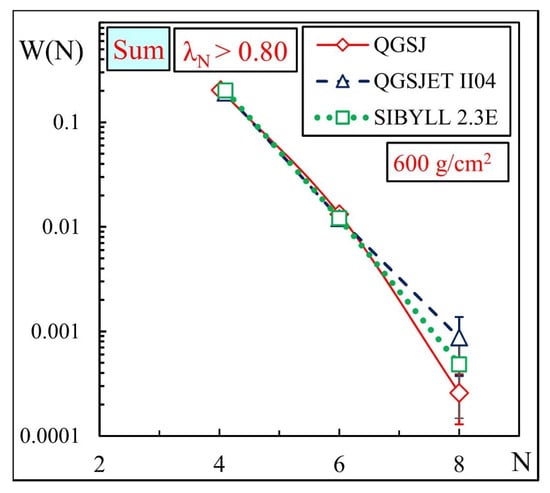
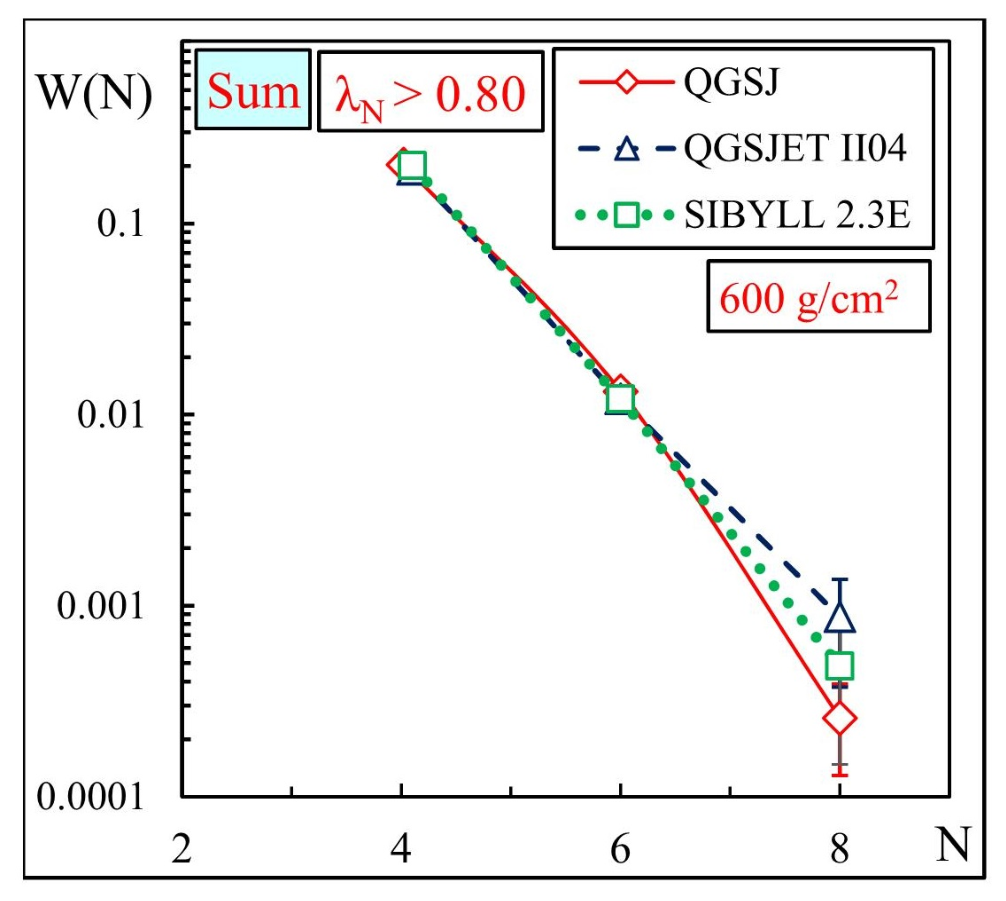
Figure 1 shows the dependence of the probability of observing coplanar energetic energy flows, W(N), for the total (Sum) component satisfying the criterion λN ≥ 0.80 on the number of the most energetic objects N at a depth of 600 g/cm2 in the atmosphere in events with energy ΣESum ≥ 500 TeV for the FANSY 2.0/QGSJ, QGSJET II-04, and SIBYLL 2.3E models.
Figure 1.
Dependencies of probability of observing coplanar energetic energy flows in EAS cores, W(N), for the total (Sum) component satisfying the criterion λN ≥ 0.80 on the number of the most energetic objects, N, at a depth of 600 g/cm2 in the atmosphere in events with energy ΣESum ≥ 500 TeV for the FANSY 2.0/QGSJ, QGSJET II-04 and SIBYLL 2.3E models.
Obviously, all three traditional models predict almost identical probabilities of observing background coplanar families for the Sum component at N = 4–6, i.e., in the range of values with a small statistical error.
Differences in the selection criteria are not important, since the physical conclusions about the coincidence of backgrounds in different models do not depend on the threshold energy values or the observation depth in the atmosphere.
Therefore, only one of the traditional models, namely, FANSY 2.0/QGSJ, will be considered later in this paper.
8. Event Characteristics
Unfortunately, experimental data related to the study of the problem of coplanarity obtained using the ADRON-55 calorimeter are not yet available. The results of this paper are, in fact, only an assessment of the possibility of using the calorimeter to study this phenomenon. In the future, the analysis of this problem will have, firstly, a methodological aspect related to the allocation of sub-cascades initiated by the most energetic particles. Secondly, an appropriate simulation will be performed using the Geant package.
A comparison of the experimental data obtained in stratospheric and high-altitude XREC experiments with the results of simulations performed within the framework of FANSY 2.0/QGSJ and FANSY 2.0/2D models can be found in [9]. This article shows that the existing experimental results are very difficult to explain even within the framework of the radical FANSY 2.0/2D model.
Next, we compare the characteristics of events at a depth of 700 g/cm2 in the atmosphere simulated with the FANSY 2.0/QGSJ and FANSY 2.0/2D models. Particle detection processes are not simulated. Therefore, this study provides an upper estimate of the role of non-traditional physical effects.
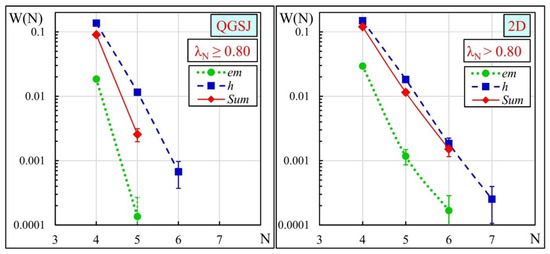
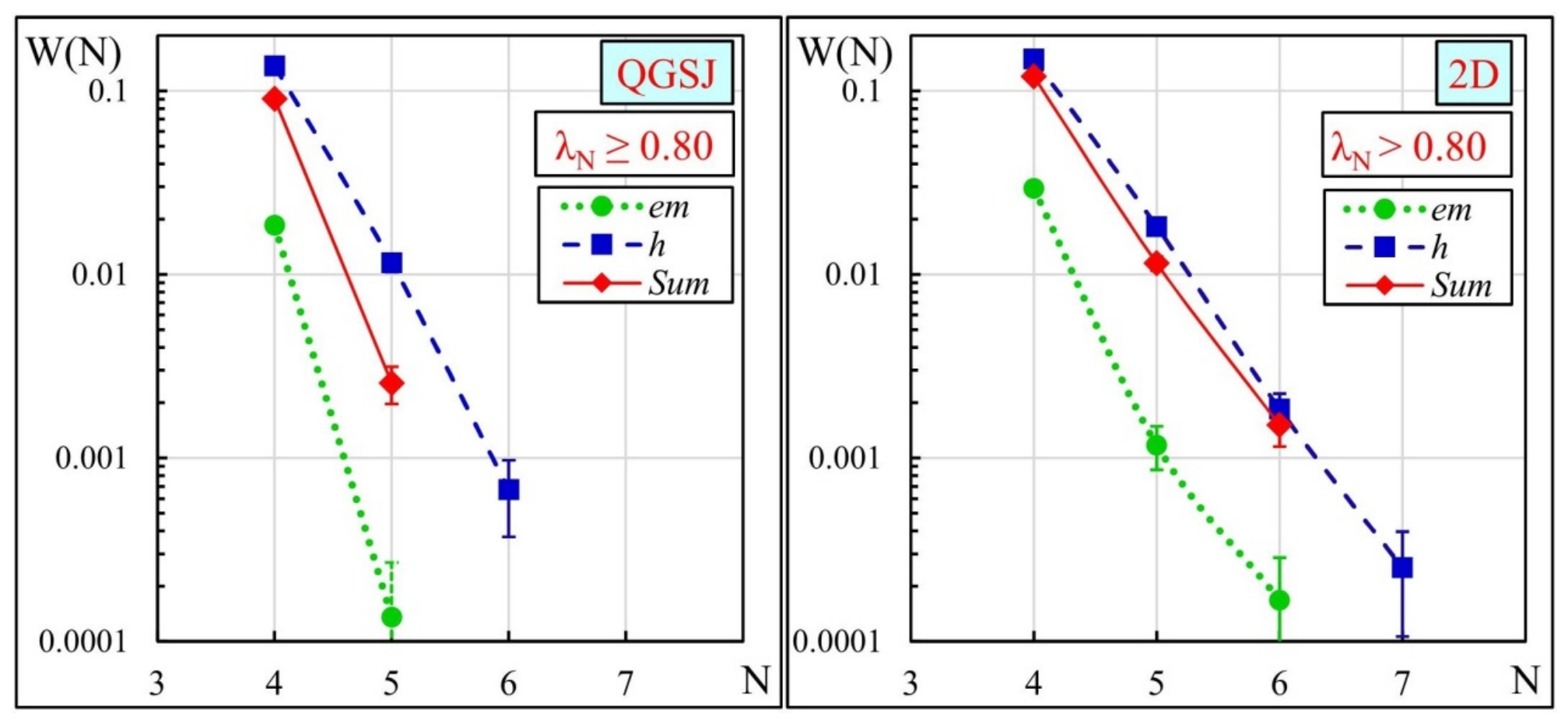
Figure 2 shows the dependence of the probability of observing coplanar events, W(N), on the number of the most energetic objects N for the electromagnetic (em), hadronic (h), and total (Sum) components. The events under consideration must have energies ΣEem, ΣEh, ΣESum ≥ 300 TeV, respectively, and satisfy the criterion λN ≥ 0.80. Moreover, they must be obtained within the QGSJ (left) and 2D (right) versions of the FANSY 2.0 model at a depth of 700 g/cm2 in the atmosphere. From here on, all dependencies of the probability of observing coplanar events, W(N), for the electromagnetic, hadronic, and total components are indicated by green, blue, and red markers, respectively.
Figure 2.
Probabilities of observing coplanar (satisfying the criterion λN ≥ 0.80) events, W(N), for the electromagnetic (em), hadronic (h), and total (Sum) components with energies ΣEem, ΣEh, ΣESum ≥ 300 TeV, respectively, as a function of the number of the most energetic objects N considered at a depth of 700 g/cm2 in the atmosphere. The energies of events obtained within the framework of FANSY 2.0/QGSJ (left) and FANSY 2.0/2D (right) are, respectively, ΣEem, ΣEh, ΣESum ≥ 300 TeV.
It can be seen that the behavior of the probabilities of observing coplanar events with high values of the parameter λN differs between the FANSY 2.0/QGSJ and FANSY 2.0/2D versions. The larger the number of the most energetic objects, N, the greater the differences in the model predictions. While for N = 4 the difference between the curves obtained within the QGSJ (left) and 2D (right) versions for any of the components is small, for N = 5 the probabilities for the total (Sum) component differ by an order of magnitude. Moreover, in the QGSJ version, out of ~104 events for the electromagnetic and total components, no events were obtained that satisfied the criterion λN ≥ 0.80 for N ≥ 6.
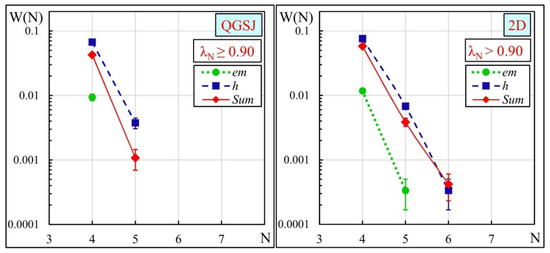
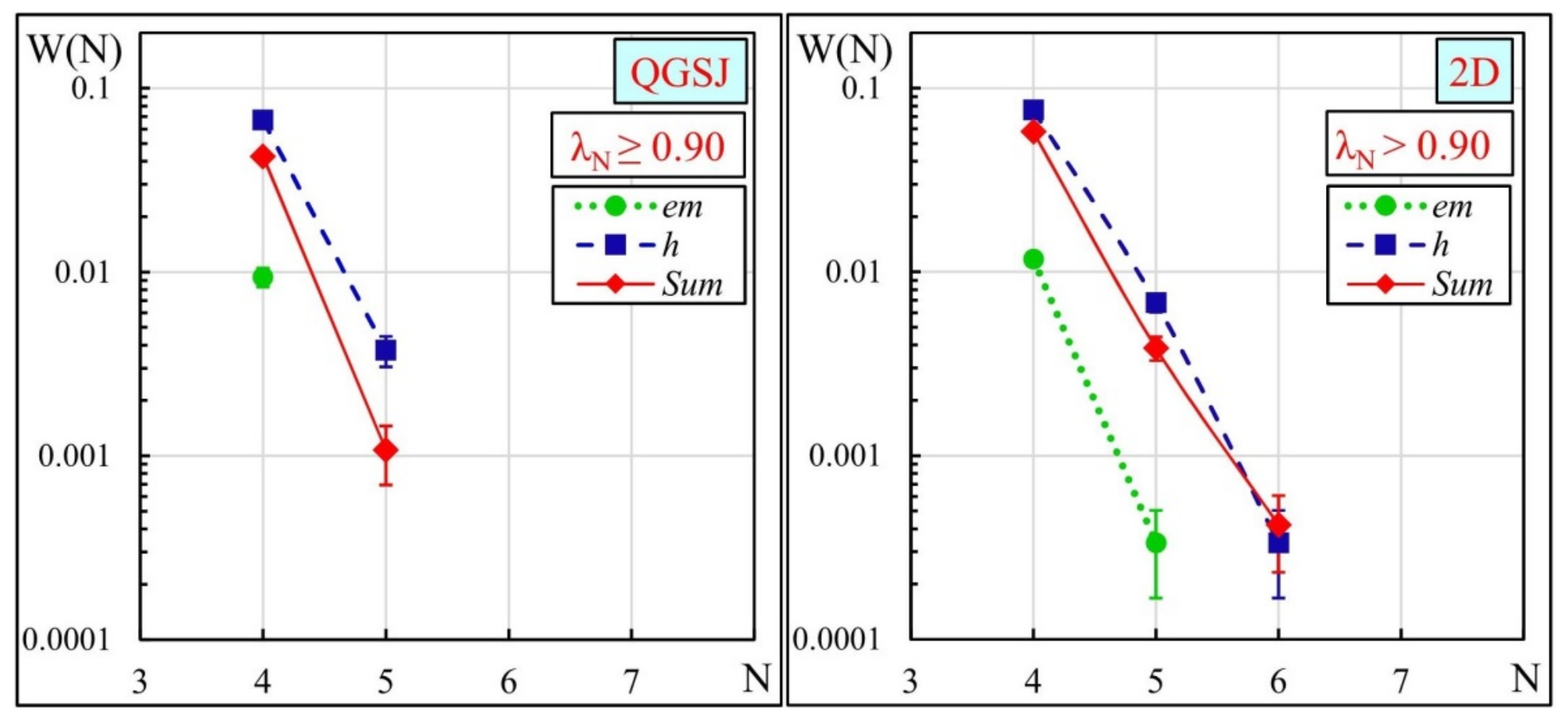
Furthermore, the relationship between the h and Sum components differs significantly between FANSY 2.0/QGSJ and FANSY 2.0/2D. FANSY 2.0/QGSJ predicts that the W(N) values for the Sum component are several times smaller than those for the h component. However, FANSY 2.0/2D predicts that the W(N) values for the Sum and h components are very close. A similar result can also be seen in Figure 2 and Figure 3. This is explained by the fact that azimuthal correlations between these components in the FANSY 2.0/2D model arise in real hadronic interactions, while in the FANSY 2.0/QGSJ model, azimuthal effects arise due to chaotic fluctuations in cascade processes.
Figure 3.
Probabilities of observing coplanar (satisfying the criterion λN ≥ 0.90) events, W(N), for the electromagnetic (em), hadronic (h), and total (Sum) components with energies ΣEem, ΣEh, ΣESum ≥ 300 TeV, respectively, as a function of the number of the most energetic objects, N. The energies of events obtained within the framework of FANSY 2.0/QGSJ (left) and FANSY 2.0/2D (right) are, respectively, ΣEem, ΣEh, ΣESum ≥ 300 TeV.
Figure 3 shows the dependence of the probability of observing coplanar events, W(N), for the em, h, and Sum components satisfying the more stringent criterion, λN ≥ 0.90, on the number of the most energetic objects N, obtained in events with energies ΣEem, ΣEh, ΣESum ≥ 300 TeV, respectively, within the QGSJ (left) and 2D (right) versions of the FANSY 2.0 model. Obviously, the calculated probabilities of observing coplanar events with high values of the parameter λN are much higher in the more radical 2D version. Moreover, the larger the value of N, the greater the differences in the predictions of the versions, i.e., the more effective the parameter used is. If, for N = 4, the difference between the curves obtained within the QGSJ (left) and 2D (right) versions for any of the components is small, then for N = 5 the probabilities for the total (Sum) component differ by approximately an order of magnitude. Note that within the QGSJ version, no results were obtained that satisfied the criterion λN ≥ 0.90 for N ≥ 6. This is based on statistics from ~104 events with energies ΣEem, ΣEh, ΣESum ≥ 300 TeV.
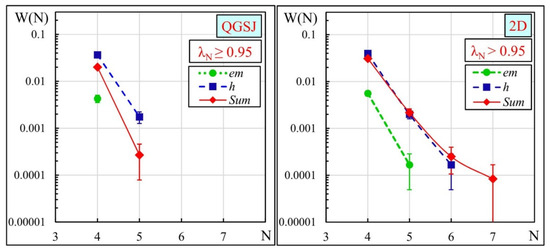
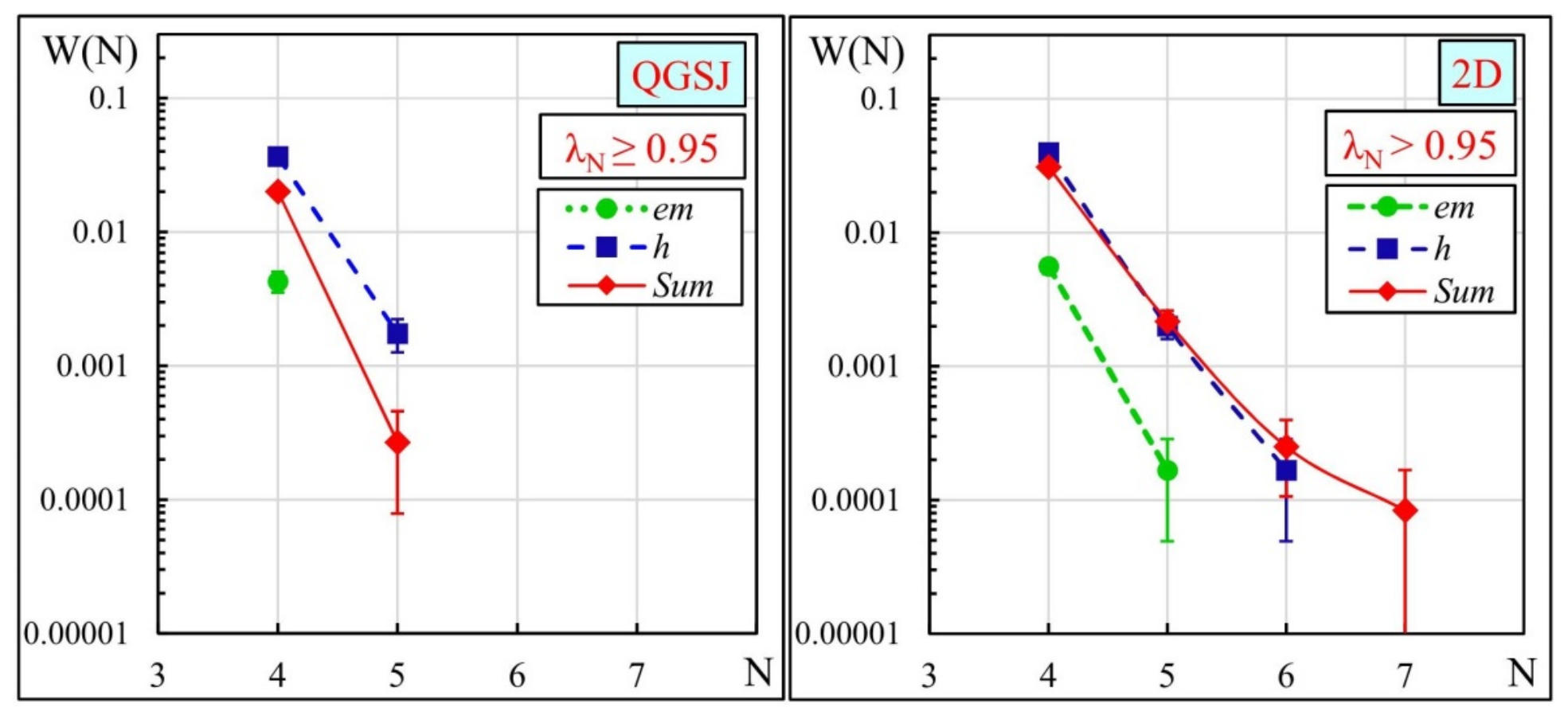
Figure 4 shows the dependence of the probability of observing coplanar events, W(N), for the em, h, and Sum components satisfying an even stricter criterion, λN ≥ 0.95, on the number of the most energetic objects N considered, obtained in events with energies, ΣEem, ΣEh, ΣESum ≥ 300 TeV, respectively, within the QGSJ (left) and 2D (right) versions of the FANSY 2.0 model. It is obvious that the difference between the predictions of FANSY 2.0/QGSJ (left) and FANSY 2.0/2D is even greater than in Figure 2 and Figure 3.
Figure 4.
Probabilities of observing coplanar (satisfying the criterion λN ≥ 0.95) events, W(N), for em, h, and Sum components with energies, ΣEem, ΣEh, ΣESum ≥ 300 TeV, respectively, for the number of the most energetic objects N under consideration. The energies of events obtained within the framework of FANSY 2.0/QGSJ (left) and FANSY 2.0/2D (right) are ΣEem, ΣEh, ΣESum ≥ 300 TeV, respectively.
Figure 2, Figure 3 and Figure 4 demonstrate that the predictions of the FANSY 2.0/QGSJ and FANSY 2.0/D models are almost identical at N = 4, but increase with increasing N. The predictions of the FANSY 2.0/QGSJ and FANSY 2.0/D models for XREC experiments differ much more strongly [10].
This is a result of the influence of the following factors. The relatively large observation depth in the atmosphere compared to [1,2,3,4,5] leads to a greater influence of cascade processes, which is reflected in a weakening of the influence of the characteristics of the first interaction and in an increased role of fluctuations in the development of cascades. The coarser lateral space resolution also plays a negative role.
In addition to the differences in the predicted probability values between the two models, it is necessary to note the difference in the relationships predicted by them between the h and Sum components within each of the models. While FANSY 2.0/2D predicts a strong correlation between the h and Sum components, in the FANSY 2.0/QGSJ model, these components appear independent. This is explained, on the one hand, by the presence of a very strong correlation between the components in the FANSY 2.0/2D model even at the level of hadronic interactions, and on the other hand, by chaotic and unpredictable fluctuations in the development of EAS in the FANSY 2.0/QGSJ model.
Recall that the calculated dependencies reflect the characteristics of events arriving at the surface of the detectors; i.e., the results do not take into account the processes of registration and detector response, which introduce additional distorting effects.
9. Conclusions
A detailed study of azimuthal correlations of energy fluxes in EAS cores, based on experimental data from the hadron calorimeter ADRON-55, can confirm the existence of a coplanar generation process in hadron interactions at energies of PCR protons above 1 PeV, or at least establish an upper limit on the probability of such a process.
Simultaneous detection of the electromagnetic and hadron components in the trunks of rocks, as well as the study of their correlations, are necessary, since only such an approach can provide new information.
Author Contributions
Conceptualization, R.M., Y.T. and A.A.; Methodology, R.M., T.S., A.A., D.K., K.M. and V.P.; Software, R.M., V.G., Y.T., A.A. and K.M.; Validation, R.M., V.G., A.A. and K.M.; Formal analysis, R.M., D.K. and K.M.; Investigation, T.S., V.G., Y.T., A.A., D.K. and K.M.; Resources, R.M. and V.G.; Data curation, T.S., V.G., Y.T., A.A., K.M. and V.P.; Writing—original draft, V.G., Y.T., A.A., D.K., K.M. and V.P.; Writing—review & editing, T.S. and V.P.; Supervision, T.S.; Project administration, T.S., V.G., D.K. and V.P.; Funding acquisition, V.P. All authors have read and agreed to the published version of the manuscript.
Funding
This research is funded by the Science Committee of the Ministry of Science and Higher Education of the Republic of Kazakhstan (Grant No. AP23488396).
Data Availability Statement
The original contributions presented in this study are included in the article. Further inquiries can be directed to the corresponding author.
Conflicts of Interest
The authors declare no conflicts of interest.
References
- Osedlo, V.I.; Rakobolskaya, I.V.; Galkin, V.I.; Managadze, A.K.; Sveshnikova, L.G.; Goncharova, L.A.; Kotelnikov, K.A.; Martynov, A.G.; Polukhina, N.G. A superfamily with Sigma Eγ > 1015 eV observed in stratosphere. In Proceedings of the 27th ICRC, Hamburg, Germany, 7–15 August 2001; Copernicus Gesellschaft: Göttingen, Germany, 2001; Volume 1, pp. 1426–1429. [Google Scholar]
- Capdevielle, J.N. Analysis of One Cosmic Ray Collision Near 107 GeV. J. Phys. G 1988, 14, 503–511. [Google Scholar] [CrossRef] [Scilit]
- Pamir Collaboration. Search for events with coplanar divergence of superhigh energy particles. In Proceedings of the 4th ISVHECRI; Institute of High Energy Physics: Beijing, China, 1986; pp. 429–437. [Google Scholar]
- Kopenkin, V.V.; Managadze, A.K.; Rakobolskaya, I.V.; Roganova, T.M. Alignment in γ-hadron families of cosmic rays. Phys. Rev. D 1995, 52, 2766–2774. [Google Scholar] [CrossRef] [Scilit] [PubMed]
- Borisov, A.S.; Mukhamedshin, R.A.; Puchkov, V.S.; Slavatinsky, S.A.; Zdanov, G.B. On the nature of gamma-hadron family alignment. Nucl. Phys. B-Proc. Suppl. 2001, 97, 118–121. [Google Scholar] [CrossRef] [Scilit]
- Mukhamedshin, R.A. On coplanarity of most energetic cores in gamma-ray—Hadron families and hadron interactions at s1/2 > 4 TeV. J. High Energy Phys. 2005, 2005, 049. [Google Scholar] [CrossRef] [Scilit]
- Wibig, T. Alignment in hadronic interactions. arXiv 2000, arXiv:hep-ph/0003230. [Google Scholar] [CrossRef] [Scilit]
- Royzen, I.I. Theoretical approach to alignment phenomenon. Mod. Phys. Lett. A 1994, 9, 3517–3522. [Google Scholar] [CrossRef] [Scilit]
- Capdevielle, J.N. Cosmic Ray Interactions near the LHC energy range (approach with XREC at mountain altitude and in the stratosphere). Nucl. Phys. B Proc. Suppl. 2008, 175–176, 137–142. [Google Scholar] [CrossRef] [Scilit]
- Yuldashbaev, T.S.; Nuritdinov, K.; Chudakov, V.M. Unusual Family Characteristics at Energies above 10 PeV. Nuovo Cimento Della Soc. Ital. Fis. 2001, 24, 569–572. [Google Scholar]
- Anchordoqui, L.; Dai, D.C.; Goldberg, H.; Landsberg, G.; Shaughnessy, G.; Stojkovic, D.; Weiler, T.D. Searching for the Layered Structure of Space at the LHC. Phys. Rev. D 2011, 83, 114046. [Google Scholar] [CrossRef] [Scilit]
- Stojkovic, D. Vanishing Dimensions: A Review. Mod. Phys. Lett. A 2013, 28, 1330034. [Google Scholar] [CrossRef] [Scilit]
- Mukhamedshin, R.; Sadykov, T.; Serikkanov, A.; Argynova, A.; Iskakov, B.; Argynova, K.; Mahmet, H.; Novolodskaya, O.; Idrissova, T.; Zhukov, V.; et al. Studies of Anomalous Phenomena in the Development of Electron-Nuclear Cascades in the EAS Cores Registered by a Modernized Complex Installation at Mountain Altitudes. Appl. Sci. 2023, 13, 2507. [Google Scholar] [CrossRef] [Scilit]
- Mukhamedshin, R.; Galkin, V. The mystery of coplanarity of most powerful energy flows in EAS cores. Eur. Phys. J. C 2026, 86, 582. [Google Scholar] [CrossRef] [Scilit]
- Mukhamedshin, R.A. FANSY 2.0: A Monte Carlo tool for study of superhigh-energy cosmic-ray interactions Proton-proton interactions. Eur. Phys. J. Plus 2019, 134, 584. [Google Scholar] [CrossRef] [Scilit]
- Mukhamedshin, R.A. Does superhigh-energy cosmic-ray coplanarity contradict LHC data? Eur. Phys. J. C 2019, 79, 441. [Google Scholar] [CrossRef] [Scilit]
- Mukhamedshin, R.A. FANSY 1.0: A phenomenological model for simulation of coplanar particle generation in supehigh-energy hadron interactions. Eur. Phys. J. C 2009, 60, 345–358. [Google Scholar] [CrossRef] [Scilit]
- Kempa, J.; Mukhamedshin, R.; Tamada, M. On pt(xL) dependence in h-A interactions and lateral features of most energetic particles in EAS cores. J. Phys. Conf. Ser. 2013, 409, 012109. [Google Scholar] [CrossRef] [Scilit]
- Dunaevsky, A.M.; Pashkov, S.V.; Slavatinsky, S.A. Binocular gamma-families and large-pt jets production. In Proceedings of the 18th ICRC, Bangalore, India, 1983; Tata Institute of Fundamental Research: Mumbai, India, 1983; Volume 5, pp. 449–452. [Google Scholar]
Disclaimer/Publisher’s Note: The statements, opinions and data contained in all publications are solely those of the individual author(s) and contributor(s) and not of MDPI and/or the editor(s). MDPI and/or the editor(s) disclaim responsibility for any injury to people or property resulting from any ideas, methods, instructions or products referred to in the content. |
© 2026 by the authors. Licensee MDPI, Basel, Switzerland. This article is an open access article distributed under the terms and conditions of the Creative Commons Attribution (CC BY) license.