


Abstract
We briefly review our recent theoretical progress on one-neutron () halo nuclei in the mass region of 15 ≲ A ≲ 50 from microscopic structure to reaction observables, by combining the deformed relativistic Hartree–Bogoliubov theory in continuum (DRHBc) and its triaxial extension (TRHBc) with the Glauber reaction model. In such an effective scheme, we first succeed in reproducing the enhanced reaction cross sections and narrow longitudinal momentum distributions of both the heaviest p-wave halo nucleus 37Mg and the heavier 31Ne on a carbon target, which are loosely bound and well-deformed systems with dominant p-wave configurations of the valence neutron. To test its capability for the lighter halo cases, we select neutron-rich carbon isotopes as examples. It turns out that the DRHBc + Glauber approaches are still valid for the s-wave halo in 15C, while a better description of the ground state for 19C requires the inclusion of exchange terms and tensor forces via the deformed relativistic Hartree–Fock–Bogoliubov (D-RHFB) model.Finally, these approaches are applied to search for heavier halo candidates. It was suggested that 40,42Al are promising candidates as p-wave triaxial halo nuclei and 43,45Si as p-wave axial halo nuclei with prominent shape decoupling from the oblate core. Our studies cast a new light on future experimental measurements for new halo nuclei.
1. Introduction
With the upgrading of radioactive beam facilities, the detection for more exotic nuclei becomes possible. Because of the extreme neutron-to-proton ratios, some abnormal phenomena arise, such as halo structures along with shell evolution, related to the emergence of new magic numbers or the formation of an “island of inversion”. Meanwhile, the influence of halo nuclei located on the nucleosynthesis path in the neutron-rich region on the rapid neutron-capture process (r-process) is also one of the important topics in the study of the nucleosynthesis process during stellar evolution.
In a weakly bound system, the valence nucleon(s) in a halo nucleus exhibit an extremely diffuse spatial distribution compared to that for the core nucleus. So far, no more than 20 nuclei have been confirmed as halo structures among those 3400 nuclei reached from the experiments, including neutron halo nuclei 6,8He, 11Li, 11,14Be, 17,19B, 15,19,22C, 29F, 31Ne, and 37Mg, and proton halo nuclei 8B, 12N, and 17Ne, etc. [1]. Since 1985, the first observation of a sudden increase in the reaction cross section of 11Li + 12C [2] started the era to study the formation mechanism of halo nuclei.
In the last four decades, phenomenological and microscopic structure models have been widely adopted in theoretical studies of the structure of halo nuclei, including physical quantities such as binding energies, density distributions, and radii and applied in calculations of reaction observables. However, the predictive power is limited due to non-unique parameters in the potential models, such as the Woods–Saxon potential, and not suitable for available halo nuclei with medium mass. We aim at building up a bridge between experimental detection and theoretical research by developing a connection from the advanced microscopic structure to reaction observables, and providing candidate nuclei and effective ranges for experimental searches.
Since not all the nuclei nearby the drip line possess halo structure, there are some criteria to judge a halo nucleus from structure to reaction observables. Experimentally, one- or two-neutron separation energies below 2 MeV are often considered a necessary condition of a possible halo structure. Furthermore, an enhanced soft electric dipole response is also a notable signature of collective excitation in halo nuclei, which can be measured from the experiments. Theoretically, dilute density distribution is an indication for neutron-rich halo nuclei, which results in a larger radius compared to neighboring isotopes, usually along with the valence nucleon(s) largely occupying low-angular-momentum s or p orbitals.
After all, the radius of a neutron halo nucleus cannot be measured directly. Reaction observables, such as an enhanced reaction cross section, enhanced Coulomb breakup cross section, enhanced nucleon removal cross section, and a narrow inclusive longitudinal momentum distribution of the residues (corresponding to dilute spatial distribution) after breakup reaction [3,4,5], are commonly regarded as direct and convincing evidence for a halo nucleus. Therefore, the description of halo nuclei from microscopic structure to reaction observables can be a tool to check the validity of the structure theory via the comparison with the experimental data, and also provide a promising way to predict new halo nuclei.
In recent years, the axially deformed relativistic Hartree–Bogoliubov theory in continuum (DRHBc) [6,7,8,9] and the triaxial relativistic Hartree–Bogoliubov theory in continuum (TRHBc) [10,11], both based on covariant density functionals, have been successfully developed. These structure theories self-consistently take into account deformation degrees of freedom (axially deformed/triaxially deformed), continuum effects, and pairing correlations, making them suitable for describing exotic nuclear structure. Nevertheless, they have not yet been applied in reaction models to study the observables of halo nucleus reactions.
Recently, we realized the description from microscopic structure to reaction observables by DRHBc theory combined with the Glauber model. It has been successfully applied to describe one-neutron () p-wave halo nuclei, both 31Ne [5,12] and 37Mg [13,14] with the assumption of axial deformations, superior to other approaches, such as the asymmetric molecular dynamics (AMD) model with the resonating group method (RGM) [15,16]. Later on, Lu studied the soft electric dipole response of deformed halo nuclei 31Ne and 37Mg using a deformed Woods–Saxon potential [17].
To see the limit of the DRHBc + Glauber approach for the lighter halo nuclei, we choose neutron-rich carbon isotopes as the samples. It turns out that it works well for halo nuclei, such as 15C, but the spin and parity of the ground state for 19C cannot be obtained with DRHBc theory [18]. This can be cured by taking into account the exchange (Fock) terms and tensor forces with the deformed relativistic Hartree–Fock–Bogoliubov (D-RHFB) model [19]. On the other hand, we safely apply the DRHBc + Glauber approach to search for possible deformed neutron halos in neutron-rich silicon isotopes and find that 43,45Si are p-wave neutron halos with prominent shape decoupling from the core [20].
Furthermore, we adopt the TRHBc theory combined with the Glauber model to study the reaction cross sections of aluminum isotopes on a carbon target and find a pronounced increase for 40,42Al deviating from the systematic trend of their neighbors, and the predicted longitudinal momentum distributions of the residues after removal reactions for 40,42Al are narrower than those for 36,38Al, which suggests a halo structure with spatially extended density distribution [21].
In this review, we summarize our progress in the description of halo nuclei from microscopic structure to reaction observables, covering the lighter s-wave halos 15,19C, the predicted new halo candidates 40,42Al with triaxial shape, and axially deformed 43,45Si in the mass region of 15 ≲ A ≲ 50. This paper is organized as follows. In Section 2, we briefly outline the main formalism for the Glauber reaction model. In Section 3, we first review the success for heaviest halo 37Mg and 31Ne, then discuss the cases of 15C and 19C, and apply to new halo candidates 40,42Al and 43,45Si. Finally, we make a summary in Section 4.
2. Methods
The structural inputs for the Glauber reaction model include the angle-averaged densities of the core nucleus and the wave function of the valence neutron, which are extracted from the microscopic DRHBc or TRHBc theory (See details in Refs. [7,8,10,11]). The starting point is the relativistic Hartree–Bogoliubov (RHB) equation, which can be solved in a Dirac Woods–Saxon basis [22,23]. Its wave function has a more reasonable asymptotic behavior compared to that of the commonly used harmonic oscillator basis and is therefore suitable for the description of weakly bound nuclei.
The densities of core nucleus and the wave functions of valence neutron are put into the Glauber reaction model [24,25,26,27,28] to calculate the reaction observables of neutron-rich halo nuclei on a target. Via this combination, the reaction cross sections between a projectile (P) nucleus and target nucleus (T) are expressed by
where b, and denote the impact parameters of the projectile, core, and valence nucleon.
Another observable, the longitudinal momentum distribution of the fragments after the breakup reaction, can be derived and written as [24]
where refers to the radial wave function of the valence neutron with quantum numbers n, l, j, and denotes the l-order Legendre Polynomial as a function of and .
It can be seen that these observables are mainly determined by the phase-shift function , which reflects the information of the interactions. The () denotes the interaction between core (whole) nuclei, which can be obtained with the density directly from the nuclear structure models through Fourier transform and reads
where and denote the density distributions of the core and target nuclei, is the nucleon–nucleon scattering amplitude, and represents the zeroth-order Bessel function. The density of the target nucleus is obtained by using two sets of Gaussian functions to fit the results from the harmonic-oscillator shell model, which can reproduce the measured interaction cross section as clarified in Ogawa et al. [29]. Since the density of the target obtained in this way is reasonable, we directly use it as the input of the Glauber model. Details of the Glauber reaction model can be found in Refs. [5,14,18,19,30] and the references therein.
3. Results and Discussions
3.1. Halos in Well-Deformed Nuclei: 31Ne and 37Mg
The descriptions from microscopic structure to reaction observables for well-deformed nuclei 31Ne and 37Mg are not available until we make a break-through as benchmark works [5,14]. We combine the DRHBc theory with the Glauber model so that the deformation, the pairing correlations, and the continuum effects can be directly linked to measurable quantities, and found enhanced reaction or removal cross sections and narrow longitudinal momentum distributions of the fragments after break-up reactions of 31Ne/37Mg on a carbon target.
Compared with our earlier calculations with the spherical assumption, the consideration of the deformation effect can improve the results by and become consistent with the experimental data for the reaction of 31Ne + 12C, especially for removal cross sections dropping down to the experimental data within at the incident energy 230–240 MeV/nucleon [5]. Subsequently, a systematic study of reactions of neutron-rich magnesium isotopes on a carbon target successfully reproduces most of the experimental reaction cross sections, especially for the 37Mg + 12C cross section that cannot be described by the AMD model. The narrow longitudinal momentum distribution of fragments after this reaction is consistent with the measurements with a Lorentzian folded with the experimental resolution, and the large contribution of the p-wave component confirms its p-wave spatially diffused halo nature [13,14].
These studies demonstrate that the DRHBc + Glauber approach can capture the essential physics of axial deformed halo nuclei with medium mass, which provides a reliable tool to search for heavier halo candidates. Detailed review for both halo nuclei can be found in Ref. [31].
3.2. s-Wave Halos in Lighter Neutron-Rich Carbon Isotopes: 15,19C
Neutron-rich carbon isotopes have two confirmed halo nuclei, i.e., 15C and 19C. For a long period of time, whether 17C is a halo nucleus is still controversial. We wonder if our DRHBc+Glabuer model can also describe all these halo nuclei and tell the limit for this approach. In this scheme, we easily rule out the possibility of 17C being a halo structure and clarify 15,19C as s-wave halo nuclei. But the spin-parity for the ground state in 19C is still not satisfactory within this framework. Therefore, we include the contributions from the exchange terms and the tensor effect to obtain the correct spin-parity. In such a way, the calculated reaction observables can be reproduced well.
3.2.1. 15C: s-Wave Halo
The structure information of 15C was given by the DRHBc theory with the PK1 [32] density functional. The calculated spin-parity of the ground-state is consistent with the measurement and the predicted separation energy 0.56 MeV [18] smaller than 2 MeV, and comparable with the experimental value of 1.218(8) MeV [33]. The quadrupole deformation parameter is calculated to be , indicating a slightly oblate shape [18]. Analysis of the single-neutron orbitals (Figure 3a in Ref. [18]) reveals that the valence neutron in 15C occupies a weakly bound orbital with an overwhelmingly dominant component. The angle-averaged neutron densities for 15C (Figure 2 in Ref. [18]) distribute diffusely at the “tail” compared with those for 14C and 16C. As a result, the root-mean-square (rms) matter radius calculated by the density distributions shows a significant increase from 14C to 15C, as seen in both the calculated and empirical values (Table 2 in Ref. [18]). All these suggest 15C as a halo nucleus from a structural point of view.
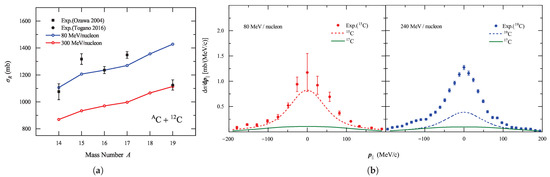
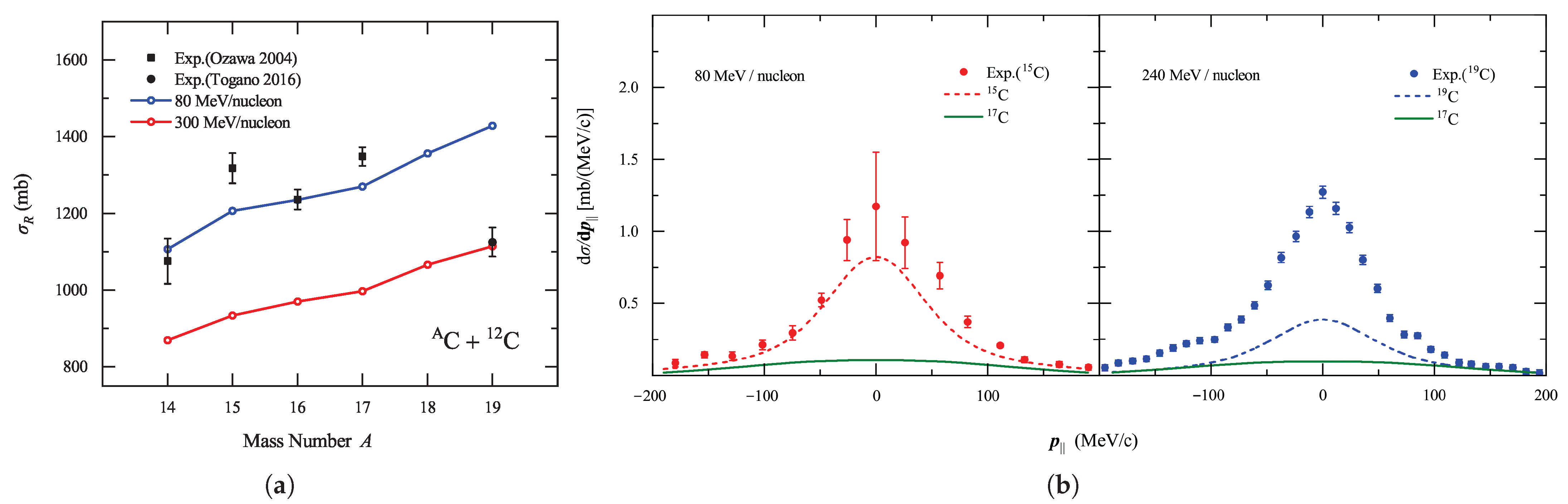
As the inputs of the Glauber model, the core density of 15C and the wave function for valence neutron extracted from the DRHBc theory are used to calculate the reaction observables. The predicted reaction cross sections for 14−19C on a carbon target at 80 and 300 MeV/nucleon are shown in Figure 1a. At 80 MeV/nucleon, the reaction cross section reproduces the measured data for 14C and 16C well, while it slightly underestimates that for 15C. There is a dramatic increase of 93 mb from 14C to 15C, nearly three times that from 15C to 16C. Furthermore, the inclusive longitudinal momentum distribution of the residue 14C and from the break-up reaction of 15C on a carbon target at 80 MeV/nucleon (Figure 1b) shows a narrow, peaked distribution, agreeing with the trend of experimental data [27]. In contrast, the distribution for the non-halo 17C projectile is much flatter. Quantitatively, the maximum of the distribution for 15C is 7.5 times larger than that for 17C, and its full width at half maximum (FWHM) 107 MeV/c is only 40% of that for 17C (260 MeV/c). Narrow momentum distributions reflect spatially extended systems obeying the Heisenberg uncertainty principle, which provides compelling evidence for the halo structure of 15C.
Figure 1.
(Color online) (a) Reaction cross sections of 14–19C bombarding a carbon target at 80 and 300 MeV/nucleon. Open blue and red circles represent the computed results for reaction cross sections at energies of 80 and 300 MeV/nucleon, respectively. Experimental data are taken from Refs. [27,34,35], where the energies for 14–16C are 83 MeV/nucleon [27], and for 17C, it is 79 MeV/nucleon [34]. The closed black circle represents the experimental value from Ref. [35] at an energy of 307 MeV/nucleon. (b) Inclusive longitudinal momentum distributions for the core residues of the 15C + 12C reaction at 80 MeV/nucleon and the 19C + 12C reaction at 240 MeV/nucleon. The experimental data are taken from Refs. [27,36], respectively. For comparison, the calculated results for 17C + 12C reactions are also shown in both panels.
3.2.2. 19C: s-Wave Halo with D-RHFB Model
There are some efforts for the description of 19C from the structure theory, but it is still challenging [37,38,39,40,41]. In the DRHBc calculations [18], the potential energy surface for 19C has multiple minima corresponding to different configurations. However, the lowest-energy state was found to be oblate with spin-parity , which disagrees with the measurement for the ground state. It is the prolate minimum with that exhibits a small (0.21 MeV) with a dilute density distribution for valence neutrons. Although this prolate state is not the ground state in the DRHBc framework, its predicted reaction cross section for 19C on a carbon target at 300 MeV/nucleon is in excellent agreement with experimental data. Since the increase of reaction cross section from 18C to 19C is not pronounced, we further examine the halo characteristics via the momentum distributions of reaction residues after the removal reactions of 19C. Nevertheless, the longitudinal momentum distributions for the prolate state show a moderate peak, which underestimates the experimental data. Therefore, a more sophisticated structure model is desired for the correct spin-parity of the ground state.
This can be realized by the D-RHFB model [42], which incorporates Fock terms and thus naturally includes the tensor force [43,44,45,46,47]. Using the PKO3 [43] density functional, the D-RHFB calculations successfully reproduce the properties of ground states for carbon isotopes, especially for 19C [19]. One- (and two-) neutron separation energies () are in good agreement with experimental data [33]. Two-dimensional neutron density distributions suggest a highly extended halo structure. A decomposition of this density shows that the extended tail originates almost entirely from the valence odd neutron, and the continuum plays a crucial role in this extension.
Using the D-RHFB structure inputs in the Glauber model, reaction observables for 19C on a beryllium target were calculated [19]. As shown in Table 1, the predicted removal cross sections at 60, 70, and 700 MeV/nucleon are in excellent agreement with experimental data [48,49,50] for the ground state, while the predictions for the hypothetical state vastly underestimate the data. Most convincingly, the longitudinal momentum distributions of the 18C residue at both 60 and 700 MeV/nucleon show a narrow, peaked distribution for the case, consistent with experimental data [48,50]. The calculated FWHMs of about 62 and 58.5 MeV/c at 60 and 700 MeV/nucleon match the measured and MeV/c [49,50]. A decomposition reveals that this narrow distribution is almost entirely due to the s-wave component of the valence neutron, providing definitive evidence for 19C as a s-wave halo nucleus with a ground state.
Table 1.
The removal cross sections of 19C bombarding a beryllium target at 60, 70 and 700 MeV/nucleon. Experimental data are taken from Refs. [48,49,50].
3.3. Search for New Heavier Halo Candidates in the Mass Region of 15 ≲ A ≲ 50
With the experience of the previous work, we have the confidence in searching for new heavier halo candidates in the mass region of 15 ≲ A ≲ 50. Mentioned that both axial and triaxial deformation are taken into account in the following calculations. We select the minimum binding energy of the many-body system as the final results.
3.3.1. Triaxial Deformed Halo Candidates: 40,42Al
Neutron-rich aluminum isotopes need to consider the triaxial deformation in the formation of halo structures. The newly developed TRHBc [10,11] self-consistently incorporates the triaxial deformation, the pairing correlations, and the continuum effects. In this scheme, systematic calculations are carried out for neutron-rich aluminum isotopes. It turns out that the binding energies, one- and two-neutron separation energies, and charge radii agree well with the experimental data. The odd-odd aluminum isotopes 40Al and 42Al are weakly bound with below 1 MeV and the ground state exhibits triaxial deformation [33,51], and , respectively [11]. This highlights the essential role of triaxiality in correctly describing the ground states of these nuclei. Analysis of single-neutron orbitals around the Fermi energy for 40Al shows that the valence neutron occupies a weakly bound orbital with more than 60% p-wave components. The contribution of this orbital to the total neutron density becomes dominant beyond fm, a clear signature of a halo. The neutron density decomposition for 40Al reveals a remarkable shape decoupling: the core is triaxially deformed with and , while the halo exhibits extreme deformation with and , characterized by an exchange of the long and intermediate axes. Note that the core deformation here is extracted from the core density after subtracting the halo contribution, which differs from the total ground-state deformation given above. For 42Al, a similar shape decoupling involving an exchange of the intermediate and short axes was predicted [10].
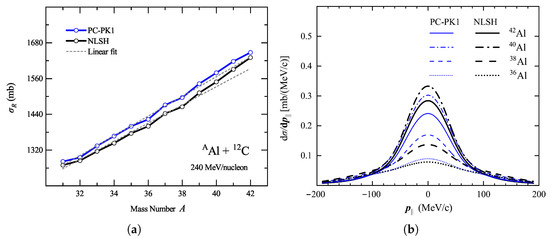
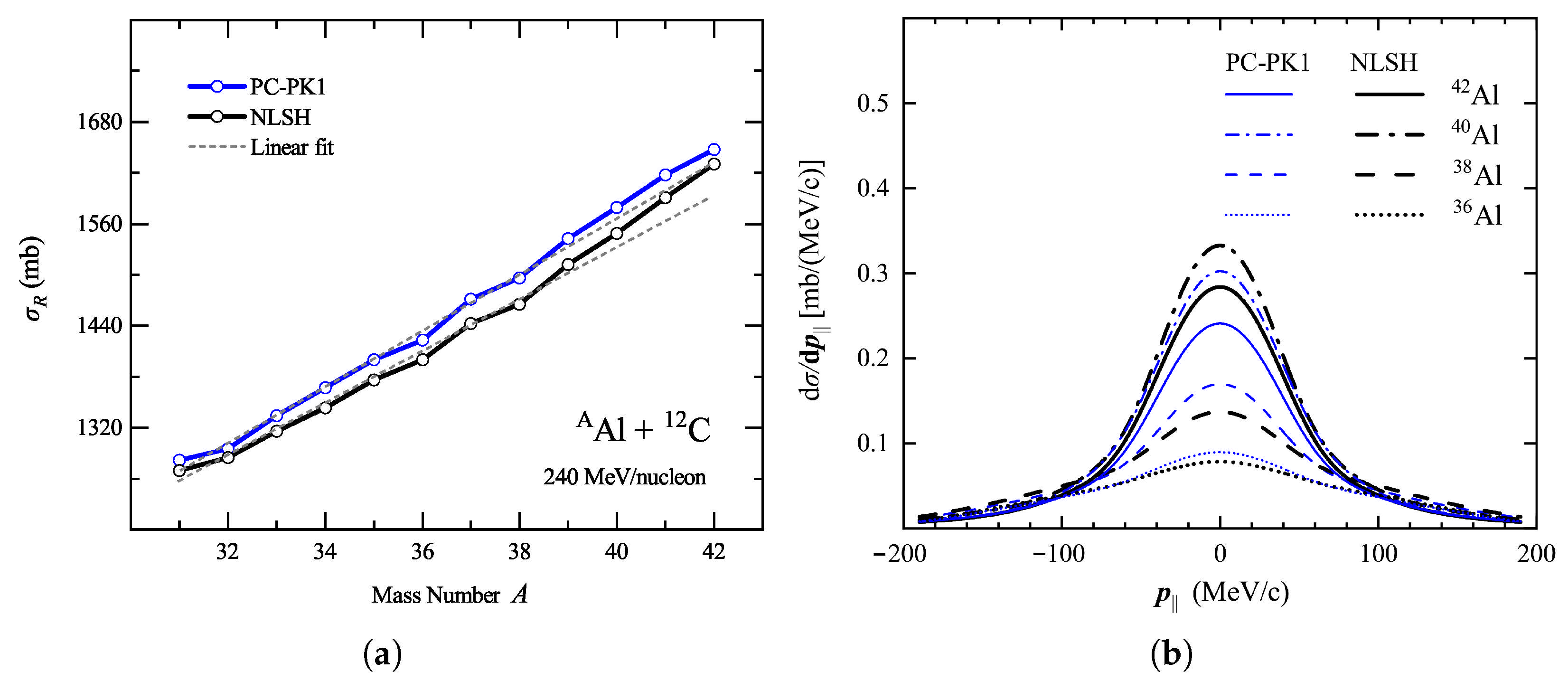
To provide experimental evidence for these triaxial halo candidates, reaction observables are calculated using the TRHBc + Glauber approach [21]. The reaction cross sections for 31
42Al on a carbon target at 240 MeV/nucleon are calculated with the PC-PK1 and the NLSH density functionals and displayed in Figure 2a. A pronounced deviation from the nearly linear fit of the reaction cross sections can be clearly seen at 40,42Al, compared with those of the lighter isotopes. This indicates a significant spatial extension of the density distribution and supports their halo character independent of the selection of the density functional. Furthermore, the longitudinal momentum distributions of the residues after removal from 36,38,40,42Al on a 12C target at 240 MeV/nucleon are exhibited in Figure 2b. It can be seen that the distributions for 40Al and 42Al are significantly narrower than those for 36,38Al in both the PC-PK1 and NLSH calculations. It has been confirmed that the dominant p-wave contributions in 40,42Al are responsible for this narrow momentum distribution, while f-wave components dominate in the non-halo 36,38Al. Therefore, we conclude that 40,42Al might be triaxial halo candidates from microscopic structure to reaction observables in TRHBc + Glauber calculations.
Figure 2.
(Color online) (a) Reaction cross sections of aluminum isotopes on a carbon target at 240 MeV/nucleon with the PC-PK1 and NLSH density functionals in comparison with a linear fit to the results of 31–39Al + 12C. (b) Inclusive longitudinal momentum distributions of residues after the breakup reactions 36,38,40,42Al + 12C at 240 MeV/nucleon.
3.3.2. Axially Deformed Halo Candidates: 43,45Si
Systematic DRHBc calculations with the PC-PK1 density functional [52] were performed for neutron-rich silicon isotopes [20]. The calculated separation energies reproduce the experimental data well and drop down to less than 1 MeV for odd-A isotopes with . Furthermore, we checked the angle-averaged neutron densities and found that 43Si and 45Si exhibit diffuse tails extending to large radii, while their even-even neighbors are more compact. Analysis of single-neutron levels in the canonical basis shows that the valence neutron in both 43Si and 45Si occupies a weakly bound orbital, with dominant p-wave components (e.g., 58% in 43Si and 62% in 45Si). The valence neutron distributions extend far from the core, with rms radii of 5.56 fm for 43Si and 5.21 fm for 45Si, compared to core radii of about 3.83 fm.
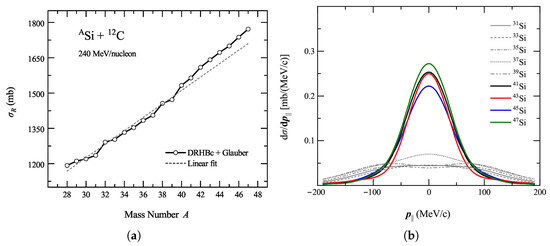
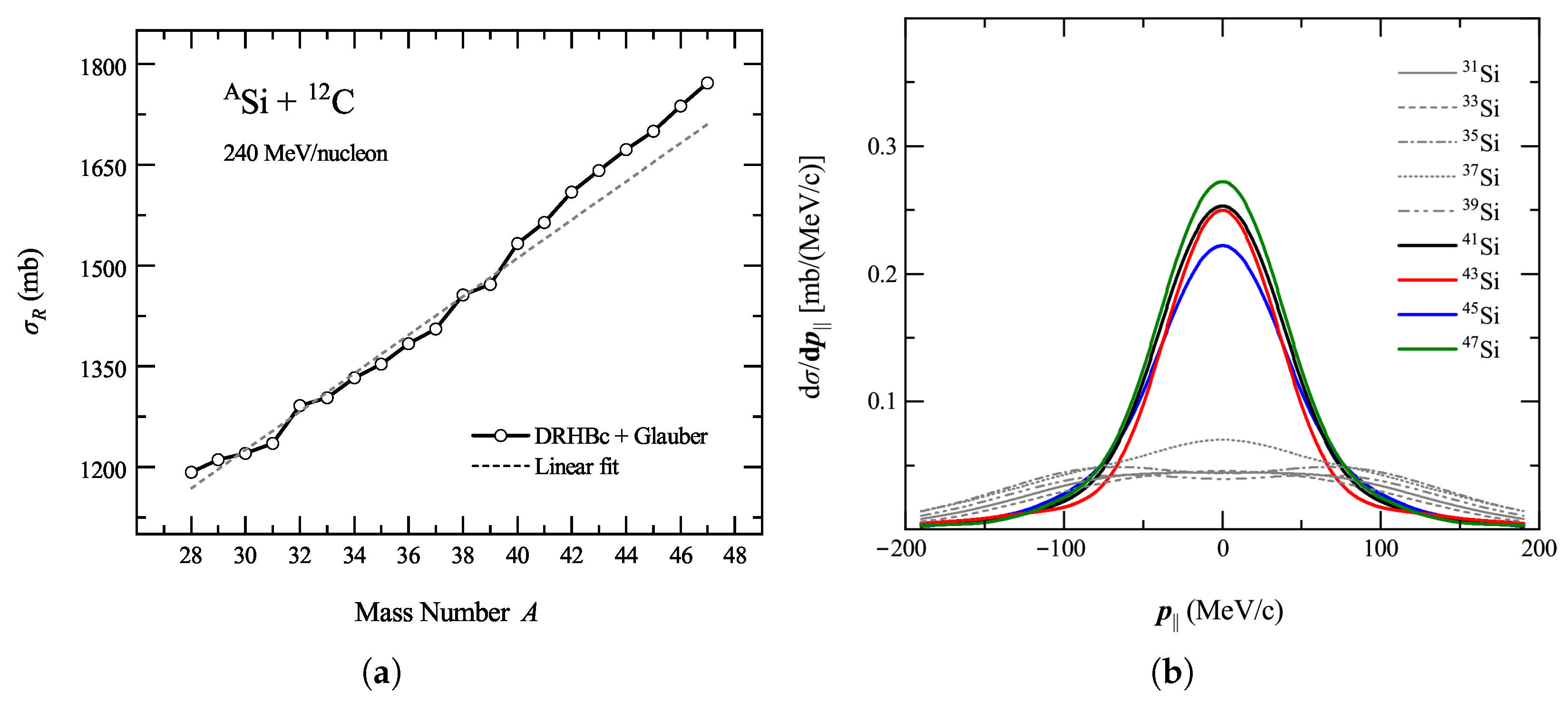
Based on the dilute density distributions and the sudden increase of the radii as a consequence, we further use the Glauber model to calculate reaction cross sections and longitudinal momentum distributions for neutron-rich silicon isotopes on a carbon target at 240 MeV/nucleon. In Figure 3a, we display the reaction cross sections and find that an increase in slope starts from 41Si, together with 43,45Si, larger than the linear fit to the neighboring lighter isotopes. Moreover, the longitudinal momentum distributions of the residues after removal from 41,43,45Si on a carbon target exhibit narrow peak structures as shown in Figure 3b. Their peak values are approximately five times larger than those for and the FWHMs are around 100 MeV/c, compared to over 240 MeV/c for the non-halo nuclei. These narrow distributions give the evidence for the dilute density distribution of the valence neutron, consistent with the halo structure. For 41Si, separation energy is larger than 6 MeV which indicates it as a deeply bound system and agrees with the dense neutron density distribution [20]. Therefore, 43,45Si are expected to be the heaviest halo nuclei in the near future.
Figure 3.
(Color online) (a) Reaction cross sections of silicon isotopes bombarding a carbon target at 240 MeV/nucleon are predicted based on the Glauber model with inputs from the DRHBc model, in comparison with a linear fit using the results for . (b) Inclusive longitudinal momentum distributions of corresponding residues after removal reaction of silicon isotopes bombarding a carbon target at 240 MeV/nucleon.
4. Summary
In summary, we review recent progress in the description of halo nuclei from microscopic structure to reaction observables by combining the DRHBc/TRHBc theories with the Glauber model. For the well-deformed p-wave halo nuclei 31Ne and 37Mg, the DRHBc + Glauber approach provides pretty good descriptions for both of them, obviously superior to other approaches. It can also give hints for the s-wave halo in 15C. For 19C, the D-RHFB model incorporating exchange (Fock) terms and tensor forces can give correct spin and parity for the ground state. Reaction observables agree well with experimental data. This highlights the importance of beyond-mean-field effects and continuum contributions.
Finally, we search for new halo candidates in the mass region of 15 ≲ A ≲ 50. The TRHBc approach predicts 40,42Al as triaxial p-wave halos exhibiting novel shape decoupling with an exchange of principal axes. Moreover, the DRHBc approach predicts 43,45Si as axially deformed oblate-core halo nuclei. Combined with the Glauber model, we calculate reaction observables and find increased reaction cross sections on a carbon target and narrow longitudinal momentum distributions for the residues after reactions, which support 40,42Al and 43,45Si as p-wave halo nuclei. These results provide the range to search for new halo nuclei for future experiments.
Author Contributions
Conceptualization, S.Z. and K.Z.; methodology, J.A.; software, J.A.; formal analysis, S.Z.; investigation, J.A. and Q.L.; writing—original draft preparation, S.Z., J.A. and Q.L.; writing—review and editing, S.Z. and K.Z.; visualization, J.A.; supervision, S.Z.; funding acquisition, S.Z. and K.Z. All authors have read and agreed to the published version of the manuscript.
Funding
This research was funded by the National Natural Science Foundation of China grant numbers 12575122, 12175010, 12305125 and the National Key Laboratory of Neutron Science and Technology grant number NST202401016.
Data Availability Statement
Data will be made available on request.
Conflicts of Interest
The authors declare no conflicts of interest.
References
- Sun, Y. Progress and prospects of experimental studies on the structure of neutron-rich halo nuclei. Chin. Sci. Bull. 2025, 70, 3298–3307. [Google Scholar] [CrossRef] [Scilit]
- Tanihata, I.; Hamagaki, H.; Hashimoto, O.; Shida, Y.; Yoshikawa, N.; Sugimoto, K.; Yamakawa, O.; Kobayashi, T.; Takahashi, N. Measurements of interaction cross sections and nuclear radii in the light p-shell region. Phys. Rev. Lett. 1985, 55, 2676–2679. [Google Scholar] [CrossRef] [Scilit]
- Tanihata, I.; Savajols, H.; Kanungo, R. Recent experimental progress in nuclear halo structure studies. Prog. Part. Nucl. Phys. 2013, 68, 215–313. [Google Scholar] [CrossRef] [Scilit]
- Al-Khalili, J.; Arai, K. Excited state halos in 10Be. Phys. Rev. C 2006, 74, 034312. [Google Scholar] [CrossRef] [Scilit]
- Zhong, S.Y.; Zhang, S.S.; Sun, X.X.; Smith, M.S. Study of the deformed halo nucleus 31Ne with Glauber model based on microscopic self-consistent structures. Sci. China Phys. Mech. Astron. 2022, 65, 262011. [Google Scholar] [CrossRef] [Scilit]
- Zhou, S.G.; Meng, J.; Ring, P.; Zhao, E.G. Neutron halo in deformed nuclei. Phys. Rev. C 2010, 82, 011301. [Google Scholar] [CrossRef] [Scilit]
- Li, L.; Meng, J.; Ring, P.; Zhao, E.G.; Zhou, S.G. Deformed relativistic Hartree-Bogoliubov theory in continuum. Phys. Rev. C 2012, 85, 024312. [Google Scholar] [CrossRef] [Scilit]
- Zhang, K.; Cheoun, M.K.; Choi, Y.B.; Chong, P.S.; Dong, J.; Geng, L.; Ha, E.; He, X.; Heo, C.; Ho, M.C.; et al. Deformed relativistic Hartree-Bogoliubov theory in continuum with a point-coupling functional: Examples of even-even Nd isotopes. Phys. Rev. C 2020, 102, 024314. [Google Scholar] [CrossRef] [Scilit]
- Pan, C.; Cheoun, M.K.; Choi, Y.B.; Dong, J.; Du, X.; Fan, X.H.; Gao, W.; Geng, L.; Ha, E.; He, X.T.; et al. Deformed relativistic Hartree-Bogoliubov theory in continuum with a point-coupling functional. II. Examples of odd Nd isotopes. Phys. Rev. C 2022, 106, 014316. [Google Scholar] [CrossRef] [Scilit]
- Zhang, K.Y.; Zhang, S.Q.; Meng, J. Possible neutron halo in the triaxial nucleus 42Al. Phys. Rev. C 2023, 108, L041301. [Google Scholar] [CrossRef] [Scilit]
- Zhang, K.Y.; Zhang, S.Q.; Meng, J. Triaxial relativistic Hartree-Bogoliubov theory in continuum for exotic nuclei. Phys. Rev. C 2025, 112, 044308. [Google Scholar] [CrossRef] [Scilit]
- Pan, C.; Zhang, K.; Zhang, S. Nuclear magnetism in the deformed halo nucleus 31Ne. Phys. Lett. B 2024, 855, 138792. [Google Scholar] [CrossRef] [Scilit]
- Zhang, K.Y.; Yang, S.Q.; An, J.L.; Zhang, S.S.; Papakonstantinou, P.; Mun, M.H.; Kim, Y.; Yan, H. Missed prediction of the neutron halo in 37Mg. Phys. Lett. B 2023, 844, 138112. [Google Scholar] [CrossRef] [Scilit]
- An, J.L.; Zhang, K.Y.; Lu, Q.; Zhong, S.Y.; Zhang, S.S. A unified description of the halo nucleus 37Mg from microscopic structure to reaction observables. Phys. Lett. B 2024, 849, 138422. [Google Scholar] [CrossRef] [Scilit]
- Minomo, K.; Sumi, T.; Kimura, M.; Ogata, K.; Shimizu, Y.R.; Yahiro, M. Determination of the structure of 31Ne by a fully microscopic framework. Phys. Rev. Lett. 2012, 108, 052503. [Google Scholar] [CrossRef] [Scilit]
- Watanabe, S.; Minomo, K.; Shimada, M.; Tagami, S.; Kimura, M.; Takechi, M.; Fukuda, M.; Nishimura, D.; Suzuki, T.; Matsumoto, T.; et al. Ground-state properties of neutron-rich Mg isotopes. Phys. Rev. C 2014, 89, 044610. [Google Scholar] [CrossRef] [Scilit]
- Lu, X.; Sagawa, H.; Zhou, S.G. Dipole response of deformed halo nuclei 31Ne and 37Mg. Phys. Rev. C 2025, 111, 064320. [Google Scholar] [CrossRef] [Scilit]
- Wang, L.Y.; Zhang, K.; An, J.L.; Zhang, S.S. Toward a unified description of the one-neutron halo nuclei 15C and 19C from structure to reaction. Eur. Phys. J. A 2024, 60, 251. [Google Scholar] [CrossRef] [Scilit]
- An, J.L.; Li, H.C.; Geng, J.; Long, W.H.; Zhang, S.S. First self-consistent study of 1n halo nucleus 19C from D-RHFB structure to reaction observables on a beryllium target. J. Phys. G Nucl. Part. Phys. 2025, 52, 055106. [Google Scholar] [CrossRef] [Scilit]
- Pan, C.; An, J.; Ring, P.; Wu, X.; Papakonstantinou, P.; Mun, M.H.; Kim, Y.; Zhang, S.; Zhang, K. Prediction of deformed halo nuclei 43,45Si from multiple criteria based on structure and reaction analyses. Phys. Lett. B 2026, 877, 140487. [Google Scholar] [CrossRef] [Scilit]
- An, J.L.; Zhang, S.S.; Zhang, K.Y. One neutron triaxial halo candidates in aluminum isotopes from reaction observables. arXiv 2026, arXiv:2604.00834. [Google Scholar] [CrossRef] [Scilit]
- Zhou, S.G.; Meng, J.; Ring, P. Spherical relativistic Hartree theory in a Woods-Saxon basis. Phys. Rev. C 2003, 68, 034323. [Google Scholar] [CrossRef] [Scilit]
- Zhang, K.Y.; Pan, C.; Zhang, S.Q. Optimized Dirac Woods-Saxon basis for covariant density functional theory. Phys. Rev. C 2022, 106, 024302. [Google Scholar] [CrossRef] [Scilit]
- Abu-Ibrahim, B.; Ogawa, Y.; Suzuki, Y.; Tanihata, I. Cross section calculations in Glauber model: I. Core plus one-nucleon case. Comput. Phys. Commun. 2003, 151, 369–386. [Google Scholar] [CrossRef] [Scilit]
- Glauber, R.J. Lectures in Theoretical Physics; Interscience Publishers: New York, NY, USA, 1959. [Google Scholar]
- Horiuchi, W.; Suzuki, Y.; Capel, P.; Baye, D. Probing the weakly-bound neutron orbit of 31Ne with total reaction and one-neutron removal cross sections. Phys. Rev. C 2010, 81, 024606. [Google Scholar] [CrossRef] [Scilit]
- Fang, D.Q.; Yamaguchi, T.; Zheng, T.; Ozawa, A.; Chiba, M.; Kanungo, R.; Kato, T.; Morimoto, K.; Ohnishi, T.; Suda, T.; et al. One-neutron halo structure in 15C. Phys. Rev. C 2004, 69, 034613. [Google Scholar] [CrossRef] [Scilit]
- Zhao, Y.L.; Ma, Z.Y.; Chen, B.Q.; Sun, X.Q. Extended Glauber theory and its application in halo nucleus scattering. High Energ. Phys. Nucl. 2001, 25, 506–513. [Google Scholar]
- Ogawa, Y.; Yabana, K.; Suzuki, Y. Glauber model analysis of the fragmentation reaction cross sections of 11Li. Nucl. Phys. A 1992, 543, 722–750. [Google Scholar] [CrossRef] [Scilit]
- Zhang, S.S.; Zhong, S.Y.; Shao, B.; Smith, M.S. Self-consistent description of the halo nature of 31Ne with continuum and pairing correlations. J. Phys. G. Nucl. Part. Phys. 2022, 49, 025102. [Google Scholar] [CrossRef] [Scilit]
- Zhang, S.S.; An, J.L.; Zhang, K.Y.; Sun, X.X. Progress on the description of 1n halo nuclei from microscopic structures to reaction observables. Chin. Sci. Bull. 2025, 70, 3288–3297. [Google Scholar] [CrossRef] [Scilit]
- Long, W.; Meng, J.; Van Giai, N.; Zhou, S.G. New effective interactions in relativistic mean field theory with nonlinear terms and density-dependent meson-nucleon coupling. Phys. Rev. C 2004, 69, 034319. [Google Scholar] [CrossRef] [Scilit]
- Wang, M.; Audi, G.; Kondev, F.G.; Huang, W.J.; Naimi, S.; Xu, X. The AME2016 atomic mass evaluation (II). Tables, graphs and references. Chin. Phys. C 2017, 41, 030003. [Google Scholar] [CrossRef] [Scilit]
- Wu, C.; Yamaguchi, Y.; Ozawa, A.; Kanungo, R.; Tanihata, I.; Suzuki, T.; Fang, D.; Suda, T.; Ohnishi, T.; Fukuda, M.; et al. Study of the Density Distribution of 17C from Reaction Cross Section Measurement. Nucl. Phys. A 2004, 739, 3–14. [Google Scholar] [CrossRef] [Scilit]
- Togano, Y.; Nakamura, T.; Kondo, Y.; Tostevin, J.; Saito, A.; Gibelin, J.; Orr, N.; Achouri, N.; Aumann, T.; Baba, H.; et al. Interaction cross section study of the two-neutron halo nucleus 22C. Phys. Lett. B 2016, 761, 412–418. [Google Scholar] [CrossRef] [Scilit]
- Kobayashi, N.; Nakamura, T.; Tostevin, J.A.; Kondo, Y.; Aoi, N.; Baba, H.; Deguchi, S.; Gibelin, J.; Ishihara, M.; Kawada, Y.; et al. One- and Two-Neutron Removal Reactions from the Most Neutron-Rich Carbon Isotopes. Phys. Rev. C 2012, 86, 054604. [Google Scholar] [CrossRef] [Scilit]
- Bazin, D.; Benenson, W.; Brown, B.A.; Brown, J.; Davids, B.; Fauerbach, M.; Hansen, P.G.; Mantica, P.; Morrissey, D.J.; Powell, C.F.; et al. Probing the halo structure of 19,17,15C and 14B. Phys. Rev. C 1998, 57, 2156–2164. [Google Scholar] [CrossRef] [Scilit]
- Ridikas, D.; Smedberg, M.H.; Vaagen, J.S.; Zhukov, M.V. 19–C: The heaviest one–neutron halo nucleus? Europhys. Lett. 1997, 37, 385. [Google Scholar] [CrossRef] [Scilit]
- Kanungo, R.; Tanihata, I.; Ogawa, Y.; Toki, H.; Ozawa, A. Halo structure in 19C: A Glauber model analysis. Nucl. Phys. A 2000, 677, 171–186. [Google Scholar] [CrossRef] [Scilit]
- Geng, Y.F.; Li, J.G.; Ma, Y.Z.; Hu, B.S.; Wu, Q.; Sun, Z.H.; Zhang, S.; Xu, F.R. Excitation spectra of the heaviest carbon isotopes investigated within the CD-Bonn Gamow shell model. Phys. Rev. C 2022, 106, 024304. [Google Scholar] [CrossRef] [Scilit]
- Sun, X.X.; Zhao, J.; Zhou, S.G. Study of ground state properties of carbon isotopes with deformed relativistic Hartree–Bogoliubov theory in continuum. Nucl. Phys. A 2020, 1003, 122011. [Google Scholar] [CrossRef] [Scilit]
- Geng, J.; Long, W.H. Relativistic Hartree-Fock-Bogoliubov model for axially deformed nuclei. Phys. Rev. C 2022, 105, 034329. [Google Scholar] [CrossRef] [Scilit]
- Long, W.H.; Sagawa, H.; Meng, J.; Giai, N.V. Evolution of nuclear shell structure due to the pion exchange potential. Europhys. Lett. 2008, 82, 12001. [Google Scholar] [CrossRef] [Scilit]
- Wang, L.J.; Dong, J.M.; Long, W.H. Tensor effects on the evolution of the N = 40 shell gap from nonrelativistic and relativistic mean-field theory. Phys. Rev. C 2013, 87, 047301. [Google Scholar] [CrossRef] [Scilit]
- Jiang, L.J.; Yang, S.; Dong, J.M.; Long, W.H. Self-consistent tensor effects on nuclear matter systems within a relativistic Hartree-Fock approach. Phys. Rev. C 2015, 91, 025802. [Google Scholar] [CrossRef] [Scilit]
- Jiang, L.J.; Yang, S.; Sun, B.Y.; Long, W.H.; Gu, H.Q. Nuclear tensor interaction in a covariant energy density functional. Phys. Rev. C 2015, 91, 034326. [Google Scholar] [CrossRef] [Scilit]
- Wang, Z.H.; Zhao, Q.; Liang, H.Z.; Long, W.H. Quantitative analysis of tensor effects in the relativistic Hartree-Fock theory. Phys. Rev. C 2018, 98, 034313. [Google Scholar] [CrossRef] [Scilit]
- Maddalena, V.; Aumann, T.; Bazin, D.; Brown, B.A.; Caggiano, J.A.; Davids, B.; Glasmacher, T.; Hansen, P.G.; Ibbotson, R.W.; Navin, A.; et al. Single-Neutron Knockout Reactions: Application to the Spectroscopy of 16,17,19C. Phys. Rev. C 2001, 63, 024613. [Google Scholar] [CrossRef] [Scilit]
- Chiba, M.; Kanungo, R.; Abu-Ibrahim, B.; Adhikari, S.; Fang, D.Q.; Iwasa, N.; Kimura, K.; Maeda, K.; Nishimura, S.; Ohnishi, T.; et al. Neutron removal studies on 19C. Nucl. Phys. A 2004, 741, 29–41. [Google Scholar] [CrossRef] [Scilit]
- Rodríguez-Tajes, C.; Álvarez-Pol, H.; Aumann, T.; Benjamim, E.; Benlliure, J.; Borge, M.J.G.; Caamaño, M.; Casarejos, E.; Chatillon, A.; Cortina-Gil, D.; et al. One-neutron knockout from light neutron-rich nuclei at relativistic energies. Phys. Rev. C 2010, 82, 024305. [Google Scholar] [CrossRef] [Scilit]
- Heylen, H.; Devlin, C.S.; Gins, W.; Bissell, M.L.; Blaum, K.; Cheal, B.; Filippin, L.; Ruiz, R.F.G.; Godefroid, M.; Gorges, C.; et al. High-resolution laser spectroscopy of 27–32Al. Phys. Rev. C 2021, 103, 014318. [Google Scholar] [CrossRef] [Scilit]
- Zhao, P.W.; Li, Z.P.; Yao, J.M.; Meng, J. New parametrization for the nuclear covariant energy density functional with a point-coupling interaction. Phys. Rev. C 2010, 82, 054319. [Google Scholar] [CrossRef] [Scilit]

Disclaimer/Publisher’s Note: The statements, opinions and data contained in all publications are solely those of the individual author(s) and contributor(s) and not of MDPI and/or the editor(s). MDPI and/or the editor(s) disclaim responsibility for any injury to people or property resulting from any ideas, methods, instructions or products referred to in the content. |
© 2026 by the authors. Licensee MDPI, Basel, Switzerland. This article is an open access article distributed under the terms and conditions of the Creative Commons Attribution (CC BY) license.