


Abstract
In quantum field theory, the vacuum is popularly considered to be a complex medium populated with virtual particle + antiparticle pairs. To an observer experiencing uniform acceleration, it is generally held that these virtual particles become real, appearing as a gas at a temperature that grows with the acceleration. This is the Unruh effect. However, it has been shown that vacuum complexity is an artifact produced by treating quantum field theory in a manner that does not manifestly enforce causality. Choosing a quantization approach that patently enforces causality, the quantum field theory vacuum is barren, bereft even of virtual particles. We show that acceleration has no effect on a trivial vacuum; hence, there is no Unruh effect in such a treatment of quantum field theory. Since the standard calculations suggesting an Unruh effect are formally consistent, insofar as they have been completed, there must be a canceling contribution that is omitted in the usual analyses. We argue that it is the dynamical action of conventional Lorentz transformations on the structure of an Unruh detector.
1. Introduction
The Unruh effect is the name given to a theoretical prediction that an accelerated observer can detect particles, which are unobservable to an inertial observer [1,2,3,4]. The effect is often interpreted as a consequence of the intrinsic complexity of the inertial frame vacuum, which is commonly imagined to be populated by pairs of virtual particles that become detectable in an accelerated frame. However, vacuum complexity can be viewed as a pseudoeffect expressed in formalisms that do not manifestly enforce causality [5], such as instant-form (IF) dynamics, a commonly used approach for the quantization of field theories. In contrast, the explicitly causality-enforcing front-form (FF) framework of Dirac [6] has an essentially trivial vacuum, i.e., a structureless Fock space ground state [7].
A question thus arises: does acceleration complexify the FF vacuum so that the Unruh effect is also a feature of the FF? If not, then the Unruh effect is itself a pseudoeffect, arising only in approaches that violate causality at intermediate stages of a calculation. This conclusion would have profound implications, since by Einstein’s equivalence principle between gravity and acceleration [8], the Unruh and Hawking effects [9] are typically considered to be related. Alternatively, if the Unruh effect occurs in FF dynamics, then the usual interpretation of Unruh and Hawking phenomena, based on particles created from a supposedly complex quantum vacuum, is mistaken, because the effects would also emerge with a trivial vacuum.
Herein, we discuss the following three distinct cases: (1) IF Minkowski space (i.e., inertial) vacuum, which is complex; (2) FF Minkowski space vacuum, which is trivial—see Section 4 and Appendix A; and (3) “Rindler vacuum”, associated with an accelerating frame for which “Rindler coordinates” are defined—see Appendix B. The Rindler vacuum is complex because Rindler fields are quantized at equal Rindler time. Importantly, the three vacua are inequivalent because IF, FF and Rindler frames are not related by any Poincaré transformation. Notably, although the Rindler vacuum is complex, it is, nevertheless, the vacuum for a Rindler observer; hence, imperceptible by definition. In this connection, the Unruh effect is a statement that a Rindler viz., accelerated) observer perceives pairs that constitute the IF Minkowski space vacuum.
In Section 2, we summarize important features of Dirac’s three forms of dynamics [6] and, drawing on an analogy with classical Newtonian dynamics, explain the emergence and character of pseudoeffects in the IF formalism. In Section 3, we explain why an Unruh effect is predicted when fields are quantized using the common IF approach, whereas that is not so when fields viewed from the inertial frame are quantized using the FF. The connection between a complex vacuum and causality violation in IF dynamics is elucidated in Section 4 on commutation relations. In Section 5, we discuss how the IF and FF findings can be reconciled. This must be possible because natural (observable) phenomena do not depend on the approach used to explain them. Section 6 supplies concluding remarks.
2. Forms of Dynamics
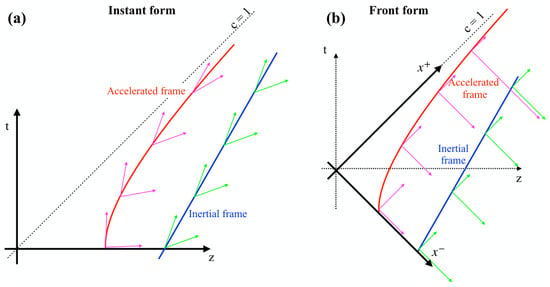
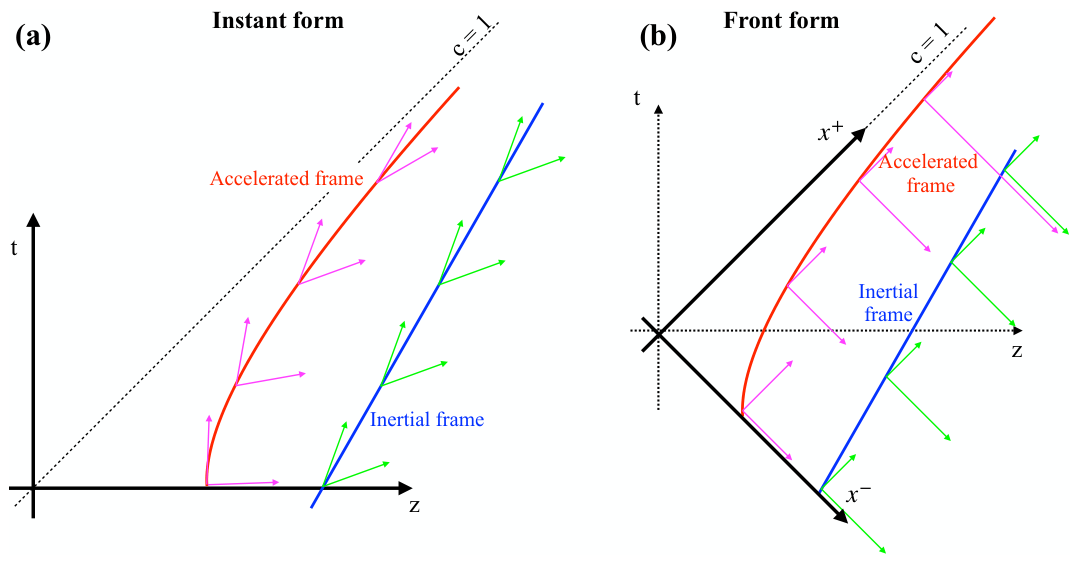
There is no unique choice of time parameter in relativistic kinematics. Parameterizing the worldline amounts to a specific convention for foliating the four-dimensional (4D) spacetime into a 3D space + 1D time. There are three pertinent conventions (forms) that fulfill the requirements of relativistic invariance, basic causality, and fundamental spacetime symmetry [6]: IF, where time is the usual Galilean time (Figure 1, panel-a); FF, where the time is aligned tangentially with the light-cone (Figure 1, panel-b); and Point-Form (PF), where the equal time hypersurfaces are hyperboloids. For future reference, the FF coordinates are
Figure 1.
Effect of boosts (blue worldline) and constant accelerations (red worldline) on attached IF (panel a) and FF (panel b) frames. Thick arrows show the frame axes of an observer at rest. The 45° dashed line is the trajectory for a particle moving at light speed ( in natural units). The metric is used in this figure, but is used for FF in the main text, following usage in particle physics where FF dynamics is employed. In that case, has the opposite direction, pointing left and upward.
The labels here highlight the FF associations, and () is the IF energy momentum. Importantly, distinct forms of dynamics are not related by Poincaré transformations. Furthermore, they are not equivalent: each form of dynamics possesses a different stability group, viz. a distinct set of Poincaré generators that are purely kinematical. Such generators operate in constant form-time hypersurfaces, whereas dynamical operators evolve the system from one hypersurface to the next.
The Poincaré group has 10 generators: 4 linear momenta for spacetime translations; 3 angular momenta for space rotations; and 3 Lorentz boosts. The FF stability group is the largest, with seven generators: the linear momenta, the boosts and one angular momentum. The IF and PF stability groups have only six generators: IF—linear and angular momenta; and PF—boosts and angular momenta.
Besides FF’s larger stability group, crucial advantages are offered by the kinematical character of its boosts [10]. For instance, contrary to IF dynamics, popular in textbooks, and to other forms of dynamics, such as PF and oblique FF [11], FF dynamics manifestly preserve causality and the number of particles in systems related by boosts. These things are key to its success in proving exact results in high-energy physics—see, e.g., Ref. [12].
In stark contrast, IF does not straightforwardly respect causality because it allows for vacuum-induced particle pairs, whose creation events are uncorrelated with the worldline of the system; hence, they are acausal. Furthermore, the dynamics induced when IF-boosting a system often complicates its description with pseudoeffects [10]. As elaborated in Section 4, since commutation relations are imposed at equal forming time in canonical quantization i.e., along the light-cone in the FF case, the FF vacuum is trivial (the possible existence of zero modes [5] is irrelevant to the Unruh effect—see Appendix A).
The conclusion reached in this article is that the Unruh effect is a pseudoeffect. Before demonstrating that, it is useful to elucidate the meaning and significance of this conclusion using an analogy from non-relativistic mechanics.
The symmetry of spacetime in the non-relativistic limit is Galilean invariance. Analyses performed in a frame that violates this basic symmetry, i.e., a non-Galilean (non-inertial) frame, induce pseudoeffects, such as Coriolis, centrifugal, and Euler forces. In the relativistic case, the spacetime symmetry is Poincaré invariance, and analyses in frameworks that violate it likewise generate pseudoeffects. Once spacetime is foliated into space and time, preserving Poincaré invariance in the foliated space requires that there exists a single dynamical operator (the time-evolution operator, typically the Hamiltonian), with all other operators being kinematical, otherwise they would also evolve the system. Plainly, since the Hamiltonian is the quantity that contains the fundamental interactions, evolution generated by other operators is merely an expression of pseudodynamics.
Dirac showed that pseudodynamics arise for the IF foliation because, in addition to the Hamiltonian, the three boost operators are dynamical [6]. Thus, pseudoeffects appear each time the description of a system requires a change of frame, e.g., in particle physics, where particles are frequently boosted from one frame to another and, even more clearly, with the Unruh effect, where several frames enter its description.
However, Dirac also showed that for the FF foliation, there are only 2 dynamical operators besides the Hamiltonian, and that these correspond to two space rotations. The rotation axes are transverse to the spatial coordinate z used to define the FF coordinates, (1), typically the direction of the particle motion. The two rotations are irrelevant in particle physics problems where the only rotational symmetry is around the displacement axis. Thus, FF respects Poincaré invariance for particle physics studies. Likewise, rotational invariance in the transverse directions is unconnected with the Unruh problem, and FF also respects Poincaré invariance in that case.
The analogy between the Unruh effect and classical pseudodynamics is now apparent. Nevertheless, a few points may benefit from elaboration. Just as the derivation of, e.g., the centrifugal force in a non-Galilean frame is valid, the derivation of the Unruh effect in IF is valid. We do not suggest otherwise. Rather, the central issue is that the effect originates from pseudodynamics and is therefore neither an objective nor a fundamental part of quantum field theory (QFT). The Unruh effect is necessary for the consistency of any IF analysis, and it survives if that analysis is incomplete. Drawing again on the non-relativistic analogy, just like overlooking a pseudoforce (e.g., the Coriolis force) would lead to an incorrect conclusion, not accounting for the Unruh effect in an IF analysis will lead to internal inconsistencies. A corollary is that all pseudodynamics must be accounted for, which is a non-trivial requirement. Just like analyses in Galilean frames avoid these complications, analyses in the Poincaré-preserving FF do, too. An FF analysis, completed by Dirac’s construction, shows that the Unruh effect is not observable because, in contrast to the aforementioned analogy, where non-relativistic pseudoeffects can be experienced by attaching oneself to a non-Galilean frame, the IF or FF frameworks have no material realization. The perception that the Unruh effect is observable thus originates from an incomplete IF analysis.
In Section 5, we discuss another pseudoeffect that balances the Unruh effect, ultimately reconciling the IF and FF conclusions. Again, our arguments do not entail that IF analyses which produce an Unruh effect are wrong, only that such analyses are incomplete. They have omitted a subjective pseudodynamical effect whose contribution is required when one adopts a choice of analysis framework that does not preserve relevant symmetries at intermediate stages of a calculation.
3. Unruh Effect
Basic discussions of an Unruh effect focus on a free scalar field in (1 + 1) spacetime dimensions. Here, we also follow this simplification.
The Unruh effect is predicted in IF dynamics because in non-inertial IF frames a field cannot unambiguously be factored into distinct time-dependent and space-dependent parts, namely, separated in a Poincaré-invariant manner [13]. Consequently, in the decomposition of into what may, for ease of discussion, be called positive and negative frequency modes, and :
The assignment of positive or negative frequency mode is frame dependent. ( and are, respectively, annihilation and creation operators. is a mode. A positive (resp. negative) frequency mode is defined as = (resp. =), with t the proper time, a Minkowski metric sign and the frequencies being always positive, ).
In another frame, , with : if one of the IF frames is non-inertial. A Bogolyubov transformation [14] expresses this mixing:
Since and are creation operators, the vacuum of frame 1, satisfying by definition, is perceived from frame 2 as containing particles: .
Typical formal analyses leading to a prediction of the Unruh effect, involving Rindler frames, are provided in Appendix B and Appendix C. Here, we approach the problem by beginning with a boost and observing the effect of making its rapidity time-dependent so that the boosted frame accelerates. We perform the analysis for IF and FF dynamics in parallel, using normal fonts for IF-specific formulae and bold fonts for their FF equivalents. The IF analysis employs the conventional relativistic metric , with which the Unruh effect is usually discussed, whereas the FF derivation follows the particle physics convention . The latter implies the FF product = in (1 + 1)D spacetime. Given the metrics, the positive frequency modes are (recall ):
For pedagogy, we first discuss the case of inertial frames and then proceed to the accelerated frame case.
3.1. Inertial Frame Case
It is straightforward to show that a positive (or negative) frequency mode of a wave expressed in an inertial frame remains so in another inertial frame, viz., one related to the first frame by a Lorentz boost. Figure 1 shows the effect of the boost (blue straight worldline with green coordinate axes): in IF dynamics, it generates a rotation of the coordinate axes through an angle determined by , the rapidity, whereas the orientation of the axes is unaffected in FF.
The Lorentz boost transformation formulae in the IF and FF frameworks are
or, for energy momentum,
The inverse transforms are straightforwardly obtained by changing and switching , etc.:
In the boosted frame, the sign of a mode frequency can be identified via its time derivative:
Using Equations (5) and (8), this becomes
or, using Equation (7),
i.e., the frequency in a boosted frame is the boosted frequency, or . The same holds for negative frequency modes, and . Using IF, the dispersion relation implies . With FF, one has (Equation (7)). An exponential function is always positive, so the signs of the mode derivatives are consistent in the initial and boosted frames. Thus, for a time-independent boost, there is no mixing of positive and negative frequency modes; the Bogolyubov transform is diagonal; and the vacua of the original and boosted inertial frames coincide.
3.2. Accelerated Frame Case
We now consider transformation to an accelerated frame. The latter can be formalized by making vary with time—see Figure 1. We set or , with and both small so that acceleration is constant to a good approximation. Importantly, is not explicitly space-dependent:
Using IF dynamics and the appropriate entries in Equations (6)–(8), then (9) yields
whereas, using the FF,
Evidently, the IF and FF expressions are similar: (13) cf. (14). Moreover, reviewing Equations (6)–(8), one sees that = and = ; the combinations are Poincaré invariant scalar products, which we write as :
Compared with the inertial case, (10), a Poincaré-violating term or has appeared. Of course, the appearance of that derivative means the new term violates Poincaré invariance, as was to be expected since inertial and accelerated frames are not related by genuine boosts, for which constant.
Considering the IF case, the time direction changes along the accelerated worldline; so, time and space mix—see Figure 1. This is expressed in the following result:
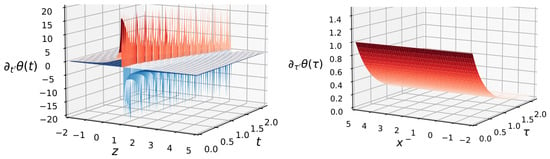
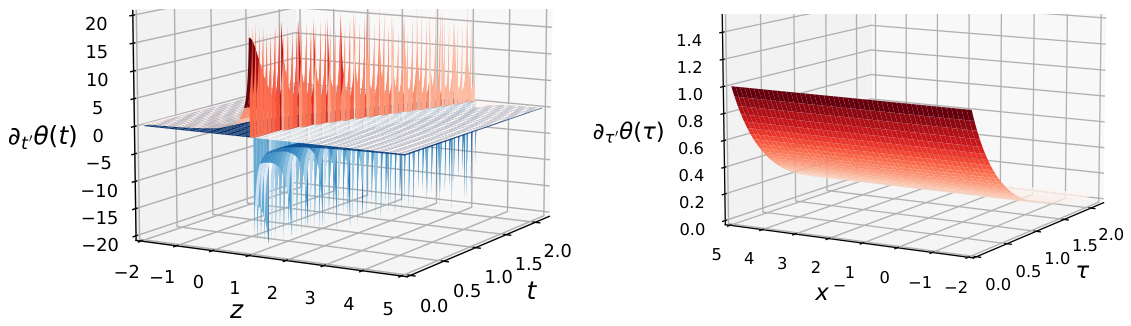
The variation in the sign of makes evident that one cannot develop a Poincaré-invariant separation of the field into time and space components. Since , the sign of is determined by , (16). Figure 2 reveals its rapid oscillation with t and z (or and ). So, what were the positive and negative frequency modes in the IF inertial frame mix in the IF accelerated frame: the Bogolyubov matrix is not diagonal and there is an Unruh effect in this development of the IF case.
Figure 2.
Derivative of the accelerated frame rapidity with proper time. (Left panel): IF case . (Right panel): FF case . Red indicates positive values, and blue indicates negative values. The swiftly oscillating sign in the IF case reveals the Unruh effect: the inertial frame’s positive and negative frequency modes become mixed in the IF accelerated frame. The discrepancy in mode definitions between the IF inertial frame and the accelerated frame entails a non-diagonal Bogolyubov matrix; hence, an Unruh effect. In the FF case, time and space do not mix: is independent of . Consequently, the sign of stays the same, allowing for a consistent definition of positive and negative frequency modes between the FF inertial and accelerated frames. The Bogolyubov matrix is diagonal, precluding an Unruh effect in the FF framework.
Using FF, on the other hand, the time direction remains fixed along the accelerated worldline—see Figure 1. Thus, the time derivative of is solely a function of time:
Consequently, with time and space directions remaining mutually perpendicular, can still be unambiguously expanded over positive and negative frequency modes, even for accelerated frames. Indeed, the sign of is determined by , (17), whose sign is constant—see Figure 2, right panel. Therefore, the definition of positive and negative frequency modes in the FF inertial frame and accelerated frame is consistent, the Bogolyubov matrix remains diagonal, and the vacua of frames coincide and are trivial: there is no Unruh effect in FF dynamics.
There is a straightforward explanation for arriving at a prediction of the Unruh effect when using IF dynamics, but not with the FF. Namely, boost operators are dynamical in the IF—see Section 2: they mix kinematics and dynamics, leading to non-conservation of particle number. In an accelerating frame, this mixing changes with time. Thus, non-stationary dynamics emerge with energy being transferred between systems, which would be an observable effect, unless canceled by some other process. In contrast, FF boosts are kinematic operators. Hence, no dynamical effects are introduced by acceleration. So, an Unruh detector remains quiet.
4. Connection to Commutation Relations
Canonical quantization of fields is performed at constant proper time, i.e., with fields defined along the fixed z-direction for the IF inertial frame (Figure 1, left panel), along the varying z-direction for the IF accelerated frame, and along the fixed -direction for both inertial and accelerated FF frames (Figure 1, right panel).
In canonical quantization, the Heisenberg uncertainty principle originates from commutation relations [15]. Since they are imposed at the same time, the uncertainty principle also operates on equal time hypersurfaces. This results in a complex vacuum when time is defined as IF time because events that should be causally linked, i.e., timelike-separated, may become spacelike-separated owing to position uncertainty.
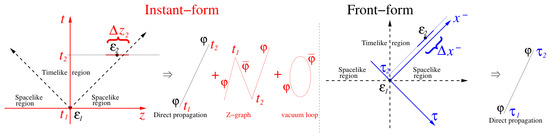
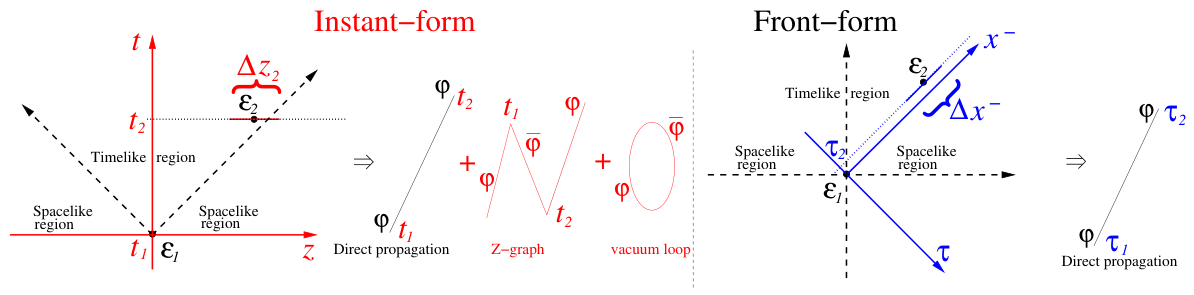
Consider Figure 3, which shows the propagation of a massive field between events and at times and , whereat the field interacts with an external scalar potential U. In a classical treatment, the propagation is restricted to the timelike region, viz. the upper part of the light-cone. However, quantum fluctuations, intuitively visualized in Figure 3-left as a Heisenberg uncertainty on the particle position at , allow for instances of to leak out of the light-cone. In that case, and are spacelike-separated, and the time-ordering of and is frame-dependent, with in some frames where they form Z-graphs with event , the spontaneous appearance of a particle-antiparticle pair. The antiparticle annihilates at a later time with the initial particle. This description is acausal since the pair’s appearance is spontaneous and cannot be caused by the original particle’s propagation owing to the spacelike interval.
Figure 3.
Origin of IF vacuum complexity. A field propagates between events and . Equal-time commutation relations imply uncertainty relations along the fixed-time hypersurface (dotted line). In IF dynamics, timelike events with respect to may become spacelike owing to the Heisenberg uncertainty (left panel). Thus, the time-ordering of and is frame-dependent. When , causality-violating Z-graphs arise. Their negative probabilities are compensated by vacuum loops, rendering the vacuum complex. The loops’ virtual particles may borrow four-momentum from an accelerated frame and become observable in that frame (Unruh effect). In FF dynamics, commutation relations are set at fixed FF time . Thus, the uncertainty never accesses the spacelike region: is always timelike with respect to (right panel). No Z-graphs arise, virtual loops are forbidden by unitarity, and the vacuum is trivial. Without vacuum loops, no Unruh effect emerges.
More formally, the propagation amplitude for is
with the field four-momentum and the energy sign fixed, e.g., . This last point is crucial because a function that is Fourier decomposed with only positive (or only negative) energies cannot be zero for a finite t range, unless it vanishes everywhere. Therefore, can be nonzero for spacelike and spacelike processes are allowed in IF. In frames with , they appears as Z-graphs, which contribute negative probabilities to the propagation, so disconnected creation-annihilation diagrams (vacuum loops), balancing the negative probabilities, must be introduced to preserve unitarity [16]. The virtual particles in the loops can cause state transitions in a detector, but such a transition is followed, after a time , by an opposite transition, resulting in no net excitation of the detector, as demanded in general by Lorentz invariance and, specifically, by the field correlation encoded in the propagator of that field. In accelerated frames, however, after , the energy gap would have been boosted to a different value, and the correlated back transition no longer matches the boosted energy gap [17]. Thus, the virtual particles in the vacuum loops borrow four-momentum from the acceleration process and, unless this is somehow cancelled, become observable, leading to the Unruh effect. An acceleration of an FF frame continuously rescales the axes (Figure 1, right panel) without reorienting them; hence, the uncertainty principle continues to operate along the light-cone direction . The events and remain timelike-separated, causality is preserved, and unitarity forbids vacuum loops [10]. Vacuum simplicity persists in an accelerated FF frame, and without vacuum loops in any type of FF frame, there is no Unruh effect. Consistently, momentum conservation also prohibits vacuum loops: FF particles must have non-negative momenta [5,18,19]; and since for the vacuum, by definition, one of the particles of the hypothetical vacuum loop would have , which is forbidden. From the FF momentum boost formula, Equation (7), ; so, the vacuum momentum is zero in all FF frames; i.e., for the vacuum, even in boosted and accelerated frames. This contrasts with non-relativistic intuition, as well as with the IF framework, in which boosts mix energy and momentum. Thus, zero-mode (, ) vacuum contributions acquire non-zero momentum under an IF boost.
5. Reconciling Instant and Front Form Descriptions
Physics is independent of any choice of frame or framework. Therefore, IF and FF conclusions must finally agree. Here, we describe how one may reconcile the apparently conflicting pictures drawn above. A detailed quantitative discussion involves extensive calculation of nuclear structure. We provide, as an illustration, the outline of such a study.
Following Ref. [20], which reconciled the IF and FF descriptions of deuteron structure, we consider an Unruh detector [3,21] made of an ensemble of particles consisting of two bound fermions. Such a detector would monitor the distribution of the particle energy states. The temperature T is obtained from the population distributions: , where N is the total number of particles; , the energy of state , , Boltzmann’s constant, and Z, the partition function. Irrespective of the Unruh effect, the detector structure in the IF case continuously changes with time because of a combination of three facts: (1) An IF boost is dynamical; (2) The rapidity becomes time-dependent for accelerations, ; (3) A boost is equivalent to a Rindler time translation—see Appendix C.
Specifically, in IF dynamics, the boost generator decomposes into a kinematical part and an interaction-dependent dynamical part, , where r is the distance between the two particles composing the bound system, and V is the binding potential (we include a to distinguish the operator from the classical quantity). Since does not commute with the internal Hamiltonian, , describing the bound system in its center-of-mass, , an IF boost does not preserve internal energy eigenstates. If the bound system undergoes, as in Section 3.2, a succession of boosts of rapidity , this non-covariance produces an effective Hamiltonian , where is an overage over the binding potential weighted by the form factor of the system.
Again, a succession of boosts of changing rapidity is equivalent to an acceleration by u, the system’s proper acceleration. The generated drives coherent internal transitions, viz. reversible Rabi-like oscillations between states. In a non-ideal gas, interactions between the bound systems cause these coherences to damp out at a rate , which produces an irreversible transition rate between the bound system states. Here, , with and being the ground and excited states of the bound system, respectively (for the deuteron, they are the s-wave ground state and the p-wave continuum).
The total internal energy flux, , in the gas ensemble can be decomposed into three coupled components: an Unruh flux, , an “IF-boost” flux, , and a cross flux, . The and fluxes only depend explicitly on the parameters characterizing their effects, viz. the acceleration, u, and the Unruh detector characteristics for the former and, for the latter, u, the deuteron structure, and the nuclear force potential. On the other hand, combines both sets of parameters. The cross term produces a negative interference between the Unruh and IF-boost effect because the Unruh bath acts as an additional decoherence channel, , where is the Unruh transition rate density, thereby suppressing the efficiency of boost heating, i.e., effectively producing a cooling mechanism. Unruh detectors are typically described in terms of energy levels without considering the dynamics of the internal detector structure responsible for those levels. (This is highlighted by the fact that the masses of the particles constituting the Unruh detector are not mentioned in descriptions. Where the internal dynamical structure underlying the energy levels was discussed, masses would appear, as they do when dynamics is described.) Without such consideration, one cannot account for the IF boost dynamical effect. Overlooking the IF-boost-generated transitions and the associated cooling that emerges from them, there is no compensation mechanism for the Unruh effect; hence, it seems objectively observable.
In FF dynamics, none of this occurs because boosts are kinematical (no IF-boost transitions and cooling) and the FF vacuum is trivial (no Unruh temperature). Since physics is independent of the choice of frame and form, the two IF effects must compensate each other so that IF and FF agree. It is now evident, however, that since boost-induced dynamics are overlooked in the usual IF analyses that lead to an Unruh effect, it has hitherto been erroneously identified as observable.
6. Discussion and Conclusions
The Unruh effect is a widely held to be a feature of QFT. It owes its importance mainly to its relation with Hawking radiation, via Einstein’s equivalence principle between gravity and acceleration. It is popularly claimed that the Unruh effect needs no empirical verification, beyond that involved in validating Poincaré-invariant QFT as a description of Nature [4,22]. We have exposed the flaw in that position: FF quantization is a powerful predictive tool in QFT; yet, this approach reveals that the prediction of an Unruh effect is an erroneous consequence of causality-violating aspects of conventional IF dynamics.
The crucial point is that any apparent dynamics generated by kinematic transformations, here the Lorentz boosts, is pseudodynamics by definition. In IF, boosts have long been known to generate such effects, while they are purely kinematical in FF. Then, a natural question is whether there should also be a rotational Unruh effect generated by centripetal acceleration. Evidently, the naive answer from the standard approach is yes. However, IF rotations are purely kinematical operations and, indeed, even if the IF is used to study a purely rotational Unruh effect, one finds that the effect is absent [23,24]. This accords with our present finding: in FF, boosts are kinematical, leading to no Unruh effect, and in IF, rotations are kinematical, leading to no rotational Unruh effect—counterintuitively from the usual IF standpoint (there is also no rotational Unruh effect with the FF because the two relevant rotations are also kinematical). This strongly supports the conclusions arrived at herein. (We note that there are claims for the existence of a rotational Unruh effect [25,26]. However, to reach this conclusion, boosts are used to move from the center of the rotation to the rotating Unruh detector. Since IF boosts are involved, a Unruh pseudo-effect can be identified. This will be discussed in a forthcoming article).
Properly, the Unruh effect is cancelled in IF dynamics by another pseudoeffect, namely, the cooling of the Unruh detector owing to dynamical evolution under a succession of IF boosts. Consequently, notwithstanding popular perspectives, one is left with a final point that should not be lightly dismissed; namely, neither the Unruh effect nor any of its supposed corollaries can be considered real without empirical verification.
Author Contributions
A.D. performed the calculations and drafted the manuscript. S.J.B. verified the calculations and the applicability of the front form discussion and reviewed and corrected the manuscript. C.D.R. verified the calculations and their context within quantum field theory, introduced concepts to the discussion, and contributed materially to writing the manuscript. B.T. verified the calculations, reviewed, and corrected the manuscript. All authors have read and agreed to the published version of the manuscript.
Funding
This material is based upon work supported by U.S. Department of Energy, Office of Science, Office of Nuclear Physics, contract DE-AC05-06OR23177 (A.D.); U.S. Department of Energy contract DE-AC02-76SF00515 (S.J.B.); National Natural Science Foundation of China, grant no. 12135007 (C.D.R.); and the U. S. National Science Foundation award no. 1847771 (B.T.).
Data Availability Statement
The original contributions presented in this study are included in the article. Further inquiries can be directed to the corresponding authors.
Acknowledgments
We are grateful to G. de Téramond for useful discussions.
Conflicts of Interest
The authors declare no conflicts of interest.
Appendix A. Front Form Vacuum
- No heating—That virtual particle loops are absent from the front form (FF) vacuum is firmly established. Nevertheless, the role of zero-momentum modes in the FF vacuum is a topic of intense discussion, e.g., such issues as whether, in flat spacetime, the vacuum energy can be renormalized away are widely canvassed [27,28]. Though important in themselves, these questions are irrelevant to the Unruh effect because modes cannot transfer momentum (equally, kinetic energy) to the particles forming the Unruh detector/thermometer: zero modes cannot heat thermometers.
- Event horizons do not split zero modes—The popular interpretation of the Unruh and Hawking effects suggests an intuitive explanation of why zero modes are irrelevant in this connection. In that interpretation, one of the particles of the vacuum loop falls beyond the event horizon (for the Unruh effect, the Killing horizons are the and axes); so, it cannot annihilate with its partner. Such a process requires space separations between the two particles and evolution, while zero modes have no space or time extension, making them irrelevant. Thus, either zero modes are immaterial; the vacuum pair interpretation is erroneous; or it is an instant form (IF) specific, hence can play no role in an objective explanation.
- Constraints from General Relativity—Considering that, by Einstein’s equivalence principle, accelerated frames are equivalent to curved spacetime, one arrives at another argument for the irrelevance of zero modes, as well as a new perspective on the Unruh effect.
Indeed, it is known that the definition of positive and negative frequency modes is ambiguous in a curved spacetime/non-inertial frame, in contrast to Minkowski spacetime. This is the formal reason for the Unruh effect, see Section 3. These features apparently contradict the basic principle of general relativity that one must tend to a Minkowski spacetime in the limit of vanishing distances. In other words, when distance scales are negligible in comparison with the curvature radius, space appears flat, with a unique vacuum.
Naturally, naive and classical vacua have no special scales and one may, unhindered, reach the small distance limit. However, in the IF framework, the vacuum is complex, with a characteristic distance scale set by the size of the vacuum loops. Such a scale forbids one from achieving the small-distance limit, keeping the definition of positive and negative modes ambiguous, and allowing for an Unruh effect. This perspective makes the crucial role of a non-trivial vacuum clear. It also provides an intuitive understanding of the thermal distribution. The greater distance scale set by larger loops allows for a larger curvature, therefore, by the equivalence principle, a larger acceleration and, in turn, a larger Unruh temperature. Since large loops are less probable than the smaller loops, so also are larger temperatures. Conversely, the FF vacuum is trivial; hence, without distance scales that would prevent an approach to the Minkowski limit. So, positive and negative modes are well defined, precluding an Unruh effect.
This discussion also elucidates why zero-point energy cannot contribute to an Unruh effect; namely, by definition, it is associated with an operator expectation value at a single point [28], hence, devoid of a characteristic distance scale.
- Nonperturbative vacuum—We note that studies of the vacuum in QFT often employ a perturbative formalism; thus, one can consider whether the nonperturbative FF vacuum could be nontrivial. This is also irrelevant to our subject because no field coupling or other expansion parameter is active in predictions of the Unruh effect, which is derived from kinematical considerations alone. If such were not the case, then one could always choose a small coupling for which a perturbative treatment is sufficient, since typical analyses find the Unruh effect to occur universally, irrespective of coupling strength. Additionally, discussions of the Unruh effect are often set for simplicity in (1 + 1)D [4,13], where the triviality of the nonperturbative FF vacuum is clear: quantum chromodynamics has been solved exactly in (1 + 1)D, with the meson spectrum recovered in the number of colors limit using FF [29] or IF [30]. Both studies involve obtaining the Hartree-Fock solution for its vacuum, but with the FF calculation being considerably simpler owing to vacuum’s simplicity. Finally, vacuum structure, whether trivial or complex, is not invoked: the demonstrations only use coordinate definitions of the forms of dynamics, the consequent quantization conditions, and generic properties of QFT. Only the interpretation of the result invokes the vacuum (perturbative) structure, as it provides a seemingly intuitive picture.
- Infinite momentum frame—Often, FF results are formally recovered by boosting IF results to the infinite momentum frame (IMF) [31]. This is also the case here, since in the IMF, the Rindler, IF and FF times coincide—see Figure 1. From Ref. [32], this implies the same vacua and, in turn, no Unruh effect. Yet, one also needs to allow for the possibility of zero modes in the IF-IMF vacuum. Some of these modes correspond to real particles—rather than the null-momentum vacuum loops (“tadpole graphs”) responsible for zero-point energy—and might contribute to the static properties of bound states [33]. However, consistent with the FF result, even these particular IF-IMF zero modes cannot lead to the dynamics underlying the Unruh effect for several reasons. First, such modes manifest themselves only within bound states, potentially contributing inside to long-distance field correlations (sometimes called “condensates”) without support outside a bound state [10,34,35,36]. Second, IF-IMF vacuum loops or condensates cannot produce pairs of physical particles for the same reason as for the FF (see Section 4): all particles must have nonnegative IF-IMF momenta. Since the vacuum or zero modes have null momenta by definition, and since momentum is conserved, this excludes loops because one of the particles would have a negative momentum. Considering the IMF limit offers a simple interpretation of the absence of the Unruh effect: in the IMF the acceleration must fall to zero; thus, so must the Unruh temperature.
- Summary—Herein, FF vacuum triviality refers to the absence of loops of particles with non-zero momenta, without considering zero modes, which might play a role in some physics but are irrelevant to the Unruh effect. Furthermore, vacuum triviality is not employed in the FF analyses and Appendix B, Appendix C and Appendix D: an Unruh effect is precluded in FF quantization for the same reason that the vacuum is trivial; so, the latter need not be assumed. Discussing vacuum triviality is useful chiefly in interpreting the FF results.
Appendix B. Standard Derivations of the Unruh Effect
Appendix B.1. Analyticity Argument
Here, we follow a standard IF approach to the Unruh effect [13] and simultaneously present the analogue in FF dynamics. Herein and in the subsequent sections, we use red fonts for IF-specific formulae, which are taken directly from Ref. [13], and blue fonts for their FF equivalents. Since the Unruh effect is usually discussed in the “relativity convention” metric, viz. (−,+,+,+), while the FF is generally discussed in the “particle physics convention” , then to preserve the familiar formulae, we use (−,+,+,+) in the IF case and (+,−,−,−) in FF.
Following Ref. [13], we consider massless scalar particles in (1 + 1)D spacetime for simplicity. The spacelike line element is thus
A uniformly accelerated observer follows a trajectory:
where is the acceleration and a parameter. The trajectory describes a hyperboloid in the IF and a hyperbola in the FF:
Working with these kinematics, Rindler coordinates , can be defined, along with the Rindler frame. Their relation to the Minkowski (i.e., inertial) frame is
with the metric Thus, can be identified as the Rindler proper time and as the Rindler space coordinate.
Equations (A4) provide a coordinate system only on the right spacelike quadrant of the Minkowski space delimited by and denoted quadrant I in Figure A1. Coordinates for the left spacelike quadrant (, quadrant IV), are obtained by flipping Minkowski coordinate signs. This is because the Rindler space coordinate is a ray originating at rather than a line spanning . Therefore, in quadrant IV, points left and the Rindler time is reversed: flows downward. The reasoning applies to IF and equally to FF since the FF Killing field is
with components . Thus, is orthogonal to the hypersurface, as in the IF case and, like the IF, defines positive and negative modes for a Fock basis. Consequently, in quadrant IV,
In Rindler coordinates, the Klein-Gordon equation for massless free fields is
Figure A1.
Coordinate frames: Rindler (black), Minkowski IF (red), and FF (blue). As in Figure 1, we use the (−,+,+,+) metric for both IF and FF.
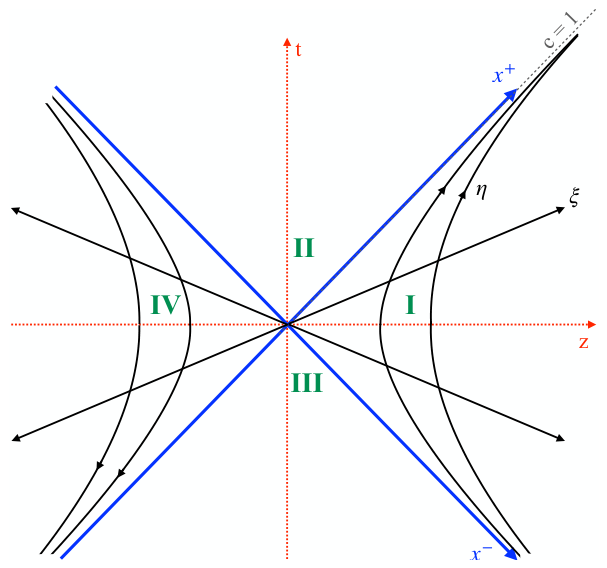
(The extension to massive fields is straightforward and without qualitative import). Solutions are given by planes waves: , with . In Minkowski frames, the Klein-Gordon equation is
Here, , . They are the operators associated with FF momentum, , and FF energy, , respectively. The plane wave solutions of Equation (A8) are
There is no component in the FF wave function because massless particles are also zero-energy in FF dynamics: .
Since in quadrant IV, future Minkowski time (IF or FF) flows in the “” direction—see Figure A1, two sets of positive frequency Rindler modes must be introduced: one for quadrant I and the other for quadrant IV,
so that in both quadrants. The modes and can be analytically continued outside their respective quadrant, which enables to be expressed in terms of four Rindler creation/annihilation operators:
In contrast, Minkowski space not being partitioned, two creation/annihilation operators are sufficient:
The annihilation operators of Equations (A11) and (A12) define the Rindler and Minkowski vacua, respectively:
Exposing an Unruh effect hinges on showing that cannot be expressed with only but must also include . Then, a Rindler observer will detect particles from the Minkowski vacuum, .
The expressions of in terms of and can be obtained by finding Rindler modes that have the same vacuum as the Minkowski modes [37]. Using Equations (A4) and (A6), the relationship between the phases of the Rindler and Minkowski modes in the two spacetime quadrants is (recall the different metric signatures for IF and FF):
Above, for the sake of generality, we wrote , but for a (1 + 1)D massless scalar field, contributions involving vanish because their phase is , with . Recall also that a is the acceleration and should not be confused with the operators , .
We can now identify which Rindler modes match the spacetime dependence of the Minkowski modes or . Using Equations (A10a) and (A14) and the Rindler dispersion relation, , the Rindler mode in quadrant I that has the same phase as or is
The available Rindler mode in quadrant IV, (A10b), does not have the same phase as in (A15). To match the phase, we must consider the complex conjugate of with negative momentum :
The Rindler dispersion relation, , and the definition, , impose on the domain . Thus, in the FF case, there is no available Rindler mode in quadrant IV. (A16) then becomes
The rightmost result follows because must be a plane wave, by definition of the Fourier decomposition of , (A11), and a nonzero value for the constant would violate this constraint.
With Equations (A15) and (A17), the Rindler modes can now be expressed in terms of the Minkowski modes:
Plainly, only the Rindler mode matches the phase of the Minkowski FF modes —see (A9), and not ; the Bogolyubov matrix is diagonal. Hence, there is no Unruh effect in the FF framework. Notwithstanding this, concluding details are included below.
The IF combination in (A18) is not yet properly normalized. The normalized IF mode is (the FF mode remains unchanged):
The normalized Rindler modes, , have corresponding creation/annihilation operators , which, by the construction above, act on the Minkowski vacuum as and . Using (A19) and analogous reasoning for , one obtains the relationship between , and the original Rindler operators:
Acting now with, e.g., on the Minkowski vacuum, one finds:
Evidently, in a Rindler frame, following this reasoning, one can observe particles from the IF Minkowski vacuum but not from the (trivial) FF vacuum.
The crucial point is the transition between Equations (A15) and (A18): modes with negative momentum, , are introduced. This is allowed in the IF: it simply means waves moving toward “” (for quadrant I); and they can be detected by an observer in that quadrant. In the FF, on the other hand, always; waves with would propagate backward in IF time; thus violating causality. Therefore, they do not exist; so, neither do Unruh particles. In other words, because, formally, , one must set or one would double count in the Fourier expansion, (A12). (Note that cannot be invoked for (A16) since the procedure is to match Rindler modes to , not to ).
The demonstration provided in this Appendix is formal. To apprehend the difference between the IF and FF demonstrations, it is helpful to interpret the central result, (A19). Let us first consider the usual mode expansion of a field operator, (A12). Modes and correspond to particles and antiparticles since removes a quantum of the field and adds one. Let us choose to call the antiparticle mode and the particle mode (A19) for IF, viz. , means that for an individual mode , particles of momentum and antiparticles of momentum p co-exist, as in the disconnected pair-creation diagrams of vacuum loops. This is the standard interpretation of the Unruh effect: the IF vacuum structure, made of disconnected loops of particles/antiparticles of opposite momenta, becomes observable. In the FF case, the term does not contribute because its power, , and a constant mode normalizes to 0. The absence of does not permit the simultaneous creation of a particle and an antiparticle with opposite momenta, i.e., of disconnected vacuum loops, as is well-known for FF.
Appendix B.2. Direct Derivation of the Bogolyubov Transformation
As discussed in Appendix B.1, the Bogolyubov transformation was derived following the original analyticity argument [37]. Here we discuss the direct derivation—see, e.g., Ref. [4]. The steps need not be fully detailed because the argument precluding the Unruh effect in FF is the same as in Appendix B.1.
The Bogolyubov transformation is
with , .
For IF, these coefficients are non-zero; hence, the Unruh effect is predicted. In contrast, for FF, because no FF modes are permitted in quadrant IV. Hence, , and no Unruh effect is perceived.
Appendix C. The Unruh Effect in Thermal Quantum Field Theory
Before examining the Unruh effect using thermal QFT, it is worth recalling the correspondence between Rindler time translations and Minkowski boosts, and the implications for Rindler Hamiltonian definition in FF dynamics.
Appendix C.1. Relation Between Rindler Time Translations and Boosts: Implications for the Hamiltonian
For IF and FF, a Rindler time translation corresponds to a Minkowski boost. This is readily seen using Equation (A4) and making a Rindler time translation , which leads to
Hence,
which are the usual boost formulae with rapidity .
Now, since FF boosts are kinematical, the above correspondence makes, in FF dynamics, the Rindler time translation a kinematical operator. Therefore, it cannot serve as the Hamiltonian. In Euclidean space, where thermal QFT is used to study the Unruh effect, the dilation operator defines the FF Hamiltonian, as explained in the next section.
Appendix C.2. Thermal QFT
For a scalar field, the thermal QFT derivation of the IF Unruh effect [38] utilizes the periodicity in Euclidean time (viz. imaginary time ) of a QFT at finite temperature , .
Consider the two-point Schwinger function of field :
with Z the partition function and the imaginary-time ordering operator. In the Boltzmann factor , H is the operator providing energy eigenvalues, not necessarily the time-evolution operator, although it is both in IF dynamics. This implies , which, with the cyclicity property of a trace and (A25), yields—see, e.g., Ref. [39] (Equation (2.86)):
Using Equation (A24), a shift in imaginary time , , is seen to yield and or and . Namely, after a Wick rotation, the Rindler metric makes a succession of boosts that correspond to a single rotation in imaginary time; and the shift is just a change in temperature. On the other hand, in FF dynamics, as shown in Appendix C.1, the Rindler Hamiltonian is not the time translation operator; so, and there is no cyclic relation in FF.
Evidently, only in IF does the formal equivalence between and periodicity yield an Unruh temperature =T=.
The Rindler frame identifies with Dirac’s Point-Form (PF, see Section 2) after switching time and space, which is nugatory in Euclidean space because the axes are indistinguishable. The PF Hamiltonian being the dilation operator [40], as evinced by the continuous dilation of the axes attached to the red wordline in Figure 1, right panel, one may choose it as the FF Rindler Hamiltonian. One then recovers (A26), but the Rindler frame is no longer equivalent to a cyclic frame under dilation factors : except for the trivial case . Consequently, the thermal QFT approach reveals no Unruh effect in FF dynamics.
Appendix D. Dynamical Derivation
Consider the Lagrangian of a free scalar field in (1 + 1)D:
with m the field mass. Then change the perspective to a frame in which the field appears shifted,
In this frame, after subtracting a (physically immaterial) constant, , becomes
where a acts as an external source term and provides a linear potential, viz., a constant acceleration. This model was studied in Refs. [41,42], albeit not in the context of the Unruh effect. To see that in (A29) produces a constant force, consider the classical mechanics equivalent, , where k is the harmonic oscillator constant. The potential term generates a constant force a in the (1 + 1)D case. (In (1+2)D or (1+3)D spacetimes, and , respectively, are needed to obtain a constant force. This may be understood as the flux from source a diluting in 2D or 3D space. To keep a constant force on the accelerating body moving away from the source, the latter must intensify with t).
Suppose a detector sensitive to is attached to the new frame. It may be pictured as being composed of fermions that couple to . The field waves induce transitions in the detector, making it sensitive to , and the term accelerates the detector.
To avoid infrared issues, suppose space is of finite extent, with length L and circular boundary conditions. Then decompose the two fields as follows (the spectrum is discrete because L is finite):
The relation between and , is obtained by expressing (A28) in terms of a translation operator, U:
where is the momentum integrated over a time characterizing the (Unruh) detector response. is obtained from the momentum density, viz. the canonical conjugate of :
Focusing now on IF dynamics (red fonts):
(factors of are omitted here as they are immaterial to the discussion). Equations (A31) and (A33) give
which becomes, upon using the Baker–Campbell–Hausdorff formula and the commutation properties of and :
The Unruh effect is a statement that although the vacuum of an inertial field (here ) is, by definition, without real particles so that , an accelerated field (here ) is not . This again suggests that the IF predicts an observable Minkowski vacuum. However, the detector involved in the observation process should also be included in the analysis. Such would require incorporation of fermion fields into the Lagrangian, (A27), and subsequent study of the bound states constituting the detector. The discussion Section 5 then indicates that the interaction of with the detector, i.e., the dynamical effect of the time-dependent boost, will cancel the Unruh effect.
For the FF, however, the momentum density is a simple space derivative: . Therefore,
owing to the periodic boundary conditions. Thus, and the trivial vacuum of in Minkowski space remains such for the accelerated field: . There is no Unruh effect in FF.
One may interpret the IF and FF results as follows.
- (i)
- IF. is the time derivative of the field, . Thus, it gives the difference between on two infinitesimally separated hypersurfaces, i.e., its dynamical evolution.
- (ii)
- FF. is a space derivative of the field, . It operates on a single hypersurface without dynamical evolution.
Consequently, the conclusions of the previous sections are recovered: (i) the IF treatment dynamically affects a seemingly nontrivial vacuum, whereas (ii) the FF treatment does not impact upon a trivial vacuum. These qualities trace back to the dynamical vs. kinematical character of IF cf. FF boosts.
References
- Fulling, S.A. Nonuniqueness of canonical field quantization in Riemannian space-time. Phys. Rev. D 1973, 7, 2850–2862. [Google Scholar] [CrossRef] [Scilit]
- Davies, P.C.W. Scalar particle production in Schwarzschild and Rindler metrics. J. Phys. A 1975, 8, 609–616. [Google Scholar] [CrossRef] [Scilit]
- Unruh, W.G. Notes on black hole evaporation. Phys. Rev. D 1976, 14, 870. [Google Scholar] [CrossRef] [Scilit]
- Crispino, L.C.B.; Higuchi, A.; Matsas, G.E.A. The Unruh effect and its applications. Rev. Mod. Phys. 2008, 80, 787–838. [Google Scholar] [CrossRef] [Scilit]
- Brodsky, S.J.; Pauli, H.C.; Pinsky, S.S. Quantum chromodynamics and other field theories on the light cone. Phys. Rept. 1998, 301, 299–486. [Google Scholar] [CrossRef] [Scilit]
- Dirac, P.A.M. Forms of Relativistic Dynamics. Rev. Mod. Phys. 1949, 21, 392–399. [Google Scholar] [CrossRef] [Scilit]
- Casher, A.; Susskind, L. Chiral magnetism (or magnetohadrochironics). Phys. Rev. D 1974, 9, 436–460. [Google Scholar] [CrossRef] [Scilit]
- Einstein, A. On the Relativity Principle and the Conclusions Drawn from It. Jahrb. Radioakt. 1907, 4, 411–462. [Google Scholar]
- Hawking, S.W. Particle Creation by Black Holes. Commun. Math. Phys. 1975, 43, 199–220, Erratum in Commun. Math. Phys. 1976, 46, 206. https://doi.org/10.1007/BF02345020. [Google Scholar] [CrossRef] [Scilit]
- Brodsky, S.J.; Deur, A.; Roberts, C.D. Artificial dynamical effects in quantum field theory. Nat. Rev. Phys. 2022, 4, 489–495. [Google Scholar] [CrossRef] [Scilit]
- Das, A.K.; Frenkel, J.; Perez, S. Unruh effect in the general light-front frame. Phys. Rev. D 2005, 71, 105018. [Google Scholar] [CrossRef] [Scilit]
- Lepage, G.P.; Brodsky, S.J. Exclusive Processes in Perturbative Quantum Chromodynamics. Phys. Rev. D 1980, 22, 2157. [Google Scholar] [CrossRef] [Scilit]
- Carroll, S.M. Spacetime and Geometry: An Introduction to General Relativity; Cambridge University Press: Cambridge, UK, 2019. [Google Scholar] [CrossRef] [Scilit]
- Bogolyubov, N.N. On a New method in the theory of superconductivity. Nuovo Cim. 1958, 7, 794–805. [Google Scholar] [CrossRef] [Scilit]
- Kennard, E.H. Zur Quantenmechanik einfacher Bewegungstypen. Z. Phys. 1927, 44, 326–352. [Google Scholar] [CrossRef] [Scilit]
- Feynman, R.P.; Weinberg, S. Elementary Particles and the Laws of Physics. The 1986 Dirac Memorial Lectures; Cambridge University Press: Cambridge, UK, 1999. [Google Scholar]
- Zee, A. Einstein Gravity in a Nutshell; Princeton University Press: Princeton, NJ, USA, 2013. [Google Scholar]
- Casher, A.; Kogut, J.B.; Susskind, L. Vacuum polarization and the absence of free quarks. Phys. Rev. D 1974, 10, 732–745. [Google Scholar] [CrossRef] [Scilit]
- Kogut, J.B.; Susskind, L. Vacuum Polarization and the Absence of Free Quarks in Four-Dimensions. Phys. Rev. D 1974, 9, 3501–3512. [Google Scholar] [CrossRef] [Scilit]
- Brodsky, S.J.; Primack, J.R. The electromagnetic interactions of loosely bound composite systems. Phys. Rev. 1968, 174, 2071–2073. [Google Scholar] [CrossRef] [Scilit]
- Hawking, S.W.; Israel, W. General Relativity: An Einstein Centenary Survey; Cambridge University Press: Cambridge, UK, 1979. [Google Scholar]
- Fulling, S.; Matsas, G. Unruh effect. Scholarpedia 2014, 9, 31789. [Google Scholar] [CrossRef] [Scilit]
- Denardo, G.; Percacci, R. Quantum Field Theory for a Rotating Observer. Nuovo Cim. B 1978, 48, 81–89. [Google Scholar] [CrossRef] [Scilit]
- Letaw, J.R.; Pfautsch, J.D. The Quantized Scalar Field in Rotating Coordinates. Phys. Rev. D 1980, 22, 1345. [Google Scholar] [CrossRef] [Scilit]
- Bell, J.S.; Leinaas, J.M. Electrons as accelerated thermometers. Nucl. Phys. B 1983, 212, 131. [Google Scholar] [CrossRef] [Scilit]
- Bell, J.S.; Leinaas, J.M. The Unruh Effect and Quantum Fluctuations of Electrons in Storage Rings. Nucl. Phys. B 1987, 284, 488. [Google Scholar] [CrossRef] [Scilit]
- Collins, J. The non-triviality of the vacuum in light-front quantization: An elementary treatment. arXiv 2018, arXiv:1801.03960. [Google Scholar]
- Mannheim, P.D.; Lowdon, P.; Brodsky, S.J. Structure of light front vacuum sector diagrams. Phys. Lett. B 2019, 797, 134916. [Google Scholar] [CrossRef] [Scilit]
- ’t Hooft, G. A Planar Diagram Theory for Strong Interactions. Nucl. Phys. B 1974, 72, 461. [Google Scholar] [CrossRef] [Scilit]
- Bars, I.; Green, M.B. Poincare and Gauge Invariant Two-Dimensional QCD. Phys. Rev. D 1978, 17, 537. [Google Scholar] [CrossRef] [Scilit]
- Weinberg, S. Dynamics at infinite momentum. Phys. Rev. 1966, 150, 1313–1318. [Google Scholar] [CrossRef] [Scilit]
- Chmielowski, P. States of scalar field on space-times with two isometries with timelike orbits. Class. Quant. Grav. 1994, 11, 41–56. [Google Scholar] [CrossRef] [Scilit]
- Ji, X. Fundamental Properties of the Proton in Light-Front Zero Modes. Nucl. Phys. 2020, B, 115181. [Google Scholar] [CrossRef] [Scilit]
- Brodsky, S.J.; Shrock, R. Condensates in Quantum Chromodynamics and the Cosmological Constant. Proc. Nat. Acad. Sci. USA 2011, 108, 45–50. [Google Scholar] [CrossRef] [Scilit]
- Brodsky, S.J.; Roberts, C.D.; Shrock, R.; Tandy, P.C. Essence of the vacuum quark condensate. Phys. Rev. C 2010, 82, 022201. [Google Scholar] [CrossRef] [Scilit]
- Brodsky, S.J.; Roberts, C.D.; Shrock, R.; Tandy, P.C. Confinement contains condensates. Phys. Rev. C 2012, 85, 065202. [Google Scholar] [CrossRef] [Scilit]
- Unruh, W.G.; Wald, R.M. What happens when an accelerating observer detects a Rindler particle. Phys. Rev. D 1984, 29, 1047–1056. [Google Scholar] [CrossRef] [Scilit]
- Bisognano, J.J.; Wichmann, E.H. On the Duality Condition for a Hermitian Scalar Field. J. Math. Phys. 1975, 16, 985–1007. [Google Scholar] [CrossRef] [Scilit]
- Kapusta, J.I. Finite-Temperature Field Theory; Cambridge University Press: Cambridge UK, 1989. [Google Scholar]
- Fubini, S.; Hanson, A.J.; Jackiw, R. New approach to field theory. Phys. Rev. D 1973, 7, 1732–1760. [Google Scholar] [CrossRef] [Scilit]
- Heinzl, T. Light cone dynamics of particles and fields. arXiv 1998, arXiv:hep-th/9812190. [Google Scholar] [CrossRef] [Scilit]
- Hornbostel, K. Nontrivial vacua from equal time to the light cone. Phys. Rev. D 1992, 45, 3781–3801. [Google Scholar] [CrossRef] [Scilit]
Disclaimer/Publisher’s Note: The statements, opinions and data contained in all publications are solely those of the individual author(s) and contributor(s) and not of MDPI and/or the editor(s). MDPI and/or the editor(s) disclaim responsibility for any injury to people or property resulting from any ideas, methods, instructions or products referred to in the content. |
© 2026 by the authors. Licensee MDPI, Basel, Switzerland. This article is an open access article distributed under the terms and conditions of the Creative Commons Attribution (CC BY) license.