


Abstract
During cycling, riders are exposed to vibration, but literature lacks a synthesis of its effects. This work aims to systematically review existing research on the effects of exposure to vibration during cycling. PubMed and Scopus were consulted on 29 August 2025 using keywords related to vibration and cycling. Of the 4141 records identified, 32 met the inclusion criteria (bias risk: low in 25 studies, moderate in 6, high in 1). The results were categorized according to the investigated outcomes: transmissibility (6 studies), transmitted acceleration (12), metabolic performance (16), neuromuscular activity (8), biomechanics (1), comfort (3), and vibration perception (2). Rider position, cycling speed, and crank cycle phase influence the transmission of vibration. Exposure limits defined by European Directive 2002/44/EC were exceeded, even under non-demanding cycling conditions. Vibration increases muscle activation and may impair cycling performance. Overall, bicycle design should minimize vibration exposure to enhance comfort, performance, and safety.
1. Introduction
Cycling is one of the most widely practiced physical activities, both as a means of transportation and as a competitive and recreational sport. The health benefits of cycling are well established, but riders are continuously exposed to mechanical stimuli originating from the interaction between the bicycle and the riding surface. Among these stimuli, mechanical vibration is always present at different levels, depending on the riding surface, type of bike, bike components, and rider’s posture [1]. Vibration may affect comfort, performance, and health [2]. Currently, bicycles are not only used for commuting and sport, but are also an integral part of occupations such as food, parcel, and mail delivery. Therefore, vibration exposure during cycling should increasingly be considered in the context of an occupational health concern.
Human exposure to vibration is classified according to the contact point between the vibration source and the body, as whole-body vibration (WBV), which usually occurs when a subject is standing, seated or lying down on a vibrating surface; hand-arm vibration (HAV); and foot-transmitted vibration (FTV). Due to the presence of multiple contact points with the bike, cyclists are exposed simultaneously to WBV, HAV, and FTV.
In occupational settings, HAV and WBV have been associated with health issues. For example, prolonged exposure to HAV can result in hand-arm vibration syndrome (HAVS), which includes a reduction in tactile sensitivity, loss of manual dexterity, and blanching of fingers and hands [3,4,5,6,7]. These health issues have led to the development of International Standard ISO 5349 [8] to regulate the methods for evaluating HAV exposure. Exposure to WBV is associated with an increase in lower back, neck, and shoulder pain, together with disorders connected to the gastrointestinal system, female reproductive organs, peripheral veins, and cochlear-vestibular system [3,9], and ISO 2631 [10] defines the guidelines for the evaluation of WBV exposure. Chronic exposure to FTV has also been linked to health issues, in particular vibration-induced white foot (VIWFt), the foot analog of HAVS [11,12], although FTV is not widely studied or included in current standards.
Cycling-specific vibration exposure differs from traditional occupational scenarios as postures, exposure patterns, and the presence of voluntary muscular activity make it challenging to precisely assess exposure. In addition, cycling vibration may also negatively affect performance by altering cyclist biomechanics, muscular activity, and comfort.
Despite the likelihood that many cyclists are continuously exposed to vibration due to prolonged riding time and the potential for rough riding surfaces, no comprehensive synthesis of the existing evidence of the effects of vibration on the different types of human responses is available to date.
Therefore, this work aimed to systematically review the existing literature on the effects of cycling-induced vibration on the rider, to identify available findings, methodological limitations, and knowledge gaps. Different aspects of vibration in cycling will be examined, including acceleration transmitted to the body, vibration transmissibility, physiological, biomechanical and cycling performance factors, and comfort.
2. Methods
2.1. Search Strategy
The systematic search was focused on the literature concerning the effects of vibration experienced during cycling on the rider. A preliminary search on two databases (PubMed, Google Scholar) and PROSPERO was performed, revealing no existing reviews on the selected topic. The search strategy was developed based on the words contained in the titles, abstracts, and keywords of relevant articles identified during the preliminary search. Search words belong to two main subjects: cycling and vibration; the terms of each subject were combined using the Boolean operator ‘OR’; to combine the different subjects, the operator ‘AND’ was used. Search terms are listed in Table 1, where the search string read ‘(cycling AND vibration) OR (cycling AND vibration exposure) OR (cycling AND comfort) OR (cyclist AND vibration) OR (cyclist AND vibration exposure) OR (cyclist AND comfort) OR (bik* AND vibration) OR (bik* AND vibration exposure) OR (bik* AND comfort) OR (bicycl* AND vibration) OR (bicycl* AND vibration exposure) OR (bicycl* AND comfort) OR (biking AND vibration) OR (biking AND vibration exposure) OR (biking AND comfort)’. The search was conducted on 29 August 2025 on two databases (PubMed, Scopus), with no limits on the year of publication; only studies published in English with human participants were considered. The types of publications considered were articles, conference proceedings, theses, and books.
Table 1.
Search terms and Booleans.
2.2. Inclusion and Exclusion Criteria
Only the articles complying with the following criteria were considered:
- Focused on bike and rider exposure to vibration.
- Investigating exposure to prolonged vibration (not just transient events).
- Quantification of the vibration exposure provided in the study.
- Investigation of at least one type of human response (biomechanical, physiological, transmissibility, comfort, and performance).
The exclusion criteria were:
- No quantification of vibration exposure.
- Vibration applied directly on the muscles.
- No investigation of the human response.
- Vibration exposure before or after, but not during, cycling.
2.3. Selection Process
After the database search, all the obtained sources were imported into Mendeley (Elsevier, Amsterdam, The Netherlands) to remove duplicates, and the remaining sources were exported to a .csv file. Subsequent screening steps were performed in Microsoft Excel (Microsoft, Redmond, WA, USA); the first was a screening based on the titles, then the selected articles underwent an abstract screening, and, lastly, a full-text review of the remaining articles was conducted. Each screening process was conducted by two screeners independently (A.B. and G.W.), and the sources considered for the following step were the ones selected by at least one of the screeners. Where disagreements were present after the abstract and full-text review, resolution was reached through discussion. Additionally, forward and backward citation chasing from the articles included after the screening process was performed to intercept relevant studies not captured in the database search.
2.4. Quality Assessment
The quality of the selected sources was assessed using the Risk of Bias in Non-Randomized Studies of Exposure (ROBINS-E) tool [13]. The final risk of bias for each study was obtained by considering the risk of bias in seven domains (confounding factors, measurement of exposure, participant selection, post-exposure intervention, missing data, measurement of outcomes, and selection of reported results). For each domain, a partial evaluation was obtained by answering the tool’s signaling questions with responses limited to ‘Yes’, ‘Probably yes’, ‘No’, ‘Probably no’, and ‘No information’. The final judgment was obtained by considering the partial results (‘Low risk of bias’, ‘Some concerns’, ‘High risk of bias’, ‘Very high risk of bias’) of each domain.
2.5. Data Extraction and Synthesis
Data extraction was performed by a single reviewer (A.B.), comprising two main stages: familiarization with the studies selected, during which the main results were summarized, and the formal extraction of the relevant results. The results obtained from the extraction process were then checked by another reviewer (G.W.), and in case of disagreement, reconciliation was reached by discussion. If data about vibration exposure or investigated human response were not complete or were insufficient, the reviewers attempted to contact the authors to request further information.
The following data were extracted from each paper: the experimental setting, the type of vibration source, vibration characteristics (e.g., frequency, amplitude, direction, root mean square acceleration (arms), the frequency-weighted arms with respect to an 8 h reference period (A(8)) [8,10], vibration dose value ((VDV) [10]), the location of the accelerometers and any other sensors, and the most relevant results. With respect to the outcomes of the studies, the statistical significance of findings was considered if included. Vibration was considered to affect the investigated variables only if a statistically significant relationship was present; otherwise, the result was recorded as no statistically significant effect detected, rather than as an absence of effect.
Two main sections were identified: (i) Mechanical effects, comprising acceleration and transmissibility parameters, where transmissibility is defined as the relative vibration at an anatomical location with respect to a contact point, for example, at the lumbar spine region relative to the bicycle saddle. (ii) Physiological effects, divided into performance, neuromuscular activity, biomechanics, comfort, and vibration perception/vibrotactile parameters.
3. Results
3.1. Search Results
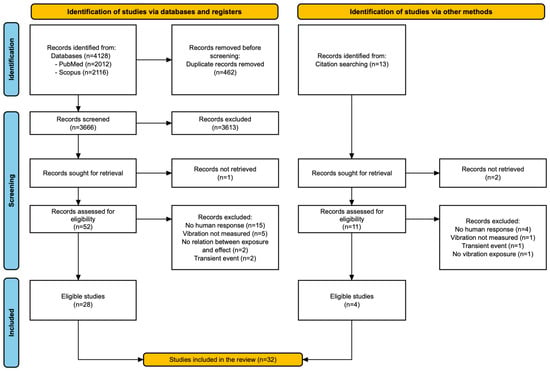
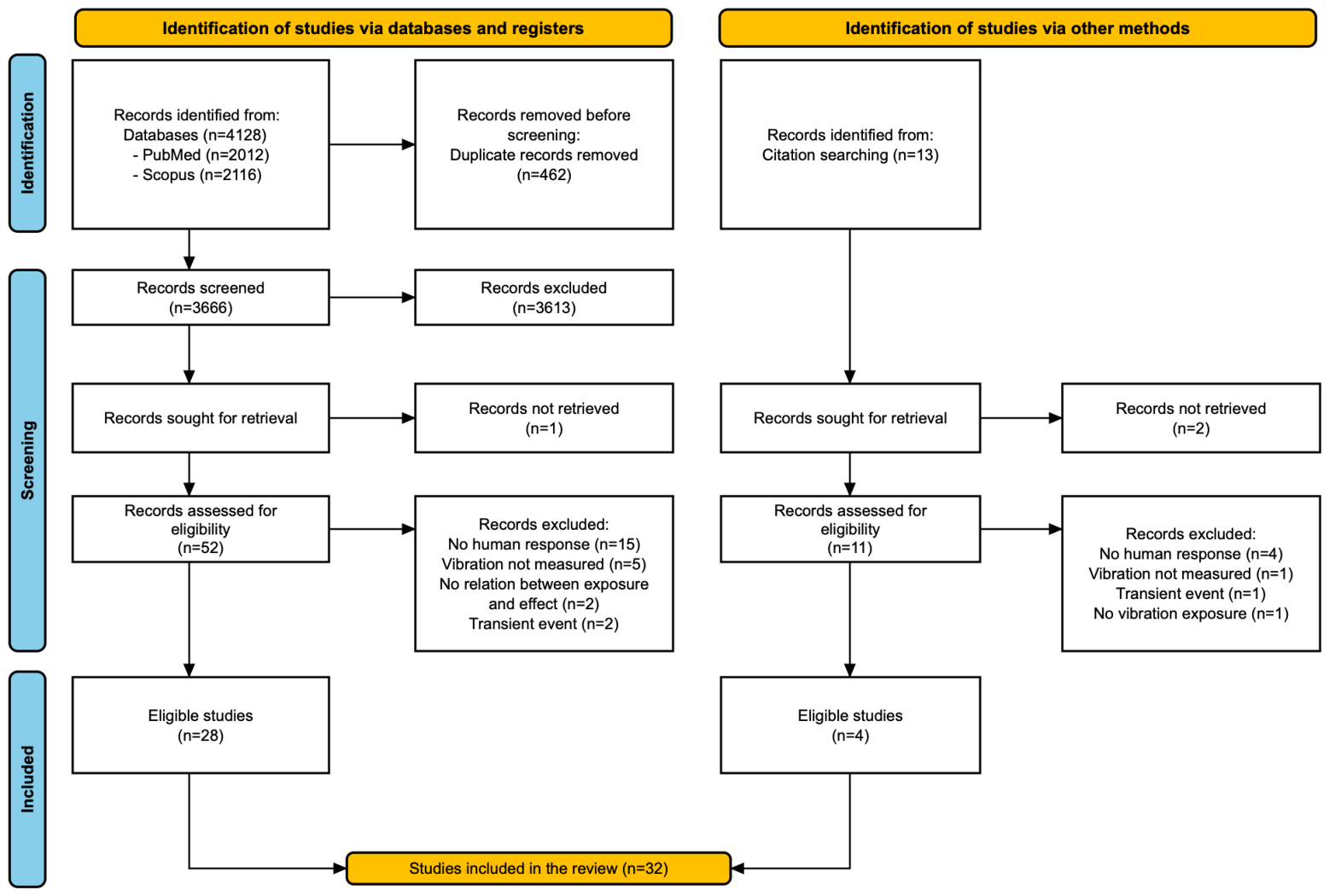
The search resulted in 4128 studies, of which 462 were removed as duplicates. Of the 3666 studies screened, 28 met the inclusion criteria. The forward and backward citation chasing process resulted in 13 additional studies being identified, of which 4 were considered eligible and included in the review. This led to a total of 32 studies included for analysis (Figure 1). The included studies were published between 1989 and 2025.
Figure 1.
PRISMA flowchart of the selection process.
3.2. Quality Assessment
The quality of all 32 studies included in the review was deemed appropriate following the guidelines of the ROBINS-E Risk of Bias tool. In total, 25 studies (78%) showed low risk of bias, 6 (19%) some concerns, and 1 (3%) high risk (Table 2).
Table 2.
Results of risk of bias assessment.
3.3. Study Characteristics
Different types of human responses were investigated in the selected studies (Table 3), with some studies examining more than one aspect: transmissibility of vibration (6); acceleration experienced by the body (12); effects on performance (16); neuromuscular activity (8); biomechanics (1); comfort (3); and vibration perception (2). A total of 401 participants were involved in the studies, of which 386 were men (96%) and 15 were women (4%). The age of the participants ranged between 16.5 and 51.0 years.
Table 3.
Characteristics investigated in each study.
3.4. Mechanical Effects
3.4.1. Transmissibility
Six studies examined the transmissibility of vibration and the resonant frequency of the different body parts during cycling; five of these were conducted in laboratory settings [18,30,31,32,43], and one in the field [17]. The type of bicycle (road, city, or mountain bike (MTB)) and vibration signal varied across the studies, although all laboratory studies applied vibration to the bike or mock-up bike via a vibration platform. The studies did not have a common aim, with the measurement of transmissibility the evaluation of HAV exposure with a focus on transmissibility and accelerations [17]; the analysis of the mechanical and physiological responses of the human body while cycling, with a focus on transmissibility, physiological and neuromuscular aspects [30]; the characterization of the vibration transmitted to the rider [18,31]; and the use of the experimental results as a comparison for results obtained from a dynamic model of the rider [43] or to evaluate the comfort of bike components [32].
The results (Table 4) indicate that vibration transmissibility decreases from the ankle to the knee and the hip [30] and that it is influenced both by crank cycle phase [30] and by the rider’s position on the bike [43]. Vibration transmissibility from the handlebar to the wrist, elbow and collarbone is also influenced by the cycling speed [17]. The other studies [18,31,32,43] investigated the resonant frequencies of different body parts, not permitting comparison of the results.
Table 4.
Overview of the studies investigating transmissibility.
3.4.2. Acceleration
A total of twelve studies examined acceleration experienced by the body of the rider, of which eight were conducted in a real-world scenario [1,17,23,26,27,28,29,33], and four in the lab [38,39,40,41] (Table 5). Of the studies dealing with exposure to in-field vibration conditions, two of them measured vibration only on the body of the rider [23,33]; in the others, the sensors were placed both on the body and on a part of the bike close to the considered body part. Additionally, two of the field studies evaluated the vibration exposures with respect to the exposure action value (EAV) and exposure limit value (ELV), as outlined in EU Directive 2002/44/EC for the protection of the health and safety of workers occupationally exposed to WBV and HAV [44]. When considering the studies performed in the laboratory, the measurement locations were only on the body of the rider, and only the characteristics (direction, frequency, amplitude, and in some cases arms) of the vibration produced by the platform or cycle-ergometer were specified, with no measurement of the vibration on the bike. The specific measurement positions varied considerably between studies, covering lower and upper limbs, lower back, neck and head, and the abdominal region.
Table 5.
Overview of the studies investigating acceleration outcomes.
The analyzed studies (Table 5) show a decrease in vibration exposure from the contact points with the bike towards more proximal locations, meaning that the body parts in contact with the bike are crucial points in the evaluation of vibration exposure [17,26,40,41]. The results also highlight that the exposure limits imposed by European Directive 2002/44/EC [44] are rapidly exceeded during standard riding conditions [1,17]. At the abdominal region, the acceleration seems to be influenced more by interindividual differences than by the cycling speed; however, more research is required in this area due to the high risk of bias associated with this study [33] (Table 2). Inconclusive results are obtained regarding the effectiveness of seatpost damping systems in reducing vibration transmission to the rider. In one case no beneficial effects were observed from the use of seatposts to reduce vibration transmission [1]. In contrast, two other studies reported a decrease in vibration transmitted [39,40]. However, differences in seatpost brands and study conditions likely influenced these results, highlighting the need for additional investigations. The use of a full-suspension MTB was observed to be beneficial for the reduction in vibration transmitted to the rider compared with a hardtail MTB [28]; the influence of wheel size on vibration transmission must be further investigated due to inconclusive results, which are likely affected by specific test conditions [23,26]. As for the studies investigating transmissibility, experiments in laboratory settings are characterized by more controlled conditions than in-field studies; on the other hand, in-field studies benefit from the ecological validity of vibration exposure, but are more affected by confounding factors.
3.5. Physiological Effects
3.5.1. Performance
A total of 16 studies, both in laboratory (12 studies) and in the field (4 studies), dealing with the effects of vibration on cyclists’ performance were included (Table 6).
Table 6.
Overview of the studies investigating physiological outcomes.
The studies investigating physiological outcomes in laboratory settings are characterized by different test protocols that make comparisons extremely challenging, and limit the ability to obtain clear and definitive conclusions. The studies involving interval training protocols suggest a decrease in metabolic performance due to vibration when the exposure is longer than 1 min [16,19,34]. Vibration seems to negatively influence metabolic parameters measured during tests to exhaustion, but some inconclusive results are present. In fact, studies reported lower exercise time [35] or increased 2, HR and lactate concentration [21,41], whereas others reported no influence [24,30] or an influence only at high workloads or vibration frequencies [25,36,41]. Additionally, vibration has been observed to influence angiogenic regulators in the blood; a significant increase has been observed for Vascular Endothelial Growth Factor (VEGF) at 0 h post-exercise, and Matrix metalloproteinase-2 (MMP-2) levels at both 0 h and 4 h post-exercise [37]. The influence of different bike components on vibration transmission and physiological performance has been investigated in field conditions. Even though changing components did lead to significantly different vibration experienced by the riders, no significant difference was found in RPE, gross efficiency, HR, 2 or cycling economy [20,26,28]. However, in comparing riding a full-suspension MTB on road and off-road conditions, it was observed that, together with lower accelerations at the handlebar, arm, and seatpost, during road riding there were also lower values of and HR, but this result is also likely to be influenced by the higher power output in the off-road condition [27]. As previously stated, field studies benefit from ecologically valid vibration exposure, but are subject to the influence of confounding factors, whereas laboratory studies can be more easily controlled, but may not reflect the true experience of cycling.
3.5.2. Muscular Activity
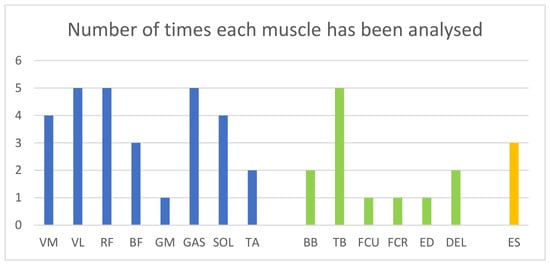
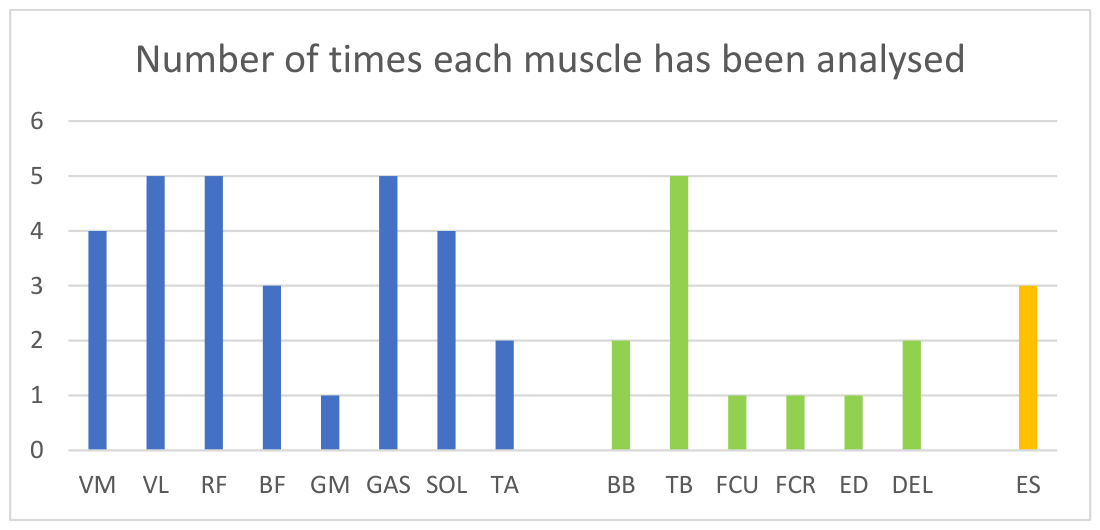
Eight studies investigated the effects of vibration on muscular activation, six laboratory studies [19,30,34,40,41,42], and two field studies [14,23] (Table 7, Figure 2), which included measurements of the upper and lower limbs and the lower back. Across these studies, vibration exposure was compared to cycling at matched power output or pedal rate without vibration, with outcomes reported as root mean square (RMS) of the electromyography (EMG) signal or normalized EMG amplitude relative to baseline.
Table 7.
Overview of the studies investigating muscular outcomes.
Figure 2.
Number of times the different muscles have been analyzed in the studies. Blue: lower limbs (VM: vastus medialis; VL: vastus lateralis; RF: rectus femoris; BF: biceps femoris; GM: gluteus maximus; GAS: gastrocnemius; SOL: soleus; TA: tibialis anterior). Green: upper limbs (BB: biceps brachii; TB: triceps brachii; FCU: flexor carpi ulnaris; FCR: flexor carpi radialis; ED: extensor digitorum; DEL: deltoideus). Orange: lumbar region (ES: erector spinae).
Although the results were not unanimous, in general, an increase in vibration exposure resulted in an increase in muscular activation. The muscles that were consistently influenced by vibration in studies conducted in the laboratory are the biceps femoris, gastrocnemius, soleus, triceps brachii and deltoideus. For the other analyzed muscles, the high discordance in the results does not allow for a definitive conclusion. In field conditions, the muscular activity of extensor digitorum was observed to increase with increasing order of roughness, both for road bikes and MTBs on the same surfaces [14]. Although the accelerations at the stem were higher on a road bike than on an MTB on all the surfaces investigated, significant differences in total muscle activation levels between road bikes and MTBs were observed only in rough road trials, where the acceleration level was higher [14].
3.5.3. Biomechanics
Only one study found in the literature investigated the effects of vibration on the biomechanics of the rider while cycling [42]. While there were no significant differences in the lower limbs, differences were observed between vibration exposure and no vibration exposure conditions for the upper body. A decrease in mean pelvic-floor plane inclination angle and an increase in pelvis-thorax extension were observed in the abdominal region, along with an increase in elbow flexion [42].
3.5.4. Comfort
While investigation of comfort is predominantly based on subjective evaluation, some efforts have been made to assess comfort via quantitative parameters. Investigating the influence of the type of suspension in MTBs on comfort, it was observed that, in addition to lower-frequency vibration transmitted, a full-suspension MTB provides greater comfort [20]. Other attempts have been made to evaluate comfort based on the vibration exposure itself. One study combined the vibration in the three orthogonal directions measured at the handlebar of city bikes during commuting rides into a single parameter, the frequency-weighted vibration, , where awx, awy, awz are the frequency-weighted arms accelerations in the different directions [10]. All subjects considered the vibration exposure acceptable when the awv was less than 2.04 m/s2. The acceptance decreased to 80% of participants when the awv was 2.44 m/s2, and this was reduced to only 40% with an awv of 3.19 m/s2. Overall, the cycling vibration was described to be ‘comfortable’ to ‘very comfortable’ when awv was less than 1.62 m/s2, ‘intermediately comfortable’ when awv was between 1.81 m/s2 and 2.04 m/s2, and ‘uncomfortable’ when awv was greater than 2.20 m/s2 [22]. A further study aimed to quantitatively evaluate comfort by using a comfort index (CI48) calculated as the integral of the transfer function between the seatpost and the pelvis between 4 Hz and 8 Hz. Evaluating the correlation between the subjective comfort evaluation and the CI48 factor, it was found that the correlation depends on the Body Mass Index (BMI) of the subjects. The BMI of the subjects ranged from 22.9 to 27.5; when only riders with a BMI between 23 and 25 were considered, the correlation coefficient increased from 0.4 to 0.7 [32].
3.5.5. Vibration Perception
Two studies investigated vibration perception during cycling and the influence of vibration on vibrotactile parameters. One study analyzed vibration perception, and the results found that the minimum amount of reduction in vibration perceived by the riders is 15% [15]. Another study [2] investigated vibrotactile parameters and observed an increase in vibrotactile perception threshold (VPT) after exposure to triaxial white noise vibration between 2 and 30 Hz of 0.45, 0.50, and 0.28 m/s2 rms along the anteroposterior, vertical, and mediolateral directions, respectively.
4. Discussion
This review aimed to synthesize the results of the existing literature that has investigated the effects of vibration experienced by riders during cycling. To date, no comprehensive synthesis of this topic exists in the literature; therefore, a broad overview on the effects of vibration in cycling may be beneficial to identify the key factors for the enhancement of rider comfort and performance. During the search process, no constraints on the type of human response investigated were set. Thirty-two studies were included in the review (Table 3). The main themes addressed were grouped into seven categories: transmissibility (6 studies), acceleration (12 studies), metabolic performance (16 studies), neuromuscular activity (8 studies), biomechanics (1 study), comfort (3 studies), and vibration perception (2 studies).
The field investigated is broad and varied, resulting in a limited number of studies focusing on each aspect that included different methodologies and measurements related to vibration exposure in cycling. Therefore, the strength of evidence in any one area is currently low.
Several related areas were intentionally outside the scope of this review. These include epidemiological information on long-term or occupational health outcomes of chronic vibration exposure (e.g., hand-arm vibration syndrome risk in professional cyclists or cycle-couriers), and evaluations of vibration mitigation technologies such as damping or suspension systems in the absence of measures of the human response.
4.1. Transmissibility
The studies highlighted that transmissibility of vibration while riding a bike can be influenced by different factors, including the rider’s position on the bike [43], cycling speed [17] and crank cycle phase [30]. Nevertheless, the strength of the current evidence is limited due to the differences in experimental methodologies and types of exposure examined in each study. Different settings were used (real-world [17] and laboratory [30,43]), different types of bikes (road bikes [17,30] and an MTB mock-up [43]), and, when in laboratory settings, vibrations were recreated in different ways (vibrating ram [43], vibrating platform [30]). This methodological heterogeneity has also been found among the studies focused on the estimation of the resonant frequency of different body parts, leading to single results not corroborated by other studies. In addition, it should be noted that most of the studies were conducted in laboratory settings, which differ from in-field conditions. Future studies may be useful to assess the extent to which these differences influence the results, evaluating the validity of laboratory-based findings. The possibility of conducting studies in a laboratory setting can be beneficial in terms of standardization of test protocols and conditions, as well as ease of execution.
4.2. Acceleration
High heterogeneity is also present in studies investigating the acceleration to which the rider’s body is exposed while cycling in different conditions. The main finding is a decrease in acceleration magnitude from contact points with the bike towards more proximal locations, both for the upper and the lower limbs [17,26,40,41]. This result has been confirmed both in real-world and laboratory conditions using MTB and road bikes, strengthening this evidence. The difficulties in evaluating vibration exposure in real conditions are confirmed by the inconclusive results about the influence of MTB wheel size on the transmission of vibration. However, regarding wheels, there are additional factors beyond vibration transmission. In fact, when agility is not crucial, larger wheels (29″ and 32″) are currently preferred due to their greater ability to maintain speed and to roll over obstacles. In highly technical disciplines, smaller (27.5″) wheels are still used due to the higher maneuverability they provide.
Other aspects, such as the effects of pads and road bike damping systems, have been examined [29,39,40], finding a decrease in acceleration transmitted to the body; however, only one study investigated each condition, requiring further studies to improve the strength of the evidence found.
When ISO 2631 [10] and ISO 5349 [8] are used, it has been shown that the daily limit of exposure imposed by the EU Directive 2002/44/EC [44] is exceeded both for HAV on cobblestones with a road bike [17] and WBV on a road surface with a road bike [1]. Specifically, Chiementin et al. [17] found the EAV exceeded from 5 km/h and the ELV exceeded between 5 and 10 km/h on cobblestones, while Edwards et al. [1] found the EAV exceeded for all participants and the ELV exceeded in 83% of trials during road riding. Despite the limited number of studies investigating these aspects, the adherence to ISO guidelines and, therefore, the availability of clear and comparable parameters for the evaluation of vibration exposure strengthens these results. However, a sporadic use of ISO guidelines in the other studies for the quantification of vibration exposure prevents proper comparison of the exposure in different conditions and at different levels.
Both ISO 2631 (WBV) and ISO 5349 (HAV) were developed primarily around continuous, seated or gripped contact with a vibrating surface (e.g., machinery operation, vehicle seats), which reasonably approximates saddle-transmitted WBV during steady seated cycling but is a weaker fit for HAV at the handlebars and for any condition involving intermittent or loose contact. None of the included studies reported measurement uncertainty arising from such intermittent contact loss, and we did not identify any study that quantified this specifically for cycling. Future methodological work is recommended, including contact estimates via pressure sensors and estimates of transmissibility via accelerometers.
4.3. Performance
Among the studies investigating the effects of vibration on physiological parameters, one analyzed how the production of angiogenic regulators is affected by vibration while cycling, suggesting that vibration increases the level of VEGF in the blood [37]; however, due to the heterogeneity of the subjects and the uniqueness of the examined aspects, further investigations are necessary to achieve a complete understanding.
Generally, a negative effect of vibration on cyclists’ performance was observed. The main evidence that can be extracted from the results of the interval training test protocols is the presence of negative effects of vibration exposure on metabolic parameters, such as 2, HR and lactate concentration, when the duration of intervals with vibration exposure is longer than 1 min; in fact, an increase in metabolic effort caused by vibration was found in studies with intervals of 1 min [19] and 5 min [34], but no influence was found in the study with intervals of 30 s [16]. However, the strength of this evidence is affected by the low number of studies (3) and by the fact that all the studies used different exercise protocols, with efforts at different intensities. To increase the strength of this evidence and better understand if the duration of the exposure period influences the effects of vibration, a study examining the effects of vibration on metabolic parameters during interval training efforts of different durations, but with the same intensity may be useful.
When dealing with exhaustion tests, the introduction of vibration decreases performance, causes 2max to be reached earlier, and leads to a higher lactate concentration during cycling [21,25,35,36,41]. This highlights the importance of minimizing vibration that cyclists are exposed to in order to maximize performance. However, the heterogeneity of the test protocol parameters, such as workload levels and level of vibration exposure, does not permit reaching a definitive conclusion as to a dose–response relationship between vibration and performance, or whether critical levels of vibration exposure exist at which there is a negative effect on performance.
In real-world conditions, one study reported a lower level of vibration, associated with a lower metabolic cost when riding a MTB on a road surface compared with a gravel surface on courses with the same characteristics [27]; however, this study presents a moderate risk of bias due to some issues in the confounding factors domain of the assessment. Therefore, this evidence should be used carefully, and further investigation is necessary to reach a clearer result.
4.4. Muscular Activity
Generally, the exposure to vibration was observed to cause an increase in RMS values of the EMG signals, or in the normalized EMG amplitudes, with respect to non-vibration cycling in the same condition of power output or pedal rate.
Some evidence suggests that muscular activity is influenced by vibration while cycling; in fact, in 7 studies out of the 8 analyzed, it has been observed that muscular activation of at least one muscle, among the ones analyzed, is influenced by vibration. The most influenced muscles are biceps femoris, gastrocnemius, soleus, triceps brachii and deltoideus; while for erector spinae no influence has been observed in any of the studies in which it was analyzed. It should be noted that the erector spinae has only been examined in laboratory-based studies, meaning that the specific conditions, with the bike fixed, may influence the activity of this muscle. This limitation also applies to the other muscles, highlighting the need for further work in in-field conditions as well to obtain a more precise understanding. However, the results obtained so far can be used as a basis for future work. While seven out of the eight studies report a vibration-related increase in RMS/normalized EMG amplitude for at least one muscle, only three also reported a concurrent metabolic-cost measure allowing the two to be linked directly (see below), and that link is not fully consistent across studies; a systematic, standardized vibration vs. no-vibration EMG comparison, ideally paired with simultaneous metabolic and kinematic measurement and reported for a consistent muscle set, remains a research gap.
In three of the studies that examined the effects of vibration on both the metabolic performance and the muscular activity, when an increase in muscular activity was observed, there was also an increase in metabolic cost [19,34,41]. This relation suggests that the increase in metabolic cost in the presence of vibration is due to the increased effort performed by the muscles to overcome vibration during propulsion and stabilization. However, Munera et al. [30] found an increase in muscular activation without a corresponding significant change in metabolic measures.
4.5. Biomechanics
In addition to the effects on performance and muscular activity, preliminary evidence suggests that vibration also affects the biomechanics of the riders [42]. To find a more comfortable position and to increase the stabilization, the kinematics of the lumbar and abdominal region and of the upper limbs were adapted. However, to strengthen these results, additional studies should be performed, with particular attention to having consistent methodologies and protocols.
4.6. Comfort
The objective evaluation of the effects of vibration on comfort can be useful in both the manufacturing of bicycle components and the assessment of riding surfaces. In component development, such evaluation may be particularly valuable in the early stages of testing, allowing a preliminary evaluation of comfort without involving a large number of participants. However, subjective comfort perception should not be overlooked, as users’ perceptions may not always align with objective data. On the other hand, a rapid and objective assessment of comfort across different roads and bike lanes may assist municipalities in evaluating road conditions. Nevertheless, due to the limited number and uniqueness of the studies currently available in the literature [20,22,32] as well as the small sample sizes involved, further research is needed to identify appropriate metrics for the quantitative assessment of comfort.
4.7. Vibration Perception
Due to the limited number of studies, it is not possible to reach a definitive conclusion on how vibration affects vibration perception. Preliminary evidence suggests a decrease in vibrotactile perception at the hand after exposure to vibration while cycling [2], requiring further investigations. No studies examined FTV in cycling.
5. Conclusions
This systematic review provides an overall view of the knowledge about the human response to vibration during cycling. In all of the fields investigated, the publications analyzed are characterized by a methodological heterogeneity that does not permit drawing clear and exhaustive conclusions. The main finding regarding the acceleration measured at different body parts is that the exposure limits imposed by the European Directive 2002/44/EC [44] are reached rapidly, even in conditions that would not be regarded as demanding, based on the two field studies that directly evaluated exposure against these thresholds [1,17]. Because the Directive’s action and limit values were developed around occupational, full-shift exposure, their applicability to short-duration recreational cycling should be treated with caution; we consider the finding most directly relevant to occupational cycling contexts, such as delivery and courier work, where exposure durations approach those the Directive was designed for. This highlights that the assessment of vibration exposure is important not only in occupational settings, but also during recreational cycling. Vibration has been demonstrated to increase muscle activation and physiological demand at matched workload. Performance impairment, related to measured performance outcome (e.g., time-to-exhaustion), was shown in a smaller number of studies, and the two should not be treated as equivalent. Consequently, equipment and bicycle configurations designed to minimize vibration exposure may enhance comfort, performance, and safety. Nevertheless, these benefits must be balanced against cost and possible adverse effects on other performance-related aspects, such as mass and aerodynamics. To reach a deeper understanding of the analyzed topic, a standardization of the test protocols in all the fields of investigation is needed, with the use of the ISO guidelines being essential to compare vibration exposure.
Author Contributions
Conceptualization, A.B., M.T. and G.K.R.W.; methodology, A.B., M.T., F.M., T.P.H., B.H. and G.K.R.W.; software, A.B., M.T., F.M. and G.K.R.W.; validation, A.B., M.T., F.M. and G.K.R.W.; formal analysis, A.B., M.T., F.M., T.P.H., B.H. and G.K.R.W.; investigation, A.B., F.M. and B.H.; resources, M.T. and G.K.R.W.; data curation, A.B., M.T., F.M., T.P.H., B.H. and G.K.R.W.; writing—original draft preparation, A.B., M.T., F.M., T.P.H., B.H. and G.K.R.W.; writing—review and editing, A.B., M.T., F.M., T.P.H., B.H. and G.K.R.W.; visualization, A.B., F.M. and B.H.; supervision, M.T., T.P.H. and G.K.R.W.; project administration, M.T. and G.K.R.W.; funding acquisition, n/a. All authors have read and agreed to the published version of the manuscript.
Funding
This study was not supported by any funding.
Data Availability Statement
All data included analysed are available in the cited articles. Additional details regarding the data extraction or analysis are available from the corresponding author upon reasonable request.
Conflicts of Interest
The authors declare no conflicts of interest.
References
- Edwards, P.I.; Holsgrove, T.P. Thunder road—Whole-body vibration during road cycling, and the effect of different seatpost designs to minimize it. J. Sports Sci. 2021, 39, 489–495. [Google Scholar] [CrossRef] [Scilit] [PubMed]
- Marrone, F.; Sanna, N.; Zanoni, G.; Mansfield, N.J.; Tarabini, M. Method for Assessing Numbness and Discomfort in Cyclists’ Hands. Sensors 2025, 25, 4708. [Google Scholar] [CrossRef] [Scilit] [PubMed]
- Krajnak, K. Health effects associated with occupational exposure to hand-arm or whole body vibration. J. Toxicol. Environ. Health Part B 2018, 21, 320–334. [Google Scholar] [CrossRef] [Scilit] [PubMed]
- Campbell, R.A.; Janko, M.R.; Hacker, R.I. Hand-arm vibration syndrome: A rarely seen diagnosis. J. Vasc. Surg. Cases Innov. Tech. 2017, 3, 60–62. [Google Scholar] [CrossRef] [Scilit] [PubMed]
- Nieradko-Iwanicka, B. Hand-arm vibration syndrome. Reumatologia 2019, 57, 347–349. [Google Scholar] [CrossRef] [Scilit] [PubMed]
- Pelmear, P.L. The clinical assessment of hand-arm vibration syndrome. Occup. Med. 2003, 53, 337–341. [Google Scholar] [CrossRef] [Scilit] [PubMed]
- Aarhus, L.; Veiersted, K.B.; Nordby, K.C.; Bast-Pettersen, R. Neurosensory component of hand-arm vibration syndrome: A 22-year follow-up study. Occup. Med. 2019, 69, 215–218. [Google Scholar] [CrossRef] [Scilit] [PubMed]
- BS EN ISO 5349-1:2001; Mechanical Vibration: Measurement and Assessment of Human Exposure to Hand-Transmitted Vibration. Part 1, General Guidelines. BSI: London, UK, 2001.
- Bovenzi, M. Health Effects of Mechanical Vibration. 2005. Available online: https://www.researchgate.net/publication/7825436 (accessed on 29 August 2025).
- ISO 2631-1; Mechanical Vibration and Shock—Evaluation of Human Exposure to Whole-Body Vibration—Part 1: General Requirements. International Organization for Standardization (ISO): Geneva, Switzerland, 2011.
- Thompson, A.M.S.; House, R.; Krajnak, K.; Eger, T. Vibration-white foot: A case report. Occup. Med. 2010, 60, 572–574. [Google Scholar] [CrossRef] [Scilit] [PubMed][Green Version]
- Eger, T.; Thompson, A.; Leduc, M.; Krajnak, K.; Goggins, K.; Godwin, A.; House, R. Vibration induced white-feet: Overview and field study of vibration exposure and reported symptoms in workers. Work 2014, 47, 101–110. [Google Scholar] [CrossRef] [Scilit] [PubMed]
- Higgins, J.P.T.; Morgan, R.L.; Rooney, A.A.; Taylor, K.W.; Thayer, K.A.; Silva, R.A.; Lemeris, C.; Akl, E.A.; Bateson, T.F.; Berkman, N.D.; et al. A tool to assess risk of bias in non-randomized follow-up studies of exposure effects (ROBINS-E). Environ. Int. 2024, 186, 108602. [Google Scholar] [CrossRef] [Scilit] [PubMed]
- Arpinar-Avsar, P.; Birlik, G.; Sezgin, Ö.C.; Soylu, A.R. The Effects of Surface-Induced Loads on Forearm Muscle Activity During Steering a Bicycle. Sports Sci. Med. 2013, 12, 512–520. [Google Scholar]
- Ayachi, F.S.; Drouet, J.M.; Champoux, Y.; Guastavino, C. Perceptual Thresholds for Vibration Transmitted to Road Cyclists. Hum. Factors 2018, 60, 844–854. [Google Scholar] [CrossRef] [Scilit] [PubMed]
- Bossi, A.H.; Mesquida, C.; Hopker, J.; Rønnestad, B.R. Adding Intermittent Vibration to Varied-Intensity Work Intervals: No Extra Benefit. Int. J. Sports Med. 2023, 44, 126–132. [Google Scholar] [CrossRef] [Scilit] [PubMed]
- Chiementin, X.; Rigaut, M.; Crequy, S.; Bolaers, F.; Bertucci, W. Hand-arm vibration in cycling. JVC/J. Vib. Control 2013, 19, 2551–2560. [Google Scholar] [CrossRef] [Scilit]
- Dialynas, G.; Schouten, A.C.; Happee, R.; Schwab, A.L. The Dynamic Response of the Bicycle rider’s Body to Vertical, Fore-and-Aft and Lateral Perturbations. 2019. Available online: https://www.researchgate.net/publication/336367510 (accessed on 29 August 2025).
- Duc, S.; Urianstad, T.; Rønnestad, B.R. Adding Vibration During Varied-Intensity Work Intervals Increases Time Spent Near Maximal Oxygen Uptake in Well-Trained Cyclists. Int. J. Sports Physiol. Perform. 2022, 17, 1565–1573. [Google Scholar] [CrossRef] [Scilit] [PubMed]
- Faiss, R.; Praz, M.; Meichtry, A.; Deriaz, O. The Effect of Mountain Bike Suspensions on Vibrations and Off-Road Uphill Performance. 2007. Available online: https://www.researchgate.net/publication/6279940 (accessed on 29 August 2025).
- Filingeri, D.; Jemni, M.; Bianco, A.; Zeinstra, E.; Jimenez, A. The Effects of Vibration During Maximal Graded Cycling Exercise: A Pilot Study. Sports Sci. Med. 2012, 11, 423–429. [Google Scholar]
- Gao, J.; Sha, A.; Huang, Y.; Hu, L.; Tong, Z.; Jiang, W. Evaluating the cycling comfort on urban roads based on cyclists’ perception of vibration. J. Clean. Prod. 2018, 192, 531–541. [Google Scholar] [CrossRef] [Scilit]
- Hurst, H.T.; Sinclair, J.; Atkins, S.; Rylands, L.; Metcalfe, J. Influence of wheel size on muscle activity and tri-axial accelerations during cross-country mountain biking. J. Sports Sci. 2017, 35, 1342–1348. [Google Scholar] [CrossRef] [Scilit] [PubMed][Green Version]
- Jemni, M.; Gu, Y.; Hu, Q.; Marina, M.; Fessi, M.S.; Moalla, W.; Mkaouer, B.; Konukman, F. Vibration Cycling Did Not Affect Energy Demands Compared to Normal Cycling During Maximal Graded Test. Front. Physiol. 2019, 10, 1083. [Google Scholar] [CrossRef] [Scilit] [PubMed]
- Kramer, M.; Kholvadia, A. The effect of vibration cycle ergometry on pulmonary VO2 kinetics, isokinetic knee torque, and lower extremity explosive power. Ergonomics 2021, 64, 943–952. [Google Scholar] [CrossRef] [Scilit] [PubMed]
- Macdermid, P.W.; Fink, P.W.; Stannard, S.R. Transference of 3D accelerations during cross country mountain biking. J. Biomech. 2014, 47, 1829–1837. [Google Scholar] [CrossRef] [Scilit] [PubMed]
- Macdermid, P.W.; Fink, P.W.; Stannard, S.R. The Effects of Vibrations Experienced during Road vs. Off-road Cycling. Int. J. Sports Med. 2015, 36, 783–788. [Google Scholar] [CrossRef] [Scilit] [PubMed]
- Macdermid, P.W.; Fink, P.W.; Miller, M.C.; Stannard, S. The impact of uphill cycling and bicycle suspension on downhill performance during cross-country mountain biking. J. Sports Sci. 2017, 35, 1355–1363. [Google Scholar] [CrossRef] [Scilit] [PubMed]
- Marcolin, G.; Panizzolo, F.A.; Paoli, A.; Petrone, N. Experimental methods for the mechanical characterization of cycling short pads. Proc. Inst. Mech. Eng. P J. Sport. Eng. Technol. 2018, 232, 22–27. [Google Scholar] [CrossRef] [Scilit]
- Munera, M.; Bertucci, W.; Duc, S.; Chiementin, X. Analysis of muscular activity and dynamic response of the lower limb adding vibration to cycling. J. Sports Sci. 2018, 36, 1465–1475. [Google Scholar] [CrossRef] [Scilit] [PubMed]
- Ota, S.; Nishiyama, S.; Shinohara, T. Vibration Characteristics of a Human Adult and Infants Travelling in a Bicycle with Two Child Seats. 2012. Available online: https://proceedings.asmedigitalcollection.asme.org (accessed on 29 August 2025).
- Petrone, N.; Trabacchin, F. Development of a Test Bench for the Subjective and Objective Evaluation of the Vibrational Comfort of Bicycle Components. In Proceedings of the ASME 2014 International Design Engineering Technical Conferences and Computers and Information in Engineering Conference, Buffalo, NY, USA, 17–20 August 2014. [Google Scholar] [CrossRef] [Scilit]
- Rehrer, N.J. Biomechanical Vibration of the Abdominal Region During Running and Bicycling. 1991. Available online: https://www.researchgate.net/publication/21401520 (accessed on 29 August 2025).
- Rønnestad, B.R.; Moen, M.; Gunnerød, S.; Øfsteng, S. Adding vibration to high-intensity intervals increase time at high oxygen uptake in well-trained cyclists. Scand. J. Med. Sci. Sports 2018, 28, 2473–2480. [Google Scholar] [CrossRef] [Scilit] [PubMed]
- Samuelson, B.; Jorfeldt, L.; Ahlborg, B. Influence of Vibration on Work Performance During Ergometer Cycling. Upsala J. Med. Sci. 1989, 94, 73–79. [Google Scholar] [CrossRef] [Scilit] [PubMed]
- Sperlich, B.; Kleinoeder, H.; De Marées, M.; Quarz, D.; Linville, J.; Haegele, M.; Mester, J. Physiological and perceptual responses of adding vibration to cycling. J. Exerc. Physiol. (JEPonline) 2009, 12, 40–46. [Google Scholar]
- Suhr, F.; Brixius, K.; de Marées, M.; Bölck, B.; Kleinöder, H.; Achtzehn, S.; Bloch, W.; Mester, J. Effects of short-term vibration and hypoxia during high-intensity cycling exercise on circulating levels of angiogenic regulators in humans. J. Appl. Physiol. 2007, 103, 474–483. [Google Scholar] [CrossRef] [Scilit] [PubMed]
- Trama, R.; Hautier, C.; Blache, Y.; Bertucci, W.; Chiementin, X.; Hintzy, F. Intra-cycle analysis of muscle vibration during cycling. Sports Biomech. 2022, 22, 554–566. [Google Scholar] [CrossRef] [Scilit] [PubMed]
- Viellehner, J. Acceleration Transmitted to the Human Body During Cycling: Effect of a Road Bike Damping System. 2018. Available online: https://www.researchgate.net/publication/334401047 (accessed on 29 August 2025).
- Viellehner, J.; Potthast, W. The effect of road-bike damping on neuromuscular short-term performance. Sports Biomech. 2020, 19, 723–737. [Google Scholar] [CrossRef] [Scilit] [PubMed]
- Viellehner, J.; Potthast, W. The Effect of Cycling-specific Vibration on Neuromuscular Performance. Med. Sci. Sports Exerc. 2020, 53, 936–944. [Google Scholar] [CrossRef] [Scilit] [PubMed]
- Viellehner, J.; Potthast, W. The effect of vibration on kinematics and muscle activation during cycling. J. Sports Sci. 2022, 40, 1760–1771. [Google Scholar] [CrossRef] [Scilit] [PubMed]
- Wang, E.L.; Hull, M.L. A Dynamic System Model of an Off-Road Cyclist. J. Biomech. Eng. 1997, 119, 248–253. [Google Scholar] [CrossRef] [Scilit] [PubMed]
- European Parliament and Council of the European Union. Directive 2002/44/EC of the European Parliament and of the Council of 25 June 2002 on the Minimum Health and Safety Requirements Regarding the Exposure of Workers to the Risks Arising from Physical Agents (Vibration) (Sixteenth Individual Directive Within the Meaning of Article 16(1) of Directive 89/391/EEC); Publications Office of the European Union: Luxembourg, 2002. [Google Scholar]

Disclaimer/Publisher’s Note: The statements, opinions and data contained in all publications are solely those of the individual author(s) and contributor(s) and not of MDPI and/or the editor(s). MDPI and/or the editor(s) disclaim responsibility for any injury to people or property resulting from any ideas, methods, instructions or products referred to in the content. |
© 2026 by the authors. Licensee MDPI, Basel, Switzerland. This article is an open access article distributed under the terms and conditions of the Creative Commons Attribution (CC BY) license.