


Abstract
Based on the decoupled n-dodecane skeletal mechanism and the computational fluid dynamics (CFD) numerical framework, a multilayer feedforward neural network surrogate model was developed to predict ignition delay in a constant-volume combustion vessel. The Levenberg–Marquardt optimizer with adaptive damping coefficients was used for model training, with mean squared error as the loss function and an inherent early stopping mechanism to prevent overfitting without additional weight decay regularization. To eliminate random interference from initial parameter settings, the surrogate model underwent 1000 repeated training trials, each with random weight re-initialization. The effects of hidden neurons, data partition strategy, normalization scheme, and sample size on predictive performance were systematically examined. The optimal configuration—three hidden neurons, a 70:15:15 data split, and a 105-sample training set—showed low sensitivity to data normalization. The resulting surrogate model is concise and sample-efficient, maintaining satisfactory prediction accuracy at 800 K and 1100 K while substantially reducing computational overhead. It provides a practical and reliable tool for subsequent combustion prediction and uncertainty quantification of hydrocarbon fuels. The feedforward neural network surrogate model substantially cuts the computational overhead for fuel combustion prediction to merely 15–20 min for every batch of 60 samples.
1. Introduction
Advances in computer performance have made numerical tools increasingly advantageous for studying combustion processes in internal combustion engines. Numerical simulation is increasingly applied in internal combustion engine design due to its flexibility and ease of use, which greatly streamlines the design process and reduce costs. However, as computational models are continuously refined, it becomes necessary to incorporate a growing number of parameter variables into the models [1,2]. The interactions among these parameters have also become more complex, leading to longer simulation times and greater uncertainty in the results, which adversely affects the convergence efficiency of the calculations. For this reason, a variety of uncertainty analysis techniques are employed by researchers to analyze and constrain the uncertainties associated with numerical simulations. Based on existing uncertainty analysis studies [3,4], the primary sources of uncertainty can be categorized into three types: aleatory uncertainty, epistemic uncertainty, and model structural uncertainty.
During mechanism simplification and optimization, complex reaction pathways require careful evaluation of reaction priorities and their impact on combustion, based on species parameters across the full reactant-to-product chain [5,6,7,8,9]. The quality and speed of these assessments directly shape the predictive performance and computational efficiency of the final mechanism.
Based on the idea of reaction pathway analysis approach, Bhoorasingh et al. [10] used a deep learning model program to achieve classification analysis similar to the reaction path lumping method, constructed a molecular database for combustion processes, and assisted in the calculation of intermediates and transition states for the combustion model constructed by Sarathy’s group [11].
Using deep learning models to accelerate predictions of chemical reaction kinetics is another promising line of inquiry. The Blasco research group has successively used different deep learning models to efficiently assist in the accelerated prediction of combustion characteristics of fuels with various chemical reaction mechanisms [12,13]. With the in-depth research on applying neural network models to accelerate and enhance the efficiency of numerical simulations of chemical reaction kinetic mechanisms, numerous researchers have adopted various methods to train neural network models and applied them to the testing and simulation of reaction mechanisms, gradually improving the final predictive computational accuracy and efficiency [14,15].
Although various deep learning models have achieved rapid development in predicting combustion characteristics such as fuel ignition and flame propagation [16,17,18], and can accurately predict the combustion characteristics of fuels including hydrogen and biodiesel [19,20,21], some researchers have constructed deep learning models whose predictive performance is even comparable to detailed mechanisms [22]. However, similar to detailed chemical kinetics mechanisms, the complete representation of reaction pathways and parameter evolution in fuel combustion remains an active research topic. In particular, further investigation is needed on the uncertainty propagation from source models to deep learning surrogates, and on the robustness of predictions beyond the training domain.
From previous research, it can be seen that leveraging continuously developing artificial intelligence (AI) technologies [23,24,25,26,27,28] to assist in improving chemical reaction kinetics mechanisms, and even CFD computational models, is a current trend in studying fuel combustion characteristics. Especially in the aspect of reaction pathway selection and optimization, it shares highly similar algorithmic attributes with mainstream deep learning technologies such as neural networks [29,30]. These factors have driven mechanism research toward algorithmic optimization. However, completely replacing chemical reaction kinetics mechanisms with deep learning algorithms still presents considerable challenges [26,27,28,31]. Key areas requiring continuous research and analysis include the impact of data normalization on model performance [32], multi-objective optimization [33], overfitting [34], loss functions [35,36], constrained multi-objective enhancement, the balance between data volume and computational cost [22,36,37], the “black box” problem [38], and the weak generalization ability of deep learning models [39,40].
Based on the above research direction, this approach intends to use an efficient chemical reaction kinetics mechanism as the source model to train a suitable deep learning model [41]. This approach has several advantages. On one hand, it can greatly increase the prediction speed of the trained model, and by using an appropriate number of samples and suitable training methods, the surrogate model can maintain a balance between accuracy and efficiency, providing a streamlined and efficient calculation pathway for subsequent research. On the other hand, while maintaining reasonable prediction accuracy, by comparing the prediction differences between the two types of models, or studying the influence of various factors in their optimization processes on prediction results, it is possible to better feedback the generation and evolution mechanisms of their respective uncertainties [42], making subsequent comparative analysis feasible. Although this strategy is not common in combustion characteristics research systems, it is mentioned in numerous deep learning research papers [43,44] and can serve as one method for investigating the transmission mechanisms of combustion characteristic uncertainties among different models.
2. Source Model
This chapter utilizes feedforward neural networks (FNN) to simulate ignition delay data in isochoric combustion predicted by the n-dodecane mechanism in a constant volume bomb (CVB), and analyzes the variance of the input parameters and the variance of the ignition delay obtained from the artificial neural network.
2.1. Numerical Model
The sample data used for training the neural network in the neural network originated from ignition delay data predicted by numerical simulation of a CVB. All sample data were obtained through coupled calculations using KIVA-3V(R2) [45] and Chemkin Pro (15083) [46]. The CVB data used for calculation in this investigation was the n-dodecane data from Sandia National Laboratories [47]. Fuel combustion simulations in the present work were performed jointly with KIVA-3V and Chemkin Pro. Pure n-dodecane is utilized as the diesel surrogate fuel for CFD modeling. Its critical thermodynamic properties at ambient conditions (25 °C, 1 atm) are specified as follows: density of 749 kg/m3, constant-pressure specific heat of 2.21 kJ/(kg·K), thermal conductivity of 0.14 W/(m·K), and net heating value of 44.2 MJ/kg. These parameters are consistent with the default material database embedded in the KIVA-3V. The thermodynamic parameters calculated by KIVA-3V provided the inputs for chemical kinetic calculations performed using Chemkin Pro. Based on the selected chemical kinetic mechanism, the heat release and fuel composition were updated accordingly, and the new data were then fed back to KIVA-3V for the next simulation step. The governing equations of KIVA-3V include the continuity Equation (1), momentum Equation (3), and internal energy Equation (5), which are presented below.
where is the mass density of component m; is the total mass density; is the fluid velocity; denotes the diffusion coefficient; is the chemically induced source term; is the injection-induced source term; represents the Dirac delta function; is calculated according to Equation (2); is the chemical reaction rate, which can be determined by the Arrhenius formula; denotes the pressure; is a dimensionless quantity calculated via the pressure gradient scaling (PGS) method; the value of is 0 for laminar flow and 1 for turbulent flow; denotes the viscous stress tensor, which is computed by the generalized Newtonian Formula (4); is the volumetric momentum change rate induced by injection; is the specific body force; and represent the first and second viscosity coefficients, respectively, where the superscript denotes the transpose and denotes the unit matrix; is the specific internal energy excluding chemical energy; represents the total contribution of heat conduction and enthalpy diffusion, which is calculated by Equation (6); is the source term induced by chemical heat release and is computed by the Chemkin Pro program; is the source term generated by spray processes; is the fluid temperature; and is the specific enthalpy of component m.
This investigation adopts the generalized Renormalization Group (g-RNG) turbulence model, improved by Wang et al. [48] based on RNG, as the turbulence model required for the numerical simulation in this paper. The turbulence model mainly consists of the turbulent kinetic energy transport Equation (7) and the turbulent dissipation rate transport Equation (8).
where is the turbulent kinetic energy production source term; is the turbulent viscosity coefficient; is the turbulent velocity; is the turbulent kinetic energy; is the turbulent dissipation rate; denotes the spray source term; , , and are model constants; represents the anisotropy term; denotes the term related to compression and two-phase flow; and is the local flow dimensional term.
The spray process in a CVB is a continuous process, making direct CFD calculation difficult; it is usually discretized. The entire fuel spray is simplified into a discrete model composed of individual oil droplets. Using a two-phase flow approach, interactions between droplets and the environment, between droplets themselves, and between droplets and the cylinder wall are analyzed and modeled individually. This mainly includes atomization models, collision models, wall impingement models, and evaporation models. The KH-RT breakup model used in this investigation describes the droplet change processes caused by KH [49] breakup and RT breakup [50], respectively, achieving a mathematical expression for fuel atomization.
where and are the initial droplet radii before KH and RT breakup, respectively; and are the new droplet radius after KH and RT breakup, which are calculated by Equations (11) and (12); and denote the breakup times of KH and RT breakup, obtained from Equations (13) and (14); and represent the maximum surface wave growth rates for KH and RT breakup; and are the wavelengths corresponding to the maximum surface wave growth rates of KH and RT breakup; is a model constant with a typical value of 0.6; is the breakup time constant ranging from 10 to 60; and are tunable model parameters with default values of 1.0 and 0.1, respectively.
The Nordin collision model was employed in this work. Ref. [51] to simulate the collision process. This model judges whether a collision occurs by calculating droplet trajectories and solving whether two droplets can simultaneously reach the same position within the cylinder. It belongs to a model with high computational efficiency and low grid dependency.
where denotes the droplet velocity vector, denotes the droplet position vector, and denotes the droplet radius. Subscripts 1 and 2 represent two individual droplets, respectively. is the probability density function, is the minimum distance between droplets, and is the droplet trajectory vector function. and correspond to the solutions for the collision times of the two droplets [51].
The process by which droplets transform into gas within the CVB due to changes in temperature and pressure is called evaporation. The complex evaporation process is modeled using the KIVA-3V built-in evaporation model, which was developed based on single-droplet evaporation experiments.
where is the gas-phase diffusion coefficient, is the gas-phase density, is the droplet radius, is the droplet mass, is the specific heat capacity, is the heat absorbed by the droplet from the gas phase, is the heat transferred from the gas phase to the droplet, is the gas-phase thermal conductivity, is the gas-phase temperature, and denotes the Nusselt number.
The heat transfer model used in this study is the modified heat transfer model by Han and Reitz [52]. This model is based on ideal gas convective heat transfer theory and considers gas compression and turbulence effects, achieving numerical simulation of heat transfer by solving the wall heat flux Formula (24). For the other physical processes in the CFD simulations, the default models provided by KIVA-3V were employed without modification.
where is the wall heat flux, is the temperature; the subscript denotes wall-related parameters; is the velocity; is the density; is the specific heat at constant pressure; represents the friction velocity, which is calculated by Equation (25); denotes the distance to the wall; and is the turbulent kinetic energy.
2.2. Computational Grid
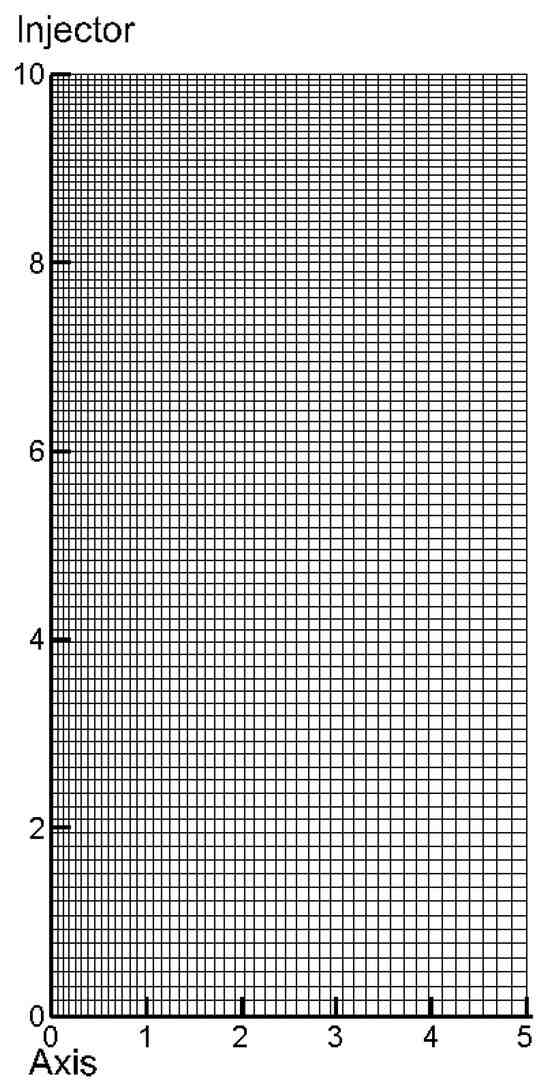
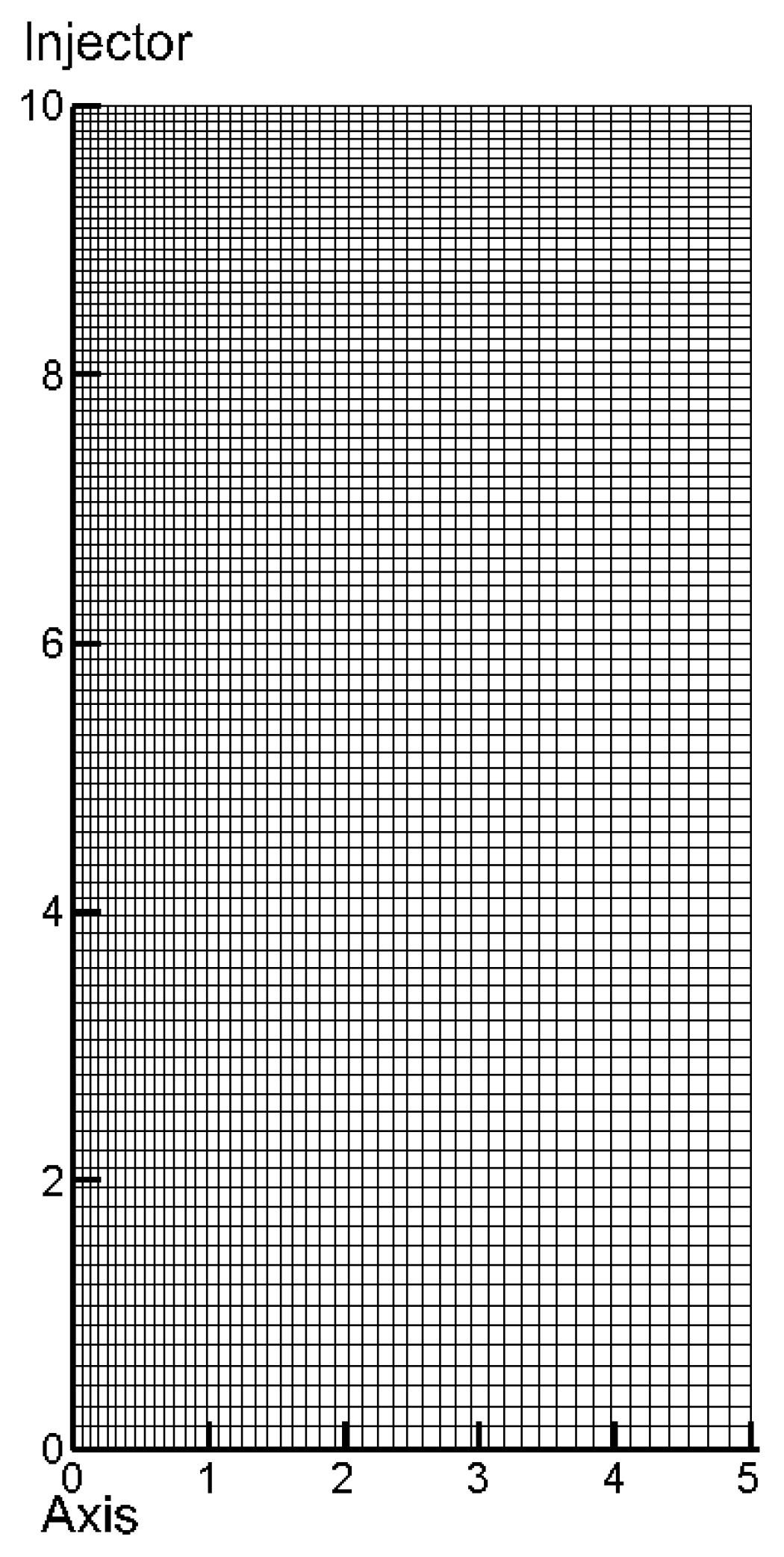
When using KIVA-3V(R2) for numerical simulation, the division of the computational grid is a core step, as it determines the accuracy and efficiency of the prediction results. In this work, a progressive axisymmetric mesh created with ICEM-CFD (Figure 1) is imported into KIVA-3V(R2) for predicting ignition delay in the CVB. With cylinder dimensions of 100 × 100 mm, the total grid size is 100 × 50 mm. The grid gradually becomes sparser downward from the nozzle core, featuring a core grid size of 0.6 × 0.6 mm and a maximum grid size of 1.5 × 1.5 mm at the farthest end, totaling approximately 4400 cells. Comparative simulations are carried out using uniform meshes of multiple sizes and the progressive axisymmetric mesh developed herein. Validation results indicate that the progressive mesh achieves stable prediction accuracy while significantly improving computational efficiency. The progressive axisymmetric mesh used in this work maintains good computational accuracy while keeping computational cost relatively low.
Figure 1.
Grid used in the present study.
2.3. N-Dodecane Mechanism
2.3.1. Mechanism Optimization
C12H26 + O2 <=> C12H25 + HO2
C12H26 + OH <=> C12H25 + H2O
C12H26 + H <=> C12H25 + H2
C12H26 + HO2 <=> C12H25 + H2O2
C12H25 <=> 2C3H6 + C2H5 + 2C2H4
C12H25 + O2 <=> C12H25OO
C12H25OO <=> C12H24OOH
C12H24OOH + O2 <=> OOC12H24OOH
OOC12H24OOH <=> C12KET + OH
C12KET <=> C5H11CO + OH + CH2O + C2H4 + C3H6
C5H11CO + O2 <=> C3H7 + C2H3 + CO + HO2
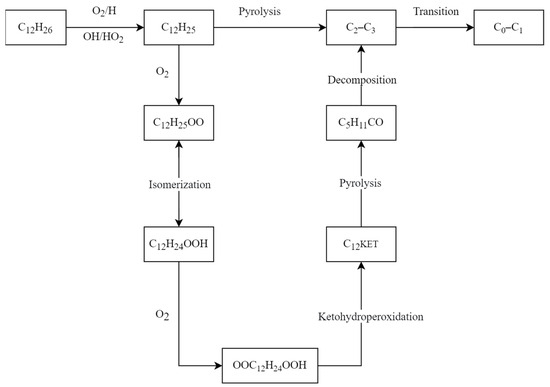
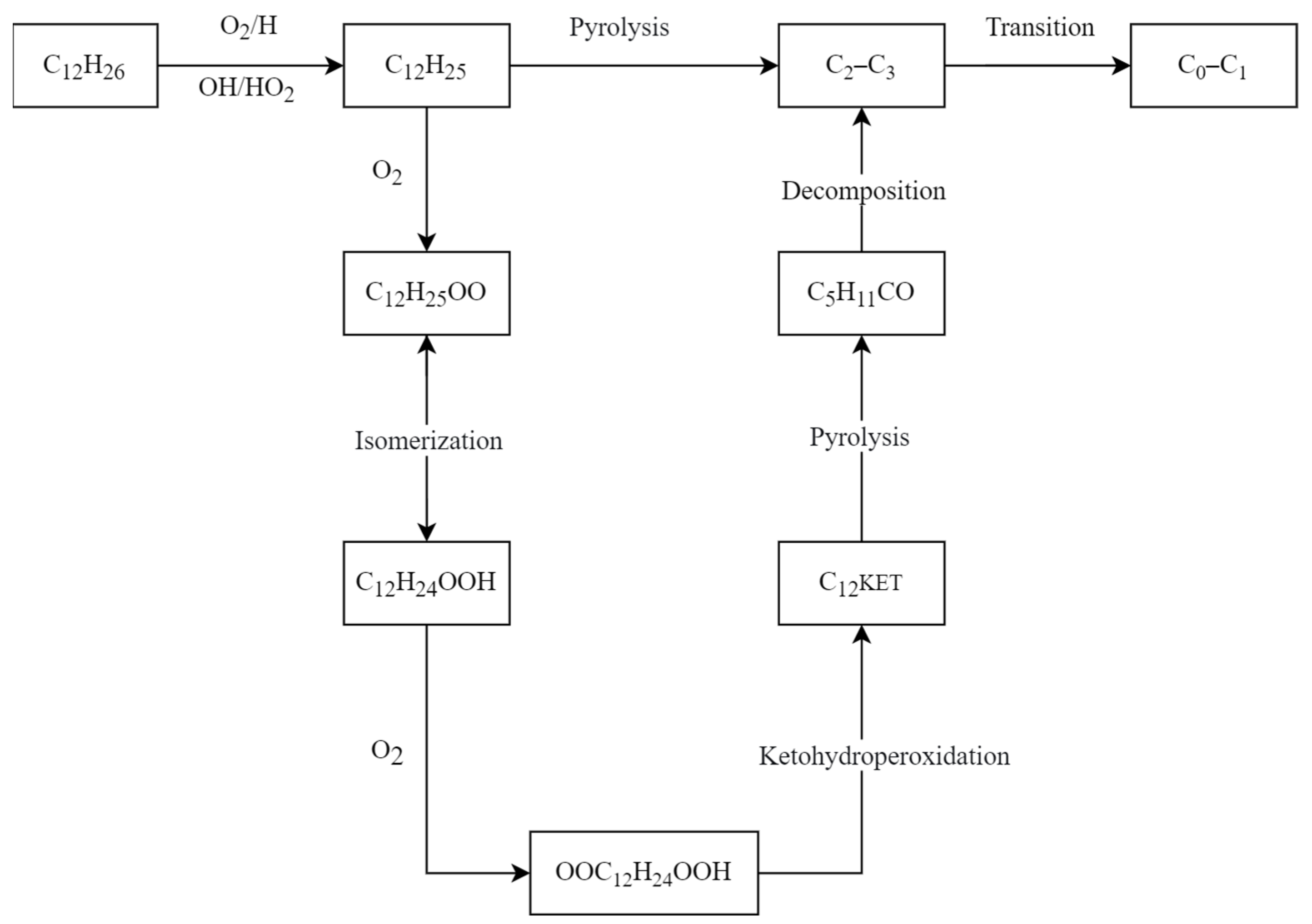
Based on the n-dodecane skeletal mechanism by Chang et al. [53], this study optimized the C5–C12 reaction pathways of the large-molecule skeletal mechanism, with its reaction pathway as shown in Figure 2. In this skeletal mechanism, the reverse reaction rate constants are no longer artificially specified; instead, they are automatically calculated by Chemkin Pro based on the forward reaction rate constants and the thermodynamic data of the reactants themselves [54]. In the large-molecule skeletal mechanism, C12H26 first generates C12H25 through dehydrogenation reactions (R1)–(R4). C12H25 forms C2/C3 small molecules via two reaction pathways. One is direct high-temperature cracking to C2/C3 small molecules, and this reaction pathway consolidated into a single reaction (R5). The other pathway is the oxidation of C12H25to form C12H25OO (R6); subsequently, C12H25OO isomerizes to C12H24OOH (R7); C12H24OOH again reacts with oxygen to form OOC12H24OOH (R8); OOC12H24OOH immediately eliminates OH to form C12KET (R9); C12KET undergoes pyrolysis to form C5H11CO (R10); C5H11CO oxidatively decomposes to C2/C3 small molecules (R11). This mechanism replaces the entire C5–C12 macromolecular reaction pathway with 11 global reactions. All large molecule cracking reactions have undergone collective treatment, thereby eliminating multiple reactions of isomers. This n-dodecane skeletal mechanism contains a total of 40 species and 147 reactions. Apart from the aforementioned specific reaction improvements, the main reaction rate constants and thermodynamic data are selected from those listed in the LLNL detailed mechanism [55].
Figure 2.
Reaction path diagram.
2.3.2. Mechanism Validation
The optimized n-dodecane skeletal mechanism was validated for ignition delay predictions in shock tubes and CVBs, and its performance was compared with that of the mechanism developed by Chang et al. [56]. The modified KIVA-3V code was used for the CVB simulations in this work [45], while shock tube ignition delay predictions were achieved using Chemkin Pro [46] software. Based on the pressure trajectory intersection point method by Lapuerta et al. [53], Fraser et al. [57], and Burke et al. [58], the ignition delay in the CVB was defined as the time from the start of fuel injection until the pressure rise rate reaches 0.01 MPa/ms. The initial chamber pressure varies within the range of 4.93–7.94 MPa with the change of initial gas temperature (750–1200 K) and oxygen concentration (13–21%). A constant temperature boundary of 600 K is prescribed for the cylinder liner, cylinder head, and piston crown surfaces during simulation.
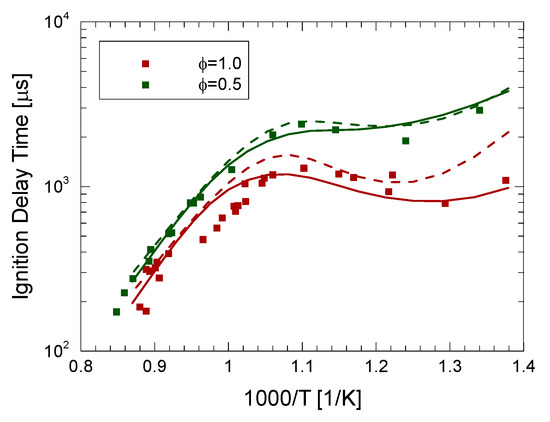
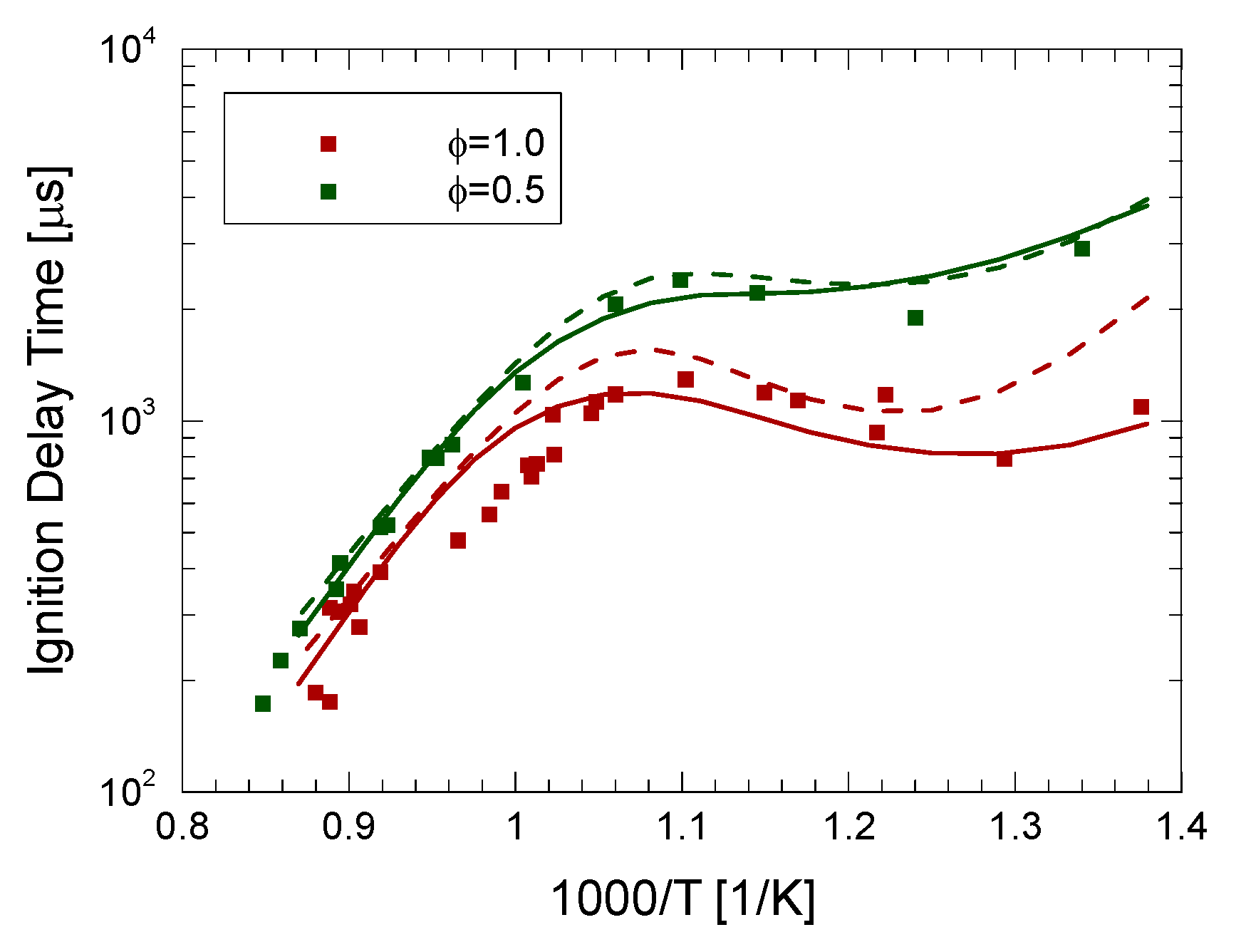
Figure 3 shows the prediction results of this mechanism for n-dodecane ignition delay in a shock tube under conditions of 20 atm pressure and equivalence ratios of 0.5 and 1.0. It also compared the experimental data from Vasu et al. [59] under the same conditions and the prediction results from the mechanism proposed by Chang et al. [56]. From the figure, it can be seen that this mechanism predicts the overall trend of the experimental data relatively accurately. However, it overestimates high-temperature ignition delays at an equivalence ratio of 1. Compared to the results of Chang et al. [56], under an equivalence ratio of 1, this mechanism predicts lower values in the negative temperature coefficient (NTC) region and low-temperature region, closer to the experimental data. At an equivalence ratio of 0.5, the predictions from this mechanism are slightly lower than those of Chang et al. in the NTC region [56]. The predictions of the two mechanisms for ignition delay in the high-temperature region under both equivalence ratio conditions are basically consistent.
Figure 3.
Ignition delay time of n-dodecane/air mixture in a shock tube at 20 atm (symbols are experimental data from Vasu et al. [59]; solid lines are the computational data of the present mechanism; dashed lines are the computational data of the Chang et al. mechanism [56]).
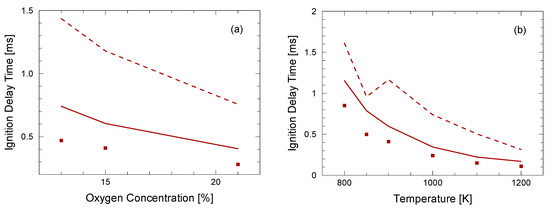
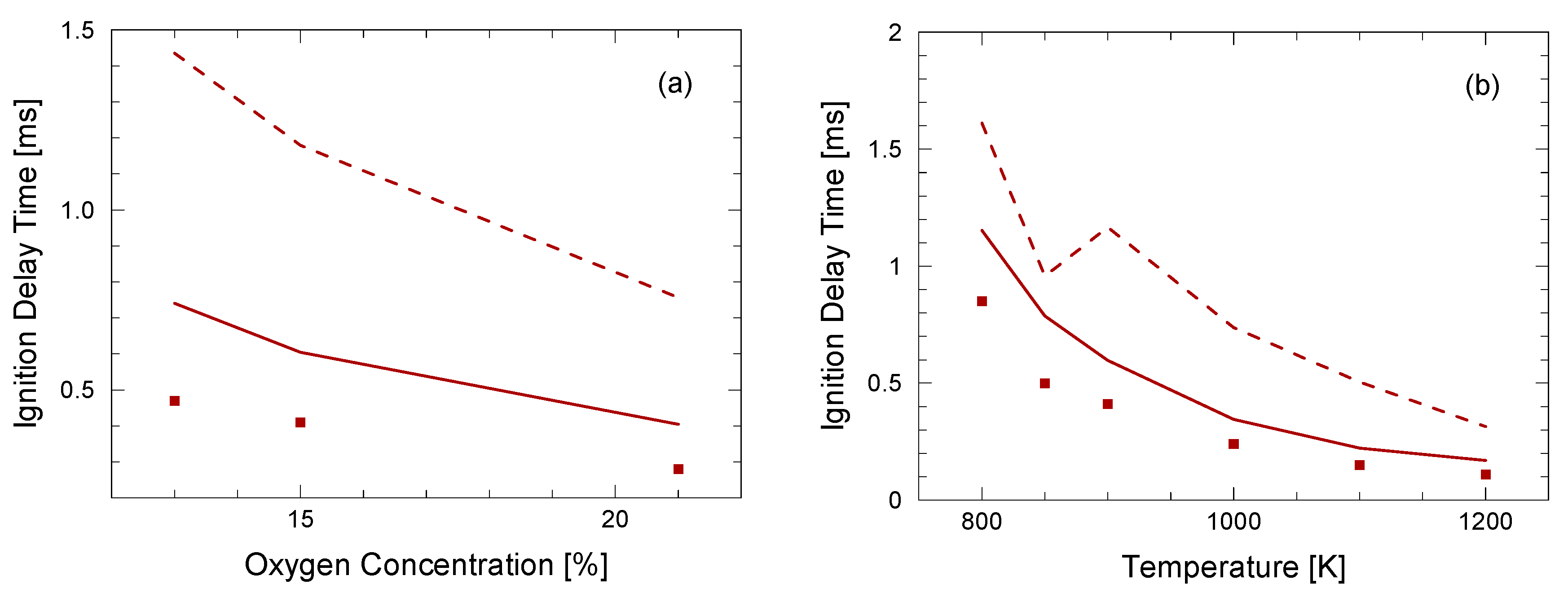
In this work, we evaluated the predictive accuracy of the n-dodecane skeletal mechanism for ignition delay in the CVB [47] and compared it with the prediction results of the Chang et al. [56] mechanism. Figure 4 shows the prediction results of the n-dodecane skeletal mechanism constructed in this study for the ignition delay of n-dodecane experiments in a CVB, with experimental conditions listed in Table 1. This mechanism yields higher predictions under varying oxygen conditions, while its accuracy tends to deteriorate at lower temperatures. The prediction deviations of the original mechanism may stem from the comprehensive adjustments of thermodynamic parameters and reaction pathways. Combined with the path screening rule of the skeletal mechanism, the main uncertainty sources concerned in this work are epistemic uncertainty and model structural uncertainty.
Figure 4.
Comparisons of the predicted ignition delays with the measurements in a CVB: (a) Variation of oxygen; (b) Variation of temperature (points are the experimental data from Sandia [47]; solid line is predictions of the present model; dashed lines are the computational data of Chang et al. mechanism [56]).
Table 1.
Operating conditions of the spray in a constant volume bomb [47].
Although the original chemical mechanism has been extensively validated, modifications are still required when applied to CVB simulations. The optimized mechanism can basically accurately predict the trend of ignition delay change in the CVB, and shows significant improvement compared to the prediction results of the n-dodecane mechanism by Chang et al. [56]. Meanwhile, this n-dodecane mechanism can avoid the prediction deviation observed in the Chang et al. [56] n-dodecane mechanism under the 850 K condition.
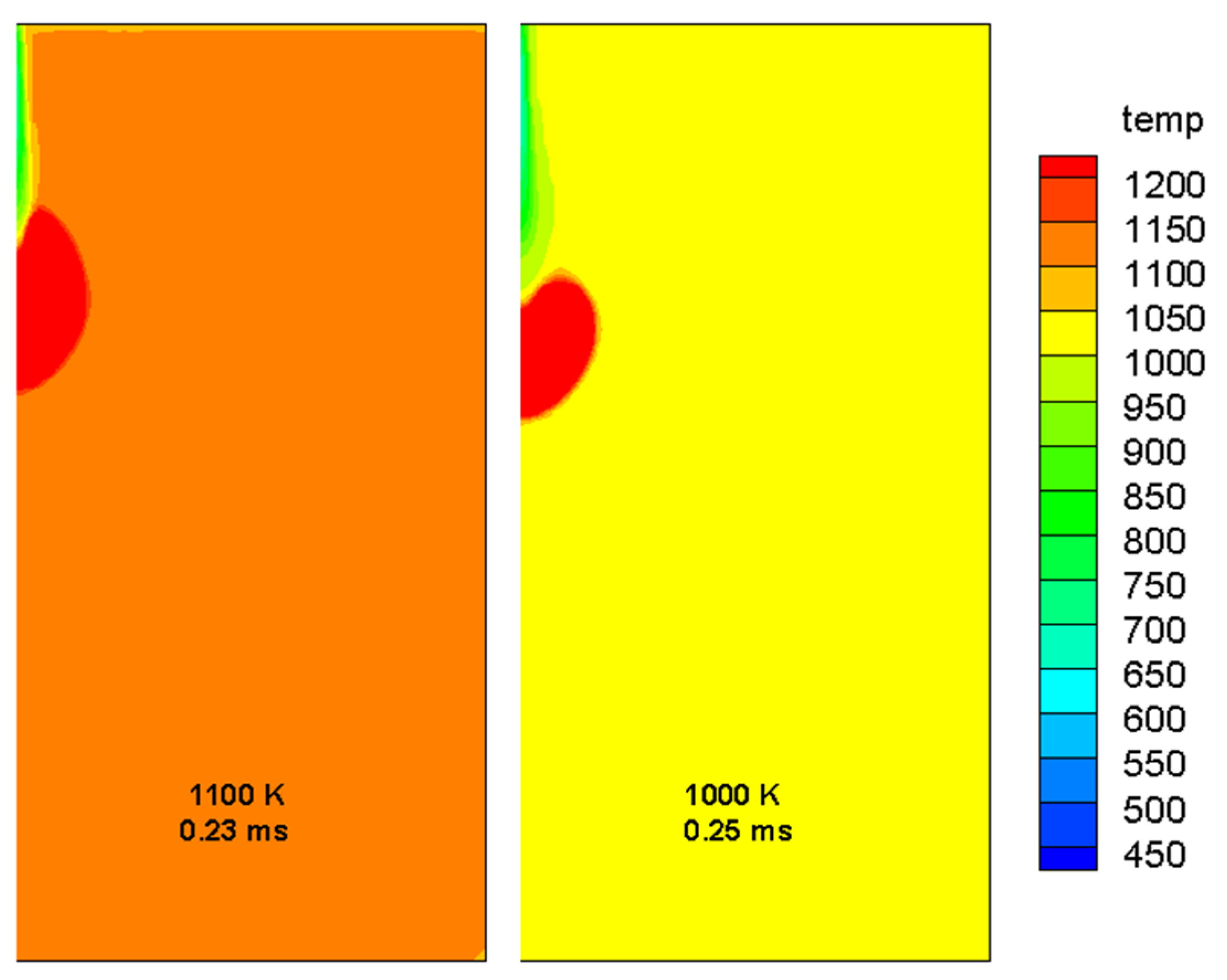
Figure 5 shows the simulated results of in-cylinder temperature evolution trends under different initial temperatures based on the CFD model. Comparison of temperature contour plots at initial temperatures of 1100 K (0.23 ms) and 1000 K (0.25 ms) match reasonably well with the ignition characteristic predictions of the optimized chemical mechanism. According to the analysis of n-dodecane mechanism predictions for CVB ignition delay data by Wang et al. [60] and Bhattacharjee and Haworth [61], the prediction results of this n-dodecane mechanism are basically accurate and can meet the needs of neural network training.
Figure 5.
Temperature variation trend based on CFD simulation results.
3. Neural Network Surrogate Model
Neural networks imitate the neural conduction between brain cells and their function of adapting to external information, using mathematical methods to handle nonlinear and uncertain problems. For the predicted ignition delay data in the CVB, a direct CFD calculation requires at least 20 h per case. This is excessively time-consuming for global sensitivity analysis, which requires a large number of samples. Therefore, this study employs a multilayer feedforward neural network [62] as a surrogate for the CFD model to predict n-dodecane ignition delay in a CVB, compressing the prediction time to approximately 60 samples/20 min. All calculations involved in this work are performed using MATLAB (R2022a). A multilayer feedforward neural network does not require prior knowledge of the functional relationship between independent and dependent variables. Instead, it determines the functional relationship between variables through appropriate training based on sample data. Therefore, as long as a multilayer feedforward neural network has a sufficient number of hidden neurons and undergoes effective training, it can be used to approximate the target function and maintain high prediction accuracy [63]. Simultaneously, during the training process, the multilayer feedforward neural network can accommodate the uncertainties inherent in the source model, making it very suitable for studying the uncertainty relationships between the independent and dependent variables of a function [64].
where is the input from the previous node to the -th node, is the weight coefficient between the -th node and the -th node, is the total number of connected nodes to the -th node, is the bias of the -th node, is the activation function, and is the output node following the -th node.
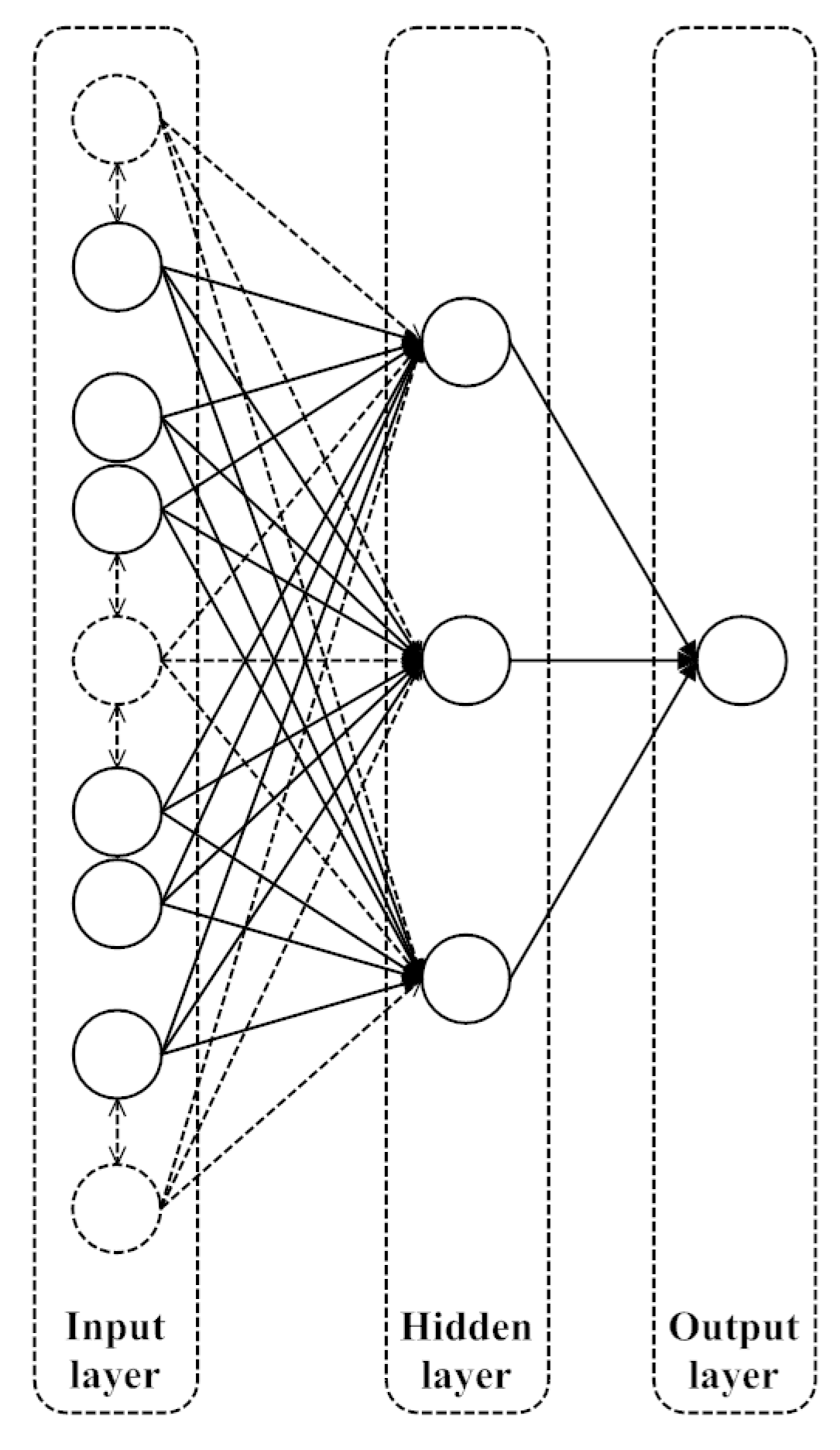
Figure 6 shows the architecture of the multilayer feedforward neural network used in this study. This feedforward neural network contains an input layer, one hidden layer, and an output layer. The input layer corresponds to the key physical parameters selected for the CVB simulation, and the output layer corresponds to the n-dodecane ignition delay data in the CVB. Although Hornik et al. [45] believe that a neural network with a single hidden layer can achieve good approximation as long as it has a sufficient number of hidden neurons, there is no fixed rule for the specific number of hidden neurons required to achieve the best effect. Too few hidden neurons affect the prediction accuracy and stability of the neural network, making it susceptible to local biases, resulting in low recognition rates for unknown samples and poor fault tolerance [65]. Too many hidden neurons affect the computational efficiency of the neural network and may lead to increased error. Currently, the optimal number of hidden neurons is primarily determined through trial-and-error methods [66]. In this neural network, nodes between layers are connected by adaptive weights, and the interaction rules conform to Formula (26). That is, the parameter variables of the input nodes are multiplied by the weights of the connected hidden neurons, added to the effective bias, and then transmitted to the output nodes through the activation functions (27) or (28) [67]. Among them, activation function (27) is used for nonlinear approximation, and (28) is used for linear approximation.
Figure 6.
The architecture of the multilayer feedforward neural network (Single hidden layer).
The relationships among the neural network parameters are illustrated in Figure 6, where solid lines denote main variables and dashed lines represent auxiliary variables. The mean and uncertainty given by the Sandia n-dodecane data [47] for each main variable was used as the expectation and variance for sampling, and samples are taken according to a normal distribution for neural network training. The input variables used for training the neural network were sampled from a normal distribution. The output variable is the ignition delay predicted under the conditions of 900 K and 15% O2 using the coupled n-dodecane skeletal model described in the previous section. The number of hidden nodes was determined by trial and error. This study first randomly selected 105 samples and used the Levenberg–Marquardt (LM) algorithm to train the neural network. The LM algorithm uses an adaptive damping coefficient μ instead of a fixed constant learning rate. The default initial value μ = 1, attenuation coefficient μdec = 0.8, and growth coefficient μinc = 1.5. A maximum of 1000 training epochs was set for each independent run, and the network weights were randomly reinitialized prior to every training trial. Training terminates by performance threshold criterion: training stops when the validation mean squared error (MSE) drops below 0.005 to avoid overfitting. MSE is adopted as the loss function for network training. An automatic early stopping mechanism is strictly applied to prevent overfitting, and no additional weight decay regularization is used.
A trained neural network must be tested with validation samples to determine its prediction accuracy. Commonly used validation criteria include general error analysis metrics, such as the correlation coefficient R (Formula (29)) and the MSE (Formula (30)). Values of R and R2 closer to 1 indicate better training performance and a closer fit to the sample data. An MSE closer to 0 implies smaller deviation between the predicted and sample outputs.
where, is the total number of samples, is the true output value of the i-th sample, is the predicted value of the i-th sample from the neural network, is the global average of all true sample outputs, is the correlation coefficient, and is the mean squared error.
3.1. Number of Hidden Neurons
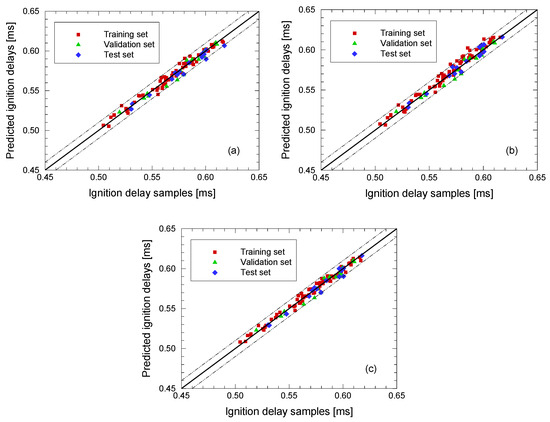
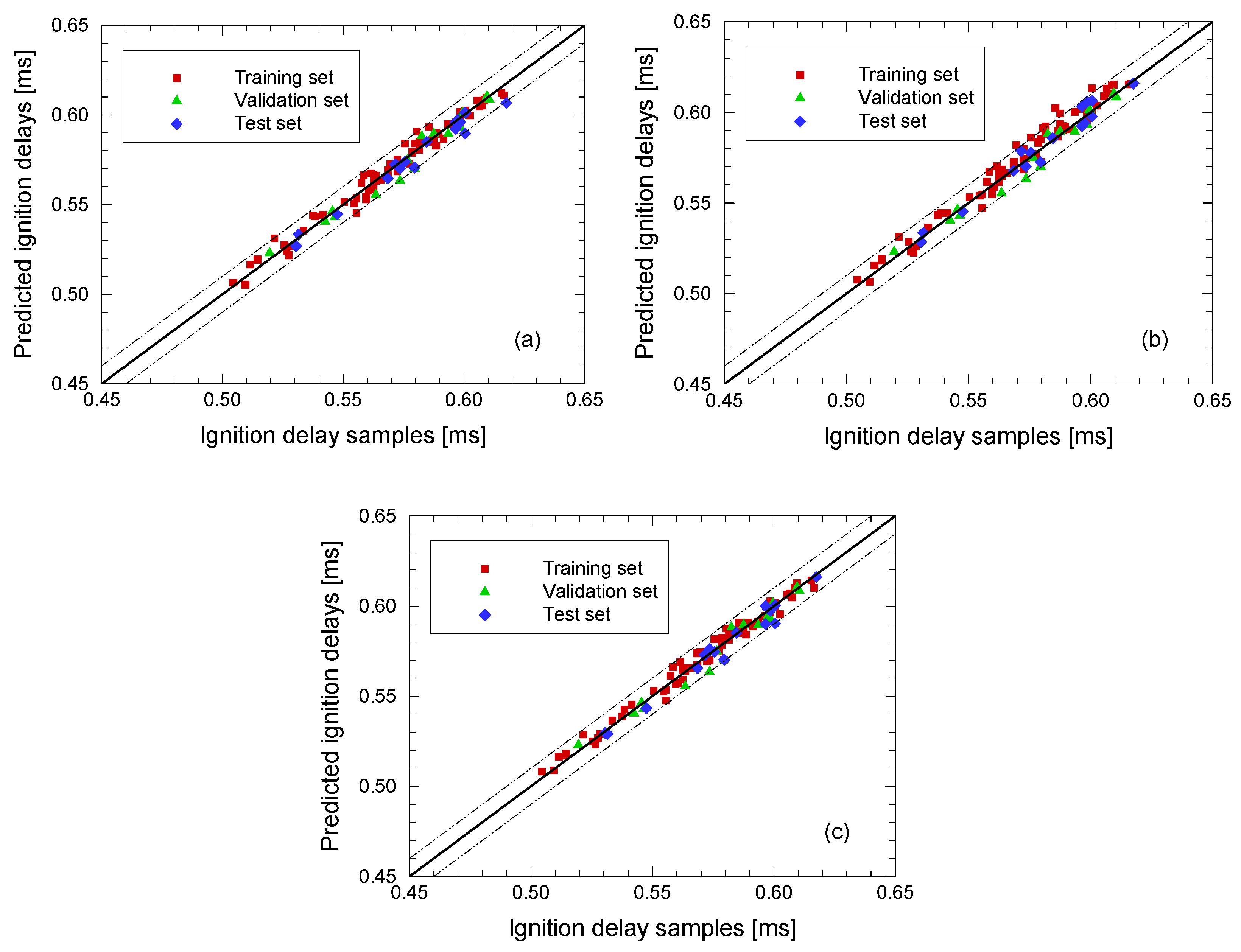
The neural network first needs to determine the appropriate number of hidden nodes through trial and error. This study compared different numbers of hidden nodes using the same set of samples, as shown in Figure 7. A coefficient of determination (R2) threshold of 0.98 is taken as the criterion to quantify the quality of neural network training outputs. In the figure, the red squares represent training data; the green triangles represent validation data; and the blue diamonds represent test data. Figure 7 shows the prediction effects for 1–3 hidden neurons respectively, and the corresponding prediction correlation coefficients and mean squared errors for each number of hidden neurons are listed in Table 2. From Figure 7a, it can be seen that the predicted values for a single hidden node are mostly concentrated within a deviation of ±0.01 ms from the sample values. However, the correlation coefficient and mean squared error for a single hidden neuron can still be improved. Although the correlation coefficient and mean squared error for two hidden neurons are slightly better than those for a single hidden neuron, the prediction effect of two hidden neurons is worse than that of a single hidden neuron (see Figure 7b). This is because the predicted values for two hidden neurons are overall unevenly distributed, leading to better overall correlation coefficient and mean squared error, but local deviations cause predicted values to exceed the deviation range of ±0.01 ms from the sample values. Figure 7c shows the prediction effect for three hidden neurons. Combined with the correlation coefficient and mean squared error in Table 2, it can be seen that the overall effect has improved, and the accuracy of the data results already fully meets the experimental uncertainty requirements. For the dataset with 400 samples, the number of hidden layers was tested up to 10, while tests on the 105-sample dataset were carried out with a maximum of eight hidden neurons. Therefore, this study adopts three hidden neurons. This does not mean that more hidden neurons cannot yield better predictions. The current number of hidden neurons is chosen only to boost computational efficiency.
Figure 7.
Ignition delay samples versus predicted ignition delay by the multilayer feedforward neural network: (a) one hidden node; (b) two hidden nodes; (c) three hidden nodes.
Table 2.
R and MSE of different hidden neurons.
3.2. Data Allocation Ratio
During neural network training, overfitting may occur when the model becomes too tailored to the training samples and fails to generalize. The neuron sitting problem is directly related to the number of training samples [68] and is also called the overtraining problem. In theory, the training, validation, and test sets differ in their data characteristics, making it unlikely that all three will simultaneously reach optimal performance. Therefore, it is necessary to reasonably allocate training, validation, and testing samples to avoid the occurrence of overtraining.
Figure 8 shows the prediction results for different allocation ratios of samples, where the sample allocation ratio is randomly divided according to the percentages of training: validation: testing. Data points and boundary lines share the same notation as Figure 7. Table 3 lists the correlation coefficients and mean squared errors for neural networks trained under different allocation ratios. Although the correlation coefficient and MSE for the 60:20:20 split in Table 3 are comparable to those for the 70:15:15 split, clear deviations are evident in the validation and test results shown in Figure 8a. Although the neural network trained with the 80:10:10 split shows a good correlation coefficient, its MSE increases, as reflected in Figure 8c by larger scatter in the predictions and noticeable fluctuations around the mean. This prediction deviation is caused by overfitting. Based on the above comparison, the neural network trained with the 70:15:15 split offers the best overall performance.
Figure 8.
Ignition delay samples versus predicted ignition delay by the multilayer feedforward neural network: (a) 60:20:20; (b) 75:15:15; (c) 80:10:10.
Table 3.
and of different proportions.
3.3. Normalization
Due to the significant differences in magnitude among the input parameters, the influence of certain parameters on the final result may be amplified or diminished during propagation through the activation function, owing to accumulated numerical errors. This may weaken the influence of input parameters on the output, and in some cases, even slow down network convergence. Therefore, data normalization is typically performed before training neural networks, mapping the data to the range [0, 1] to stabilize training outcomes. This section adopts Formula (31) to normalize all data and compares the prediction results before and after normalization. The neural network was trained with three hidden neurons and a node distribution ratio of 70:15:15.
In the formula, xmin is the minimum value of a single parameter sample, xmax is the maximum value of that parameter sample, xk is the value of sample k, and xk′ is the normalized value of sample k.
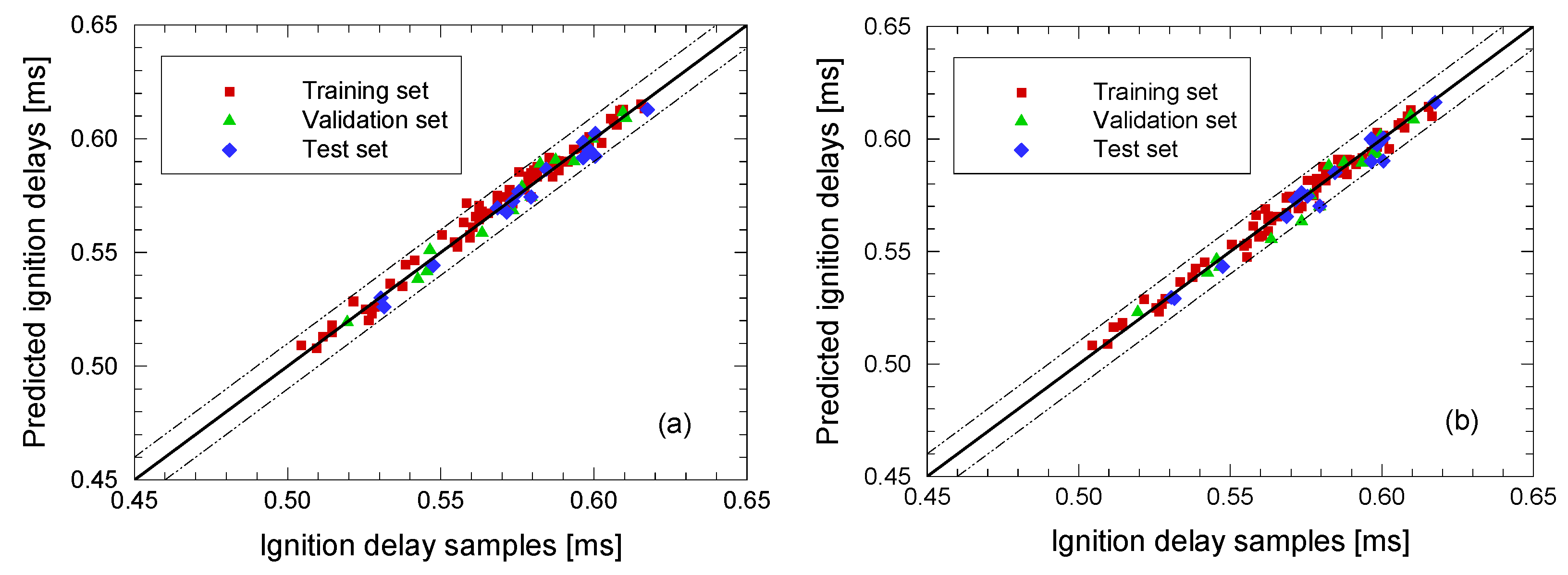
Figure 9 compares the prediction results using normalized and unprocessed data. Data points and boundary lines share the same notation as Figure 7. The corresponding correlation coefficients and mean squared errors are listed in Table 4. Regardless of the data processing method used, both neural networks achieved high prediction accuracy, with comparable correlation coefficients and mean squared errors. This reveals that the neural network trained with the established data sampling strategy in this study is insensitive to data normalization, which is likely caused by the inherent characteristics of the dataset. Given the research objectives and experimental results, raw data can be directly employed for model training in this work.
Figure 9.
Ignition delay samples versus predicted ignition delay by the multilayer feedforward neural network: (a) normalized data; (b) initial data.
Table 4.
R and MSE of different data format.
3.4. Sample Size
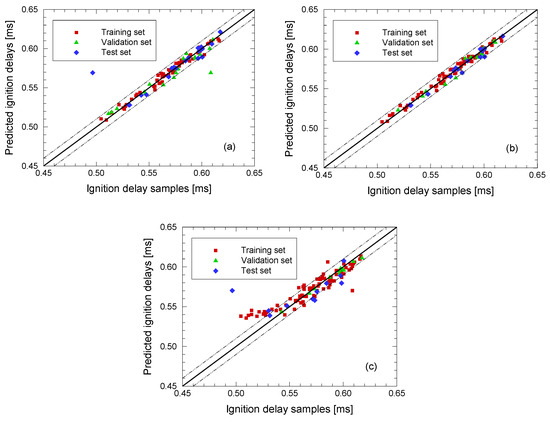
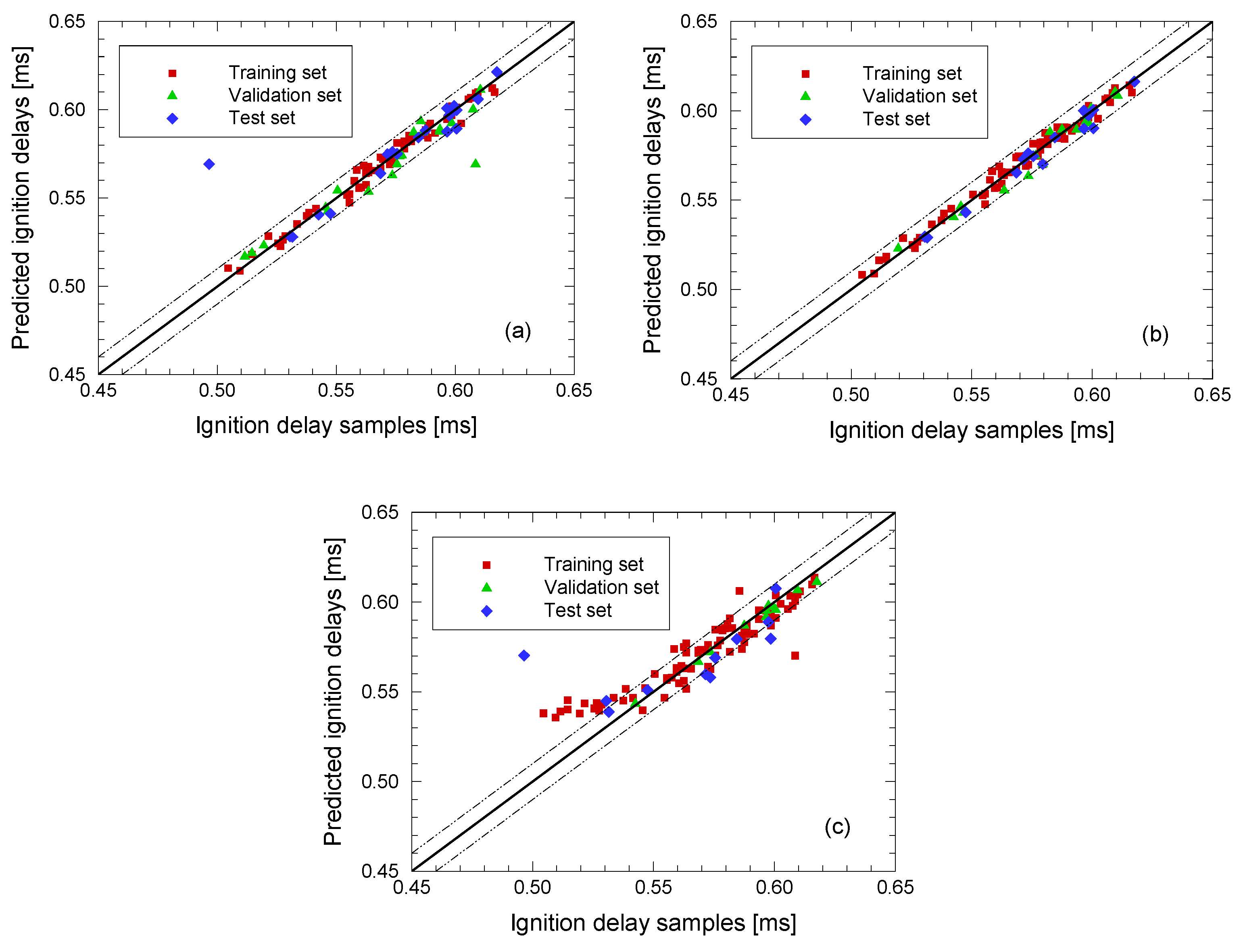
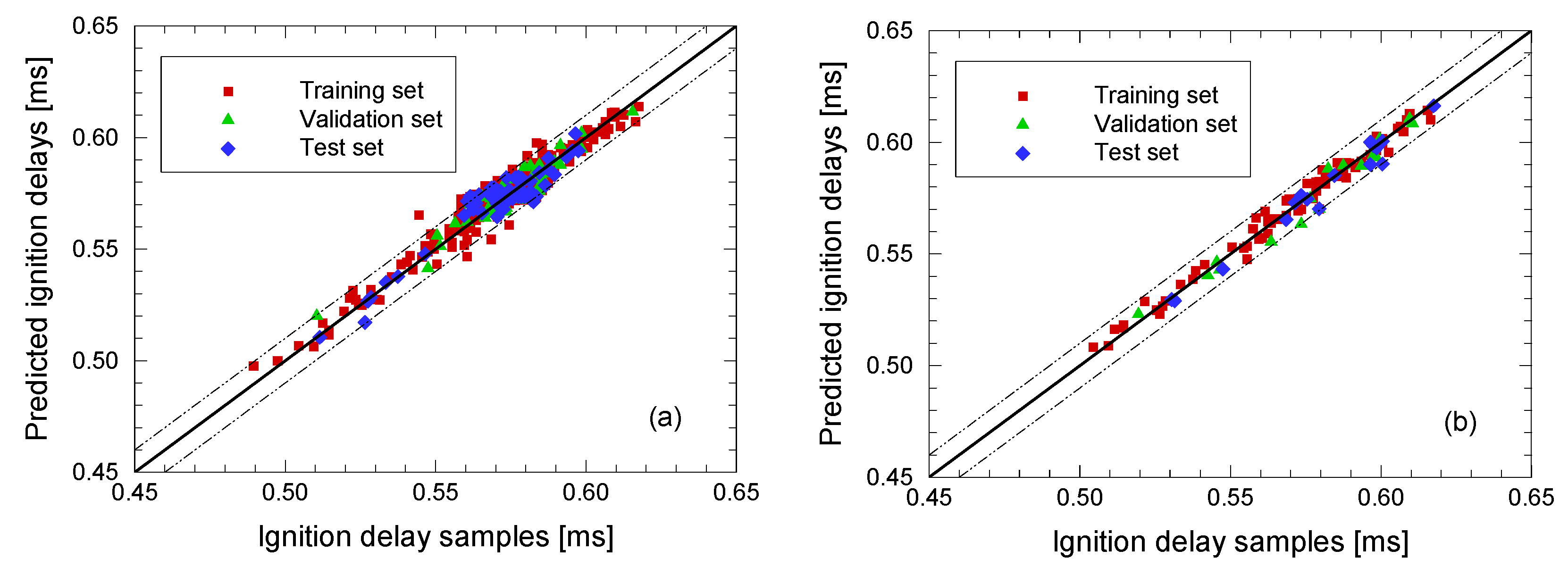
Alternative approaches for uncertainty analysis of ignition delay, such as the Monte Carlo method, also face sample-size limitations. For neural network-based analysis, prediction accuracy generally improves with sample size, but this inevitably increases the overall computational cost. Training sets of 105 and 400 samples are separately generated following normal distributions defined by the mean and variance of experimental data for the six types of parameters (Table 1). Therefore, this section analyzes the neural network’s requirement for sample size. The neural network was trained with three hidden neurons and a node distribution ratio of 70:15:15. The prediction effects are shown in Figure 10, and the correlation coefficient and mean squared error data are listed in Table 5.
Figure 10.
Ignition delay samples versus predicted ignition delay by the multilayer feedforward neural network: (a) 400; (b) 105.
Table 5.
R and MSE of different sample size.
According to the prediction results for different sample sizes shown in Figure 10, increasing the sample size does not significantly improve prediction accuracy. The meanings of data points and boundary lines in this figure are consistent with those in Figure 7. From Table 5, it can be seen that after increasing the sample size, although the mean squared error improves, the correlation coefficient shows a downward trend. The above indicates that increasing the sample size for the neural network constructed in this study causes overtraining, leading to fluctuations in prediction accuracy. Compared with the 400-sample dataset, the model trained on 105 samples achieves comparable correlation coefficient and mean squared error under the fixed random data split adopted in this study, while greatly reducing the total computational overhead of sample generation and neural network training. It should be noted that the high computational efficiency of the model trained on 105 samples may only be valid for the current random splitting scheme. Repeated training with diverse random seeds will be conducted in follow-up studies to remove the disturbances induced by random data division.
3.5. Uncertainty Analysis
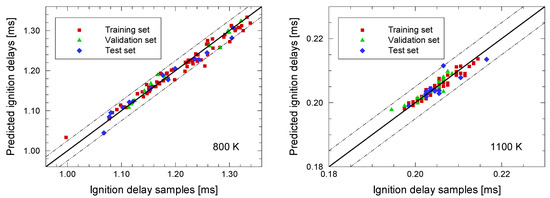
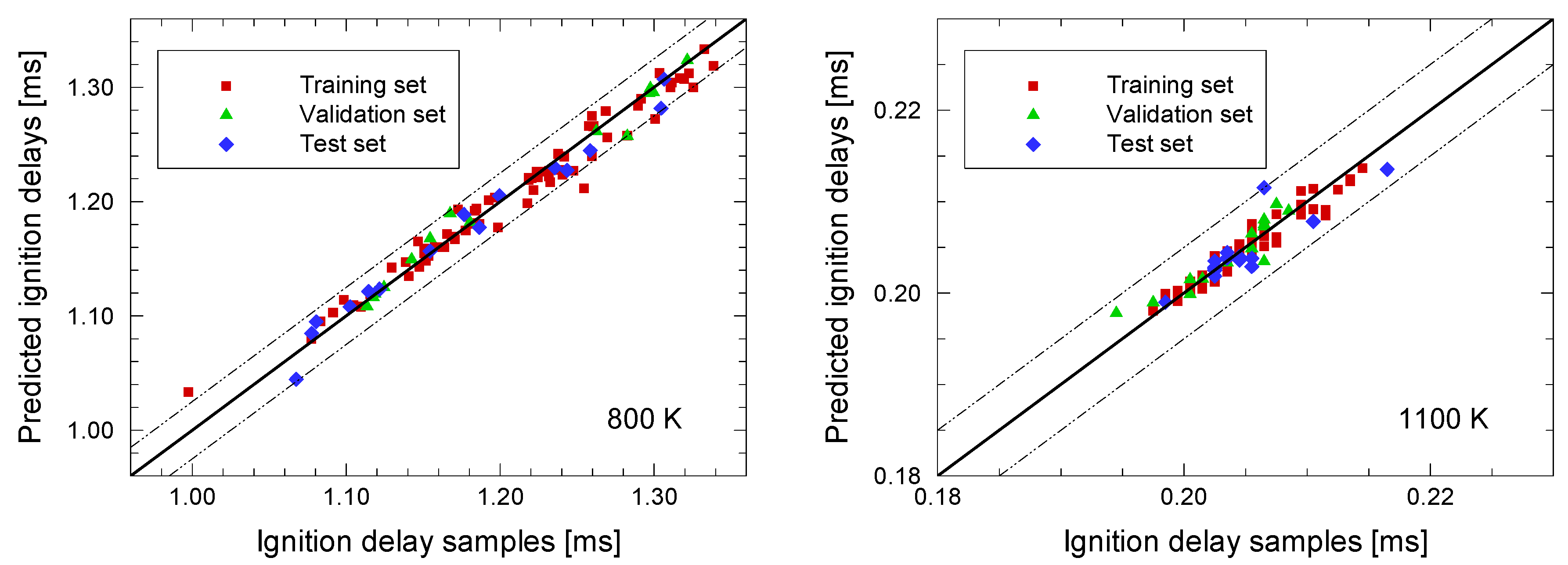
Table 6 lists the uncertainty ranges of physical parameters for n-dodecane under ambient temperatures of 800 K and 1100 K, respectively [47]. Based on the data at 800 K and 1100 K, the aforementioned neural network is trained and predicted in this section, and the results are shown in Figure 11. The neural network adopts a three-layer FNN with three hidden neurons and a total sample size of 105, which is split at a ratio of 70:15:15. The meanings of data points and boundary lines in this figure are consistent with those in Figure 7.
Table 6.
Variables and their uncertainty ranges at 800 K and 1100 K ambient temperature [47].
Figure 11.
Ignition delay samples versus predicted ignition delay by the multilayer feedforward neural network at different ambient temperatures.
It can be observed from Figure 11 that the neural network adopted in this study is also applicable to uncertainty analysis under ambient temperatures of 800 K and 1100 K. At an ambient temperature of 800 K, the ignition delay of n-dodecane in the constant-volume combustion vessel is 0.85 ms with an experimental uncertainty of ±0.11 ms [47]. A comparison with the prediction results at 800 K in Figure 11 reveals that the prediction accuracy of the neural network is far better than the experimental uncertainty. As presented in Table 7, the mean square error under the ambient temperature of 1100 K is extremely low, which is reflected in Figure 11 by the excellent agreement between predicted values and sample data. Consequently, the neural network can be utilized for uncertainty analysis under both operating conditions.
Table 7.
800 K and 1100 K ambient temperature.
In actual research, the greatest advantage of neural network surrogate models lies in their minimal computational consumption. In the work of Pei et al. [69], calculating each sample roughly required 75 h of computation on a 16-core processor. In this study, apart from the necessary sensitivity calculations, the remaining variance results were obtained directly from the trained neural network. The computation time for each set of 60 samples was approximately 15–20 min.
4. Conclusions
A feedforward neural network surrogate model was constructed based on the n-dodecane skeletal mechanism derived using the decoupling method and integrated with a CFD numerical model. The training samples were obtained from ignition delay predictions in a constant-volume bomb, and the predictive performance of the surrogate model was systematically evaluated. The Levenberg–Marquardt optimizer was employed with an adaptive damping coefficient μ (initial value = 1.0, attenuation factor = 0.8, increment factor = 1.5) in place of a constant learning rate. Each training trial was limited to 1000 epochs, with random weight re-initialization performed before every run. Mean squared error was adopted as the loss function, and the training process was terminated once the validation MSE decreased below 0.005. An inherent early stopping strategy was deployed to suppress overfitting, without supplementary weight decay regularization. In addition, 1000 repeated training runs with weight re-initialization were implemented to mitigate result randomness induced by initial weight assignments.
The effects of hidden neuron count, data allocation ratio, normalization, and sample size on prediction accuracy were individually examined. Regarding hidden neuron count, both the single-neuron and three-neuron models outperformed the two-node model, with the three-neuron configuration delivering slightly superior predictive accuracy while maintaining sufficient computational efficiency. During actual training, a moderate training set partition ratio of 70:15:15 (%) yields better predictive performance than other data allocation schemes, in terms of both correlation coefficient and mean squared error. The dataset and model architecture adopted in this study were found to be insensitive to data normalization, allowing the direct training method to be used without loss of predictive performance. Under the sampling rule adopted, the model trained with 105 samples exhibited higher practicability compared with the 400-sample counterpart, maintaining favorable prediction accuracy while substantially reducing computational cost. Therefore, a sample size of 105 was recommended for neural network training to effectively reduce the overall runtime. In summary, this paper employs a three-layer FNN for uncertainty analysis, with three hidden neurons, a training: validation: testing sample ratio of 70:15:15 (%), a training sample size of 105, and no normalization processing. Under the parameter uncertainty ranges given in Table 6, the neural network achieved satisfactory predictions of n-dodecane ignition delay in the constant-volume bomb at 800 K and 1100 K, with good agreement against the sample data. The surrogate model can be adopted for combustion prediction and uncertainty quantification. The surrogate model can greatly improve the efficiency of fuel combustion characteristic prediction and support more complex and extensive analyses. The adopted feedforward neural network surrogate drastically reduces the computational time cost for combustion prediction to merely 15–20 min per 60-sample batch, accelerating the forecasting of fuel combustion characteristics and facilitating subsequent complex and efficient analyses. Future work will conduct comprehensive comparative analyses of modeling performance across diverse neural network architectures.
Supplementary Materials
The following supporting information can be downloaded at: https://www.mdpi.com/article/10.3390/fire9080341/s1, Model S1: Source model.
Author Contributions
Conceptualization and methodology, W.F.; validation, M.M.; data curation, F.L.; software, W.W. All authors have read and agreed to the published version of the manuscript.
Funding
This research was funded by the Key Scientific Research Project of Institutions of Higher Education in Henan Province (No. 26A470001) and the National Natural Science Foundation of China (No. 52066004).
Informed Consent Statement
Informed consent was obtained from all subjects involved in the study.
Data Availability Statement
Data is contained within the article or Supplementary Materials.
Conflicts of Interest
The authors declare no conflicts of interest.
References
- He, Z.; Fan, Z.; Qi, W.; Song, J.; Lai, C.; Feng, S.; Fu, L.; Nie, Y.; Wu, Y.; Zhang, C. Novel bionic honeycomb micro combustor with hydrogen/air premixed combustion for photovoltaic systems. Appl. Therm. Eng. 2026, 302, 132037. [Google Scholar] [CrossRef] [Scilit]
- He, Z.; Liu, S.; Qi, W.; Song, J.; Lai, C.; Feng, S.; Fu, L.; Zhang, Y.; Zhang, C.; Wu, Y. Numerical investigation of a novel micro-combustor with geometrically stretched and twisted channels for enhanced thermo-photovoltaic system performance. Appl. Therm. Eng. 2026, 291, 130230. [Google Scholar] [CrossRef] [Scilit]
- Soyler, I.; Üstün, C.E.; Paykani, A.; Jiang, X.; Karimi, N. Machine learning-enabled uncertainty quantification for thermo-catalytic reactors: A study on fugitive methane oxidation in monolith reactors. Fuel 2025, 407, 137466. [Google Scholar] [CrossRef] [Scilit]
- Wang, H.; Sheen, D.A. Combustion kinetic model uncertainty quantification, propagation and minimization. Prog. Energy Combust. Sci. 2015, 47, 1–31. [Google Scholar] [CrossRef] [Scilit]
- Zhao, L.; Yuan, B.; Gong, L.; Wang, H.; Ran, Q.; Qin, L.; Liu, J.; Zhang, L.; Li, K.; Liang, G.; et al. Insight into the molecular structure construction and pyrolysis mechanism simulation of typical carbonaceous feedstocks for the rapid design and preparation of porous carbon-based materials. Fuel 2024, 379, 132893. [Google Scholar] [CrossRef] [Scilit]
- Yu, J.; Shan, D.; Song, H.; Yang, M. A novel hybrid machine learning model for predicting rate constants of the reactions between alkane and CH3 radical. Fuel 2022, 322, 124150. [Google Scholar] [CrossRef] [Scilit]
- Rotavera, B.; Taatjes, C.A. Influence of functional groups on low-temperature combustion chemistry of biofuels. Prog. Energy Combust. Sci. 2021, 86, 100925. [Google Scholar] [CrossRef] [Scilit]
- Simm, G.N.; Vaucher, A.C.; Reiher, M. Exploration of Reaction Pathways and Chemical Transformation Networks. J. Phys. Chem. A 2018, 123, 385–399. [Google Scholar] [CrossRef] [Scilit] [PubMed]
- Jacobson, L.D.; Bochevarov, A.D.; Watson, M.A.; Hughes, T.F.; Rinaldo, D.; Ehrlich, S.; Steinbrecher, T.B.; Vaitheeswaran, S.; Philipp, D.M.; Halls, M.D.; et al. Automated Transition State Search and Its Application to Diverse Types of Organic Reactions. J. Chem. Theory Comput. 2017, 13, 5780–5797. [Google Scholar] [CrossRef] [Scilit] [PubMed]
- Bhoorasingh, P.L.; Slakman, B.L.; Khanshan, F.S.; Cain, J.Y.; West, R.H. Automated Transition State Theory Calculations for High-Throughput Kinetics. J. Phys. Chem. A 2017, 121, 6896–6904. [Google Scholar] [CrossRef] [Scilit] [PubMed]
- Sarathy, S.M.; Vranckx, S.; Yasunaga, K.; Mehl, M.; Oßwald, P.; Metcalfe, W.K.; Westbrook, C.K.; Pitz, W.J.; Kohse-Höinghaus, K.; Fernandes, R.X.; et al. A comprehensive chemical kinetic combustion model for the four butanol isomers. Combust. Flame 2012, 159, 2028–2055. [Google Scholar] [CrossRef] [Scilit]
- Blasco, J.; Fueyo, N.; Dopazo, C.; Chen, J.-Y. A self-organizing-map approach to chemistry representation in combustion applications. Combust. Theory Model. 2000, 4, 61–76. [Google Scholar] [CrossRef] [Scilit]
- Blasco, J.; Fueyo, N.; Larroya, J.; Dopazo, C.; Chen, Y.-J. A single-step time-integrator of a methane–air chemical system using artificial neural networks. Comput. Chem. Eng. 1999, 23, 1127–1133. [Google Scholar] [CrossRef] [Scilit]
- Chatzopoulos, A.; Rigopoulos, S. A chemistry tabulation approach via Rate-Controlled Constrained Equilibrium (RCCE) and Artificial Neural Networks (ANNs), with application to turbulent non-premixed CH4/H2/N2 flames. Proc. Combust. Inst. 2013, 34, 1465–1473. [Google Scholar] [CrossRef] [Scilit]
- Franke, L.L.; Chatzopoulos, A.K.; Rigopoulos, S. Tabulation of combustion chemistry via Artificial Neural Networks (ANNs): Methodology and application to LES-PDF simulation of Sydney flame L. Combust. Flame 2017, 185, 245–260. [Google Scholar] [CrossRef] [Scilit]
- Wan, K.; Barnaud, C.; Vervisch, L.; Domingo, P. Chemistry reduction using machine learning trained from non-premixed micro-mixing modeling: Application to DNS of a syngas turbulent oxy-flame with side-wall effects. Combust. Flame 2020, 220, 119–129. [Google Scholar] [CrossRef] [Scilit]
- Zhou, Y.; Zhang, C.; Han, X.; Lin, Y. Monitoring combustion instabilities of stratified swirl flames by feature extractions of time-averaged flame images using deep learning method. Aerosp. Sci. Technol. 2021, 109, 106443. [Google Scholar] [CrossRef] [Scilit]
- Popov, P.P.; Buchta, D.A.; Anderson, M.J.; Massa, L.; Capecelatro, J.; Bodony, D.J.; Freund, J.B. Machine learning-assisted early ignition prediction in a complex flow. Combust. Flame 2019, 206, 451–466. [Google Scholar] [CrossRef] [Scilit]
- Zhao, Z.; Chen, Z.; Chen, S. Correlations for the ignition delay times of hydrogen/air mixtures. Chin. Sci. Bull. 2011, 56, 215–221. [Google Scholar] [CrossRef] [Scilit]
- Sánchez-Borroto, Y.; Piloto-Rodriguez, R.; Errasti, M.; Sierens, R.; Verhelst, S. Prediction of cetane number and ignition delay of biodiesel using artificial neural networks. Energy Procedia 2014, 57, 877–885. [Google Scholar] [CrossRef] [Scilit]
- Liu, W.; Zhang, J.; Huang, Z.; Han, D. Applicability of high dimensional model representation correlations for ignition delay times of n-heptane/air mixtures. Front. Energy 2018, 13, 367–376. [Google Scholar] [CrossRef] [Scilit]
- Eckart, S.; Prieler, R.; Hochenauer, C.; Krause, H. Application and comparison of multiple machine learning techniques for the calculation of laminar burning velocity for hydrogen-methane mixtures. Therm. Sci. Eng. Prog. 2022, 32, 101306. [Google Scholar] [CrossRef] [Scilit]
- Harris, S.; Elliott, L.; Ingham, D.; Pourkashanian, M.; Wilson, C. The optimisation of reaction rate parameters for chemical kinetic modelling of combustion using genetic algorithms. Comput. Methods Appl. Mech. Eng. 2000, 190, 1065–1090. [Google Scholar] [CrossRef] [Scilit]
- Kalogirou, S.A. Applications of artificial neural-networks for energy systems. Appl. Energy 2000, 67, 17–35. [Google Scholar] [CrossRef] [Scilit]
- Zhai, C.; Wang, X.; Zhang, S.; Cao, Z. Parameter estimation of distributed activation energy models via chemical reaction neural network. Combust. Flame 2024, 270, 113798. [Google Scholar] [CrossRef] [Scilit]
- Kalogirou, S.A. Artificial intelligence for the modeling and control of combustion processes: A review. Prog. Energy Combust. Sci. 2003, 29, 515–566. [Google Scholar] [CrossRef] [Scilit]
- Kalogirou, S.A. Artificial neural networks in renewable energy systems applications: A review. Renew. Sustain. Energy Rev. 2001, 5, 373–401. [Google Scholar] [CrossRef] [Scilit]
- Kalogirou, S.A. Artificial Intelligence in Energy and Renewable Energy Systems; Nova Science Pub Inc.: Hauppauge, NY, USA, 2006; pp. 1–471. [Google Scholar]
- Wang, H.; Xu, Y.; Wen, M.; Wang, W.; Chu, Q.; Yan, S.; Xu, S.; Chen, D. Kinetic modeling of CL-20 decomposition by a chemical reaction neural network. J. Anal. Appl. Pyrolysis 2023, 169, 105860. [Google Scholar] [CrossRef] [Scilit]
- Xing, Z.; Freitas, R.S.; Jiang, X. Neural network potential-based molecular investigation of thermal decomposition mechanisms of ethylene and ammonia. Energy AI 2024, 18, 100454. [Google Scholar] [CrossRef] [Scilit]
- Han, X.; Jia, M.; Chang, Y.; Li, Y. An improved approach towards more robust deep learning models for chemical kinetics. Combust. Flame 2022, 238, 111934. [Google Scholar] [CrossRef] [Scilit]
- Jlassi, O.; Dixon, P.C. The effect of time normalization and biomechanical signal processing techniques of ground reaction force curves on deep-learning model performance. J. Biomech. 2024, 168, 112116. [Google Scholar] [CrossRef] [Scilit] [PubMed]
- Jiang, H.; Pang, K.; Chen, X.; Liu, D.; Ma, J.; Liang, C. Deep learning-assisted multi-objective optimization of coke dry quenching system efficiency. Fuel 2023, 359, 130490. [Google Scholar] [CrossRef] [Scilit]
- Agarwal, L.; Jaint, B.; Mandpura, A.K. Reducing overfitting in deep learning intrusion detection for power systems with CTGAN. Chaos Solitons Fractals 2024, 188, 115603. [Google Scholar] [CrossRef] [Scilit]
- Paul, S.; Jhamb, B.; Mishra, D.; Kumar, M.S. Edge loss functions for deep-learning depth-map. Mach. Learn. Appl. 2022, 7, 100218. [Google Scholar] [CrossRef] [Scilit]
- Zhao, T.; Wu, C.; Zhu, R.; Liu, B.; Qin, F.; An, J.; He, G. A deep learning framework for supersonic turbulent combustion. Acta Astronaut. 2024, 225, 524–537. [Google Scholar] [CrossRef] [Scilit]
- Li, E.; Wang, L.; Xie, Q.; Gao, R.; Su, Z.; Li, Y. A novel deep learning method for maize disease identification based on small sample-size and complex background datasets. Ecol. Inform. 2023, 75, 102011. [Google Scholar] [CrossRef] [Scilit]
- Messner, W. From black box to clear box: A hypothesis testing framework for scalar regression problems using deep artificial neural networks. Appl. Soft Comput. 2023, 146, 110729. [Google Scholar] [CrossRef] [Scilit]
- Warey, A.; Gao, J.; Grover, R.O. Generalization performance of a deep learning based engine-out emissions model. Energy AI 2021, 5, 100080. [Google Scholar] [CrossRef] [Scilit]
- Huang, Y.; Jiang, C.; Wan, K.; Gao, Z.; Vervisch, L.; Domingo, P.; He, Y.; Wang, Z.; Lee, C.-H.; Cai, Q.; et al. Prediction of ignition delay times of Jet A-1/hydrogen fuel mixture using machine learning. Aerosp. Sci. Technol. 2022, 127, 107675. [Google Scholar] [CrossRef] [Scilit]
- Yamaguchi, K.; Matsukawa, Y.; Numazawa, Y.; Aoki, H. Modeling of water gas shift reaction using neural network trained on detailed kinetic mechanisms. Chem. Eng. J. 2024, 491, 151659. [Google Scholar] [CrossRef] [Scilit]
- Robertson, G.; Sjöstrand, H.; Andersson, P.; Göök, A.; Blair, P. Model inadequacy in fuel performance code calibration: Derivative-based parameter uncertainty inflation. Ann. Nucl. Energy 2024, 208, 110794. [Google Scholar] [CrossRef] [Scilit]
- Xu, B.; Yang, G. Interpretability research of deep learning: A literature survey. Inf. Fusion 2024, 115, 102721. [Google Scholar] [CrossRef] [Scilit]
- Saputra, N.A.; Riza, L.S.; Setiawan, A.; Hamidah, I. A Systematic Review for Classification and Selection of Deep Learning Methods. Decis. Anal. J. 2024, 12, 100489. [Google Scholar] [CrossRef] [Scilit]
- Amsden, A. A Block-Structured KIVA Program for Engines with Vertical and Canted Valves; Technical Report, LA-13313-MS; Los Alamos National Laboratory: Los Alamos, NM, USA, 1997. [Google Scholar]
- Chemkin-Pro Release 15101; Reaction Design: San Diego, CA, USA, 2010.
- ECN. Available online: http://www.sandia.gov/ecn/cvdata/dsearch/frameset.php (accessed on 22 September 2023).
- Wang, B.-L.; Lee, C.-W.; Reitz, R.D.; Miles, P.C.; Han, Z. A generalized renormalization group turbulence model and its application to a light-duty diesel engine operating in a low-temperature combustion regime. Int. J. Engine Res. 2012, 14, 279–292. [Google Scholar] [CrossRef] [Scilit]
- Reitz, R.D.; Diwakar, R. Effect of Drop Breakup on Fuel Sprays; SAE paper; SAE International: Warrendale, PA, USA, 1986. [Google Scholar]
- Reitz, R.D.; Beale, J.C. Modeling spray atomization with the kelvin-helmholtz/rayleigh-taylor hybrid model. At. Sprays 1999, 9, 623–650. [Google Scholar] [CrossRef] [Scilit]
- Nordin, P.A.N. Complex Chemistry Modeling of Diesel Spray Combustion; Chalmers University of Technology: Goteborg, Sweden, 2001; pp. 1–55. [Google Scholar]
- Han, Z.; Reitz, R.D. A temperature wall function formulation for variable-density turbulent flows with application to engine convective heat transfer modeling. Int. J. Heat Mass Transf. 1997, 40, 613–625. [Google Scholar] [CrossRef] [Scilit]
- Lapuerta, M.; Sanz-Argent, J.; Raine, R.R. Ignition characteristics of diesel fuel in a constant volume bomb under diesel-like conditions. Effect of the operation pa-rameters. Energy Fuels 2014, 28, 5445–5454. [Google Scholar] [CrossRef] [Scilit]
- Chang, Y.; Jia, M.; Li, Y.; Xie, M. Application of the optimized decoupling methodology for the construction of a skeletal primary reference fuel (PRF) mechanism focusing on engine-relevant conditions. Front. Mech. Eng. 2015, 1, 11. [Google Scholar] [CrossRef] [Scilit]
- Westbrook, C.K.; Pitz, W.J.; Herbinet, O.; Curran, H.J.; Silke, E.J. A comprehensive detailed chemical kinetic reaction mechanism for combustion of n-alkane hydrocarbons from n-octane to n-hexadecane. Combust. Flame 2009, 156, 181–199. [Google Scholar] [CrossRef] [Scilit]
- Chang, Y.; Jia, M.; Liu, Y.; Li, Y.; Xie, M.; Yin, H. Application of a Decoupling Methodology for Development of Skeletal Oxidation Mechanisms for Heavy n-Alkanes from n-Octane to n-Hexadecane. Energy Fuels 2013, 27, 3467–3479. [Google Scholar] [CrossRef] [Scilit]
- Fraser, R.A.; Siebers, D.L.; Edwards, C.F. Autoignition of Methane and Natural Gas in a Simulated Diesel Environment; SAE paper; SAE International: Warrendale, PA, USA, 1991. [Google Scholar]
- Burke, U.; Pitz, W.J.; Curran, H.J. Experimental and kinetic modeling study of the shock tube ignition of a large oxygenated fuel: Tri-propylene glycol mono-methyl ether. Combust. Flame 2015, 162, 2916–2927. [Google Scholar] [CrossRef] [Scilit]
- Vasu, S.; Davidson, D.; Hong, Z.; Vasudevan, V.; Hanson, R. n-Dodecane oxidation at high-pressures: Measurements of ignition delay times and OH concentration time-histories. Proc. Combust. Inst. 2009, 32, 173–180. [Google Scholar] [CrossRef] [Scilit]
- Wang, H.; Ra, Y.; Jia, M.; Reitz, R.D. Development of a reduced n-dodecane-PAH mechanism and its application for n-dodecane soot predictions. Fuel 2014, 136, 25–36. [Google Scholar] [CrossRef] [Scilit]
- Bhattacharjee, S.; Haworth, D.C. Simulations of transient n-heptane and n-dodecane spray flames under engine-relevant conditions using a transported PDF method. Combust. Flame 2013, 160, 2083–2102. [Google Scholar] [CrossRef] [Scilit]
- Meng, X.; Jia, M.; Wang, T. Neural network prediction of biodiesel kinematic viscosity at 313K. Fuel 2014, 121, 133–140. [Google Scholar] [CrossRef] [Scilit]
- Hornik, K.; Stinchcombe, M.; White, H. Multilayer feedforward networks are universal approximators. Neural Netw. 1989, 2, 359–366. [Google Scholar] [CrossRef] [Scilit]
- He, Q.S.; Xiao, S.F.; Liu, X.E. Application of ANN and SVM for Uncertainty Quantification and Propagation. Adv. Mater. Res. 2011, 230–232, 192–196. [Google Scholar] [CrossRef] [Scilit]
- Yuan, Z. Artificial Neuron Network and Its Application; Tsinghua University Press: Beijing, China, 1999. [Google Scholar]
- Moradi, G.; Dehghani, S.; Khosravian, F.; Arjmandzadeh, A. The optimized operational conditions for biodiesel production from soybean oil and application of artificial neural networks for estimation of the biodiesel yield. Renew. Energy 2013, 50, 915–920. [Google Scholar] [CrossRef] [Scilit]
- Ismail, H.M.; Ng, H.K.; Queck, C.W.; Gan, S. Artificial neural networks modelling of engine-out responses for a light-duty diesel engine fuelled with biodiesel blends. Appl. Energy 2012, 92, 769–777. [Google Scholar] [CrossRef] [Scilit]
- Hagiwara, K.; Fukumizu, K. Relation between weight size and degree of over-fitting in neural network regression. Neural Netw. 2008, 21, 48–58. [Google Scholar] [CrossRef] [Scilit] [PubMed]
- Pei, Y.; Davis, M.J.; Pickett, L.M.; Som, S. Engine Combustion Network (ECN): Global sensitivity analysis of Spray A for different combustion vessels. Combust. Flame 2015, 162, 2337–2347. [Google Scholar] [CrossRef] [Scilit]

Disclaimer/Publisher’s Note: The statements, opinions and data contained in all publications are solely those of the individual author(s) and contributor(s) and not of MDPI and/or the editor(s). MDPI and/or the editor(s) disclaim responsibility for any injury to people or property resulting from any ideas, methods, instructions or products referred to in the content. |
© 2026 by the authors. Licensee MDPI, Basel, Switzerland. This article is an open access article distributed under the terms and conditions of the Creative Commons Attribution (CC BY) license.