


Abstract
Traditional road tunnel ventilation systems suffer from high energy consumption and limited effectiveness in fire smoke control. Thus, there is a pressing need to develop advanced air purification technologies that integrate low energy demand with efficient smoke mitigation capabilities. In this study, a self-developed negative ion purification system was implemented, and systematic full-scale experimental investigations were conducted in both a test tunnel and an operational road tunnel to evaluate its performance in air purification and smoke suppression under normal operation and fire conditions. Key parameters, including negative ion concentration, particulate matter concentration, carbon monoxide (CO) concentration, and smoke distribution characteristics, were measured to elucidate smoke evolution behavior and the underlying mechanisms influenced by negative ions. The results show that the negative ion purification system can rapidly establish a high-concentration negative ion field within the tunnel space. Under normal operating conditions, negative ions markedly reduce particulate matter concentrations and their fluctuations, thereby effectively improving tunnel air quality. Under fire conditions, the system maintains high purification efficiency, with significant reductions in particulate matter concentration observed in the test tunnel and clear suppression of longitudinal particulate transport in the real tunnel. In particular, PM10 exhibits a higher removal efficiency. In addition, negative ions promote particle agglomeration and gravitational settling, accelerate CO dilution and dispersion, and significantly improve tunnel visibility. The results demonstrate that the negative ion purification system exhibits strong applicability and considerable engineering potential across different spatial scales and fire scenarios.
1. Introduction
Road tunnels, as critical infrastructure for overcoming complex terrain constraints, significantly shorten travel distances and improve transportation efficiency, thereby playing an increasingly important strategic role in modern transportation systems [1,2]. With China transitioning from a country with large-scale transportation infrastructure to a leading transportation power, tunnel development has gradually shifted from extensive construction to refined operation and lifecycle management [3,4,5]. In this context, achieving efficient and low-energy tunnel operation while ensuring safety and service quality has become a critical challenge [6,7,8]. In existing tunnel operation systems, longitudinal mechanical ventilation serves as the core component for environmental control [9]. Jet fans are primarily employed to maintain air quality and dilute pollutants inside tunnels [10], but they also represent one of the most energy-intensive components during tunnel operation. Continuous ventilation substantial electricity consumption, leading to elevated operational costs and conflicting with national objectives for green and low-carbon development [11]. Therefore, developing low-energy and high-efficiency ventilation and air purification technologies is of great theoretical importance and engineering value for reducing operational energy consumption and promoting sustainable tunnel infrastructure [12,13].
In addition to energy consumption during normal operation, fire represents another major safety threat in road tunnels [14,15]. Due to the semi-enclosed environment of tunnels, once a fire occurs, high-temperature smoke [16] and toxic combustion products [17] rapidly accumulate and propagate longitudinally, posing severe risks to vehicle occupants and evacuees [18]. Previous studies have shown that smoke inhalation is one of the primary causes of fatalities in tunnel fires, often posing greater danger than direct flame exposure [19,20]. Currently, longitudinal ventilation (LV) remains the primary engineering strategy for smoke control in tunnel fires [21,22]. By generating a directional airflow along the tunnel axis, smoke backlayering toward upstream regions can be suppressed, thereby facilitating safer evacuation conditions [23]. The effectiveness of this approach depends on the critical velocity, defined as the minimum airflow velocity required to prevent smoke backflow [24,25]. However, excessive airflow velocity may intensify flame tilt and combustion, thereby accelerating fire growth, whereas insufficient velocity fails to prevent smoke backlayering [26]. Furthermore, critical velocity is altered by multiple components, including tunnel slope, firepower, tunnel geometry, and ventilation conditions [8,24]. It should be noted that LV primarily protects upstream regions, while its effectiveness in improving downstream smoke and thermal conditions is limited and may even exacerbate smoke accumulation downstream [27]. Therefore, relying solely on LV presents inherent limitations, highlighting the necessity for alternative or supplementary smoke control technologies based on multiple mechanisms.
Negative ion air purification technology is based on air ionization, whereby a large number of negatively charged ions are generated to electrically charge airborne particles and promote their agglomeration [28,29]. These enlarged particles settle more rapidly under gravitational and aerodynamic forces, thereby reducing airborne particulate concentration [30]. When negative ion concentration reaches sufficiently high levels, particle aggregation and removal efficiency can be significantly enhanced [31]. This technology has been widely applied in enclosed environments such as vehicle cabins, residential buildings, offices, hospitals, and industrial facilities [32,33]. For example, Grabarczyk [34] deployed a negative corona ionizer in a 50 m3 enclosed office and reported a reduction in particulate concentration of approximately two orders of magnitude after 2 h of operation. Mayya et al. [35] systematically examined the effects of ion concentration, particle size distribution, and ventilation rate on aerosol removal efficiency and developed a theoretical model describing particle removal by unipolar ionizers.
From a fire safety perspective, tunnel fire smoke is a complex multiphase flow consisting of gaseous combustion products, entrained air, and suspended solid particles and liquid droplets [36]. Toxic gases are the primary cause of fatalities, while suspended particulate matter also poses significant health risks [37]. These fine particles can penetrate deeply into the respiratory system, causing respiratory distress and physiological stress, particularly under high-temperature conditions [38]. With the advancement of ionization and plasma technologies, negative ions have demonstrated substantial potential in promoting aerosol agglomeration and particle removal, providing a promising low-energy air purification strategy for tunnel environments [28,32]. Integrating negative ion technology into tunnel smoke control systems may significantly reduce particulate concentrations, improve visibility, and enhance overall smoke management performance, thereby providing a novel pathway for energy-efficient tunnel ventilation and fire safety control [39]. Despite the extensive research on tunnel smoke control and electrostatic purification technologies, several gaps remain. First, existing smoke control studies mainly focus on airflow organization using longitudinal ventilation, with limited attention to direct removal of smoke particulates [40,41]. Second, although negative ion technology has been widely applied in enclosed environments, its effectiveness and mechanisms under tunnel fire conditions, particularly at full scale, have not been sufficiently investigated [42]. Third, the coupling effects between ion-induced particle dynamics and smoke flow behavior in tunnel environments remain unclear [43]. These limitations restrict the application of electrostatic purification technologies in tunnel fire safety.
Based on corona discharge principles, a dedicated negative ion purification device tailored for road tunnel environments was developed in this study. To evaluate its engineering applicability, full-scale experiments were conducted in both a real tunnel and a test tunnel, where multiple ionizers were symmetrically installed to establish a spatially distributed negative ion purification system (NIPS). Under normal operating conditions, air purification performance was evaluated by comparing negative ion and particulate matter concentrations before and after system activation. Under fire conditions, negative ion concentration, particulate matter evolution, smoke dispersion, and visibility were systematically monitored to assess the system’s effectiveness in smoke suppression and particle control. Through comprehensive multi-scenario experimental analysis, the mechanisms and engineering potential of negative ion purification technology for tunnel air purification and fire smoke control were systematically elucidated, providing experimental evidence and theoretical support for low-energy tunnel ventilation and integrated smoke control technologies. It should be noted that the NIPS is not intended to replace LV but to serve as a low-energy supplementary technology. While LV controls smoke propagation through airflow, NIPS enhances particulate removal via ion-induced agglomeration and deposition. Therefore, this study focuses on the independent performance of NIPS under natural ventilation to reveal its intrinsic mechanisms, while direct comparisons with mechanical ventilation will be addressed in future work.
2. Experimental Design
The experimental program considered both normal tunnel operation conditions and fire conditions. The operation-condition experiments were conducted in the Tiemenguan (TMG) tunnel in Xinjiang, China, while fire-condition experiments were carried out in a dedicated test tunnel constructed by Anhui Zhongyi New Materials Technology Co., Ltd. (Chuzhou, China) and in the Longchi (LC) tunnel in Sichuan Province, China.
2.1. Experimental Design Under Operation Conditions
2.1.1. Test Tunnel
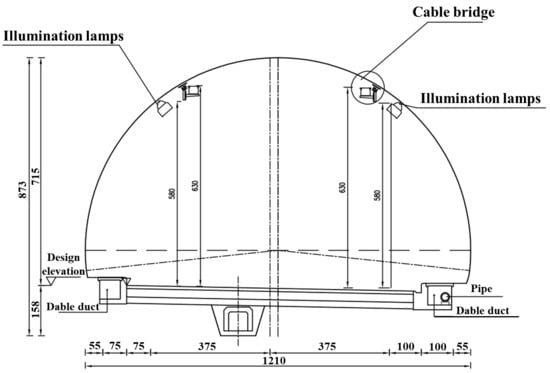
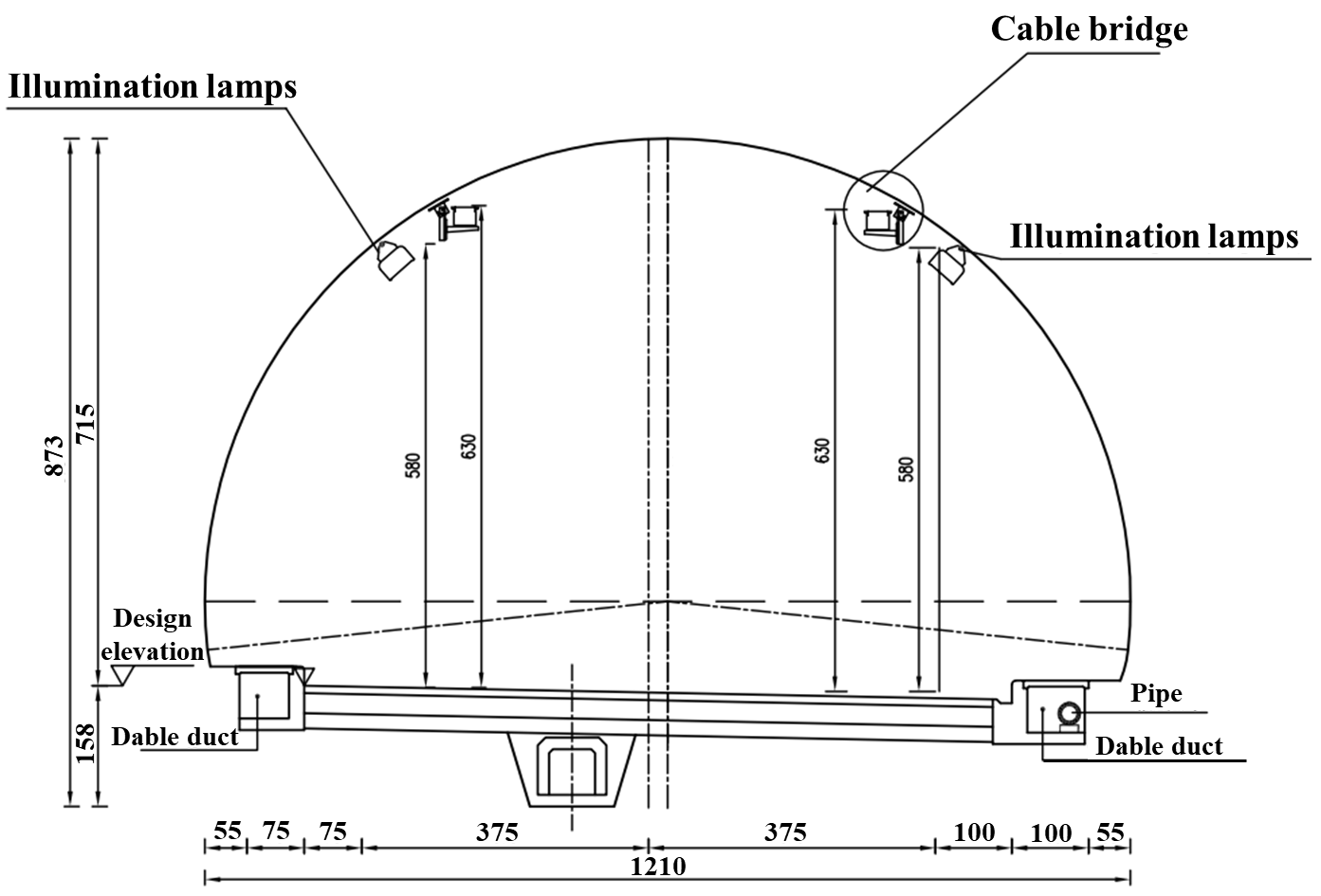
The TMG tunnel is located along the G0711 expressway in Xinjiang, China, with an entire length of 2910 m. It is a bidirectional two-lane road tunnel with a clear height of 7.15 m and a clear width of 7.5 m. The standard tunnel cross-section is shown in Figure 1. During the experimental period, the tunnel had not yet been opened to public traffic and was therefore not under full service conditions. However, frequent movement of construction vehicles within the tunnel generated substantial dust and particulate matter, resulting in relatively poor air quality. Such conditions share important similarities with real tunnel operating environments under heavy traffic, construction, or maintenance scenarios, where elevated particulate concentrations are commonly observed. Therefore, although the tunnel was not officially in operation, the experimental environment can be considered representative of polluted operating conditions. This provides a reasonable and practical basis for evaluating the effectiveness of the NIPS in improving tunnel air quality, as well as its air purification performance and engineering applicability.
Figure 1.
Cross-section of TMG tunnel (unit: cm).
2.1.2. Negative Ion Purification System (NIPS)
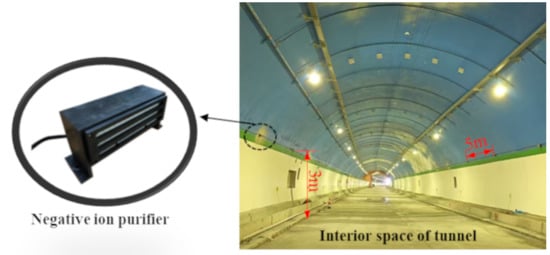
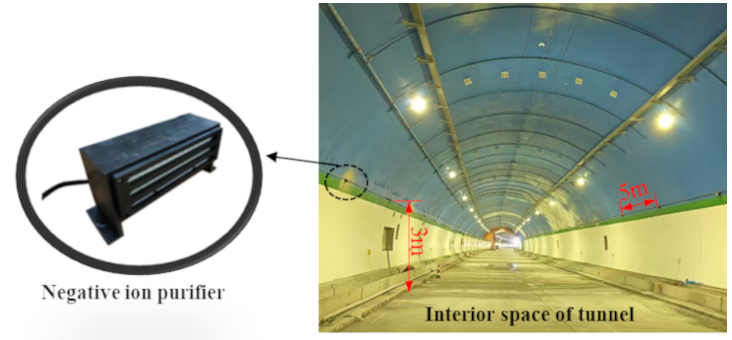
The NIPS employed in this research consisted of multiple negative ion generators symmetrically arranged along both sidewalls of the tunnel. The ionizers were manufactured by Anhui Zhongyi New Materials Technology Co., Ltd., with model number ZY-S220C and a rated power of 8 W per unit. The physical appearance of the device is presented in Figure 2. The ionizer operates based on the principle of corona discharge. A huge electric potential distinction is applied to the needle-tip electrode, generating a stable corona discharge field. Under the strong electric field, a large amount of electrons is emitted from the needle tip and rapidly attaches to oxygen molecules, forming negative air ions and enabling continuous ion generation. Under operating conditions, the NIPS units were symmetrically installed on both tunnel sidewalls at a height of 3 m above the road surface, with a longitudinal spacing of 5 m between adjacent units. This configuration was determined based on engineering considerations of ion dispersion and spatial coverage. The installation height allows negative ions to effectively diffuse into the typical human breathing zone, while the 5 m longitudinal spacing ensures sufficient overlap of ion diffusion regions. In addition, the symmetrical arrangement along both tunnel sidewalls improves the cross-sectional uniformity of the ion field under tunnel airflow conditions. As a result, a spatially distributed and relatively uniform negative ion field can be established inside the tunnel, as presented in Figure 2.
Figure 2.
Physical appearance and installation locations of NIPS.
In addition, the potential health effects of the negative ion generators were considered. The ionizers operate under low-power corona discharge conditions, which may produce trace amounts of ozone as a by-product. However, the emission level is minimal due to the controlled discharge design. Combined with the natural and mechanical ventilation within the tunnel, any generated ozone can be effectively diluted. The negative ion concentrations achieved in this study (on the order of 104–105 ions/cm3) fall within ranges commonly used in air purification applications and are generally regarded as safe for human exposure. Furthermore, the installation height of 3 m above the road surface and the distributed arrangement of the ionizers reduce direct exposure to localized high concentrations. Therefore, under the experimental and expected operational conditions, the NIPS is not expected to pose significant health risks to pedestrians or tunnel users.
In terms of economic feasibility, the capital cost of the negative ion generators is relatively low, with a unit price of approximately 40–60 USD per device. Considering the modular configuration and scalable installation of the system, the overall investment required for tunnel applications is manageable. This demonstrates that the NIPS is not only technically effective but also economically viable for practical engineering implementation.
2.1.3. Measurement Parameters
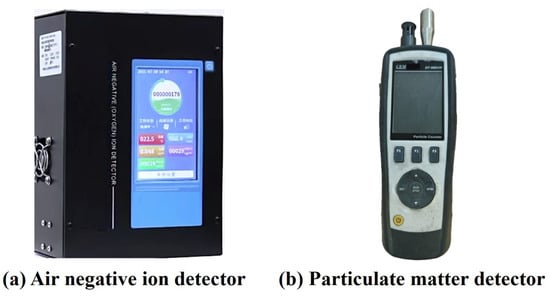
The measurement point was located in the middle section of the TMG tunnel, approximately 1500 m from the tunnel entrance. To minimize interference from passing construction vehicles, all measurement instruments were installed on the tunnel maintenance walkway. The measured parameters included the temporal variations in negative ion concentration and particulate matter concentration under both NIPS-on and NIPS-off conditions. Specifically, continuous measurements were conducted for 280 min following NIPS activation and 280 min following deactivation, allowing a systematic evaluation of the air purification performance of the NIPS and its temporal evolution. Negative ion concentration was measured by the air negative ion detector displayed in Figure 3a, with a measurement accuracy of 10 ions/cm3. Data were recorded at 1 min intervals. Particulate matter measurements included both PM2.5 and PM10 concentrations, which were monitored using the portable particulate matter detector displayed in Figure 3b, with a measurement accuracy of 1 μg/m3. The measurement points were mainly arranged along the tunnel centerline at a height of approximately 2 m, corresponding to the typical human breathing zone. This layout was adopted to capture representative exposure conditions and to ensure consistency across different experimental scenarios.
Figure 3.
Measurement instruments.
2.2. Experimental Design Under Fire Conditions
To systematically evaluate the smoke suppression performance of NIPS under different fire scales and spatial conditions, two types of full-scale fire experiments were designed and conducted. The first type consisted of fire tests in a dedicated test tunnel, designed to enable controlled comparative analysis and investigation of the underlying mechanisms. The second type consisted of fire tests in a real tunnel, aimed at validating the engineering applicability and effectiveness of the NIPS under larger spatial scales and higher fire loads. To ensure the comparability and consistency of the experimental results, the configuration, installation parameters, and operational mode of the NIPS were kept consistent across both experimental scenarios. This standardized experimental framework enabled systematic investigation of the smoke control performance and suppression mechanisms of the NIPS under varying fire intensities and spatial scales.
2.2.1. Fire Conditions in the Test Tunnel
- (1)
- Configuration of test tunnel and fire source
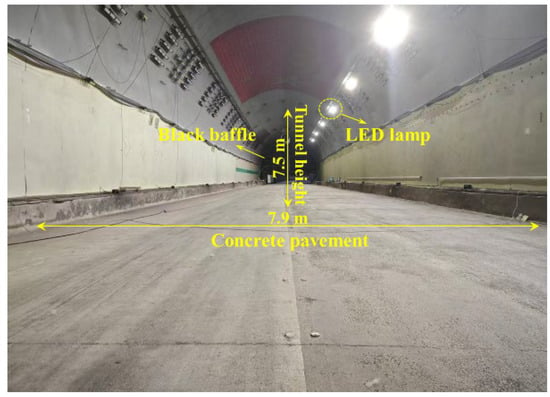
The test tunnel was constructed using a steel-frame structure with an overall length of 160 m. It consisted of a bidirectional two-lane configuration, with a clear height of 7.5 m and a clear width of 7.9 m. The tunnel walls and ceiling were lined with light gray aluminum panels, while the lower 3 m of the sidewalls were coated with a yellow marking layer. The tunnel pavement was made of concrete, and LED fixtures were symmetrically installed along the tunnel ceiling. The internal structure of the test tunnel is presented in Figure 4.
Figure 4.
Internal view of test tunnel.
To control the smoke boundary conditions, a black smoke barrier with a height of 2 m above the ground was installed at the tunnel exit portal. This barrier was designed to restrict rapid smoke discharge and facilitate smoke accumulation within the tunnel, as shown in Figure 4. All fire experiments were conducted under natural ventilation conditions, with ambient wind speeds below 0.5 m/s, thereby minimizing external airflow disturbances. It should be noted that longitudinal airflow velocity during the fire tests was not continuously measured. However, prior environmental monitoring and on-site observations confirmed that the background airflow remained weak and stable throughout the experiments. Therefore, the influence of longitudinal ventilation on smoke propagation was limited, and the experimental conditions can be regarded as representative of near-quiescent airflow scenarios.
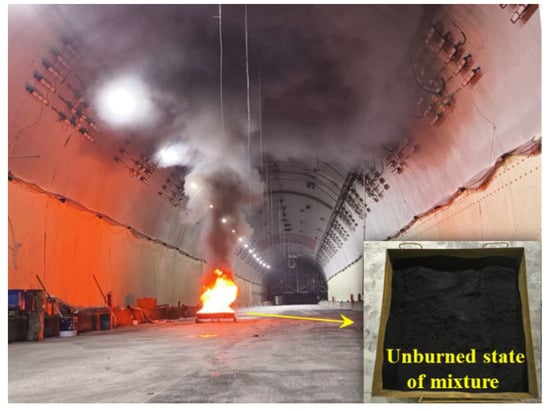
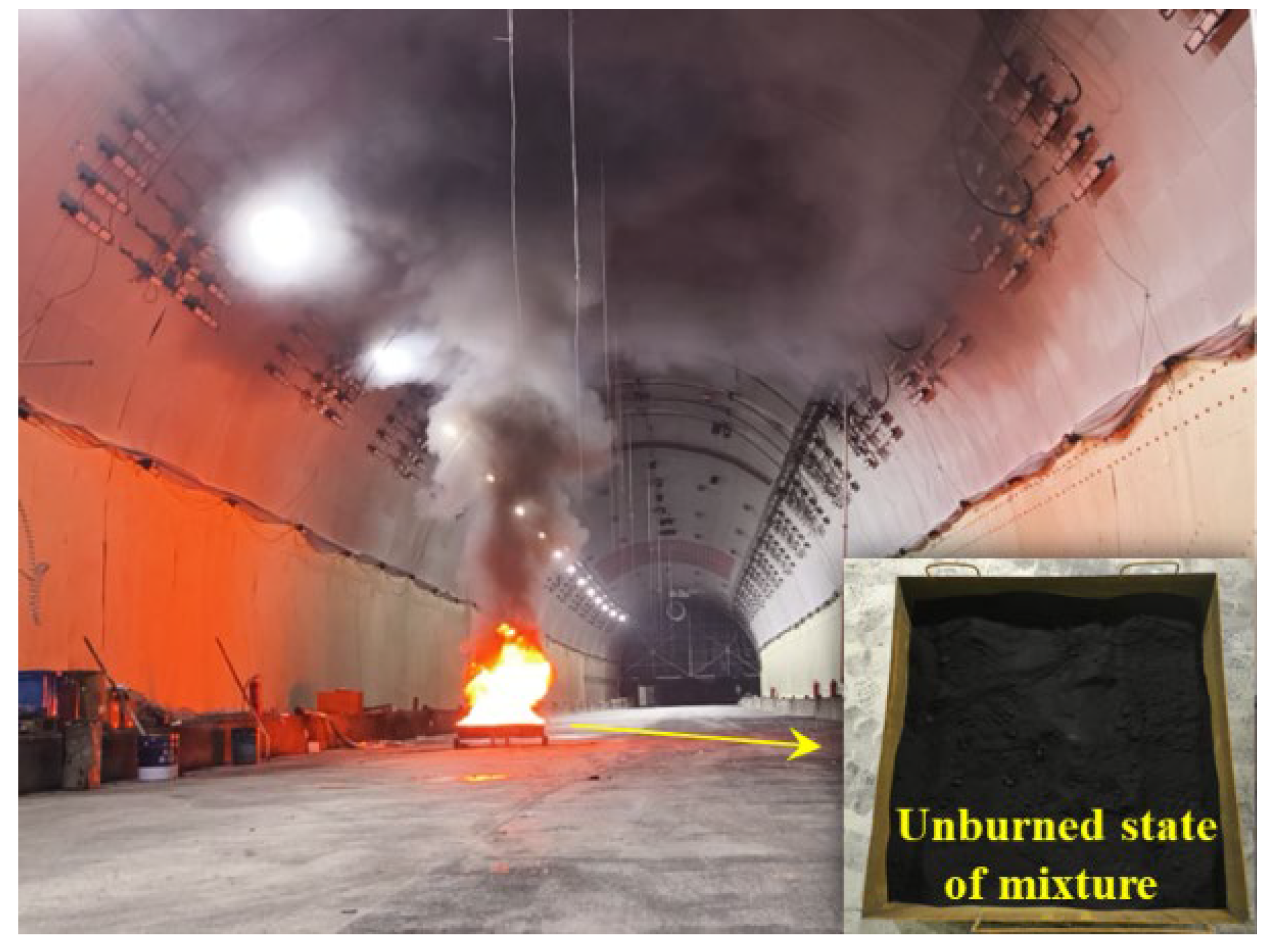
The fire source consisted of a fuel pan with dimensions of 1 m × 1 m × 0.1 m, mounted on a thermally insulated wooden support frame and positioned at the center of one traffic lane. The fuel consisted of a mixture of diesel and black rubber powder. Diesel served as the primary fuel, while rubber powder was added to enhance smoke production and particulate generation, simulating the combustion characteristics of vehicle fires. Each test consumed 10 L of diesel and 15 kg of rubber powder. Prior to ignition, the diesel and rubber powder were thoroughly mixed to ensure stable combustion and sustained smoke production. The combustion condition of the fire source is displayed in Figure 5.
Figure 5.
Combustion state of fire source.
- (2)
- NIPS configuration and experimental procedure
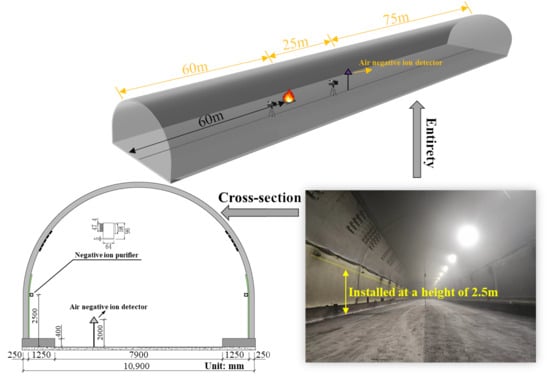
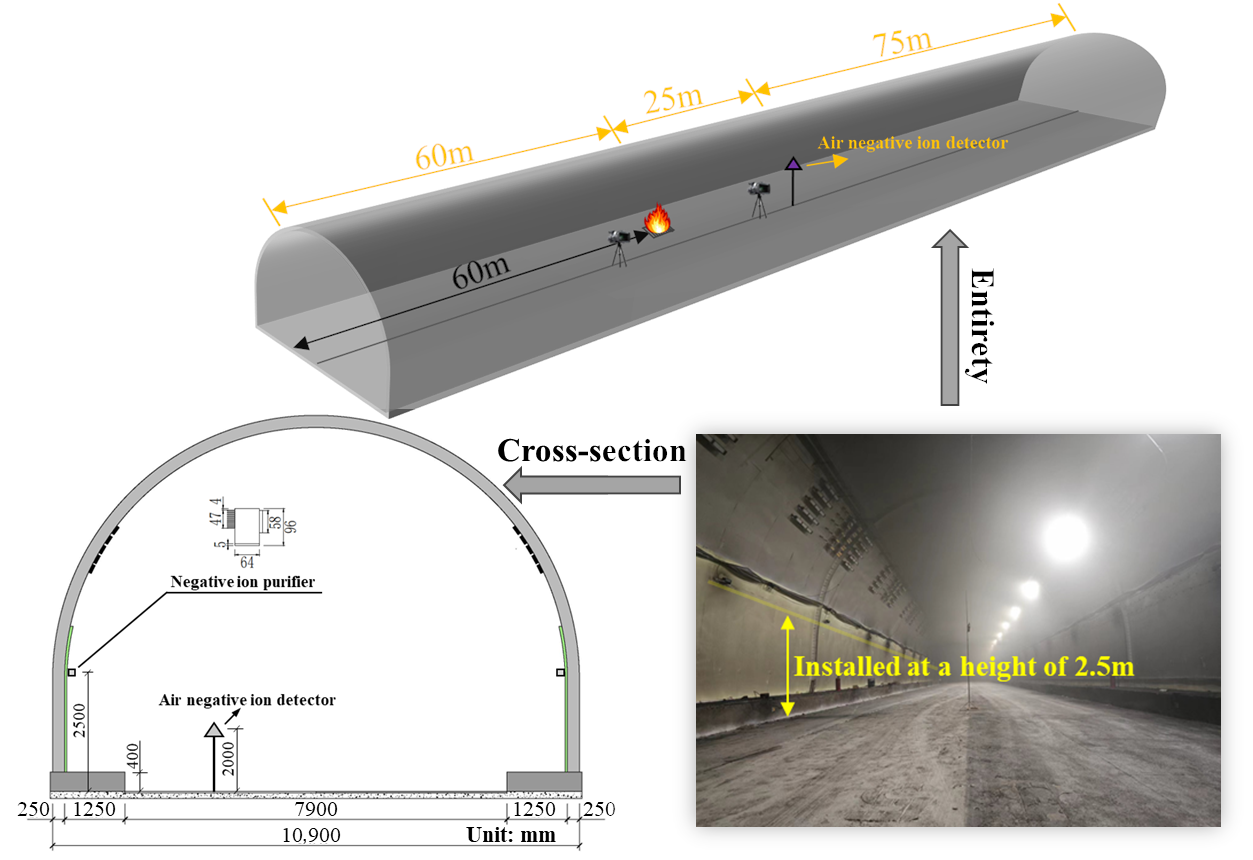
NIPS used in this experimental scenario consisted of multiple negative ion generators, as shown in Figure 2. As illustrated in Figure 6, the NIPS units were symmetrically installed along both tunnel sidewalls at a height of 2.5 m above the ground, with a longitudinal spacing of 5 m. This configuration enabled the establishment of a uniformly distributed negative ion field throughout the tunnel space.
Figure 6.
Installation locations of NIPS in the test tunnel.
Prior to the fire experiments, the negative ion concentration within the tunnel was measured by the specific detector displayed in Figure 3a to evaluate the ion distribution generated by the NIPS. The measurement point was located along the centerline of one traffic lane in the middle section of the tunnel, at a height of 2 m above the ground. The exact location of the measurement point is shown in Figure 6. The fire source, consisting of a fuel pan, was placed on the centerline of the traffic lane at a distance of 60 m from the tunnel entrance. A high-definition video camera was installed downstream of the fire source to continuously record the smoke propagation behavior and spatial distribution characteristics. In addition, a particulate matter detector was installed 25 m downstream of the fire source at a height of 2 m to continuously monitor the concentrations of PM2.5 and PM10. The detailed locations of these instruments are shown in Figure 6. A comparative experimental approach was adopted, and the procedure consisted of the following steps:
First, a fire experiment was conducted with NIPS turned off. The temporal evolution of particulate matter concentrations in the tunnel was recorded for 15 min after ignition. After the completion of the test, the fire source was extinguished using a fire extinguisher, and tunnel ventilation fans were activated to remove residual smoke and restore the initial environmental conditions. Subsequently, the fire experiment was repeated under the NIPS-on condition. The NIPS was operated continuously for more than 5 h prior to ignition to establish a stable and high-concentration negative ion environment within the tunnel. The same experimental procedure was then conducted to enable a direct comparison of smoke propagation and particulate transport characteristics with and without NIPS. To ensure repeatability, the experimental conditions, including fire source configuration, environmental conditions, and measurement setup, were kept consistent between repeated tests. The tunnel environment was restored to its initial state after each test to minimize residual effects.
2.2.2. Full-Scale Fire Experiments in the Real Tunnel
- (1)
- Overview of the real tunnel
To further improve the engineering representativeness and scalability of the fire experiment results, full-scale fire tests were additionally conducted in a real road tunnel based on the controlled fire experiments performed in the test tunnel. The selected test site was the LC tunnel, located in Sichuan Province, China. The LC tunnel has a total length of approximately 1100 m. Due to route realignment, the tunnel is no longer in operational use and is currently dedicated to fire experimental research, providing safe testing conditions and a full-scale structural environment.
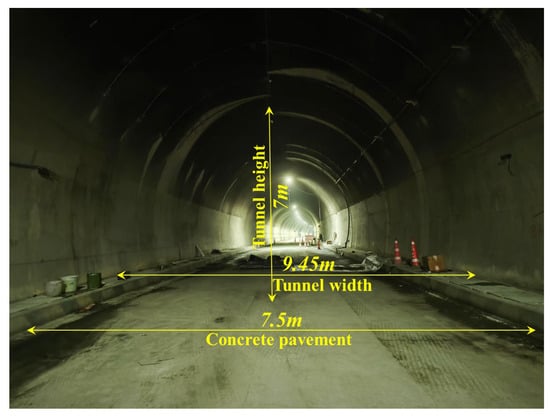
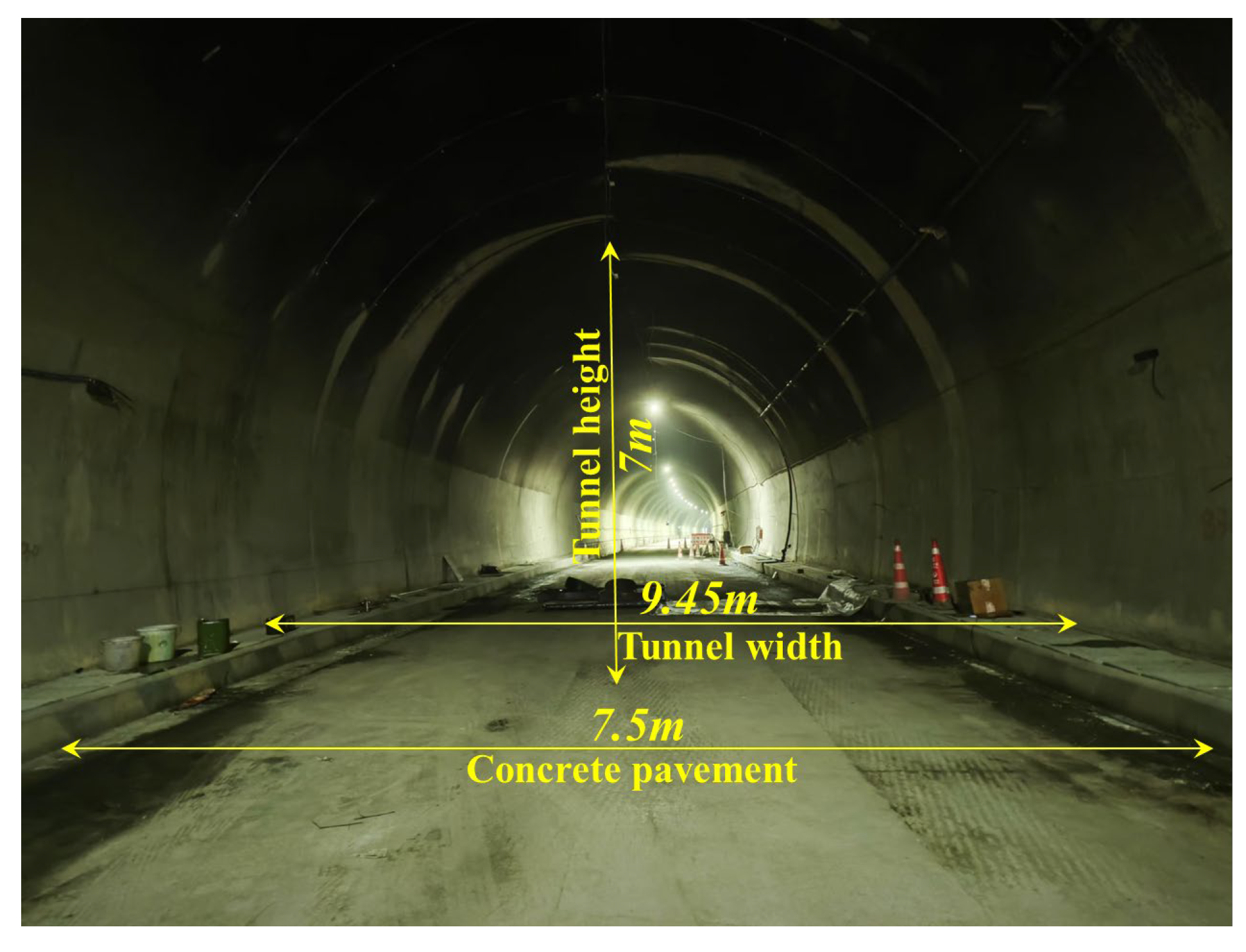
As displayed in Figure 7, the LC tunnel is a bidirectional two-lane road tunnel with a clear width of 9.45 m and a clear height of 7.0 m. Its cross-sectional dimensions are representative of typical mountain road tunnels. The first approximately 300 m from the tunnel entrance is paved with asphalt, while the remaining sections consist of concrete pavement. The tunnel sidewalls and ceiling are constructed of concrete lining, and LED fixtures are installed along the ceiling to provide internal illumination. Compared with the steel-structured test tunnel, the LC tunnel more closely represents actual operational tunnels in terms of structural scale, thermal properties of enclosure materials, and longitudinal spatial continuity. Consequently, the thermal boundary conditions and smoke flow evolution within the LC tunnel more realistically reflect actual tunnel fire scenarios, thereby enhancing the engineering reliability and practical applicability of the experimental results.
Figure 7.
Dimensions and internal view of LC tunnel.
- (2)
- Fire size
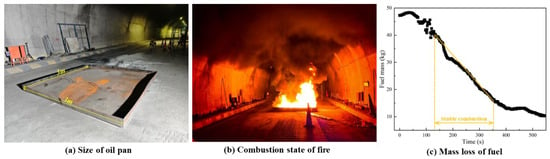
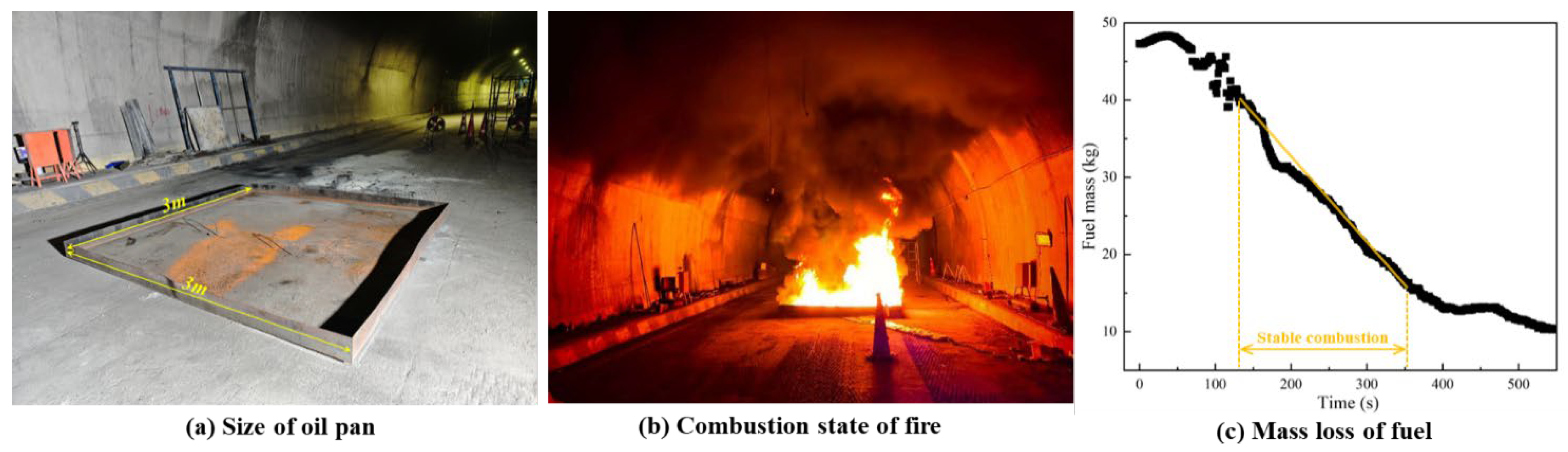
A larger-scale fire source was employed in the full-scale tunnel experiments to better simulate realistic highway tunnel fire scenarios. The fire source was positioned at the center of the tunnel cross-section and consisted of a diesel pool fire. Compared with the test tunnel scenario, the full-scale tunnel fire involved a significantly greater fuel load, longer burning duration, and increased smoke generation, resulting in a higher heat release rate (HRR) and smoke production. The pool fire had dimensions of 3 m × 3 m × 0.25 m, as shown in Figure 8a, and the corresponding flame characteristics are presented in Figure 8b. During combustion, the fuel mass loss was continuously measured using a weighing system, as illustrated in Figure 8c. The average HRR during the quasi-steady burning stage was calculated based on the measured mass loss rate using Equation (1). It should be noted that the instantaneous mass loss data exhibited noticeable fluctuations due to limitations in measurement accuracy and environmental disturbances during the fire tests. Therefore, a time-resolved HRR curve derived directly from the raw data would contain significant uncertainty and may not reliably represent the actual fire behavior. For this reason, an averaged HRR over the quasi-steady burning stage was adopted to provide a more stable and representative estimation of the fire size. Based on the measured mass loss curve and Equation (1), the fire size was estimated to be approximately 3.7 MW. The selected fire size represents a moderate-scale tunnel fire rather than an extreme scenario. This choice was made to ensure experimental safety, controllability, and repeatability under full-scale conditions. Despite its relatively smaller scale, the fire was sufficient to produce a stable smoke layer, significant particulate generation, and representative smoke propagation behavior, thereby providing a reliable basis for evaluating the performance of the NIPS.
where is the average HRR (MW), χ is the combustion efficiency, taken as 0.75 [44,45], is the average mass loss rate (kg/s), and ΔHc is the heat of combustion, taken as 43 MJ/kg for diesel fuel [46,47].
Figure 8.
Fire size.
- (3)
- Layout of NIPS and experimental setup
Under the full-scale tunnel fire condition, the NIPS was symmetrically installed along both sidewalls of the tunnel. The installation height, longitudinal spacing, and operational mode were consistent with those used in the test tunnel fire experiments. The installation region extended from the tunnel entrance to the middle section of the tunnel, forming a continuous negative ion coverage zone. To systematically evaluate the effectiveness of the NIPS, comparative fire experiments were conducted under two conditions: with the NIPS deactivated and activated. All fire tests were performed under natural ventilation conditions. During the experiments, the ambient airflow velocity in the tunnel ranged from 1 to 1.5 m/s, with the airflow direction from the tunnel exit toward the entrance. Under these ventilation conditions, the full-scale tunnel fire experiments focused on large-scale fire scenarios to evaluate the capability of the NIPS in reducing high concentrations of fire-generated particulate matter and toxic gases, as well as its overall smoke purification performance. The layout of the NIPS and the locations of measurement points are illustrated in Figure 9.
Figure 9.
Layout of experimental equipment and measurement points in the tunnel.
2.3. Experimental Uncertainty and Repeatability
Due to the large spatial scale and high operational cost of tunnel experiments, especially under fire conditions, fully independent repeated experiments under identical conditions were not always feasible in this study. Instead, a controlled comparative approach was adopted, in which the NIPS-on and NIPS-off conditions were tested under carefully maintained and consistent experimental settings, including fire source characteristics, environmental conditions, and instrumentation layout.
The presented results are primarily based on representative experimental runs with continuous time-series measurements, rather than statistical averages over multiple independent replicates. To improve data reliability, measurements were conducted with high temporal resolution and over sufficiently long durations to capture stable trends and system behavior. Measurement uncertainty was controlled through the use of calibrated instruments with known accuracy (±10 ions/cm3 for negative ion concentration and ±1 μg/m3 for particulate matter concentration). Considering that the observed variations in particulate matter concentrations exceeded 90%, the influence of instrument uncertainty on the overall conclusions is limited.
Nevertheless, the lack of multiple independent repetitions introduces some uncertainty in the quantitative assessment. This limitation should be acknowledged, and future work will focus on conducting repeated experiments and statistical analyses to further validate the reproducibility and robustness of the results.
3. Results Under Operation Conditions
3.1. Temporal Evolution of Negative Ion Concentration in the Tunnel
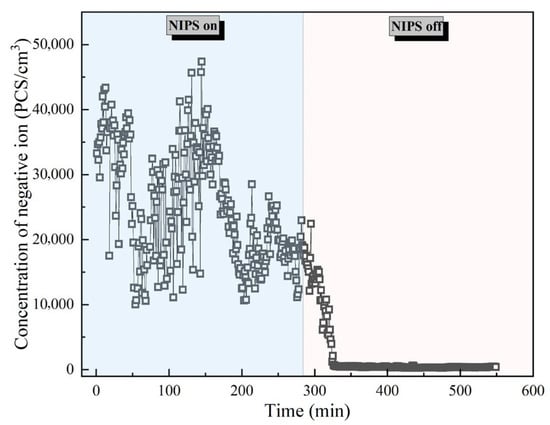
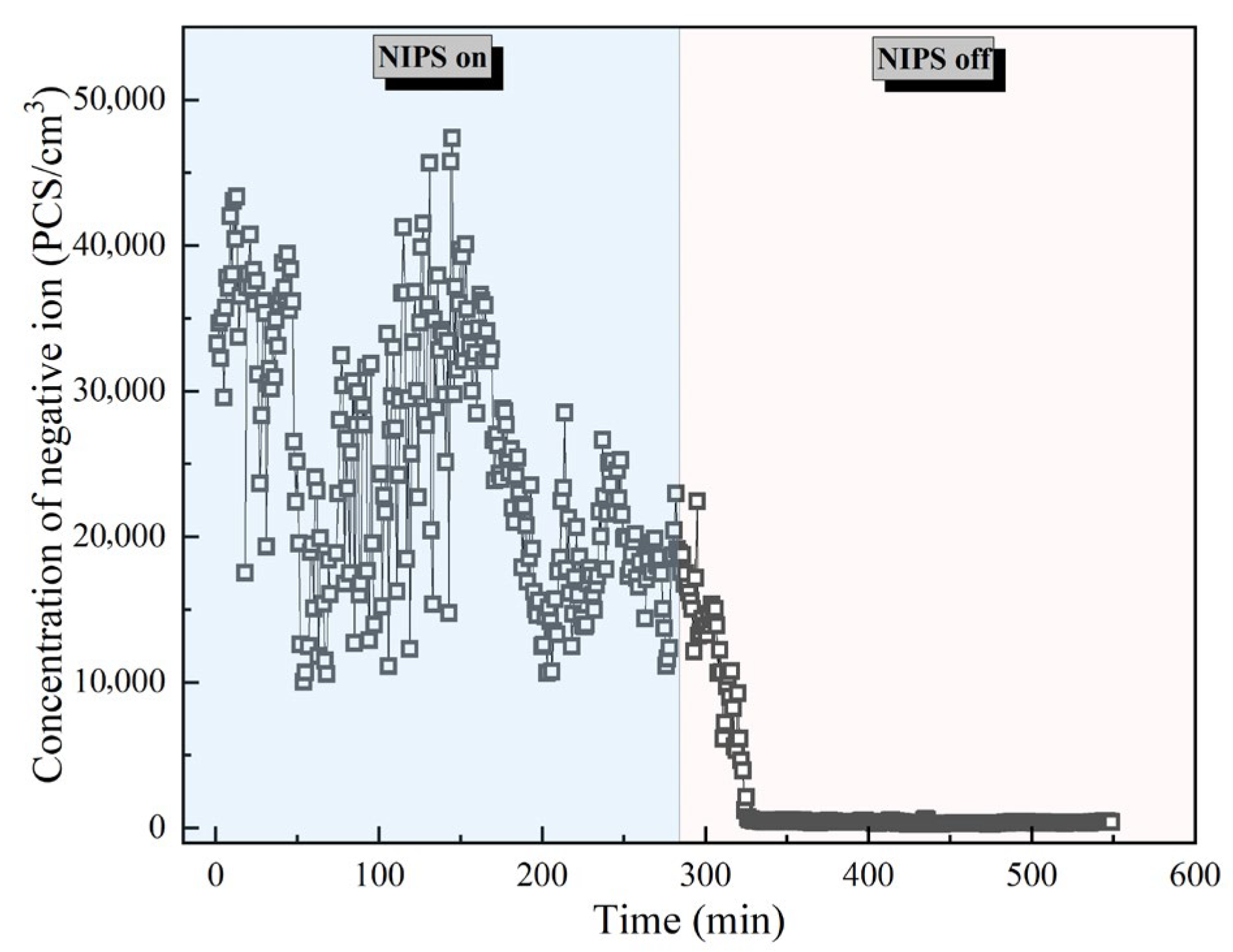
Figure 10 illustrates the temporal evolution of negative ion concentration inside the tunnel during the NIPS-on stage (0–280 min) and the subsequent decay stage after deactivation (280–560 min). The results indicate that the negative ion concentration increased rapidly, reaching a relatively high level shortly after activation. This demonstrates the strong ion generation capacity and effective spatial dispersion capability of the negative ion generators, enabling the rapid establishment of a high-concentration negative ion environment under realistic tunnel ventilation conditions. During continuous operation, although the overall concentration remained at a relatively high level, it did not exhibit a strict steady-state behavior. Instead, moderate dynamic fluctuations were observed. This phenomenon can be attributed to airflow disturbances induced by natural wind and construction vehicle movement inside the tunnel, which resulted in unsteady turbulent flow structures. Such complex flow conditions influence the spatial transport, diffusion, and local accumulation of negative ions. As charged micro-particles, the migration of negative ions is governed by both convective transport and molecular diffusion mechanisms, leading to temporally varying concentration distributions under non-uniform airflow conditions.
Figure 10.
Temporal evolution of negative ion concentration in the TMG tunnel under operation conditions.
After deactivation of the NIPS, the negative ion concentration decreased rapidly and gradually approached the ambient background level. This attenuation process results from the combined effects of multiple physical mechanisms, including recombination between positive and negative ions in air, attachment of negative ions to suspended particulate matter, migration and deposition of ions onto tunnel walls and structural surfaces, and dilution induced by airflow transport. Under the combined influence of these mechanisms, the negative ion concentration exhibited a rapid decay trend before returning to its baseline level. Overall, the NIPS deployed in this study was capable of rapidly establishing and maintaining a relatively high negative ion concentration field. The system demonstrated strong spatial coverage and operational stability, thereby providing a favorable electrostatic environment for subsequent particle charging, agglomeration, and gravitational settling processes.
3.2. Variation of Particulate Matter Concentration in the Tunnel
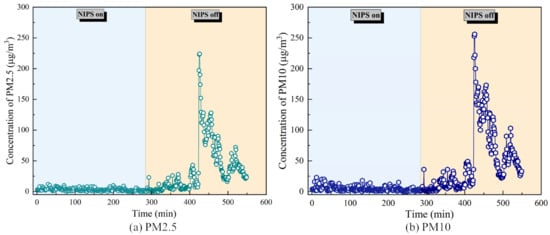
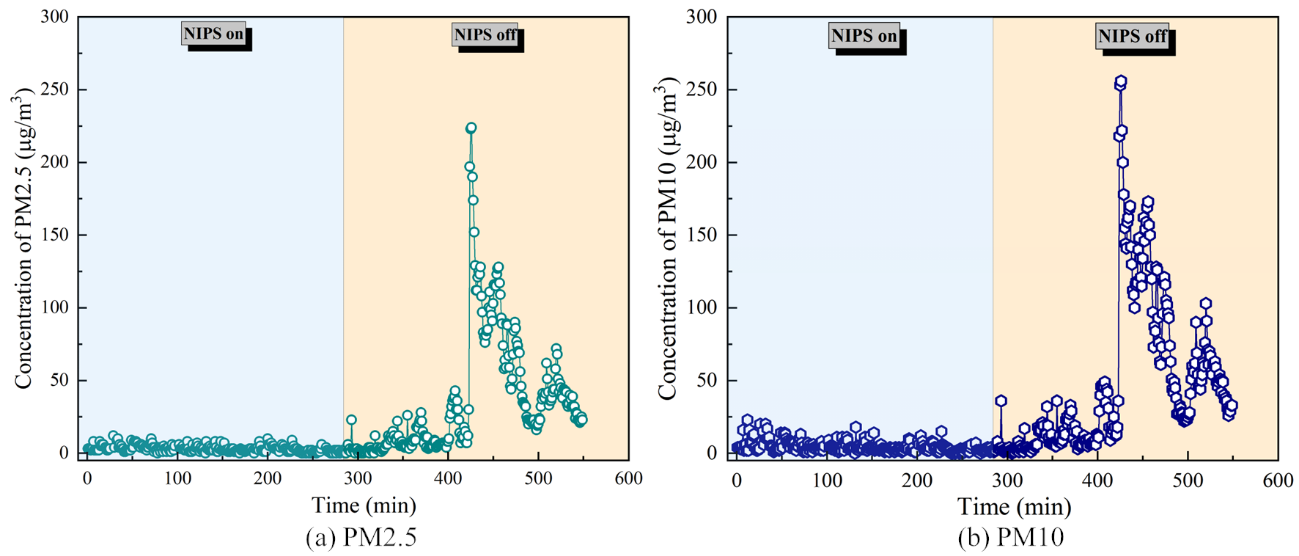
Figure 11 presents the differences in the concentrations of PM2.5 and PM10 under NIPS-on and NIPS-off conditions. As shown in Figure 11a, during NIPS operation, the PM2.5 concentration remained at a relatively low level, and the amplitude of fluctuation was significantly reduced, indicating a pronounced suppression effect of the NIPS on fine particulate matter. This improvement can be attributed to the continuous release of negative ions, which establishes a stable, high-concentration ion environment within the tunnel, thereby promoting the removal of suspended particles. After the NIPS was deactivated, the PM2.5 concentration gradually increased and returned to a state characterized by larger fluctuations. This behavior reflects the absence of ion-induced regulation, under which vehicle-induced airflow disturbances, resuspension of road dust, and air exchange at the tunnel portals collectively contributed to renewed particle accumulation and elevated concentrations. As illustrated in Figure 11b, the temporal trend of PM10 was generally consistent with that of PM2.5, although the overall PM10 concentration was slightly higher. This is primarily because coarse particles originate from a wider range of sources, including not only combustion emissions but also road dust resuspension, mechanical disturbances from vehicle movement, and external particle inflow through tunnel portals. Overall, the experimental results demonstrate that the NIPS significantly reduces particulate matter concentrations and improves tunnel air quality under operating conditions.
Figure 11.
Temporal evolution of the concentrations of PM2.5 and PM10 in the TMG tunnel under operation conditions.
From a microscopic perspective, the purification mechanism is mainly attributed to ion-induced particle charging and electrostatic agglomeration. Under the influence of the electric field, negative ions frequently collide with suspended particles and attach to their surfaces through diffusion and field charging mechanisms, imparting negative charges to the particles. Charged particles experience enhanced mutual attraction due to image forces and induced polarization effects, which significantly increase the probability of article collision and agglomeration. As a result, fine particles are transformed into larger aggregates. With increasing particle size, the gravitational settling velocity increases substantially, facilitating particle removal from the aerosol phase and deposition onto the tunnel floor or structural surfaces. Meanwhile, charged particles are more likely to migrate toward and deposit on grounded surfaces such as tunnel walls, ceilings, and pavements under the electric field. In addition, enlarged particles possess greater inertia and are more readily transported out of the tunnel by ventilation airflow. This synergistic mechanism accounts for the enhanced particulate removal efficiency of the NIPS and the significant improvement of air quality under tunnel operating conditions.
4. Results Under Fire Conditions
4.1. Results Under Fire Conditions in the Test Tunnel
4.1.1. Variation of Negative Ion Concentration in the Tunnel
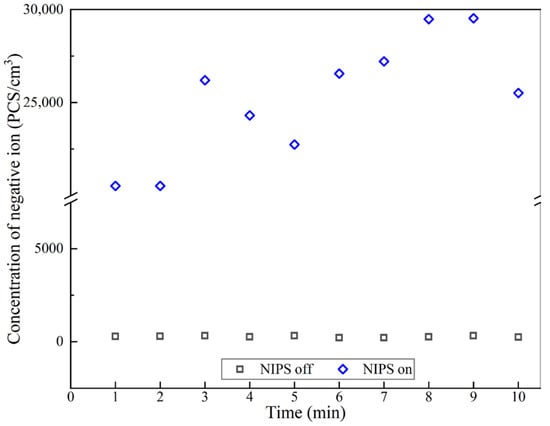
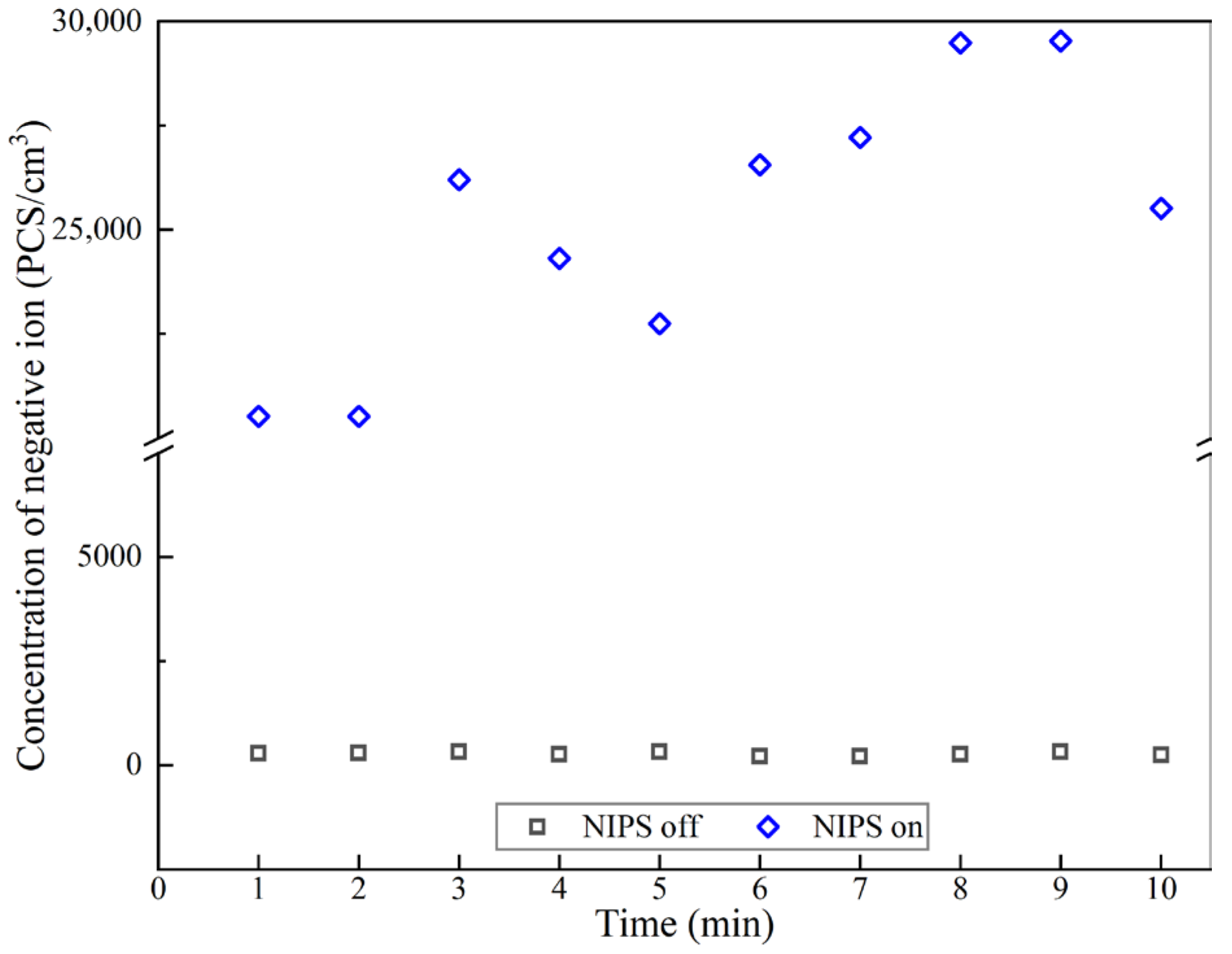
Figure 12 presents a direct comparison of the variation of negative ion concentration in the test tunnel under NIPS-off and NIPS-on conditions. When the NIPS was deactivated, the negative ion concentration remained at approximately 300 PCS/cm3, corresponding to the natural background level. This indicates that, in the absence of an external ion source, the concentration of air negative ions inside the tunnel is primarily maintained by natural ionization processes and remains relatively low. After activation of the NIPS and installation of the ionizers at a height of 2.5 m along the tunnel sidewalls, the negative ion concentration increased rapidly and reached 20,000–30,000 PCS/cm3 within approximately 10 min. This represents an increase of more than two orders of magnitude compared to the background level, demonstrating the strong ion generation capacity and effective spatial dispersion capability of the ionizers. The system was therefore capable of rapidly establishing a high-concentration negative ion field within the tunnel space.
Figure 12.
Variation of negative ion concentration in the test tunnel under NIPS-off and NIPS-on conditions during fire experiments.
Moreover, during continuous operation, the concentration of negative ions exhibited a gradual increasing trend, suggesting that the processes of ion generation, recombination, wall deposition, and airflow transport progressively approached a dynamic equilibrium state. These results indicate that the NIPS can establish a stable and high-intensity ion environment prior to fire ignition, thereby providing the necessary electrostatic conditions for subsequent particle charging and agglomeration during fire-induced smoke generation.
Given that the NIPS configuration, installation parameters, and operating conditions were maintained consistent in the subsequent full-scale tunnel experiments, and that the airflow velocity range and geometric characteristics of the tunnels were comparable, it can be reasonably inferred that a similar high-concentration negative ion environment was also established in the LC tunnel.
4.1.2. Variation of Particulate Matter Concentration in the Tunnel
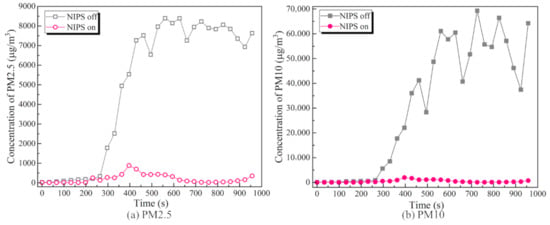
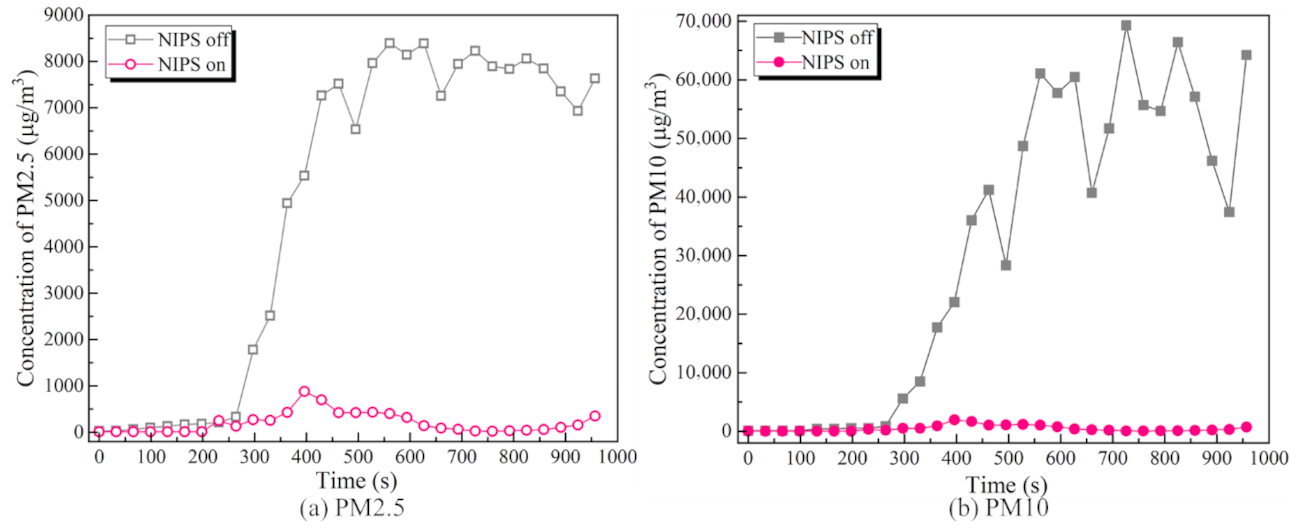
Figure 13 illustrates the variations in concentrations of PM2.5 and PM10 under NIPS-on and NIPS-off conditions during fire experiments. The results demonstrate that, after the NIPS was activated, particulate matter concentrations inside the tunnel were significantly reduced. Specifically, the reduction exceeded 90% for PM2.5 and 95% for PM10, indicating that the NIPS maintained strong particle removal efficiency even under high-concentration fire smoke conditions. Compared with operation conditions, particulate concentrations under fire scenarios were substantially higher. The primary sources include soot particles generated by the incomplete combustion of fuel, organic aerosol particles formed during combustion, and secondary particles produced through condensation as high-temperature smoke cools. These particles are predominantly submicron in size, possessing strong suspension capability and pronounced optical extinction effects, which are major contributors to visibility reduction during tunnel fires.
Figure 13.
Temporal variation in the concentrations of PM2.5 and PM10 in the test tunnel during fire experiments.
In high-concentration smoke environments, negative ions are likely to enhance particle charging and electrostatic agglomeration processes, thereby significantly promoting inter-particle collision and aggregation. After acquiring electrical charges, submicron particles experience strengthened mutual interactions and rapidly coagulate into larger aggregates. As particle size increases, gravitational settling velocity rises markedly, accelerating particle removal from the smoke-laden airflow. Furthermore, the elevated temperature of fire smoke intensifies molecular thermal motion and enhances Brownian motion of particles, thereby increasing collision probability and further strengthening agglomeration. Meanwhile, charged particles are more likely to migrate toward and deposit on tunnel walls and structural surfaces under electrostatic forces, leading to an additional reduction in airborne particle concentration. Therefore, through the synergistic effects of ion-induced charging, electrostatic agglomeration, and gravitational settling, the NIPS substantially improves particulate removal efficiency under fire conditions, demonstrating robust smoke purification performance and stable smoke suppression capability even in extreme fire environments.
Overall, compared with the NIPS-off condition, the NIPS-on condition demonstrates a substantial and sustained reduction in particulate matter concentrations.
4.1.3. Smoke Distribution in the Tunnel
Figure 14 illustrates the smoke distribution inside the tunnel under NIPS-off and NIPS-on conditions. After ignition, the fire burned vigorously, with smoke spreading along the ceiling toward both ends of the tunnel. Upon reaching the black smoke barrier, the smoke descended, leading to a well-mixed smoke layer within the tunnel space. Figure 14a shows the downstream smoke distribution 15 min after ignition under NIPS-off conditions. The high smoke concentration significantly attenuated the LED illumination, resulting in reduced tunnel brightness and low visibility. In contrast, Figure 14b presents the smoke distribution 15 min after ignition with the NIPS operating continuously. In this case, the smoke was effectively removed through agglomeration and deposition, leading to increased tunnel brightness, enhanced visibility, and more distinct smoke layering compared to the control scenario. This comparison clearly demonstrates the effectiveness of the NIPS in improving smoke conditions relative to the NIPS-off scenario.
Figure 14.
Smoke distribution in the downstream tunnel section 15 min after ignition.
Upon fire occurrence, buoyant high-temperature smoke rapidly rises, impinges on the tunnel ceiling to form ceiling jet structures, and subsequently spreads longitudinally, gradually establishing a stable smoke layer. This smoke layer contains large quantities of carbonaceous soot and combustion-generated aerosol particles, which strongly absorb and scatter light, thereby reducing tunnel brightness and visibility. When the NIPS is deactivated, smoke concentrations remain high, and light extinction is significant, adversely affecting evacuation and emergency response. Activation of the NIPS markedly improves smoke conditions, enhancing tunnel brightness and visibility and clarifying the smoke layer stratification, demonstrating the system’s effective smoke suppression and purification performance.
The observed phenomena can be reasonably explained by particle charging and electrostatic agglomeration induced by negative ions. Released negative ions rapidly attach to submicron carbonaceous particles, imparting electric charges and enhancing interparticle interactions, which promote coagulation into larger aggregates. According to particle optics theory, the mass-specific extinction coefficient decreases with increasing particle size, reducing the light absorption and scattering effect of smoke. Simultaneously, the enlarged particle size increases gravitational settling velocity, facilitating deposition onto the tunnel floor and structural surfaces. Charged particles also migrate toward tunnel walls and ceiling under electrostatic forces, further decreasing suspended particulate concentrations. Through the combined effects of enhanced coagulation, accelerated settling, and wall deposition, overall smoke extinction diminishes, light transmittance increases, and tunnel visibility improves significantly. It should be noted that light transmittance, which is a more direct indicator of visibility under fire conditions, was not quantitatively measured in this study. Instead, the evaluation of visibility improvement was based on particulate matter concentration measurements and visual observations of smoke distribution. While these parameters are closely related to light extinction and can provide reasonable indirect evidence, they cannot fully replace direct optical measurements. Therefore, the improvement in visibility reported in this study should be interpreted with this limitation in mind. Future research will focus on incorporating quantitative measurements of light transmittance or optical density to provide a more comprehensive assessment of smoke suppression performance.
In summary, the experimental results indicate that the NIPS not only effectively reduces smoke particulate concentrations but also substantially enhances spatial visibility under fire conditions, highlighting its potential for tunnel smoke control and the improvement of safety during evacuation and emergency response.
4.2. Results Under Fire Conditions in the LC Tunnel
4.2.1. Variation in Particulate Matter Concentration
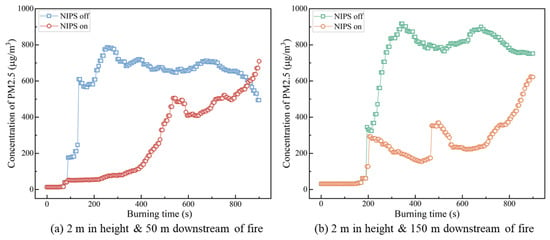
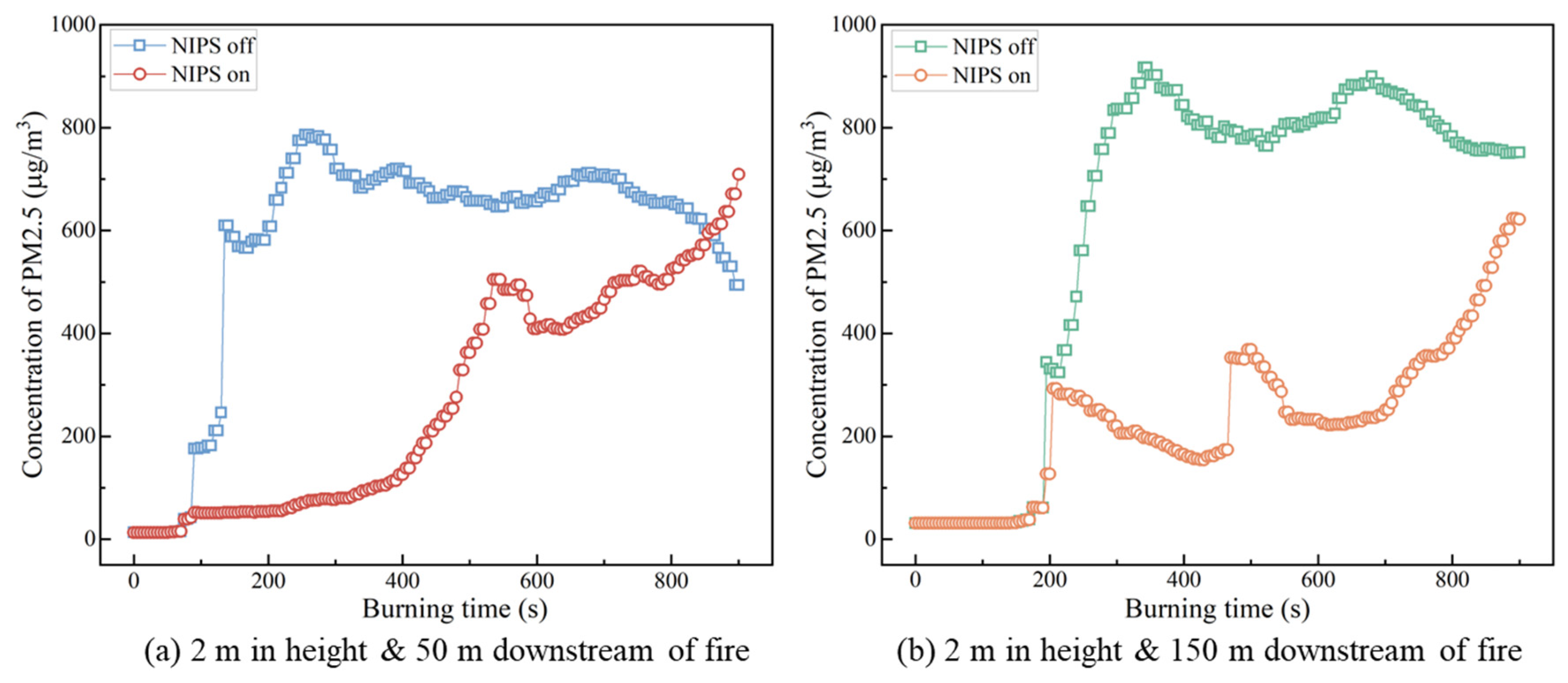
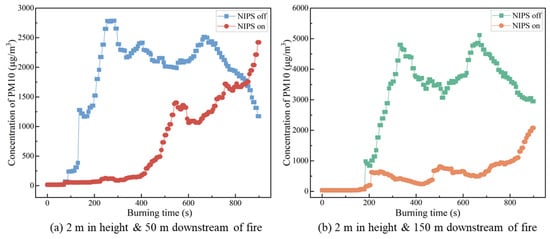
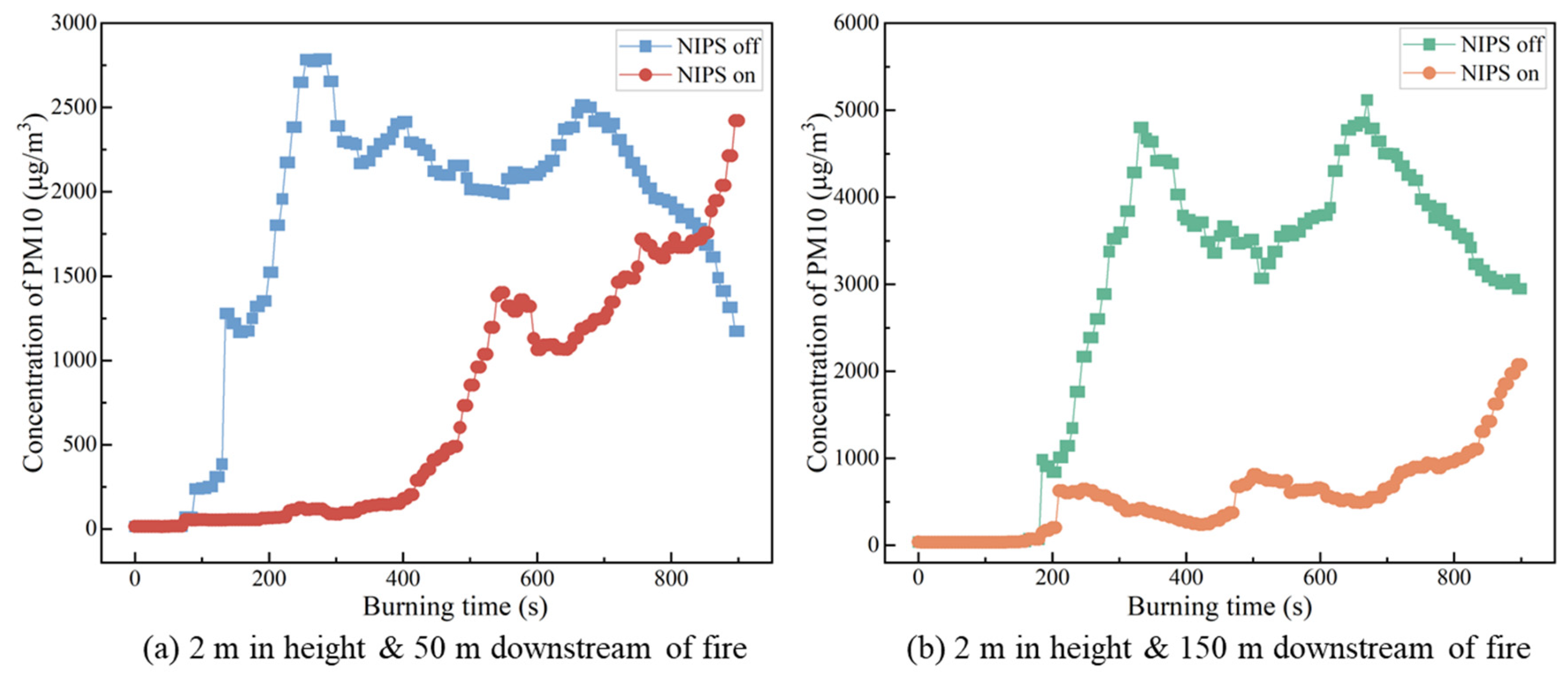
Figure 15 and Figure 16 present the temporal evolution and longitudinal distribution of the concentrations of PM2.5 and PM10 at different measurement points in the full-scale tunnel fire experiments under NIPS-on and NIPS-off conditions. Overall, the concentration of particulate matter in the tunnel rapidly increased after fire ignition and propagated longitudinally with smoke transport. When NIPS was deactivated, both PM2.5 and PM10 concentrations remained elevated and decayed slowly, indicating that fire-generated particles exhibited strong suspension and spatial persistence, which could not be mitigated solely by natural deposition and ventilation. In contrast, when NIPS was activated, particle concentrations decreased significantly with an accelerated decay rate, demonstrating that negative ions promoted particle coagulation and sedimentation through electrostatic interactions, effectively suppressing the sustained accumulation of airborne particles during transport. These results clearly indicate that, compared with the NIPS-off condition, the NIPS-on condition significantly accelerates particle removal and suppresses long-range transport.
Figure 15.
Temporal variation in PM2.5 concentration at different measurement points within the tunnel.
Figure 16.
Temporal variation in PM10 concentration at different measurement points within the tunnel.
The longitudinal distribution revealed that under NIPS-off conditions, the concentration of PM2.5 increased with distance from the fire source, as fine particles were continuously transported downstream by buoyant plumes and longitudinal airflow, leading to particle accumulation. Conversely, under NIPS-on conditions, the concentration of PM2.5 decreased with distance, indicating that negative ions facilitated ongoing coagulation and sedimentation of fine particles, thereby reducing their long-range transport. In comparison, the concentration of PM10 decreased with distance under both conditions due to the more pronounced effects of gravitational settling and inertial deposition of coarse particles. Furthermore, the NIPS exhibited a more pronounced removal effect on PM10, suggesting that negative-ion-induced coagulation enhances the transformation of fine particles into larger aggregates and accelerates their deposition, enhancing the overall particulate removal efficiency from the aerosol phase.
It should be noted that, at certain stages and measurement locations, the particle concentration under the NIPS-on condition may exhibit a temporary increase and even exceed that under the NIPS-off condition. This phenomenon can be attributed to the transient effects of ion-induced particle agglomeration and spatial transport. Specifically, when negative ions are introduced, fine particles are rapidly charged and undergo enhanced collision and coagulation, leading to the formation of larger particle aggregates. During this dynamic process, local particle concentration may temporarily increase due to intensified particle interactions and redistribution in the measurement region. Moreover, under longitudinal airflow, particles from upstream regions may accumulate at downstream measurement points, resulting in short-term concentration peaks. As agglomeration and gravitational settling continue, the overall particle concentration subsequently decreases, reflecting the dominant removal effect of the NIPS over longer time scales.
Additionally, the overall concentrations of PM2.5 and PM10 measured in the full-scale tunnel were lower than those observed in the test tunnel, primarily due to differences in spatial scale and experimental conditions. The shorter test tunnel with an exit barrier promoted smoke accumulation, and the addition of rubber powder to the fuel generated large amounts of black smoke. Combined with low natural ventilation, these factors impeded smoke dilution. In contrast, the full-scale tunnel offered a larger space and stronger natural ventilation, allowing continuous smoke dilution and dispersion, resulting in relatively lower particulate concentrations.
In summary, under full-scale tunnel fire conditions, the NIPS significantly enhanced particle coagulation and sedimentation, effectively inhibited long-range transport of PM2.5, and exhibited higher removal efficiency for PM10, thereby substantially reducing smoke particle concentrations and improving the air quality and smoke hazard mitigation within the tunnel.
4.2.2. Variation in CO Concentration
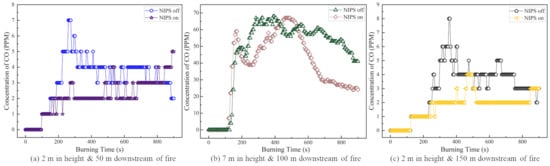
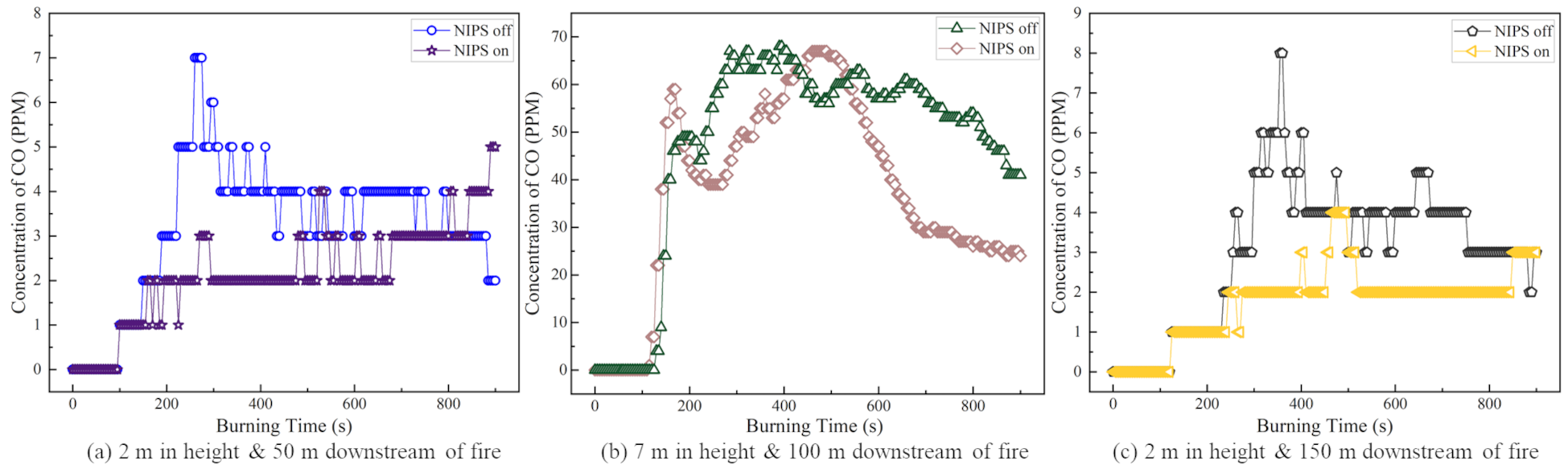
Figure 17 illustrates the variation in CO concentration at different measurement points in the real tunnel under fire conditions, comparing NIPS-on and NIPS-off scenarios. The CO measurement points were located 50 m (2 m above the road surface), 100 m (under the tunnel vault), and 150 m (2 m above the road surface) downstream of the fire source, capturing the influence of longitudinal position and vertical height on toxic gas transport and distribution.
Figure 17.
Variation in CO concentration at different measurement points in the tunnel under fire conditions.
Overall, the concentration of CO rapidly increased at all measurement points following fire ignition and propagated downstream under the combined effects of buoyancy-driven smoke rise and longitudinal airflow. With NIPS deactivated, the concentration of CO remained elevated and decayed slowly, indicating that fire-generated CO exhibits strong spatial persistence and transport capacity, which cannot be rapidly dissipated by natural ventilation alone. Spatially, the measurement points under the tunnel vault exhibited higher CO concentration than near-ground points, reflecting the accumulation of hot smoke at the tunnel ceiling due to buoyancy, forming a relatively stable smoke layer.
When NIPS was activated, the concentration of CO at all measurement points decreased significantly, and the decay rate increased markedly, suggesting a possible indirect influence on fire-generated CO. Although NIPS does not chemically remove CO, its influence can be explained through coupled aerosol–flow interactions. Specifically, negative ions generated by the system attach to suspended particles, leading to particle charging and enhanced electrostatic attraction. This process increases the collision frequency among particles, promoting rapid agglomeration into larger clusters. As particle size increases, gravitational settling velocity is significantly enhanced, resulting in accelerated particle removal from the smoke layer. The reduction in particle concentration alters the physical structure of the smoke layer. Lower particle loading reduces radiation absorption and scattering, thereby decreasing the optical thickness and weakening thermal stratification within the smoke layer. Consequently, the stability of the hot upper smoke layer is reduced, making it more susceptible to ambient airflow disturbances.
As a result, the mixing between smoke and surrounding fresh air is intensified, enhancing the dilution and transport of gaseous species such as CO. This process may contribute to the enhanced dilution and removal of CO from the tunnel space, even though no direct chemical decomposition occurs. In summary, the observed reduction in CO concentration may be attributed to the coupling effect of particle removal, smoke layer destabilization, and enhanced air–smoke mixing, rather than direct interaction between negative ions and CO molecules.
4.2.3. Smoke Distribution Within the Tunnel
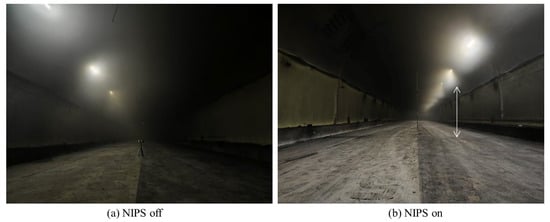
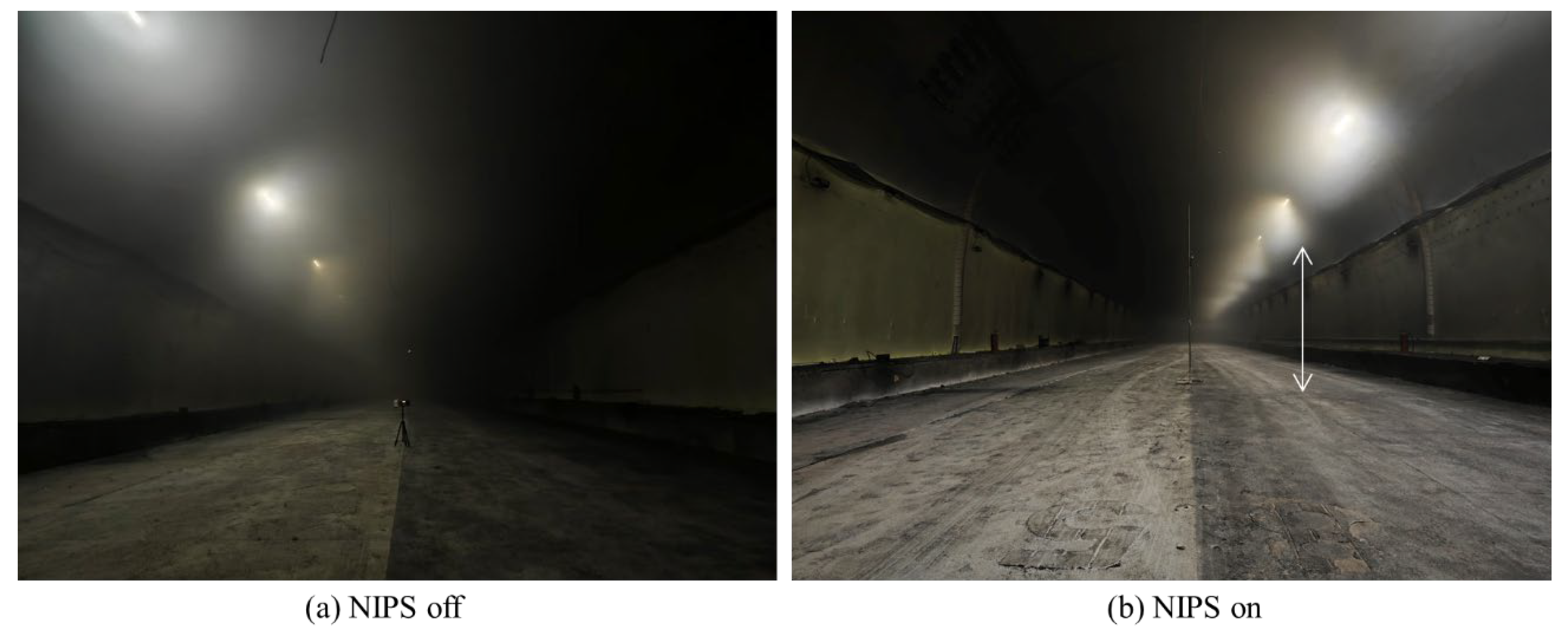
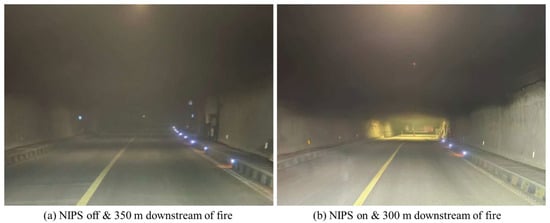
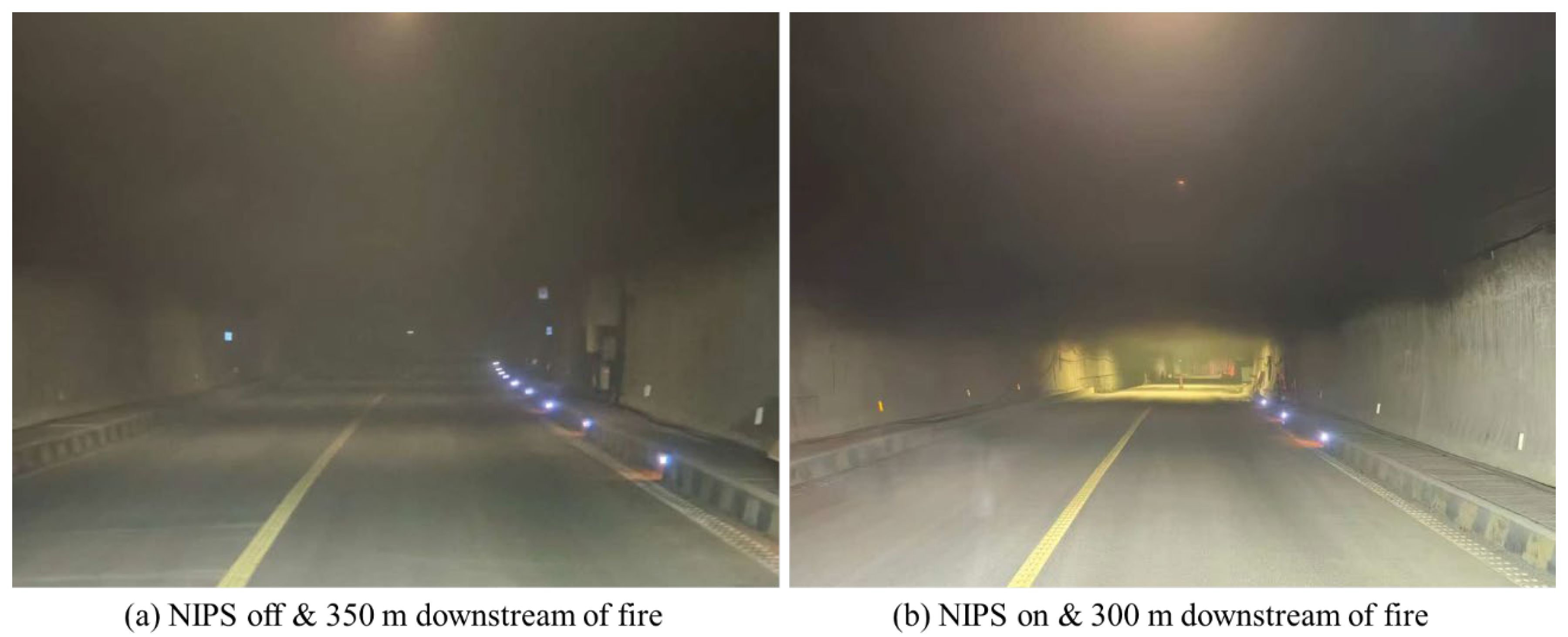
Figure 18 illustrates the smoke distribution downstream of the fire source under fire conditions in the full-scale tunnel, with NIPS deactivated and activated. The images were captured approximately 10 min after ignition, when the fire had passed the steady burning stage and the smoke layer became relatively stable and representative. The observation region was located about 300–350 m downstream of the fire source. Although the exact camera positions were not identical, both images represent comparable downstream regions under similar smoke propagation conditions.
Figure 18.
Smoke distribution downstream of the fire source under fire conditions in the full-scale tunnel.
With NIPS deactivated, the fire-generated smoke rapidly rose due to buoyancy and spread longitudinally along the tunnel crown, subsequently descending and filling the tunnel space, resulting in a high-concentration smoke layer. The smoke contained abundant carbon particles and combustion-generated aerosols, which strongly absorb and scatter light, significantly reducing tunnel light transmittance and visibility, thereby hindering safe evacuation and firefighting operations. In contrast, with NIPS activated, the smoke distribution was significantly improved. The smoke was primarily concentrated in the upper portion of the tunnel, while the lower space remained relatively clear, leading to improved illumination and visibility within the tunnel. The NIPS promoted particle coagulation and deposition, reduced smoke particle concentration, and weakened the thermal stability of the smoke layer, thereby enhancing mixing with surrounding air, accelerating smoke dilution and removal, and increasing light transmittance. These effects collectively enhanced tunnel visibility and lighting conditions.
In summary, compared with the NIPS-off condition, the NIPS-on condition effectively suppresses smoke particle accumulation, improves smoke layer structure, and significantly enhances tunnel visibility.
5. Discussion
5.1. Comparison of Purification Performance Under Operational and Fire Conditions
The experimental results indicate that the NIPS exhibits significant particle removal capabilities under both tunnel operational and fire conditions, though the dominant mechanisms differ.
Under operational conditions, particles mainly originate from vehicle exhaust, road dust, and tire wear, with relatively low concentrations and a wide size distribution. NIPS generates a high concentration of negative ions through corona discharge, charging suspended particles and enhancing electrostatic attraction, which promotes particle agglomeration and deposition, thereby reducing particle concentrations. Results show that the concentrations of PM2.5 and PM10 decrease significantly when the purifier is activated, demonstrating the system’s effectiveness in improving tunnel air quality.
Under fire conditions, particulate concentrations increase sharply, primarily due to incomplete combustion of carbonaceous particles, organic aerosols, and high-temperature condensation products. NIPS maintains high purification efficiency due to the elevated particle collision probability in dense smoke and enhanced electrostatic agglomeration, allowing submicron particles to quickly form larger particles and settle. Furthermore, high temperatures intensify Brownian motion, improving agglomeration efficiency. Therefore, NIPS demonstrates even higher particle removal efficiency under fire conditions, indicating strong adaptability to fire scenarios.
5.2. Comparison of Purification Performance Between Test Tunnel and LC Tunnel Under Fire Conditions
Both test tunnel and LC tunnel experiments confirmed the effectiveness of NIPS, though differences in particle concentration levels and spatial distribution were observed.
In the test tunnel, the concentrations of PM2.5 and PM10 were generally higher than in the LC tunnel due to the shorter tunnel length limiting smoke dilution, outlet barriers restricting smoke discharge, fuel containing rubber particles generating more smoke, and lower natural wind speed reducing dilution capacity.
In the LC tunnel, particle concentrations exhibited clear longitudinal spatial variation. When NIPS was off, the concentration of PM2.5 increased with distance from the fire source, indicating particle migration and accumulation along the longitudinal airflow. When NIPS was on, the concentration of PM2.5 decreased with distance, showing effective suppression of fine particle transport and promotion of deposition. The concentration of PM10 decreased with distance under both conditions, but the decline was more pronounced when NIPS was on, indicating more efficient agglomeration and settling of coarse particles under the influence of negative ions, yielding better purification efficiency than PM2.5. However, the measurement points were limited to the tunnel centerline at a single height, and thus vertical and transverse variations were not fully captured. Future studies should incorporate multi-point measurements to better resolve three-dimensional distributions.
Overall, test tunnel experiments validated the system’s performance under extremely high-concentration smoke conditions, while full-scale tunnel experiments further confirmed its applicability in real engineering scenarios. The consistency of observed trends under different experimental scenarios further confirms the reliability and reproducibility of the experimental results.
5.3. Feasibility Analysis of NIPS for Smoke Control
Smoke visualization results show that activating NIPS significantly reduces smoke concentration, limits diffusion, and improves visibility within the tunnel. This indicates that NIPS effectively promotes smoke particle deposition and suppresses smoke spread. Moreover, NIPS operates with low energy consumption and does not rely on high-power mechanical ventilation, demonstrating favorable low-carbon performance. Compared with traditional LV, NIPS simultaneously achieves air purification and smoke control while reducing energy consumption.
The experiments demonstrate the following engineering advantages: (1) Significantly reduces tunnel particulate concentrations, improving air quality; (2) Maintains high particle removal efficiency under fire conditions; (3) Promotes smoke deposition and improves smoke dispersion; (4) Low energy consumption, aligning with low-carbon operation requirements; (5) Serves as a complement to traditional ventilation systems, enhancing tunnel safety assurance.
5.4. Energy Consumption Comparison Between NIPS and LV
To quantitatively assess the energy efficiency of the NIPS, a simplified theoretical comparison with conventional LV was conducted based on typical engineering parameters. The energy consumption of LV is mainly determined by the power of jet fans. For a typical road tunnel, the rated power of a single jet fan generally ranges from 30 to 75 kW, depending on tunnel size and ventilation demand. Assuming a conservative case with a 37 kW jet fan, and considering that multiple fans are usually required to maintain the target airflow velocity, the total power consumption (PLV) of LV can be expressed as Equation (2).
where Nf is the number of operating jet fans and Pf is the rated power of a single fan.
For example, assuming that four jet fans operate simultaneously, the total power consumption of longitudinal ventilation can be calculated as 148 kW, as shown in Equation (3).
In contrast, the NIPS consists of distributed low-power ionizers. In this study, each unit has a rated power of 8 W, and the installation spacing is 5 m along both tunnel sidewalls. For a 1 km tunnel section, the total number of ionizers (NNIPS) can be estimated as 400, as shown in Equation (4).
Accordingly, the total power consumption of the NIPS is 3.2 kW, as shown in Equation (5).
Therefore, the ratio of power consumption between LV and NIPS is approximately 46, as shown in Equation (6).
This result indicates that the energy consumption of longitudinal ventilation is approximately one to two orders of magnitude higher than that of the NIPS under typical operating conditions. It should be noted that LV and NIPS differ fundamentally in their control mechanisms. LV primarily regulates airflow to control smoke propagation, whereas NIPS focuses on particulate removal through ionization. Therefore, the above comparison does not imply functional equivalence, but rather highlights the significant advantage of NIPS in terms of energy efficiency.
From an engineering perspective, NIPS can be deployed as a low-energy supplementary system to reduce particulate concentration during normal operation and assist smoke control under fire conditions, thereby potentially reducing the operating time or load of jet fans. These results demonstrate the strong potential of the NIPS as a low-energy supplementary technology for tunnel ventilation. Future work should focus on coupled operation strategies and quantitative evaluation of energy consumption under equivalent smoke suppression performance.
6. Conclusions
To address the challenges of high energy consumption in ventilation and smoke control under fire conditions in highway tunnels, this study developed and tested a NIPS using full-scale tests and real tunnels. The system’s performance under both normal operation and fire scenarios was systematically evaluated, revealing the evolution of particulate matter and smoke under negative ion effects. Key conclusions are as follows:
- (1)
- NIPS rapidly establishes a high-concentration, stable negative ion field within the tunnel. Upon activation, the concentration of negative ions increases by over two orders of magnitude relative to background levels and remains dynamically stable under complex airflow. The concentrations of PM2.5 and PM10 decrease significantly with reduced fluctuations, demonstrating effective particle removal through charging, electrostatic agglomeration, and deposition, validating its applicability for low-energy air purification.
- (2)
- Under fire scenarios, NIPS maintains excellent particle removal efficiency. In the test tunnel, PM2.5 decreases with distance from the fire source when the system is on, indicating suppressed long-distance transport of fine particles, while PM10 shows accelerated deposition and higher removal efficiency. This confirms the system’s stability and effectiveness in high-concentration smoke environments.
- (3)
- Fire tests in the real tunnel indicate that the concentration of CO is lower and decays faster when NIPS is activated. While negative ions do not chemically decompose CO, they promote particle agglomeration and deposition, destabilize the smoke layer, and enhance air mixing, accelerating CO dilution and dispersion, thereby reducing toxic hazards.
- (4)
- Smoke visualization shows clearer stratification, lower smoke concentration in the lower tunnel space, and significantly improved illumination and visibility when NIPS is on. This is attributed to particle agglomeration and deposition, which reduce particle concentration and optical extinction, improving light transmission and the visual environment, which benefits evacuation and firefighting.
Compared with conventional high-power ventilation systems, NIPS consumes only 8 W per unit, significantly reducing operational energy consumption while improving particle removal and smoke control performance. The technology demonstrates promising application potential in low-carbon tunnel ventilation and fire smoke control, providing a novel and efficient approach for safe and sustainable tunnel environmental management.
Author Contributions
F.H.: Conceptualization, Methodology, Formal analysis, Writing—original draft, Funding acquisition. S.F.: Project administration, Resources, Supervision. G.W.: Supervision. W.W.: Supervision. Y.Z.: Resources. All authors have read and agreed to the published version of the manuscript.
Funding
Guangdong Provincial Transportation Science and Technology Project (Project Number: JT2024JB02).
Institutional Review Board Statement
Not applicable.
Informed Consent Statement
Not applicable.
Data Availability Statement
The data and other information can be obtained by contacting the following e-mail address: kandeyuan152@163.com.
Conflicts of Interest
Author Fuqing Han was employed by the company Guangdong Transportation Group Co., Ltd., authors Fuqing Han, Guozhi Wang and Weili Wang were employed by the company Guangdong Yunmao Expressway Co., Ltd. The remaining authors declare that the research was conducted in the absence of any commercial or financial relationships that could be construed as a potential conflict of interest.
References
- Haddad, R.K.; Harun, Z. Development of a Novel Quantitative Risk Assessment Tool for UK Road Tunnels. Fire 2023, 6, 65. [Google Scholar] [CrossRef] [Scilit]
- Benardos, A.; Skenderas, D. Exploring the true cost of infrastructure transit projects: Road vs Tunnel alternatives. Tunn. Undergr. Space Technol. 2025, 162, 106624. [Google Scholar] [CrossRef] [Scilit]
- Song, Y.; Zhu, H.; Shen, Y.; Luo, X.; Feng, S. Modeling carbon footprints of road tunnels by spatio-temporal sequence distribution and insights from case study on Yangtze River Delta region. Tunn. Undergr. Space Technol. 2026, 167, 107038. [Google Scholar] [CrossRef] [Scilit]
- Sun, H.; Ma, F.; Wang, X.; Du, Z.; Xu, R. How periodic decorations in extra-long highway tunnels affect driving safety: A simulation study. Traffic Inj. Prev. 2026. [Google Scholar] [CrossRef] [Scilit]
- Hong, K. Typical Underwater Tunnels in the Mainland of China and Related Tunneling Technologies. Engineering 2017, 3, 871–879. [Google Scholar] [CrossRef] [Scilit]
- Haiko, H.; Savchenko, I.; Shelestov, A. Ensuring resilience and safety of the transportation system of Kyiv in planning the network of road tunnels. Case Stud. Transp. Policy 2025, 19, 101355. [Google Scholar] [CrossRef] [Scilit]
- Fakhri, N.; Fadel, M.; Abdallah, C.; Karam, C.; Iakovides, M.; Oikonomou, K.; Formenti, P.; Doussin, J.-F.; Borbon, A.; Sciare, J.; et al. Characterization of PM2.5 emissions from on-road vehicles in the tunnel of a major Middle Eastern city. Environ. Pollut. 2024, 361, 124769. [Google Scholar] [CrossRef] [Scilit]
- Barbato, L.; Cascetta, F.; Musto, M.; Rotondo, G. Fire safety investigation for road tunnel ventilation systems—An overview. Tunn. Undergr. Space Technol. 2014, 43, 253–265. [Google Scholar] [CrossRef] [Scilit]
- Zhu, B.; Cong, H.; Yu, B.; Shao, Z.; Ye, L.; Bi, Y.; Zeng, Y. Experimental study on the performance of synergistic ventilation system combining shaft with mechanical ventilation in extra-long road tunnels. Tunn. Undergr. Space Technol. 2024, 147, 105706. [Google Scholar] [CrossRef] [Scilit]
- Song, X.; Zhang, Y.; Zhang, G.; Chen, X. Characteristics of thermal environment and pollutant diffusion when considering VIT and jet fans inside a 3 km long road tunnel. Atmos. Pollut. Res. 2025, 16, 102393. [Google Scholar] [CrossRef] [Scilit]
- Guo, C.; Wang, M.; Yang, L.; Sun, Z.; Zhang, Y.; Xu, J. A review of energy consumption and saving in extra-long tunnel operation ventilation in China. Renew. Sustain. Energy Rev. 2016, 53, 1558–1569. [Google Scholar] [CrossRef] [Scilit]
- Khdair, A.I.; Aburumman, G.A.; Tahmasbi, F.; Tahmasebi, M.; Kalbasi, R.; Afrand, M. Advancing natural ventilation in sustainable architecture: Mechanisms, innovations, and climate-responsive design for energy-efficient buildings. Renew. Sustain. Energy Rev. 2026, 226, 116314. [Google Scholar] [CrossRef] [Scilit]
- Bracale, A.; Caramia, P.; De Falco, P.; Carpaneto, E.; Russo, A.; D’Ambrosio, S.; Nicotra, S. Optimal planning of distributed energy resources for sustainable road tunnels under uncertainty. Sustain. Energy Grids Netw. 2025, 43, 101832. [Google Scholar] [CrossRef] [Scilit]
- Zhu, R.; Zhang, D.-M.; Huang, Z.-K.; Guo, X.-y.; Gan, B.-l.; Zhou, W.-d. Traffic-based resilience assessment on urban road tunnel affected by fire accident. Tunn. Undergr. Space Technol. 2025, 161, 106543. [Google Scholar] [CrossRef] [Scilit]
- Wan, H.; Jiang, Y.; Jiang, J. A survey of fire accidents during the process of highway tunnel operation in China from 2010 to 2021: Characteristics and countermeasures. Tunn. Undergr. Space Technol. 2023, 139, 105237. [Google Scholar] [CrossRef] [Scilit]
- Yang, X.; Pan, R.; Ran, C.; Zhong, M. Experimental and Numerical Study on the Two-Dimensional Longitudinal Temperature Rise Behavior of Fire Smoke in the Shenzhen–Zhongshan Ultra-Wide Cross-Section Undersea Tunnel. Fire 2026, 9, 29. [Google Scholar] [CrossRef] [Scilit]
- Xu, L.; Qiu, M.; Zhao, Y.; Ding, C.; Li, L.; Zhao, S. Estimating the Spatio-Temporal Distribution of Smoke Layer Interface Height in Tunnel Fires During Construction. Fire 2026, 9, 39. [Google Scholar] [CrossRef] [Scilit]
- Ma, H.; Zhao, J.; Huang, H.; Wang, Z.; Yao, Y. An experimental investigation into the fire behaviors and smoke characteristics of continuous spill fires in road tunnels. Fire Saf. J. 2023, 141, 104009. [Google Scholar] [CrossRef] [Scilit]
- Halawa, T.; Safwat, H. Fire-smoke control strategies in road tunnels: The effectiveness of solid barriers. Case Stud. Therm. Eng. 2021, 27, 101260. [Google Scholar] [CrossRef] [Scilit]
- Li, W.; Seike, M.; Fujiwara, A.; Sasaoka, T.; Chikaraishi, M.; Yamawaki, S. Association of walking speed with psychological state: An experiment in smoke-filled full-scale tunnel. Fire Saf. J. 2026, 161, 104645. [Google Scholar] [CrossRef] [Scilit]
- Zebardasti Nik, A.; Afshin, H.; Koolivand, A. Numerical investigation of influential parameters on plug-holing and the development of a prediction model for this phenomenon in tunnel fires with mechanical ventilation. Int. J. Therm. Sci. 2026, 219, 110233. [Google Scholar] [CrossRef] [Scilit]
- Song, J.; Chen, J.; Wang, H.; Li, H.; Meng, D. Spread dynamics and heat transfer mechanism of tunnel spill fire under longitudinal ventilation. Int. Commun. Heat Mass Transf. 2025, 164, 108882. [Google Scholar] [CrossRef] [Scilit]
- Guo, X.; Lin, Z.; Yang, D.; Yang, Y.; Jiang, L.; Liu, Y. Experimental evaluation on PID-based adaptive longitudinal ventilation control of tunnel fire smoke. J. Wind. Eng. Ind. Aerodyn. 2024, 254, 105884. [Google Scholar] [CrossRef] [Scilit]
- Li, B.; Zhu, H.; Qu, B.; Li, X.; Wang, J. Influence of transverse fire locations on hot smoke movement and critical driving force of bifurcated tunnel fire under forced ventilation. Case Stud. Therm. Eng. 2026, 77, 107596. [Google Scholar] [CrossRef] [Scilit]
- Li, J.; Zhao, H.; Liu, W.; Li, Y. Experimental Study on Critical Ventilation Speed in Asymmetric V-Shaped Tunnel Fires. Fire 2026, 9, 8. [Google Scholar] [CrossRef] [Scilit]
- Mateus, M.; Fernandes, U.; Viegas, J.C.; Coelho, P.J. Fire in Tunnels: The Influence of the Heat Release Rate on the Lower Layer Contamination. Fire 2026, 9, 41. [Google Scholar] [CrossRef] [Scilit]
- Kan, D.; Feng, S.; Yan, Z.; Zhou, L.; Zhu, H. Full-scale experimental study on the smoke and thermal insulation of a water mist fire extinguishing system in a short road tunnel with natural ventilation. Tunn. Undergr. Space Technol. 2025, 158, 106414. [Google Scholar] [CrossRef] [Scilit]
- Li, F.; Yang, C.; Liang, H.; Zhou, B.; Feng, Z.; Zhao, W.; Cao, X. Numerical simulation of indoor particle removal by negative air ionizer through a particle enhanced deposition model. J. Build. Eng. 2026, 121, 115626. [Google Scholar] [CrossRef] [Scilit]
- Tao, S.; Zhu, Y.; Chen, M.; Shangguan, W. PM1.0 removal enhancement in cooperated electric-ionic field by negative air ions carbon fiber electrode. Sep. Purif. Technol. 2025, 355, 129619. [Google Scholar] [CrossRef] [Scilit]
- Viheriäkoski, T.; Tamminen, P.; Pöllänen, J.; Holdstock, P.; Smallwood, J. Indoor air purification using electrostatic fields without traditional air circulation. J. Electrost. 2025, 138, 104127. [Google Scholar] [CrossRef] [Scilit]
- Destrieux, A.; Jangra, R.; Hensel, K.; Machala, Z. Review on scientific studies and commercial indoor air purification devices: Focus on plasma-catalytic technology. J. Electrost. 2025, 137, 104153. [Google Scholar] [CrossRef] [Scilit]
- Kolarž, P.; Ilić, A.Ž.; Janković, M.; Janićijević, A.; Trbovich, A.M. Estimating aerosol particle removal in indoor air by ion-enhanced deposition. J. Aerosol Sci. 2023, 173, 106199. [Google Scholar] [CrossRef] [Scilit]
- Liu, S.; Huang, Q.; Wu, Y.; Song, Y.; Dong, W.; Chu, M.; Yang, D.; Zhang, X.; Zhang, J.; Chen, C.; et al. Metabolic linkages between indoor negative air ions, particulate matter and cardiorespiratory function: A randomized, double-blind crossover study among children. Environ. Int. 2020, 138, 105663. [Google Scholar] [CrossRef] [Scilit] [PubMed]
- Grabarczyk, Z. Effectiveness of indoor air cleaning with corona ionizers. J. Electrost. 2001, 51–52, 278–283. [Google Scholar] [CrossRef] [Scilit]
- Mayya, Y.S.; Sapra, B.K.; Khan, A.; Sunny, F. Aerosol removal by unipolar ionization in indoor environments. J. Aerosol Sci. 2004, 35, 923–941. [Google Scholar] [CrossRef] [Scilit]
- Gao, Y.; Liu, Z.; Guo, Z.; Wang, Q.; Ye, Y. Research on fire and smoke control in urban and underground confined spaces: Advances, challenges, and prospects. Smart Undergr. Eng. 2026, 2, 33–54. [Google Scholar] [CrossRef] [Scilit]
- Sanders, K.N.; Aggarwal, J.; Stephens, J.M.; Michalopoulos, S.N.; Dalton, D.; Lewis, D.E.; Kahn, S.A. Cost impact of hydroxocobalamin in the treatment of patients with known or suspected cyanide poisoning due to smoke inhalation from closed-space fires. Burns 2022, 48, 1325–1330. [Google Scholar] [CrossRef] [Scilit]
- Holme, J.A.; Låg, M.; Skuland, T.; Parenicová, M.; Ciganek, M.; Penciková, K.; Grytting, V.S.; Neca, J.; Øvrevik, J.; Mariussen, E.; et al. Characterization of elements, PAHs, AhR-activity and pro-inflammatory responses of road tunnel-derived particulate matter in human hepatocyte-like and bronchial epithelial cells. Toxicol. In Vitro 2023, 90, 105611. [Google Scholar] [CrossRef] [Scilit]
- Feng, S.; Kan, D.; Yan, Z.; Mao, W.; Zhou, L. A new negative air ion smoke suppression purifier for purifying fire smoke in road tunnel based on corona discharge. Results Eng. 2025, 25, 104258. [Google Scholar] [CrossRef] [Scilit]
- Beyer, M.; Stacey, C.; Brenn, G. A Mixed Convection Model for Estimating the Critical Velocity to Prevent Smoke Backlayering in Tunnels. Fire Technol. 2025, 61, 295–342. [Google Scholar] [CrossRef] [Scilit]
- Ingason, H.; Li, Y.Z.; Lönnermark, A. (Eds.) Tunnel Fire Tests. In Tunnel Fire Dynamics; Springer: Cham, Switzerland, 2024; pp. 367–408. [Google Scholar] [CrossRef] [Scilit]
- Kumari, N.; Sahu, V.; Chintala, K.; C. M., S.; Durga, C.S.; Mantravadi, H.B.; Peddapalegani, P.; Ealla, K.K.R. Effectiveness of a negative ion generator “Instashield” for indoor air disinfection: Evidence from tertiary care hospital and GLP laboratory settings. Bull. Atmos. Sci. Technol. 2025, 6, 3. [Google Scholar] [CrossRef] [Scilit]
- Lu, M.; Feng, J.; Wang, K.; Li, Y.; Yuan, D.; Zhang, G.; Gu, H. Study on the elimination characteristics of smoke particles with different materials using electric agglomeration technology. Environ. Technol. 2025, 46, 1804–1816. [Google Scholar] [CrossRef] [Scilit]
- Guo, Q.; Yan, Z.; Xi, B.; Li, X.; Zhang, Y. Experimental and numerical studies on the buoyancy-driven smoke movement in inclined short tunnel fires under natural ventilation. Tunn. Undergr. Space Technol. 2025, 163, 106722. [Google Scholar] [CrossRef] [Scilit]
- Guo, Q.; Li, Y.Z.; Ingason, H.; Yan, Z.; Zhu, H. Theoretical studies on buoyancy-driven ceiling jets of tunnel fires with natural ventilation. Fire Saf. J. 2021, 119, 103228. [Google Scholar] [CrossRef] [Scilit]
- Guo, C.; Zhang, T.; Guo, Q.; Yu, T.; Fang, Z.; Yan, Z. Full-scale experimental study on fire characteristics induced by double fire sources in a two-lane road tunnel. Tunn. Undergr. Space Technol. 2023, 131, 104768. [Google Scholar] [CrossRef] [Scilit]
- Guo, Q.; Zhu, H.; Zhang, Y.; Yan, Z. Theoretical and experimental studies on the fire-induced smoke flow in naturally ventilated tunnels with large cross-sectional vertical shafts. Tunn. Undergr. Space Technol. 2020, 99, 103359. [Google Scholar] [CrossRef] [Scilit]


Disclaimer/Publisher’s Note: The statements, opinions and data contained in all publications are solely those of the individual author(s) and contributor(s) and not of MDPI and/or the editor(s). MDPI and/or the editor(s) disclaim responsibility for any injury to people or property resulting from any ideas, methods, instructions or products referred to in the content. |
© 2026 by the authors. Licensee MDPI, Basel, Switzerland. This article is an open access article distributed under the terms and conditions of the Creative Commons Attribution (CC BY) license.