


Abstract
As the operational demands on piezoelectric devices grow increasingly stringent, there is an urgent need for materials capable of delivering stable performance at elevated temperatures. BiFeO3 (BF), a lead-free piezoelectric oxide with high-temperature resilience, is characterized by its notably high Curie temperature (Tc ∼ 835 °C), rendering it a promising candidate for high-temperature applications. However, its piezoelectric coefficients remain inadequate to satisfy practical requirements. The 0.7BiFeO3-0.3Ba(1-x) SrxTiO3 system (abbreviated as BF-BSxT) was designed to elucidate the roles of chemical disorder and local structural heterogeneities in the enhancement of functional properties through fine-tuning of the Sr content. The phase structure of the samples was carefully examined by X-ray diffraction. Rietveld refinement of the XRD data revealed that all BF-BSxT ceramics consist of coexisting R and PC phases. Optimized compositional disorder and local heterogeneities led to a moderate enhancement in the piezoelectric coefficient d33 value of 160 pC/N, a high Tc of 495 °C, and a remanent polarization Pr ≈ 22.1 μC/cm2 -were achieved in the BF-BSxT system at x = 0.06. These results indicate that BF-BSxT ceramics hold good potential for use in high-temperature piezoelectric devices.
1. Introduction
The history of ferroelectric materials can be traced back to the discovery of ferroelectricity in Rochelle salt in 1921. Research on ferroelectricity extended to polycrystalline ceramics in the 1940s. The discovery of the lead zirconate titanate solid solution accelerated the rapid development of ferroelectric materials and facilitated their transition into device applications. Ferroelectric materials have since become essential electronic components, including precision actuators [1], force sensors [2], energy collector [3] and energy storage devices [4], etc., and in the meantime, these ceramics have found extensive application across industries including industrial manufacturing, national defense, and biomedicine [5]. Taking the most widely used conventional hard Pb(Zr,Ti)O3 (PZT) piezoelectric ceramics as an example, their Curie temperature Tc typically remains below 360 °C, while their piezoelectric coefficient (d33) is generally under 400 pC/N [6,7].
To date, commercially available piezoelectric ceramics have predominantly been employed in operational environments below 200 °C, a factor that significantly restricts their application under more demanding conditions. Compounding this limitation is the fact that most commercial piezoelectric compositions contain toxic elements, which present risks to both human health and the environment. In response to these environmental concerns, the use of such hazardous substances in electronic devices has begun to be regulated within European markets [8]. Given these constraints, lead-free piezoelectric ceramics have attracted considerable research interest. Prominent systems include alkali-niobate-based ceramics (e.g., (Na0.5K0.5)NbO3 and KNbO3) [9,10,11,12], bismuth-layer-structured ferroelectrics (e.g., (Na0.5Bi0.5)TiO3 and (K0.5Bi0.5)TiO3) [13,14,15], BiFeO3-based ceramics [16,17], and BaTiO3-based ceramics [18,19,20]. Over recent decades, significant efforts have been dedicated to exploring and enhancing the properties of these materials. Their deployment in extreme environments, particularly under high-temperature conditions, is critical for both industrial and aerospace applications. However, most current lead-free ferroelectrics remain inadequate for high-temperature use. For example, while BaTiO3-based and (Na0.5K0.5)NbO3-based ceramics can exhibit excellent piezoelectric coefficients (d33) of up to ~1000 pC/N and ~650 pC/N, respectively [21], their relatively low Tc ≈ 60 °C and ~200 °C, respectively, fundamentally limit their operational temperature range.
In contrast to most lead-free ferroelectrics, BiFeO3-based ceramics are distinguished by their high Tc and depolarization temperatures Td, with Tc reaching up to 835 °C. This exceptional thermal stability positions them as highly promising candidates for high-temperature piezoelectric applications. Consequently, they have been the subject of extensive research over the past quarter-century [22]. While numerous studies have advanced the understanding and processing of these materials through innovative sintering techniques, novel synthesis routes, and strategic doping, the translation of these laboratory advancements into practical applications remains limited. A primary challenge is that most BiFeO3-based ceramics exhibit low piezoelectric coefficients (d33 typically below 50 pC/N) and high coercive fields (~7 kV/mm). To address these inherent limitations, research focus has shifted towards binary or ternary solid solutions with BiFeO3 as the primary component [23]. Several key systems have been developed, including BiFeO3-SrTiO3 (BF-ST) [24,25,26], BiFeO3-BaTiO3 (BF-BT) [27], BiFeO3-NaNbO3 (BF-NN) [28,29], BiFeO3-K0.5Na0.5NbO3 (BF-KNN) [30], BiFeO3-Bi0.5Na0.5TiO3 (BF-NBT) [31], and BiFeO3-CaTiO3 (BF-CT) solid solutions [32]. However, similar to pure BiFeO3, these solid solutions often suffer from high leakage currents and high coercive fields, which impede device integration. A notable breakthrough was reported by Leontsev et al., who demonstrated that incorporating a small amount of MnO2 into BF-BT ceramics can reduce their electrical conductivity by several orders of magnitude [33], offering a promising pathway toward mitigating these critical issues for practical applications.
Among these materials, BiFeO3-Ba(1-x)SrxTiO3 (BF-BSxT) is a binary solid solution primarily based on BiFeO3 ceramics. Barium strontium titanate (BST) is widely used in energy storage ceramics research due to its low dielectric loss, and high dielectric permittivity [34], and it is promising for use in tunable electronic components [35]. The Ba/Sr ratio affects the crystal structure of Ba(1-x)SrxTiO3, which may be either tetragonal or cubic with increasing Sr content; by adjusting the Sr content, it is possible to adapt the ferroelectric/paraelectric transition temperature for certain uses [36]. In the realm of BF-BT-based ceramics, Kang Fang et al. previously reported on 0.06SrTiO3-0.94[0.63BaTiO3-0.37BiFeO3)] high-temperature lead-free piezoelectric ceramics with a Tc of approximately 280 °C [37]. However, the investigation of their piezoelectric performance remains far from exhaustive, and further research on varying Sr contents of BF-BSxT for piezoelectric properties is needed. Due to the sharp decrease in the Tc of the ceramics caused by high Sr content, the structural, dielectric, and piezoelectric properties were investigated within a fine Sr content range. In this research, the effect of various chemical compositions on structural, piezoelectric, and various electrical properties was systematically studied with fine-tuning Sr content of 0.7BiFeO3-0.3Ba(1-x)SrₓTiO3 (BF-BSₓT) ceramics, and achieved a significantly higher Tc of up to 495 °C, thereby expanding the understanding and potential applications of these materials. Quenched 0.7BiFeO3-0.3Ba(1-x)SrₓTiO3 (BF-BSₓT) ceramics were prepared using the traditional solid-state method. Excess Bi2O3 was added to compensate for bismuth volatilization during the sintering process.
2. Experimental Method
BF-BSxT (x = 0.04, 0.06, 0.08, 0.1) ceramics were prepared by traditional solid-state method. The raw powders were Bi2O3 (99.9%) (Aladdin, Shanghai, China), Fe2O3 (99.9%) (Aladdin, Shanghai, China), TiO2 (99.8%) (Zhongxing Company, Xiantao, China), BaCO3 (99.8%) (Huanyu Company, Boshan, China), and SrCO3 (99.8%) (Aladdin, Shanghai, China). Zirconia balls and nylon milling jars were employed during the ball-milling process, and the powders were mixed in accordance with the stoichiometric ratio, with an additional 2 mol% of Bi2O3 incorporated to compensate for the volatilization of the bismuth element and to reduce the conductivity of the ceramics. The powders were subjected to ball-milling for 24 h at 365 rpm, followed by drying and calcination at 800 °C for 6 h. After calcination, the powders were re-milled and dried, then mixed with 7 wt.% polyvinyl alcohol (PVA) and pressed into pellets with a diameter of 10 mm. Finally, the pressed pellets were sintered at 980 °C for 3 h and subsequently quenched in air for enhancing piezoelectric properties [38].
Samples were poled at 80 °C with 4 kV/mm DC for 20 min. In the piezoelectric testing, the frequency of the alternating force was set at 110 Hz, with an amplitude of 0.3 N, while a static pressure of 0.5 N was applied. In the XRD measurement, the scanning rate was 0.5°/min, the step size was 0.02°, and the scanning range was 20–80°. The density was measured at room temperature using the Archimedes method with water. The ceramic cross-section was thermally etched at 980 °C for 10 min after polishing. SEM acceleration voltage was 16 kV. The crystal structure was measured by X-ray diffraction (XRD, Shimadzu—7000 with Cu Kα doublet rays (1.5406 Å, Shimadzu, Kyoto, Japan)). Scanning electron microscopy (EM-30 Plus, COXEM, Daejeon, Republic of Korea) was used to analyze the fracture surface. Dielectric permittivity and loss measurements were performed by a DMS2000 test system at temperatures ranging from 35 °C to 550 °C with heating rate of 3 °C/min, and at a measuring step of 1 °C, the dielectric properties were measured at 1 kHz, 10 kHz, 100 kHz, and 1 MHz (Partulab Technology Co., Ltd., Wuhan, China). Piezoelectric coefficients were measured using quasi-static measurements (YNS-ZJ-6BN, Institute of Acoustics, Chinese Academy of Sciences, Beijing, China). Polarization-Electric field (P-E) loops curve measurements were performed in silicone oil using a ferroelectric test system (PolyK Technologies, State College, PA, USA) with a frequency of 10 Hz.
3. Result and Discussion
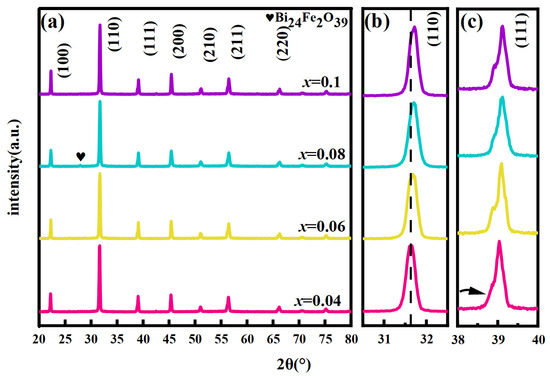
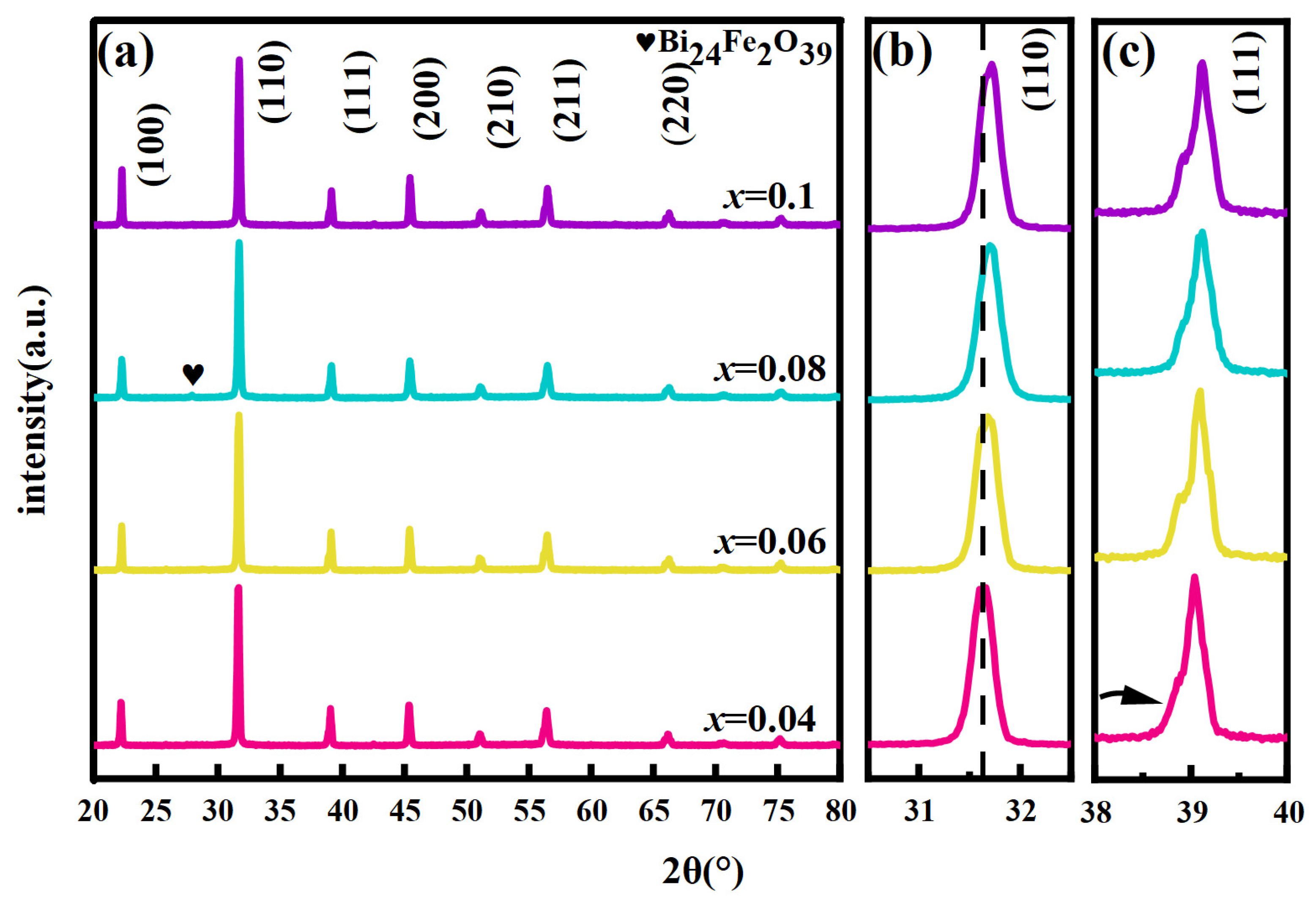
Figure 1a shows the room-temperature XRD patterns of BF-BSₓT ceramics (x = 0.04, 0.06, 0.08, 0.1). The bulk ceramic of x = 0.06 exhibits the presence of a bismuth-rich phase at 2θ = 27–28°, and the other ceramics exhibit a perovskite phase within the XRD range, indicating the formation of a stable solid solution. As illustrated in the enlarged view in Figure 1b, the dashed line corresponds to the position of the (110) peak of x = 0.04 ceramic, with increasing Sr content, the (110) peak shifts to a higher angle, signifying a reduction in lattice size. This is attributed to the substitution of Ba2⁺ ions (r = 1.60 Å) at the A-site by the smaller Sr2⁺ ions (r = 1.44 Å), which leads to lattice contraction. In the enlarged Figure 1c, the shoulder peak at the (111) position is marked by an arrow, and the presence of a shoulder peak in the (111) reflection indicates that all studied ceramics are a mixture of rhombohedral (R) and pseudocubic (PC) phases.
Figure 1.
The X-ray diffraction patterns of BF-BSxT ceramics were selected in the range of (a) 20–80°, (b) 30.5–32.5°, (c) 38–40°.
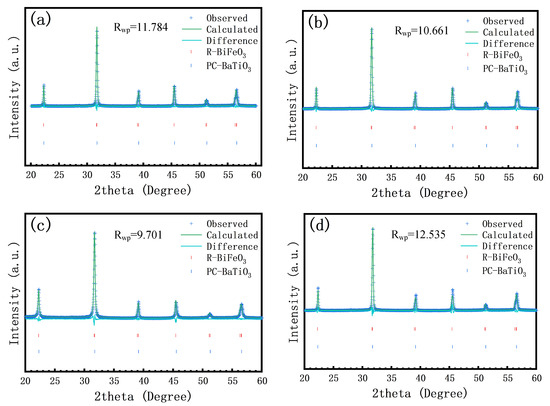
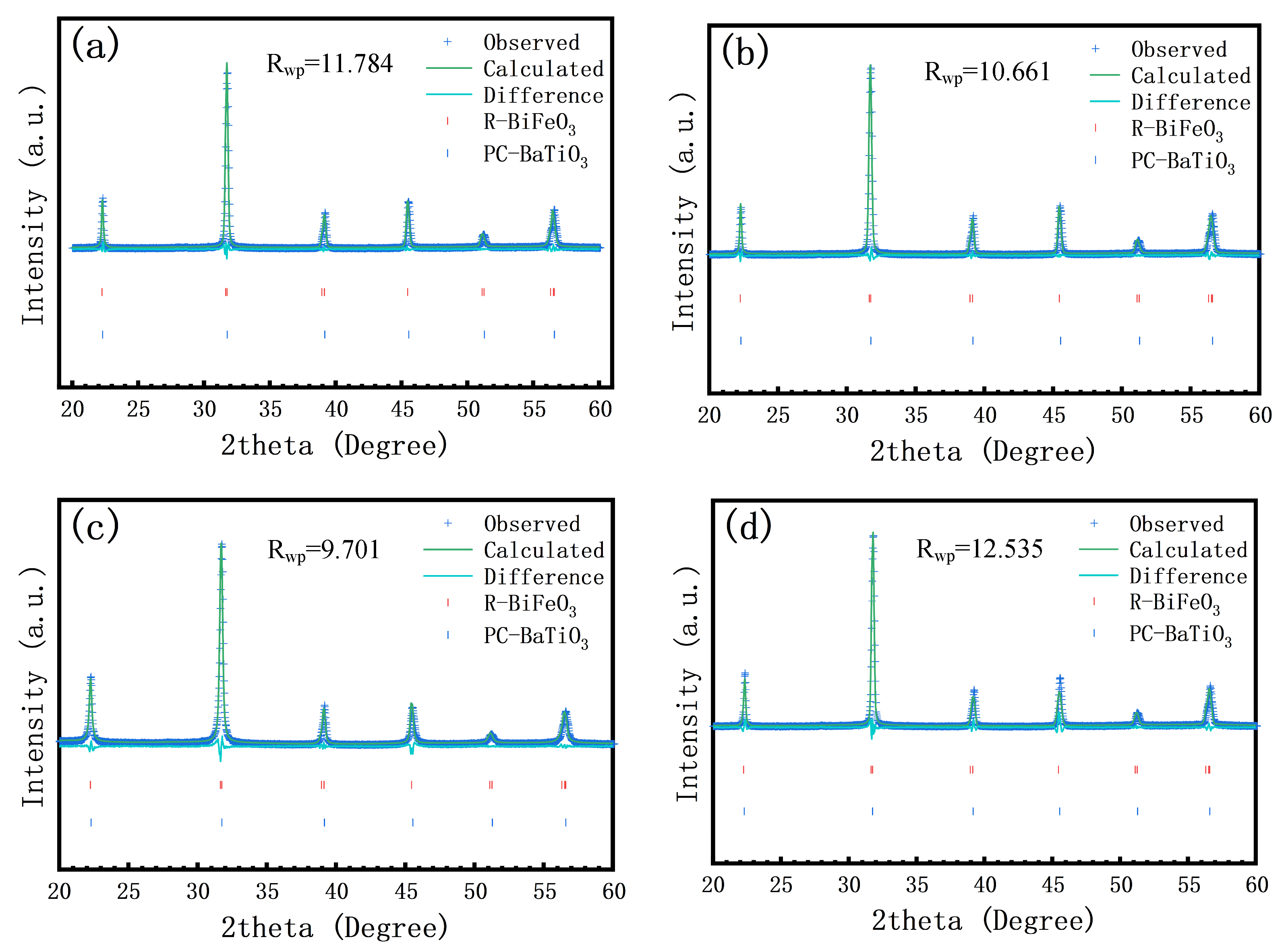
Rietveld refinement results are shown in Figure 2a–d, and Table 1 shows Rietveld refinement parameters of BF-BSxT ceramics; the standard diffraction peaks cited from BiFeO3 with R symmetry and BaTiO3 with PC phase are indicated by vertical lines for comparison.
Figure 2.
Rietveld refinement XRD patterns for BF-BSxT ceramics (a) x = 0.04, (b) x = 0.06, (c) x = 0.08, and (d) x = 0.1.
Table 1.
Rietveld refinement parameters of BF-BSxT ceramics.
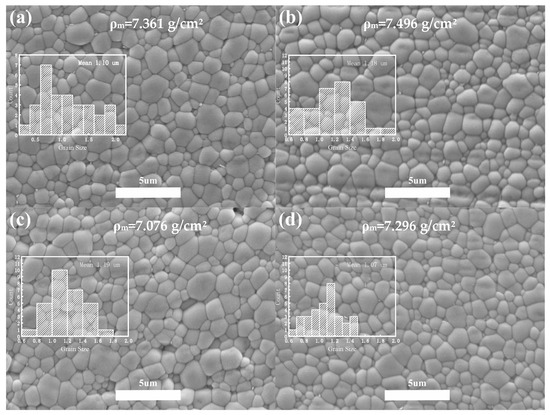
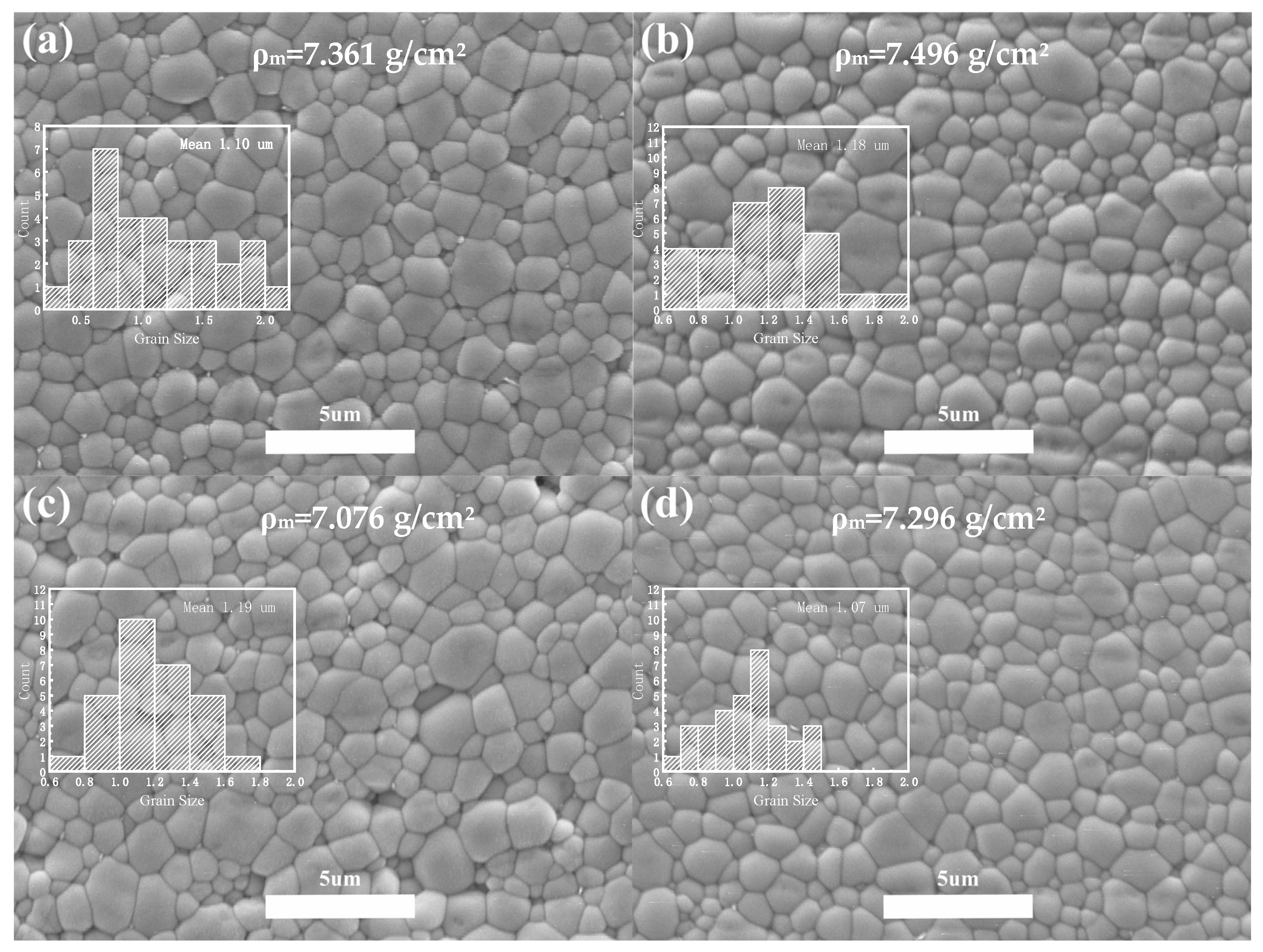
Figure 3a–d display the SEM images of the polished and thermally etched fracture surfaces of BF-BSxT ceramics (0.04 ≤ x ≤ 0.1). As observed in these images, all sintered pellets exhibit high density and well-defined grain boundaries; x = 0.06 ceramics shows the highest measured density ρm = 7.496 g/cm3 with 1% err. The ratio of measured density ρm to theoretical density ρt for all ceramics is greater than 94%, indicating excellent densification, with the ceramic at x = 0.06 ceramics having the highest ratio of 99.51%. The grain size exhibits variability, ranging from a minimum of 0.5 μm to a maximum of 2 μm, showing unevenness. The mean grain size distribution remains remarkably stable across the entire compositional range, with the mean grain size confined to the narrow interval of 1.1–1.2 μm.
Figure 3.
SEM images of the polished and thermally etched fracture surfaces for BF-BSxT ceramics (a) x = 0.04, (b) x = 0.06, (c) x = 0.08, (d) x = 0.1.
Figure 4a–d depict the dielectric properties of BF-BSₓT ceramics (x = 0.04, 0.06, 0.08, 0.1) from room temperature to 550 °C at frequencies of 1 kHz, 10 kHz, 100 kHz, and 1 MHz, the dashed line in the figure represents the dielectric loss (tanδ) of the ceramics. All ceramics display sharp peaks in the temperature-dependent dielectric permittivity, which is characteristic of a normal ferroelectric phase transition. The four sets of sintered pellets exhibited dielectric dispersion, characterized by the dielectric peak shifting towards higher frequencies. This phenomenon is attributed to mobile dipoles formed by the thermal motion of oxygen vacancies at elevated temperatures [39]. However, a weak frequency dispersion of the dielectric permittivity (ε) is still evident near and below the Tc. Dielectric relaxation refers to the process where microscopic particles exchange energy due to interactions and subsequently reach a stable distribution. In order to describe the dielectric relaxation behavior of BF-BSxT ceramics, the Curie-Weiss law is applied to the following equation:
The diffusion factor (γ) is determined by performing a linear fit to the ε as a function of temperature in the vicinity of the Tc. For normal ferroelectrics, γ = 1, whereas for an ideal relaxor ferroelectric, γ = 2. As shown in Figure 4a–d, the diffusion factor decreases from 1.79 to 1.67 and subsequently increases to 1.85 with increasing Sr content, with corresponding standard errors of 0.0075, 0.0049, 0.0065, and 0.0124. This trend appears to suggest that the concentration of local structural heterogeneities and polar nanoregions (PNRs) might initially diminish and then rise with higher Sr doping levels. Doping could potentially be utilized to tailor the degree of chemical inhomogeneity, thereby possibly generating nanoscale micro-regions that may enhance piezoelectric performance and thermal stability. However, when the formation of PNRs exceeds a critical threshold dictated by the dopant concentration, it becomes detrimental and degrades the piezoelectric properties [40]. The observed trend would seem to indicate that controlled Sr content might be instrumental in reducing local structural heterogeneity, although this hypothesis requires more detailed study.
Figure 4.
Temperature dependence dielectric permittivity (εr-T) and diffused factor (γ) at 10 kHz for BF-BSxT (x = 0.04, 0.06, 0.08, and 0.1) ceramics. (a) x = 0.04, (b) x = 0.06, (c) x = 0.08, (d) x = 0.1, (e) dielectric loss (tanδ-T) for BF-BSxT ceramics at 10 kHz.
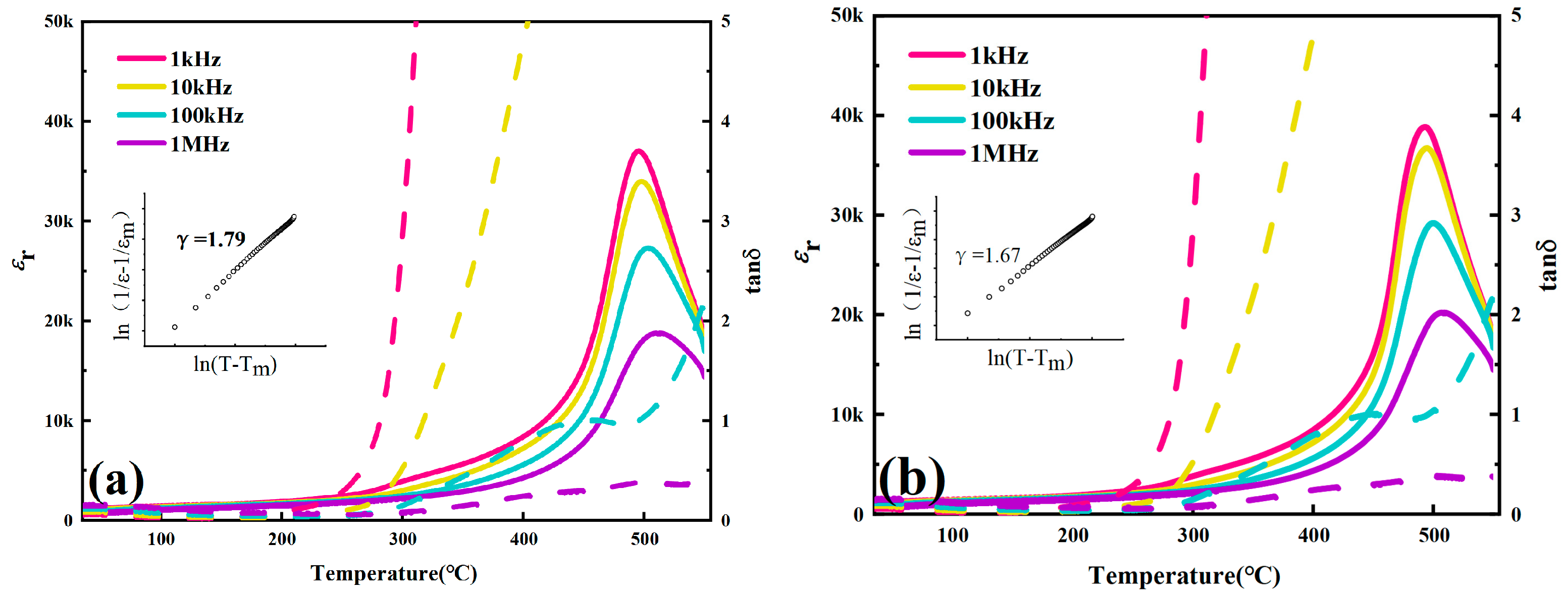
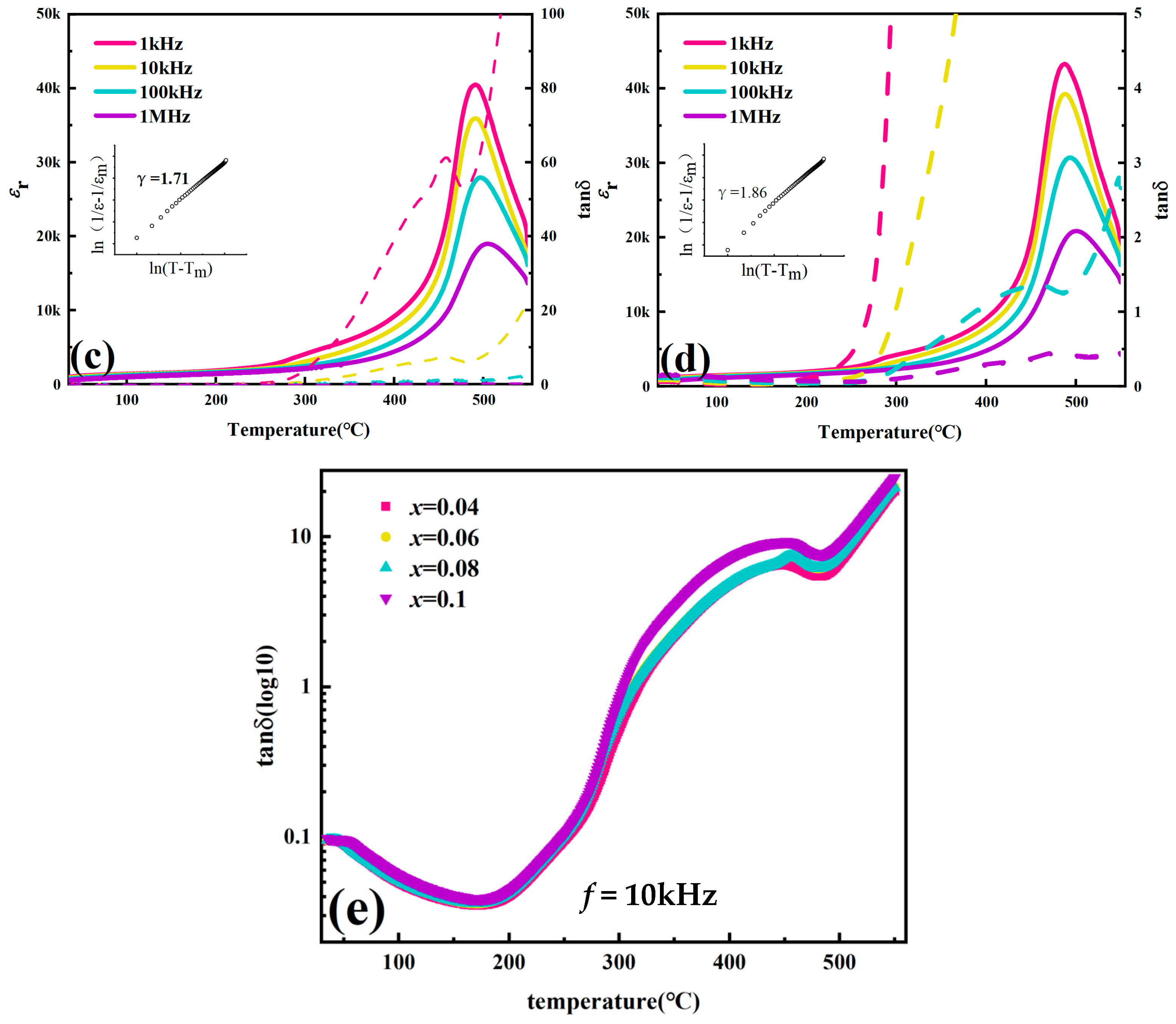
Figure 4e shows the dielectric loss-temperature curves of BF-BSxT ceramics with varying x values. To effectively highlight the trends in both the low and high-temperature regions, the vertical axis is depicted on a logarithmic scale of tanδ. As is well known, the resistance of the ceramics decreases with increasing temperature, which leads to an increase in loss. In contrast, the internal bias field weakens the electric field effect, resulting in a decreased tanδ value [41]. In the temperature range of 70–170 °C, tanδ gradually decreases with rising temperature, indicating that the effect of the internal bias field for tanδ is more significant. The lowest detected values are 0.0351, 0.0361, 0.0363, and 0.0388 at x = 0.04, 0.06, 0.08, and 0.1. Above 170 °C, resistance becomes the dominant factor, tanδ gradually increases, and a peak appears near 450 °C, which is caused by a phase transition.
Figure 5a gives the dielectric permittivity-temperature (εr-T) curve of BF-BSxT (x = 0.04, 0.06, 0.08, 0.1) ceramics at 10 kHz. Among all the components, as indicated by the arrow, the dielectric peak shifts toward lower temperatures with increasing x, and x = 0.1 ceramic has the highest dielectric permittivity (εr = 39,282 at Tc). Figure 5b shows the ferroelectric polarization-electric field (P-E) hysteresis loop at room temperature under an applied electric field of 50 kV/cm. The loss of Bi2O3 during the sintering process was controlled by adding 2 mol% excess Bi powders. However, due to some charge defects (VBi3⁺, VO2−), under high-temperature sintering conditions, the loss of oxygen from ceramics occurs readily, resulting in the generation of oxygen vacancies as described by defect reaction principles:
Fe3⁺ ions can capture electrons to form weakly bound electrons, thereby compensating for the excess charge as described by the following equation:
This leads to a high leakage current density. In BiFeO3, the volatile nature of Bi2O3 would create bismuth vacancy and oxygen vacancy which can be explained as [42]
Therefore, the electrostatic force of these defect charges forms defect complexes (such as and ), which would hinder domain wall motion by pinning domains under applied electric fields, thereby causing the deterioration of functional properties [43]. This could lead to the appearance of unsaturated P-E hysteresis loops as in Figure 5b. With the increase in x, the width of the P-E hysteresis loop increases slightly, and the ferroelectric properties of the ceramics exhibit a slight enhancement. Figure 5c shows the variations in remanent polarization (Pr) and coercive field (Ec). As x rises from 0.04 to 0.1, Pr initially increases slightly, reaching its maximum at x = 0.1 with 1% err (Pr ≈ 24.1 µC/cm2). Ec remains stable at 27.6, 28.5, 28.1, and 29.1 kV/cm, showing no significant variation.
Figure 5.
Dielectric properties and ferroelectric properties of BF-BSxT ceramics: (a) dielectric permittivity-temperature curves of BF-BSxT ceramics, (b) room-temperature ferroelectric properties (P-E loops) at 10 Hz of BF-BSxT, (c) remanent polarization (Pr) and coercive field (Ec) as functions of x.
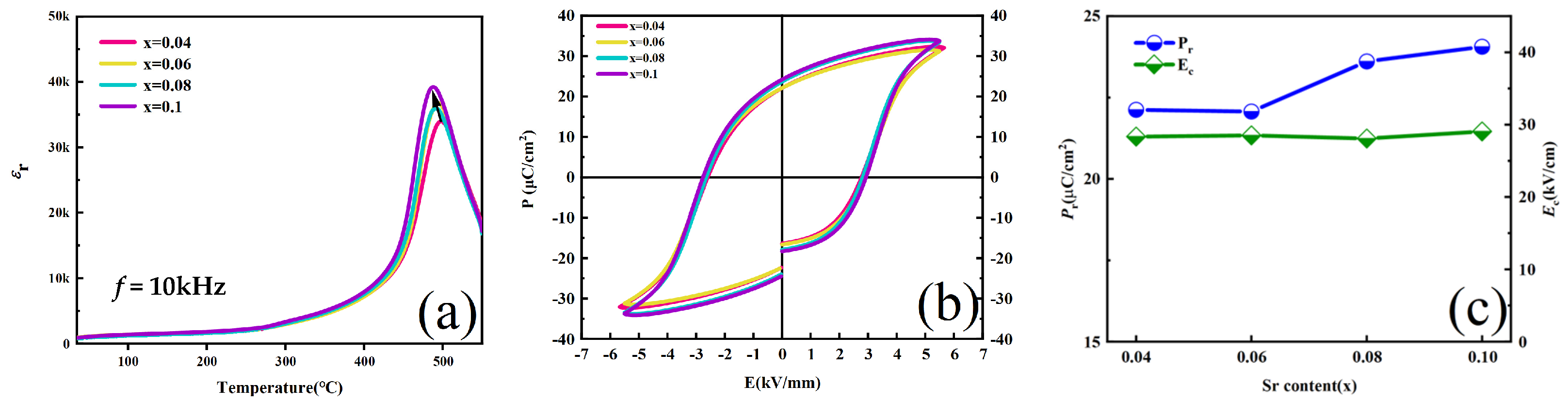
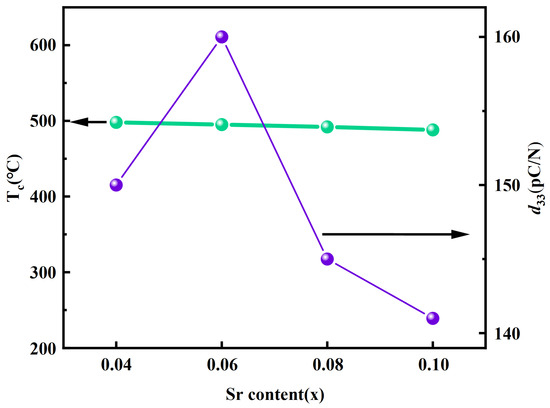
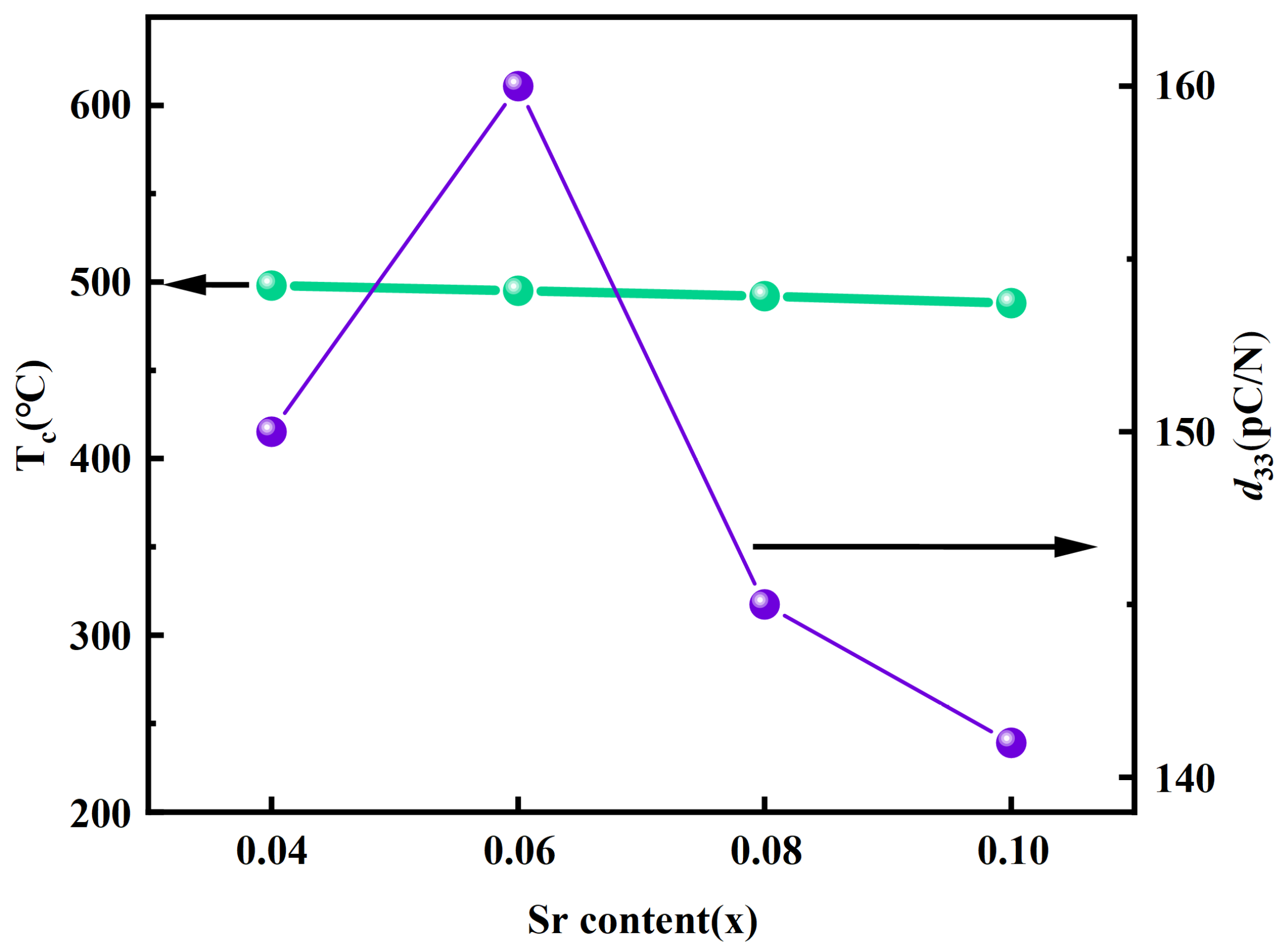
Figure 6 presents the Tc and piezoelectric coefficient (d33) of the BF-BSₓT ceramics. Each data point was obtained from the measurement of three individual samples, with an error of ±1 pC/N. As indicated by the arrows, the green and purple lines correspond to the variations in Tc and d33, respectively, as a function of the x content. With increasing x, Tc shows a slight decreasing trend, with values of 497 °C, 495 °C, 492 °C, and 488 °C, respectively. This trend is attributed to the paraelectric nature of SrTiO3; its incorporation into the ceramic matrix results in a reduction in the Tc. A maximum piezoelectric coefficient of d33 = 160 pC/N was achieved at the composition of x = 0.06. The enhanced piezoelectric coefficient (d33) observed in this work can be attributed to the synergistic interplay between engineered phase coexistence and optimized compositional disorder, which collectively lower energy barriers for polarization reorientation and enhance structural responsiveness. Table 2 presents a comparison with representative studies on BF-BT-based ceramics. As can be seen, our work exhibits a competitive advantage in terms of Curie temperature while maintaining a favorable d33.
Figure 6.
Curie temperature and d33 of BF-BSxT with different Sr contents.
Table 2.
The summary of optimized d33 and their corresponding phase fraction, coercive field (Ec), remnant polarization (Pr) in BF-BT ceramics.
4. Conclusions
The BF-BSxT (0.04 ≤ x ≤ 0.1) high-temperature lead-free piezoelectric ceramics were synthesized via a conventional solid-state reaction at 980 °C. Their phase structure and electrical properties were systematically characterized. XRD patterns confirm a pure phase formation across all compositions, exhibiting a mixed structure of rhombohedral (R) and pseudocubic (PC) phases. Rietveld refinement further reveals an evolution in the phase fraction with increasing x, where the compositions with x = 0.04 and x = 0.10 demonstrate a higher PC-to-R phase ratio. Due to synergistic interplay between engineered phase coexistence and optimized compositional disorder, which collectively lower energy barriers for polarization reorientation and enhance structural responsiveness, the x = 0.06 ceramic exhibits enhanced d33 along with a high Tc of 495 °C. Meanwhile, the highest remanent polarization Pr of 24.1 μC/cm2 is obtained at x = 0.10. This study demonstrates that trace Sr doping constitutes a highly effective strategy for optimizing piezoelectric properties, providing crucial insights for the development of high-temperature lead-free piezoelectric ceramics.
Author Contributions
Conceptualization, J.L.; methodology, J.L.; software, J.L. and H.G.; validation, J.L.; formal analysis, J.L., H.G., Y.C., G.F. and F.Z.; investigation, J.L., H.G., Y.C., G.F. and F.Z.; resources, J.L., H.G., Y.C., G.F. and F.Z.; data curation, J.L., H.G., Y.C. and G.F.; writing—original draft preparation, J.L.; writing—review and editing, J.L., H.G., Y.C. and G.F.; visualization, J.L.; supervision, H.G., F.Z. and G.F.; project administration, G.F. and F.Z.; funding acquisition, G.F. and F.Z. All authors have read and agreed to the published version of the manuscript.
Funding
This work was supported by National key research and development plan (2022YFF0706502); the National Natural Science Foundation of China (52176072, 12364015); Hubei Key Laboratory of Micro-Nanoelectronic Materials and Devices, Science and Technology Innovation Base (Platform) Program of Hubei Province (No. 2025CSA063).
Data Availability Statement
The original contributions presented in this study are included in the article. Further inquiries can be directed to the corresponding authors.
Conflicts of Interest
The authors declare that they have no known competing financial interests or personal relationships that could have appeared to influence the work reported in this paper.
References
- Jin, H.; Gao, X.; Ren, K.; Liu, J.; Qiao, L.; Liu, M.; Chen, W.; He, Y.; Dong, S.; Xu, Z.; et al. Review on Piezoelectric Actuators Based on High-Performance Piezoelectric Materials. IEEE Trans. Ultrason. Ferroelectr. Freq. Control 2022, 69, 3057–3069. [Google Scholar] [CrossRef] [Scilit]
- Tressler, J.F.; Alkoy, S.; Newnham, R.E. Piezoelectric Sensors and Sensor Materials. J. Electroceramics 1998, 2, 257–272. [Google Scholar] [CrossRef] [Scilit]
- Wei, X.; Domingo, N.; Sun, Y.; Balke, N.; Dunin-Borkowski, R.E.; Mayer, J. Progress on Emerging Ferroelectric Materials for Energy Harvesting, Storage and Conversion. Adv. Energy Mater. 2022, 12, 2201199. [Google Scholar] [CrossRef] [Scilit]
- Huang, H.; Scott, J.F. Ferroelectric Materials for Energy Applications; John Wiley & Sons: Hoboken, NJ, USA, 2019. [Google Scholar]
- Aabid, A.; Raheman, M.A.; Ibrahim, Y.E.; Anjum, A.; Hrairi, M.; Parveez, B.; Parveen, N.; Mohammed Zayan, J. A Systematic Review of Piezoelectric Materials and Energy Harvesters for Industrial Applications. Sensors 2021, 21, 4145. [Google Scholar] [CrossRef] [Scilit] [PubMed]
- Jaffe, H.; Berlincourt, D.A. Piezoelectric transducer materials. Proc. IEEE 1965, 53, 1372–1386. [Google Scholar] [CrossRef] [Scilit]
- Meng, Y.; Chen, G.; Huang, M. Piezoelectric Materials: Properties, Advancements, and Design Strategies for High-Temperature Applications. Nanomaterials 2022, 12, 1171. [Google Scholar] [CrossRef] [Scilit]
- Radley-Gardner, O.; Beale, H.G.; Zimmermann, R. (Eds.) Fundamental Texts on European Private Law, 2nd ed.; Hart Publishing: London, UK, 2020. [Google Scholar]
- Zhou, M.; Liang, R.; Zhou, Z.; Dong, X. Superior energy storage properties and excellent stability of novel NaNbO3-based lead-free ceramics with A-site vacancy obtained via a Bi2O3 substitution strategy. J. Mater. Chem. A 2018, 6, 17896–17904. [Google Scholar] [CrossRef] [Scilit]
- Luisman, L.; Feteira, A.; Reichmann, K. Weak-relaxor behaviour in Bi/Yb-doped KNbO3 ceramics. Appl. Phys. Lett. 2011, 99, 192901. [Google Scholar] [CrossRef] [Scilit]
- Wang, K.; Li, J.-F.; Liu, N. Piezoelectric properties of low-temperature sintered Li-modified (Na, K)NbO3 lead-free ceramics. Appl. Phys. Lett. 2008, 93, 092904. [Google Scholar] [CrossRef] [Scilit]
- Liu, M.; Xu, G.; Long, M.; Wang, S.; Shan, L.; Wang, C.; Li, F. Orthorhombic-to-tetragonal transition induced high piezoelectricity and energy harvesting performance in NaNbO3-based lead-free ceramics. Ceram. Int. 2025, 51, 42016–42026. [Google Scholar] [CrossRef] [Scilit]
- Guo, J.; Zhu, M.; Li, L.; Zheng, M.; Hou, Y. Relaxor to ferroelectric crossover in KBT ceramics by prolonged annealing. J. Alloys Compd. 2017, 703, 448–453. [Google Scholar] [CrossRef] [Scilit]
- Li, Y.; Cowin, P.I.; Wang, B.; Kleppe, A.; Comyn, T.P.; Hall, D.A. Actuation mechanisms in mixed-phase K0.5Bi0.5TiO3-BiFeO3-PbTiO3 ceramics. J. Eur. Ceram. Soc. 2021, 41, 6414–6423. [Google Scholar] [CrossRef] [Scilit]
- Li, L.; Li, M.; Zhang, H.; Reaney, I.M.; Sinclair, D.C. Controlling mixed conductivity in Na1/2Bi1/2TiO3 using A-site non-stoichiometry and Nb-donor doping. J. Mater. Chem. C 2016, 4, 5779–5786. [Google Scholar] [CrossRef] [Scilit]
- Liu, H. High dielectric permittivity of BiFeO3–SrTiO3–CaTiO3 ternary solid solution ceramics. Ceram. Int. 2020, 46, 8255–8258. [Google Scholar] [CrossRef] [Scilit]
- Varshney, D.; Kumar, A.; Verma, K. Effect of A site and B site doping on structural, thermal, and dielectric properties of BiFeO3 ceramics. J. Alloys Compd. 2011, 509, 8421–8426. [Google Scholar] [CrossRef] [Scilit]
- Acosta, M.; Novak, N.; Rojas, V.; Patel, S.; Vaish, R.; Koruza, J.; Rossetti, G.A.; Rödel, J. BaTiO3-based piezoelectrics: Fundamentals, current status, and perspectives. Appl. Phys. Rev. 2017, 4, 041305. [Google Scholar] [CrossRef] [Scilit]
- Usher, T.-M.; Iamsasri, T.; Forrester, J.S.; Raengthon, N.; Triamnak, N.; Cann, D.P.; Jones, J.L. Local and average structures of BaTiO3-Bi(Zn1/2Ti1/2)O3. J. Appl. Phys. 2016, 120, 184102. [Google Scholar] [CrossRef] [Scilit]
- Ogihara, H.; Randall, C.A.; Trolier-McKinstry, S. Weakly Coupled Relaxor Behavior of BaTiO3–BiScO3 Ceramics. J. Am. Ceram. Soc. 2009, 92, 110–118. [Google Scholar] [CrossRef] [Scilit]
- Panda, P.K.; Sahoo, B.; Thejas, T.S.; Krishna, M. High d33 Lead-Free Piezoceramics: A Review. J. Electron. Mater. 2022, 51, 938–952. [Google Scholar] [CrossRef] [Scilit]
- Jain, A.; Wang, Y.G.; Kumar, A.; Gupta, N.; Kumar, K.; Goyal, A.K. BiFeO3-based lead-free materials: Recent breakthroughs and their multifunctional applications. J. Alloys Compd. 2025, 1010, 177170. [Google Scholar] [CrossRef] [Scilit]
- Rödel, J.; Li, J.-F. Lead-free piezoceramics: Status and perspectives. MRS Bull. 2018, 43, 576–580. [Google Scholar] [CrossRef] [Scilit]
- Makarovic, M.; Bencan, A.; Walker, J.; Malic, B.; Rojac, T. Processing, piezoelectric and ferroelectric properties of (x)BiFeO3-(1−x)SrTiO3 ceramics. J. Eur. Ceram. Soc. 2019, 39, 3693–3702. [Google Scholar] [CrossRef] [Scilit]
- Ma, Z.Z.; Tian, Z.M.; Li, J.Q.; Wang, C.H.; Huo, S.X.; Duan, H.N.; Yuan, S.L. Enhanced polarization and magnetization in multiferroic (1-x)BiFeO3-xSrTiO3 solid solution. Solid State Sci. 2011, 13, 2196–2200. [Google Scholar] [CrossRef] [Scilit]
- Kumar, A.; Kumar, A.; Saha, S.; Basumatary, H.; Ranjan, R. Ferromagnetism in the multiferroic alloy systems BiFeO3-BaTiO3 and BiFeO3-SrTiO3: Intrinsic or extrinsic? Appl. Phys. Lett. 2019, 114, 022902. [Google Scholar] [CrossRef] [Scilit]
- Wang, D.; Wang, G.; Murakami, S.; Fan, Z.; Feteira, A.; Zhou, D.; Sun, S.; Zhao, Q.; Reaney, I.M. BiFeO3-BaTiO3: A new generation of lead-free electroceramics. J. Adv. Dielectr. 2018, 08, 1830004. [Google Scholar] [CrossRef] [Scilit]
- Mohanta, D.; Mohanty, N.K.; Agrawal, K.; Behera, B. Effect of Gd on impedance, modulus and ferroelectric properties of multiferroic ceramic composite BiFeO3–NaNbO3. MRS Adv. 2022, 7, 316–325. [Google Scholar] [CrossRef] [Scilit]
- De, M.; Hajra, S.; Tiwari, R.; Sahoo, S.; Choudhary, R.N.P.; Tewari, H.S. Structural, dielectric and electrical characteristics of BiFeO3-NaNbO3 solid solutions. Ceram. Int. 2018, 44, 11792–11797. [Google Scholar] [CrossRef] [Scilit]
- Huo, S.X.; Yuan, S.L.; Qiu, Y.; Ma, Z.Z.; Wang, C.H. Crystal structure and multiferroic properties of BiFeO3–Na0.5K0.5NbO3 solid solution ceramics prepared by Pechini method. Mater. Lett. 2012, 68, 8–10. [Google Scholar] [CrossRef] [Scilit]
- Tian, Z.M.; Zhang, Y.S.; Yuan, S.L.; Wu, M.S.; Wang, C.H.; Ma, Z.Z.; Huo, S.X.; Duan, H.N. Enhanced multiferroic properties and tunable magnetic behavior in multiferroic BiFeO3–Bi0.5Na0.5TiO3 solid solutions. Mater. Sci. Eng. B 2012, 177, 74–78. [Google Scholar] [CrossRef] [Scilit]
- Wang, Q.Q.; Wang, Z.; Liu, X.Q.; Chen, X.M. Improved Structure Stability and Multiferroic Characteristics in CaTiO3-Modified BiFeO3 Ceramics. J. Am. Ceram. Soc. 2012, 95, 670–675. [Google Scholar] [CrossRef] [Scilit]
- Leontsev, S.O.; Eitel, R.E. Dielectric and Piezoelectric Properties in Mn-Modified (1−x)BiFeO3–x BaTiO3 Ceramics. J. Am. Ceram. Soc. 2009, 92, 2957–2961. [Google Scholar] [CrossRef] [Scilit]
- Sassi, E.; Maayoufi, A.E.; Dkhil, B.; Jomni, F. Enhancing Structural, electrical and energy storage performance of lead-free BaxSr 1−xTiO3 ceramics. Ceram. Int. 2025, 51, 30537–30550. [Google Scholar] [CrossRef] [Scilit]
- Mortensen, J.; Borah, D.; Kalkur, T.S. Reflection Type Phase Shifter with Commercial BST Capacitors. In 2024 IEEE Asia-Pacific Microwave Conference (APMC); IEEE: Bali, Indonesia, 2024; pp. 139–141. [Google Scholar]
- Kathait, G.S.; Panwar, N.S.; Maini, S. Dielectric, piezoelectric and energy storage properties of large grain Ba1−xSrxTiO3 (BST) ceramic system for 0.17 ≤ x ≤ 0.26. Mater. Sci. Eng. B 2023, 297, 116786. [Google Scholar] [CrossRef] [Scilit]
- Kang, F.; Zhang, L.; Huang, B.; Mao, P.; Wang, Z.; Sun, Q.; Wang, J.; Hu, D. Enhanced electromechanical properties of SrTiO3-BiFeO3-BaTiO3 ceramics via relaxor behavior and phase boundary design. J. Eur. Ceram. Soc. 2020, 40, 1198–1204. [Google Scholar] [CrossRef] [Scilit]
- Wang, B.; Hall, D.A. Structural evolution in BiFeO3-BaTiO3 ceramics via quenching strategy. J. Alloys Compd. 2025, 1044, 184439. [Google Scholar] [CrossRef] [Scilit]
- Kang, B.S.; Choi, S.K.; Park, C.H. Diffuse dielectric anomaly in perovskite-type ferroelectric oxides in the temperature range of 400–700 °C. J. Appl. Phys. 2003, 94, 1904–1911. [Google Scholar] [CrossRef] [Scilit]
- Habib, M.; Zhou, X.; Tang, L.; Xue, G.; Rahman, A.; Akram, F.; Zhang, D. Enhancement of Piezoelectricity by Novel Poling Method of the Rare-Earth Modified BiFeO3–BaTiO3 Lead-Free Ceramics. Adv. Electron. Mater. 2023, 9, 2201210. [Google Scholar] [CrossRef] [Scilit]
- Zhu, L.-F.; Zhang, B.-P.; Li, S.; Zhao, G.-L. Large piezoelectric responses of Bi(Fe,Mg,Ti)O3-BaTiO3 lead-free piezoceramics near the morphotropic phase boundary. J. Alloys Compd. 2017, 727, 382–389. [Google Scholar] [CrossRef] [Scilit]
- Zhu, L.-F.; Zhang, B.-P.; Duan, J.-Q.; Xun, B.-W.; Wang, N.; Tang, Y.-C.; Zhao, G.-L. Enhanced piezoelectric and ferroelectric properties of BiFeO3-BaTiO3 lead-free ceramics by optimizing the sintering temperature and dwell time. J. Eur. Ceram. Soc. 2018, 38, 3463–3471. [Google Scholar] [CrossRef] [Scilit]
- Habib, M.; Akram, F.; Rahman, A.; Ahmad, P.; Iqbal, M.J.; Liu, Q.; Zeb, A.; Zhang, D. Defects dipoles control strategy for temperature-insensitive piezoelectricity in the lead-free BiFeO3-BaTiO3 ceramics. Mater. Chem. Phys. 2022, 287, 126326. [Google Scholar] [CrossRef] [Scilit]
- Kim, S.; Khanal, G.P.; Nam, H.-W.; Fujii, I.; Ueno, S.; Moriyoshi, C.; Kuroiwa, Y.; Wada, S. Structural and electrical characteristics of potential candidate lead-free BiFeO3-BaTiO3 piezoelectric ceramics. J. Appl. Phys. 2017, 122, 164105. [Google Scholar] [CrossRef] [Scilit]
- Habib, M.; Zhou, X.; Tang, L.; Xue, G.; Akram, F.; Alzaid, M.; Zhang, D. Phase and domain engineering strategy for enhancement of piezoelectricity in the lead-free BiFeO3-BaTiO3 ceramics. J. Mater. 2023, 9, 920–929. [Google Scholar] [CrossRef] [Scilit]
- Wang, B.; Fu, C.; Liu, X.; Xie, B.; Hall, D.A. Microchemical homogeneity and quenching-induced property enhancement in BiFeO3–BaTiO3 ceramics. Open Ceram. 2023, 13, 100322. [Google Scholar] [CrossRef] [Scilit]
- Habib, M.; Iqbal, M.J.; Lee, M.H.; Kim, D.J.; Akram, F.; Gul, M.; Zeb, A.; Rehman, I.U.; Kim, M.-H.; Song, T.K. Piezoelectric performance of Zr-modified lead-free BiFeO3-BaTiO3 ceramics. Mater. Res. Bull. 2022, 146, 111571. [Google Scholar] [CrossRef] [Scilit]
- Habib, M.; Ahmad, P.; Akram, F.; Kebaili, I.; Rahman, A.; Din, I.U.; Javid Iqbal, M.; Kim, M.-H.; Lee, S.; Uddin Khandaker, M.; et al. High and temperature-insensitive piezoelectric performance in the lead-free Sm-doped BiFeO3–BaTiO3 ceramics with high Curie temperature. Ceram. Int. 2022, 48, 26608–26617. [Google Scholar] [CrossRef] [Scilit]
- Ahmed, T.; Khan, S.A.; Kim, M.; Akram, F.; Park, H.W.; Hussain, A.; Qazi, I.; Lim, D.H.; Jeong, S.-J.; Song, T.K.; et al. Effective A-site modulation and crystal phase evolution for high ferro/piezoelectric performance in ABO3 compounds: Yttrium-doped BiFeO3-BaTiO3. J. Alloys Compd. 2023, 933, 167709. [Google Scholar] [CrossRef] [Scilit]
- Lin, J.; Lv, F.; Hong, Z.; Liu, B.; Wu, Y.; Huang, Y. Ultrahigh Piezoelectric Response Obtained by Artificially Generating a Large Internal Bias Field in BiFeO3–BaTiO3 Lead-Free Ceramics. Adv. Funct. Mater. 2024, 34, 2313879. [Google Scholar] [CrossRef] [Scilit]
- Habib, M.; Tang, L.; Xue, G.; Rahman, A.; Kim, M.-H.; Lee, S.; Zhou, X.; Zhang, Y.; Zhang, D. Design and development of a new lead-free BiFeO3-BaTiO3 quenched ceramics for high piezoelectric strain performance. Chem. Eng. J. 2023, 473, 145387. [Google Scholar] [CrossRef] [Scilit]

Disclaimer/Publisher’s Note: The statements, opinions and data contained in all publications are solely those of the individual author(s) and contributor(s) and not of MDPI and/or the editor(s). MDPI and/or the editor(s) disclaim responsibility for any injury to people or property resulting from any ideas, methods, instructions or products referred to in the content. |
© 2026 by the authors. Licensee MDPI, Basel, Switzerland. This article is an open access article distributed under the terms and conditions of the Creative Commons Attribution (CC BY) license.