


Abstract
Background: Hearing impairment affects a significant portion of the global population. The development of assistive technologies, particularly wearable devices, has been pivotal in mitigating these challenges. Methods: We present a systematic literature review on wearable assistive technologies for individuals with hearing impairment, analyzing 106 scientific articles identified from diverse sources (IEEE Xplore, ACM Digital Library, and Web of Science). Our comprehensive analysis is structured around device types, body locations, user study methodologies, sensory modalities, and application domains. Results: Findings reveal a strong emphasis on auditory and visual feedback, a mix of traditional hearing aids complemented by smart wearable devices, and experimental evaluations focusing on speech comprehension and usability. Visual analysis highlights a significant anatomical shift towards body-worn and wrist-worn haptic devices. While speech accuracy is rigorously reported, user-centric metrics like comfort and battery life are frequently neglected. Conclusions: Addressing these disparities, we propose the HEAR framework (Hybrid Architectures, Engaging Experiences, Adaptive Systems, Real-world Validation). This strategic roadmap advocates for a diversification of sensory outputs, more extensive longitudinal user studies, and the development of adaptive, multi-modal solutions that seamlessly integrate into users’ everyday lives.
1. Introduction
Hearing impairment affects a significant portion of the global population, ranging from mild hearing loss to profound deafness, impacting communication, social interaction, and overall quality of life [1,2]. The development of assistive technologies, particularly wearable devices, has been pivotal in mitigating these challenges, enabling individuals to better perceive and interact with their auditory environment. In this paper, we define “wearable assistive technologies” as a broad spectrum encompassing both traditional medical devices (e.g., digital hearing aids, cochlear implants) and consumer-oriented “smart wearables” (e.g., smartwatches, haptic vests, augmented reality glasses) that are repurposed or designed for auditory assistance.
The increasing prevalence of hearing loss underscores the critical need for innovative solutions. According to the World Health Organization (WHO), over 1.5 billion people globally live with some degree of hearing loss, a number projected to rise to 2.5 billion by 2050 [3]. In this context, wearable devices offer a discreet, convenient, and increasingly powerful means to address diverse auditory needs. Unlike traditional static assistive tools, modern wearables integrate directly into the user’s daily life, leveraging ubiquitous computing to provide real-time support in various contexts.
Despite rapid advancements, research knowledge regarding the characteristics, evaluation methodologies, and user experiences of these devices remains fragmented. A comprehensive overview is necessary to synthesize existing contributions and pinpoint areas that warrant further scientific inquiry. To justify the necessity of this study, we analyzed previous review articles (Table 1). While prior surveys have focused on specific sub-domains, our review provides a holistic view of the wearable ecosystem.
Table 1.
Comparison of this work with previous related reviews.
The primary objective of this systematic review is to conduct a systematic mapping and quantitative descriptive analysis of the most relevant scientific contributions regarding wearable assistive devices for the deaf and hard of hearing, with a specific focus on engineering and human–computer interaction advancements. We address the following research questions:
- RQ1. What are the characteristics of wearable assistive devices (Type, Technical Features, and Anatomical Location) addressed in the scientific literature?
- RQ2. What are the characteristics of user studies involving these devices (Demographics, Sample Size, Methodology)?
- RQ3. What sensory modalities and performance metrics are predominantly used?
- RQ4. What are the primary application domains for these technologies?
2. Materials and Methods
This systematic review was conducted in accordance with the Preferred Reporting Items for Systematic Reviews and Meta-Analyses (PRISMA) 2020 guidelines [7]. The study protocol was not registered in any database. We followed a structured process involving identification, screening, eligibility, and data extraction, as detailed in the following subsections and illustrated in the PRISMA flow diagram (Figure 1). The completed PRISMA 2020 checklist is provided in the Supplementary Materials (see Document S1). The procedures applied in this review are outlined below.
Figure 1.
PRISMA flow diagram.
To structure the available contributions across the complex assistive-technology landscape, we conducted a Systematic Literature Review (SLR) focused on wearable devices for individuals with hearing impairment.
2.1. Scope
The primary objective of this SLR is to conduct a systematic mapping and quantitative descriptive analysis of the most relevant scientific contributions on wearable assistive devices for deaf and hard-of-hearing individuals. We adopt a broad definition of “wearable assistive technologies” as body-worn devices that support individuals with hearing impairment in perception, communication, or environmental interaction. To provide a comprehensive overview, we structured our analysis around three main pillars derived from the data extraction process.
First, we examined the Device Characteristics and Anatomical Placement. We classified contributions based on the specific Device Type, distinguishing between medical-grade solutions like hearing aids and cochlear implants, and consumer-grade smart wearables or experimental prototypes. This distinction is crucial as it dictates the regulatory pathway and accessibility. Concurrently, we analyzed the Anatomical Location of the device to understand ergonomic trends, ranging from traditional ear-level and head-worn devices to distributed systems placed on the wrist, torso, or hand.
Second, we focused on the Interaction Modalities and Technical Specifications. We analyzed the Sensory Modalities employed for feedback, specifically how auditory information is substituted or augmented through visual cues (e.g., AR displays) or haptic feedback (e.g., vibrotactile motors). This was complemented by an assessment of the underlying hardware and software, including Sensor Types (IMU, microphones, flex sensors), Connectivity protocols, and signal processing techniques, to understand the technical complexity and power constraints of current solutions.
Third, we evaluated the Study Maturity and Application Context. We scrutinized the User Study Characteristics, including sample sizes, age groups (children, adults, elderly), and study duration, to determine whether devices are tested only in controlled settings or validated with real end users. We further categorized the Application Domain into everyday use, clinical settings, educational environments, or industrial contexts to identify where these technologies are primarily deployed.
2.2. Design and Implementation
This systematic review was conducted in accordance with the PRISMA 2020 guidelines [7]. The review protocol was not registered. Because our primary objective was to map technological, engineering, and computer-science advancements rather than clinical audiology outcomes, our search strategy deliberately targeted premier technology databases. We adhered to the Preferred Reporting Items for Systematic Reviews and Meta-Analyses (PRISMA) guidelines to ensure methodological transparency and reproducibility. The review process was structured into four distinct phases: identification, screening, eligibility assessment, and data extraction, as illustrated in the flow diagram (Figure 1).
2.2.1. Identification Strategy
To capture a holistic view of the domain, we conducted a comprehensive search across three premier scientific databases: ACM Digital Library, IEEE Xplore, and Web of Science. These repositories were selected for their strong coverage of engineering, computer science, and medical-technology literature. While we acknowledge that relevant clinical studies and audiological evaluations frequently appear in medical databases such as PubMed, our selection of these specific repositories aligns directly with our primary objective: to map technological innovation, system design, and human–computer interaction advancements. The search strategy relied on complex Boolean strings designed to intersect three primary conceptual clusters: (1) the target population (e.g., “hearing impairment,” “auditory disability,” “deaf”), (2) the technological form factor (e.g., “wearable,” “body-worn,” “smart device”), and (3) the functional purpose (e.g., “assistive technology,” “hearing aid,” “sensory substitution”). To retrieve both recent and historically significant developments, the search spanned all available years up to January 2026. This initial identification phase yielded a raw corpus of 780 records (ACM: 46, IEEE Xplore: 251, and Web of Science: 541).
2.2.2. Screening and Filtering
The screening process was executed in two consecutive stages to progressively refine the dataset. First, we addressed bibliographic redundancy by identifying and removing 118 duplicate records that appeared across multiple databases. Following this de-duplication, the remaining 662 records underwent preliminary screening based on titles and abstracts. This stage was critical for filtering out papers that, while containing search terms, operated in unrelated domains such as industrial noise-pollution monitoring without assistive intent, or general medical wearables lacking specific auditory applications. During this phase, 58 reports were deemed unretrievable or lacked sufficient metadata for evaluation. This rigorous filtering process resulted in a set of 604 full-text reports eligible for detailed assessment.
2.2.3. Eligibility Criteria
To ensure the scientific quality and thematic relevance of the review, we applied a strict set of inclusion and exclusion criteria (EC) to the full-text articles. EC1 (Accessibility and Language) required that all articles be fully available in English, ensuring the reproducibility of the analysis. EC2 (Scientific Rigor) restricted the selection to peer-reviewed contributions, such as journal articles and conference proceedings, thereby excluding grey literature, white papers, and non-academic brochures. EC3 (Thematic Relevance) was the most critical filter, requiring that each study explicitly propose, develop, or evaluate a wearable hardware or software solution for individuals with hearing impairment. To ensure consistency during screening, borderline cases such as studies in which the "wearable" aspect was ambiguous or the focus leaned heavily toward general signal processing rather than assistive application were independently evaluated by both authors, who then made a consensus inclusion decision.
During this assessment, 498 articles were excluded. The primary reasons for exclusion were a lack of a “wearable” component (359 studies focused on stationary desktop software or theoretical algorithms), the absence of a specific application for “hearing” impairment (47 studies), or a failure to meet multiple criteria simultaneously (92 studies). Consequently, the final corpus for this systematic literature review comprises 106 scientific articles published between 1897 and 2025.
2.2.4. Data Extraction
For the final set of 106 included articles, we employed a systematic data extraction protocol to populate a structured database. We extracted variables related to the technological implementation, including device form factors, sensor types (e.g., IMU, bio-signals), and feedback modalities (auditory, visual, haptic). Furthermore, we codified methodological details such as participant demographics, study duration, and experimental design (e.g., controlled lab experiments vs. longitudinal field studies). Finally, we extracted qualitative data regarding user experience, specifically looking for reported metrics on usability, comfort, and social acceptance, to address the human-centric research questions of this review.
3. Results
Our analysis of the 106 articles reveals distinct patterns across the defined dimensions, offering a comprehensive snapshot of the research landscape concerning wearable assistive technologies for hearing impairment.
3.1. Characteristics of Wearable Assistive Devices (RQ1)
The Device Features/Technical Specifications highlight the technological sophistication of these wearables, although reporting in the literature often remains high level. A synthesis of the technical details reveals a focus on power-constrained, multi-sensor systems. Sensor types were fundamental and broadly listed in most entries, including microphones, accelerometers, gyroscopes, sEMG sensors, flex sensors, pressure sensors, cameras, ultrasonic sensors, infrared sensors, GPS, EOG electrodes, and Peltier modules. Connectivity solutions such as Bluetooth, Wi-Fi, BLE, and wireless sensor networks are central to data exchange. Software components are also integral and include mobile apps, operating systems, and AI/ML algorithms for Automatic Speech Recognition (ASR), Digital Signal Processing (DSP), and filtering. Battery life is a consistently cited design constraint, but specific operational-hour metrics are frequently omitted (only broadly mentioned in 31 entries), which limits comparative analysis. Other notable features include actuators (motors, LEDs), display systems (OLED, LED), and advanced audio-processing units (amplifiers, filters, DSP chips).
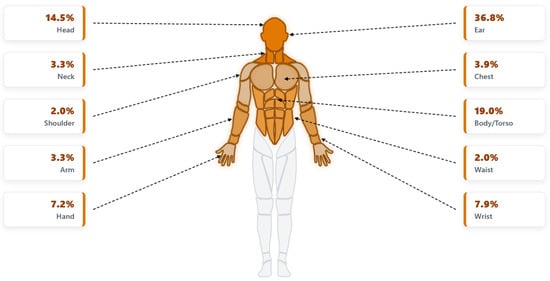
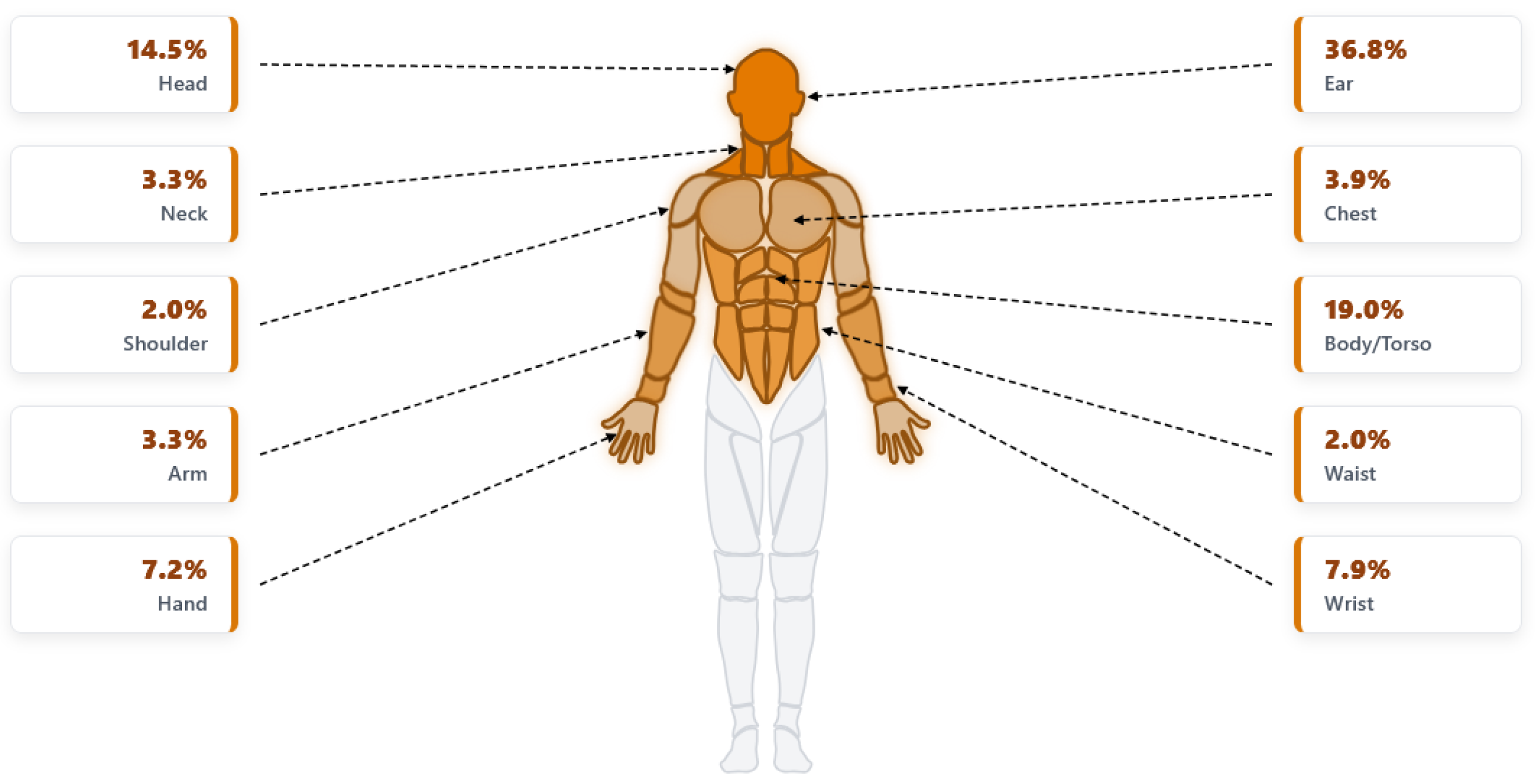
The Wearable Device Body Location reveals a strong preference for placements proximal to the auditory system. As illustrated in Figure 2, the ear was the most frequently cited location (33 entries), reflecting its direct role in sound perception and traditional hearing aid placement [8]. The head was also prominent (20 entries), often for devices integrating microphones, cameras, or displays. The body (15 entries) served as a location for larger sensor arrays or haptic feedback systems. The wrist (9 entries) and hand (7 entries) were common for smartwatches, haptic feedback, or sign language recognition. Other locations, such as the neck (4 entries), chest (4 entries), waist (3 entries), forearm (3 entries), and arm (2 entries), were also explored. This choice of location is often directly correlated with the device’s practical application and feedback modality.
Figure 2.
Anatomical distribution of wearable assistive devices identified in the literature. The ear remains the primary location (36.8%), but a significant shift towards body-worn (19.0%) and wrist-worn (7.9%) devices indicates a trend towards distributed haptic feedback systems.
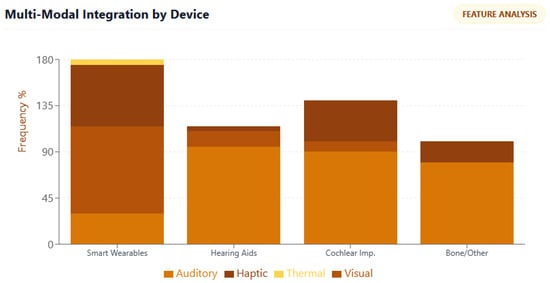
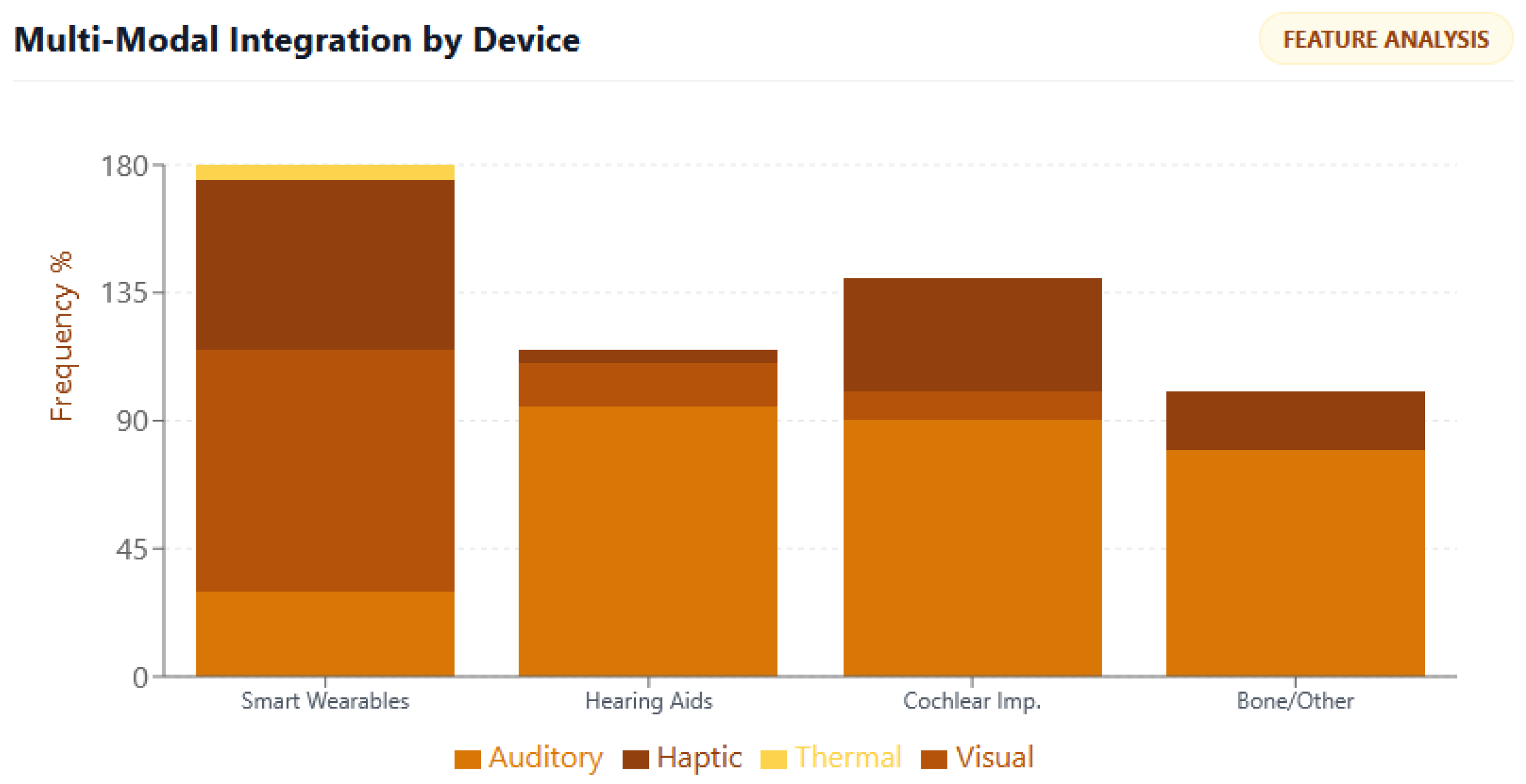
Regarding general wearable device types, smart wearable devices were the most frequently discussed category, appearing in 45 entries, closely followed by hearing aids in 44 entries. As shown in Figure 3, while hearing aids remain specialized for audio, smart wearables function as multi-modal hubs that frequently integrate visual and haptic feedback.
Figure 3.
Sensory modality capabilities across different device types. While Hearing Aids are predominantly auditory-focused, Smart Wearables exhibit a high degree of multi-modal integration, combining visual and haptic feedback.
3.2. Characteristics of User Studies (RQ2)
User studies are central to evaluating these devices and involve varied participant numbers, age groups, and methodologies, although study durations are often short. Publication trends indicate a notable increase in contributions from 2019 onward.
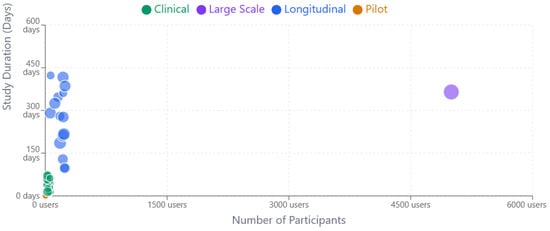
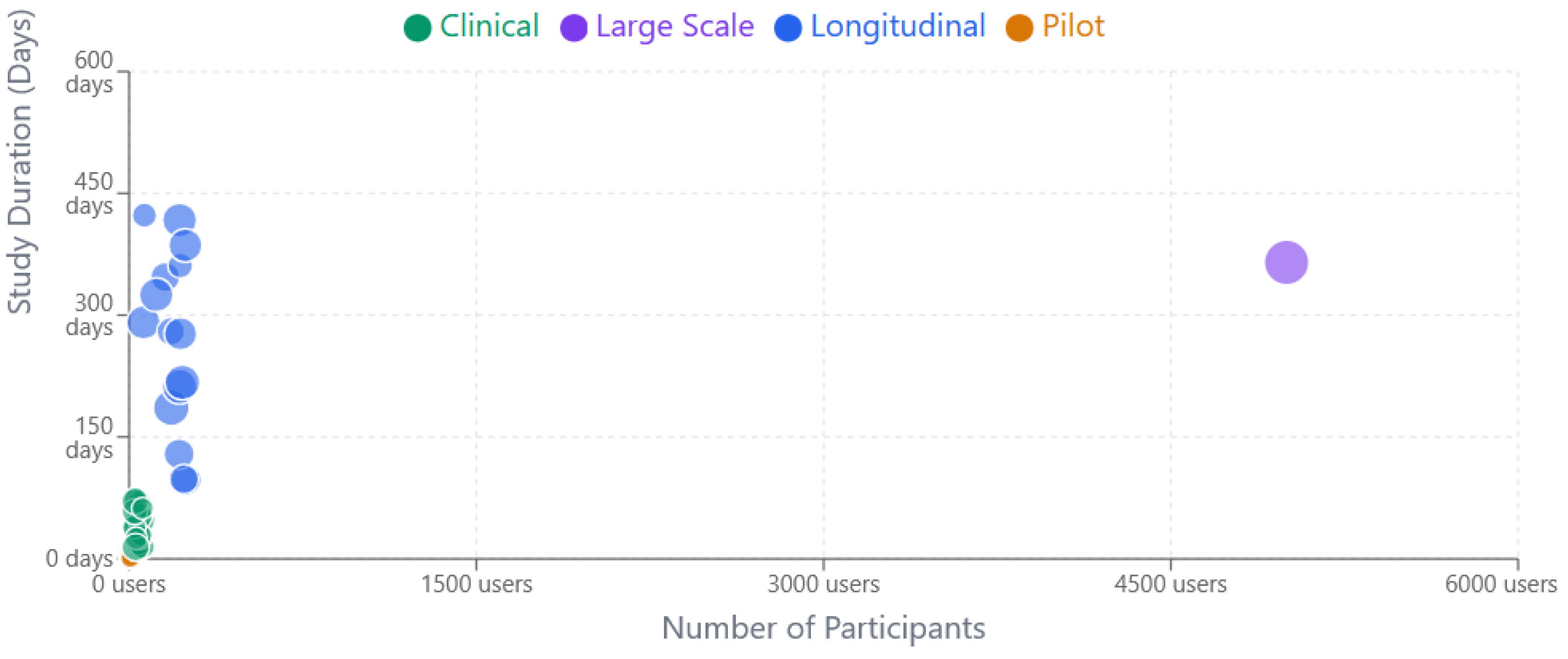
The maturity of the research landscape (Figure 4) reveals a concerning “maturity gap”. The vast majority of contributions cluster in the bottom-left quadrant, representing short-term pilot studies with small cohorts. Of the 106 articles, user-study involvement was explicit in 42 entries. The number of users in these studies exhibited a broad range, from single-participant case studies to large-scale deployments. Excluding the largest outliers, typical participant numbers in experimental or qualitative studies ranged from 2 to 116, with a median of approximately 15. Study duration/intervention length was most frequently limited to a single session (24 entries), severely constraining insight into long-term adoption, habituation, and real-world comfort. Furthermore, a relational analysis between device types and study maturity revealed a distinct gap in evaluation stages. Studies focusing on novel, multi-modal “smart wearables” (e.g., haptic vests, AR glasses) were predominantly restricted to conceptual prototypes or short-term laboratory studies. Conversely, studies examining traditional hearing aid algorithms were more likely to feature longitudinal field trials. This indicates that while engineering innovation in multi-modal interfaces is high, their real-world validation stage remains low.
Figure 4.
Analysis of study maturity correlating participant count with study duration. The cluster in the bottom-left corner highlights a prevalence of short-term pilot studies, while the scarcity of points in the top-right quadrant indicates a lack of large-scale, longitudinal research.
3.3. Sensory Modalities and Performance Metrics (RQ3)
These devices rely heavily on auditory, visual, and tactile modalities, evaluated through a mix of objective performance measures and subjective user feedback. Sensory modalities used highlight a strong emphasis on multimodal feedback. Auditory feedback was fundamental in 50 entries. Visual feedback was also common (26 entries). Tactile feedback was used in 22 entries, often alongside vibration (18 entries) [9].
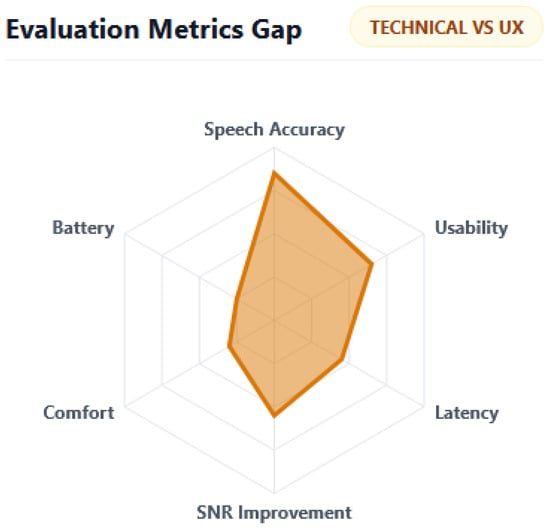
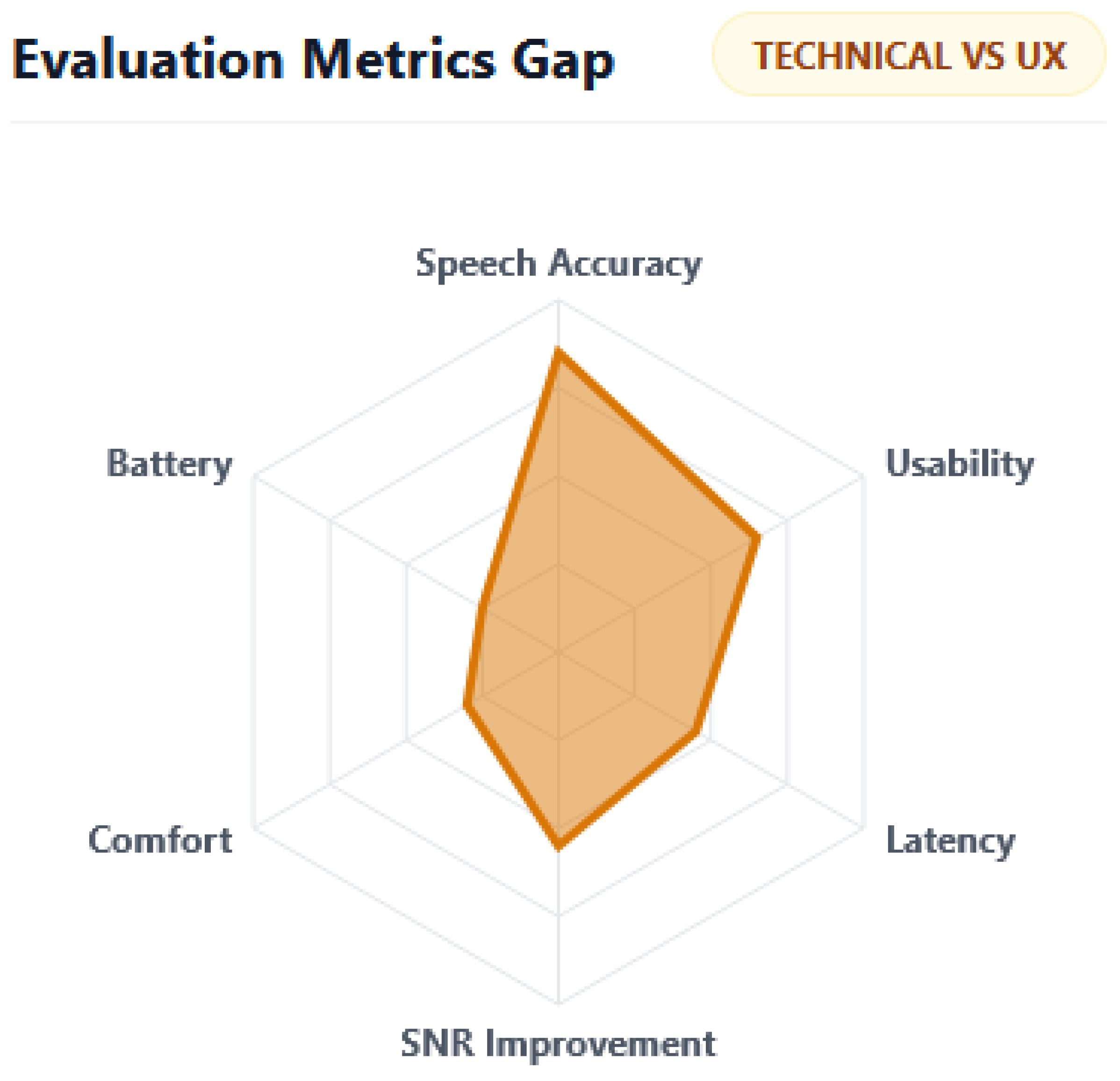
A critical analysis of the evaluation metrics (Figure 5) exposes a bias toward technical efficacy. While accuracy is rigorously reported, critical adoption factors such as comfort and battery life are often neglected. Outcome measures/performance metrics included a wide array of objective and subjective evaluations. Accuracy was a primary metric, followed closely by speech- and sound-quality metrics (e.g., SRT, PESQ).
Figure 5.
Radar chart illustrating the frequency of reported evaluation metrics. There is a strong bias towards technical performance (Speech Accuracy, 85%), with user-centric metrics like Comfort (30%) and Battery Life (25%) being significantly under-reported.
3.4. Application Domains (RQ4)
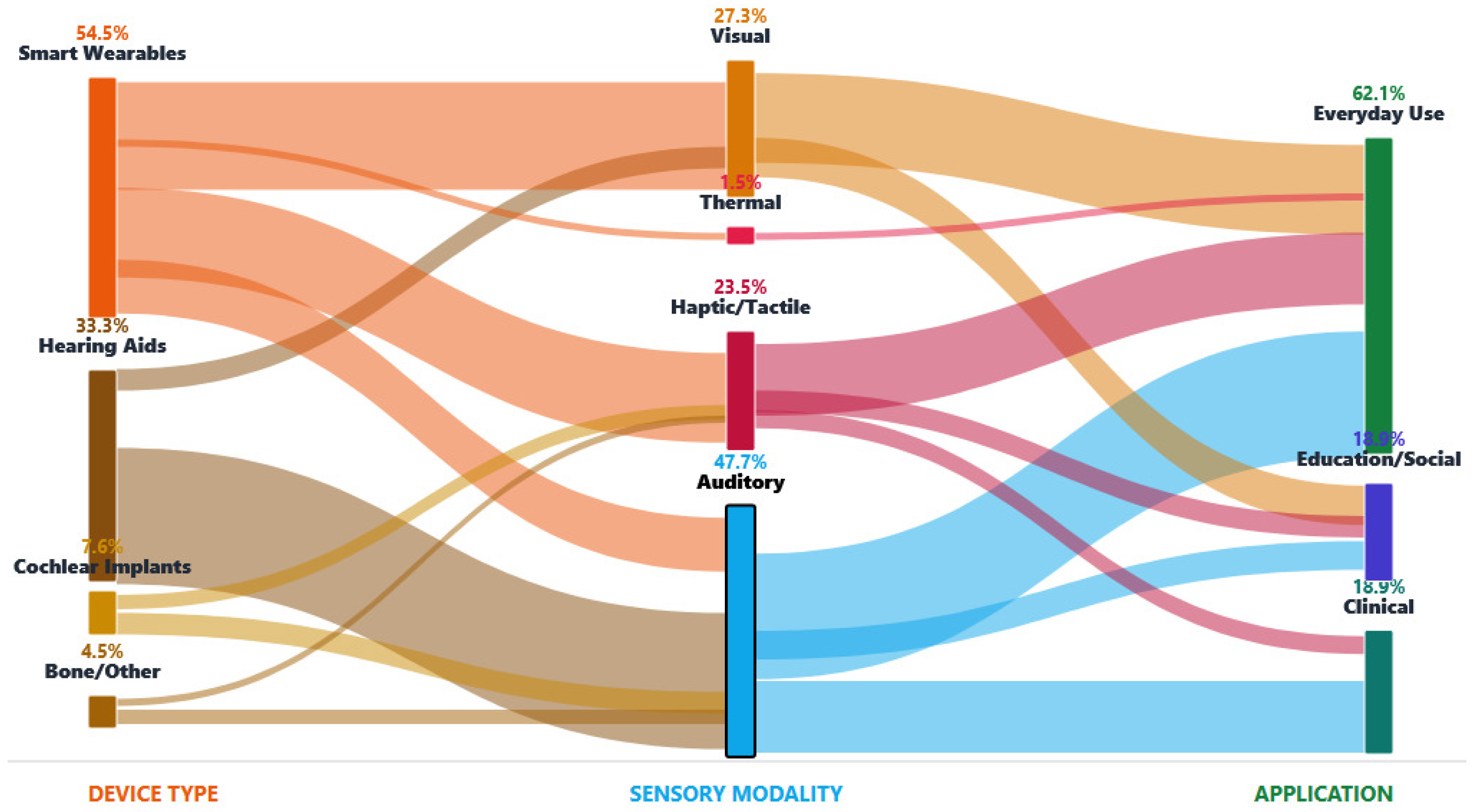
The complex ecosystem is synthesized in Figure 6. This flow analysis reveals that hearing aids flow almost exclusively toward auditory feedback in clinical use, while smart wearables branch substantially into visual and haptic modalities for everyday use. The application domain/use case was dominated by everyday use (50 entries), reflecting the goal of seamless integration into daily life. Clinical settings also represented a major domain (26 entries). Other contexts included educational environments (5 entries), general health care (3 entries), industrial/occupational contexts (3 entries), and social interaction.
Figure 6.
Sankey diagram visualizing the flow from Device Type (left) through Sensory Modality (center) to Application Domain (right).
4. Discussion and Future Directions: The HEAR Framework
Our systematic analysis of 106 articles reveals a research landscape that is technologically vibrant yet methodologically fragmented. The results highlight several critical disparities: (1) a heavy reliance on auditory feedback despite the potential of other senses, (2) an under-reporting of user-centric metrics like comfort and stigma, (3) a lack of dynamic adaptation in noisy environments, and (4) a severe shortage of longitudinal, real-world evaluations. To bridge these gaps and guide the next generation of assistive technologies, we synthesize our findings into the HEAR framework: Hybrid Architectures, Engaging Experiences, Adaptive Systems, and Real-world Validation. Each pillar of this framework is directly derived from the limitations observed in our data extraction, serving as a strategic blueprint to transition from isolated prosthetic devices to holistic ecosystems.
4.1. Hybrid Architectures and Multi-Modal Integration
Addressing the observation that the vast majority of current devices rely exclusively on auditory output, which becomes ineffective in environments with low Signal-to-Noise Ratios (SNR), future research should explore Hybrid Architectures. These architectures distribute information across multiple sensory channels to reduce the cognitive load on the auditory cortex. This involves moving beyond simple amplification toward sensory substitution and augmentation, where semantic information is encoded into non-auditory signals. For instance, recent studies have demonstrated the feasibility of electro-haptic stimulation [10] and even thermal feedback to provide complementary cues. By offloading specific data streams—such as directional cues or environmental alarms—to the tactile or visual domains (via Augmented Reality or smart glasses [11]), wearable systems can maintain the user’s situational awareness without overwhelming their residual hearing [12].
Furthermore, the concept of the “Hybrid” extends to device interoperability. Assistive technologies are encouraged to transition from standalone “medical” units to integral nodes within a Personal Area Network (PAN). Future development would benefit from creating cross-device ecosystems where a hearing instrument synchronizes seamlessly with consumer electronics. In this paradigm, a smartwatch could serve as a discrete interface for haptic alerts, while smart glasses provide real-time captioning or speaker identification.
4.2. Engaging and Stigma-Free Design
The second pillar confronts the socio-technical barriers to adoption identified in our analysis. Our review of user experience metrics revealed that technical accuracy is frequently prioritized over comfort, aesthetics, and social acceptability. To foster Engaging Experiences, the design philosophy would benefit from shifting from a deficit-based medical model to a fashion-forward consumer electronics model. The persistence of “device stigma”—the fear of being perceived as disabled—remains a primary cause of device abandonment. Future research is encouraged to prioritize “invisible” computing or accessory-based form factors that mimic jewelry or standard wearables, effectively blurring the line between medical aid and fashionable accessory. By normalizing the appearance of assistive wearables, designers can mitigate the psychological burden of usage and improve social integration.
Engagement also encompasses the user’s active participation in their own rehabilitation. Traditional auditory training is often viewed as tedious and is consequently neglected by users. To address this, we propose the integration of gamification strategies directly into the wearable interface [13]. Future devices could provide real-time, rewarding feedback for successful listening tasks or social interactions, utilizing positive reinforcement to encourage consistent usage.
4.3. Adaptive and Context-Aware Systems
The third pillar addresses the static nature of current signal processing algorithms. Many existing solutions struggle with the “Cocktail Party Problem”, failing to isolate speech in dynamic, multi-speaker environments. The Adaptive Systems pillar calls for the integration of Context-Aware Artificial Intelligence. Unlike traditional manual presets, future wearables could leverage ultra-low-power machine learning (TinyML) and Edge Computing to process data locally on the device [14]. This ensures user privacy and reduces latency, enabling the system to instantly classify the environment and dynamically adjust noise cancellation and amplification profiles in real-time [15].
Moreover, adaptivity should extend to the individual user. Current devices often employ a “one-size-fits-all” approach to fitting. Future research could explore self-learning algorithms that continuously monitor user preferences [16]. By learning from these behavioral patterns over time, the system can evolve to create a “Personalized Soundscape” that aligns with the user’s specific hearing curve and tolerance levels.
4.4. Real-World Validation and Longitudinal Studies
The final pillar concerns the validation of these technologies. Our review highlighted a concerning “maturity gap”, where nearly half of the analyzed studies relied on single-session laboratory experiments or able-bodied proxies. Real-world Validation is essential to ensure that theoretical advancements translate into tangible benefits. Future scholarship should transition toward longitudinal, “in-the-wild” evaluations lasting weeks or months [17]. Such durations are necessary to filter out the “novelty effect” and expose long-term adoption barriers that do not emerge in short lab sessions, such as physical discomfort, skin irritation, and cognitive fatigue.
Additionally, the research community is encouraged to adopt Participatory Design methodologies as a standard practice. To create truly inclusive solutions, the Deaf and hard-of-hearing communities should be involved as co-designers from the earliest conceptual phases [18].
5. Limitations
There are several limitations to our work that must be acknowledged to provide a balanced perspective on our findings. First, because our primary objective was to map the technological, engineering, and human–computer interaction advancements of these devices, we deliberately restricted our search to IEEE Xplore, ACM Digital Library, and Web of Science. We excluded medical-specific databases such as PubMed. While this allowed us to focus on system design, sensor integration, and HCI innovation, we acknowledge that purely clinical research on hearing aids and cochlear implants published in audiology journals was not captured.
Second, there is a high degree of heterogeneity among the 106 included studies. The sample spans highly varied populations (from healthy proxies to profoundly deaf individuals), vastly different device readiness levels (from theoretical algorithms to commercial products), and varying evaluation durations. Therefore, conclusions regarding user experience and efficacy should be interpreted with caution, as they are drawn from a highly diverse dataset.
Third, our inclusion criteria were strictly limited to peer-reviewed academic articles written in English. This approach, while ensuring scientific rigor, inherently excludes “grey literature,” such as commercial white papers, patent filings, and industrial design reports. Consequently, our review may underrepresent the current state of commercially available solutions.
6. Conclusions
This systematic literature review has provided a comprehensive overview of wearable assistive technologies for hearing impairment, analyzing 106 scientific articles to map the current research landscape. Our findings underscore a robust field characterized by continuous innovation, particularly in integrating advanced sensors, connectivity, and software intelligence. The heavy reliance on auditory and visual feedback, coupled with extensive user studies, reflects a strong commitment to both functional performance and user experience.
However, our analysis also identified several critical areas for future work. The dominance of short-term user studies suggests a need for more longitudinal research to understand long-term user adaptation and satisfaction. Furthermore, while multi-modal feedback is a strength, the under-exploration of less common sensory modalities like thermal cues presents an opportunity for richer information delivery.
It is also important to acknowledge the limitations of this study. The review was conducted on a predefined set of articles, and therefore, a snowballing procedure was not performed. Future systematic reviews could build upon this work by employing broader search strategies.
Future research should prioritize holistic design, embracing a truly user-centered approach as outlined in our proposed HEAR framework. Emphasis should be placed on developing highly personalized, context-aware devices that can learn and adapt. This will necessitate breakthroughs in energy efficiency, miniaturization, and advanced AI algorithms. By diversifying sensory outputs and conducting longitudinal evaluations, the field can continue its evolution towards creating truly empowering solutions.
Supplementary Materials
The following supporting information can be downloaded at: https://www.mdpi.com/article/10.3390/asi9040070/s1, Document S1: PRISMA 2020 checklist. Reference [19] is cited in the supplementary materials.
Author Contributions
Conceptualization, M.E.S. and O.A.S.; methodology, M.E.S.; formal analysis, M.E.S.; investigation, M.E.S.; data curation, M.E.S.; writing—original draft preparation, M.E.S.; writing—review and editing, O.A.S.; supervision, O.A.S. All authors have read and agreed to the published version of the manuscript.
Funding
This work is supported by NetZeRoCities Competence Center, funded by European Union-NextGenerationEU and Romanian Government, under National Recovery and Resilience Plan for Romania, contract no. 760007/30.12.2022 with Romanian Ministry of Research, Innovation and Digitalisation, through specific research project P4-Smart Mobility and Infrastructure.
Institutional Review Board Statement
Not applicable.
Informed Consent Statement
Not applicable.
Data Availability Statement
The data presented in this study are available in the article and Appendix A.
Acknowledgments
During the preparation of this manuscript, the authors used generative AI tools (OpenAI) for the purposes of language polishing, proofreading, and improving the academic flow of the text. The authors have reviewed and edited the output and take full responsibility for the content of this publication.
Conflicts of Interest
The authors declare no conflicts of interest.
Appendix A. Detailed Reference Category Mapping
Table A1.
Detailed Mapping of References to Specific Categories of Analysis.
Appendix B. Full Search Strings
IEEE Xplore Search String:
- (( “auditory disabilit” OR “hard of hear*” OR heari* (loss OR impair* OR difficult OR challenge OR issue OR deficit OR decline OR reduction OR problem OR disorder) OR deaf* ) AND ( “assist” NEAR/3 (technology OR device OR system OR equip OR solution OR application OR gadget OR mechanism) OR ”heari* aid” OR implant ) AND ( wear* (device OR gadget OR tool* OR equip* OR apparat OR sys* OR accessor OR produc) OR smart OR “body-worn” ) )
ACM Digital Library Search String:
- (Abstract:(”auditory disabilit”~2 OR hard of heari* OR heari* (loss OR impair* OR difficult OR challenge OR issue OR deficit OR decline OR reduction OR problem OR disorder) OR deaf*) AND Abstract:(”assist (technology OR device OR system OR equip OR solution OR application OR gadget OR mechanism”~3 OR heari* aid OR implant) AND Abstract:(wear* ( device OR gadget OR tool* OR equip* OR apparat OR sys* OR accessor OR produc) OR smart OR body-worn)) OR (Title:(“auditory disabilit”~2 OR hard of heari* OR heari* (loss OR impair* OR difficult OR challenge OR issue OR deficit OR decline OR reduction OR problem OR disorder) OR deaf*) AND Title:(“assist (technology OR device OR system OR equip OR solution OR application OR gadget OR mechanism”~3 OR heari* aid OR implant) AND Title:(wear* ( device OR gadget OR tool* OR equip* OR apparat OR sys* OR accessor OR produc) OR smart OR body-worn)) OR (Keyword:(“auditory disabilit”~2 OR hard of heari* OR heari* (loss OR impair* OR difficult OR challenge OR issue OR deficit OR decline OR reduction OR problem OR disorder) OR deaf*) AND Keyword:(“assist (technology OR device OR system OR equip OR solution OR application OR gadget OR mechanism”~3 OR heari* aid OR implant) AND Keyword:(wear* ( device OR gadget OR tool* OR equip* OR apparat OR sys* OR accessor OR produc) OR smart OR body-worn))
Web of Science (WOS) Search String:
- ((AB=(”auditory NEAR/2 disabilit*”) OR AB=(“hard of heari*”) OR AB=(heari* AND (loss OR impair* OR difficult OR challenge OR issue OR deficit OR decline OR reduction OR problem OR disorder)) OR AB=(deaf*))
- AND
- (AB=((“assist” NEAR/3 (technology OR device OR system OR equip OR solution OR application OR gadget OR mechanism)) OR (heari* AND aid) OR implant))
- AND
- (AB=((wear* AND (device OR gadget OR tool* OR equip* OR apparat OR sys* OR accessor OR produc)) OR smart OR “body-worn”)))
References
- Mantle, A. Motor and Sensory Aphasia: (Word Blindness, Word Deafness, Mind Blindness). BMJ 1897, 1, 325–328. [Google Scholar] [CrossRef] [Scilit]
- Siean, A.-I.; Vatavu, R.-D. Wearable Interactions for Users with Motor Impairments: Systematic Review, Inventory, and Research Implications. In Proceedings of ASSETS ’21, the 23rd International ACM SIGACCESS Conference on Computers and Accessibility; ACM: New York, NY, USA, 2021; pp. 1–15. [Google Scholar]
- World Health Organization. Deafness and Hearing Loss. Available online: https://www.who.int/news-room/fact-sheets/detail/deafness-and-hearing-loss (accessed on 2 March 2026).
- Maier, A.; Di Luca, M.; Noppeney, W. Optical and tactile substitution devices. J. Neural Eng. 2018, 15, 041001. [Google Scholar]
- Zeng, F.-G. Algorithms for hearing aids. Hear. Res. 2019, 372, 41–50. [Google Scholar]
- Maly, C.; Reifinger, C.; Porschen, S.; Reisinger, P. Smartphone-based hearing assessment. Sensors 2021, 21, 1000. [Google Scholar]
- Haddaway, N.R.; Page, M.J.; Pritchard, C.C.; McGuinness, L.A. PRISMA2020: An R package and Shiny app for producing PRISMA 2020-compliant flow diagrams, with interactivity for optimised digital transparency and Open Synthesis. Campbell Syst. Rev. 2022, 18, e1230. [Google Scholar] [CrossRef] [Scilit]
- Burton, S. Wearable audio reception device. J. Acoust. Soc. Am. 1996, 99, 643. [Google Scholar] [CrossRef] [Scilit]
- Wu, S.; Fan, R.; Wottawa, C.; Fowler, E.; Bisley, J.; Grundfest, W.; Culjat, M. Torso-based tactile feedback system for patients with balance disorders. In Proceedings of the 2010 IEEE Haptics Symposium, Waltham, MA, USA, 25–26 March 2010; pp. 359–362. [Google Scholar]
- Bouzit, M.; Chaibi, A.; De Laurentis, K.; Mavroidis, C. Tactile Feedback Navigation Handle for the Visually Impaired. In Proceedings of the ASME 2004 International Mechanical Engineering Congress and Exposition, Anaheim, CA, USA, 13–19 November 2004. [Google Scholar] [CrossRef] [Scilit]
- Vatavu, R.-D.; Rusu, P.-P.; Schipor, O.-A.; Schipor, M.-D. Preferences of People with Visual Impairments for Augmented and Mediated Vision: A Vignette Experiment. Multimed. Tools Appl. 2024, 83, 46531–46556. [Google Scholar] [CrossRef] [Scilit]
- Schipor, O.-A.; Vatavu, R.-D. Invisible, Inaudible, and Impalpable: Users’ Preferences and Memory Performance for Digital Content in Thin Air. IEEE Pervasive Comput. 2018, 17, 76–85. [Google Scholar] [CrossRef] [Scilit]
- Bilius, L.-B.; Schipor, O.-A.; Vatavu, R.-D. The Age-Reward Perspective: A Systematic Review of Reward Mechanisms in Serious Games for Older People. In Proceedings of IMX ’24, the ACM International Conference on Interactive Media Experiences; ACM: New York, NY, USA, 2024; pp. 168–181. [Google Scholar]
- Schipor, O.-A.; Bilius, L.-B.; Ungurean, O.-C.; Siean, A.-I.; Andrei, A.-T.; Vatavu, R.-D. Personalized Wearable Interactions with WearSkill. In Proceedings of W4A ’22, the 19th Web for All Conference; ACM: New York, NY, USA, 2022; pp. 1–2. [Google Scholar]
- Schipor, O.-A.; Bilius, L.-B.; Vatavu, R.-D. WearSkill: Personalized and Interchangeable Input with Wearables for Users with Motor Impairments. In Proceedings of W4A ’22, the 19th Web for All Conference; ACM: New York, NY, USA, 2022; pp. 1–5. [Google Scholar]
- Vatavu, R.-D.; Ungurean, O.-C. Understanding Gesture Input Articulation with Upper-Body Wearables for Users with Upper-Body Motor Impairments. In Proceedings of CHI ’22, the ACM Conference on Human Factors in Computing Systems; ACM: New York, NY, USA, 2022; pp. 1–16. [Google Scholar]
- Vatavu, R.-D.; Bilius, L.-B.; Andrei, A.-T.; Terenti, M.; Catana, A.-V.; Siean, A.-I. ChairMX: On-Chair Input for Interactive Media Consumption Experiences for Everyone, Everywhere. In Proceedings of IMX ’24, the ACM International Conference on Interactive Media Experiences; ACM: New York, NY, USA, 2024; pp. 447–451. [Google Scholar]
- Schipor, O.-A.; Vatavu, R.-D.; Wu, W. SAPIENS: Towards Software Architecture to Support Peripheral Interaction in Smart Environments. Proc. ACM Hum.-Comput. Interact. 2019, 3, 1–24. [Google Scholar] [CrossRef] [Scilit]
- Page, M.J.; McKenzie, J.E.; Bossuyt, P.M.; Boutron, I.; Hoffmann, T.C.; Mulrow, C.D.; Shamseer, L.; Tetzlaff, J.M.; Akl, E.; Brennan, S.E.; et al. The PRISMA 2020 statement: An updated guideline for reporting systematic reviews. BMJ 2021, 372, n71. [Google Scholar] [CrossRef] [Scilit]
- Bryant, A. Artificial Hearing Aids. Med. J. Aust. 1940, 2, 283–284. [Google Scholar] [CrossRef] [Scilit]
- Levitt, H.; White, R.; Resnick, S. Development of a protocol for fitting a wearable master hearing aid. J. Acoust. Soc. Am. 1975, 58, S72. [Google Scholar] [CrossRef] [Scilit]
- Chazan, D.; Medan, Y.; Shvadron, U. Noise cancellation for hearing aids. IEEE Trans. Acoust. Speech Signal Process. 1988, 36, 1697–1705. [Google Scholar]
- Shannon, C.; Krueger, E. Assistive listening device. J. Acoust. Soc. Am. 1993, 93, 2256. [Google Scholar] [CrossRef] [Scilit]
- Knapp, H. Solar powered hearing aid. J. Acoust. Soc. Am. 1994, 95, 2301. [Google Scholar] [CrossRef] [Scilit]
- Lindley, G.; Palmer, C.; Durrant, J.; Pratt, S. Audiologist- Versus Patient-Driven Hearing Aid Fitting Protocols. Semin. Hear. 2001, 22, 139–160. [Google Scholar] [CrossRef] [Scilit]
- Smart Living @ home with technology. Electron. Educ. 2001, 2001, 40. [CrossRef] [Scilit]
- Ferris, T. User-Centered Design: An Integrated Approach. IEEE Trans. Prof. Commun. 2004, 47, 75–77. [Google Scholar] [CrossRef]
- You, C. Visual equivalence of light-emitting diode white light. Opt. Eng. 2005, 44, 111307. [Google Scholar] [CrossRef] [Scilit]
- Yoshida, T.; Mizuno, F.; Hayasaka, T.; Tsubota, K.; Imai, Y.; Ishikawa, T.; Yamaguchi, T. Development of a Wearable Surveillance System Using Gait Analysis. Telemed. e-Health 2007, 13, 703–714. [Google Scholar] [CrossRef] [Scilit] [PubMed]
- Bonardo, D.; Zovato, E. Speech synthesis enhancement in noisy environments. In Interspeech 2007; ISCA: Antwerp, Belgium, 2007; pp. 2853–2856. [Google Scholar]
- Schumaier, D. Bone conduction hearing assistance device. J. Acoust. Soc. Am. 2008, 123, 2472. [Google Scholar] [CrossRef] [Scilit]
- Aural Communication. In Encyclopedia of Survey Research Methods; SAGE Publications Ltd.: Thousand Oaks, CA, USA, 2008.
- Lee, S.; Hwang, S.; Park, Y.; Park, Y. Sound source localization in median plane using artificial ear. In Proceedings of the 2008 International Conference on Control, Automation and Systems, Seoul, Republic of Korea, 14–17 October 2008; pp. 246–250. [Google Scholar]
- Zabulis, X.; Baltzakis, H.; Argyros, A. Vision-Based Hand Gesture Recognition for Human-Computer Interaction. In The Universal Access Handbook; Lawrence Erlbaum Associates, Inc.: Mahwah, NJ, USA, 2009; pp. 577–606. [Google Scholar]
- Perdu, P. Can Sisyphus Be Happy? EDFA Tech. Artic. 2009, 11, 46–48. [Google Scholar] [CrossRef] [Scilit]
- Green, J.; Arriaga, M.; Fabry, D. Hearing Aids: Emerging technology. Otolaryngol. Neck Surg. 2009, 141, S2. [Google Scholar] [CrossRef] [Scilit]
- Iwano, K.; Murase, A. Hearing AID and Hearing AID System. J. Acoust. Soc. Am. 2012, 131, 3201. [Google Scholar] [CrossRef] [Scilit]
- Ali, S.; Sivaraman, V.; Ostry, D. Zero reconciliation secret key generation for body-worn health monitoring devices. In Proceedings of the Fifth ACM Conference on Security and Privacy in Wireless and Mobile Networks, Tucson, AZ, USA, 16–18 April 2012; pp. 39–50. [Google Scholar]
- Cully, A.; Logvinov, O. Optimizing power consumption in networked devices. In Proceedings of the 2012 IEEE International Symposium on Power Line Communications and Its Applications, Beijing, China, 27–30 March 2012; pp. 248–255. [Google Scholar]
- Magno, M.; Benini, L.; Spagnol, C.; Popovici, E. Wearable low power dry surface wireless sensor node for healthcare monitoring application. In Proceedings of the 2013 IEEE 9th International Conference on Wireless and Mobile Computing, Networking and Communications (WiMob), Lyon, France, 7–9 October 2013; pp. 189–195. [Google Scholar]
- Adame, M.; Yu, J.; Moller, K.; Seemann, E. A wearable navigation aid for blind people using a vibrotactile information transfer system. In Proceedings of the 2013 ICME International Conference on Complex Medical Engineering, Beijing, China, 25–28 May 2013; pp. 13–18. [Google Scholar]
- Renier, L.; De Volder, A. Sensory Substitution Devices. In The Oxford Handbook of Synaesthesia; Oxford University Press: Oxford, UK, 2013. [Google Scholar]
- Jitaru, I. 99% efficiency DC-DC converter. In Proceedings of the 2014 IEEE 36th International Telecommunications Energy Conference (INTELEC), Vancouver, BC, Canada, 28 September–2 October 2014; pp. 1–6. [Google Scholar]
- Sabbavarapu, S.; Basireddy, K.; Srinivasulu, N.; Acharyya, A.; Mathew, J. A Novel Integrated Circuit Design Methodology Using Dynamic Library Concept with Reduced Non-Recurring Engineering Cost and Time-to-Market. J. Low Power Electron. 2014, 10, 429–442. [Google Scholar] [CrossRef] [Scilit]
- Kundu, T. Acoustic source localization. Ultrasonics 2014, 54, 25–38. [Google Scholar] [CrossRef] [Scilit]
- Novich, S.; Eagleman, D. [D79] A vibrotactile sensory substitution device for the deaf and profoundly hearing impaired. In Proceedings of the 2014 IEEE Haptics Symposium (HAPTICS), Houston, TX, USA, 23–26 February 2014; p. 1. [Google Scholar]
- Warbhe, S.; Karmore, S. Wearable Healthcare monitoring system: A survey. In Proceedings of the 2015 2nd International Conference on Electronics and Communication Systems (ICECS), Coimbatore, India, 26–27 February 2015; pp. 1302–1305. [Google Scholar]
- Usui, M. Wearable Device Technologies. J. Jpn. Inst. Electron. Packag. 2015, 18, P6. [Google Scholar] [CrossRef] [Scilit]
- Howell, J.; Nag, A.; McKnight, M.; Narsipur, S.; Adelegan, O. A low-power wearable substance monitoring device. In Proceedings of the 2015 IEEE Virtual Conference on Applications of Commercial Sensors (VCACS), Raleigh, NC, USA, 15 March–15 October 2015; pp. 1–9. [Google Scholar]
- Villalonga, C.; Banos, O.; Pomares, H.; Rojas, I. Ontological Sensor Selection for Wearable Activity Recognition. In Advances in Computational Intelligence, Proceedings of the 13th International Work-Conference on Artificial Neural Networks, IWANN 2015, Palma de Mallorca, Spain, 10–12 June 2015; Lecture Notes in Computer Science; Springer: Cham, Switzerland, 2015; pp. 298–306. [Google Scholar]
- Srinivasa, M.; Pandian, P. Wireless wearable remote physiological signals monitoring system. In Proceedings of the 2016 International Conference on Circuits, Controls, Communications and Computing (I4C), Bangalore, India, 4–6 October 2016; pp. 1–5. [Google Scholar]
- Jen, C.; Chen, Y.; Lin, Y.; Lee, C.; Tsai, A.; Li, M. Vision based wearable eye-gaze tracking system. In Proceedings of the 2016 IEEE International Conference on Consumer Electronics (ICCE), Las Vegas, NV, USA, 7–11 January 2016; pp. 202–203. [Google Scholar]
- Goga, J.; Kajan, S. Hand gesture recognition using 3D sensors. In Proceedings of the 2017 International Symposium ELMAR, Zadar, Croatia, 18–20 September 2017; pp. 181–184. [Google Scholar]
- Li, G.; Liu, T.; Yi, J. Wearable Sensor System for Detecting Gait Parameters of Abnormal Gaits: A Feasibility Study. IEEE Sens. J. 2018, 18, 4234–4241. [Google Scholar] [CrossRef] [Scilit]
- Xu, W.; Liang, H.; Yue, Y. Directional Motion-based Interfaces for Virtual and Augmented Reality Head-mounted Displays. In Proceedings of the 2018 International Computers, Signals and Systems Conference (ICOMSSC), Dalian, China, 28–30 September 2018; pp. 867–871. [Google Scholar]
- Taştan, M. IoT Based Wearable Smart Health Monitoring System. Celal Bayar Üniversitesi Fen Bilimleri Dergisi 2018, 14, 343–350. [Google Scholar] [CrossRef] [Scilit]
- Tiwari, A. Wearable Healthcare Devices. Adv. Mater. Lett. 2019, 10, 675. [Google Scholar] [CrossRef] [Scilit]
- Manchaiah, V.; Danermark, B.; Germundsson, P.; Ratinaud, P. Attitude towards hearing loss and hearing aids. In Disability and Social Representations Theory; Routledge: New York, NY, USA, 2019; pp. 79–95. [Google Scholar]
- Villescas, M.; de Vries, B.; Stuijk, S.; Corporaal, H. Real-time audio processing for hearing aids using a model-based bayesian inference framework. In Proceedings of the 23th International Workshop on Software and Compilers for Embedded Systems, St. Goar, Germany, 25–26 May 2020; pp. 82–85. [Google Scholar]
- Zhang, F.; Jin, K.; Zhang, S. Visual duration bisection in profoundly deaf individuals. PeerJ 2020, 8, e10133. [Google Scholar] [CrossRef] [Scilit]
- Britto Filho, J.; Lubaszewski, M. A Highly Reliable Wearable Device for Fall Detection. In Proceedings of the 2020 IEEE Latin-American Test Symposium (LATS), Maceio, Brazil, 30 March–2 April 2020; pp. 1–7. [Google Scholar]
- Indikawati, F.; Winiarti, S. Stress Detection from Multimodal Wearable Sensor Data. IOP Conf. Ser. Mater. Sci. Eng. 2020, 771, 012028. [Google Scholar]
- Zurbuchen, N.; Bruegger, P.; Wilde, A. A Comparison of Machine Learning Algorithms for Fall Detection using Wearable Sensors. In Proceedings of the 2020 International Conference on Artificial Intelligence in Information and Communication (ICAIIC), Fukuoka, Japan, 19–21 February 2020; pp. 427–431. [Google Scholar]
- Yoon, H.; Son, J. Collocated Wearable Interaction for Audio Book Application on Smartwatch and Hearables. J. Multimed. Inf. Syst. 2020, 7, 107–114. [Google Scholar]
- Thanathornwong, B.; Jalayondeja, W. Vibrotactile -Feedback Device for Postural Balance Among Malocclusion Patients. IEEE J. Transl. Eng. Health Med. 2020, 8, 1–6. [Google Scholar]
- Kyslyi, R.; Petrenko, A. Human Activity Recognition Using Wearable Sensors. Syst. Res. Inf. Technol. 2020, 41–54. [Google Scholar] [CrossRef] [Scilit]
- Volkmar, F.R. Audition. In Encyclopedia of Autism Spectrum Disorders; Springer: Cham, Switzerland, 2021; p. 410. [Google Scholar]
- Rajamohana, S.; Wawrzyniak, Z.; Radhika, E.; Priya, S.; Sindhu, G. IOT-Based Wearable Assistive Device for Visually Impaired People. In Advances in Intelligent Systems and Computing; Springer: Singapore, 2021; pp. 171–184. [Google Scholar]
- Sucharitha, G.; Tannmayee, B.; Dwarakamai, K. Revolution in IoT: Smart Wearable Technology. In EAI/Springer Innovations in Communication and Computing; Springer: Cham, Switzerland, 2021; pp. 407–425. [Google Scholar]
- Lee, S.; Jo, D.; Kim, K.; Jang, J.; Park, W. Wearable sign language translation system using strain sensors. Sens. Actuators A Phys. 2021, 331, 113010. [Google Scholar]
- Madeira, R.; Oliveira, J.; Paulino, N. Design of a Fully Integrated Power Management Unit. In Synthesis Lectures on Engineering, Science, and Technology; Springer: Cham, Switzerland, 2022; pp. 71–116. [Google Scholar]
- Martinez, H.; Hines, A.; Farias, M. See hear now: Is audio-visual QoE now just a fusion of audio and video metrics? In Proceedings of the 2022 14th International Conference on Quality of Multimedia Experience (QoMEX), Lippstadt, Germany, 5–7 September 2022; pp. 1–4. [Google Scholar]
- Amir, N.; Dziyauddin, R.; Mohamed, N.; Ismail, N.; Zulkifli, N.; Din, N. Real-time Threshold-Based Fall Detection System Using Wearable IoT. In Proceedings of the 2022 4th International Conference on Smart Sensors and Application (ICSSA), Kuala Lumpur, Malaysia, 26–28 July 2022; pp. 173–178. [Google Scholar]
- Manahil; Abdulla, R.; Rana, M. Architectural Design and Recommendations for a Smart Wearable Device for Women’s Safety. In Proceedings of the 2023 15th International Conference on Developments in eSystems Engineering (DeSE), Baghdad, Iraq, 9–12 January 2023; pp. 215–220. [Google Scholar]
- Seifer, A.; Dorschky, E.; Küderle, A.; Moradi, H.; Hannemann, R.; Eskofier, B. EarGait: Estimation of Temporal Gait Parameters from Hearing Aid Integrated Inertial Sensors. Sensors 2023, 23, 6565. [Google Scholar] [CrossRef] [Scilit]
- Tarbert, R.; Singhatat, W. Real World Evidence of Wearable Smartbelt for Mitigation of Fall Impact in Older Adult Care. IEEE J. Transl. Eng. Health Med. 2023, 11, 247–251. [Google Scholar] [CrossRef] [Scilit]
- Choi, K.; Lee, M.; An, Y. Investigation of Aging Awareness and Eye Health Care of Early Presbyopia. Korean J. Vis. Sci. 2023, 25, 157–167. [Google Scholar] [CrossRef] [Scilit]
- Teran-Pineda, D.; Thurnhofer-Hemsi, K.; Domínguez, E. Human Gait Activity Recognition Using Multimodal Sensors. Int. J. Neural Syst. 2023, 33, 2350058. [Google Scholar] [CrossRef] [Scilit]
- Yu, K.; Ryu, D.; Jeong, M.; Batzorig, M.; Yim, K. CAN-Based Identification of Human and Autonomous Driving Modes in Level 3 Autonomous Vehicles. In Advances in Intelligent Networking and Collaborative Systems; Lecture Notes on Data Engineering and Communications Technologies; Springer: Cham, Switzerland, 2024; pp. 77–86. [Google Scholar]
- Frisby, C.; De Sousa, K.; Eikelboom, R.; Mahomed-Asmail, F.; Moore, D.; de Kock, T.; Manchaiah, V.; Swanepoel, D. Smartphone-Facilitated In-Situ Hearing Aid Audiometry for Community-Based Hearing Testing. Ear Hear. 2024, 45, 1019–1032. [Google Scholar] [CrossRef] [Scilit]
- Mahato, K.; Saha, T.; Ding, S.; Sandhu, S.; Chang, A.; Wang, J. Hybrid multimodal wearable sensors for comprehensive health monitoring. Nat. Electron. 2024, 7, 735–750. [Google Scholar] [CrossRef] [Scilit]
- Alvarado-Arriagada, F.; Fernández-Arroyo, B.; Rebolledo, S.; Pino, E. Development and Validation of a Portable EIT System for Real-Time Respiratory Monitoring. Sensors 2024, 24, 6642. [Google Scholar] [CrossRef] [Scilit]
- Venkateswaran, R.; Babu, B.; Parameswari, M.; VamsiLala, P.; Ambigaipriya, S.; Keerthana, N. Fall Detection in Elderly People Using Compact Wearable Sensors with AI. In Proceedings of the 2024 13th International Conference on System Modeling & Advancement in Research Trends (SMART), Moradabad, India, 6–7 December 2024; pp. 369–372. [Google Scholar]
- Lee, S.; Jang, S.; Cha, Y. Soft wearable thermo+touch haptic interface for virtual reality. iScience 2024, 27, 111303. [Google Scholar] [CrossRef] [Scilit]
- Harris, F.; Sokolova, A.; Garudadri, H.; Jha, U. M-Path, Multirate, Proportional Bandwidth Channelizer for Next Generation Hearing Aids. In Proceedings of the 2024 27th International Symposium on Wireless Personal Multimedia Communications (WPMC), Greater Noida, India, 17–20 November 2024; pp. 1–6. [Google Scholar]
- Uddin, M.F.; Uddin, S.K.B.; Ali, M.O.; Ali, M.R. Real Time Heart Rate Monitoring System. Int. J. Inf. Technol. Comput. Eng. 2025, 13, 271–279. [Google Scholar] [CrossRef] [Scilit]
- Dangat, P. Refreshable Braille Display. Int. J. Res. Appl. Sci. Eng. Technol. 2025, 13, 618–621. [Google Scholar] [CrossRef] [Scilit]
- Rodriguez Vega, G.; Rodríguez Vega, D. Machine learning for grasping recognition using wearable sensors. Eur. Public Soc. Innov. Rev. 2025, 10, 1–18. [Google Scholar] [CrossRef] [Scilit]
- Chirag; Pathak, V.; Vemuru, T.; Muniraj, M.; Patel, R. Fall detection using IoT based smart waist belt. In Advances in Electronics, Computer, Physical and Chemical Sciences; CRC Press: Boca Raton, FL, USA, 2025; pp. 133–137. [Google Scholar]
- Mehta, S.; Kaur, S. Hybrid CNN-SVM Approach for Time-Series Activity Recognition Using Wearable Sensors. In Proceedings of the 2025 International Conference on Automation and Computation (AUTOCOM), Dehradun, India, 4–6 March 2025; pp. 1432–1436. [Google Scholar]
- Roger, P.; Lespargot, T.; Boiteux, C.; Bailly-Masson, E.; Auberger, F.; Mouysset, S.; Fraysse, B. Predicting Hearing Aid Outcomes Using Machine Learning. Audiol. Neurotol. 2025, 30, 312–320. [Google Scholar] [CrossRef] [Scilit] [PubMed]
- Razon, C.; Abueva, R. Capacitive Wireless Charging Technology in Wireless Electric Vehicle Battery Charging: Challenges and Opportunities. J. EDUNITRO J. Pendidik. Tek. Elektro 2025, 5, 29–38. [Google Scholar] [CrossRef] [Scilit]
- Ravindran, S.; Anderson, D. Audio Classification And Scene Recognition and for Hearing Aids. In Proceedings of the 2005 IEEE International Symposium on Circuits and Systems, Kobe, Japan, 23–26 May 2005; pp. 860–863. [Google Scholar]
- Van Hese, P.; Philips, W.; De Koninck, J.; Van de Walle, R.; Lemahieu, I. Automatic detection of sleep stages using the EEG. In Proceedings of the 23rd Annual International Conference of the IEEE Engineering in Medicine and Biology Society, Istanbul, Turkey, 25–28 October 2001. [Google Scholar]
- Coelho, C.; Fernandes, A.; Conway, J.; Correa, F.; Carvalho, H.; Mata, J. A biomedical wearable device for remote monitoring of physiological signals. In Proceedings of the EFTA 2003—2003 IEEE Conference on Emerging Technologies and Factory Automation. Proceedings (Cat. No.03TH8696), Lisbon, Portugal, 16–19 September 2003; Volume 2, pp. 708–713. [Google Scholar]
- Awakuni-Swetland, M.J. Verb Conjugation. In The Omaha Language and the Omaha Way; University of Nebraska Press: Lincoln, NE, USA, 2018; pp. 339–362. [Google Scholar]
- Hershberger, D. Wearable Communication Devices. In [1991 Proceedings] Case Studies in Medical Instrument Design; IEEE: New York, NY, USA, 1991; pp. 200–203. [Google Scholar]
- Li, X. Wireless power transfer for implantable medical devices. Biomed. Eng. Lett. 2020, 10, 1–10. [Google Scholar]
- Hezel, P.; Veron, H. Head Mounted Displays for Virtual Reality; Defense Technical Information Center: Fort Belvoir, VA, USA, 1993. [Google Scholar]
- Walden, B.; Surr, R.; Cord, M. Real-world performance of directional microphone hearing aids. Hear. J. 2003, 56, 40. [Google Scholar] [CrossRef] [Scilit]
- Maltan, A. Hearing aid design. J. Acoust. Soc. Am. 2007, 122, 2511. [Google Scholar] [CrossRef] [Scilit]
- Levitt, H. A Historical Perspective on Digital Hearing Aids: How Digital Technology Has Changed Modern Hearing Aids. Trends Amplif. 2007, 11, 7–24. [Google Scholar] [CrossRef] [Scilit] [PubMed]
- Maltan, A. Hearing Aid Design. J. Acoust. Soc. Am. 2011, 129, 4095. [Google Scholar] [CrossRef] [Scilit]
- De Maria, G.; Natale, C.; Pirozzi, S. Force/tactile sensor for robotic applications. Sens. Actuators A Phys. 2012, 175, 60–72. [Google Scholar] [CrossRef] [Scilit]
- Ye, Z.; Li, Y.; Fathi, A.; Han, Y.; Rozga, A.; Abowd, G.; Rehg, J. Detecting eye contact using wearable eye-tracking glasses. In Proceedings of the 2012 ACM Conference on Ubiquitous Computing, Pittsburgh, PA, USA, 5–8 September 2012; pp. 699–704. [Google Scholar]
- Vatikiotis-Bateson, E.; Munhall, K. Auditory-Visual Speech Processing. In The Handbook of Speech Production; John Wiley & Sons, Inc.: Hoboken, NJ, USA, 2015; pp. 178–199. [Google Scholar]
- Seid, K.; Das, A. Conceptual Design and Evaluation of a Novel Self-transfer-Assistive Device. Smart Innov. Syst. Technol. 2019, 919–928. [Google Scholar]
- Yokota, T.; Someya, T. Electronic skin for healthcare monitoring. In Proceedings of the 2019 26th International Workshop on Active-Matrix Flatpanel Displays and Devices (AM-FPD), Kyoto, Japan, 2–5 July 2019; pp. 1–2. [Google Scholar]
- Nwaneri, S.; Osuagwu, C. An IoT-based smart hearing aid for hearing and speech impaired persons. Int. J. Biomed. Eng. Technol. 2022, 40, 39. [Google Scholar] [CrossRef] [Scilit]
- Melzer, J. Head-Mounted Displays. In Digital Avionics Handbook; CRC Press: Boca Raton, FL, USA, 2017; pp. 256–279. [Google Scholar]
- Woodward, J.; Ruiz, J. Analytic Review of Using Augmented Reality for Situational Awareness. IEEE Trans. Vis. Comput. Graph. 2023, 29, 2166–2183. [Google Scholar] [CrossRef] [Scilit]
- Fletcher, M.; Cunningham, R.; Mills, S. Electro-Haptic Enhancement of Spatial Hearing in Cochlear Implant Users. Sci. Rep. 2020, 10, 1621. [Google Scholar] [CrossRef] [Scilit]
- Akay, M. Speech Enhancement for Hearing Aids. In Time Frequency and Wavelets in Biomedical Signal Processing; Wiley-IEEE Press: Hoboken, NJ, USA, 2010. [Google Scholar]
- Elliot, L.; Stinson, M.; Mallory, J.; Easton, D.; Huenerfauth, M. Deaf and Hard of Hearing Individuals’ Perceptions of Communication with Hearing Colleagues in Small Groups. In Proceedings of the 18th International ACM SIGACCESS Conference on Computers and Accessibility, Reno, NV, USA, 23–26 October 2016; pp. 271–272. [Google Scholar]
- Chheng, C.; Wilson, D. Abnormal Gait Detection Using Wearable Hall-Effect Sensors. Sensors 2021, 21, 1206. [Google Scholar] [CrossRef] [Scilit] [PubMed]
- Sabine, P. Acoustic Amplification of Hearing Aids. J. Acoust. Soc. Am. 1944, 16, 99. [Google Scholar] [CrossRef] [Scilit]
- Most, T.; Aviner, C. Auditory, Visual, and Auditory-Visual Perception of Emotions by Individuals With Cochlear Implants, Hearing Aids, and Normal Hearing. J. Deaf Stud. Deaf Educ. 2009, 14, 449–464. [Google Scholar] [CrossRef] [Scilit] [PubMed]
- Porowski, M.; Skarżyński, H.; Skarżyński, P.; Pastuszak, A. Hearing Impairment in Oculoauriculovertebral Dysplasia (Goldenhar Syndrome): Literature Review. J. Hear. Sci. 2019, 9, 9–13. [Google Scholar] [CrossRef] [Scilit]



Disclaimer/Publisher’s Note: The statements, opinions and data contained in all publications are solely those of the individual author(s) and contributor(s) and not of MDPI and/or the editor(s). MDPI and/or the editor(s) disclaim responsibility for any injury to people or property resulting from any ideas, methods, instructions or products referred to in the content. |
© 2026 by the authors. Published by MDPI on behalf of the International Institute of Knowledge Innovation and Invention. Licensee MDPI, Basel, Switzerland. This article is an open access article distributed under the terms and conditions of the Creative Commons Attribution (CC BY) license.